 Login
LoginHow to Upgrade to Zorin OS 18 from 17: A Step-by-Step Guide
28 November 2025 at 21:33


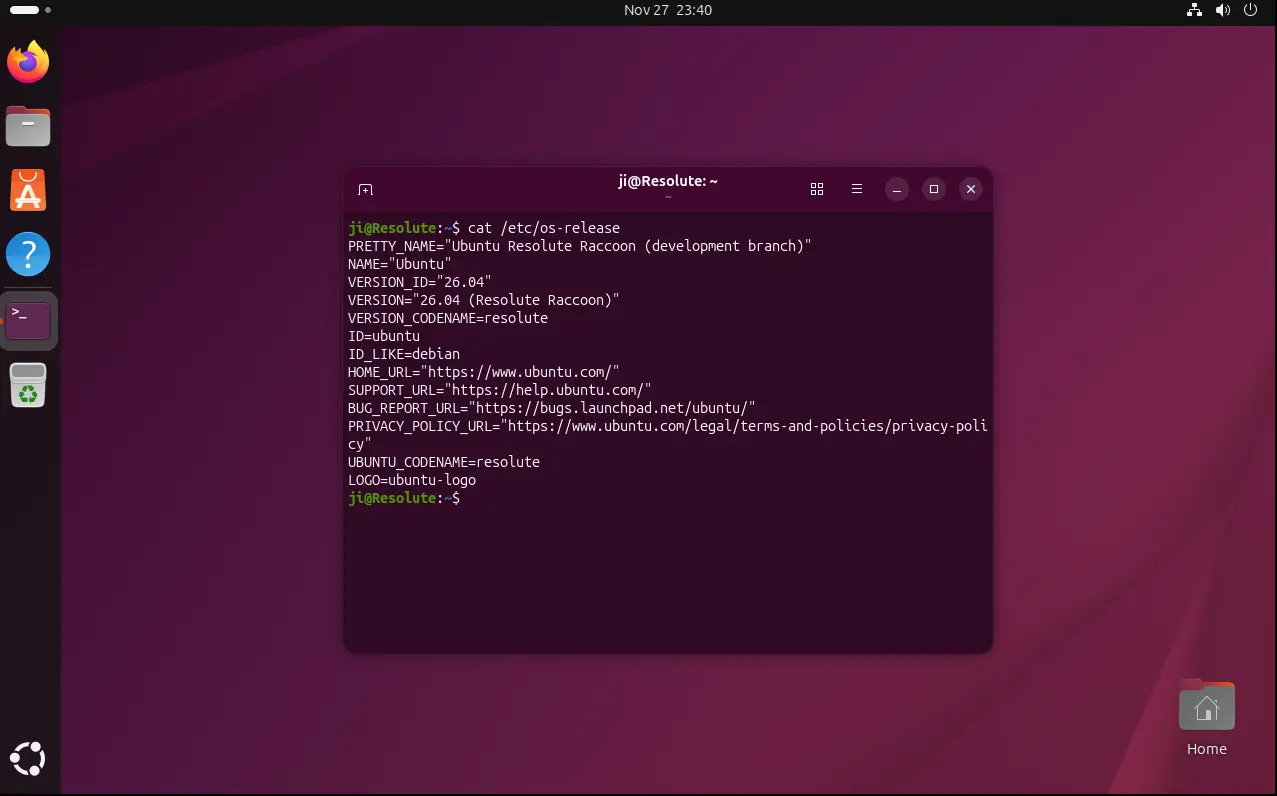
The first monthly snapshot release for Ubuntu 26.04 LTS was released yesterday morning (UTC time).
Ubuntu development team announced this development snapshot:
Hello everyone, I’d like to announce the first successful publication of the monthly snapshot – Resolute Snapshot 1. You can find the images on cdimage.ubuntu.com …
As you may know, Ubuntu 26.04 is the next Long Term Support (LTS) release with 5 years standard support until 2031, plus Expanded Security Maintenance (ESM) support until 2036, and security coverage (for paid customers) until 2041.
Ubuntu 26.04 will use GNOME 50 as default desktop environment. According to Linux Kernel history release date, it will perhaps be powered by Kernel 6.20 (or 7.0).
According to the road map, the 26.04 release will also introduced 2 new default applications. It will replace Totem with Gnome core Showtime video player, and replace Gnome System Monitor with Resources system monitor and task manager.
And, it will continue improving the performance and stability for Wayland on NVIDIA, unify the package management experience, and update Security Center with ability to re-encrypt a disk and manage Ubuntu Pro features.
At the moment, the 26.04 Snapshot 1 still has GNOME 49, Kernel 6.17, and most features are not completed yet. You may keep an eye on this on-going release note page for the recent changes.
NOTE: This snapshot is a development release that’s NOT ready for production use!
The .iso images for Desktop and Server, as well as Netboot tarball and WSL image are available to download via the link below:
Don’t know why, but this snapshot does not provide the Desktop and Server image for amd64 (Intel/AMD platform) at the moment of writing.
Thanks to @Rodolfo, the iso images for amd64 (AMD/Intel platform) is available via the link below:
For non-GNOME users, the 26.04 snapshot 1 also includes the .iso images for all the 10 official flavors, which are available to download via the link below:
For current Ubuntu 25.10, it easy to upgrade to the new 26.04 Development release by first installing all updates:
sudo apt update && sudo apt full-upgrade
Restart if required, then run:
do-release-upgrade -d
For future releases, see the table below or the official release schedule.
| December 18, 2025 | Snapshot 2 |
| January 29, 2026 | Snapshot 3 |
| February 26, 2026 | Snapshot 4 |
| March 26, 2026 | Beta (mandatory) |
| April 16, 2026 | Final Freeze, Release Candidate |
| April 23, 2026 | Final Release |
The first Ubuntu 26.04 monthly snapshot is out, the first of 5 planned for the 'Resolute Raccoon' before next April's stable release. Fancy testing it? Details inside.
You're reading Ubuntu 26.04 Snapshot 1 is Available to Download, a blog post from OMG! Ubuntu. Do not reproduce elsewhere without permission.
Ubuntu developers confirm plans to ship 2 new apps in Ubuntu 26.04 LTS, replacing its video and system monitor apps with a pair it feels are more 'modern'.
You're reading Ubuntu 26.04 Replaces System Monitor and Totem with New Apps, a blog post from OMG! Ubuntu. Do not reproduce elsewhere without permission.
Future versions of KDE Plasma will no longer support the Xorg/X11 display server, as developers set-out the timeline for a transition to a Wayland-only future.
You're reading KDE Plasma is Going Wayland-Only, Dropping X11 Support, a blog post from OMG! Ubuntu. Do not reproduce elsewhere without permission.
The Ubuntu Desktop team announced the road-map for Ubuntu 26.04 LTS today, introducing two new default applications!
As you may know, Ubuntu introduced some new default apps in recent releases, e.g., Security Center to manage snap app permissions, the container-focused Ptyxis terminal emulator, Papers document viewer, and Loupe image viewer.
According to the road-map, 2 new default applications will be made into the next Ubuntu 26.04 Long Term Support (LTS) release along with GNOME 50.
They are:
Showtime is the core video player for GNOME since version 49, meaning it’s also default in Fedora 43, Debian Forky, Arch etc Linux Distribution with vanilla Gnome Desktop environment.
As you see via the screenshot above, it features a distraction-free viewing experience with minimal interface clutter. Controls (e.g., play/pause, seek-bar, and title-buttons) fade away automatically during playback so the screen is clean.
And, it supports essential features such as volume and playback speed control, rotate video, take screenshot, and multiple audio and subtitle tracks.
The player has been made into Ubuntu system repository since Ubuntu 25.04, while Ubuntu 24.04 and earlier may install it through Flatpak package which runs in sandbox environment.
To install Showtime flatpak package, simply open terminal (Ctrl+Alt+T) and run the 2 commands below one by one.
sudo apt install flatpak
flatpak install https://dl.flathub.org/repo/appstream/org.gnome.Showtime.flatpakref
Tip: If this is the first time you install a flatpak package, then you may need a log out and back in to make app icon visible.
Resources is a free open-source Rust written application that uses GTK4 + LibAdwaita to provide a modern UI for monitoring system processes and resources.
As you see, it supports monitoring running apps and processes, with CPU, GPU, Memory usage and Drive read/write data on per app/process basis, and actions to end, kill, halt, or continue app/process.
And, it monitors the real-time usage of your system resources, such as CPU, GPU, Memory, Drive, and Network, in graphs along with basic info of your hardware properties.
As well, it shows the percentage of battery and its health, design capacity, charge circles, manufacturer, and the module name, etc information. For more about Resources, go to its project page.
Same to Showtime, all current Ubuntu releases can install Resources through Flatpak package, by running the 2 commands below one by one.
sudo apt install flatpak
flatpak install https://dl.flathub.org/repo/appstream/net.nokyan.Resources.flatpakref
Besides new default applications, Ubuntu 26.04 will also improve the performance and stability for Wayland on NVIDIA, add more controls for the disk encryption, such as ability add/remove PIN/passphrase after installation, and graphical option to re-encrypt a disk.
It’s also going to unify the package management experience by making App Center the single place to handle all applications, deprecate Software Properties (Software & Updates), and more. See the discourse page for details.
FFmpeg, the popular multimedia library released new version 8.0.1 in last week. Here’s the PPA contains the .deb packages for all current Ubuntu users.
As a maintenance update, the release includes only minor new features, some improvements, and bug-fixes. And, the FFmpeg website does not even provide an official release note for it.
The new release updated the RealVideo 6.0 decoder that was introduced in last 8.0 release, with upper bound check for qp (Quantization Parameter) which is useful to prevent excessive quality loss, and avoid artifacts like blocking, banding, or blurring.
For mac and iOS, it updated the VideoToolbox encoder with global_quality support without qscale (quantizer scale), low latency RC with HEVC (H.265) video codec, which is perfect for live, interactive, or RC video applications, and fix for precision loss when calculating quality.
It also updated the MPEG‑5 LCEVC decoding with support for LCEVCdec version 4, which features new CPU pipeline with multithreading updates, new default and recommended pipeline, and new Vulkan pipeline with experimental GPU support for decoding. For more about LCEVCdec v4, see its github releases page.
For the libavfilter library, the release fixed some issues for af_whisper, the built-in Whisper audio filter for speech-to-text transcription. They include fixes for srt index, int64 printf format, srt file format, and broken output for multibyte character. And, it updated the drawtext video filter with explanation for bbox text separator, fix for incorrect text length and call GET_UTF8 with invalid argument.
As well, it updated the libavformat with rtp_ctx->streams access fix for WebRTC-HTTP Ingestion Protocol, and ability to handle IPv6 Zone ID in hostname with built-in HTTP protocol handler.
For the libutil utility library, it re-introduced the block offset state for aes_ctr, the implementation of AES encryption in Counter mode, and added support casting GET_BYTE/GET_16BIT returned value.
Other changes in FFmpeg 8.0.1 include:
The source tarball for the new release and optional installer packages are available to download in FFmpeg website via the link below:
For Ubuntu 22.04, Ubuntu 24.04 and 25.04, I’ve uploaded v8.0.1 packages into this unofficial PPA for Intel/AMD and ARM platforms.
NOTE: FFmpeg is an important library that many apps and even graphics drivers depend on it. Upgrade FFmpeg may break compatibility! Install it at your own risk.
To add the PPA and install FFmpeg 8.0.1, run commands below one by one in terminal (Ctrl+Alt+T):
sudo add-apt-repository ppa:ubuntuhandbook1/ffmpeg8
sudo apt update
sudo apt install ffmpeg -t "o=LP-PPA-ubuntuhandbook1-ffmpeg8"
If you are in charge of managing a database server, from time to time you may need to run a
The post How to Execute MySQL Queries via Linux Terminal first appeared on Tecmint: Linux Howtos, Tutorials & Guides.
When you’re managing a Linux server, especially one with multiple users, you need visibility into what’s happening on your system,
The post How to Monitor Linux User Activity with psacct and acct Tools first appeared on Tecmint: Linux Howtos, Tutorials & Guides.