Reading view

USDC Is Being Used for More Than Trading, and Bybit Is Expanding Support on XDC

As 2025 winds down, stablecoins like USDC are being used for more than just trading. They are increasingly part of payments, business transfers, and routine movement of funds, not only activity tied to market cycles. As more money moves more often, the way those transfers settle has started to matter far more than it used to. 

That change has put pressure on existing blockchain networks. Activity picked up over the second half of the year, and during busy periods this showed up through higher fees, slower confirmations, and less predictable transfer costs.

On Ethereum, for example, sending USDC late in 2025 has often cost anywhere from a few dollars to well over ten dollars during periods of congestion, meaning even a basic transfer can end up costing more than expected.

By the second half of the year, fee volatility had become another familiar issue. Gas-based pricing means the cost of a stablecoin transfer can change quickly depending on network conditions, making routine payments harder to plan for traders, businesses, and treasury teams. In practice, once exchange and transfer fees are factored in, the cost advantage of using stablecoins can narrow more than many users expect.

That’s where Bybit’s decision to add USDC support on the XDC Network fits in. As stablecoin transfers become part of everyday activity, exchanges are under pressure to offer routes that are easier to manage and more predictable. How quickly and cheaply funds can move now matters as much as access itself.

“Most users don’t care about blockchain labels anymore. They care about whether a transfer clears quickly and what it costs them in the end,” said Angus O’Callaghan, head of trading and markets at XDC Network. “If stablecoins are going to function as everyday financial tools, the infrastructure underneath them has to feel reliable, not stressful.”

Bybit Waives USDC Fees on XDC and Launches $200,000 Reward Program

For most stablecoin users, access isn’t the problem anymore. USDC is already available on nearly every major exchange. What people care about now is whether moving funds actually works the way they need it to: quickly, regularly, and without having to think twice about the cost.

Bybit’s recent changes make sense within this context. Alongside opening another route for USDC transfers, the exchange is waiving withdrawal fees on XDC from December 1, 2025 through January 1, 2026, and offering a 200,000 USDC reward pool for new users who register and make qualifying deposits.

From a user point of view, this is less about features and more about convenience. When transfers start to feel expensive or unpredictable, people naturally change how they move money. Some wait longer to transfer, others batch payments, and some avoid smaller transactions altogether. Having another option available makes those decisions easier.

For Bybit users, USDC on XDC simply adds flexibility. It gives them another way to move funds when the usual routes don’t feel like the best choice, without changing what they’re using or how they think about stablecoins.

What This Signals for Exchanges

Bybit’s recent move around USDC transfers reflects a change that’s starting to show up across the exchange landscape. While Bybit has taken a clear step in expanding how users can move funds, it’s also part of a wider pattern playing out over the past few weeks.

BTSE, KuCoin, MEXC, Gate.io, Bitrue, and Pionex have also expanded support for XDC, enabling deposits, withdrawals, and trading. Taken together, these moves point to growing interest among exchanges in settlement networks that can handle regular transfer activity without the fee swings seen on more congested chains.

For exchanges, the reasoning is largely practical. As stablecoin flows increase, relying on a small set of networks can make platforms more exposed to sudden cost changes and slower settlement during peak periods. Adding alternative routes gives exchanges more flexibility, helps smooth out those pressures, and offers users more consistent ways to move funds without changing the assets they already use.

All of this is also happening as stablecoins start to be treated more like real payment tools. In the U.S., proposals such as the GENIUS Act are focused on putting clearer rules around how stablecoins are issued and used, especially for payments and institutional activity. As that happens, the way stablecoins move between platforms and networks becomes more than a technical detail and part of what users and institutions expect by default.

“When stablecoins start getting used outside of trading, the conversation changes,” O’Callaghan added. “Once there are clearer rules around how they’re meant to work, like what’s being discussed with the GENIUS Act, people stop treating transfers as experiments. They expect them to behave like regular payments: to go through on time, at a cost they can understand, and without needing to second-guess every move.”

XDC in Practice

XDC Network is mostly used for practical, behind-the-scenes work rather than consumer-facing crypto activity. It’s been used in areas like trade finance, real-world asset tokenization, and settlement processes where systems need to work consistently and without surprises.

That same setup also works well for moving stablecoins. Transfers on XDC tend to go through quickly and usually cost very little, which matters more now that stablecoin transfers became more common. For people or businesses sending USDC often, lower and more predictable costs make those transfers easier to manage over time.

This is starting to show in the data. The amount of USDC issued on XDC has continued to rise and recently passed $200 million, indicating that usage is moving beyond early tests and into more regular activity. Rather than brief spikes, the numbers point to steady use by participants who move funds often.
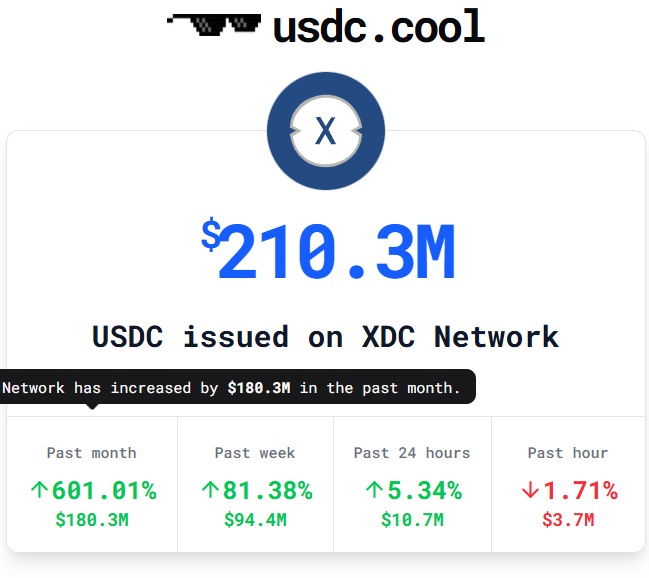
Image source: USDC.COOL

From XDC’s side, integrations like Bybit’s are mainly about being useful. The network is being used as another place where stablecoin transfers can happen reliably, rather than as something meant to attract attention on its own.

XDC was also designed with institutional payment flows in mind, where predictable settlement and consistent costs matter more than short-term optimization. That makes it practical for businesses and financial institutions moving stablecoins at scale, where delays or sudden fee swings quickly turn into operational problems.

That focus is already showing up in how the network is being used. Beyond basic transfers, XDC supports more complex financial workflows, including global payments, tokenized settlement, and stablecoin-based liquidity. Assets like USDC are increasingly used within these flows, including as collateral, and more than $500 million worth of assets have already been tokenized and settled on the network.
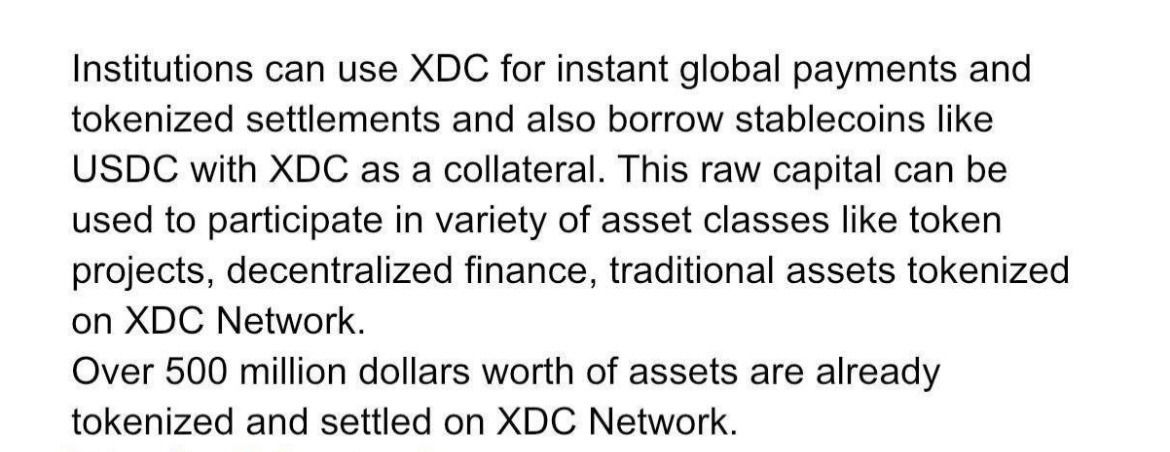
Image source: TradeFi Network

This kind of activity is especially relevant for trade finance and cross-border settlement, where funds need to move reliably across jurisdictions rather than fluctuate with market conditions. As more payment and trade processes move on-chain, infrastructure that can handle steady, high-volume transfers becomes less of a nice-to-have and more of a requirement.

Closing

In the end, decisions like Bybit’s USDC support on XDC are not about any single network or promotion and more about how exchanges are adjusting to a maturing market. For the exchange, offering another way to move USDC is part of that adjustment – making sure the experience holds up not just during quiet periods, but when activity picks up and small frictions start to matter. XDC’s role in that setup reflects how infrastructure choices are becoming part of the exchange’s responsibility, even if they stay largely out of sight.

“Good infrastructure doesn’t draw attention to itself,” O’Callaghan concludes. “When it works properly, users barely think about it, and that’s usually the goal.”

The post USDC Is Being Used for More Than Trading, and Bybit Is Expanding Support on XDC appeared first on BeInCrypto.
  •  

Yuan Soars, Bitcoin Stalls: Why the Dollar Dip Isn’t Lifting Crypto

China’s currency hits a 2.5-year high as the dollar weakens — a classic bullish setup for Bitcoin that isn’t working.

China’s onshore yuan closed at its strongest level since May 2023 on Thursday, trading at 7.0066 per dollar and nearly breaching the psychologically key 7-per-dollar mark. The move caps a 5% appreciation against the greenback since early April.

Yuan’s Rally, Dollar’s Exit

The rally is being driven by Chinese exporters rushing to convert their dollar revenues into yuan before year-end. This is more than seasonal housekeeping — analysts estimate that over $1 trillion in corporate dollars held offshore could eventually flow back to China.

Why now? The calculus has shifted. China’s economy is showing signs of recovery, the US Federal Reserve has been cutting rates, and the yuan itself is strengthening — creating a self-reinforcing cycle. Holding dollars looks less attractive when the currency you’re converting into keeps rising.

Some brokerages believe this is only the beginning. The headwinds that pressured the yuan for years — trade tensions, capital flight, a surging dollar — are now reversing into tailwinds. If the Fed eases more aggressively in 2026, as some expect, the yuan’s climb could accelerate further.

The Setup That Should Work

A weakening dollar typically lifts Bitcoin. The logic is straightforward: as the world’s reserve currency loses ground, dollar-denominated assets like BTC become relatively cheaper, and the “digital gold” narrative gains traction.

Gold is playing its part — the metal has hit record highs this month. Yet Bitcoin remains stuck in a $85,000-$90,000 range, unable to sustain breaks above $90,000 despite three attempts this week alone.

Why the Disconnect?

Several factors are muting Bitcoin’s response to what should be favorable macro conditions.

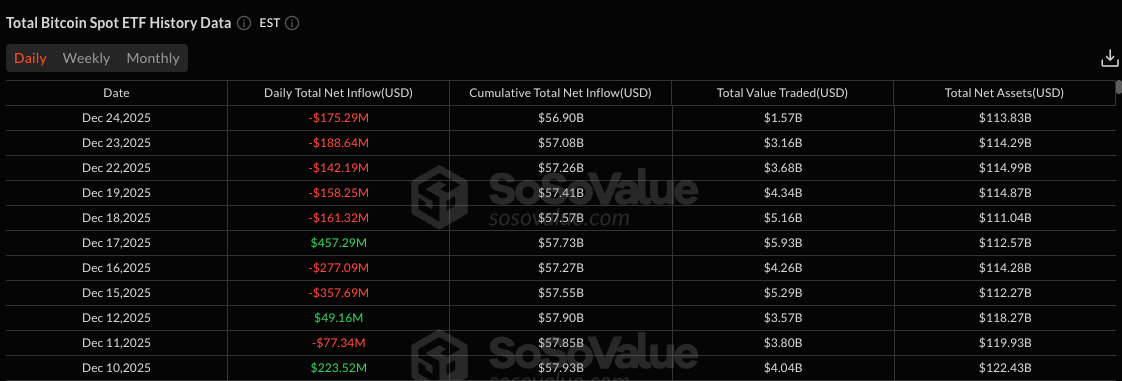
First, year-end liquidity is thin. Holiday trading volumes have amplified volatility while limiting conviction-driven moves. Second, institutional flows have turned negative — US spot Bitcoin ETFs have seen five consecutive days of net outflows totaling over $825 million, according to SoSoValue data.

Source: SoSoValue

Third, the Bank of Japan’s rate hike last week to a three-decade high has kept markets on edge. Although the yen weakened rather than strengthened after the decision — limiting carry trade unwind pressure — uncertainty over the BOJ’s future path continues to weigh on risk appetite.

2026: Delayed Rally?

The bullish case isn’t dead, just deferred. Some analysts expect the dollar to weaken further in 2026, particularly if US monetary easing exceeds current market expectations.

If that thesis plays out, Bitcoin’s muted response to current dollar weakness may reflect timing rather than a structural breakdown in the correlation. Once liquidity normalizes in January and Fed policy clarity improves, the yuan’s signal may finally reach crypto markets.

For now, Bitcoin watches from the sidelines as China flashes one of the clearest dollar-bearish signals in years.

The post Yuan Soars, Bitcoin Stalls: Why the Dollar Dip Isn’t Lifting Crypto appeared first on BeInCrypto.
  •  

Canton Network (CC) Has Overtaken Top Coins As Price Hit 4-Week High

Canton Network price has surged sharply over recent weeks, capturing market attention with a near 40% weekly gain. The rally accelerated after Canton announced a strategic collaboration with The Depository Trust & Clearing Corporation earlier last week. 

This development positioned CC at the center of institutional tokenization discussions, driving renewed investor interest.

Canton Network and DTCC Join Hands

DTCC and Canton Network confirmed a partnership last week to support the tokenization of assets custodied by The Depository Trust Company on the Canton Network. The initiative aims to enable compliant, privacy-enabled blockchain infrastructure for regulated financial institutions. This move highlights a shared commitment to advancing digital asset adoption.

The partnership highlights Digital Asset’s long-standing collaboration with DTCC on institutional-grade blockchain solutions. Market participants interpreted the announcement as a major validation of Canton’s architecture. As a result, demand for CC rose quickly, reflecting growing confidence in its role within regulated financial markets.

Canton Holders Outperform Chainlink

Investor participation has remained elevated throughout the past week, supporting the sustainability of the rally. On-chain data shows 23,972 active addresses over the last 24 hours. These addresses collectively executed more than 500,000 transactions, indicating strong network engagement.

For context, comparable activity across established tokens remains lower. XRP recorded roughly 39,000 active addresses, Cardano posted about 25,000, and Chainlink logged near 4,000. This comparison suggests CC’s price increase is driven by genuine usage rather than speculative spikes or thin liquidity.

Want more token insights like this? Sign up for Editor Harsh Notariya’s Daily Crypto Newsletter here.

Canton Activity.
Canton Activity. Source: Cantonscan

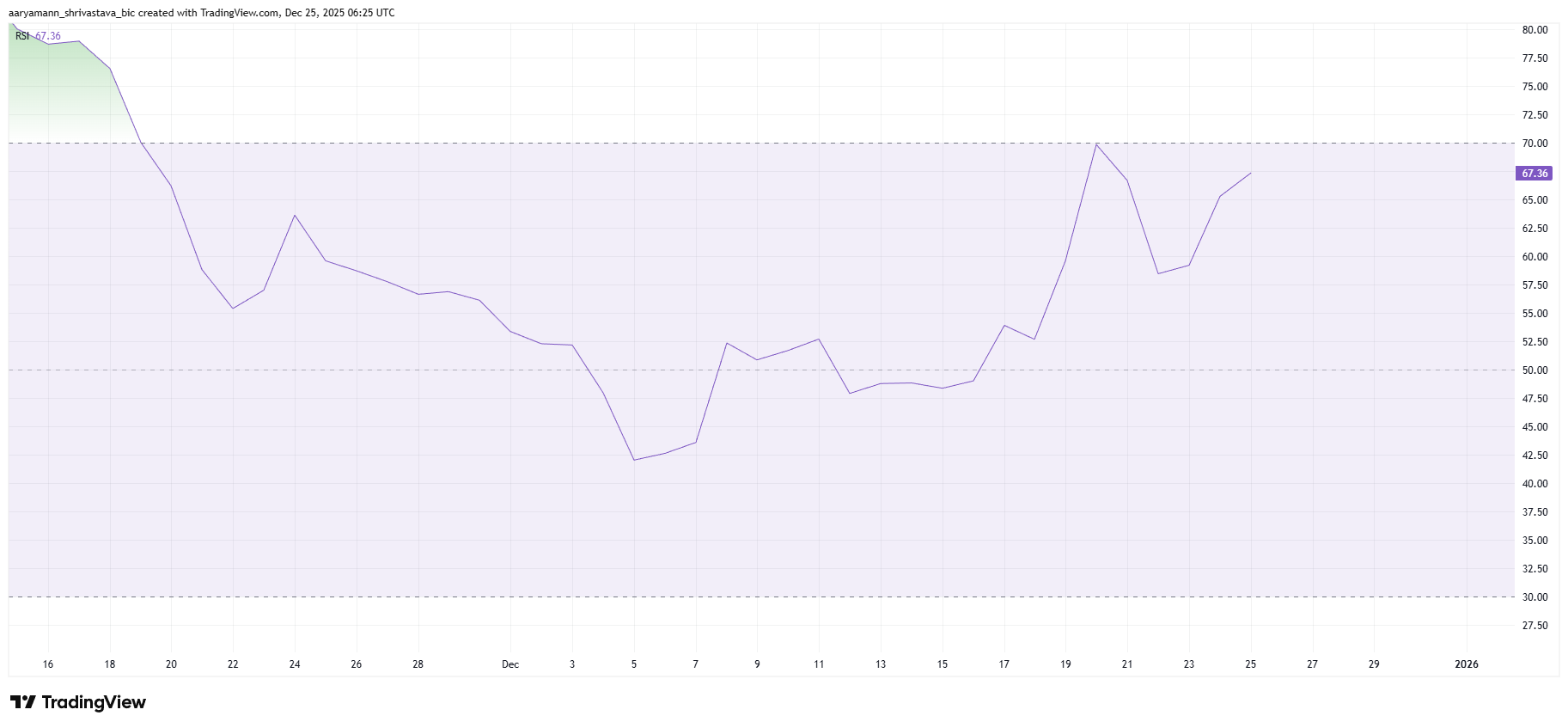
Technical indicators further support the bullish outlook. The Relative Strength Index currently sits above the neutral zero line, signaling positive momentum. This positioning confirms that buyers remain in control, aligning with the sustained rise in network activity and transaction volume.

However, caution is warranted as the RSI approaches overbought territory. Such conditions often precede short-term pullbacks. As long as the indicator avoids breaching extreme levels, CC’s broader uptrend remains technically intact.

CC RSI
CC RSI. Source: TradingView

CC Price Hits Monthly High

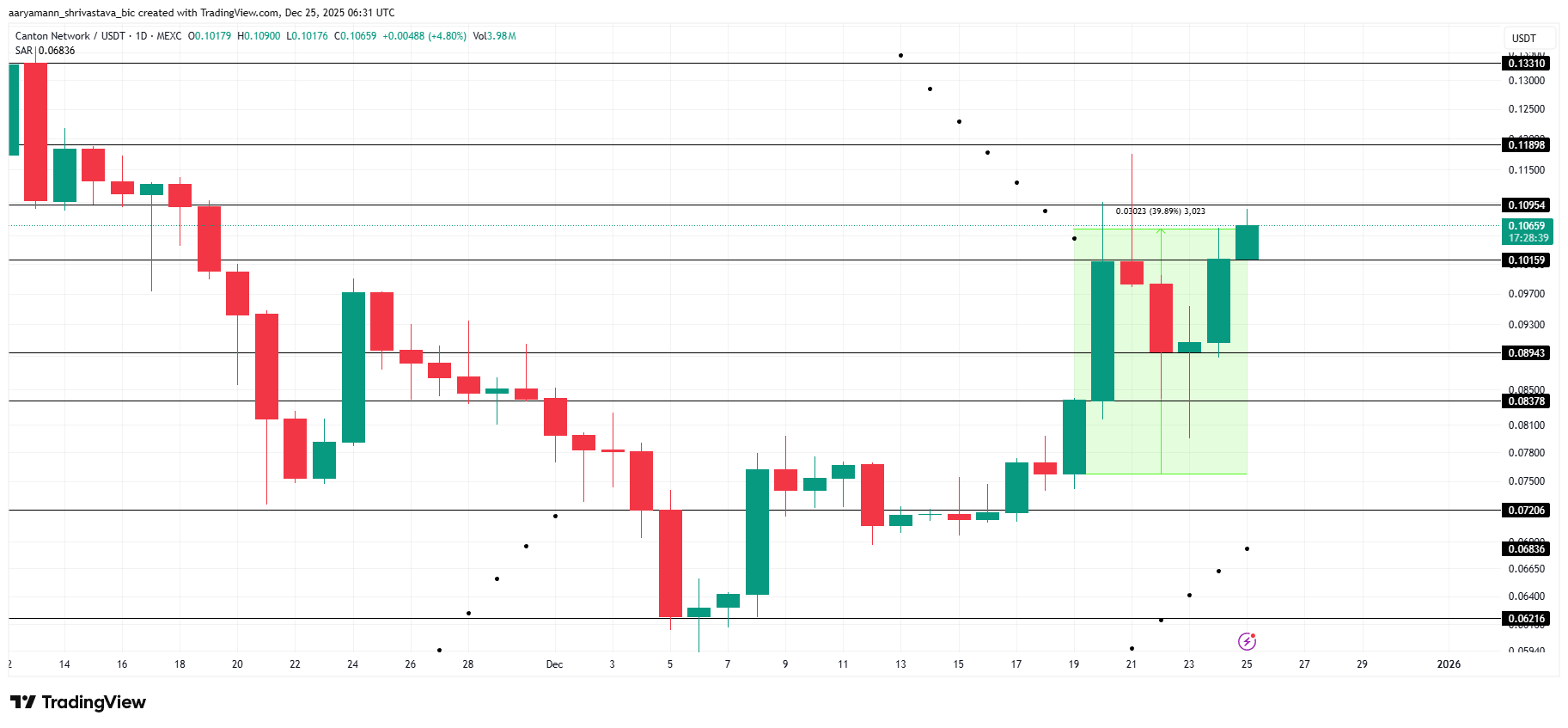
CC price traded near $0.106 at the time of writing, reflecting a near 40% weekly increase. The Parabolic SAR continues to signal an active uptrend. This indicator suggests the altcoin may extend gains if broader market conditions remain supportive.

A decisive break above the $0.109 resistance could push CC toward $0.118. Clearing that level may open the path to $0.133. Such a move would build on the token’s recent monthly high and reinforce bullish structure.

CC Price Analysis.
CC Price Analysis. Source: TradingView

Downside risks persist if momentum weakens. Overbought conditions or profit-taking could pressure price action. A drop below $0.101 may expose CC to a decline toward $0.089, invalidating the current bullish thesis.

The post Canton Network (CC) Has Overtaken Top Coins As Price Hit 4-Week High appeared first on BeInCrypto.
  •  

Gold’s Rally Could Be Bitcoin’s Next Catalyst, But Risks Still Linger

Bitcoin price action has remained mixed in recent sessions, reflecting uncertainty across global markets. At the time of writing, broader risk cues offer little direction for short-term momentum. 

However, one notable signal is emerging from gold, whose recent strength may be positioning Bitcoin for a renewed rally if historical correlations continue to hold.

Bitcoin Is Tracking Gold

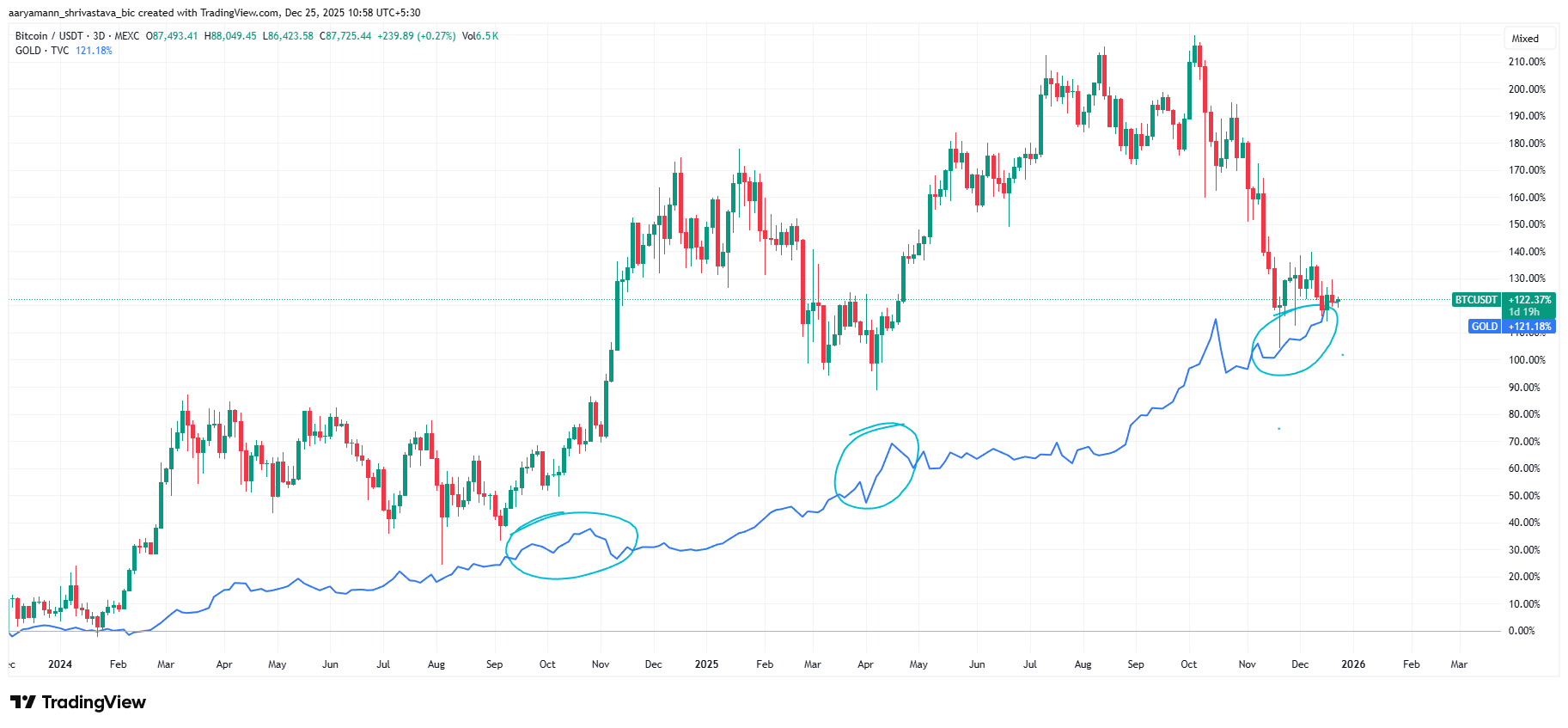
Bitcoin has increasingly mirrored gold’s trajectory over the past year, reinforcing its role as a macro-sensitive asset. Historically, sharp advances in gold prices have often preceded upside moves in Bitcoin. This relationship stems from rising risk appetite once capital rotates from defensive assets into higher-risk alternatives.

As gold strengthens, investors tend to seek asymmetric returns, benefiting Bitcoin inflows. This pattern has repeated several times since early 2024. Sustained gold rallies have coincided with higher Bitcoin demand, supported by both retail and institutional participation across spot and derivatives markets.

Bitcoin, Gold Price Trajectory
Bitcoin, Gold Price Trajectory. Source: TradingView

An exception emerged in October this year, when Bitcoin declined sharply alongside gold. That drop followed intensified macroeconomic pressure, including higher bond yields and tighter financial conditions. Currently, gold is regaining momentum. If Bitcoin maintains stability near current levels, it could once again benefit from this renewed risk-on shift.

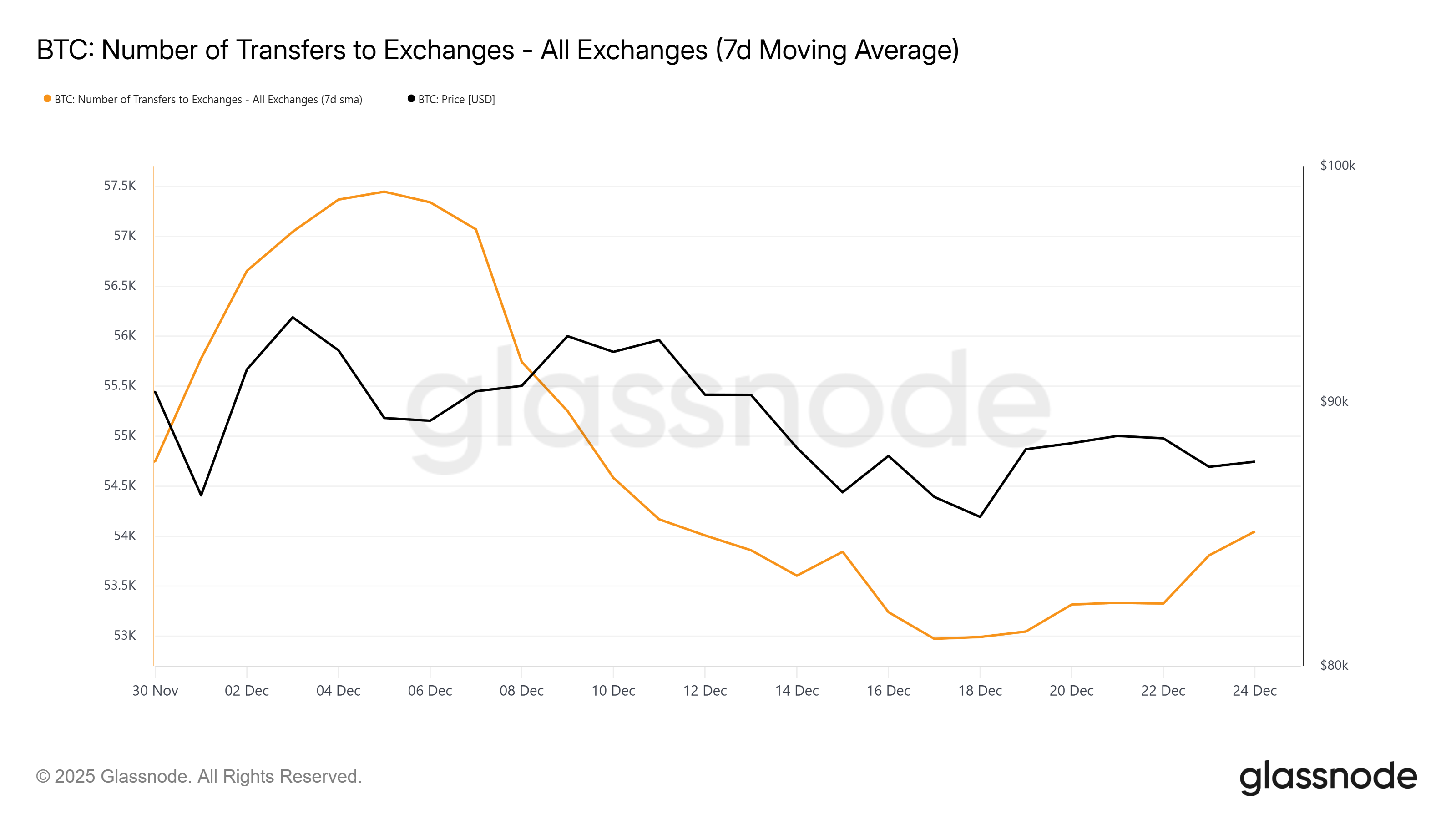
On-chain data suggests caution remains present among Bitcoin holders. Transfers to exchanges have increased in recent weeks, signaling elevated deposits from investors. This metric often reflects profit-taking behavior or preparation for potential downside protection during uncertain market phases.

Rising exchange inflows do not always signal immediate selling pressure. However, sustained increases typically precede heightened volatility. In Bitcoin’s case, growing deposits suggest some investors are managing risk rather than aggressively accumulating. This dynamic aligns with the mixed sentiment currently shaping price action.

Bitcoin Transfers to Exchanges
Bitcoin Transfers to Exchanges. Source: Glassnode

Can BTC Price Close At No Loss?

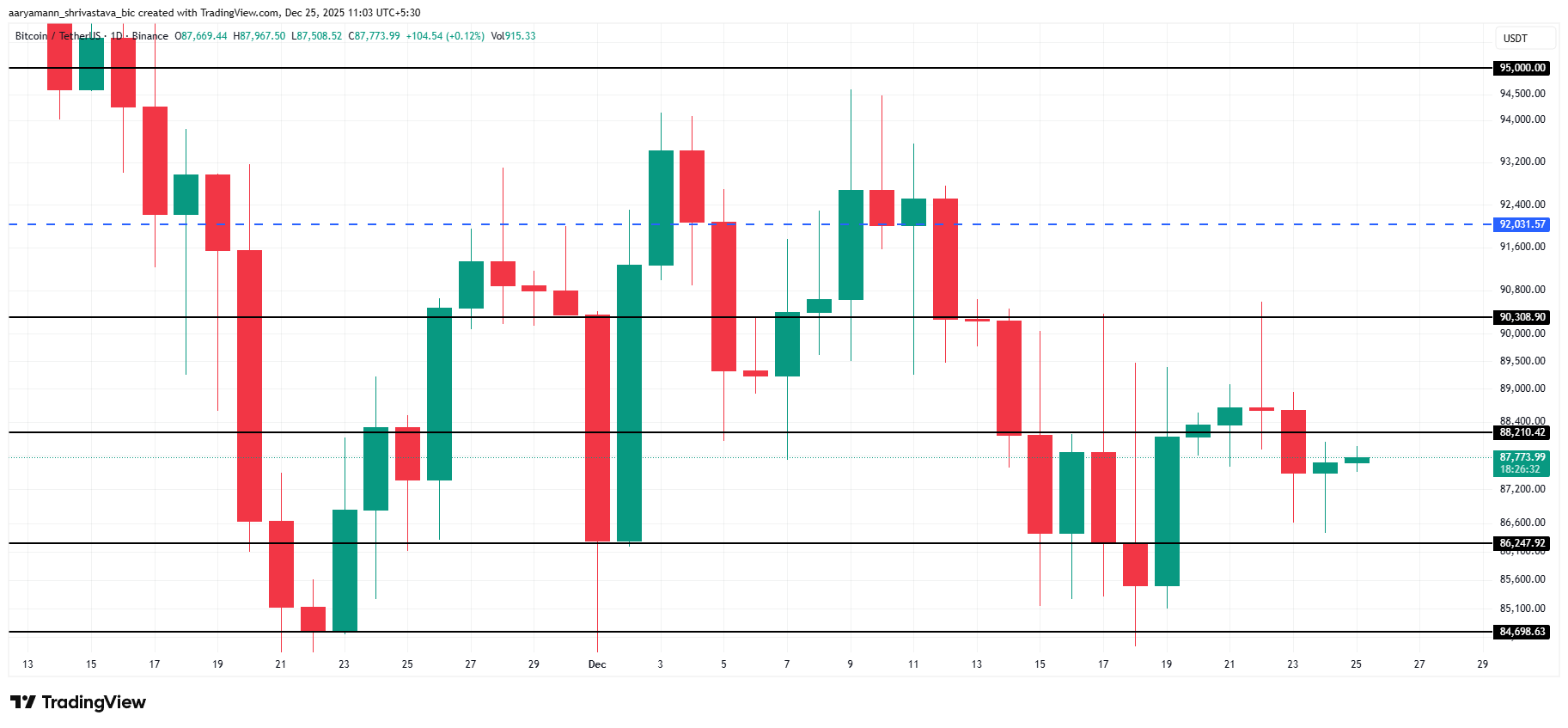
Bitcoin price traded at $87,773 at the time of writing, sitting below the $88,210 resistance. BTC began 2025 near $93,576. For now, the primary objective remains reclaiming that level before year-end, provided market conditions improve, and volatility remains contained.

This scenario becomes more likely if Bitcoin continues tracking gold’s bullish cues. A confirmed breakout would require flipping $88,210 into support. A sustained move above $90,308 would strengthen upside conviction and signal renewed momentum across spot markets.

Bitcoin Price Analysis.
Bitcoin Price Analysis. Source: TradingView

Conversely, increased selling pressure could disrupt this setup. If Bitcoin loses the $86,247 support, downside risks expand. A drop toward $84,698 would invalidate the bullish thesis and reintroduce near-term bearish pressure.

The post Gold’s Rally Could Be Bitcoin’s Next Catalyst, But Risks Still Linger appeared first on BeInCrypto.
  •  

A Christmas Bounce for XRP? 3 Clues Hang in the Stocking

XRP has been flat for most of the last 24 hours and remains down about 16.8% over the past 30 days. The chart still feels bearish, but this 2025 Christmas season brings three tailwinds that look like they are trying to pull the sleigh in a new direction.

It is not a rally call. It is a setup. If buyers follow through, this could be the start of something.

Momentum and Money Flow Try To Join The Christmas Choir

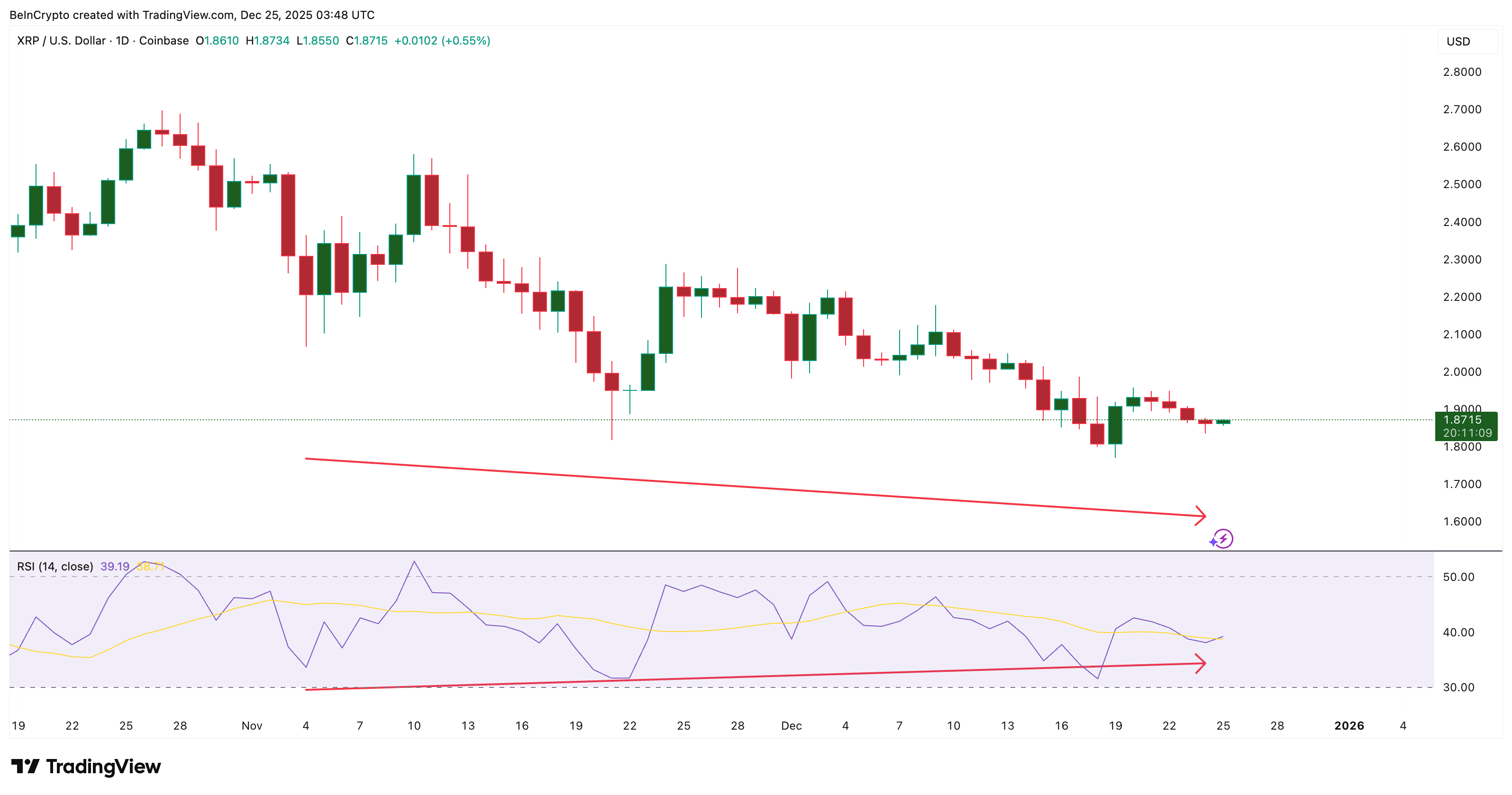
The XRP price has been trending lower between November 4 and December 24, forming clear lower lows. But the relative strength index (RSI), which measures momentum, has made higher lows in the same period. That is called a bullish divergence. It happens when the price goes down, but momentum quietly turns up, and it often appears before a reversal attempt.

Bullish XRP Divergence
Bullish XRP Divergence: TradingView

Want more token insights like this? Sign up for Editor Harsh Notariya’s Daily Crypto Newsletter here.

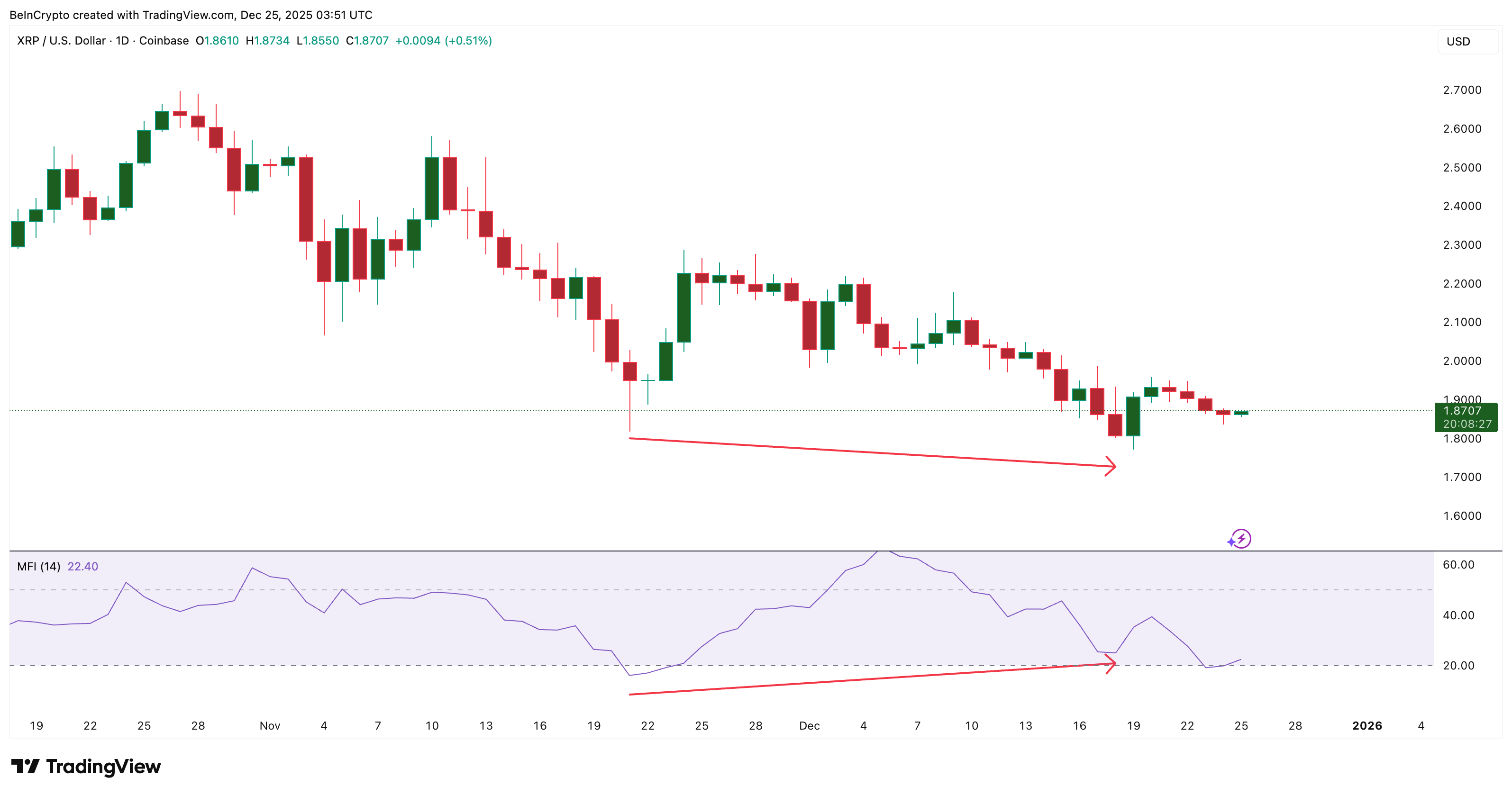
The money flow index (MFI), which tracks volume and inflows, is also showing a divergence.

Between November 21 and December 18, the price trended lower, but the MFI trended higher. That hints at dip-buying pressure and money rotating back in even while the price hesitated. In response, the XRP price began to rebound after December 18.

Currently, the MFI still maintains the higher low setup relative to November 21, despite the recent dip against the rising price. Plus, it has now moved out of deeply oversold territory, hinting at a resumption of dip-buying narrative, near the reversal zone.

Dip Buying Returns
Dip Buying Returns: TradingView

Both signals suggest sellers could be losing authority. They are not confirmations, but they are Christmas carols humming under the surface.

Whales Return Like Cautious Reindeer

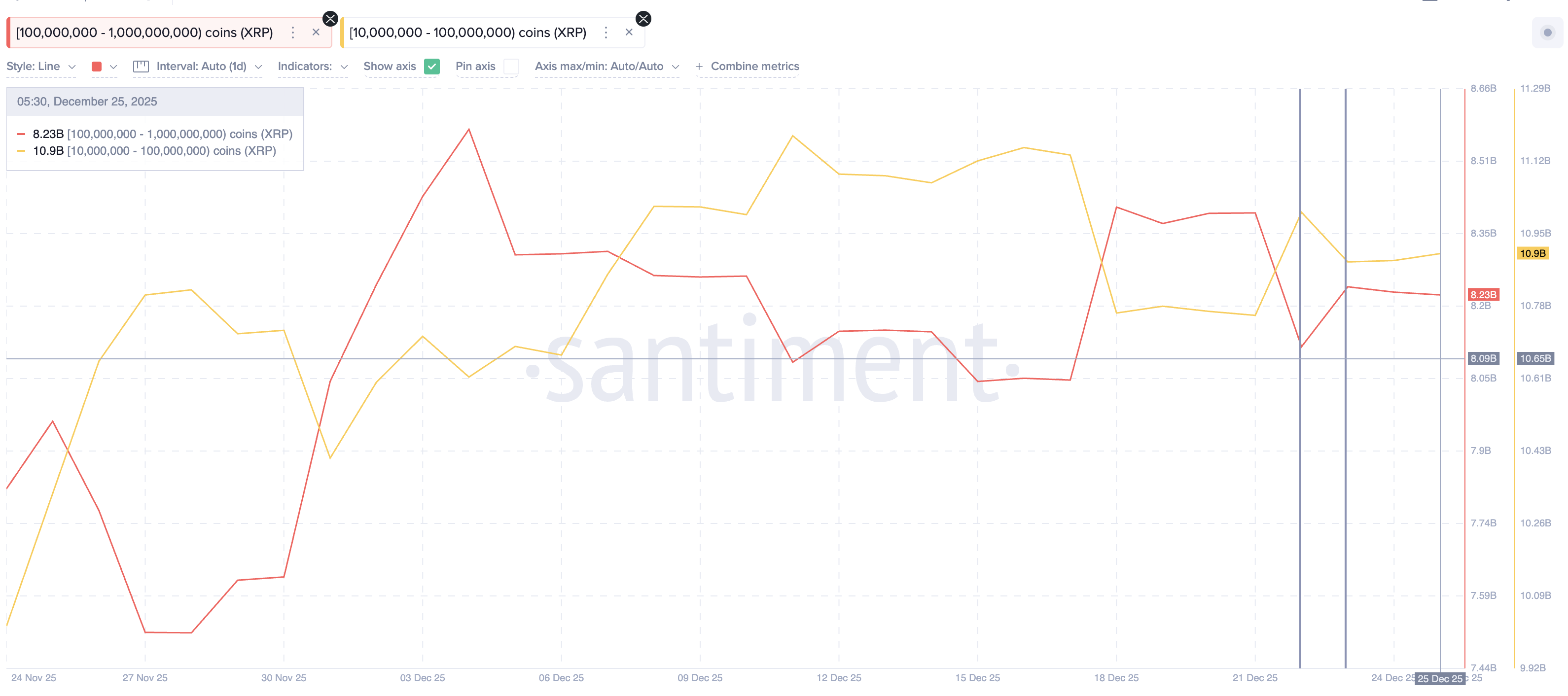
Two whale cohorts have resumed adding, but not dramatically. The second-largest cohort, holding between 100 million and 1 billion XRP, increased its holdings from 8.11 billion XRP to 8.23 billion XRP starting on December 22. At the current price, that is roughly a $150 million change.

The next cohort holding between 10 million and 100 million XRP increased from 10.88 billion XRP to 10.9 billion XRP, a tad late on December 23. At current prices, that is roughly a $50 million increase.

Slow Whale Adding
Slow Whale Adding: Santiment

This is not aggressive accumulation like the mid-December spikes. It is cautious, like reindeer testing the snow before charging forward. Still, whales adding while momentum improves gives the reversal attempt a spine. It shows the market’s deepest pockets are not abandoning ship at current levels.

XRP Price Levels That Can Light Up The Christmas Tree

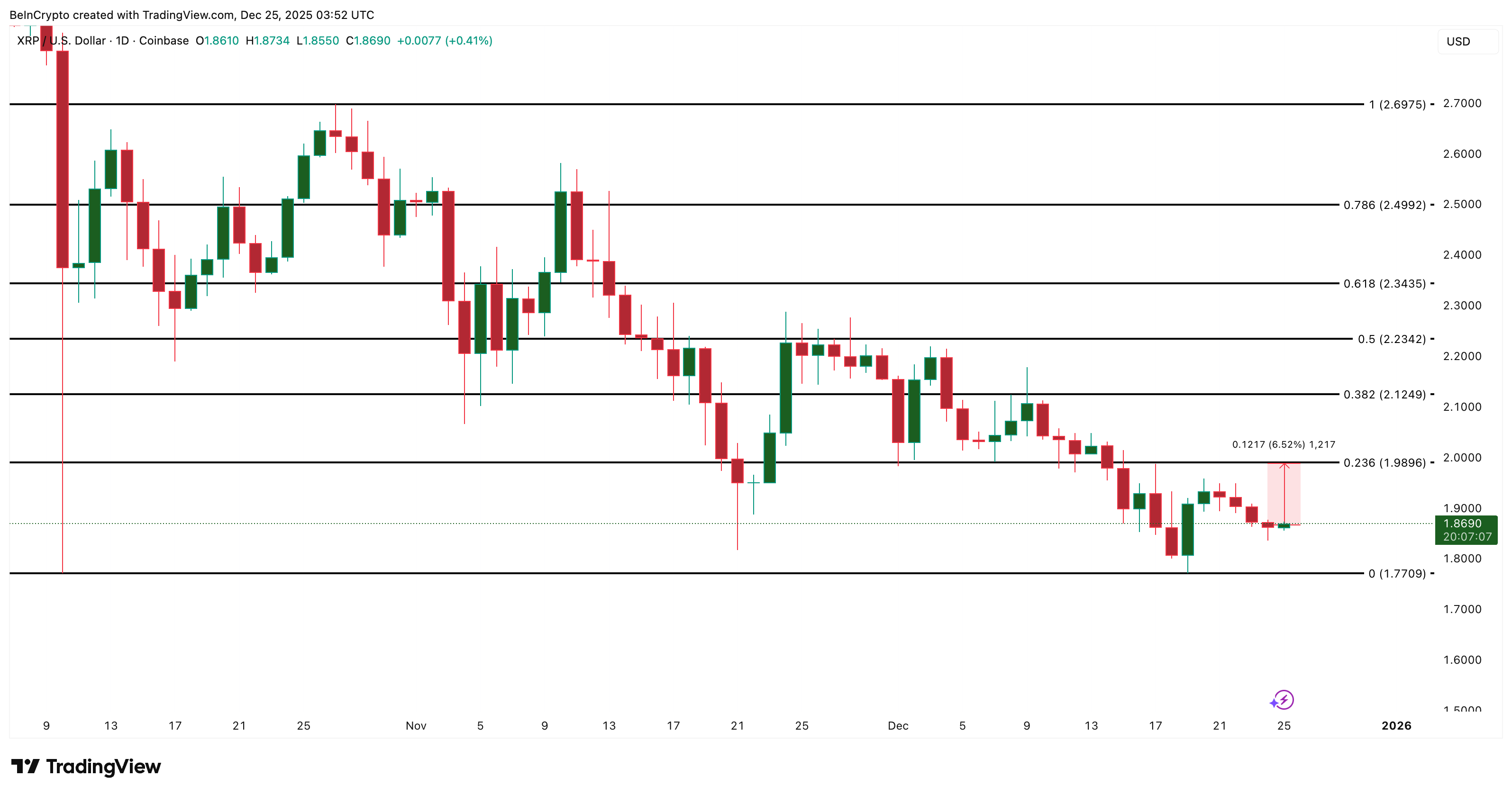
If the XRP price wants to turn these signals into real results, it needs to work with them. The first hurdle sits near $1.98. That level has capped every upside move since December 15. If XRP buyers can help clear it, a move into the $2.12 zone becomes possible. Above that, $2.23 is where buyers would prove they are more than holiday visitors.

On the downside, the key level is $1.77. That has acted as structural support since October 10. A daily close below $1.77 would signal the sleigh might not get off the ground and that sellers still own the season.

XRP Price Analysis
XRP Price Analysis: TradingView

For now, XRP is holding above $1.77 with momentum slowly improving, money flow no longer bleeding out, and whales stepping back in. None of these turns the chart bullish on its own. Together, they set the stage for a potential trend change if the price cooperates.

If XRP climbs above $1.98 with strength, the Christmas tailwinds pushing from underneath might get loud enough to matter. Until then, the sleigh is pulling forward, but it has not taken flight.

The post A Christmas Bounce for XRP? 3 Clues Hang in the Stocking appeared first on BeInCrypto.
  •  

XRP Price Slump Leaves Evernorth Facing Over $200 Million in Unrealized Losses

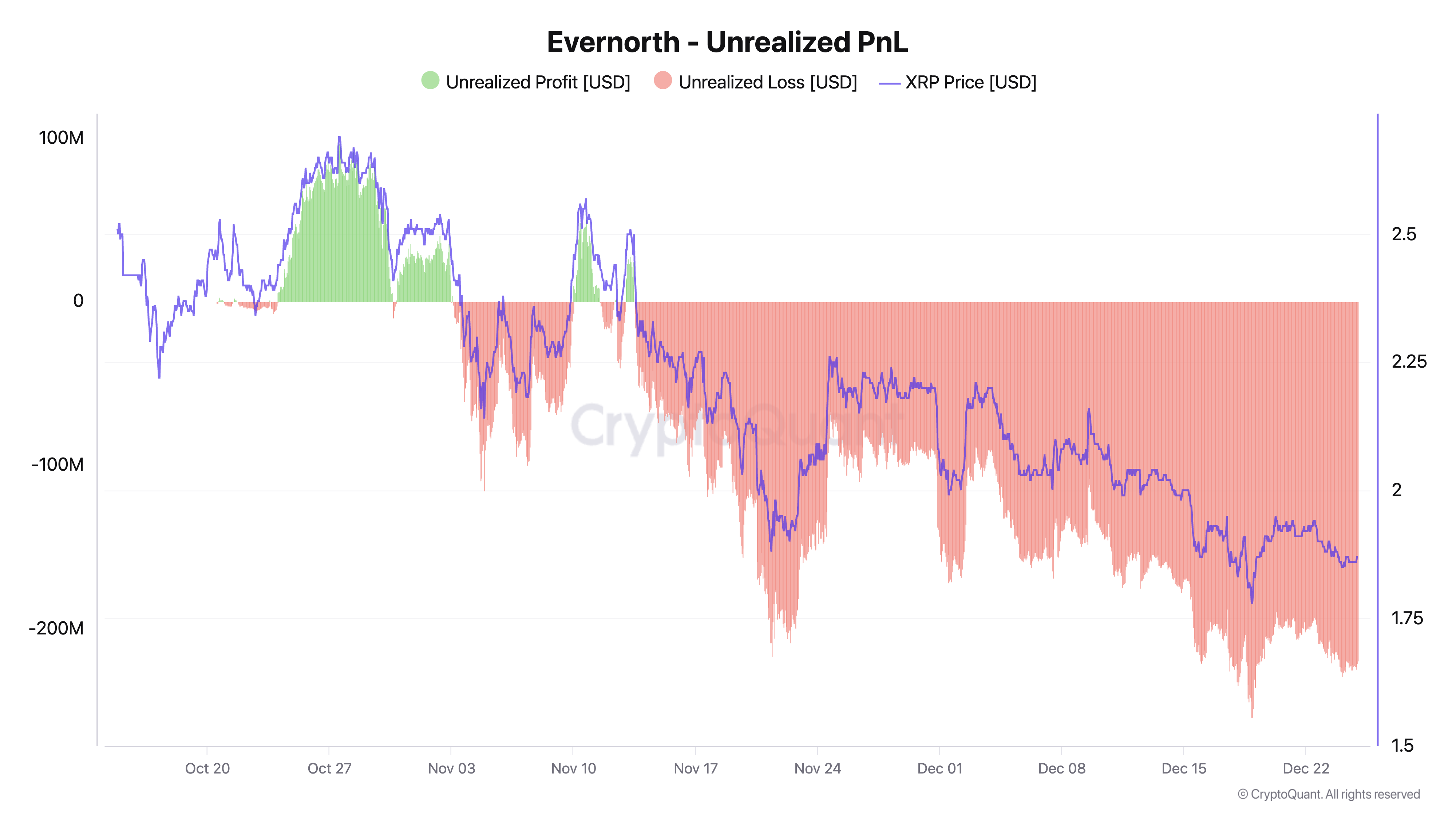
Evernorth, the largest institutional holder of XRP, is sitting on more than $200 million in unrealized losses.

This position highlights the volatility and risks associated with institutional cryptocurrency holdings during a market downturn.

XRP Treasury Firm Evernorth Sees Value of Holdings Drop by Over $200 Million

Evernorth has emerged as a prominent player in the institutional adoption of XRP. In late October, the Nevada-based firm announced plans to raise $1 billion to establish what it described as the “largest public XRP treasury company.”

On November 4, 2025, Evernorth acquired 84.36 million XRP at an average price of $2.54 per token. The transaction pushed the company’s total XRP holdings to more than 473.27 million tokens.

“This continued accumulation reflects Evernorth’s conviction in XRP as the most important asset of the internet, and its mission to build a long-term, institutional-grade XRP treasury with compounding yield,” the firm stated.

However, these purchases have come at a cost. According to data from CryptoQuant, Evernorth’s XRP position is now showing unrealized losses exceeding $200 million.

Evernorth XRP Holdings Performance
Evernorth XRP Holdings Performance. Source: CryptoQuant

This mirrors broader weakness across the XRP market. Nearly half of the token’s circulating supply is currently held at a loss. The drawdown stems from XRP’s recent price weakness.

The altcoin has fallen by roughly 25% since Evernorth’s initial treasury announcement. It is now trading below price levels seen at the start of the year, highlighting the challenges facing XRP as momentum continues to fade.

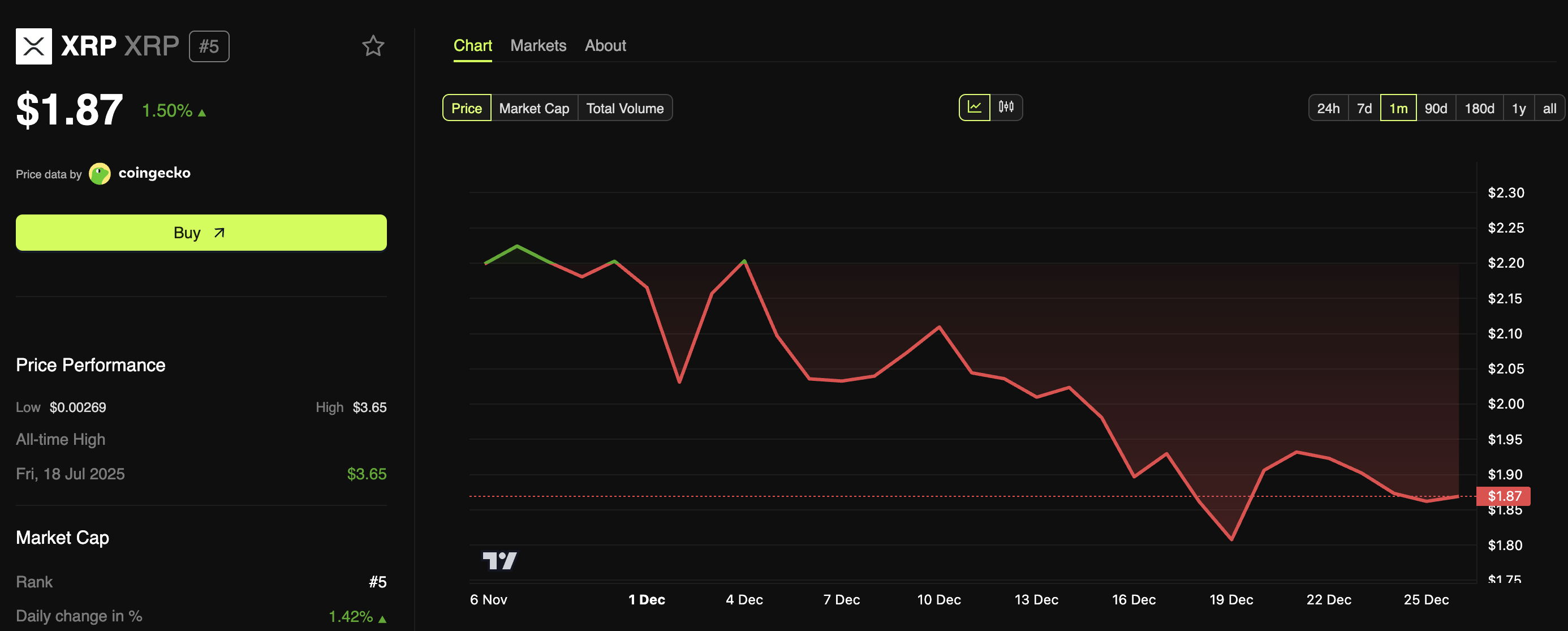
At the time of writing, XRP’s trading price stood at $1.87. The price rose 1.5% over the past day as part of the broader market rally.

XRP Price Performance
XRP Price Performance. Source: BeInCrypto Markets

Still, BeInCrypto reported that the current market cycle threatens to end XRP’s two-year streak of positive annual returns, with the token likely to close the year down approximately 11%.

Meanwhile, XRP is not the only major crypto asset facing pressure in the fourth quarter of 2025. Other leading cryptocurrencies have also declined, weighing on institutional investors with large on-chain positions.

According to analyst Maartunn, BitMine is currently sitting on an unrealized loss of approximately $3.5 billion on its Ethereum holdings. Despite the drawdown, the firm has continued to accumulate ETH.

Bitmine is currently sitting on an unrealized loss of -$3.5B — a massive drawdown. 🤯 pic.twitter.com/dp2lQMaPWl

— Maartunn (@JA_Maartun) December 24, 2025

Bitcoin-focused treasuries are facing similar challenges. Metaplanet’s Bitcoin holdings are down roughly 18.8%, while several other institutional holders are showing comparable declines as broader market weakness persists.

The post XRP Price Slump Leaves Evernorth Facing Over $200 Million in Unrealized Losses appeared first on BeInCrypto.
  •  

Multicoin Capital Buys 60 Million Worldcoin (WLD) as Retail Engagement and Price Slide

Multicoin Capital has reportedly purchased 60 million Worldcoin (WLD) in an over-the-counter transaction with the project’s team, betting on the biometric identity protocol.

The acquisition comes amid a period of declining investor engagement, with WLD’s price slipping 21% over the past month.

Multicoin Capital Doubles Down on Worldcoin Despite Price Slide

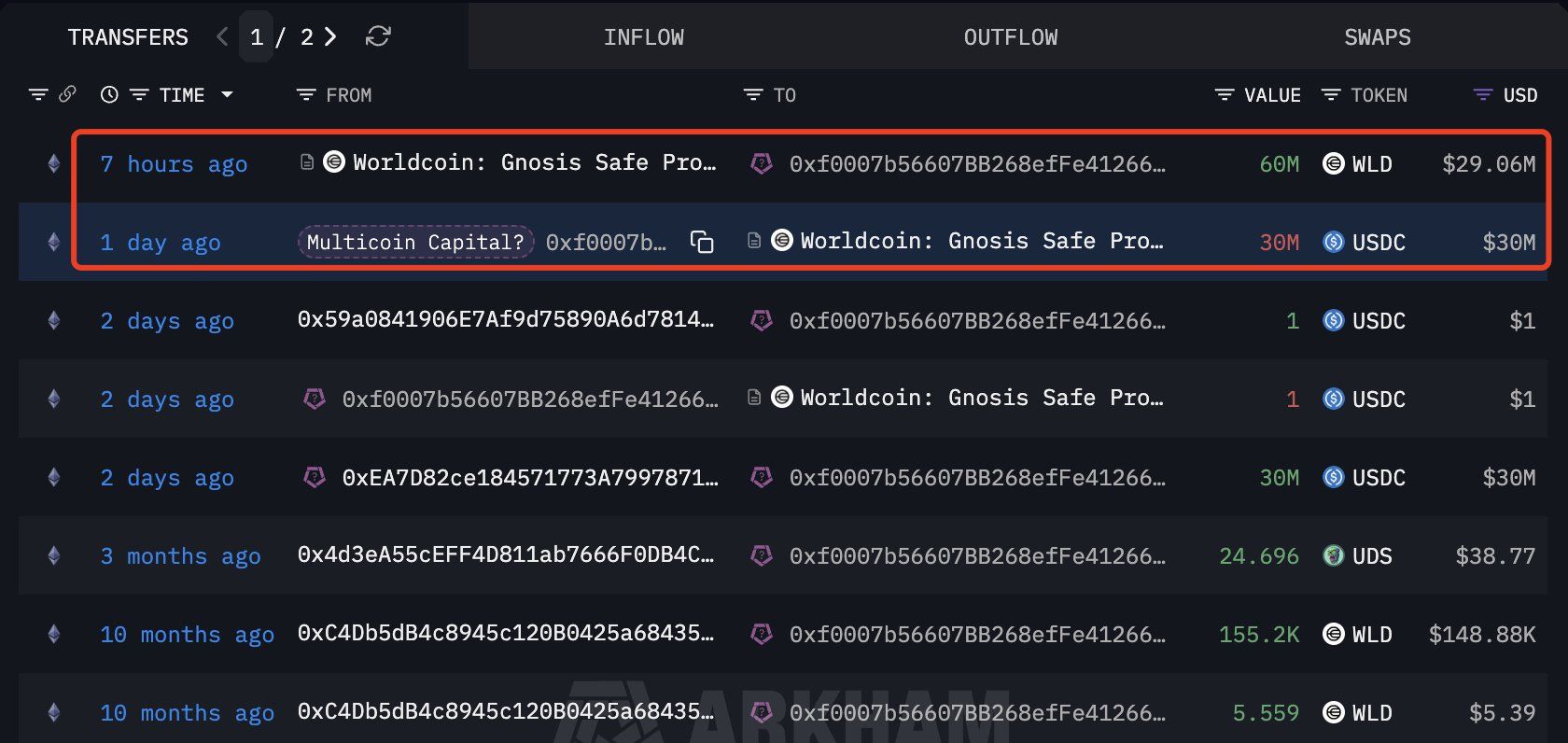
Founded in 2017, Multicoin Capital is a thesis-driven firm specializing in crypto and blockchain projects. Blockchain analytics firm Lookonchain identified a large transaction involving a wallet reportedly associated with Multicoin Capital (0xf0007b56607BB268efFe4126655f077F8cf42696).

Multicoin Capital's WLD Purchase
Multicoin Capital’s WLD Purchase. Source: X/Lookonchain

According to on-chain data, the address transferred 30 million USDC to the Worldcoin team one day ago. Then, Multicoin received 60 million WLD tokens, suggesting an OTC deal directly with the project rather than an open-market purchase.

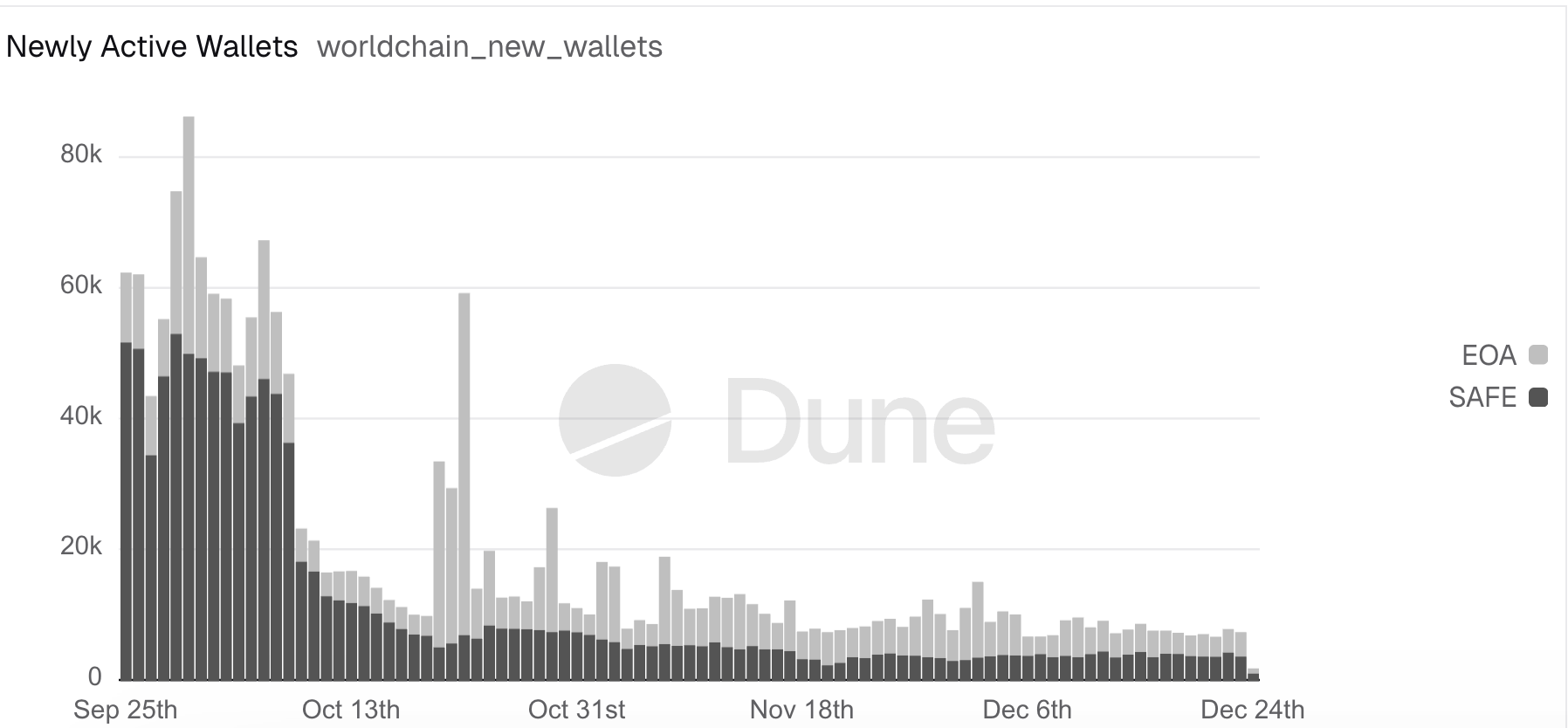
The timing of the transaction is notable, as on-chain and search data point to declining interest in Worldcoin. Dune Analytics showed that the number of new active wallet addresses has fallen sharply since September.

New Worldcoin Wallets
New Worldcoin Wallets. Source: Dune

The slowdown in new participants suggests weakening retail demand, even as institutional investors continue to accumulate. Search interest has followed a similar trajectory.

Google Trends data revealed that searches for “Worldcoin” dropped significantly after peaking at a score of 100 in September. That surge was largely driven by Upbit’s listing of WLD, which also pushed the token’s price up at the time. Since then, however, Worldcoin has erased those gains, with search interest falling to a score of 6 at press time.

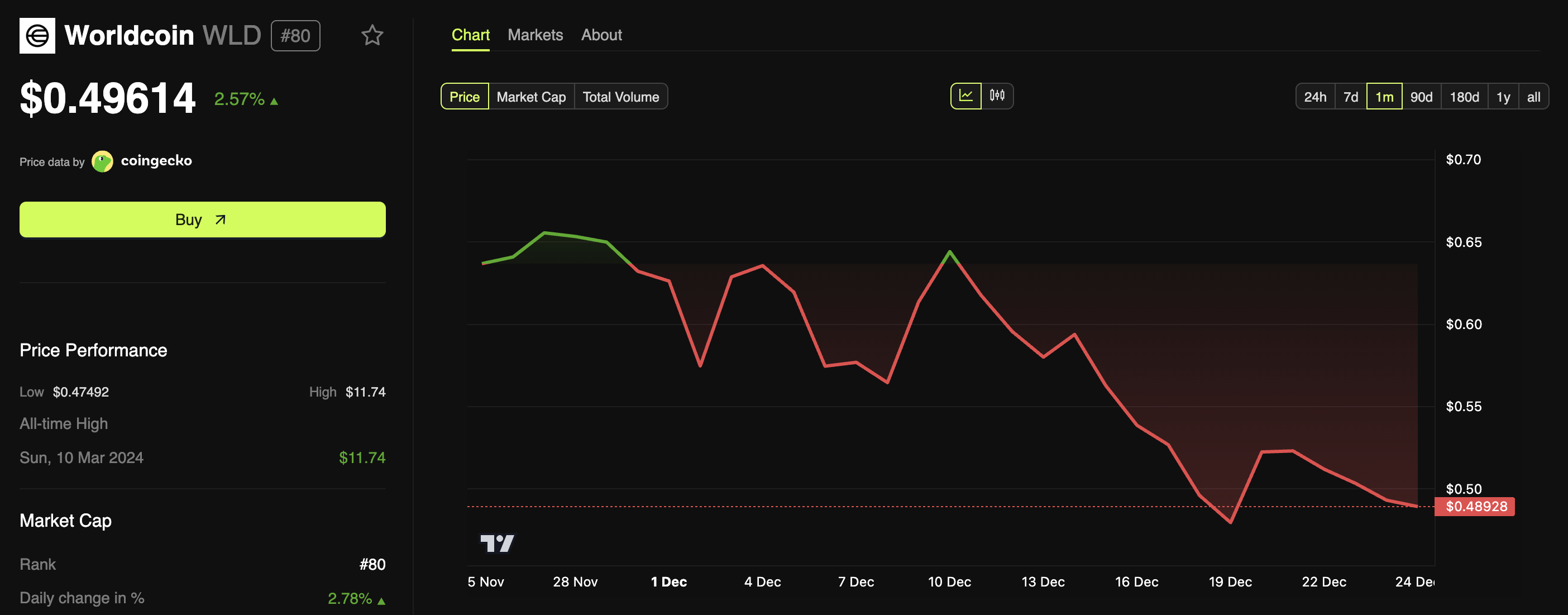
Price action reflects this cooling momentum. According to BeInCrypto Markets data, WLD has lost more than 21% of its value over the past month.

At the time of writing, the token was trading at $0.49614, representing a 2.57% increase over the past 24 hours. The short-term rebound comes amid a broader market recovery, with the total crypto market capitalization rising by nearly 0.5%.

Worldcoin (WLD) Price Performance. Source: BeInCrypto Markets

Beyond its price performance, the project is also under growing regulatory pressure. In late November, Thai authorities ordered World to suspend its iris-based enrollment activities in the country and erase biometric data gathered from more than 1 million individuals.

The order followed an October enforcement action, during which officials raided one of the project’s iris-scanning sites in Thailand.

“This collaboration will enhance the effectiveness of law enforcement in prosecuting and suppressing unlicensed digital asset businesses, while protecting users from lack of legal protection and mitigating risks of scams and money laundering,” Ms. Jomkwan Kongsakul, SEC Deputy Secretary-General, noted.

These developments add to earlier challenges. In May, the project encountered regulatory setbacks in both Indonesia and Kenya.

The post Multicoin Capital Buys 60 Million Worldcoin (WLD) as Retail Engagement and Price Slide appeared first on BeInCrypto.
  •  

Why Retail’s Lack of Interest May No Longer Signal a Market Bottom

Retail participation in the cryptocurrency market has continued to decline throughout this cycle, with interest weakening further as the year draws to a close.

While some analysts still interpret fading retail engagement as a classic bottom signal, others argue the current downturn reflects a deeper cultural and social shift, where investor attention has moved away from crypto altogether.

Does Retail Apathy Mark a Bottom or a New Phase?

The crypto market’s downturn has prompted many analysts to call for a potential bottom, citing a range of factors from on-chain data and technical patterns to shifts in investor behavior. Among these indicators, retail disengagement has often been viewed as a key bottom signal.

Analysts argue that periods of extreme pessimism and low participation have coincided with market bottoms, leading them to interpret today’s widespread indifference as a similar turning point.

“Retail comes in at the TOP, not at the bottom, and the absence of retail at this moment implies this is not a market top, but rather a market bottom in the making,” an analyst stated.

However, new data suggests things may have changed. In a recent post, analyst Luc highlighted a deeper shift in retail. According to him,

“It’s cultural. A social shift. Attention has relocated.”

One clear sign is plunging interest in crypto content platforms. For example, a crypto YouTuber with 139,000 subscribers reported that their views have dropped more than at any other point in the past five years.

Well-known crypto influencers are also shifting focus to traditional equities. Together, these trends suggest a fading of attention rather than a temporary retracement.

Among younger investors, perceptions have changed. Crypto now competes with accessible alternatives such as prediction markets and crypto stocks, which have a lower risk of “rug pulls.”

“Every vehicle is becoming more accessible. From COIN adding stock trading, to HOOD adding 0DTE options, to prediction markets as a whole…Everything’s right there…without the perceived risk of a rug-pull via the “lawless” crypto landscape that defined crypto’s appeal in the first place,” Luc said.

Recently, BeInCrypto reported that many new investors are favoring gold and silver over crypto amid persistent inflation and broader macroeconomic uncertainty. This shift points to a wider generational turn.

Crypto’s image struggles further due to the rising number of hacks and scams. According to Chainalysis, the crypto industry lost more than $3.4 billion between January and early December.

Security incidents have increased during this period, with attackers employing increasingly sophisticated tactics to steal funds and exploit users.

“It’s now considered cringe to be in crypto. There’s too many scams for the average degen to handle. Kids would rather work in AI or something. general population doesnt really wanna do anything with crypto we didnt redeem ourselves after luna + ftx + illiquid jpegs debacles of 2022,” Kate, another market watcher, said.

Institutional Entry Is Changing Market Dynamics

While retail interest wanes, established financial firms are expanding their presence in crypto. Polygon Labs’ Aishwary Gupta told BeInCrypto that institutions account for an estimated 95% of crypto inflows, while retail participation has dropped to around 5–6%.

From the rise of digital asset treasuries (DATs) to legacy financial institutions increasingly entering the space, the market is becoming more institutionally driven. Yet, increased institutional involvement is a double-edged sword.

This adds legitimacy and easier access, but the sector’s original appeal drew people keen to escape traditional finance. Growing institutional dominance may undermine that core.

“But with legacy brokerages like Schwab/JPMorgan getting involved + gov’t interest, is crypto losing the demographic that made it popular in the first place?” Luc remarked.

Luc acknowledged that many of these dynamics have appeared in previous crypto bear markets. However, he emphasized that new variables now “change the game.”

“Crypto seems to be in a transition phase…from a momentum asset to an infrastructure asset,” he added.

If retail participation has indeed structurally declined, the key question becomes whether real-world crypto utility can offset fading speculative demand. Blockchain adoption in payments, supply chains, and decentralized finance is growing.

Still, it remains unclear whether these developments can generate the level of enthusiasm that fueled previous market cycles. As 2026 approaches, the dynamics of the crypto sector may offer clearer insight into whether this shift represents a temporary phase or a lasting transformation.

The post Why Retail’s Lack of Interest May No Longer Signal a Market Bottom appeared first on BeInCrypto.

  •  

Bloomberg’s 2026 Outlook Ignored Crypto—But Four Themes Still Matter

Bloomberg’s year-end Trumponomics podcast delivered a comprehensive outlook for the global economy in 2026. Stephanie Flanders, head of government and economics at Bloomberg, hosted the episode.

It featured Tom Orlik, chief economist at Bloomberg Economics; Mario Parker, managing editor for US politics; and Parmy Olson, a Bloomberg Opinion columnist covering AI.

No Crypto Talk, But Four Themes Matter

Over nearly 48 minutes, the panel covered a broad range of topics, including trade and tariffs, security (Ukraine), AI, the Federal Reserve, China, and the overall US economy. Notably, cryptocurrency was never directly mentioned.

However, four themes discussed during the podcast stand out as particularly relevant for digital asset markets heading into 2026. Below is an analysis of those selected topics and their potential implications for crypto.


1. Threats to Fed Independence

Orlik addressed the Federal Reserve’s independence as one of the most consequential issues for 2026. President Trump will have the authority to appoint a new Fed chair when Powell’s term ends in May 2026. Kevin Hasset is widely considered a leading candidate, while Steven Myron has already joined the Fed board.

“An independent Federal Reserve is a fundamental underpinning of market confidence that the US will be serious about controlling inflation,” Orlik said. “If that confidence is undermined, well, the status of the dollar, the status of the Treasury market, both open to question.”

Crypto implication: Erosion of Fed independence is a double-edged sword for crypto. If the dollar’s credibility weakens, Bitcoin’s “digital gold” narrative could gain traction. Grayscale noted in its 2026 outlook that “the outlook for fiat currencies is increasingly uncertain; in contrast, we can be highly confident that the 20 millionth Bitcoin will be mined in March 2026.”

However, policy uncertainty could also trigger risk-off sentiment, pressuring crypto prices in the short term alongside other risk assets.


2. AI Bubble Risk

Olson warned of a potential correction in AI-related stocks in 2026. “You’ve got 900 million people using ChatGPT every week. That’s astoundingly successful from a market dominance perspective, but it’s not really making money for OpenAI because very few of those people are paying subscriptions,” she said. She compared the current environment to the dot-com bubble and the 19th-century railroad boom.

Crypto implication: QCP Capital analysts noted that “crypto remains caught in the macro crosscurrents,” with AI stocks acting as “a key driver of broader risk sentiment.” If AI stocks correct, the resulting risk-off sentiment would likely drag crypto markets down as well.


3. Tariff Pass-Through to the Real Economy

Orlik noted that one surprise of 2025 was how slowly tariffs passed through to consumer prices and corporate earnings. However, he expects this to change in early 2026. “That pass-through of tariffs to the rest of the economy—higher prices at the shops, lower margins for US businesses, potentially a hit to US stocks—that’s still something that will play out in the early months of 2026,” he said.

Crypto implication: If tariff-driven inflation persists, the Fed’s ability to cut rates will be constrained. YouHodler noted that “prolonged high interest rates could reduce risk appetite and slow capital inflows into crypto assets.” However, in a stagflation scenario—where inflation persists alongside slowing growth—Bitcoin could be re-evaluated as an inflation hedge.


4. Dollar Stability and Political Dynamics

Orlik highlighted a potential paradox in post-midterm political dynamics. If Trump loses ground in the midterms and faces gridlock in Congress, he may turn to the Fed—where he will have appointed his own chair—as an alternative lever of influence.

“It could be that there’s some dynamic between loss of power at the midterms, greater capacity to and willingness to influence the Fed, which could potentially play out in a pretty negative way for the US bond market.”

Crypto implication: Dollar instability has historically correlated with Bitcoin demand. Grayscale projected that “digital money systems like Bitcoin and Ethereum that offer transparent, programmatic, and ultimately scarce supply will be in rising demand due to rising fiat currency risks.”


Q1 Will Set the Direction

Institutional forecasts for Bitcoin’s 2026 price vary widely. Grayscale expects a new all-time high in the first half of the year, declaring “the end of the four-year cycle theory.” JP Morgan projects $170,000, while Fundstrat sees $200,000 to $250,000. Bear-case scenarios point to a potential drop below $75,000 if global liquidity tightens.

The big picture for 2026 appears bullish, given the Trump economic mandate, the Fed’s policy trajectory, and crypto-friendly regulation. But the unknown outcomes of the AI buildout and the actual impact of rate cuts on consumers and the economy will likely determine the direction markets take in Q1 and Q2.

The post Bloomberg’s 2026 Outlook Ignored Crypto—But Four Themes Still Matter appeared first on BeInCrypto.
  •  

US ETF Market Hits Triple Crown While BTC Bleeds and XRP Soars

The US ETF market achieved a historic “triple crown” in 2025, setting records in inflows ($1.4 trillion), new launches (1,100+), and trading volume ($57.9 trillion). This is the first time all three metrics hit records simultaneously since 2021.

Three consecutive years of double-digit S&P 500 gains powered the rally. But Wall Street is starting to ask: what comes next?

The Ghost of 2022

That precedent carries a warning. The year following the 2021 triple crown saw the S&P 500 plunge 19% amid the Federal Reserve’s aggressive rate hikes. The tech-driven rally that fueled ETF inflows reversed sharply, with both inflows and launches slowing in 2022.

The parallels are hard to ignore. In 2021, exuberance around tech stocks drove record demand. In 2025, AI spending has dominated while skepticism is mounting. Since October, the S&P 500 has traded sideways as Wall Street questions the returns on Big Tech’s AI capex.

Eric Balchunas, senior ETF analyst at Bloomberg Intelligence, warned: “Because of how perfect this year seemed to be for ETFs, you kind of want to brace for it.” He suggested a “reality check” could come in 2026 through market volatility or leveraged ETF blowups—risks already demonstrated by GraniteShares’ 3x Short AMD ETP, which lost 88.9% in a single day and was liquidated in October.


The Crypto ETF Rotation

Within the broader ETF boom, a striking divergence is playing out in cryptocurrency funds.

BlackRock’s IBIT attracted $25.4 billion despite a -9.6% return—the only negative performer among the top 10 flow leaders. Balchunas called it “Boomers putting on a HODL clinic.” But the tide turned after Bitcoin’s 30% drop from its October high. IBIT recorded five consecutive weeks of outflows totaling $2.7 billion. Ethereum ETFs followed with seven straight days of outflows in December, totaling $685 million.

The opposite emerged in newly launched altcoin ETFs. US spot XRP ETFs, debuting November 13, recorded 28 consecutive trading days of net inflows—unmatched by any crypto ETF at launch. Cumulative inflows reached $1.14 billion with zero outflow days. Still, the daily pace—mostly $10-50 million—pales compared to Bitcoin ETFs, which regularly drew $500 million or more in their early days.

Solana ETFs attracted $750 million despite SOL’s 53% price decline—though unlike XRP, they experienced several outflow days in late November and early December.

BTCETHXRPSOL
YTD Inflows$25.4B$10.3B$1.14B$750M
Dec 1-24-$629M-$512M+$470M+$132M
Notable5-week outflows7-day outflows28-day inflow streakInflows despite -53%
Source: BeInCrypto

December crystallized this rotation. Through December 24, Bitcoin ETFs shed $629 million, while Ethereum lost $512 million; XRP added $470 million, and Solana gained $132 million.


Structural Shift or Temporary Adjustment?

Those arguing for structural change point to regulatory clarity—XRP’s SEC lawsuit concluded in August with a $125 million settlement, classifying it as a non-security. Utility narratives are also gaining traction: XRP’s cross-border payments and Solana’s DeFi ecosystem offer applications beyond “digital gold.”

Skeptics caution that XRP and SOL’s consistent inflows may reflect a “honeymoon effect” typical of new ETF launches. Despite record ETF inflows, XRP remains 50% below its July peak, and SOL has dropped 53% since October—a disconnect some attribute to year-end profit-taking and to whales distributing holdings offsetting institutional demand.


2026 Outlook

With dozens of crypto ETF applications still awaiting SEC review, more altcoin products are expected in 2026.

The ETF market’s “perfect year” will be remembered alongside correction warnings. But the rotation within crypto ETFs suggests institutional investors are becoming selective—moving beyond Bitcoin and Ethereum toward assets with regulatory clarity and real-world utility. Whether this trend continues will be a key indicator for the broader market’s direction.

The post US ETF Market Hits Triple Crown While BTC Bleeds and XRP Soars appeared first on BeInCrypto.
  •  

Nvidia Absorbs Another Rival for $20B, Boosting Decentralized AI

NVIDIA has agreed to pay approximately $20 billion to acquire assets from artificial intelligence chip startup Groq, marking the company’s largest transaction on record and continuing its strategy of absorbing potential competitors before they can challenge its market dominance.

The chipmaker’s latest licensing deal mirrors a similar transaction just three months ago, reinforcing the narrative that decentralized AI infrastructure may offer the only alternative to Nvidia’s growing dominance.

Threefold Premium in Three Months with Trump Jr. Connection

The deal closed just three months after Groq raised $750 million at a $6.9 billion valuation—a round that included BlackRock, Samsung, Cisco, and 1789 Capital, where Donald Trump Jr. serves as a partner. Nvidia is acquiring all of the company’s assets substantially, except its cloud computing business, though Groq framed the transaction as a “non-exclusive licensing agreement.”

Groq CEO Jonathan Ross, a former Google engineer who helped create the search giant’s Tensor Processing Unit, will join Nvidia along with president Sunny Madra and other senior executives. The startup will continue operating independently under CFO Simon Edwards as its new chief executive.

A Repeating Playbook

The Groq transaction follows a pattern Nvidia established just three months earlier. In September, the company paid over $900 million to hire Enfabrica’s CEO and employees while licensing the startup’s technology. Both deals use licensing structures rather than outright acquisitions, potentially avoiding the antitrust scrutiny that blocked Nvidia’s $40 billion bid for Arm Holdings in 2022.

The Kobeissi Letter summarized Nvidia’s approach bluntly: “We will buy you before you can compete with us.”

Nvidia's newest strategy:

"We will buy you before you can compete with us."

There has never been a company like Nvidia. https://t.co/wsbuAgIqyM

— The Kobeissi Letter (@KobeissiLetter) December 24, 2025

Technical Edge and Competitive Pressure

Groq’s Language Processing Unit uses on-chip SRAM rather than external DRAM, enabling what the company claims is up to 10x better energy efficiency. This architecture excels at real-time inference but limits model size—a tradeoff Nvidia can now explore within its broader ecosystem.

The timing is notable. Google recently unveiled its seventh-generation TPU, codenamed Ironwood, and released Gemini 3, trained entirely on TPUs, to top benchmark rankings. Nvidia responded on X: “We’re delighted by Google’s success… NVIDIA is a generation ahead of the industry—it’s the only platform that runs every AI model.” When incumbents start issuing such reassurance statements, competitive pressure is clearly mounting.

Implications for Decentralized AI

While the deal has no direct impact on cryptocurrency markets, it reinforces the narrative driving decentralized AI computing projects. Platforms like io.net position themselves as alternatives to centralized AI infrastructure.

“People can put their own supply onto a network, whether that’s data centers or yourself with your laptop, contributing your available GPU power, and getting fairly compensated for it using tokenomics,” Jack Collier, io.net’s Chief Growth Officer, told BeInCrypto. The platform claims enterprise clients, including Leonardo.ai and UC Berkeley, have achieved significant cost savings.

However, the gap between narrative and reality remains wide. Nvidia’s acquisition of Groq’s low-latency technology further extends its technical lead, making it harder for any alternative to offer competitive performance.

The transaction also raises questions about independent AI chip development. Cerebras Systems, another Nvidia competitor preparing an IPO, may eventually face similar pressure. Whether it can remain independent or succumb to Nvidia’s financial gravity remains to be seen.

The post Nvidia Absorbs Another Rival for $20B, Boosting Decentralized AI appeared first on BeInCrypto.

  •  

Canton’s CC Token Jumps on Christmas Eve as Institutions Drive the Privacy Narrative

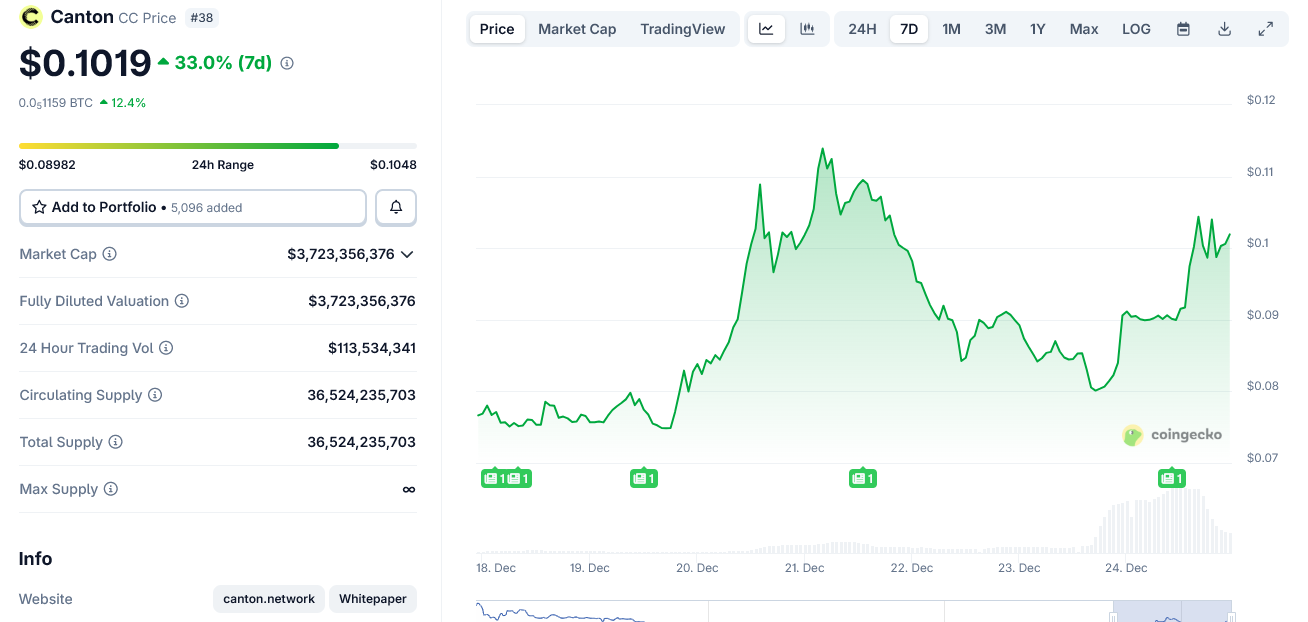
Canton’s CC token emerged as the top gainer in the crypto market on Christmas Eve, rising more than 25% in 24 hours despite thin holiday liquidity and broadly bearish sentiment. The rally pushed CC ahead of major assets and privacy coins.

The move was not driven by retail hype or seasonal speculation. Instead, it reflected a growing institutional narrative around real-world asset (RWA) tokenization and regulatory clarity—two themes that have gained traction into year-end.

Top Gainers in the Crypto Market on Christmas Eve 2025. Source: CoinGecko

Institutional Tokenization Fuels Canton Token Rally

At the center of the rally is Canton Network, a privacy-enabled Layer-1 blockchain designed specifically for regulated financial institutions. 

Unlike public DeFi chains, Canton allows institutions to transact on-chain while keeping sensitive data private. This is a key requirement for banks, clearing houses, and asset managers.

Canton’s utility token, CC, is used for transaction fees, network security, and validator incentives. Its value is tied less to retail activity and more to institutional usage

That’s why price moves are highly sensitive to infrastructure-level developments.

Momentum accelerated after DTCC (Depository Trust & Clearing Corporation) confirmed progress on tokenizing DTC-custodied US Treasury securities on the Canton Network. 

Minting and using U.S. Treasuries on Canton is coming in 2026, enabling tokenized USTs to be exchanged in near-real-time with stablecoins and other digital assets – all with the privacy and controls regulated markets demand.

A major unlock for global collateral mobility to… pic.twitter.com/XnvdprRq7X

— Canton Network (@CantonNetwork) December 17, 2025

The initiative follows a regulatory green light from the US SEC, which issued a non-action letter allowing DTCC to proceed with live tokenization infrastructure.

That development marked one of the clearest regulatory endorsements yet for on-chain Treasuries. 

As a result, markets began repricing Canton as core infrastructure rather than a speculative blockchain project.

Earlier in December, Canton also deepened its RWA stack through a partnership with RedStone, which became its primary oracle provider. 

The integration enables real-time, compliant price feeds for tokenized assets, bridging institutional markets with DeFi without compromising privacy.

Together, these developments position Canton as a settlement layer for trillions of dollars in traditional financial assets. 

Industry estimates place more than $300 billion in daily transaction volume already flowing through applications built on the network.

Canton CC Token Weekly Price Chart. Source: CoinGecko

Importantly, the rally came during a low-liquidity holiday session. That context amplified the move but also highlighted where capital is concentrating ahead of 2026: compliant tokenization infrastructure.

While broader crypto markets remain cautious, CC’s performance underscored a growing divergence. 

I’ve come to realize $CC is useless. Also it seems to be inflationary with never ending supply.

Is what I’m hearing often in comments. Let’s clarify.@CantonNetwork has implemented something called BME (Burn-Mint-Equilibrium).

1) Equilibrium in Practice:
• Annual target:… https://t.co/kMAuMCAh7q

— Heslin Kim (@HeslinKim) December 24, 2025

Investors are increasingly differentiating between speculative tokens and protocols tied directly to regulated financial adoption.

On Christmas Eve, Canton sat firmly in the latter camp—and the market reacted accordingly.

The post Canton’s CC Token Jumps on Christmas Eve as Institutions Drive the Privacy Narrative appeared first on BeInCrypto.
  •  

Quantum Computing and Cryptocurrency: A Strong Match or Critical Danger?

There’s always something to be worried about in the crypto space. Whether a failing exchange or changes in a regulatory environment, crypto has largely sailed strongly over the past year, despite the latest bearish sentiment.

However, some still see a challenge on the horizon: quantum computing.

Is Quantum Computing the Doomsday for Crypto?

Quantum computing technology can be thousands of times faster than conventional computing. Some early quantum tests have solved equations that would have taken a traditional computer thousands years.

On paper, that sounds bad for cryptocurrencies. In theory, a quantum computer would be able to crack SHA256, the protocol protecting Bitcoin’s ledger.

Bitcoin & Quantum Risk

Debating the potential risks quantum computers could pose to Bitcoin and how Bitcoin could mitigate that risk is nothing new

In 2008, several leading cryptographers, including Daniel Bernstein, published "Post-Quantum Cryptography"

🧵

[1/13] pic.twitter.com/k9wlpuFrkx

— BitMEX Research (@BitMEXResearch) December 23, 2025

While headlines often frame quantum computing and Bitcoin as adversaries locked in an inevitable showdown, a more nuanced perspective reveals these technologies as potential partners in advancing digital security and computational efficiency. 

In fact, as early crypto investor and enthusiast Charlie Shrem commented in early December at Moneyshow: 

“Quantum computing and crypto are complementary technologies.”

In short, rather than spelling doom for cryptocurrency, quantum computing could catalyze Bitcoin’s evolution into a more robust, secure, and scalable system.

The Opportunity For Crypto as Quantum Develops

Bitcoin’s open-source nature fosters collaboration among cryptographers, developers, and academics, ensuring that solutions can be rigorously tested and deployed. 

The challenge offered by quantum computing, rather than being purely destructive, serves as an impetus for strengthening Bitcoin’s cryptographic foundations. 

The Bitcoin Quantum Leap: Quantum computing won’t break Bitcoin—it will harden it. The network upgrades, active coins migrate, lost coins stay frozen. Security goes up. Supply comes down. Bitcoin grows stronger.

— Michael Saylor (@saylor) December 16, 2025

The crypto community is actively developing quantum-resistant signature schemes. That includes Lamport signatures, which would be implemented through backward-compatible soft forks similar to the successful 2021 Taproot upgrade. 

This evolutionary approach demonstrates how quantum computing’s emergence drives innovation rather than obsolescence. And as technologies continue to innovate, they continue to thrive – good news for Bitcoin.

The transition to post-quantum cryptography represents more than defensive positioning. 

“Quantum computing utiizes fundamental principles of nature, which in turn make it likely to support, rather than work against bitcoin,” states Shrem.

The US National Institute of Standards and Technology’s recent standardization of quantum-resistant cryptographic algorithms marks a significant milestone.

That’s because algorithms like CRYSTALS-Kyber provide new security frameworks that benefit the entire digital ecosystem. 

Cryptocurrencies from Bitcoin on down can adopt these advances, transforming from merely quantum-vulnerable to fundamentally quantum-proof, setting new standards for digital asset security.

Meanwhile, researchers have built and tested a blockchain that can only be mined using quantum computers. This marks the first real-world application of quantum supremacy in blockchain technology. 

This prototype, tested across four geographically distributed quantum processors, introduces “proof of quantum work” as an alternative to traditional proof-of-work systems. 

Discussions around the quantum threat in Bitcoin peaked December 2024.

It's peaking again exactly one year later.

Sentiment? Actually more positive this time.

Some narratives run on a schedule. pic.twitter.com/FKyNhrRQoH

— Perception 🌐 (@BTCPerception) December 22, 2025

The Quantum Solution for Blockchain

Unlike Bitcoin’s energy-intensive mining, which consumed 176 terawatt-hours of electricity in 2024, quantum blockchain systems achieve higher mining efficiency through quantum mechanics.

Quantum computing offers potential solutions to blockchain challenges by providing significant speedup in transaction processing. 

For instance, while Bitcoin’s consensus mechanisms are secure, they can be slow and resource-intensive. Quantum computers could optimize consensus algorithms, validate transactions more efficiently, and address scalability issues that have long plagued blockchain networks. 

This computational power could enable Bitcoin to process thousands more transactions per second without compromising decentralization.

Quantum-enhanced blockchain systems leverage quantum key distribution and quantum random number generation to achieve superior security, preventing data breaches and unauthorized access. 

In other words, rather than replacing Bitcoin’s security, quantum technologies can augment it. 

Quantum key distribution offers theoretically unbreakable encryption for securing Bitcoin wallets and transactions, while quantum random number generators ensure the creation of truly unpredictable private keys.

The Quantum Computing Threat

Every few weeks the same tired narrative resurfaces: “Quantum computing is going to break Bitcoin.”

Every time it spreads, it’s the same routine – loud voices, shallow understanding, and zero connection to the actual science.

Here’s the facts:… pic.twitter.com/xkfMS26XSA

— The White Whale (@TheWhiteWhaleV2) December 1, 2025

The convergence of these technologies creates opportunities for hybrid systems. That could include quantum tokens to provide an additional privacy layer within a specialized blockchain application. 

This complementary approach allows Bitcoin to incorporate quantum advantages while maintaining its proven decentralized structure.

The quantum challenge has united the cryptocurrency community in unprecedented ways. 

Blockchain analytics providers are preparing to support quantum-resistant address formats and transaction types to ensure continuity of compliance and quantum security monitoring capabilities.

This coordination extends beyond cryptocurrencies themselves. It includes exchanges, wallet providers, research institutions, and regulatory bodies working together to ensure the entire ecosystem transitions smoothly.

The blockchain industry is proactively addressing quantum threats with quantum-resistant tokens and post-quantum cryptography, with projects leading the charge in lattice-based cryptography and hash-based methods. 

This competitive innovation benefits crypto as a whole. That’s because successful quantum-resistant implementations in other projects help successful crypto projects evolve. The shared challenge creates a rising tide that lifts all boats.

“We haven’t even scratched the surface yet of what’s possible,” notes Shrem. “Quancum computing is turning into a new kind of computer, and we need to think about what that fully means.”

Quantum’s Path Forward for Crypto

The relationship between quantum computing and cryptocurrency need not be antagonistic. 

Timeline estimates suggest a 5 to 15-year window before quantum computers pose direct threats to current crypto standards, providing ample time for preparation. 

Quantum blockchains could open the doors for applications in fields requiring high-level security and computational power. That includes secure voting systems, supply chain management, and healthcare data sharing.

Bitcoin’s decentralized governance and adaptive nature position it well to incorporate quantum advantages. 

As quantum computing matures, all cryptocurrencies can integrate quantum-resistant cryptography, leverage quantum-enhanced mining efficiency, and adopt quantum security protocols. 

The result would be a cryptocurrency ecosystem that’s more secure, efficient, and scalable than ever before—not despite quantum computing, but because of it. 

This symbiotic relationship represents not the end of Bitcoin, but rather the beginning of its quantum-powered future.

The post Quantum Computing and Cryptocurrency: A Strong Match or Critical Danger? appeared first on BeInCrypto.
  •  

Americans Want Crypto for Christmas—Even as Inflation Squeezes Budgets

Americans are feeling the pressure of higher living costs, but they are not stepping away from crypto. 

A new holiday spending survey from Visa Inc. shows a growing appetite for digital assets as gifts, even as inflation continues to limit disposable income and keep consumers cautious. The contrast highlights a deeper shift in how households adapt when money feels tight.

Inflation Is Cooling, but Budgets Still Feel Tight

Inflation has eased from its post-pandemic peak, but prices remain elevated across essentials such as housing, food, insurance, and utilities. 

Wages have broadly kept pace with inflation, preventing a sharp drop in purchasing power. Still, the margin is thin. 

After covering necessities, many households have less flexibility for investing or discretionary spending than they did before 2022.

US energy inflation is accelerating:

CPI energy prices jumped +4.2% YoY in November, the fastest pace since February 2023.

This marks the 2nd-consecutive acceleration, following a +2.8% YoY increase in September.

The surge was driven by fuel oil, electricity, and utility gas… pic.twitter.com/nXS30Km6fI

— The Kobeissi Letter (@KobeissiLetter) December 23, 2025

This environment has not stopped spending outright. Instead, it has changed behavior. Consumers shop earlier, compare prices more aggressively, and rely on technology to stretch each dollar further. 

Financial confidence remains fragile, but economic participation continues. That caution shows up clearly in how people spend—and what they choose to buy.

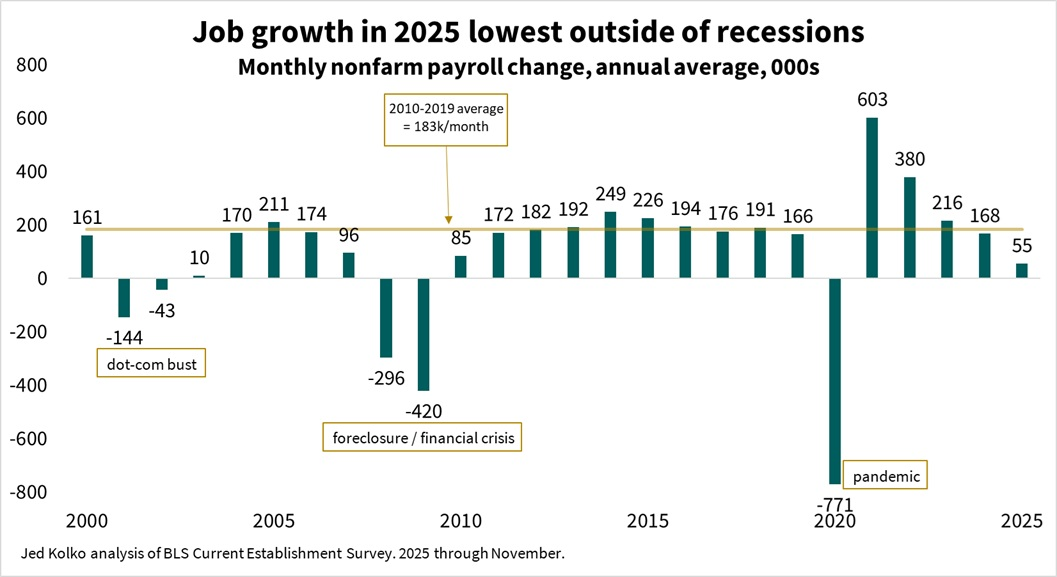
US Job Growth Over the Years. Source: X/Jed Kolko

Crypto Emerges as a “Lean Budget” Gift

Visa’s December survey reveals that 28% of Americans would be excited to receive crypto as a holiday or Christmas gift, a figure that jumps to 45% among Gen Z

The appeal is not about luxury. It reflects a preference for assets that feel flexible, digital-first, and potentially long-term in value.

At the same time, 47% of US shoppers reported using AI tools to assist with holiday purchases, primarily to find gift ideas and compare prices. This signals a consumer mindset focused on optimization rather than excess.

Could crypto replace holiday cash? More than one-in-four US adults, and nearly half of Gen-Z adults, say they would be excited to receive cryptocurrency as a gift, according to a survey from Visa and Morning Consult https://t.co/xhU2SfJpch pic.twitter.com/RUtS7aKSMP

— Reuters (@Reuters) December 5, 2025

Younger shoppers lead the shift. Gen Z respondents show higher adoption of crypto payments, digital wallets, biometric authentication, and cross-border shopping than any other age group. 

For them, crypto fits naturally into a broader digital financial identity.

The data suggests crypto gifting is not crowding out essentials. Instead, it replaces traditional discretionary items at a time when consumers remain selective.

What This Says About the US Economy

The combination of easing inflation and persistent budget pressure points to a cautious but stable economy. 

Americans are not retreating, but they are adapting. Spending continues, yet it leans toward tools and assets that promise efficiency, optionality, or future upside.

Crypto’s growing acceptance as a gift—despite tighter disposable income—signals cultural normalization rather than speculative exuberance. 

It also helps explain why digital assets continue to attract interest even during periods of economic restraint.

For markets, the message is clear. Inflation may be cooling, but confidence has not fully returned. 

In that gap, technology and alternative assets are filling a role that traditional consumption no longer does.

Americans may feel stretched, but they are still betting—carefully—on the future.

The post Americans Want Crypto for Christmas—Even as Inflation Squeezes Budgets appeared first on BeInCrypto.
  •  

Indian Authorities Bust Multi-State Crypto Scam Running for 10 Years

India’s Enforcement Directorate (ED) has carried out coordinated raids at 21 locations across Karnataka, Maharashtra, and Delhi as part of a widening probe into a large-scale crypto scam that allegedly operated for nearly a decade.

The searches were conducted on December 18 under the Prevention of Money Laundering Act (PMLA). It targeted residential and office premises linked to 4th Bloc Consultants and its associates. 

India’s Largest Crypto Bust Yet?

Authorities say the group ran fake crypto investment platforms that duped both Indian and foreign investors by promising unusually high returns.

According to the ED, the case originated from a police FIR and intelligence inputs from the Karnataka State Police. 

Investigators allege the accused created professional-looking websites that closely mimicked legitimate global crypto trading platforms, complete with dashboards, account balances, and transaction histories.

BREAKING: 🇮🇳 ED raids 21 locations across Karnataka, Maharashtra and Delhi in a major crypto investment fraud case.

• Movable and immovable properties in India and abroad identified

• Multiple crypto wallet addresses identified

• Investigation ongoing pic.twitter.com/WoDyxfO7A1

— Crypto India (@CryptooIndia) December 23, 2025

However, these platforms were largely a façade. Officials say there was little or no real trading activity. 

Instead, the crypto scammers recycled investors’ funds in a structure resembling a classic Ponzi or multi-level marketing scheme.

To build credibility, the operators allegedly misused photographs of well-known crypto commentators and public figures without consent. 

Early investors were paid small returns to gain trust. Later, they were encouraged to invest larger sums and recruit new participants through referral bonuses.

As the scheme expanded, promoters relied heavily on social media platforms. This included Facebook, Instagram, WhatsApp, and Telegram to attract victims. 

The ED believes the network targeted investors in India and overseas.

Investigators say the proceeds of crime were laundered through a complex web of crypto wallets, undisclosed foreign bank accounts, shell companies, and hawala channels. 

Scammers also moved the funds via peer-to-peer crypto transfers before being converted into cash or parked in bank accounts.

During the raids, the ED identified several crypto wallet addresses allegedly controlled by the accused, along with movable and immovable assets acquired in India and abroad using illicit funds.

Authorities also flagged multiple foreign entities used to conceal the money trail.

Notably, officials believe the operation dates back to at least 2015. The scammers evolved over time to evade detection as scrutiny of crypto markets increased.

The investigation remains ongoing.

The post Indian Authorities Bust Multi-State Crypto Scam Running for 10 Years appeared first on BeInCrypto.

  •  

Dogecoin Nears Breakdown Zone; On-Chain Signals Fight Back — What’s Next For Price

Dogecoin price has remained under pressure. The token is down around 2% over the past 24 hours and more than 12% over the past month. Price action has weakened, but the decline is slowing.

While the chart structure still leans bearish, on-chain behavior suggests the breakdown may not be a done deal yet. The next few sessions will decide whether DOGE slips into a deeper decline or stabilizes near current levels.

Dogecoin Price Pressure Builds as Short-Term Supply Exits

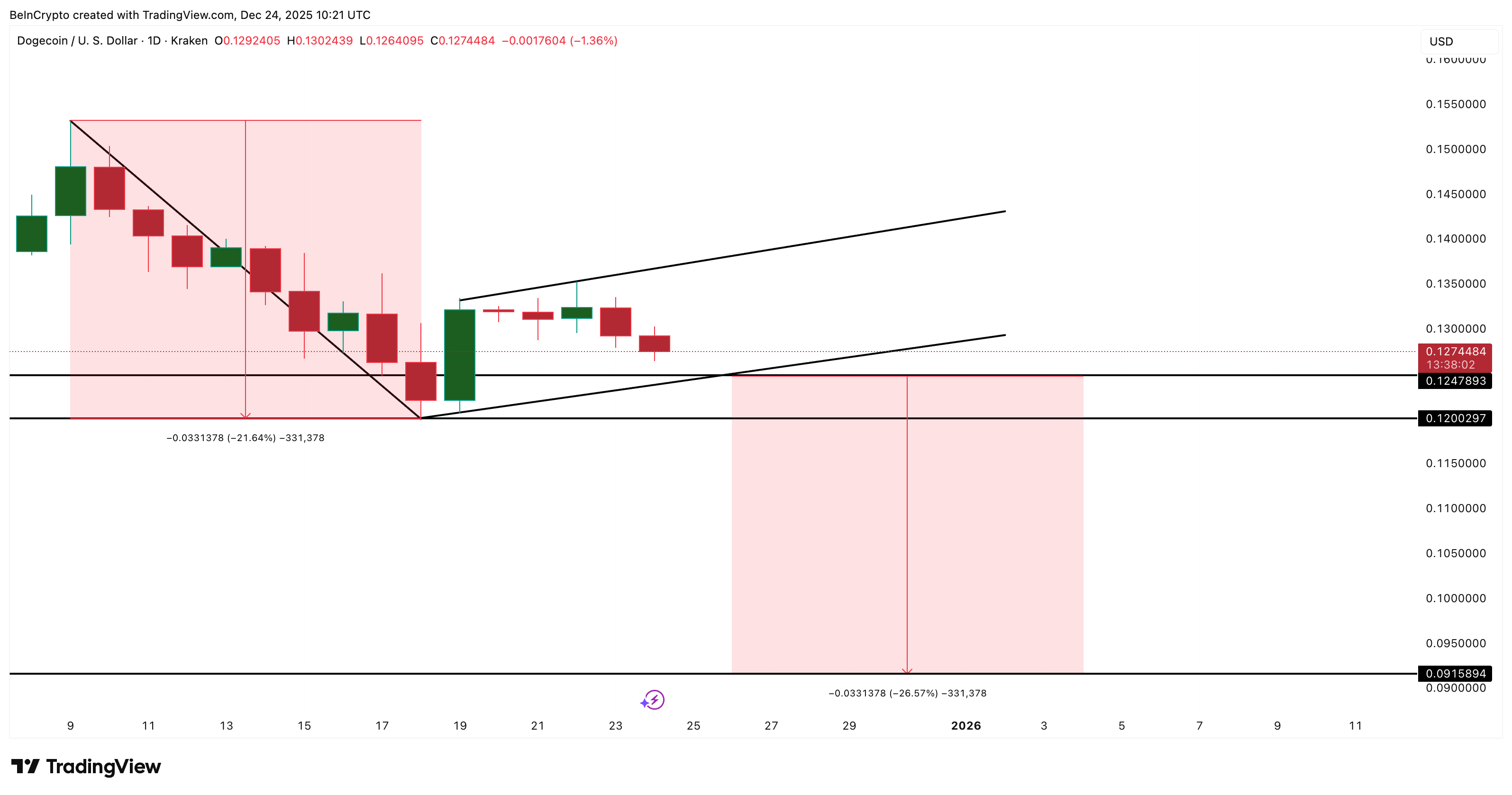
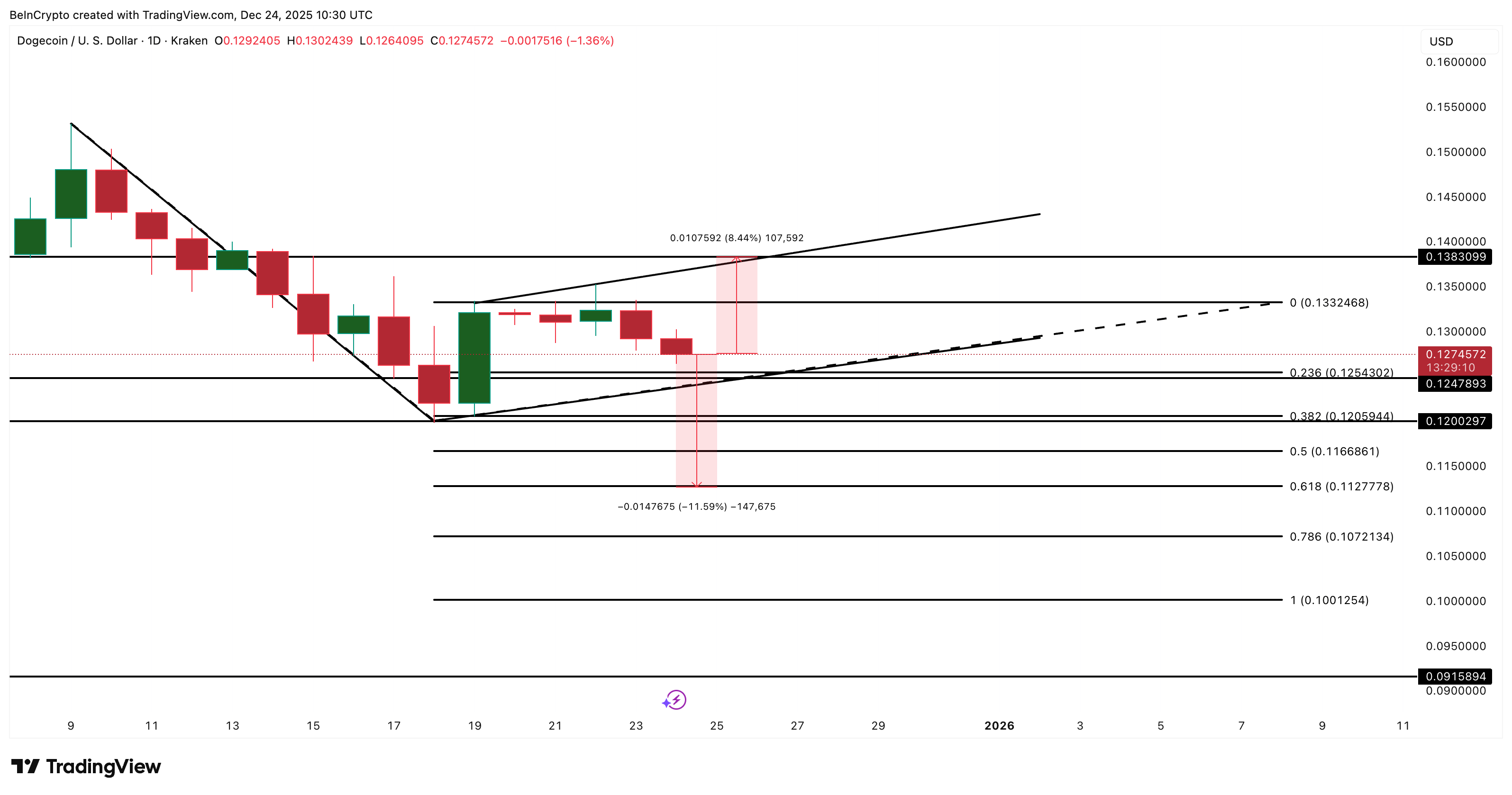
Dogecoin is trading near the lower boundary of a declining price structure, with a bear flag forming. That keeps downside risk active, especially if support near $0.124-$0.120 fails. However, what stands out is how speculative supply has behaved as price drifted lower.

Want more token insights like this? Sign up for Editor Harsh Notariya’s Daily Crypto Newsletter here.

Bear Flag Forming
Bear Flag Forming: TradingView

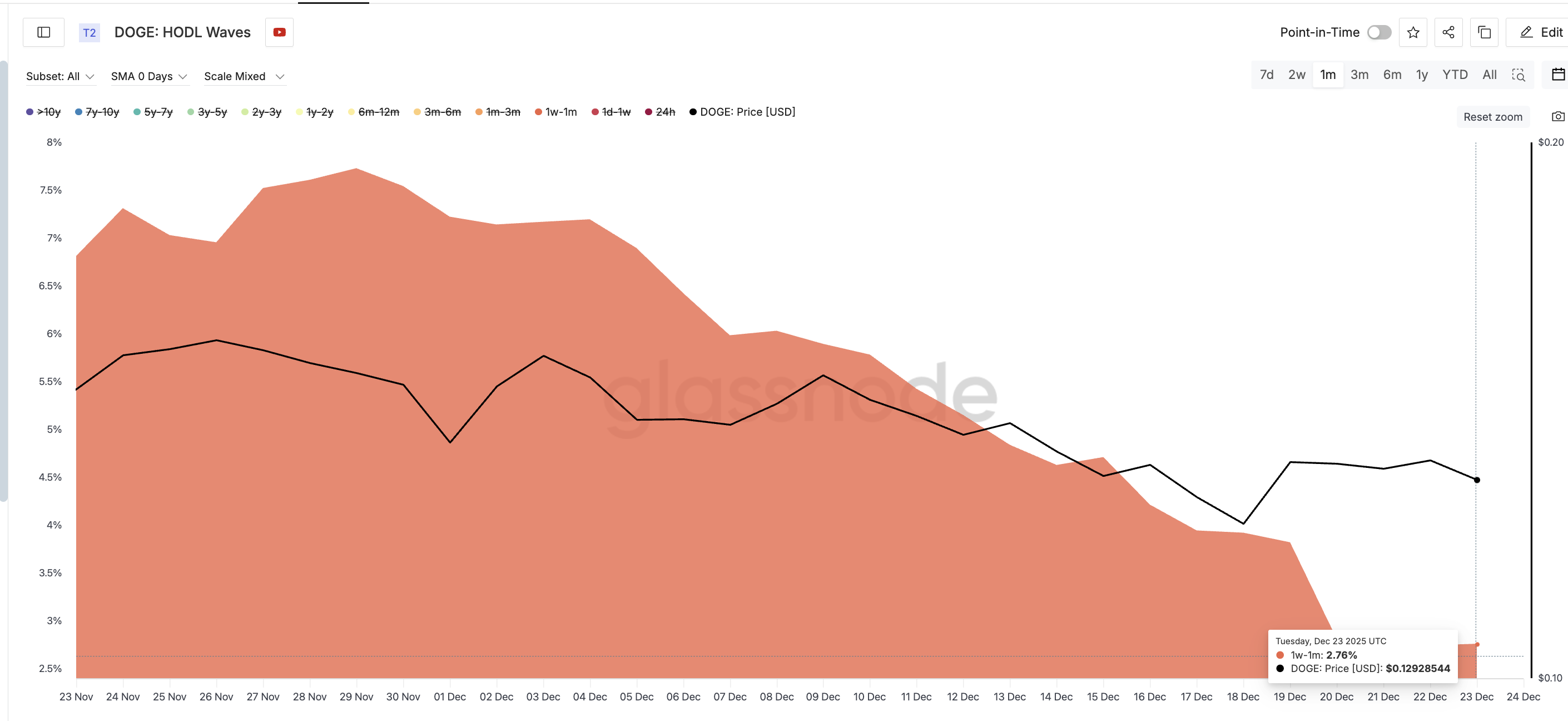
The 1-week-to-1-month-hold cohort, typically the most aggressive swing-trading group, has sharply reduced exposure, per the HODL Waves metric. This metric classifies hodlers by time.

On November 29, this cohort controlled roughly 7.73% of Dogecoin’s supply. As of December 23, that share has dropped to about 2.76%. That is a steep reduction in speculative positioning over a short period.

Speculative Holders Dumping DOGE
Speculative Holders Dumping DOGE: Glassnode

This matters because these holders tend to amplify downside when they panic sell. Their exit often reduces forced selling pressure near support.

Long-Term Holders Quietly Add as Coin Activity Drops

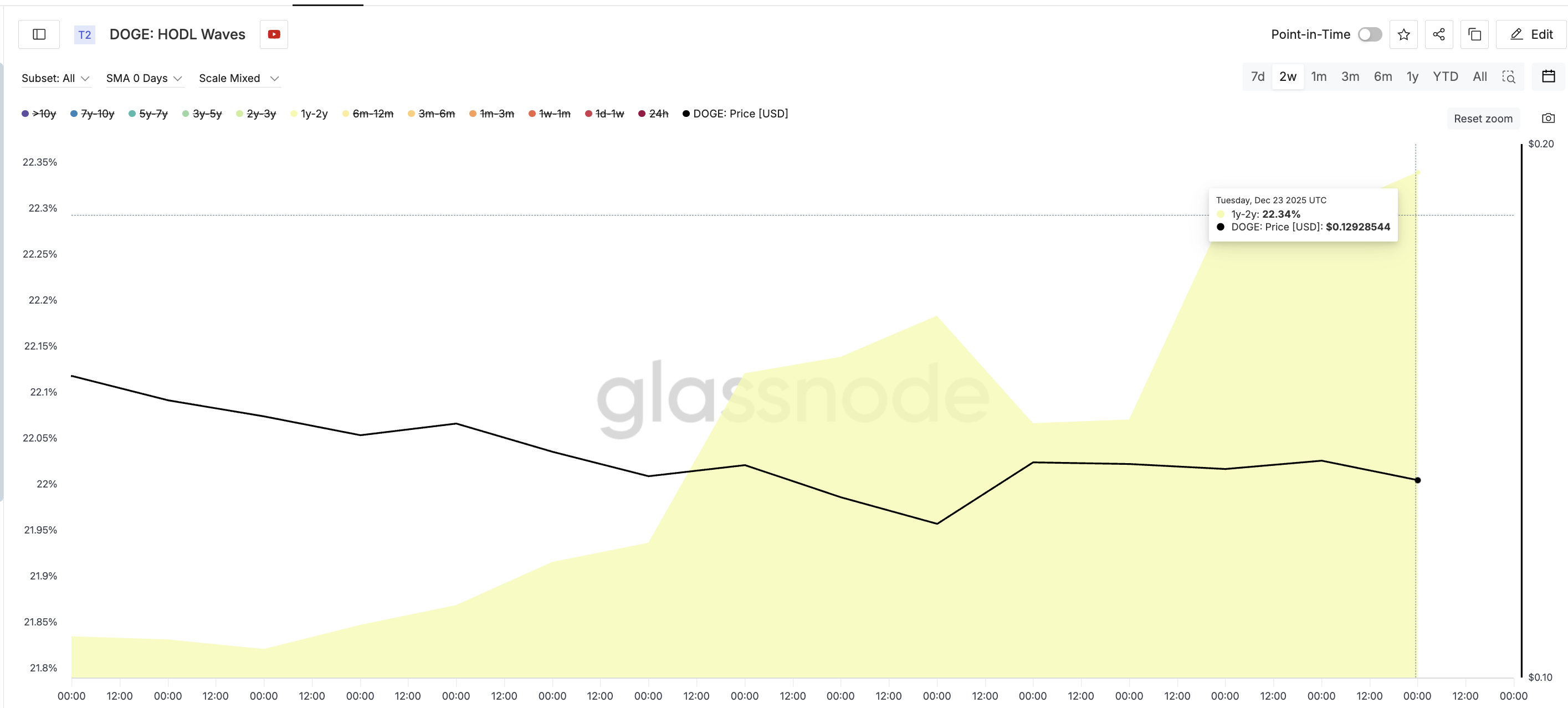
At the same time speculative supply is shrinking, longer-term holders are showing early signs of accumulation. The 1-year to 2-year holder cohort has increased its share of Dogecoin supply from around 21.84% to 22.34%. The increase is small, but the signal matters.

These holders typically add only when they believe downside risk is starting to fade.

Long-Term Holders Buying
Long-Term Holders Buying: Glassnode

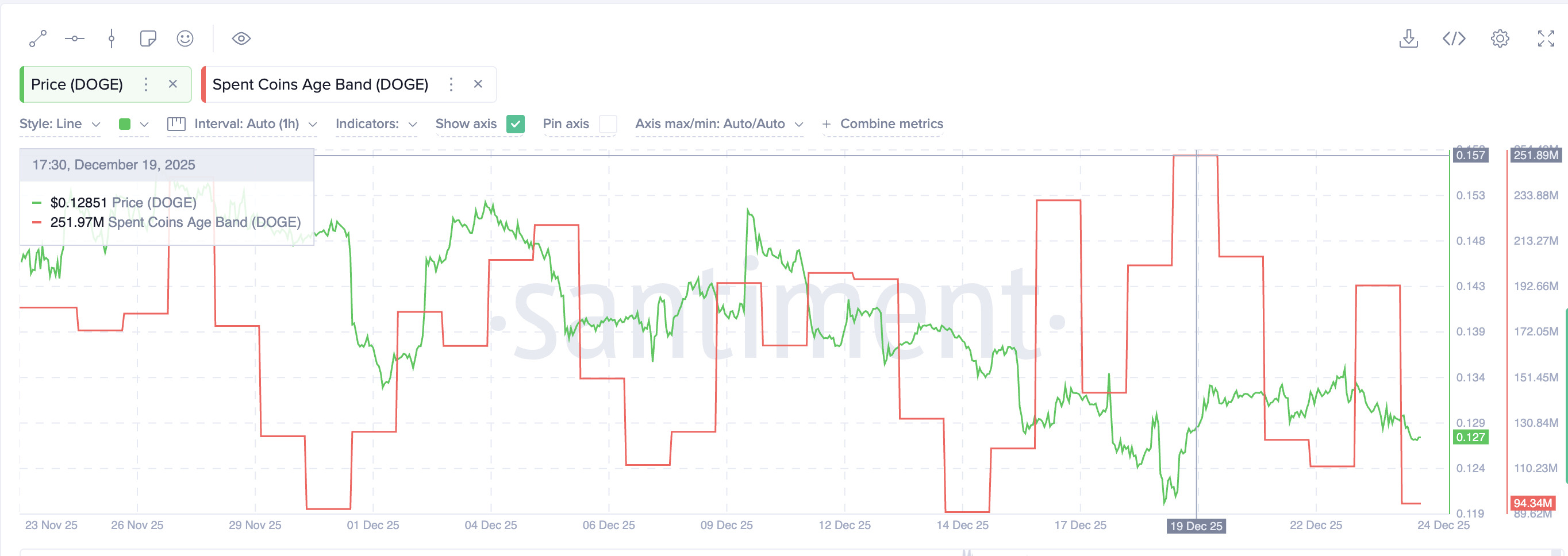
Coin activity across the network, measured via the spent coins metric, supports that view. Spent coins activity has fallen sharply. The spent coins age band metric dropped from roughly 251.97 million DOGE to about 94.34 million DOGE. That represents a decline of more than 60% in coin movement.

Coin Activity Drops
Coin Activity Drops: Santiment

Lower coin activity possibly means fewer holders are rushing to move or sell tokens. Historically, similar drops in activity have preceded short-term relief rallies in Dogecoin. Earlier in December, a similar slowdown preceded a rally from near $0.132 to $0.151, a near 15% move, within three days.

This does not guarantee a rally, but it shows selling aggression is cooling rather than accelerating.

Key Dogecoin Price Levels That Decide Breakdown or Recovery

The technical picture now hinges on a narrow price range. The $0.120 level remains the most important near-term support. A decisive daily close below it would expose the Dogecoin price to deeper downside toward the $0.112 zone and potentially lower if momentum builds.

On the upside, the recovery case depends on reclaiming nearby resistance. A move back above $0.133 would signal that selling pressure is easing. A stronger reclaim of $0.138 would confirm that buyers are regaining control and that the recent decline was corrective rather than the start of a larger breakdown.

Dogecoin Price Analysis
Dogecoin Price Analysis: TradingView

In simple terms, Dogecoin is at a crossroads. Price structure still carries risk, but on-chain data shows speculative supply leaving, long-term holders slowly stepping in, and overall coin activity drying up. If support holds, those factors can help stabilize the price. If it fails, the breakdown remains valid.

The post Dogecoin Nears Breakdown Zone; On-Chain Signals Fight Back — What’s Next For Price appeared first on BeInCrypto.

  •  

Jim Cramer Turns Fully Bearish on Bitcoin and Traders are Watching Closely

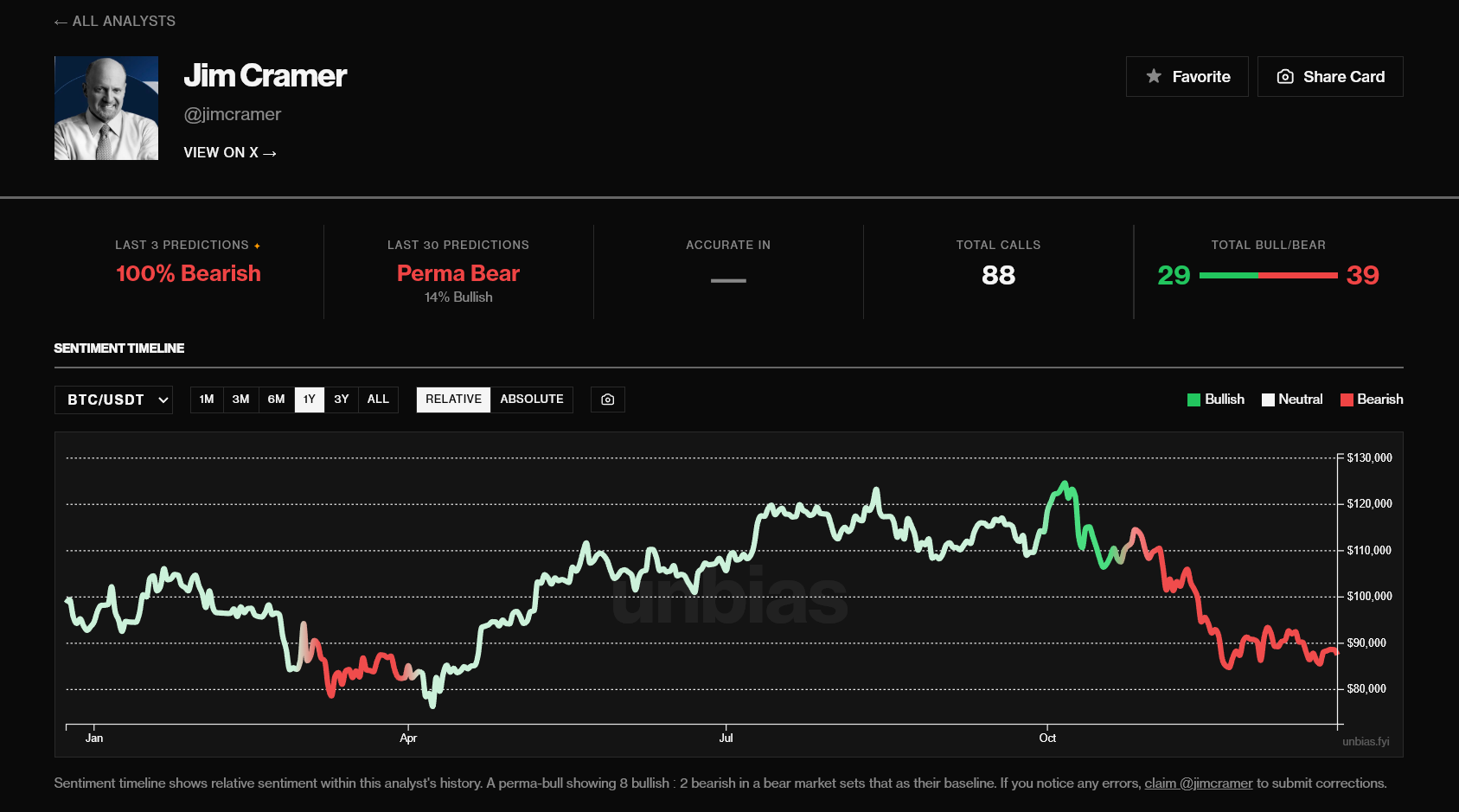
Jim Cramer’s latest Bitcoin stance has flipped to 100% bearish, according to sentiment-tracking data from Unbias. 

The shift immediately caught the attention of crypto traders, not because Cramer commands Bitcoin’s direction, but because his calls have become an informal sentiment indicator inside the market.

Inverse Cramer Narrative In Full Flow?

Data shows that Cramer’s last three Bitcoin predictions were all bearish, pushing his near-term outlook into what Unbias categorizes as “perma-bear” territory. 

Jim Cramer Bitcoin Prediction. Source: Unbias

Historically, such moments tend to spark discussion across crypto social channels, where Cramer’s commentary often triggers the well-known “Inverse Cramer” narrative.

This latest turn comes as Bitcoin trades in the mid-$80,000 range.

Since the October 10 crash, price action has remained choppy and defensive. 

Analysts broadly describe the market as range-bound, with resistance near $90,000–$93,000 and structural support closer to $81,000–$85,000

The failure to reclaim higher levels before year-end has weighed on short-term sentiment.

All Signs Point to a Bitcoin Bear Market?

Market indicators reinforce that cautious tone. The Crypto Fear & Greed Index recently slipped into Extreme Fear, reflecting risk aversion rather than panic buying. 

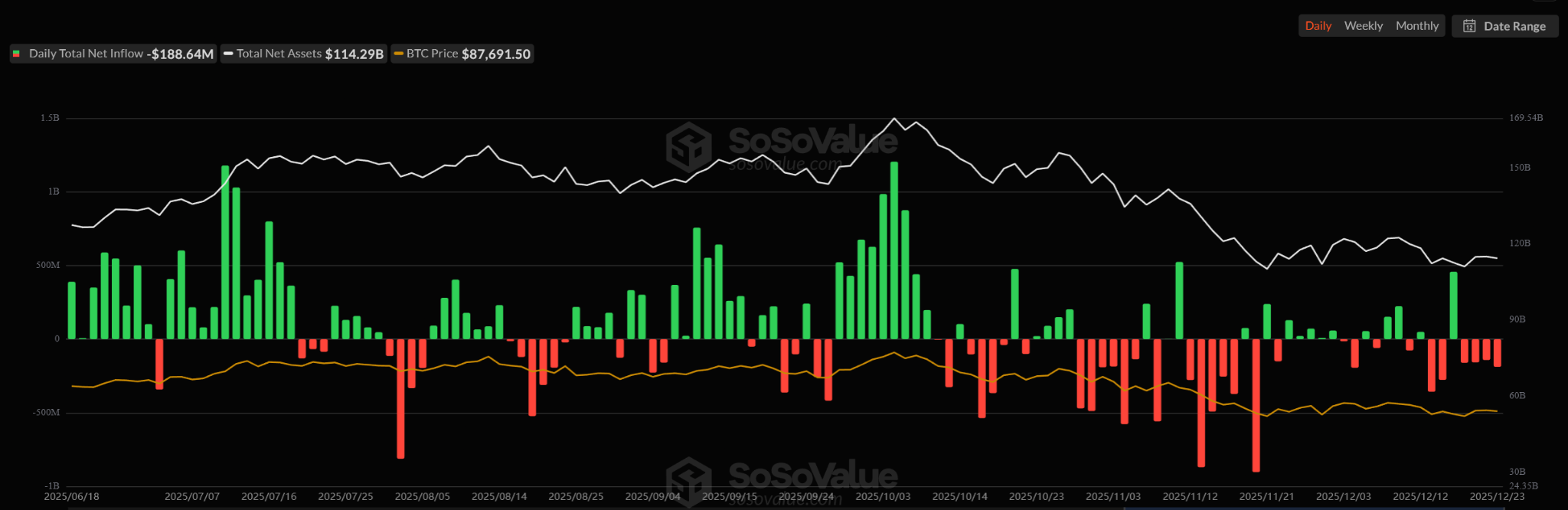
At the same time, spot Bitcoin ETFs recorded consecutive daily outflows into the Christmas week, signaling reduced institutional appetite as investors lock in profits and rebalance portfolios ahead of year-end.

US Bitcoin ETFs Continue to Bleed. Source: SoSoValue

Against that backdrop, Cramer’s bearish shift fits the prevailing mood — but it also explains why his views remain so visible in Bitcoin circles. 

As the long-time host of Mad Money, Jim Cramer has become a cultural reference point for crypto traders. 

His emphatic, short-term calls often clash with Bitcoin’s cycle-driven nature, turning his commentary into a meme-driven contrarian signal rather than conventional analysis.

BREAKING: Jim Cramer is 100% bearish on Bitcoin.

Merry Christmas 🎄 pic.twitter.com/qDr2Yx2U8X

— Ki Young Ju (@ki_young_ju) December 24, 2025

That dynamic has persisted through multiple market cycles. When Cramer grows confident in one direction, crypto traders often treat it as a sentiment extreme rather than a forecast.

Looking ahead to the New Year’s week, analysts expect thin liquidity and heightened volatility. Bitcoin’s direction may hinge on whether ETF flows stabilize and whether price can reclaim the $90,000 level after options-related positioning clears. 

Until then, Cramer’s 100% bearish read may say less about Bitcoin’s fundamentals — and more about how cautious the market feels heading into 2026.

The post Jim Cramer Turns Fully Bearish on Bitcoin and Traders are Watching Closely appeared first on BeInCrypto.
  •  

Why Christmas-Themed Tokens Could be Worst Crypto Narratives of 2025

The Christmas week is known for joy, celebration, and all things festive, and in recent history, an Xmas-themed crypto token. While these tokens are often expected to rally around the holiday, such moves occur far less frequently than anticipated, leaving many investors vulnerable to short-lived hype and potential losses.

In line with the same, BeInCrypto has analysed three such Christmas crypto tokens that the investors should stay away from in 2025.

SANTA HAT (SANTAHAT)

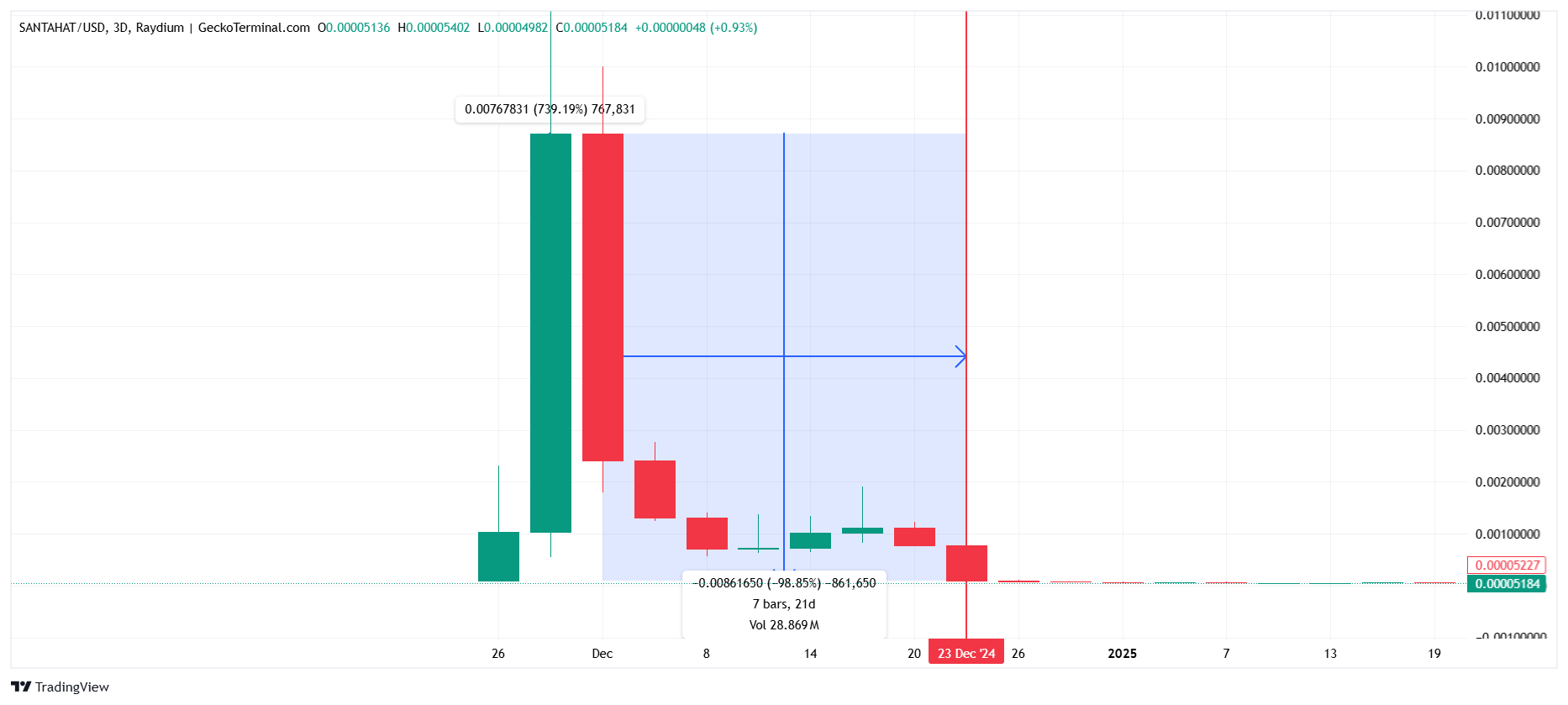
SANTA HAT previously demonstrated the risks tied to seasonal crypto tokens. After launch, the token surged 739% before collapsing 98.85% within three weeks, well before Christmas. The sharp reversal erased gains and highlighted how holiday-themed hype often fails to sustain long-term price appreciation.

Want more token insights like this? Sign up for Editor Harsh Notariya’s Daily Crypto Newsletter here.

SANTA HAT Price 2024
SANTA HAT Price 2024. Source: GeckoTerminal

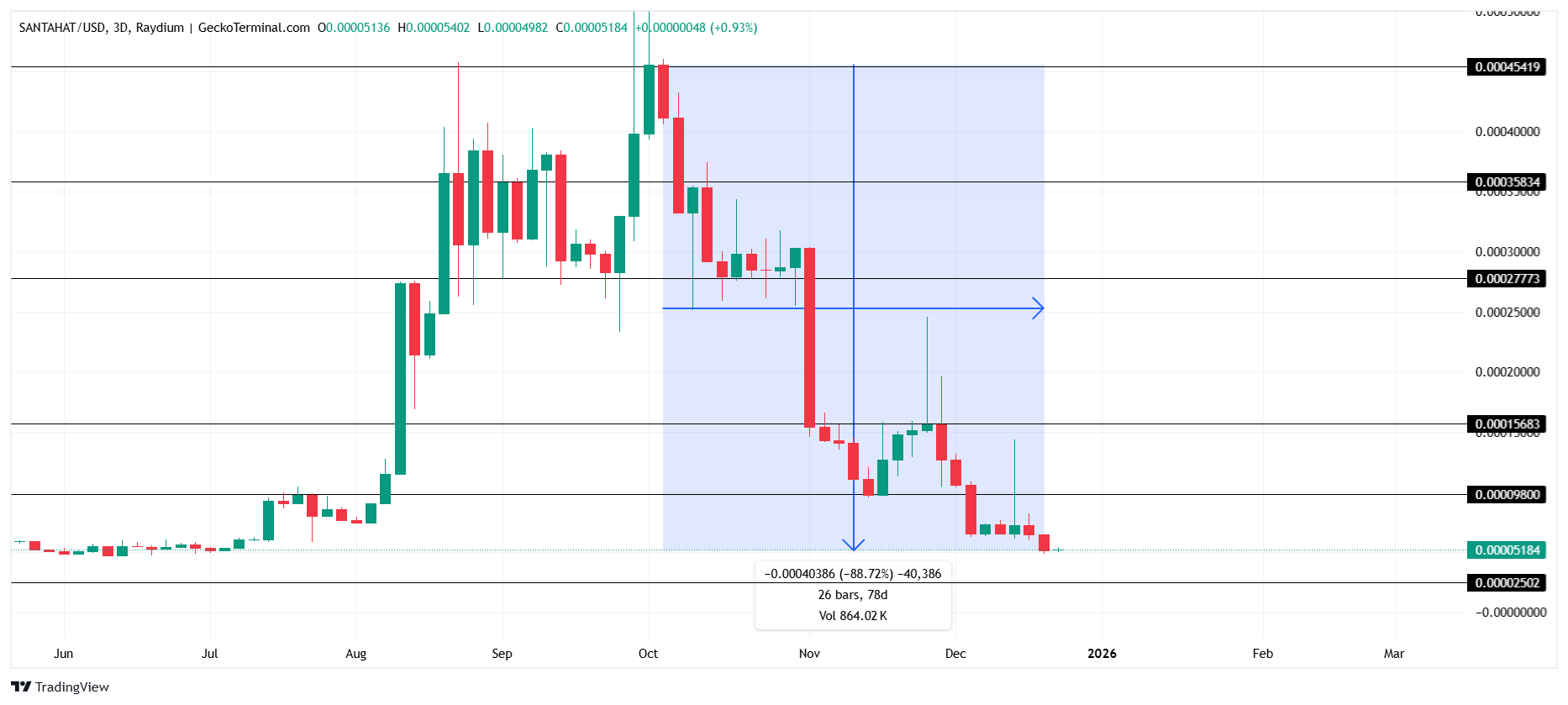
Momentum briefly returned during August and September, but selling pressure resumed in early October. Since then, SANTA HAT has plunged 88.7%, hitting a five-month low. Current price action suggests further downside, with a likely move toward the $0.00002502 support. A breakdown there risks a near-total loss.

SANTA HAT Price Analysis.
SANTA HAT Price Analysis. Source: GeckoTerminal

Despite more than 21,100 holders and locked liquidity, fundamentals have not translated into price stability. Historical performance remains the dominant signal. Past cycles show repeated failures to recover, reinforcing a bearish outlook for SANTA HAT despite its structurally sound on-chain mechanics.

Rizzmas (RIZZMAS)

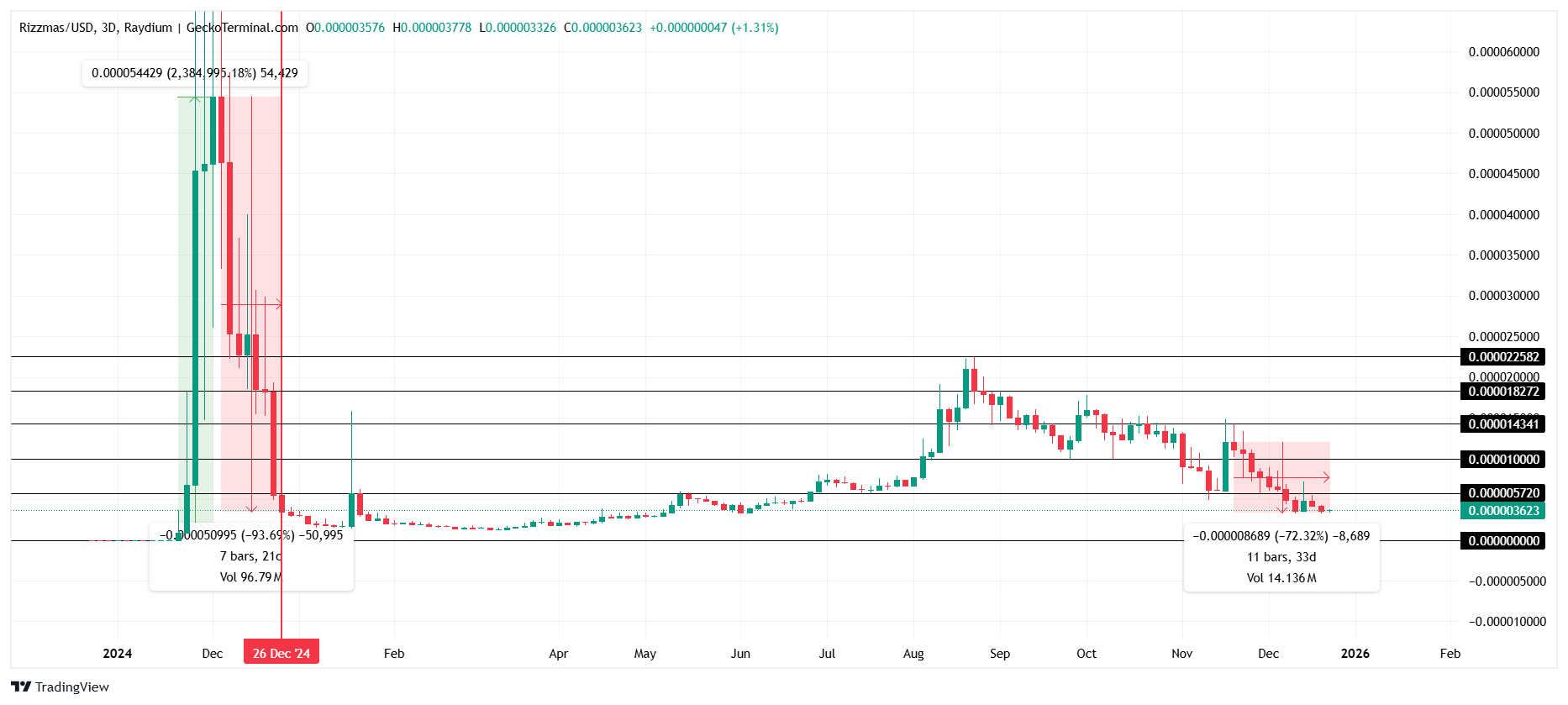
RIZZMAS illustrates the risks tied to Christmas-themed crypto tokens. Last year, the token surged 2,384% ahead of December before collapsing 93.6% by Christmas. The pattern reflects speculative hype rather than sustainable demand, leaving late investors exposed to sharp losses during seasonal reversals.

Over the past month, RIZZMAS has shed 72% of its earlier gains, despite reaching a yearly high of $0.00002258. Current price action signals continued weakness. Market structure suggests further downside, with the token at risk of losing nearly all remaining value in the coming sessions.

RIZZMAS Price Analysis.
RIZZMAS Price Analysis. Source: GeckoTerminal

A prudent approach favors caution. Seasonal tokens may appear attractive or fundamentally sound, yet often lack real utility or long-term growth drivers. Historical performance shows repeated boom-and-bust cycles, making capital preservation more important than chasing short-lived thematic rallies.

GigaMas (GIGAMAS)

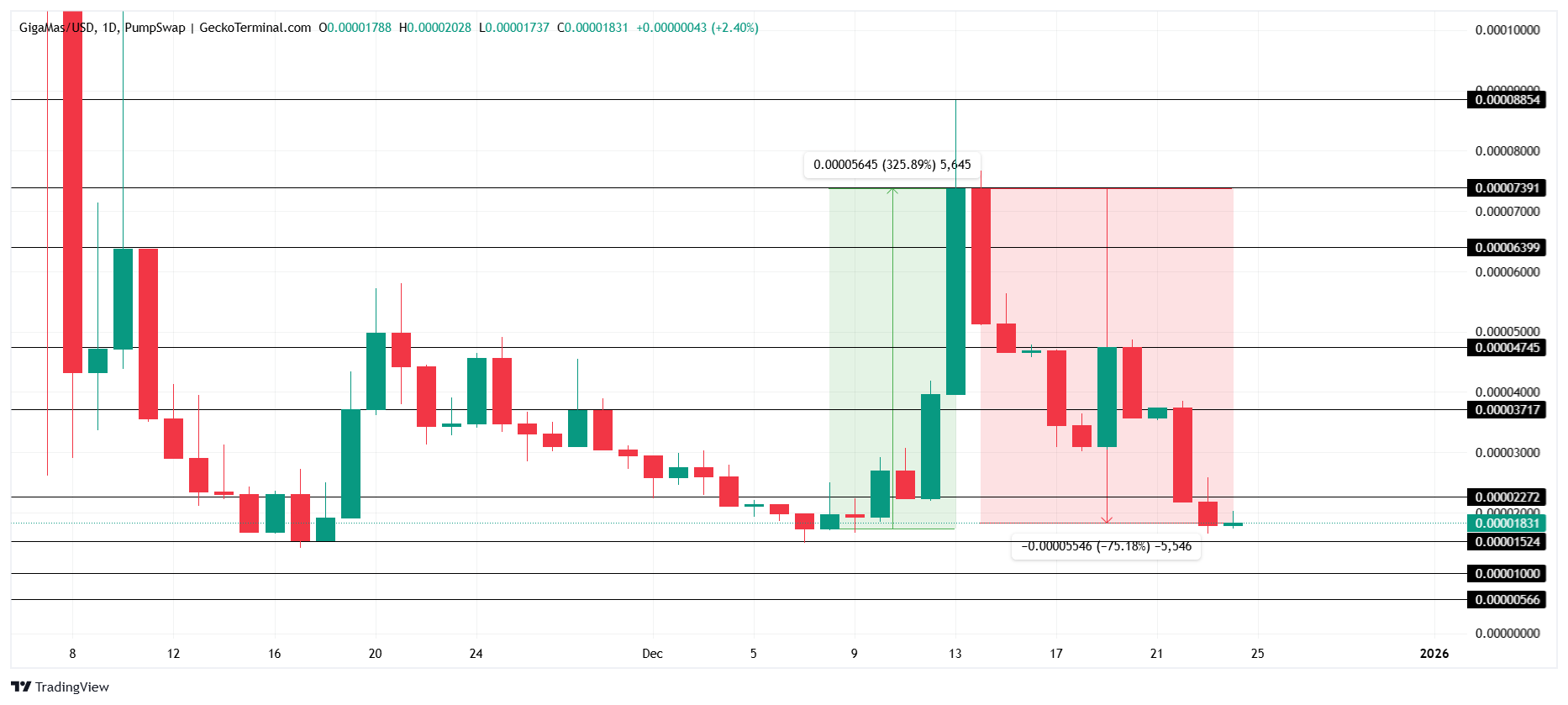
GIGAMAS represents a newer example of seasonal crypto tokens failing to sustain value. Launched less than two months ago, the Christmas-themed crypto token surged 325% during its initial rally before collapsing 75%. It now trades near $0.00001831, reflecting a rapid loss of speculative momentum.

Recovery prospects appear extremely limited. The technical structure shows weak demand and persistent selling pressure. GIGAMAS is likely to break below the $0.00001524 support, with further downside toward $0.00001000. A move through these levels could erase nearly all remaining value.

GIGAMAS Price Analysis.
GIGAMAS Price Analysis. Source: GeckoTerminal

This trend is critical for GIGAMAS’ roughly 2,000 holders to recognize. Holiday-themed tokens lack durable utility and long-term adoption. Historical performance suggests these assets behave like speculative traps, with sharp collapses typically accelerating as Christmas approaches.

The post Why Christmas-Themed Tokens Could be Worst Crypto Narratives of 2025 appeared first on BeInCrypto.
  •  

Is Bitcoin Already in a Bear Market? Fidelity Chief Raises Concerns

Bitcoin has largely ignored what should have been supportive macro signals. US CPI cooled to 2.7% in December, strengthening rate-cut expectations, yet Bitcoin failed to respond. Instead of attracting fresh capital, the price stalled while money rotated elsewhere.

That disconnect is why the Bitcoin bear market discussion is resurfacing.

Fidelity’s Director of Global Macro, Jurrien Timmer, recently warned that Bitcoin may have already ended its latest four-year cycle in October, both in price and time. The on-chain and market data since then increasingly support that view.

Data Signals Suggest Bitcoin May Already Be in a Bear Market

Multiple independent indicators now point to the same conclusion: capital is retreating, conviction holders are selling, and Bitcoin is absorbing risk without real demand.

Stablecoin Inflows Have Collapsed Since the Cycle Peak

Stablecoin inflows often act as dry powder for crypto rallies. That fuel has vanished.

Total exchange inflows for ERC-20 stablecoins peaked at around 10.2 billion on August 14. By December 24, inflows had fallen to roughly 1.06 billion, a drop of nearly 90%.

Want more token insights like this? Sign up for Editor Harsh Notariya’s Daily Crypto Newsletter here.

Stablecoin Flows
Stablecoin Flows: CryptoQuant

That August inflow peak closely preceded Bitcoin’s October high above $125,000, the same period Timmer identified as the likely cycle top.

While I remain a secular bull on Bitcoin, my concern is that Bitcoin may well have ended another 4-year cycle halving phase, both in price and time. If we visually line up all the bull markets (green) we can see that the October high of $125k after 145 months of rallying fits… pic.twitter.com/Uxg9DTccnt

— Jurrien Timmer (@TimmerFidelity) December 18, 2025

Since then, fresh capital has failed to return, reinforcing the idea that distribution replaced accumulation after the peak.

Long-Term Holders Have Turned Aggressive Sellers

Conviction holders are behaving differently after October.

Bitcoin long-term holder net position change flipped negative shortly after the cycle high. Selling accelerated from roughly 16,500 BTC per day in late October to around 279,000 BTC recently. That is an increase of more than 1,500% in daily distribution pressure.

Long-Term Holders Dumping
Long-Term BTC Holders Dumping: Glassnode

This aligns directly with Timmer’s thesis that the four-year halving cycle phase likely ended in October. Long-term holders appear to agree, reducing exposure rather than defending price.

Bitcoin Dominance Is Rising, But Not for Bullish Reasons

Bitcoin dominance has climbed back toward 57–59%, but this is not a risk-on signal.

Bitcoin Dominance
BTC Dominance: CoinGecko

After the softer CPI print, capital did not rotate into Bitcoin. Instead, it flowed into traditional hedges. Over the past year, silver has rallied by over 120%, while gold is up roughly 65%. At the same time, broader crypto markets have lagged badly.

If you invested $10,000 in each asset at the start of 2025, you’d have:

Silver → $23,000

Gold → $16,500

Copper → $13,500

Nvidia → $13,450

Nasdaq → $12,000

S&P 500 → $11,600

BTC → $9,400

ETH → $8,800

Altcoins → $5,800

— Dirk 💎 (@DirksDegen) December 24, 2025

This shift reinforces the idea that Bitcoin’s rising dominance is not being driven by fresh risk appetite, but by capital retreating into relative safety within crypto.

That view is echoed by an exclusive market comment shared with BeInCrypto by Ray Youssef, founder and CEO of NoOnes, who highlighted why gold has led the 2025 debasement trade while Bitcoin remains range-bound.

“While gold may clearly be winning the 2025 debasement trade on price performance, the comparison masks a more nuanced market reality. Gold’s recent run to new all-time highs and 67% YTD gains reflect classical defensive investor positioning as capital seeks certainty in a market environment defined by fiscal excess, geopolitical strain, and macro policy uncertainty. Increased central bank accumulation, a softer dollar, and persistent inflation risks have reinforced gold’s role as the market’s preferred defensive asset,” he said.

Youssef added that Bitcoin’s behavior this year has diverged sharply from the digital-gold narrative.

“Bitcoin, by contrast, has recently failed to deliver on the hedge narrative. The asset has not traded like digital gold in 2025, owing to its heightened sensitivity to macroeconomic factors. BTC’s upside is now tied to liquidity expansion, sovereign policy clarity, and risk sentiment, rather than to monetary debasement alone,” he highlighted.

Mega-Whale Addresses Are Quietly Declining

Large holders are also stepping back.

The number of Bitcoin addresses holding more than 10,000 BTC has fallen from 92 in early December to 88. That decline came alongside falling prices, not accumulation.

Mega Whales Distributing
Mega BTC Whales Distributing: Glassnode

These addresses often represent institutional-scale players. Their reduction adds another layer of confirmation that smart money is not positioning aggressively for upside here.

Bitcoin Remains Below a Critical Long-Term Moving Average

Bitcoin is still trading below its 365-day moving average near $102,000, a level last decisively lost at the start of the 2022 bear market.

This moving average acts as both technical and psychological support. Failure to reclaim it suggests the market has shifted from trend continuation to regime risk. If price remains below this level, historical precedent points toward deeper downside zones near the traders’ realized price band around $72,000.

Bitcoin is below its 365-day moving average ($102K), a key technical and psychological support level last broken at the start of the 2022 bear market.

If price fails to reclaim it, data suggest the next support lies near $72K, the Traders’ minimum realized price band. pic.twitter.com/VySVce5NY9

— CryptoQuant.com (@cryptoquant_com) November 5, 2025

Taken together, these signals support Timmer’s warning that Bitcoin may already be in a bear-market phase or closing in on that, even if the price has not fully reflected it yet. Capital has dried up, conviction holders are selling, dominance is rising defensively, and macro relief is being ignored.

That said, not all long-term cycle supports have broken yet. Those counter-signals, and the exact levels that decide whether this becomes a full bear market or a prolonged transition, come next.

Why the Bitcoin Bear Market Case Is Not Fully Settled Yet

Despite the growing evidence pointing toward a Bitcoin bear market, two long-term cycle indicators still argue against a confirmed structural breakdown.

Also, one reason the Bitcoin bear market case remains unresolved is how markets are interpreting the CPI slowdown. While cooling inflation typically benefits risk assets, the current response suggests investors are prioritizing safety and liquidity over growth.

That does not mean the CPI signal is wrong. It may simply be early, with Bitcoin historically reacting later than traditional hedges once liquidity expectations fully translate into capital flows.

These and the indicators we would discuss next do not negate the bearish signals discussed above. But they explain why this phase may still resolve as a prolonged transition rather than a full bear cycle.

Pi Cycle Top Has Not Triggered

One of Bitcoin’s most reliable cycle indicators, the Pi Cycle Top, has not flashed a peak signal. The indicator compares the 111-day moving average with the 350-day moving average multiplied by two.

Historically, when these two lines cross, Bitcoin has been near or at major cycle tops.

As of now, the two lines remain widely separated. That suggests Bitcoin is not in an overheated or euphoric phase, even after the October high.

PI Cycle Top
PI Cycle Top: Coinglass

This contradicts the idea raised by Fidelity’s Director of Global Macro, Jurrien Timmer, who noted that the October peak near $125,000 fit prior cycle timing.

In past cycles, true bear markets began after clear Pi Cycle confirmations. That signal is still absent.

The 2-Year SMA Remains the Line That Matters Most

The second and more immediate counter-argument is structural. Bitcoin is still trading near its 2-year simple moving average, which sits around $82,800.

This level has repeatedly acted as Bitcoin’s long-term trend divider. Monthly closes above the 2-year SMA have historically marked cycle survival.

Sustained closes below it have marked deep bear phases.

So far, Bitcoin has not confirmed a monthly close beneath this line.

That makes December’s monthly close critical. If Bitcoin holds above $82,800 into year-end, the market likely remains in a late-cycle transition rather than a confirmed Bitcoin bear market.

🚨 Bitcoin in a critical zone on the 2Y SMA Multiplier

The 2Y SMA Multiplier is one of Bitcoin’s most respected cycle charts — and the current moment demands attention.

📍 Today, BTC is trading very close to the 2Y SMA, currently at $82,800.

📉 History matters:
Whenever… pic.twitter.com/jmIW9RSSGg

— Alphractal (@Alphractal) December 16, 2025

That outcome keeps open the possibility that 2026 reflects delayed upside rather than prolonged downside.

However, if December closes decisively below the 2-year SMA, downside projections toward the $65,000–$75,000 range, referenced by Timmer, gain structural backing.

TL;DR —Key Bitcoin Price Levels To Watch Now

The bearish framework also has clear invalidation levels. A reclaim of the 365-day moving average near $102,000 would materially weaken the bear market thesis. That would align with Tom Lee’s year-end Bitcoin price prediction.

That level marked the start of the 2022 bear market when it broke, and would signal renewed trend strength if recovered.

In simple terms:

  • Above $82,800 into December close: transition phase remains intact
  • Below $82,800 on a monthly basis: bear market risk escalates
  • Back above $102,000: bullish structure begins rebuilding

For now, Bitcoin sits between conviction selling and long-term cycle support. The market is not confirming strength, but it is not fully breaking either.

The December close will decide which narrative carries into 2026.

The post Is Bitcoin Already in a Bear Market? Fidelity Chief Raises Concerns appeared first on BeInCrypto.

  •  

PIPPIN Price Nears Record Levels, but Outflows Start Rising

PIPPIN has surged sharply in recent sessions, reigniting interest across the market. The altcoin’s latest rally has pushed its price within reach of its all-time high, raising expectations of another record. 

However, as momentum builds, concerns around profit-taking and near-term selling pressure are also increasing.

PIPPIN Whales Could Shift The Outcome

On-chain flow data signals growing caution among retail participants. The Chaikin Money Flow has slipped below the zero line, entering negative territory. This shift indicates that PIPPIN outflows are beginning to outweigh inflows, reflecting early stages of distribution rather than accumulation.

The rise in outflows appears linked to investors locking in profits after the recent rally. When prices approach record levels, traders often reduce exposure to manage risk. This behavior can slow momentum, even during otherwise bullish market phases.

Want more token insights like this? Sign up for Editor Harsh Notariya’s Daily Crypto Newsletter here.

PIPPIN CMF
PIPPIN CMF. Source: TradingView

Despite signs of retail caution, whale activity remains supportive. Wallets holding more than $1 million worth of PIPPIN increased their holdings by 3.57% over the past 24 hours. Total whale-controlled supply now stands at approximately 425.34 million PIPPIN.

Large holders often influence short-term price trends due to their capital scale. Continued accumulation by whales suggests confidence in further upside. Their behavior can counterbalance retail selling, helping maintain price structure during volatile periods.

PIPPIN Whale Holdings.
PIPPIN Whale Holdings. Source: Nansen

PIPPIN Price Pushes On

PIPPIN trades near $0.497 at the time of writing, marking a 38% gain over the past 24 hours. The token now sits less than 7% below its all-time high of $0.530. Momentum remains strong, supported by sustained buying interest from large holders.

A successful breakout above $0.530 would likely attract additional speculative demand. Clearing the all-time high could open the path toward $0.600. Sustained volume above resistance would support further price discovery and the formation of new highs.

PIPPIN Price Analysis
PIPPIN Price Analysis. Source: TradingView

Downside risk remains if selling pressure accelerates. A failure to hold current levels could push PIPPIN below the $0.434 support. A deeper pullback toward $0.366 would invalidate the bullish thesis, shifting focus back to consolidation rather than expansion.

The post PIPPIN Price Nears Record Levels, but Outflows Start Rising appeared first on BeInCrypto.
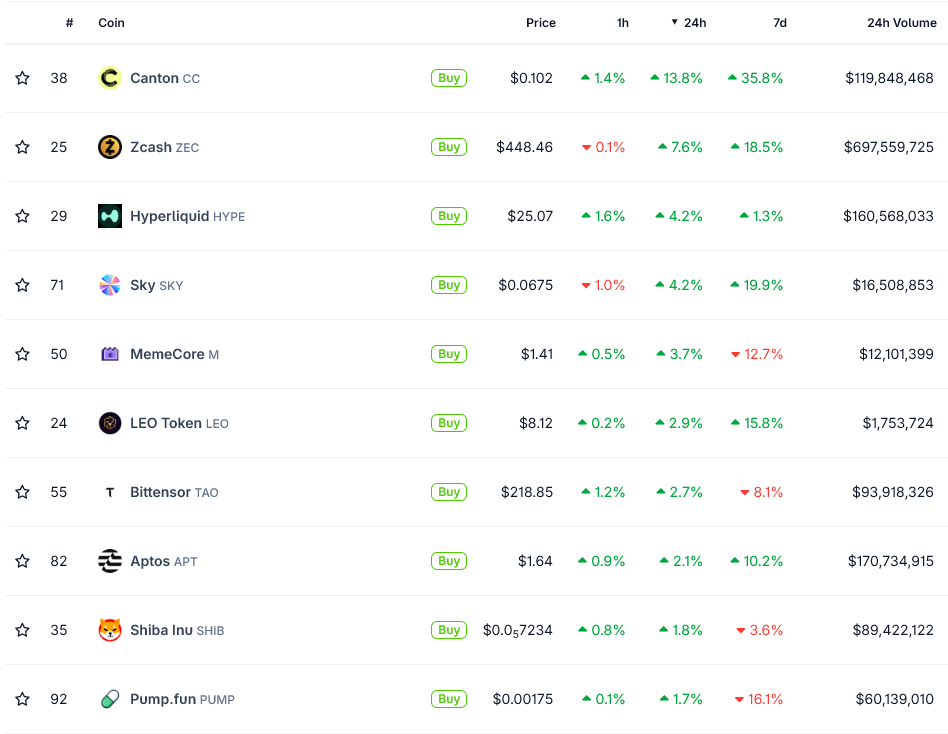
  •  
❌