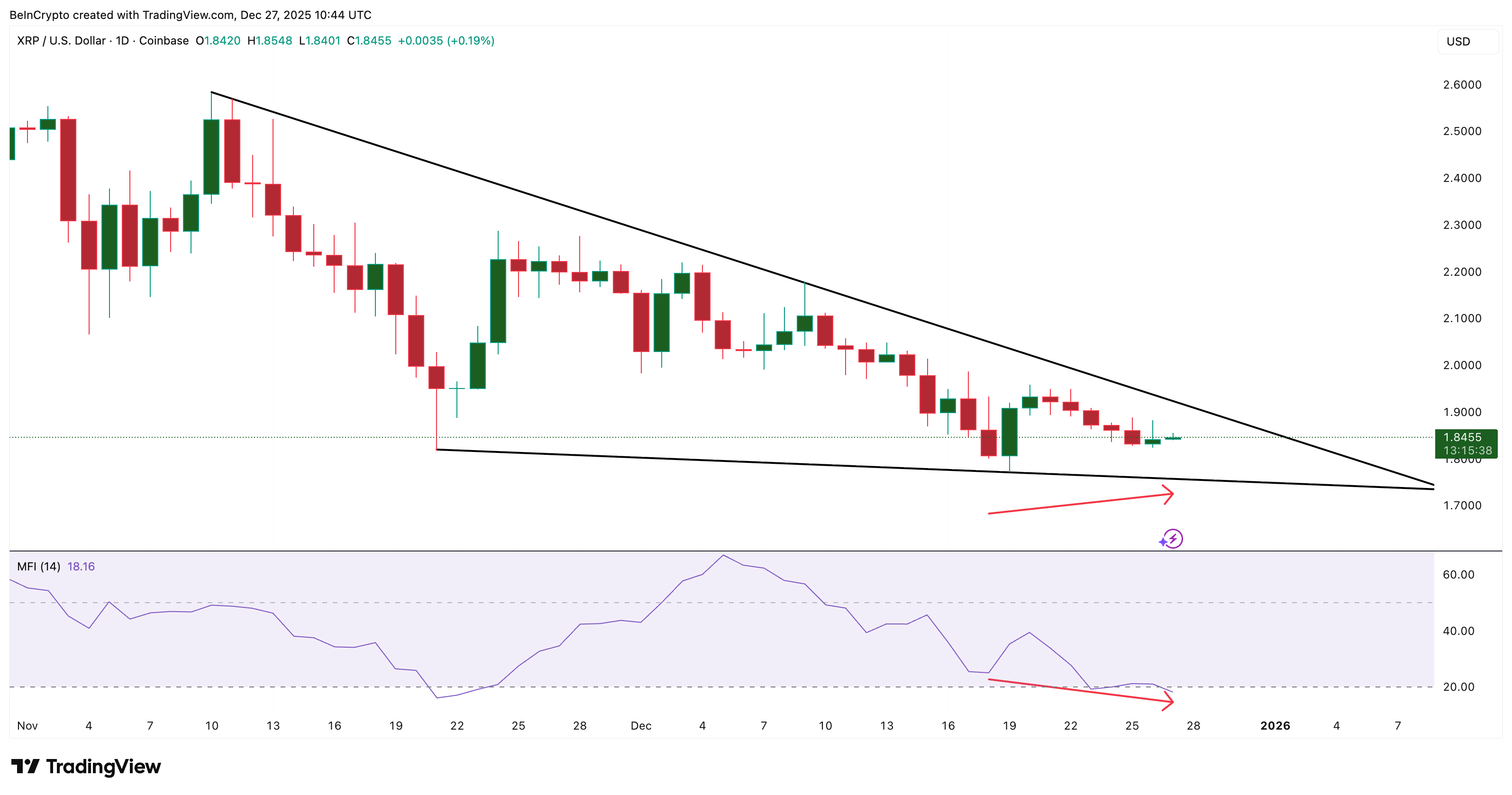
XRP is down about 1.6% over the past 24 hours. On the weekly chart, it remains one of the weaker large-cap movers, sitting roughly 16% lower than last month’s levels. Most of the price action is happening near the bottom of a descending triangle pattern, a structure that often leads to continuation moves.
This does not confirm a breakdown yet, but three market signals are lining up in a way that should make traders cautious heading into the final days of 2025.
Retail And Long-Term Holders Are Moving The Same Way
XRP is still stuck inside a descending triangle, trading flat near the lower trendline. Price trended higher between December 18 and December 27, but the Money Flow Index (MFI) moved the opposite way during that same period.
MFI tracks money entering or exiting the asset. A lower low in MFI while price rises suggests retail is selling into every bounce instead of accumulating.
That pressure keeps the XRP price pinned at the lower boundary of the pattern instead of testing the upper line.
Want more token insights like this? Sign up for Editor Harsh Notariya’s Daily Crypto Newsletter here.
The concern grows when we zoom out to long-term holders.
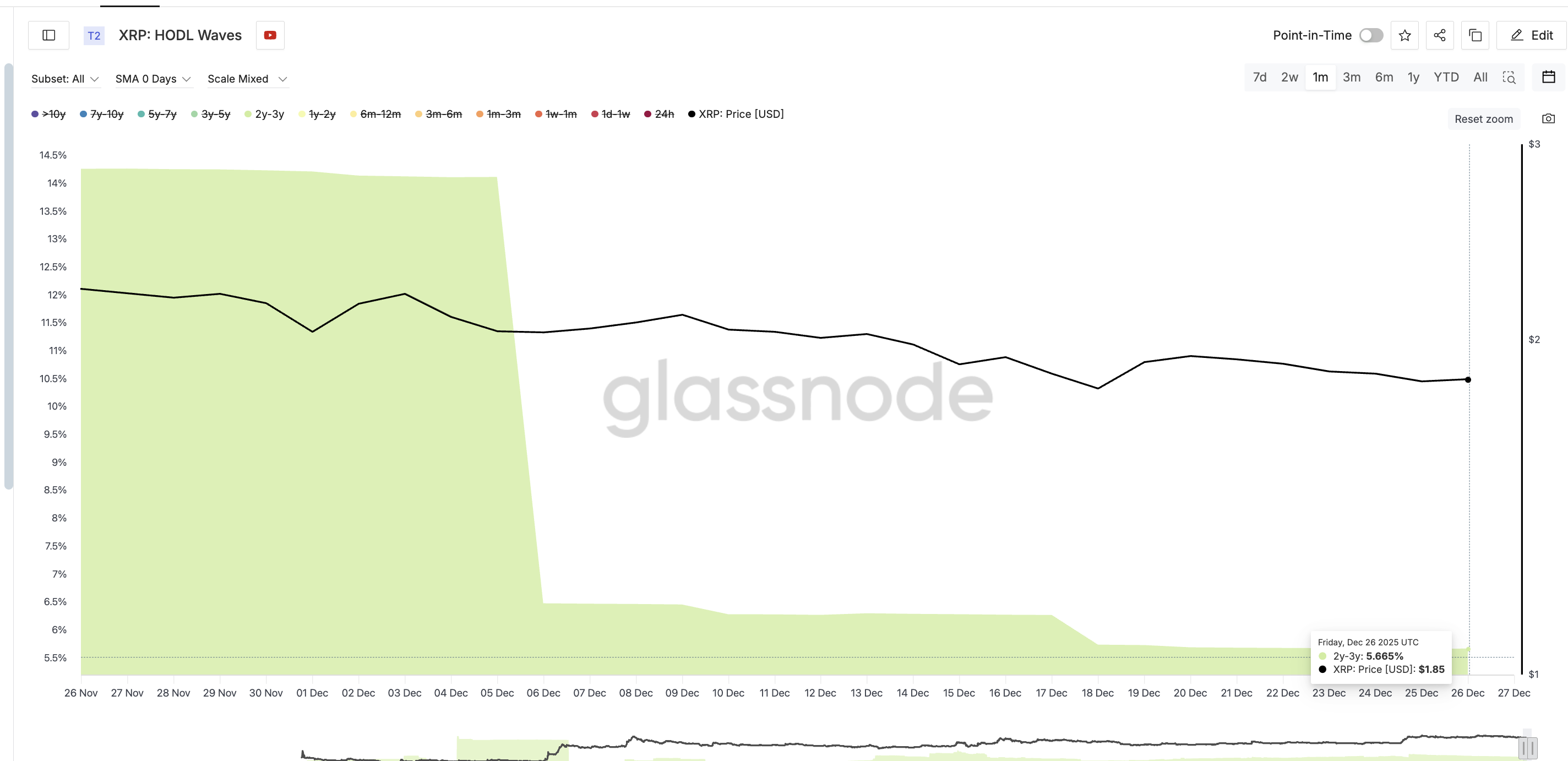
According to HODL Waves, which visualizes how much supply is held by each age group, wallets holding XRP for 2–3 years dropped from 14.26% of supply on November 26 to about 5.66% on December 26.
These are long-term conviction holders, and their selling removes a layer of market support. Retail weakness is normal. Long-term weakness at the same time is not.
This creates a setup where both short-term and long-term behavior are leaning in the same direction: out of XRP.
Capital Flow Shows Fading Demand
If retail and long-term conviction are weakening, the next check is capital flow, the third key sign.
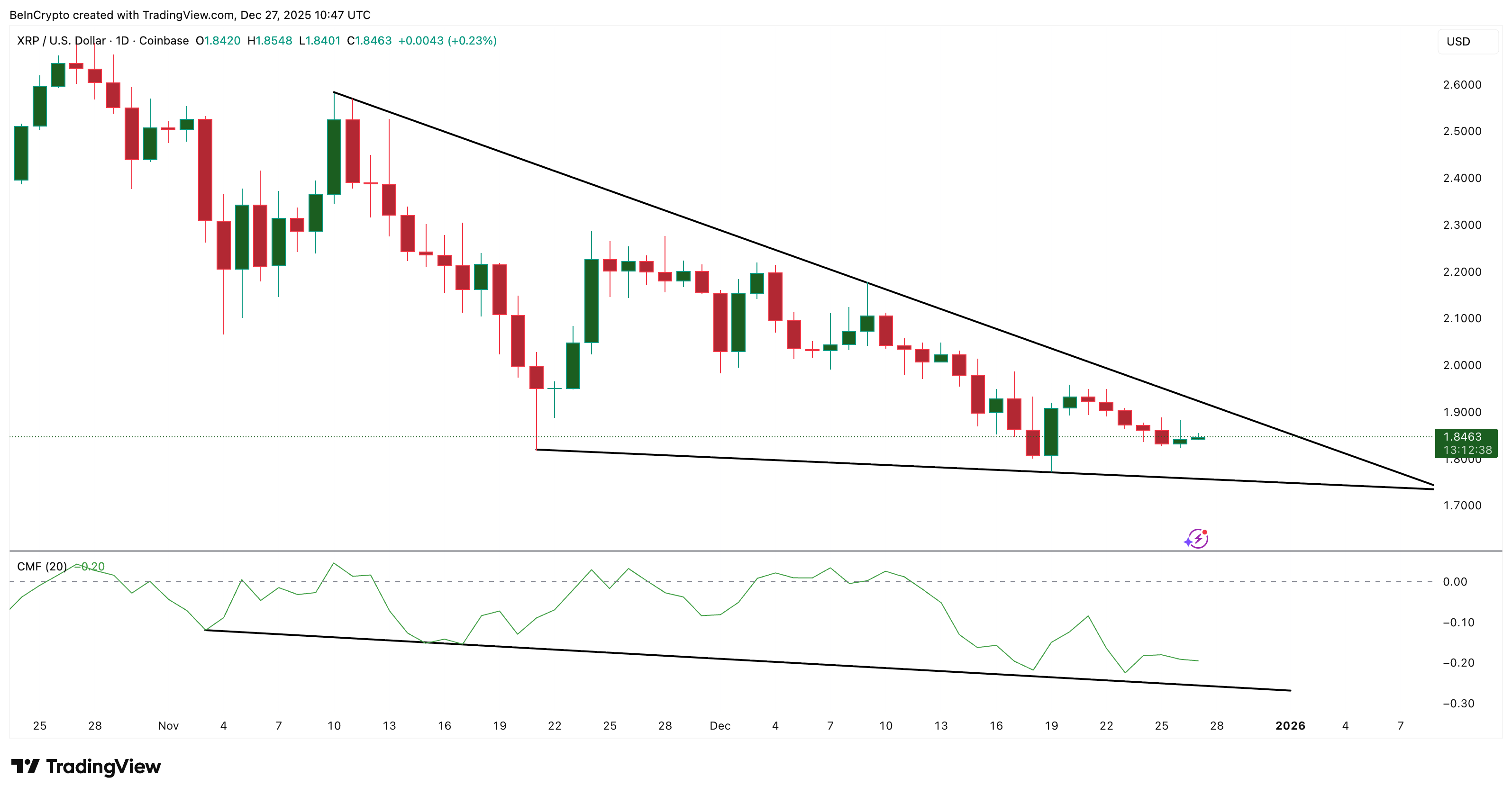
The Chaikin Money Flow (CMF) is not providing relief either. CMF tracks buying and selling pressure based on volume and price movement. The large money flow indicator remains negative for XRP and is sliding along a descending support trendline.
In simpler terms, even if the price is flat, big capital entering the asset is thinning out, and the market is leaning toward supply overpowering demand. With no pickup yet in CMF, the market loses another potential safety net.
This is why the XRP price has remained flat rather than rebounding.
XRP Price Levels Decide If The Breakdown Actually Happens
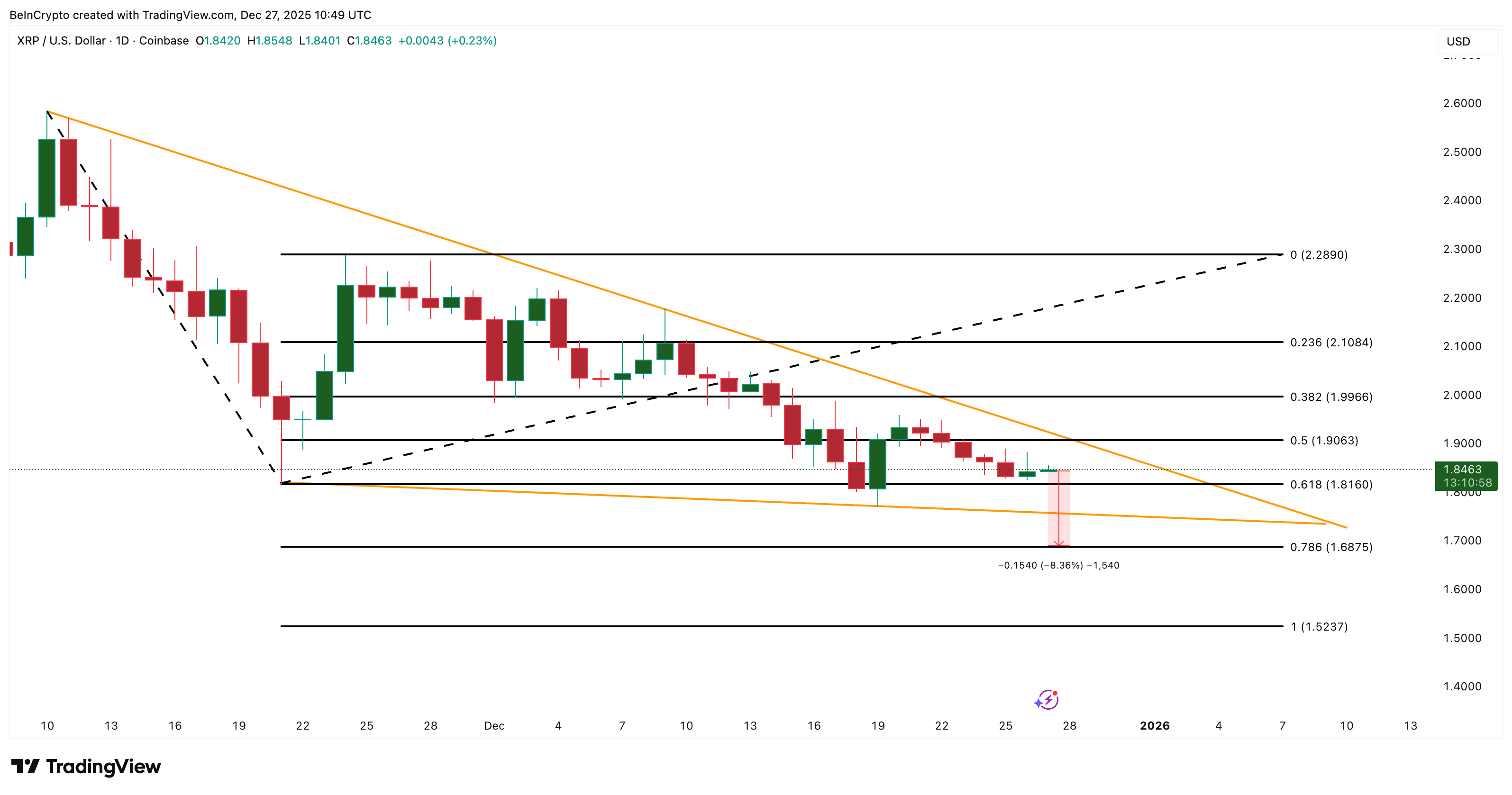
For now, XRP is trapped between $1.90 and $1.81. It lost the $1.90 level on December 22 and hasn’t reclaimed it since. Reclaiming $1.90 and then pushing for $1.99 would be the first sign of strength.
That would also mark a move above the triangle’s upper boundary and give bulls something to work with.
However, the bearish case is clearer than the bullish one at present.
If $1.81 breaks, XRP may fall out of the descending triangle pattern, which would constitute a confirmed breakdown. That loss could open room toward $1.68, where the structure fully fails, and even $1.52 if selling accelerates.
This isn’t a given yet, but the market has not shown a counter-signal yet. As long as retail selling, long-term distribution, and weakening capital inflow remain aligned, the XRP price must fight to hold the range.
Charles Hoskinson is pitching his latest venture, Midnight Protocol, as more than a sidechain for Cardano.
Instead, the Cardano founder is positioning the privacy-focused platform as a shared infrastructure layer that could extend programmable privacy to rival blockchain networks, including Bitcoin and the XRP Ledger.
Hoskinson Moves Beyond Cardano With a Cross-Chain Privacy Play
In a December 27 post on X, Hoskinson argued that Midnight’s zero-knowledge proof architecture could enhance the capabilities of competing ecosystems rather than displace them.
He said that integrating Midnight with the XRP Ledger would allow the network to challenge legacy banking systems by enabling private, compliant decentralized finance. He extended the argument to Bitcoin, saying Midnight offers programmable privacy features that Bitcoin currently lacks.
Hoskinson also framed Midnight as a catalyst for Cardano itself. He suggested that the protocol could help lift Cardano’s monthly active users and total value locked by broadening the ecosystem’s utility beyond its native chain.
“Midnight makes what it touches better. Adding Midnight to XRP DeFi is going to blow the legacy banks out of the water. Adding Midnight to Bitcoin gives the world Satoshi imagined possible. Adding Midnight to Cardano supercharges our DeFi ecosystem and will 10x the MAUs, Transactions, and TVL as we are first to market with private DeFi at scale,” he claimed.
Beyond interoperability, Hoskinson pointed to the scale of the opportunity in real-world asset tokenization. He said the estimated $10 trillion market for Real-World Assets would benefit significantly from Midnight’s privacy-preserving design.
In that context, he criticized traditional finance firms for continuing to partner with the Canton Network, a permissioned blockchain, arguing that partial solutions fall short of what institutional adoption requires.
“There are no half measures or half technologies. You need an end-to-end strategy, great partners, and great communities,” Hoskinson said.
This strategy marks a shift for Hoskinson, who has historically focused on building within the Cardano ecosystem.
By promoting Midnight as a privacy layer that enhances other Layer-1 blockchains, Hoskinson is seeking to access liquidity and user bases beyond Cardano’s existing network.
That pivot has coincided with growing speculative interest in Midnight’s native token, NIGHT.
Data from CoinGecko showed that the asset recently surpassed Bitcoin and Ethereum in search volume on the platform’s trending list.
However, the token has traded with high volatility since its launch earlier this month. According to BeInCrypto data, the token’s price has dropped by more than 80% to $0.08 as of press time.
Year-end usually brings position cuts across crypto. Big wallets and smart money often reduce exposure to secure profits, sit on cash, and wait for lower-liquidity conditions to finish. That’s normal for December. Even with that backdrop, a few assets are seeing the opposite. Crypto whales are adding again across multiple time frames.
One shows steady 30-day accumulation, another gets 7-day whale support, and a third just saw fresh 24-hour inflows.
Chainlink (LINK)
The first token on the list that crypto whales are buying is Chainlink. Whale wallets have raised their holdings by 57.79% over the last 30 days. This means whales added about 680,000 LINK in that period.
At the current LINK price, that is close to $8.5 million in accumulation.
Want more token insights like this? Sign up for Editor Harsh Notariya’s Daily Crypto Newsletter here.
This buildup occurs while Chainlink has corrected by about 7.5% over the same period. Smart money wallets have reduced exposure by 5.2%, suggesting whales are positioning early rather than expecting an immediate move.
This whale has further withdrawn 366,364 $LINK, worth $4.5M, from #Binance.
Now, the whale holds 695,783 $LINK, worth $8.52M, from #Binance in the past 2 days.
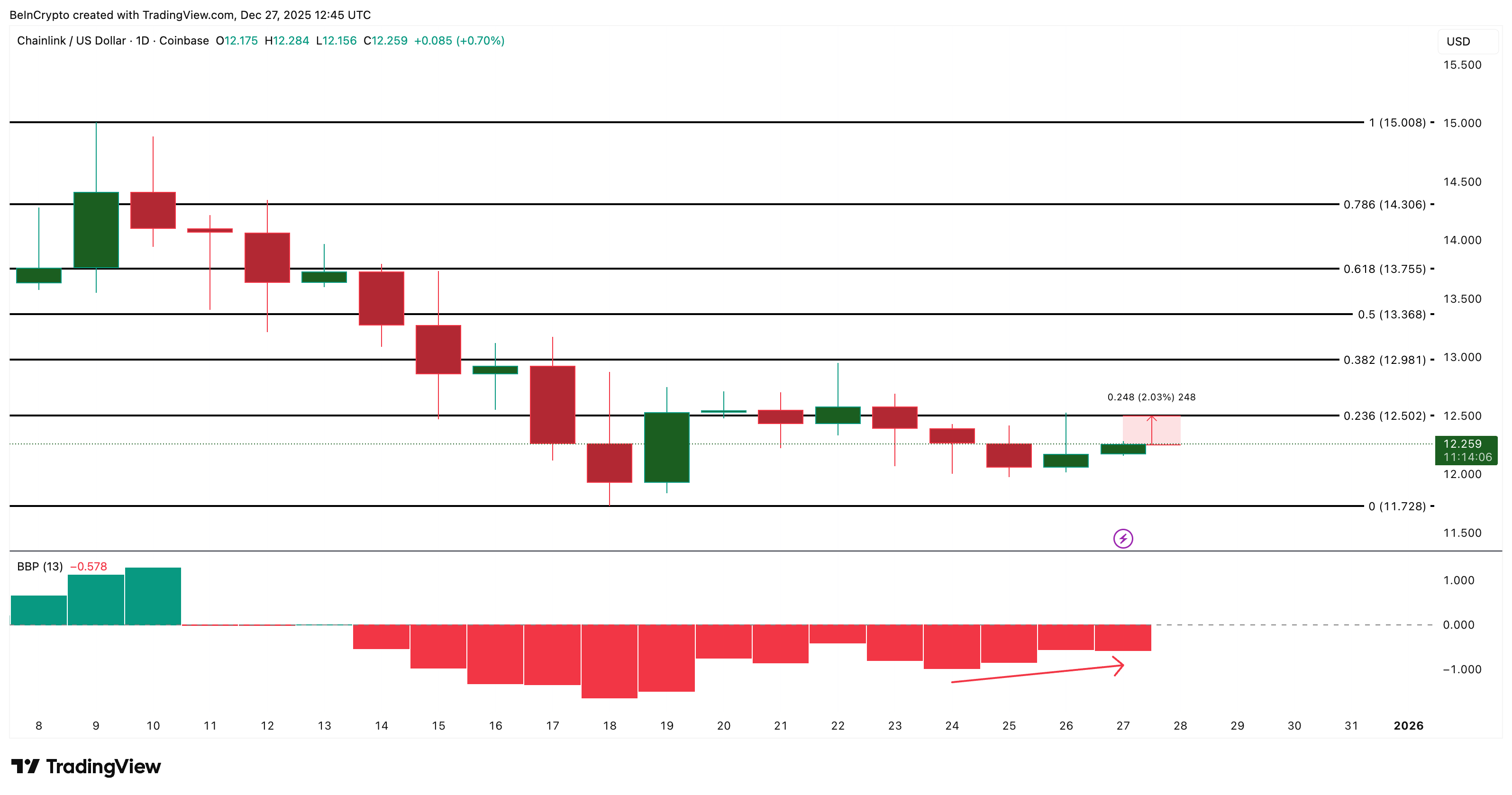
On the chart, the Bull Bear Power (BBP) indicator shows that red bars have been shrinking since December 24. BBP measures the distance between price and a moving average to highlight whether bulls or bears control momentum. When the red bars shrink, bearish pressure is fading.
At the same time, LINK is trying to reclaim a key short-term barrier near $12.50. A daily close above that level would put the token back inside the short-term breakout conversation. Above $12.50, the more critical levels sit near $12.98 and $13.75, and a move past $15.00 would return LINK to a clear bullish zone.
Smart money exiting while whales continue to add hints at a slower setup. The structure suggests whales are accumulating into weakness for a potential move in early 2026, not an immediate breakout. Until $12.50 is reclaimed, LINK may stay range-bound. Also, a dip under $11.72 can invalidate the whales’ bullish theory for now.
Lido DAO (LDO)
Crypto whales have also turned to Lido over the past 7 days. Their balances are up 30.34%, bringing the cohort’s stash to 17.49 million LDO. At the current price , whales added roughly 4.07 million LDO, worth about $2.28 million in a week.
This comes while the token has gained 4.2% during the same period, which suggests whales are buying into strength.
Not all big buyers are anonymous. One of the most notable additions came from Arthur Hayes, who accumulated 1.85 million LDO worth around $1.03 million. It also explains why the “Public Figure” cohort has climbed alongside whale activity.
Smart money, however, shows a different stance. Their balances are down 7.75%. Exchange balances are also down 1.49%, hinting that retail may be removing tokens from exchanges rather than selling. This disconnect means the whale thesis might take time to play out and could stretch into early 2026 instead of an immediate move.
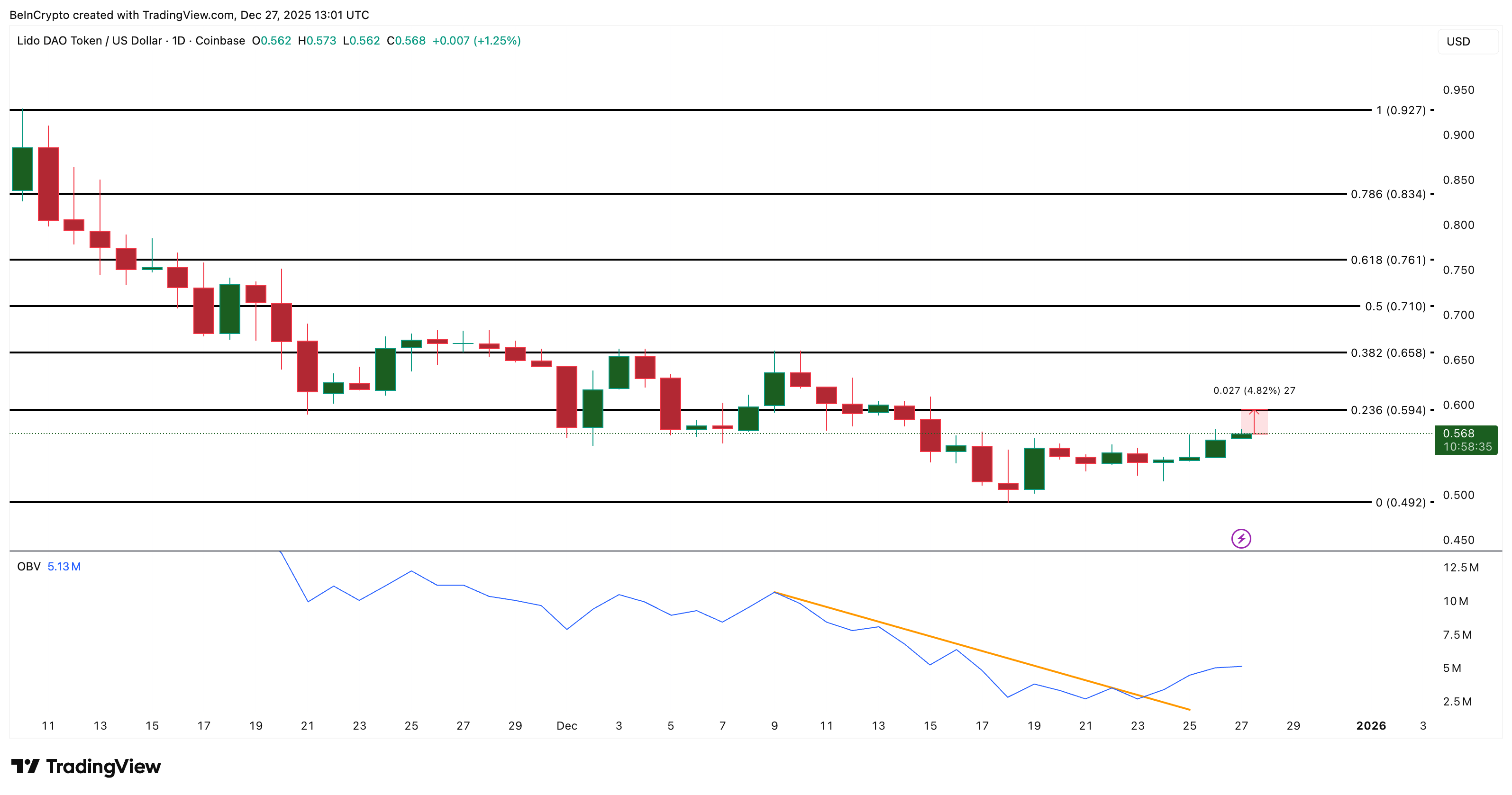
On the chart, Lido trades inside a clear range between $0.59 and $0.49. The On-Balance Volume (OBV) indicator, which measures whether volume flows in or out, broke its downtrend on December 23.
That happened at the same time whale inflows picked up, so the signal is worth watching.
A daily close above $0.59 is needed to confirm strength. That level broke on December 14 and hasn’t been reclaimed since. If buyers clear it with conviction, the next zones to watch are $0.76 (0.618 Fibonacci) and then $0.92, where momentum could flip from corrective to bullish.
Until then, range-bound trading remains the base case. A loss of $0.49 would invalidate the current LDO price setup, especially if smart money keeps reducing exposure during year-end volatility.
Aster (ASTER)
The third token on the list is Aster. This one has seen whale interest on the 24-hour window rather than a longer accumulation trend. Over the past day, whales added 2.37% to their existing stash.
Following this rise, whale holdings now stand at approximately 19.23 million ASTER. At a price of about $0.71, that means whales added roughly 455,000 ASTER, worth a little over $320,000.
The addition is not massive. It stands out because ASTER has dropped more than 30% in a month, and this pickup might hint that sentiment is slowly shifting from heavy selling to cautious positioning.
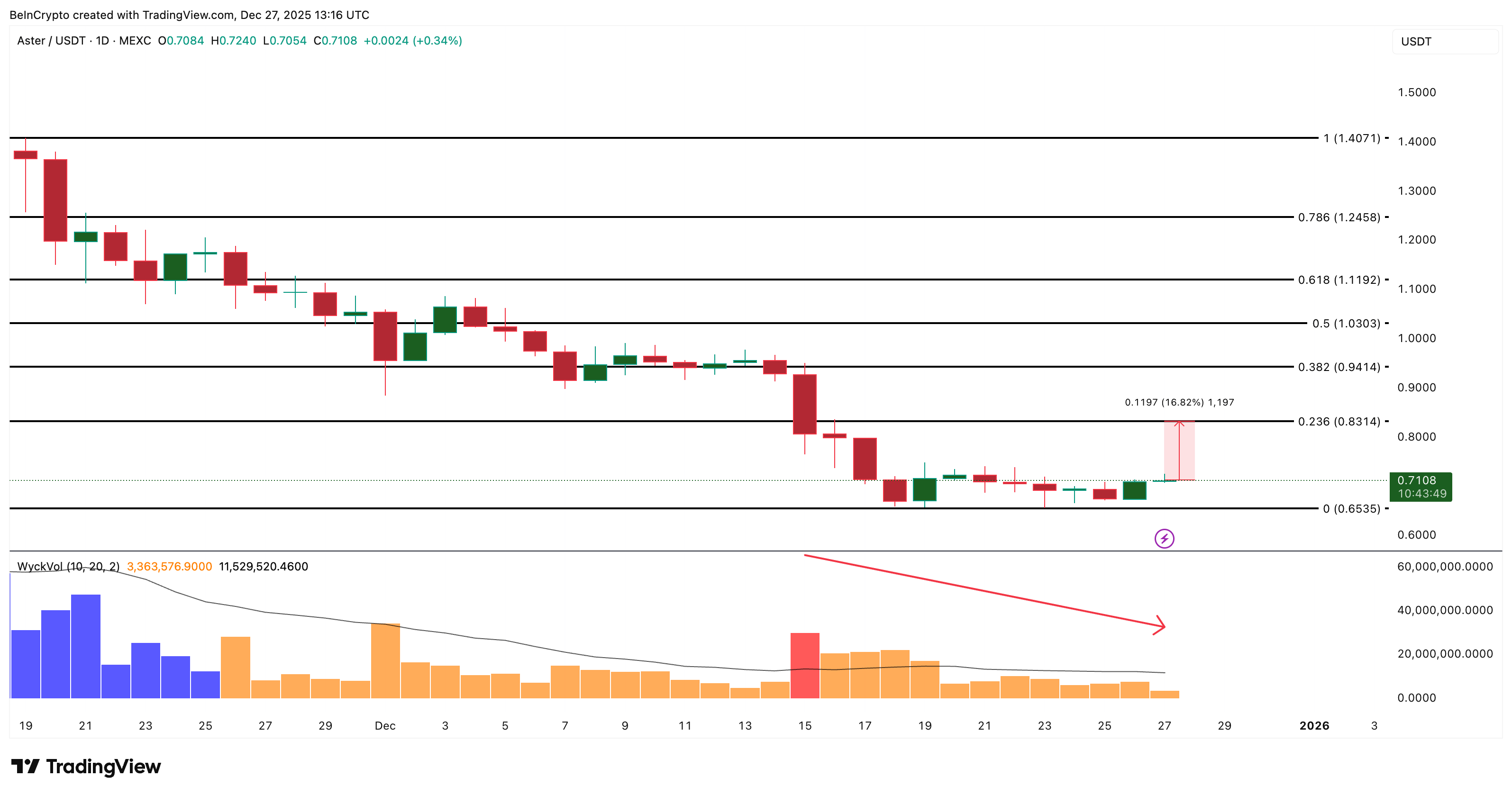
Price action supports this reading. ASTER fell sharply from about $1.40 on November 19 and found support near $0.65, which has held as a floor through December. Selling pressure also looks weaker now. On the Wyckoff Volume indicator, red and yellow bars (seller control) have been fading since December 15. The recent shift toward lighter red/yellow bars suggests sellers are losing dominance.
If whales are right, the recovery attempt begins with a push to $0.83, which requires approximately a 16% move from current prices. Breaking above $0.83 opens room toward $1.03, and then $1.24 if market conditions improve.
BitMine, the largest corporate holder of Ethereum, has begun staking part of its $12 billion ETH treasury.
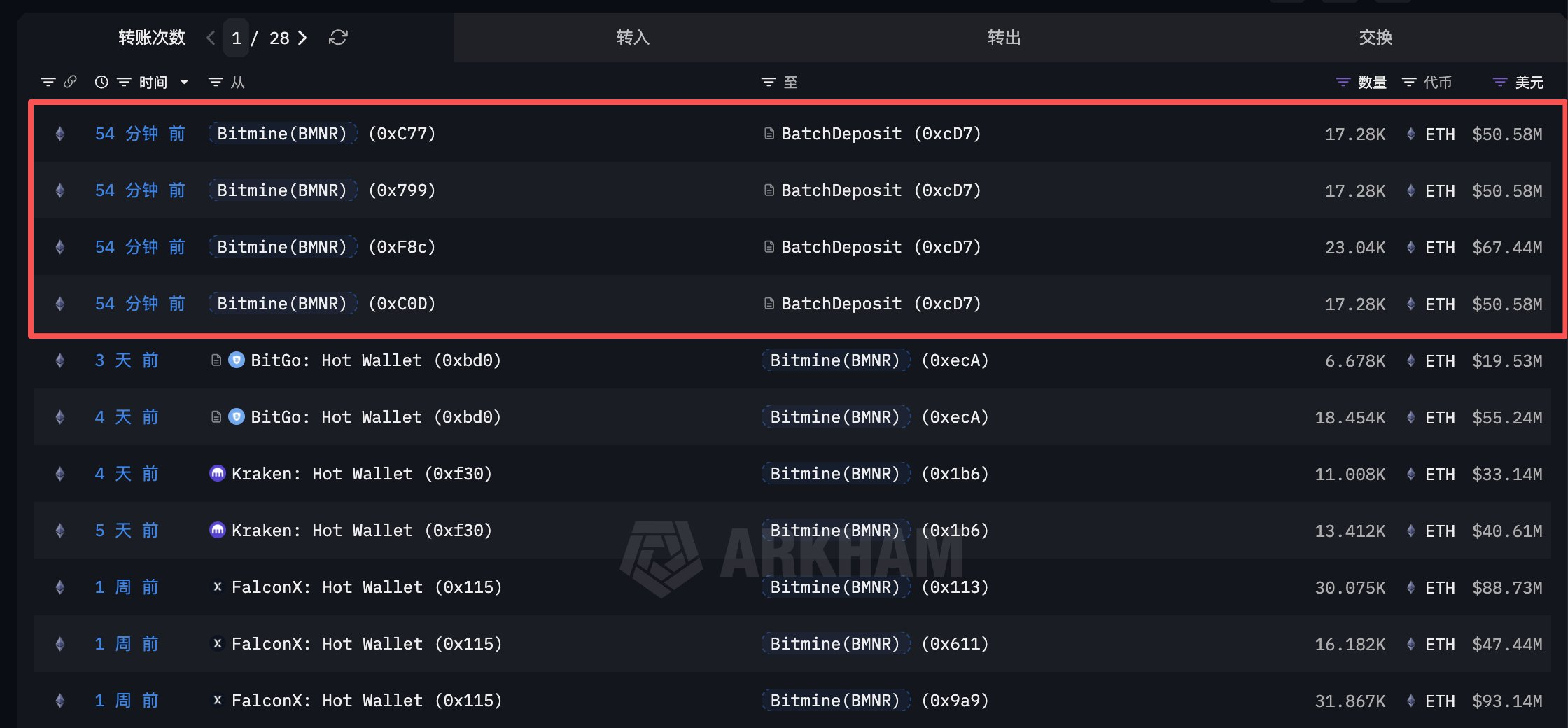
On December 27, on-chain analyst Ember CN reported that the firm deposited approximately 74,880 ETH, valued at about $219 million, into Ethereum staking contracts.
If the company were to stake its entire treasury at the current estimated annual percentage yield (APY) of 3.12%, it would generate approximately 126,800 ETH annually. At current prices, this equates to $371 million in yearly revenue.
Such a structure would effectively recast BitMine as a yield-bearing vehicle tied to Ethereum’s consensus layer. This means its valuation would no longer hinge primarily on the asset’s directional price movements.
ETH Staking Goals and Risks
However, the strategy introduces new financial and operational risks for the company.
Unlike Bitcoin held in cold storage, which can be liquidated immediately in stressed market conditions, staked Ether is constrained by protocol-level withdrawal mechanics.
Validators exiting the network must pass through an exit queue, which can delay access to capital during periods of heightened volatility.
In a liquidity crunch, that delay could leave BitMine exposed to price swings that a non-staking treasury might otherwise avoid.
This tradeoff underscores a structural difference between holding Ethereum as a passive asset and deploying it as productive capital within the network.
To support that vision, the firm is developing a proprietary staking platform, the Made in America Validator Network (MAVAN), scheduled for deployment in early 2026.
“We continue to make progress on our staking solution known as The Made in America Validator Network (MAVAN). This will be the ‘best-in-class’ solution offering secure staking infrastructure and will be deployed in early calendar 2026,” BitMine chair Thomas Lee said.
Meanwhile, critics argue that consolidating such a large share of Ether under a single US-domiciled validator framework introduces centralization risks. They say the structure could undermine a network designed to be neutral and globally distributed.
The Ethereum price is down by under 1% in the last 24 hours. At first glance, the chart looks quiet. Also, the minor price drop links to weak retail demand. But something else is happening under the surface.
New on-chain data shows whales adding again, while one key indicator flashes a rare trend shift, favoring one of the two groups mentioned in this piece.
Retail Slows Down While Whales Move In
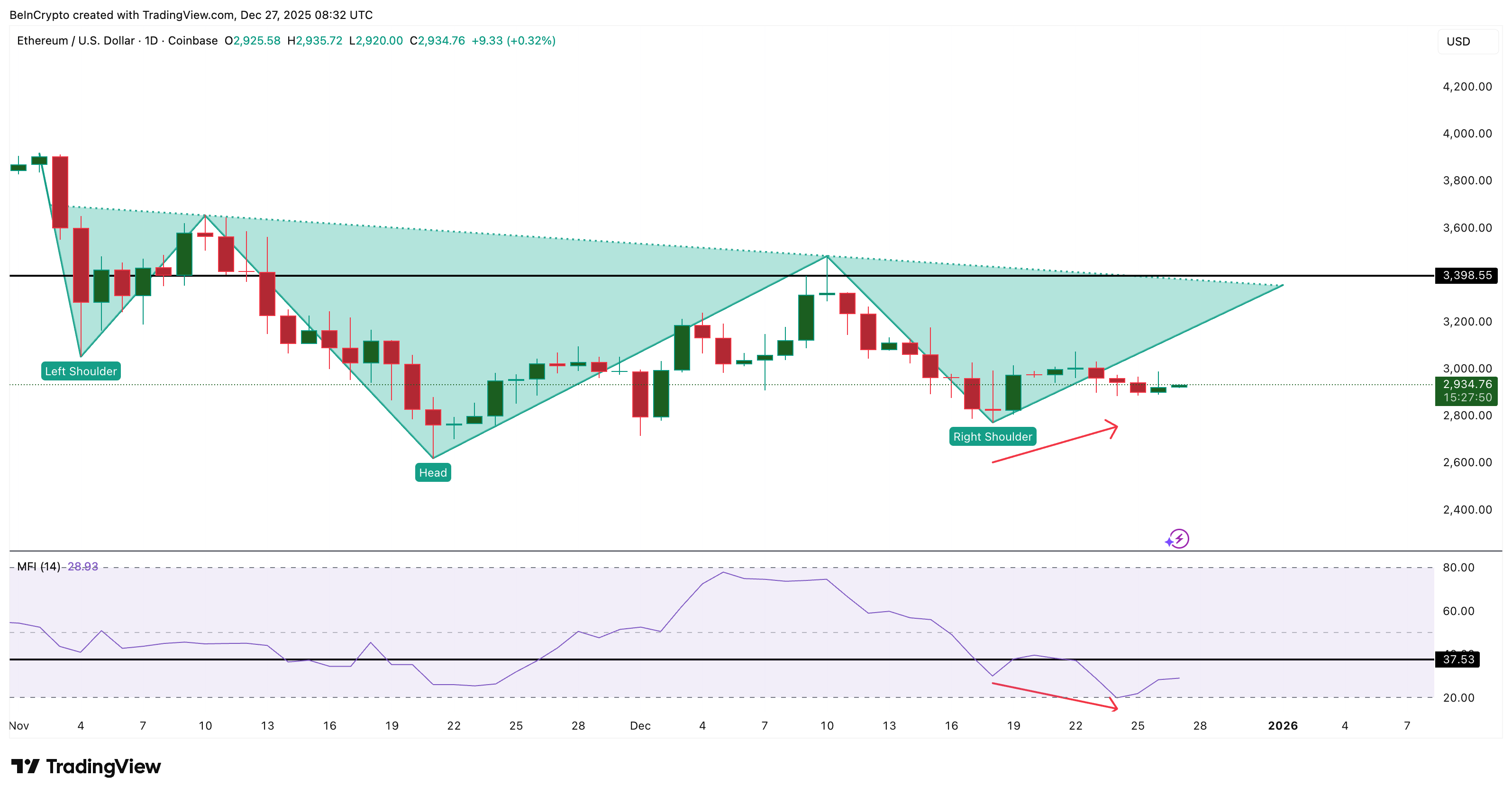
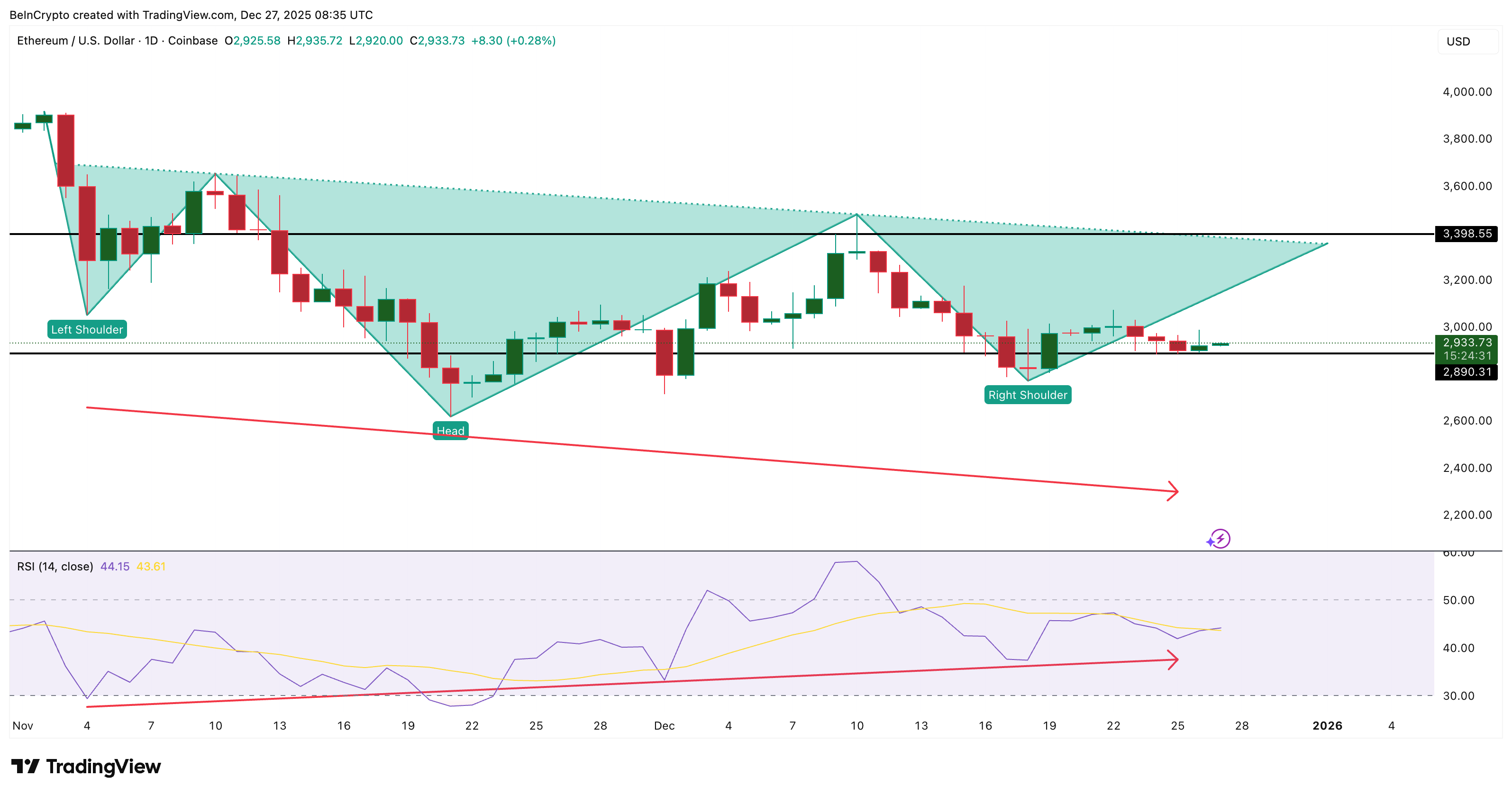
Ethereum is approaching completion of an inverse head-and-shoulders pattern. This is a bullish structure that signals a trend reversal if the price breaks above $3,390. The problem appears before that breakout level. Retail momentum weakened this week.
Between December 18 and December 24, the price trended higher. Normally, that is a positive sign. The Money Flow Index (MFI), which tracks money entering and exiting an asset, did not follow. It made a lower low. That shows that possibly retail traders did not support the higher low with real buying.
Want more token insights like this? Sign up for Editor Harsh Notariya’s Daily Crypto Newsletter here.
MFI now needs to move above 37 to form a higher high and show stronger demand.
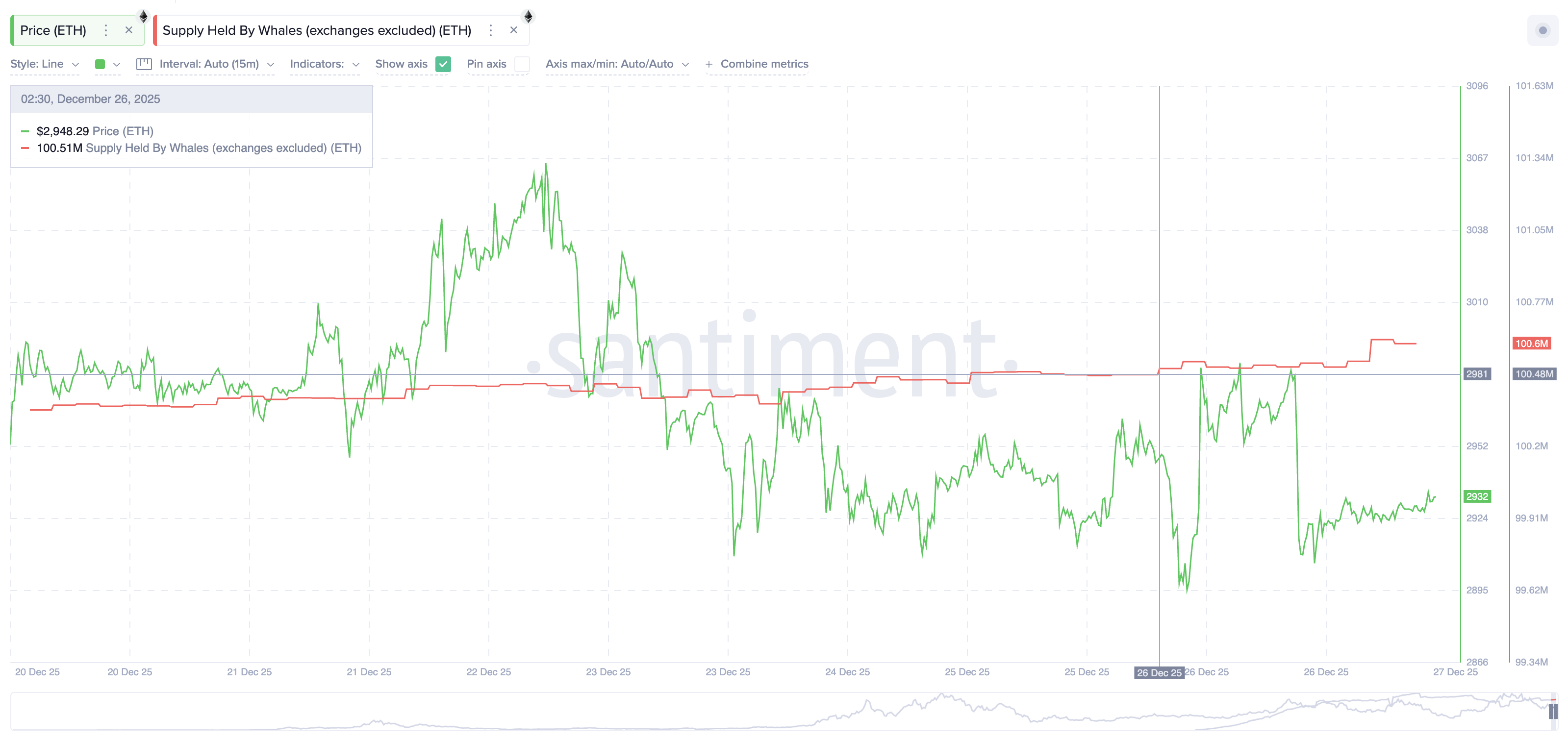
While retail slowed down, the whales reacted the opposite way. Since December 26, wallets holding large amounts moved from 100.48 million ETH to 100.6 million ETH.
At the current price, this amounts to approximately $350 million injected over the past 24 hours. Whales do not buy for short-term flips. They usually buy because they think a setup exists.
This type of divergence supports reversal patterns such as the inverse head-and-shoulders. It does not guarantee the breakout. It gives the breakout attempt a higher chance of working if the price reaches the trigger zone. And that is exactly why Ethereum whales are adding now.
Ethereum Price Zones Decide The Next Leg
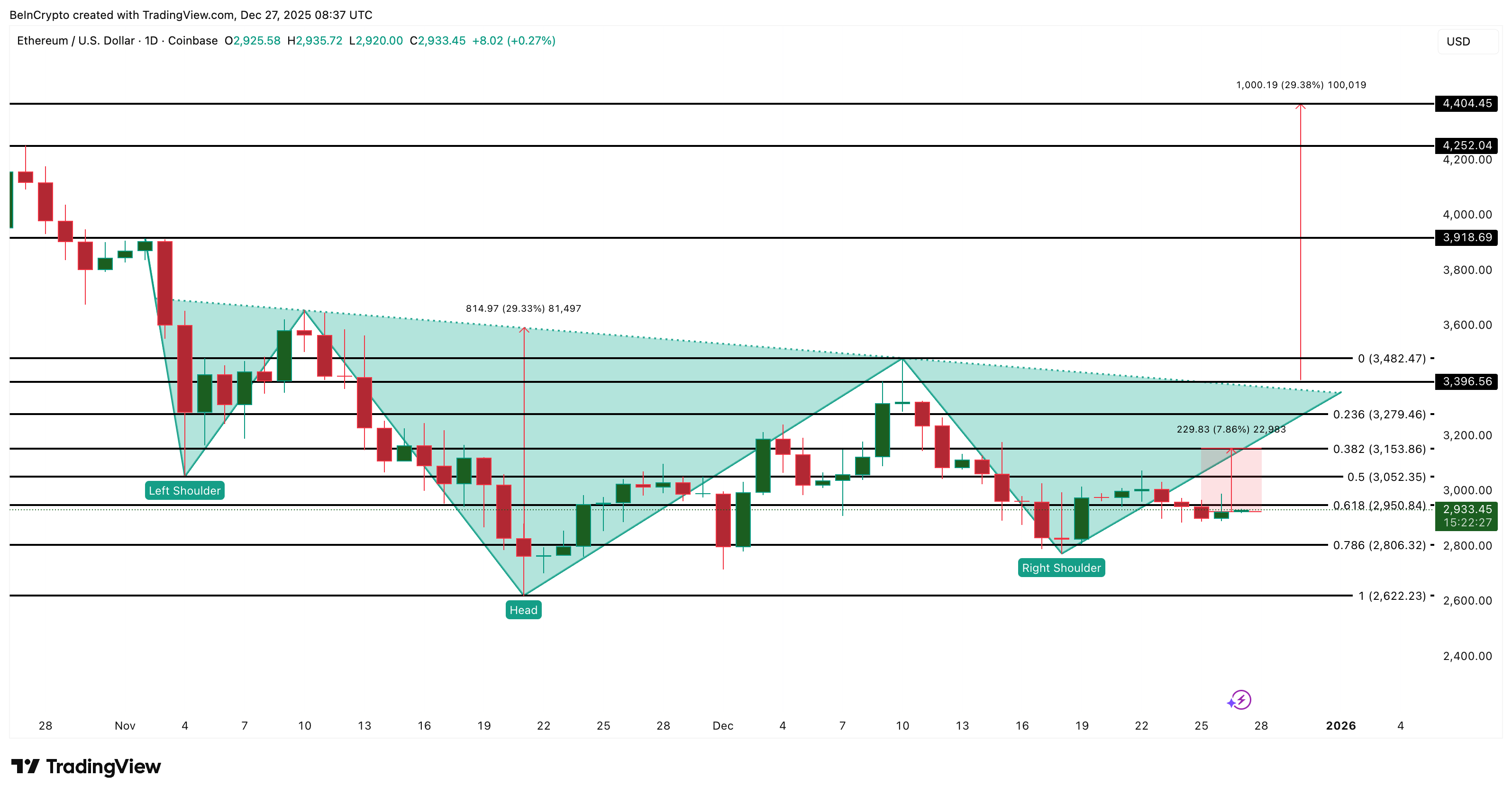
The Ethereum price must reclaim $3,050 first. This is a psychological barrier and short-term resistance.
If price clears it with strength, the next test is the neckline breakout zone at $3,390.
A breakout above $3,390 could activate an inverse head and shoulders target near $4,400. That comes from adding the height of the head to the breakout point.
On the downside, losing $2,800 weakens bullish momentum. If selling increases and whales stop adding, the Ethereum price can slide to $2,620. A drop below that level invalidates the bullish reversal structure.
Coinbase CEO Brian Armstrong predicts US banks will reverse their stance on stablecoin regulation and eventually lobby Congress to permit interest payments on these digital assets.
Armstrong’s forecast, posted December 27 on X, contradicts the banking sector’s current efforts to strip yield-generating features from the GENIUS Act.
Armstrong Predicts Banks Will Reverse Course on Stablecoin Interest Bans
He argued that lenders are currently protecting low-cost deposits but will be forced to adopt the technology to compete for capital.
“My prediction is the banks will actually flip and be lobbying FOR the ability to pay interest and yield on stablecoins in a few years,” Armstrong wrote.
The prediction reframes the current legislative battle over the GENIUS Act as more than a regulatory dispute. It presents the fight as a collision between legacy profit protection and inevitable market evolution.
The GENIUS Act, signed in July 2025, prohibits stablecoin issuers such as Circle and Tether from paying interest directly to holders.
However, it permits intermediaries—such as exchanges—to pass yield from the underlying Treasury reserves to users.
They argue that non-bank platforms can now offer near risk-free Treasury yields of roughly 4% to 5% on liquid cash equivalents. In that environment, commercial banks struggle to compete without raising deposit rates and compressing their net interest margins.
However, Armstrong characterized attempts to amend enacted law as a “red line” for the crypto industry.
Exactly – I’m actually impressed the banks can lobby for this with a straight face and not get kicked out of senator’s offices. It takes some serious mental gymnastics.
We won’t let anyone reopen GENIUS. Red line issue for us. And will keep advocating for our customers and the… https://t.co/6EfF2oBn5A
He criticized the banking lobby’s approach as “mental gymnastics.” He pointed to the contradiction of citing safety concerns while defending a business model built on paying depositors below-market rates.
The Coinbase CEO also described the current lobbying spend by banking trade groups as “100% wasted effort.”
Notably, a coalition of 125 crypto companies, including Coinbase, recently submitted a letter to the Senate Banking Committee opposing any revisions. The group argued that reopening the bill would undermine regulatory certainty.
Armstrong’s position implies that banks will eventually lose the ability to hold deposits at near-zero rates. Instead, they would issue their own tokenized dollars to capture the yield spread directly.
Until that pivot occurs, Coinbase and its peers intend to defend the existing framework that allows them to serve as the high-yield interface for dollar holders.
The Bitcoin price has decreased by almost 2% over the last 24 hours and is down nearly 3% from yesterday’s peak. At first glance, nothing about the price appears exciting.
However, something beneath the chart, especially on-chain, has changed for the first time in almost three months, and something else changed this week. These two shifts do not confirm a rally as 2026 approaches, but they might be the first building blocks of one.
A Momentum Shift Begins, but Needs Proof
Two signals have appeared simultaneously. They are separate, but the timing matters.
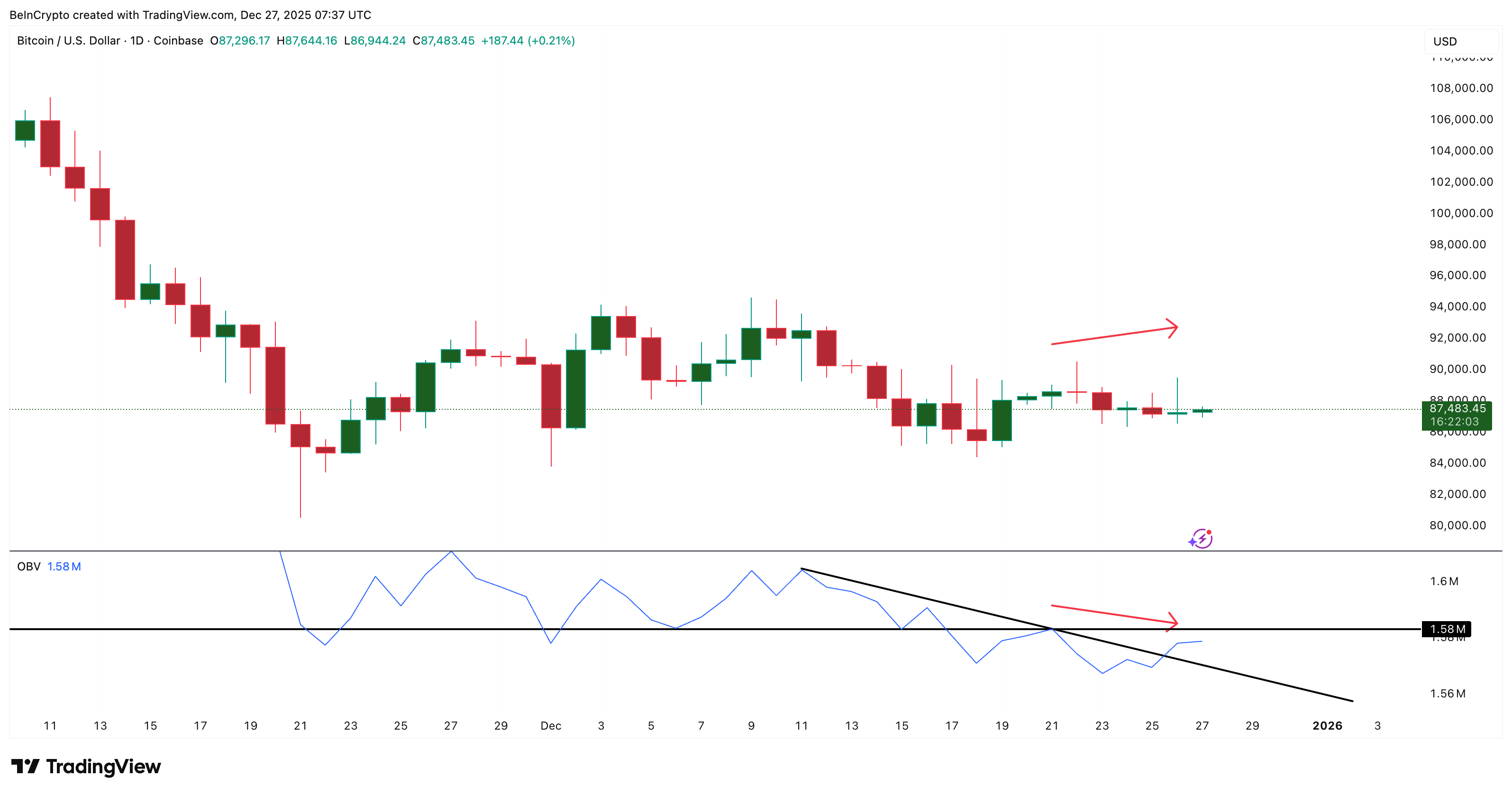
The first is the On-Balance Volume (OBV). OBV measures buying and selling pressure through volume. Between December 21 and December 26, Bitcoin’s price trended higher. OBV did not follow. It made lower highs. That is a bearish OBV divergence. It explains why the price failed to break through (long wick on December 26), as volume didn’t accompany the minor price rise.
Want more token insights like this? Sign up for Editor Harsh Notariya’s Daily Crypto Newsletter here.
This week, OBV broke above the trend line that connected those lower highs. That breakout suggests stronger buying pressure is forming. The signal is not confirmed until OBV makes a higher high above 1.58 million. If that happens, the Bitcoin price could finally react. That has not happened yet.
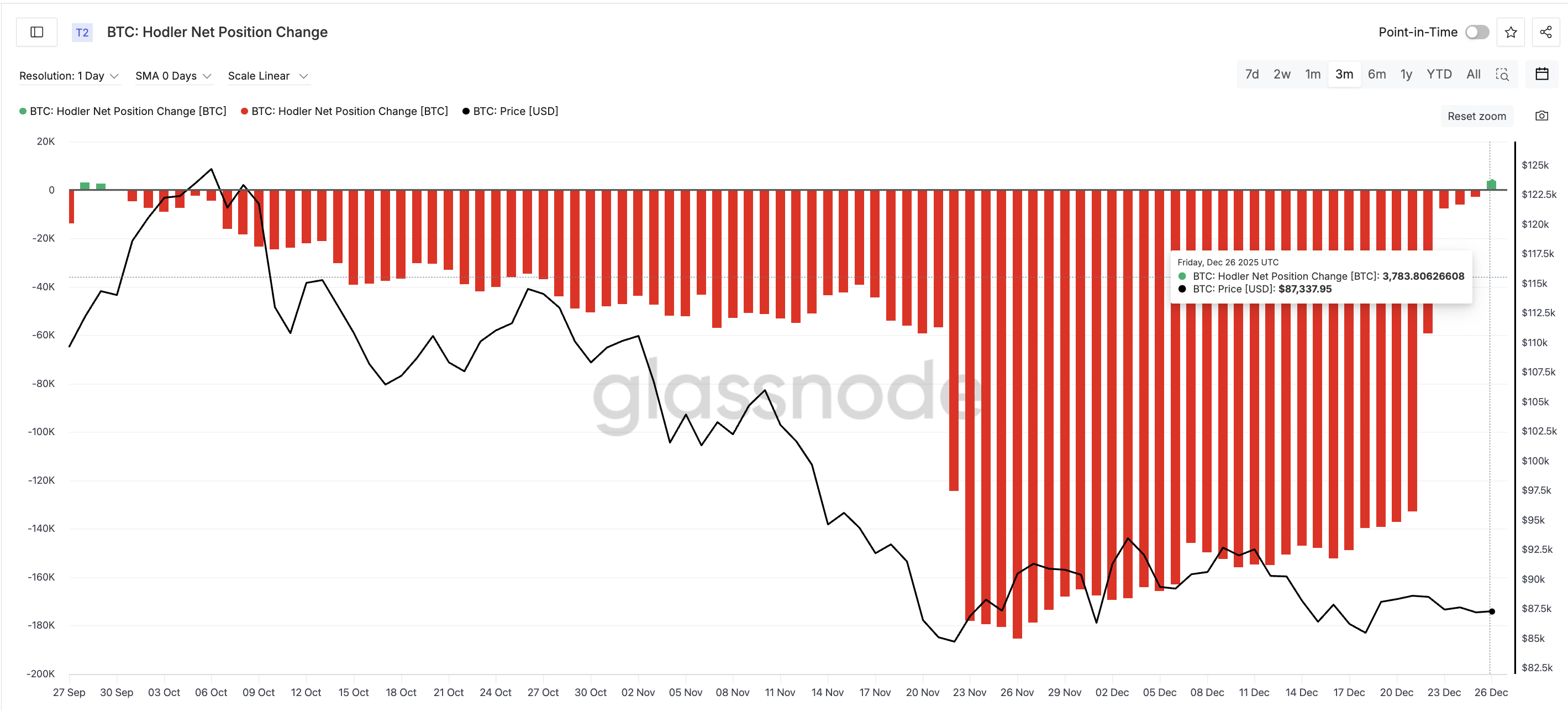
The second signal comes from the Hodler net position change metric. This tracks wallets that hold for longer than 155 days. They are the slowest movers in the market.
On December 26, this metric flipped positive for the first time since late September. Long-term holders added 3,783.8 BTC. They do not buy for short-term moves. They buy for conviction. And this is the first time in almost three months that conviction has shown up.
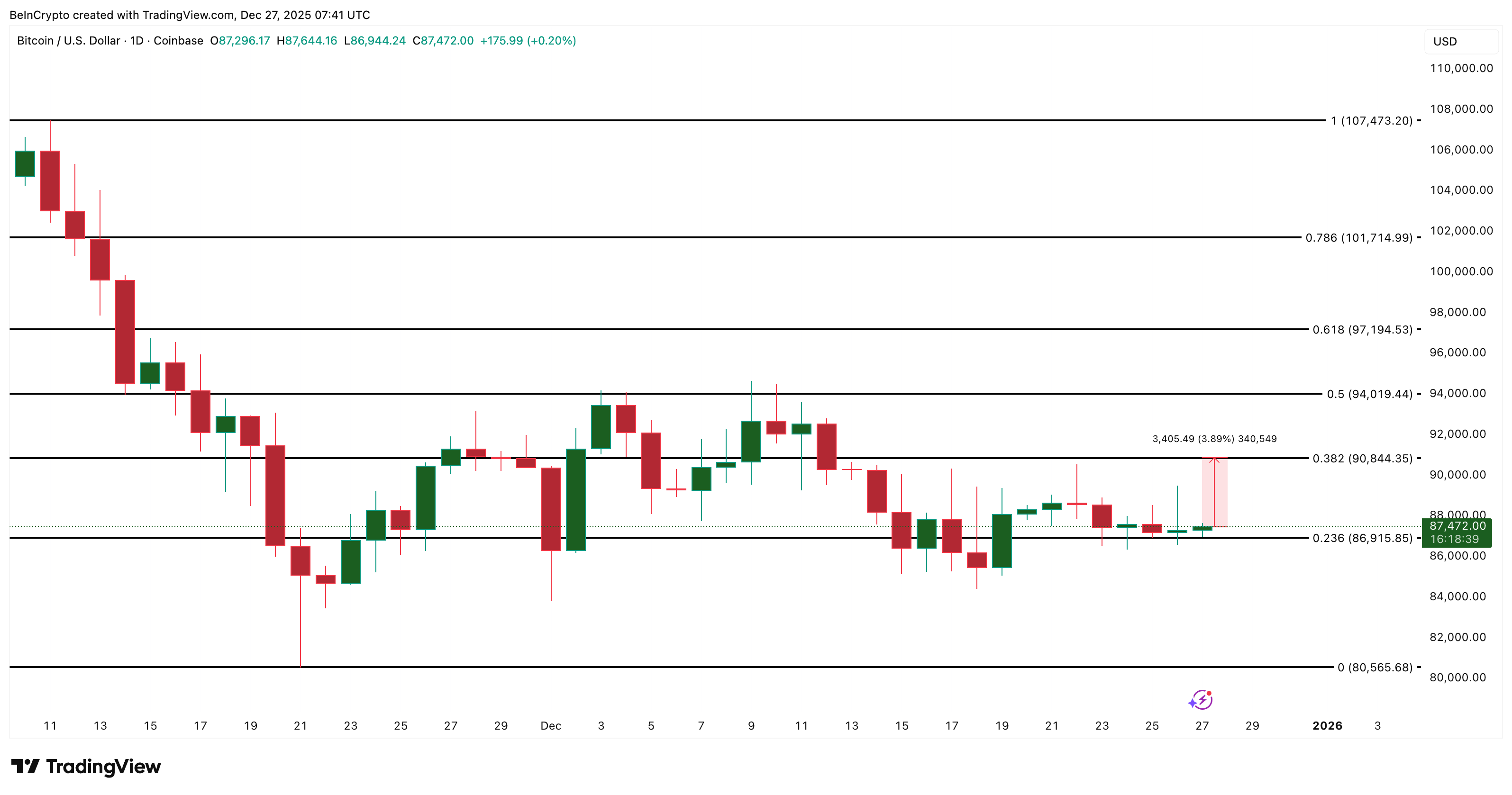
Bitcoin has failed to reclaim $90,840 for almost two weeks. That level rejected the price on December 12 and has blocked every attempt since. Until price clears that level, every bounce feels temporary.
Above $90,840, the first real relief rally checkpoint sits near $97,190. The BTC price fell below that level on November 14.
If the rally extends, $101,710 and $107,470 are the next zones.
On the downside, support sits at $86,915. It has held since December 19. Losing it opens room to $80,560. Low year-end liquidity increases that risk. For now, based on how long-term investors are positioning, the Bitcoin price can attempt a relief rally toward $90,840 and even beyond if the support at $86,910 holds.
Ripple Labs is doubling down on its presence in Japan, drawing on longstanding relationships with the country’s traditional financial institutions. The strategy is aimed at increasing adoption and interest in the XRP Ledger (XRPL).
This week, Asia Web3 Alliance Japan and Web3 Salon launched the Japan Financial Infrastructure Innovation Program. The initiative is designed to support Japanese startups developing next-generation, compliant digital financial solutions on the XRP Ledger.
Ripple’s Japan Strategy Tests Whether Institutions Can Lift XRP
The program opened applications on December 19 and is offering a $10,000 grant per startup. It is narrowly focused on three high-value verticals, including stablecoins, real-world asset tokenization, and credit infrastructure.
“Japan offers an overwhelming opportunity for blockchain innovation, supported by a forward-thinking regulatory framework and deep talent pool. This program represents Ripple’s commitment to fostering a vibrant ecosystem where startups can leverage the speed, low cost, and reliability of the XRP Ledger to create real-world benefits and transform financial infrastructure,” Christina Chan, Senior Director of Developer Growth at RippleX, said.
Analysts view it as a low-cost funnel for identifying candidates for Ripple’s significantly larger capital pool, including the 1 billion XRP fund dedicated to developers in Japan and Korea.
The program has secured backing from a formidable roster of establishment players, including Mizuho Bank, SMBC Nikko Securities, and Securitize Japan.
@AWAJ_official and @Web3Salon, with support from #JETRO and @RippleXrpie, are proud to announce the Japan Financial Infrastructure Innovation Program (JFIIP) 🇯🇵 during the Japan Fintech Week
— Asia Web3 Alliance Japan (AWAJ) (@AWAJ_official) December 24, 2025
Despite the initiative’s high-profile corporate backing, it comes at a precarious moment for the network. While Ripple touts institutional adoption, the underlying usage of the XRPL tells a conflicting story of contraction.
According to data from DefiLlama, the Total Value Locked (TVL) on the XRPL has plummeted in recent months. The TVL has fallen from a July high of $120 million to roughly $62 million as of press time.
This nearly 50% drawdown suggests that capital is exiting the network’s DeFi protocols even as corporate partnerships expand.
Meanwhile, the broader crypto market downturn likely contributed to the drawdown, as Bitcoin has fallen 30% from its October high of more than $126,000.
Furthermore, the push into asset tokenization faces stiff competition. According to Rwa.xyz, XRPL currently ranks ninth globally in tokenized assets, with approximately $213 million in assets.
While substantial, this lags significantly behind networks like Ethereum and newer competitors that have captured the lion’s share of the RWA market.
Considering this, the JFIIP program is more than a startup accelerator. By entrenching itself in Japan’s banking infrastructure, Ripple hopes to create a sticky ecosystem that is immune to the speculative volatility of the broader crypto market.
Strategy (formerly MicroStrategy) is the largest corporate holder of Bitcoin, owning 671,268 BTC, which represents over 3.2% of all Bitcoin in circulation. That makes the company a high-risk keystone in the Bitcoin ecosystem.
If it falls apart, the impact could be larger than the 2022 FTX collapse. Here’s why that threat is real, what could trigger it, and how bad the fallout could be.
MicroStrategy Is a Leveraged Bitcoin Bet
MicroStrategy’s entire identity is now tied to Bitcoin. The company spent over $50 billion buying BTC, mostly using debt and stock sales. Its software business brings in just $460 million a year, which is a fraction of its exposure.
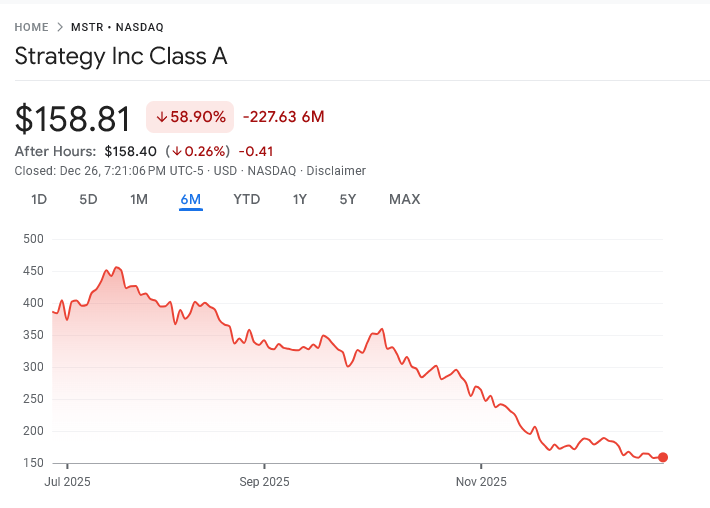
As of December 2025, its stock trades well below the value of its Bitcoin holdings. The market value is approximately $45 billion, but its BTC is worth around $59–60 billion.
MicroStrategy’s Share Prices Over the Second Half of 2025. Source: Google Finance
Investors are discounting its assets because of concerns about dilution, debt, and sustainability.
Its average BTC cost basis is around $74,972, and most of its recent buys were near Bitcoin’s peak in Q4 2025.
More than 95% of its valuation hinges on the price of Bitcoin.
If BTC drops sharply, the company could be trapped — holding billions in debt and preferred equity with no way out.
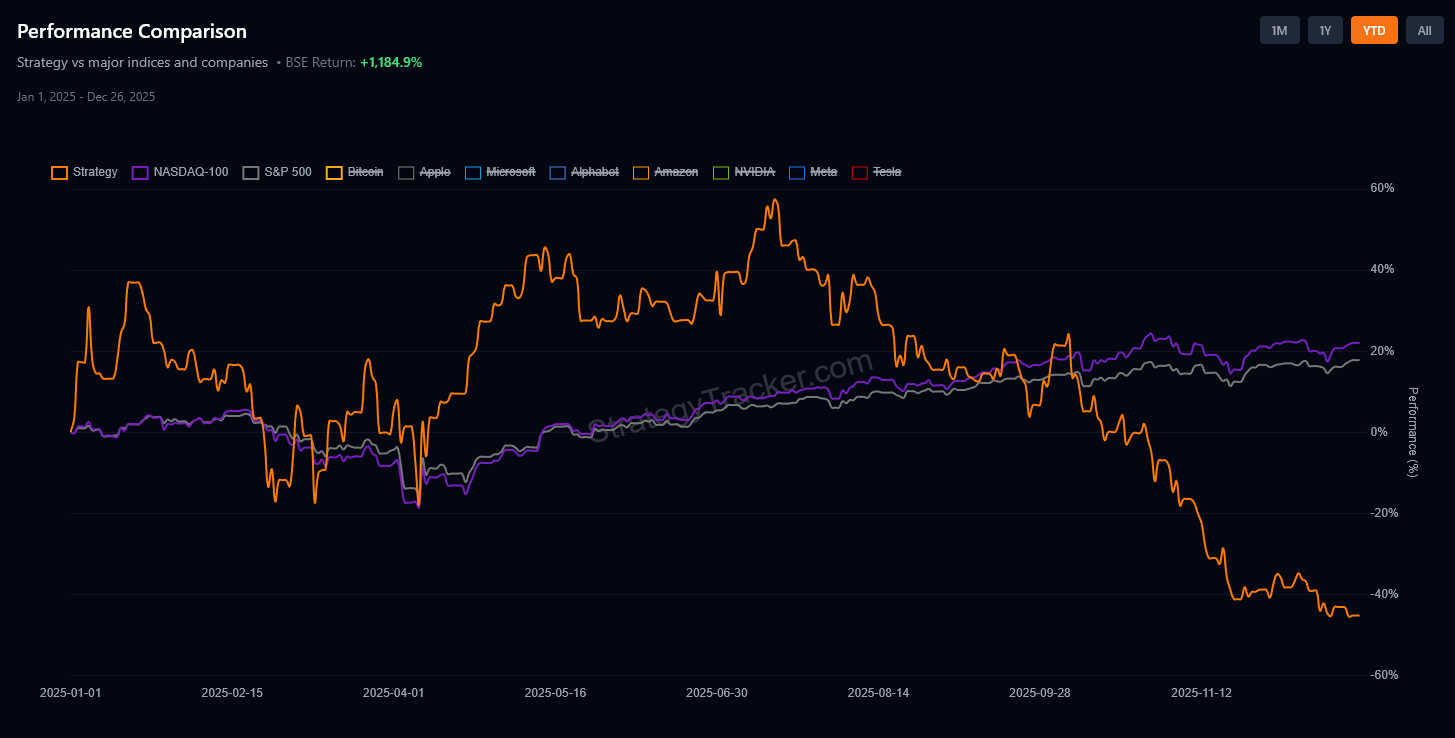
MSTR Stock Performance Comparison with NASDAQ-100 and S&P 500 in 2025. Source: Saylor Tracker
What Makes This a Black Swan Risk?
MicroStrategy used aggressive tactics to fund Bitcoin buys. It sold common stock and issued new types of preferred shares.
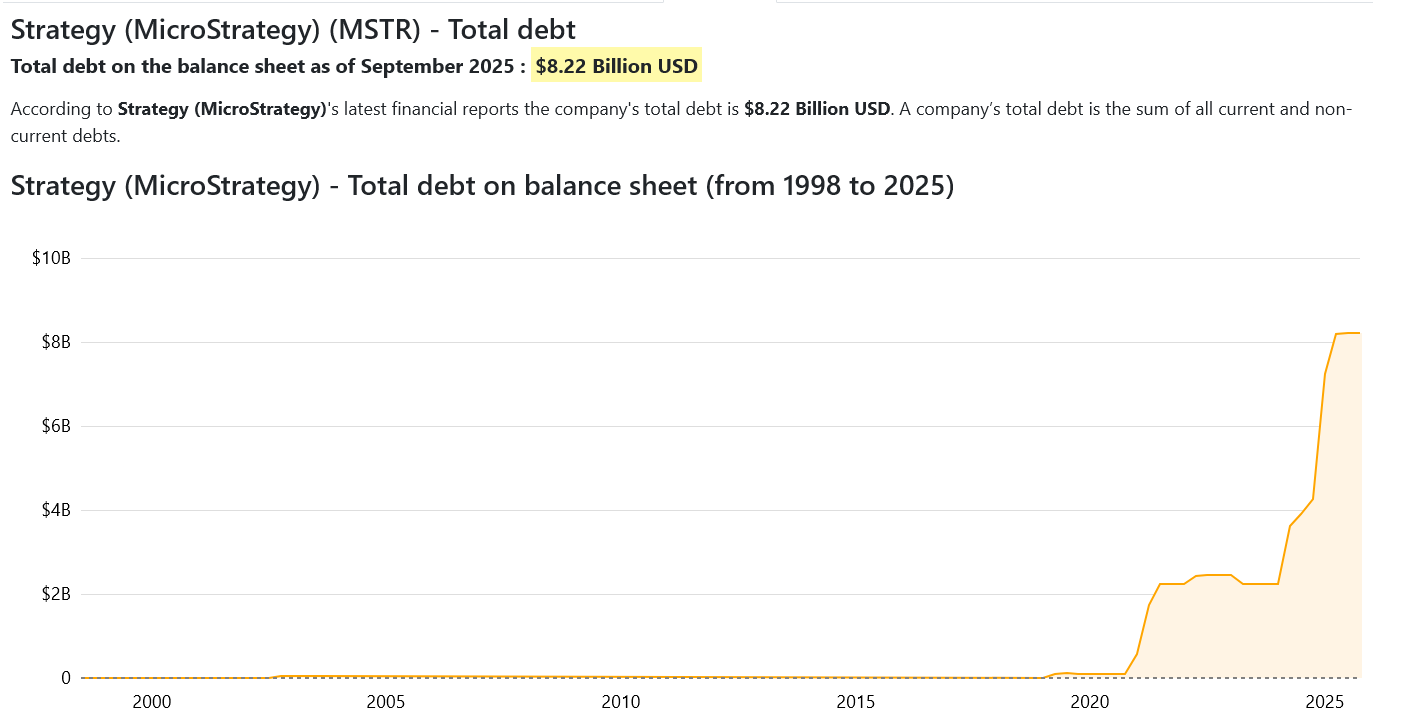
It now owes over $8.2 billion in convertible debt and has more than $7.5 billion in preferred stock. These financial tools require large cash outflows: $779 million annually in interest and dividends.
At the current levels, if Bitcoin crashes below $13,000, MicroStrategy could become insolvent. That’s not likely in the near term, but BTC’s history shows that 70–80% drawdowns are common.
A large crash, especially if paired with a liquidity crunch or ETF-driven volatility, could push the company into distress.
Unlike FTX, MicroStrategy is not an exchange. But the effect of its failure could be deeper. It owns more Bitcoin than any entity except a few ETFs and governments.
Forced liquidation or panic over MicroStrategy’s collapse could drive BTC’s price down sharply — creating a feedback loop across crypto markets.
As of late 2025, it holds $2.2 billion in reserves. This is enough to cover two years of payouts. But that buffer could vanish if BTC falls and capital markets close.
How Likely Is a Collapse for Michael Saylor’s Strategy?
Probability isn’t binary. But the risk is rising.
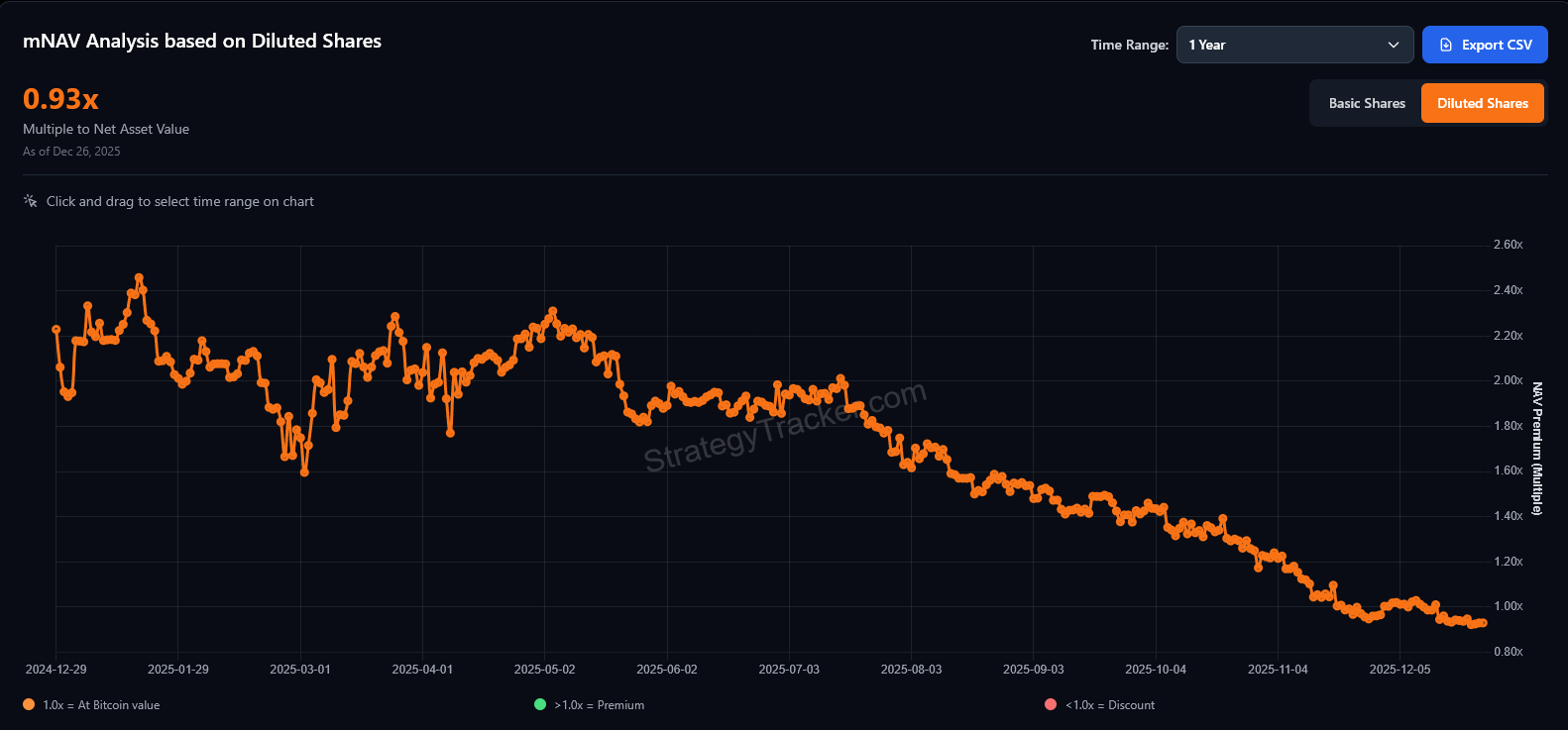
MicroStrategy’s current position is fragile. Its stock has fallen 50% this year. Its mNAV is below 0.8×. Institutional investors are shifting to Bitcoin ETFs, which are cheaper and less complex.
Index funds may drop MSTR due to its structure, triggering billions in passive outflows.
MicroStrategy mNAV. Source: Saylor Tracker
If Bitcoin falls below $50,000 and stays there, the company’s market cap could fall below its debt load. At that point, its ability to raise capital could dry up — forcing painful decisions, including asset sales or restructuring.
The odds of a total collapse in 2026 are low, but not remote. A rough estimate might place the probability between 10–20%, based on current balance sheet risk, market behavior, and Bitcoin volatility.
But if it does happen, the damage could exceed FTX’s collapse. FTX was a centralized exchange. MicroStrategy is a key holder of Bitcoin’s supply.
If its holdings flood the market, Bitcoin’s price and confidence could be hit hard. This would potentially trigger a broader selloff across crypto.
Few topics divide the crypto industry more than politics. Donald Trump is often referred to as “America’s first crypto president,” while the Biden administration earned a reputation for being hostile toward the sector.
But when rhetoric is stripped away and replaced with market data, the picture becomes more nuanced. The key question is not which administration spoke more favorably about crypto, but under whose leadership Bitcoin ultimately performed better.
Bitcoin Performance: The Numbers Tell a Clear Story
In the 2024 United States presidential election, Trump positioned himself as a pro-crypto candidate, vowing to make the US the “crypto capital of the world.” He promised to halt anti-crypto actions, rein in SEC crackdowns, and, in his own words:
“End Joe Biden’s war on crypto and we will ensure that the future of crypto and the future of Bitcoin will be made in America.”
This fueled optimism in the market and ignited hopes for a bull run. Fast forward to near the end of 2025, and Bitcoin is down nearly 5%.
By comparison, during Biden’s first year as president, the world’s largest cryptocurrency gained roughly 65%. Performance weakened in 2022, but momentum returned in the following years.
Bitcoin rebounded strongly, rising approximately 155% in 2023 and a further 120.7% in 2024.
Year
Bitcoin return (%)
2021
65%
2022
– 64.2%
2023
155%
2024
120.7%
2025 (As of December 26)
-5%
When examining Trump’s first term as president, an analyst noted that it was “the greatest crypto bull run” in history, during which the total cryptocurrency market capitalization increased by roughly 115 times from the beginning of his term to its end.
“Biden’s term returned 4.5x from beginning to end, and even at the worst moment, it never went below the annual open for his term. Trump’s 2nd term so far is below annual open, but 3 more years to go,” the pseudonymous analyst wrote.
Bitcoin Under Trump
So what actually happened this year? The pullback is not something that can be understood by looking at headline 2025 returns alone.
In January, momentum was broadly on Bitcoin’s side. Ahead of Trump’s inauguration, BTC rallied above $109,000, marking a new all-time high at the time. There were also developments on the regulatory side, with the SEC creating a task force to offer a transparent regulatory framework for digital assets.
Nonetheless, Trump’s next moves erased all these gains. After he announced tariffs on the EU and later expanded on them at Liberation Day, cryptocurrency markets declined alongside equities.
Notably, the announcement of a pause led to a modest recovery. This highlighted the market’s sensitivity to broader macroeconomic developments and pointed to increased volatility.
Meanwhile, adoption continued to rise as state-level Bitcoin reserve initiatives and institutional involvement increased. Bitcoin’s price continued to trend higher, posting positive returns for four consecutive months from April through July.
A key trend during this period was the emergence of digital asset treasuries (DATs). Public companies increasingly began adopting Bitcoin as a reserve asset, following the playbook popularized by Micro (Strategy).
Bitcoin benefited from this shift, as many experts argued institutional involvement could help reduce volatility and signal the asset’s maturation within traditional finance.
As confidence grew, so did the risk appetite and the use of leverage. High-risk, highly leveraged traders drew widespread attention. On the macroeconomic front, the Fed slashed interest rates in September. This was again bullish for risk assets.
Bitcoin went on to reach a new all-time high in October, peaking at $125,761 on October 6. Many projected further upside, with targets ranging from $185,000 to $200,000 by year-end.
This optimism was supported by favorable macroeconomic catalysts and Bitcoin’s historically strong performance during the fourth quarter.
BeInCrypto reported that on October 11, Trump’s announcement of 100% tariffs on China pulled the market lower. Over $19 billion in leveraged positions were wiped out, resulting in significant losses for many traders.
🚨 BIGGEST WIPEOUT SINCE LUNA, COVID & FTX.
Heading into Trump’s 100% China tariff announcement, markets got the pullback they were waiting for.
Nearly $20 BILLION in crypto liquidations in just 24 hours, a record wipeout. 😱
“It also appears to be a structural and mechanical downturn. It all began with institutional outflows in mid-to-late October. In the first week of November, crypto funds saw -$1.2 billion of outflows. The problem becomes excessive levels of leverage AMID these outflows…Excessive levels of leverage have resulted in a seemingly hypersensitive market,” The Kobeissi Letter posted in November.
Bitcoin dropped 17.67% in November and has since lost an additional 1.7% of its value this month, according to Coinglass data.
From Bitcoin ETFs to Altcoins: Regulatory Changes and Market Response
The Trump and Biden administrations differed on several key issues, one of which was crypto ETFs. Under the Biden administration, the SEC initially took a far more cautious approach to the crypto sector. This stance extended to crypto ETFs.
However, the regulatory position shifted following a ruling by the US Court of Appeals for the DC Circuit, which ordered the SEC to reconsider Grayscale Investments’ application to convert its flagship GBTC fund into a spot Bitcoin ETF.
Notably, after Gary Gensler’s departure from the SEC, asset managers were quick to file multiple applications for altcoin ETFs. Firms including Bitwise, 21 Capital, and Canary Capital, among others, submitted filings to launch a range of crypto-based investment products.
In September, the SEC approved generic listing standards, eliminating the need for case-by-case approvals. Following this shift, ETFs linked to assets such as SOL, HBAR, XRP, LTC, LINK, and DOGE entered the market.
In November, Canary Capital’s XRP ETF saw $58.6 million in trading volume on its first day, ranking as the strongest debut among more than 900 ETFs launched in 2025. Bitwise’s Solana ETF also attracted significant interest, generating $56 million in first-day volume, while other products recorded comparatively lower activity.
From a regulatory standpoint, the ETFs have increased market access, and the ruling reduced barriers for issuers. However, early performance data suggest that the introduction of additional crypto ETFs has not yet translated into a proportional increase in aggregate market inflows.
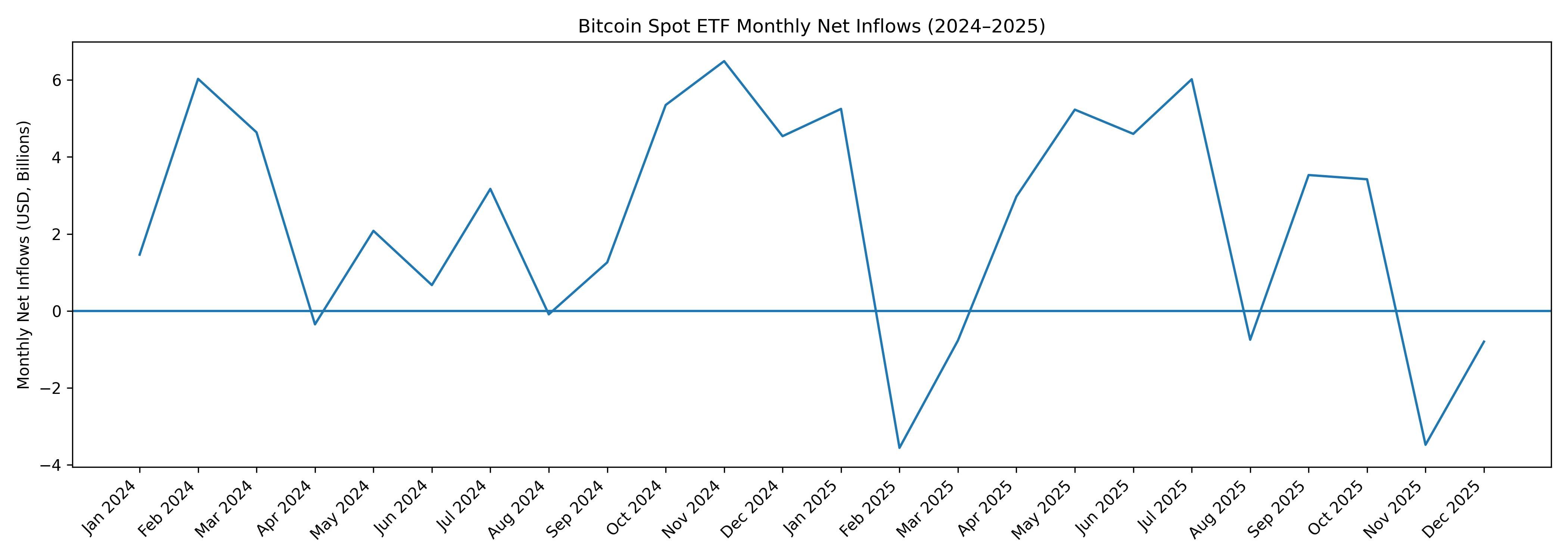
In 2024, spot Bitcoin ETFs attracted approximately $35.2 billion in net inflows. In 2025, inflows into Bitcoin ETFs slowed to $22.16 billion according to SoSoValue data. This divergence suggests that the growth in ETF offerings may have coincided with a redistribution of capital across products rather than an expansion of total crypto exposure.
Bitcoin ETF Flows. Source: Data Curated by BeInCrypto
Inside the Trump Family’s Crypto Empire
Although Donald Trump’s influence on the market is clear, he has also become directly involved in the crypto space. In January, the president introduced a meme coin, soon followed by a closely resembling token launched by Melania Trump.
In March, US President Donald Trump’s sons, Eric Trump and Donald Trump Jr., partnered with Hut 8 to launch American Bitcoin Corp.
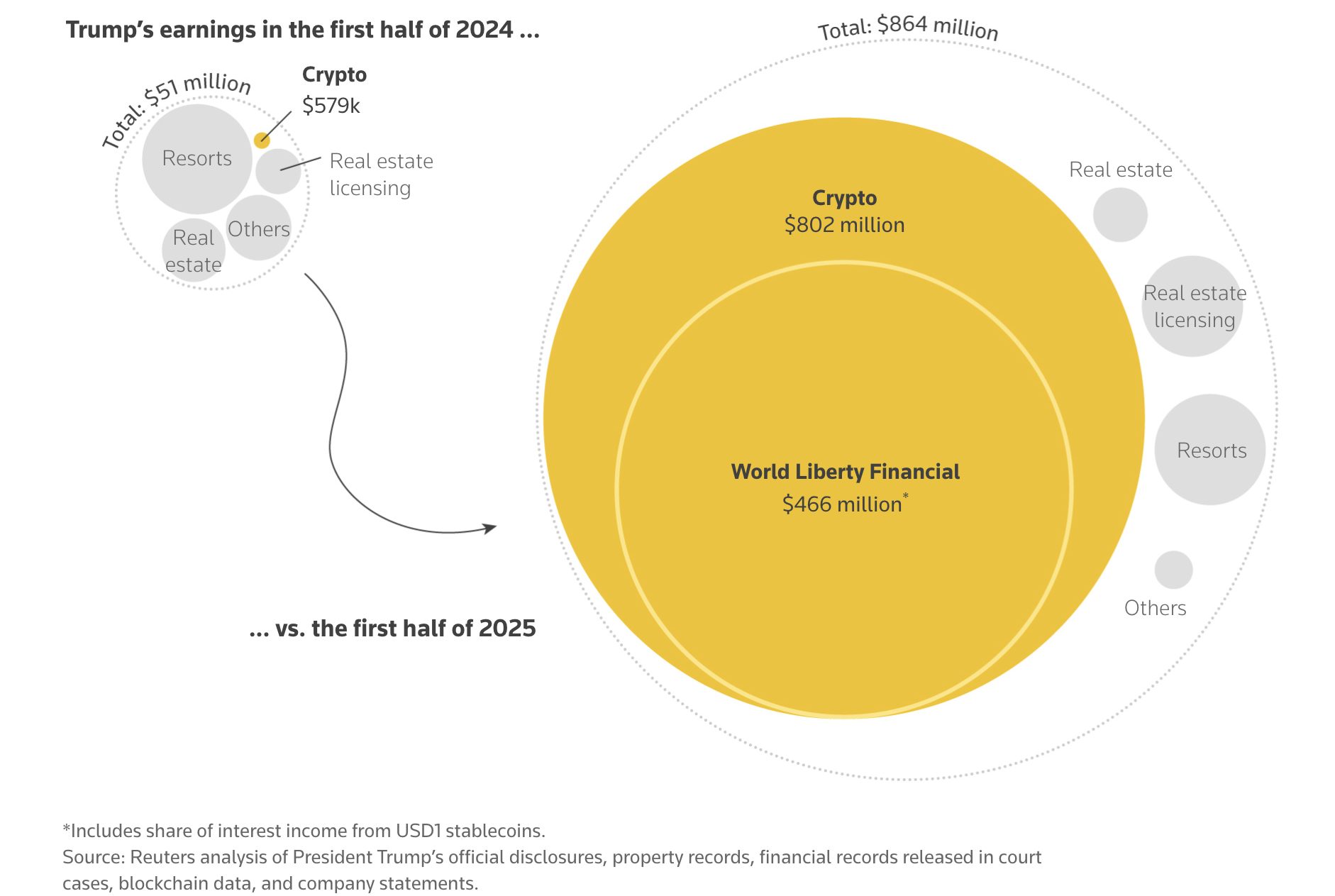
These ventures have generated significant wealth for the US president and his family. According to a Reuters analysis, they earned more than $800 million from crypto asset sales in the first half of 2025 alone,
One could argue that these moves helped legitimize the sector and accelerate adoption. Still, Trump’s direct and indirect involvement in crypto-related ventures raises concerns around optics, governance, and market integrity. While meme coins are not new to the crypto space, their association with a sitting US president is unprecedented.
Taken together, the data suggest that the answer to who helped crypto the most depends on how “help” is defined. Under Trump, crypto has benefited from a friendlier regulatory tone, reduced enforcement pressure, and faster approval of new investment products.
These changes lowered barriers for issuers and expanded market access.
However, market performance tells a different story. Bitcoin’s strongest gains occurred earlier, during Joe Biden’s presidency.
Meanwhile, Trump’s first year back in office has been marked by heightened volatility.
Vitalik Buterin has warned that the European Union’s regulatory approach under the Digital Services Act risks undermining pluralism by trying to leave “no space” for controversial speech or products online.
In a detailed post on X, the Ethereum co-founder argued that a free society should not aim to eliminate ideas it considers harmful. Instead, he said regulators should focus on stopping such content from being algorithmically amplified and dominating public discourse.
What the EU’s “No-Space” Approach Means
The Digital Services Act applies to the entire online ecosystem. Any service reaching EU users falls under the law, regardless of size or location. Obligations scale with reach and risk, but no platform sits outside the regulatory framework.
Critics describe this as a “no-space” approach, meaning there should be no unregulated digital gaps where harmful content can escape accountability.
This is what I worry Europe will get negatively polarized into: an ideology taking pride in a neat, sanitized online environment free of evil corporate and fascist pathogens.
I hope European govs do not go this way, and instead take a Pirate Party approach of user empowerment.… https://t.co/oH7Yfdg9pa
The goal is not blanket censorship. Instead, the DSA focuses on risk assessments, transparency, and platform design choices that influence how content spreads.
Buterin said the real failure of modern social platforms is not that fringe views exist, but that algorithms often push them at scale.
He warned that zero-tolerance thinking can lead to overreach, conflict, and growing reliance on technocratic enforcement.
should be solved at as local a level as possible, ideally the operator of whatever institution is using the room and organizing toddlers to come there, otherwise the municipality
Buterin warned that treating disliked ideas as pathogens to be erased reflects an anti-pluralistic instinct. He argued that disagreement is inevitable in open societies and that trying to fully remove controversial views often expands surveillance and enforcement powers.
He advocated for user empowerment, transparency, and competition. In his view, platforms should reduce incentives that reward harmful content, rather than attempting to eliminate it entirely.
As regulators push platforms to monitor behavior and retain more data, users may grow more aware that increased oversight often leads to greater data exposure.
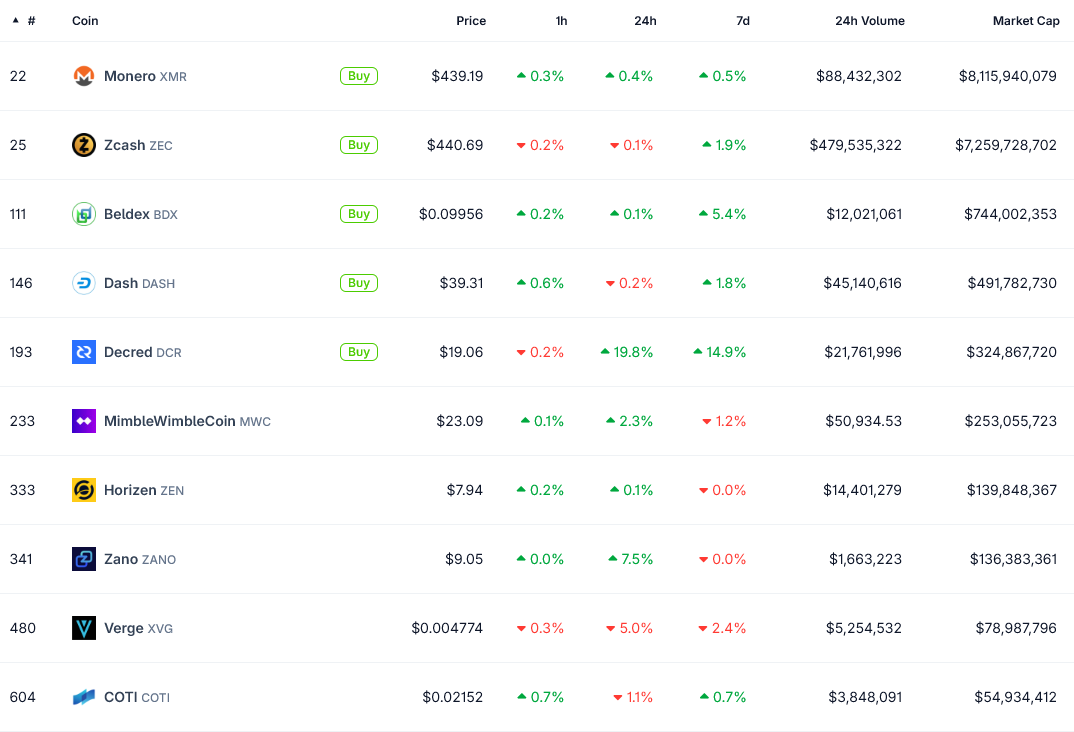
Top Privacy Coins by Market Cap. Source: CoinGecko
However, the impact is uneven. While philosophical support for privacy coins may grow, access in regulated EU markets remains constrained. Exchanges continue to limit or delist them due to compliance risk.
In short, Europe’s approach reinforces why privacy matters, even as it complicates where privacy-focused tools can operate.
The crypto market is heading into the final weekend of 2025, and before the new year begins, there might be some room for altcoins to record growth still.
Led by Pippin (PIPPIN), these three altcoins are must-watch in the coming 48 hours as we near the year-end.
UNUS SED LEO (LEO)
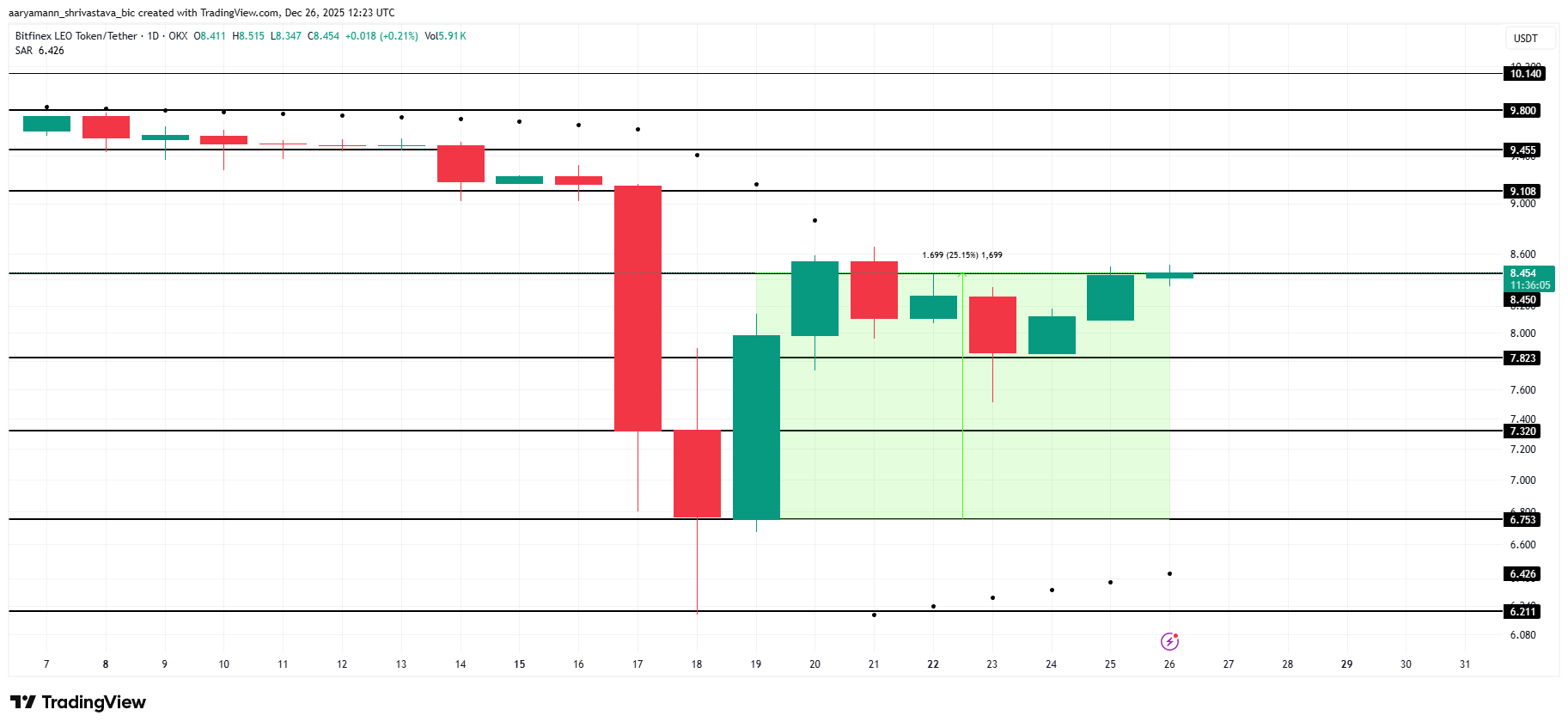
LEO price surged 25% over the past week, trading near $8.45 at the time of writing. The technical structure shows strong support, with the Parabolic SAR confirming an active uptrend. This setup suggests buyers remain in control as momentum builds despite broader market uncertainty.
If bullish conditions persist, LEO could rebound toward $9.10, recovering losses recorded earlier this month. Sustained buying pressure may extend gains toward the $9.80 target. Achieving this level would reflect renewed confidence and reinforce the prevailing upward trend in the short term.
Want more token insights like this? Sign up for Editor Harsh Notariya’s Daily Crypto Newsletter here.
Downside risks remain if investors move to lock in profits early. Selling pressure could push LEO below the $7.82 support. A further decline toward $7.32 would weaken technical structure, invalidate the bullish thesis, and signal a potential shift back to short-term bearish momentum.
Pippin (PIPPIN)
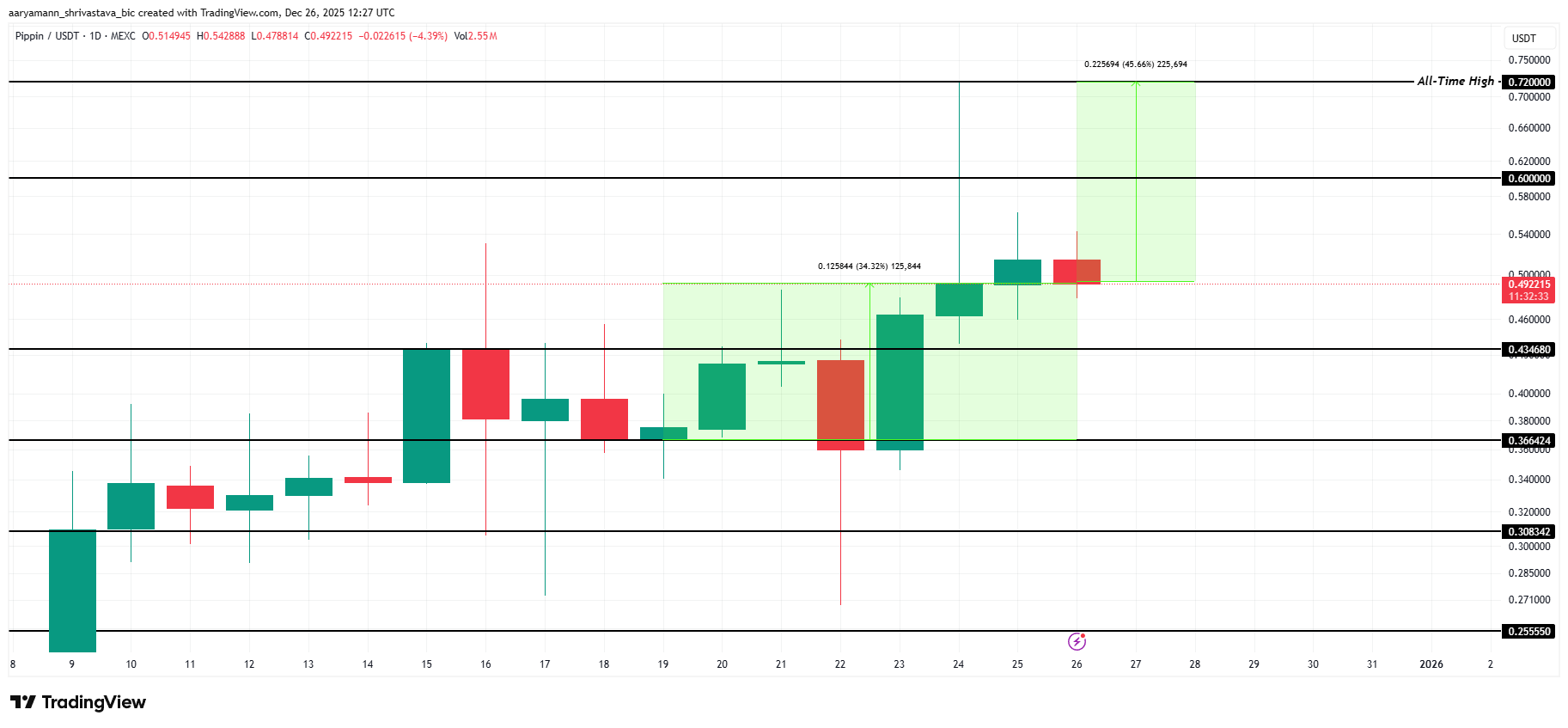
PIPPIN has emerged as one of the strongest-performing altcoins this week, gaining 34% over the past seven days. The token continues to post fresh all-time highs on a weekly basis. Persistent buying interest and strong momentum have supported its sustained upward trajectory.
The latest all-time high stands at $0.720, with PIPPIN requiring a 45.6% move to revisit that level. Achieving this depends on flipping $0.600 into firm support. A successful hold above that zone would confirm strength and increase the probability of continued price discovery.
Downside risk remains if broader market sentiment turns bearish. Weakening risk appetite could push PIPPIN below the $0.434 support. A breakdown there may extend losses toward $0.366, erasing recent gains and invalidating the prevailing bullish outlook.
MYX Finance (MYX)
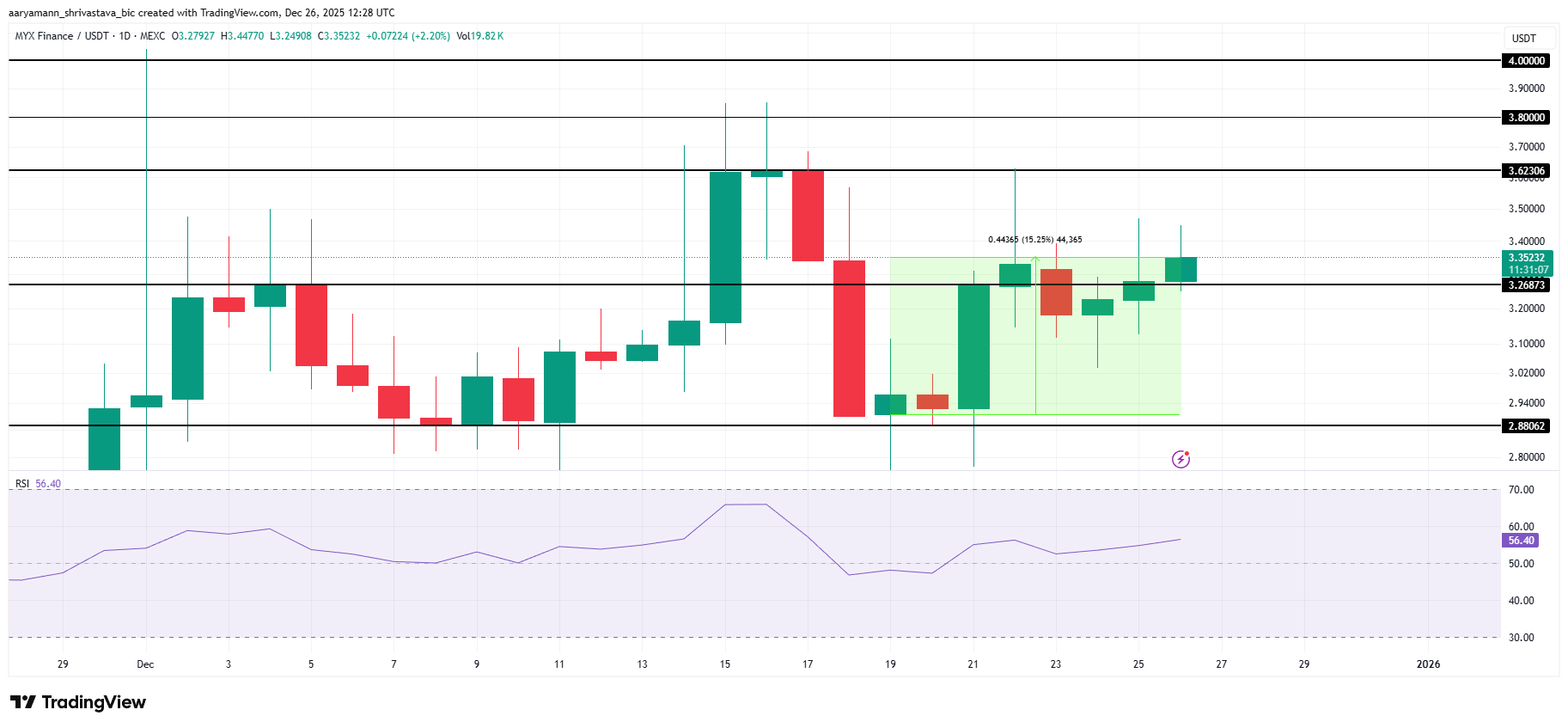
MYX price traded near $3.35 at the time of writing after rising 15.2% over the past seven days. The altcoin continues to hold above the $3.26 support. The current structure suggests buyers are targeting the $3.62 resistance as momentum gradually builds.
Technical indicators reinforce the bullish bias. The Relative Strength Index remains above the neutral 50.0 level, signaling sustained buying pressure. This strength could support further recovery. A confirmed breakout above $3.62 may open the path toward $3.80 in the short term.
Downside risks persist if broader market conditions weaken. Increased selling pressure could push MYX below the $3.26 support. A breakdown there would expose the $2.88 level, invalidating the bullish outlook and signaling a shift back toward short-term bearish momentum.
The fallout from Trust Wallet’s Chrome extension incident intensified on December 26 after Changpeng Zhao (CZ), weighed in publicly, suggesting the breach may have involved an insider.
The comment came as Trust Wallet confirmed that roughly $7 million in user funds have been affected so far.
Insider Access as Key Line of Investigation
CZ said Trust Wallet will fully reimburse impacted users and stressed that customer funds remain safe.
However, he added that investigators are still examining how a compromised browser extension update was able to pass through distribution controls, calling an insider role “most likely.”
The statement amplified concerns around internal access and update governance, rather than an external exploit alone.
Trust Wallet later confirmed that the incident affected Browser Extension version 2.68 only, reiterating that mobile users and other versions were not impacted.
The company said it is finalizing reimbursement procedures and will issue clear instructions to affected users.
Meanwhile, users should remain cautious against phishing attempts posing as official support.
Update on the Trust Wallet Browser Extension (v2.68) incident:
We’ve confirmed that approximately $7M has been impacted and we will ensure all affected users are refunded.
Supporting affected users is our top priority, and we are actively finalizing the process to refund the… https://t.co/2XRx8GvZ75
The insider angle has drawn particular attention within the crypto security community. Browser extensions require signing keys, developer credentials, and approval workflows to publish updates.
For a malicious or compromised build to be distributed through the official Chrome Web Store, investigators typically look at either credential compromise or direct internal access.
Both scenarios point to weaknesses in operational security rather than a traditional software vulnerability.
Such risks are not theoretical. Over the past year, several high-profile browser extension incidents have stemmed from hijacked developer accounts or compromised release pipelines.
TWT Token Briefly Dips Before Rebounding
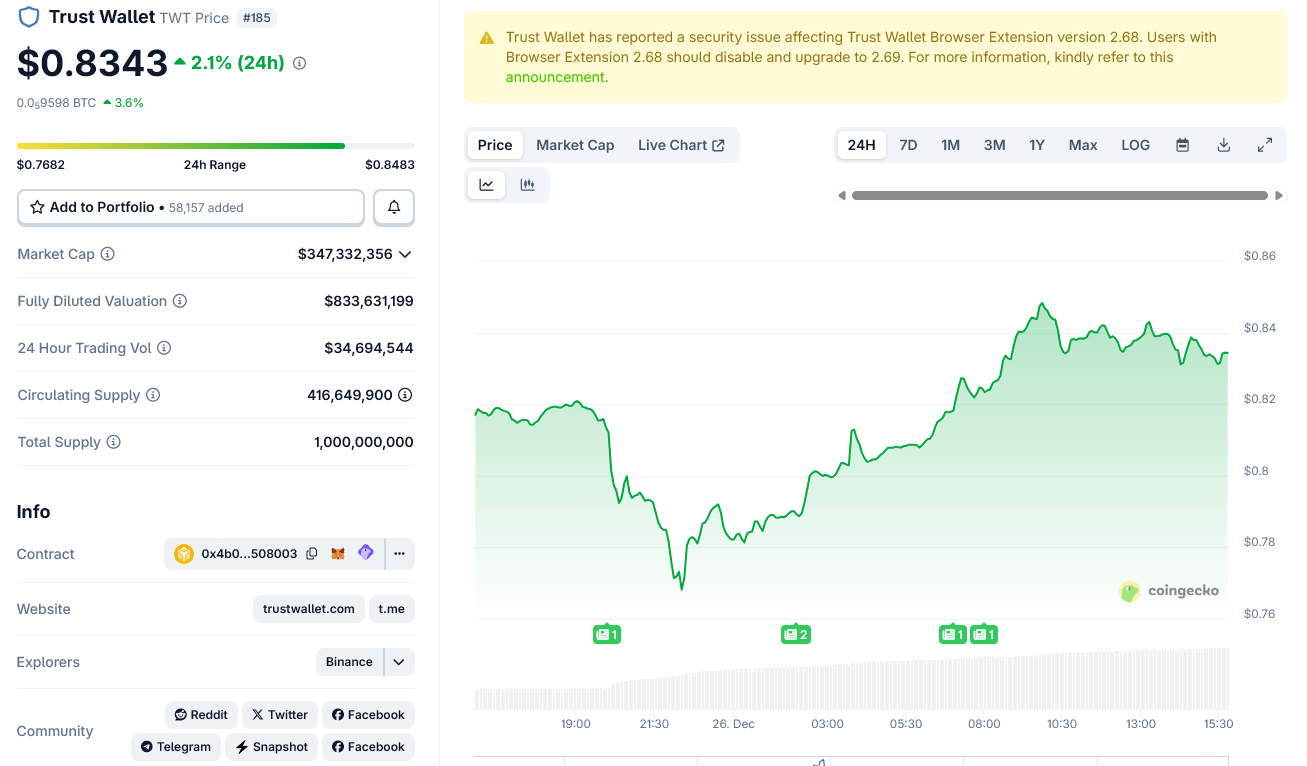
Market reaction reflected the uncertainty. Trust Wallet’s native token, TWT, saw a sharp sell-off following the initial reports on December 25.
However, prices stabilized and rebounded on December 26 after confirmation that losses were limited and refunds would be issued.
While Trust Wallet has moved quickly to contain the incident, the episode reflects a broader industry challenge.
As crypto wallets increasingly rely on browser extensions, update security and insider risk management are emerging as critical attack surfaces, not secondary concerns.
As another year comes to an end, the hope of a bullish next year is likely proliferating among the investors. While the leash generally sits with Bitcoin to lead the altcoins upwards, some tokens have carved out their path owing to independent factors.
BeInCrypto has analysed three such altcoins that could witness growth and also form new all-time highs in January 2026.
Monero (XMR)
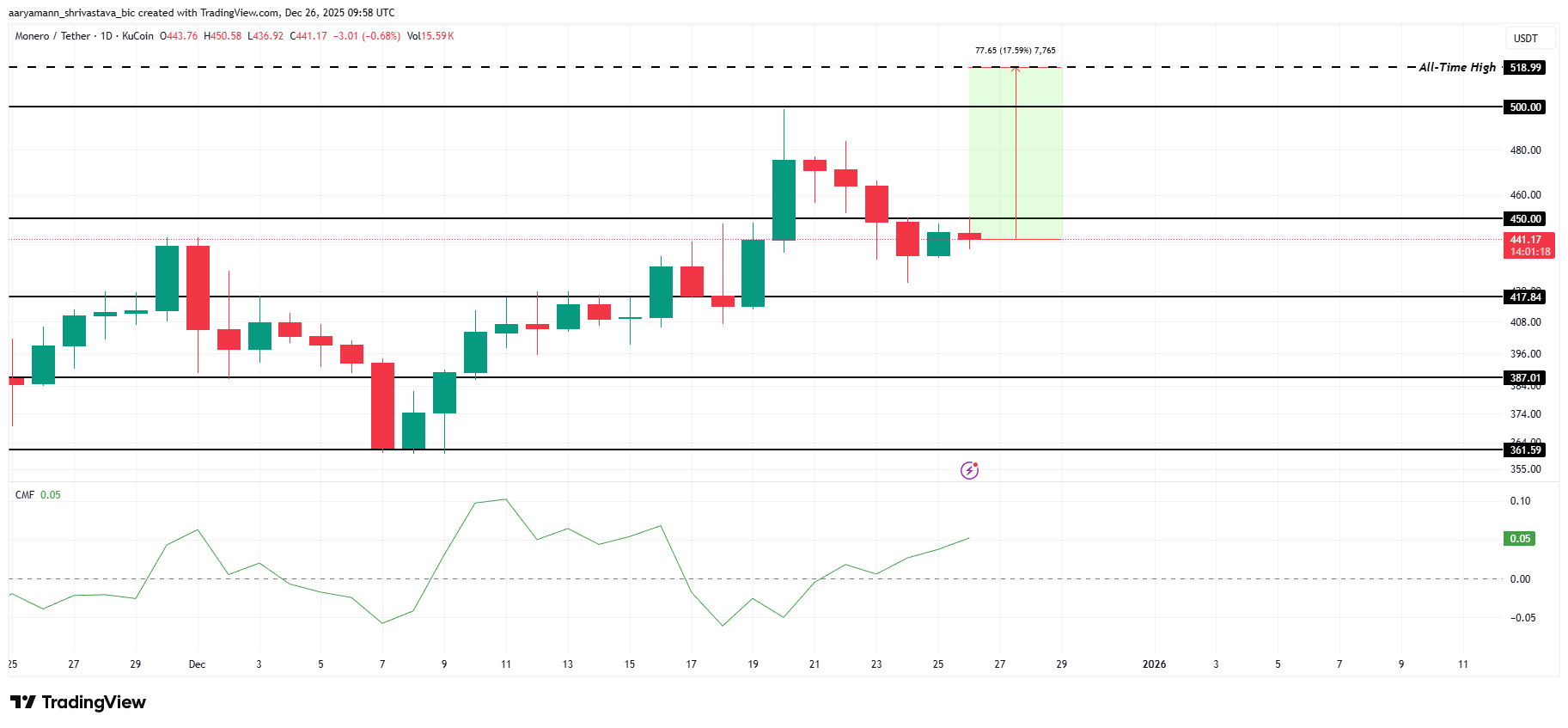
Monero price remains among the closest to its all-time high, trading just 17.5% below $519. A breakout above this level would establish a new record. Relative strength reflects sustained demand as XMR continues to outperform many large-cap cryptocurrencies during the current market cycle.
Monero benefits from growing attention toward privacy-focused cryptocurrencies. This narrative has strengthened amid regulatory debates and user demand for financial confidentiality. Chaikin Money Flow indicates strong capital inflows. These factors could drive XMR above $450 and toward the $500 psychological level, a key step toward $519.
Want more token insights like this? Sign up for Editor Harsh Notariya’s Daily Crypto Newsletter here.
Downside risk remains if profit-taking intensifies before a breakout occurs. Selling pressure could push XMR below the $417 support zone. A confirmed breakdown may extend losses toward $387, erasing recent gains and invalidating the bullish outlook in the short term.
Midnight (NIGHT)
NIGHT has attracted strong investor interest due to its foundation and leadership. Developed by Cardano founder Charles Hoskinson, the project benefits from credibility and long-term vision. This association has strengthened market confidence, positioning NIGHT for potential price appreciation as adoption builds in early trading phases.
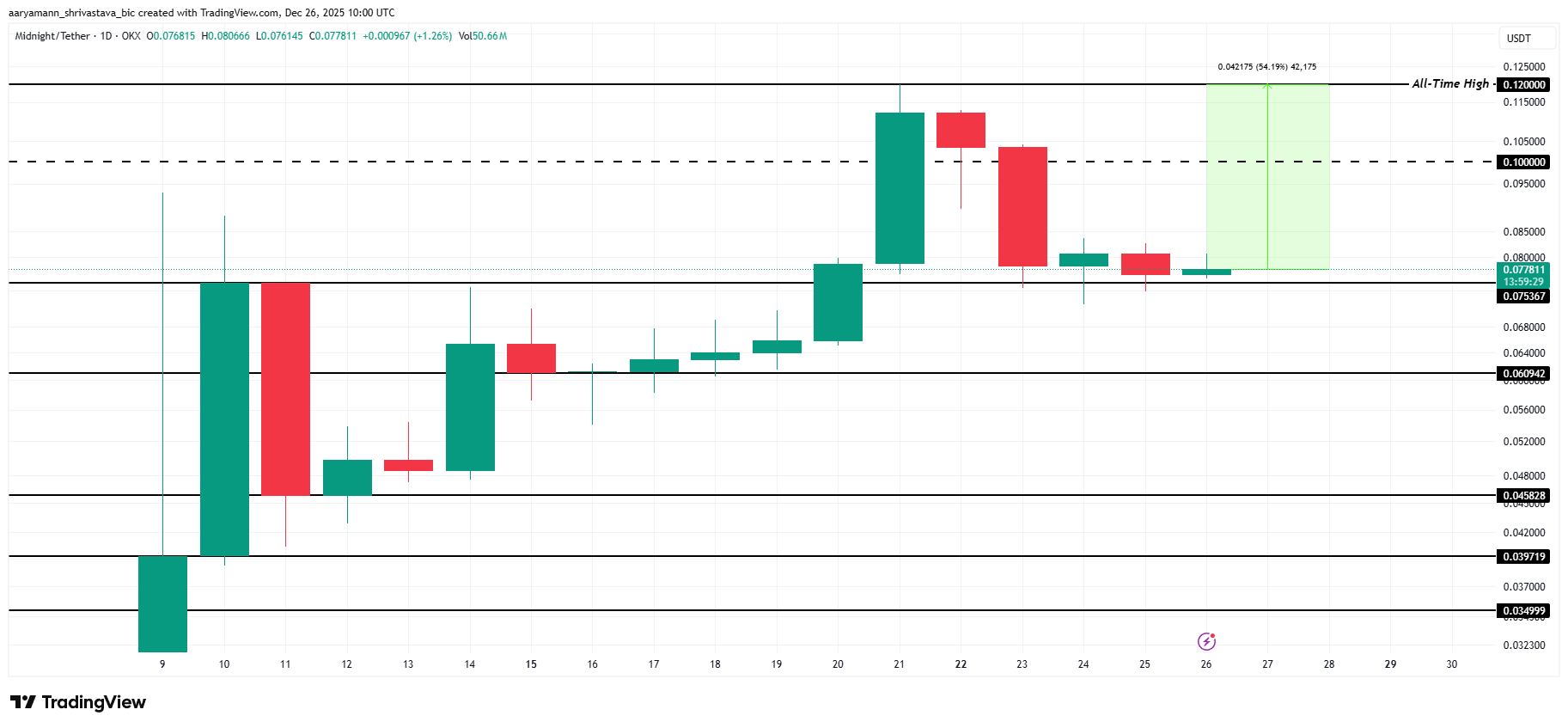
As a newly launched token, NIGHT is expected to see steady growth in users and demand. A successful bounce from the $0.075 support could lift the price toward $0.100. A breakout above that level may drive NIGHT to $0.120, marking a 54.1% gain and a potential new all-time high.
Downside risk depends heavily on broader market conditions at the start of the year. A positive 2025 open could sustain momentum. However, deteriorating sentiment may push NIGHT below $0.075. A drop toward $0.060 would invalidate the bullish outlook and signal increased selling pressure.
Ethereum (ETH)
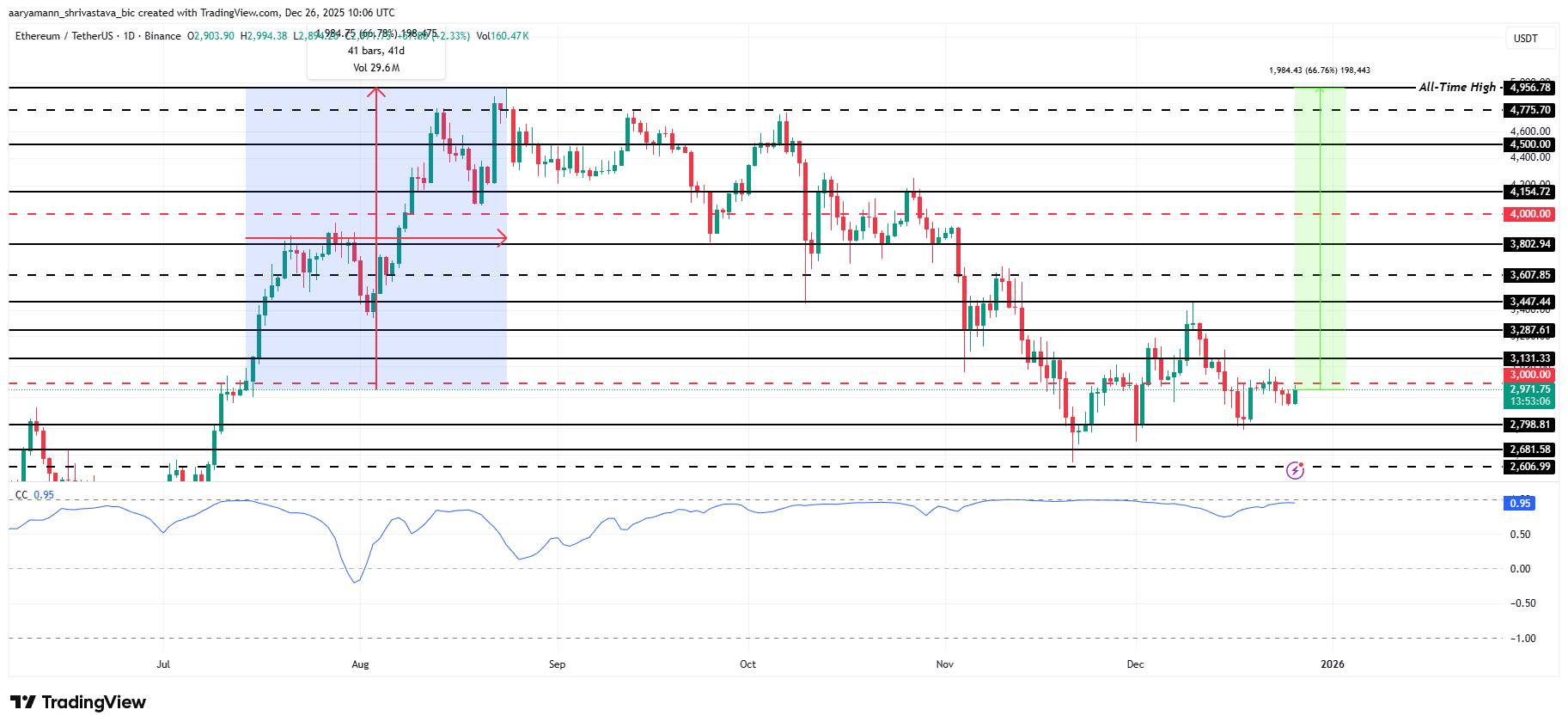
Ethereum remains roughly 66.7% below its $4,956 all-time high, highlighting the scale of recovery still required. A rapid, miracle-style rally appears unlikely under current conditions. Recent price action suggests ETH needs sustained demand and broader market alignment before attempting a meaningful upside move.
In August, Ethereum briefly surged to set a new peak, but replicating that move soon appears improbable. Any recovery may take weeks and requires consistent investor support. A decisive break above the $3,000 psychological level is critical. Success there could lift ETH toward $3,287, narrowing the gap to its record high.
Furthermore, the strong correlation that Ethereum shares with Bitcoin will be a major factor. If BTC manages to post a bullish momentum, ETH can benefit from it and rise as well.
However, risk remains if bullish momentum fails to develop and BTC ends up falling on the charts. Ethereum could continue consolidating near $3,000 or face a mild correction. Prolonged weakness at this level would undermine recovery efforts. Such price action would invalidate the bullish thesis and delay any realistic path toward higher resistance zones.
Welcome to the US Crypto News Morning Briefing—your essential rundown of the most important developments in crypto for the day ahead.
Grab a coffee and watch closely: while gold surges to new highs, signaling capital rotation toward safety, Bitcoin remains trapped below $90,000. A $300 million options structure suppressed volatility, but after the major expiry, this calm could quickly give way to dramatic price action.
Crypto News of the Day: Bitcoin’s Gamma Cage In Focus After Today’s Options Expiry
Gold has surged to fresh highs, breaking above a multi-year ceiling and reinforcing its reputation as the market’s early warning signal when capital rotates toward safety.
Bitcoin, however, has failed to respond in kind. Instead, the world’s largest cryptocurrency remains pinned below $90,000.
New insights suggest it may not be due to fading demand, but rather to a massive derivatives structure that mechanically suppresses price movement.
“Gold made the first move. Bitcoin is still loading,” said analyst Crypto Tice.
The analyst explained that gold’s breakout often marks the point where liquidity begins to reposition, while Bitcoin typically reacts later, once risk appetite returns.
“Gold tends to move first when liquidity seeks safety. Bitcoin follows when risk appetite turns back on,” CryptoTice said, adding that such compressed phases “don’t fade out slowly” but instead resolve with expansion that can reset an entire market cycle.
In Bitcoin’s case, that compression is being driven by what derivatives analysts have dubbed a $300 million “gamma trap.”
According to David, a market structure analyst, Bitcoin is currently “mechanically trapped in a tight range” defined by heavy options positioning.
The downside is anchored by an $85,000 put wall holding nearly $98.8 million in put gamma, while the upside is capped by a $90,000 call wall containing about $36.2 million in call gamma. This positioning has created a negative gamma feedback loop.
The analyst notes that when Bitcoin rises toward the upper range, dealers who are long calls are compelled to sell spot Bitcoin to hedge their exposure. When the price falls toward the lower range, those same dealers must buy to hedge puts.
“The result: Price is effectively locked in a cage,” he said, emphasizing that the market is not being driven by sentiment or headlines, but by “the mathematical necessity of dealer hedging.”
Could Today’s Gamma Expiry Trigger Bitcoin’s Next Big Move?
This stability is temporary. Roughly $300 million worth of gamma, about 58% of the total gamma complex, expired in a single options event earlier today. David described this as a “pin release,” warning that once the expiry hits, the incentives that have kept Bitcoin locked between $85,000 and $90,000 vanish almost instantly.
Historically, such releases have often led to sharp and sudden volatility as the market seeks a new equilibrium.
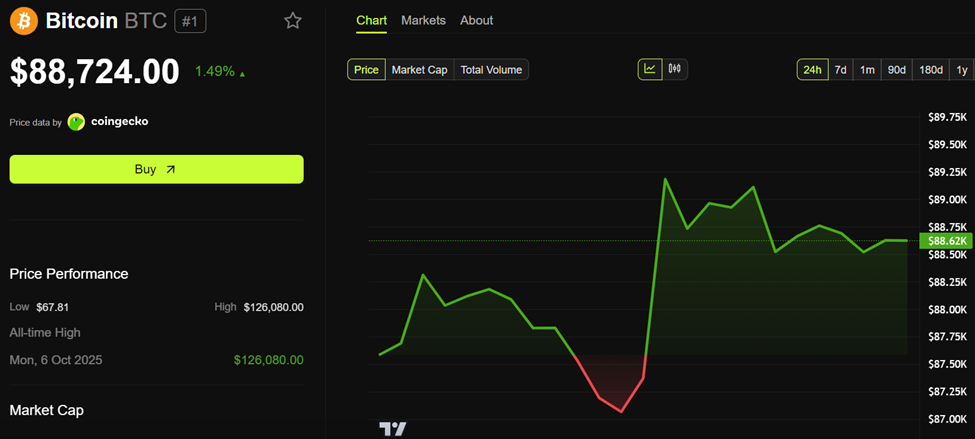
One level has become especially important. The so-called gamma flip sits at $88,925. This is slightly above $88,724, Bitcoin’s price as of this writing.
A sustained move above that threshold could flip dealer flows from dampening price action to amplifying it. Such a move could force dealers to buy into strength rather than sell rallies.
Systemic Stress Builds as Bitcoin Lags Behind Precious Metals
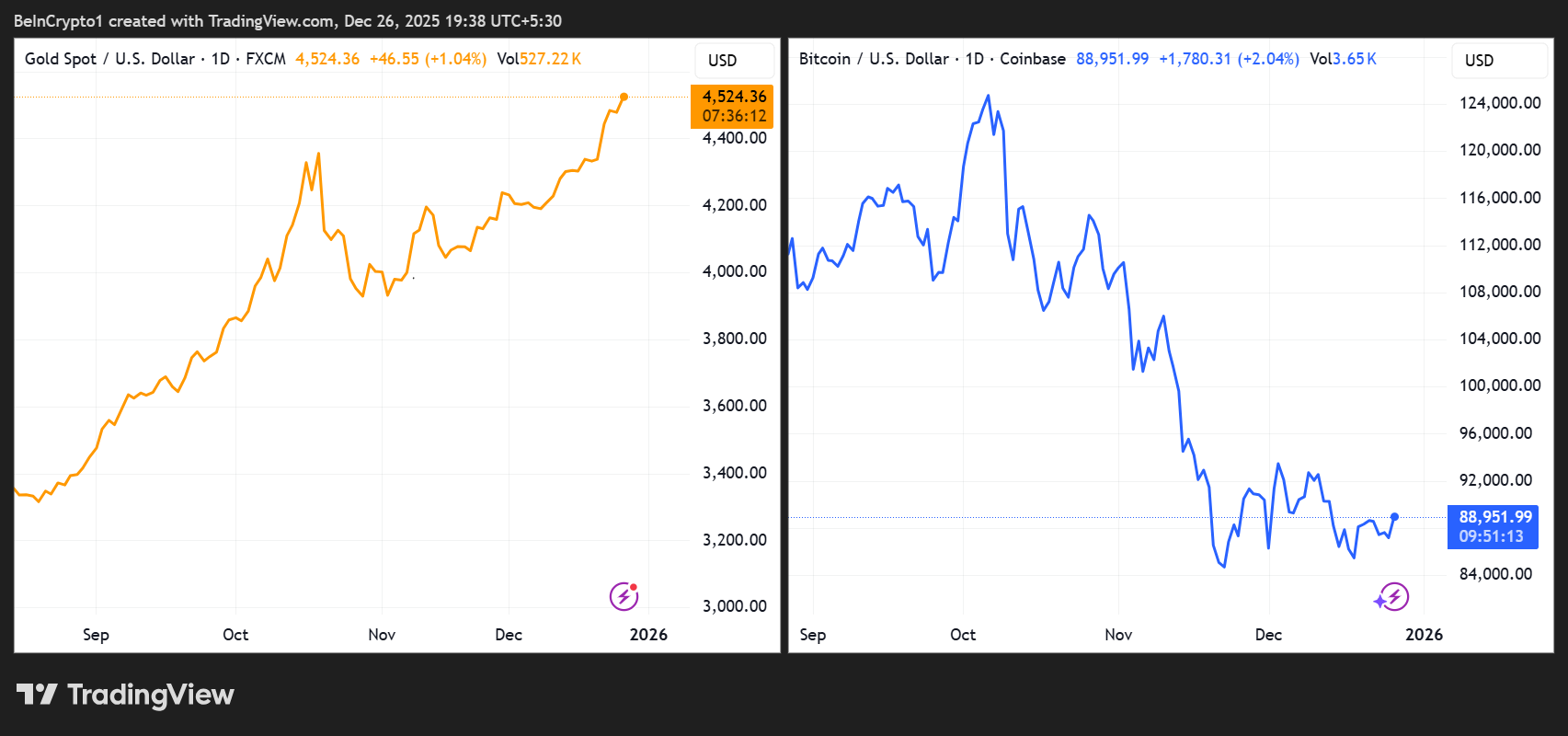
The divergence between gold and Bitcoin is also happening against a tense macroeconomic backdrop. Economist Mohamed El-Erian recently highlighted that gold has risen by more than 40% this year, its strongest performance since 1979. Manwhile, Bitcoin is down roughly 20% year-to-date after peaking earlier in the cycle.
At the same time, multiple analysts have warned that a synchronized rally across gold, silver, copper, and energy markets historically signals rising systemic stress. It aligns with a recent report suggesting the metals rally may signal stress.
Still, many crypto observers see Bitcoin’s stagnation as structural rather than bearish.
SP500 – All-Time High! Nasdaq- All-Time High! Gold – All-Time High! Silver – Ripping, All-Time High Platinum- All-Time High! Palladium All-Time High! Other world markets – All-Time High!
I don’t see a world where Bitcoin doesn’t catch up!
With the gamma trap nearing expiration and gold already signaling stress in the system, Bitcoin’s prolonged compression may be setting the stage for its next major move.
Chart of the Day
Gold (XAU) and Bitcoin (BTC) Price Performances. Source: TradingView
Byte-Sized Alpha
Here’s a summary of more US crypto news to follow today:
Global cryptocurrency trading platform Zoomex today announced the official early registration for its latest payment product, the Zoomex Card.
Designed to bridge the gap between crypto assets and real-world payment scenarios, the Zoomex Card aims to provide users with a Global Multicurrency bank account that’s connected to tradfi payment rails and crypto ramps, enabling seamless on / off ramps to fiat for cross border transactions.
The Zoomex Card is jointly launched by Zoomex and fully regulated and licensed financial platform UR, with a focus on usability, security, and regulatory compliance. UR provides banking infrastructure that is fully composable, allowing Zoomex to provide a fully functional crypto-financial gateway for everyday spending, cross-border payments and subscription services to its users.
Historically, crypto assets have largely remained confined to trading and holding, making their integration into real-world payment systems cumbersome. The introduction of the Zoomex Card addresses this gap.
Through the Zoomex Card, users can deposit USDC into their multi-currency fiat accounts and use it for daily spending and global transactions across multiple countries and regions, achieving a seamless connection from on-chain assets to real-world payments.
Jerry, CEO of Zoomex, stated:
“We want our users to avoid constantly switching between the crypto world and traditional finance, and instead enjoy a truly integrated asset account.”
UR’s Chief Product Officer, Ng Yingzhong, commented:
“As a fully licensed and regulated financial platform, UR has long been focused on delivering secure, compliant, and scalable financial infrastructure for users worldwide. Our partnership with Zoomex marks an important step forward in crypto-enabled payments. Through Zoomex Card, we aim to bring digital assets into everyday spending and cross-border use, while maintaining strict compliance and bank-grade security.”
Global Multi-Currency Account Experience
The Zoomex Card provides users with one-stop access to UR’s multi-fiat accounts, currently supporting major currencies including USD, EUR, CHF, JPY, SGD, and HKD, addressing cross-regional fund management and payment needs.
Seamless Crypto ↔ Fiat Conversion
Users can directly deposit USDC into UR accounts for spending, transfers, or subscription payments, while also supporting transfers back to the Zoomex platform for continued crypto trading.
Instant Global Payment Capability
The Zoomex Card supports mainstream payment methods including Apple Pay, Google Pay, and Samsung Pay, making it usable across various online and offline payment scenarios.
Bank-Grade Security and Compliance
All assets are custodied by UR, which is a registered trademark under Swiss financial institution SR Saphirstein AG, adhering to strict compliance and risk management standards to ensure financial-grade protection for cross-border payments and asset security.
Early Registration Benefits Now Open
To reward early supporters, Zoomex has launched early registration for the Zoomex Card. Upon official launch, eligible users will enjoy exclusive benefits, including:
Limited-time Pro account free upgrade
1% cashback on spending
New user reward: Spend $5, get $10 back
No card issuance fee
Custom Zoomex card design
Early registration will remain open until the official launch phase of Zoomex Card is completed. The product is expected to officially roll out in early 2026, with specific timelines subject to Zoomex’s official announcements.
About ZOOMEX
Founded in 2021, Zoomex is a global cryptocurrency trading platform with over 3 million users across more than 35 countries and regions, offering 700+ trading pairs. Guided by its core values of “Simple × User-Friendly × Fast,” Zoomex is also committed to the principles of fairness, integrity, and transparency, delivering a high-performance, low-barrier, and trustworthy trading experience.
Powered by a high-performance matching engine and transparent asset and order displays, Zoomex ensures consistent trade execution and fully traceable results. This approach reduces information asymmetry and allows users to clearly understand their asset status and every trading outcome. While prioritizing speed and efficiency, the platform continues to optimize product structure and overall user experience with robust risk management in place.
As an official partner of the Haas F1 Team, Zoomex brings the same focus on speed, precision, and reliable rule execution from the racetrack to trading. In addition, Zoomex has established a global exclusive brand ambassador partnership with world-class goalkeeper Emiliano Martínez. His professionalism, discipline, and consistency further reinforce Zoomex’s commitment to fair trading and long-term user trust.
In terms of security and compliance, Zoomex holds regulatory licenses including Canada MSB, U.S. MSB, U.S. NFA, and Australia AUSTRAC, and has successfully passed security audits conducted by blockchain security firm Hacken. Operating within a compliant framework while offering flexible identity verification options and an open trading system, Zoomex is building a trading environment that is simpler, more transparent, more secure, and more accessible for users worldwide.
UR is the world’s first global onchain stablecoin banking infrastructure that is compliant, fully licensed and covers over 50 countries with 7 multicurrency fiat access for each user and business — all under the supervision of SR Sapherstein AG. UR simplifies the way people and businesses move between digital assets and fiat currencies. Self-custodial, fast, and intuitive, UR turns complex crypto workflows into a seamless everyday experience.
XRP price has struggled to regain traction over recent weeks, with multiple failed recovery attempts deepening bearish pressure. The token remains locked in a downtrend, reflecting hesitation across the broader crypto market.
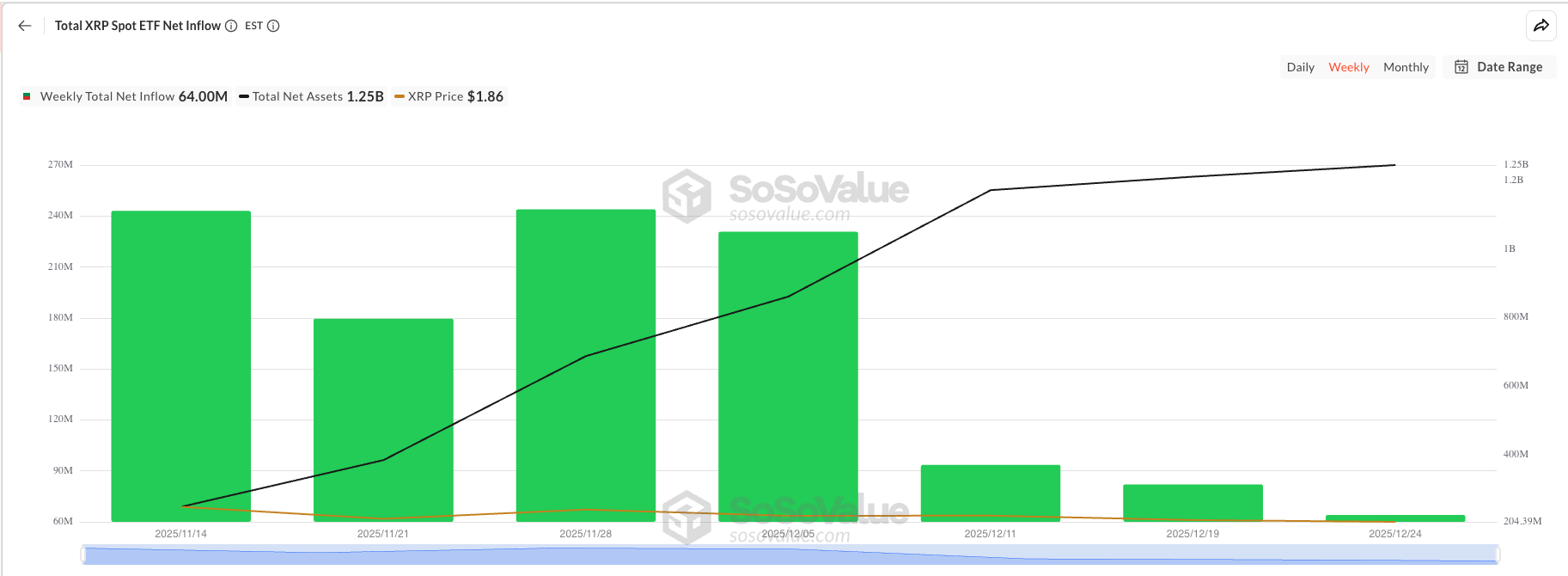
Despite this weakness, XRP ETFs continue to attract capital, signaling that institutional demand remains resilient.
XRP ETF Demand Remains Strong
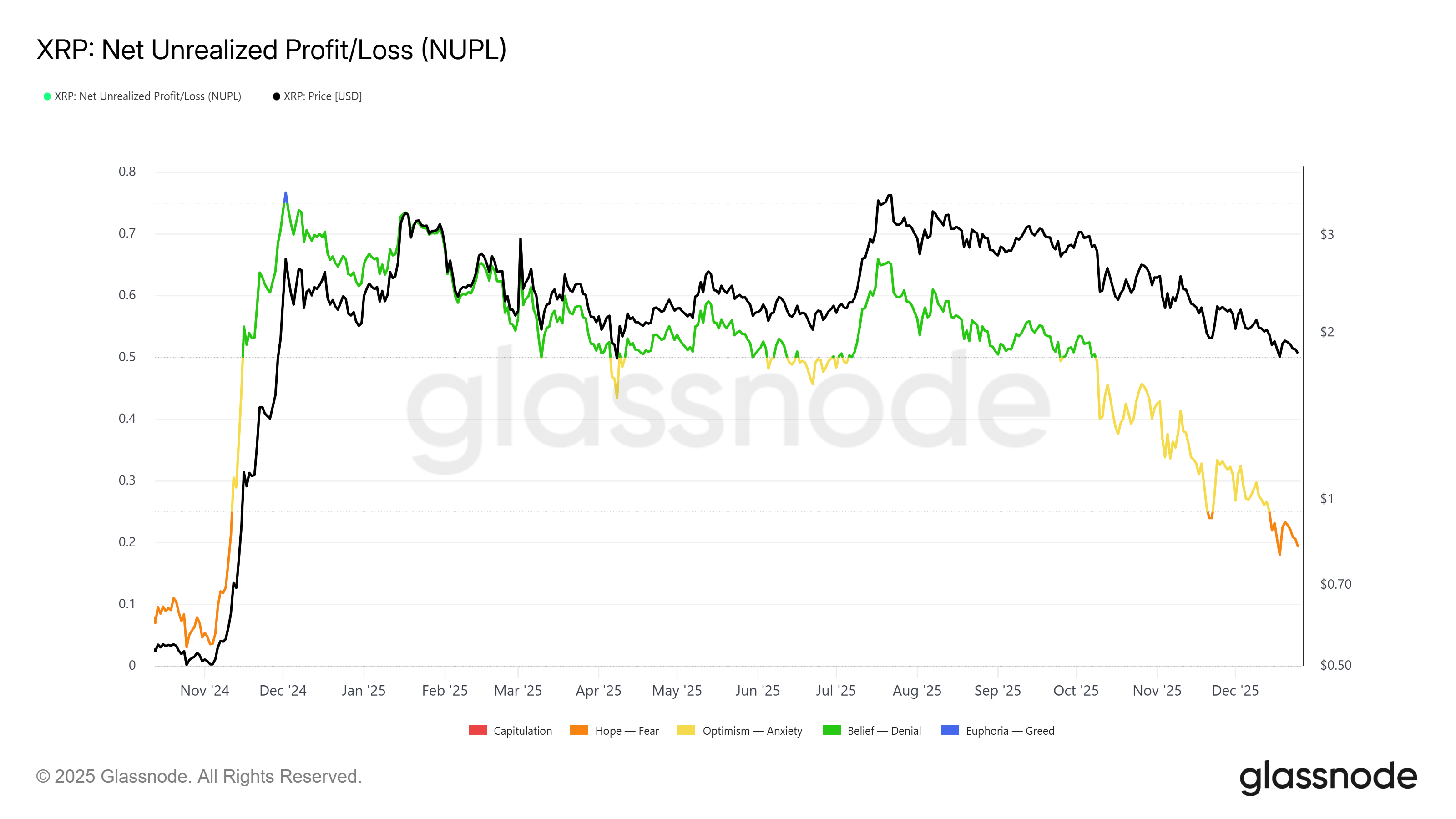
Losses among XRP holders have steadily increased, adding pressure to near-term price action. Net Unrealized Profit and Loss data shows unrealized profits have dropped to a yearly low. Investors who purchased XRP above $1.86 are now holding losses, while only those who entered below this level remain in profit.
This shift raises concerns around long-term holder behavior. Addresses holding XRP for more than a year may consider selling to lock in remaining gains. If profit-taking accelerates among these holders, selling pressure could intensify and further weigh on XRP price stability.
XRP ETFs remain the asset’s strongest macro support. Since launching six weeks ago, the funds have not recorded a single day of net outflows. This consistency stands out amid broader market uncertainty and declining activity in the spot crypto market.
Momentum has continued into week seven. On the trading day before Christmas, XRP ETFs recorded $11.93 million in inflows. This data suggests institutional investors maintain confidence in XRP’s longer-term outlook, even as retail sentiment weakens and price action remains constrained.
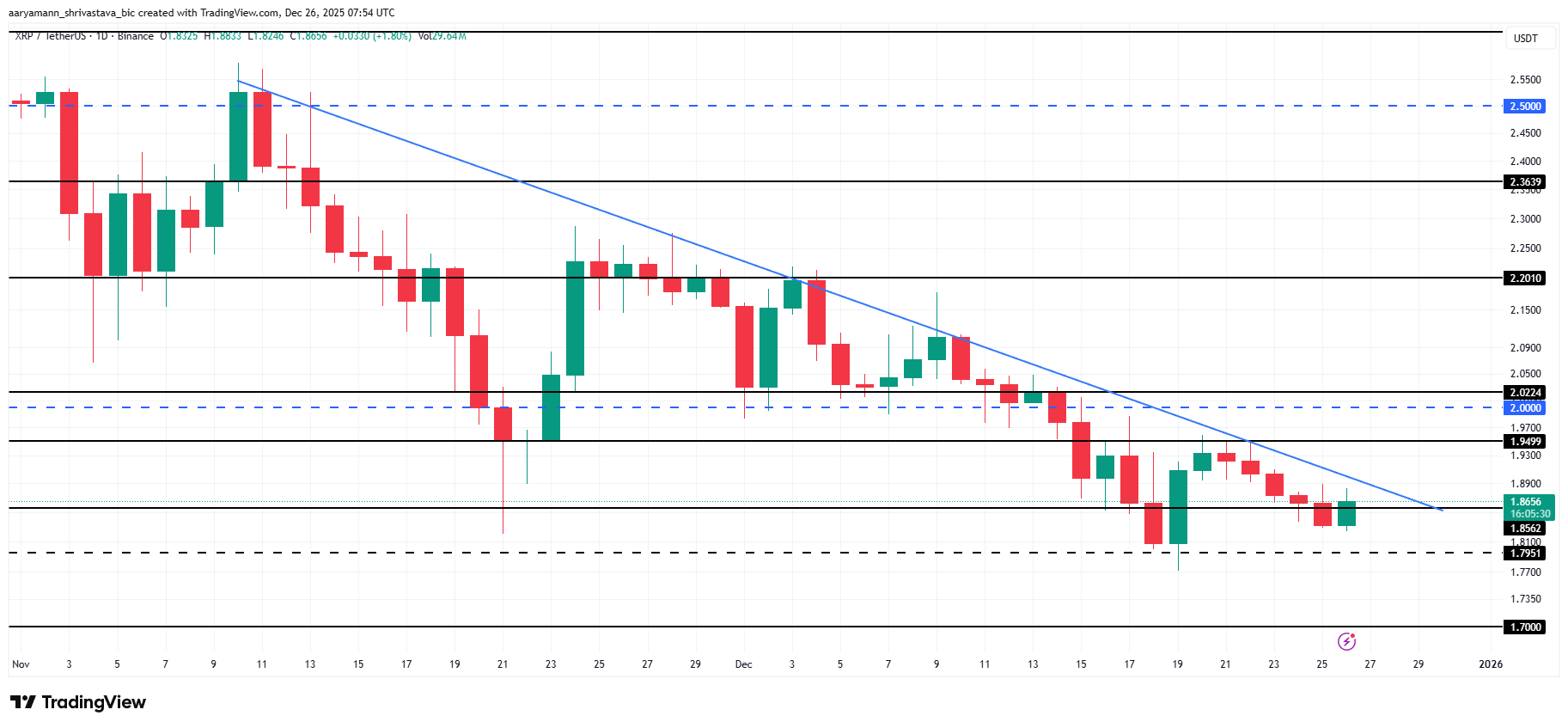
XRP traded near $1.86 at the time of writing, holding just above the $1.85 support level. Price remains capped beneath a downtrend line that has persisted for over six weeks. Repeated failures to break this structure have reinforced bearish sentiment among short-term traders.
A breakout appears unlikely under current conditions. Market direction remains unclear, and rising losses increase the risk of additional selling. ETF inflows may help stabilize price, potentially keeping XRP above the $1.79 support. A breakdown below that level could extend the downtrend toward $1.70.
However, a shift in broader market conditions could alter the outlook. Improved risk sentiment may allow XRP to bounce from $1.85. A decisive move above the downtrend line would target $1.94. Clearing that level could open a path toward $2.00, invalidating the bearish thesis.
Crypto markets struggled throughout December, but a small group of institutional investors managed to close the year in the black.
New on-chain data from analytics platform Nansen shows that while prices remained under pressure, several major crypto funds generated millions in realized gains, only to pivot toward aggressive selling as the month progressed.
Elite Funds Secure Top Gains Amid Market Downturn
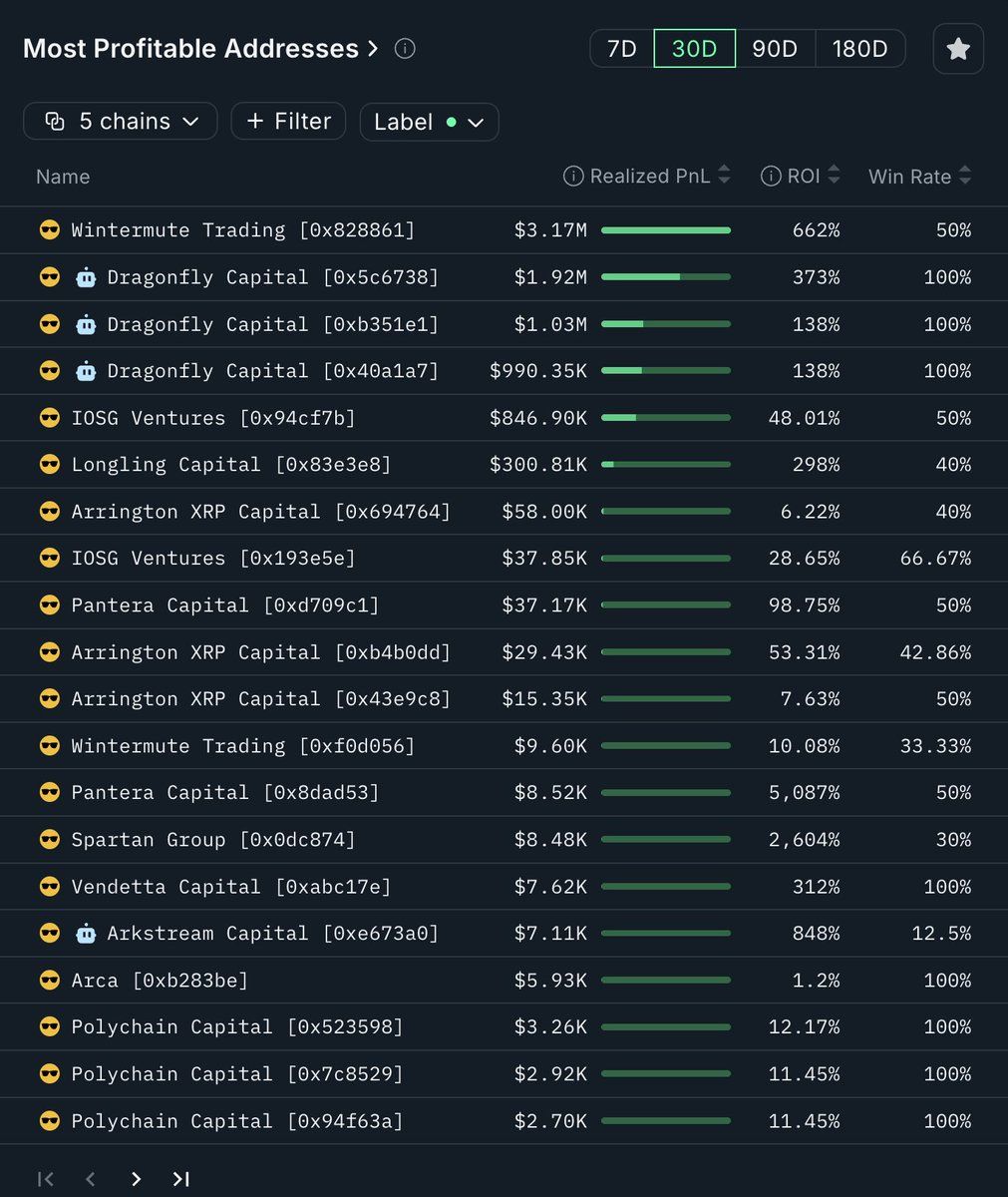
According to Nansen, market maker Wintermute emerged as the most profitable fund in December, recording approximately $3.17 million in realized profit.
Dragonfly Capital followed closely, with profits spread across multiple wallets totaling $1.9 million, $1.0 million, and $990,000.
IOSG and Longling Capital also ranked among the top performers. Together, these trends suggest that profits were concentrated among a repeat group of highly active institutional traders rather than isolated, one-off wallets.
“Profits are concentrated among a small group of repeat funds, not one-off wallets,” Nansen noted, highlighting how consistent execution and active trade management separated institutional winners from the broader market downturn.
Arrington, Pantera, and Polychain also featured in Nansen’s 30-day dataset from five blockchain networks, each with varied profitability.
December 2025 profit rankings show Wintermute leading with $3.17M, followed by multiple Dragonfly Capital wallets. Nansen
Despite this backdrop, Wintermute and Dragonfly Capital capitalized on short-term dislocations and liquidity-driven opportunities.
Their performance highlights the advantage of scale, sophisticated trading infrastructure, and multi-chain monitoring during periods of market stress.
Dragonfly’s strategy stood out for its diversification across wallets, allowing the fund to spread risk while capturing upside across different positions.
IOSG and Longling Capital also posted notable gains, placing them among the month’s most profitable funds. Together, the data paints a picture of institutional resilience at a time when retail traders largely struggled to stay afloat.
Active Profit-Taking Shapes On-Chain Behavior
However, Nansen’s on-chain tracking shows that these same profitable funds are now leaning toward selling rather than accumulation.
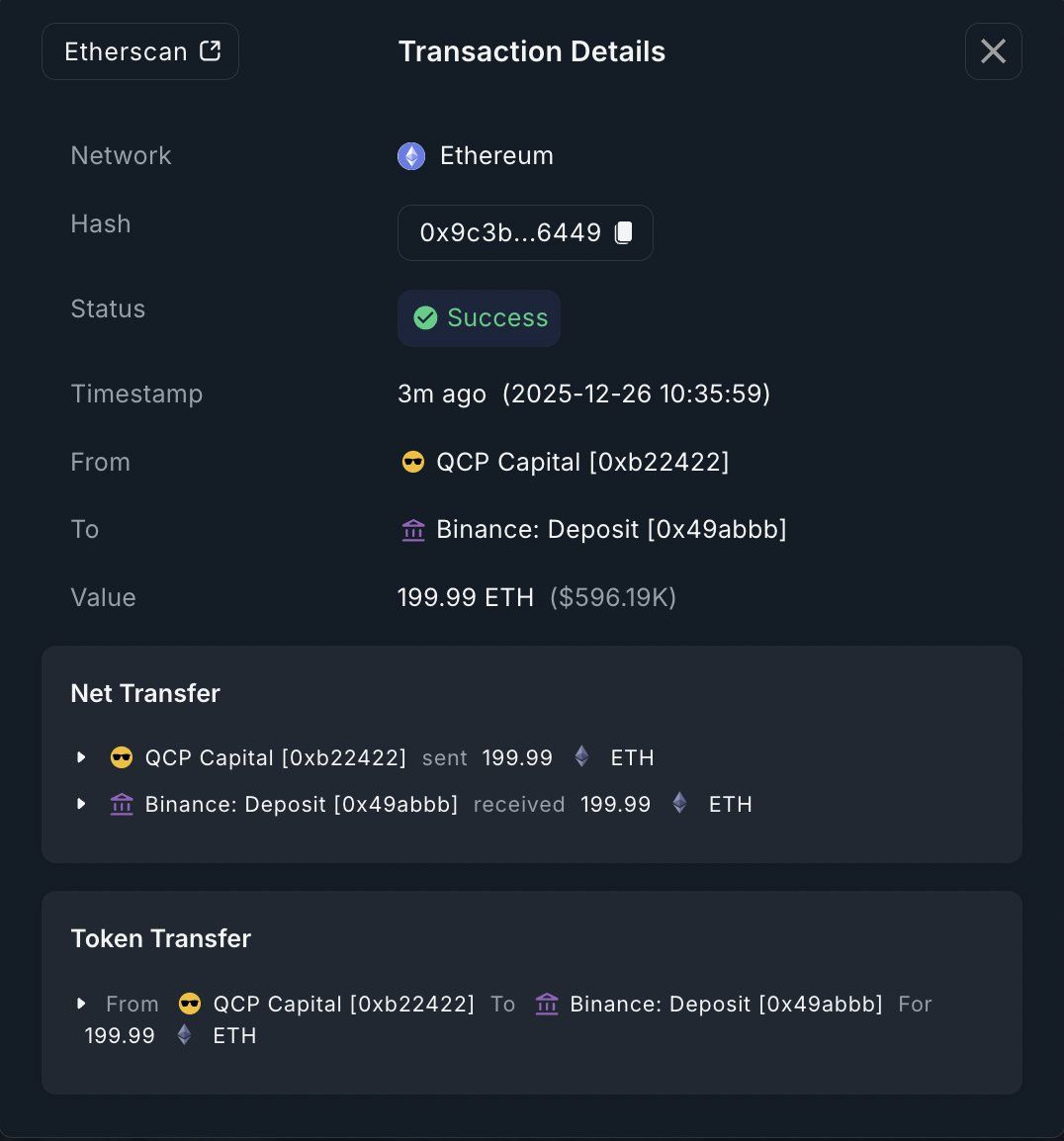
On December 26, QCP Capital deposited 199.99 ETH, worth roughly $595,929, into the Binance exchange, a move typically associated with preparing assets for sale.
QCP Capital transferred 199.99 ETH worth $595,929 to Binance on December 26, 2025. Nansen
Wintermute has also been active on the sell side. While social media commentary has accused the firm of aggressively dumping Bitcoin and Ethereum during December volatility, on-chain data confirms that Wintermute reduced exposure after building positions earlier in the month.
🚨 BREAKING:
WINTERMUTE ACCUMULATED MILLIONS WORTH OF $BTC AND $ETH RIGHT BEFORE CHRISTMAS DUMP
THEY DUMPED $125M+ OF $BTC IN A MINUTE, DROPPING IT TO $24K
The activity aligns with profit-taking and risk management rather than passive holding.
Dragonfly Capital similarly reduced its positions in Mantle (MNT). Over seven days in December, the fund deposited 6 million MNT tokens, worth approximately $6.95 million, to Bybit.
Despite these sales, Dragonfly still holds 9.15 million MNT tokens, valued at around $10.76 million, suggesting a partial rather than complete exit.
The contrast between strong December profits and rising sell pressure illustrates a dual institutional strategy:
Exploit volatility when opportunities arise,
De-risk quickly as conditions shift.
For professional funds, year-end selling may also reflect portfolio rebalancing, capital preservation, or preparation for new allocations in the early part of 2026.
While continued selling from top-performing funds could weigh on short-term prices, it may also signal discipline rather than bearish conviction.
Although the altcoin market cap has not recovered and market sentiment remains in a prolonged state of fear, several low-cap altcoins with market caps under $100 million have shown signs of on-chain accumulation.
This may reflect whales building positions and betting on price increases next month.
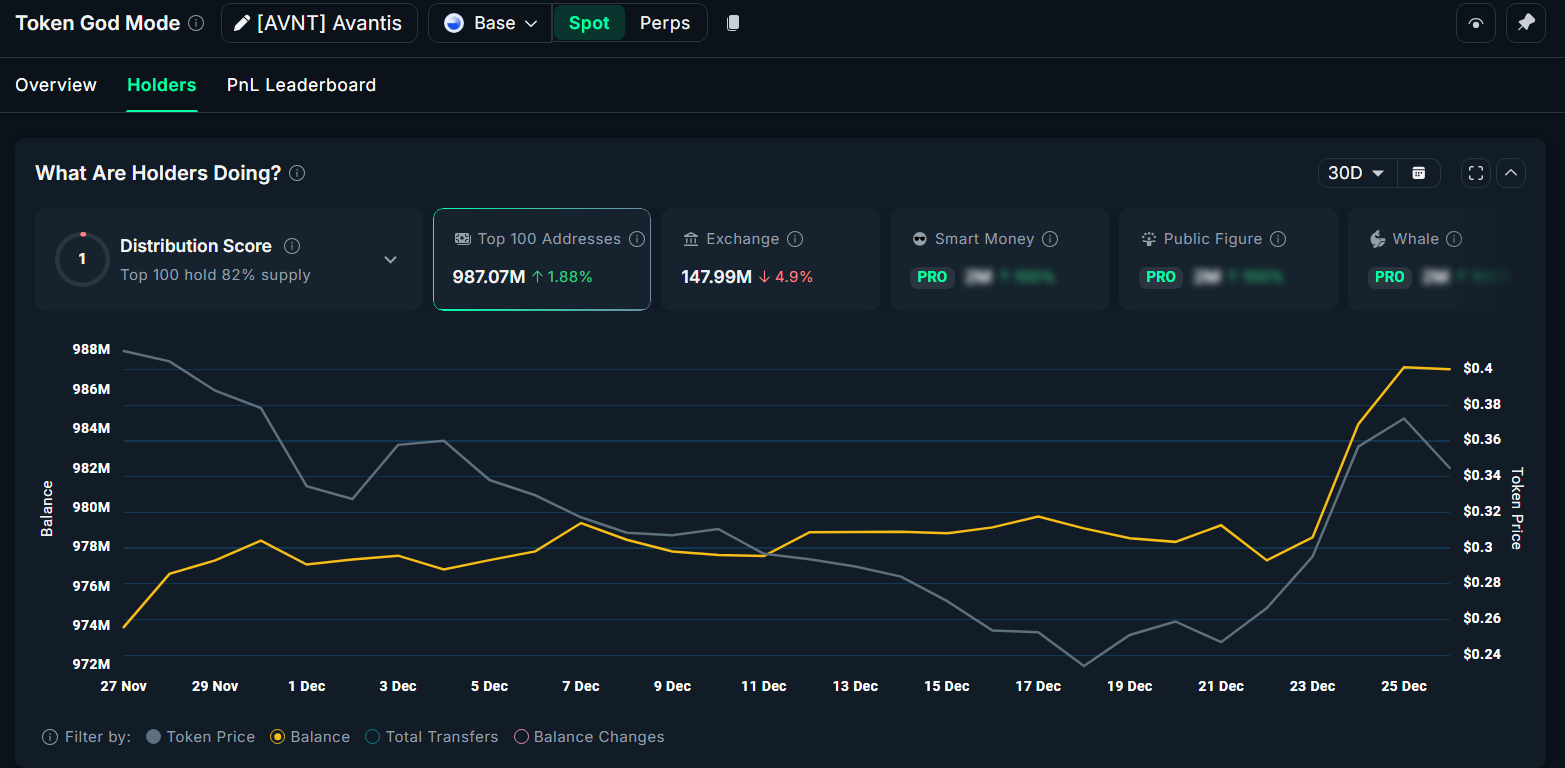
However, by December, the downtrend shifted to a sideways range around $0.30. The token has also shown signs of accumulation.
Accumulated Balance of AVNT Whales. Source: Nansen
Nansen data shows that AVNT whale wallets accumulated 11 million AVNT in December. The total balance of the top 100 wallets increased by 1.88%, while exchange reserves decreased by 4.9%.
Rising whale balances and declining exchange reserves typically indicate that investors are buying and moving tokens to private wallets, driven by long-term expectations.
Holderscan data also shows that the number of AVNT holders increased from 105,800 to 109,800 over the past 30 days.
From a technical analysis perspective, analysts believe AVNT may be in the final stage of a falling-wedge formation. This pattern typically predicts a reversal from bearish to bullish.
2. Succinct (PROVE)
Succinct (PROVE) is a decentralized network designed to facilitate the creation of zero-knowledge proofs (ZKPs) easily and securely.
Privacy on blockchain has gained attention thanks to Zcash (ZEC) and the broader use of ZKP technology. This trend has also drawn attention to Succinct.
The market cap of PROVE currently stands at $75.6 million. The price has dropped more than 77% after listings on Binance and Coinbase.
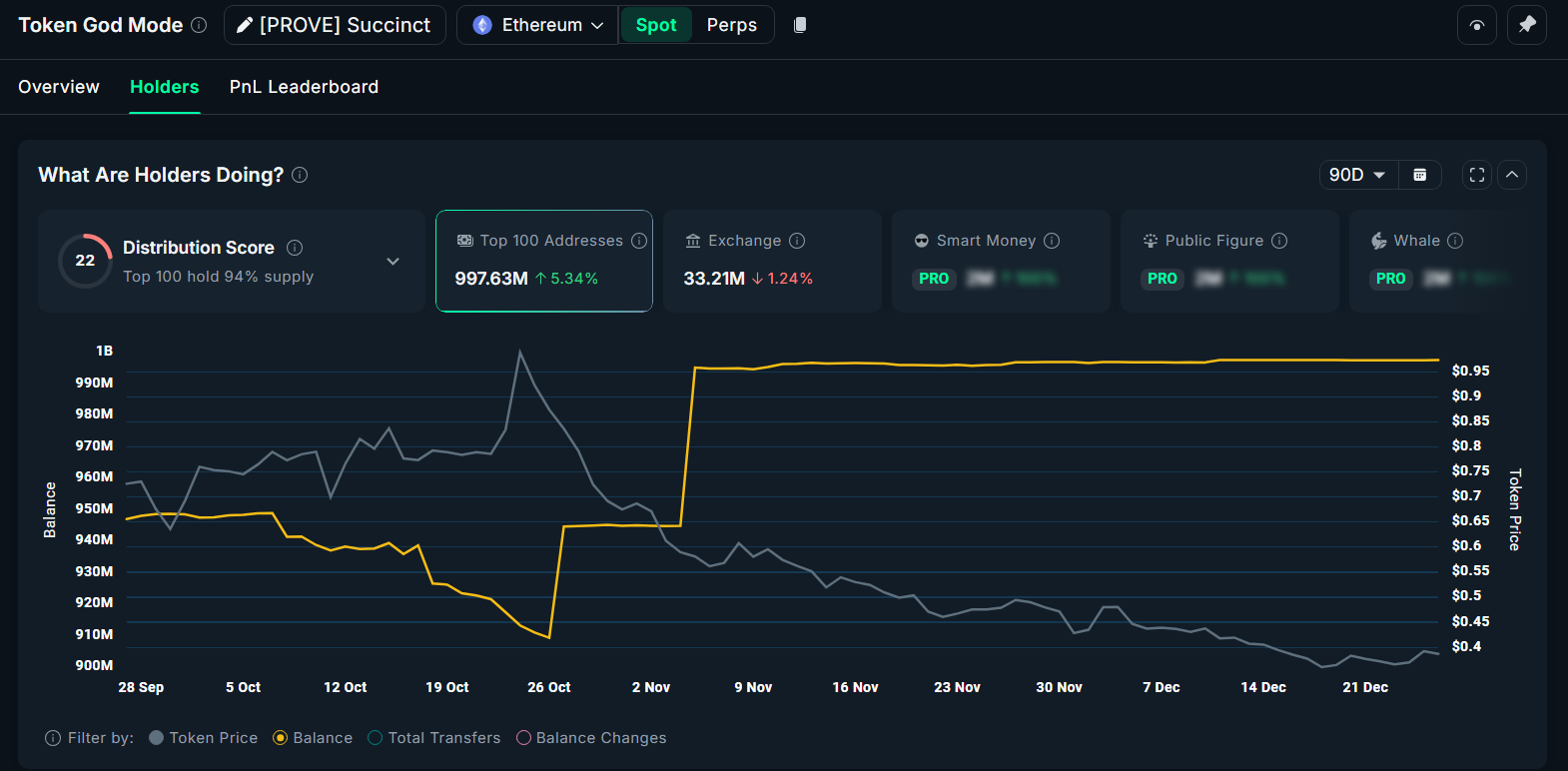
Accumulated Balance of PROVE Whales. Source: Nansen
In recent months, Nansen data shows that top whale wallets accumulated an additional 5.34%. Exchange reserves dropped 1.24%. At the same time, the price decline of PROVE has slowed.
A slower price decline, combined with whale accumulation, has increased investor expectations of a potential rebound.
3. Plume Network (PLUME)
Plume Network (PLUME) is an Ethereum layer-2 blockchain designed specifically for Real-World Assets (RWA).
The market cap of PLUME is currently $60 million, following an 85% decline in the token price during the final quarter of the year.
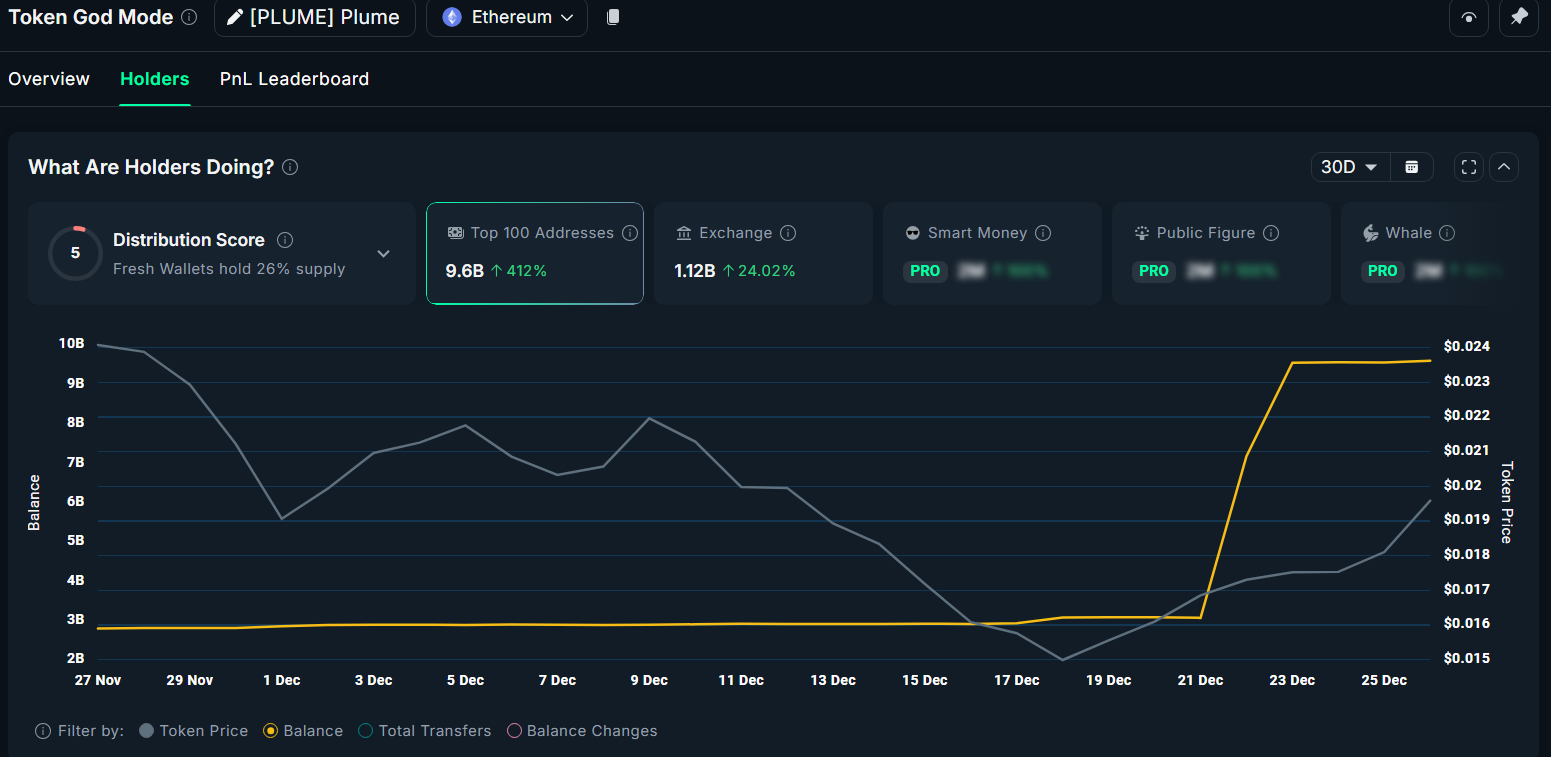
However, Nansen data shows a notable shift. PLUME whales have accumulated nearly 7 billion PLUME. The price has also recovered 35%, rising from $0.014 to $0.019.
Accumulated Balance of PLUME Whales. Source: Nansen
This accumulation has halted the three-month downtrend.
Another reason investors remain optimistic about RWA altcoins is the strong growth outlook for the sector in 2026.
A recent BeInCrypto report states that the total RWA market value hit a new all-time high in December, despite widespread market fear.
When discussing expectations for RWA in 2026, Plume CEO Chris Yin projected 10–20x growth in both value and users.
“Seeing 10–20x growth in value and users next year as well is the low end of what we should expect,” Chris Yin told BeInCrypto.
If this projection becomes reality, low-cap tokens such as PLUME may benefit significantly.
These three low-cap altcoins represent three different themes: DEX, Privacy, and RWA. All three themes hold strong expectations from analysts for the year ahead.
Zcash price has moved steadily higher in recent sessions as it attempts to break out of a well-defined bullish pattern. The privacy-focused cryptocurrency is approaching a critical inflection point that could unlock further upside.
Investor confidence and supportive broader market conditions are reinforcing expectations of a near-term breakout.
Zcash Holders Show Strength
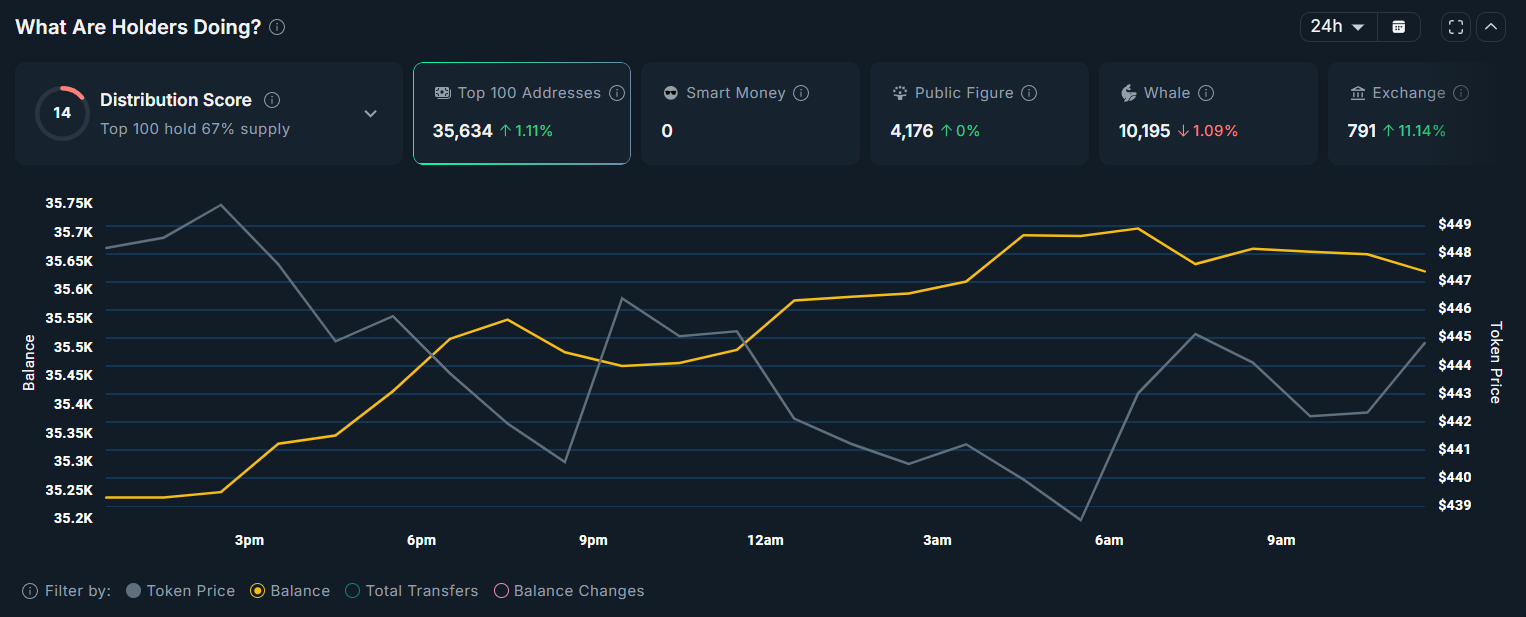
Large Zcash holders are showing growing optimism as the price approaches key resistance. Data indicates that the top 100 ZEC holders increased their combined balances by 1.11% over the last 24 hours. While modest, this accumulation signals confidence in continued recovery rather than short-term profit-taking.
This behavior suggests conviction among Zcash holders. Whales typically accumulate during consolidation phases when they anticipate expansion. Their continued support implies expectations of higher prices and reduced downside risk, reinforcing bullish sentiment.
Want more token insights like this? Sign up for Editor Harsh Notariya’s Daily Crypto Newsletter here.
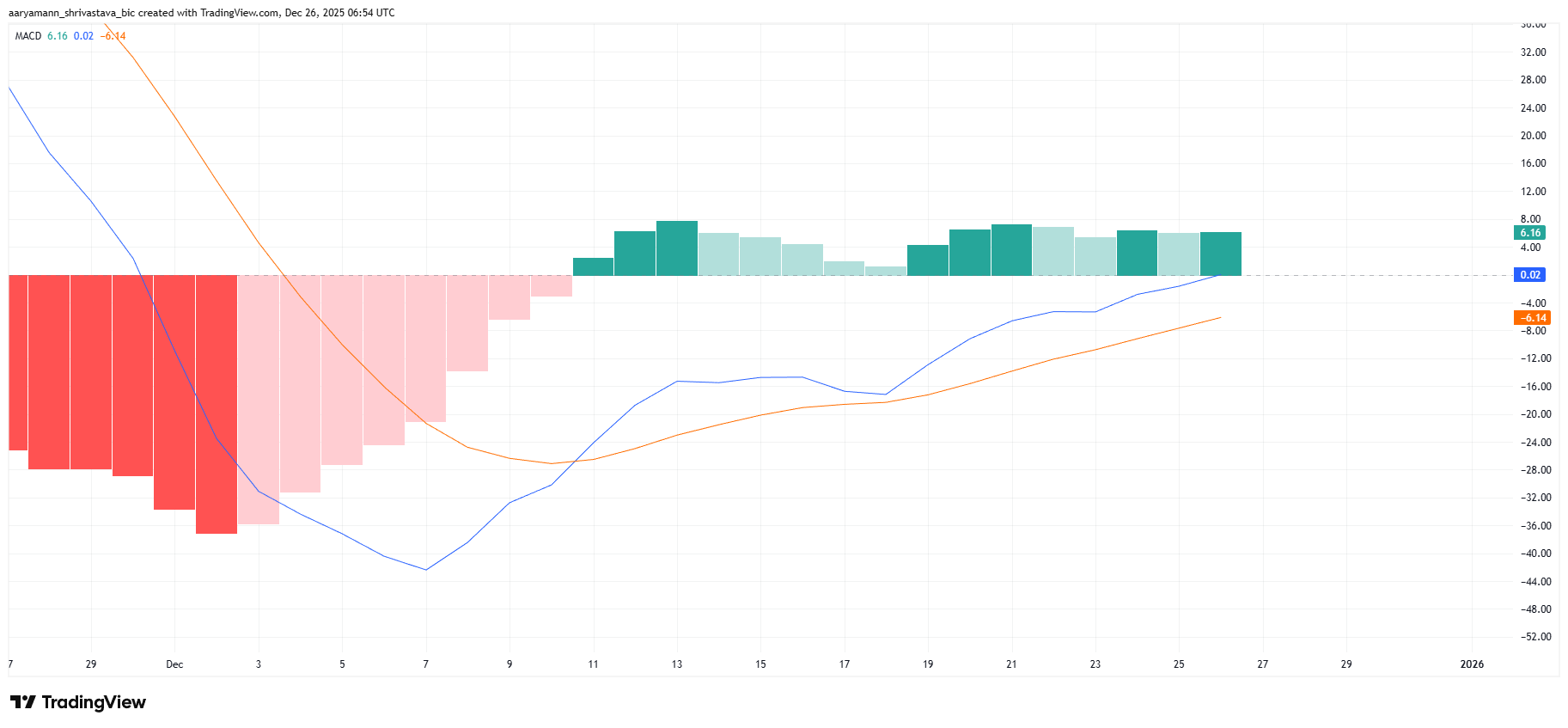
Technical indicators support the constructive outlook. The MACD has maintained strong bullish signals for the past two weeks, reflecting sustained positive momentum. This consistency indicates trend strength rather than a short-lived bounce, reducing the likelihood of abrupt reversals under current conditions.
Broader macro cues further support ZEC price stability. Bitcoin remains near the $88,000 level, providing a firm anchor for altcoins. Meanwhile, the Nasdaq and S&P 500 continue to show mildly bullish signals. This alignment encourages risk appetite across digital assets, benefiting Zcash.
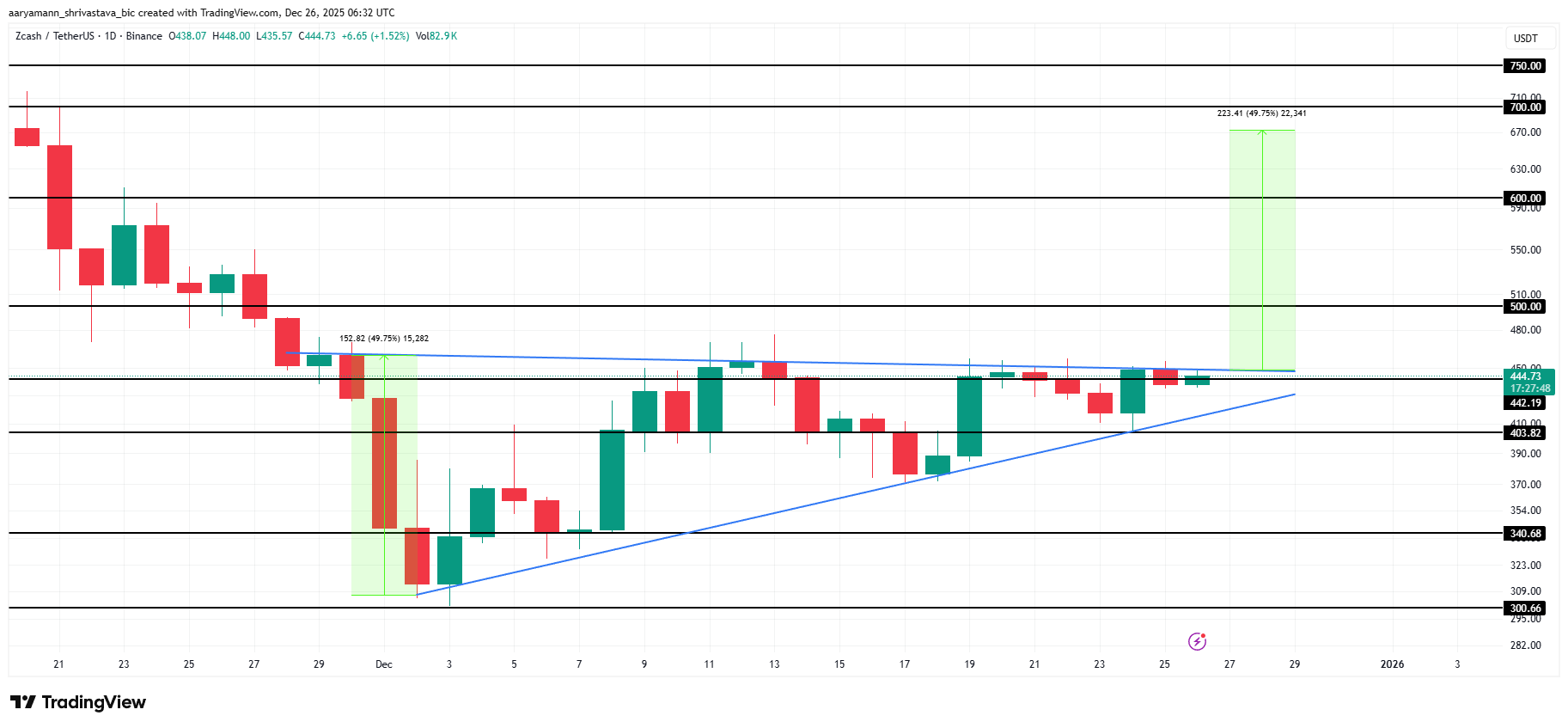
ZEC price traded near $444 at the time of writing, moving within an ascending triangle pattern. This formation typically precedes upward continuation. A confirmed breakout could trigger a move of nearly 49%, aligning with the pattern’s projected target.
Flipping $442 into a sustained support level remains critical. A decisive move above $500 would confirm the breakout and validate bullish positioning. Given supportive technicals and investor behavior, Zcash could realistically cross $500 before the start of the next year.
However, risks remain if momentum weakens. Failure to break resistance may keep ZEC trading sideways between $442 and $403. A breakdown below $403 would shift sentiment sharply. In that case, price could decline toward $340, invalidating the bullish thesis and increasing downside exposure.

 Login
Login