Reading view

Cardano Founder Charles Hoskinson Pitches Midnight as a Privacy Layer for Bitcoin and XRP

Charles Hoskinson is pitching his latest venture, Midnight Protocol, as more than a sidechain for Cardano.

Instead, the Cardano founder is positioning the privacy-focused platform as a shared infrastructure layer that could extend programmable privacy to rival blockchain networks, including Bitcoin and the XRP Ledger.

Hoskinson Moves Beyond Cardano With a Cross-Chain Privacy Play

In a December 27 post on X, Hoskinson argued that Midnight’s zero-knowledge proof architecture could enhance the capabilities of competing ecosystems rather than displace them.

He said that integrating Midnight with the XRP Ledger would allow the network to challenge legacy banking systems by enabling private, compliant decentralized finance. He extended the argument to Bitcoin, saying Midnight offers programmable privacy features that Bitcoin currently lacks.

Hoskinson also framed Midnight as a catalyst for Cardano itself. He suggested that the protocol could help lift Cardano’s monthly active users and total value locked by broadening the ecosystem’s utility beyond its native chain.

“Midnight makes what it touches better. Adding Midnight to XRP DeFi is going to blow the legacy banks out of the water. Adding Midnight to Bitcoin gives the world Satoshi imagined possible. Adding Midnight to Cardano supercharges our DeFi ecosystem and will 10x the MAUs, Transactions, and TVL as we are first to market with private DeFi at scale,” he claimed.

Beyond interoperability, Hoskinson pointed to the scale of the opportunity in real-world asset tokenization. He said the estimated $10 trillion market for Real-World Assets would benefit significantly from Midnight’s privacy-preserving design.

In that context, he criticized traditional finance firms for continuing to partner with the Canton Network, a permissioned blockchain, arguing that partial solutions fall short of what institutional adoption requires.

“There are no half measures or half technologies. You need an end-to-end strategy, great partners, and great communities,” Hoskinson said.

This strategy marks a shift for Hoskinson, who has historically focused on building within the Cardano ecosystem.

By promoting Midnight as a privacy layer that enhances other Layer-1 blockchains, Hoskinson is seeking to access liquidity and user bases beyond Cardano’s existing network.

That pivot has coincided with growing speculative interest in Midnight’s native token, NIGHT.

Data from CoinGecko showed that the asset recently surpassed Bitcoin and Ethereum in search volume on the platform’s trending list.

However, the token has traded with high volatility since its launch earlier this month. According to BeInCrypto data, the token’s price has dropped by more than 80% to $0.08 as of press time.

The post Cardano Founder Charles Hoskinson Pitches Midnight as a Privacy Layer for Bitcoin and XRP appeared first on BeInCrypto.

  •  

BitMine Begins Staking Its $12 Billion Ethereum Holdings

BitMine, the largest corporate holder of Ethereum, has begun staking part of its $12 billion ETH treasury.

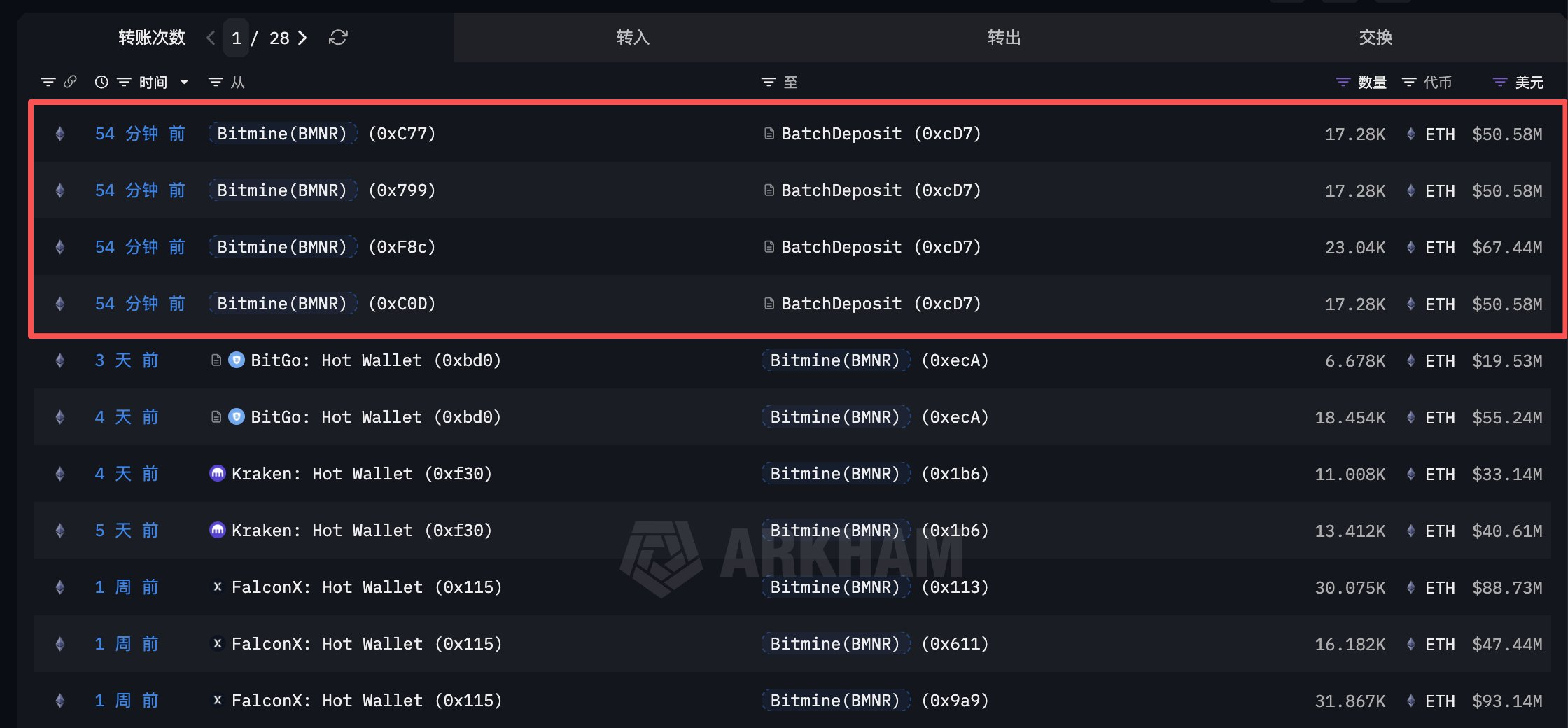
On December 27, on-chain analyst Ember CN reported that the firm deposited approximately 74,880 ETH, valued at about $219 million, into Ethereum staking contracts.

Why is BitMine Staking Its Holdings?

The move represents only a small slice of BitMine’s total holdings of roughly 4.07 million ETH, currently valued near $12 billion.

Still, it signals a meaningful shift in how the company intends to manage its balance sheet.

BitMine's Ethereum Staking
BitMine Ethereum Staking. Source: Ember CN

If the company were to stake its entire treasury at the current estimated annual percentage yield (APY) of 3.12%, it would generate approximately 126,800 ETH annually. At current prices, this equates to $371 million in yearly revenue.

Such a structure would effectively recast BitMine as a yield-bearing vehicle tied to Ethereum’s consensus layer. This means its valuation would no longer hinge primarily on the asset’s directional price movements.

ETH Staking Goals and Risks

However, the strategy introduces new financial and operational risks for the company.

Unlike Bitcoin held in cold storage, which can be liquidated immediately in stressed market conditions, staked Ether is constrained by protocol-level withdrawal mechanics.

Validators exiting the network must pass through an exit queue, which can delay access to capital during periods of heightened volatility.

In a liquidity crunch, that delay could leave BitMine exposed to price swings that a non-staking treasury might otherwise avoid.

This tradeoff underscores a structural difference between holding Ethereum as a passive asset and deploying it as productive capital within the network.

Still, BitMine has a long-term goal of acquiring and staking 5% of Ethereum’s total supply.

To support that vision, the firm is developing a proprietary staking platform, the Made in America Validator Network (MAVAN), scheduled for deployment in early 2026.

“We continue to make progress on our staking solution known as The Made in America Validator Network (MAVAN). This will be the ‘best-in-class’ solution offering secure staking infrastructure and will be deployed in early calendar 2026,” BitMine chair Thomas Lee said.

Meanwhile, critics argue that consolidating such a large share of Ether under a single US-domiciled validator framework introduces centralization risks. They say the structure could undermine a network designed to be neutral and globally distributed.

With BitMine currently controlling about 3.36% of the total ETH supply, MAVAN could, in theory, face pressure to comply with the US Office of Foreign Assets Control (OFAC) sanctions.

As a result, the firm could refuse to validate blocks containing transactions linked to sanctioned addresses.

The post BitMine Begins Staking Its $12 Billion Ethereum Holdings appeared first on BeInCrypto.

  •  

Coinbase CEO Says Banks Will Eventually Demand Interest-Paying Stablecoins

Coinbase CEO Brian Armstrong predicts US banks will reverse their stance on stablecoin regulation and eventually lobby Congress to permit interest payments on these digital assets.

Armstrong’s forecast, posted December 27 on X, contradicts the banking sector’s current efforts to strip yield-generating features from the GENIUS Act.

Armstrong Predicts Banks Will Reverse Course on Stablecoin Interest Bans

He argued that lenders are currently protecting low-cost deposits but will be forced to adopt the technology to compete for capital.

“My prediction is the banks will actually flip and be lobbying FOR the ability to pay interest and yield on stablecoins in a few years,” Armstrong wrote.

The prediction reframes the current legislative battle over the GENIUS Act as more than a regulatory dispute. It presents the fight as a collision between legacy profit protection and inevitable market evolution.

The GENIUS Act, signed in July 2025, prohibits stablecoin issuers such as Circle and Tether from paying interest directly to holders.

However, it permits intermediaries—such as exchanges—to pass yield from the underlying Treasury reserves to users.

Due to this, banking lobbyists are petitioning lawmakers to reopen the legislation and close this loophole.

They argue that non-bank platforms can now offer near risk-free Treasury yields of roughly 4% to 5% on liquid cash equivalents. In that environment, commercial banks struggle to compete without raising deposit rates and compressing their net interest margins.

However, Armstrong characterized attempts to amend enacted law as a “red line” for the crypto industry.

Exactly – I’m actually impressed the banks can lobby for this with a straight face and not get kicked out of senator’s offices. It takes some serious mental gymnastics.

We won’t let anyone reopen GENIUS. Red line issue for us. And will keep advocating for our customers and the… https://t.co/6EfF2oBn5A

— Brian Armstrong (@brian_armstrong) December 26, 2025

He criticized the banking lobby’s approach as “mental gymnastics.” He pointed to the contradiction of citing safety concerns while defending a business model built on paying depositors below-market rates.

The Coinbase CEO also described the current lobbying spend by banking trade groups as “100% wasted effort.”

Notably, a coalition of 125 crypto companies, including Coinbase, recently submitted a letter to the Senate Banking Committee opposing any revisions. The group argued that reopening the bill would undermine regulatory certainty.

Armstrong’s position implies that banks will eventually lose the ability to hold deposits at near-zero rates. Instead, they would issue their own tokenized dollars to capture the yield spread directly.

Until that pivot occurs, Coinbase and its peers intend to defend the existing framework that allows them to serve as the high-yield interface for dollar holders.

The post Coinbase CEO Says Banks Will Eventually Demand Interest-Paying Stablecoins appeared first on BeInCrypto.

  •  

Ripple Leverages Japanese Banking Giants to Drive XRP Ledger Activity

Ripple Labs is doubling down on its presence in Japan, drawing on longstanding relationships with the country’s traditional financial institutions. The strategy is aimed at increasing adoption and interest in the XRP Ledger (XRPL).

This week, Asia Web3 Alliance Japan and Web3 Salon launched the Japan Financial Infrastructure Innovation Program. The initiative is designed to support Japanese startups developing next-generation, compliant digital financial solutions on the XRP Ledger.

Ripple’s Japan Strategy Tests Whether Institutions Can Lift XRP

The program opened applications on December 19 and is offering a $10,000 grant per startup. It is narrowly focused on three high-value verticals, including stablecoins, real-world asset tokenization, and credit infrastructure.

Japan offers an overwhelming opportunity for blockchain innovation, supported by a forward-thinking regulatory framework and deep talent pool. This program represents Ripple’s commitment to fostering a vibrant ecosystem where startups can leverage the speed, low cost, and reliability of the XRP Ledger to create real-world benefits and transform financial infrastructure,” Christina Chan, Senior Director of Developer Growth at RippleX, said.

Analysts view it as a low-cost funnel for identifying candidates for Ripple’s significantly larger capital pool, including the 1 billion XRP fund dedicated to developers in Japan and Korea.

The program has secured backing from a formidable roster of establishment players, including Mizuho Bank, SMBC Nikko Securities, and Securitize Japan.

@AWAJ_official and @Web3Salon, with support from #JETRO and @RippleXrpie, are proud to announce the Japan Financial Infrastructure Innovation Program (JFIIP) 🇯🇵 during the Japan Fintech Week

🗓 Dec 19, 2025 – Jan 18, 2026
👉 Apply here: https://t.co/kW1uq9uu6P#FinTech #XRPL pic.twitter.com/5cBox776PD

— Asia Web3 Alliance Japan (AWAJ) (@AWAJ_official) December 24, 2025

Despite the initiative’s high-profile corporate backing, it comes at a precarious moment for the network. While Ripple touts institutional adoption, the underlying usage of the XRPL tells a conflicting story of contraction.

According to data from DefiLlama, the Total Value Locked (TVL) on the XRPL has plummeted in recent months. The TVL has fallen from a July high of $120 million to roughly $62 million as of press time.

This nearly 50% drawdown suggests that capital is exiting the network’s DeFi protocols even as corporate partnerships expand.

Meanwhile, the broader crypto market downturn likely contributed to the drawdown, as Bitcoin has fallen 30% from its October high of more than $126,000.

Furthermore, the push into asset tokenization faces stiff competition. According to Rwa.xyz, XRPL currently ranks ninth globally in tokenized assets, with approximately $213 million in assets.

While substantial, this lags significantly behind networks like Ethereum and newer competitors that have captured the lion’s share of the RWA market.

Considering this, the JFIIP program is more than a startup accelerator. By entrenching itself in Japan’s banking infrastructure, Ripple hopes to create a sticky ecosystem that is immune to the speculative volatility of the broader crypto market.

The post Ripple Leverages Japanese Banking Giants to Drive XRP Ledger Activity appeared first on BeInCrypto.
  •  

MicroStrategy’s Saylor Signals Imminent Bitcoin Buy Amid MSTR Stock YTD Decline

Michael Saylor is signaling another aggressive Bitcoin accumulation for Strategy (formerly MicroStrategy).

This signals that the firm is down on its high-stakes treasury strategy even as its MSTR stock falters.

Why Saylor is Teasing a New Bitcoin Buy for Strategy

On December 21, Saylor posted a cryptic image to X captioned “Green Dots ₿eget Orange Dots,” referencing the company’s “SaylorTracker” portfolio visualization.

Green Dots ₿eget Orange Dots. pic.twitter.com/aLdvPe4YuG

— Michael Saylor (@saylor) December 21, 2025

The post continues a year-long pattern Saylor has used to hint at a new BTC purchase. Notably, such a weekend teaser is usually followed by a Monday morning SEC filing confirming a significant acquisition.

Meanwhile, a new purchase would add to an already staggering hoard.

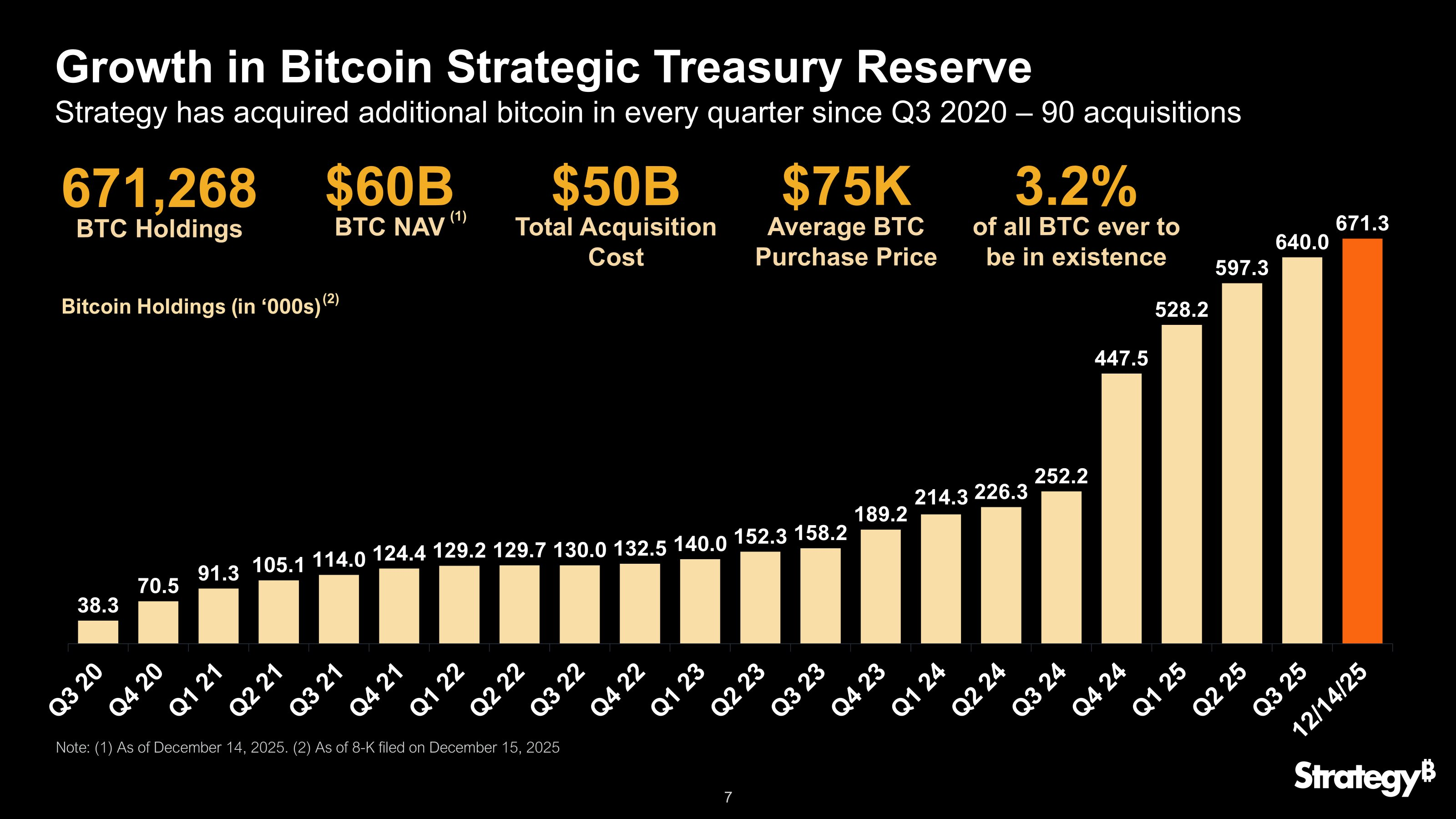
As of press time, Strategy held 671,268 BTC—valued at roughly $50.3 billion—representing 3.2% of the total Bitcoin supply.

Strategy’s Bitcoin Holdings. Source: Strategy

However, the market has punished the stock in 2025. MSTR shares have collapsed 43% year-to-date to trade around $165, mirroring Bitcoin’s 30% retreat from its October peak of $126,000.

While the company touts a “BTC Yield” of 24.9%—a proprietary metric measuring the accretion of Bitcoin per share—institutional investors are increasingly focused on the looming external risks rather than internal yield metrics.

However, the most immediate threat to Saylor’s strategy is not Bitcoin’s price, but a potential regulatory reclassification.

MSCI is considering removing Strategy Inc. from its global indices during its February review. The index provider has flagged concerns that the firm now functions more like an investment vehicle than an operating company.

Market analysts have pointed out that the financial implications of such a move are severe.

JPMorgan estimates that an exclusion would trigger approximately $11.6 billion in forced selling as passive ETFs and index-tracking funds liquidate their MSTR positions.

This mechanical selling pressure could decouple the stock from its Bitcoin holdings, creating a liquidity spiral.

In response, Strategy has launched a vigorous defense.

The firm called the MSCI proposal “arbitrary, discriminatory, and unworkable,” arguing that it unfairly targets digital asset companies while ignoring other holding-heavy conglomerates.

“The proposal improperly injects policy considerations into indexing. The proposal conflicts with U.S. policy and would stifle innovation,” it argued.

So, Saylor’s potential new purchase serves a dual purpose: it lowers the company’s average cost basis during a market correction, but more importantly, it signals to the market that despite the MSCI threat and the stock’s poor performance, the “all-in” strategy remains unchanged.

The post MicroStrategy’s Saylor Signals Imminent Bitcoin Buy Amid MSTR Stock YTD Decline appeared first on BeInCrypto.

  •  

BlackRock’s IBIT Defies Bitcoin Slump to Beat Gold in 2025 ETF Flows

BlackRock iShares Bitcoin Trust (IBIT) is set to close 2025 as a top-tier force in the US financial landscape. The fund achieved a rare feat in asset management by raising billions of dollars while losing money for its investors.

Data compiled by Bloomberg Intelligence confirms that IBIT secured the sixth spot on the US ETF leaderboard by net inflows.

Institutional ‘Dip Buying’ Drives $25 Billion into IBIT Despite Negative Returns

The fund attracted $25.4 billion in fresh capital throughout the year, outpacing traditional heavyweights such as the Invesco QQQ Trust and the SPDR Gold Trust (GLD).

This capital flood occurred despite a stark divergence in asset performance.

$IBIT is the only ETF on the 2025 Flow Leaderboard with a negative return for the year. CT's knee-jerk reaction is to whine about the return but the real takeaway is that is was 6th place DESPITE the negative return (Boomers putting on a HODL clinic). Even took in more than $GLDpic.twitter.com/68uq3HFRuO

— Eric Balchunas (@EricBalchunas) December 19, 2025

While gold surged nearly 65% in 2025—driven by central bank buying and geopolitical hedging—IBIT posted a year-to-date loss of 9.59%.

The fund’s performance suffered as Bitcoin retreated approximately 30% from its October record high of $126,173, trading near $88,000.

Typically, negative returns trigger capital flight.

However, IBIT’s ability to attract $25 billion during a correction signals a fundamental shift in investor behavior. It shows that institutional allocators are systematically buying the dip rather than panic-selling volatility.

Considering this, Bloomberg Senior ETF Analyst Eric Balchunas characterized the inflows as a definitive bullish signal for the asset’s long-term trajectory.

“IBIT is the only ETF on the 2025 Flow Leaderboard with a negative return for the year,” Balchunas stated.

Meanwhile, James Thorne, Chief Market Strategist at Wellington-Altus, argues that these flows validate the “financialization” of Bitcoin.

According to him, the digital asset now behaves less like a speculative tech stock and more like a mature macro commodity.

“Watching how Bitcoin now trades, the market microstructure and narrative management increasingly resemble the way gold behaved for decades under heavy institutional influence, with price action reflecting not just fundamental demand, but also positioning, product design, and the preferences of large financial intermediaries,” he added.

For the broader market, BlackRock IBIT’s 2025 performance proves that the Bitcoin ETF is not a fad. It has successfully entrenched itself in institutional portfolios, flipping gold as the preferred “alternative” allocation even when the precious metal vastly outperforms on price.

As the year ends with Bitcoin trading at a discount to its highs, the smart money is betting that the infrastructure BlackRock built will drive the next leg up.

The post BlackRock’s IBIT Defies Bitcoin Slump to Beat Gold in 2025 ETF Flows appeared first on BeInCrypto.

  •  

Tether Hiring Push Reveals Plans for AI-Integrated Self-Custodial Crypto Wallet

Tether is pushing beyond its role as a backend stablecoin issuer and moving directly to the end user.

On December 20, Paolo Ardoino, the firm’s CEO, disclosed that he was hiring a Lead Software Engineer to build a self-custodial mobile wallet that integrates the company’s massive liquidity with its nascent artificial intelligence division.

Tether’s Planned Mobile Crypto Wallet

The recruitment posting offers the most specific look yet at Tether’s consumer strategy.

Ardoino envisions a “100% self-custodial” mobile application designed to serve as a fortress for a strict asset basket.

Unlike general-purpose wallets that support thousands of speculative tokens, Tether’s product will support only four assets. These include Bitcoin (BTC) via the Lightning Network, Tether (USDT), the gold-pegged XAUT, and USAT, the firm’s new US-compliant stablecoin.

Imagine a wallet that supports only BTC (also via LN), USDT, USAT, XAUT.
And will have local private AI integration via QVAC. https://t.co/BCyqjob1Sh

— Paolo Ardoino 🤖 (@paoloardoino) December 20, 2025

This restricted asset list signals a clear strategic intent. Tether is building a “hard money” payment rail, ignoring the broader decentralized finance (DeFi) casino in favor of pure payments and store-of-value assets.

Meanwhile, the announcement confirms the wallet will be powered by two proprietary technologies, including the Wallet Development Kit (WDK) and QVAC.

While WDK handles the non-custodial financial architecture, the integration of QVAC (Tether’s local AI computing platform) is the key differentiator.

Ardoino detailed a vision in which the wallet features a “local private AI integration,” allowing users to run advanced automated tasks directly on their devices.

By processing data locally with QVAC rather than routing it to the cloud, Tether aims to deliver the functionality of an AI-powered financial assistant.

The approach is designed to avoid the privacy trade-offs typically associated with Big Tech platforms.

Moreover, the move underscores Tether’s shift from an infrastructure provider to a consumer-facing tech giant. It builds on last week’s launch of PearPass, a peer-to-peer password manager designed to eliminate reliance on cloud storage.

Indeed, these product lines demonstrate that the company is aggressively verticalizing its stack.

Tether would control the wallet interface, the underlying stablecoins USDT and USAT, the security layer via PearPass, and the intelligence stack via QVAC.

This structure reduces reliance on third-party platforms and strengthens the company’s operational autonomy.

The post Tether Hiring Push Reveals Plans for AI-Integrated Self-Custodial Crypto Wallet appeared first on BeInCrypto.

  •  

Hundreds of Crypto Firms Slam US Bank’s Lobby to Prohibit Stablecoin Yields 

A coalition of more than 125 cryptocurrency companies and advocacy groups has launched a coordinated offensive against US banking lobbyists. The group includes major crypto firms such as Coinbase, Gemini, and Kraken.

The move escalates a high-stakes battle over who has the right to pay interest on stablecoin deposits.

Why Banks Are Lobbying to Tweak the GENIUS Act

The main bone of contention is that the GENIUS Act explicitly prohibits stablecoin issuers like Tether from paying dividends.

However, there is currently a loophole that allows third-party platforms, such as crypto exchanges, to pass this stablecoin yield on to users.

As a result, traditional banking groups are aggressively lobbying to close this avenue, arguing that it constitutes regulatory arbitrage.

The banking lobby contends that if unregulated fintech platforms are allowed to offer high yields on cash-equivalent tokens, it poses a systemic risk to the traditional financial architecture.

In briefings with Capitol Hill, they warned that preserving the current rules could trigger a massive capital flight. They estimated potential deposit outflows of up to $6.6 trillion from commercial banks to digital asset platforms.

Such a shift, they argue, would hollow out the capital base that banks use to underwrite mortgages and business loans. That erosion would force lenders to shrink capacity and raise borrowing costs for American households.

Crypto Coalition Fights Back

In a December 18 letter to the US Senate Committee on Banking, the crypto coalition urged lawmakers to reject attempts to expand the scope of the recently enacted GENIUS Act.

“Reopening this issue before the GENIUS Act’s implementation would weaken the certainty that defines Congressional-enacted regulatory frameworks and introduce unnecessary risk into the broader market structure effort. It would signal that even recently enacted compromises remain subject to almost immediate renegotiation, undermining the predictability that markets, consumers, and innovators rely on,” the group argued.

The crypto coalition also dismissed the banks’ concerns about stability as a protectionist effort to maintain a monopoly on low-interest deposits.

The signatories argued that banks are merely trying to protect their profit margins by preventing consumers from accessing the 4% yields currently available in the Treasury market.

“Stablecoins rewards programs enable platforms to share value directly with users, helping households benefit from higher-rate environments rather than absorbing losses to inflation,” the crypto firms argued.

The Banksters are trying to prohibit platforms like @Gemini, @coinbase, and @krakenfx from offering stablecoin rewards to you. The GENIUS Act already settled this issue with an elegant compromise — stablecoin issuers cannot offer rewards, but intermediary platforms like Gemini,… https://t.co/QpdiQfaD0X

— Tyler Winklevoss (@tyler) December 19, 2025

Tyler Winklevoss, co-founder of Gemini, also publicly slammed the banking lobby’s maneuver, characterizing it as an attempt to “relitigate a settled legislative issue.”

The post Hundreds of Crypto Firms Slam US Bank’s Lobby to Prohibit Stablecoin Yields  appeared first on BeInCrypto.

  •  

Ethereum Developers Plan ‘Glamsterdam’ and ‘Hegota’ Upgrades for 2026

Ethereum core developers have revealed plans to execute two major network upgrades in 2026, codenamed “Glamsterdam” and “Hegota.”

This decision marks the blockchain network’s continued strategic pivot toward a faster release cadence. The move is intended to establish a predictable biannual upgrade schedule and strengthen its competitive position against high-throughput rivals.

Ethereum Shifts to Biannual Upgrades to Fend Off High-Speed Rivals

The roadmap positions “Glamsterdam” for release in the first half of 2026, arriving fast on the heels of the recent “Fusaka” hard fork.

According to developers, Glamsterdam will focus on immediate scalability and efficiency fixes, primarily through gas optimizations and “Enshrined Proposer-Builder Separation” (ePBS).

This technical upgrade aims to separate the roles of block builders and block proposers at the protocol level. It reduces censorship risks and further decentralizes the network.

Meanwhile, the developers intend to finalize the full feature list for Glamsterdam immediately following the holiday break.

On the other hand, the second phase of the 2026 sprint, “Hegota,” targets the latter half of the year.

The upgrade’s name reflects its dual nature, combining the “Bogota” execution-layer update with the “Heze” consensus-layer update.

Christine Kim, a former Vice President at Galaxy Digital who now closely tracks protocol governance, noted that scoping discussions for Hegota will commence on the January 8 All Core Developers call.

These sessions will determine the fork’s “headliner” features, with a finalized scope expected by late February.

Other Planned Updates

Parallel to these structural changes, the Ethereum Foundation is aggressively reorienting its long-term research toward security hardening.

Researcher George Kadianakis confirmed that the network aims to achieve “128-bit provable security” by year-end 2026. The cryptographic standard is considered essential for institutional-grade financial applications.

“For zkEVMs, this isn’t academic. A soundness issue is not like other security issues. If an attacker can forge a proof, they can forge anything: mint tokens from nothing, rewrite state, steal funds. For an L1 zkEVM securing hundreds of billions of dollars, the security margin is not negotiable,” he stated.

The Foundation has linked this initiative to specific milestones, including a “soundcalc” integration in February and full alignment with the Glamsterdam hard fork in May.

Meanwhile, these efforts aim to remove the technical friction that currently limits Ethereum’s mass adoption.

To bridge this gap, developers are implementing a strategy to lower entry barriers and match the intuitive simplicity of mainstream consumer applications.

The post Ethereum Developers Plan ‘Glamsterdam’ and ‘Hegota’ Upgrades for 2026 appeared first on BeInCrypto.
  •  

Crypto Trader Suffers $50 million Loss Following Address Poisoning Attack

A cryptocurrency trader lost $50 million in Tether’s USDT after falling victim to a sophisticated “address poisoning” attack.

On December 20, blockchain security firm Scam Sniffer reported that the attack began after the victim sent a small $50 test transaction to his own address.

How The Address Poisoning Scheme Unfolded

Notably, traders use this standard precaution to confirm that they are sending funds to the correct address.

However, that activity alerted an automated script controlled by the attacker, which immediately generated a “spoofed” wallet address.

🚨💔 A victim lost ~$50M after copying the wrong address from contaminated transfer history. https://t.co/ur4SJ0cvN0 pic.twitter.com/6K5ftJzC1G

— Scam Sniffer | Web3 Anti-Scam (@realScamSniffer) December 20, 2025

The fake address is designed to match the intended recipient’s address at the beginning and end of the alphanumeric string. The differences appear only in the middle characters, making the fraud difficult to detect at a glance.

The attacker then sent a negligible amount of cryptocurrency from the spoofed address to the victim’s wallet.

That transaction effectively placed the fraudulent address into the victim’s recent transaction history, where many wallet interfaces display only truncated address details.

Relying on that visual shorthand, the victim copied the address from their transaction history without checking the full string. So, instead of transferring funds to a secure personal wallet, the trader sent 49,999,950 USDT directly to the attacker.

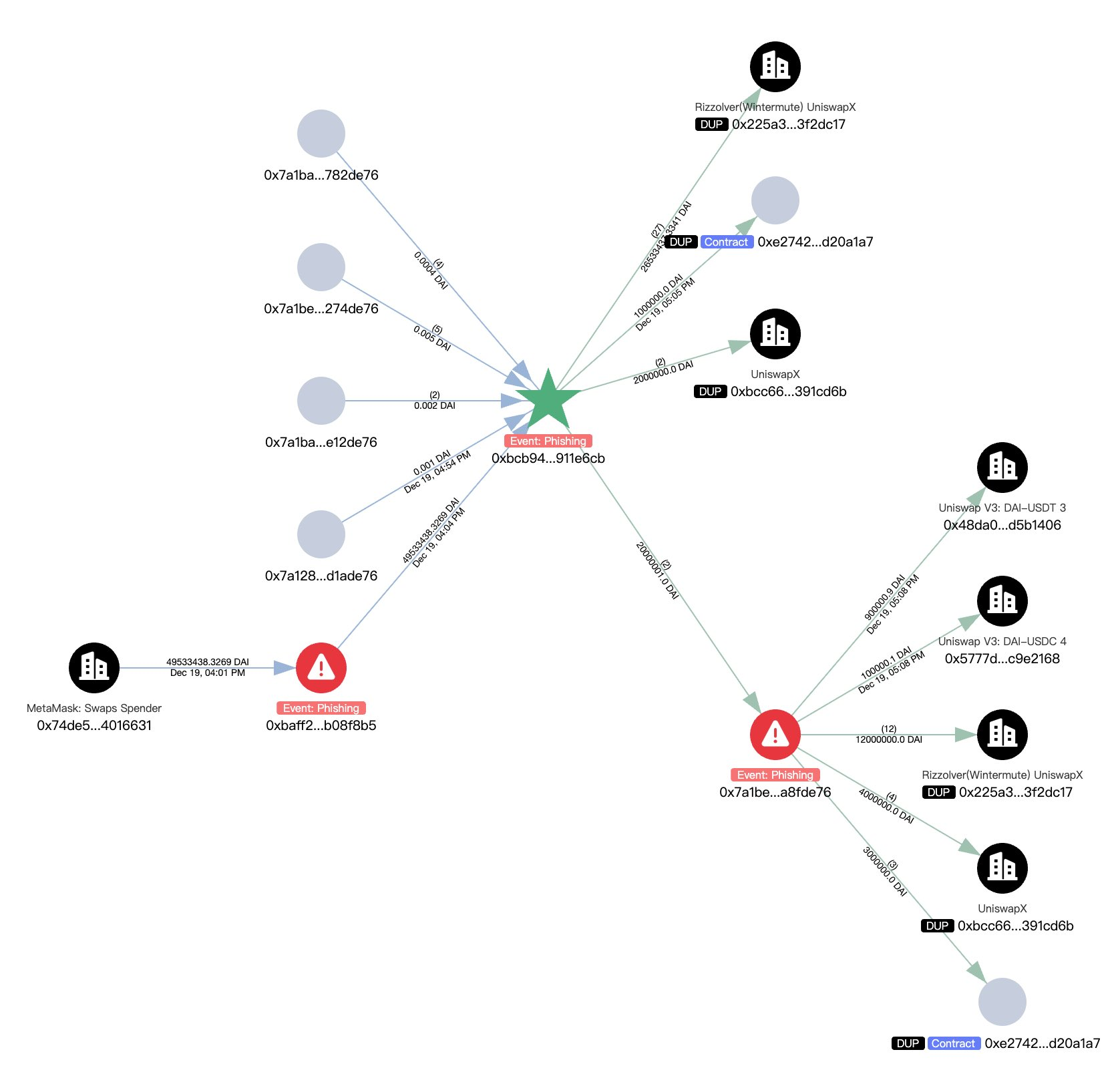
After receiving the funds, the malicious attacker quickly moved to limit the risk of asset seizure, according to on-chain records. The attacker immediately swapped the stolen USDT, which its issuer can freeze, for the DAI stablecoin using MetaMask Swap.

Attacker Moves to Obscure Transaction Trail.
Attacker Moves to Obscure Transaction Trail. Source: Slowmist

The attacker then converted the funds into roughly 16,680 ETH.

To further obscure the transaction trail, the attacker deposited the ETH into Tornado Cash. The decentralized mixing service is designed to sever the visible link between sending and receiving addresses.

Victim Offers $1 Million Bounty

In an attempt to recover the assets, the victim sent an on-chain message offering a $1 million white-hat bounty in return for 98% of the stolen funds.

“We have officially filed a criminal case. With the assistance of law enforcement, cybersecurity agencies, and multiple blockchain protocols, we have already gathered substantial and actionable intelligence regarding your activities,” the message stated.

The message warned that the victim would pursue “relentless” legal action if the attacker failed to comply within 48 hours.

“If you fail to comply: We will escalate the matter through legal and international law enforcement channels. Your identity will be uncovered and shared with the appropriate authorities. We will relentlessly pursue criminal and civil action until full justice is served. This is not a request. You are being given one final chance to avoid irreversible consequences,” the victim stated.

The incident underscores a persistent vulnerability in how digital wallets display transaction information and how attackers exploit user behavior rather than flaws in blockchain code.

Security analysts have repeatedly warned that wallet providers’ practice of abbreviating long address strings for usability and design reasons creates a persistent risk.

If this problem is not solved, attackers are likely to continue exploiting users’ tendency to verify only the first and last few characters of an address.

The post Crypto Trader Suffers $50 million Loss Following Address Poisoning Attack appeared first on BeInCrypto.

  •  

Pro-Crypto Senator Cynthia Lummis Won’t Run for Re-Election

Senator Cynthia Lummis, the US Senate’s most prominent cryptocurrency advocate, announced on December 19 that she will not seek reelection in 2026.

The decision sets a definitive deadline on her legislative agenda, creating a two-year sprint to enshrine digital asset regulations before she leaves office in January 2027.

Lummis’ Impending Retirement Adds Pressure to Codify Crypto Laws

Lummis cited the “exhausting” pace of recent sessions as the primary driver for her exit. “I am a devout legislator, but I feel like a sprinter in a marathon,” she wrote, admitting she lacks the energy reserves for another six-year term.

Thank you, Wyoming! Serving our state has been the honor of my life. – Cynthia Lummis pic.twitter.com/FoRTlHaHxI

— Cynthia Lummis 🦬 (@CynthiaMLummis) December 19, 2025

Her impending departure adds immediate urgency to the crypto legislative calendar.

Lummis has been a major player behind several pivotal crypto bills, including the crypto market structure bill and the US National Bitcoin Strategic Reserve (SBR). Her efforts also stood against the SEC’s “regulation by enforcement” approach under Gensler.

While the Trump administration has reversed several anti-crypto measures and advanced pro-crypto goals through executive action, Sen. Lummis has welcomed those steps.

She has consistently argued, however, that durable progress requires legislative codification rather than policy set by executive order alone.

So, her final term will focus on bridging the gap between temporary executive orders and permanent congressional law to protect the industry from future political reversals.

“I look forward to throwing all my energy into bringing important legislation to [Trump’s] desk in 2026 and into retaining commonsense Republican control of the US Senate,” Lummis said.

Meanwhile, the announcement triggered immediate accolades from industry heavyweights. Some argued that her exit would leave a crypto leadership vacuum in Washington.

Collin McCune, Head of Government Affairs at a16z, highlighted her national impact and noted her role in advancing crypto legislation.

“Senator Lummis fought for Wyoming every day for many years. Beyond that, her leadership created space for innovators and builders across the country. Crypto would not be where it is today without her fight in the Congress,” he added.

Arjun Sethi, co-CEO of crypto exchange Kraken, offered a detailed retrospective on Lummis’s legacy, crediting her with making Wyoming the first jurisdiction to take a “technically informed approach” to digital assets.

Sethi praised Lummis for championing frameworks that aligned with “technical reality” rather than legacy assumptions. He said the approach helped create operating certainty across markets, from Bitcoin to emerging “memetic assets.”

“Senator Lummis advocacy for Bitcoin and digital assets has been grounded, patient, and long term. Not performative. Not reactive. Focused on competitiveness, resilience, and ensuring the United States remains a place where open systems can be built and operated responsibly,” Sethi said.

The post Pro-Crypto Senator Cynthia Lummis Won’t Run for Re-Election appeared first on BeInCrypto.
  •  

North Korea Hackers Steal $300 Million via Fake Zoom Meetings

North Korea cybercriminals have executed a strategic pivot in their social engineering campaigns. They have stolen more than $300 million by impersonating trusted industry figures in fake video meetings.

The warning, detailed by MetaMask security researcher Taylor Monahan (known as Tayvano), outlines a sophisticated “long-con” targeting crypto executives.

How North Korea’s Fake Meetings Are Draining Crypto Wallets

According to Monahan, the campaign departs from recent attacks that relied on AI deepfakes.

Instead, it uses a more straightforward approach built on hijacked Telegram accounts and looped footage from real interviews.

🚨 WARNING (AGAIN)

DPRK threat actors are still rekting way too many of you via their fake Zoom / fake Teams meets.

They're taking over your Telegrams -> using them to rekt all your friends.

They've stolen over $300m via this method already.

Read this. Stop the cycle. 🙏 pic.twitter.com/tJTo9lkq0v

— Tay 💖 (@tayvano_) December 13, 2025

The attack typically starts after hackers seize control of a trusted Telegram account, often belonging to a venture capitalist or someone the victim previously met at a conference.

Then, the malicious attackers exploit prior chat history to appear legitimate, guiding the victim to a Zoom or Microsoft Teams video call via a disguised Calendly link.

Once the meeting starts, the victim sees what appears to be a live video feed of their contact. In reality, it is often a recycled recording from a podcast or public appearance.

The decisive moment typically follows a manufactured technical issue.

After citing audio or video problems, the attacker urges the victim to restore the connection by downloading a specific script or updating a software development kit, or SDK. The file delivered at that point contains the malicious payload.

Once installed, the malware—often a Remote Access Trojan (RAT)—grants the attacker total control.

It drains cryptocurrency wallets and exfiltrates sensitive data, including internal security protocols and Telegram session tokens, which are then used to target the next victim in the network.

Considering this, Monahan warned that this specific vector weaponizes professional courtesy.

The hackers rely on the psychological pressure of a “business meeting” to force a lapse in judgment, turning a routine troubleshooting request into a fatal security breach.

For industry participants, any request to download software during a call is now considered an active attack signal.

Meanwhile, this “fake meeting” strategy is part of a broader offensive by Democratic People’s Republic of Korea (DPRK) actors. They have stolen an estimated $2 billion from the sector over the past year, including the Bybit breach.

The post North Korea Hackers Steal $300 Million via Fake Zoom Meetings appeared first on BeInCrypto.

  •  

Cosmos Eyes ATOM Radical Redesign Amid Price Struggles

Cosmos Labs has opened an urgent search for external economists to redesign the ATOM token amid the digital asset’s price struggles.

According to the firm, the Cosmos SDK has become a widely used framework for launching blockchain networks. This includes projects tied to major enterprises and government initiatives often cited as evidence of “Fortune 500” interest.

Why Cosmos Wants to Overhaul ATOM’s Design

However, because the software is open source, those users can deploy independent, sovereign chains without paying fees or royalties to the Cosmos Hub.

As a result, these institutional builders can use the network’s core technology without holding or interacting with ATOM.

Request for Proposals: ATOM Tokenomics Research ⚛️

A tokenomics RFP invites qualified research firms to submit proposals to provide data-driven research supporting a redesign of ATOM’s economic model.

Applications are due January 15. Read more: https://t.co/96lGdAyCAI

— Cosmos Hub ⚛️ (@cosmoshub) December 12, 2025

The blockchain development firm wants to change this by promoting a new “revenue-driven model.” This approach would monetize both on-chain and off-chain usage.

“The goal of this research effort is not to design a new tokenomic model from first-principles, but rather to provide research and design support for a revenue-driven model that synergizes various sources of potential ATOM revenue with updates to ATOM’s supply dynamics and inflation schedule. Ultimately, ATOM’s utility will be driven by these fees, either in the form of ATOM buybacks, ATOM staking rewards, other mechanisms, or some combination thereof,” it stated.

Meanwhile, the initiative also marks a strategic pivot for the Cosmos ecosystem.

Cosmos Labs acknowledged that Interchain Security, the shared security framework once promoted as ATOM’s primary value driver, “failed to find product market fit.”

“Interchain Security is in the process of being deprecated, and the Hub’s economic architecture remains relatively detached from the broader activity of the Cosmos ecosystem. It lacks a comprehensive fee model today, outside of transaction fees occurring on the network,” the firm explained.

Consequently, this redesign effort points toward economic models closer to enterprise software norms, including consumption-based fees tied to usage rather than security rent.

However, implementing any proposal would face significant political constraints. Any material changes must be approved by the Cosmos Hub DAO, which has historically resisted measures viewed as centralizing.

Cosmos Labs referenced a previous proposal to reduce inflation that passed by a narrow 3% margin. The decision triggered a sharp withdrawal of staked assets, illustrating how sensitive token economics remain within the community.

Considering this, the firm stated that any successful proposal outlines potential revenue pathways, analyzes supply-side constraints, and offers practical guidance aligned with stakeholder interests. The RFP closes Jan. 15.

Meanwhile, this move comes as ATOM has fallen nearly 76% this year to a five-year low of around $2.1.

This price performance reflects a deep stress across the ecosystem, even as the Cosmos software stack has gained wider traction among blockchain developers and institutional pilots.


The post Cosmos Eyes ATOM Radical Redesign Amid Price Struggles appeared first on BeInCrypto.

  •  

Prysm Bug Cost Ethereum Validators Over $1 Million After Fusaka Upgrade

Ethereum consensus client Prysm said validators missed out on 382 ETH, equivalent to more than $1 million, after a software bug triggered network disruptions shortly after the recent Fusaka upgrade.

The incident, detailed in a post-mortem titled “Fusaka Mainnet Prysm incident,” stemmed from a resource exhaustion event that affected nearly all Prysm nodes and led to missed blocks and attestations.

What Caused Prysm’s Outage?

According to Offchain Labs, the developer behind Prysm, the problem emerged on December 4 when a previously introduced bug caused delays in validator requests.

Those delays resulted in missed blocks and attestations across the network.

“Prysm beacon nodes received attestations from nodes that were possibly out of sync with the network. These attestations referenced a block root from the previous epoch,” the project explained.

The disruption led to 41 missed epochs, with 248 blocks missing out of 1,344 available slots. That represented an 18.5% missed slot rate and pushed overall network participation down to 75% during the incident.

Offchain Labs said the bug responsible for the behavior was introduced and deployed to testnets about a month earlier, before being triggered on mainnet following the Fusaka upgrade.

While a temporary mitigation reduced the immediate impact, Prysm said it has since implemented permanent changes to its attestation validation logic to prevent a recurrence.

Ethereum’s Client Diversity

Meanwhile, the outage has renewed scrutiny around Ethereum’s client concentration and the risks posed by software monocultures.

Offchain Labs said the outage could have had more severe consequences if Prysm had accounted for a larger share of Ethereum’s validator base. The firm pointed to Ethereum’s client diversity as a key factor in preventing a wider network failure.

“A client with more than 1/3rd of the network would have caused a temporary loss in finality and more missed blocks. A bug client with more than 2/3rd could finalize an invalid chain,” it stated.

Despite that mitigation, the incident has intensified calls for greater client diversity.

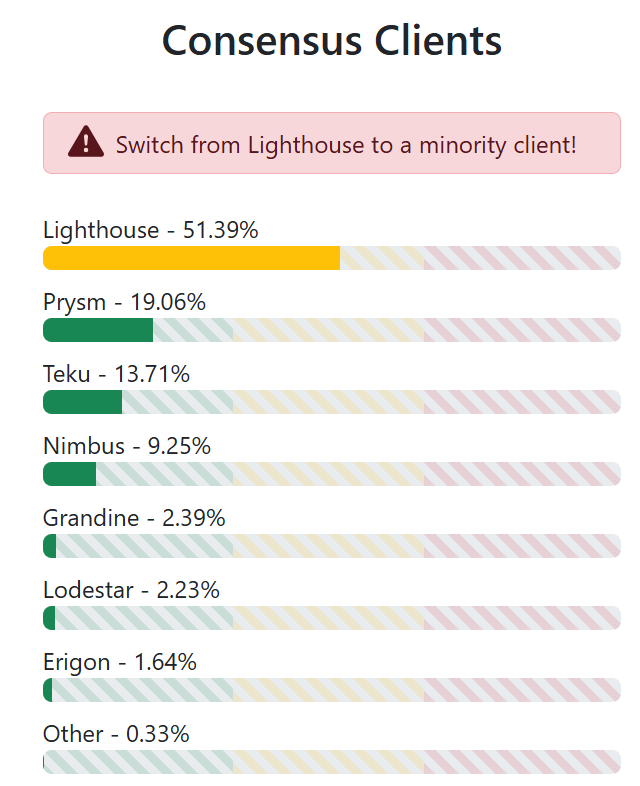
Data from Miga Labs show that Lighthouse remains the dominant Ethereum consensus client, accounting for 51.39% of validators. Prysm represents 19.06%, followed by Teku at 13.71% and Nimbus at 9.25%.

Ethereum's Consensus Clients.
Ethereum’s Consensus Clients. Source: Clientdiversity

Lighthouse’s share places it roughly 15% points away from a threshold that some researchers view as a systemic risk.

As a result, developers and ecosystem participants have again urged validators to consider switching to alternative clients to reduce the likelihood that a single software flaw could disrupt the blockchain’s core operations.

The post Prysm Bug Cost Ethereum Validators Over $1 Million After Fusaka Upgrade appeared first on BeInCrypto.

  •  

Brazil’s Largest Private Bank Advises 3% Bitcoin Allocation For Clients

Itaú Unibanco Holding SA, Latin America’s largest private bank, has advised clients to allocate up to 3% of their portfolios to Bitcoin for 2026.

The bank framed the cryptocurrency not as a speculative asset, but as a hedge against the erosion of the Brazilian real.

Why Itau Wants Clients’ Funds in Bitcoin

In a strategy note, analysts at the Sao Paulo-based lender said investors face a dual challenge from global price uncertainty and domestic currency fluctuations. They argued that these conditions necessitate a new approach to portfolio construction.

The bank recommends a Bitcoin weight of 1% to 3% to capture returns uncorrelated with domestic cycles.

“Bitcoin [is] an asset distinct from fixed income, traditional stocks, or domestic markets, with its own dynamics, return potential, and — due to its global and decentralized nature — a currency hedging function,” the bank wrote.

Itau emphasized that Bitcoin should not become a core holding. Instead, the bank framed the asset as a complementary allocation calibrated to an investor’s risk profile.

The objective is to capture returns that are not closely tied to domestic economic cycles and to provide partial protection against currency depreciation. It also aims to preserve exposure to long-term appreciation.

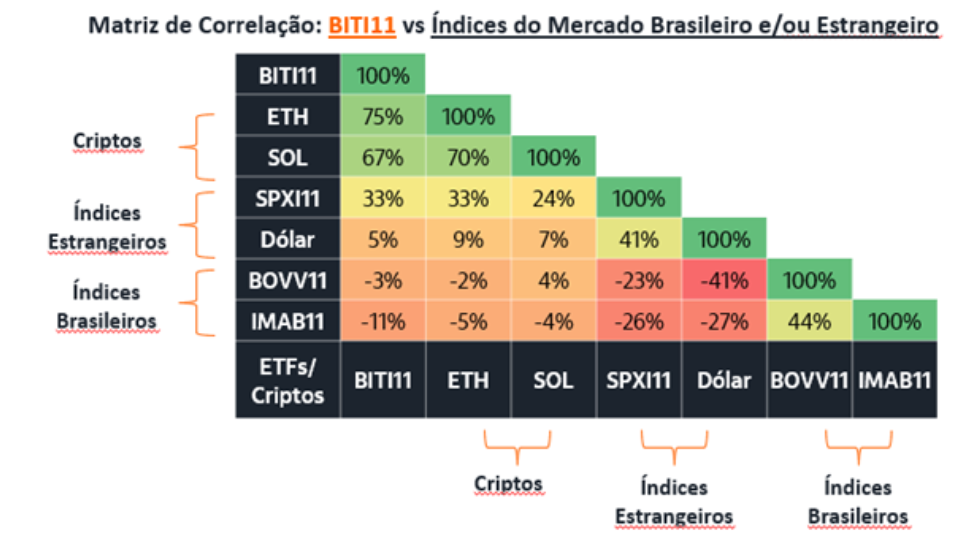
The bank pointed to the relatively low correlation between Bitcoin and traditional asset classes. It argued that an allocation of 1% to 3% can enhance diversification without overwhelming overall portfolio risk.

Bitcoin Performance vs Traditional Assets.
Bitcoin Performance vs Traditional Assets. Source: Itau

The approach, the note said, requires moderation, discipline, and a long-term horizon, rather than reactions to short-term price swings.

“Attempting ‘perfect timing’ in assets like Bitcoin or other international markets is risky — and often counterproductive,” the bank warned.

Itaú’s 3% ceiling places it squarely in line with the most forward-looking global guidance, narrowing the gap with US counterparts.

Notably, major US banks such as Morgan Stanley and Bank of America have recommended that their clients allocate up to 4% of their assets to the flagship digital asset.

For Brazilian investors, however, the stakes are different.

Itaú said that in a world of shortening economic cycles and more frequent external shocks, Bitcoin’s “hybrid character” sets it apart from traditional assets.

The bank described the flagship cryptocurrency as part high-risk asset and part global store of value. It argued that this combination offers a form of resilience that fixed income can no longer guarantee.

The post Brazil’s Largest Private Bank Advises 3% Bitcoin Allocation For Clients appeared first on BeInCrypto.

  •  

CFTC’s Treasury Reform Paves Way for Crypto Market

The Commodity Futures Trading Commission (CFTC) is quietly laying the plumbing for a market structure where US Treasuries and cryptocurrencies could eventually live side-by-side.

On December 12, the CFTC approved an expansion of cross-margining for US Treasuries.

How CFTC’s New Order Impacts Crypto

This change allows certain customers, not just clearing members, to offset margin requirements between Treasury futures cleared at CME Group. CME Group is one of the largest crypto derivatives trading platform in the US.

It also applies to cash Treasuries cleared at the Depository Trust and Clearing Corporation’s Fixed Income Clearing Corporation.

“Expanding cross-margining to customers will provide capital efficiencies that can increase liquidity and resiliency in US Treasuries, the most important market in the world,” Caroline Pham, CFTC’s Acting Chair, said.

Cross-margining allows firms to reduce total collateral by netting correlated positions within a portfolio. Extending that mechanism from dealer balance sheets to end customers in Treasuries represents a significant structural shift.

Market participants view it as a practical test of risk models. Those frameworks could eventually support portfolios holding Treasuries, tokenized funds and crypto assets within a single clearing ecosystem.

For crypto derivatives traded on CME, the orders could have significant market implications.

If Treasuries and Treasury futures can be cross-margined at scale, similar frameworks could eventually support more complex portfolios. Those portfolios could include tokenized Treasury bills and spot Bitcoin backing positions in CME Bitcoin and ETH futures, all governed by unified margin and risk controls.

Meanwhile, this order’s timing places it squarely within a broader crypto regulatory effort that spans both the CFTC and the Securities and Exchange Commission (SEC).

It also echoes the SEC’s parallel work on market structure and clearing reform, as regulators assess how tokenized securities and digital collateral might fit within established settlement and custody frameworks.

Notably, the Pham-led Commission recently unveiled a Digital Asset Collateral Pilot. The initiative permits Bitcoin, Ethereum and USDC to be used as margin in CFTC-regulated derivatives markets.

These moves reflect a regulatory focus on capital efficiency and risk management across asset classes that increasingly blur the line between traditional and digital markets.

The post CFTC’s Treasury Reform Paves Way for Crypto Market appeared first on BeInCrypto.

  •  

US Banks Warn OCC Crypto Charters Could Weaken The Banking System

The US banking industry has mounted a coordinated challenge to the Office of the Comptroller of the Currency’s (OCC) approach. The pushback targets the regulator’s efforts to integrate cryptocurrency firms into the federal banking system.

On December 12, OCC issued conditional approval of national trust charters for five digital asset firms, including Ripple, Fidelity, Paxos, First National Digital Currency Bank, and BitGo. The bank regulator stressed that the crypto applicants underwent the same “rigorous review” as any national bank charter applicant.

US Banking Industry Challenges OCC’s Move

However, the American Bankers Association (ABA) and the Independent Community Bankers of America (ICBA) argue that the OCC’s actions create a two-tier banking system.

Just released – ABA statement on @USOCC’s announcement regarding national trust charters: https://t.co/OqGgUtPAyd pic.twitter.com/NH6RevliRX

— American Bankers Association (@ABABankers) December 12, 2025

Their central claim is that fintech and crypto firms are being granted prestigious national charters without carrying Federal Deposit Insurance Corp. (FDIC) coverage or meeting traditional capital and liquidity standards required of full-service banks.

The groups contend that this structure encourages what they describe as regulatory arbitrage at the federal level.

By securing a national charter, the crypto firms can benefit from federal preemption of state money transmitter laws. At the same time, they avoid many of the compliance obligations that apply to insured depository institutions.

ABA President Rob Nichols said the approvals “blur the lines” of what constitutes a bank. He further argues that this erosion of definitions risks weakening the integrity of the charter itself.

In his view, expanding trust powers to firms that do not perform traditional fiduciary duties creates a class of institutions that resemble banks in name and scope but lack comparable oversight.

Meanwhile, their concern extends beyond competition.

Banking groups warn that consumers may struggle to distinguish between insured banks and national trust institutions holding large volumes of uninsured crypto assets.

They argue that the OCC has not adequately explained how it would manage the failure of such an entity, particularly if it were holding billions of dollars in digital assets outside the traditional safety net.

ICBA Wants the Charters Halted

The ICBA also directly challenged the OCC’s statutory authority to issue the charters.

We oppose the OCC’s conditional approval of five national trust bank charter applications from nonbank fintechs. We have repeatedly said the OCC lacks statutory authority to expand trust powers and that the sudden influx of applications threatens consumers and the financial…

— Independent Community Bankers of America (@ICBA) December 12, 2025

The group focused its criticism on Interpretive Letter No. 1176. This guidance enabled trust banks to engage in non-fiduciary activities such as custody of stablecoin reserves.

ICBA President Rebeca Romero Rainey described the move as a “dramatic policy change” that stretches the national trust charter beyond its historical purpose.

“The OCC’s dramatic policy change under Interpretive Letter #1176 is a departure from the role of conventional trust companies and allows for an inconsistent regulatory framework that threatens financial instability — requiring the agency to change course,” Rainey added.

The group argues that the OCC is allowing non-bank fintech firms to effectively borrow the credibility of the US banking system while avoiding the “full scope” of regulations imposed on insured institutions.

Considering this, both trade groups have called for an immediate pause and rescission of the approvals.

They warn that the current framework could produce institutions that the OCC is “not equipped to resolve in an orderly way.” According to them, such a failure could leave traditional banks and the broader financial system exposed.

The post US Banks Warn OCC Crypto Charters Could Weaken The Banking System appeared first on BeInCrypto.

  •  

Aave Governance Conflict Widens Over $10 Million Revenue Dispute

A dispute over revenue sharing has erupted between the community governing DeFi lender Aave and its primary development firm, Aave Labs.

The conflict centers on Aave Labs’ recent decision to integrate CoW Swap as the underlying infrastructure for trading on the protocol’s primary website. The switch replaced ParaSwap, a previous integration that generated referral fees for the Aave DAO treasury.

DAO Members Question Economic Fallout From Interface Update

Governance delegates say the change has cut off a revenue stream of about $200,000 per week. On an annualized basis, they estimate the impact at roughly $10 million, shifting value away from token holders.

Marc Zeller, founder of the Aave Chan Initiative, criticized the move, calling it a “stealth privatization” of brand assets.

Extremely concerning.

The stealth privatization of approximately 10% of Aave DAO's potential revenue, leveraging brand and IPs paid for by the DAO, represents a clear attack on the best interests of the $AAVE Token holders.

We will prepare an official response with @AaveChan. https://t.co/opoG3I7x7s

— Marc ”七十 Billy” Zeller (@Marczeller) December 12, 2025

Zeller argued that Aave Labs unilaterally altered the economic arrangement without seeking approval from the DAO, which governs the underlying smart contracts.

“Aave Labs, in the pursuit of their own monetization, redirected Aave user volume towards competition. This is unacceptable. By doing this integration, the Aave protocol lost two revenue streams that cannot be easily replaced,” he wrote.

Zeller warned that the lack of communication raises concerns about how future upgrades will be handled.

He pointed specifically to the upcoming V4 upgrade and questioned whether other “accessory features” could also be ring-fenced from the DAO.

“It is important to consider the picture as a whole to define if Aave Labs breached its expected fiduciary duty towards the Aave DAO and the AAVE token holders, and what we should expect from V4 in general,” Zeller concluded

Aave Labs Defend Moves

In a detailed response, Stani Kulechov, founder and CEO of Aave Labs, defended the integration, rejecting the characterization of the lost funds as stolen revenue.

Kulechov argued that the previous fees from ParaSwap were a “discretionary surplus” rather than a mandated protocol fee.

“It was never a fee switch, its been a surplus that we donated to the DAO,” he stated.

He also drew a sharp line between the Aave protocol, the DAO-governed decentralized smart contracts, and the front-end interface. He described the interface as a private product funded and maintained by Aave Labs.

Kulechov said Aave Labs bears the costs of engineering and security for the website. He added that the DAO does not subsidize ongoing product development expenses.

Consequently, the firm asserts the right to monetize the interface to ensure its sustainability.

“It’s also perfectly fine for Aave Labs to monetize its products, especially as they don’t touch the protocol itself,” he said.

The development firm also restated Kulechov’s position, acknowledging a failure to communicate the change effectively.

The firm said it switched to CoW Swap to deliver better execution prices and stronger protection against MEV (maximum extractable value), rather than to generate additional revenue.

The post Aave Governance Conflict Widens Over $10 Million Revenue Dispute appeared first on BeInCrypto.

  •  

Vitalik Buterin Warns Against Zcash Token Voting

Ethereum co-founder Vitalik Buterin is urging the Zcash community to avoid adopting token-based voting for governance.

In a November 30 post on X, he said token voting would push the system toward short-term price incentives at the expense of the long-term civil liberties the project aims to protect.

Buterin Flags Governance Risks to Privacy

Buterin linked his position to arguments he outlined in a 2021 essay on decentralized governance, noting that token-weighted systems carry vulnerabilities such as unbundled rights that make covert vote buying possible.

I hope Zcash resists the dark hand of token voting.

Token voting is bad in all kinds of ways (see https://t.co/Cvl7CFVgtc ); I think it's worse than Zcash's status quo.

Privacy is exactly the sort of thing that will erode over time if left to the median token holder. https://t.co/NbRqGLOrpj

— vitalik.eth (@VitalikButerin) November 30, 2025

He added that these mechanisms tend to concentrate influence among whales while leaving smaller holders with little accountability. Many smaller participants may vote without regard for the outcome if they believe their individual impact is negligible.

He described token voting as “bad in all kinds of ways,” saying it would be worse than Zcash’s existing structure.

“Privacy is exactly the sort of thing that will erode over time if left to the median token holder,” Buterin said.

Buterin’s remarks land amid a broader debate over how Zcash should select the Zcash Community Grants committee, a five-member group that reviews and approves major grants across the ecosystem.

Community Members Argue on Decentralized Governance

Some community members argue the current committee-based framework is outdated and should be replaced.

Mert Mumtaz, CEO of Helius and a pro-Zcash investor, said the debate underscores a broader governance issue.

Mumtaz argued that markets provide built-in correction mechanisms because poor decisions are punished through falling prices, shifting governance influence, and updating collective knowledge. He noted that committees lack that feedback loop and can remain detached from real-world outcomes.

He likened this separation to what Nassim Nicholas Taleb calls the “interventionista,” a bureaucrat making consequential decisions without bearing the associated risks.

By contrast, he noted that ancient Roman generals operated on the front lines, where survival depended directly on the quality of their decisions.

While acknowledging the flaws in token voting, Mumtaz said static committees present a deeper problem because they are “uncriticizable and account to no one.” He added that systems grounded in market dynamics adapt over time, whereas committees do not, arguing that “evolution wins long-term.”

Community members have echoed related concerns. Naval, a user on X, said third-party overseers introduce structural security flaws regardless of their independence.

Another user, Darklight, argued that market-based systems tend toward plutocracy and may fail to preserve civil liberties.

The governance dispute comes as Zcash attracts renewed market attention.

Data from BeInCrypto show the token has risen more than 1,000% in the last three months, reaching a high of $723 before retreating to current levels. Zcash trades near $448 at press time after falling more than 20% in the past week.

The post Vitalik Buterin Warns Against Zcash Token Voting appeared first on BeInCrypto.

  •  

Kazakhstan Prepares for Potential $300 Million Crypto Investment

Kazakhstan’s central bank is weighing a plan to invest up to $300 million in cryptocurrency assets.

On November 28, Timur Suleimenov, chairman of the National Bank of Kazakhstan, said the bank could allocate funds from the National Fund and its foreign-exchange reserves into crypto.

Kazakhstan’s Central Bank Weighs Timing for Crypto Plan

However, he emphasized that the full amount may not be used.

“In the first stage, we’ll be managing gold and foreign exchange reserves. This is the same money that needs to be managed. Some of it is in gold, some in securities. Within this portfolio, a separate portfolio has already been created, focusing on investments in high-tech stocks and other financial instruments related to digital financial assets. The amounts are up to $300 million. This doesn’t mean we’ve just invested $300 million; we might limit ourselves to $50 million, $100 million, or $250 million,” he reportedly said.

Meanwhile, he said the recent pullback across digital asset markets has made the timing of any allocation less certain. Indeed, Bitcoin price has declined by more than 17% during the past month amid broader market volatility.

Considering this, he stated that the central bank intends to wait for conditions to stabilize before committing funds to the industry.

“We won’t make any decisions without thorough analysis. We’re analyzing. We won’t rush these decisions until good investment opportunities emerge. After the current decline in all digital, financial, and crypto assets, we need to let the dust settle before making investment decisions,” He explained

The initiative forms part of a broader expansion of the central bank’s foreign-exchange portfolio.

The NBK plans to diversify its holdings, which currently rely heavily on gold and securities, by adding high-tech stocks and financial instruments linked to digital assets.

Suleimenov said the investment would be sourced from the bank’s gold and foreign-exchange reserves rather than the National Fund.

Meanwhile, the deliberations come nearly three months after Tokayev instructed the creation of a strategic state reserve for digital assets. The Presidential Press Service said the reserve should focus on cryptocurrency markets given “modern realities.”

Since then, Kazakhstan has entered the digital asset reserve space through its Alem Crypto Fund. The country, through a partnership with Binance, has purchased BNB.

Kazakhstan’s consideration aligns with a broader shift by some sovereign institutions, including that of the United States, toward testing or accumulating digital assets.

Earlier this month, the Czech National Bank acquired $1 million worth of digital assets for a test portfolio, including Bitcoin and an unnamed stablecoin.

Taken together, these moves indicate that governments are increasingly viewing digital assets as a viable tool for reserve diversification.

The post Kazakhstan Prepares for Potential $300 Million Crypto Investment appeared first on BeInCrypto.

  •  
❌