Reading view

US Crypto CLARITY Act Set for Senate Markup in January

David Sacks, the White House’s AI and crypto czar, said the Digital Asset Market Clarity Act (CLARITY Act) will enter the US Senate markup stage in January, marking a critical step toward final passage.

Sacks said Senate Banking Committee Chair Tim Scott and Senate Agriculture Committee Chair John Boozman have confirmed the timeline, setting the stage for formal review and amendments before a full Senate vote.

We had a great call today with Chairmen @SenatorTimScott and @JohnBoozman who confirmed that a markup for Clarity is coming in January. Thanks to their leadership, as well as @RepFrenchHill and @CongressmanGT in the House, we are closer than ever to passing the landmark crypto…

— David Sacks (@davidsacks47) December 18, 2025

What Happens in January

The update signals growing momentum behind the bill after the House advanced it earlier in 2025. 

If the Senate process stays on schedule, lawmakers could finalize a reconciled version later in the year. This will position the CLARITY Act as the central market-structure law for US crypto markets.

During markup, Senate committees will review the House-passed text line by line. Lawmakers will propose amendments, debate policy trade-offs, and vote on changes before sending a revised bill to the Senate floor. 

The process will involve both the Banking Committee, which oversees securities regulation, and the Agriculture Committee, which supervises the Commodity Futures Trading Commission (CFTC).

🚨 The $CLARITY Act — the U.S. $crypto market structure bill — has been delayed until 2026 as Senate action stalls. This means federal regulatory clarity for digital #assets won’t happen this year, keeping the industry in limbo 📉

No law = more uncertainty
More delay = more… pic.twitter.com/gpuUTMQGUU

— COACHTY (@TheRealTRTalks) December 18, 2025

The goal is to resolve long-standing jurisdictional disputes between the SEC and the CFTC and to strengthen guardrails for spot crypto markets. 

Committee leaders have indicated they want a bill that can attract bipartisan support and avoid reopening enforcement-heavy approaches.

Likely Amendment Focus for the CLARITY Act

Amendments are expected to concentrate on three areas. 

First, asset classification, including tighter criteria for determining when a token qualifies as a digital commodity versus a security. 

Also, investor and consumer protections, such as disclosures, custody standards, and conflict-of-interest rules for exchanges and brokers. 

Lastly, implementation timelines, including how quickly platforms must register and how agencies coordinate supervision during the transition.

Senators may also refine preemption language to limit overlapping state rules without weakening state enforcement authority.

After years of talk, the CLARITY Act now has a real path forward.

The White House and key Senators have finally agreed to move the bill, and they’ve put an actual date on it.

January 2026 is when the Senate plans to formally debate it, amend it, and try to push it toward… https://t.co/Uq9BIOQGLx pic.twitter.com/251ij1zE5i

— Milk Road (@MilkRoad) December 18, 2025

How will the CLARITY Act Change US Crypto Markets in 2026?

If enacted, the CLARITY Act would reshape the US crypto market in 2026. It would place spot digital commodity markets under CFTC oversight, end years of regulatory ambiguity, and create a federal registration regime for exchanges, brokers, and dealers. 

For the industry, this would reduce legal uncertainty, support institutional participation, and shift compliance from courtroom battles to rule-based supervision.

For regulators, the law would replace fragmented enforcement with clearer mandates. 

Most importantly, for the market, it would mark the United States’ first comprehensive framework for crypto trading. This would potentially restore competitiveness with jurisdictions that already offer regulatory clarity.

The post US Crypto CLARITY Act Set for Senate Markup in January appeared first on BeInCrypto.
  •  

FTX Scandal Figure Caroline Ellison Leaves Prison: Was Justice Too Lenient?

Caroline Ellison, the former CEO of Alameda Research and a central figure in the FTX scandal, is no longer behind bars. 

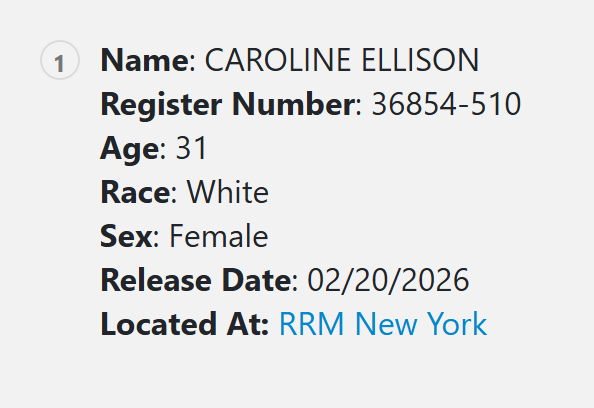
US Bureau of Prisons records show Ellison has been transferred from federal prison to Residential Reentry Management (RRM) in New York. This marks a shift from incarceration to community confinement.

What RRM Status Actually Means

According to the Bureau of Prisons inmate locator, Ellison remains in federal custody with a projected release date of February 20, 2026. However, her current status confirms she is no longer housed in a correctional facility.

RRM — short for Residential Reentry Management — oversees the final phase of a federal sentence. Individuals under RRM may be placed in a halfway house or home confinement, rather than a prison. 

BOP Inmate Location. Source: Federal Bureau of Prisons

While still under Bureau of Prisons supervision, inmates face fewer physical restrictions and may be permitted to work, maintain limited social contact, and prepare for reintegration.

Unlike prison, RRM placements involve no cells, no guards, and significantly more autonomy, though strict monitoring and movement limits remain in place. 

Ellison’s transfer signals she has entered the reentry phase of her sentence, not that she has been released.

Ellison’s Role in the FTX Collapse

Ellison pleaded guilty in 2022 to multiple federal fraud charges tied to the misuse of FTX customer funds

As CEO of Alameda Research, the trading arm closely tied to FTX, she admitted to executing trades and financial maneuvers that relied on billions in customer deposits.

However, prosecutors and the court drew a clear distinction between Ellison’s role and that of FTX founder Sam Bankman-Fried, who designed the systems that enabled the fraud. Ellison did not control FTX’s exchange infrastructure, customer custody mechanisms, or governance.

Today, SBF's lawyer asked him about his relationship with Caroline Ellison and why it ended. SBF responded by mentioning she wanted more than the time and energy he could give:

"Historically, I haven't been great at … romantic relationships" pic.twitter.com/w19csqFgPr

— Zack Guzmán ♻️ (@zGuz) October 27, 2023

Her cooperation proved decisive. Ellison became the government’s key witness, offering extensive testimony that helped secure Bankman-Fried’s conviction. In 2024, a federal judge sentenced her to two years in prison, citing her cooperation, early guilty plea, and subordinate role.

A Stark Contrast With Do Kwon

Ellison’s move out of prison comes as Terraform Labs co-founder Do Kwon begins serving a 15-year US federal sentence for fraud linked to the collapse of the TerraUSD stablecoin. 

Prosecutors argued Kwon knowingly misled investors about the stability of Terra’s algorithmic peg, triggering losses estimated at over $40 billion.

4:04 pm- they've back.
Judge Engelmayer: 5 years is entire off the table. Even 12 years might be unreasonable & here is why. The fraud you pled guilty to cost victims more than $40 billion. Even in SDNY, it's eye popping. There is a 25 year cap, so not life

— Inner City Press (@innercitypress) December 11, 2025

Unlike Ellison, Kwon was a founder, public promoter, and architect of the system at the center of the collapse. The sentencing disparity reflects how courts differentiate between system designers and operators.

Too Lenient Or Legally Consistent?

Ellison’s transition to community confinement is legally routine, but politically charged. To critics, it reinforces perceptions of uneven accountability in crypto scandals. 

To prosecutors, it reflects established sentencing principles: cooperation, reduced authority, and acceptance of responsibility.

For now, Ellison remains under federal supervision. But her exit from prison, even if temporary, has reopened a familiar question — who truly pays the price when crypto empires collapse?

The post FTX Scandal Figure Caroline Ellison Leaves Prison: Was Justice Too Lenient? appeared first on BeInCrypto.

  •  

Trump Hints at Samourai Wallet Pardon — Another After CZ, Ulbricht

President Donald Trump said he would consider pardoning Keonne Rodriguez, the CEO of privacy-focused Bitcoin wallet Samourai, who was sentenced to five years in federal prison last month for money laundering charges.

The statement reignited debate over the privacy technology of cryptocurrencies. It also raised questions about whether other convicted developers, including Tornado Cash’s Roman Storm, might receive similar presidential clemency.

Calls for More Pardons Meet Market Frustration

During a press briefing on Dec. 15, a reporter asked Trump about Rodriguez’s case, noting it began under the Biden administration but continued under his Department of Justice. Trump responded, “I’ve heard about it. I’ll look at it.” The President added that he would review the matter after the reporter mentioned widespread support for clemency within the crypto community.

Rodriguez, 37, and co-founder William Lonergan Hill, 67, were convicted of operating a cryptocurrency mixing service. The prosecutors say the two facilitated the laundering of over $237 million in criminal proceeds. Rodriguez received five years, while Hill received four years, with both ordered to pay $250,000 in fines.

The announcement drew varied responses. Some supporters expressed hope that the decision would provide momentum for crypto-friendly policies. One X user even called for extending clemency to Do Kwon, the embattled founder of the collapsed Terra/Luna ecosystem.

However, critics pointed to broader market performance under Trump’s presidency. Since he took office, there have been significant declines across major cryptocurrencies, with some tokens down more than 70%.

Prosecution’s Case Against “Simple Developer” Narrative

The Department of Justice presented evidence that challenges the portrayal of Rodriguez and Hill as mere privacy tool developers. According to the Nov. 19 sentencing announcement, prosecutors demonstrated that the founders actively promoted their services to criminal users.

Hill allegedly marketed Samourai on Dread, a darknet forum, directly responding to a user seeking “secure methods to clean dirty BTC” by recommending Whirlpool as a superior option. Rodriguez reportedly encouraged Twitter hackers in 2020 to funnel stolen proceeds through the mixing service. He even expressed disappointment when they chose a competitor.

Most damaging was Rodriguez’s own description of mixing as “money laundering for bitcoin” in WhatsApp messages. At the same time, the company’s marketing materials acknowledged targeting “Dark/Grey Market participants” moving proceeds from “illicit activity.”

Prosecutors said criminal funds processed through Samourai originated from drug trafficking, darknet marketplaces, cyber intrusions, fraud, sanctioned jurisdictions, murder-for-hire schemes, and a child pornography website.

Broader Implications

The case has reignited debate over developer liability for user actions on decentralized platforms. Privacy advocates argue that the prosecution sets a dangerous precedent for open-source software development, while law enforcement maintains that actively promoting criminal use crosses legal boundaries.

Online discussions have expanded to question whether Roman Storm, the Tornado Cash developer convicted on similar charges in August, might also be considered for clemency. Storm was found guilty of conspiracy to operate an unlicensed money transmitting business. The jury deadlocked on more serious money laundering and sanctions violation charges.

Congress continues to debate cryptocurrency regulation. The lawmakers are introducing multiple bills to clarify the legal status of privacy-enhancing technologies, though none have passed into law.

Trump has previously pardoned several crypto figures, including former Binance CEO Changpeng Zhao and Silk Road founder Ross Ulbricht, establishing a pattern that fuels speculation about future clemency decisions in the sector.

The post Trump Hints at Samourai Wallet Pardon — Another After CZ, Ulbricht appeared first on BeInCrypto.

  •  

US Senate Delays Crypto Market Structure Bill Until 2026

The US Senate has delayed the long-awaited Crypto Market Structure Bill, pushing final consideration into early 2026. Lawmakers ran out of legislative time as internal disputes stalled consensus on key provisions.

The delay prolongs regulatory uncertainty for crypto exchanges, issuers, and institutional investors operating in the US.

Why the Crypto Market Structure Bill Was Delayed

The bill, built on the House-passed Digital Asset Market Clarity (CLARITY) Act, aims to define how digital assets are regulated. It would formally split oversight between the Securities and Exchange Commission and the Commodity Futures Trading Commission.

However, unresolved disagreements over jurisdiction, DeFi oversight, and consumer protections slowed progress.

🚨NEW: In a statement, a Senate Banking Committee spokesperson confirmed my reporting from this AM that @BankingGOP will not hold a market structure markup this year:

“Chairman Scott and the Senate Banking Committee have made strong progress with Democratic counterparts on… pic.twitter.com/op5rIyMn3d

— Eleanor Terrett (@EleanorTerrett) December 15, 2025

Senate negotiators struggled to reconcile differences between the Banking and Agriculture committees. These committees oversee the SEC and CFTC respectively, and both claim authority over crypto spot markets.

As a result, lawmakers could not finalize language that both sides supported before the session ended.

DeFi regulation also emerged as a major sticking point. Some senators pushed for exemptions for decentralized protocols with no controlling intermediary.

Others warned that broad exemptions could weaken enforcement and create regulatory gaps.

Consumer advocacy groups added pressure by opposing parts of the bill. They argue the framework shifts power away from the SEC and risks weakening investor protections after several high-profile crypto failures.

This opposition prompted further revisions and slowed negotiations.

Despite the delay, the bill differs sharply from other crypto legislation already passed. Unlike the GENIUS Act, which focuses narrowly on stablecoins, the market structure bill targets the entire crypto trading ecosystem.

It sets rules for exchanges, brokers, custody providers, and token issuers under a unified federal framework.

The bill also goes further than enforcement-led regulation. It introduces formal asset classification standards and limits reliance on court rulings to define whether tokens are securities or commodities.

Lawmakers say this approach would replace regulatory uncertainty with statutory clarity.

The post US Senate Delays Crypto Market Structure Bill Until 2026 appeared first on BeInCrypto.

  •  

Do Kwon Gets 15 Years, 10 Less Than SBF—Here’s Why

Terraform Labs co-founder Do Kwon was sentenced to 15 years in federal prison on Thursday for orchestrating a $40 billion cryptocurrency fraud—a sentence notably lighter than the 25 years handed to FTX founder Sam Bankman-Fried (SBF) last year, despite Kwon’s fraud causing nearly four times the financial damage.

The sentencing disparity highlights how courtroom behavior, remorse, and cooperation with authorities can dramatically influence outcomes in high-profile white-collar cases.

The Verdicts

US District Judge Paul Engelmayer, presiding over Kwon’s case in the Southern District of New York, described the Terra-Luna collapse as “a fraud on an epic, generational scale.” He rejected both the prosecution’s recommendation of 12 years as “unreasonably lenient” and the defense’s request for five years as “utterly unthinkable and wildly unreasonable.”

“Your offense caused real people to lose $40 billion in real money, not some paper loss,” Engelmayer told Kwon, noting there may have been as many as one million victims worldwide.

By contrast, Judge Lewis Kaplan sentenced SBF to 25 years in March 2024 for an $11 billion fraud, citing the defendant’s “exceptional flexibility with the truth” and “apparent lack of any real remorse.”

Why the Difference?

Guilty Plea vs. Trial

Kwon pleaded guilty in August 2025 to conspiracy and wire fraud charges, accepting responsibility for misleading investors about TerraUSD’s stability mechanisms. In a letter to the court, he wrote: “I alone am responsible for everyone’s pain. The community looked to me to know the path, and I, in my hubris, led them astray.”

SBF, on the other hand, went to trial and maintained his innocence throughout. He argued that FTX was merely experiencing a “liquidity crisis” rather than outright fraud. The jury took just four hours to convict him on all seven counts.

Courtroom Conduct

Judge Kaplan found that SBF committed perjury at least three times during his testimony. Kaplan called SBF’s performance on the stand the most “evasive” he had witnessed in nearly 30 years on the bench. “When he wasn’t outright lying, he was often evasive, hairsplitting, dodging questions,” Kaplan said.

The judge also found that SBF had attempted to tamper with witnesses before trial. He sent messages to former FTX general counsel Ryne Miller suggesting they “vet things with each other.”

Kwon, by contrast, listened to victim impact statements—315 letters submitted to the court—and apologized directly. “Hearing from victims was harrowing and reminded me again of the great losses that I have caused,” he told Judge Engelmayer.

Future Legal Exposure

A critical factor in Kwon’s sentencing was his pending prosecution in South Korea. He faces charges that could result in up to 40 additional years in prison. Judge Engelmayer explicitly considered this when crafting the sentence. Kwon will likely be extradited to face trial in his home country after serving his US term.

SBF faces no comparable foreign legal jeopardy, making his 25-year US sentence his primary punishment. However, he is actively fighting to overturn his conviction. In November 2025, SBF’s legal team filed an appeal, arguing that he was “presumed guilty” before his trial even began. His attorney, Alexandra Shapiro, claims the court blocked key evidence proving FTX’s solvency and allowed biased treatment throughout the proceedings. The Second Circuit is expected to take several months to issue a ruling.

Do KwonSam Bankman-Fried
Sentence15 years25 years
Estimated Loss$40 billion$11 billion
PleaGuilty pleaTrial conviction
RemorseApologized to victimsNo remorse shown
PerjuryNone3 counts found
Witness TamperingNoneYes
Additional ChargesUp to 40 years in South KoreaNone
Source: BeInCrypto

The Bigger Picture

Both cases represent landmark moments in cryptocurrency enforcement. Prosecutors noted that Kwon’s losses exceeded those caused by SBF, OneCoin co-founder Karl Sebastian Greenwood, and former Celsius CEO Alex Mashinsky combined.

The sentencing outcomes send a clear message to the crypto industry: cooperation and genuine remorse can meaningfully reduce prison time.

Kwon has agreed to forfeit $19.3 million as part of his plea deal. He was also ordered to pay an $80 million fine and to receive a lifetime ban on cryptocurrency transactions as part of his 2024 SEC settlement.

His request to serve his sentence in South Korea was denied.

The post Do Kwon Gets 15 Years, 10 Less Than SBF—Here’s Why appeared first on BeInCrypto.

  •  

What Does the Market Structure Bill ‘CLARITY Act’ Need to Pass in 2026?

With 2026 on the horizon, uncertainty is mounting over whether the crypto market structure bill will sail through early in the year or become mired in a political fight that pushes its passage further down the calendar.

Key unresolved issues continue to slow momentum, including how the bill should address stablecoin yield, conflict-of-interest language, and the treatment of decentralized finance under federal law.

Path to Senate Vote Uncertain

The CLARITY Act cleared the House in July with broad bipartisan support, marking the strongest move yet toward a federal digital asset framework.

The bill now awaits action in the Senate, where the Banking and Agriculture committees are advancing parallel versions of a market-structure framework. The Senate’s split jurisdiction adds complexity, with the Banking Committee overseeing securities, while the Agriculture Committee handles commodities.

Both committees have now published discussion drafts, but a unified package has yet to emerge. Lawmakers still need to reconcile differences before either committee can send a combined bill to the Senate floor.

One major technical dispute involves how the legislation should treat yield-bearing stablecoins.

Banks Push Broader Yield Restrictions

The GENIUS Act, passed earlier this year, bars permitted stablecoin issuers from paying holders any form of interest or yield. 

However, the restriction is narrowly written. It applies only to direct payments from payment-stablecoin issuers and does not explicitly cover reward programs, third-party yield, or other digital asset structures.

The banks demanded the exclusion for yield-bearing stablecoins in the GENIUS Act. Now they're upset that the language they asked for doesn't screw over stablecoin holders hard enough.

Sorry you guys did a bad job negotiating your regulatory moat. Try lobbying better next time! https://t.co/3BbjUxmZlm

— Jake Chervinsky (@jchervinsky) August 13, 2025

Banking groups argue these gaps could allow workarounds and are urging lawmakers to expand the prohibition in upcoming market structure legislation. They want a broader rule that covers all forms of yield associated with stablecoins. 

Several senators appear open to that approach, giving the issue significant weight in negotiations. Any expansion would influence how stablecoins compete with traditional bank deposits, which remains a central concern for the banking lobby.

Meanwhile, lawmakers remain divided over how the broader framework should address potential conflicts of interest.

Concerns Over Political Influence Intensify

The involvement of US President Donald Trump and his family members in crypto-related projects has prompted renewed scrutiny of potential ethical concerns. 

Some lawmakers, such as Senator Elizabeth Warren, argue that new conflict-of-interest language is necessary to ensure that political figures and their relatives are prohibited from engaging in activities that could raise questions about their influence over digital asset policy.

Such measures would help insulate the legislation from perceptions of political interference.

However, the proposed language does not appear in the House-passed CLARITY Act, nor was it included in earlier Senate drafts. Its absence has become a point of debate, and the disagreement is contributing to ongoing hesitation.

Meanwhile, questions remain regarding how the bill should address decentralized finance (DeFi).

DeFi Oversight Remains Unresolved

The market structure bill is designed for centralized intermediaries, including exchanges, brokers, and custodial platforms. Yet the rapid rise of DeFi introduces questions the Senate has not fully resolved.

First Ken Griffin screwed over Constitution DAO

Now he's coming for DeFi, asking the SEC to treat software developers of decentralized protocols like centralized intermediaries

Bet Citadel has been lobbying behind closed doors on this for years

Okay thats all pretty bad, but… pic.twitter.com/ExoNhbhadu

— Hayden Adams 🦄 (@haydenzadams) December 4, 2025

Current drafts primarily focus on custodial activity. However, some traditional financial institutions are advocating for broader definitions that would classify developers, validators, and other non-custodial actors as regulated intermediaries.

Such an approach would significantly expand federal oversight and reshape the legal environment for open-source development.

Until lawmakers define that boundary, the bill is unlikely to advance. The DeFi question remains one of the key factors shaping when the market structure bill may finally move forward in 2026.

The post What Does the Market Structure Bill ‘CLARITY Act’ Need to Pass in 2026? appeared first on BeInCrypto.

  •  

Why the Latest Binance Lawsuit Is More Dangerous Than Any Regulator

A lawsuit against Binance is testing the extent to which crypto platforms can be held liable for real-world harm. Filed by families of victims of the October 2023 attacks against Israel, it arrives amid continued backlash over the recent presidential pardon of founder Changpeng Zhao (CZ).

More than a new legal headache, the lawsuit is being watched as a potential blueprint for a shift from regulatory fines to high-stakes private liability tied to terrorism financing.

Terror Financing Claims Hit Binance

The case, brought by more than 70 families in a US federal court last week, accuses Binance of knowingly enabling transactions for Hamas, Hezbollah, Iran’s Islamic Revolutionary Guard Corps, and other US-designated terrorist groups.

The plaintiffs, mostly relatives of those killed or injured in the October 7 attacks, argue Binance was not merely exploited. They say the platform structurally enabled terrorist financing at scale.

“For years, Defendants knowingly, willfully, and systematically assisted Hamas… and other terrorist groups to transfer and conceal the equivalent of hundreds of millions of US dollars through the Binance platform in support of their terrorist activities. This assistance directly and materially contributed to the October 7 Attacks and to subsequent terrorist attacks,” read the complaint.

Earlier government investigations have focused on Binance’s anti-money laundering failures. However, this lawsuit reframes the narrative, arguing that CZ’s stewardship of the platform has systemically contributed to real-world violence. 

The lawsuit also arrives at a consequential moment for the company.

Last month, US President Donald Trump granted Binance founder CZ a pardon after Binance participated in a multibillion-dollar deal tied to a crypto venture linked to the Trump family. 

The move cleared CZ’s criminal record and could allow him to take on a more direct role at the company.

Just posted: the pardon that Trump issued to @cz_binance on Tuesday.

It wipes away CZ's conviction for failing to maintain an effective anti-money laundering program, which prosecutors said allowed Hamas, Al Qaeda & ISIS to move money using @binance. https://t.co/ptbRCzxhd3 pic.twitter.com/1B9tKnZG6P

— Kenneth P. Vogel (@kenvogel) October 25, 2025

The case also arises two years after Binance’s 2023 settlement with US authorities, which included a $4.3 billion penalty. The company admitted to violating the Bank Secrecy Act and US sanctions laws. CZ pleaded guilty, stepped down as CEO, and served a four-month prison sentence.

While CZ’s pardon suggested Binance was in the clear, the lawsuit shows neither he nor the company is insulated from civil liability.

Despite Criminal Leniency, Civil Claims Intensify

The families’ lawsuit builds on facts already established by US criminal enforcement, giving the plaintiffs a strong legal foundation.

Because Binance has already admitted to sweeping violations of the Bank Secrecy Act and US sanctions laws, the burden of proof is significantly lower. The families argue Binance embedded these flaws in its core operations, not in isolated compliance failures.

Rather than leaning on broad allegations, the complaint reportedly names specific wallets, laundering intermediaries, and transaction flows tied to designated terrorist groups. 

In its structure, the case closely mirrors the way federal prosecutors assemble complex criminal indictments. The difference is that this same evidentiary framework is now being deployed by private plaintiffs under US anti-terrorism statutes.

Those laws allow victims of terrorism to pursue civil damages against entities accused of providing material support, even indirectly. This legal pathway transforms Binance’s past regulatory violations into the foundation of a potentially massive civil liability case.

For years, crypto enforcement followed a cycle: regulators investigated, companies paid fines, executives stepped aside, and markets moved on. Civil litigation tied directly to terrorism financing breaks that rhythm. 

Unlike regulatory settlements, which cap financial exposure and close legal chapters, terror-related civil cases can involve multiplied damages and years of continuing risk.

A New Enforcement Class?

For the crypto industry, the implications extend far beyond one exchange or one courtroom. If the case survives early dismissal and proceeds to discovery, it could lead to new scrutiny of how centralized platforms monitor, flag, and freeze high-risk activity. 

More significantly, a win for the families could establish that private plaintiffs—not just regulators—now pose one of the most serious financial threats to crypto businesses. 

In that scenario, compliance failures would no longer result in fines alone. They would become long-tail liabilities that follow platforms for years to come.

The post Why the Latest Binance Lawsuit Is More Dangerous Than Any Regulator appeared first on BeInCrypto.

  •  

What The Latest UK Budget Means For Crypto Tax and DeFi Access

The UK’s latest Budget leaves headline crypto tax rules unchanged but tightens the wider environment for traders.

Meanwhile, HMRC signals a major rethink on how it taxes DeFi lending and liquidity provision.

No New “Crypto Tax,” But Pressure Still Rises

Chancellor Rachel Reeves did not introduce any crypto-specific tax in the 2025 Budget. There is no new levy on trading, holding, or spending digital assets.

However, the Budget extends income-tax threshold freezes for three more years. As wages rise, more taxpayers drift into higher bands, including active crypto traders.

Summary of the key highlights from the UK budget 👇

-The UK is fck’d and has no money

-Labour have zero idea how to fix this and instead have focused on killing productivity and raising unemployment

-As the deficit widens, it will just be monetised

-GBP will be the escape…

— LondonCryptoClub (@LDNCryptoClub) November 26, 2025

The capital gains tax (CGT) allowance remains very low compared to historic levels. That means more crypto disposals trigger reportable gains, even for modest retail portfolios.

At the same time, the UK is pushing ahead with global data-sharing under new reporting standards. 

Exchanges and platforms will supply more detailed customer information to HMRC from 2026.

No tax changes for crypto earnings announced in the UK budget. Seems like regulation there is likely to get stricter, but for now 🇬🇧 looks like a slightly more favorable jurisdiction for crypto than some other European countries (eg Spain & France)

— Butian | Bless (@blessbutian) November 26, 2025

HMRC Backs Away From Its Hard Line on DeFi

Alongside the Budget, HMRC published a consultation outcome on DeFi lending and staking. It responds to strong criticism of its 2022 guidance on loans and liquidity pools.

Stakeholders told HMRC that current rules create disproportionate administrative burdens. They warned that treating every DeFi move as a disposal bears little relation to economic reality.

In response, HMRC has dropped its earlier idea of copying repo and stock lending rules. It now prefers a framework based on “no gain, no loss” (NGNL) for many DeFi flows.

HMRC has published its consultation outcome in the UK regarding the taxation of DeFi activities related to lending and staking.

A particularly interesting conclusion is that when users deposit assets into Aave, the deposit itself is not treated as a disposal for capital gains…

— Stani.eth (@StaniKulechov) November 27, 2025

Crucially, the department accepts that automated market makers represent a major share of activity. It signals that any new rules should explicitly cover Uniswap-style multi-token liquidity pools.

Proposed NGNL Rules for DeFi Loans and Liquidity Pools

HMRC now outlines a potential NGNL approach for three areas. These are single-token arrangements, crypto borrowing, and automated market makers.

For single-token lending, entering and exiting a platform could be NGNL for CGT. The real gain or loss would arise only when the user finally sells the token.

For borrowing, posting collateral and taking out tokens would be ignored for CGT. Selling borrowed tokens and later buying them back to repay would crystallise the gain or loss.

For AMMs, HMRC proposes NGNL treatment when users deposit tokens for LP positions. Tax would then focus on differences in the number of tokens received when they exit.

If users receive more of a token than they originally deposited, the extra counts as a gain. But if they receive fewer, the shortfall is treated as a loss against their tax base.

HMRC stresses that this is still a “potential approach,” not enacted law. It will continue consultations before deciding whether to legislate.

How is the UK approaching crypto regulation to become a global leader? 🇬🇧

In one minute, Matt Osborne, Policy Director for the UK & Europe at Ripple, explains the plan: adopt proportionate, growth-friendly rules and allow overseas stablecoins, such as $RLUSD, to be used locally.… pic.twitter.com/lsFC1SgsRA

— Ripple (@Ripple) November 26, 2025

DeFi Rewards: No New “All Income” Rule – For Now

One of the most controversial ideas was to treat all DeFi rewards as income. Respondents warned that this would ignore capital versus revenue distinctions and create dry tax charges.

HMRC now says it is not actively pursuing an “all revenue” deeming rule. Rewards will continue to follow existing principles for now.

What This Means for UK Crypto Traders

For spot traders on centralised exchanges, the Budget brings no direct structural change. CGT still applies on each disposal, and income tax applies where trading amounts to a trade.

However, the combination of frozen thresholds and low CGT allowances increases effective tax pressure.

More active traders will breach reporting thresholds and face higher marginal rates on gains. HMRC expects more users to use portfolio tracking software to support their filings.

The post What The Latest UK Budget Means For Crypto Tax and DeFi Access appeared first on BeInCrypto.

  •