Reading view

$4 Billion Lawsuit Claims Jump Trading Helped Engineer Terraform’s Collapse

The administrator overseeing the wind-down of Terraform Labs has filed a $4 billion lawsuit against high-frequency trading firm Jump Trading. They accuse the market maker of secretly manipulating prices and contributing to the collapse of Do Kwon’s once-dominant crypto ecosystem.

It comes barely a week after the judge issued Do Kwon his sentence, a 15-year term in federal prison for orchestrating a $40 billion crypto fraud.

Terraform Labs Estate Seeks $4 Billion From Jump Trading

The complaint names Jump Trading, co-founder William DiSomma, and former head of its crypto division, Kanav Kariya. It alleges unlawful profiteering tied to the failure of TerraUSD (UST).

Citing court filings, The Wall Street Journal reports that the Terraform Labs estate claims Jump conducted undisclosed, large-scale trading interventions to prop up UST during multiple de-pegging episodes in 2021 and 2022.

Rather than stabilizing the system, the administrator argues these actions created a false sense of market confidence. In turn, this masked structural weaknesses that ultimately made Terra’s collapse more severe.

At the center of the lawsuit is the claim that Jump aggressively purchased UST whenever the algorithmic stablecoin fell below its $1 peg. These purchases allegedly inflated demand artificially, misleading market participants into believing the peg mechanism was functioning as designed.

The estate argues that Jump was not acting as a neutral liquidity provider. Instead, it exploited its market position and inside knowledge to extract profits from the volatility it helped manage.

The filing alleges that Jump earned roughly $1 billion through these strategies, benefiting from preferential token arrangements and trading advantages. Meanwhile, retail investors remained unaware of the behind-the-scenes support.

When Terra ultimately unraveled in May 2022, triggering an estimated $40 billion wipeout across UST and LUNA, the lawsuit claims the earlier illusion of stability magnified the damage.

It is worth mentioning that this is not the first time Jump Trading is linked to manipulation allegations. In October 2024, game developer FractureLabs filed a lawsuit against Jump Trading over crypto manipulation claims

“Jump then systematically liquidated its DIO holdings, generating millions of dollars in revenue for itself,” Bloomberg reported, citing an excerpt in the lawsuit.

Do Kwon’s Sentencing Puts Fresh Spotlight on Jump Trading’s Market Power

The legal action arrives amid renewed headlines of Terra’s collapse. It follows Do Kwon’s recent sentencing to 15 years in prison over fraud charges related to the project.

In the days following that ruling, some market observers publicly speculated that additional institutional players could face legal exposure, with Whale Calls citing Jump Trading.

When jump trading ? https://t.co/yowAZA1DAw

— WhaleCalls (@whalecalls) December 11, 2025

Beyond the immediate allegations, the case highlights Jump Trading’s formidable technological capabilities.

Jump Trading’s Technological Edge and Its Role in the Lawsuit

Jump is widely regarded as one of the most sophisticated high-frequency trading firms globally. Industry reporting has highlighted its willingness to spend vast sums to gain marginal speed advantages, including the acquisition of a microwave tower previously used by NATO to shave milliseconds off transatlantic trade transmission times.

In 2018, Jump also partnered with firms such as Citadel to build the “Go West” undersea fiber-optic cable, connecting Chicago and Tokyo and enabling faster access to global futures markets.

According to commentary from Colin Wu, Jump’s quote data processing capabilities are considered to be on a vastly different scale from those of many competitors. This reflects the asymmetric power that large trading firms can wield in both traditional and crypto markets.

That technological edge now forms part of the broader context of the lawsuit. While the complaint does not allege the use of illegal infrastructure, it argues that Jump’s scale and sophistication amplified the market impact of its UST trades. This raises questions about fairness, disclosure, and market integrity.

If successful, the case could have far-reaching implications. A ruling in favor of the Terraform Labs estate may establish a clearer legal boundary between legitimate market making and manipulation in crypto markets, potentially reshaping how large trading firms operate.

It could also lead to substantial financial penalties, with any recovered funds likely directed toward compensating creditors and victims of the Terra collapse.

Jump Trading has not publicly commented on the lawsuit as of the time of publication, but is expected to mount a vigorous defense.

As discovery continues, the case may offer rare insight into the opaque mechanics of crypto market making. Beyond that, it could mark a watershed moment in the industry’s ongoing reckoning with accountability.

The post $4 Billion Lawsuit Claims Jump Trading Helped Engineer Terraform’s Collapse appeared first on BeInCrypto.

  •  

Peter Brandt Turns Bearish on XRP Price Despite Ripple’s Push for Multichain Expansion

Veteran trader Peter Brandt has struck a bearish tone on XRP price, warning that the token may be forming a classic double-top pattern. His stance comes despite Ripple accelerating ecosystem growth through multichain stablecoin expansion and new institutional tools for XRP holders.

Brandt’s caution comes at a moment when XRP’s fundamentals and infrastructure narrative appear to be strengthening, creating a growing disconnect between technical signals and long-term adoption developments.

Brandt Flags Potential Double-Top Risk for XRP Price

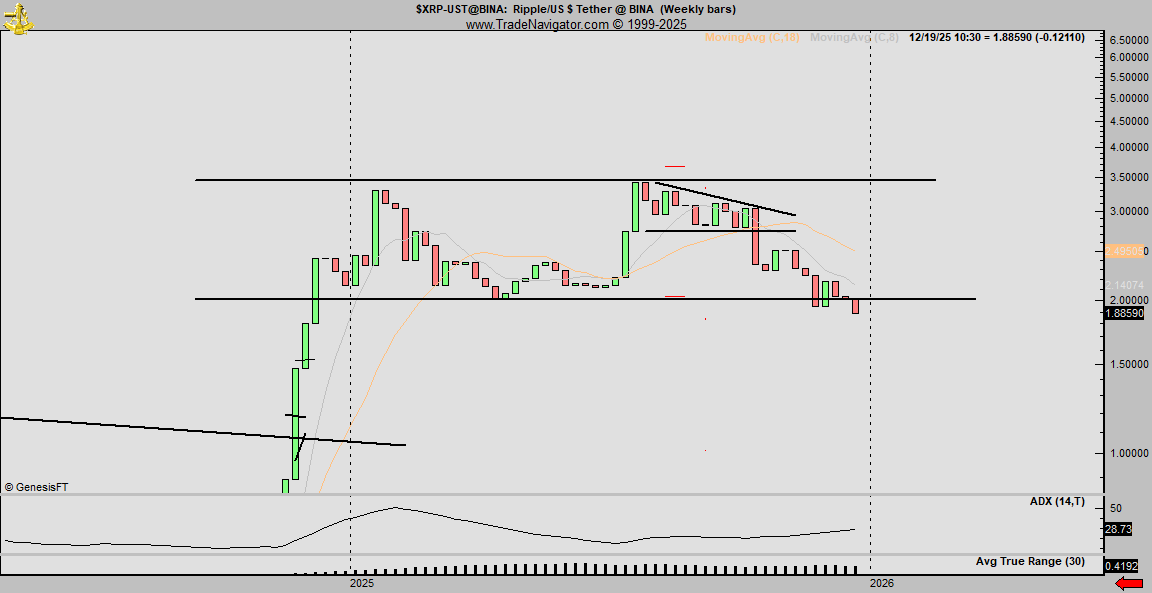
The veteran chartist highlighted what he views as a potentially bearish setup on the XRP price chart. According to Peter Brandt, XRP may be forming a double-top, an often-cited reversal pattern that emerges when an asset fails to break above resistance after two attempts.

XRP chart showing potential double top pattern
XRP price chart highlighting potential double-top formation. Source: Peter Brandt on X

Double-top patterns in technical analysis typically signal waning bullish momentum and can precede deeper pullbacks if confirmation follows.

“I know in advance that all you Riplosts XRP will forever remind me of this post — ask me if I care. This is a potential double top,” Brandt wrote.

The XRP price has been consolidating after its late-2024 rally, placing greater focus on whether support levels can hold.

However, Brandt also acknowledged that the pattern could fail, leaving room for alternative interpretations.

“Sure, it may fail, and I will deal with this if it does. But for now, this has bearish implications. Love it or not — you need to deal with it,” he added.

Analysts Highlight Bullish Historical Context

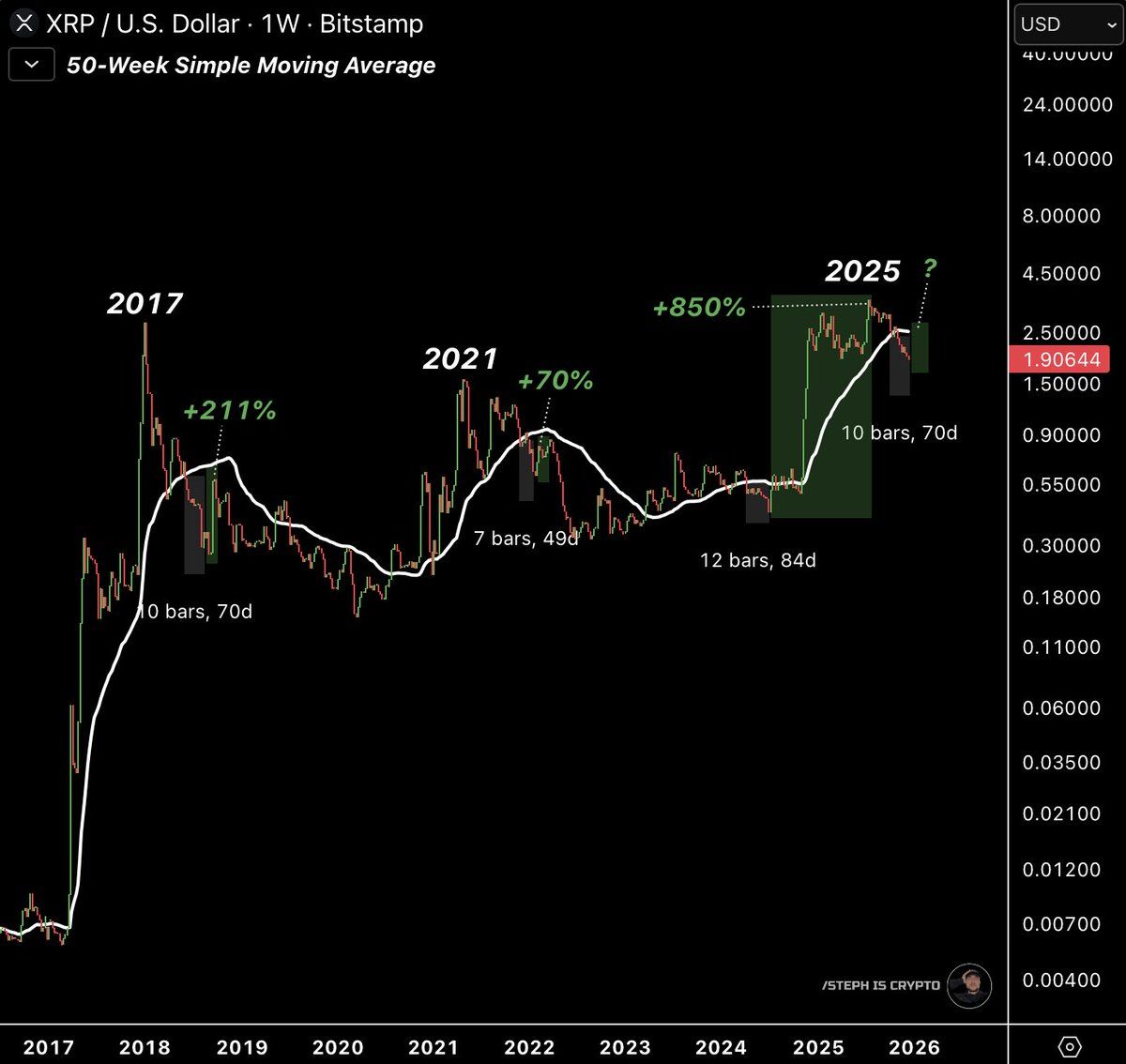
Other market analysts see the current setup very differently. Analyst Steph is Crypto pointed to XRP’s recurring behavior around its 50-week simple moving average (SMA), arguing that prior cycles suggest downside exhaustion rather than the start of a larger decline.

“Every cycle, when XRP breaks below the 50-week SMA and stays there for roughly 50–84 days, a strong rally has followed,” the analyst noted.

Historical examples include a 211% rally after 70 days below the SMA in 2017, a 70% move following 49 days in 2021, and an 850% surge after 84 days in 2024.

The XRP price has now spent roughly 70 days below its 50-week SMA, placing it squarely within the same historical window..

XRP historical performance relative to 50-week SMA
XRP’s historical rallies following extended periods below 50-week SMA. Source: Steph_iscrypto

The analysis suggests that what appears bearish in isolation could align with past cycle bottoms, mirroring the current split in technical interpretation.

Ripple Expands RLUSD Across Layer 2 Networks As Institutional Access Continues to Grow

While technical debate intensifies, Ripple continues to expand its ecosystem. On December 16, the company announced that its US dollar stablecoin, Ripple USD (RLUSD), will expand to Optimism, Base, Ink, and Unichain.

It leverages Wormhole’s Native Token Transfers (NTT) standard for multichain interoperability.

RLUSD was initially issued on the XRP Ledger and Ethereum. The Layer 2 rollout is designed to improve scalability, liquidity movement, and real-world utility across DeFi and institutional platforms.

Ripple emphasized that RLUSD is issued under a trust charter granted by the New York Department of Financial Services (NYDFS). This positions it as one of the most tightly regulated stablecoins entering Layer 2 ecosystems.

The company has also applied for a US OCC charter and recently gained regulatory recognition in Dubai and Abu Dhabi.

Wormhole added that XRP holders will be able to use XRP alongside RLUSD as a “premier trading and liquidity pair” across supported chains, supported by wrapped XRP (wXRP) issuance for cross-chain use.

Enhanced utility is coming for $XRP

XRP holders can use XRP alongside $RLUSD as a premier trading and liquidity pair on supported chains, allowing businesses to facilitate payments and checkout options that let users buy, sell, or send digital assets. pic.twitter.com/DMcSWyQ2XV

— Wormhole (@wormhole) December 17, 2025

Institutional tooling for XRP is also expanding. Digital Wealth Partners recently launched an algorithmic XRP trading strategy for qualified retirement accounts, offering insured custody through Anchorage Digital.

The service gives high-net-worth investors access to systematic XRP trading within regulated, tax-advantaged accounts. This reflects broader efforts to integrate crypto into traditional wealth management structures.

Digital Wealth Partners Launches Algorithmic XRP Trading Strategy Powered by @tryarchpublic for Qualified Retirement Accountshttps://t.co/ro7ipgP48D

— Digital Wealth Partners (@DWP_advisors) December 16, 2025

As XRP faces conflicting technical signals, its trajectory may hinge on whether bearish chart patterns dominate or whether historical cycles and expanding utility ultimately reassert control.

The post Peter Brandt Turns Bearish on XRP Price Despite Ripple’s Push for Multichain Expansion appeared first on BeInCrypto.

  •  

Tether’s USDT Payment Stats Show the Real State of Crypto Adoption in 2025

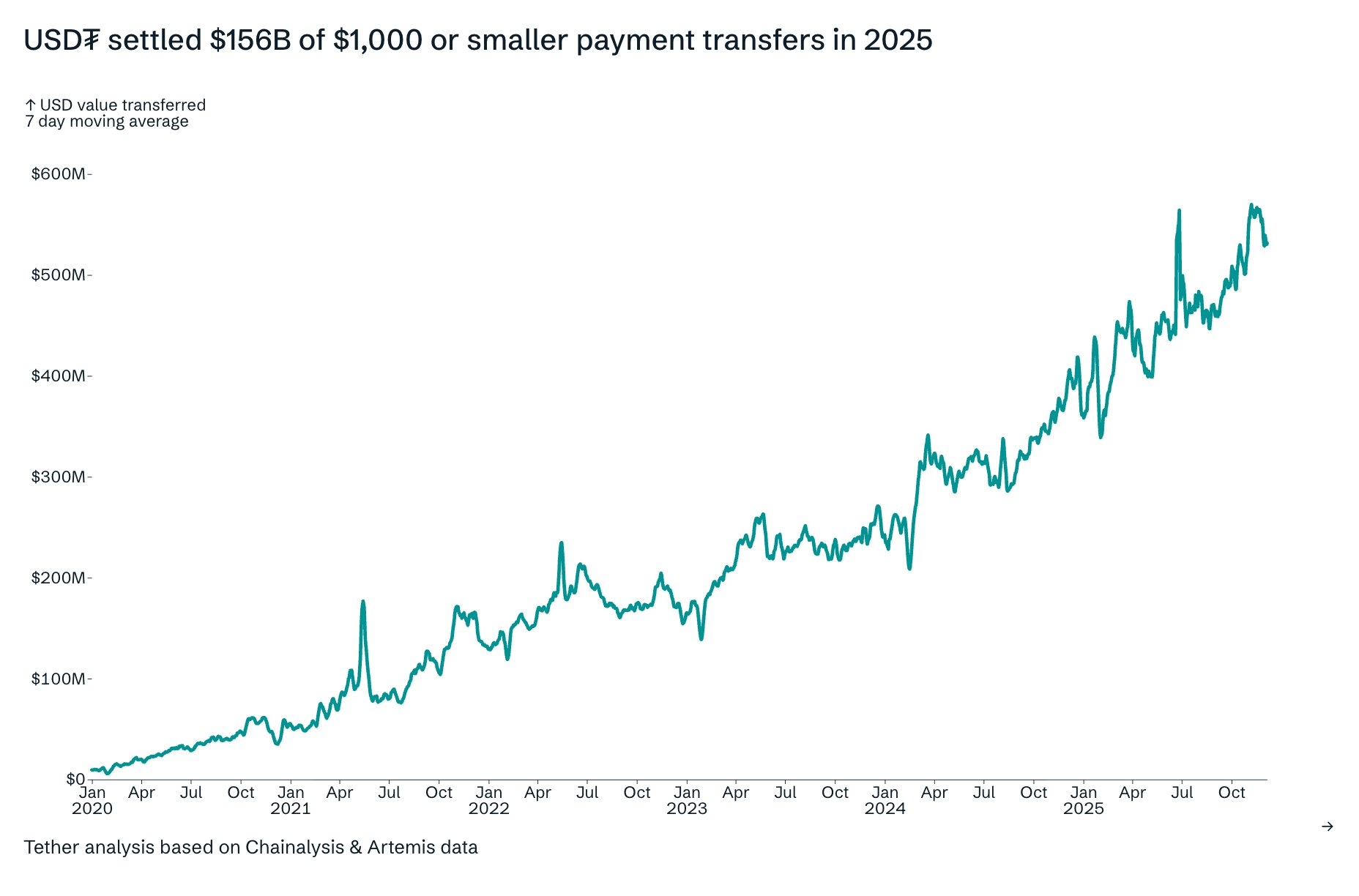
Tether’s USDT processed $156 billion in payments of $1,000 or less in 2025, according to figures shared today by CEO Paolo Ardoino, based on Chainalysis and Artemis data. 

The number highlights a side of crypto adoption often missed by price charts and ETF flows – everyday transactional use.

USDT is Being Used as a Substitute for Banks and Cash

Small-value transfers now represent a meaningful share of USDT activity. The data shows steady growth since 2020, with acceleration through 2024 and into 2025, as average daily volumes for sub-$1,000 transfers climbed above $500 million. 

This points to USDT functioning less as a trading instrument and more as a digital payments rail.

USDT Payments Data Shared By Tether CEO. Source: X/Paolo Ardoino

The significance lies in who uses stablecoins and how. Transfers under $1,000 typically reflect remittances, payroll, retail payments, savings movement, and peer-to-peer transfers, especially in emerging markets. 

Unlike large exchange flows, these transactions tend to be non-speculative and recurring. 

In practical terms, USDT is increasingly acting as a substitute for cash and bank wires in regions where access to dollars is limited or expensive.

This trend aligns with USDT’s broader trajectory in 2025. Circulating supply reached new highs during the year, reflecting demand for dollar liquidity beyond crypto trading. 

At the same time, regulatory developments reshaped where and how USDT circulates. 

In the US, the GENIUS Act clarified the legal framework for payment stablecoins, reinforcing institutional confidence in compliant dollar-backed tokens. 

In Europe, MiCA introduced stricter licensing rules, shifting some regulated platform activity away from USDT but not slowing global on-chain usage.

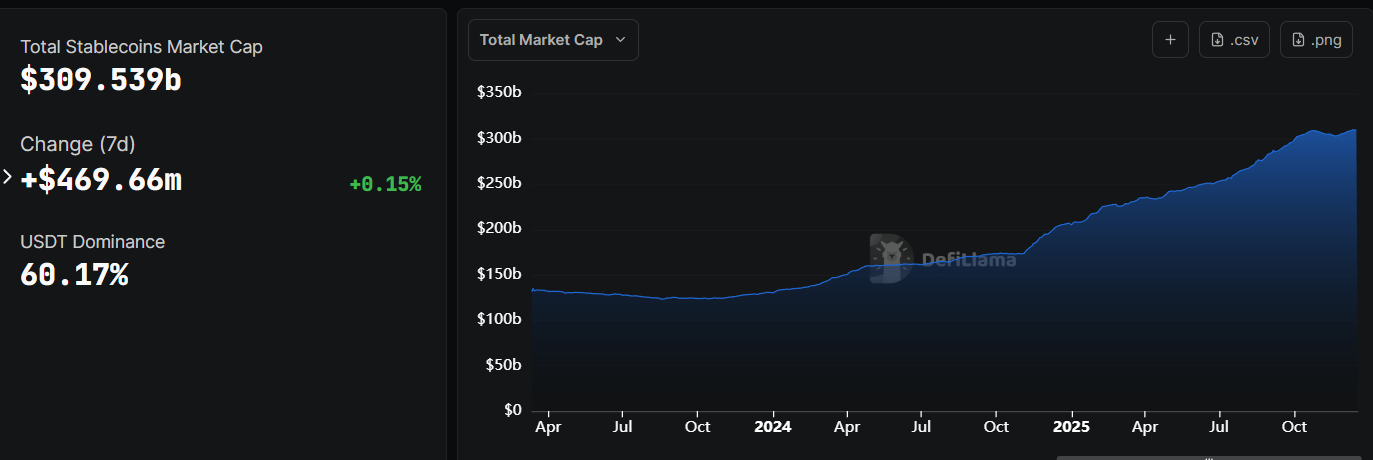
Stablecoins Market Cap In 2025. Source: DeFilLama

Tether has also expanded its infrastructure footprint. Recent investments in Lightning-based payment rails signal an effort to push USDT into faster, lower-cost settlement networks. 

Regional partnerships in Africa and the Middle East further indicate a focus on payments and financial access, not just exchange liquidity.

Taken together, the $156 billion figure reframes the crypto adoption debate. While market cycles drive headlines, stablecoins continue to scale quietly as financial plumbing. 

The growth in small USDT payments suggests that, in 2025, crypto adoption is less about speculation and more about utility, resilience, and global dollar access. This shift may prove more durable than any bull market.

The post Tether’s USDT Payment Stats Show the Real State of Crypto Adoption in 2025 appeared first on BeInCrypto.

  •  

Tom Lee Spots a Big Ethereum Signal in JPMorgan’s Tokenization Push| US Crypto News

Welcome to the US Crypto News Morning Briefing—your essential rundown of the most important developments in crypto for the day ahead.

Grab a coffee, because Wall Street has just sent another signal that crypto’s future is becoming increasingly institutional. As JPMorgan moves a core financial product on-chain, market watchers are wondering whether this is merely experimentation or a deeper shift toward Ethereum as an economic infrastructure.

Crypto News of the Day: JPMorgan Takes Money Markets On-Chain with Ethereum-Powered Fund

JPMorgan Chase has taken another decisive step into blockchain-based finance, launching its first tokenized money market fund on the Ethereum network.

According to reporting by WSJ, the banking giant’s $4 trillion asset-management arm has rolled out the My OnChain Net Yield Fund, or MONY. It is a private money market fund deployed on Ethereum and supported by JPMorgan’s tokenization platform, Kinexys Digital Assets.

The bank will seed the fund with $100 million of its own capital before opening it to outside investors, signaling strong internal conviction in tokenized financial products.

JPMORGAN STEPS FURTHER INTO CRYPTO WITH TOKENIZED MONEY FUND

The banking giant’s $4 trillion asset-management arm is rolling out its first tokenized money-market fund on the Ethereum blockchain. JPMorgan will seed the fund with $100 million of its own capital, and then open it… pic.twitter.com/TTlS5E1MyV

— Evan (@StockMKTNewz) December 15, 2025

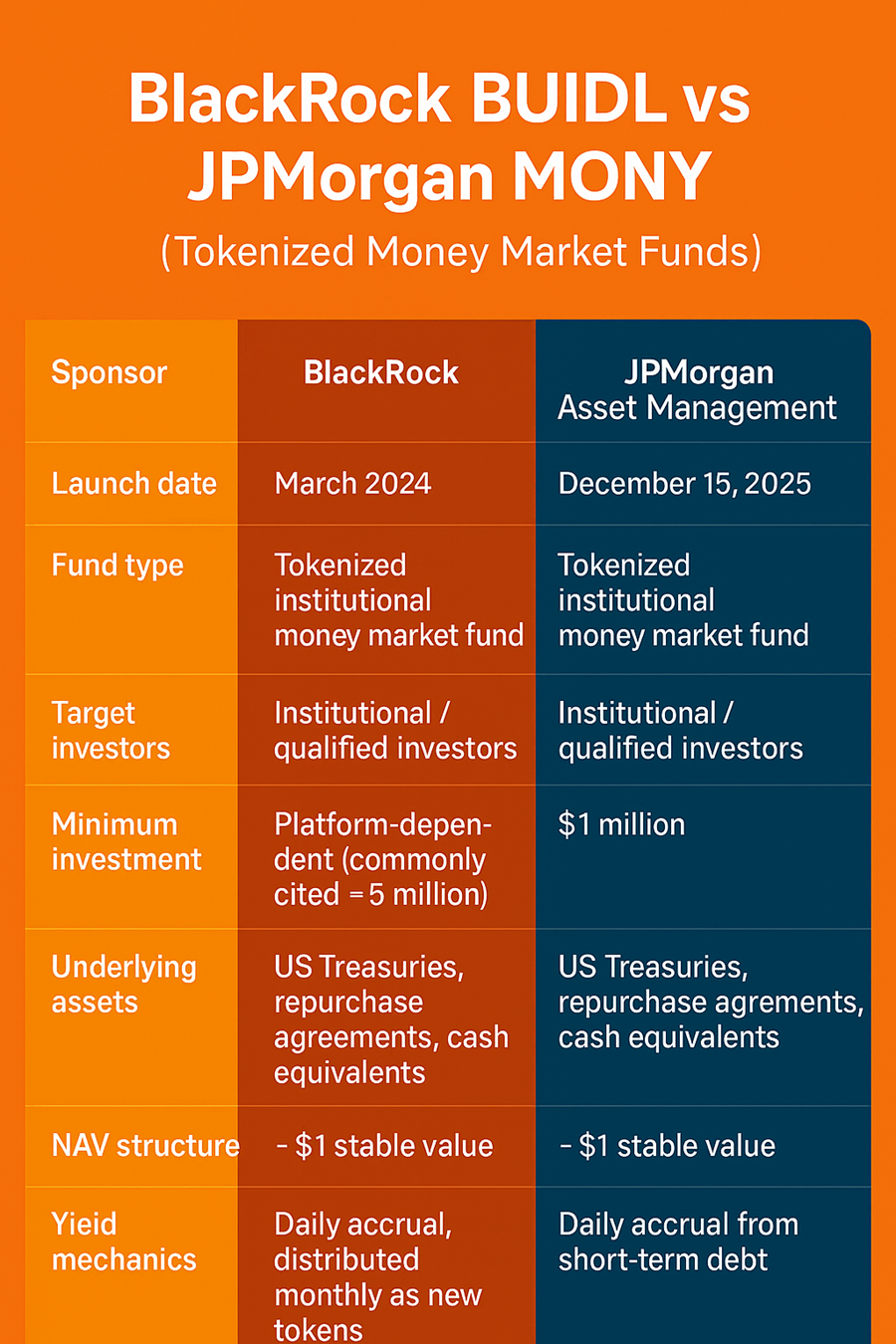
MONY is structured for institutional and high-net-worth participation only. It is open to qualified investors, including individuals with at least $5 million in investable assets and institutions with a minimum of $25 million, as well as a $1 million investment minimum.

Investors receive digital tokens representing their fund interests, bringing traditional money-market exposure onto blockchain rails while preserving familiar yield dynamics.

According to the report, JPMorgan executives attribute client demand as the driving force behind the launch.

“There is a massive amount of interest from clients around tokenization,” read an excerpt in the report, citing John Donohue, head of global liquidity at JPMorgan Asset Management.

He added that the firm expects to be a leader in the space by offering blockchain-based equivalents to traditional money-market products.

The launch comes amid accelerating momentum for tokenized assets on Wall Street, following the passage of the GENIUS Act earlier this year.

The legislation established a US regulatory framework for stablecoins and is widely viewed as a catalyst for broader tokenization efforts across funds, bonds, and real-world assets.

Since then, major financial institutions have moved quickly to explore blockchain as core market infrastructure rather than a peripheral experiment.

For Ethereum, JPMorgan’s decision to deploy MONY on its network is being read as a meaningful institutional endorsement. Fundstrat co-founder Tom Lee reacted to the news by calling it “bullish for ETH.”

This is bullish for $ETH https://t.co/LdGMHYKM9P

— Thomas (Tom) Lee (not drummer) FSInsight.com (@fundstrat) December 15, 2025

This comment highlights how products like MONY expand Ethereum’s real-world utility through transaction activity, smart contract execution, and deeper integration into global finance.

Crypto commentators echoed the sentiment, with some arguing that Ethereum’s role as the settlement layer for regulated financial products is becoming increasingly difficult to ignore.

JPMorgan vs. BlackRock: Tokenized Money Market Funds Signal a New Era in Finance

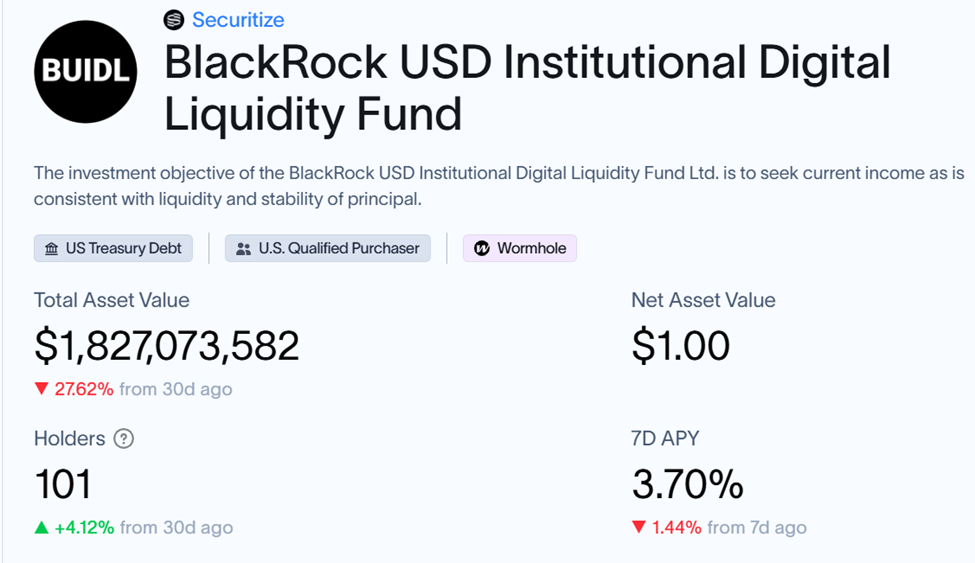
JPMorgan’s move also invites comparisons with BlackRock’s tokenized money market fund, BUIDL, which has grown to roughly $1.83 billion in assets under management, according to public blockchain data.

BlackRock’s Money Market Fund (BUIDL)
BlackRock’s Money Market Fund (BUIDL). Source: Rwa.xyz

Like MONY, BUIDL invests in short-term US Treasuries, repurchase agreements, and cash equivalents. However, it follows a multi-chain strategy and is administered through a different tokenization partner.

Together, the two funds highlight a broader trend that traditional finance (TradFi) firms are converging on blockchain to modernize low-risk, yield-bearing products.

More broadly, analysts view tokenization as a means for traditional money market funds to remain competitive with stablecoins, while unlocking new use cases such as on-chain settlement, programmability, and enhanced transferability.

JPMorgan has already experimented with tokenized deposits, private equity funds, and institutional payment tokens, suggesting that MONY is part of a longer-term strategy rather than a standalone pilot.

As regulatory clarity improves and institutional participation deepens, JPMorgan’s Ethereum-based fund reinforces the narrative that blockchain, once seen as niche, is steadily becoming an integral part of the operating system of modern finance.

For Ethereum, that shift may prove to be one of the most consequential signals yet.

Chart of the Day

BlackRock’s BUIDL vs JPMorgan’s MONY Tokenized Money Market Fund

Byte-Sized Alpha

Here’s a summary of more US crypto news to follow today:

Crypto Equities Pre-Market Overview

CompanyAt the Close of December 12Pre-Market Overview
Strategy (MSTR)$176.45$176.75 (+0.17%)
Coinbase (COIN)$267.46$268.40 (+0.35%)
Galaxy Digital Holdings (GLXY)$26.75$26.75 (0.00%)
MARA Holdings (MARA)$11.52$11.56 (+0.35%)
Riot Platforms (RIOT)$15.30$15.31 (+0.065%)
Core Scientific (CORZ)$16.53$16.65 (+0.73%)
Crypto equities market open race: Google Finance

The post Tom Lee Spots a Big Ethereum Signal in JPMorgan’s Tokenization Push| US Crypto News appeared first on BeInCrypto.

  •  

Why Stablecoin Market Caps Keep Rising but the Crypto Market Isn’t Exploding

Stablecoin issuers continue to mint new tokens such as USDT and USDC. This expansion is often compared to the spark that ignites major market rallies. However, data shows that the market caps of leading stablecoins have increased for months while the broader crypto market has not grown proportionally.

The following report outlines several reasons behind this mismatch, based on recent data and industry analyses.

3 Reasons Behind the Decoupling Between Stablecoin Growth and the Crypto Market

CoinGecko data shows that the market caps of USDT and USDC reached new highs in December, at $185 billion and $78 billion, respectively.

Both stablecoins have experienced steady growth since the start of the year. By December, Circle and Tether continued to issue aggressively. The latest report from on-chain tracker Lookonchain noted that Tether minted $1 billion and Circle added another $500 million.

Analysts often describe this capital as “dry powder” for the market. Yet the question remains: where has it actually gone?

More Stablecoins Flow Into Derivatives Exchanges Than Spot Exchanges

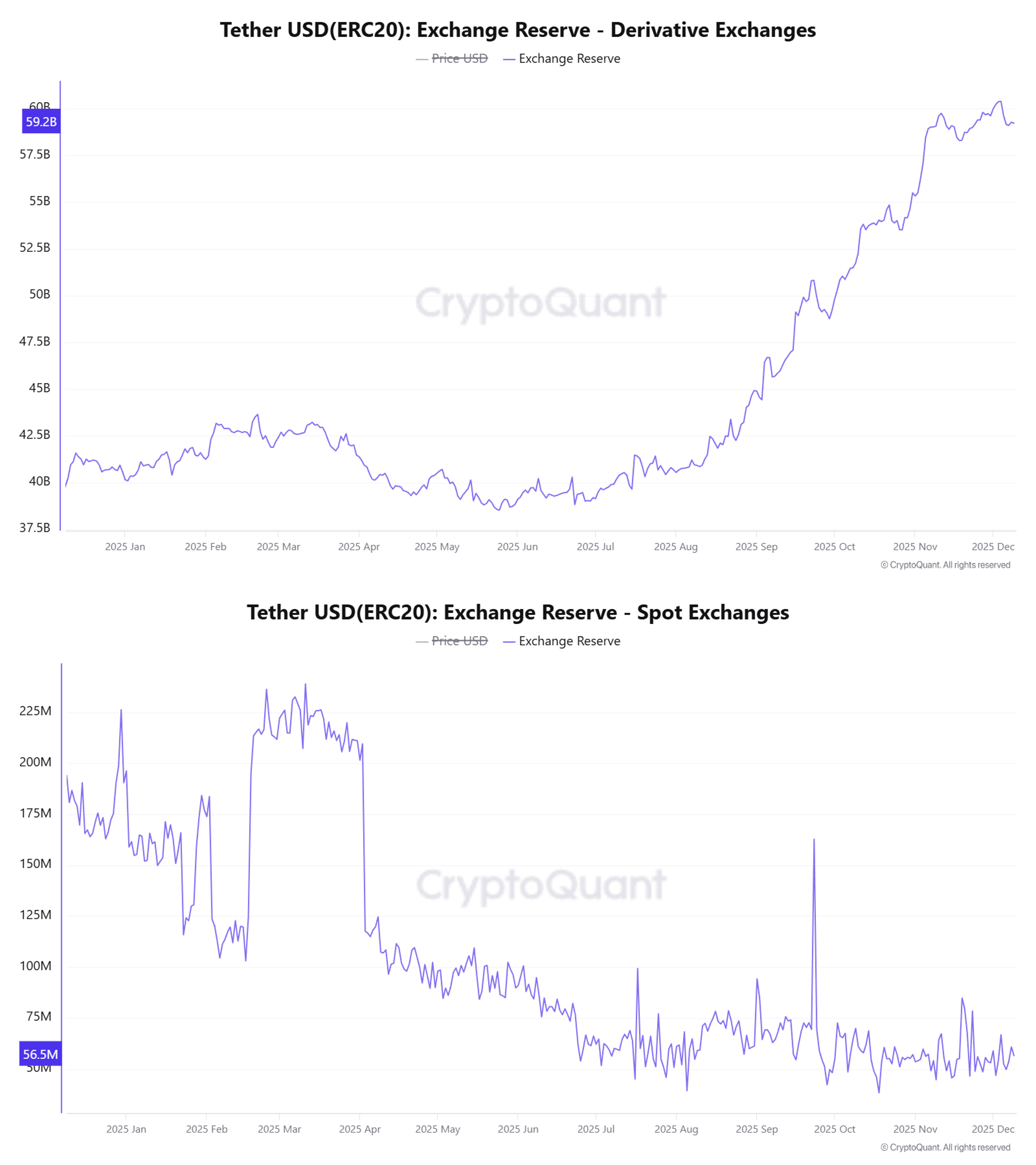
CryptoQuant data indicate that USDT (ERC-20) on derivatives exchanges has increased consistently since early 2025, rising from below $40 billion to nearly $60 billion.

Meanwhile, USDT (ERC-20) on spot exchanges has been trending downward. It currently sits near yearly lows.

Tether (ERC-20) Exchange Reserve. Source: CryptoQuant.

USDC on spot exchanges has also dropped sharply in recent months, falling from $6 billion to $3 billion.

This data reflects a shift in trader behavior. Many prefer short-term opportunities with leverage rather than long-term spot accumulation. This shift makes it harder for altcoin prices to gain upward momentum.

Leveraged trading also introduces higher risk. It delivers fast profits but can erase capital just as quickly. Multiple billion-dollar liquidation events in 2025 illustrate this ongoing trend.

Stablecoins Now Serve Many Purposes Beyond Crypto Investing

Another reason stems from the broader utility of stablecoins. The issuance by Tether and Circle does not solely reflect internal demand for cryptocurrencies. It also reflects demand from the global finance ecosystem.

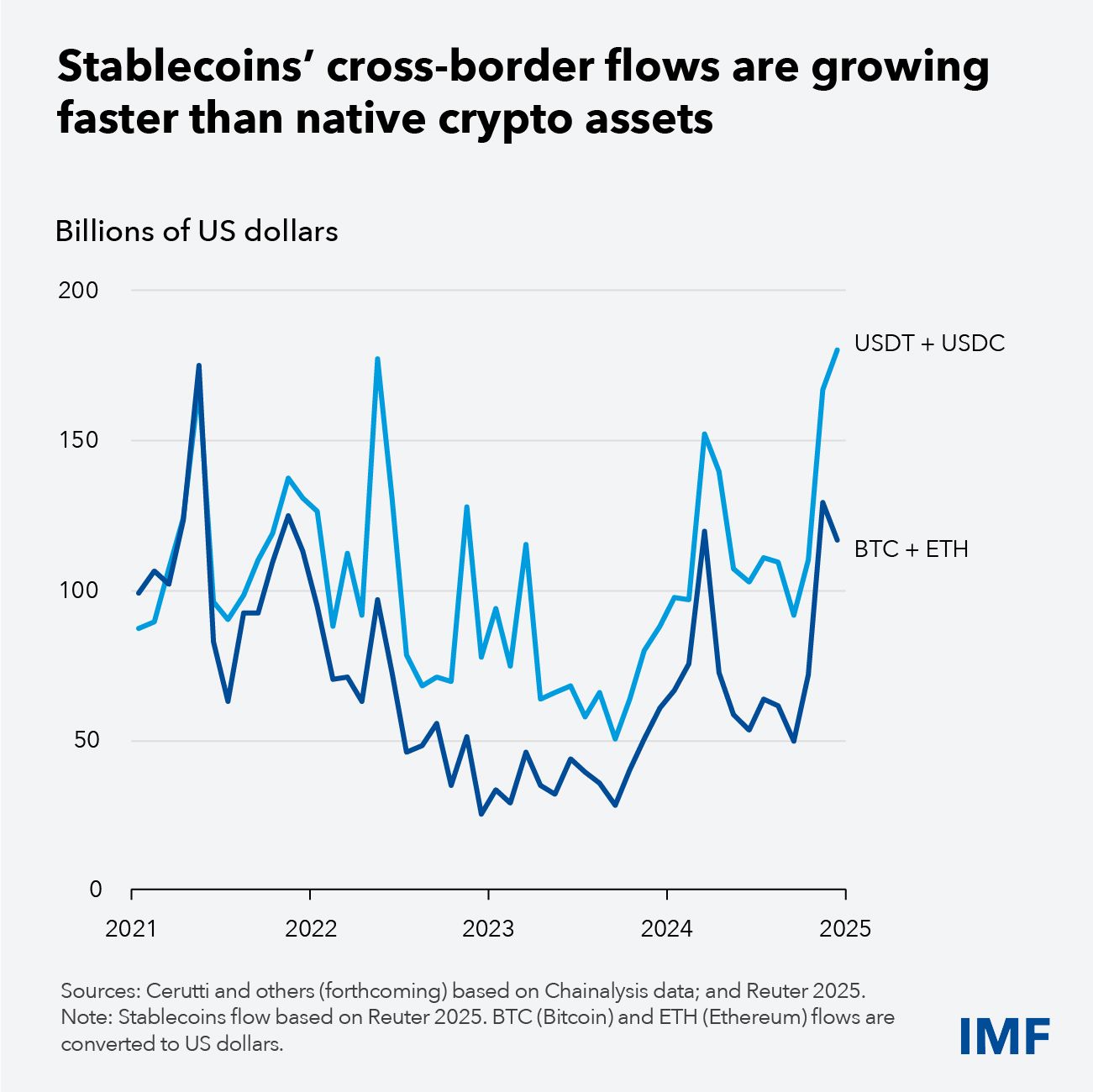
A new IMF report highlights the widespread use of stablecoins such as USDT for cross-border remittances.

Stablecoins' Cross-border Flows. Source: IMF
Stablecoins’ Cross-border Flows. Source: IMF

The chart shows that cross-border flows involving USDT and USDC reached approximately $170 billion in 2025.

“Stablecoins could enable faster and cheaper payments, particularly across borders and for remittances, where traditional systems are often slow and costly,” the IMF noted.

As a result, even though supply increases, a substantial portion of capital is absorbed into real-world applications rather than speculation.

Investor Caution Slows Capital Rotation

A third factor is cautious investor sentiment.

A recent Matrixport report describes the current market conditions as lacking retail participation and exhibiting low trading volume. Sentiment indicators remain in “fear” and “extreme fear” territory.

“Simply put, without volume, enthusiasm cannot compound, and without enthusiasm, volume will not return, a classic crypto chicken-and-egg standoff,” Matrixport reported.

This sentiment pushes investors to hold stablecoins instead of deploying them into Bitcoin or altcoins.

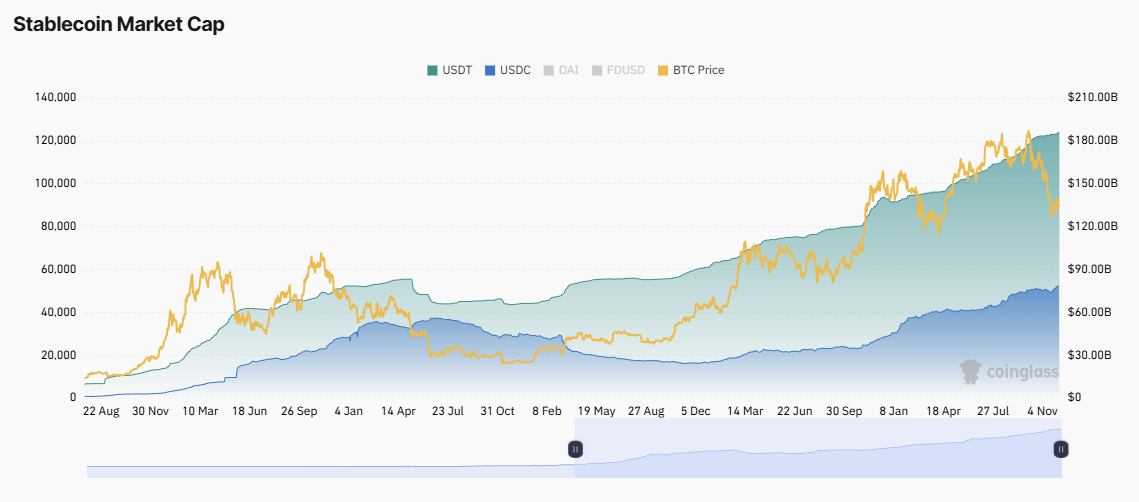
Stablecoin Market Cap. Source: Coinglass

Historical data reinforces this view. A comparison of Bitcoin’s price and the market caps of USDT and USDC reveals that, in the first half of 2022, stablecoin supply continued to rise even after the market had entered a bear phase. In late 2022, stablecoin supply dropped sharply as many investors exited the market.

An increase in stablecoin market caps does not automatically translate into higher Bitcoin or altcoin prices. The impact depends heavily on investor sentiment, capital flows, and the broader use cases driving stablecoin demand.

The post Why Stablecoin Market Caps Keep Rising but the Crypto Market Isn’t Exploding appeared first on BeInCrypto.

  •  

House Report Alleges Trump Administration Tied US Policy to $11.6 Billion Crypto Empire

A congressional report alleges that the Trump administration generated over $800 million from cryptocurrency ventures in early 2025.

The report claims total Trump family crypto holdings climbed to $11.6 billion, alleging that foreign actors and state-linked entities invested in family projects in exchange for policy favors.

Crypto Ventures and Foreign Investment

On November 25, 2025, House Judiciary Committee Democrats released these findings. They allege that President Trump used his position to increase his family’s crypto interests while reducing enforcement and halting federal investigations into the industry.

The report from Rep. Jamie Raskin describes the Trump family’s accumulation of billions through crypto schemes driven by foreign investments and regulatory changes.

Trump family projects included World Liberty Financial (WLF), the WLFI governance token, the USD1 stablecoin, and the TRUMP meme coin. These ventures attracted substantial investments from foreign nationals and entities linked to foreign governments.

Allegedly:

  • The WLFI token sale raised $550 million in March 2025,
  • The USD1 stablecoin reached a $2.7 billion market cap.
  • TRUMP meme coin brought in $350 million in trading fees and reached a peak price of $75 before a sharp decline.

World Liberty Financial was co-founded by Eric Trump, Donald Trump Jr., and Barron Trump, along with business partners Zach and Andrew Witkoff, according to documents from the House Financial Services Committee.

Foreign investors included Justin Sun, founder of Tron, who invested $30 million in late 2024 and later expanded his stake to $75 million, becoming the largest shareholder.

We are thrilled to invest $30 million in World Liberty Financial @worldlibertyfi as its largest investor. The U.S. is becoming the blockchain hub, and Bitcoin owes it to @realDonaldTrump! TRON is committed to making America great again and leading innovation. Let's go! pic.twitter.com/cISTsVYP1f

— H.E. Justin Sun 👨‍🚀 🌞 (@justinsuntron) November 25, 2024

Other major investors, allegedly connected to Chinese state-backed entities and the UAE royal family, were Guren Bobby Zhou, Aqua 1, MGX, and DWF Labs.

The investigation identified Chinese state-owned CNPC and UAE entities, including those linked to Sheikh Tahnoon, as key contributors to Trump’s ventures.

The report outlines a pay-for-access scheme involving the TRUMP meme coin dinner contest, which raised $148 million.

Top buyers were given access to White House meetings and golf courses, with several winners being foreign nationals. In addition, Trump Media & Technology Group revealed a $2.5 billion bitcoin treasury, deepening the family’s ties to cryptocurrency holdings.

Regulatory Rollbacks and Enforcement Actions

The Trump administration enacted major regulatory shifts on digital assets. In January 2025, President Trump repealed Executive Order 14178, a major Biden-era policy.

By March, a Strategic Crypto Reserve was created, marking a significant change in how the federal government approached cryptocurrency.

In April 2025, the Department of Justice disbanded the National Cryptocurrency Enforcement Team (NCET). Deputy Attorney General Todd Blanche issued an official memorandum ordering the immediate dissolution of this specialized unit.

This act ended “regulation by prosecution” in crypto enforcement. The Computer Crime and Intellectual Property Section remained in operation, but the dedicated enforcement team was eliminated.

Lawsuits and enforcement actions by the SEC and DOJ targeting major crypto firms with political connections were halted. Benefiting companies included Coinbase, Gemini, Robinhood, Ripple, Crypto.com, Uniswap, Yuga Labs, and Kraken.

In February 2025, the SEC ruled that meme coins are not securities, ending oversight for these digital assets.

The administration also pardoned individuals with ties to Trump crypto projects. Changpeng Zhao (CZ), the founder of Binance, received a presidential pardon after starting business relationships with the Trump family companies.

According to the report, these pardons and sanctions rollbacks directly benefited supporters of Trump ventures.

Constitutional and Legal Concerns

Congressional investigators warn that the situation exposes deep flaws in US anti-corruption, campaign finance, and conflict-of-interest laws.

The report questions whether the Foreign Emoluments Clause, which bars federal officials from taking gifts or payments from foreign governments without congressional approval, was violated.

Lawmakers argue that existing laws cannot adequately prevent conflicts of interest and foreign influence in the crypto sector.

The sequence of policy changes and business initiatives raised alarm among investigators. World Liberty Financial announced the USD1 stablecoin just after Trump endorsed the GENIUS Act, a major piece of stablecoin legislation expedited through Congress in 2025.

The full staff report includes a timeline showing policy rollbacks, access, and investment events.

The investigation relied on reporting from TradFi and crypto outlets to verify reported numbers and policy actions.

It documents how prior opposition to crypto shifted to active industry support as money entered campaign and family business channels during and after the 2024 campaign.

Possible second order effects from Trump's win:

• BTC becomes a US strategic reserve asset
• New regulatory regime will make it much easier for tokens to capture value from their protocols
• Token classification framework could shift from "most tokens are securities" to… pic.twitter.com/Yar5Lk1yuG

— Aylo (@alpha_pls) November 6, 2024

House Judiciary Committee Democrats called for urgent congressional reforms, citing an unprecedented scale of self-enrichment and foreign influence through cryptocurrency.

The report stresses national security, legal, and ethical risks caused by foreign and corporate money bypassing anti-corruption protections.

It remains unclear if these allegations will result in new laws or further investigations as political debates continue.

The post House Report Alleges Trump Administration Tied US Policy to $11.6 Billion Crypto Empire appeared first on BeInCrypto.
  •  

MicroStrategy and BitMine Strike Together — Tom Lee Says the Mania Awaits

Two of the largest corporate players in cryptocurrency, MicroStrategy and BitMine, have just escalated a quiet accumulation war. One is doubling down on Bitcoin, the other is expanding its grip on Ethereum.

While each move looked routine at first glance, the scale and timing reveal something far more consequential building beneath the surface.

MicroStrategy Accelerates Bitcoin Buying as Pressure Mounts

MicroStrategy snapped up 8,178 BTC last week for roughly $835.6 million at an average price of $102,171 per coin. The firm now holds 649,870 BTC, acquired for $48.37 billion at an average cost basis of $74,433, according to a confirmed update shared by Michael Saylor and Strategy Inc.

Strategy has acquired 8,178 BTC for ~$835.6 million at ~$102,171 per bitcoin and has achieved BTC Yield of 27.8% YTD 2025. As of 11/16/2025, we hodl 649,870 $BTC acquired for ~$48.37 billion at ~$74,433 per bitcoin. $MSTR $STRC $STRD $STRE $STRF $STRK https://t.co/HI1TeYOvQ9

— Michael Saylor (@saylor) November 17, 2025

The aggressive move comes just days after Saylor promised that the market would be pleasantly surprised.

“We’re buying quite a lot… people will be pleasantly surprised.” He added that Strategy is “always buying” and now controls 3.1% of the Bitcoin network.

While MicroStrategy’s BTC yield for 2025 stands at 27.8%, the purchase sparked an immediate wave of commentary and controversy.

Lookonchain verified that the company sits on $12.88 billion in unrealized profit (+27%), even after the latest dip. But the crypto community remains split. On one side, analysts argue that MicroStrategy’s structure is sound.

“Even if BTC drops -70%, Saylor still won’t have to sell… There’s no margin call,” analyst Miles Deutscher noted.

Jeff Dorman added that concerns about forced selling are “not even remotely a concern,” citing low interest expense, positive cash flow, and Saylor’s 42% ownership, which prevents activist intervention.

On the other hand, critics like goldbug Peter Schiff argue that the strategy is fragile, with Dom Kwok, a popular user on X, echoing the sentiment.

“MSTR will be forced to sell its BTC to make interest payments… it’s sell bitcoin or bust,” he claimed.

Even market watchers questioned the rollout. Analyst AB Kuai Dong highlighted that Strategy posted, then deleted, its announcement within minutes, calling it “amateurish,” and noting that MSTR fell 3% in pre-market despite the bullish purchase.

BitMine’s Ethereum Grab Signals a Corporate Race for Treasury Dominance

As MicroStrategy expands its Bitcoin empire, Tom Lee’s BitMine is executing a parallel strategy on Ethereum, but at an even larger scale. BitMine now holds almost 3.6 million ETH tokens, representing 2.9% of the total supply, according to its official November update. The firm purchased 54,156 ETH in a single week.

🧵
BitMine provided its latest holdings update for Nov 17th, 2025:

$11.8 billion in total crypto + "moonshots":
-3,,559,879 ETH at $3,120 per ETH (Bloomberg)
– 192 Bitcoin (BTC)
– $37 million stake in Eightco Holdings (NASDAQ: ORBS) (“moonshots”) and
– unencumbered cash of…

— Bitmine (NYSE-BMNR) $ETH (@BitMNR) November 17, 2025

At current valuations, the company holds $11.8 billion in a combined mix of crypto, cash, and “moonshot” investments, including 3,559,879 ETH, 192 BTC, $607 million in cash, and strategic equity positions.

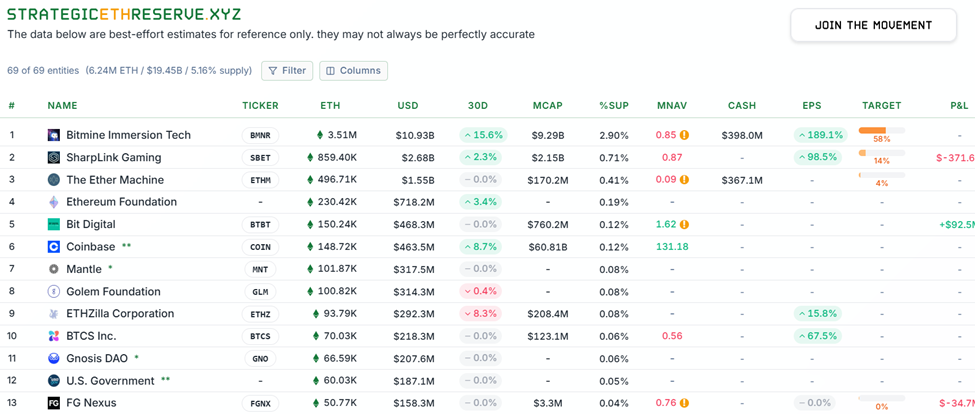
Fundstrat data, corroborated by the StrategicETHReserve.xyz dashboard, confirms BitMine is now the leading Ethereum treasury globally and the second crypto treasury overall, behind MicroStrategy.

Corporate ETH Reserves
Corporate ETH Reserves. Source: StrategicETHReserve.xyz

In his November message, Lee argued that the crypto cycle peak is still 12–36 months away, breaking from traditional four-year expectations. He said the recent weakness reflects a market maker undergoing balance sheet stress, a temporary form of “QT” for the crypto ecosystem.

“Crypto prices have not recovered since the liquidation event on October 10… The lingering weakness has the hallmarks of a market maker suffering from a crippled balance sheet,” read an excerpt in the announcement, citing Lee.

He added that tokenization on Ethereum is a “major unlock” and compared current regulatory moves, such as the GENIUS Act and the SEC’s Project Crypto, to 1971’s end of the Bretton Woods era.

BitMine’s stock reflects rising institutional attention, with trading volume of $1.4 billion per day, ranking 48th in the US, ahead of DoorDash.

Together, MicroStrategy’s BTC build and BitMine’s ETH accumulation mark the clearest trend of 2025, that crypto is becoming a battlefield for corporate treasuries.

With Saylor targeting deeper Bitcoin control and BitMine pushing toward the “Alchemy of 5%,” the market may be entering its first true multi-chain corporate accumulation era, one driven not by retail cycles, but by balance sheets, liquidity channels, and long-duration conviction.

The post MicroStrategy and BitMine Strike Together — Tom Lee Says the Mania Awaits appeared first on BeInCrypto.

  •