Reading view

Japan Tightens, America Eases: Which Central Bank Really Moves Markets Now? | US Crypto News

Welcome to the US Crypto News Morning Briefing—your essential rundown of the most important developments in crypto for the day ahead.

Grab a coffee because today’s Morning Briefing isn’t just about interest rates. It’s about leverage, funding, and which side of the Pacific really sets the rhythm for risk assets when the policy paths split. As one central bank eases (the US), the other tightens (Japan). The tension between the two is beginning to reshape global liquidity in ways that don’t show up in a single chart or price candle.

Crypto News of the Day: Japan Raises Interest Rates, But the Fed Cuts, Which Side Has A Stronger Impact?

Global markets are at an impasse, amid a rare and consequential policy divergence. On the one hand, the US Federal Reserve has begun cutting interest rates to support slowing growth. In contrast, the Bank of Japan (BOJ) is moving in the opposite direction, raising rates to levels not seen in three decades.

The question facing investors is no longer whether these moves matter, but which one ultimately carries more weight for global liquidity, currencies, and crypto markets.

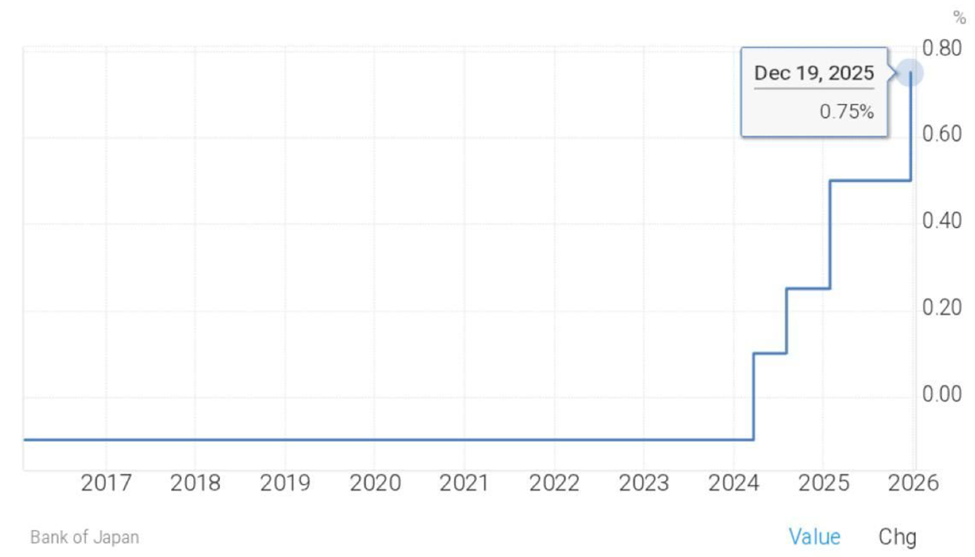
On December 19, the BOJ raised its policy rate by 25 basis points to 0.75%, the highest level since 1995. This marks another step away from decades of ultra-loose monetary policy. Macro analysts see the move as more than a routine adjustment.

🚨 BREAKING: 🇯🇵 BOJ DELIVERS THE HIKE

Rates raised 25 bps to 0.75%, marking a 30-year high.

Japan’s era of ultra-easy money keeps fading.

This is a major global LIQUIDITY shift… watch yen and risk assets closely. 👀 pic.twitter.com/vfciRH84WJ

— Wise Advice (@wiseadvicesumit) December 19, 2025

Unlike the Federal Reserve’s rate cuts, which are cyclical and designed to smooth economic slowdowns, Japan’s tightening is structural. For nearly 30 years, near-zero Japanese rates anchored one of the world’s most important sources of cheap leverage.

Even modest increases now carry outsized consequences because they disrupt funding strategies deeply embedded across global markets.

The immediate impact was most visible in currency markets. Despite the historic hike, the yen initially weakened as Governor Kazuo Ueda offered limited clarity on the pace of future tightening.

Reuters noted that the currency slipped as the BOJ “stays vague on tightening path.” This highlights how forward guidance, not just the hike itself, remains critical.

Still, analysts argue the real transmission channel lies elsewhere: the yen carry trade, as reported in a recent US Crypto News publication.

As Japanese yields rise and the US–Japan rate gap narrows, borrowing yen to fund higher-yielding positions becomes increasingly expensive.

Fed cut rates, but the message mattered more than the cut. Their dot plot now shows fewer cuts ahead. That flipped expectations from “easy money coming” to “higher for longer.” At the same time, BOJ hike expectations strengthened the yen → yen carry trades started unwinding →… pic.twitter.com/eSaJLWQajg

— Dmytro V7 🇺🇦 (@V7Dmytro) December 16, 2025

This is where the divergence between Tokyo and Washington becomes critical:

  • Fed cuts tend to support markets gradually by easing credit conditions.
  • BOJ tightening, by contrast, forces immediate repositioning as leverage costs rise.

Crypto markets have historically experienced this impact more quickly than traditional assets. Previous BOJ tightening cycles coincided with sharp Bitcoin drawdowns of 20–30% as liquidity tightened and carry trades unwound.

THE BANK OF JAPAN MIGHT BE BITCOIN’S BIGGEST ENEMY

Japan holds the most US debt.
Every time they hike, Bitcoin bleeds:

March 2024: -23%
July 2024: -30%
Jan 2025: -31%

Next hike: Dec 19
Next move: loading…

If the pattern repeats, $70K is in play. pic.twitter.com/R5916R702I

— Merlijn The Trader (@MerlijnTrader) December 14, 2025

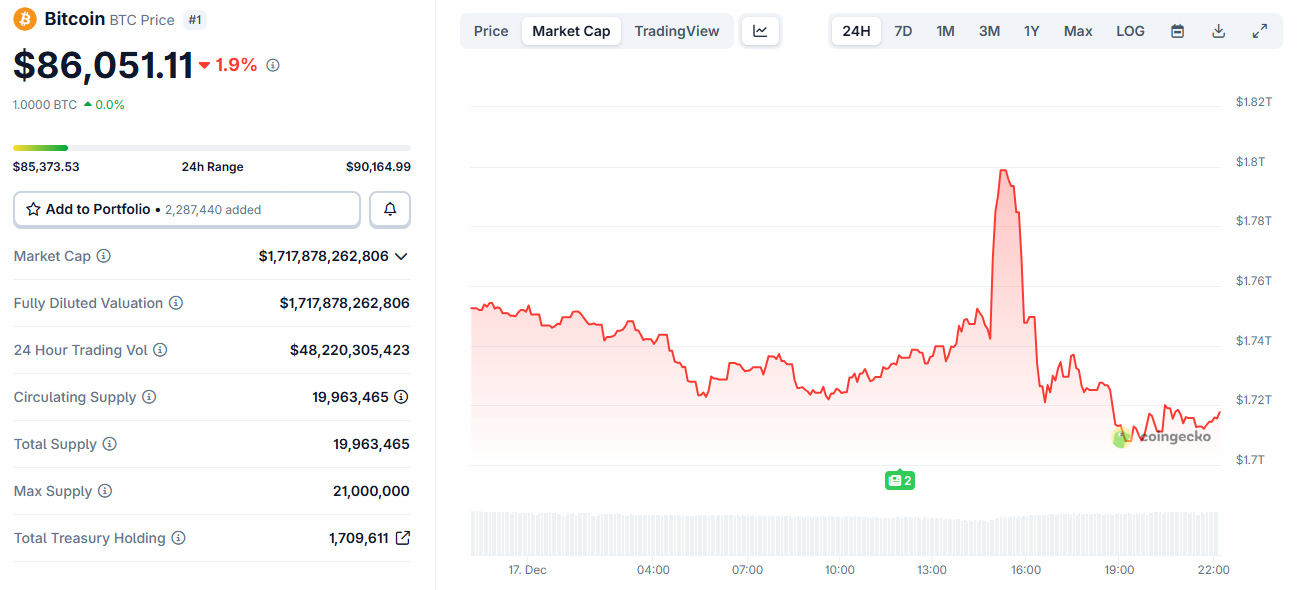
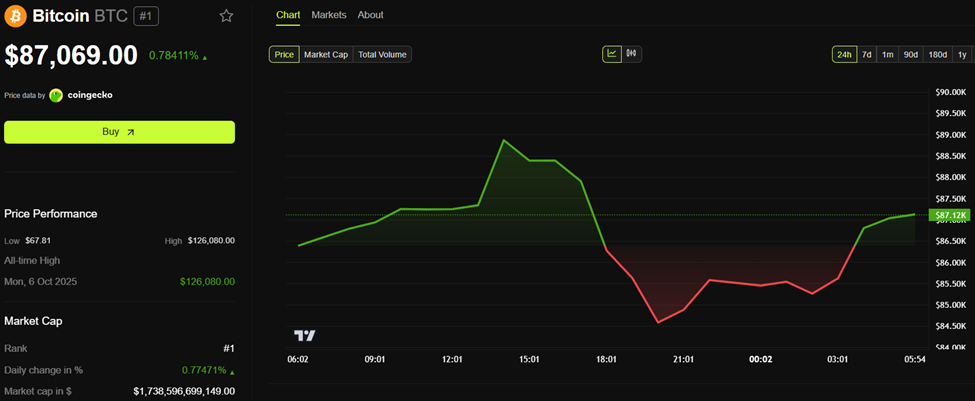
That pattern has made Bitcoin’s recent stability stand out. As of this writing, BTC was trading for $88,035, up by almost 1% in the last 24 hours.
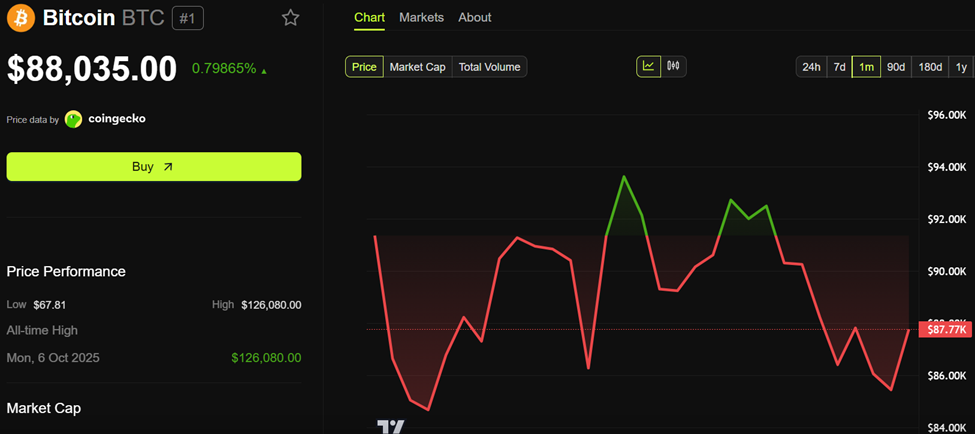
Bitcoin (BTC) Price Performance. Source: BeInCrypto

“History shows every prior tightening triggered 20–30% Bitcoin drops as yen carry trades unwound and liquidity tightened. Yet with the hike fully priced in and BTC holding around $85k–$87k, this could be the dip buyers have been waiting for,” wrote analyst Blueblock.

However, resilience at the top of the crypto market does not eliminate risk elsewhere. Altcoins, which are far more sensitive to liquidity conditions, remain exposed if Japanese tightening continues.

Indeed, BOJ officials have openly signaled willingness to keep tightening if wage growth and inflation remain durable. Analysts at ING and Bloomberg have warned that while further hikes may not be imminent, the direction of travel is clear.

The implication for global markets is stark. Fed cuts may provide broad support over time, but Japan’s retreat from ultra-easy policy strikes directly at the foundation of global leverage.If the BOJ continues down this path, its influence on liquidity, currencies, and crypto could outweigh US easing, at least in the near term.

Chart of the Day
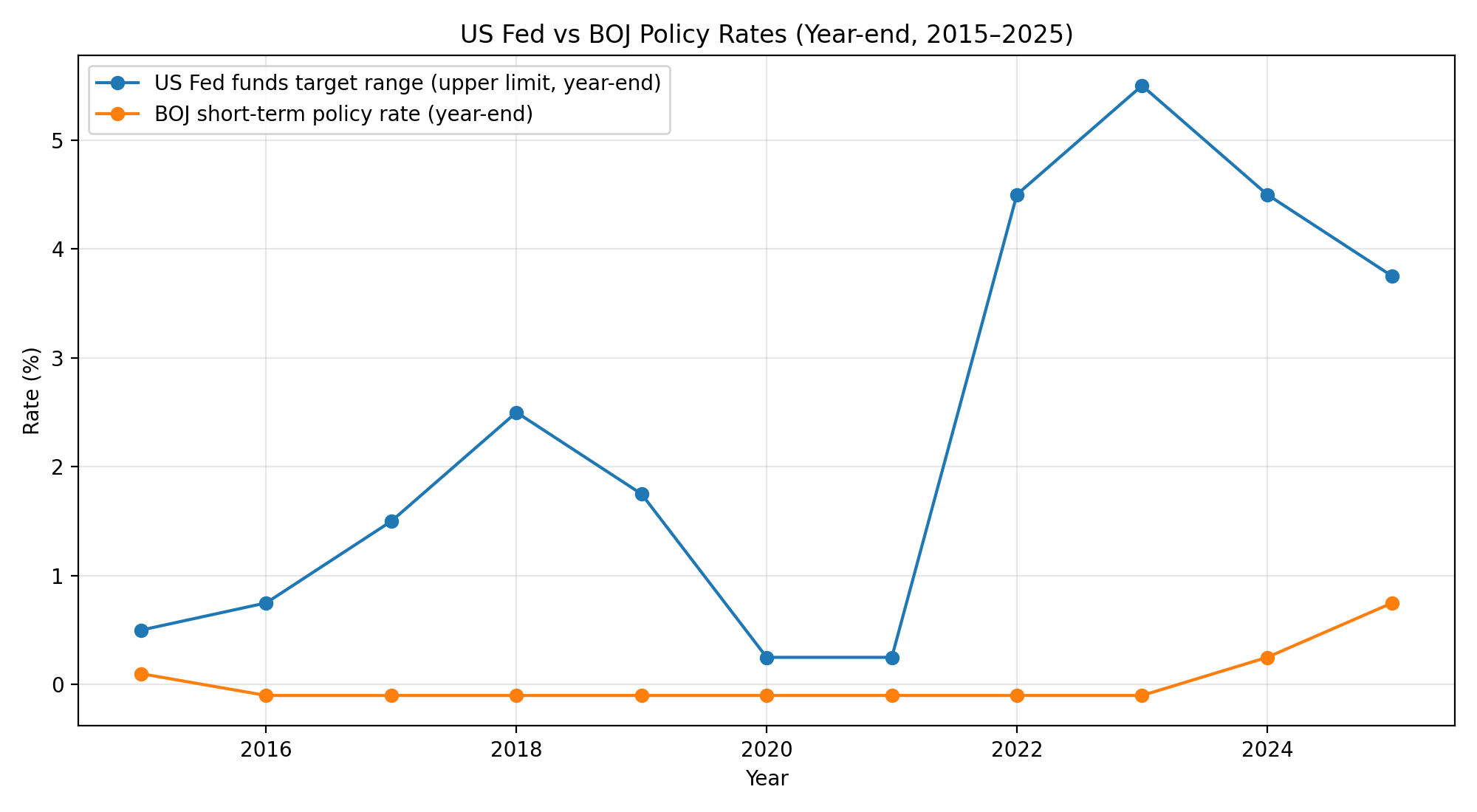
Fed Fund Rates vs BOJ Policy Rate

Byte-Sized Alpha

Here’s a summary of more US crypto news to follow today:

Crypto Equities Pre-Market Overview

CompanyAt the Close of December 18Pre-Market Overview
Strategy (MSTR)$158.24$163.97 (+3.62%)
Coinbase (COIN)$239.20$246.00 (+2.84%)
Galaxy Digital Holdings (GLXY)$22.51$22.95 (+1.95%)
MARA Holdings (MARA)$9.69$9.87 (+1.86%)
Riot Platforms (RIOT)$13.38$13.73 (+2.62%)
Core Scientific (CORZ)$14.56$15.04 (+3.30%)
Crypto equities market open race: Google Finance

The post Japan Tightens, America Eases: Which Central Bank Really Moves Markets Now? | US Crypto News appeared first on BeInCrypto.

  •  

$1 Billion by 2026? Analysts Eye Ownership Coins as Crypto’s Next Governance Game-Changer

Ownership coins are set to transform decentralized governance in 2026, with analysts forecasting that at least one project will surpass a $1 billion market cap.

Unlike current governance tokens, ownership coins combine economic, legal, and governance rights in one asset. This development could solve longstanding issues that have challenged decentralized autonomous organizations (DAOs) for years.

How Ownership Coins Differ From Traditional Governance Tokens

Traditional DAO governance tokens generally offer only voting rights, lacking real economic power or legal accountability within decentralized organizations. This limitation introduces investment risks and weakens the goal of truly decentralized governance.

Ownership coins offer a major shift in design. According to research from Galaxy Digital, these tokens unite economic, legal, and governance rights within a legally enforceable digital asset. This integrated approach aims to fix accountability issues that have affected DAOs since their start.

Galaxy Digital describes this model as creating “digital companies” in which onchain governance holds legal weight rather than relying only on social consensus.

Token holders thus gain meaningful and enforceable control over digital organizations with tangible assets. This innovation creates a path toward legally recognized, self-governed on-chain entities.

MetaDAO was among the first to use this framework, applying futarchy principles, a governance system using prediction markets instead of direct votes.

The project launched on Solana in November 2023, guiding decisions with trading in prediction markets rather than traditional voting methods.

Messari Report Identifies AVICI as Top Performer

The Messari Theses report positions ownership coins as a major investment opportunity for 2026. It spotlights AVICI as the biggest winner over the past year, highlighting the sector’s growth prospects.

We are so back!

The Messari Theses for 2026 is live and available for free.

Jump into the full report now ⬇️ pic.twitter.com/HA3za2QktZ

— Messari (@MessariCrypto) December 18, 2025

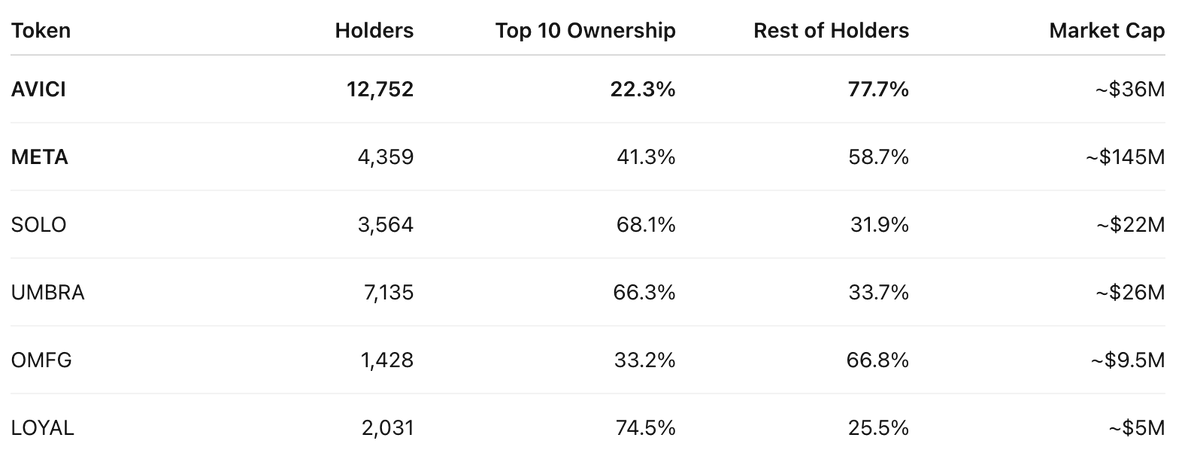
AVICI has shown strong holder retention and broad distribution, despite price volatility. As of mid-December 2025, the token counted 12,752 holders and maintained a low concentration among large holders.

Analyst crypto_iso shared that AVICI began with 4,000 holders and reached 13,300 within 45 days.

During a steep 65% price decline, AVICI lost only 600 holders, just 21% of its initial growth rate. On average, the coin added 200 holders per day at its peak and lost about 43 per day during the downturn. These numbers signal community resilience despite market fluctuation.

Yes for sure.

Here is an interesting datapoint on the holder front.$Avici is still sitting at 12.7k holders which is pretty impressive because if you think about the net number given a drawdown of 65% it's strong. I think it started with around 4k holders or so day 1 and in 45… pic.twitter.com/pTnn9pItjf

— CryptoISO (@crypto_iso) December 18, 2025
Table comparing ownership coin holder metrics
AVICI leads in holder count and distribution among ownership coins (crypto_iso)

Sector Remains Early-Stage, Offering Potential for Growth

The ownership coin market is viewed as a new frontier with substantial upside, as no project yet has exceeded a $1 billion fully diluted valuation. Many investors see this as untapped potential for significant gains.

“My biggest bet for 2026 are ownership coins. They are in early stage right now, not a single coin above 1B mcap. Opportunity right in front of you,” wrote analyst Anglio.

Much of the discourse on social media calls 2026 the “year of the ownership coin.” The blend of authentic innovation and early entry point is attracting interest from retail and institutional investors alike.

Ownership coins may solve barriers that have limited DAO growth and investment. Their legally binding onchain governance systems can let blockchain-native organizations function as true business entities.

This step could impact capital formation, investor protection, and the development of decentralized governance.

Nevertheless, this market is still in its infancy. Most ownership coin projects remain under development, and legal clarity for these hybrid entities varies across regions. Whether this innovation can fulfill the aspiration of self-governing onchain organizations will depend on successful implementation in 2026.

The post $1 Billion by 2026? Analysts Eye Ownership Coins as Crypto’s Next Governance Game-Changer appeared first on BeInCrypto.

  •  

What Does a 100% Accurate Historical Indicator Signal for Bitcoin in December?

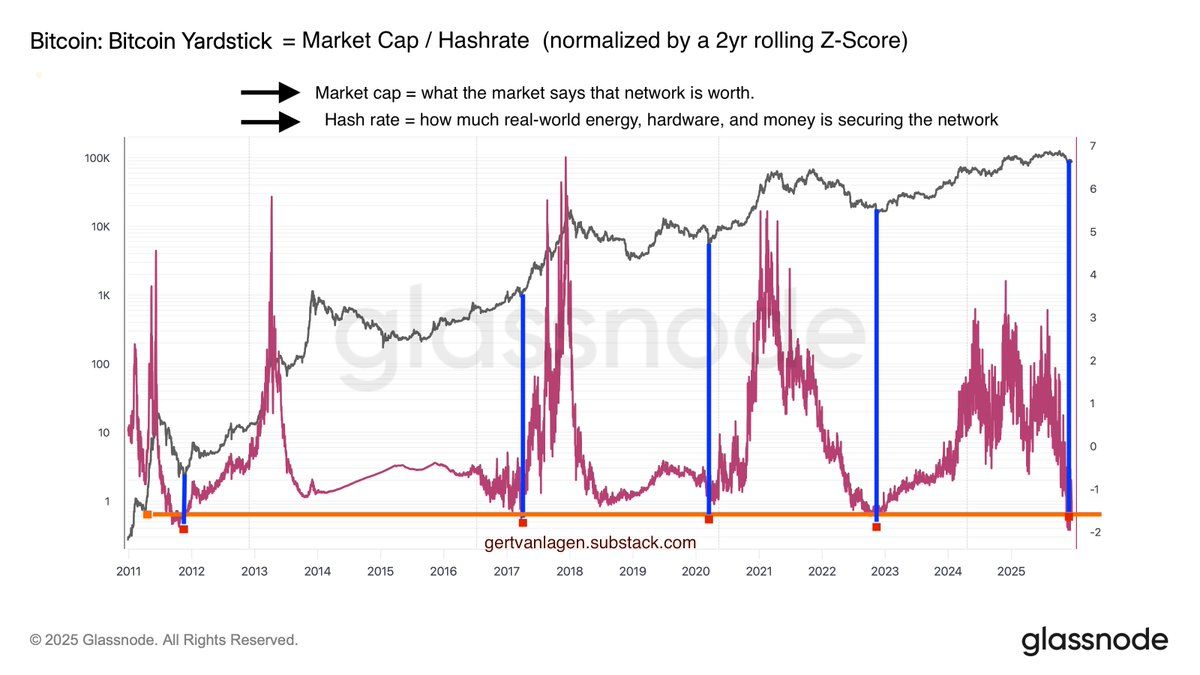
Bitcoin may be approaching one of its most pivotal turning points in years. A leading valuation metric, the BTC Yardstick, currently reads -1.6 standard deviations below its long-term mean, signaling the pioneer crypto’s deepest undervaluation since the 2022 bear market low.

Historically, this level has coincided with major cycle bottoms, including 2011, 2017, 2020, and 2022.

BTC Yardstick Shows Strongest Undervaluation in Years

The Yardstick measures Bitcoin’s market price against the cost and power required to secure its network. This includes mining infrastructure and operational expenditures.

“BTC Yardstick at –1.6σ = Bitcoin is insanely undervalued. Other occurrences: 2022 bear market low, 2020 COVID crash bottom, 2017 pre-blow-off base, 2011 bear market bottom…All occurrences coincided with strong accumulation…Bottom was in as well!” wrote analyst Gert van Lagen in a post.

BTC Yardstick indicator showing historical undervaluation signals
BTC Yardstick indicator at major market bottoms, attributed to Gert van Lagen

Whale Accumulation Hits Highest Levels in Over a Decade

Meanwhile, the undervaluation signal coincides with unprecedented accumulation activity. Over the past 30 days, BTC whales and large holders purchased 269,822 BTC, worth approximately $23.3 billion. According to Glassnode data, this is the largest monthly accumulation since 2011.

BITCOIN'S BIGGEST MONTHLY ACCUMULATION IN 13 YEARS

Whales purchased 269,822 BTC, worth approximately $23.3 billion, in just 30 days.

– Glassnode Data pic.twitter.com/6FPfhFhfh4

— Kashif Raza (@simplykashif) December 18, 2025

“Largest accumulation in 13 years. The 4-year cycle is dead; the Supercycle is here,” wrote crypto analyst Kyle Chasse.  

The bulk of this buying occurred in wallets holding between 100 and 1,000 BTC. This suggests that both high-net-worth individuals and smaller institutions are positioning for a potential market rebound.

Market Sentiment After Bitcoin’s Minor Correction As Frustration Breeds Opportunity

Despite the record accumulation and undervaluation, Bitcoin’s price has faced downward pressure this year. According to Bloomberg ETF analyst Eric Balchunas, recent losses are modest relative to prior gains.

I get that this year is a drag but consider Bitcoin was up 468%(!!) in the two years prior to this year. That's 138% ann, 8x US stocks. That is sooo much excess return beyond normalcy (even for btc, thank you ETFs!). All that happened this year is you gave back a tiny bit of the… https://t.co/oQ4EuUt64A

— Eric Balchunas (@EricBalchunas) December 18, 2025

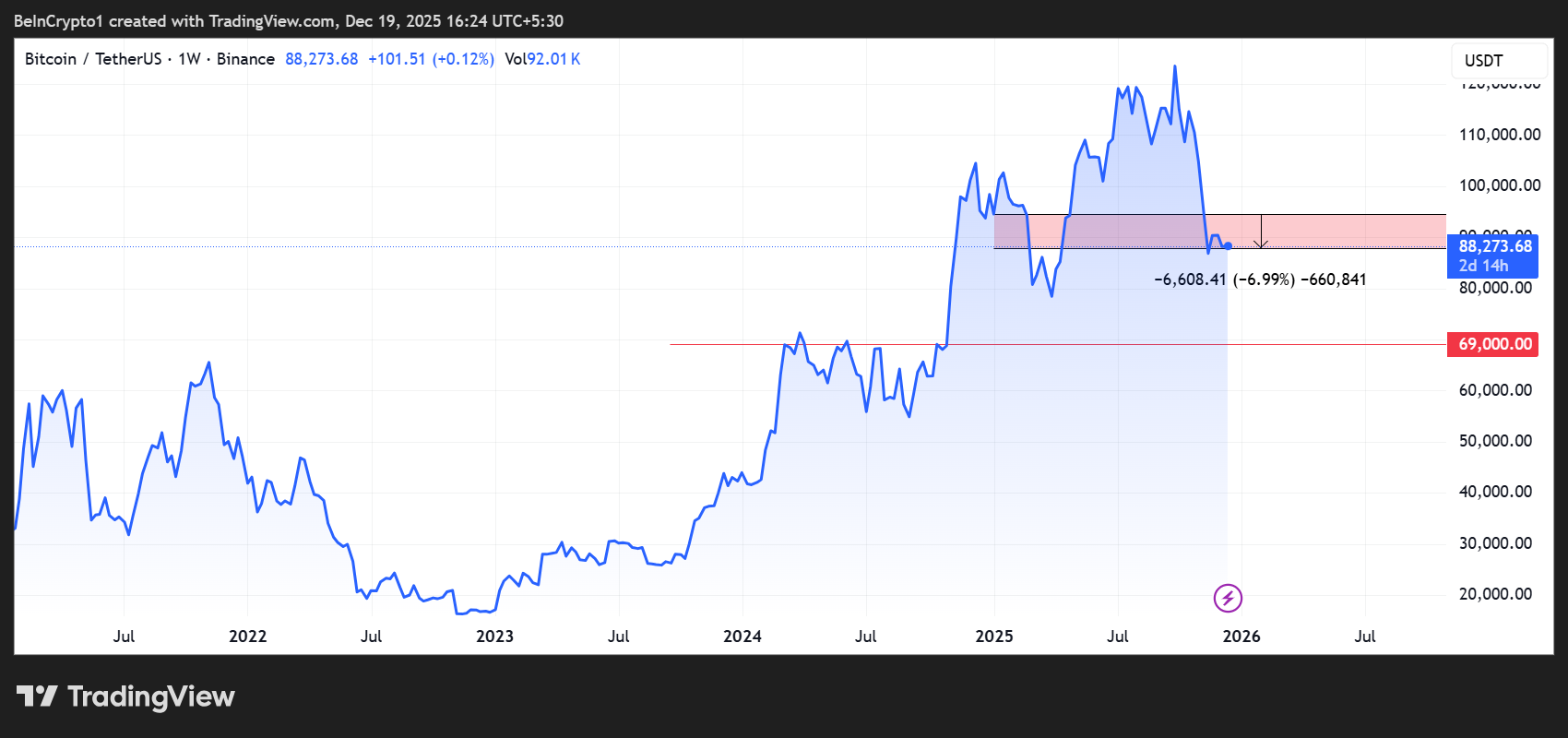
The launch of spot Bitcoin ETFs in early 2024 contributed to previous surges, driving the asset to its then-record highs near $69,000 in March 2024.

Overall, Bitcoin returned 155.42% in 2023 and 121.05% in 2024 before experiencing an 7% decline year-to-date. This suggests the current dip may be a natural correction after exceptional gains.

Bitcoin (BTC) Price Performance
Bitcoin (BTC) Price Performance. Source: TradingView

Analysts note that market rallies often begin not when hope is high, but when investors are weary.

“We are not scared anymore, we are tired. Tired of waiting. Tired of believing. But listen, market rallies don’t start when hope is high; it’s when people are tired, frustrated, and ready to give up,” wrote analyst Ash Crypto.

The convergence of historically low valuation, record whale accumulation, and declining leverage suggests that Bitcoin may be nearing another cyclical inflection point.

While timing remains uncertain, these indicators highlight a unique window of potential opportunity for long-term investors.

The post What Does a 100% Accurate Historical Indicator Signal for Bitcoin in December? appeared first on BeInCrypto.

  •  

$4 Billion Lawsuit Claims Jump Trading Helped Engineer Terraform’s Collapse

The administrator overseeing the wind-down of Terraform Labs has filed a $4 billion lawsuit against high-frequency trading firm Jump Trading. They accuse the market maker of secretly manipulating prices and contributing to the collapse of Do Kwon’s once-dominant crypto ecosystem.

It comes barely a week after the judge issued Do Kwon his sentence, a 15-year term in federal prison for orchestrating a $40 billion crypto fraud.

Terraform Labs Estate Seeks $4 Billion From Jump Trading

The complaint names Jump Trading, co-founder William DiSomma, and former head of its crypto division, Kanav Kariya. It alleges unlawful profiteering tied to the failure of TerraUSD (UST).

Citing court filings, The Wall Street Journal reports that the Terraform Labs estate claims Jump conducted undisclosed, large-scale trading interventions to prop up UST during multiple de-pegging episodes in 2021 and 2022.

Rather than stabilizing the system, the administrator argues these actions created a false sense of market confidence. In turn, this masked structural weaknesses that ultimately made Terra’s collapse more severe.

At the center of the lawsuit is the claim that Jump aggressively purchased UST whenever the algorithmic stablecoin fell below its $1 peg. These purchases allegedly inflated demand artificially, misleading market participants into believing the peg mechanism was functioning as designed.

The estate argues that Jump was not acting as a neutral liquidity provider. Instead, it exploited its market position and inside knowledge to extract profits from the volatility it helped manage.

The filing alleges that Jump earned roughly $1 billion through these strategies, benefiting from preferential token arrangements and trading advantages. Meanwhile, retail investors remained unaware of the behind-the-scenes support.

When Terra ultimately unraveled in May 2022, triggering an estimated $40 billion wipeout across UST and LUNA, the lawsuit claims the earlier illusion of stability magnified the damage.

It is worth mentioning that this is not the first time Jump Trading is linked to manipulation allegations. In October 2024, game developer FractureLabs filed a lawsuit against Jump Trading over crypto manipulation claims

“Jump then systematically liquidated its DIO holdings, generating millions of dollars in revenue for itself,” Bloomberg reported, citing an excerpt in the lawsuit.

Do Kwon’s Sentencing Puts Fresh Spotlight on Jump Trading’s Market Power

The legal action arrives amid renewed headlines of Terra’s collapse. It follows Do Kwon’s recent sentencing to 15 years in prison over fraud charges related to the project.

In the days following that ruling, some market observers publicly speculated that additional institutional players could face legal exposure, with Whale Calls citing Jump Trading.

When jump trading ? https://t.co/yowAZA1DAw

— WhaleCalls (@whalecalls) December 11, 2025

Beyond the immediate allegations, the case highlights Jump Trading’s formidable technological capabilities.

Jump Trading’s Technological Edge and Its Role in the Lawsuit

Jump is widely regarded as one of the most sophisticated high-frequency trading firms globally. Industry reporting has highlighted its willingness to spend vast sums to gain marginal speed advantages, including the acquisition of a microwave tower previously used by NATO to shave milliseconds off transatlantic trade transmission times.

In 2018, Jump also partnered with firms such as Citadel to build the “Go West” undersea fiber-optic cable, connecting Chicago and Tokyo and enabling faster access to global futures markets.

According to commentary from Colin Wu, Jump’s quote data processing capabilities are considered to be on a vastly different scale from those of many competitors. This reflects the asymmetric power that large trading firms can wield in both traditional and crypto markets.

That technological edge now forms part of the broader context of the lawsuit. While the complaint does not allege the use of illegal infrastructure, it argues that Jump’s scale and sophistication amplified the market impact of its UST trades. This raises questions about fairness, disclosure, and market integrity.

If successful, the case could have far-reaching implications. A ruling in favor of the Terraform Labs estate may establish a clearer legal boundary between legitimate market making and manipulation in crypto markets, potentially reshaping how large trading firms operate.

It could also lead to substantial financial penalties, with any recovered funds likely directed toward compensating creditors and victims of the Terra collapse.

Jump Trading has not publicly commented on the lawsuit as of the time of publication, but is expected to mount a vigorous defense.

As discovery continues, the case may offer rare insight into the opaque mechanics of crypto market making. Beyond that, it could mark a watershed moment in the industry’s ongoing reckoning with accountability.

The post $4 Billion Lawsuit Claims Jump Trading Helped Engineer Terraform’s Collapse appeared first on BeInCrypto.

  •  

BOJ Raises Interest Rates to 0.75%, But Bitcoin Stands Unshaken—Is the Crypto Calm a Warning or Opportunity?

The Bank of Japan (BOJ) raised its policy interest rate by 25 basis points to 0.75% on December 19. It marks its highest level in nearly 30 years, reinforcing the country’s gradual exit from ultra-easy monetary policy.

Yet despite the historic shift and warnings of a global liquidity squeeze, Bitcoin showed little reaction, rising just under 1% and holding in the $87,000 range.

BOJ Just Raised Interest Rates Another 25 Basis Points – Why Did Bitcoin Hold Steady?

The muted response stands in contrast to history. Previous BOJ tightening cycles have often coincided with sharp sell-offs in crypto markets, particularly as yen carry trades unwind and global liquidity tightens.

THE BANK OF JAPAN MIGHT BE BITCOIN’S BIGGEST ENEMY

Japan holds the most US debt.
Every time they hike, Bitcoin bleeds:

March 2024: -23%
July 2024: -30%
Jan 2025: -31%

Next hike: Dec 19
Next move: loading…

If the pattern repeats, $70K is in play. pic.twitter.com/R5916R702I

— Merlijn The Trader (@MerlijnTrader) December 14, 2025

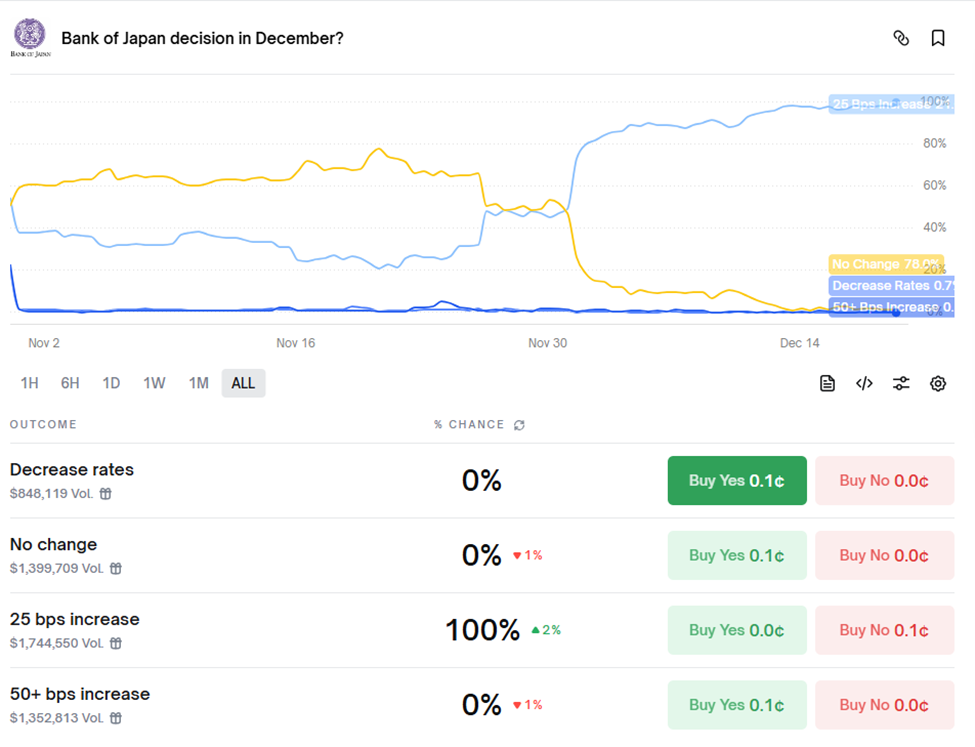
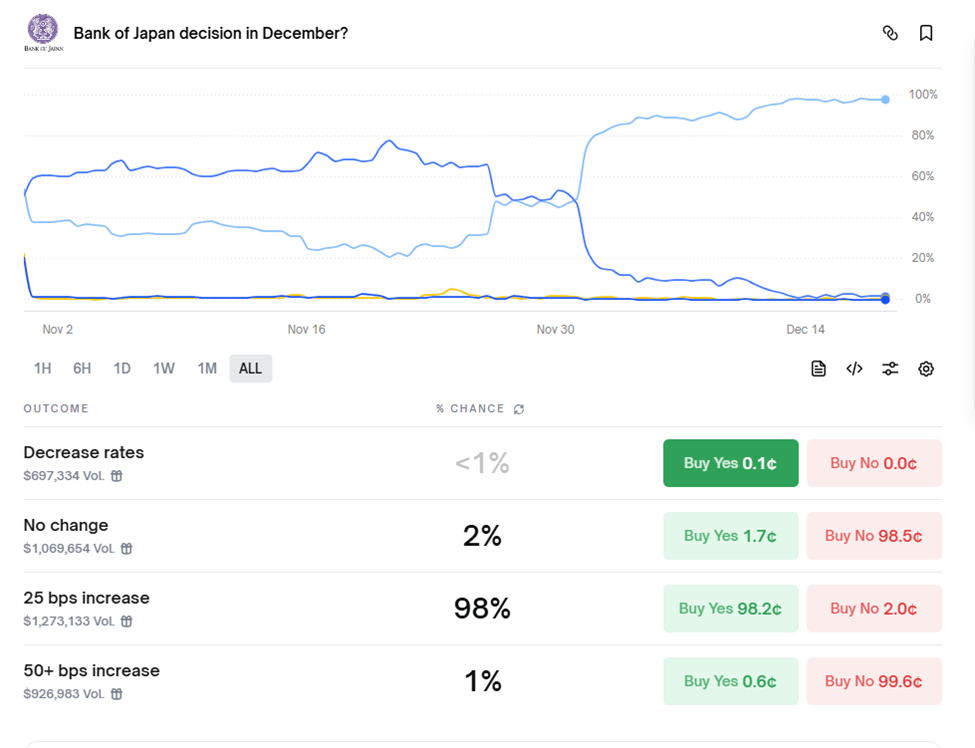
This time, however, traders appeared unfazed, suggesting the move had been fully priced in well ahead of the announcement. Market participants had largely anticipated the decision.

BOJ Interest Rate Probabilities
BOJ Interest Rate Probabilities. Source: Polymarket

Japan’s rate increase represents a symbolic break from decades of near-zero interest rates that made the yen a cornerstone of global funding markets. Cheap yen borrowing fueled leverage across equities, bonds, and cryptocurrencies.

As Japanese yieds rise and narrow the gap with global rates, those trades become less attractive, potentially forcing investors to unwind risk positions. Still, Bitcoin’s calm reaction suggests markets were prepared.

Bitcoin (BTC) Price Performance
Bitcoin (BTC) Price Performance. Source: BeInCrypto

According to analysts, however, the focus was never the hike itself, but what comes next.

“Markets are pricing in a near-certain 25 basis point hike, marking the highest Japanese policy rate in about 30 years. While the hike itself is largely anticipated, the real focus is on Governor Ueda’s forward guidance during the press conference—signals of future hikes could amplify effects,” wrote analyst Marty Party.

That forward guidance may prove crucial. The BOJ has signaled it remains prepared to raise rates further, potentially to 1% or higher by late 2026, depending on wage growth and sustained inflation.

BOJ policy rate climbing from near 0% to 0.75% in December 2025, ending decades of ultra-easy policy. Source: Wise Advice via X

That outlook keeps pressure on risk assets, even if the initial move failed to trigger volatility.

Bitcoin Holds Firm as Altcoins Face a Prolonged Liquidity Squeeze

Analysts argue that Bitcoin’s resilience could be a bullish sign. Blueblock pointed to historical patterns, noting the divergence from past reactions.

“The BOJ just hiked rates to 0.75%, ending decades of ultra-loose policy and narrowing the gap with global yields. History shows that every prior tightening has triggered 20–30% Bitcoin drops as yen carry trades unwind and liquidity tightens. Yet with the hike fully priced in and BTC holding around $85k–$87k, this could be the dip buyers have been waiting for,” the analyst wrote.

However, not all corners of the crypto market are expected to fare as well. Altcoins, which are typically more sensitive to shifts in liquidity, remain vulnerable if Japanese tightening accelerates.

The prospect of higher rates through 2026 suggests a prolonged headwind rather than a one-off shock.

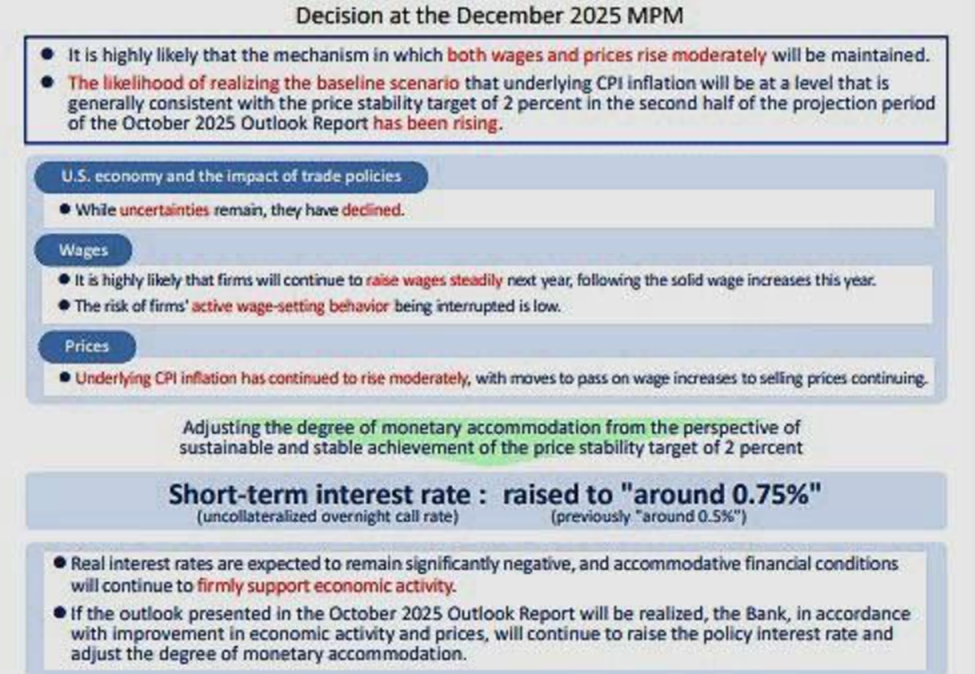
BOJ’s December 2025 policy decision raised rates to 0.75% with guidance for further tightening
BOJ’s December 2025 policy decision raised rates to 0.75% with guidance for further tightening. Source: Money Ape on X

“BOJ signals it is ready to hike further, potentially 1% or higher by late 2026, depending on wage growth and sustained inflation. NO MERCY FOR ALTCOINS,” commented Money Ape.

Bitcoin’s stability reflects a market that had ample time to prepare for the BOJ’s decision. Whether that resilience holds will depend less on the December hike itself and more on how aggressively Japan continues its path of tightening. It will also hinge on how global liquidity adapts to the end of one of its longest-running monetary backstops.

The post BOJ Raises Interest Rates to 0.75%, But Bitcoin Stands Unshaken—Is the Crypto Calm a Warning or Opportunity? appeared first on BeInCrypto.

  •  

$3.16 Billion Crypto Options Expiry Puts Bitcoin and Ethereum’s Next Move in Question

Over $3.16 billion worth of Bitcoin and Ethereum options are set to expire on Friday at 08:00 UTC on Deribit, marking the final major derivatives settlement before Christmas.

With liquidity thinning out as the holiday period approaches and positioning tightly clustered around key price levels, traders appear cautious, waiting for a clearer catalyst before committing to a direction.

What to Expect as Nearly $3 Billion Bitcoin Options Expire

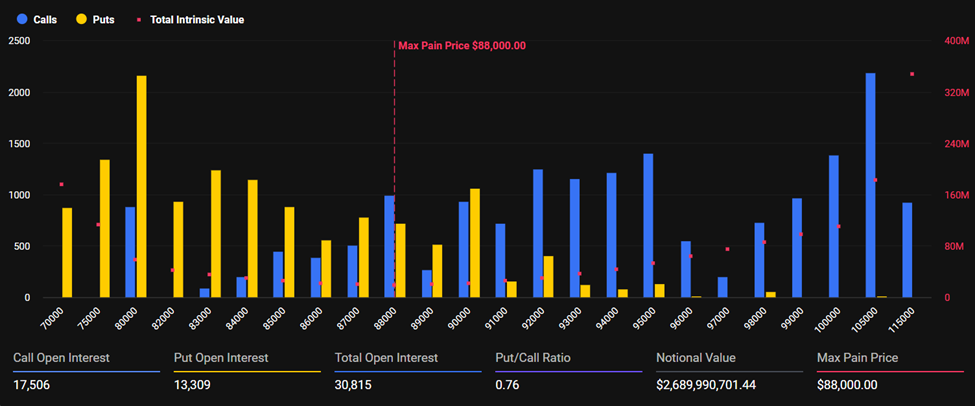
Bitcoin accounts for the bulk of the expiry, with roughly $2.69 billion in notional value rolling off. At the time of writing, BTC was trading at $87,194, representing a 0.54% increase over the past 24 hours.

The max pain level for today’s expiring Bitcoin options sits at $88,000, placing the spot price just below the strike. This is where the greatest number of options expire worthless.

Meanwhile, open interest data suggests a relatively balanced but slightly defensive stance. Bitcoin call open interest stands at 17,506 contracts, compared with 13,309 puts, resulting in a total open interest of 30,815 contracts and a put-to-call ratio of 0.76.

Expiring Bitcoin Options
Expiring Bitcoin Options. Source: Deribit

While calls still dominate numerically, the concentration of positioning near $88,000 points to limited upside momentum unless the spot decisively breaks higher. Deribit analysts highlighted this dynamic in a market update.

“BTC open interest is concentrated around 88K, with slightly heavier put positioning, pointing to a relatively contained expiry unless spot breaks range,” they wrote.  

The commentary reinforces the view that Bitcoin could remain range-bound through settlement, especially amid pre-holiday caution.

Over $470 Million Ethereum Options Expire Today: What Investors Should Know

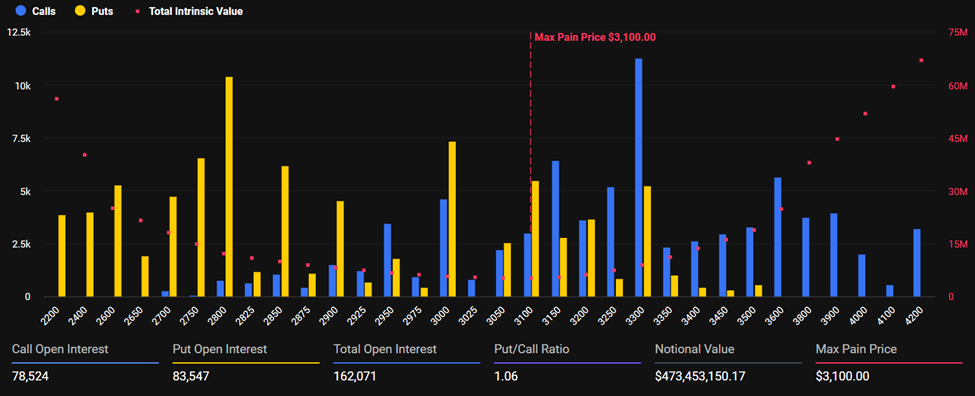
Ethereum presents a different setup. Approximately $473 million in ETH options are expiring, with the asset trading at $2,928, representing a 3.37% increase in the last 24 hours. ETH’s max pain level is higher, at $3,100, leaving spot price meaningfully below the key strike.

Ethereum’s open interest profile is more evenly split, with 78,524 call contracts versus 83,547 puts. This results in a put-to-call ratio of 1.06 and a total open interest of 162,071 contracts.

Expiring Ethereum Options
Expiring Ethereum Options. Source: Deribit

Unlike Bitcoin, ETH positioning is spread across a wider range of strikes, indicating greater uncertainty about the near-term direction.

“ETH positioning is more distributed across strikes, with notable upside interest above 3.4K, keeping larger moves in play if volatility reaccelerates,” Deribit analysts indicated.

The analysts added that positioning suggests patience into settlement, which happens at 08:00 UTC today, with traders waiting for a clearer catalyst rather than forcing direction.

Beyond today’s options expiry, attention is already shifting to December 26 and early 2026 positioning.

“December 26 85k Put OI now ~15k ($1.25bn notional) on Deribit, and bears+FUD currently in control with ATM 86k,” Deribit Insights noted.

At the same time, upside bets appear less aggressive in the near term, with analysts observing that “the Dec26 100k+ $1.75bn Call condor feels a distant punt now.”

However, longer-dated flows tell a more constructive story, with recent flows continuing to show upside bias into 2026. According to the analysts, this suggests that while short-term sentiment remains cautious, longer-horizon traders are still positioning for a renewed bullish phase.

As the final options expiry before Christmas approaches, both Bitcoin and Ethereum appear caught between near-term restraint and longer-term optimism, leaving their next decisive move unresolved.

Traders and investors may experience some volatility, which the BOJ’s interest rate decision could exacerbate. However, markets tend to stabilize as traders adjust to new market conditions.

The post $3.16 Billion Crypto Options Expiry Puts Bitcoin and Ethereum’s Next Move in Question appeared first on BeInCrypto.

  •  

How is Crypto VC Investment Trending in a Bearish Market?

Venture capital is the lifeblood of the startup world in Web3 and crypto. Entrepreneurs need to raise money for projects in order to hire talented people, pay operating costs, and perform marketing for scaling a business. 

VCs, of course, are more than happy to do this, as they get a chunk of the long-term payoff – if there ever is one, of course. Most startups fail, and the business is highly predicated on unicorns to drive venture funds. 

The crypto market is unique, to be sure, with cryptocurrencies also playing a role as many startups launch tokens. However, the digital asset market hasn’t been performing as well. 

Since October, when the price per 1 BTC hit an eye-watering $126,000 record level, the orange asset is in the red by 25%

Crypto VC Investments Over the Past 10 Years. Source: Galaxy Research

Crypto prices impact the VC market, and dynamics have certainly changed for startups to raise money. What’s the outlook looking like overall right now? 

“Market cycles may influence investment sentiment and can slow or accelerate the pace of closing deals,” noted Stefan Deiss, CEO of Hashgraph Group, focused on VC in the Hedera ecosystem.

Lowered Expectations From Venture Capital

One of the first things that happens when crypto trends to a downward cycle is that startup valuations go lower. 

It may not seem directly related, but the concept of the “hot rounds” for fashionable startups cool off, and VCs don’t really go for sky-high valuations so much, noted Artem Gordadze, an angel investor in NEAR Foundation and advisor at startup accelerator Techstars.

“When Bitcoin is trading at high levels, like the perceived $100k level, startup valuations are commensurately high,” Gordadze said. “This creates a challenging dynamic: VCs must justify the entry valuation based on a potential future price that must materialize within the investment horizon to generate acceptable returns.”

Bitcoin’s price since the start of Q4 on October 1. Source: CoinGecko

It seems the theory that Bitcoin always goes up is not one venture capitalists are attuned to. Because of long time horizons for VC investments, they have seen many cycles, especially with Bitcoin. 

In addition, many VCs often call November and December “write-off” months. This means they don’t expect to do too much work during the fourth quarter and the holiday season, preferring to start investing anew after the calendar turns to another year. 

The Pragmatic View

The view of venture from 10,000 feet up, as it pertains to the crypto sector specifically, is one of spending, but less volume. 

Case in point: Prediction market Polymarket closed $1 billion, while Kraken took in $800m in funding this quarter. 

In the third quarter, the total amount of funding was $4.59 billion, but half of that was concentrated on just seven deals, according to Alex Thorne, head of research for Galaxy. 

The cash is flowing: 2025 Q3 was the second-highest since 2022 Q1. Source: X

“Market downturns sharpen the focus because you stop seeing price action as a signal but rather resilience in execution and product as the main indicators that count,” said Hashgraph Group’s Deiss. “Downturns push investors to focus more on fundamentals rather than short-term momentum.”

That short-term momentum may often be more hype than anything else. And many big venture-backed projects doing a TGE have not performed very well this year. This includes PUMP (down over 50% in 2025) and Berachain (a 91% drop since its February launch). 

“High volatility and uncertain early-stage valuations are driving a significant shift in capital deployment, favoring strategies with shorter liquidity cycles and better pricing control,” added Gordadze. 

The Lock-Up and the Liquidity

One of the most distinctive aspects of the cryptocurrency industry is the token generation event, or TGE.

The successor to ICOs of days past, Coinbase is now facilitating TGEs after its $375 million purchase of investor platform Echo.

Monad was the first project to launch there, raising $296m, and there’s surely more to come. 

However, once a token launches, there are a few metrics that are unique to crypto that venture investors must closely monitor. 

One is the lock-up, whereby, at TGE, not all tokens are circulating in the market yet; there is a period of holding these assets back. This is designed to better incentivize a network’s participants, from team members to community airdrops and foundation efforts. 

Then there’s fully diluted value, or FDV – this is the total number of tokens times the price – basically a market cap for all tokens, even if they haven’t been unlocked yet. 

And when markets gyrate, it’s really hard to forecast any potential exits of tokens for VCs, which can be a conundrum.

Recently, Arthur Hayes of Maelstrom Capital went on a rant about lock-ups, specifically related to Monad. As a trader, Hayes clearly doesn’t like the illiquidity of these types of tokens. 

Arthur Hayes tagging Monad’s Keone Hon about lock-ups. Source: X

“Given the average token or equity vesting/lock-up period of 12 to 48 months, VCs must model the market’s likely condition when these lock-ups end,” said Gordadze, the Techstars mentor. “The entry price must be strategically set to ensure a profitable exit, making long-term market forecasts crucial for deal finalization.

The Future of Crypto VC Investment in 2026 and Beyond

On the subject of market forecasts, VCs surely love to talk about the future. And for crypto, it seems, given favorable US regulatory actions in 2025, that next year could be much better. Is that just investor hopium? 

Maybe. But rose colored (or green) glasses are always the default mode for VCs. Optimism, of course, always wins. 

“2026 is shaping up as a year defined by real utility – DeFi will make a strong comeback with enhanced momentum and maturity and the stablecoin moment becomes background,” noted  Deiss. Stablecoins certainly had a moment this year, although they are the boring infrastructure that’s going to power, say, the next Polymarket, which uses USDC on Polygon as its main coin and chain. 

“Now that stablecoins are finally going mainstream and banks are rushing to get in, the next level will be services for users that are powered by these assets behind the scenes,” noted Gordadze.

The most significant growth areas will likely reside in the intersection of AI/Blockchain and RWA/Blockchain, as these represent the greatest opportunities for real-world impact and institutional revenue generation.”

The post How is Crypto VC Investment Trending in a Bearish Market? appeared first on BeInCrypto.

  •  

US Inflation Cooled, So Why Did Bitcoin and Stocks Sell Off?

US inflation delivered its biggest downside surprise in months. Yet instead of a sustained rally, both Bitcoin and US equities sold off sharply during US trading hours. 

The price action puzzled many traders, but the charts point to a familiar explanation rooted in market structure, positioning, and liquidity rather than macro fundamentals.

What Happened After the US CPI Release

Headline CPI slowed to 2.7% year over year in November, well below the 3.1% forecast. Core CPI also undershot expectations at 2.6%. 

On paper, this was one of the most risk-positive inflation prints of 2025. Markets initially reacted as expected. Bitcoin jumped toward the $89,000 area, while the S&P 500 spiked higher shortly after the data hit.

That rally did not last.

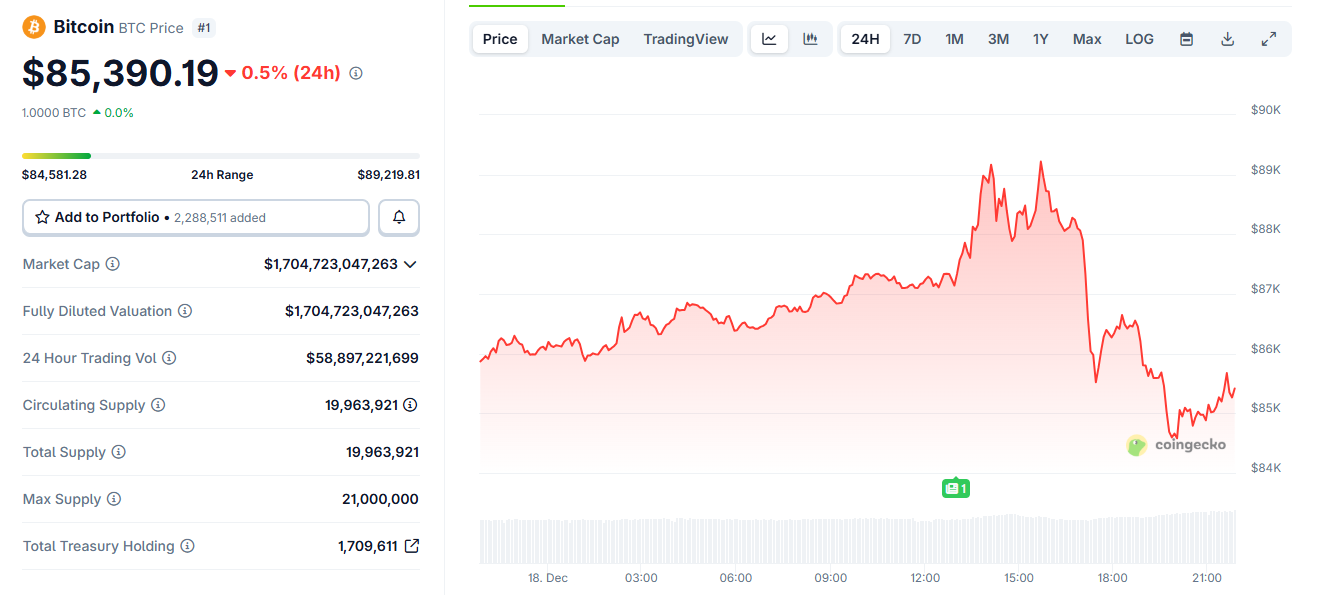
Bitcoin Price Briefly Rallies and Dumps After US CPI Data. Source: CoinGecko

Within roughly 30 minutes of the CPI print, Bitcoin reversed sharply. After tagging intraday highs near $89,200, BTC sold off aggressively, sliding toward the $85,000 area. 

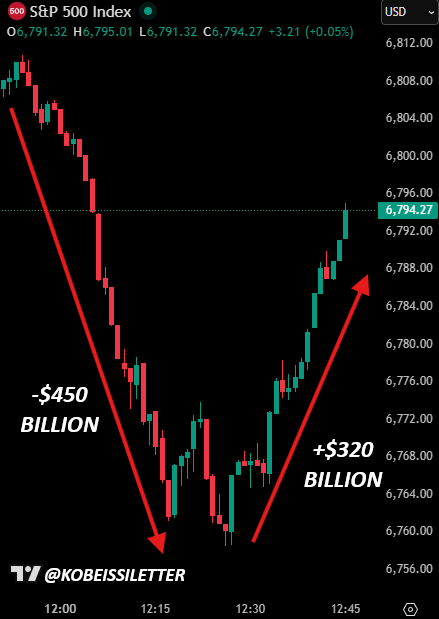
The S&P 500 followed a similar path, with sharp intraday swings that erased much of the initial CPI-driven gains before stabilizing.

S&P 500 Sharply Drops and then Spikes After US CPI. Source: X/Kobeissi Letter

This synchronized reversal across crypto and equities matters. It signals that the move was not asset-specific or sentiment-driven. It was structural.

Bitcoin Taker Sell Volume Tells the Story

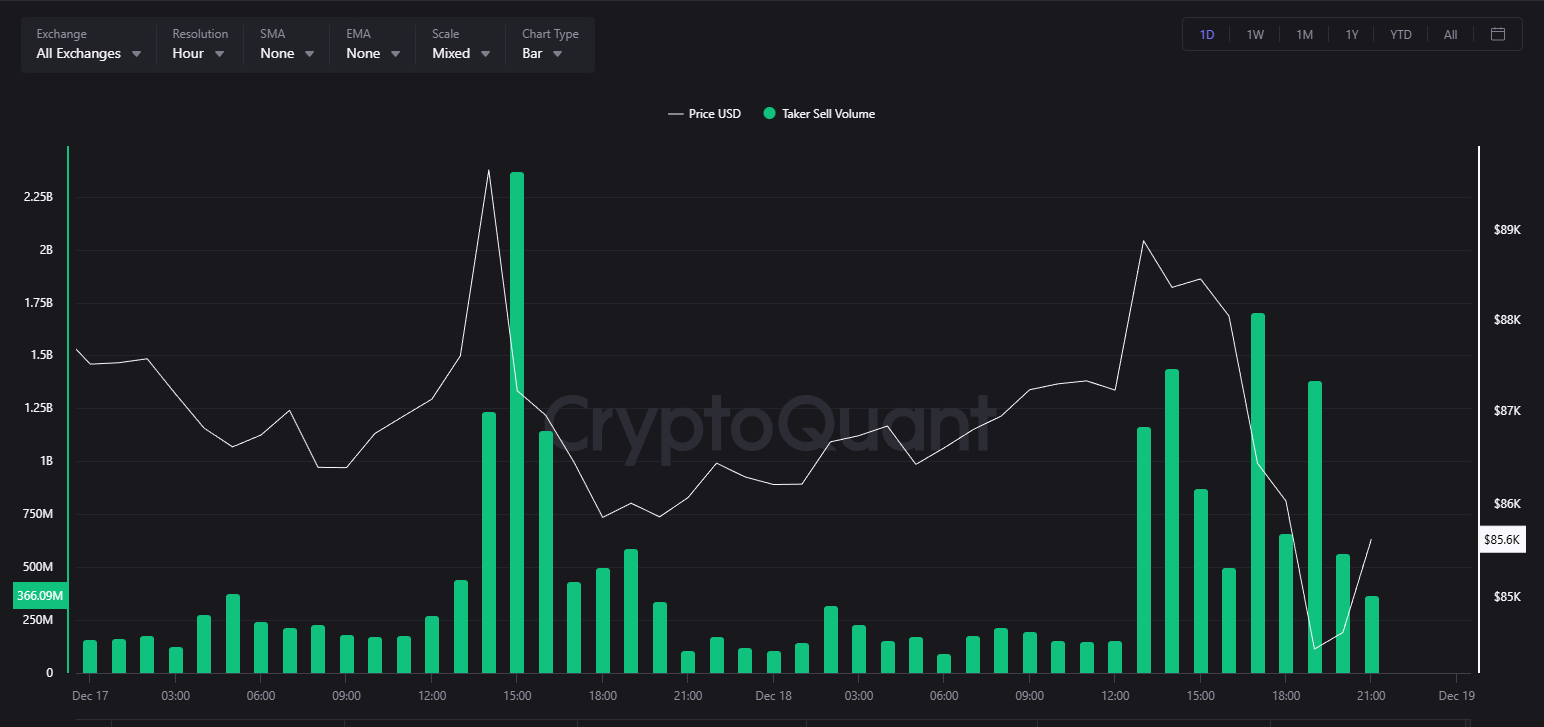
The clearest clue comes from Bitcoin’s taker sell volume data.

On the intraday chart, large spikes in taker sell volume appeared precisely as Bitcoin broke lower. Taker sells reflect market orders hitting the bid — aggressive selling, not passive profit-taking. 

These spikes clustered during US market hours and coincided with the fastest part of the decline.

Bitcoin Taker Volume Across All Exchanges On December 18. Source: CryptoQuant

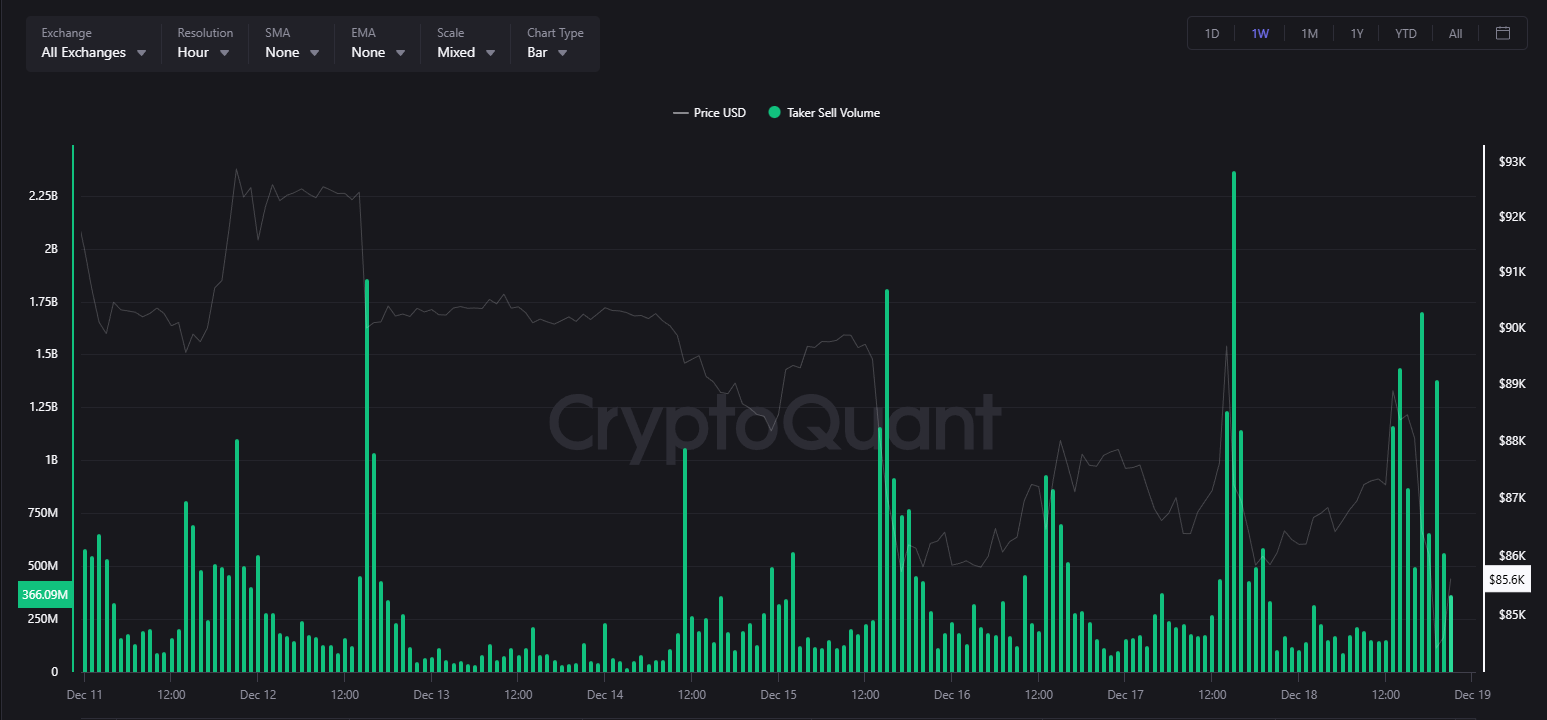
The weekly view reinforces this pattern. Similar sell-side bursts appeared multiple times over the past week, often during high-liquidity windows, suggesting repeated episodes of forced or systematic selling rather than isolated retail exits.

This behavior is consistent with liquidation cascades, volatility-targeting strategies, and algorithmic de-risking — all of which accelerate once price starts moving against leveraged positions.

Bitcoin Taker Volume Across All Exchanges Over the Past Week. Source: CryptoQuant

Why ‘Good News’ Became the Trigger

The CPI report did not cause the selloff because it was bad. It caused volatility because it was good.

Softer inflation briefly increased liquidity and tightened spreads. That environment allows large players to execute size efficiently. 

Bitcoin’s initial spike likely ran into a dense zone of resting orders, stop losses, and short-term leverage. Once upside momentum stalled, price reversed, triggering long liquidations and stop-outs.

As liquidations hit, forced market selling amplified the move. This is why the decline accelerated rather than unfolded gradually.

The S&P 500’s intraday whipsaw shows a similar dynamic. Rapid downside and recovery patterns during macro releases often reflect dealer hedging, options gamma effects, and systematic flows adjusting risk in real time.

🚨 This is insane level of manipulation.

8:30 a.m.

CPI came in lower than expected.

– On the bullish CPI news, Bitcoin pumped $2217, from $87,260 to $89,477 in just 60 minutes.
– $70B added to the crypto market.
– $94 million worth of shorts liquidated.

10:00 a.m.

The… pic.twitter.com/FmJqLDKbBw

— Bull Theory (@BullTheoryio) December 18, 2025

Does This Look Like Manipulation?

The charts do not prove manipulation. But they show patterns commonly associated with stop-runs and liquidity extraction:

  • Fast moves into obvious technical levels
  • Reversals immediately after liquidity improves
  • Large bursts of aggressive selling during breakdowns
  • Tight alignment with US trading hours

These behaviors are typical in highly leveraged markets. The most likely drivers are not individuals, but large funds, market makers, and systematic strategies operating across futures, options, and spot markets. Their goal is not narrative control, but execution efficiency and risk management.

In crypto, where leverage remains high and liquidity thins quickly outside key windows, these flows can look extreme.

🚨 THEY ARE MANIPULATING BITCOIN AGAIN AND I HAVE EVIDENCE!!!

Bitcoin dumped $4000 in minutes…

and almost no one actually understands what just took place.

It’s the same group of players manipulating the price… AGAIN.

Stop looking at charts, YOU NEED TO CHECK THE OUTFLOWS.… pic.twitter.com/ymU4kXdWvb

— NoLimit (@NoLimitGains) December 18, 2025

What This Means Going Forward

The selloff does not invalidate the CPI signal. Inflation genuinely cooled, and that remains supportive for risk assets over time. What the market experienced was a short-term positioning reset, not a macro reversal.

In the near term, traders will watch whether Bitcoin can stabilize above recent support and whether sell-side pressure fades as liquidations clear. 

If taker sell volume subsides and price holds, the CPI data may still assert itself over the coming sessions.

The post US Inflation Cooled, So Why Did Bitcoin and Stocks Sell Off? appeared first on BeInCrypto.

  •  

Why 2025 Became the Year Crypto Stopped Chasing Hype

In 2025, the most influential narratives in crypto shifted away from hype toward utility and systems delivering measurable, real-world impact. The year marked a transition to production-ready systems that enhance the global movement and settlement of value.

Experts from SynFutures, Brickken, and Cake Wallet said that stablecoins, privacy, tokenized assets, and applied AI shaped adoption through genuine demand rather than speculation.

The Year Crypto Became Infrastructure

In many ways, 2025 was an exceptional year. It marked the first time crypto reached this level of institutional integration, with users often interacting with crypto rails without consciously engaging with “crypto” as a product.

While the sector remained shaped by volatility, only a few crypto narratives stood out for their practical utility. By contrast, those driven primarily by hype and sensationalism faded quickly.

In conversations with BeInCrypto, industry representatives offered a consistent assessment: narratives grounded in integration and execution endured, while novelty-driven stories steadily lost relevance.

Despite a wide range of narratives, stablecoins consistently emerged as the most frequently cited theme.

Stablecoins Became Crypto’s Core Use Case

Stablecoins have helped bridge the gap between risk-tolerant crypto participants and more cautious users seeking limited exposure to an industry long associated with volatility.

By maintaining a peg to assets such as the US dollar or gold, stablecoins positioned themselves as a more reliable alternative to other types of digital assets. Their borderless nature also gave them particular appeal over fiat currency.

Our 2026 Infra Year Ahead Report is out now!

Stablecoins have become the most important infrastructure story in crypto.

Every fintech wave promised to fix payments but just layered better UX on the same infrastructure. Revolut and Nubank delivered better experiences while… pic.twitter.com/zEhC6sndmv

— Delphi Digital (@Delphi_Digital) December 17, 2025

Regulatory milestones, including the passage of the GENIUS Act, further strengthened confidence in stablecoins, allowing their utility and infrastructure efficiency to stand on their own merits.

“Stablecoins solved a very concrete, everyday problem: moving and settling money efficiently across borders without relying on slow, fragmented, and expensive banking rails,” said Brickken CEO Edwin Mata. “For users, they provided access to digital dollars and euros in jurisdictions where banking access is limited, costly, or unreliable,” he added. 

The impact was concrete, not theoretical, as Stripe and Visa integrated stablecoins into settlement and treasury operations. At the same time, Circle enabled businesses to use USDC as working capital rather than as a speculative asset.

As stablecoins matured into dependable settlement tools, they enabled the expansion of tokenized real-world assets (RWAs).

Tokenization Advanced Beyond Pilot Programs

According to SynFutures CEO Rachel Lin, RWAs managed to bridge the gap between traditional finance and crypto. However, the way this was achieved wasn’t comprehensive. 

The success of RWAs was actually much more selective than previously anticipated. 

“Tokenized treasuries, funds, and yield products showed real traction because they offered tangible benefits: better settlement, composability, and broader access,” Lin told BeInCrypto, adding, “However, 2025 also clarified that RWAs only work when legal clarity, liquidity, and credible issuers are in place. The narrative moved from experimentation to execution, but it’s still early.”

The evidence spoke for itself, with large banks and asset managers relying on tokenization to improve efficiency. Earlier this week, JPMorgan launched a tokenized money market fund on Ethereum, marking a move beyond internal testing or pilot programs. 

Meanwhile, asset managers such as BlackRock expanded tokenized fund offerings, and banks integrated stablecoins into treasury and settlement workflows.

Another narrative that drew widespread attention across industries, particularly within the crypto sector, was artificial intelligence (AI).

Where AI Delivered Measurable Value

Early AI hype centered on fears that autonomous agents would replace human decision-making, a narrative that quickly lost momentum. 

What endured was a more practical focus on how AI could enhance the user experience by helping individuals understand exposure and manage risk.

“AI added real value where it reduced cognitive and operational complexity—particularly in trading interfaces, risk controls, and decision support. Products that used AI to help users understand exposure, automate execution within guardrails, or avoid costly mistakes delivered tangible improvements,” Lin explained.

The rise of AI agents also generated significant attention, though expectations became more measured over the year. 

Their success depended less on autonomy and more on trust, auditability, and user-defined limits. Use cases such as liquidity management, automated strategy execution, and treasury optimization demonstrated potential when clear guardrails were in place.

Yet, as AI became more deeply embedded in crypto products, it also sharpened long-standing concerns around data exposure.

This convergence pushed privacy from a niche concern into a central narrative of 2025.

Why Privacy Could No Longer Wait

Privacy emerged as one of the most consequential crypto narratives of the year, driven by growing awareness of how financial systems expose user information and behavior. 

spent last night deep in the a16z state of crypto 2025 report…

and wow, privacy is quietly becoming the next trillion-dollar narrative

> google searches for “crypto privacy” and “financial privacy” are up 10x since january
> total flows through railgun passed $200M
> zcash’s… https://t.co/zv36Kcgi10 pic.twitter.com/T8p3EsR9Hn

— Pix🔎 (@PixOnChain) October 24, 2025

As a result, long-standing concerns around data visibility moved to the forefront. In parallel, privacy, once treated as a niche preference, increasingly appeared as a structural requirement.

“One of the biggest narrative shifts in the industry to date happened this year, where people woke up to the need (and market demand) for simple, approachable privacy for their money,” Seth for Privacy, Vice President of Cake Wallet, told BeInCrypto.

Rising usage of Monero, increased global media attention on Zcash, and a broader shift toward privacy features across stablecoin and Layer 2 networks reinforced this pivot. 

“All of that solves one of the biggest painpoints of crypto for users – how do I retain privacy that I have today in the financial system or with cash, with the decentralization and power of crypto?” Seth added. 

The rise of privacy solutions, alongside other successful narratives of the past year, reinforced that crypto adoption increasingly hinges exclusively on utility. 

As crypto continues to mature, success may be defined not by how loudly it announces itself, but by how reliably it works.

The post Why 2025 Became the Year Crypto Stopped Chasing Hype appeared first on BeInCrypto.

  •  

$U Stablecoin Launches on BNB Сhain and Ethereum by United Stables

$U integrates with leading DeFi protocols including PancakeSwap, Aster, Four.meme, and ListaDAO, is listed on HTX

[Dubai, UAE, Dec. 18, 2025] — United Stables, a leading digital asset infrastructure provider, today announced the official launch of $U, a fully backed, next-generation stablecoin designed to unify liquidity across trading, payments, DeFi, institutional settlement, and AI-driven autonomous systems.

$U is now deployed on both BNB Smart Chain (BSC) and Ethereum, two of the most widely used blockchain networks, offering immediate multi-chain access and interoperability. 

From day one, $U integrates with leading DeFi protocols including PancakeSwap, Aster, Four.meme, and ListaDAO, enabling trading, liquidity provision, staking, and lending. It is also fully supported by Binance Wallet,SafePal, and Trust Wallet, allowing users to seamlessly store, transfer, and interact with $U across different chains and applications. While also be listed on HTX. 

$U is fully backed 1:1 by a combination of cash and audited stablecoins such as USDC, USDT and USD1. As the first stablecoin on BNB Chain that unites all major stablecoins into a single liquidity layer, $U leverages these reserves to aggregate liquidity and improve capital efficiency.

All reserves are held in segregated accounts, verified through instant on-chain Proof-of-Reserve and undergo independent quarterly audits, ensuring full transparency and security. 

In the future, $U will introduce a confidential balance feature, enabling organizations  to protect sensitive financial data while maintaining transparent transaction flows for compliance and auditing purposes.

$U is designed for the AI economy, will natively support EIP-3009 for gasless, signature-based authorization and x402-enabled delegated execution. This will allow autonomous agents and AI systems to perform secure, programmable transactions, making $U ideal for high-frequency, automated trading, micropayments, and machine-to-machine commerce.

With  transparent reserves, instant redemption, and multi-chain distribution, U aims to serve a wide range of core use cases, including:

  • Centralized and decentralized trading
  • Lending, staking, and yield strategies across DeFi
  • Institutional OTC settlement and treasury operations
  • Cross-border payments and remittances
  • Supply-chain and B2B settlement workflows
  • AI-driven autonomous payment systems

“$U is designed to become the united value layer for a world where humans and AI operate side-by-side as economic participants. We believe programmable, transparent, and universally accessible money will define the next era of global digital finance.”
— Athena Y, CEO of  United Stables, said.

“BNB Chain has always welcomed diverse stablecoins. As one of the most active communities for stablecoin trading, we’re excited to see $U launch on BNB Chain, strengthening liquidity and powering the next wave of AI-native payments.” 

— Sarah S, the Head of Business Development at BNB Chain.

$U is now live on BNB Smart Chain and Ethereum, with additional ecosystem integrations planned in the coming months.

For more information, visit u.tech.

About United Stables

United Stables is a digital asset infrastructure provider focused on building transparent, secure, and programmable stablecoin solutions for global markets. $U is issued by United Stables Holding (BVI), with reserves custodied under regulated structures to ensure security, transparency, and segregation of client assets.

Website: u.tech
Media Contact: [email protected]

About BNB Chain

BNB Chain is a community-driven blockchain ecosystem that is removing barriers to Web3 adoption. It is composed of:

  • BNB Smart Chain (BSC): A secure DeFi hub with the lowest gas fees of any EVM-compatible L1; serves as the ecosystem’s governance chain.  
  • opBNB: A scalability L2 that delivers some of the lowest gas fees of any L2 and rapid processing speeds.
  • BNB Greenfield: Meets decentralized storage needs for the ecosystem and lets users establish their own data marketplaces.

Website: https://www.bnbchain.org/en

The post $U Stablecoin Launches on BNB Сhain and Ethereum by United Stables appeared first on BeInCrypto.
  •  

US Inflation Cools Sharply in November, CPI Misses Forecasts

US inflation slowed more than expected in November, delivering a clear downside surprise that could reshape near-term market and Federal Reserve expectations. According to fresh data released on December 18, the headline Consumer Price Index (CPI) rose 2.7% year over year, well below market expectations of 3.1%.

Meanwhile, core CPI, which excludes food and energy, increased 2.6% year over year, also missing forecasts of 3.0%. The data marks a notable deceleration in price pressures and signals that disinflation momentum has strengthened heading into the end of 2025.

Is This Bullish For Crypto Markets?

The softer-than-expected print reinforces the view that inflation is cooling faster than policymakers and markets anticipated just weeks ago. Core inflation, closely watched by the Federal Reserve, now sits well below 3%—a level last seen before inflation reaccelerated earlier this year.

This print weakens the case for prolonged restrictive monetary policy and strengthens expectations that the Fed may turn more accommodative sooner than previously priced in.

Markets are likely to interpret the data as rate-cut supportive, particularly for early 2026. Lower inflation reduces pressure on real yields and the US dollar—two key headwinds for risk assets in recent months.

Risk markets, including equities and crypto, were already positioned cautiously ahead of the release, suggesting room for sharp repricing as traders digest the data.

Bitcoin and the broader crypto market entered the CPI release in consolidation mode, with traders bracing for volatility. A downside inflation surprise typically acts as a macro tailwind for crypto, as easing inflation expectations improve liquidity conditions and risk appetite.

Short-term price action will now depend on how quickly markets reprice Fed policy expectations and whether follow-through buying emerges after the initial reaction.

What comes next? Attention will shift to:

  • Updated Fed rate-cut probabilities
  • US Treasury yield reactions
  • Dollar strength or weakness
  • Risk-asset follow-through into year-end

For now, November’s CPI report delivers a clear message: inflation cooled faster than expected, and markets will need to adjust quickly.

The post US Inflation Cools Sharply in November, CPI Misses Forecasts appeared first on BeInCrypto.
  •  

Japan’s Bond Yields Hit 1.98%: BOJ Rate Shift Impacts Gold, Silver, and Bitcoin

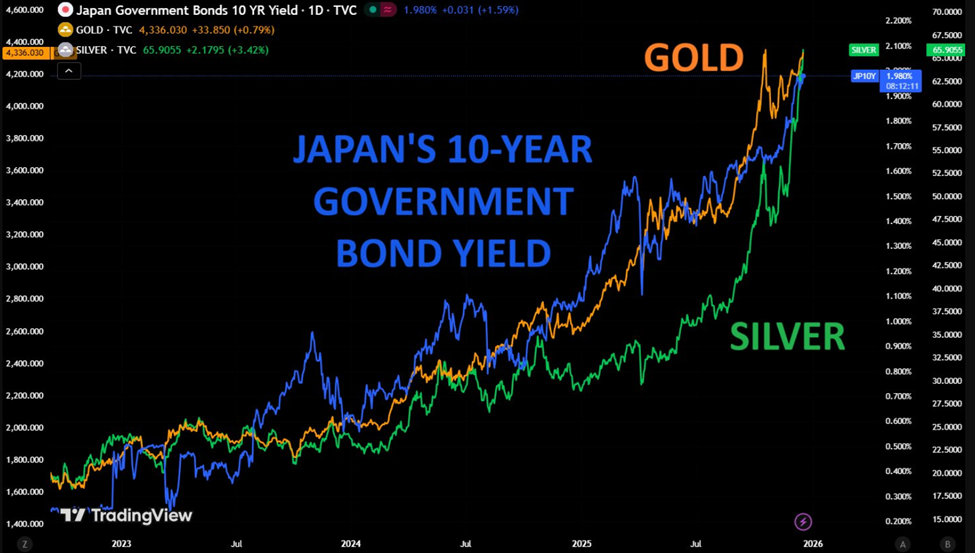
Japan’s 10-year government bond yields surged to 1.98% in December 2025, the highest level since the 1990s. It comes as markets braced for the Bank of Japan’s (BOJ) policy meeting on December 19.

The move has triggered a global rally in precious metals, with gold and silver surging 135% and 175%, respectively, since early 2023. Meanwhile, Bitcoin is under pressure as forced selling intensifies across Asian exchanges, highlighting a divergence in market reactions to Japan’s rate shift.

Japan’s Bond Yields Hit 1.98%

For decades, Japan maintained near-zero interest rates, anchoring global liquidity through the yen carry trade.

Investors borrowed yen at a low rate to fund higher-yielding assets worldwide, effectively exporting ultra-low interest rates.

An expected 25-basis-point hike, raising the rate to 0.75%, may appear modest in absolute terms, but the pace of change matters more than the level.

BOJ Interest Rate Probabilities
BOJ Interest Rate Probabilities. Source: Polymarket

“Carry trade at risk: Nobody knows when the real consequences will materialize, but this continued shift will likely drain liquidity from markets, potentially causing a ripple effect through margin calls and other forced deleveraging,” warned Guilherme Tavares, CEO at i3 Invest.

Analysts see the BOJ move as more than a domestic adjustment.

“When Japan’s yields move, global capital pays attention. Gold and silver aren’t reacting to inflation headlines. They’re pricing sovereign balance sheet risk. Japan isn’t a sideshow anymore. It’s the fulcrum,” noted Simon Hou-Vangsaae Reseke.

Gold and Silver Prices Surge Amid Rising Sovereign Risk

Precious metals have been closely tracking Japanese yields. According to Global Market Investor, gold and silver are moving almost perfectly in line with Japanese government bond yields. This suggests that precious metals are being used as a primary hedge against the rising cost of government debt.

Gold and Silver Prices Tracking Japan’s 10Y Bond. Source: Global Markets Investor on X

“It’s not the yield itself, it’s what the move represents — rising sovereign risk, tighter global liquidity, and uncertainty about currency credibility. Gold responds as protection, and silver follows with more volatility,” commented analyst EndGame Macro.

The silver market is showing signs of speculative mania. The China Silver Futures Fund recently traded 12% above the physical metal it tracks, indicating that demand for leveraged exposure is outpacing the underlying asset.

⚠️ Silver market mania is an UNDERSTATEMENT:

The China Silver Futures Fund was trading +12% above the actual value of the silver it is supposed to track

Investors are buying the fund much faster than the silver behind is rising, a sign of SPECULATION. 👇https://t.co/8kAngXV9CH

— Global Markets Investor (@GlobalMktObserv) December 17, 2025

Investors are increasingly treating gold and silver as hedges against broader macro risks, rather than just inflation.

Bitcoin Faces Pressure as Carry Trades Unwind

Meanwhile, the Bitcoin price is feeling the strain of tightening yen liquidity.

“Asia-based exchanges have seen persistent spot selling. Miner reserves are falling — forced selling, not choice…Long-term Asian holders appear to be distributing…Price stays heavy until forced supply is cleared,” wrote CryptoRus, citing XWIN Research Japan.

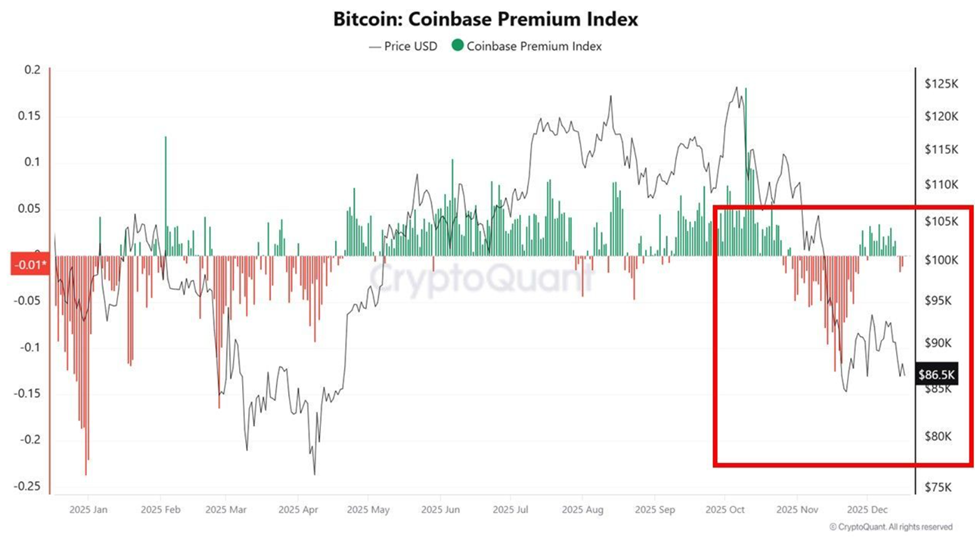
US institutions continue buying, with the Coinbase Premium positive, but forced liquidations in Asia and an 8% drop in Bitcoin hashrate have added downward pressure.

Bitcoin Price and Coinbase Premium
Bitcoin Price and Coinbase Premium. Source: CryptoQuant

Past BOJ rate shifts have coincided with significant BTC declines, and traders are watching closely for further downside toward $70,000.

THE BANK OF JAPAN MIGHT BE BITCOIN’S BIGGEST ENEMY

Japan holds the most US debt.
Every time they hike, Bitcoin bleeds:

March 2024: -23%
July 2024: -30%
Jan 2025: -31%

Next hike: Dec 19
Next move: loading…

If the pattern repeats, $70K is in play. pic.twitter.com/R5916R702I

— Merlijn The Trader (@MerlijnTrader) December 14, 2025

The contrasting reactions of precious metals and Bitcoin highlight differences in risk positioning. Gold and silver are attracting safe-haven flows amid growing sovereign risk, while Bitcoin faces liquidation-driven price pressure.

Analysts note that future Fed rate cuts may offset the BOJ’s impacts, but the speed of the policy change is crucial.

The post Japan’s Bond Yields Hit 1.98%: BOJ Rate Shift Impacts Gold, Silver, and Bitcoin appeared first on BeInCrypto.
  •  

The 11th Crypto Prediction from Bitwise May Not Survive—James Seyffart Warns

The US crypto ETF (exchange-traded fund) market is approaching a tipping point. Bitwise Asset Management’s 2026 forecast anticipates the launch of more than 100 new crypto-linked ETFs, driven by the SEC’s streamlined listing standards effective from October 2025.

While the outlook projects new all-time highs for Bitcoin, Ethereum, and Solana, Bloomberg ETF analyst James Seyffart warns that a significant shakeout may be inevitable as the sector becomes overcrowded.

Bitwise Shares 11 Crypto Predictions for 2026

Bitwise has made 10 projects for 2026, spanning crypto and ETF markets that investors will track closely. According to the crypto index fund manager:

  • Bitcoin, Ethereum, and Solana will set new all-time highs
  • Bitcoin will break the four-year cycle and set new all-time highs
  • Bitcoin will be less volatile than Nvidia.
  • ETFs will purchase more than 100% of the new supply of Bitcoin, Ethereum, and Solana as institutional demand accelerates.
  • Crypto equities will outperform tech equities.
  • Polymarket open interest will set a new all-time high, surpassing 2024 election levels.
  • Stablecoins will be blamed for destabilizing an emerging market currency.
  • Onchain vaults will double in AUM.
  • Ethereum and Solana will set new all-time highs (if the CLARITY Act passes).
  • Half of Ivy League endowments will invest in crypto.
  • More than 100 crypto-linked ETFs will launch in the US.
  • Bitcoin’s correlation to stocks will fall.

A Wave of ETF Liquidations Could Occur in 2026, James Seyffart

The eleventh prediction turned heads, becoming of particular concern for analysts. The surge of anticipated crypto-linked ETF launches follows a major regulatory shift.

In September 2025, the SEC introduced generic listing standards for commodity-based trust shares, including crypto assets.

“[Several leading exchanges] filed with the SEC proposed rule changes to adopt generic listing standards for Commodity-Based Trust Shares. Each of the foregoing proposed rule changes… was subject to notice and comment. This order approves the Proposals on an accelerated basis,” the SEC’s filing claimed.

This change allows ETFs to list without individualized review, reducing delays and uncertainty.

Bitwise expects this regulatory clarity to drive institutional adoption and fresh inflows into crypto ETFs in 2026.

2026 PREDICTION: More than 100 crypto-linked ETFs will launch in the U.S.⁰⁰In October 2025, the SEC published generic listing standards, allowing ETF issuers to launch crypto ETFs under a general set of rules. A clearer regulatory roadmap in 2026 is why we see the stage being… pic.twitter.com/rQbcWe6JE4

— Bitwise (@BitwiseInvest) December 17, 2025

“I’m in 100% agreement with Bitwise here,” Seyffart indicated. “I also think we’re going to see a lot of liquidations in crypto ETP products. Might happen at the tail end of 2026, but likely by the end of 2027. Issuers are throwing A LOT of products at the wall.”

Bitcoin ETF Dominance and Altcoin Saturation

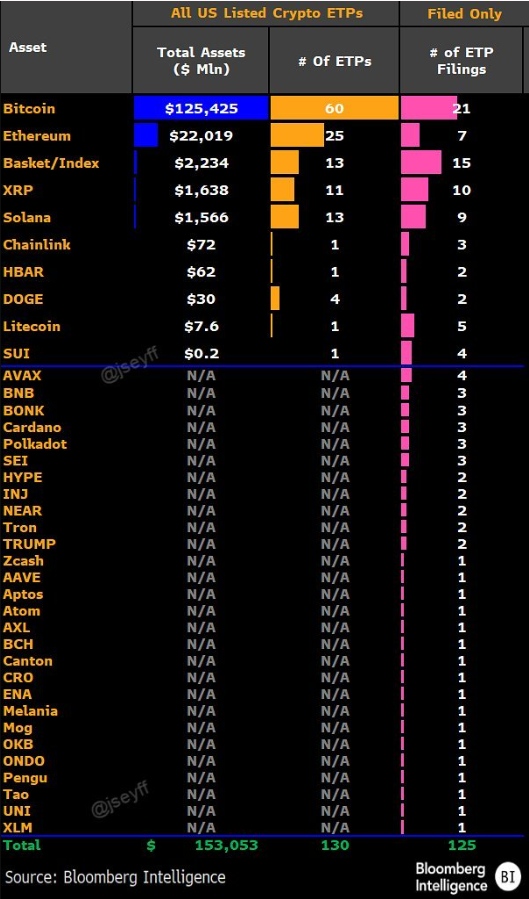
Bloomberg data shows 90 existing crypto ETPs managing $153 billion, with 125 filings pending. Bitcoin leads with $125 billion across 60 products, while Ethereum follows at $22 billion in 25 ETFs.

Altcoins like XRP and Solana remain niche, with 11–13 products each and $1.5–$1.6 billion in assets, signaling rising saturation risks.

The state of crypto ETFs/ETPs
The state of crypto ETFs/ETPs. Source: Bloomberg’s James Seyffart on X

With the market poised to be flooded, analysts anticipate direct competition for investor capital. However, historical trends suggest caution, with roughly 40% of ETFs launched since 2010 eventually closing, often due to insufficient assets or trading volume.

The Coming Crypto ETF Shakeout: Winners, Losers, and the Rise of ‘Zombie’ Assets

Seyffart’s warning reflects a broader concern that fast expansion often precedes consolidation. Crypto ETFs that fail to attract sufficient AUM, differentiate their strategies, or establish strong distribution networks may face early closure.

Products offering specialized exposure strategies, income features, or tailored risk profiles could establish lasting positions.

Chris Matta, CEO of Liquid Collective, echoes this concern in the context of “zombie” projects, describing crypto assets with market caps of $1 billion or more but minimal development.

“Maybe the failure to sustain an ETF in trad markets will be a stronger signal and will result in larger performance dispersion between active and dead crypto assets,” Matta said.

Therefore, investors entering the ETF space will need to be highly selective. Trading liquidity, tracking accuracy, fee structures, and issuer credibility will be crucial in distinguishing sustainable products from those that are likely to fail.

Meanwhile, Bitwise’s bullish predictions suggest that leading ETFs tied to major assets may continue to benefit from sustained institutional inflows.

The expected wave of liquidations by late 2027 will likely reshape the sector, consolidating capital among the strongest products.

While disruptive, the process may ultimately strengthen the US crypto ETF market by:

  • Removing weak offerings,
  • Clarifying choices for investors, and
  • Highlighting differentiated strategies.

The question remains: in a crowded ETF sector, which products will survive and which will join the growing ranks of crypto’s forgotten “zombie” assets?

The post The 11th Crypto Prediction from Bitwise May Not Survive—James Seyffart Warns appeared first on BeInCrypto.
  •  

Gamma Prime Highlights Its Marketplace for Uncorrelated Strategies at the Tokenized Capital Summit in Abu Dhabi

Gamma Prime successfully hosted the Tokenized Capital Summit 2025 in Abu Dhabi on December 9, bringing together more than 2,500 attendees. The event welcomed decision-makers from family offices, investment firms, hedge funds, venture capital funds, and other institutional capital vehicles, positioning it as the most important tokenization-focused gathering of the year.

The summit featured a high-profile speaker lineup, including Reeve Collins, Bryan Pellegrino, Charles Hoskinson, and Yat Siu, alongside senior executives from 21Shares, Galaxy Ventures, Spartan Capital, Crypto.com, HashKey, Revolut, and the founder of The Sandbox. Collectively, the participating speakers and organizations represented over $15 billion in assets under management, offering attendees deep insights into institutional adoption, tokenized capital markets, and emerging private investment structures.

During the event, attendees actively engaged in networking, held one-on-one meetings, and recorded interviews and media content throughout the day. The summit created a practical environment for meaningful connections, with discussions continuing well beyond the main stage sessions.

The Tokenized Capital Summit 2025 is a key industry gathering for the tokenization space, reinforcing its role as an important meeting point for institutional capital, technology providers, and market leaders shaping the next phase of tokenized finance.

Gamma Prime’s Product

Gamma Prime runs a compliant and secure marketplace for private investments, giving investors access to opportunities that are typically difficult to reach. The platform is built around non-correlated strategies, helping investors diversify beyond public markets in a practical and structured way.

Operating in line with regulatory requirements across multiple jurisdictions, Gamma Prime positions itself as a global marketplace for hedge funds, venture capital, private equity, and other illiquid assets. This approach enables funds to engage with institutional investors, family offices, and accredited investors worldwide, while expanding the range of available private market opportunities.

The leadership team brings together experience from DeFi, traditional finance, and academic research, and Stanford PhDs. This combination supports a balance between blockchain innovation and the governance and operational standards expected by institutional participants.

Where Traditional Finance Meets Tokenization

The Tokenized Capital Summit marks a significant step for the institutional digital asset sector. The event creates a focused environment where participants from traditional finance and leaders in tokenization can engage directly, exchange perspectives, and better understand how capital markets are evolving.

By hosting the Tokenized Capital Summit 2025 in Abu Dhabi on December 9, Gamma Prime reinforces its role in enabling secure and compliant access to private market opportunities. The summit also reflects a broader industry shift, as institutional investors, family offices, and Web3 companies increasingly collaborate to define the next phase of financial market development.

About Gamma Prime

Gamma Prime is a marketplace for private investments, offering investors streamlined access to hard-to-find, non-correlated yield and enabling funds to expand their reach globally. Fully regulatory compliant and built with institutional security standards, Gamma Prime is positioned to become the leading global platform for hedge funds, venture capital, private equity, and other illiquid private investment opportunities. The company was founded by a team of DeFi pioneers, traditional finance professionals, and Stanford PhDs.

The post Gamma Prime Highlights Its Marketplace for Uncorrelated Strategies at the Tokenized Capital Summit in Abu Dhabi appeared first on BeInCrypto.
  •  

Peter Brandt Turns Bearish on XRP Price Despite Ripple’s Push for Multichain Expansion

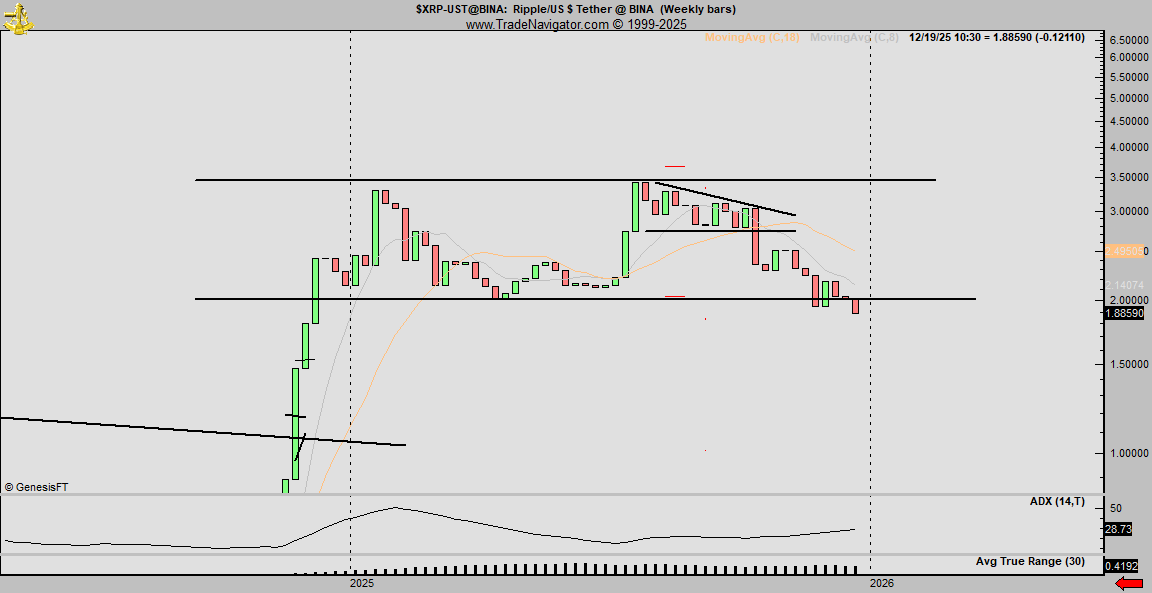
Veteran trader Peter Brandt has struck a bearish tone on XRP price, warning that the token may be forming a classic double-top pattern. His stance comes despite Ripple accelerating ecosystem growth through multichain stablecoin expansion and new institutional tools for XRP holders.

Brandt’s caution comes at a moment when XRP’s fundamentals and infrastructure narrative appear to be strengthening, creating a growing disconnect between technical signals and long-term adoption developments.

Brandt Flags Potential Double-Top Risk for XRP Price

The veteran chartist highlighted what he views as a potentially bearish setup on the XRP price chart. According to Peter Brandt, XRP may be forming a double-top, an often-cited reversal pattern that emerges when an asset fails to break above resistance after two attempts.

XRP chart showing potential double top pattern
XRP price chart highlighting potential double-top formation. Source: Peter Brandt on X

Double-top patterns in technical analysis typically signal waning bullish momentum and can precede deeper pullbacks if confirmation follows.

“I know in advance that all you Riplosts XRP will forever remind me of this post — ask me if I care. This is a potential double top,” Brandt wrote.

The XRP price has been consolidating after its late-2024 rally, placing greater focus on whether support levels can hold.

However, Brandt also acknowledged that the pattern could fail, leaving room for alternative interpretations.

“Sure, it may fail, and I will deal with this if it does. But for now, this has bearish implications. Love it or not — you need to deal with it,” he added.

Analysts Highlight Bullish Historical Context

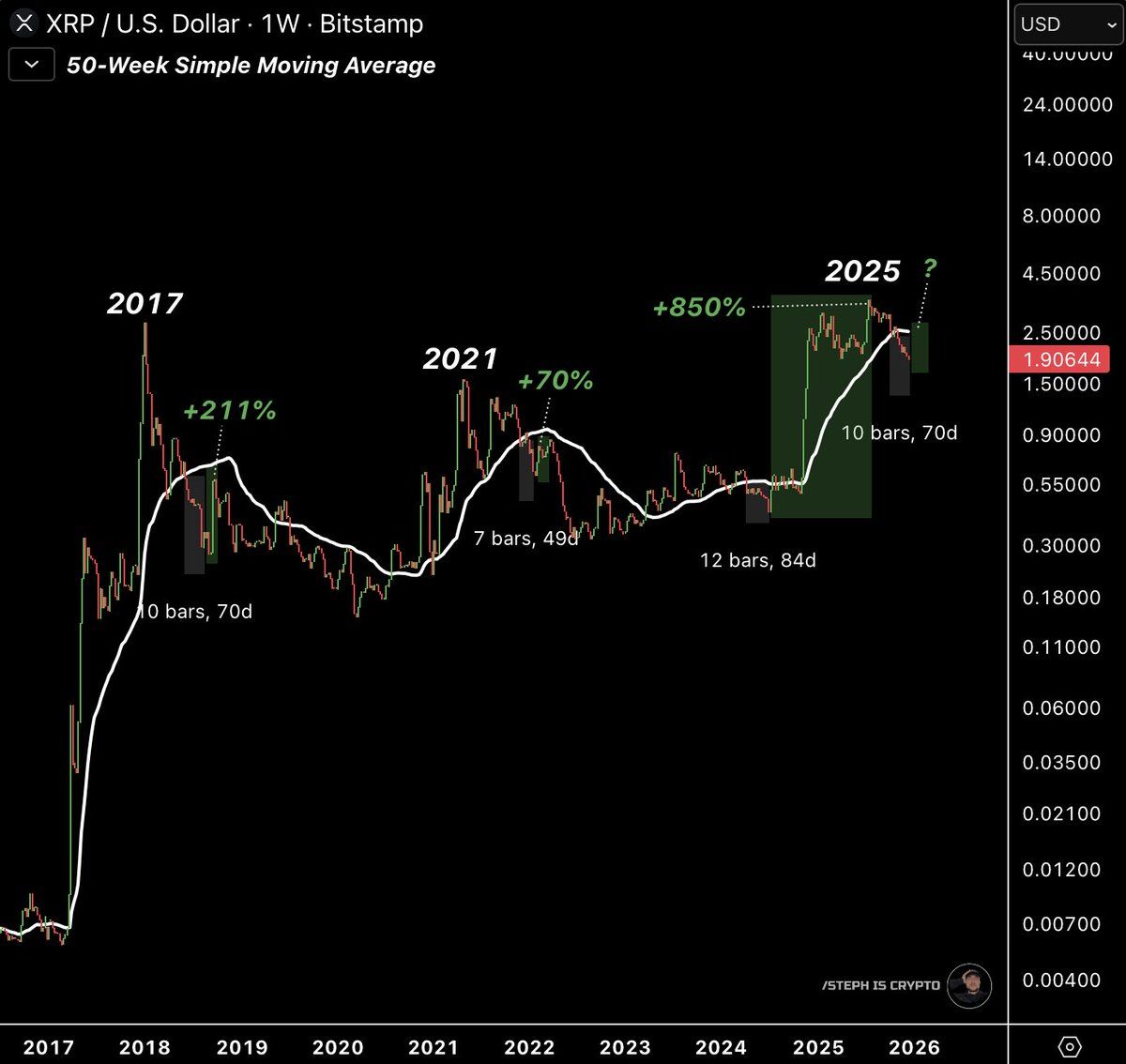
Other market analysts see the current setup very differently. Analyst Steph is Crypto pointed to XRP’s recurring behavior around its 50-week simple moving average (SMA), arguing that prior cycles suggest downside exhaustion rather than the start of a larger decline.

“Every cycle, when XRP breaks below the 50-week SMA and stays there for roughly 50–84 days, a strong rally has followed,” the analyst noted.

Historical examples include a 211% rally after 70 days below the SMA in 2017, a 70% move following 49 days in 2021, and an 850% surge after 84 days in 2024.

The XRP price has now spent roughly 70 days below its 50-week SMA, placing it squarely within the same historical window..

XRP historical performance relative to 50-week SMA
XRP’s historical rallies following extended periods below 50-week SMA. Source: Steph_iscrypto

The analysis suggests that what appears bearish in isolation could align with past cycle bottoms, mirroring the current split in technical interpretation.

Ripple Expands RLUSD Across Layer 2 Networks As Institutional Access Continues to Grow

While technical debate intensifies, Ripple continues to expand its ecosystem. On December 16, the company announced that its US dollar stablecoin, Ripple USD (RLUSD), will expand to Optimism, Base, Ink, and Unichain.

It leverages Wormhole’s Native Token Transfers (NTT) standard for multichain interoperability.

RLUSD was initially issued on the XRP Ledger and Ethereum. The Layer 2 rollout is designed to improve scalability, liquidity movement, and real-world utility across DeFi and institutional platforms.

Ripple emphasized that RLUSD is issued under a trust charter granted by the New York Department of Financial Services (NYDFS). This positions it as one of the most tightly regulated stablecoins entering Layer 2 ecosystems.

The company has also applied for a US OCC charter and recently gained regulatory recognition in Dubai and Abu Dhabi.

Wormhole added that XRP holders will be able to use XRP alongside RLUSD as a “premier trading and liquidity pair” across supported chains, supported by wrapped XRP (wXRP) issuance for cross-chain use.

Enhanced utility is coming for $XRP

XRP holders can use XRP alongside $RLUSD as a premier trading and liquidity pair on supported chains, allowing businesses to facilitate payments and checkout options that let users buy, sell, or send digital assets. pic.twitter.com/DMcSWyQ2XV

— Wormhole (@wormhole) December 17, 2025

Institutional tooling for XRP is also expanding. Digital Wealth Partners recently launched an algorithmic XRP trading strategy for qualified retirement accounts, offering insured custody through Anchorage Digital.

The service gives high-net-worth investors access to systematic XRP trading within regulated, tax-advantaged accounts. This reflects broader efforts to integrate crypto into traditional wealth management structures.

Digital Wealth Partners Launches Algorithmic XRP Trading Strategy Powered by @tryarchpublic for Qualified Retirement Accountshttps://t.co/ro7ipgP48D

— Digital Wealth Partners (@DWP_advisors) December 16, 2025

As XRP faces conflicting technical signals, its trajectory may hinge on whether bearish chart patterns dominate or whether historical cycles and expanding utility ultimately reassert control.

The post Peter Brandt Turns Bearish on XRP Price Despite Ripple’s Push for Multichain Expansion appeared first on BeInCrypto.
  •  

US CPI in Focus as Investors Weigh Fed’s January Rate Outlook

The United States (US) Bureau of Labor Statistics (BLS) will publish the all-important Consumer Price Index (CPI) data for November on Thursday at 13:30 GMT. 

The inflation report will not include CPI figures for October and will not offer monthly CPI prints for November due to a lack of data collection during the government shutdown. Hence, investors will scrutinize the annual CPI and core CPI prints to assess how inflation dynamics could influence the Federal Reserve’s (Fed) policy outlook. 

What to expect in the next CPI data report? 

As measured by the change in the CPI, inflation in the US is expected to rise at an annual rate of 3.1% in November, mildly above September’s reading. The core CPI inflation, which excludes the volatile food and energy categories, is also forecast to rise 3% in this period. 

TD Securities analysts expect annual inflation to rise at a stronger pace than anticipated, but see the core inflation holding steady.

“We look for the US CPI to rise 3.2% y/y in November – its fastest pace since 2024. The increase will be driven by rising energy prices, as we look for the core CPI to remain steady at 3.0%,” they explain. 

How could the US Consumer Price Index report affect the US Dollar? 

Heading into the US inflation showdown on Thursday, investors see a nearly 20% probability of another 25-basis-point Fed rate cut in January, according to the CME FedWatch Tool. 

The BLS’ delayed official employment report showed on Tuesday that Nonfarm Payrolls declined by 105,000 in October and rose by 64,000 in November. Additionally, the Unemployment Rate climbed to 4.6% from 4.4% in September. These figures failed to alter the market pricing of the January Fed decision, as the sharp decline seen in payrolls in October was not surprising, given the loss of government jobs during the shutdown.

In a blog post published late Tuesday, Atlanta Fed President Raphael Bostic argued that the mixed jobs report did not change the policy outlook and added that there are “multiple surveys” that suggest there are higher input costs and that firms are determined to preserve their margins by increasing prices. 

A noticeable increase, with a print of 3.3% or higher, in the headline annual CPI inflation, could reaffirm a Fed policy hold in January and boost the US Dollar (USD) with the immediate reaction. On the flip side, a soft annual inflation print of 2.8% or lower could cause market participants to lean toward a January Fed rate cut. In this scenario, the USD could come under heavy selling pressure with the immediate reaction. 

Eren Sengezer, European Session Lead Analyst at FXStreet, offers a brief technical outlook for the US Dollar Index (DXY) and explains: 

“The near-term technical outlook suggests that the bearish bias remains intact for the USD Index, but there are signs pointing to a loss in negative momentum. The Relative Strength Index (RSI) indicator on the daily chart recovers above 40 and the USD Index holds above the Fibonacci 50% retracement of the September-November uptrend.”

“The 100-day Simple Moving Average (SMA) aligns as a pivot level at 98.60. In case the USD Index rises above this level and confirms it as support, technical sellers could be discouraged. In this scenario, the Fibonacci 38.2% retracement could act as the next resistance level at 98.85 ahead of the 99.25-99.40 region, where the 200-day SMA and the Fibonacci 23.6% retracement are located.” 

“On the downside, the Fibonacci 61.8% retracement level forms a key support level at 98.00 before 97.40 (Fibonacci 78.6% retracement) and 97.00 (round level).”

The post US CPI in Focus as Investors Weigh Fed’s January Rate Outlook appeared first on BeInCrypto.
  •  

Bitfinex Bitcoin Whale Long Positions Surge 36%: What Does it Mean?

Large Bitcoin investors on Bitfinex are once again commanding market attention. Analysts tracking leveraged positioning data show that margined Bitcoin long positions held by “whales” have surged sharply, approaching levels last seen in March 2024.

The renewed build-up is occurring even as broader market participation cools, raising questions about what these well-capitalized traders are signaling.

What Does the Record High in Whale Long Positions on Bitfinex Signify?

According to on-chain analyst James Van Straten, Bitfinex whales have continued to add aggressively to their positions.

“Bitfinex whale continues to add to its margin long bitcoin position, approaching March 2024 highs. 36% higher in the past 3 months,” he wrote on X (Twitter).

The data highlights a steady accumulation trend since September, with long exposure expanding during periods of price weakness rather than rallies.

Bitfinex itself appeared to acknowledge the activity, highlighting that large, experienced traders may be positioning with conviction, while smaller participants are reducing risk.

Whale moves 🐳https://t.co/1Zgcof54xV

— Bitfinex (@bitfinex) December 8, 2025

This divergence in behavior is notable. While Bitcoin’s price action has remained choppy in recent weeks, whale accumulation has intensified.

Bitfinex Bitcoin long positions approaching March 2024 highs
Bitfinex Bitcoin long positions approaching March 2024 highs. Source: TradingView

Historically, these Bitfinex long positions have been associated with traders who use leverage tactically. They often scale into positions during drawdowns rather than chasing upside momentum.

According to crypto executive Samson Mow, the current dynamic is a transfer of coins from impatient sellers to long-term holders.

“Bitfinex whales out in force buying from paper hands,” he said, pointing to the contrast between selling pressure from weaker hands and sustained buying by large accounts.

A Contrarian Signal, But Not a Timing Tool

The Bitfinex whale long metric has long been watched as a potential leading indicator in technical analysis. However, its interpretation requires nuance.

These traders have a documented pattern of increasing long exposure during declines and trimming positions into strength. As a result, elevated long positions are often followed, not preceded, by price rallies.

Van Straten cautioned that the signal’s real value lies in watching for reversals rather than absolute levels.

“Short term, once the trend reverses,” he noted, implying that the eventual reduction of these longs may be more informative than their current size.

Not everyone agrees on the reliability of the indicator. Analyst Parabear Nick challenges overly confident interpretations of whale data, dismissing some bullish narratives entirely, amid claims that whale accumulation alone guarantees higher prices.

Indeed, historical data support a more balanced view. Whale long positions have reached extremes at different points in past cycles, sometimes remaining elevated for months before any decisive move in price.

Multi-year comparison of whale positioning versus Bitcoin price trends
Multi-year comparison of whale positioning versus Bitcoin price trends. Source: Parabear Nick on X

This suggests that while the metric can provide insight into positioning and sentiment, it should be evaluated in conjunction with other indicators, such as open interest, funding rates, and macro liquidity conditions.

The current accumulation comes as open interest across derivatives markets trends lower, signaling reduced participation from retail and short-term traders.

In that context, the concentration of leverage among whales becomes more significant. With fewer speculative participants, large players exert greater influence over marginal price movements.

What remains unclear is timing. Elevated whale longs suggest expectations of higher prices, but not necessarily an imminent breakout.

The key inflection point will come if and when these positions begin to unwind. Historically, such shifts have preceded changes in market regimes.

The post Bitfinex Bitcoin Whale Long Positions Surge 36%: What Does it Mean? appeared first on BeInCrypto.
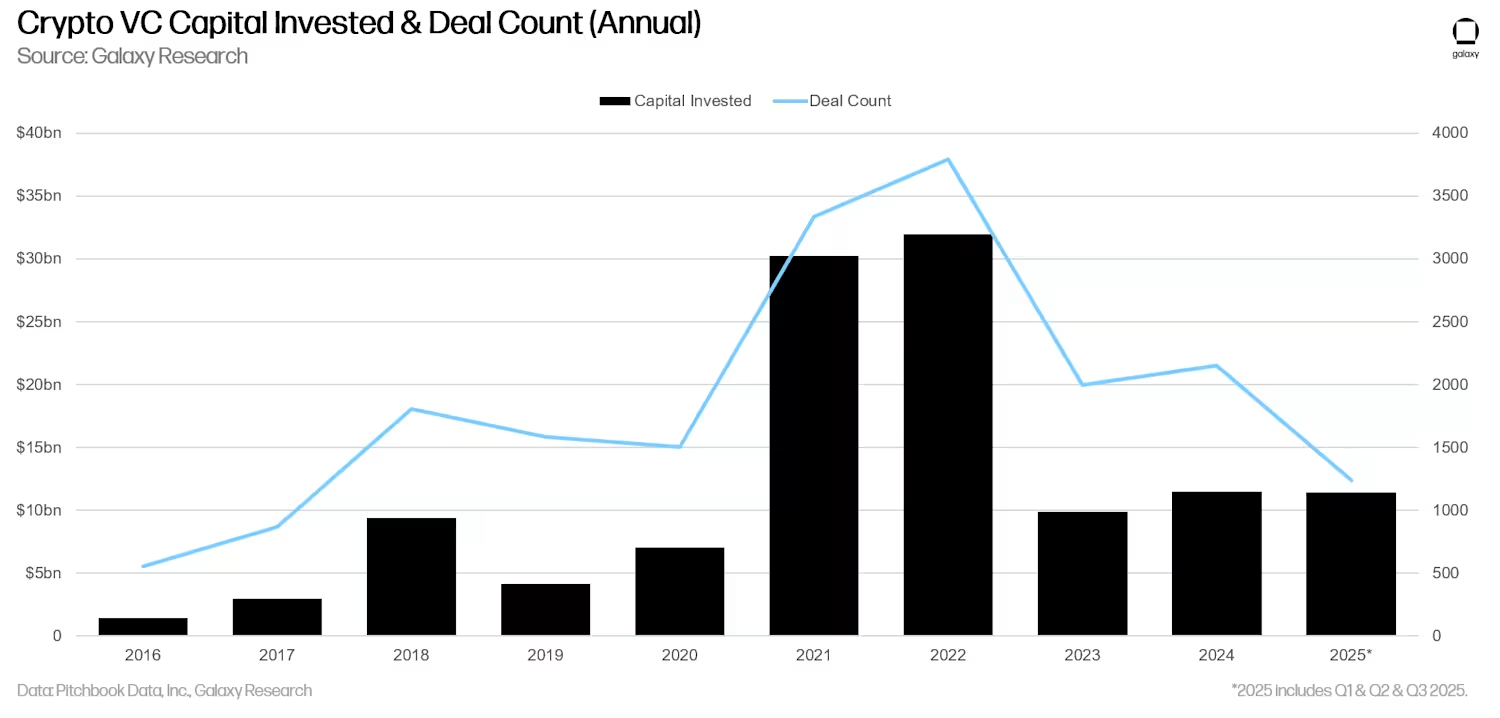
  •  

Could Bittensor Ever Be as Successful as Bitcoin?

Bitcoin is now, almost paradoxically to its original ethos, being adopted by Wall Street. Bittensor is a new finger to “the man” of centralization. It’s a sizzling hot narrative. With the rise of AI, concerns have arisen about the tech’s concentration and centralization. 

Bittensor, and its cryptocurrency, TAO, aims to decentralize AI services.  Despite losing nearly 53% in 2025, some believe Bittensor is a next-generation Bitcoin for the AI age. But how realistic is this optimism?

The Premise and Promise of Bittensor

The network just completed a reward halving on December 15, reducing its supply of minted coins. The problem is, many have heard this narrative before. 

With the first Bittensor halving complete, I can’t help but recall Bitcoin’s first halving, which I was fortunate enough to witness.  History doesn’t repeat, but the rhymes are unmistakable; both the parallels and differences between the two are striking:

Same: A Decentralized…

— Greg Schvey (@GSchvey) December 15, 2025

Plenty of cryptocurrencies have claimed to be “the next Bitcoin” – because there’s money to be made with that story. 

However, there could be some real value for Bittensor over the long run – though it has hurdles to overcome, as any sort of ambitious crypto project like this would.

The tale of Bittensor is not unlike Bitcoin: There are powerful incumbents, and a new network can take on and even upend this world order.

For years, influencers rehashed an often similar, anthemic phrase of “long Bitcoin, short the banks”. Notwithstanding that now Bitcoin is embedded in Wall Street banks and publicly traded DAT stocks, this narrative worked well. 

Bittensor’s price history since exchange listing in 2023. Source: CoinGecko

A premise is that AI companies such as OpenAI, Anthropic, and Deepseek have become too big and frightening, and people need to be concerned about their rise.


Decentralizing artificial intelligence workloads and replacing proof-of-work puzzles with actual real-use AI is Bittensor’s basic gist. 

“Bitcoin proved that cryptographic incentives could coordinate a global network of hardware to secure a ledger,” Evan Malanga, an executive at Yuma, one of the largest backers of the Bittensor platform, told BeInCrypto. “Bittensor takes that same mechanism and redirects the compute power toward something that has direct benefits in today’s world: Training and running AI models, applications, and infrastructure.”

Another Bitcoin? Really?

It’s important to note that Yuma is a subsidiary of Digital Currency Group (DCG), whose firm was one of the earliest backers of various cryptocurrencies, including Bitcoin, Zcash, and Decentraland. 

It was also an early investor in Coinbase, Circle, and Chainalysis. DCG’s CEO, Barry Silbert, is clearly on board with Bittensor – which for some could be considered a positive signal. 

Barry Silbert, who started crypto investing in 2012, is on board the TAO train. Source: X

Bittensor does have some Bitcoin-like characteristics. There are only 21 million units of TAO, clearly a nod to BTC. Bittensor also has halvings, which in December reduced its rewards from 7,200 TAO to 3,600 per day. 

Instead of the energy-intensive proof-of-work riddles Bitcoin uses, Bittensor uses something called proof-of-intelligence, where nodes must perform tasks to prove their capability in handling AI workloads. The better a node’s task output quality, the higher the chance it can receive rewards in TAO. 

Nodes that are allowed on the Bittensor network are then assigned a subnet, of which there are currently 128. These subnets have different AI-related specialties. 

“Each subnet is like a specialized marketplace for a specific type of AI service – some focus on image generation, others on language models,” said Arrash Yasavolian, the cofounder of Taoshi, which runs a financial intelligence subnet. 

Centralization Versus Decentralization

Concerns about AI often center on a few companies having concentrated power. Concentration in any industry typically means higher prices and poorer services for customers – sometimes both at the same time. 

Bittensor aims to make AI more of a global good with its decentralization characteristics, like having independent node operators power the subnets for its artificial intelligence capabilities. 

“AI is redefining every industry,” said Ken Jon Miyachi, CEO of BitMind, which runs a subnet focused on deepfake detections on Bittensor. ”Bitcoin revolutionized the store of value, but Bittensor is revolutionizing entire economic systems by making intelligence a global commodity.”

But how decentralized is this network? On July 10, 2024, the Bittensor network was halted amidst an $8 million hack that drained wallets. The chain was put into a “safe mode” that produced blocks without any transaction capabilities. 

“There are legitimate centralization concerns today,” noted Taoshi’s Yasavolian. “The OpenTensor foundation is the sole party responsible for validating blocks. The top 10 largest subnet validators comprise about 67% of total network stake weight.”

Some might argue that Bittensor’s security risks and ability to shut down the network are antithetical to decentralization. Proponents of the network say that full decentralization will come later, becoming “credibly neutral” the same way Bitcoin is supposed to be for store-of-value purposes. 

“Bittensor’s long-term strategic goal is to become a credibly neutral AI development tool. It’s progressive decentralization, similar to how Ethereum evolved,” Yasavolian added. 

The AI Alarm

One way to increase the decentralization of Bittensor and to hear more voices of dissent is via subnet operators. These groups are spending time and money to invest in the network, and they, like Yasavolian, voice their opinions. 

And subnet growth has been strong. Since the start of 2025, the number of subnets has increased 97%, from 65 to 128. 

Sergey Khusnetdinov, Director of AI at Gain Ventures, sees the subnet community as critically important to Bittensor’s success. 

“The result is a meritocratic, self-improving ecosystem where useful intelligence doesn’t come from one lab or one corporation but emerges organically from a worldwide, permissionless community.”

Chart of Bittensor subnet growth since March 2023. Source: Taostats

Centralized AI companies are valued quite ridiculously these days – OpenAI has a $500 billion valuation, Anthropic is at $350 billion. China-based Deepseek is rumored to have a $150 billion. With that in mind, what would be the value of a powerful AI network like Bittensor? 

Miyachi, the BitMind CEO who runs a deepfake detection subnet, bullishly believes the Bittensor network could someday excel over that of Bitcoin. 

“Value produced by the Bittensor ecosystem could surpass Bitcoin’s in the long run,” he told BeInCrypto. 

This could ultimately depend on how people perceive centralized AI systems over time, or whether anyone is concerned. But Bitcoin’s had huge runs as people reacted to economic instability and centralization failures such as a global pandemic, bank runs, and fiat currency debasement.  

Maybe soon, influencers might be saying, “long Bittensor, short centralized AI.” But who knows? Sometimes the future can be even stranger than AI could predict. 

The post Could Bittensor Ever Be as Successful as Bitcoin? appeared first on BeInCrypto.
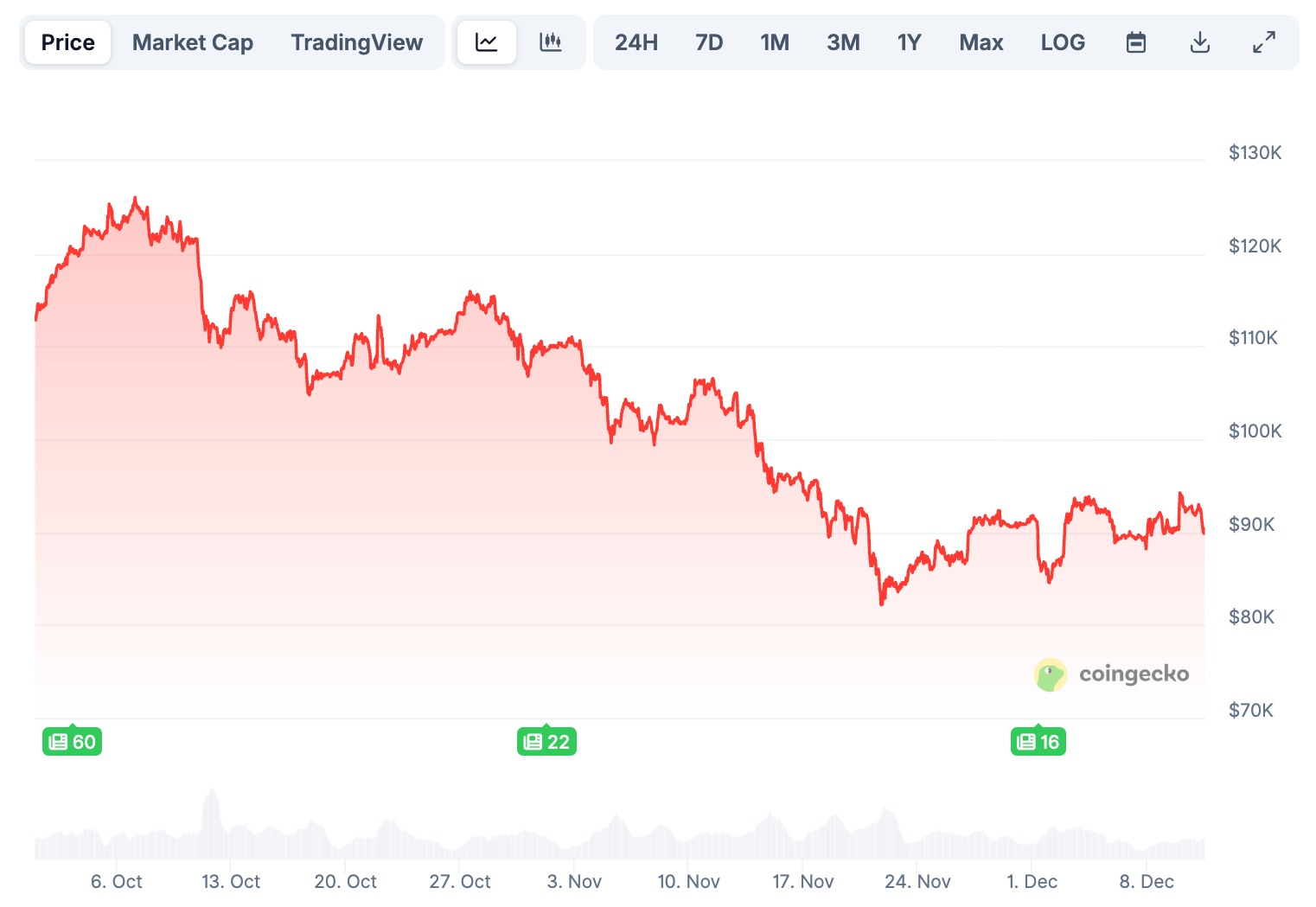
  •  

Bitcoin Added And Lost Nearly $100 Billion In Hours, What Just Happened?

Bitcoin experienced an extreme bout of volatility on December 17, surging more than $3,000 in under an hour before reversing sharply and falling back toward $86,000.

The violent swing did not follow any major news. Instead, market data shows the move was driven by leverage, positioning, and fragile liquidity conditions.

A Short Squeeze Pushed Bitcoin Higher

The initial rally began as Bitcoin pushed toward the $90,000 level, a major psychological and technical resistance zone.

Bitcoin Price Wild Swing on December 17. Source: CoinGecko

Liquidation data shows a dense cluster of leveraged short positions positioned above that level. When price moved higher, those shorts were forced to close. That process requires buying Bitcoin, which pushed prices up even faster.

Roughly $120 million in short positions were liquidated during the spike. This created a classic short squeeze, where forced buying accelerates the move beyond what normal spot demand would justify.

Crypto Market Liquidations On December 17. Source: Coinglass

At this stage, the move looked strong. But the structure underneath it was weak.

The Rally Flipped Into A Long Liquidation Cascade

As Bitcoin briefly reclaimed $90,000, new traders entered the market chasing momentum.

Many of those traders opened leveraged long positions, betting the breakout would hold. However, the rally lacked sustained spot buying and quickly stalled.

When the price began to fall, those long positions became vulnerable. Once key support levels broke, exchanges automatically liquidated those positions. More than $200 million in long liquidations followed, overwhelming the market.

Whoever is left

We need to know what happened on October 10

It's VERY apparent that the market broke that day and nothing has been the same since

We haven't seen Bitcoin or Alts trade like this since 2018

We need answers pic.twitter.com/jXe7jwd7RA

— EllioTrades (@elliotrades) December 17, 2025

This second wave explains why the drop was faster and deeper than the initial rise. 

Within hours, Bitcoin had fallen back toward $86,000, erasing most of the gains.

Positioning Data Shows A Fragile Market Setup

Trader positioning data from Binance and OKX helps explain why the move was so violent.

On Binance, the number of top trader accounts leaning long rose sharply ahead of the spike. However, position-size data showed less conviction, suggesting many traders were long but not heavily sized.

Bitcoin Long/Short Ratio on Binance Futures. Source: Coinglass

On OKX, position-based ratios shifted aggressively after the volatility. That suggests larger traders repositioned quickly, either buying the dip or adjusting hedges as liquidations played out.

This combination — crowded positioning, mixed conviction, and heavy leverage — creates a market that can move violently in both directions with little warning.

Bitcoin Long/Short Ratio on OKX. Source: Coinglass

Did Market Makers Or Whales Manipulate The Move?

On-chain data showed market makers such as Wintermute moving Bitcoin between exchanges during the volatility. Those transfers coincided with the price swings but do not prove manipulation.

Market makers routinely rebalance inventory during periods of stress. Deposits to exchanges can indicate hedging, margin management, or liquidity provision, not necessarily selling to crash prices.

Importantly, the entire move can be explained by known market mechanics: liquidation clusters, leverage, and thin order books. There is no clear evidence of coordinated manipulation.

Wintermute Heavily Repositioning Bitcoin Across Centralized Exchanges. Source: Arkham

What This Means For Bitcoin Going Forward

This episode highlights a key risk in today’s Bitcoin market.

Leverage remains elevated. Liquidity thins quickly during fast moves. When price approaches key levels, forced liquidations can dominate price action.

Bitcoin’s fundamentals did not change during those hours. The swing reflected market structure fragility, not a shift in long-term value.

🚨 BITCOIN IS BEING MANIPULATED, AND I HAVE SOLID PROOF!!!

Everyone’s talking about how Bitcoin went up $3,000 and then down $4,000 in minutes.

Everyone’s posting about it…

but nobody seems to understand what actually happened.

You need to look at the flows, not the chart.… pic.twitter.com/IHCXtx3sUF

— NoLimit (@NoLimitGains) December 17, 2025

Until leverage resets and positioning becomes healthier, similar sharp moves remain possible. In this case, Bitcoin did not rally and crash because of news.

It moved because leverage turned price against itself.

The post Bitcoin Added And Lost Nearly $100 Billion In Hours, What Just Happened? appeared first on BeInCrypto.
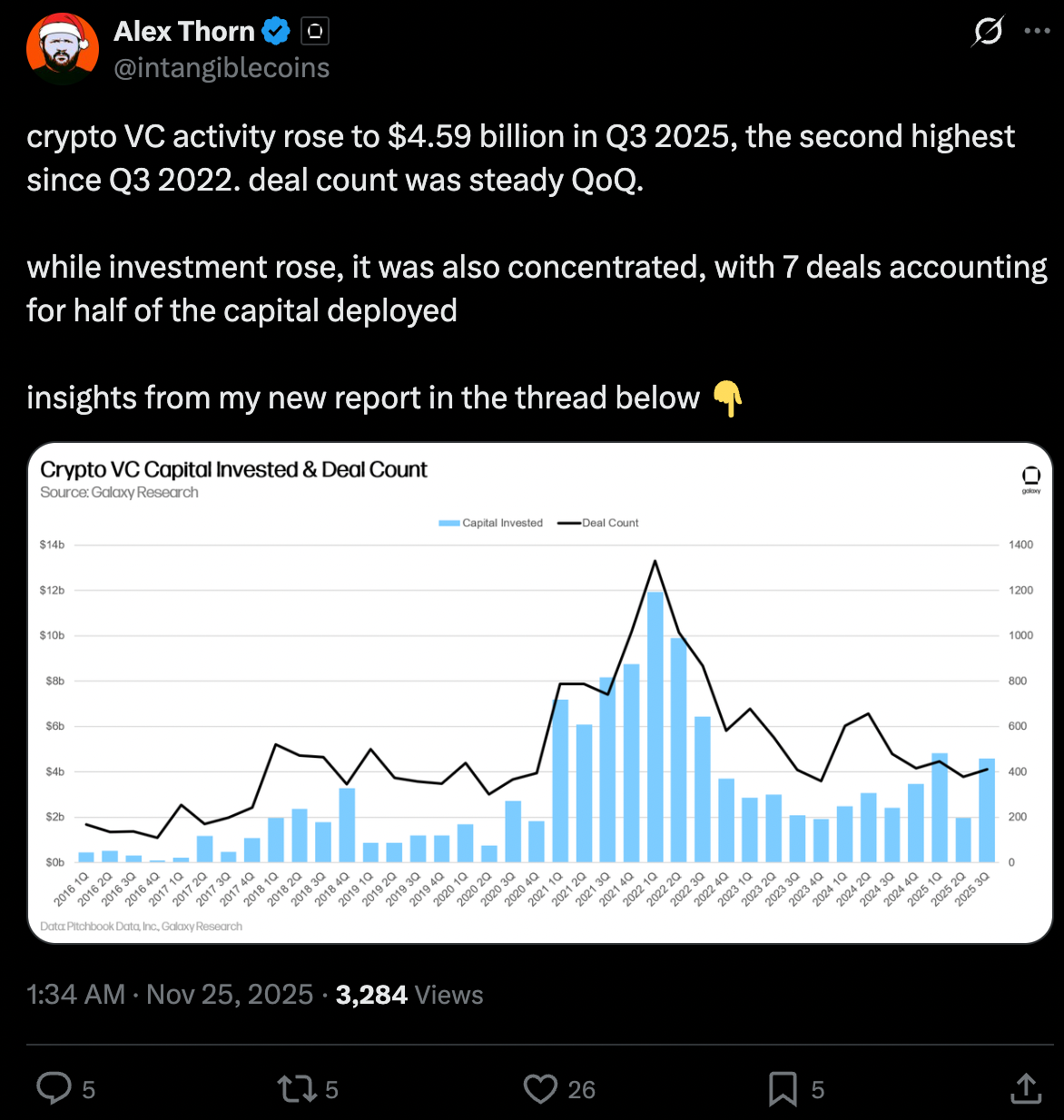
  •  

Coinbase Ventures-Backed Stablecoin Bank Triggers Terra UST-Style Fears

Kontigo is gaining traction by promoting a stablecoin-first banking model as a global alternative to traditional financial services.

At the same time, its rapid rise has prompted skepticism within the crypto community. The model has raised questions over whether it can scale sustainably without repeating the missteps that have defined past industry failures.

Kontigo’s Rapid Rise Draws Attention

A new bank building its entire identity around stablecoins is rapidly climbing the ranks of the financial services industry.

Kontigo positions itself as a stable-currency platform offering self-custodial wallet services that allow users to store value in Bitcoin and spend in local stablecoins, with all transactions recorded on the blockchain.

On Tuesday, Kontigo CEO Jesus Castillo announced that the company had raised $20 million in a seed funding round to pursue its ambition of building the world’s largest bank. 

We just raised a $20M seed round to build the largest bank in the world.

Kontigo crossed $30M in annual revenue, $1B in payment volume, and 1M users in under 12 months, with a team of six engineers and one designer.

We are the fastest-growing stablecoin neobank in the world.… pic.twitter.com/pOmQ6gSy2H

— Jesus A. Castillo F. (@jecastillof) December 16, 2025

Castillo also described Kontigo as the fastest-growing stablecoin neobank globally. He said the platform allows individuals and businesses to earn a 10% yield on digital dollars, use a stablecoin-linked card with Bitcoin cashback, and invest in tokenized US stocks, among other features.

The leadership team says Kontigo aims to expand access to basic financial services to nearly 5 billion people worldwide. Prominent institutional investors, including Base and Coinbase Ventures, back the company.

Despite gaining significant traction almost immediately, Kontigo has also faced skepticism. Some observers questioned whether it represents a familiar crypto narrative, one that has previously generated catastrophic consequences for the broader market.

No-KYC Access Triggers Warning Signs

Among the various benefits Kontigo has highlighted, the company has emphasized that users from anywhere in the world can open an account and begin transacting in USDC or USDT without having to comply with Know Your Customer (KYC) requirements.

While this approach may appear less bureaucratic on the surface, it quickly raised concerns among users and industry observers. 

KYC rules are designed to protect financial institutions from bad actors. They require identity verification and confirmation of customer legitimacy.

Without such safeguards, both financial platforms and users face increased exposure to risks of fraud, money laundering, and terrorist financing.

Within the crypto industry, the absence of KYC standards has previously proven harmful for users relying on unprotected platforms.

A multinational stablecoin operation
Promising a fixed above-market yield
And access to tokenized stocks
With no KYC

Where have I seen all this before? pic.twitter.com/YAKiPpWH9B

— Zack Guzmán ♻️ (@zGuz) December 17, 2025

Last week, Terraform Labs co-founder Do Kwon was sentenced to 15 years in prison for orchestrating a $40 billion cryptocurrency fraud. Terra’s ecosystem operated without meaningful KYC controls, enabling vast sums of capital to enter the system anonymously and at scale.

When confidence in its algorithmic stablecoin unraveled, that absence of oversight intensified the run on the network, limited transparency around fund flows, and amplified losses for millions of users. The case underscored how the lack of basic safeguards can transform rapid expansion into systemic collapse.

The absence of KYC standards is not the only factor that has raised concerns about Kontigo’s mission.

Yield Promises Test User Confidence

Castillo clarified at one point that the 10% yield on USDC holdings comes from lending through DeFi protocol Morpho, exposure to US Treasury bills, and custody or yield-related services via Coinbase. 

Yet, critics said the numbers did not add up, raising concerns over the credibility of Kontigo’s advertised promises. Yields from these sources typically range between 3% and 7% annually, even when combined under current market conditions. 

be @kontigo_app a new Fintech

offer 10% yield on USDC

when asked where does it comes from lie saying is lending in Morpho + Tbills + Coinbase

math ain't mathing as those APRs are 5-7% short of 10%

Ignore people who point this shortage

any comments @jecastillof ? https://t.co/xegvZiODrg pic.twitter.com/blSKZLN7g7

— Cisco | CryptoAlert (@CiscoCANFT) December 17, 2025

Skeptics questioned how Kontigo can sustainably offer a 10% return. They pointed to the possibility of undisclosed risk, leverage, or opaque strategies.

Meanwhile, another user reported that a USDC transfer had not been credited to their wallet several hours after its initiation. 

For platforms that position themselves as banks or payment infrastructure, even short delays in fund availability can erode user confidence. Reliability and timely settlement are foundational expectations, regardless of transaction size.

As Kontigo scales, its long-term credibility will depend less on growth claims than on execution and earned user trust.

In a sector shaped by past failures, the company now faces mounting pressure to show that rapid expansion can be sustained without repeating the mistakes that have defined earlier crypto collapses.

The post Coinbase Ventures-Backed Stablecoin Bank Triggers Terra UST-Style Fears appeared first on BeInCrypto.
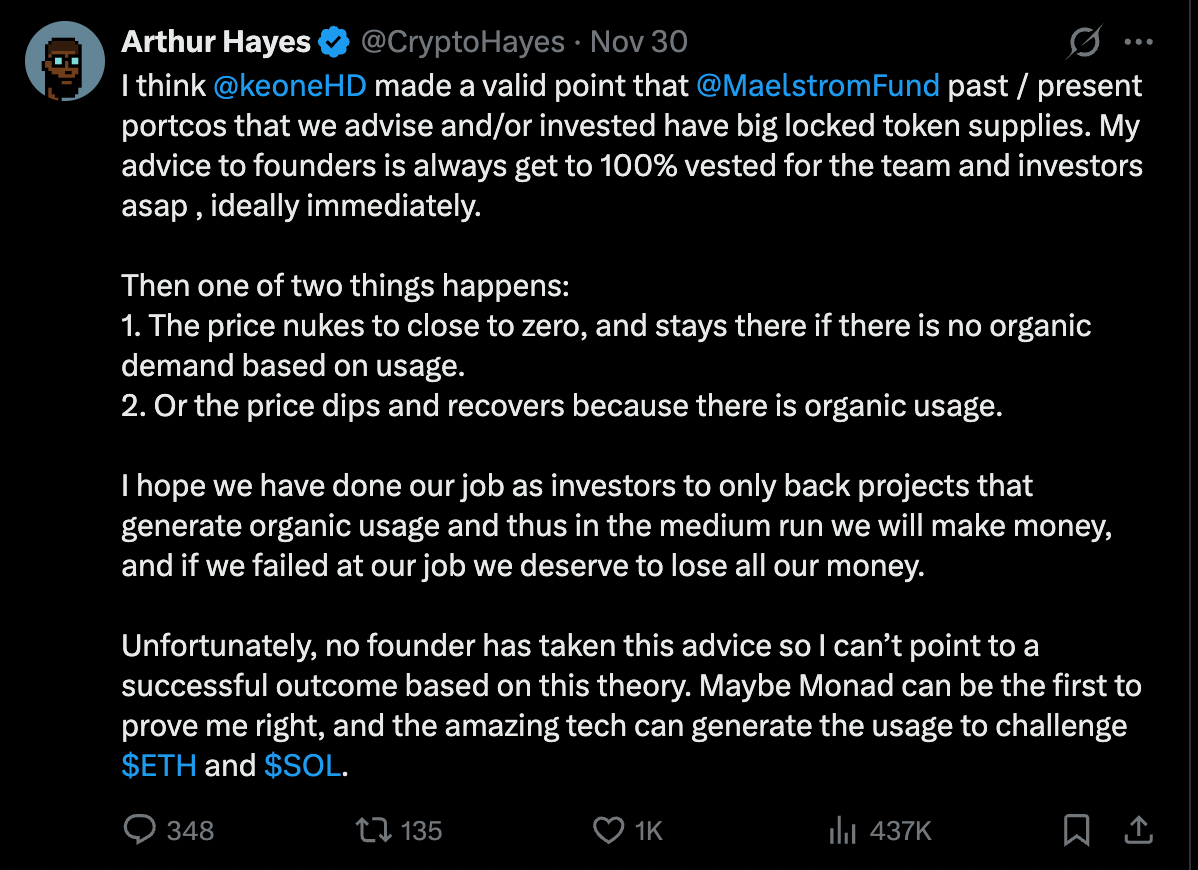
  •