Reading view

Japan Tightens, America Eases: Which Central Bank Really Moves Markets Now? | US Crypto News

Welcome to the US Crypto News Morning Briefing—your essential rundown of the most important developments in crypto for the day ahead.

Grab a coffee because today’s Morning Briefing isn’t just about interest rates. It’s about leverage, funding, and which side of the Pacific really sets the rhythm for risk assets when the policy paths split. As one central bank eases (the US), the other tightens (Japan). The tension between the two is beginning to reshape global liquidity in ways that don’t show up in a single chart or price candle.

Crypto News of the Day: Japan Raises Interest Rates, But the Fed Cuts, Which Side Has A Stronger Impact?

Global markets are at an impasse, amid a rare and consequential policy divergence. On the one hand, the US Federal Reserve has begun cutting interest rates to support slowing growth. In contrast, the Bank of Japan (BOJ) is moving in the opposite direction, raising rates to levels not seen in three decades.

The question facing investors is no longer whether these moves matter, but which one ultimately carries more weight for global liquidity, currencies, and crypto markets.

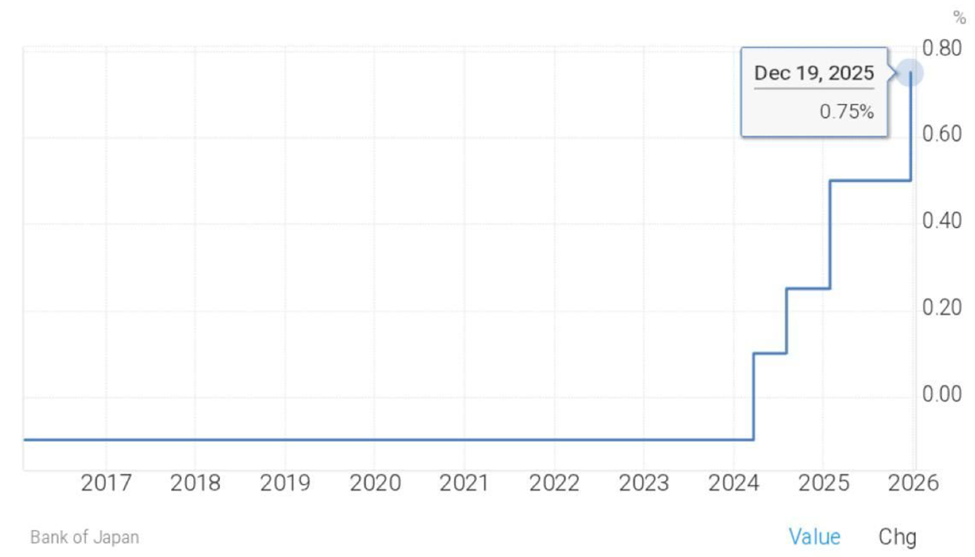
On December 19, the BOJ raised its policy rate by 25 basis points to 0.75%, the highest level since 1995. This marks another step away from decades of ultra-loose monetary policy. Macro analysts see the move as more than a routine adjustment.

🚨 BREAKING: 🇯🇵 BOJ DELIVERS THE HIKE

Rates raised 25 bps to 0.75%, marking a 30-year high.

Japan’s era of ultra-easy money keeps fading.

This is a major global LIQUIDITY shift… watch yen and risk assets closely. 👀 pic.twitter.com/vfciRH84WJ

— Wise Advice (@wiseadvicesumit) December 19, 2025

Unlike the Federal Reserve’s rate cuts, which are cyclical and designed to smooth economic slowdowns, Japan’s tightening is structural. For nearly 30 years, near-zero Japanese rates anchored one of the world’s most important sources of cheap leverage.

Even modest increases now carry outsized consequences because they disrupt funding strategies deeply embedded across global markets.

The immediate impact was most visible in currency markets. Despite the historic hike, the yen initially weakened as Governor Kazuo Ueda offered limited clarity on the pace of future tightening.

Reuters noted that the currency slipped as the BOJ “stays vague on tightening path.” This highlights how forward guidance, not just the hike itself, remains critical.

Still, analysts argue the real transmission channel lies elsewhere: the yen carry trade, as reported in a recent US Crypto News publication.

As Japanese yields rise and the US–Japan rate gap narrows, borrowing yen to fund higher-yielding positions becomes increasingly expensive.

Fed cut rates, but the message mattered more than the cut. Their dot plot now shows fewer cuts ahead. That flipped expectations from “easy money coming” to “higher for longer.” At the same time, BOJ hike expectations strengthened the yen → yen carry trades started unwinding →… pic.twitter.com/eSaJLWQajg

— Dmytro V7 🇺🇦 (@V7Dmytro) December 16, 2025

This is where the divergence between Tokyo and Washington becomes critical:

  • Fed cuts tend to support markets gradually by easing credit conditions.
  • BOJ tightening, by contrast, forces immediate repositioning as leverage costs rise.

Crypto markets have historically experienced this impact more quickly than traditional assets. Previous BOJ tightening cycles coincided with sharp Bitcoin drawdowns of 20–30% as liquidity tightened and carry trades unwound.

THE BANK OF JAPAN MIGHT BE BITCOIN’S BIGGEST ENEMY

Japan holds the most US debt.
Every time they hike, Bitcoin bleeds:

March 2024: -23%
July 2024: -30%
Jan 2025: -31%

Next hike: Dec 19
Next move: loading…

If the pattern repeats, $70K is in play. pic.twitter.com/R5916R702I

— Merlijn The Trader (@MerlijnTrader) December 14, 2025

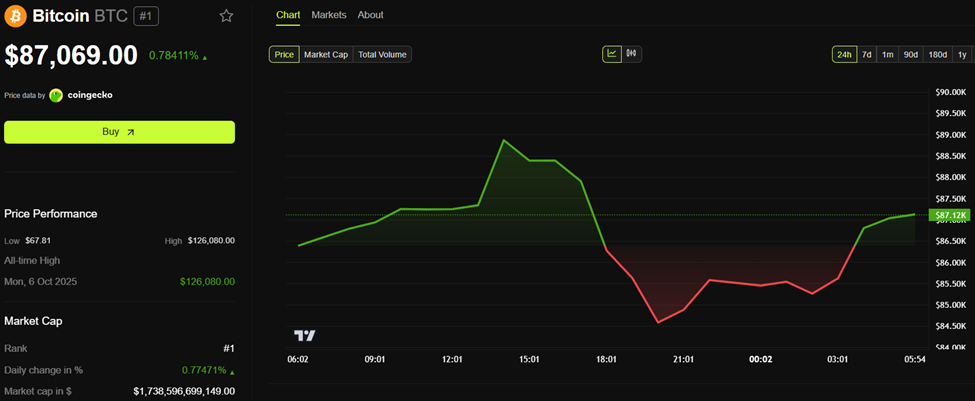
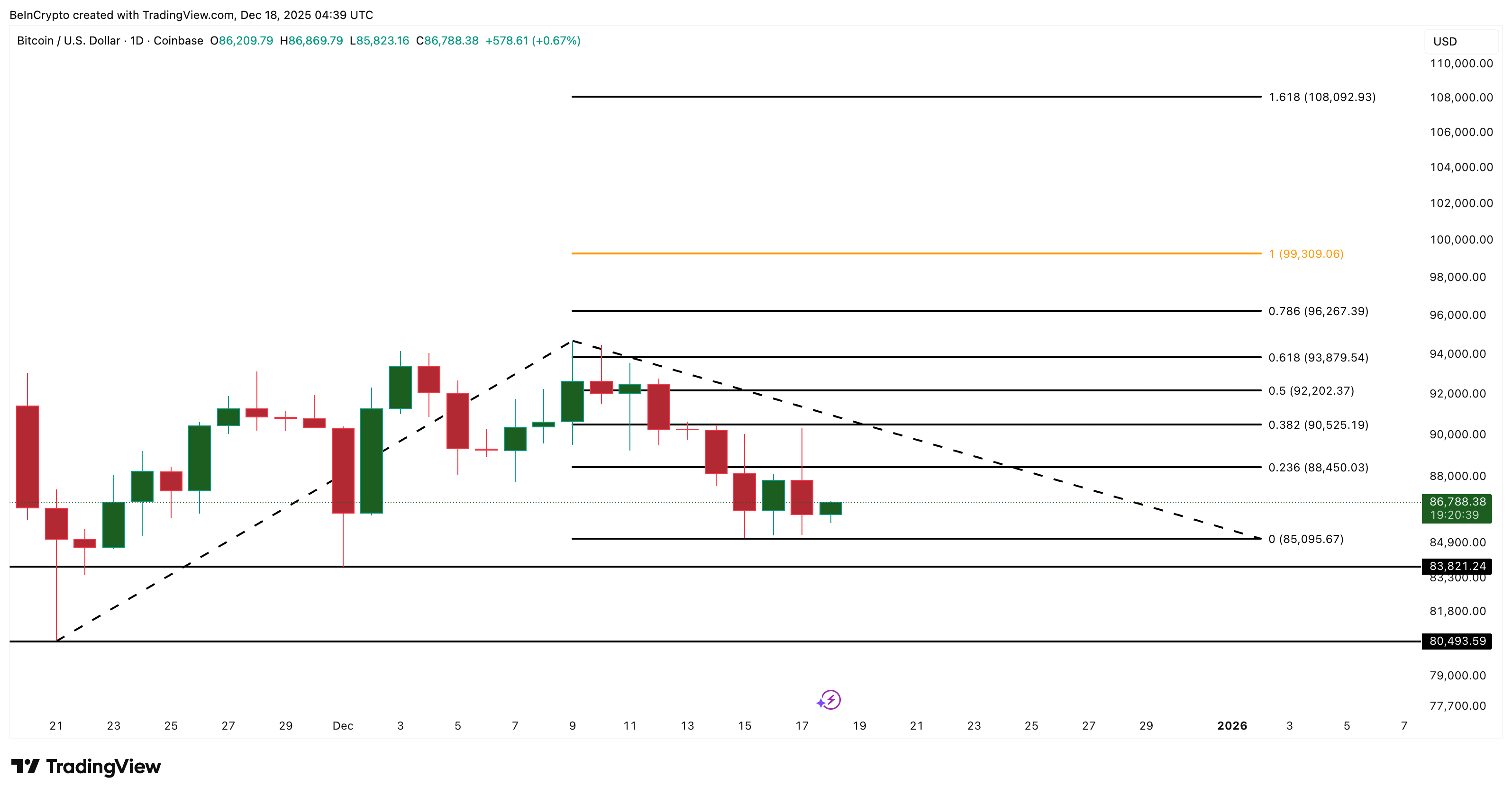
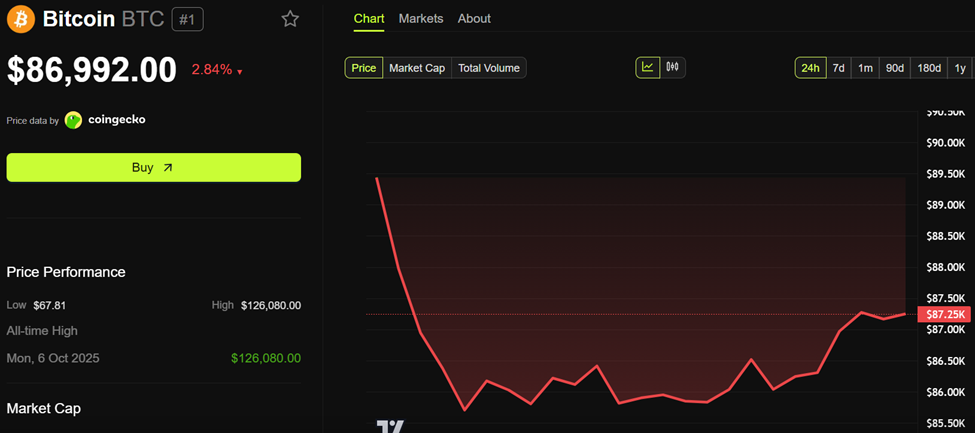
That pattern has made Bitcoin’s recent stability stand out. As of this writing, BTC was trading for $88,035, up by almost 1% in the last 24 hours.
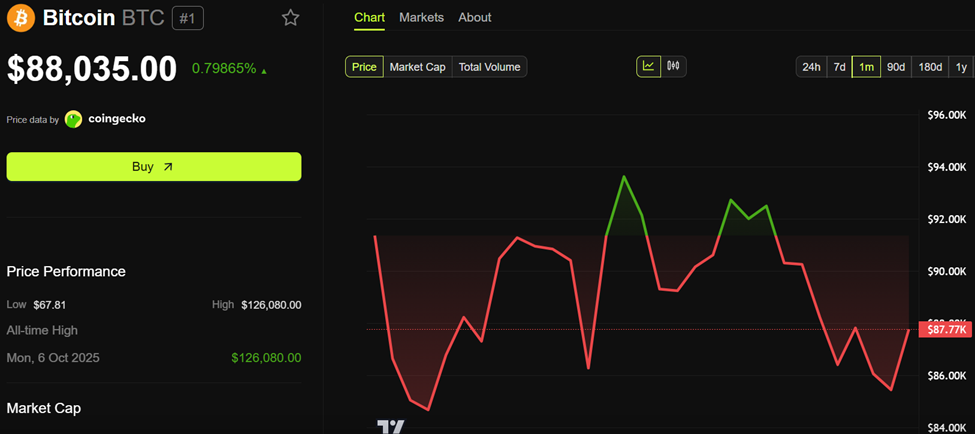
Bitcoin (BTC) Price Performance. Source: BeInCrypto

“History shows every prior tightening triggered 20–30% Bitcoin drops as yen carry trades unwound and liquidity tightened. Yet with the hike fully priced in and BTC holding around $85k–$87k, this could be the dip buyers have been waiting for,” wrote analyst Blueblock.

However, resilience at the top of the crypto market does not eliminate risk elsewhere. Altcoins, which are far more sensitive to liquidity conditions, remain exposed if Japanese tightening continues.

Indeed, BOJ officials have openly signaled willingness to keep tightening if wage growth and inflation remain durable. Analysts at ING and Bloomberg have warned that while further hikes may not be imminent, the direction of travel is clear.

The implication for global markets is stark. Fed cuts may provide broad support over time, but Japan’s retreat from ultra-easy policy strikes directly at the foundation of global leverage.If the BOJ continues down this path, its influence on liquidity, currencies, and crypto could outweigh US easing, at least in the near term.

Chart of the Day
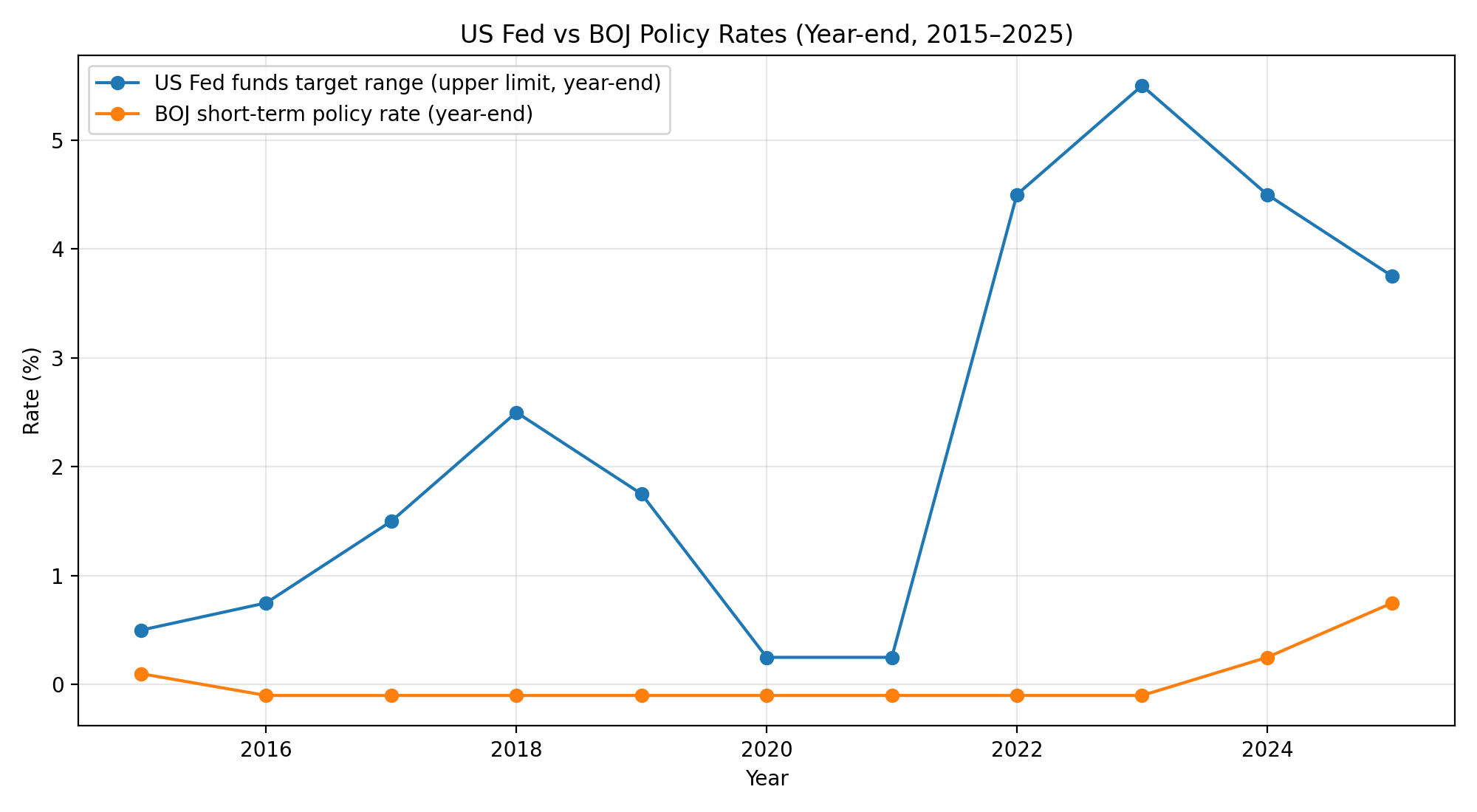
Fed Fund Rates vs BOJ Policy Rate

Byte-Sized Alpha

Here’s a summary of more US crypto news to follow today:

Crypto Equities Pre-Market Overview

CompanyAt the Close of December 18Pre-Market Overview
Strategy (MSTR)$158.24$163.97 (+3.62%)
Coinbase (COIN)$239.20$246.00 (+2.84%)
Galaxy Digital Holdings (GLXY)$22.51$22.95 (+1.95%)
MARA Holdings (MARA)$9.69$9.87 (+1.86%)
Riot Platforms (RIOT)$13.38$13.73 (+2.62%)
Core Scientific (CORZ)$14.56$15.04 (+3.30%)
Crypto equities market open race: Google Finance

The post Japan Tightens, America Eases: Which Central Bank Really Moves Markets Now? | US Crypto News appeared first on BeInCrypto.

  •  

What Does a 100% Accurate Historical Indicator Signal for Bitcoin in December?

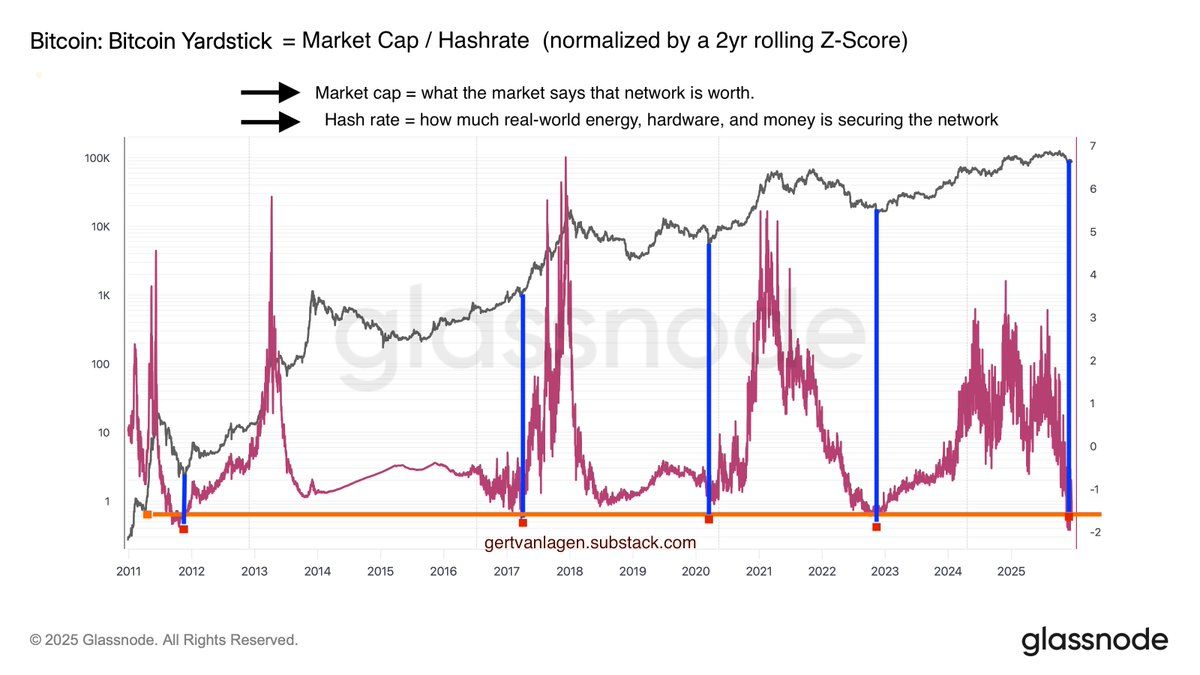
Bitcoin may be approaching one of its most pivotal turning points in years. A leading valuation metric, the BTC Yardstick, currently reads -1.6 standard deviations below its long-term mean, signaling the pioneer crypto’s deepest undervaluation since the 2022 bear market low.

Historically, this level has coincided with major cycle bottoms, including 2011, 2017, 2020, and 2022.

BTC Yardstick Shows Strongest Undervaluation in Years

The Yardstick measures Bitcoin’s market price against the cost and power required to secure its network. This includes mining infrastructure and operational expenditures.

“BTC Yardstick at –1.6σ = Bitcoin is insanely undervalued. Other occurrences: 2022 bear market low, 2020 COVID crash bottom, 2017 pre-blow-off base, 2011 bear market bottom…All occurrences coincided with strong accumulation…Bottom was in as well!” wrote analyst Gert van Lagen in a post.

BTC Yardstick indicator showing historical undervaluation signals
BTC Yardstick indicator at major market bottoms, attributed to Gert van Lagen

Whale Accumulation Hits Highest Levels in Over a Decade

Meanwhile, the undervaluation signal coincides with unprecedented accumulation activity. Over the past 30 days, BTC whales and large holders purchased 269,822 BTC, worth approximately $23.3 billion. According to Glassnode data, this is the largest monthly accumulation since 2011.

BITCOIN'S BIGGEST MONTHLY ACCUMULATION IN 13 YEARS

Whales purchased 269,822 BTC, worth approximately $23.3 billion, in just 30 days.

– Glassnode Data pic.twitter.com/6FPfhFhfh4

— Kashif Raza (@simplykashif) December 18, 2025

“Largest accumulation in 13 years. The 4-year cycle is dead; the Supercycle is here,” wrote crypto analyst Kyle Chasse.  

The bulk of this buying occurred in wallets holding between 100 and 1,000 BTC. This suggests that both high-net-worth individuals and smaller institutions are positioning for a potential market rebound.

Market Sentiment After Bitcoin’s Minor Correction As Frustration Breeds Opportunity

Despite the record accumulation and undervaluation, Bitcoin’s price has faced downward pressure this year. According to Bloomberg ETF analyst Eric Balchunas, recent losses are modest relative to prior gains.

I get that this year is a drag but consider Bitcoin was up 468%(!!) in the two years prior to this year. That's 138% ann, 8x US stocks. That is sooo much excess return beyond normalcy (even for btc, thank you ETFs!). All that happened this year is you gave back a tiny bit of the… https://t.co/oQ4EuUt64A

— Eric Balchunas (@EricBalchunas) December 18, 2025

The launch of spot Bitcoin ETFs in early 2024 contributed to previous surges, driving the asset to its then-record highs near $69,000 in March 2024.

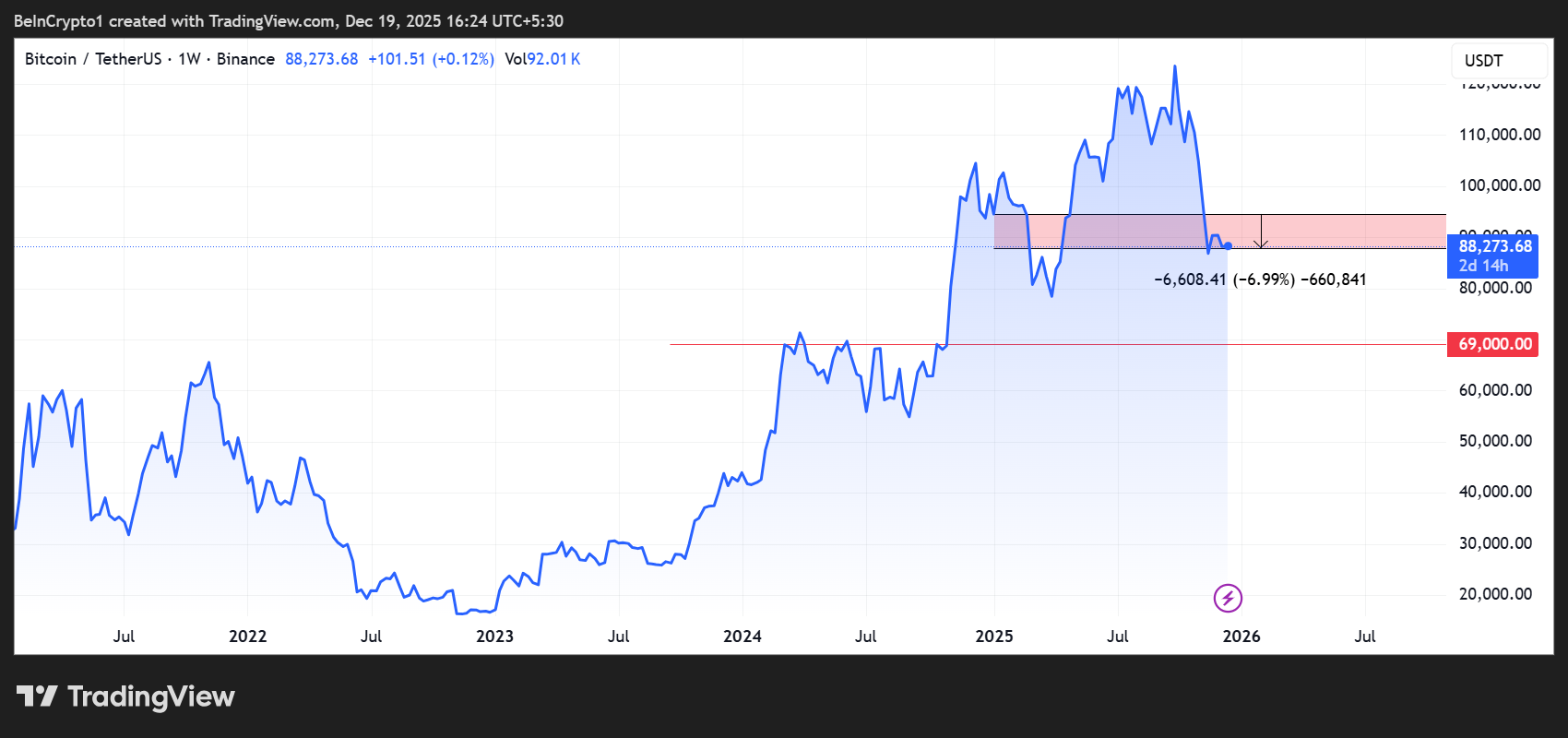
Overall, Bitcoin returned 155.42% in 2023 and 121.05% in 2024 before experiencing an 7% decline year-to-date. This suggests the current dip may be a natural correction after exceptional gains.

Bitcoin (BTC) Price Performance
Bitcoin (BTC) Price Performance. Source: TradingView

Analysts note that market rallies often begin not when hope is high, but when investors are weary.

“We are not scared anymore, we are tired. Tired of waiting. Tired of believing. But listen, market rallies don’t start when hope is high; it’s when people are tired, frustrated, and ready to give up,” wrote analyst Ash Crypto.

The convergence of historically low valuation, record whale accumulation, and declining leverage suggests that Bitcoin may be nearing another cyclical inflection point.

While timing remains uncertain, these indicators highlight a unique window of potential opportunity for long-term investors.

The post What Does a 100% Accurate Historical Indicator Signal for Bitcoin in December? appeared first on BeInCrypto.

  •  

BOJ Raises Interest Rates to 0.75%, But Bitcoin Stands Unshaken—Is the Crypto Calm a Warning or Opportunity?

The Bank of Japan (BOJ) raised its policy interest rate by 25 basis points to 0.75% on December 19. It marks its highest level in nearly 30 years, reinforcing the country’s gradual exit from ultra-easy monetary policy.

Yet despite the historic shift and warnings of a global liquidity squeeze, Bitcoin showed little reaction, rising just under 1% and holding in the $87,000 range.

BOJ Just Raised Interest Rates Another 25 Basis Points – Why Did Bitcoin Hold Steady?

The muted response stands in contrast to history. Previous BOJ tightening cycles have often coincided with sharp sell-offs in crypto markets, particularly as yen carry trades unwind and global liquidity tightens.

THE BANK OF JAPAN MIGHT BE BITCOIN’S BIGGEST ENEMY

Japan holds the most US debt.
Every time they hike, Bitcoin bleeds:

March 2024: -23%
July 2024: -30%
Jan 2025: -31%

Next hike: Dec 19
Next move: loading…

If the pattern repeats, $70K is in play. pic.twitter.com/R5916R702I

— Merlijn The Trader (@MerlijnTrader) December 14, 2025

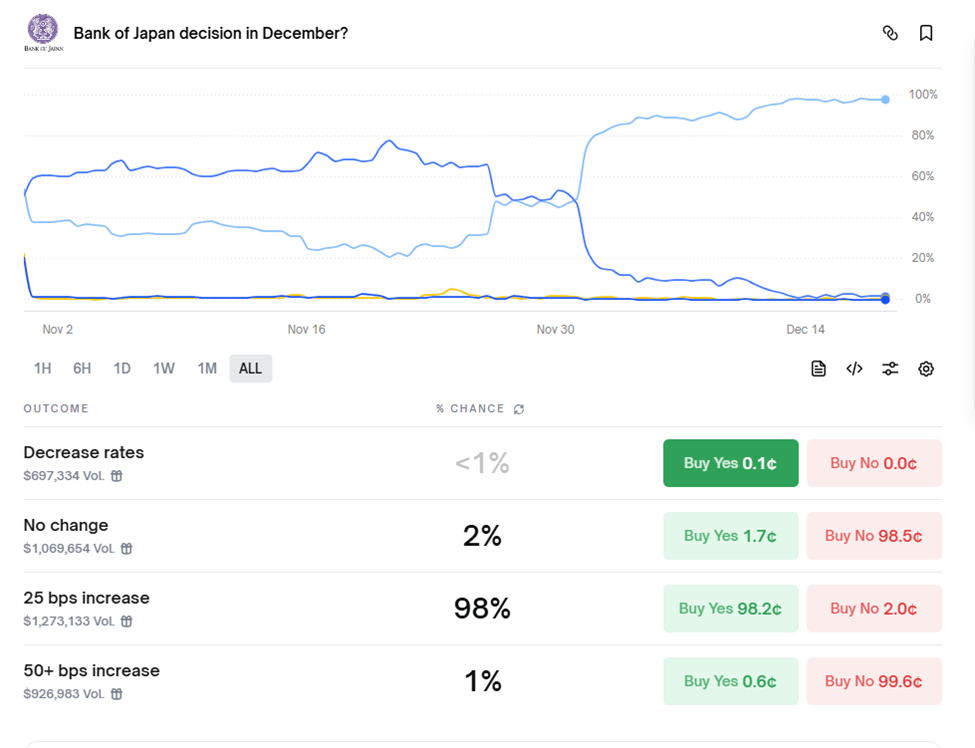
This time, however, traders appeared unfazed, suggesting the move had been fully priced in well ahead of the announcement. Market participants had largely anticipated the decision.

BOJ Interest Rate Probabilities
BOJ Interest Rate Probabilities. Source: Polymarket

Japan’s rate increase represents a symbolic break from decades of near-zero interest rates that made the yen a cornerstone of global funding markets. Cheap yen borrowing fueled leverage across equities, bonds, and cryptocurrencies.

As Japanese yieds rise and narrow the gap with global rates, those trades become less attractive, potentially forcing investors to unwind risk positions. Still, Bitcoin’s calm reaction suggests markets were prepared.

Bitcoin (BTC) Price Performance
Bitcoin (BTC) Price Performance. Source: BeInCrypto

According to analysts, however, the focus was never the hike itself, but what comes next.

“Markets are pricing in a near-certain 25 basis point hike, marking the highest Japanese policy rate in about 30 years. While the hike itself is largely anticipated, the real focus is on Governor Ueda’s forward guidance during the press conference—signals of future hikes could amplify effects,” wrote analyst Marty Party.

That forward guidance may prove crucial. The BOJ has signaled it remains prepared to raise rates further, potentially to 1% or higher by late 2026, depending on wage growth and sustained inflation.

BOJ policy rate climbing from near 0% to 0.75% in December 2025, ending decades of ultra-easy policy. Source: Wise Advice via X

That outlook keeps pressure on risk assets, even if the initial move failed to trigger volatility.

Bitcoin Holds Firm as Altcoins Face a Prolonged Liquidity Squeeze

Analysts argue that Bitcoin’s resilience could be a bullish sign. Blueblock pointed to historical patterns, noting the divergence from past reactions.

“The BOJ just hiked rates to 0.75%, ending decades of ultra-loose policy and narrowing the gap with global yields. History shows that every prior tightening has triggered 20–30% Bitcoin drops as yen carry trades unwind and liquidity tightens. Yet with the hike fully priced in and BTC holding around $85k–$87k, this could be the dip buyers have been waiting for,” the analyst wrote.

However, not all corners of the crypto market are expected to fare as well. Altcoins, which are typically more sensitive to shifts in liquidity, remain vulnerable if Japanese tightening accelerates.

The prospect of higher rates through 2026 suggests a prolonged headwind rather than a one-off shock.

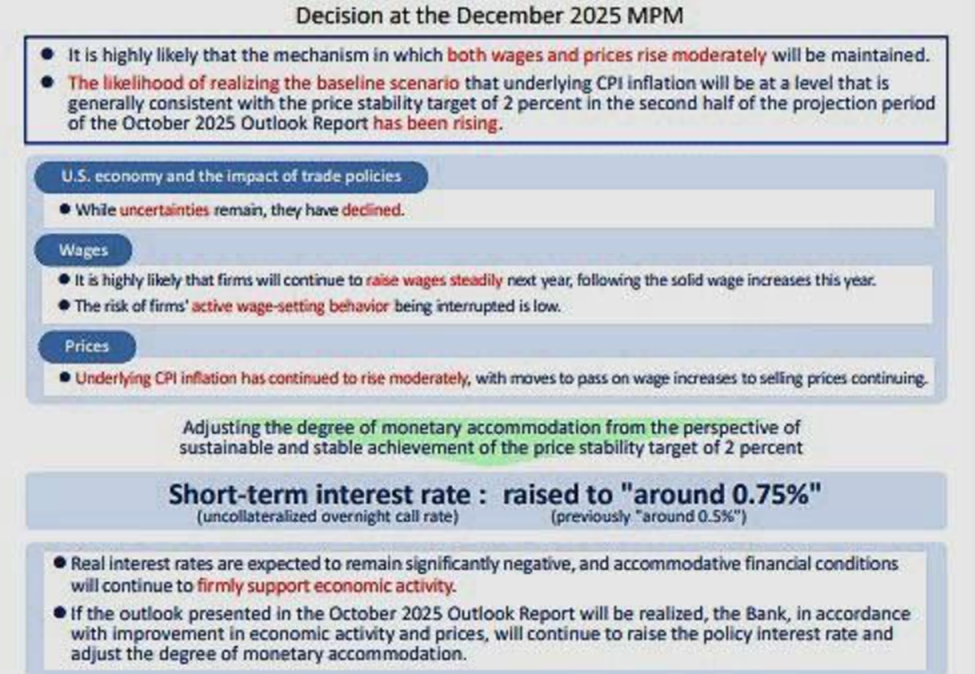
BOJ’s December 2025 policy decision raised rates to 0.75% with guidance for further tightening
BOJ’s December 2025 policy decision raised rates to 0.75% with guidance for further tightening. Source: Money Ape on X

“BOJ signals it is ready to hike further, potentially 1% or higher by late 2026, depending on wage growth and sustained inflation. NO MERCY FOR ALTCOINS,” commented Money Ape.

Bitcoin’s stability reflects a market that had ample time to prepare for the BOJ’s decision. Whether that resilience holds will depend less on the December hike itself and more on how aggressively Japan continues its path of tightening. It will also hinge on how global liquidity adapts to the end of one of its longest-running monetary backstops.

The post BOJ Raises Interest Rates to 0.75%, But Bitcoin Stands Unshaken—Is the Crypto Calm a Warning or Opportunity? appeared first on BeInCrypto.

  •  

Bitcoin Whales Moved — But Not in the Way Markets Assumed

Bitcoin’s recent pullback below $85,000 briefly suggested renewed accumulation among large investors. Instead, on-chain data shows a different picture forming beneath the surface. 

While price has stabilized above key support, the underlying behavior points to balance restructuring rather than fresh capital entering the market.

Bitcoin Holders Are Not Too Bullish

Wallets holding between 100 and 1,000 BTC recently showed an increase, initially signaling potential whale accumulation. However, Glassnode’s senior researcher clarified that this rise reflects wallet reshuffling rather than new buying. These movements do not represent additional demand entering the Bitcoin market.

Wallet reshuffling occurs when large entities split or consolidate balances across addresses. The process helps manage custody, internal risk, or accounting needs. Ownership does not change. Coinbase recently reshuffled about 640,000 BTC internally, offering a clear example of this behavior influencing cohort data.

Because reshuffling does not introduce new capital, its impact on price is zero. The activity can distort accumulation metrics, leading to false bullish signals. 

Want more token insights like this? Sign up for Editor Harsh Notariya’s Daily Crypto Newsletter here.

Bitcoin Supply Held By Large Entities.
Bitcoin Supply Held By Large Entities. Source: Glassnode

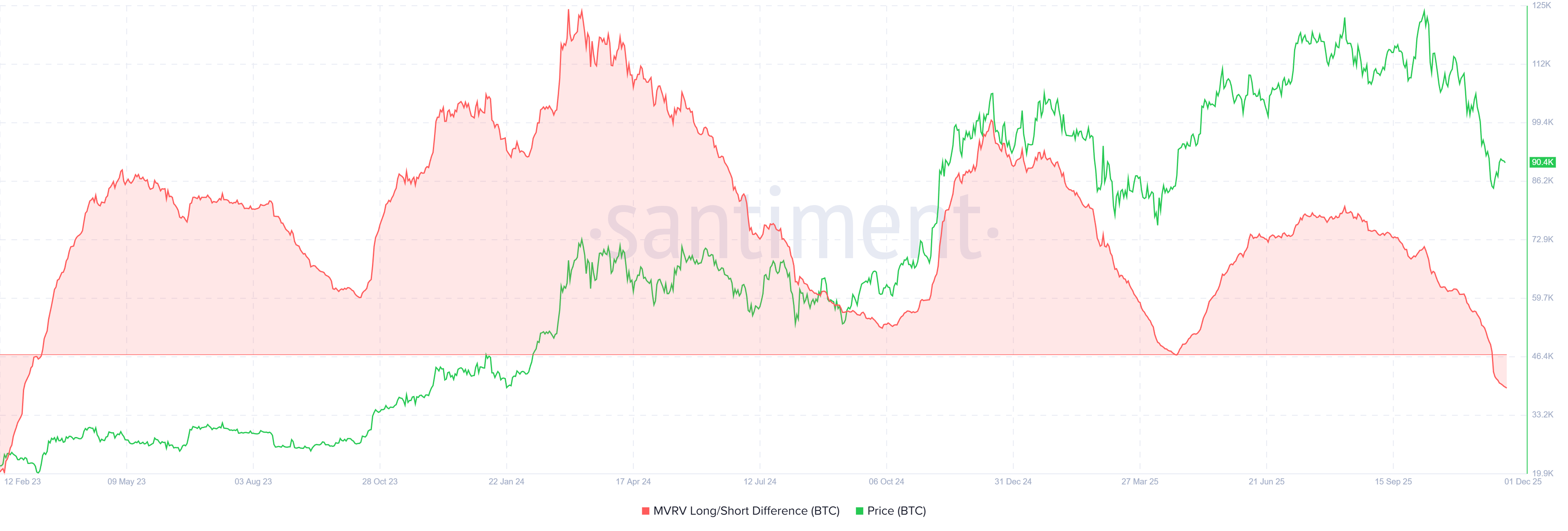
Macro indicators add further caution. The MVRV Long/Short Difference currently shows profits concentrated among short-term Bitcoin holders rather than long-term holders. This imbalance raises downside risk, as short-term holders historically react quickly to price fluctuations.

When profits sit with short-term participants, selling pressure often increases during periods of uncertainty. These holders are more likely to secure gains at the first sign of weakness. This dynamic can suppress upside momentum and prolong consolidation across key price ranges.

Bitcoin MVRV Long/Short Difference
Bitcoin MVRV Long/Short Difference. Source: Santiment

BTC Price May See Some Struggle

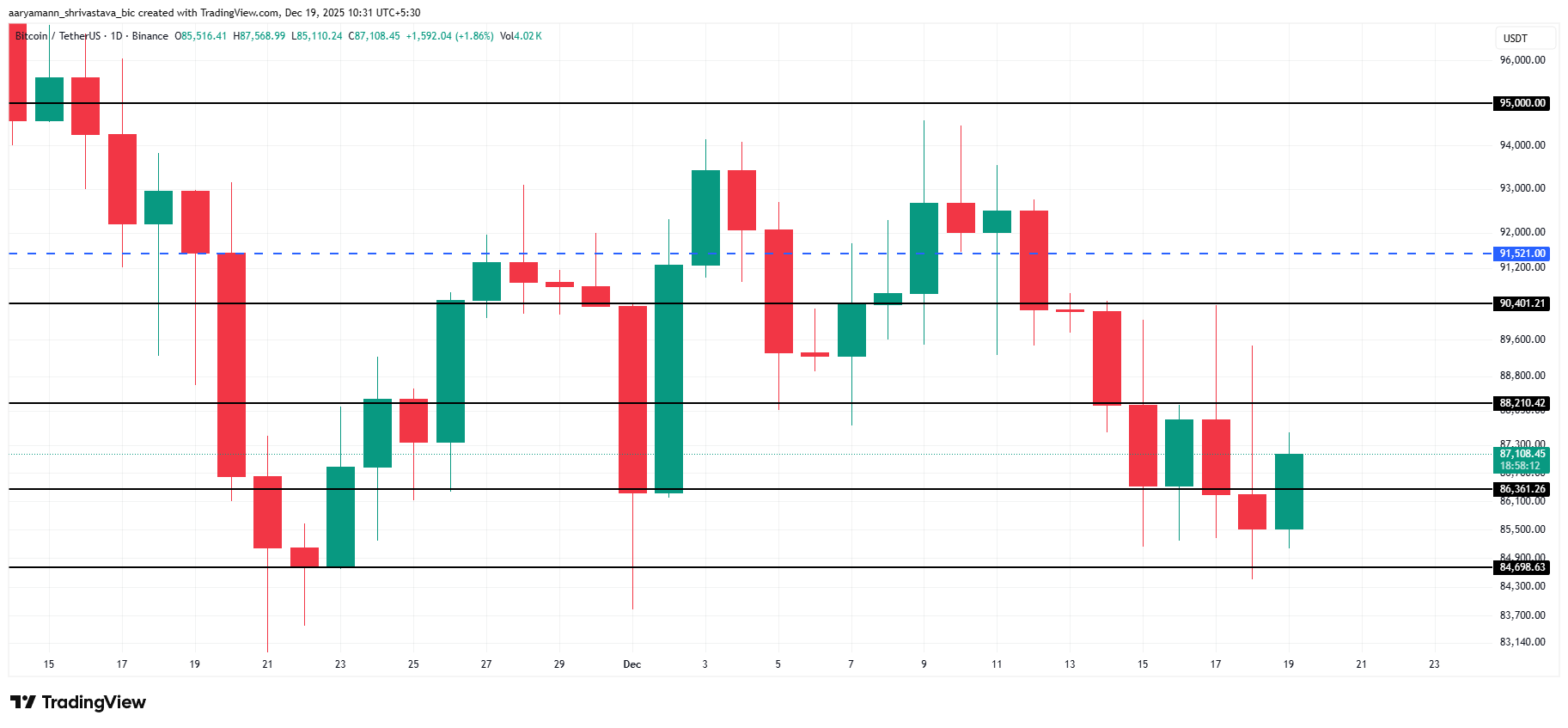
Bitcoin is trading near $87,108 at the time of writing, holding above the $86,361 support level. While this zone provides near-term stability, recovery remains fragile. BTC must reclaim higher levels before signaling a meaningful trend reversal.

Short-term holders continue to pose a risk to upside progress. If they begin taking profits, Bitcoin could remain range-bound below $88,210. A failure to maintain this structure could result in another test of $84,698, a level already visited during recent volatility.

Bitcoin Price Analysis.
Bitcoin Price Analysis. Source: TradingView

A stronger recovery requires Bitcoin to convincingly breach $88,210. A push toward $90,401 would signal improving momentum. Achieving this move depends on renewed investor support, which may emerge as value-oriented buyers respond to current price discounts.

The post Bitcoin Whales Moved — But Not in the Way Markets Assumed appeared first on BeInCrypto.

  •  

$3.16 Billion Crypto Options Expiry Puts Bitcoin and Ethereum’s Next Move in Question

Over $3.16 billion worth of Bitcoin and Ethereum options are set to expire on Friday at 08:00 UTC on Deribit, marking the final major derivatives settlement before Christmas.

With liquidity thinning out as the holiday period approaches and positioning tightly clustered around key price levels, traders appear cautious, waiting for a clearer catalyst before committing to a direction.

What to Expect as Nearly $3 Billion Bitcoin Options Expire

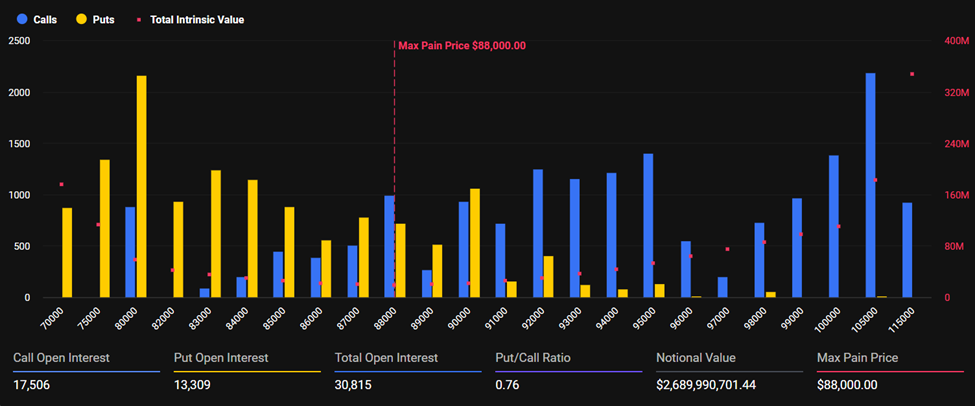
Bitcoin accounts for the bulk of the expiry, with roughly $2.69 billion in notional value rolling off. At the time of writing, BTC was trading at $87,194, representing a 0.54% increase over the past 24 hours.

The max pain level for today’s expiring Bitcoin options sits at $88,000, placing the spot price just below the strike. This is where the greatest number of options expire worthless.

Meanwhile, open interest data suggests a relatively balanced but slightly defensive stance. Bitcoin call open interest stands at 17,506 contracts, compared with 13,309 puts, resulting in a total open interest of 30,815 contracts and a put-to-call ratio of 0.76.

Expiring Bitcoin Options
Expiring Bitcoin Options. Source: Deribit

While calls still dominate numerically, the concentration of positioning near $88,000 points to limited upside momentum unless the spot decisively breaks higher. Deribit analysts highlighted this dynamic in a market update.

“BTC open interest is concentrated around 88K, with slightly heavier put positioning, pointing to a relatively contained expiry unless spot breaks range,” they wrote.  

The commentary reinforces the view that Bitcoin could remain range-bound through settlement, especially amid pre-holiday caution.

Over $470 Million Ethereum Options Expire Today: What Investors Should Know

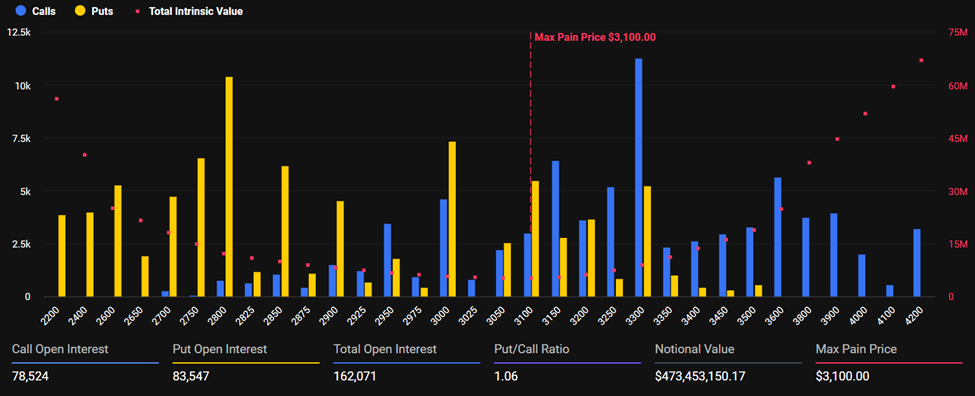
Ethereum presents a different setup. Approximately $473 million in ETH options are expiring, with the asset trading at $2,928, representing a 3.37% increase in the last 24 hours. ETH’s max pain level is higher, at $3,100, leaving spot price meaningfully below the key strike.

Ethereum’s open interest profile is more evenly split, with 78,524 call contracts versus 83,547 puts. This results in a put-to-call ratio of 1.06 and a total open interest of 162,071 contracts.

Expiring Ethereum Options
Expiring Ethereum Options. Source: Deribit

Unlike Bitcoin, ETH positioning is spread across a wider range of strikes, indicating greater uncertainty about the near-term direction.

“ETH positioning is more distributed across strikes, with notable upside interest above 3.4K, keeping larger moves in play if volatility reaccelerates,” Deribit analysts indicated.

The analysts added that positioning suggests patience into settlement, which happens at 08:00 UTC today, with traders waiting for a clearer catalyst rather than forcing direction.

Beyond today’s options expiry, attention is already shifting to December 26 and early 2026 positioning.

“December 26 85k Put OI now ~15k ($1.25bn notional) on Deribit, and bears+FUD currently in control with ATM 86k,” Deribit Insights noted.

At the same time, upside bets appear less aggressive in the near term, with analysts observing that “the Dec26 100k+ $1.75bn Call condor feels a distant punt now.”

However, longer-dated flows tell a more constructive story, with recent flows continuing to show upside bias into 2026. According to the analysts, this suggests that while short-term sentiment remains cautious, longer-horizon traders are still positioning for a renewed bullish phase.

As the final options expiry before Christmas approaches, both Bitcoin and Ethereum appear caught between near-term restraint and longer-term optimism, leaving their next decisive move unresolved.

Traders and investors may experience some volatility, which the BOJ’s interest rate decision could exacerbate. However, markets tend to stabilize as traders adjust to new market conditions.

The post $3.16 Billion Crypto Options Expiry Puts Bitcoin and Ethereum’s Next Move in Question appeared first on BeInCrypto.

  •  

Japan’s Bond Yields Hit 1.98%: BOJ Rate Shift Impacts Gold, Silver, and Bitcoin

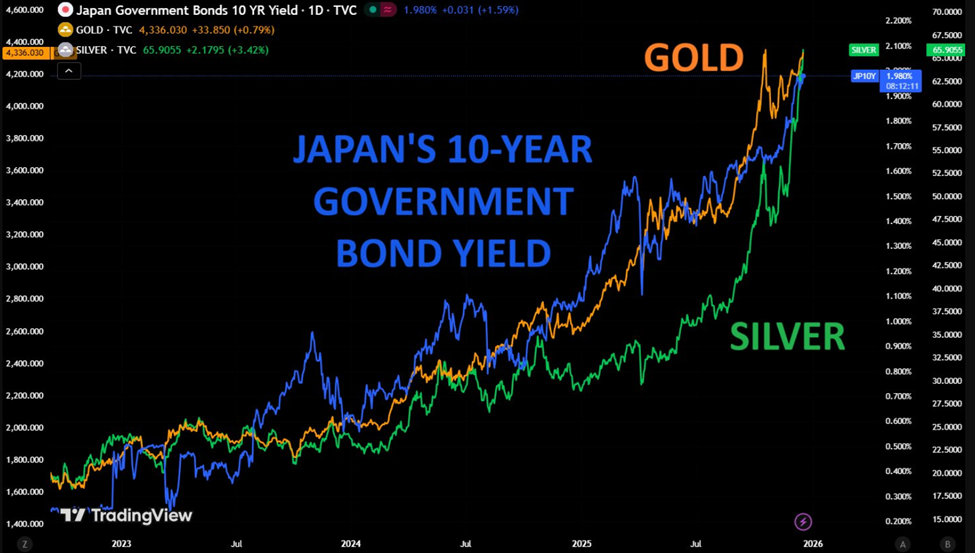
Japan’s 10-year government bond yields surged to 1.98% in December 2025, the highest level since the 1990s. It comes as markets braced for the Bank of Japan’s (BOJ) policy meeting on December 19.

The move has triggered a global rally in precious metals, with gold and silver surging 135% and 175%, respectively, since early 2023. Meanwhile, Bitcoin is under pressure as forced selling intensifies across Asian exchanges, highlighting a divergence in market reactions to Japan’s rate shift.

Japan’s Bond Yields Hit 1.98%

For decades, Japan maintained near-zero interest rates, anchoring global liquidity through the yen carry trade.

Investors borrowed yen at a low rate to fund higher-yielding assets worldwide, effectively exporting ultra-low interest rates.

An expected 25-basis-point hike, raising the rate to 0.75%, may appear modest in absolute terms, but the pace of change matters more than the level.

BOJ Interest Rate Probabilities
BOJ Interest Rate Probabilities. Source: Polymarket

“Carry trade at risk: Nobody knows when the real consequences will materialize, but this continued shift will likely drain liquidity from markets, potentially causing a ripple effect through margin calls and other forced deleveraging,” warned Guilherme Tavares, CEO at i3 Invest.

Analysts see the BOJ move as more than a domestic adjustment.

“When Japan’s yields move, global capital pays attention. Gold and silver aren’t reacting to inflation headlines. They’re pricing sovereign balance sheet risk. Japan isn’t a sideshow anymore. It’s the fulcrum,” noted Simon Hou-Vangsaae Reseke.

Gold and Silver Prices Surge Amid Rising Sovereign Risk

Precious metals have been closely tracking Japanese yields. According to Global Market Investor, gold and silver are moving almost perfectly in line with Japanese government bond yields. This suggests that precious metals are being used as a primary hedge against the rising cost of government debt.

Gold and Silver Prices Tracking Japan’s 10Y Bond. Source: Global Markets Investor on X

“It’s not the yield itself, it’s what the move represents — rising sovereign risk, tighter global liquidity, and uncertainty about currency credibility. Gold responds as protection, and silver follows with more volatility,” commented analyst EndGame Macro.

The silver market is showing signs of speculative mania. The China Silver Futures Fund recently traded 12% above the physical metal it tracks, indicating that demand for leveraged exposure is outpacing the underlying asset.

⚠️ Silver market mania is an UNDERSTATEMENT:

The China Silver Futures Fund was trading +12% above the actual value of the silver it is supposed to track

Investors are buying the fund much faster than the silver behind is rising, a sign of SPECULATION. 👇https://t.co/8kAngXV9CH

— Global Markets Investor (@GlobalMktObserv) December 17, 2025

Investors are increasingly treating gold and silver as hedges against broader macro risks, rather than just inflation.

Bitcoin Faces Pressure as Carry Trades Unwind

Meanwhile, the Bitcoin price is feeling the strain of tightening yen liquidity.

“Asia-based exchanges have seen persistent spot selling. Miner reserves are falling — forced selling, not choice…Long-term Asian holders appear to be distributing…Price stays heavy until forced supply is cleared,” wrote CryptoRus, citing XWIN Research Japan.

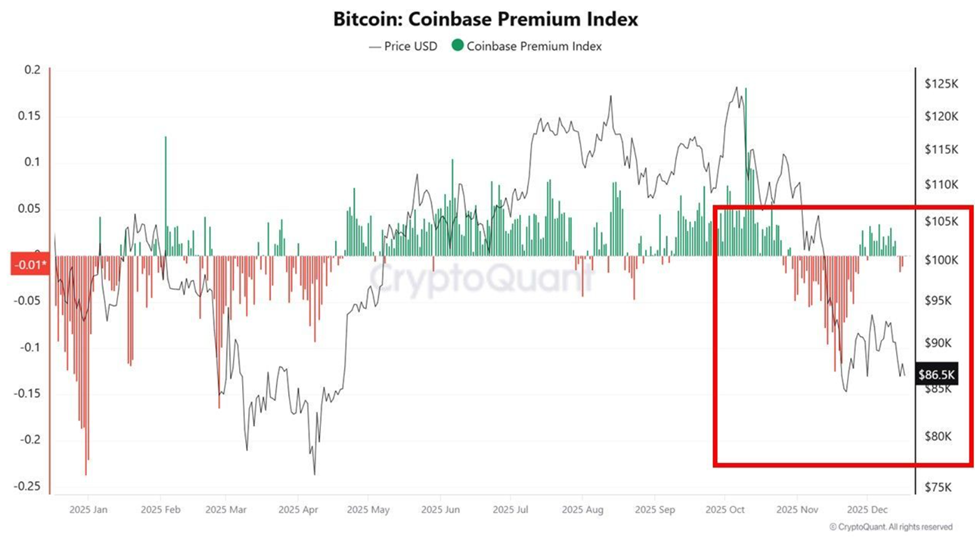
US institutions continue buying, with the Coinbase Premium positive, but forced liquidations in Asia and an 8% drop in Bitcoin hashrate have added downward pressure.

Bitcoin Price and Coinbase Premium
Bitcoin Price and Coinbase Premium. Source: CryptoQuant

Past BOJ rate shifts have coincided with significant BTC declines, and traders are watching closely for further downside toward $70,000.

THE BANK OF JAPAN MIGHT BE BITCOIN’S BIGGEST ENEMY

Japan holds the most US debt.
Every time they hike, Bitcoin bleeds:

March 2024: -23%
July 2024: -30%
Jan 2025: -31%

Next hike: Dec 19
Next move: loading…

If the pattern repeats, $70K is in play. pic.twitter.com/R5916R702I

— Merlijn The Trader (@MerlijnTrader) December 14, 2025

The contrasting reactions of precious metals and Bitcoin highlight differences in risk positioning. Gold and silver are attracting safe-haven flows amid growing sovereign risk, while Bitcoin faces liquidation-driven price pressure.

Analysts note that future Fed rate cuts may offset the BOJ’s impacts, but the speed of the policy change is crucial.

The post Japan’s Bond Yields Hit 1.98%: BOJ Rate Shift Impacts Gold, Silver, and Bitcoin appeared first on BeInCrypto.

  •  

Bitcoin’s 5% Whiplash Was No Accident — Charts Reveal The Full Story

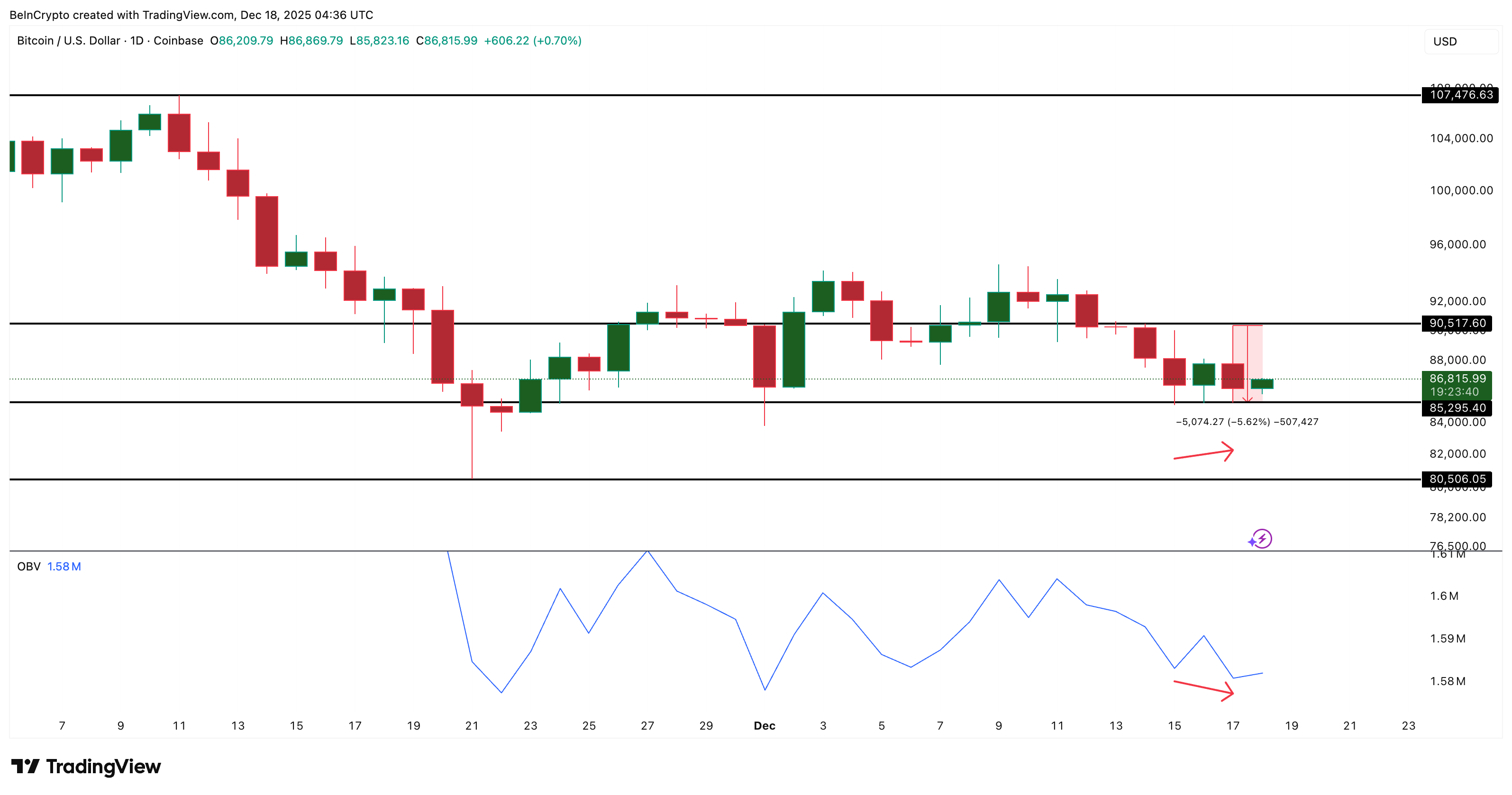
Bitcoin’s violent move on December 17 caught traders off guard. In a single day, BTC surged to around $90,500 before reversing hard and sliding toward $85,200. From high to low, that was a swing of more than 5%, or roughly $5,000.

This was not news-driven. It was structure-driven. Three charts explain why the move happened, why it stalled exactly where it did, and why similar volatility remains possible.

Volume Breakdown Signaled Risk Before the Drop

Before the sell-off, the BTC price action already showed stress. Between December 15 and December 17, the Bitcoin price printed a marginal higher low on the daily chart. On the surface, that looked stable. But On-Balance Volume told a different story.

OBV tracks whether volume confirms price moves. During this period, OBV failed to follow the price higher and instead made a lower low. That bearish divergence signaled distribution. In simple terms, price was holding up, but volume was quietly flowing out.

Want more token insights like this? Sign up for Editor Harsh Notariya’s Daily Crypto Newsletter here.

First Trigger For The Volatile Price Swing
First Trigger For The Volatile Price Swing: TradingView

When Bitcoin pushed toward $90,500, it did so with weak participation. That made the rally fragile. Once selling started, there was no volume support beneath, which turned a pullback into a sharp intraday whiplash.

In markets, whiplash refers to a rapid move up followed immediately by a sharp move down, or vice versa.

Cost Basis Heatmap Shows Why $90,500 Rejected and $85,200 Held

On-chain cost basis data explains the exact turning points.

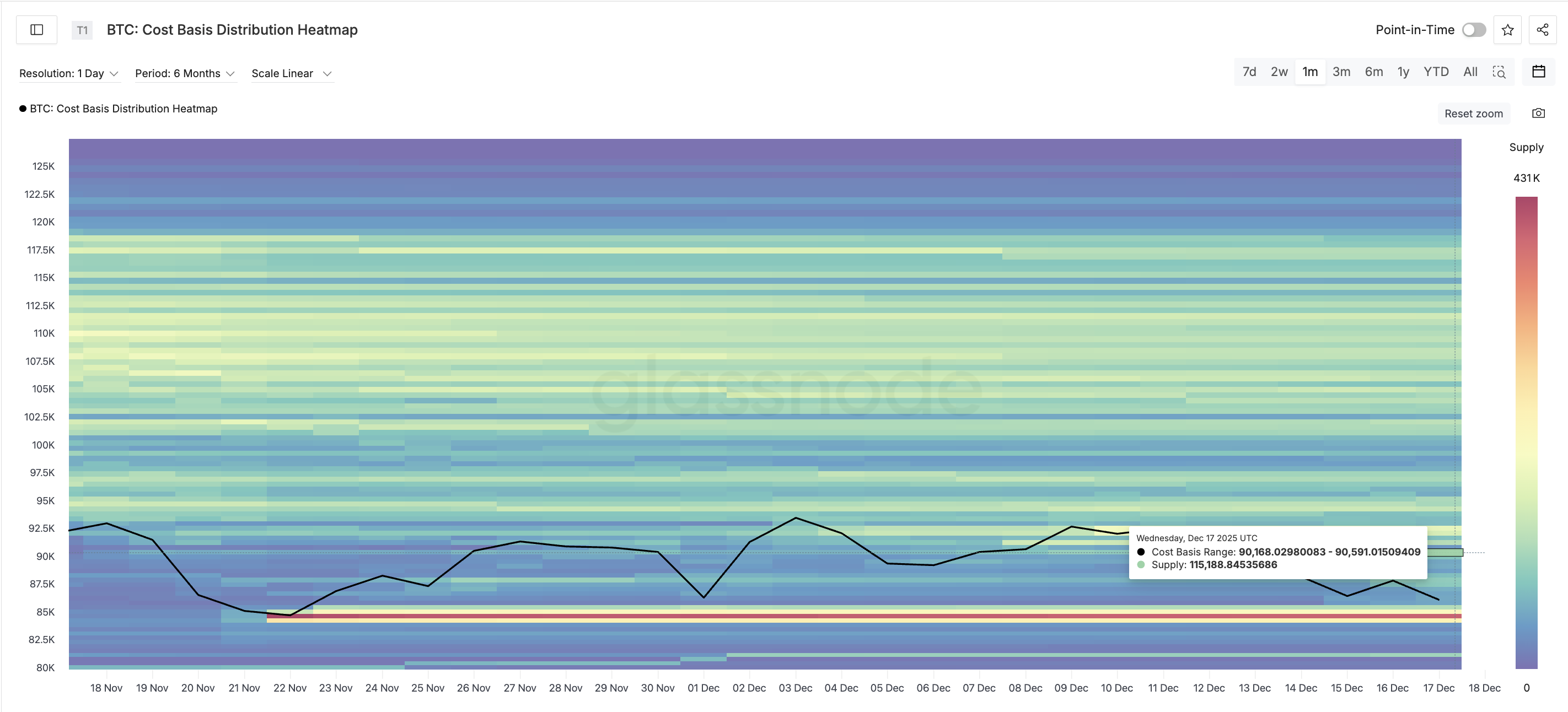
The cost basis heatmap shows a dense supply cluster between $90,168 and $90,591. Around 115,188 BTC were accumulated in this zone. When the price revisited this range, many holders reached break-even.

BTC Supply Cluster: Glassnode

That could have created immediate sell pressure. Combined with OBV weakness, this cluster acted like a ceiling. The rally stalled, then reversed.

On the downside, the story changes.

Another strong cluster sits between $84,845 and $85,243. This is the most concentrated near-term support zone on the chart. As the price fell, buyers stepped in aggressively here. That is why the Bitcoin price did not collapse further, even during forced liquidations.

Key Support Cluster: Glassnode

So the move was boxed in. Sellers defended $90,500. Buyers defended $85,200. The whiplash happened inside those walls.

Bitcoin Price Levels Now Decide If Volatility Returns

Structurally, Bitcoin is still holding a mild uptrend from the November 21 low. That matters. Yesterday’s volatility event was inside the range.

For upside continuation, one level stands out. Bitcoin must post a clean daily close above $90,500. That level has not been reclaimed since December 13. Without a close above it, any rally risks another rejection.

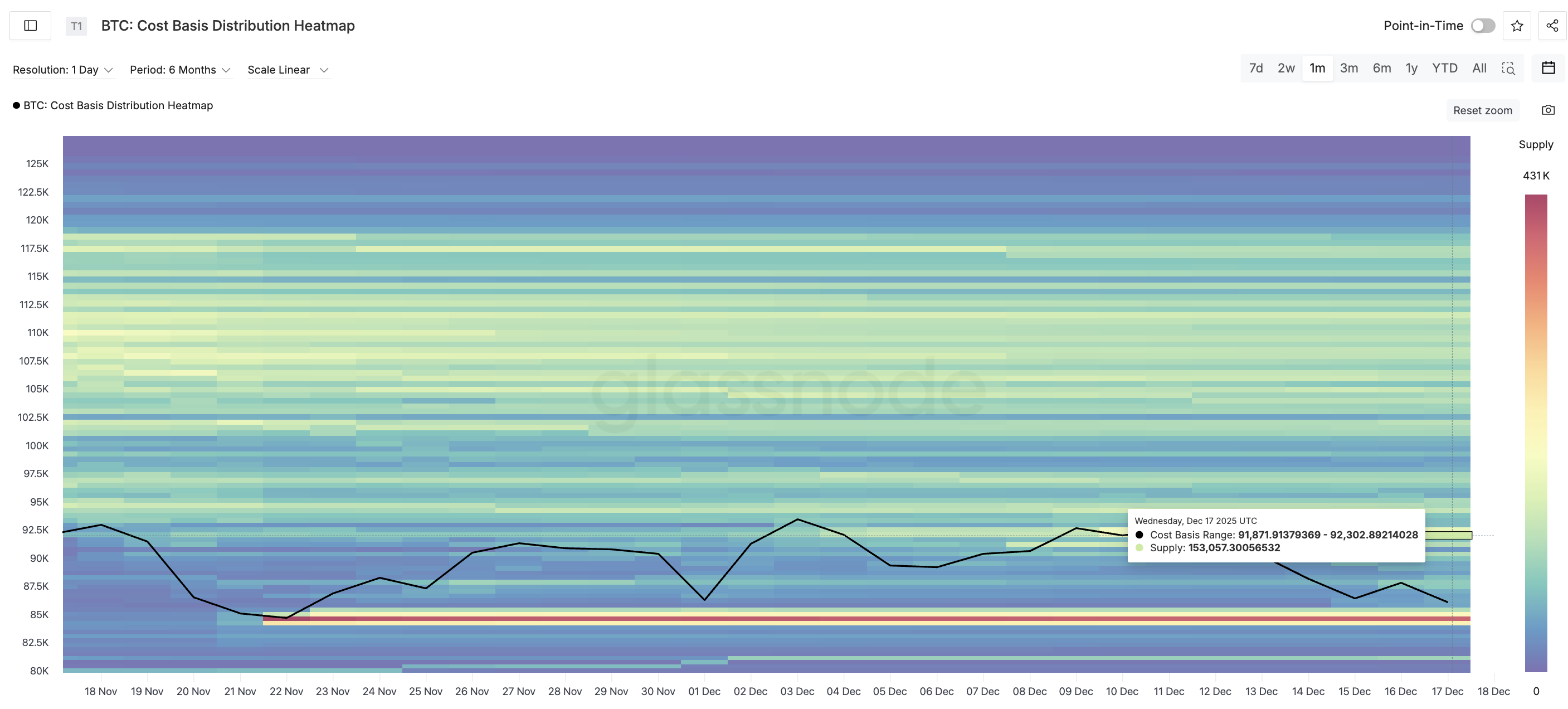
Above that, $92,200 to $92,300 becomes critical. On-chain data shows another supply cluster there. Traders should expect friction unless the price clears that zone decisively. Also, traders reading this might want to consider complete daily closes above key levels mentioned on the charts instead of wick-styled breakouts.

Key Upside Clusters
Key Upside Clusters: Glassnode

On the downside, $85,000-$85,200 remains the key zone. As long as this cluster holds, a deeper downside is less likely. A failure there would expose $83,800, but breaching $85,000 would require fresh liquidation pressure.

Bitcoin Price Analysis
Bitcoin Price Analysis: TradingView

The takeaway is simple. Bitcoin’s 5%+ whiplash was not random. It was the result of weak volume, heavy supply at known cost levels, and tight liquidity. Until those structures change, sharp moves like this remain part of the crypto market’s reality.

The post Bitcoin’s 5% Whiplash Was No Accident — Charts Reveal The Full Story appeared first on BeInCrypto.

  •  

Bitfinex Bitcoin Whale Long Positions Surge 36%: What Does it Mean?

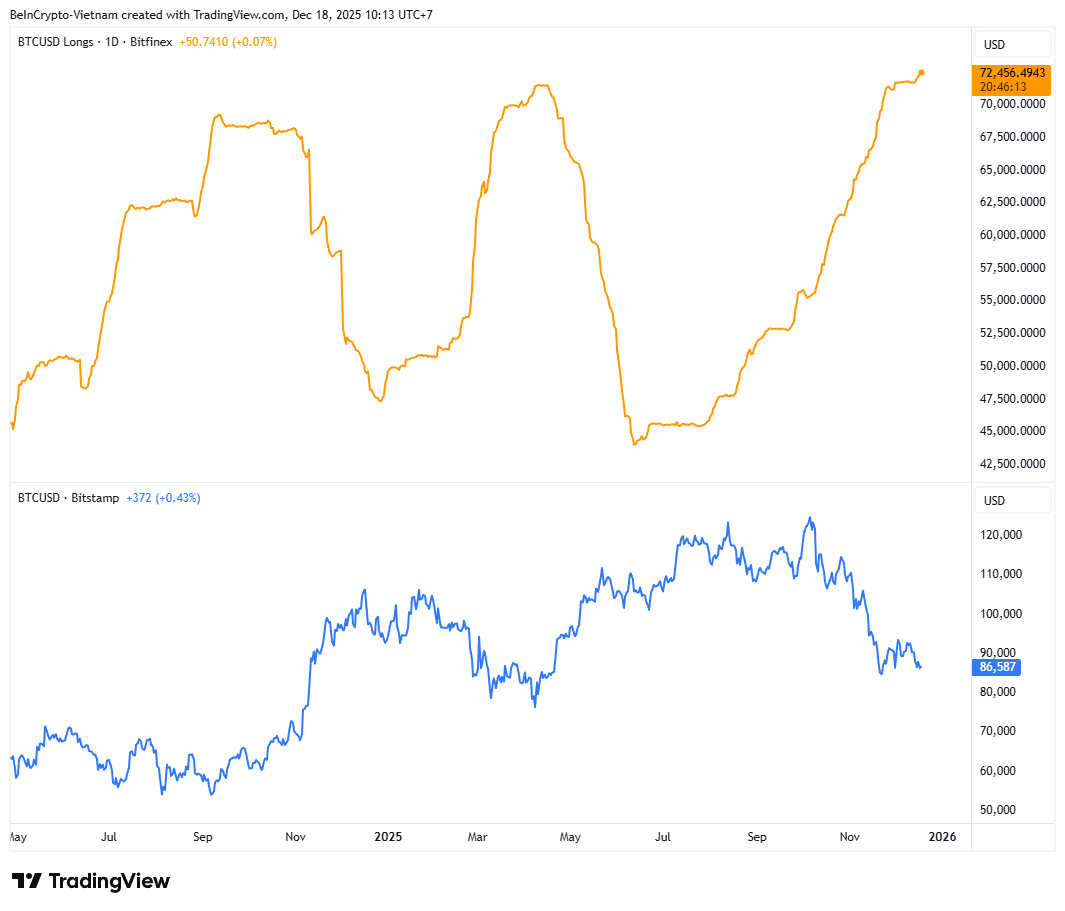
Large Bitcoin investors on Bitfinex are once again commanding market attention. Analysts tracking leveraged positioning data show that margined Bitcoin long positions held by “whales” have surged sharply, approaching levels last seen in March 2024.

The renewed build-up is occurring even as broader market participation cools, raising questions about what these well-capitalized traders are signaling.

What Does the Record High in Whale Long Positions on Bitfinex Signify?

According to on-chain analyst James Van Straten, Bitfinex whales have continued to add aggressively to their positions.

“Bitfinex whale continues to add to its margin long bitcoin position, approaching March 2024 highs. 36% higher in the past 3 months,” he wrote on X (Twitter).

The data highlights a steady accumulation trend since September, with long exposure expanding during periods of price weakness rather than rallies.

Bitfinex itself appeared to acknowledge the activity, highlighting that large, experienced traders may be positioning with conviction, while smaller participants are reducing risk.

Whale moves 🐳https://t.co/1Zgcof54xV

— Bitfinex (@bitfinex) December 8, 2025

This divergence in behavior is notable. While Bitcoin’s price action has remained choppy in recent weeks, whale accumulation has intensified.

Bitfinex Bitcoin long positions approaching March 2024 highs
Bitfinex Bitcoin long positions approaching March 2024 highs. Source: TradingView

Historically, these Bitfinex long positions have been associated with traders who use leverage tactically. They often scale into positions during drawdowns rather than chasing upside momentum.

According to crypto executive Samson Mow, the current dynamic is a transfer of coins from impatient sellers to long-term holders.

“Bitfinex whales out in force buying from paper hands,” he said, pointing to the contrast between selling pressure from weaker hands and sustained buying by large accounts.

A Contrarian Signal, But Not a Timing Tool

The Bitfinex whale long metric has long been watched as a potential leading indicator in technical analysis. However, its interpretation requires nuance.

These traders have a documented pattern of increasing long exposure during declines and trimming positions into strength. As a result, elevated long positions are often followed, not preceded, by price rallies.

Van Straten cautioned that the signal’s real value lies in watching for reversals rather than absolute levels.

“Short term, once the trend reverses,” he noted, implying that the eventual reduction of these longs may be more informative than their current size.

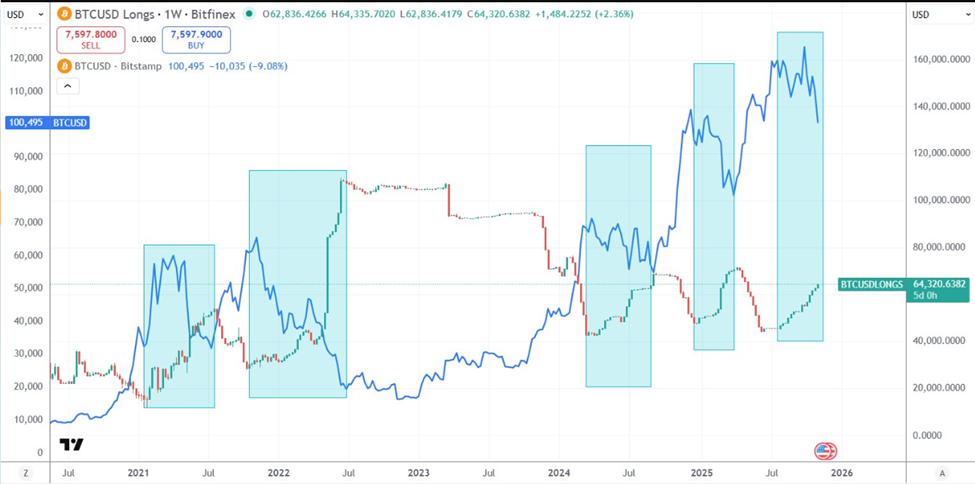
Not everyone agrees on the reliability of the indicator. Analyst Parabear Nick challenges overly confident interpretations of whale data, dismissing some bullish narratives entirely, amid claims that whale accumulation alone guarantees higher prices.

Indeed, historical data support a more balanced view. Whale long positions have reached extremes at different points in past cycles, sometimes remaining elevated for months before any decisive move in price.

Multi-year comparison of whale positioning versus Bitcoin price trends
Multi-year comparison of whale positioning versus Bitcoin price trends. Source: Parabear Nick on X

This suggests that while the metric can provide insight into positioning and sentiment, it should be evaluated in conjunction with other indicators, such as open interest, funding rates, and macro liquidity conditions.

The current accumulation comes as open interest across derivatives markets trends lower, signaling reduced participation from retail and short-term traders.

In that context, the concentration of leverage among whales becomes more significant. With fewer speculative participants, large players exert greater influence over marginal price movements.

What remains unclear is timing. Elevated whale longs suggest expectations of higher prices, but not necessarily an imminent breakout.

The key inflection point will come if and when these positions begin to unwind. Historically, such shifts have preceded changes in market regimes.

The post Bitfinex Bitcoin Whale Long Positions Surge 36%: What Does it Mean? appeared first on BeInCrypto.

  •  

The Nonfarm Payrolls Surprise That Could Rattle Bitcoin Before Christmas | US Crypto News

Welcome to the US Crypto News Morning Briefing—your essential rundown of the most important developments in crypto for the day ahead.

Grab a coffee as the latest US labor data delivers mixed signals on jobs, wages, and unemployment. Traders are weighing what it all means for risk assets, from equities to Bitcoin, as volatility sets the tone.

Crypto News of the Day: October Jobs Collapse and November Modest Gain Signal Uneven Market

The US Nonfarm Payrolls (NFP) report for October and November 2025 delivered a shock to markets, as it is one of the crucial economic data points this week. It revealed a cooling labor market that could reverberate through both equities and crypto.

According to the US Bureau of Labor Statistics (BLS),October saw a sharp decline of 105,000 jobs, far below the estimated -25,000. This marks a pronounced slowdown in labor market momentum.

Analysts are labeling it an outlier, reflecting disruptions from delayed government data collection and seasonal adjustments.

*US OCT. NONFARM PAYROLLS FALL 105K M/M; EST. -25K

this is all govt and an outlier

— zerohedge (@zerohedge) December 16, 2025

November posted a 64,000 gain, slightly above the 50,000 consensus, but with the unemployment rate climbing to 4.6% from 4.4% in October, higher than the expected 4.5%.

🚨 Just In: November Nonfarm Payrolls rise 64,000, above expectations for 40,000.

The U.S. Unemployment Rate rose from 4.4% to 4.6%, worse than estimates for 4.5%.

What will Jerome Powell do now? pic.twitter.com/kFozsmOsgh

— Jesse Cohen (@JesseCohenInv) December 16, 2025

While November’s rise offers some relief, it highlights the uneven nature of recent US labor market activity.

Fed and Market Implications For Bitcoin and Risk Assets

The data is likely to reinforce dovish narratives for the Federal Reserve. Powell previously cited a weakening labor market as justification for rate cuts, and today’s figures suggest the economy is far from overheated.

Traders may interpret the report as a signal that further easing in 2026 is plausible, which could support risk assets, including Bitcoin, if liquidity expectations remain intact. Bitcoin has been trapped near $90,000, and today’s data could trigger short-term volatility.

Bitcoin (BTC) Price Performance
Bitcoin (BTC) Price Performance. Source: BeInCrypto

A weak October print followed by a modest November recovery may fuel a relief rally toward $95,000 as markets price in potential Fed accommodation.

Conversely, the unexpectedly high unemployment rate could reignite recession fears, creating whipsaw moves in crypto, equities, and FX.

“While markets typically cheer the resolution of uncertainty, this specific data dump is unique. The cooling trend might spark an initial crypto rally on renewed hopes for aggressive Fed cuts in 2026. But if the numbers are too weak, the narrative could quickly pivot from liquidity hopes to recession fears, historically dampening risk appetite across the board,” Jimmy Xue, COO and Co-founder at Axis, told BeInCrypto.

Market participants remain wary. With October’s data representing an outlier and November’s figures collected late, statistical distortions and revisions are possible.

Algorithm-driven trading and lean liquidity could amplify volatility in the near term, making measured positioning critical.

Amid mixed signals, traditional safe havens like gold may continue to attract flows, as the US dollar faces pressure and risk sentiment remains fragile in tech-heavy sectors.

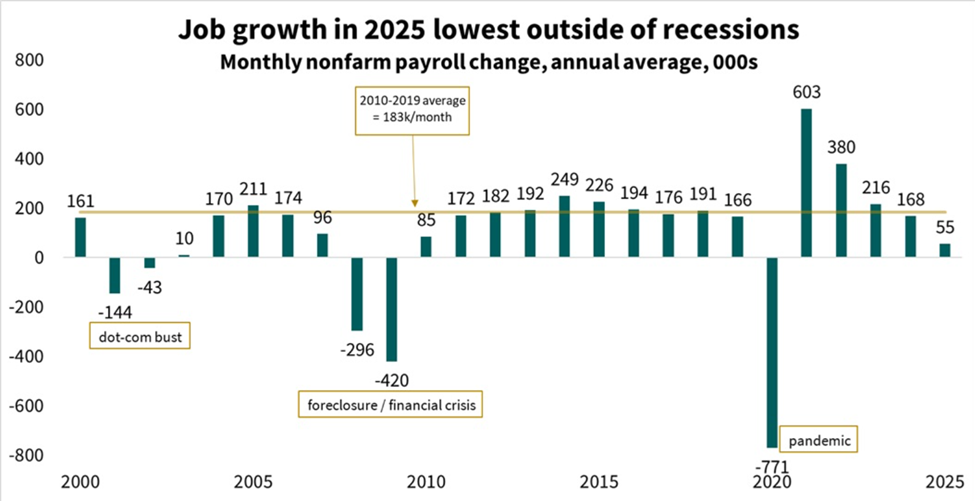
Chart of the Day

Analysis of BLS Current Establishment Survey
Analysis of BLS Current Establishment Survey. Source: Jed Kolko on X

Byte-Sized Alpha

Here’s a summary of more US crypto news to follow today:

Crypto Equities Pre-Market Overview

CompanyAt the Close of December 15Pre-Market Overview
Strategy (MSTR)$162.08$165.23 (+1.94%)
Coinbase (COIN)$250.42$253.61 (+1.27%)
Galaxy Digital Holdings (GLXY)$24.54$24.59 (+0.20%)
MARA Holdings (MARA)$10.70$10.82 (+1.12%)
Riot Platforms (RIOT)$13.71$13.81 (+0.73%)
Core Scientific (CORZ)$15.28$15.27 (-0.065%)
Crypto equities market open race: Google Finance

The post The Nonfarm Payrolls Surprise That Could Rattle Bitcoin Before Christmas | US Crypto News appeared first on BeInCrypto.
  •  

5 Reasons Q1 2026 Could Spark the Biggest Crypto Bull Run Yet

Experts are increasingly signaling a potential crypto bull run in the first quarter (Q1) of 2026, driven by a convergence of macroeconomic factors.

Analysts suggest Bitcoin could surge between $300,000 and $600,000 if these catalysts materialize.

Five Macro Trends Fueling a Potential Rally in Q1 2026

A combination of five key trends is creating what analysts describe as a “perfect storm” for digital assets.

1. Fed Balance Sheet Pause Removes Headwind

The Federal Reserve’s quantitative tightening (QT), which drained liquidity throughout 2025, ended recently.

Simply halting the liquidity drain is historically bullish for risk assets. Data from previous cycles suggest Bitcoin can rally up to 40% when central banks stop contracting their balance sheets.

Analyst Benjamin Cowen indicated that early 2026 could be the time when markets begin to feel the impact of the Fed ending its QT.

In 2019, the Fed announced QT would end on August 1st.

The balance sheet of the Fed continued dropping in August despite QT having officially ended because the last round of treasury maturities did not settle until mid August.

Just because QT ends December 1st does not mean the…

— Benjamin Cowen (@intocryptoverse) December 1, 2025

2. Rate Cuts Could Return

The Federal Reserve recently cut interest rates, with its commentary and Goldman Sachs forecasts indicating interest rate cuts could resume in 2026, potentially bringing rates down to 3–3.25%.

Goldman: "We expect another Fed cut in December, followed by two more moves in March and June 2026 that take the funds rate to 3-3.25%."

— zerohedge (@zerohedge) November 23, 2025

Lower rates typically increase liquidity and boost appetite for speculative assets such as cryptocurrencies.

3. Improved Short-End Liquidity

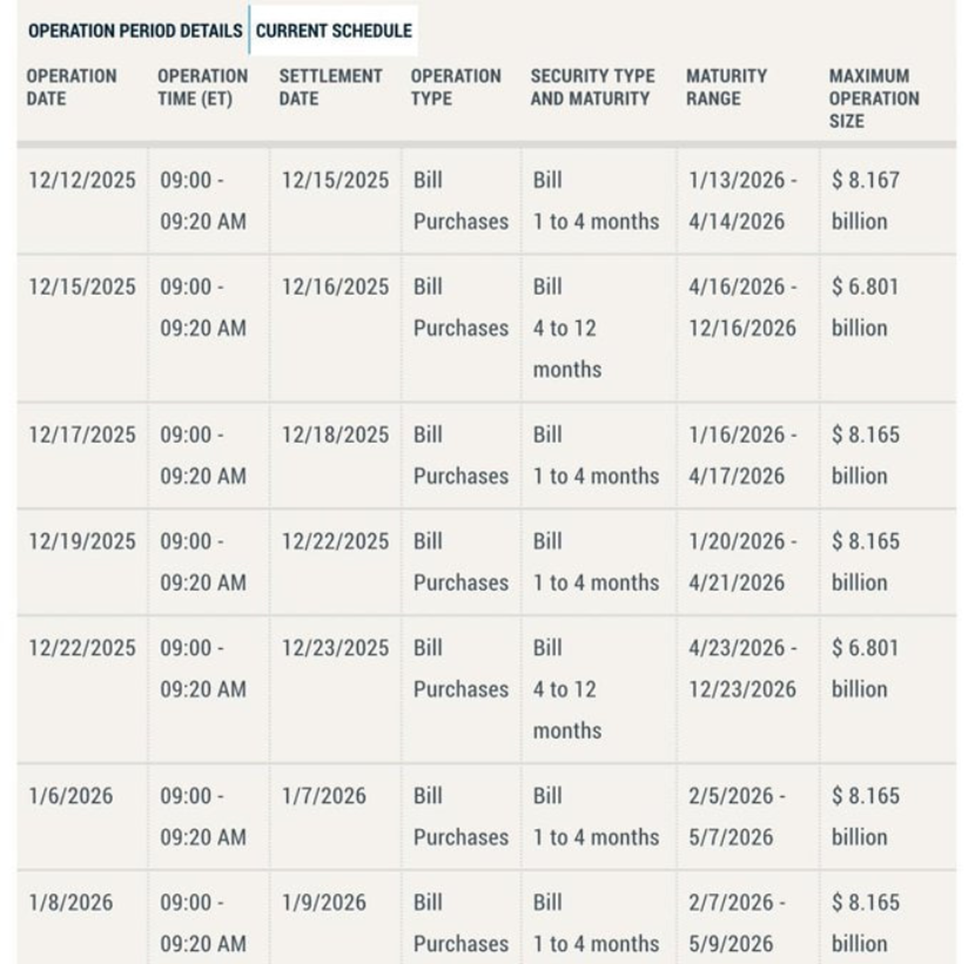
Increased Treasury bill purchases or other support at the short end of the yield curve could ease funding pressures and reduce short-term rates. The Fed says it will start technical buying of Treasury bills to manage market liquidity.

“[buying is] solely for the purpose of maintaining an ample supply of reserves over time, thus supporting effective control of our policy rate…these issues are separate from and have no implications for the stance of monetary policy,” said Fed Chair Jerome Powell.

The Fed periodically comes in during short-term funding markets amid instances of liquidity imbalances. These imbalances manifest in the overnight repo market, where banks borrow cash in exchange for Treasuries.

Recently, multiple indicators point to a rising short-term funding pressure, including:

  • Money market funds sitting on elevated levels of cash,
  • T-bill issuance tightening as the Treasury shifted its borrowing mix, and
  • Increasing seasonal demand for liquidity.

The Fed initiated a controlled purchase plan of Treasury bills to prevent short-term interest rates from deviating from the target Federal Funds Rate. These are the shortest-maturity government securities, typically ranging from a few weeks to one year in duration.

While not a classic QE move, this measure could still serve as a significant liquidity tailwind for crypto markets.

Schedule for regular Treasury bill (T-bill) purchase operations conducted by the New York Fed
Schedule for regular Treasury bill (T-bill) purchase operations conducted by the New York Fed. Source: XWIN Research and Asset Management

For Q1 2026, the broader implications for risk assets, such as crypto and equities, are generally positive but moderate, stemming from a shift in Fed policy toward maintaining or gradually expanding liquidity.

4. Political Incentives Favor Stability

With US midterm elections scheduled for November 2026, policymakers are likely to favor market stability over disruption.

This environment reduces the risk of sudden regulatory shocks and enhances investor confidence in risk assets.

“If the stock market in the USA falters before the midterm elections, the current US administration will be held accountable – hence they will do everything they can to keep things going in equities (and crypto,” wrote macro researcher Thorsten Froehlich.

5. The Employment “Paradox”

Weakening labor market data, such as soft employment or modest layoffs, often triggers dovish Fed responses.

Softer labor conditions increase pressure on the Fed to ease policy, indirectly creating more liquidity and favorable conditions for cryptocurrencies.

Expert Outlook Suggests Bullish Sentiment Growing

Industry observers are aligning with the macro view. Alice Liu, Head of Research at CoinMarketCap, forecasts a crypto market comeback in February and March 2026, citing a combination of positive macro indicators.

“We are going to see a market comeback in Q1 of 2026. February and March will be a bull market again, based on a combination of macro indicators,” Binance reported, citing said Alice Liu, Head of Research, CoinMarketCap

Some analysts are even more optimistic. Crypto commentator Vibes predicts Bitcoin could reach $300,000 to $600,000 in Q1 2026. This reflects extreme bullish sentiment amid improving liquidity and easing macro conditions.

CRYPTO IS ABOUT TO HAVE THE BIGGEST PUMP WE'VE EVER SEEN IN OUR LIVES

I'M EXPECTING ANYWHERE BETWEEN $300K AND $600K IN Q1 2026

— Vibes (@Vibesmetax) December 14, 2025

Currently, market participation remains muted. Bitcoin open interest has declined, reflecting cautious trader sentiment.

However, if these macroeconomic tailwinds materialize, consolidation could quickly give way to a significant surge, setting the stage for a historic start to 2026 in the crypto markets.

The post 5 Reasons Q1 2026 Could Spark the Biggest Crypto Bull Run Yet appeared first on BeInCrypto.

  •  

3 Reasons Why Bullish Bitcoin Price Predictions Still Hold

Bitcoin price looks stuck at first glance. Over the past 24 hours, the price has been nearly flat, down just 0.2%. Even on a weekly basis, Bitcoin has barely moved, up roughly 0.7%. The market feels quiet, and many traders are calling this range-bound action.

But under the surface, several signals suggest Bitcoin (BTC) is not as weak as it looks. Momentum is shifting slowly, sellers are losing conviction, and large holders continue to position quietly. Together, these factors explain why bullish Bitcoin price predictions made by experts like Tom Lee have not disappeared, even without a breakout yet.

Momentum And Volume Signals Are Quietly Improving

On the daily chart, the Bitcoin price continues to respect the $90,100 level. This zone has acted as a firm base during recent volatility, preventing deeper pullbacks even as the price failed to trend higher.

One of the clearest early signals comes from On-Balance Volume (OBV). OBV tracks whether volume is flowing into or out of an asset, helping identify hidden buying or selling pressure.

Between December 9 and December 11, the Bitcoin price made a lower high, while OBV made a higher high. This divergence shows that even as prices struggled, buyers were more active beneath the surface.

Bitcoin Flashes Divergence
Bitcoin Flashes Divergence: TradingView

Want more token insights like this? Sign up for Editor Harsh Notariya’s Daily Crypto Newsletter here.

That signal strengthened between December 10 and December 12. During this period, the Bitcoin price made a lower low, while OBV formed a higher low. This tells the same story from another angle. Sellers pushed the price lower, but with weaker volume support.

These two OBV divergences work together, not against each other. Combined, they show selling pressure is fading, not accelerating. This does not confirm a breakout, but it often appears before one.

Holders And Whales Are Positioning Despite the Flat Price

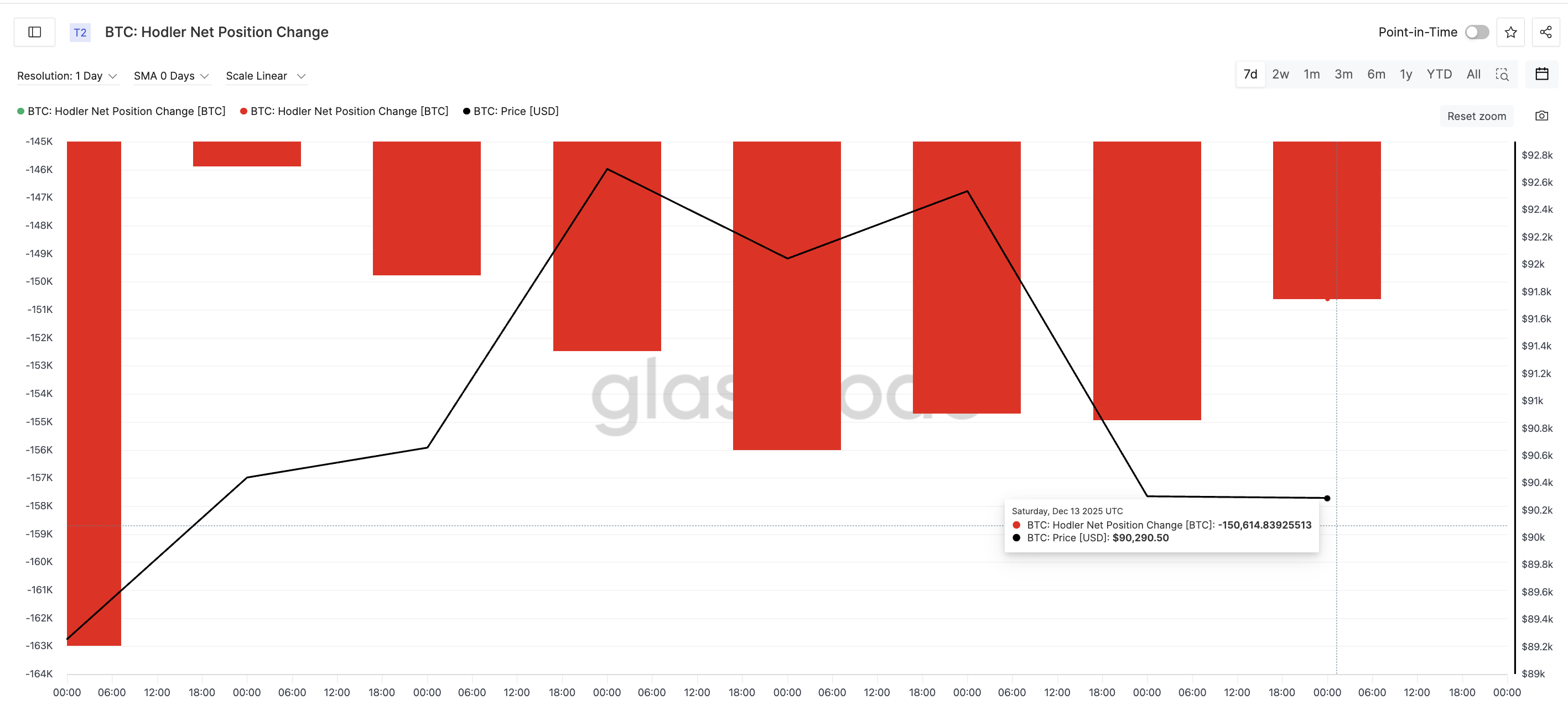
Momentum signals alone are not enough. On-chain data adds confirmation. Holder Net Position Change tracks whether long-term holders are adding or reducing Bitcoin positions. Negative values mean selling. Fewer negative values mean selling pressure is easing.

On December 10, long-term holders were distributing roughly 155,999 BTC. By December 13, that number dropped to around 150,614 BTC. That is a reduction of about 3.4% in selling pressure.

HODLers Selling Fewer Coins
HODLers Selling Fewer Coins: Glassnode

The change is not dramatic, but it is meaningful. Bitcoin is not seeing panic selling despite trading in a range. Instead, holders are selling less as the price stabilizes. This behavior typically appears during consolidation phases, not during breakdowns.

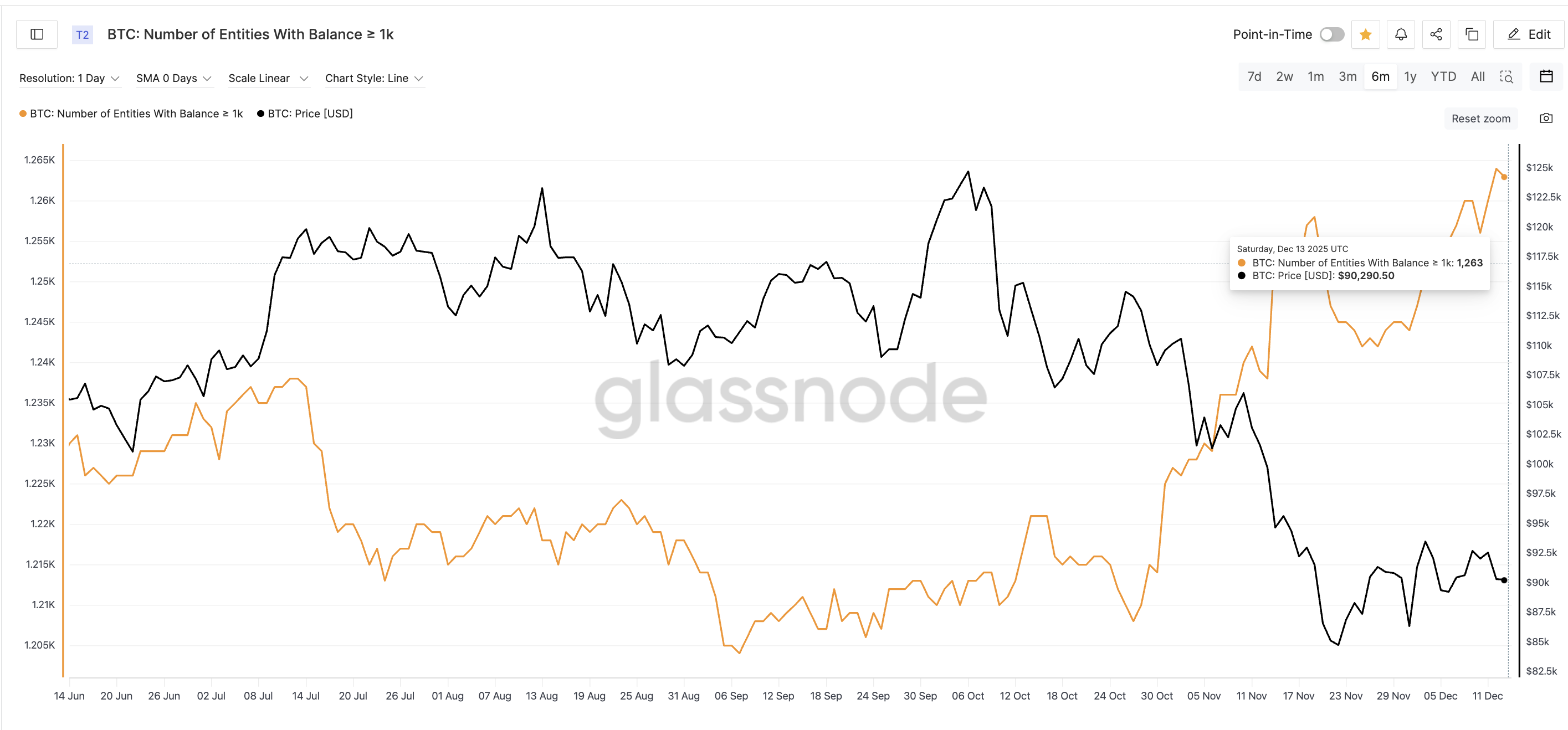
The strongest signal comes from whales. The number of entities holding at least 1,000 BTC remains near its six-month high. This metric often reflects large, long-term investors.

Since late October, the Bitcoin price has corrected and moved sideways. During the same period, whale entities continued to add. This creates a clear divergence. Price weakened, but large holders kept accumulating. And they usually do not add without any valid reason.

BTC Whales Keep Increasing
BTC Whales Keep Increasing: Glassnode

This behavior helps explain why bullish Bitcoin price predictions from analysts like Tom Lee remain in play.

JUST IN: Tom Lee says Bitcoin has likely bottomed and could break the 4 year cycle and hit $180,000 by the end of January. pic.twitter.com/NuFAltmFm8

— The ₿itcoin Therapist (@TheBTCTherapist) December 13, 2025

These forecasts are not based on short-term candles. They rely on reduced selling, improving volume structure, and steady whale accumulation. Still, the Bitcoin price must confirm the thesis.

Bitcoin Price Levels That Decide Whether Bulls Take Control

For Bitcoin to turn these signals into action, price confirmation is required.

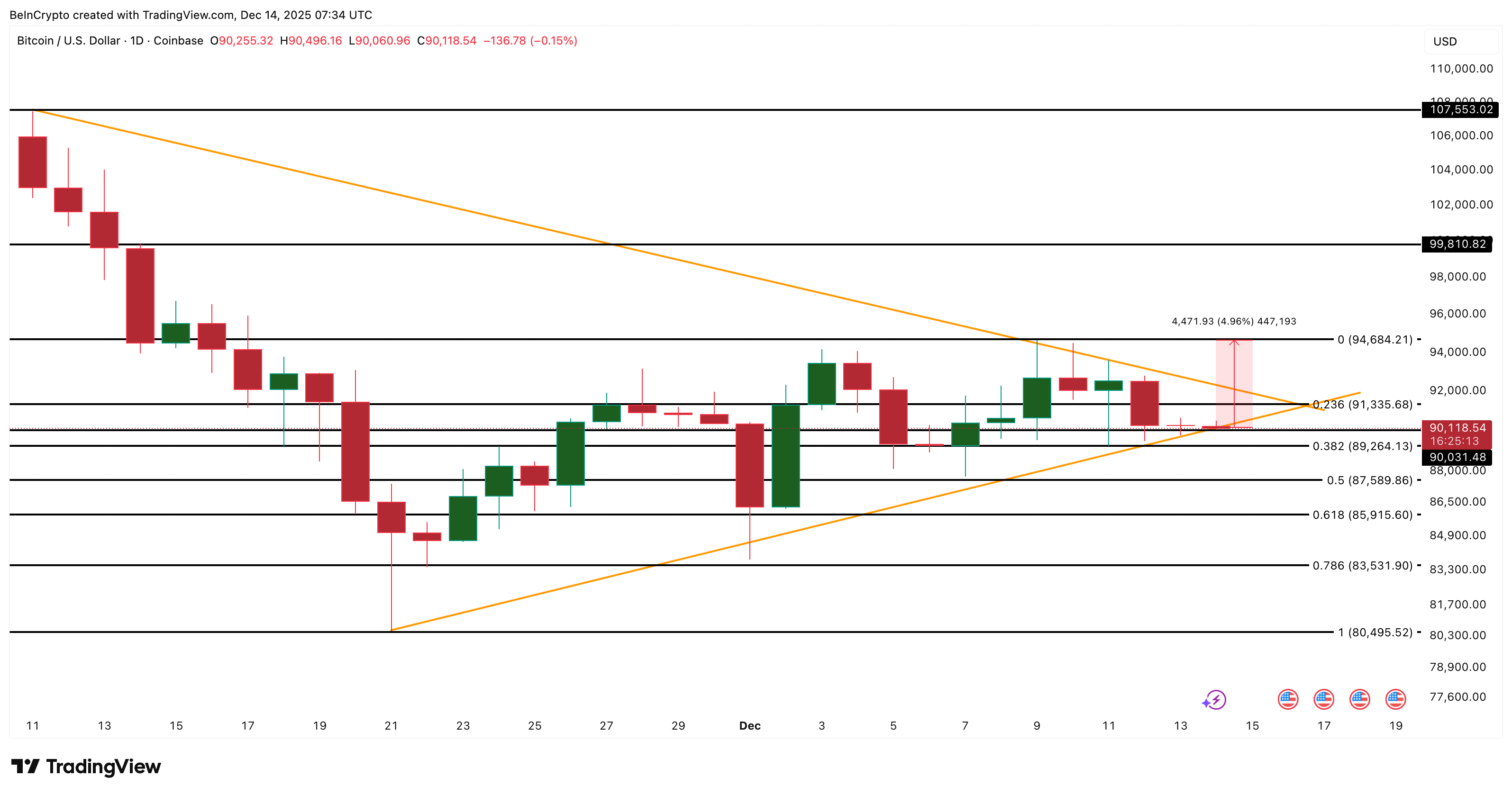
The most important level remains $94,600. A daily close above this zone would mark roughly a 5% move from current levels and break above the upper boundary of the current compression structure. That would signal that buyers have regained short-term control.

Bitcoin Price Analysis
Bitcoin Price Analysis: TradingView

If $94,600 breaks, the next resistance sits near $99,800. A sustained move above that level could open the path toward $107,500, if broader market conditions allow. That could be the first real catalyst to Tom Lee’s aggressive $180,000 outlook, as stated earlier.

On the downside, if the Bitcoin price loses $90,000, support lies near $89,200. Below that, $87,500 becomes the next key level. A break under these zones would invalidate the bullish setup, at least in the short term.

The post 3 Reasons Why Bullish Bitcoin Price Predictions Still Hold appeared first on BeInCrypto.

  •  

Bitcoin Weekly Forecast: Fed Delivers, Yet Fails to Impress BTC Traders

Bitcoin (BTC) continues to trade within the recent consolidation phase, hovering around $90,000 at the time of writing on Friday, as investors digest the Federal Reserve’s (Fed) cautious December rate cut and its implications for risk assets. 

BTC price action approaches a key descending trendline that could determine its next directional move. Meanwhile, institutional flows into Spot Bitcoin ETFs showed mild inflows, and Strategy added more BTC to its treasury reserve.

Fed’s Policy Tone Triggers Consolidation in Bitcoin

Bitcoin price started the week on a positive note, extending its weekend recovery during the first half of the week and holding above $92,600 on Tuesday. 

However, momentum softened on Wednesday, with BTC closing at $92,015 after the Federal Open Market Committee (FOMC) meeting. 

In a widely expected move, the Fed lowered interest rates by 25 basis points. But the FOMC meeting signaled a likely pause in January. 

Adding to the cautious tone, policymakers projected only a one-quarter-percentage-point cut for the overall 2026 outlook. This was the same outlook as in September, which tempered market expectations of two rate cuts and contributed to short-term pressure on risk assets. 

The Fed’s cautious tone, combined with disappointing Oracle earnings, contributed to a brief risk-off move. 

All these factors weighed on riskier assets, with the largest cryptocurrency by market capitalization sliding to a low of $89,260 before rebounding and finishing above $92,500 on Thursday. 

With no major US data releases ahead, crypto markets will now look to FOMC member speeches and broader risk sentiment for direction

at the end of the week. 

BTC is likely to consolidate in the near term unless a significant catalyst emerges. 

Russia-Ukraine Uncertainty Limits Risk-on Momentum 

On the geopolitical front, US President Donald Trump is “extremely frustrated” with Russia and Ukraine, and he doesn’t want any more talk, his spokeswoman said on Thursday. 

Earlier, Ukrainian President Volodymyr Zelenskyy said that the US was pushing the country to cede land to Russia as part of an agreement to end a nearly four-year war. 

These lingering geopolitical tensions and stalled peace talks continue to weigh on global risk sentiment, limiting risk-on appetite and contributing to Bitcoin’s consolidation so far this week

Institutional Demand Sees Mild Signs of Improvement 

Institutional demand for Bitcoin shows mild signs of improvement. 

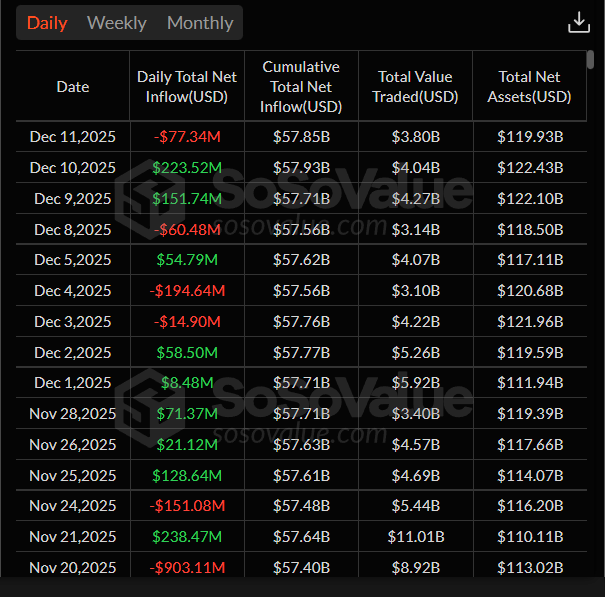
According to SoSoValue data, US-listed spot Bitcoin ETFs recorded a total inflow of $237.44 million through Thursday, following a mild outflow of $87.77 million a week earlier, signaling that institutional investor interest improved somewhat. 

However, these weekly inflows remain small relative to those observed in mid-September. For BTC to continue its recovery, the ETF inflows should intensify. 

Total Bitcoin Spot ETF Net Inflow Chart. Source: SoSoValue 

On the corporate front, Strategy Inc. (MSTR) announced on Monday that it purchased 10,624 Bitcoin for $962.7 million between December 1 and 7 at an average price of $90,615. 

The firm currently holds 660,624 BTC, valued at $49.35 billion. Strategy still retains substantial capacity to raise additional capital, potentially allowing for further large-scale Bitcoin accumulation. 

On-Chain Data Shows Easing Selling Pressure 

CryptoQuant’s weekly report on Wednesday highlights that selling pressure on Bitcoin is beginning to ease.

The report notes that exchange deposits eased as large players reduced their transfers to exchanges. 

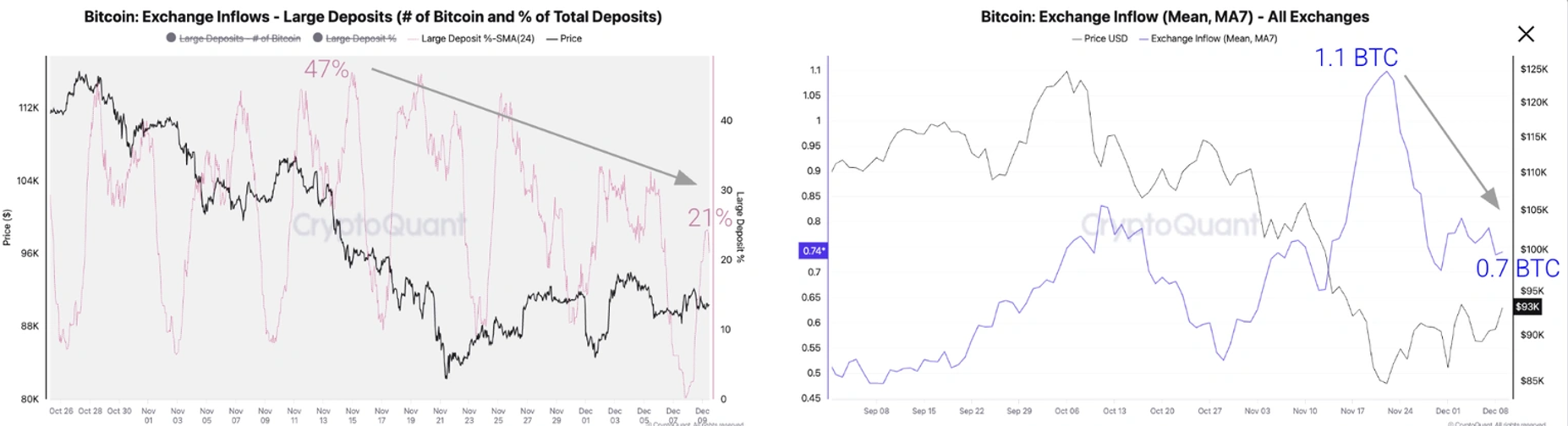
The graph below shows that the share of total deposits from large players has declined from a 24-hour average high of 47% in mid-November to 21% as of Wednesday. 

At the same time, the average deposit has declined by 36%, from 1.1 BTC in November 22 to 0.7 BTC. 

Bitcoin Exchange Flows. Source: CryptoQuant

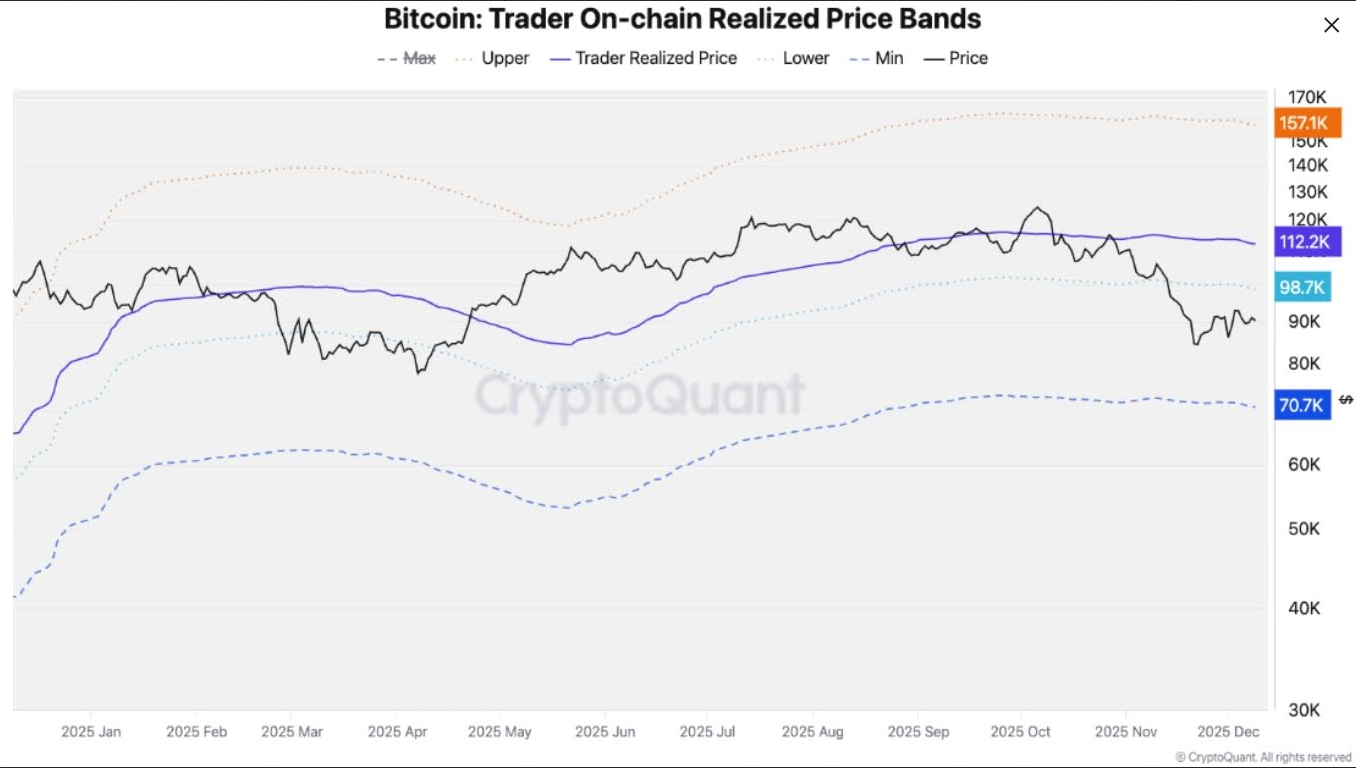
CryptoQuant concludes that, if selling pressure remains low, a relief rally could push Bitcoin back to $99,000. This level is the lower band of the Trader On-chain Realized Price bands, which is a price resistance during bear markets. 

After this level, the key price resistances are $102,000 (one-year moving average) and $112,000 (the Trader On-chain Realized price).

Bitcoin Trader’s Realized Price Bands

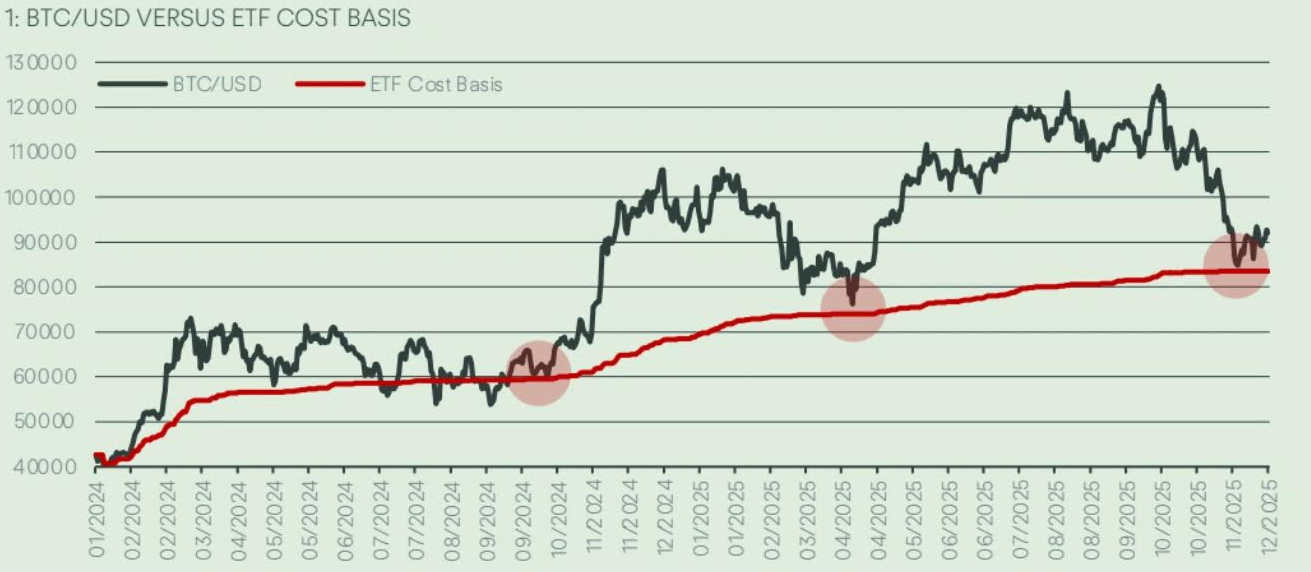
The Copper Research report also signaled optimism about Bitcoin. The report suggests that BTC’s four-year cycle hasn’t died; it has been replaced. 

Since the launch of spot ETFs, Bitcoin has exhibited repeatable Cost-Basis Return Cycles, as shown in the graph below.

Bitcoin USD Price Vs ETF Cost Basis

Fadi Aboualfa, Head of Research at Copper, told FXStreet that “Since spot ETFs launched, Bitcoin has moved in repeatable mini-cycles where it pulls back to its cost basis and then rebounds by around 70%. 

With BTC now trading near its $84,000 cost basis, this pattern suggests a move north of $140,000 in the next 180 days. 

If the cost basis rises 10-15%, as in prior cycles, the resulting premium seen at past peaks produces a target range of $138,000 to $148,000. 

Bitcoin Santa Rally Ahead? 

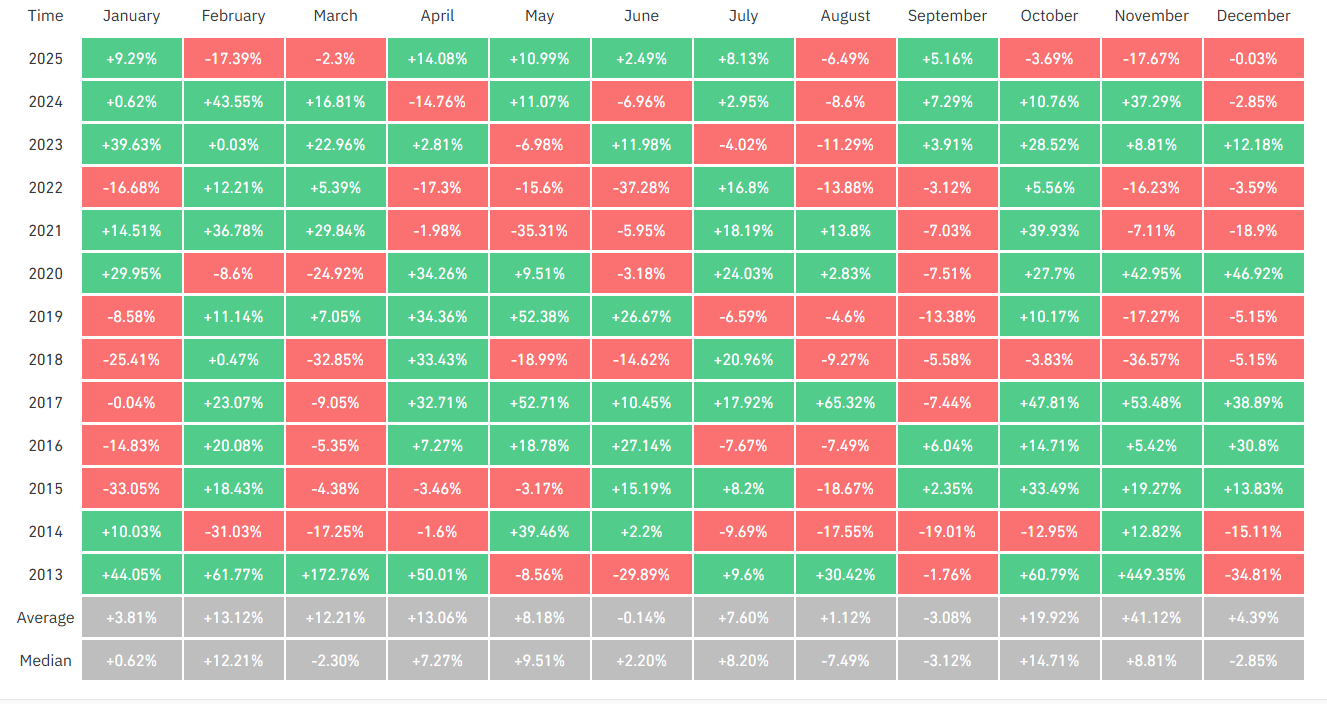
Bitcoin posted a 17.67% loss in November, disappointing traders who had anticipated a rally based on its strong historical returns for the month (see CoinGlass data below). 

December has historically been a positive month for the king crypto, delivering an average return of 4.55%.

Bitcoin Monthly Returns. Source: CoinGlass

Looking at quarterly data, the fourth quarter (Q4) has been the best quarter for BTC in general, with an average return of 77.38%. 

Still, the performance in the last three months of 2025 has been underwhelming so far, posting for now a 19% loss.

Is BTC Setting a Bottom? 

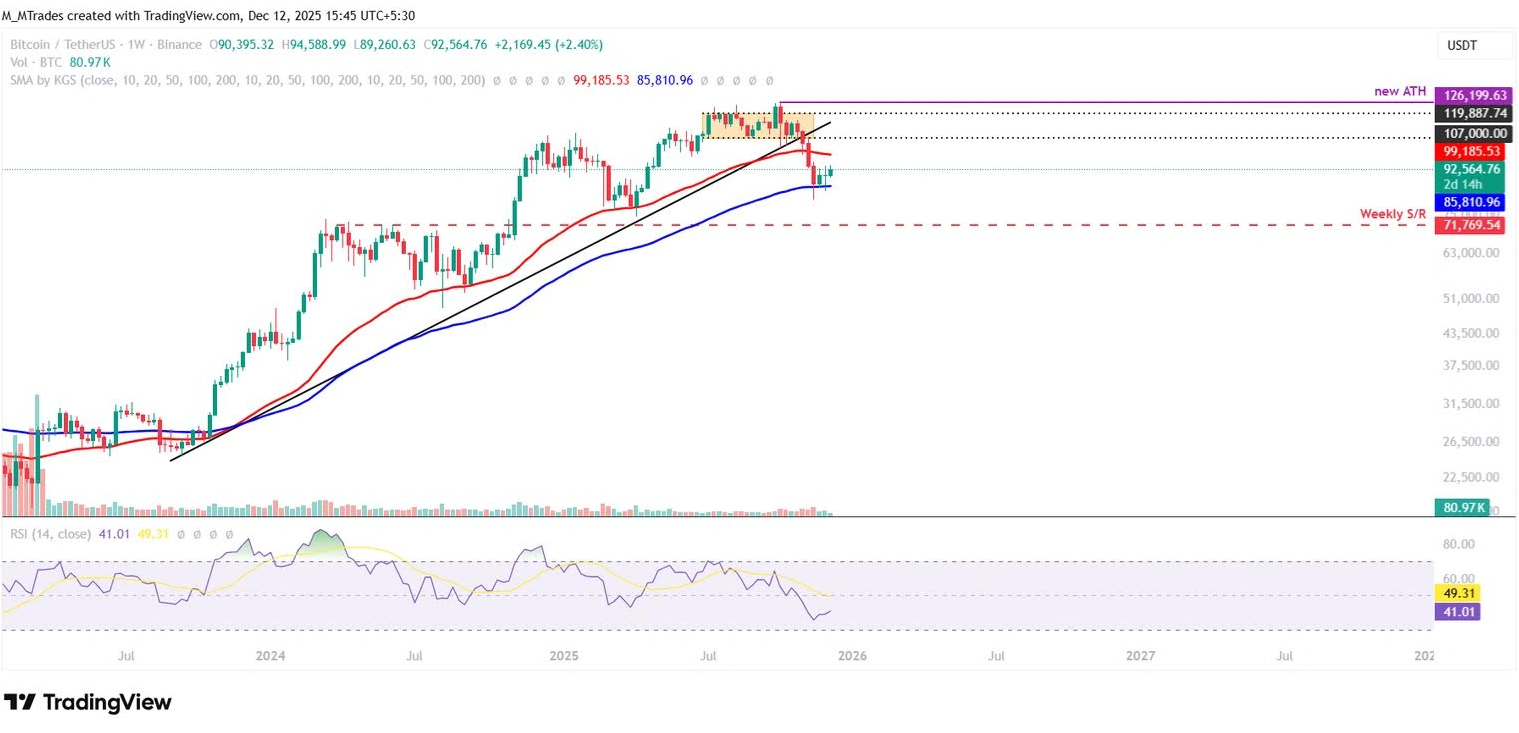
Bitcoin’s weekly chart shows the price finding support around the 100-week Exponential Moving Average (EMA) at $85,809, posting two consecutive green candles following a four-week correction that began in late October. 

As of this week, BTC is trading slightly higher, holding above $92,400. 

If BTC continues its recovery, it could extend the rally toward the 50-week EMA at $99,182.

The Relative Strength Index (RSI) on the weekly chart reads 40, pointing upward and indicating fading bearish momentum. For the recovery rally to be sustained, the RSI should move above the neutral level of 50. 

BTC/USDT weekly chart 

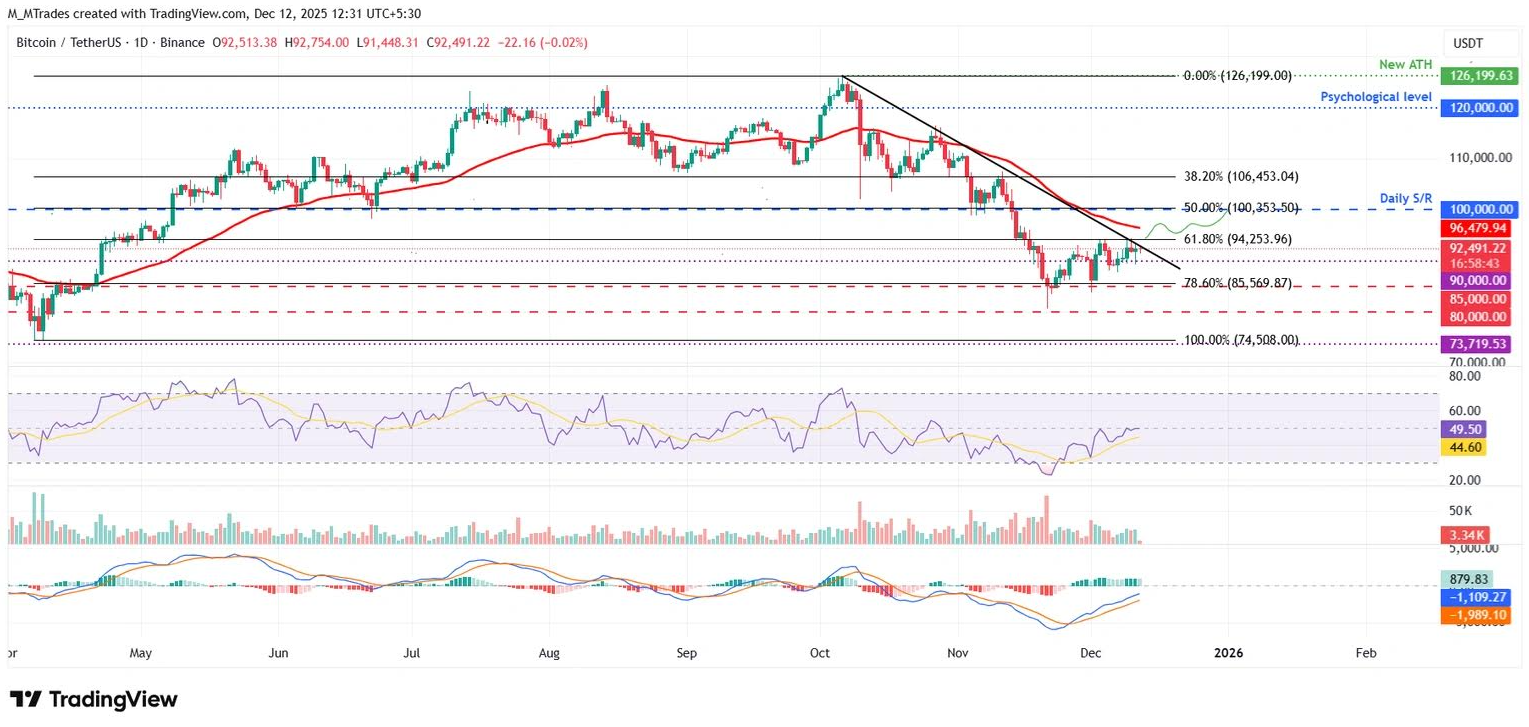
On the daily chart, Bitcoin’s price was rejected at the 61.8% Fibonacci retracement level at $94,253 (drawn from the April low of $74,508 to the all-time high of $126,199 set in October) on Wednesday. 

However, on Thursday, BTC rebounded after retesting its $90,000 psychological level. 

If BTC breaks above the descending trendline (drawn by connecting multiple highs since early October) and closes above the $94,253

resistance level, it could extend the rally toward the $100,000 psychological level. 

The Relative Strength Index (RSI) on the daily chart is stable near the neutral 50 level, suggesting the lack of near-term momentum in either side. 

For the bullish momentum to be sustained, the RSI should move above the neutral level. 

Meanwhile, the Moving Average Convergence Divergence (MACD) showed a bullish crossover at the end of November, which remains intact, supporting the bullish thesis. 

BTC/USDT Daily Chart 

If BTC were to resume its downward correction, the first key support is at $85,569, which aligns with the 78.6% Fibonacci retracement level.

The post Bitcoin Weekly Forecast: Fed Delivers, Yet Fails to Impress BTC Traders appeared first on BeInCrypto.

  •  

4 Charts Explain Bitcoin’s Price Condition Heading into Christmas 2025

Bitcoin approaches Christmas 2025 in a fragile but interesting position. Price trades around the $93,000 area after weeks of pressure. Four key charts show a market late in its correction, yet still lacking a clear bullish trigger.

The data highlights three big forces at work. Recent buyers sit in heavy losses, while new whales are capitulating. Macro conditions still drive price, even as spot buying strength quietly returns.

Short-Term Bitcoin Holders are in Deep Pain

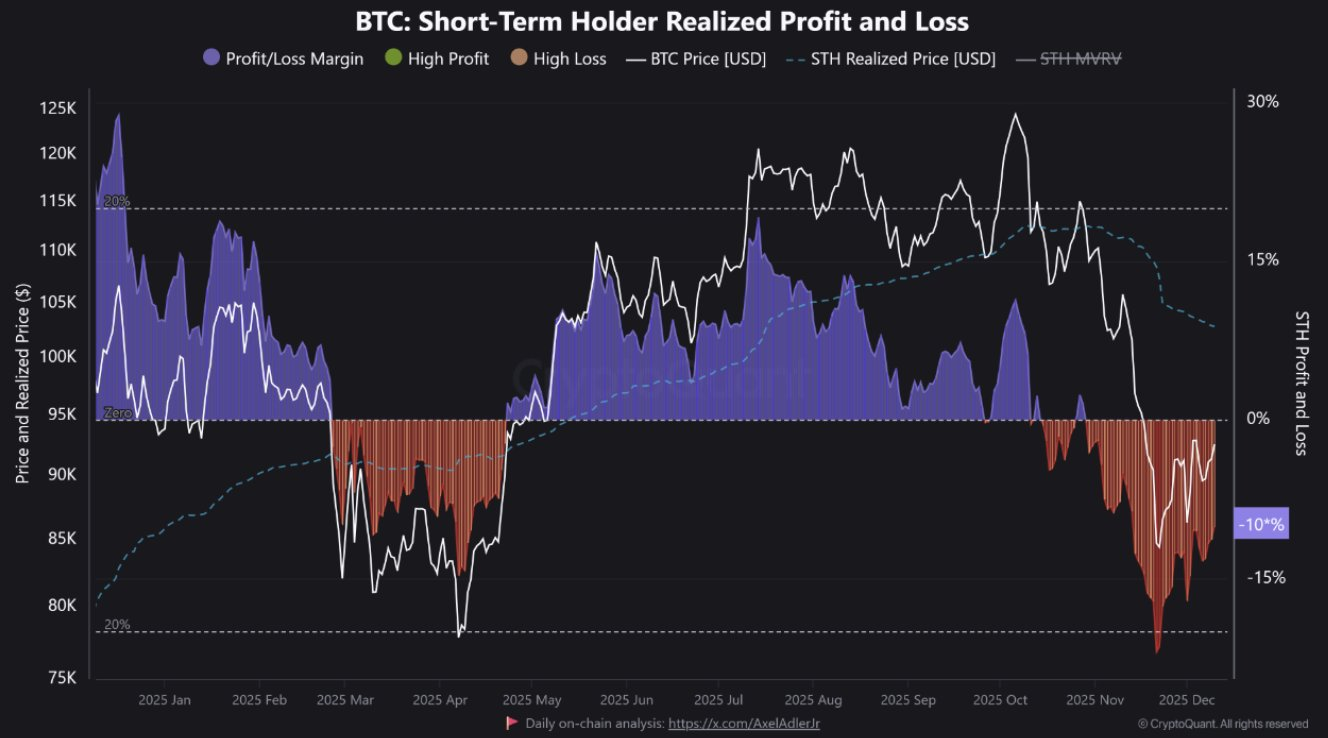
The first chart tracks short-term holder (STH) realized profit and loss. This group includes coins bought in recent months. Their “realized price” is the average cost basis for these coins. 

Bitcoin Short-Term Holders Realized Profits and Losses. Source: CryptoQuant

Earlier in 2025, STHs sat on strong gains. Their average position was 15–20% in profit as Bitcoin pushed higher. That phase encouraged profit-taking and added sell pressure near the highs.

Today, the picture has flipped. Bitcoin trades below the STH realized price, and the cohort shows about -10% losses. The histogram on the chart is red, marking one of the deepest loss regimes of 2025.

This has two consequences.

Near term, these underwater holders can sell into every bounce. Many simply want out at break-even, which caps rallies toward their entry zone.

However, deep and persistent loss pockets usually appear later in corrections. They signal that weak hands already took heavy damage.

At some point, the selling power of this group runs low.

75% of Short-Term Holder's coins are sitting in loss (over 4.36 million BTC).

Interestingly enough, this is a comparable trend to the prior two local bottoms of this Bitcoin cycle. pic.twitter.com/2w1J4rXzi9

— On-Chain College (@OnChainCollege) December 8, 2025

Historically, the key turning signal comes when price reclaims the STH realized price from below. That move tells you forced selling is mostly done and new demand absorbs supply.

Until that happens, the chart still argues for caution and range trading around current levels.

New Bitcoin Whales Just Surrendered

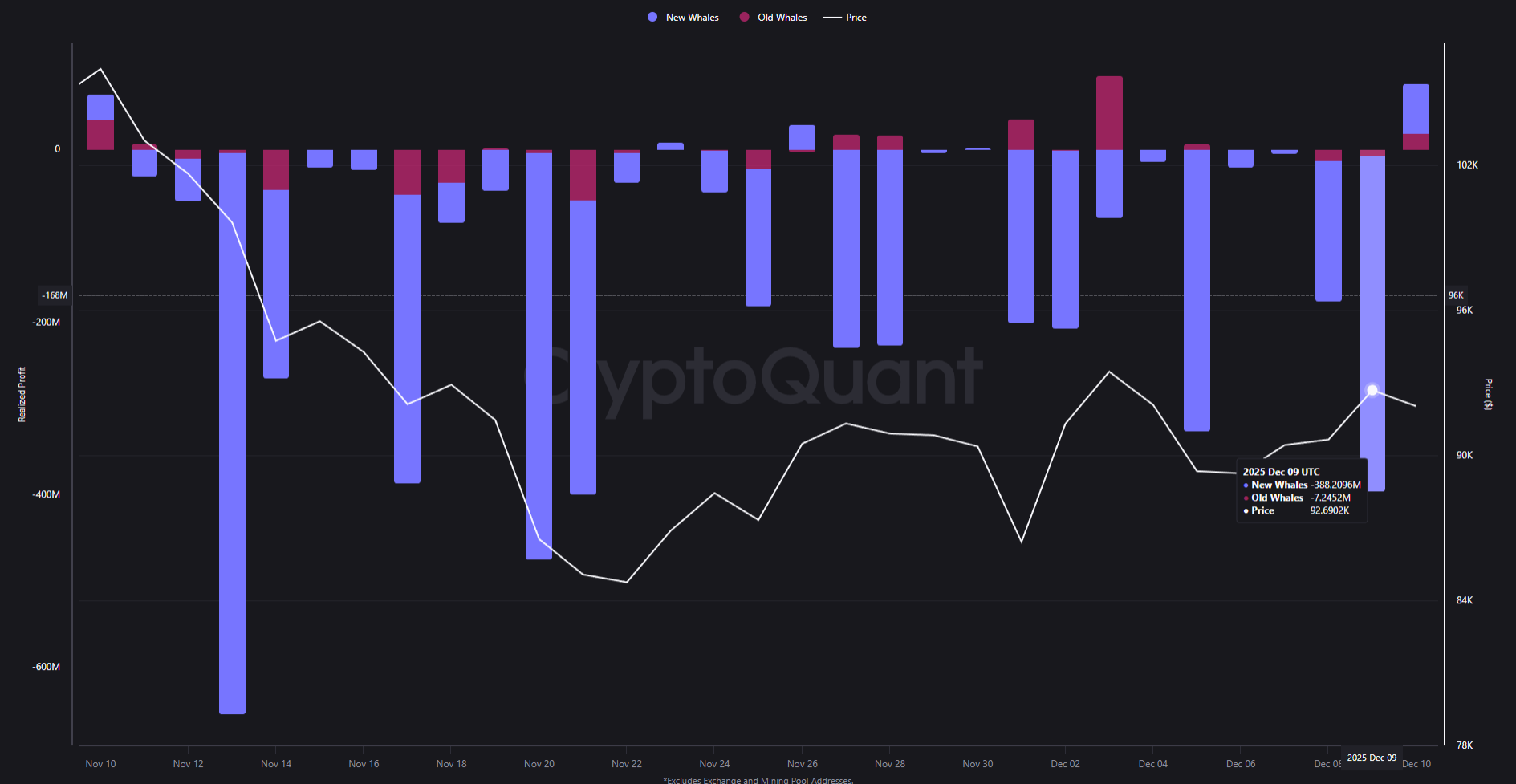
The second chart shows realized profit and loss by whale cohorts. It splits flows between “new whales” and “old whales”. New whales are large holders that accumulated recently.

Realized Profits by Bitcoin Whales Since November 2025. Source: CryptoQuant


Yesterday, new whales realized $386 million in losses in one day. Their bar on the chart is a large negative spike. Several other big negative bars cluster around recent lows.

Old whales tell a different story. Their realized losses and profits are smaller and more balanced. They are not exiting at the same pace as the newcomers.

This pattern is typical at late stages of a correction. New whales often buy late, sometimes with leverage or strong narrative bias. When price moves against them, they are first to capitulate.

That capitulation has a structural benefit. Coins move from weak large hands to stronger hands or smaller buyers. Future sell-side overhang from this group decreases after such events.

Short term, these flushes can still drag price lower. Yet medium term, they improve the quality of Bitcoin’s holder base.

The market becomes more resilient once panicked large sellers finish exiting.

Real Interest Rates Still Steer Bitcoin

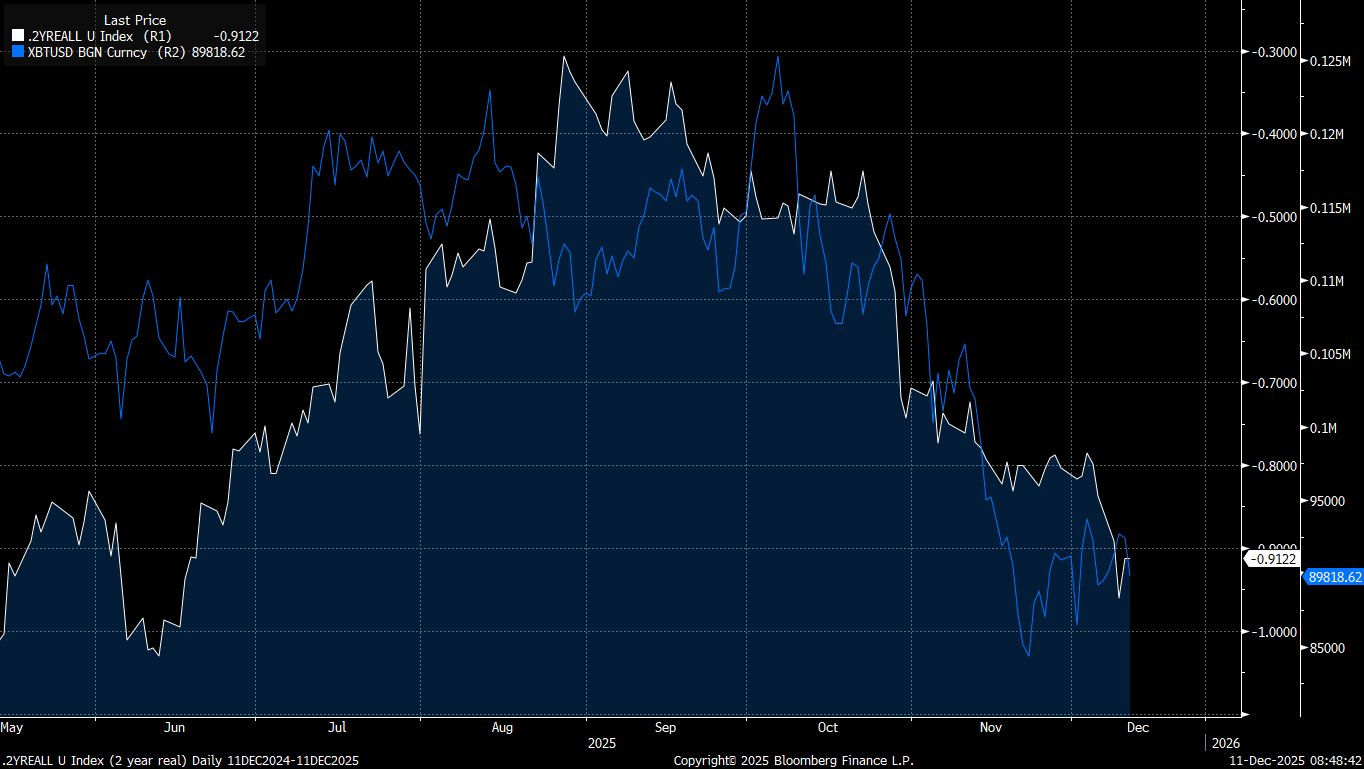
The third chart overlays Bitcoin with two-year US real yields, inverted. Real yields measure interest rates after inflation. The series moves almost tick-for-tick with BTC across 2025.

When real yields fall, the inverted line rises. Bitcoin tends to rise alongside it as liquidity improves. Lower real yields make risk assets more appealing relative to safe bonds.

2-Year Real Interest Rates Inverted With BTC Overlaid

Since late summer, real yields have moved higher again. The inverted line trended lower, and Bitcoin followed it down. This shows macro conditions still dominate the larger trend.

Federal Reserve rate cuts alone may not fix this. What matters is how markets expect real borrowing costs to evolve. If inflation expectations fall faster than nominal rates, real yields can even rise.

For Bitcoin, a durable new bull leg likely needs easier real conditions. Until bond markets price that shift, BTC rallies face a macro headwind.

What is driving the drawdown in Bitcoin?

When you stop listening to Bitcoin pundits and start listening to what Bitcoin is saying about itself, then you will see the real truth

I am going to lay out the 3 major things you need to watch for Bitcoin right now 🧵 pic.twitter.com/FC60PPt2gG

— Capital Flows (@Globalflows) December 11, 2025

Spot Taker Buyers are Stepping Back In

The fourth chart tracks 90-day Spot Taker CVD across major exchanges. CVD measures the net volume of market orders that cross the spread.

It shows whether aggressive buyers or sellers dominate.

For weeks during the drawdown, the regime was Taker Sell Dominant. Red bars filled the chart as sellers hit bids across spot markets. This aligned with the grinding drift lower in price.

Now the signal has flipped. The metric just turned Taker Buy Dominant, with green bars returning. Aggressive buyers now outnumber aggressive sellers on spot venues.

Taker Buy momentum is back 🔄

Bitcoin's 90-day Spot Taker CVD just flipped to **Taker Buy Dominant** — marking a shift in market behavior after weeks of sell-side pressure.

Buy-side aggression is returning across major spot exchanges. pic.twitter.com/w5uaGcGHPi

— Maartunn (@JA_Maartun) December 11, 2025

This is an early but important change. Trend reversals often start with microstructure shifts like this.
First buyers step in, then price stabilizes, then larger flows follow.

One day of data is never enough. However, a sustained green regime would confirm that real demand is back. It would show spot markets absorbing supply from STHs and capitulating whales.

What It All Means For Bitcoin Price Heading Into Christmas

Taken together, the four charts show a late-stage correction, not a fresh bull market.

Short-term holders and new whales carry heavy losses and still sell into strength. Macro real yields keep a lid on risk appetite at the index level.

At the same time, some building blocks for a recovery are visible. Capitulation by new whales cleans up the holder base.

Spot taker buyers are returning, which reduces downside velocity.

Heading into Christmas 2025, Bitcoin looks range-bound with a bearish tilt, hovering around $90,000.

Downside spikes into the mid or high-$80,000s remain possible if real yields stay high. A clear bullish shift likely needs three signals together:

First, price must reclaim the short-term holders’ realized price and hold above it. Second, two-year real yields should roll lower, easing financial conditions.

Third, Taker Buy dominance should persist, confirming strong spot demand.

Until that alignment appears, traders face a choppy market shaped by macro data and trapped holders. Long-term investors may see this as a planning zone rather than a time for aggressive bets.

The post 4 Charts Explain Bitcoin’s Price Condition Heading into Christmas 2025 appeared first on BeInCrypto.

  •  

Bitcoin Is Just One Push Away From Ending Its Correction — Here’s How

Bitcoin price has extended its correction after the FOMC rate cut. The coin is down about 13% over the past 30 days and almost 4% in the past week. The move still fits inside a slow, grinding corrective phase since the October peak.

But two on-chain shifts now show something that did not appear at any point earlier in this downturn. These signals suggest the correction could be close to a turn — if Bitcoin delivers the push it needs.

Two Metrics Now Point Toward a Possible Turn

Short-term capitulation is showing up clearly now. CryptoQuant’s realized profit-and-loss data shows short-term Bitcoin holders are still deep in losses. This usually happens near the end of a correction, not the middle, because panicked selling at a loss often marks late-stage exhaustion.

BTC Short-Term Holders are Still in a Pain Zone

“Structurally, these deep loss pockets usually show up closer to the late stages of a correction than the early ones.” – By @IT_Tech_PL pic.twitter.com/bw39CfxGh6

— CryptoQuant.com (@cryptoquant_com) December 11, 2025

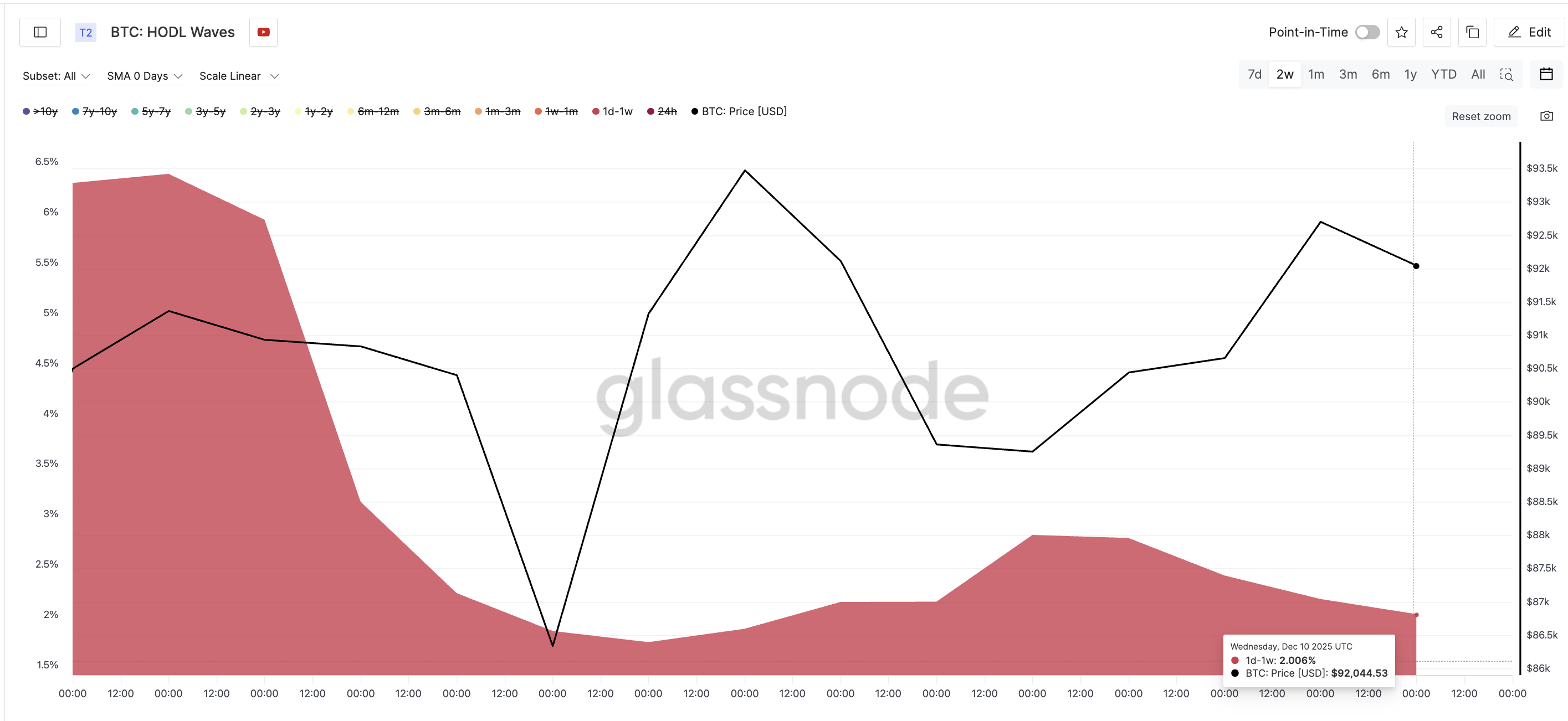
This fits with what shows up on HODL Waves.

HODL Waves measure how much Bitcoin each “age band” holds — from very new coins to very old ones. It shows which groups are accumulating or selling. The one-day to one-week cohort held 6.2% of the supply in late November. By December 10, they held only 2%.

That is a massive 68% drop and signals heavy short-term selling, the kind that often completes a correction rather than starts a new one. Plus, this cohort dumping also pushes speculative money out of the asset.

Short-Term Holders Keep Selling
Short-Term Holders Keep Selling: Glassnode

Want more token insights like this? Sign up for Editor Harsh Notariya’s Daily Crypto Newsletter here.

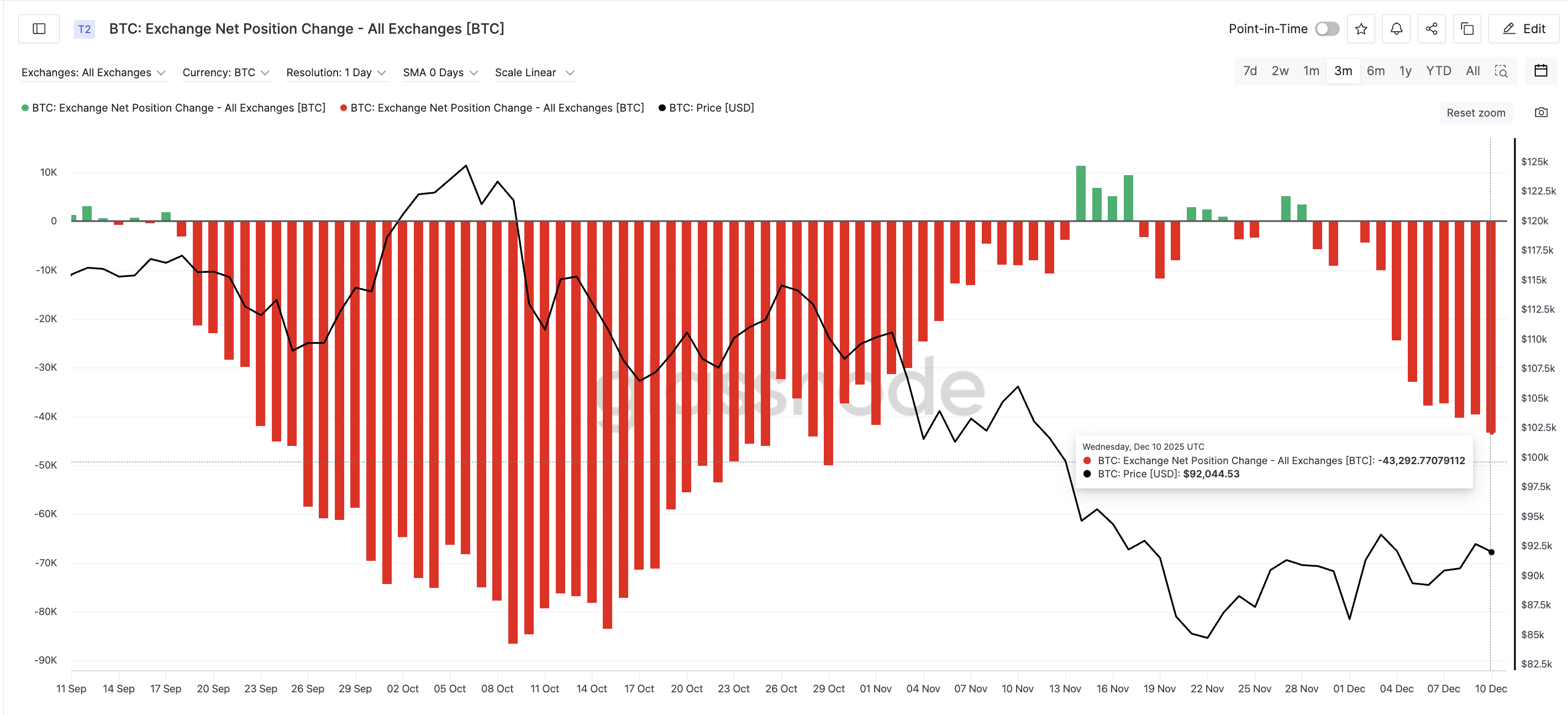
The next signal comes from Exchange Net Position Change, which tracks how many coins move into or out of exchanges each day.

On November 27, net flows were +5,103 BTC (coins moving in).

By December 10, the flows flipped to –43,292 BTC, a flip of more than 8.4x from inflows to outflows.

A similar shift happened between September 17 and September 25. After that flip, Bitcoin rallied toward its all-time high above $126,000, per CoinGecko.

BTC Buying Intensifies
BTC Buying Intensifies: Glassnode

Now the same combination — short-term capitulation plus strong outflows — is forming again. Together, they create the cleanest trend-shift setup of this entire correction.

Bitcoin Price Needs a 4% Push to Break Out?

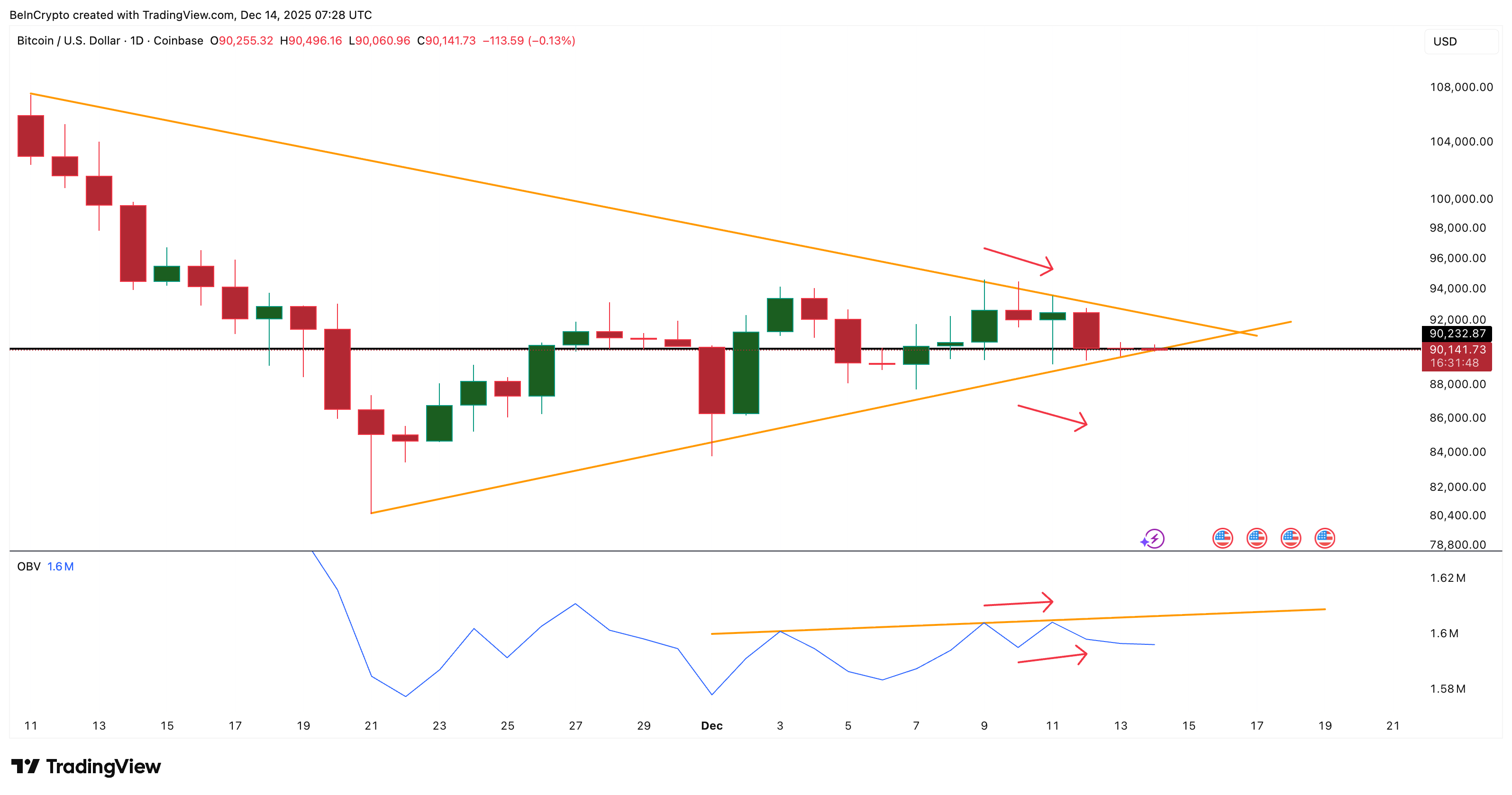
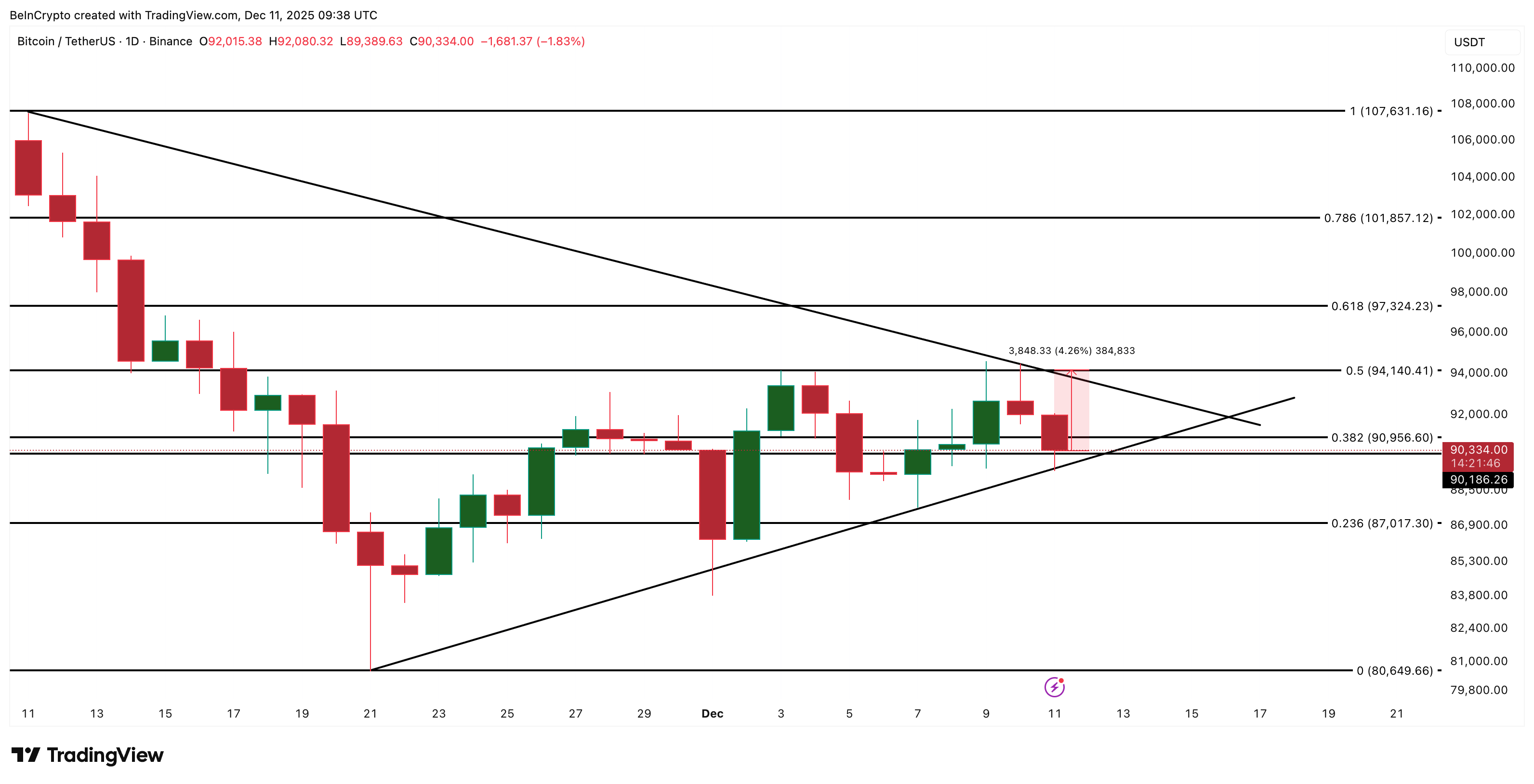
If these signals are pointing to a turn, the Bitcoin price chart needs to confirm it. The Bitcoin price has been moving inside a symmetrical triangle on the daily chart. A symmetrical triangle forms when buyers and sellers slow at the same pace. Each side has only two touch points, which makes both trend lines weak. A small push can break the entire setup on either side.

That push is clear: Bitcoin needs a daily close above $94,140, which is only about a 4% move from current levels. This level overlaps with both the horizontal resistance and the upper edge of the triangle. A clean breakout opens the path toward $97,320 and then $101,850.

On the downside, the nearest risk level is $90,180. A daily close under it weakens the bullish case. If that breaks, $87,010 is the next major support. Losing that exposes $80,640, where the broader bullish idea breaks.

Bitcoin Price Analysis
Bitcoin Price Analysis: TradingView

Right now, the setup is neutral but improving. Short-term capitulation and heavy outflows give the Bitcoin price a chance to end its correction — but only if it delivers that 4% breakout.

The post Bitcoin Is Just One Push Away From Ending Its Correction — Here’s How appeared first on BeInCrypto.

  •  

Top 3 Price Prediction Bitcoin, Gold, Silver: Is the Fed-Driven Rally Built to Last?

Bitcoin, gold, and silver experienced a sudden surge in strength on Tuesday, the eve of what appears to be another Fed rate cut.

The pioneer crypto, as well as the two commodity safe havens, Gold and Silver, may face volatility around the Fed’s interest rate decision, even as XAG price breaks above $60/oz for the first time in history, now up +108% in 2025.

Top BTC, XAU, and XAG Price Targets Ahead of the Fed Cut

All eyes are on the Fed’s interest rate decision tomorrow and the subsequent Jerome Powell press conference. This is one of the most important macroeconomic events for Bitcoin and commodity safe havens this week.

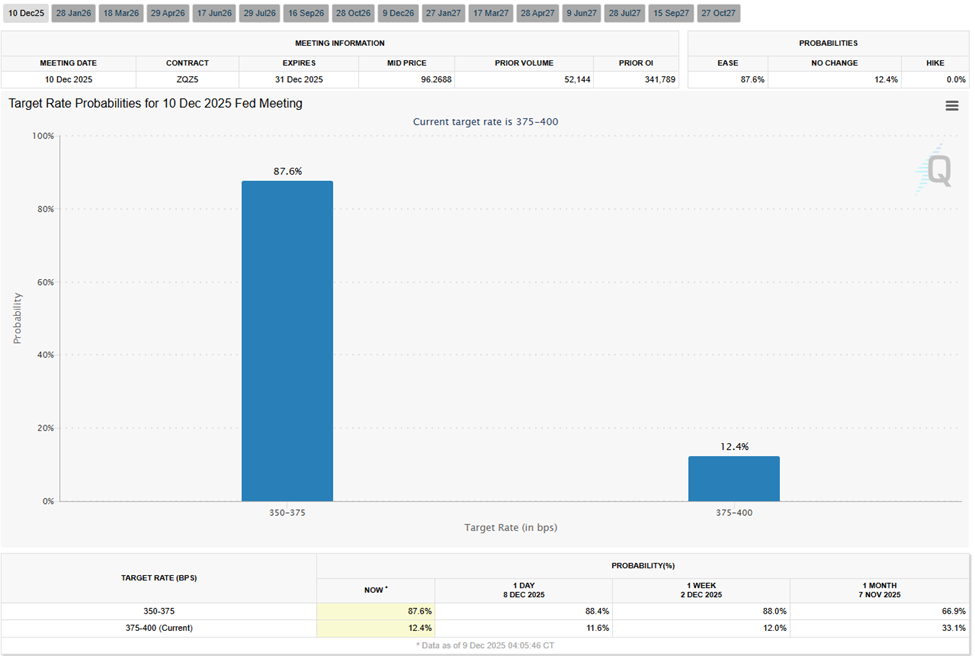
Data from the CME FedWatch Tool shows that interest bettors see an 87.6% chance that the Fed will cut interest rates.

Interest Rate Cut Probabilities
Interest Rate Cut Probabilities. Source: CME FedWatch Tool

A Fed rate cut is generally a tailwind for Bitcoin as it injects liquidity into the financial markets. Gold is typically the cleanest and fastest beneficiary of rate cuts, while silver often lags gold initially, then outperforms during strong reflation moves. This is why silver tends to make violent upside moves after cuts once momentum builds.

  • Gold reacts first and most predictably
  • Bitcoin benefits as liquidity expands
  • Silver often becomes the late-stage momentum winner

Based on current price action, however, markets are already pricing in the event, with traders already front-running a rate cut amid near-certain probabilities.

Bitcoin Races for $100,000 Ahead of Fed’s Interest Rate Decision

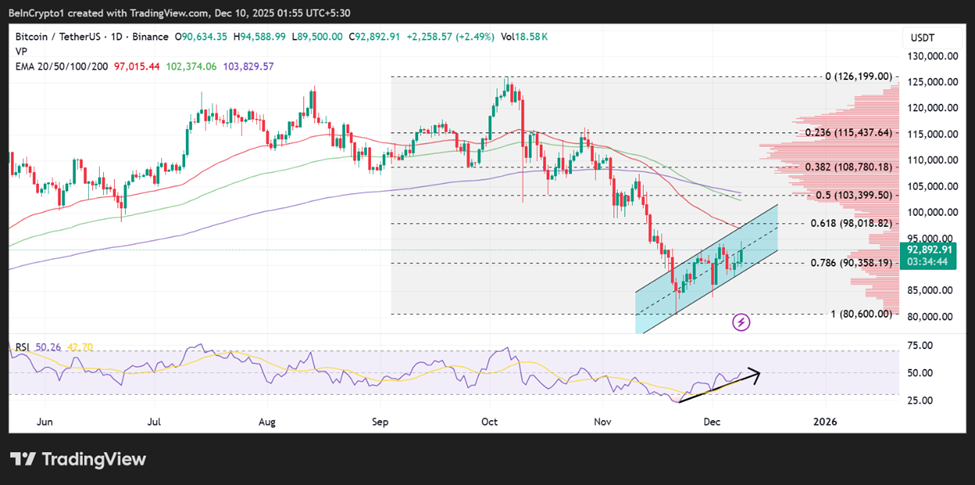
The Bitcoin price is trading with a bullish bias, consolidating within an ascending parallel channel since bottoming out at $80,600 on November 21. As long as the price remains confined within this technical formation, the prospects for further upside remain alive.

Based on the RSI (Relative Strength Index) indicator, momentum is rising, which could push BTC further north. Its position above the 50 threshold suggests significant buyer momentum, but a lot remains in the balance, as this midline level is also susceptible to a bearish takeover.

The Bitcoin price faces immediate resistance due to the 50-day Exponential Moving Average (EMA) at $97,015, a roadblock in BTC’s path to the most critical Fibonacci retracement level, 61.8%, at $98,018.

This would be a key entry point for late bulls, such that if the Bitcoin price breaks cleanly through the level with strong volume, it would signal a strengthening trend. Such a directional bias would see the pioneer crypto extend a neck higher to $103,399, earmarked by the 50% midrange.

In a highly bullish case, BTC could reach the 38.2% Fibonacci retracement level, signaling a strong trend.  

Bitcoin (BTC) Price Performance
Bitcoin (BTC) Price Performance. Source: TradingView

Conversely, if the 61.8% Fibonacci retracement level holds as resistance, it would set the tone for a trend reversal.

Sellers pulling the trigger at current levels could see the 78.6% Fibonacci retracement level give way as support, a move that could cause BTC to fall out of the ascending parallel channel.

Such a directional bias could send the pioneer crypto’s price toward the $80,600 support floor. Such a move would constitute a drop of almost 15% from current levels.

Gold may be in a Stage A Classic Reload Zone

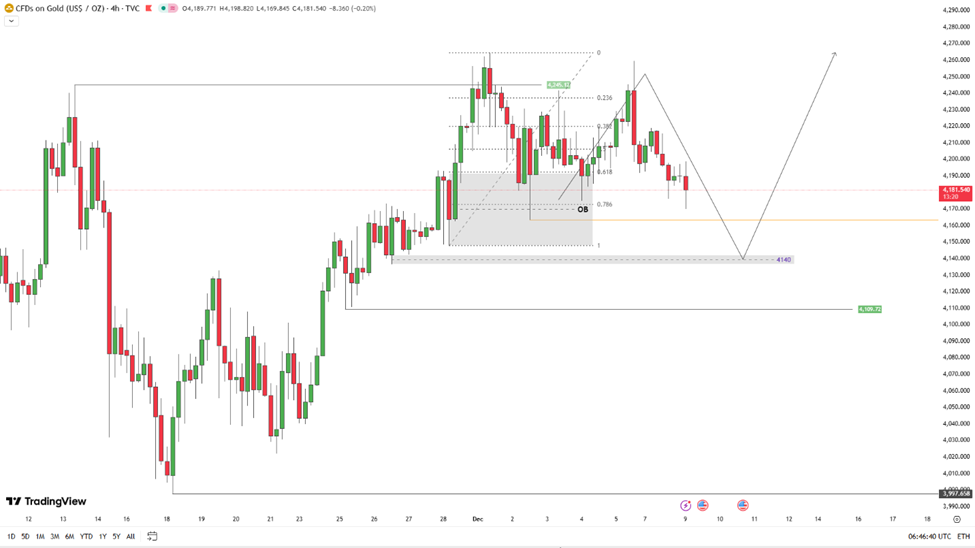
The gold price could sell off towards the lows of $4,199 and potentially violate the rising support trendline before reversing higher. Based on the RSI, momentum is fading, putting the XAU price at risk of a correction.

However, with the RSI still above the 50 threshold and strong downward support provided by the confluence of the 50- and 100-day EMAs at $4,202 and $4,203, respectively, the price could forge higher.

Critical support resides in the range between $4,178 and $4,192. If this zone holds, the bull structure would remain intact.

Meanwhile, the key resistance is at $4,241, with a clean break above this supplier congestion level likely to spark an acceleration.

In such a directional bias, targets would be $4,260, or in a highly bullish case, $4,300 before a potential recapture of the $4,381 all-time high (ATH).  

Gold (XAU) Price Performance
Gold (XAU) Price Performance. Source: TradingView

Therefore, current price levels could be a classic reload zone, with every dip providing a buying opportunity for late bulls.

Silver is up 6x as Much as the S&P 500 YTD

The silver price is experiencing one of the strongest bull runs in stock market history, up six times the S&P 500’s year-to-date (YTD) gain. The XAG/USD price is now on track for the largest 12-month gain since 1979.

After establishing a new all-time high of $60.794, silver is on price discovery levels, with potential for further upside.

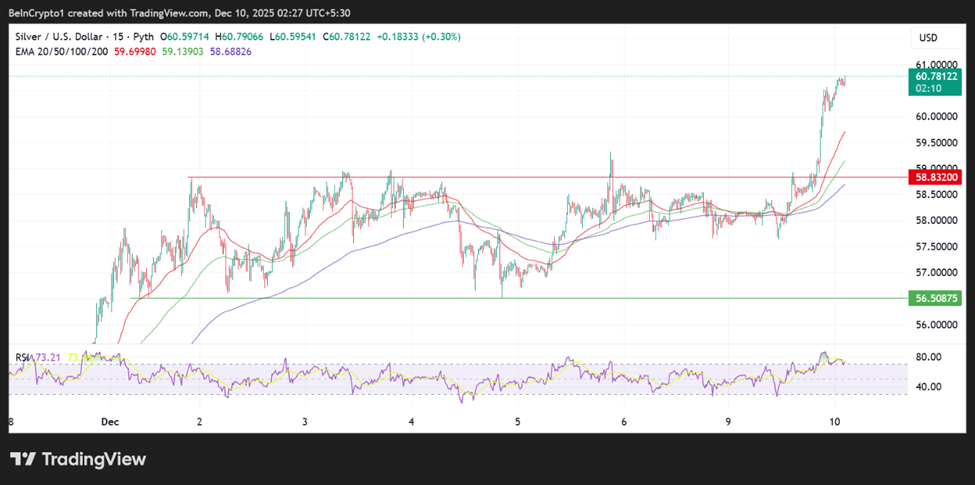
On the 15-minute chart below, the XAG/USD price shows a clean bullish continuation breakout. The silver price has decisively cleared the prior range high near $58.83 and accelerated to price discovery, confirming a shift from consolidation to expansion.

All key EMAs (50/100/200) are now stacked bullishly and turning higher, signaling strong short-term trend alignment and trend strength.

Silver (XAG) Price Performance
Silver (XAG) Price Performance. Source: TradingView

Momentum supports the move, as evidenced by the RSI above 73, indicating strong buying pressure. However, this RSI position also warns of near-term overheating and the risk of a shallow pullback or consolidation before continuation.

Structurally, the former resistance at $58.80 to $59.00 now acts as first support, while the next psychological and technical target sits around $61.00–$61.50.

As long as the silver price holds above the rising 50-EMA (red), the bias remains buy-the-dip, with downside risk increasing only on a sustained breakdown back below $59.00.

The post Top 3 Price Prediction Bitcoin, Gold, Silver: Is the Fed-Driven Rally Built to Last? appeared first on BeInCrypto.

  •  

Bitcoin Price Prediction: Recovery to $100,000 Could Be Tainted by These Holders

Bitcoin’s recent price action shows continued weakness as the asset struggles to find direction amid muted macro signals, presenting a bullish-neutral prediction. 

The lack of momentum has kept BTC drifting downward for several days, but the Federal Open Market Committee’s expected 25 basis point rate cut on Wednesday could shift sentiment. Whether this becomes a catalyst depends heavily on how short-term holders behave.

Bitcoin Holders Might Present Some Challenge

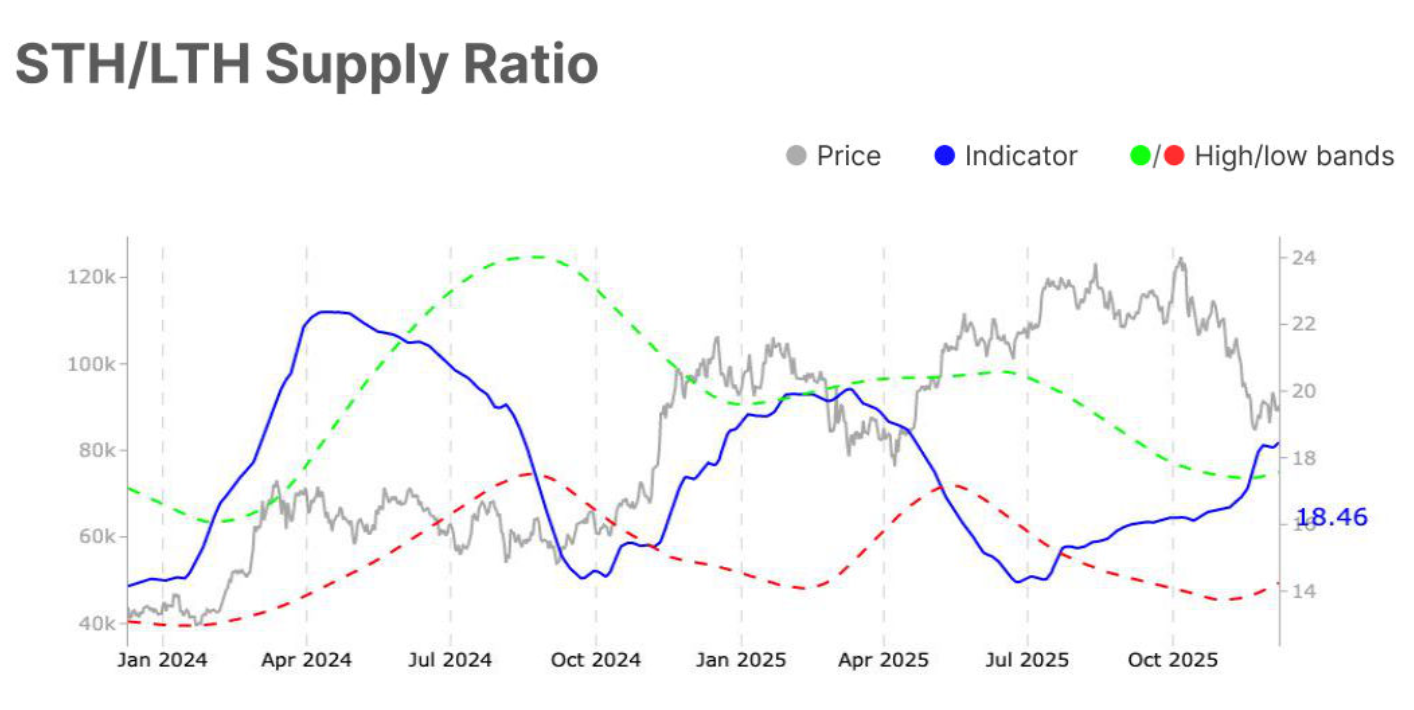
The STH to LTH Supply Ratio recently rose from 18.3% to 18.5%, breaking above the 17.6% upper band. This signals a growing presence of short-term holders within Bitcoin’s supply mix. 

Their presence increases speculative activity, which can boost liquidity but also create sharper intraday swings. The shift highlights a market poised for volatility if conditions change quickly.

This higher ratio also suggests that STHs hold greater influence over Bitcoin’s immediate trajectory. Their tendency to sell when in profit has historically capped recoveries. If the FOMC rate decision triggers a rally, STH behavior will determine whether the momentum sustains or fades.

Want more token insights like this? Sign up for Editor Harsh Notariya’s Daily Crypto Newsletter here.

Bitcoin STH/LTH Supply Ratio
Bitcoin STH/LTH Supply Ratio. Source: Glassnode

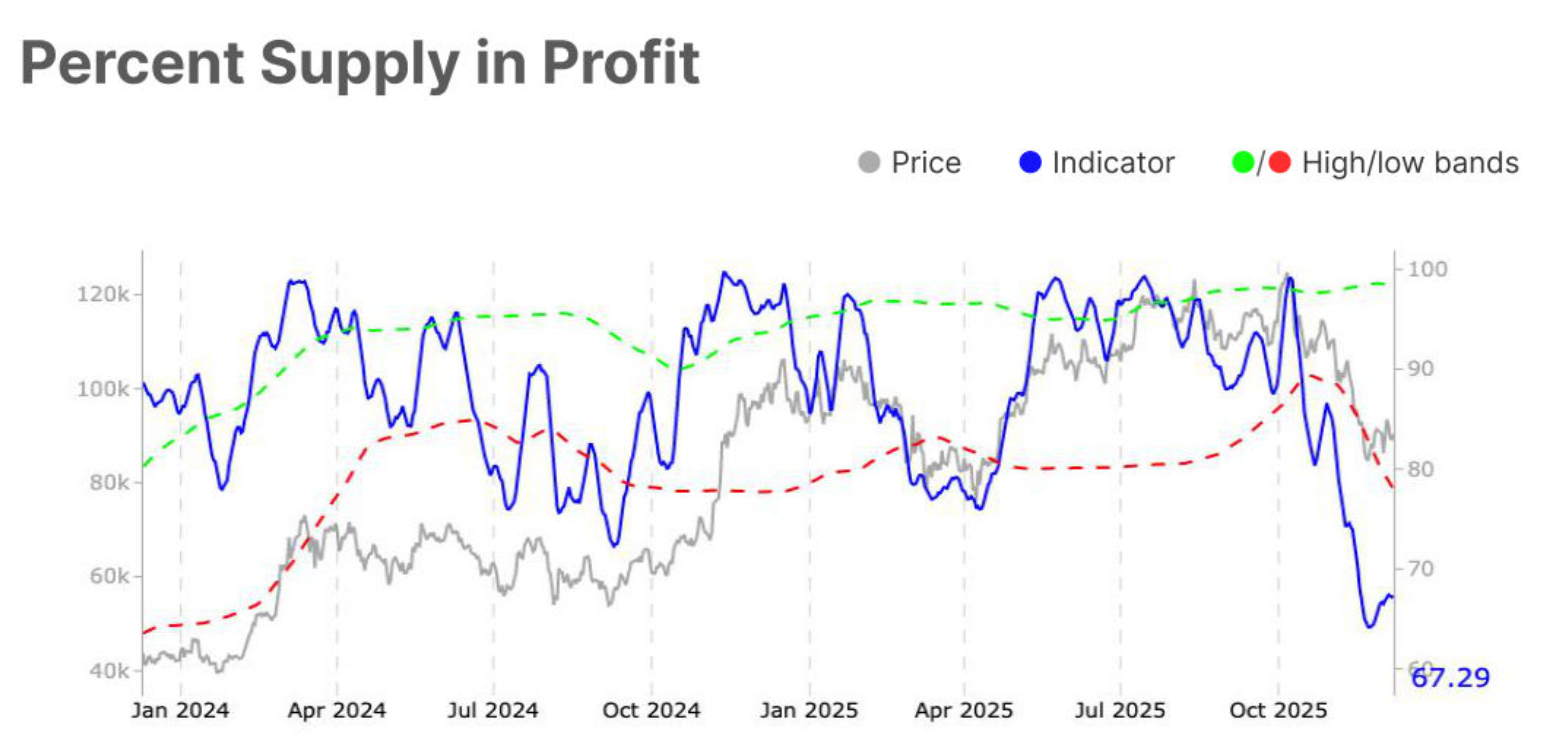
Bitcoin’s Percent Supply in Profit has increased from 66.5% to 67.3%, a modest 1.2% gain. While upward movement is positive, the metric remains far below the 98.4% high band typically seen in strong bull phases. This shows that a significant portion of supply is still underwater, reflecting a cautious environment rather than euphoric strength.

Such subdued profitability aligns with early-stage accumulation behavior. Investors appear selective and patient, waiting for stronger macro cues before committing. If the FOMC cut boosts risk appetite, this profitability gap leaves room for expansion and stronger follow-through.

Bitcoin Supply In Profit
Bitcoin Supply In Profit. Source: Glassnode

BTC Price Awaits An Escape

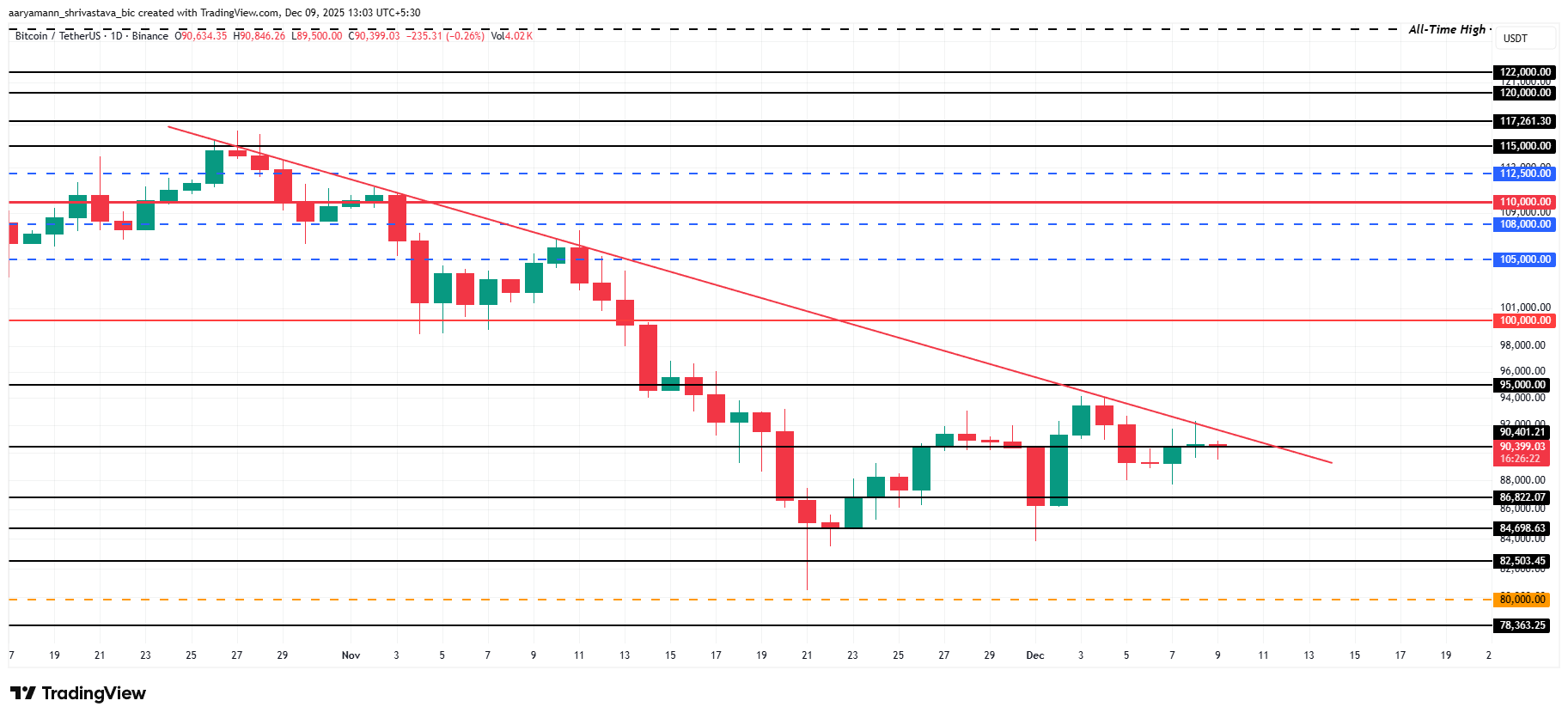
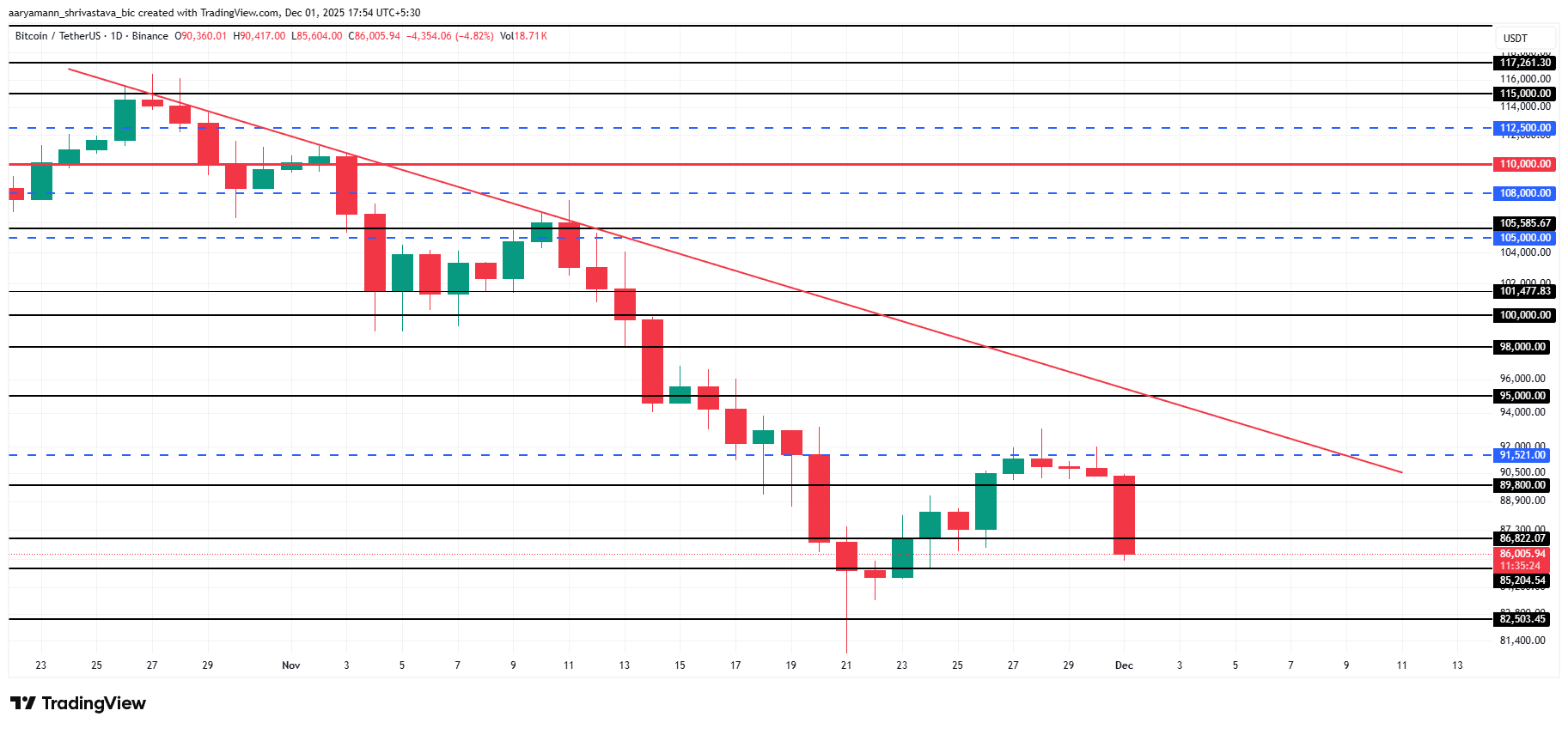
Bitcoin’s price is at $90,399 at the time of writing, sitting just below a downtrend that has persisted for one and a half months. BTC is attempting to flip $90,400 into a support level, which would mark the first step toward reversing the trend.

If macro conditions align and rate cuts revive broader market optimism, BTC could rebound sharply. A clean bounce from $90,400 may drive a retest of $95,000, and breaking that resistance would open a clear path toward the long-anticipated $100,000 level, proving Bitcoin’s price prediction true.

Bitcoin Price Analysis.
Bitcoin Price Analysis. Source: TradingView

However, if short-term holders sell into strength, Bitcoin may struggle to maintain upward pressure. A rejection from $95,000 or failure to break the downtrend could send BTC back toward $86,822, invalidating the bullish scenario.

The post Bitcoin Price Prediction: Recovery to $100,000 Could Be Tainted by These Holders appeared first on BeInCrypto.

  •  

Wall Street Braces as Bitcoin Goes Public for the First Time | US Crypto News

Welcome to the US Crypto News Morning Briefing—your essential rundown of the most important developments in crypto for the day ahead.

Grab a coffee and brace for Wall Street’s latest twist: a Bitcoin-native company is about to hit the NYSE. Shareholders have approved a major merger, putting billions in Bitcoin under one roof and signaling a shift in how crypto meets traditional markets.

Crypto News of the Day: Twenty One Capital Gains NYSE Approval

Cantor Equity Partners (CEP) shareholders voted to approve the merger with Twenty One Capital, clearing the final major hurdle for the business combination.

The deal, subject to standard closing conditions, is expected to finalize on December 8, 2025. Following the completion, the merged entity will operate under the Twenty One Capital name and begin trading the next day (December 9).

Strike CEO Jack Mallers will lead the company, which Tether and Bitfinex hold as majority owners. The firm markets itself as the first Bitcoin-native company preparing for a public listing, offering investors a regulated pathway to gain exposure to the cryptocurrency.

“Following the consummation of such transactions, the combined company will operate as Twenty One Capital, Inc., and its shares of Class A common stock are expected to trade on the New York Stock Exchange (“NYSE”) beginning on December 9, 2025, under the symbol XXI,” read an excerpt in the announcement.

Public Equity Exposure to Bitcoin Amid Crypto and Banking Frictions

Twenty One Capital currently holds 43,514 BTC, valued at approximately $4 billion, making it the third-largest Bitcoin holder among publicly traded companies, after Strategy and MARA Holdings.

Top 22 Public BTC Treasury Companies
Top 22 Public BTC Treasury Companies. Source: Bitcoin Treasuries

The firm emphasizes “capital-efficient Bitcoin accumulation” and plans to introduce a “Bitcoin Per Share” metric. This metric would enable shareholders to track Bitcoin holdings in real time with auditable on-chain proof-of-reserves.

“This listing provides a transparent, regulated way for investors to access Bitcoin without directly holding the asset,” the company added.

The NYSE debut also positions Twenty One Capital as a bridge between crypto-native operations and traditional equity markets, potentially reshaping investor access to digital assets.

“…offers investors a new way to gain BTC exposure via the equity markets,” commented Conor Kenny, a popular user on x (Twitter).

The announcement comes amid wider discussions about the banking sector’s relationship with crypto firms. In late November, Jack Mallers revealed that JPMorgan Chase abruptly closed his personal accounts without explanation, fueling fears of “debanking” in the crypto industry.

Tether CEO Paolo Ardoino described the move as an opportunity for crypto executives to operate independently of centralized financial institutions.

I think it's for the best

— Paolo Ardoino 🤖 (@paoloardoino) November 23, 2025

These tensions coincide with broader market scrutiny. JPMorgan is currently monitoring potential MSCI reclassification rules that could impact companies with significant Bitcoin holdings, such as MicroStrategy.

Analysts estimate that index changes could trigger billions in passive fund outflows, potentially as high as $9 billion for MicroStrategy.

As Twenty One Capital prepares to trade under the “XXI” ticker on December 9, market participants will watch for trading volumes, investor appetite, and the reception of the Bitcoin-per-share metric.

The listing could set a precedent for other crypto-native firms seeking regulated market exposure, potentially broadening institutional and retail participation in the Bitcoin economy.

Chart of the Day

Twenty One Capital (XXI) BTC Holdings
Twenty One Capital (XXI) BTC Holdings. Source: Bitcoin Treasuries

Byte-Sized Alpha

Here’s a summary of more US crypto news to follow today:

Crypto Equities Pre-Market Overview

   
Strategy (MSTR)$188.39$187.82 (-0.30%)
Coinbase (COIN)$276.92$275.85 (-0.39%)
Galaxy Digital Holdings (GLXY)$27.05$26.93 (-0.44%)
MARA Holdings (MARA)$12.47$12.45 (-0.16%)
Riot Platforms (RIOT)$15.64$15.57 (-0.45%)
Core Scientific (CORZ)$16.55$16.50 (-0.30%)
Crypto equities market open race: Google Finance

The post Wall Street Braces as Bitcoin Goes Public for the First Time | US Crypto News appeared first on BeInCrypto.

  •  

Bitcoin Mining Hit Its Breaking Point — Now AI Is Taking Over Its Racks | US Crypto News

Welcome to the US Crypto News Morning Briefing—your essential rundown of the most important developments in crypto for the day ahead.

Grab a coffee to read how the Bitcoin mining sector is changing. Skyrocketing costs, collapsing fees, and the rise of AI are forcing miners to rethink their playbook, turning once-stable operations into a battleground for next-generation compute power.

Crypto News of the Day: AI Takes Over Bitcoin Mining Racks as Costs Explode and Profitability Craters

The CoinShares Bitcoin Mining Report Q4 2025 reported that the sector has hit its breaking point. Production costs have surged to all-time highs, hash price has collapsed, and artificial intelligence (AI) is now outbidding miners for their own infrastructure, triggering the most dramatic structural shift the sector has ever faced.

The industry entered Q2 2025 with a brutal new reality:

  • The average cash cost to mine one BTC among public miners jumped to approximately $74,600,
  • All-in costs soared to $137,800.
  • Transaction fees, once a buffer for miner revenue, fell below 1% of block rewards in May and June, the weakest contribution since the 2024 halving.

Yet even as margins collapsed, the Bitcoin network continued to climb, smashing through 1 Zetta hash/s for the first time in August.

Public miners contributed only about 80 EH/s of year-to-date growth, meaning most of the expansion is now coming from private operators, sovereign miners, and well-capitalized energy players with vastly cheaper power.

The result: miners are being diluted by hashrate growth they are no longer driving.

AI Moves In — And It Pays 10–20× More Per Megawatt

A far bigger disruption is unfolding at the infrastructure level. Industrial-scale mining campuses, comprising 100MW to 1GW sites, share nearly identical power, cooling, and rack density requirements with modern AI datacenters.

That overlap has turned mining facilities into prime targets for hyperscalers.

Deals from Google–TeraWulf, Google–Cipher, and multi-site agreements with Fluidstack signal the same direction, that big-tech is moving into miner-built capacity at a premium.

The math explains why. Bitcoin mining yields roughly $1 million per megawatt, while AI compute generates $10 million to $20 million per megawatt.

No miner can ignore that spread.

Industry Splits: AI Megacampuses vs. Mobile, Ultra-Low-Cost Miners

The sector is now diverging into two clear models:

  1. 1. Megascale miners → fully or partially converting to AI/HPC

These facilities can upgrade their electrical topology and uptime standards to meet enterprise requirements. They’re signing decade-long contracts and shifting from volatile block rewards to stable, capacity-based revenue.

2. Low-cost, mobile miners → shifting to stranded energy

Miners unable to compete with AI are moving off-grid: flare gas, remote hydro, and surplus renewables. Portable rigs are being deployed everywhere cheap energy exists, echoing mining’s early decentralized roots.

This migration marks a long-term reshaping of the industry, and not a temporary cycle.

According to a CoinShares report:

  • Hashprice averaged approximately $50 per PH/s/day throughout Q2, continuing its post-halving slide.
  • With difficulty rising, fees stagnant, and Bitcoin trading mostly sideways, older ASIC fleets have been forced offline.

Analysts expect hashprice to remain range-bound between $37–55 per PH/s/day through 2028 unless BTC rallies far faster than hashrate growth.

A Structural Shift: AI Outbids Bitcoin

For the first time in Bitcoin’s history, miners are being priced out of their own infrastructure.

AI’s superior economics, hyperscaler deal flow, and the rising cost of industrial mining are pushing the industry into a permanent transformation.

The Bitcoin network remains strong, where hashrate is still climbing, but the business of mining is being rewritten fast.

This puts miners at an impasse, to either go big into AI, or go remote into stranded power.

Chart of the Day

Analysis of Cost to Mine Bitcoin
Analysis of Cost to Mine Bitcoin. Source: CoinShares

Byte-Sized Alpha

Here’s a summary of more US crypto news to follow today:

Crypto Equities Pre-Market Overview

CompanyAt the Close of December 2Pre-Market Overview
Strategy (MSTR)$181.33$185.83 (+2.48%)
Coinbase (COIN)$263.26$269.39 (+2.33%)
Galaxy Digital Holdings (GLXY)$25.36$25.90 (+2.13%)
MARA Holdings (MARA)$11.91$12.27 (+3.02%)
Riot Platforms (RIOT)$15.22$15.55 (+2.17%)
Core Scientific (CORZ)$15.82$16.03 (+1.33%)
Crypto equities market open race: Google Finance

The post Bitcoin Mining Hit Its Breaking Point — Now AI Is Taking Over Its Racks | US Crypto News appeared first on BeInCrypto.
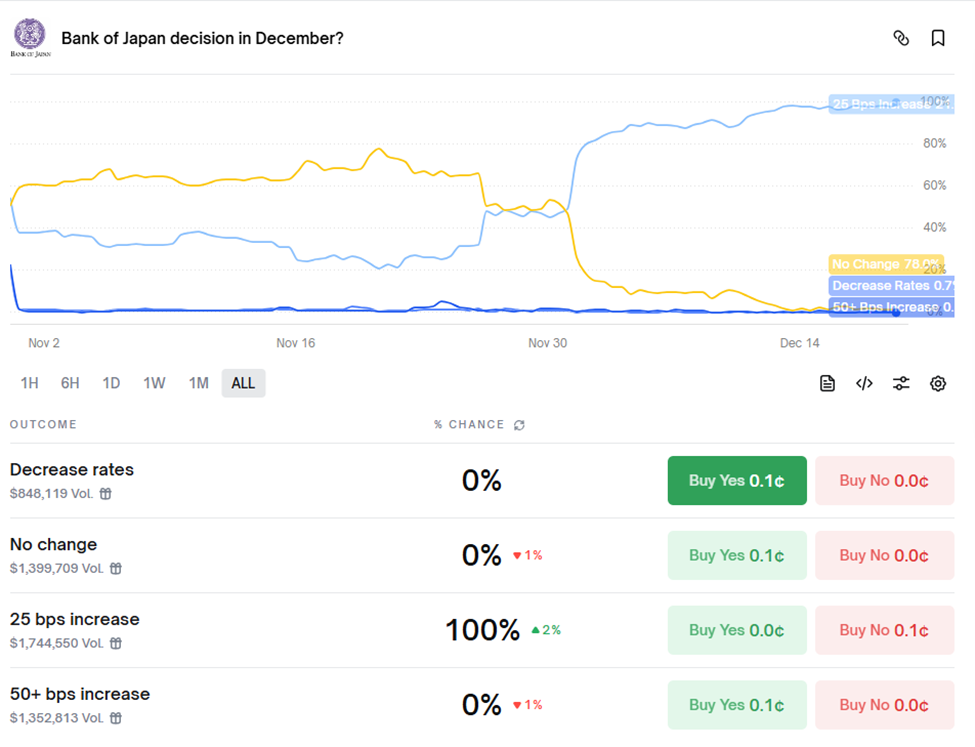
  •  

Bitcoin’s Famous 4-Year Cycle Is Breaking Down — What Now?

Since its inception in 2009, Bitcoin has shown a consistent four-year cycle. It’s driven by massive moves centered around Bitcoin’s halving, peaking with a blow-off top the next year.

Since the 2024 halving, Bitcoin prices have trended higher, but none of the signs of a speculative blow-off top have occurred in 2025, at least within the timeframe consistent with the four-year cycle.

Without that blow-off top, the rest of the crypto market has stalled out, since soaring Bitcoin prices tend to kick off altcoin season.

The history of Bitcoin bull market cycles has been a history of exponential decay. Agree with it or not, you will have to deal with it. Should the current decline carry to $50k, the next bull market cycle should carry to $200k to $250K pic.twitter.com/fFdgPPKvok

— Peter Brandt (@PeterLBrandt) December 1, 2025

End of the Famous Bitcoin Cycle?

With Bitcoin prices down 30% from their early October highs, it’s clear that the four-year price cycle has lost its validity.

This is a sensible development, since BTC is rapidly maturing as an asset class. Rising institutional interest also means that Bitcoin’s cycles will more likely center around economic cycles.

One area where investors have noted a strong correlation with Bitcoin is with global liquidity:

Global Liquidity and Bitcoin Correlation. Source: ZeroHedge

While there has been a strong correlation since the start of 2024, even that trend has broken in recent months.

Should that trend establish itself, Bitcoin could jump higher – and even kick off an altcoin season.

Michael Saylor recently called out the four-year cycle as “dead.” Saylor sees a massive repricing soon, which may explain his rush this year to acquire as much Bitcoin as possible.

However, liquidity isn’t the only factor.

Economic Activity

Some investors today are turning to the relationship between Bitcoin’s price and the US Purchasing Managers’ Index (PMI).

The PMI measures manufacturing sector health and serves as an economic leading indicator. 

When PMI is above 50, it suggests expansion; below 50 indicates contraction. 

With the PMI cooling off again, Bitcoin’s macro fair value has slipped back to around $140k.

2025 has been a choppy year for BTC.

Hot money has been stampeding toward faster horses: AI, gold, small caps… pretty much anything except Bitcoin.

But we haven’t seen BTC this far… https://t.co/Vxbi3Xlyqc pic.twitter.com/GlzpReWN4t

— mNAV.com (@BitcoinPowerLaw) December 1, 2025

In theory, a strong PMI signals economic growth, which could influence Bitcoin through several channels:

  • Strong PMI → robust economy → risk-on sentiment → higher appetite for speculative assets like Bitcoin
  • Weak PMI → economic concerns → potential Fed easing → more liquidity → potentially supportive for Bitcoin

However, even tools like PMI fail to work as a one-stop indicator for Bitcoin and the crypto cycle. 

Sometimes, Bitcoin trades as a “risk-on” asset (correlating positively with stocks and economic strength). 

Other times, it trades as a “risk-off” hedge (like digital gold during uncertainty), and it will even move independently based on crypto-specific factors.

Data also shows that the correlations between Bitcoin and PMI are unstable and vary across different time periods.

United States ISM vs. Bitcoin

•ISM Manufacturing PMI: This monthly index measures the health of the U.S. manufacturing sector. It is based on a survey of purchasing and supply executives across various industries and tracks factors such as new orders, production, employment,… https://t.co/W9wmN54Kx0 pic.twitter.com/YS1Bm3zwBQ

— Chad Steingraber (@ChadSteingraber) November 7, 2025

Bitcoin often responds more strongly to monetary policy signals (Fed decisions, liquidity conditions) than to real economy indicators like PMI.

When PMI does seem to matter, it’s typically through the broader risk sentiment channel rather than a direct mechanistic relationship.

If you’re looking to use PMI as a Bitcoin trading signal, you’d likely find it less reliable than monitoring Fed policy, liquidity conditions, or crypto-native metrics. But a growing economy likely won’t hurt – as sometimes that can push Bitcoin higher even when monetary conditions are tightening.

Sentiment – The Factor that Can Drive Extremes

Cryptocurrencies, particularly Bitcoin, lack traditional valuation anchors like earnings, dividends, or cash flows. 

Without these fundamental metrics, price discovery relies heavily on what people believe the asset should be worth. 

This creates space for sentiment to be the primary driver. 

Studies of crypto market behavior consistently show that social media activity, search trends, and news sentiment have measurable predictive power for short-term price movements in ways that exceed their impact on traditional assets.

The crypto market also has structural features that amplify sentiment, including high retail participation (which leads to more emotional trading), 24/7 trading (with no circuit breakers to cool emotions), high leverage availability, and rapid information dissemination through crypto-native social channels. 

Fear and greed cycles can become self-reinforcing quickly.

Here’s where it gets complicated: what looks like “pure sentiment” often includes assessments of fundamental factors. 

When investors get excited about institutional adoption news, is that sentiment or recognition of changing supply/demand fundamentals? 

When macro concerns drive people toward Bitcoin as a hedge, sentiment is the transmission mechanism for macro factors.

During stable periods, you might see something like: 40% macro conditions (Fed policy, inflation, dollar strength), 30% supply/demand fundamentals (adoption metrics, on-chain activity, halving cycles), and 30% pure sentiment/speculation.

During euphoric bull runs or panic crashes, sentiment could dominate at 60-70%+, temporarily overriding both fundamentals and macro logic. 

These are the periods where asset prices detach most dramatically from any rational valuation model. Investors who can recognize when sentiment is in control are best positioned to profit from those conditions.

Academic studies attempting to decompose crypto returns generally find that sentiment indicators explain 20-40% of price variance in normal conditions, but this can spike much higher during extreme market phases. 

Notably, crypto markets show much stronger “momentum” and “herding” effects than traditional markets, which are often hallmarks of sentiment-driven trading.

The cryptocurrency market is probably best understood as fundamentally sentiment-driven in the short to medium term, with macro and supply/demand factors providing boundaries and direction over longer timeframes. 

Bringing It Together

Clearly, there’s no one signal or trend for investors to look at to determine Bitcoin’s cycles. 

An expanding economy should be bullish for Bitcoin prices. A contracting one shouldn’t be – unless there’s a massive infusion of liquidity in the system.

Individual indicators like global liquidity, credit market conditions, business conditions and market sentiment will all play a role.

Beyond Bitcoin, individual crypto projects working on real-world problems will rise or fall with their prospects. 

Meme coins will rise and fall much faster – driven by the short-lived magic of memes themselves.

But bear in mind, even with Bitcoin moving beyond its four-year, retail-driven cycle, the fundamental concept remains intact.

As Bitwise CIO Matt Houghton recently noted:

“The reason bitcoin’s price is up ~28,000% over the last ten years is that more and more people want the ability to store digital wealth in a way that isn’t intermediated by a company or a government.”

And when Bitcoin takes off again, the altcoins will follow.

The post Bitcoin’s Famous 4-Year Cycle Is Breaking Down — What Now? appeared first on BeInCrypto.
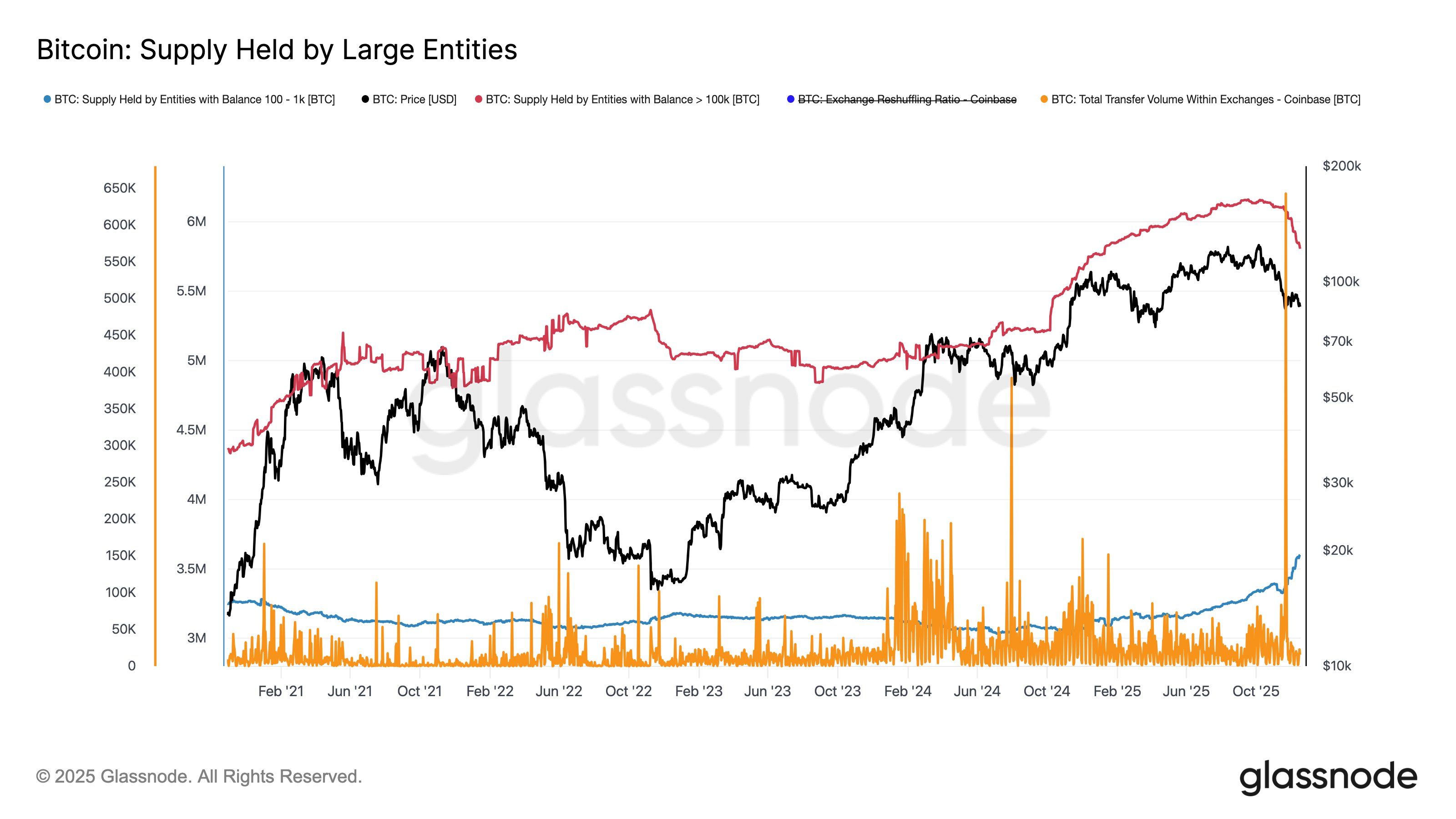
  •  

Will Bitcoin Price’s Drop To $86,000 Trigger These Holders’ Selling?

Bitcoin is trading under pressure this week after falling to $86,000, driven by bearish macroeconomic cues and weaker risk appetite. 

The decline is raising concern among analysts because it coincides with an important shift in profitability among short-term holders, who are seeing their first meaningful profits since February 2023.

Bitcoin Holders Could Sell

The MVRV Long/Short Difference has slipped into negative territory for the first time in nearly three years. This shift signals that short-term holders now hold more unrealized profit than long-term holders, a rare dynamic that last appeared in early 2023. Historically, such periods lead to heightened selling because short-term investors tend to exit positions quickly when they see profit.

This trend is concerning for Bitcoin’s price outlook. With BTC already under a month-long downtrend, any spike in short-term selling could intensify the decline. The metric’s drop reflects rising fragility in market sentiment and hints at a potential acceleration of downward momentum if conditions fail to improve.

Want more token insights like this? Sign up for Editor Harsh Notariya’s Daily Crypto Newsletter here

Bitcoin MVRV Long/Short Difference
Bitcoin MVRV Long/Short Difference. Source: Santiment

Broader macro momentum is also flashing warning signs. Bitcoin’s NVT Ratio has surged, showing the network is becoming overheated. The ratio compares the dollar value of network activity with transaction volume. A high reading indicates strong social enthusiasm but weak on-chain usage, a combination that often precedes corrective moves.

This imbalance suggests Bitcoin’s current valuation may not be supported by underlying activity. If the divergence persists, a market correction could follow to bring the ratio back to healthier levels. This adds pressure to the already fragile short-term outlook.

Bitcoin NVT Ratio
Bitcoin NVT Ratio. Source: Santiment

BTC Price Slips To Crucial Support

Bitcoin is trading at $86,005, holding just above the $85,204 support level. The asset remains trapped under a persistent downtrend that has lasted more than a month. This would prevent any sustained recovery attempts.

If market conditions worsen or short-term holder selling accelerates, Bitcoin could break below $85,204. A drop through this support would expose the price to $82,503 and potentially deepen losses as fear rises across the market.

Bitcoin Price Analysis.
Bitcoin Price Analysis. Source: TradingView

However, if buyers step in and support strengthens, Bitcoin could reclaim upward momentum. A bounce from current levels could send BTC toward $89,800. A decisive move above that resistance would be essential for Bitcoin to retest $90,000 and invalidate the bearish thesis.

The post Will Bitcoin Price’s Drop To $86,000 Trigger These Holders’ Selling? appeared first on BeInCrypto.
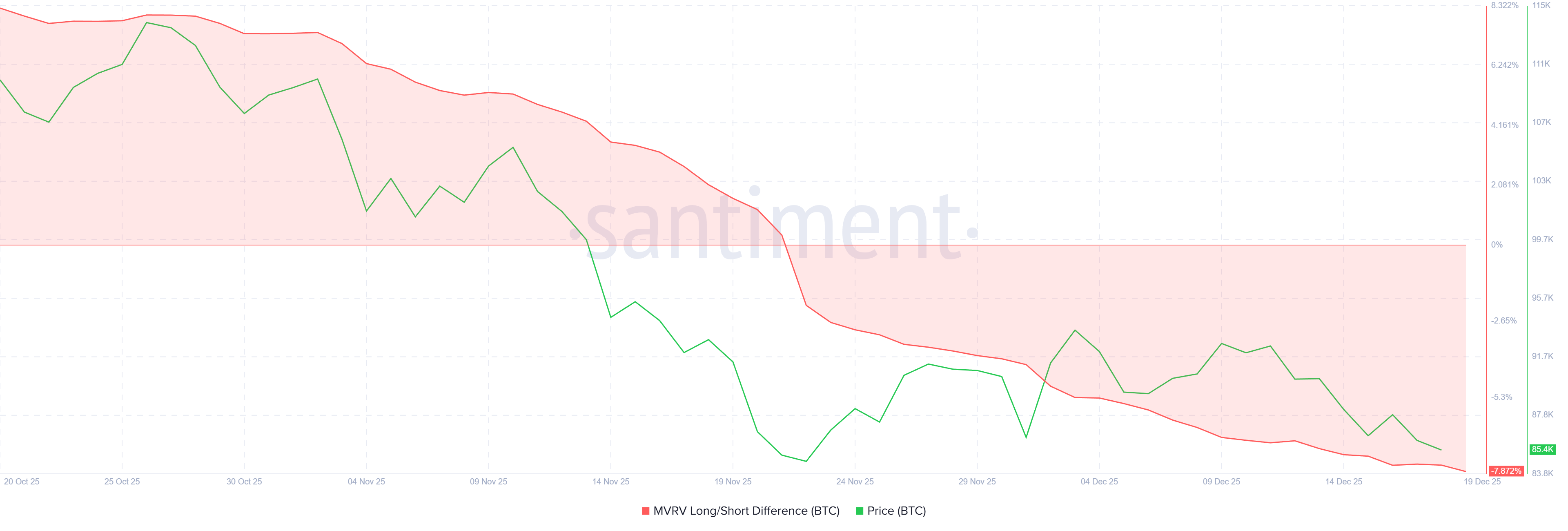
  •