Reading view

23 Best Python Bootcamps in 2026 – Prices, Duration, Curriculum

Before choosing a Python bootcamp, it helps to understand which programs are actually worth your time and money.

This guide breaks down the best Python bootcamps available in 2026, from affordable self-paced paths to intensive, instructor-led programs and full career-focused bootcamps. You’ll see exactly what each offers, who it’s best for, and what real students say about them.

Since Python is used across many careers, this guide is organized by learning path. This makes it easier to focus on programs that align with your goals, whether you want a general Python foundation or training for a specific role.

Use the jump links below to go straight to the sections that matter most to you and skip anything that doesn’t.

This is your shortcut to choosing a Python bootcamp with confidence, not guesswork.

Best General Python Bootcamps

If you want a structured way to learn, these are some of the best Python-focused bootcamps available today. They offer clear teaching, hands-on projects, and strong support for beginners.

1. Dataquest

Dataquest
  • Price: Free to start; full-access plans regularly \$49/month or \$588/year, but often available at a discounted rate.
  • Duration: Recommended 5 hrs/week, but completely self-paced.
  • Format: Online, self-paced.
  • Rating: 4.79/5.
  • Extra perks: Browser-based coding, instant feedback, real datasets, guided learning paths, portfolio projects.
  • Who it’s best for: Self-motivated learners who want flexible, hands-on coding practice without a huge tuition cost.

Dataquest isn’t a traditional bootcamp, but it’s still one of the most effective ways to learn Python.

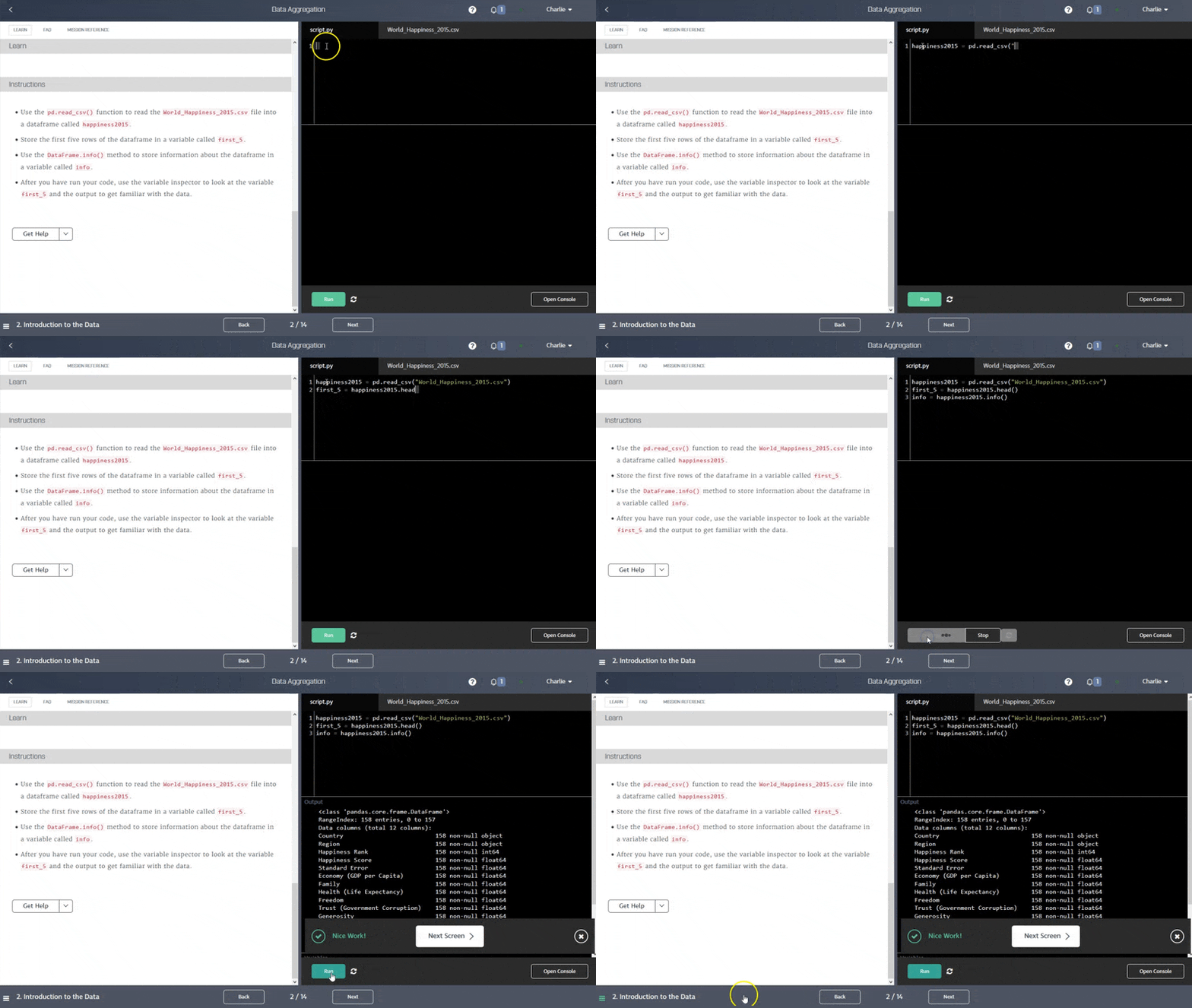
Instead of long video lectures, everything is hands-on. You learn by writing real Python code in the browser, completing guided exercises, and building small projects as you go. It’s practical, fast, and far more affordable than most bootcamps without sacrificing results.

One of Dataquest’s biggest strengths is its career paths. These are structured sequences of courses and projects that guide you from beginner to job-ready. You can choose paths in Python such as Data Scientist, Data Analyst, or Data Engineer.

Each path shows you exactly what to learn next and includes real coding projects that help you build a portfolio. This gives you a clear, organized learning experience without the cost or rigidity of a traditional bootcamp.

Dataquest also offers shorter skill paths for more targeted learning. These focus on specific areas like Python fundamentals, machine learning, or APIs and web scraping. They work well if you want to strengthen a particular skill without committing to a full career program.

Pros Cons
✅ You learn by doing, every lesson has real coding practice ❌ No live instructors or cohort-style learning
✅ Much more affordable than most bootcamps ❌ You need self-discipline since it's fully self-paced
✅ Pick individual courses or follow full learning paths ❌ Some learners prefer having set deadlines
✅ Projects use real datasets, so you build a portfolio early ❌ Text-based lessons may not suit video-first learners
✅ Beginner-friendly, with a clear order to follow if you want structure ❌ No job placement services like some bootcamps offer

Dataquest starts at the most basic level, so a beginner can understand the concepts. I tried learning to code before, using Codecademy and Coursera. I struggled because I had no background in coding, and I was spending a lot of time Googling. Dataquest helped me actually learn.

Aaron Melton, Business Analyst at Aditi Consulting

The Dataquest platform offers the necessary elements needed to succeed as a data science learner. By starting from the basics and building upon it, Dataquest makes it easy to grasp and master the concept of data science.

Goodluck Ogundare

2. Noble Desktop

Noble Desktop
  • Price: \$1,495.
  • Duration: 30 hours spread across five intensive days (Monday–Friday, 10 am–5 pm).
  • Format: Live online or in person (NYC).
  • Rating: 5/5.
  • Extra perks: Free retake, class recordings, 1-on-1 mentoring, certificate of completion.
  • Who it’s best for: Beginners who prefer live instruction, personal support, and a short, intensive bootcamp.

Noble Desktop has a complete Python bootcamp that is a beginner-friendly program designed for anyone starting from zero.

It covers the essential skills you need for Python-based fields like web development, data science, or automation. Classes are small, hands-on, and taught live by expert instructors.

You’ll learn core programming concepts, including variables, data types, loops, functions, and object-oriented programming. Throughout the week, you’ll complete guided exercises and small projects, ending with code you can upload to GitHub as part of your portfolio.

Students also receive a 1-on-1 training session, access to class recordings, and a free retake within one year.

Pros Cons
✅ Very beginner-friendly with clear explanations ❌ Too basic for learners who already know some Python
✅ Strong instructors with a lot of teaching experience ❌ Moves quickly, which can feel rushed for absolute beginners
✅ Small class sizes for more personal support ❌ Only covers fundamentals, not deeper topics
✅ Live online or NYC in-person options ❌ Higher price for a short program
✅ Free retake and access to class recordings ❌ Limited career support compared to full bootcamps

I am learning what I wanted and in the right atmosphere with the right instructor. Art understands Python and knows how to drive its juice into our souls. He is patient and tolerant with us and has so many ways to make each format sink in.

― Jesse Daniels

Very good foundational class with good information for those just starting out in Python. Getting the Python class set up and scheduled was very smooth and the instructor was excellent.

― Clayton Wariner

3. Byte Academy

Byte Academy
  • Price: Course Report lists the program at about \$14,950 with a \$1,500 refundable deposit, but you need to contact Byte Academy for exact pricing.
  • Duration: Full-time or part-time options and hands-on projects + required 4-week internship.
  • Format: Live online, instructor-led 45-minute lessons.
  • Rating: 3.99/5.
  • Extra perks: Mandatory internship, personalized support, real-world project experience.
  • Who it’s best for: Aspiring software engineers who want full-stack skills plus Python in a structured, live, project-heavy program.

Byte Academy offers a Python-focused full stack bootcamp with live, instructor-led training and a required internship.

The curriculum covers Python fundamentals, data structures, algorithms, JavaScript, React, SQL, Git, and full end-to-end application development.

Students follow structured lessons, complete daily practice exercises, and build three major projects. These projects include apps that use production databases and external APIs.

A key feature of this bootcamp is the 4-week internship. Students work on real tasks with real deadlines to gain practical experience for their resume. Instructors track progress closely and provide code reviews, interview prep, and presentation practice.

Pros Cons
✅ Practical, project-heavy curriculum that helps you build real apps. ❌ Fast pace can be difficult for beginners without prior coding exposure.
✅ Small classes and instructors who offer close guidance. ❌ Career support feels inconsistent for some students.
✅ Good option for career changers who need structured learning. ❌ Job outcomes vary and there's no job guarantee.
✅ Strong focus on Python, full stack skills, and hands-on exercises. ❌ Requires a heavy weekly time commitment outside of class.

Coming from a non-coding background, I was concerned about my ability to pick up the coursework but Byte's curriculum is well structured and the staff is so incredibly supportive. I truly felt like I was joining a family and not a bootcamp.

― Chase Ahn

Byte really understands what it takes to get a great job…I can genuinely say that the learning which Byte provided me with, was pinnacle to receiving an offer.

― Ido

4. General Assembly

General Assembly
  • Price: \$4,500, with occasional discounts that can reduce tuition to around \$2,700. Installment plans are available, and most learners pay in two to four monthly payments.
  • Duration: 10-week part-time (evenings) or 1-week accelerated full-time.
  • Format: Live online or in person (depending on region).
  • Rating: 4.31/5.
  • Extra perks: Capstone project, real-time teaching, AI-related content included.
  • Who it’s best for: Beginners who want live instruction, a portfolio project, and flexible part-time or intensive options.

General Assembly’s Python Programming Short Course is built for beginners who want a structured way to learn Python with live, instructor-led classes.

You learn core Python fundamentals and see how they apply to web development and data science. It’s taught by industry professionals and uses a clear, project-based curriculum with around 40 hours of instruction.

The course starts with Python basics, object-oriented programming, and working with common libraries.

Depending on the cohort, the specialization leans toward either data analysis (Pandas, APIs, working with datasets) or web development (Flask, basic backend workflows).

You finish the program by building a portfolio-ready project, such as a small web app or a data analysis tool that pulls from external APIs.

Pros Cons
✅ Live, instructor-led classes with real-time support ❌ Higher cost than most beginner-friendly Python options
✅ Clear, structured curriculum that works well for first-time programmers ❌ Job support varies and isn't as strong as full bootcamps
✅ Portfolio project lets you showcase real work ❌ Only 40 hours of instruction, so depth is limited
✅ Flexible schedules (part-time or 1-week intensive) ❌ Pace can feel fast for complete beginners
✅ Large alumni network and strong brand recognition ❌ Quality depends on the instructor and cohort

The approach that the instructor has taken during this course is what I have been looking for in every course that I have been in. General Assembly has acquired some of the finest teachers in the field of programming and development, and if all the other classes are structured the same way as the Python course I took, then there is a very high chance that I will come back for more.

― Nizar Altarooti

The Python course was great! Easy to follow along and the professor was incredibly knowledgeable and skilled at guiding us through the course.

― Fernando

Other Career-Specific Python Bootcamps

Learning Python doesn’t lock you into one job. It’s a flexible skill you can use in data, software, AI, automation, and more. To build a real career, you’ll need more than basic syntax, which is why most bootcamps train you for a full role.

These are the most common career paths you can take with Python and the best programs for each.

Best Python Bootcamps for Data Analytics

Most data analytics bootcamps are more beginner-friendly than data science programs. Python is used mainly for cleaning data, automating workflows, and running basic analysis alongside tools like Excel and SQL.

What you’ll do:

  • Work with Excel, SQL, and basic Python
  • Build dashboards
  • Create reports for business teams

1. Dataquest

Dataquest
  • Price: Free to start; \$49/month or \$588/year for full access.
  • Duration: ~11 months at 5 hrs/week.
  • Format: Online, self-paced.
  • Rating: 4.79/5.
  • Extra perks: Browser-based coding, instant feedback, real datasets, guided learning paths, portfolio projects.
  • Who it’s best for: Beginners who want a fully Python-based, affordable, project-driven path into data science at their own pace.

Dataquest teaches data analytics and data science entirely through hands-on coding.

You learn by writing Python in the browser, practicing with libraries like Pandas, NumPy, Matplotlib, and scikit-learn. Each step builds toward real projects that help you clean data, analyze datasets, and build predictive models.

Because the whole program is structured around Python, it’s one of the easiest ways for beginners to get comfortable writing real code while building a portfolio.

Pros Cons
✅ Affordable compared to full bootcamps ❌ No live mentorship or one-on-one support
✅ Flexible, self-paced structure ❌ Limited career guidance and networking
✅ Strong hands-on learning with real projects ❌ Text-based learning, minimal video content
✅ Beginner-friendly and well-structured ❌ Requires high self-discipline to stay consistent
✅ Covers core tools like Python, SQL, and machine learning

I used Dataquest since 2019 and I doubled my income in 4 years and became a Data Scientist. That’s pretty cool!

Leo Motta

I liked the interactive environment on Dataquest. The material was clear and well organized. I spent more time practicing than watching videos and it made me want to keep learning.

Jessica Ko, Machine Learning Engineer at Twitter

2. CareerFoundry

CareerFoundry
  • Price: Around \$7,900.
  • Duration: 6–10 months.
  • Format: Online, self-paced.
  • Rating: 4.66/5.
  • Extra perks: Dual mentorship model (mentor + tutor), portfolio-based projects, flexible pacing, structured career support.
  • Who it’s best for: Complete beginners who want a gentle, guided introduction to Python as part of a broader data analytics skill set, with mentor feedback and portfolio projects.

CareerFoundry includes Python in its curriculum, but it is not the primary focus.

You learn Python basics, data cleaning, and visualization with Pandas and Matplotlib, mostly applied to beginner-friendly analytics tasks. The course also covers Excel and SQL, so Python is one of several tools rather than the main skill.

This bootcamp works well if you want a gradual introduction to Python without jumping straight into advanced programming or machine learning. It’s designed for complete beginners and includes mentor feedback and portfolio projects, but the depth of Python is lighter compared to more technical programs.

Pros Cons
✅ Clear structure and portfolio-based learning ❌ Mentor quality can be inconsistent
✅ Good for beginners switching careers ❌ Some materials feel outdated
✅ Flexible study pace with steady feedback ❌ Job guarantee has strict conditions
✅ Supportive community and active alumni ❌ Occasional slow responses from support team

The Data Analysis bootcamp offered by CareerFoundry will guide you through all the topics, but lets you learn at your own pace, which is great for people who have a full-time job or for those who want to dedicate 100% to the program. Tutors and Mentors are available either way, and are willing to assist you when needed.

― Jaime Suarez

I have completed the Data Analytics bootcamp and within a month I have secured a new position as data analyst! I believe the course gives you a very solid foundation to build off of.

― Bethany R.

3. Coding Temple

Coding Temple
  • Price: \$6,000–\$9,000.
  • Duration: ~4 months.
  • Format: Live online + self-paced.
  • Rating: 4.77/5.
  • Extra perks: Daily live sessions, LaunchPad real-world projects, smaller class sizes, lifetime career support.
  • Who it’s best for: Learners who want a fast-paced, structured program with deeper Python coverage and hands-on analytics and ML practice.

Coding Temple teaches Python more deeply than most data analytics bootcamps.

You work with key libraries like Pandas, NumPy, Matplotlib, and scikit-learn, and you apply them in real datasets through LaunchPad and live workshops. Students also learn introductory machine learning, making the Python portion more advanced than many entry-level programs.

The pace is fast, but you get strong support from instructors and daily live sessions. If you want a structured environment and a clear understanding of how Python is used in analytics and ML, Coding Temple is a good match.

Pros Cons
✅ Supportive instructors who explain concepts clearly ❌ Fast pace can feel intense for beginners
✅ Good mix of live classes and self-paced study ❌ Job-guarantee terms can be strict
✅ Strong emphasis on real projects and practical tools ❌ Some topics could use a bit more depth
✅ Helpful career support and interview coaching ❌ Can be challenging to balance with a full-time job
✅ Smaller class sizes make it easier to get help

Enrolling in Coding Temple's Data Analytics program was a game-changer for me. The curriculum is not just about the basics; it's a deep dive that equips you with skills that are seriously competitive in the job market.

― Ann C.

The support and guidance I received were beyond anything I expected. Every staff member was encouraging, patient, and always willing to help, no matter how small the question.

― Neha Patel

Best Python Bootcamps for Data Science

Most data science bootcamps use Python as their main language. It’s the standard tool for data analysis, machine learning, and visualization.

What you’ll do in this field:

  • Analyze datasets
  • Build machine learning models
  • Work with statistics, visualization, and cloud tools
  • Solve business problems with data

1. BrainStation

BrainStation
  • Price: Around \$16,500.
  • Duration: 6 months, part-time.
  • Format: Live online or in major cities.
  • Rating: 4.66/5.
  • Extra perks: Live instructor-led classes, real company datasets, career coaching, global alumni network.
  • Who it’s best for: Learners who prefer structured, instructor-led programs and real-world data projects.

BrainStation’s Data Science Bootcamp teaches Python from the beginning and uses it for almost every part of the bootcamp.

Students learn Python basics, then apply it to data cleaning, visualization, SQL work, machine learning, and deep learning. The curriculum includes scikit-learn, TensorFlow, and AWS tools, with projects built from real company datasets.

Python is woven throughout the program. So it’s ideal for learners who want structured, instructor-led practice using Python in real data scenarios.

Pros Cons
✅ Instructors with strong industry experience ❌ Expensive compared to similar online bootcamps
✅ Flexible schedule for working professionals ❌ Fast-paced, can be challenging to keep up
✅ Practical, project-based learning with real company data ❌ Some topics are covered briefly without much depth
✅ 1-on-1 career support with resume and interview prep ❌ Career support is not always highly personalized
✅ Modern curriculum including AI, ML, and big data ❌ Requires strong time management and prior technical comfort

Having now worked as a data scientist in industry for a few months, I can really appreciate how well the course content was aligned with the skills required on the job.

― Joseph Myers

BrainStation was definitely helpful for my career, because it enabled me to get jobs that I would not have been competitive for before.

― Samit Watve, Principal Bioinformatics Scientist at Roche

2. NYC Data Science Academy

NYC Data Science Academy
  • Price: \$17,600.
  • Duration: 12–16 weeks full-time or 24 weeks part-time.
  • Format: Live online, in-person (NYC), or self-paced.
  • Rating: 4.86/5.
  • Extra perks: Company capstone projects, highly technical curriculum, small cohorts, lifelong alumni access.
  • Who it’s best for: Students aiming for highly technical Python and ML experience with multiple real-world projects.

NYC Data Science Academy provides one of the most technical Python learning experiences.

Students work with Python for data wrangling, visualization, statistical modeling, and machine learning. The program also teaches deep learning with TensorFlow and Keras, plus NLP tools like spaCy. While the bootcamp includes R, Python is used heavily in the ML and project modules.

With four projects and a real company capstone, students leave with strong Python experience and a portfolio built around real-world datasets.

Pros Cons
✅ Teaches both Python and R ❌ Expensive compared to similar programs
✅ Instructors with real-world experience (many PhD-level) ❌ Fast-paced and demanding workload
✅ Includes real company projects and capstone ❌ Requires some technical background to keep up
✅ Strong career services and lifelong alumni access ❌ Limited in-person location (New York only)
✅ Offers financing and scholarships ❌ Admission process can be competitive

The opportunity to network was incredible. You are beginning your data science career having forged strong bonds with 35 other incredibly intelligent and inspiring people who go to work at great companies.

― David Steinmetz, Machine Learning Data Engineer at Capital One

My journey with NYC Data Science Academy began in 2018 when I enrolled in their Data Science and Machine Learning bootcamp. As a Biology PhD looking to transition into Data Science, this bootcamp became a pivotal moment in my career. Within two months of completing the program, I received offers from two different groups at JPMorgan Chase.

― Elsa Amores Vera

3. Le Wagon

Le Wagon
  • Price: From €7,900.
  • Duration: 9 weeks full-time or 24 weeks part-time.
  • Format: Online or in-person.
  • Rating: 4.95/5.
  • Extra perks: Global campus network, intensive project-based learning, AI-focused Python curriculum, career coaching.
  • Who it’s best for: Learners who want a fast, intensive program blending Python, ML, and AI skills.

Le Wagon uses Python as the foundation for data science, AI, and machine learning training.

The program covers Python basics, data manipulation with Pandas and NumPy, and modeling with scikit-learn, TensorFlow, and Keras. New modules include LLMs, RAG pipelines, prompt engineering and GenAI tools, all written in Python.

Students complete multiple Python-based projects and an AI capstone, making this bootcamp strong for learners who want a mix of classic ML and modern AI skills.

Pros Cons
✅ Supportive, high-energy community that keeps you motivated ❌ Intense schedule, expect full commitment and long hours
✅ Real-world projects that make a solid portfolio ❌ Some students felt post-bootcamp job help was inconsistent
✅ Global network and active alumni events in major cities ❌ Not beginner-friendly, assumes coding and math basics
✅ Teaches both data science and new GenAI topics like LLMs and RAGs ❌ A few found it pricey for a short program
✅ University tie-ins for MSc or MBA pathways ❌ Curriculum depth can vary depending on campus

Looking back, applying for the Le Wagon data science bootcamp after finishing my master at the London School of Economics was one of the best decisions. Especially coming from a non-technical background it is incredible to learn about that many, super relevant data science topics within such a short period of time.

― Ann-Sophie Gernandt

The bootcamp exceeded my expectations by not only equipping me with essential technical skills and introducing me to a wide range of Python libraries I was eager to master, but also by strengthening crucial soft skills that I've come to understand are equally vital when entering this field.

― Son Ma

Best Python Bootcamps for Machine Learning

This is Python at an advanced level: deep learning, NLP, computer vision, and model deployment.

What you’ll do:

  • Train ML models
  • Build neural networks
  • Work with transformers, embeddings, and LLM tools
  • Deploy AI systems

1. Springboard

Springboard
  • Price: \$9,900 upfront or \$13,950 with monthly payments; financing and scholarships available.
  • Duration: ~9 months.
  • Format: Online, self-paced with weekly 1:1 mentorship.
  • Rating: 4.6/5.
  • Extra perks: Weekly 1:1 mentorship, two-phase capstone with deployment, flexible pacing, job guarantee (terms apply).
  • Who it’s best for: Learners who already know Python basics and want guided, project-based training in machine learning and model deployment.

Springboard’s ML Engineering & AI Bootcamp teaches the core skills you need to work with machine learning.

You learn how to build supervised and unsupervised models, work with neural networks, and prepare data through feature engineering. The program also covers common tools such as scikit-learn, TensorFlow, and AWS.

You also build a two-phase capstone project where you develop a working ML or deep learning prototype and then deploy it as an API or web service. Weekly 1:1 mentorship helps you stay on track, get code feedback, and understand industry best practices.

If you want a flexible program that teaches both machine learning and how to put models into production, Springboard is a great fit.

Pros Cons
✅ Strong focus on Python for machine learning and AI ❌ Self-paced format requires strong self-discipline
✅ Weekly 1:1 mentorship for code and project feedback ❌ Mentor quality can vary between students
✅ Real-world projects, including a deployed capstone ❌ Program can feel long if you fall behind
✅ Covers in-demand tools like scikit-learn, TensorFlow, and AWS ❌ Job guarantee has strict requirements
✅ Flexible schedule for working professionals ❌ Not beginner-friendly without basic Python knowledge

I had a good time with Spring Board's ML course. The certificate is under the UC San Diego Extension name, which is great. The course itself is overall good, however I do want to point out a few things: It's only as useful as the amount of time you put into it.

― Bill Yu

Springboard's Machine Learning Career Track has been one of the best career decisions I have ever made.

― Joyjit Chowdhury

2. Fullstack Academy

Fullstack Academy
  • Price: \$7,995 with discount (regular \$10,995).
  • Duration: 26 weeks.
  • Format: Live online, part-time.
  • Rating: 4.77/5.
  • Extra perks: Live instructor-led sessions, multiple hands-on ML projects, portfolio-ready capstone, career coaching support.
  • Who it’s best for: Learners who prefer live, instructor-led training and want structured exposure to Python, ML, and AI tools.

Fullstack Academy’s AI & Machine Learning Bootcamp teaches the main skills you need to work with AI.

You learn Python, machine learning models, deep learning, NLP, and popular tools like Keras, TensorFlow, and ChatGPT. The lessons are taught live, and you practice each concept through small exercises and real examples.

You also work on several projects and finish with a capstone where you use AI or ML to solve a real problem. The program includes career support to help you build a strong portfolio and prepare for the job search.

If you want a structured, live learning experience with clear weekly guidance, Fullstack Academy is a good option.

Pros Cons
✅ Live, instructor-led classes with clear weekly structure ❌ Fast pace can be tough without prior Python or math basics
✅ Strong focus on Python, ML, AI, and modern tools ❌ Fixed class schedule limits flexibility
✅ Multiple hands-on projects plus a portfolio-ready capstone ❌ Expensive compared to self-paced or online-only options
✅ Good career coaching and job search support ❌ Instructor quality can vary by cohort
✅ Works well for part-time learners with full-time jobs ❌ Workload can feel heavy alongside other commitments

I was really glad how teachers gave you really good advice and really good resources to improve your coding skills.

― Aleeya Garcia

I met so many great people at Full Stack, and I can gladly say that a lot of the peers, my classmates that were at the bootcamp, are my friends now and I was able to connect with them, grow my network of not just young professionals, but a lot of good people. Not to mention the network that I have with my two instructors that were great.

― Juan Pablo Gomez-Pineiro

3. TripleTen

TripleTen
  • Price: From \$9,113 upfront (or installments from around \$380/month; financing and money-back guarantee available).
  • Duration: 9 months.
  • Format: Online, part-time with flexible schedule.
  • Rating: 4.84/5.
  • Extra perks: Live instructor-led sessions, multiple hands-on ML projects, portfolio-ready capstone, career coaching support.
  • Who it’s best for: Beginners who want a flexible schedule, clear explanations, and strong career support while learning advanced Python and ML.

TripleTen’s AI & Machine Learning Bootcamp is designed for beginners, even if you don’t have a STEM background.

You learn Python, statistics, machine learning, neural networks, NLP, and LLMs. The program also teaches industry tools like NumPy, pandas, scikit-learn, PyTorch, TensorFlow, SQL, Docker, and AWS. Training is project-based, and you complete around 15 projects to build a strong portfolio.

You get 1-on-1 tutoring, regular code reviews, and the chance to work on externship-style projects with real companies. TripleTen also offers a job guarantee. If you finish the program and follow the career steps but don’t get a tech job within 10 months, you can get your tuition back.

This bootcamp is a good fit if you want a flexible schedule, beginner-friendly teaching, and strong career support.

Pros Cons
✅ Beginner-friendly explanations, even without a STEM background ❌ Long program length (9 months) can feel slow for some learners
✅ Strong Python focus with ML, NLP, and real projects ❌ Requires steady self-discipline due to part-time, online format
✅ Many hands-on projects that build a solid portfolio ❌ Job guarantee has strict requirements
✅ 1-on-1 tutoring and regular code reviews ❌ Some learners want more live group instruction
✅ Flexible schedule works well alongside a full-time job ❌ Advanced topics can feel challenging without math basics

Most of the tutors are practicing data scientists who are already working in the industry. I know one particular tutor, he works at IBM. I’d always send him questions and stuff like that, and he would always reply, and his reviews were insightful.

― Chuks Okoli

I started learning to code for the initial purpose of expanding both my knowledge and skillset in the data realm. I joined TripleTen in particular because after a couple of YouTube ads I decided to look more into the camp to explore what they offered, on top of already looking for a way to make myself more valuable in the market. Immediately, I fell in love with the purpose behind the camp and the potential outcomes it can bring.

― Alphonso Houston

Best Python Bootcamps for Software Engineering

Python is used for backend development, APIs, web apps, scripting, and automation.

What you’ll do:

  • Build web apps
  • Work with frameworks like Flask or Django
  • Write APIs
  • Automate tasks

1. Coding Temple

Coding Temple
  • Price: From \$3,500 upfront with discounts (or installment plans from ~\$250/month; 0% interest options available).
  • Duration: ~4–6 months.
  • Format: Online, part-time with live sessions.
  • Rating: 4.77/5.
  • Extra perks: Built-in tech residency, daily live coding sessions, real-world industry projects, and ongoing career coaching.
  • Who it’s best for: Learners who want a structured, project-heavy path into full-stack development with Python and real-world coding practice.

Coding Temple has one of the best coding bootcamps that teaches the core skills needed to build full-stack applications.

You learn HTML, CSS, JavaScript, Python, React, SQL, Flask, and cloud tools while working through hands-on projects. The program mixes self-paced lessons with daily live coding sessions, which helps you stay on track and practice new skills right away.

Students also join a built-in tech residency where they solve real coding problems and work on industry-style projects. Career support is included and covers technical interviews, mock assessments, and portfolio building.

It’s a good choice if you want structure, real projects, and a direct path into software engineering.

Pros Cons
✅ Very hands-on with daily live coding and frequent practice ❌ Fast pace can feel overwhelming for complete beginners
✅ Strong focus on real-world projects and applied skills ❌ Requires a big time commitment outside scheduled sessions
✅ Python is taught in a practical, job-focused way ❌ Depth can vary depending on instructor or cohort
✅ Built-in tech residency adds realistic coding experience ❌ Job outcomes depend heavily on personal effort
✅ Ongoing career coaching and interview prep ❌ Less flexibility compared to fully self-paced programs

Taking this class was one of the best investments and career decisions I've ever made. I realize first hand that making such an investment can be a scary and nerve racking decision to make but trust me when I say that it will be well worth it in the end! Their curriculum is honestly designed to give you a deep understanding of all the technologies and languages that you'll be using for your career going forward.

― Justin A

My experience at Coding Temple has been nothing short of transformative. As a graduate of their Full-Stack Developer program, I can confidently say this bootcamp delivers on its promise of preparing students for immediate job readiness in the tech industry.

― Austin Carlson

2. General Assembly

General Assembly
  • Price: \$16,450 total (installments and 0% interest loan options available).
  • Duration: 12 weeks full-time or 32 weeks part-time.
  • Format: Online or on campus, with live instruction.
  • Rating: 4.31/5.
  • Extra perks: Large global alumni network, multiple portfolio projects, flexible full-time or part-time schedules, dedicated career coaching.
  • Who it’s best for: Beginners who want a well-known program with live instruction, strong fundamentals, and a broad full-stack skill set.

General Assembly’s Software Engineering Bootcamp teaches full-stack development from the ground up.

You learn Python, JavaScript, HTML, CSS, React, APIs, databases, Agile workflows, and debugging. The program is beginner-friendly and includes structured lessons, hands-on projects, and support from experienced instructors. Both full-time and part-time formats are available, so you can choose a schedule that fits your lifestyle.

Students build several portfolio projects, including a full-stack capstone, and receive personalized career coaching. This includes technical interview prep, resume help, and job search support.

General Assembly is a good option if you want a well-known bootcamp with strong instruction, flexible schedules, and a large global hiring network.

Pros Cons
✅ Well-known brand with a large global alumni network ❌ Expensive compared to many similar bootcamps
✅ Live, instructor-led classes with structured curriculum ❌ Pace can feel very fast for true beginners
✅ Broad full-stack coverage, including Python and JavaScript ❌ Python is not the main focus throughout the program
✅ Multiple portfolio projects, including a capstone ❌ Instructor quality can vary by cohort or location
✅ Dedicated career coaching and interview prep ❌ Job outcomes depend heavily on individual effort and market timing

GA gave me the foundational knowledge and confidence to pursue my career goals. With caring teachers, a supportive community, and up-to-date, challenging curriculum, I felt prepared and motivated to build and improve tech for the next generation.

― Lyn Muldrow

I thoroughly enjoyed my time at GA. With 4 projects within 3 months, these were a good start to having a portfolio upon graduation. Naturally, that depended on your effort and diligence throughout the project duration. The pace was pretty fast with a project week after every two weeks of classes, but that served to stretch my learning capabilities.

― Joey L.

3. Flatiron School

Flatiron School
  • Price: \$17,500, or as low as \$9,900 with available discounts.
  • Duration: 15 weeks full-time or 45 weeks part-time.
  • Format: Online, full-time cohort, or flexible part-time.
  • Rating: 4.45/5.
  • Extra perks: Project at the end of every unit, full software engineering capstone, extended career services access, mentor, and peer support.
  • Who it’s best for: Learners who want a highly structured curriculum, clear milestones, and long-term career support while learning Python and full-stack development.

Flatiron School teaches software engineering through a structured, project-focused curriculum.

You learn front-end and back-end development using JavaScript, React, Python, and Flask, plus core engineering skills like debugging, version control, and API development. Each unit ends with a project, and the program includes a full software engineering capstone to help you build a strong portfolio.

Students also get support from mentors, 24/7 learning resources, and access to career services for up to 180 days, which includes resume help, job search guidance, and career talks.

Flatiron is a good fit if you want a beginner-friendly bootcamp with strong structure, clear milestones, and both full-time and part-time options.

Pros Cons
✅ Strong, well-structured curriculum with projects after each unit ❌ Intense workload that can feel overwhelming
✅ Multiple portfolio projects plus a full capstone ❌ Part-time / flex formats require high self-discipline
✅ Teaches both Python and full-stack development ❌ Instructor quality can vary by cohort
✅ Good reputation and name recognition with employers ❌ Not ideal for people who want a slower learning pace
✅ Extended career services and job-search support ❌ Expensive compared to self-paced or online-only options

As a former computer science student in college, Flatiron will teach you things I never learned, or even expected to learn, in a coding bootcamp. Upon graduating, I became even more impressed with the overall experience when using the career services.

― Anslie Brant

I had a great experience at Flatiron. I met some really great people in my cohort. The bootcamp is very high pace and requires discipline. The course is not for everyone. I got to work on technical projects and build out a great portfolio. The instructors are knowledgable. I wish I would have enrolled when they rolled out the new curriculum (Python/Flask).

― Matthew L.

Best Python Bootcamps for DevOps & Automation

Python is used for scripting, cloud automation, building internal tools, and managing systems.

What you’ll do:

  • Automate workflows
  • Write command-line tools
  • Work with Docker, CI/CD, AWS, Linux
  • Build internal automations for engineering teams

1. TechWorld with Nana

TechWorld with Nana
  • Price: \$1,795 upfront or 5 × \$379.
  • Duration: ~6 months (self-paced).
  • Format: Online with 24/7 support.
  • Rating: 4.9/5.
  • Extra perks: Real-world DevOps projects, DevOps certification, structured learning roadmap, active Discord community.
  • Who it’s best for: Self-motivated learners who want to use Python for automation while building practical DevOps skills at a lower cost.

TechWorld with Nana’s DevOps Bootcamp focuses on practical DevOps skills through a structured roadmap.

You learn core tools like Linux, Git, Jenkins, Docker, Kubernetes, AWS, Terraform, Ansible, and Python for automation.

The program includes real-world projects where you build pipelines, deploy to the cloud, and write Python scripts to automate tasks. You also earn a DevOps certification and get access to study guides and an active Discord community.

This bootcamp is ideal if you want an affordable, project-heavy DevOps program that teaches industry tools and gives you a portfolio you can show employers.

Pros Cons
✅ Strong focus on real-world DevOps projects and automation ❌ Fully self-paced, no live instructor-led classes
✅ Python taught in a practical DevOps and scripting context ❌ Less suited for absolute beginners with no tech background
✅ Very affordable compared to DevOps bootcamps ❌ No formal career coaching or job placement services
✅ Clear learning roadmap that's easy to follow ❌ Requires strong self-motivation and consistency
✅ Active Discord community for support and questions ❌ Certification is less recognized than major bootcamp brands

I would like to thank Nana and the team, your DevOps bootcamp allowed me to get a job as a DevOps engineer in Paris while I was living in Ivory Coast, so I traveled to take the job.

― KOKI Jean-David

I have ZERO IT background and needed a course where I can get the training for DevOps Engineering role. While I'm still progressing through this course, I have feel like I have gained so much knowledge in a short amount of time.

― Daniel

2. Zero To Mastery

Zero To Mastery
  • Price: \$25/month (billed yearly at \$299) or \$1,299 lifetime.
  • Duration: About 5 months.
  • Format: Fully online, self-paced, with an active Discord community and career support.
  • Rating: 4.9/5.
  • Extra perks: Large course library, 30+ hands-on projects, lifetime access option, active Discord, and career guidance.
  • Who it’s best for: Budget-conscious learners who want a self-paced, project-heavy DevOps path with strong Python foundations.

Zero To Mastery offers a full DevOps learning path that includes everything from Python basics to Linux, Bash, CI/CD, AWS, Terraform, networking, and system design.

You also get a complete Python developer course, so your programming foundation is stronger than what many DevOps programs provide.

The path is project-heavy, with 14 courses and 30 hands-on projects, plus optional career tasks like polishing your resume and applying to jobs.

If you want a very affordable way to learn DevOps, build a portfolio, and study at your own pace, ZTM is a practical choice.

Pros Cons
✅ Extremely affordable compared to most DevOps bootcamps ❌ Fully self-paced with no live instructor-led classes
✅ Strong Python foundation alongside DevOps tooling ❌ Can feel overwhelming due to the large amount of content
✅ Very project-heavy with 30+ hands-on projects ❌ Requires high self-discipline to finish the full path
✅ Lifetime access option adds long-term value ❌ No formal job guarantee or placement program
✅ Active Discord community and peer support ❌ Career support is lighter than traditional bootcamps

Great experience and very informative platform that explains concepts in an easy to understand manner. I plan to use ZTM for the rest of my educational journey and look forward to future courses.

― Berlon Weeks

The videos are well explained, and the teachers are supportive and have a good sense of humor.

― Fernando Aguilar

3. Nucamp

Nucamp
  • Price: \$99/month, with up to 25% off through available scholarships.
  • Duration: ~16 weeks (part-time, structured weekly schedule).
  • Format: Live online with scheduled instruction and weekend sessions.
  • Rating: 4.74/5.
  • Extra perks: AI-powered learning tools, lifetime content access, nationwide job board, hackathons, LinkedIn Premium.
  • Who it’s best for: Learners who want a low-cost, part-time backend-focused path that still covers Python, SQL, DevOps, and cloud deployment.

Nucamp’s backend program teaches the essential skills needed to build and deploy real web applications.

You start with Python fundamentals, data structures, and common algorithms. Then you move into SQL and PostgreSQL, where you learn to design relational databases and connect them to Python applications to build functional backend systems.

The schedule is designed for people with full-time jobs. You study on your own during the week, then attend live instructor-led workshops to review concepts, fix errors, and complete graded assignments.

Career services include resume help, portfolio guidance, LinkedIn Premium access, and a nationwide job board for graduates.

Pros Cons
✅ Very affordable compared to most bootcamps. ❌ Self-paced format can be hard if you need more structure.
✅ Instructors are supportive, and classes stay small. ❌ Career help isn't consistent across cohorts.
✅ Good hands-on practice with Python, SQL, and DevOps tools. ❌ Some advanced topics feel a bit surface-level.
✅ Lifetime access to learning materials and the student community. ❌ Not as intensive as full-time immersive programs.

As a graduate of the Back-End Bootcamp with Python, SQL, and DevOps, I can confidently say that Nucamp excels in delivering the fundamentals of the main back-end development technologies, making any graduate of the program well-equipped to take on the challenges of an entry-level role in the industry.

― Elodie Rebesque

The instructors at Nucamp were the real deal—smart, patient, always there to help. They made a space where questions were welcome, and we all hustled together to succeed.

― Josh Peterson

Best Python Bootcamps for Web Development

1. Coding Dojo

Coding Dojo
  • Price: \$9,995 for 1 stack; \$13,495 for 2 stacks; \$16,995 for 3 stacks. You can use a \$100 Open House grant, an up to \$750 Advantage Grant, and optional payment plans.
  • Duration: 20-32 weeks, depending on pace.
  • Format: Online or on-campus in select cities.
  • Rating: 4.38/5.
  • Extra perks: Multi-stack curriculum, hands-on projects, career support, mentorship, and career prep workshops.
  • Who it’s best for: Learners who want exposure to multiple web stacks, including Python, and strong portfolio development.

Coding Dojo’s Software Development Bootcamp is a beginner-friendly full-stack program for learning modern web development.

You start with basic programming concepts, then move into front-end work and back-end development with Python, JavaScript, or another chosen stack. Each stack includes practice with simple frameworks, server logic, and databases so you understand how web apps are built.

You also learn core tools used in real workflows. This includes working with APIs, connecting your projects to a database, and understanding basic server routing. As you move through each stack, you build small features step by step until you can create a full web application on your own.

The program is flexible and supports different learning styles. You get live lectures, office hours, code reviews, and 24/7 access to the platform. A success coach and career services team help you stay on track, build a portfolio, and prepare for your job search without adding stress.

Pros Cons
✅ Multi-stack curriculum gives broader web dev skills than most bootcamps ❌ Career support quality is inconsistent across cohorts
✅ Strong instructor and TA support for beginners ❌ Some material can feel outdated in places
✅ Clear progression from basics to full applications ❌ Students often need extra study after graduation to feel job-ready
✅ 24/7 platform access plus live instruction and code reviews ❌ Higher cost compared to many online alternatives

My favorite project was doing my final solo project because it showed me that I have what it takes to be a developer and create something from start to finish.

― Alexander G.

Coding Dojo offers an extensive course in building code in multiple languages. They teach you the basics, but then move you through more advanced study, by building actual programs. The curriculum is extensive and the instructors are very helpful, supplemented by TA's who are able to help you find answers on your own.

― Trey-Thomas Beattie

2. App Academy

App Academy
  • Price: \$9,500 upfront; \$400/mo installment plan; or \$14,500 deferred payment option.
  • Duration: ~5 months (part-time live track; daily commitment ~40 hrs/week).
  • Format: Online or in-person in select cities.
  • Rating: 4.65/5.
  • Extra perks: Built-in tech residency, AI-enhanced learning, career coaching, and lifetime support.
  • Who it’s best for: Highly motivated learners who want an immersive experience and career-focused training with Python web development.

App Academy’s Software Engineering Program is a beginner-friendly full-stack bootcamp that covers the core tools used in modern web development.

You start with HTML, CSS, and JavaScript, then move into front-end development with React and back-end work with Python, Flask, and SQL. The program focuses on practical, hands-on projects so you learn how complete web applications are built.

You also work with tools used in real production environments. This includes API development, server routing, databases, Git workflows, and Docker. The built-in tech residency gives you experience working on real projects in an Agile setting, with code reviews and sprint cycles that help you build a strong, job-ready portfolio.

The bootcamp supports different learning styles with live instruction, on-demand help, code reviews, and 24/7 access to materials. Success managers and career coaches also help you build your resume, improve your portfolio, and get ready for interviews.

Pros Cons
✅ Rigorous curriculum that actually builds real engineering skills ❌ Very time-intensive and demanding; easy to fall behind
✅ Supportive instructors, TAs, and a strong peer community ❌ Fast pacing can feel overwhelming for beginners
✅ Tech Residency gives real project experience before graduating ❌ Not a guaranteed path to a job; still requires heavy effort after graduation
✅ Solid career support (resume, portfolio, interview prep) ❌ High workload expectations (nights/weekends)
✅ Strong overall reviews from alumni across major platforms ❌ Stressful assessments and cohort pressure for some students

In a short period of 3 months, I've learnt a great deal of theoretical and practical knowledge. The instructions for the daily projects are very detailed and of high quality. Help is always there when you need it. The curriculum covers diverse aspects of software development and is always taught with a practical focus.

― Donguk Kim

App Academy was a very structured program that I learned a lot from. It keeps you motivated to work hard through having assessments every Monday and practice assessments prior to the main ones. This helps to constantly let you know what you need to do to stay on track.

― Alex Gonzalez

3. Developers Institute

Developers Institute
  • Price: 23,000 ILS full-time (~\$6,300 USD) and 20,000 ILS part-time (~\$5,500 USD). These are Early Bird prices.
  • Duration: 12 weeks full-time; 28 weeks part-time; 30 weeks flex.
  • Format: Online, on-campus (Israel, Mexico, Cameroon), or hybrid.
  • Rating: 4.94/5.
  • Extra perks: Internship opportunities, AI-powered learning platform, hackathons, career coaching, global locations.
  • Who it’s best for: Learners who want a Python + JavaScript full-stack path, strong support, and flexible schedule options.

Developers Institute’s Full Stack Coding Bootcamp is a beginner-friendly program that teaches the essential skills used in modern web development.

You start with HTML, CSS, JavaScript, and React, then move on to backend development with Python, Flask, SQL, and basic API work. The curriculum is practical and project-focused. You learn how the front end and back end fit together by building real applications.

You also learn tools used in professional environments, such as Git workflows, databases, and basic server routing. Full-time students can join an internship for real project experience. All learners also get access to DI’s AI-powered platform for instant feedback, code checking, and personalized quizzes.

The program offers multiple pacing options and includes strong career support. You get 1:1 coaching, portfolio guidance, interview prep, and job-matching tools. This makes it a solid option if you want structured training with Python in the backend and a clear path into a junior software or web development role.

Pros Cons
✅ Clear, supportive instructors who help when you get stuck. ❌ The full-time schedule can feel intense.
✅ Lots of hands-on practice and real coding exercises. ❌ Some lessons require extra self-study to fully understand.
✅ Helpful AI tools for instant feedback and code checking. ❌ Beginners may struggle during the first weeks.
✅ Internship option that adds real-world experience. ❌ Quality of experience can vary depending on the cohort.

You will learn not only main topics but also a lot of additional information which will help you feel confident as a developer and also impress HR!

― Vladlena Sotnikova

I just finished a Data Analyst course in Developers Institute and I am really glad I chose this school. The class are super accurate, we were learning up-to date skills that employers are looking for. All the teachers are extremely patient and have no problem reexplaining you if you did not understand, also after class-time.

― Anaïs Herbillon

Your Next Step

You don't need to pick the "perfect" bootcamp. You need to pick one that matches where you are right now and where you want to go.

If you're still figuring out whether coding is for you, start with something affordable and flexible like Dataquest or Noble Desktop's short course. If you already know you want a career change and need full support, look at programs like BrainStation, Coding Temple, or Le Wagon that include career coaching and real projects.

The bootcamp itself won't get you the job. It gives you structure, skills, and a portfolio. What comes after (building more projects, applying consistently, fixing your resume, practicing interviews) is still on you.

But if you're serious about learning Python and using it professionally, a good bootcamp can save you months of confusion and give you a clear path forward.

Pick one that fits your schedule, your budget, and your goals. Then commit to finishing it.

The rest will follow.

FAQs

Are Python bootcamps worth it?

Bootcamps can work, but they’re not going to magically land you a perfect job. You still need to put in hours outside of class and be accountable.

Bootcamps are worth it if:

  • You need structure because you struggle to stay consistent on your own.
  • You want career support like mock interviews, portfolio reviews, or job-search coaching.
  • You learn faster with deadlines, instructors, and a guided curriculum.
  • You prefer hands-on projects instead of reading tutorials in isolation.

Bootcamps are not worth it if:

  • You expect a job to be handed to you at the end.
  • You’re not ready to study outside class hours (Sometimes 20–40 extra hours per week is normal).
  • The tuition is so high that it adds stress instead of motivation.

Bootcamps work best for people who have already tried learning alone and hit a wall.

They give structure, accountability, networking, and a way to skip the confusion of “what do I learn next?” But you still have to do the messy part: debugging, building projects, failing, trying again, and actually understanding the code.

Bootcamps are worth it when they save you time, not when they sell you shortcuts.

Can you learn Python by yourself?

You can learn Python on your own, and a lot of people do. The language is designed to be readable, and there are endless free resources. You can follow tutorials, practice with small exercises, and slowly build confidence without joining a bootcamp.

The challenge usually appears after the basics. People often get stuck when they try to build real projects or decide what to learn next. This is one reason why bootcamps don’t focus on Python alone. Instead, they focus on careers like data science, analytics, or software development. Python is just one part of the larger skill set you need for those jobs.

So learning Python by yourself is completely possible. Bootcamps simply help learners take the next step and build the full stack of skills required for a specific role.

What’s the best way to learn Python?

No one can tell you exactly how you learn. Some people say you don’t need a structured Python course and that python.org is enough. Others swear by building projects from day one. Some prefer learning from a Python book. None of these are wrong. You can choose whichever path fits your learning style, and you can absolutely combine them.

To learn Python well, you should understand a few core things first. These are the Python foundations that make every tutorial, bootcamp, or project much easier:

  • Basic programming concepts (variables, loops, conditionals)
  • How Python syntax works and why it’s readable
  • Data types and data structures (strings, lists, dictionaries, tuples)
  • How to write and structure functions
  • How to work with files and modules
  • How to install and use libraries (like requests, Pandas, Matplotlib)
  • How to find and read documentation

Once you’re comfortable with these basics, you can move into whatever direction you want: data analysis, automation, web development, machine learning, or even simple scripting to make your life easier.

How long does it take to learn Python?

Most people learn basic Python in 1 to 3 months. This includes variables, loops, functions, and simple object-oriented programming.

Reaching an intermediate level takes about 3 to 6 months. At this stage, you can use Python libraries and work in Jupyter Notebook.

Becoming job-ready for a role like Python developer, data scientist, or software engineer usually takes 6 to 12 months because you need extra skills such as SQL, data visualization, or machine learning.

Is Python free?

Yes, Python is completely free. You can download it from python.org and install it on any device.

Most Python libraries for data visualization, machine learning, and software development are also free.

You do not need to pay for a Python course to get started. A coding bootcamp or Python bootcamp is helpful only if you want structure or guidance.

Is Python hard to learn?

Python is as easy a programming language can be. The syntax is simple and clear, which helps beginners understand how code works.

Most people find the challenge later, when they move from beginner basics into intermediate Python topics. This is where you need to learn how to work with libraries, build projects, and debug real code. Reaching advanced Python takes even more practice because you start dealing with larger applications, complex data work, or automation.

This is why some people choose coding bootcamps. They give structure and support when you want a clear learning path.
  •  

13 Best Data Engineering Certifications in 2026

Data engineering is one of the fastest-growing tech careers, but figuring out which certification actually helps you break in or level up can feel impossible. You'll find dozens of options, each promising to boost your career, but it's hard to know which ones employers actually care about versus which ones just look good on paper.

To make things even more complicated, data engineering has changed dramatically in the past few years. Lakehouse architecture has become standard. Generative AI integration has moved from a “specialty” to a “baseline” requirement. Real-time streaming has transformed from a competitive advantage to table stakes. And worst of all, some certifications still teach patterns that organizations are actively replacing.

This guide covers the best data engineering certifications that actually prepare you for today's data engineering market. We'll tell you which ones reflect current industry patterns, and which ones teach yesterday's approaches.


Best Data Engineering Certifications

1. Dataquest Data Engineer Path

Dataquest

Dataquest's Data Engineer path teaches the foundational skills that certification exams assume you already know through hands-on, project-based learning.

  • Cost: \$49 per month (or \$399 annually). Approximately \$50 to \$200 total, depending on your pace and available discounts.
  • Time: Three to six months at 10 hours per week. Self-paced with immediate feedback on exercises.
  • Prerequisites: None. Designed for complete beginners with no programming background.
  • What you'll learn:
    • Python programming from fundamentals through advanced concepts
    • SQL for querying and database management
    • Command line and Git for version control
    • Data structures and algorithms
    • Building complete ETL pipelines
    • Working with APIs and web scraping
  • Expiration: Never. Completion certificate is permanent.
  • Industry recognition: Builds the foundational skills that employers expect. You won't get a credential that shows up in job requirements like AWS or GCP certifications, but you'll develop the Python and SQL competency that makes those certifications achievable.
  • Best for: Complete beginners who learn better by doing rather than watching videos. Anyone who needs to build strong Python and SQL foundations before tackling cloud certifications. People who want a more affordable path to learning data engineering fundamentals.

Dataquest takes a different approach than certification-focused programs like IBM or Google. Instead of broad survey courses that touch many tools superficially, you'll go deep on Python and SQL through increasingly challenging projects. You'll write actual code and get immediate feedback rather than just watching video demonstrations. The focus is on problem-solving skills you'll use every day, not memorizing features for a certification exam.

Many learners use Dataquest to build foundations, then pursue vendor certifications once they're comfortable writing Python and SQL. With Dataquest, you're not just collecting a credential, you're actually becoming capable.

2. IBM Data Engineering Professional Certificate

IBM Data Engineering Professional Certificate

The IBM Data Engineering Professional Certificate gives you comprehensive exposure to the data engineering landscape.

  • Cost: About \$45 per month on Coursera. Total investment ranges from \$270 to \$360, depending on your pace.
  • Time: Six to eight months at 10 hours per week. Most people finish in six months.
  • Prerequisites: None. This program starts from zero.
  • What you'll learn:
    • Python programming fundamentals
    • SQL with PostgreSQL and MongoDB
    • ETL pipeline basics
    • Exposure to Hadoop, Spark, Airflow, and Kafka
    • Hands-on labs across 13 courses demonstrating how tools fit together
  • Expiration: Never. This is a permanent credential.
  • Industry recognition: Strong for beginners. ACE recommended for up to 12 college credits. Over 100,000 people have enrolled in this program.
  • Best for: Complete beginners who need a structured path through the entire data engineering landscape. Career changers who want comprehensive exposure before specializing.

This certification gives you the vocabulary to have intelligent conversations about data engineering. You'll understand how different pieces fit together without getting overwhelmed. The certificate from IBM carries more weight with employers than completion certificates from smaller companies.

While this teaches solid fundamentals, it doesn't cover lakehouse architectures, vector databases, or RAG patterns dominating current work. Think of it as your foundation, not complete preparation for today's industry.

3. Google Cloud Associate Data Practitioner

Google Cloud Associate Data Practitioner

Google launched the Associate Data Practitioner certification in January 2025 to fill the gap between foundational cloud knowledge and professional-level data engineering.

  • Cost: \$125 for the exam.
  • Time: One to two months of preparation if you're new to GCP. Less if you already work with Google Cloud.
  • Prerequisites: Google recommends six months of hands-on experience with GCP data services, but you can take the exam without it.
  • What you'll learn:
    • GCP data fundamentals and core services like BigQuery
    • Data pipeline concepts and workflows
    • Data ingestion and storage patterns
    • How different GCP services work together for end-to-end processing
  • Expiration: Three years.
  • Exam format: Two hours with multiple-choice and multiple-select questions. Scenario-based problems rather than feature recall.
  • Industry recognition: Growing rapidly. GCP Professional Data Engineer consistently ranks among the highest-paying IT certifications, with average salaries between \$129,000 and \$171,749.
  • Best for: Beginners targeting Google Cloud. Anyone wanting a less intimidating introduction to GCP before tackling the Professional Data Engineer certification. Organizations evaluating or adopting Google Cloud.

This certification is your entry point into one of the highest-paying data engineering career paths. The Associate level lets you test the waters before investing months and hundreds of dollars in the Professional certification.

The exam focuses on understanding GCP's philosophy around data engineering rather than memorizing service features. That makes it more practical than certifications that test encyclopedic knowledge of documentation.


Best Cloud Platform Data Engineering Certifications

4. AWS Certified Data Engineer - Associate (DEA-C01)

AWS Certified Data Engineer - Associate (DEA-C01)

The AWS Certified Data Engineer - Associate is the most requested data engineering certification in global job postings.

  • Cost: \$150 for the exam. Renewal costs \$150 every three years, or \$75 if you hold another AWS certification.
  • Time: Two to four months of preparation, depending on your AWS experience.
  • Prerequisites: None officially required. AWS recommends two to three years of data engineering experience and familiarity with AWS services.
  • What you'll learn:
    • Data ingestion and transformation (30% of exam)
    • Data store management covering Redshift, RDS, and DynamoDB (24%)
    • Data operations, including monitoring and troubleshooting (22%)
    • Data security and governance (24%)
  • Expiration: Three years.
  • Exam format: 130 minutes with 65 questions using multiple choice and multiple response formats. Passing score is 720 out of 1000 points.
  • Launched: March 2024, making it the most current major cloud data engineering certification.
  • Industry recognition: Extremely strong. AWS holds about 30% of the global cloud market. More data engineering job postings mention AWS than any other platform.
  • Best for: Developers and engineers targeting AWS environments. Anyone wanting the most versatile cloud data engineering certification. Professionals in organizations using AWS infrastructure.

AWS dominates the job market, making this the safest bet if you're unsure which platform to learn. The recent launch means it incorporates current practices around streaming, lakehouse architectures, and data governance rather than outdated batch-only patterns.

Unlike the old certification it replaced, this exam includes Python and SQL assessment. You can't just memorize service features and pass. Average salaries hover around \$120,000, with significant variation based on experience and location.

5. Google Cloud Professional Data Engineer

Google Cloud Professional Data Engineer

The Google Cloud Professional Data Engineer certification consistently ranks as one of the highest-paying IT certifications and one of the most challenging.

  • Cost: \$200 for the exam. Renewal costs \$100 every two years through a shorter renewal exam.
  • Time: Three to four months of preparation. Assumes you already understand data engineering concepts and are learning GCP specifics.
  • Prerequisites: None officially required. Google recommends three or more years of industry experience, including at least one year with GCP.
  • What you'll learn:
    • Designing data processing systems, balancing performance, cost, and scalability
    • Building and operationalizing data pipelines
    • Operationalizing machine learning models
    • Ensuring solution quality through monitoring and testing
  • Expiration: Two years.
  • Exam format: Two hours with 50 to 60 questions. Scenario-based and case study driven. Many people fail on their first attempt.
  • Industry recognition: Very strong. GCP emphasizes AI and ML integration more than other cloud providers.
  • Best for: Experienced engineers wanting to specialize in Google Cloud. Anyone emphasizing AI and ML integration in data engineering. Professionals targeting high-compensation roles.

This certification is challenging, and that's precisely why it commands premium salaries. Employers know passing requires genuine understanding of distributed systems and problem-solving ability. Many people fail on their first attempt, which makes the certification meaningful when you pass.

The emphasis on machine learning operations positions you perfectly for organizations deploying AI at scale. The exam tests whether you can architect complete solutions to complex problems, not just whether you know GCP services.

6. Microsoft Certified: Fabric Data Engineer Associate (DP-700)

Microsoft Certified Fabric Data Engineer Associate (DP-700)

Microsoft's Fabric Data Engineer Associate certification represents a fundamental shift in Microsoft's data platform strategy.

  • Cost: \$165 for the exam. Renewal is free through an annual online assessment.
  • Time: Two to three months preparation if you already use Power BI. Eight to 12 weeks if you're new to Microsoft's data stack.
  • Prerequisites: None officially required. Microsoft recommends three to five years of experience in data engineering and analytics.
  • What you'll learn:
    • Microsoft Fabric platform architecture unifying data engineering, analytics, and AI
    • OneLake implementation for single storage layer
    • Dataflow Gen2 for transformation
    • PySpark for processing at scale
    • KQL for fast queries
  • Expiration: One year, but renewal is free.
  • Exam format: 100 minutes with approximately 40 to 60 questions. Passing score is 700 out of 1000 points.
  • Launched: January 2025, replacing the retired DP-203 certification.
  • Industry recognition: Strong and growing. About 97% of Fortune 500 companies use Power BI according to Microsoft's reporting.
  • Best for: Organizations using Microsoft 365 or Azure. Power BI users expanding into data engineering. Engineers in enterprise environments or Microsoft-centric technology stacks.

The free annual renewal is a huge advantage. While other certifications cost hundreds to maintain, Microsoft keeps DP-700 current through online assessments at no charge. That makes total cost of ownership much lower than comparable certifications.

Microsoft consolidated its data platform around Fabric, reflecting the industry shift toward unified analytics platforms. Learning Fabric positions you for where Microsoft's ecosystem is heading, not where it's been.


Best Lakehouse and Data Platform Certifications

7. Databricks Certified Data Engineer Associate

Databricks Certified Data Engineer Associate

Databricks certifications are growing faster than any other data platform credentials.

  • Cost: \$200 for the exam. Renewal costs \$200 every two years.
  • Time: Two to three months preparation with regular Databricks use.
  • Prerequisites: Databricks recommends six months of hands-on experience, but you can take the exam without it.
  • What you'll learn:
    • Apache Spark fundamentals and distributed computing
    • Delta Lake architecture providing ACID transactions on data lakes
    • Unity Catalog for data governance
    • Medallion architecture patterns organizing data from raw to refined
    • Performance optimization at scale
  • Expiration: Two years.
  • Exam format: 45 questions with 90 minutes to complete. A mix of multiple-choice and multiple-select questions.
  • Industry recognition: Growing rapidly. 71% of organizations adopting GenAI rely on RAG architectures requiring unified data platforms. Databricks showed the fastest adoption to GenAI needs.
  • Best for: Engineers working with Apache Spark. Professionals in organizations adopting lakehouse architecture. Anyone building modern data platforms supporting both analytics and AI workloads.

Databricks pioneered lakehouse architecture, which eliminates the data silos that typically separate analytics from AI applications. You can run SQL analytics and machine learning on the same data without moving it between systems.

Delta Lake became an open standard supported by multiple vendors, so these skills transfer beyond just Databricks. Understanding lakehouse architecture positions you for where the industry is moving, not where it's been.

8. Databricks Certified Generative AI Engineer Associate

Databricks Certified Generative AI Engineer Associate

The Databricks Certified Generative AI Engineer Associate might be the most important credential on this list for 2026.

  • Cost: \$200 for the exam. Renewal costs \$200 every two years.
  • Time: Two to three months of preparation if you already understand data engineering and have worked with GenAI concepts.
  • Prerequisites: Databricks recommends six months of hands-on experience performing generative AI solutions tasks.
  • What you'll learn:
    • Designing and implementing LLM-enabled solutions end-to-end
    • Building RAG applications connecting language models with enterprise data
    • Vector Search for semantic similarity
    • Model Serving for deploying AI models
    • MLflow for managing solution lifecycles
  • Expiration: Two years.
  • Exam format: 60 questions with 90 minutes to complete.
  • Industry recognition: Rapidly becoming essential. RAG architecture is now standard across GenAI implementations. Vector databases are transitioning from specialty to core competency.
  • Best for: Any data engineer in organizations deploying GenAI (most organizations). ML engineers moving into production systems. Developers building AI-powered applications. Anyone who wants to remain relevant in modern data engineering.

If you only add one certification in 2026, make it this one. The shift to GenAI integration is as fundamental as the shift from on-premise to cloud. Every data engineer needs to understand how data feeds AI systems, vector embeddings, and RAG applications.

The data engineering team ensures data is fresh, relevant, and properly structured for RAG systems. Stale data produces inaccurate AI responses. This isn't a specialization anymore, it's fundamental to modern data engineering.

9. SnowPro Core Certification

SnowPro Core Certification

SnowPro Core is Snowflake's foundational certification and required before pursuing any advanced Snowflake credentials.

  • Cost: \$175 for the exam. Renewal costs \$175 every two years.
  • Time: One to two months preparation if you already use Snowflake.
  • Prerequisites: None.
  • What you'll learn:
    • Snowflake architecture fundamentals, including separation of storage and compute
    • Virtual warehouses for independent scaling
    • Data sharing capabilities across organizations
    • Security features and access control
    • Basic performance optimization techniques
  • Expiration: Two years.
  • Industry recognition: Strong in enterprise data warehousing, particularly in financial services, healthcare, and retail. Snowflake's data sharing capabilities differentiate it from competitors.
  • Best for: Engineers working at organizations that use Snowflake. Consultants supporting multiple Snowflake clients. Anyone pursuing specialized Snowflake credentials.

SnowPro Core is your entry ticket to Snowflake's certification ecosystem, but most employers care more about advanced certifications. Budget for both from the start. Core plus Advanced totals \$550 over three years compared to \$200 for Databricks.

Snowflake remains popular in enterprise environments for proven reliability, strong governance, and excellent data sharing. If your target organizations use Snowflake heavily, particularly in financial services or healthcare, the investment makes sense.

10. SnowPro Advanced: Data Engineer

SnowPro Advanced: Data Engineer

SnowPro Advanced: Data Engineer proves advanced expertise in Snowflake's data engineering capabilities.

  • Cost: \$375 for the exam. Renewal costs \$375 every two years. Total three-year cost including Core: \$1,100.
  • Time: Two to three months of preparation beyond the Core certification.
  • Prerequisites: SnowPro Core certification required. Snowflake recommends two or more years of hands-on experience.
  • What you'll learn:
    • Cross-cloud data transformation patterns across AWS, Azure, and Google Cloud
    • Real-time data streams using Snowpipe Streaming
    • Compute optimization strategies balancing performance and cost
    • Advanced data modeling techniques
    • Performance tuning at enterprise scale
  • Expiration: Two years.
  • Exam format: 65 questions with 115 minutes to complete. Tests practical problem-solving with complex scenarios.
  • Industry recognition: Strong in Snowflake-heavy organizations and consulting firms serving multiple Snowflake clients.
  • Best for: Snowflake specialists. Consultants. Senior data engineers in Snowflake-heavy organizations. Anyone targeting specialized data warehousing roles.

The high cost requires careful consideration. If Snowflake is central to your organization's strategy, the investment makes sense. But if you're evaluating platforms, AWS or GCP plus Databricks delivers similar expertise at lower cost with broader applicability.

Consider whether \$1,100 over three years aligns with your career direction. That money could fund multiple other certifications providing more versatile credentials across different platforms.


Best Specialized Tool Certifications

11. Confluent Certified Developer for Apache Kafka (CCDAK)

Confluent Certified Developer for Apache Kafka (CCDAK)

The Confluent Certified Developer for Apache Kafka validates your ability to build applications using Kafka for real-time data streaming.

  • Cost: \$150 for the exam. Renewal costs \$150 every two years.
  • Time: One to two months of preparation if you already work with Kafka.
  • Prerequisites: Confluent recommends six to 12 months of hands-on Kafka experience.
  • What you'll learn:
    • Kafka architecture, including brokers, topics, partitions, and consumer groups
    • Producer and Consumer APIs with reliability guarantees
    • Kafka Streams for stream processing
    • Kafka Connect for integrations
    • Operational best practices, including monitoring and troubleshooting
  • Expiration: Two years.
  • Exam format: 55 questions with 90 minutes to complete. Passing score is 70%.
  • Industry recognition: Strong across industries. Kafka has become the industry standard for event streaming and appears in the vast majority of modern data architectures.
  • Best for: Engineers building real-time data pipelines. Anyone working with event-driven architectures. Developers implementing CDC patterns. Professionals in organizations where data latency matters.

Modern applications need data measured in seconds or minutes, not hours. Real-time streaming shifted from competitive advantage to baseline requirement. RAG systems need fresh data because stale information produces inaccurate AI responses.

Many organizations consider Kafka a prerequisite skill now. The certification proves you can build production streaming applications, not just understand concepts. That practical competency differentiates junior from mid-level engineers.

12. dbt Analytics Engineering Certification

dbt Analytics Engineering Certification

The dbt Analytics Engineering certification proves you understand modern transformation patterns and testing practices.

  • Cost: Approximately \$200 for the exam.
  • Time: One to two months of preparation if you already use dbt.
  • Prerequisites: dbt recommends six months of hands-on experience.
  • What you'll learn:
    • Transformation best practices bringing software engineering principles to analytics
    • Data modeling patterns for analytics workflows
    • Testing approaches, validating data quality automatically
    • Version control for analytics code using Git workflows
    • Building reusable, maintainable transformation logic
  • Expiration: Two years.
  • Exam format: 65 questions with a 65% passing score required.
  • Updated: May 2024 to reflect dbt version 1.7 and current best practices.
  • Industry recognition: Growing rapidly. Organizations implementing data quality standards and governance increasingly adopt dbt as their standard transformation framework.
  • Best for: Analytics engineers. Data engineers focused on transformation work. Anyone implementing data quality standards. Professionals in organizations emphasizing governance and testing.

dbt brought software development practices to data transformation. With regulatory pressure and AI reliability requirements, version control, testing, and documentation are no longer optional. The EU AI Act enforcement with fines up to €40 million means data quality is a governance imperative.

Understanding how to implement quality checks, document lineage, and create testable transformations separates professionals from amateurs. Organizations need to prove their data meets standards, and dbt certification demonstrates you can build that reliability.

13. HashiCorp Terraform Associate (003)

HashiCorp Terraform Associate (003)

The HashiCorp Terraform Associate certification validates your ability to use infrastructure as code for cloud resources.

  • Cost: \$70.50 for the exam, which includes a free retake. Renewal costs \$70.50 every two years.
  • Time: Four to eight weeks of preparation.
  • Prerequisites: None.
  • What you'll learn:
    • Infrastructure as Code concepts and why managing infrastructure through code improves reliability
    • Terraform workflow, including writing configuration, planning changes, and applying modifications
    • Managing Terraform state
    • Working with modules to create reusable infrastructure patterns
    • Using providers across different cloud platforms
  • Expiration: Two years.
  • Exam format: 57 to 60 questions with 60 minutes to complete.
  • Important timing note: Version 003 retires January 8, 2026. Version 004 becomes available January 5, 2026.
  • Industry recognition: Terraform is the industry standard for infrastructure as code across multiple cloud platforms.
  • Best for: Engineers managing cloud resources. Professionals building reproducible environments. Anyone working in platform engineering roles. Developers wanting to understand infrastructure automation.

Terraform represents the best value at \$70.50 with a free retake. The skills apply across multiple cloud platforms, making your investment more versatile than platform-specific certifications.
Engineers increasingly own their infrastructure rather than depending on separate teams.

Understanding Terraform lets you automate environment creation and ensure consistency across development, staging, and production. These capabilities become more valuable as you advance and take responsibility for entire platforms.


Data Engineering Certification Comparison

Here's how all 13 certifications compare side by side. The table includes both initial costs and total three-year costs to help you understand the true investment.

Certification Exam Cost 3-Year Cost Prep Time Expiration Best For
Dataquest Data Engineer \$150-300 \$150-300 3-6 months Never Hands-on learners, foundational skills
IBM Data Engineering \$270-360 \$270-360 6-8 months Never Complete beginners
GCP Associate Data Practitioner \$125 \$125 1-2 months 3 years GCP beginners
AWS Data Engineer \$150 \$225-300 2-4 months 3 years Most job opportunities
GCP Professional Data Engineer \$200 \$300 3-4 months 2 years Highest salaries, AI/ML
Azure DP-700 \$165 \$165 2-3 months 1 year (free) Microsoft environments
Databricks Data Engineer Associate \$200 \$400 2-3 months 2 years Lakehouse architecture
Databricks GenAI Engineer \$200 \$400 2-3 months 2 years Essential for 2026
SnowPro Core \$175 \$350 1-2 months 2 years Snowflake prerequisite
SnowPro Advanced Data Engineer \$375 \$750 (with Core: \$1,100) 2-3 months 2 years Snowflake specialists
Confluent Kafka \$150 \$300 1-2 months 2 years Real-time streaming
dbt Analytics Engineering ~\$200 ~\$400 1-2 months 2 years Transformation & governance
Terraform Associate \$70.50 \$141 1-2 months 2 years Infrastructure as code

The total three-year cost reveals significant differences:

  • Terraform Associate costs just \$141 over three years, while SnowPro Advanced Data Engineer plus Core costs \$1,100
  • Azure DP-700 offers exceptional value at \$165 total with free renewals
  • Dataquest and IBM certifications never expire, eliminating long-term renewal costs.

Strategic Certification Paths That Work

Most successful data engineers don't just get one certification. They strategically combine credentials that build on each other.

Path 1: Foundation to Cloud Platform (6 to 9 months)

Start with Dataquest or IBM to build Python and SQL foundations. Choose your primary cloud platform based on job market or employer. Get AWS Data Engineer, GCP Professional Data Engineer, or Azure DP-700. Build portfolio projects demonstrating both foundational and cloud skills.

This combination addresses the most common entry-level hiring pattern. You prove you can write code and understand data engineering concepts, then add a cloud platform credential that appears in job requirements. Total investment ranges from \$300 to \$650 depending on choices.

Path 2: Cloud Foundation Plus GenAI (6 to 9 months)

Get AWS Data Engineer, GCP Professional Data Engineer, or Azure DP-700. Add Databricks Certified Generative AI Engineer Associate. Build portfolio projects demonstrating both cloud and AI capabilities.

This addresses the majority of job requirements you'll see in current postings. You prove foundational cloud data engineering knowledge plus critical GenAI skills. Total investment ranges from \$350 to \$500 depending on cloud platform choice.

Path 3: Platform Specialist Strategy (6 to 12 months)

Start with cloud platform certification. Add Databricks Data Engineer Associate. Follow with Databricks GenAI Engineer Associate. Build lakehouse architecture portfolio projects.

Databricks is the fastest-growing data platform. Lakehouse architecture is becoming industry standard. This positions you for high-value specialized roles. Total investment is \$800 to \$1,000.

Path 4: Streaming and Real-Time Focus (4 to 6 months)

Get cloud platform certification. Add Confluent Kafka certification. Build portfolio project showing end-to-end real-time pipeline. Consider dbt for transformation layer.

Real-time capabilities are baseline for current work. Specialized streaming knowledge differentiates you in a market where many engineers still think batch-first. Total investment is \$450 to \$600.

What Creates Overkill

Multiple cloud platforms without reason wastes time and money: Pick your primary platform. AWS has most jobs, GCP pays highest, Azure dominates enterprise. Add a second cloud only if you're consulting or your company uses multi-cloud.

Too many platform-specific certs creates redundancy: Databricks plus Snowflake is overkill unless you're a consultant. Choose one data platform and go deep.

Collecting credentials instead of building expertise yields diminishing returns: After two to three solid certifications, additional certs provide minimal ROI. Shift focus to projects and depth.

The sweet spot for most data engineers is one cloud platform certification plus one to two specializations. That proves breadth and depth while keeping your investment reasonable.


Making Your Decision

You've seen 13 certifications organized by what you're trying to accomplish. You understand the current landscape and which patterns matter:

  • Complete beginner with no technical background: Start with Dataquest or IBM Data Engineering Certificate to build foundations with comprehensive coverage. Then add a cloud platform certification based on your target jobs.
  • Software developer adding data engineering: AWS Certified Data Engineer - Associate assumes programming knowledge and reflects modern patterns. Most job postings mention AWS.
  • Current data analyst moving to engineering: GCP Professional Data Engineer for analytics strengths, or match your company's cloud platform.
  • Adding GenAI capabilities to existing skills: Databricks Certified Generative AI Engineer Associate is essential for staying relevant. RAG architecture and vector databases are baseline now.
  • Targeting highest-paying roles: GCP Professional Data Engineer (\$129K to \$172K average) plus Databricks certifications. Be prepared for genuinely difficult exams.
  • Working as consultant or contractor: AWS for broadest demand, plus Databricks for fastest-growing platform, plus specialty based on your clients' needs.

Before taking on any certification, ask yourself these three questions:

  1. Can I write SQL queries comfortably?
  2. Do I understand Python or another programming language?
  3. Have I built at least one end-to-end data pipeline, even a simple one?

If can say “yes” to each of these questions, focus on building fundamentals first. Strong foundations make certification easier and more valuable.

The two factors that matter most are matching your target employer's technology stack and choosing based on current patterns rather than outdated approaches. Check job postings for roles you want. Which tools and platforms appear most often? Does the certification cover lakehouse architecture, acknowledge real-time as baseline, and address GenAI integration?

Pick one certification to start. Not three, just one. Commit fully, set a target test date, and block study time on your calendar. The best data engineering certification is the one you actually complete. Every certification on this list can advance your career if it matches your situation.

Start learning data engineering today!


Frequently Asked Questions

Are data engineering certifications actually worth it?

It depends entirely on your situation. Certifications help most when you're breaking into data engineering without prior experience, when you need to prove competency with specific tools, or when you work in industries that value formal credentials like government, finance, or healthcare.

They help least when you already have three or more years of strong data engineering experience. Employers hiring senior engineers care more about systems you've built and problems you've solved than certifications you hold.

The honest answer is that certifications work best as part of a complete package. Combine them with portfolio projects, hands-on skills, and networking. They're tools that open doors, not magic bullets that guarantee jobs.

Which certification should I get first?

If you're completely new to data engineering, start with Dataquest or IBM Data Engineering Certificate. Both teach comprehensive foundations.

If you're a developer adding data skills, go with AWS Certified Data Engineer - Associate. Most job postings mention AWS, it reflects modern patterns, and it assumes programming knowledge.

If you work with a specific cloud already, follow your company's platform. AWS for AWS shops, GCP for Google Cloud, Azure DP-700 for Microsoft environments.

If you're adding GenAI capabilities, the Databricks Certified Generative AI Engineer Associate is critical for staying relevant.

How long does it actually take to get certified?

Marketing timelines rarely match reality. Entry-level certifications marketed as one to two months typically take two to four months if you're learning the material, not just memorizing answers.

Professional-level certifications like GCP Professional Data Engineer need three to four months of serious preparation even if you already understand data engineering concepts.

Your existing experience matters more than generic timelines. If you already use AWS daily, the AWS certification takes less time. If you're learning the platform from scratch, add several months.

Be realistic about your available time. If you can only study five hours per week, a 100-hour certification takes 20 weeks. Pushing faster often means less retention and lower pass rates.

Can I get a job with just a certification and no experience?

Rarely for data engineering roles, and maybe for very junior positions in some companies.

Certifications prove you understand concepts and passed an exam. Employers want to know you can apply those concepts to solve real problems. That requires demonstrated skills through projects, internships, or previous work.

Plan to combine certification with two to three strong portfolio projects showing end-to-end data pipelines you've built. Document your work publicly on GitHub. Write about what you learned. That combination of certification plus demonstrated ability opens doors.

Also remember that networking matters enormously. Many jobs get filled through referrals and relationships. Certifications help, but connections carry significant weight.

Do I need cloud experience before getting certified?

Not technically. Most certifications list no formal prerequisites. But there's a big difference between being allowed to take the exam and being ready to pass it.

Entry-level certifications like Dataquest, IBM Data Engineering, or GCP Associate Data Practitioner assume no prior cloud experience. They're designed for beginners.

Professional-level certifications assume you've worked with the technology. You can study for GCP Professional Data Engineer without GCP experience, but you'll struggle. The exam tests problem-solving with GCP services, not just memorizing features.

Set up free tier accounts. Build things. Break them. Fix them. Hands-on practice matters more than reading documentation.

Should I get multiple certifications or focus on just one?

Most successful data engineers have two to three certifications total. One cloud platform plus one to two specializations.

Strategic combinations that work include AWS plus Databricks GenAI, GCP plus dbt, or Azure DP-700 plus Terraform. These prove breadth and depth.

What creates diminishing returns: multiple cloud certifications without specific reason, too many platform-specific certs like Databricks plus Snowflake, or collecting credentials instead of building expertise.

After three solid certifications plus strong portfolio, additional certs provide minimal ROI. Focus on deepening your expertise and solving harder problems.

What's the difference between AWS, GCP, and Azure for data engineering?

AWS has the largest market share and appears in most job postings globally. It offers the broadest opportunities, is most requested, and provides a good all-around choice.

GCP offers the highest average salaries, with Professional Data Engineer averaging \$129K to \$172K. It has the strongest AI and ML integration and works best if you're interested in how data engineering connects to machine learning.

Azure dominates enterprise environments, especially companies using Microsoft 365. DP-700 reflects Fabric platform direction and is best if you're targeting large corporations or already work in the Microsoft ecosystem.

All three teach transferable skills. Cloud concepts apply across platforms. Pick based on job market in your area or your target employer's stack.

Is Databricks or Snowflake more valuable?

Databricks is growing faster, especially in GenAI adoption. Lakehouse architecture is becoming industry standard. If you're betting on future trends, Databricks has momentum.

Snowflake remains strong in enterprise data warehousing, particularly in financial services and healthcare. It's more established with a longer track record.

The cost difference is significant. Databricks certifications cost \$200 each. Snowflake requires Core (\$175) plus Advanced (\$375) for full data engineering credentials, totaling \$550.

Choose based on what your target companies actually use. Check job postings. If you're not yet employed in data engineering, Databricks provides more versatile skills for current market direction.

Do certifications expire? How much does renewal cost?

Most data engineering certifications expire and require renewal. AWS certifications last three years and cost \$150 to renew. GCP Professional expires after two years with a \$100 renewal exam option. Databricks, Snowflake, Kafka, dbt, and Terraform all expire after two years.

The exceptions are Azure DP-700, which requires annual renewal but is completely free through online assessment, and Dataquest and IBM Data Engineering Certificate, which never expire.

Budget for renewal costs when choosing certifications. Over three years, some certifications cost significantly more to maintain than initial exam fees suggest. This is why the comparison table shows three-year costs rather than just exam prices.

Which programming language should I learn for data engineering?

Python dominates data engineering today. It's the default language for data pipelines, transformation logic, and interfacing with cloud services. Nearly every certification assumes Python knowledge or tests Python skills.

SQL is mandatory regardless of programming language. Every data engineer writes SQL queries extensively. It's not optional.

Some Spark-heavy environments still use Scala, but Python with PySpark is more common now. Java appears in legacy systems but isn't the future direction.

Learn Python and SQL. Those two languages cover the vast majority of data engineering work and appear in most certification exams.

  •  

Production Vector Databases

Previously, we saw something interesting when we added metadata filtering to our arXiv paper search. Filtering added significant overhead to our queries. Category filters made queries 3.3x slower. Year range filters added 8x overhead. Combined filters landed somewhere in the middle at 5x.

That’s fine for a learning environment or a small-scale prototype. But if you’re building a real application where users are constantly filtering by category, date ranges, or combinations of metadata fields, those milliseconds add up fast. When you’re handling hundreds or thousands of queries per hour, they really start to matter.

Let’s see if production databases handle this better. We’ll go beyond ChromaDB and get hands-on with three production-grade vector databases. We won’t just read about them. We’ll actually set them up, load our data, run queries, and measure what happens.

Here’s what we’ll build:

  1. PostgreSQL with pgvector: The SQL integration play. We’ll add vector search capabilities to a traditional database that many teams already run.
  2. Qdrant: The specialized vector database. Built from the ground up in Rust for handling filtered vector search efficiently.
  3. Pinecone: The managed service approach. We’ll see what it’s like when someone else handles all the infrastructure.

By the end, you’ll have hands-on experience with all three approaches, real performance data showing how they compare, and a framework for choosing the right database for your specific situation.

What You Already Know

This tutorial assumes you understand:

  • What embeddings are and how similarity search works
  • How to use ChromaDB for basic vector operations
  • Why metadata filtering matters for real applications
  • The performance characteristics of ChromaDB’s filtering

If any of these topics are new to you, we recommend checking out these previous posts:

  1. Introduction to Vector Databases using ChromaDB
  2. Document Chunking Strategies for Vector Databases
  3. Metadata Filtering and Hybrid Search for Vector Databases

They’ll give you the foundation needed to get the most out of what we’re covering here.

What You’ll Learn

By working through this tutorial, you’ll:

  • Set up and configure three different production vector databases
  • Load the same dataset into each one and run identical queries
  • Measure and compare performance characteristics
  • Understand the tradeoffs: raw speed, filtering efficiency, operational overhead
  • Learn when to choose each database based on your team’s constraints
  • Get comfortable with different database architectures and APIs

A Quick Note on “Production”

When we say “production database,” we don’t mean these are only for big companies with massive scale. We mean these are databases you could actually deploy in a real application that serves real users. They handle the edge cases, offer reasonable performance at scale, and have communities and documentation you can rely on.

That said, “production-ready” doesn’t mean “production-required.” ChromaDB is perfectly fine for many applications. The goal here is to expand your toolkit so you can make informed choices.

Setup: Two Paths Forward

Before we get into our three vector databases, we need to talk about how we’re going to run them. You have two options, and neither is wrong.

Option 1: Docker (Recommended)

We recommend using Docker for this tutorial because it lets you run all three databases side-by-side without any conflicts. You can experiment, break things, start over, and when you’re done, everything disappears cleanly with a single command.

More importantly, this is how engineers actually work with databases in development. You spin up containers, test things locally, then deploy similar containers to production. Learning this pattern now gives you a transferable skill.

If you’re new to Docker, don’t worry. You don’t need to become a Docker expert. We’ll use it like a tool that creates safe workspaces. Think of it as running each database in its own isolated bubble on your computer.

Here’s what we’ll set up:

  • A workspace container where you’ll write and run Python code
  • A PostgreSQL container with pgvector already installed
  • A Qdrant container running the vector database
  • Shared folders so your code and data persist between sessions

Everything stays on your actual computer in folders you can see and edit. The containers just provide the database software and Python environment.

Want to learn more about Docker? We have an excellent guide on setting up data engineering labs with Docker: Setting Up Your Data Engineering Lab with Docker

Option 2: Direct Installation (Alternative)

If you prefer to install things directly on your system, or if Docker won’t work in your environment, that’s totally fine. You can:

The direct installation path means you can’t easily run all three databases simultaneously for side-by-side comparison, but you’ll still learn the concepts and get hands-on experience with each one.

What We’re Using

Throughout this tutorial, we’ll use the same dataset we’ve been working with: 5,000 arXiv papers with pre-generated embeddings. If you don’t have these files yet, you can download them:

If you already have these files from previous work, you’re all set.

Docker Setup Instructions

Let’s get the Docker environment running. First, create a folder for this project:

mkdir vector_dbs
cd vector_dbs

Create a structure for your files:

mkdir code data

Put your dataset files (arxiv_papers_5k.csv and embeddings_cohere_5k.npy) in the data/ folder.

Now create a file called docker-compose.yml in the vector_dbs folder:

services:
  lab:
    image: python:3.12-slim
    volumes:
      - ./code:/code
      - ./data:/data
    working_dir: /code
    stdin_open: true
    tty: true
    depends_on: [postgres, qdrant]
    networks: [vector_net]
    environment:
      POSTGRES_HOST: postgres
      QDRANT_HOST: qdrant

  postgres:
    image: pgvector/pgvector:pg16
    environment:
      POSTGRES_PASSWORD: tutorial_password
      POSTGRES_DB: arxiv_db
    ports: ["5432:5432"]
    volumes: [postgres_data:/var/lib/postgresql/data]
    networks: [vector_net]

  qdrant:
    image: qdrant/qdrant:latest
    ports: ["6333:6333", "6334:6334"]
    volumes: [qdrant_data:/qdrant/storage]
    networks: [vector_net]

networks:
  vector_net:

volumes:
  postgres_data:
  qdrant_data:

This configuration sets up three containers:

  • lab: Your Python workspace where you’ll run code
  • postgres: PostgreSQL database with pgvector pre-installed
  • qdrant: Qdrant vector database

The databases store their data in Docker volumes (postgres_data, qdrant_data), which means your data persists even when you stop the containers.

Start the databases:

docker compose up -d postgres qdrant

The -d flag runs them in the background. You should see Docker downloading the images (first time only) and then starting the containers.

Now enter your Python workspace:

docker compose run --rm lab

The --rm flag tells Docker to automatically remove the container when you exit. Don’t worry about losing your work. Your code in the code/ folder and data in data/ folder are safe. Only the temporary container workspace gets cleaned up.

You’re now inside a container with Python 3.12. Your code/ and data/ folders from your computer are available here at /code and /data.

Create a requirements.txt file in your code/ folder with the packages we’ll need:

psycopg2-binary==2.9.9
pgvector==0.2.4
qdrant-client==1.16.1
pinecone==5.0.1
cohere==5.11.0
numpy==1.26.4
pandas==2.2.0
python-dotenv==1.0.1

Install the packages:

pip install -r requirements.txt

Perfect! You now have a safe environment where you can experiment with all three databases.

When you’re done working, just type exit to leave the container, then:

docker compose down

This stops the databases. Your data is safe in Docker volumes. Next time you want to work, just run docker compose up -d postgres qdrant and docker compose run --rm lab again.

A Note for Direct Installation Users

If you’re going the direct installation route, you’ll need:

For PostgreSQL + pgvector:

For Qdrant:

  • Option A: Install Qdrant locally following their installation guide
  • Option B: Skip Qdrant for now and focus on pgvector and Pinecone

Python packages:
Use the same requirements.txt from above and install with pip install -r requirements.txt

Alright, setup is complete. Let’s build something.


Database 1: PostgreSQL with pgvector

If you’ve worked with data at all, you’ve probably encountered PostgreSQL. It’s everywhere. It powers everything from tiny startups to massive enterprises. Many teams already have Postgres running in production, complete with backups, monitoring, and people who know how to keep it healthy.

So when your team needs vector search capabilities, a natural question is: “Can we just add this to our existing database?”

That’s exactly what pgvector does. It’s a PostgreSQL extension that adds vector similarity search to a database you might already be running. No new infrastructure to learn, no new backup strategies, no new team to build. Just install an extension and suddenly you can store embeddings alongside your regular data.

Let’s see what that looks like in practice.

Loading Data into PostgreSQL

We’ll start by creating a table that stores our paper metadata and embeddings together. Create a file called load_pgvector.py in your code/ folder:

import psycopg2
from pgvector.psycopg2 import register_vector
import numpy as np
import pandas as pd
import os

# Connect to PostgreSQL
# If using Docker, these environment variables are already set
db_host = os.getenv('POSTGRES_HOST', 'localhost')
conn = psycopg2.connect(
    host=db_host,
    database="arxiv_db",
    user="postgres",
    password="tutorial_password"
)
cur = conn.cursor()

# Enable pgvector extension
# This needs to happen BEFORE we register the vector type
cur.execute("CREATE EXTENSION IF NOT EXISTS vector")
conn.commit()

# Now register the vector type with psycopg2
# This lets us pass numpy arrays directly as vectors
register_vector(conn)

# Create table for our papers
# The vector(1536) column stores our 1536-dimensional embeddings
cur.execute("""
    CREATE TABLE IF NOT EXISTS papers (
        id TEXT PRIMARY KEY,
        title TEXT,
        authors TEXT,
        abstract TEXT,
        year INTEGER,
        category TEXT,
        embedding vector(1536)
    )
""")
conn.commit()

# Load the metadata and embeddings
papers_df = pd.read_csv('/data/arxiv_papers_5k.csv')
embeddings = np.load('/data/embeddings_cohere_5k.npy')

print(f"Loading {len(papers_df)} papers into PostgreSQL...")

# Insert papers in batches
# We'll do 500 at a time to keep transactions manageable
batch_size = 500
for i in range(0, len(papers_df), batch_size):
    batch_df = papers_df.iloc[i:i+batch_size]
    batch_embeddings = embeddings[i:i+batch_size]

    for j, (idx, row) in enumerate(batch_df.iterrows()):
        cur.execute("""
            INSERT INTO papers (id, title, authors, abstract, year, category, embedding)
            VALUES (%s, %s, %s, %s, %s, %s, %s)
            ON CONFLICT (id) DO NOTHING
        """, (
            row['id'],
            row['title'],
            row['authors'],
            row['abstract'],
            row['year'],
            row['categories'],
            batch_embeddings[j]  # Pass numpy array directly
        ))

    conn.commit()
    print(f"  Loaded {min(i+batch_size, len(papers_df))} / {len(papers_df)} papers")

print("\nData loaded successfully!")

# Create HNSW index for fast similarity search
# This takes a couple seconds for 5,000 papers
print("Creating HNSW index...")
cur.execute("""
    CREATE INDEX IF NOT EXISTS papers_embedding_idx 
    ON papers 
    USING hnsw (embedding vector_cosine_ops)
    WITH (m = 16, ef_construction = 64)
""")
conn.commit()
print("Index created!")

# Verify everything worked
cur.execute("SELECT COUNT(*) FROM papers")
count = cur.fetchone()[0]
print(f"\nTotal papers in database: {count}")

cur.close()
conn.close()

Let’s break down what’s happening here:

  • Extension Setup: We enable the pgvector extension first, then register the vector type with our Python database driver. This order matters. If you try to register the type before the extension exists, you’ll get an error.
  • Table Structure: We’re storing both metadata (title, authors, abstract, year, category) and the embedding vector in the same table. The vector(1536) type tells PostgreSQL we want a 1536-dimensional vector column.
  • Passing Vectors: Thanks to the register_vector() call, we can pass numpy arrays directly. The pgvector library handles converting them to PostgreSQL’s vector format automatically. If you tried to pass a Python list instead, PostgreSQL would create a regular array type, which doesn’t support the distance operators we need.
  • HNSW Index: After loading the data, we create an HNSW index. The parameters m=16 and ef_construction=64 are defaults that work well for most cases. The index took about 2.8 seconds to build on 5,000 papers in our tests.

Run this script:

python load_pgvector.py

You should see output like this:

Loading 5000 papers into PostgreSQL...
  Loaded 500 / 5000 papers
  Loaded 1000 / 5000 papers
  Loaded 1500 / 5000 papers
  Loaded 2000 / 5000 papers
  Loaded 2500 / 5000 papers
  Loaded 3000 / 5000 papers
  Loaded 3500 / 5000 papers
  Loaded 4000 / 5000 papers
  Loaded 4500 / 5000 papers
  Loaded 5000 / 5000 papers

Data loaded successfully!
Creating HNSW index...
Index created!

Total papers in database: 5000

The data is now loaded and indexed in PostgreSQL.

Querying with pgvector

Now let’s write some queries. Create query_pgvector.py:

import psycopg2
from pgvector.psycopg2 import register_vector
import numpy as np
import os

# Connect and register vector type
db_host = os.getenv('POSTGRES_HOST', 'localhost')
conn = psycopg2.connect(
    host=db_host,
    database="arxiv_db",
    user="postgres",
    password="tutorial_password"
)
register_vector(conn)
cur = conn.cursor()

# Let's use a paper from our dataset as the query
# We'll find papers similar to a machine learning paper
cur.execute("""
    SELECT id, title, category, year, embedding
    FROM papers
    WHERE category = 'cs.LG'
    LIMIT 1
""")
result = cur.fetchone()
query_id, query_title, query_category, query_year, query_embedding = result

print("Query paper:")
print(f"  Title: {query_title}")
print(f"  Category: {query_category}")
print(f"  Year: {query_year}")
print()

# Scenario 1: Unfiltered similarity search
# The <=> operator computes cosine distance
print("=" * 80)
print("Scenario 1: Unfiltered Similarity Search")
print("=" * 80)
cur.execute("""
    SELECT title, category, year, embedding <=> %s AS distance
    FROM papers
    WHERE id != %s
    ORDER BY embedding <=> %s
    LIMIT 5
""", (query_embedding, query_id, query_embedding))

for row in cur.fetchall():
    print(f"  {row[1]:8} {row[2]} | {row[3]:.4f} | {row[0][:60]}")
print()

# Scenario 2: Filter by category
print("=" * 80)
print("Scenario 2: Category Filter (cs.LG only)")
print("=" * 80)
cur.execute("""
    SELECT title, category, year, embedding <=> %s AS distance
    FROM papers
    WHERE category = 'cs.LG' AND id != %s
    ORDER BY embedding <=> %s
    LIMIT 5
""", (query_embedding, query_id, query_embedding))

for row in cur.fetchall():
    print(f"  {row[1]:8} {row[2]} | {row[3]:.4f} | {row[0][:60]}")
print()

# Scenario 3: Filter by year range
print("=" * 80)
print("Scenario 3: Year Filter (2025 or later)")
print("=" * 80)
cur.execute("""
    SELECT title, category, year, embedding <=> %s AS distance
    FROM papers
    WHERE year >= 2025 AND id != %s
    ORDER BY embedding <=> %s
    LIMIT 5
""", (query_embedding, query_id, query_embedding))

for row in cur.fetchall():
    print(f"  {row[1]:8} {row[2]} | {row[3]:.4f} | {row[0][:60]}")
print()

# Scenario 4: Combined filters
print("=" * 80)
print("Scenario 4: Combined Filter (cs.LG AND year >= 2025)")
print("=" * 80)
cur.execute("""
    SELECT title, category, year, embedding <=> %s AS distance
    FROM papers
    WHERE category = 'cs.LG' AND year >= 2025 AND id != %s
    ORDER BY embedding <=> %s
    LIMIT 5
""", (query_embedding, query_id, query_embedding))

for row in cur.fetchall():
    print(f"  {row[1]:8} {row[2]} | {row[3]:.4f} | {row[0][:60]}")

cur.close()
conn.close()

This script tests the same four scenarios we measured previously:

  1. Unfiltered vector search
  2. Filter by category (text field)
  3. Filter by year range (integer field)
  4. Combined filters (category AND year)

Run it:

python query_pgvector.py

You’ll see output similar to this:

Query paper:
  Title: Deep Reinforcement Learning for Autonomous Navigation
  Category: cs.LG
  Year: 2025

================================================================================
Scenario 1: Unfiltered Similarity Search
================================================================================
  cs.LG    2024 | 0.2134 | Policy Gradient Methods for Robot Control
  cs.LG    2025 | 0.2287 | Multi-Agent Reinforcement Learning in Games
  cs.CV    2024 | 0.2445 | Visual Navigation Using Deep Learning
  cs.LG    2023 | 0.2591 | Model-Free Reinforcement Learning Approaches
  cs.CL    2025 | 0.2678 | Reinforcement Learning for Dialogue Systems

================================================================================
Scenario 2: Category Filter (cs.LG only)
================================================================================
  cs.LG    2024 | 0.2134 | Policy Gradient Methods for Robot Control
  cs.LG    2025 | 0.2287 | Multi-Agent Reinforcement Learning in Games
  cs.LG    2023 | 0.2591 | Model-Free Reinforcement Learning Approaches
  cs.LG    2024 | 0.2734 | Deep Q-Networks for Atari Games
  cs.LG    2025 | 0.2856 | Actor-Critic Methods in Continuous Control

================================================================================
Scenario 3: Year Filter (2025 or later)
================================================================================
  cs.LG    2025 | 0.2287 | Multi-Agent Reinforcement Learning in Games
  cs.CL    2025 | 0.2678 | Reinforcement Learning for Dialogue Systems
  cs.LG    2025 | 0.2856 | Actor-Critic Methods in Continuous Control
  cs.CV    2025 | 0.2923 | Self-Supervised Learning for Visual Tasks
  cs.DB    2025 | 0.3012 | Optimizing Database Queries with Learning

================================================================================
Scenario 4: Combined Filter (cs.LG AND year >= 2025)
================================================================================
  cs.LG    2025 | 0.2287 | Multi-Agent Reinforcement Learning in Games
  cs.LG    2025 | 0.2856 | Actor-Critic Methods in Continuous Control
  cs.LG    2025 | 0.3145 | Transfer Learning in Reinforcement Learning
  cs.LG    2025 | 0.3267 | Exploration Strategies in Deep RL
  cs.LG    2025 | 0.3401 | Reward Shaping for Complex Tasks

The queries work just like regular SQL. We’re just using the <=> operator for cosine distance instead of normal comparison operators.

Measuring Performance

Let’s get real numbers. Create benchmark_pgvector.py:

import psycopg2
from pgvector.psycopg2 import register_vector
import numpy as np
import time
import os

db_host = os.getenv('POSTGRES_HOST', 'localhost')
conn = psycopg2.connect(
    host=db_host,
    database="arxiv_db",
    user="postgres",
    password="tutorial_password"
)
register_vector(conn)
cur = conn.cursor()

# Get a query embedding
cur.execute("""
    SELECT embedding FROM papers 
    WHERE category = 'cs.LG' 
    LIMIT 1
""")
query_embedding = cur.fetchone()[0]

def benchmark_query(query, params, name, iterations=100):
    """Run a query multiple times and measure average latency"""
    # Warmup
    for _ in range(5):
        cur.execute(query, params)
        cur.fetchall()

    # Actual measurement
    times = []
    for _ in range(iterations):
        start = time.time()
        cur.execute(query, params)
        cur.fetchall()
        times.append((time.time() - start) * 1000)  # Convert to ms

    avg_time = np.mean(times)
    std_time = np.std(times)
    return avg_time, std_time

print("Benchmarking pgvector performance...")
print("=" * 80)

# Scenario 1: Unfiltered
query1 = """
    SELECT title, category, year, embedding <=> %s AS distance
    FROM papers
    ORDER BY embedding <=> %s
    LIMIT 10
"""
avg, std = benchmark_query(query1, (query_embedding, query_embedding), "Unfiltered")
print(f"Unfiltered search:        {avg:.2f}ms (±{std:.2f}ms)")
baseline = avg

# Scenario 2: Category filter
query2 = """
    SELECT title, category, year, embedding <=> %s AS distance
    FROM papers
    WHERE category = 'cs.LG'
    ORDER BY embedding <=> %s
    LIMIT 10
"""
avg, std = benchmark_query(query2, (query_embedding, query_embedding), "Category filter")
overhead = avg / baseline
print(f"Category filter:          {avg:.2f}ms (±{std:.2f}ms) | {overhead:.2f}x overhead")

# Scenario 3: Year filter
query3 = """
    SELECT title, category, year, embedding <=> %s AS distance
    FROM papers
    WHERE year >= 2025
    ORDER BY embedding <=> %s
    LIMIT 10
"""
avg, std = benchmark_query(query3, (query_embedding, query_embedding), "Year filter")
overhead = avg / baseline
print(f"Year filter (>= 2025):    {avg:.2f}ms (±{std:.2f}ms) | {overhead:.2f}x overhead")

# Scenario 4: Combined filters
query4 = """
    SELECT title, category, year, embedding <=> %s AS distance
    FROM papers
    WHERE category = 'cs.LG' AND year >= 2025
    ORDER BY embedding <=> %s
    LIMIT 10
"""
avg, std = benchmark_query(query4, (query_embedding, query_embedding), "Combined filter")
overhead = avg / baseline
print(f"Combined filter:          {avg:.2f}ms (±{std:.2f}ms) | {overhead:.2f}x overhead")

print("=" * 80)

cur.close()
conn.close()

Run this:

python benchmark_pgvector.py

Here’s what we found in our testing (your numbers might vary slightly depending on your hardware):

Benchmarking pgvector performance...
================================================================================
Unfiltered search:        2.48ms (±0.31ms)
Category filter:          5.70ms (±0.42ms) | 2.30x overhead
Year filter (>= 2025):    2.51ms (±0.29ms) | 1.01x overhead
Combined filter:          5.64ms (±0.38ms) | 2.27x overhead
================================================================================

What the Numbers Tell Us

Let’s compare this to ChromaDB:

Scenario ChromaDB pgvector Winner
Unfiltered 4.5ms 2.5ms pgvector (1.8x faster)
Category filter 3.3x overhead 2.3x overhead pgvector (30% less overhead)
Year filter 8.0x overhead 1.0x overhead pgvector (essentially free!)
Combined filter 5.0x overhead 2.3x overhead pgvector (54% less overhead)

Three things jump out:

  1. pgvector is fast at baseline. The unfiltered queries average 2.5ms compared to ChromaDB’s 4.5ms. That’s nearly twice as fast, which makes sense. Decades of PostgreSQL query optimization plus in-process execution (no HTTP overhead) really shows here.
  2. Integer filters are essentially free. The year range filter adds almost zero overhead (1.01x). PostgreSQL is incredibly good at filtering on integers. It can use standard database indexes and optimization techniques that have been refined over 30+ years.
  3. Text filters have a cost, but it’s reasonable. Category filtering shows 2.3x overhead, which is better than ChromaDB’s 3.3x but still noticeable. Text matching is inherently more expensive than integer comparisons, even in a mature database like PostgreSQL.

The pattern here is really interesting: pgvector doesn’t magically make all filtering free, but it leverages PostgreSQL’s strengths. When you filter on things PostgreSQL is already good at (numbers, dates, IDs), the overhead is minimal. When you filter on text fields, you pay a price, but it’s more manageable than in ChromaDB.

What pgvector Gets Right

  • SQL Integration: If your team already thinks in SQL, pgvector feels natural. You write regular SQL queries with a special distance operator. That’s it. No new query language to learn.
  • Transaction Support: Need to update a paper’s metadata and its embedding together? Wrap it in a transaction. PostgreSQL handles it the same way it handles any other transactional update.
  • Existing Infrastructure: Many teams already have PostgreSQL in production, complete with backups, monitoring, high availability setups, and people who know how to keep it running. Adding pgvector means leveraging all that existing investment.
  • Mature Ecosystem: Want to connect it to your data pipeline? There’s probably a tool for that. Need to replicate it? PostgreSQL replication works. Want to query it from your favorite language? PostgreSQL drivers exist everywhere.

What pgvector Doesn’t Handle For You

  • VACUUM is Your Problem: PostgreSQL’s VACUUM process can interact weirdly with vector indexes. The indexes can bloat over time if you’re doing lots of updates and deletes. You need to monitor this and potentially rebuild indexes periodically.
  • Index Maintenance: As your data grows and changes, you might need to rebuild indexes to maintain performance. This isn’t automatic. It’s part of your operational responsibility.
  • Memory Pressure: Vector indexes live in memory for best performance. As your dataset grows, you need to size your database appropriately. This is normal for PostgreSQL, but it’s something you have to plan for.
  • Replication Overhead: If you’re replicating your PostgreSQL database, those vector columns come along for the ride. Replicating high-dimensional vectors can be bandwidth-intensive.

In production, you’d typically also add regular indexes (for example, B-tree indexes) on frequently filtered columns like category and year, alongside the vector index.

None of these are dealbreakers. They’re just real operational considerations. Teams with PostgreSQL expertise can handle them. Teams without that expertise might prefer a managed service or specialized database.

When pgvector Makes Sense

pgvector is an excellent choice when:

  • You already run PostgreSQL in production
  • Your team has strong SQL skills and PostgreSQL experience
  • You need transactional guarantees with your vector operations
  • You primarily filter on integer fields (dates, IDs, counts, years)
  • Your scale is moderate (up to a few million vectors)
  • You want to leverage existing PostgreSQL infrastructure

pgvector might not be the best fit when:

  • You’re filtering heavily on text fields with unpredictable combinations
  • You need to scale beyond what a single PostgreSQL server can handle
  • Your team doesn’t have PostgreSQL operational expertise
  • You want someone else to handle all the database maintenance

Database 2: Qdrant

pgvector gave us fast baseline queries, but text filtering still added noticeable overhead. That’s not a PostgreSQL problem. It’s just that PostgreSQL was built to handle all kinds of data, and vector search with heavy filtering is one specific use case among thousands.

Qdrant takes a different approach. It’s a vector database built specifically for filtered vector search. The entire architecture is designed around one question: how do we make similarity search fast even when you’re filtering on multiple metadata fields?

Let’s see if that focus pays off.

Loading Data into Qdrant

Qdrant runs as a separate service (in our Docker setup, it’s already running). We’ll connect to it via HTTP API and load our papers. Create load_qdrant.py:

from qdrant_client import QdrantClient
from qdrant_client.models import Distance, VectorParams, PointStruct
import numpy as np
import pandas as pd

# Connect to Qdrant
# If using Docker, QDRANT_HOST is set to 'qdrant'
# If running locally, use 'localhost'
import os
qdrant_host = os.getenv('QDRANT_HOST', 'localhost')
client = QdrantClient(host=qdrant_host, port=6333)

# Create collection with vector configuration
collection_name = "arxiv_papers"

# Delete collection if it exists (useful for re-running)
try:
    client.delete_collection(collection_name)
    print(f"Deleted existing collection: {collection_name}")
except:
    pass

# Create new collection
client.create_collection(
    collection_name=collection_name,
    vectors_config=VectorParams(
        size=1536,  # Cohere embedding dimension
        distance=Distance.COSINE
    )
)
print(f"Created collection: {collection_name}")

# Load data
papers_df = pd.read_csv('/data/arxiv_papers_5k.csv')
embeddings = np.load('/data/embeddings_cohere_5k.npy')

print(f"\nLoading {len(papers_df)} papers into Qdrant...")

# Prepare points for upload
# Qdrant stores metadata as "payload"
points = []
for idx, row in papers_df.iterrows():
    point = PointStruct(
        id=idx,
        vector=embeddings[idx].tolist(),
        payload={
            "paper_id": row['id'],
            "title": row['title'],
            "authors": row['authors'],
            "abstract": row['abstract'],
            "year": int(row['year']),
            "category": row['categories']
        }
    )
    points.append(point)

    # Show progress every 1000 papers
    if (idx + 1) % 1000 == 0:
        print(f"  Prepared {idx + 1} / {len(papers_df)} papers")

# Upload all points at once
# Qdrant handles large batches well (no 5k limit like ChromaDB)
print("\nUploading to Qdrant...")
client.upsert(
    collection_name=collection_name,
    points=points
)

print(f"Upload complete!")

# Verify
collection_info = client.get_collection(collection_name)
print(f"\nCollection '{collection_name}' now has {collection_info.points_count} papers")

A few things to notice:

  • Collection Setup: We specify the vector size (1536) and distance metric (COSINE) when creating the collection. This is similar to ChromaDB but more explicit.
  • Payload Structure: Qdrant calls metadata “payload.” We store all our paper metadata here as a dictionary. This is where Qdrant’s filtering power comes from.
  • No Batch Size Limits: Unlike ChromaDB’s 5,461 embedding limit, Qdrant handled all 5,000 papers in a single upload without issues.
  • Point IDs: We use the DataFrame index as point IDs. In production, you’d probably use your paper IDs, but integers work fine for this example.

Run the script:

python load_qdrant.py

You’ll see output like this:

Deleted existing collection: arxiv_papers
Created collection: arxiv_papers

Loading 5000 papers into Qdrant...
  Prepared 1000 / 5000 papers
  Prepared 2000 / 5000 papers
  Prepared 3000 / 5000 papers
  Prepared 4000 / 5000 papers
  Prepared 5000 / 5000 papers

Uploading to Qdrant...
Upload complete!

Collection 'arxiv_papers' now has 5000 papers

Querying with Qdrant

Now let’s run the same query scenarios. Create query_qdrant.py:

from qdrant_client import QdrantClient
from qdrant_client.models import Filter, FieldCondition, MatchValue, Range
import numpy as np
import os

# Connect to Qdrant
qdrant_host = os.getenv('QDRANT_HOST', 'localhost')
client = QdrantClient(host=qdrant_host, port=6333)
collection_name = "arxiv_papers"

# Get a query vector from a machine learning paper
results = client.scroll(
    collection_name=collection_name,
    scroll_filter=Filter(
        must=[FieldCondition(key="category", match=MatchValue(value="cs.LG"))]
    ),
    limit=1,
    with_vectors=True,
    with_payload=True
)

query_point = results[0][0]
query_vector = query_point.vector
query_payload = query_point.payload

print("Query paper:")
print(f"  Title: {query_payload['title']}")
print(f"  Category: {query_payload['category']}")
print(f"  Year: {query_payload['year']}")
print()

# Scenario 1: Unfiltered similarity search
print("=" * 80)
print("Scenario 1: Unfiltered Similarity Search")
print("=" * 80)

results = client.query_points(
    collection_name=collection_name,
    query=query_vector,
    limit=6,  # Get 6 so we can skip the query paper itself
    with_payload=True
)

for hit in results.points[1:6]:  # Skip first result (the query paper)
    payload = hit.payload
    print(f"  {payload['category']:8} {payload['year']} | {hit.score:.4f} | {payload['title'][:60]}")
print()

# Scenario 2: Filter by category
print("=" * 80)
print("Scenario 2: Category Filter (cs.LG only)")
print("=" * 80)

results = client.query_points(
    collection_name=collection_name,
    query=query_vector,
    query_filter=Filter(
        must=[FieldCondition(key="category", match=MatchValue(value="cs.LG"))]
    ),
    limit=6,
    with_payload=True
)

for hit in results.points[1:6]:
    payload = hit.payload
    print(f"  {payload['category']:8} {payload['year']} | {hit.score:.4f} | {payload['title'][:60]}")
print()

# Scenario 3: Filter by year range
print("=" * 80)
print("Scenario 3: Year Filter (2025 or later)")
print("=" * 80)

results = client.query_points(
    collection_name=collection_name,
    query=query_vector,
    query_filter=Filter(
        must=[FieldCondition(key="year", range=Range(gte=2025))]
    ),
    limit=5,
    with_payload=True
)

for hit in results.points:
    payload = hit.payload
    print(f"  {payload['category']:8} {payload['year']} | {hit.score:.4f} | {payload['title'][:60]}")
print()

# Scenario 4: Combined filters
print("=" * 80)
print("Scenario 4: Combined Filter (cs.LG AND year >= 2025)")
print("=" * 80)

results = client.query_points(
    collection_name=collection_name,
    query=query_vector,
    query_filter=Filter(
        must=[
            FieldCondition(key="category", match=MatchValue(value="cs.LG")),
            FieldCondition(key="year", range=Range(gte=2025))
        ]
    ),
    limit=5,
    with_payload=True
)

for hit in results.points:
    payload = hit.payload
    print(f"  {payload['category']:8} {payload['year']} | {hit.score:.4f} | {payload['title'][:60]}")

A couple of things about Qdrant’s API:

  • Method Name: We use client.query_points() to search with vectors. The client also has methods called query() and search(), but they work differently. query_points() is what you want for vector similarity search.
  • Filter Syntax: Qdrant uses structured filter objects. Text matching uses MatchValue, numeric ranges use Range. You can combine multiple conditions in the must list.
  • Scores vs Distances: Qdrant returns similarity scores (higher is better) rather than distances (lower is better). This is just a presentation difference.

Run it:

python query_qdrant.py

You’ll see output like this:

Query paper:
  Title: Deep Reinforcement Learning for Autonomous Navigation
  Category: cs.LG
  Year: 2025

================================================================================
Scenario 1: Unfiltered Similarity Search
================================================================================
  cs.LG    2024 | 0.7866 | Policy Gradient Methods for Robot Control
  cs.LG    2025 | 0.7713 | Multi-Agent Reinforcement Learning in Games
  cs.CV    2024 | 0.7555 | Visual Navigation Using Deep Learning
  cs.LG    2023 | 0.7409 | Model-Free Reinforcement Learning Approaches
  cs.CL    2025 | 0.7322 | Reinforcement Learning for Dialogue Systems

================================================================================
Scenario 2: Category Filter (cs.LG only)
================================================================================
  cs.LG    2024 | 0.7866 | Policy Gradient Methods for Robot Control
  cs.LG    2025 | 0.7713 | Multi-Agent Reinforcement Learning in Games
  cs.LG    2023 | 0.7409 | Model-Free Reinforcement Learning Approaches
  cs.LG    2024 | 0.7266 | Deep Q-Networks for Atari Games
  cs.LG    2025 | 0.7144 | Actor-Critic Methods in Continuous Control

================================================================================
Scenario 3: Year Filter (2025 or later)
================================================================================
  cs.LG    2025 | 0.7713 | Multi-Agent Reinforcement Learning in Games
  cs.CL    2025 | 0.7322 | Reinforcement Learning for Dialogue Systems
  cs.LG    2025 | 0.7144 | Actor-Critic Methods in Continuous Control
  cs.CV    2025 | 0.7077 | Self-Supervised Learning for Visual Tasks
  cs.DB    2025 | 0.6988 | Optimizing Database Queries with Learning

================================================================================
Scenario 4: Combined Filter (cs.LG AND year >= 2025)
================================================================================
  cs.LG    2025 | 0.7713 | Multi-Agent Reinforcement Learning in Games
  cs.LG    2025 | 0.7144 | Actor-Critic Methods in Continuous Control
  cs.LG    2025 | 0.6855 | Transfer Learning in Reinforcement Learning
  cs.LG    2025 | 0.6733 | Exploration Strategies in Deep RL
  cs.LG    2025 | 0.6599 | Reward Shaping for Complex Tasks

Notice the scores are higher numbers than the distances we saw with pgvector. That’s just because Qdrant shows similarity (higher = more similar) while pgvector showed distance (lower = more similar). The rankings are what matter.

Measuring Performance

Now for the interesting part. Create benchmark_qdrant.py:

from qdrant_client import QdrantClient
from qdrant_client.models import Filter, FieldCondition, MatchValue, Range
import numpy as np
import time
import os

# Connect to Qdrant
qdrant_host = os.getenv('QDRANT_HOST', 'localhost')
client = QdrantClient(host=qdrant_host, port=6333)
collection_name = "arxiv_papers"

# Get a query vector
results = client.scroll(
    collection_name=collection_name,
    scroll_filter=Filter(
        must=[FieldCondition(key="category", match=MatchValue(value="cs.LG"))]
    ),
    limit=1,
    with_vectors=True
)
query_vector = results[0][0].vector

def benchmark_query(query_filter, name, iterations=100):
    """Run a query multiple times and measure average latency"""
    # Warmup
    for _ in range(5):
        client.query_points(
            collection_name=collection_name,
            query=query_vector,
            query_filter=query_filter,
            limit=10,
            with_payload=True
        )

    # Actual measurement
    times = []
    for _ in range(iterations):
        start = time.time()
        client.query_points(
            collection_name=collection_name,
            query=query_vector,
            query_filter=query_filter,
            limit=10,
            with_payload=True
        )
        times.append((time.time() - start) * 1000)  # Convert to ms

    avg_time = np.mean(times)
    std_time = np.std(times)
    return avg_time, std_time

print("Benchmarking Qdrant performance...")
print("=" * 80)

# Scenario 1: Unfiltered
avg, std = benchmark_query(None, "Unfiltered")
print(f"Unfiltered search:        {avg:.2f}ms (±{std:.2f}ms)")
baseline = avg

# Scenario 2: Category filter
filter_category = Filter(
    must=[FieldCondition(key="category", match=MatchValue(value="cs.LG"))]
)
avg, std = benchmark_query(filter_category, "Category filter")
overhead = avg / baseline
print(f"Category filter:          {avg:.2f}ms (±{std:.2f}ms) | {overhead:.2f}x overhead")

# Scenario 3: Year filter
filter_year = Filter(
    must=[FieldCondition(key="year", range=Range(gte=2025))]
)
avg, std = benchmark_query(filter_year, "Year filter")
overhead = avg / baseline
print(f"Year filter (>= 2025):    {avg:.2f}ms (±{std:.2f}ms) | {overhead:.2f}x overhead")

# Scenario 4: Combined filters
filter_combined = Filter(
    must=[
        FieldCondition(key="category", match=MatchValue(value="cs.LG")),
        FieldCondition(key="year", range=Range(gte=2025))
    ]
)
avg, std = benchmark_query(filter_combined, "Combined filter")
overhead = avg / baseline
print(f"Combined filter:          {avg:.2f}ms (±{std:.2f}ms) | {overhead:.2f}x overhead")

print("=" * 80)

Run this:

python benchmark_qdrant.py

Here’s what we found in our testing:

Benchmarking Qdrant performance...
================================================================================
Unfiltered search:        52.52ms (±1.15ms)
Category filter:          57.19ms (±1.09ms) | 1.09x overhead
Year filter (>= 2025):    58.55ms (±1.11ms) | 1.11x overhead
Combined filter:          58.11ms (±1.08ms) | 1.11x overhead
================================================================================

What the Numbers Tell Us

The pattern here is striking. Let’s compare all three databases we’ve tested:

Scenario ChromaDB pgvector Qdrant
Unfiltered 4.5ms 2.5ms 52ms
Category filter overhead 3.3x 2.3x 1.09x
Year filter overhead 8.0x 1.0x 1.11x
Combined filter overhead 5.0x 2.3x 1.11x

Three observations:

  1. Qdrant’s baseline is slower. At 52ms, unfiltered queries are significantly slower than pgvector’s 2.5ms or ChromaDB’s 4.5ms. This is because we’re going through an HTTP API to a separate service, while pgvector runs in-process with PostgreSQL. Network overhead and serialization add latency.
  2. Filtering overhead is remarkably consistent. Category filter, year filter, combined filters all show roughly 1.1x overhead. It doesn’t matter if you’re filtering on one field or five. This is dramatically better than ChromaDB’s 3-8x overhead or even pgvector’s 2.3x overhead on text fields.
  3. The architecture is designed for filtered search. Qdrant doesn’t treat filtering as an afterthought. The entire system is built around the assumption that you’ll be filtering on metadata while doing vector similarity search. That focus shows in these numbers.

So when does Qdrant make sense? When your queries look like: “Find similar documents that are in category X, from year Y, with tag Z, and access level W.” If you’re doing lots of complex filtered searches, that consistent 1.1x overhead beats pgvector’s variable performance and absolutely crushes ChromaDB.

What Qdrant Gets Right

  • Filtering Efficiency: This is the big one. Complex filters don’t explode your query time. You can filter on multiple fields without worrying about performance falling off a cliff.
  • Purpose-Built Architecture: Everything about Qdrant is designed for vector search. The API makes sense, the filtering syntax is clear, and the performance characteristics are predictable.
  • Easy Development Setup: Running Qdrant in Docker for local development is straightforward. The API is well-documented, and the Python client works smoothly.
  • Scalability Path: When you outgrow a single instance, Qdrant offers distributed deployment options. You’re not locked into a single-server architecture.

What to Consider

  • Network Latency: Because Qdrant runs as a separate service, you pay the cost of HTTP requests. For latency-sensitive applications where every millisecond counts, that 52ms baseline might matter.
  • Operational Overhead: You need to run and maintain another service. It’s not as complex as managing a full database cluster, but it’s more than just using an existing PostgreSQL database.
  • Infrastructure Requirements: Qdrant needs its own resources (CPU, memory, disk). If you’re resource-constrained, adding another service might not be ideal.

When Qdrant Makes Sense

Qdrant is an excellent choice when:

  • You need to filter on multiple metadata fields frequently
  • Your filters are complex and unpredictable (users can combine many different fields)
  • You can accept ~50ms baseline latency in exchange for consistent filtering performance
  • You want a purpose-built vector database but prefer self-hosting over managed services
  • You’re comfortable running Docker containers or Kubernetes in production
  • Your scale is in the millions to tens of millions of vectors

Qdrant might not be the best fit when:

  • You need sub-10ms query latency and filtering is secondary
  • You’re trying to minimize infrastructure complexity (fewer moving parts)
  • You already have PostgreSQL and pgvector handles your filtering needs
  • You want a fully managed service (Qdrant offers cloud hosting, but we tested the self-hosted version)

Database 3: Pinecone

pgvector gave us speed but required PostgreSQL expertise. Qdrant gave us efficient filtering but required running another service. Now let’s try a completely different approach: a managed service where someone else handles all the infrastructure.

Pinecone is a vector database offered as a cloud service. You don’t install anything locally. You don’t manage servers. You don’t tune indexes or monitor disk space. You create an index through their API, upload your vectors, and query them. That’s it.

This simplicity comes with tradeoffs. You’re paying for the convenience, you’re dependent on their infrastructure, and every query goes over the internet to their servers. Let’s see how those tradeoffs play out in practice.

Setting Up Pinecone

First, you need a Pinecone account. Go to pinecone.io and sign up for the free tier. The free serverless plan is enough for this tutorial (hundreds of thousands of 1536-dim vectors and several indexes); check Pinecone’s current pricing page for exact limits.

Once you have your API key, create a .env file in your code/ folder:

PINECONE_API_KEY=your-api-key-here

Now let’s create our index and load data. Create load_pinecone.py:

from pinecone import Pinecone, ServerlessSpec
import numpy as np
import pandas as pd
import os
import time
from dotenv import load_dotenv

# Load API key
load_dotenv()
api_key = os.getenv('PINECONE_API_KEY')

# Initialize Pinecone
pc = Pinecone(api_key=api_key)

# Create index
index_name = "arxiv-papers-5k"

# Delete index if it exists
if index_name in pc.list_indexes().names():
    pc.delete_index(index_name)
    print(f"Deleted existing index: {index_name}")
    time.sleep(5)  # Wait for deletion to complete

# Create new index
pc.create_index(
    name=index_name,
    dimension=1536,  # Cohere embedding dimension
    metric="cosine",
    spec=ServerlessSpec(
        cloud="aws",
        region="us-east-1"  # Free tier only supports us-east-1
    )
)
print(f"Created index: {index_name}")

# Wait for index to be ready
while not pc.describe_index(index_name).status['ready']:
    print("Waiting for index to be ready...")
    time.sleep(1)

# Connect to index
index = pc.Index(index_name)

# Load data
papers_df = pd.read_csv('/data/arxiv_papers_5k.csv')
embeddings = np.load('/data/embeddings_cohere_5k.npy')

print(f"\nLoading {len(papers_df)} papers into Pinecone...")

# Prepare vectors for upload
# Pinecone expects: (id, vector, metadata)
vectors = []
for idx, row in papers_df.iterrows():
    # Truncate authors field to avoid hitting metadata size limits
    # Pinecone has a 40KB metadata limit per vector
    authors = row['authors'][:500] if len(row['authors']) > 500 else row['authors']

    vector = {
        "id": row['id'],
        "values": embeddings[idx].tolist(),
        "metadata": {
            "title": row['title'],
            "authors": authors,
            "abstract": row['abstract'],
            "year": int(row['year']),
            "category": row['categories']
        }
    }
    vectors.append(vector)

    # Upload in batches of 100
    if len(vectors) == 100:
        index.upsert(vectors=vectors)
        print(f"  Uploaded {idx + 1} / {len(papers_df)} papers")
        vectors = []

# Upload remaining vectors
if vectors:
    index.upsert(vectors=vectors)
    print(f"  Uploaded {len(papers_df)} / {len(papers_df)} papers")

print("\nUpload complete!")

# Pinecone has eventual consistency
# Wait a bit for all vectors to be indexed
print("Waiting for indexing to complete...")
time.sleep(10)

# Verify
stats = index.describe_index_stats()
print(f"\nIndex '{index_name}' now has {stats['total_vector_count']} vectors")

A few things to notice:

Serverless Configuration: The free tier uses serverless infrastructure in AWS us-east-1. You don’t specify machine types or capacity. Pinecone handles scaling automatically.

Metadata Size Limit: Pinecone limits metadata to 40KB per vector. We truncate the authors field just to be safe. In practice, most metadata is well under this limit.

Batch Uploads: We upload 100 vectors at a time. This is a reasonable batch size that balances upload speed with API constraints.

Eventual Consistency: After uploading, we wait 10 seconds for indexing to complete. Pinecone doesn’t make vectors immediately queryable. They need to be indexed first.

Run the script:

python load_pinecone.py

You’ll see output like this:

Deleted existing index: arxiv-papers-5k
Created index: arxiv-papers-5k

Loading 5000 papers into Pinecone...
  Uploaded 100 / 5000 papers
  Uploaded 200 / 5000 papers
  Uploaded 300 / 5000 papers
  ...
  Uploaded 4900 / 5000 papers
  Uploaded 5000 / 5000 papers

Upload complete!
Waiting for indexing to complete...

Index 'arxiv-papers-5k' now has 5000 vectors

Querying with Pinecone

Now let’s run our queries. Create query_pinecone.py:

from pinecone import Pinecone
import numpy as np
import os
from dotenv import load_dotenv

# Load API key and connect
load_dotenv()
api_key = os.getenv('PINECONE_API_KEY')
pc = Pinecone(api_key=api_key)
index = pc.Index("arxiv-papers-5k")

# Get a query vector from a machine learning paper
results = index.query(
    vector=[0] * 1536,  # Dummy vector just to use filter
    filter={"category": {"$eq": "cs.LG"}},
    top_k=1,
    include_metadata=True,
    include_values=True
)

query_match = results['matches'][0]
query_vector = query_match['values']
query_metadata = query_match['metadata']

print("Query paper:")
print(f"  Title: {query_metadata['title']}")
print(f"  Category: {query_metadata['category']}")
print(f"  Year: {query_metadata['year']}")
print()

# Scenario 1: Unfiltered similarity search
print("=" * 80)
print("Scenario 1: Unfiltered Similarity Search")
print("=" * 80)

results = index.query(
    vector=query_vector,
    top_k=6,  # Get 6 so we can skip the query paper itself
    include_metadata=True
)

for match in results['matches'][1:6]:  # Skip first result (query paper)
    metadata = match['metadata']
    print(f"  {metadata['category']:8} {metadata['year']} | {match['score']:.4f} | {metadata['title'][:60]}")
print()

# Scenario 2: Filter by category
print("=" * 80)
print("Scenario 2: Category Filter (cs.LG only)")
print("=" * 80)

results = index.query(
    vector=query_vector,
    filter={"category": {"$eq": "cs.LG"}},
    top_k=6,
    include_metadata=True
)

for match in results['matches'][1:6]:
    metadata = match['metadata']
    print(f"  {metadata['category']:8} {metadata['year']} | {match['score']:.4f} | {metadata['title'][:60]}")
print()

# Scenario 3: Filter by year range
print("=" * 80)
print("Scenario 3: Year Filter (2025 or later)")
print("=" * 80)

results = index.query(
    vector=query_vector,
    filter={"year": {"$gte": 2025}},
    top_k=5,
    include_metadata=True
)

for match in results['matches']:
    metadata = match['metadata']
    print(f"  {metadata['category']:8} {metadata['year']} | {match['score']:.4f} | {metadata['title'][:60]}")
print()

# Scenario 4: Combined filters
print("=" * 80)
print("Scenario 4: Combined Filter (cs.LG AND year >= 2025)")
print("=" * 80)

results = index.query(
    vector=query_vector,
    filter={
        "$and": [
            {"category": {"$eq": "cs.LG"}},
            {"year": {"$gte": 2025}}
        ]
    },
    top_k=5,
    include_metadata=True
)

for match in results['matches']:
    metadata = match['metadata']
    print(f"  {metadata['category']:8} {metadata['year']} | {match['score']:.4f} | {metadata['title'][:60]}")

Filter Syntax: Pinecone uses MongoDB-style operators ($eq, $gte, $and). If you’ve worked with MongoDB, this will feel familiar.

Default Namespace: Pinecone uses namespaces to partition vectors within an index. If you don’t specify one, vectors go into the default namespace (empty string ““). This caught us initially because we expected a namespace called”default.”

Run it:

python query_pinecone.py

You’ll see output like this:

Query paper:
  Title: Deep Reinforcement Learning for Autonomous Navigation
  Category: cs.LG
  Year: 2025

================================================================================
Scenario 1: Unfiltered Similarity Search
================================================================================
  cs.LG    2024 | 0.7866 | Policy Gradient Methods for Robot Control
  cs.LG    2025 | 0.7713 | Multi-Agent Reinforcement Learning in Games
  cs.CV    2024 | 0.7555 | Visual Navigation Using Deep Learning
  cs.LG    2023 | 0.7409 | Model-Free Reinforcement Learning Approaches
  cs.CL    2025 | 0.7322 | Reinforcement Learning for Dialogue Systems

================================================================================
Scenario 2: Category Filter (cs.LG only)
================================================================================
  cs.LG    2024 | 0.7866 | Policy Gradient Methods for Robot Control
  cs.LG    2025 | 0.7713 | Multi-Agent Reinforcement Learning in Games
  cs.LG    2023 | 0.7409 | Model-Free Reinforcement Learning Approaches
  cs.LG    2024 | 0.7266 | Deep Q-Networks for Atari Games
  cs.LG    2025 | 0.7144 | Actor-Critic Methods in Continuous Control

================================================================================
Scenario 3: Year Filter (2025 or later)
================================================================================
  cs.LG    2025 | 0.7713 | Multi-Agent Reinforcement Learning in Games
  cs.CL    2025 | 0.7322 | Reinforcement Learning for Dialogue Systems
  cs.LG    2025 | 0.7144 | Actor-Critic Methods in Continuous Control
  cs.CV    2025 | 0.7077 | Self-Supervised Learning for Visual Tasks
  cs.DB    2025 | 0.6988 | Optimizing Database Queries with Learning

================================================================================
Scenario 4: Combined Filter (cs.LG AND year >= 2025)
================================================================================
  cs.LG    2025 | 0.7713 | Multi-Agent Reinforcement Learning in Games
  cs.LG    2025 | 0.7144 | Actor-Critic Methods in Continuous Control
  cs.LG    2025 | 0.6855 | Transfer Learning in Reinforcement Learning
  cs.LG    2025 | 0.6733 | Exploration Strategies in Deep RL
  cs.LG    2025 | 0.6599 | Reward Shaping for Complex Tasks

Measuring Performance

One last benchmark. Create benchmark_pinecone.py:

from pinecone import Pinecone
import numpy as np
import time
import os
from dotenv import load_dotenv

# Load API key and connect
load_dotenv()
api_key = os.getenv('PINECONE_API_KEY')
pc = Pinecone(api_key=api_key)
index = pc.Index("arxiv-papers-5k")

# Get a query vector
results = index.query(
    vector=[0] * 1536,
    filter={"category": {"$eq": "cs.LG"}},
    top_k=1,
    include_values=True
)
query_vector = results['matches'][0]['values']

def benchmark_query(query_filter, name, iterations=100):
    """Run a query multiple times and measure average latency"""
    # Warmup
    for _ in range(5):
        index.query(
            vector=query_vector,
            filter=query_filter,
            top_k=10,
            include_metadata=True
        )

    # Actual measurement
    times = []
    for _ in range(iterations):
        start = time.time()
        index.query(
            vector=query_vector,
            filter=query_filter,
            top_k=10,
            include_metadata=True
        )
        times.append((time.time() - start) * 1000)  # Convert to ms

    avg_time = np.mean(times)
    std_time = np.std(times)
    return avg_time, std_time

print("Benchmarking Pinecone performance...")
print("=" * 80)

# Scenario 1: Unfiltered
avg, std = benchmark_query(None, "Unfiltered")
print(f"Unfiltered search:        {avg:.2f}ms (±{std:.2f}ms)")
baseline = avg

# Scenario 2: Category filter
avg, std = benchmark_query({"category": {"$eq": "cs.LG"}}, "Category filter")
overhead = avg / baseline
print(f"Category filter:          {avg:.2f}ms (±{std:.2f}ms) | {overhead:.2f}x overhead")

# Scenario 3: Year filter
avg, std = benchmark_query({"year": {"$gte": 2025}}, "Year filter")
overhead = avg / baseline
print(f"Year filter (>= 2025):    {avg:.2f}ms (±{std:.2f}ms) | {overhead:.2f}x overhead")

# Scenario 4: Combined filters
avg, std = benchmark_query(
    {"$and": [{"category": {"$eq": "cs.LG"}}, {"year": {"$gte": 2025}}]},
    "Combined filter"
)
overhead = avg / baseline
print(f"Combined filter:          {avg:.2f}ms (±{std:.2f}ms) | {overhead:.2f}x overhead")

print("=" * 80)

Run this:

python benchmark_pinecone.py

Here’s what we found (your numbers will vary based on your distance from AWS us-east-1):

Benchmarking Pinecone performance...
================================================================================
Unfiltered search:        87.45ms (±2.15ms)
Category filter:          88.41ms (±3.12ms) | 1.01x overhead
Year filter (>= 2025):    88.69ms (±2.84ms) | 1.01x overhead
Combined filter:          87.18ms (±2.67ms) | 1.00x overhead
================================================================================

What the Numbers Tell Us

Now let’s look at all four databases:

Scenario ChromaDB pgvector Qdrant Pinecone
Unfiltered 4.5ms 2.5ms 52ms 87ms
Category filter overhead 3.3x 2.3x 1.09x 1.01x
Year filter overhead 8.0x 1.0x 1.11x 1.01x
Combined filter overhead 5.0x 2.3x 1.11x 1.00x

Two patterns emerge:

  1. Filtering overhead is essentially zero. Pinecone shows 1.00-1.01x overhead across all filter types. Category filters, year filters, combined filters all take the same time as unfiltered queries. Pinecone’s infrastructure handles filtering so efficiently that it’s invisible in the measurements.
  2. Network latency dominates baseline performance. At 87ms, Pinecone is the slowest for unfiltered queries. But this isn’t because Pinecone is slow at vector search. It’s because we’re sending queries from Mexico City to AWS us-east-1 over the internet. Every query pays the cost of network round-trip time plus serialization/deserialization.

If you ran this benchmark from Virginia (close to us-east-1), your baseline would be much lower. If you ran it from Tokyo, it would be higher. The filtering overhead would stay at 1.0x regardless.

What Pinecone Gets Right

  • Zero Operational Overhead: You don’t install anything. You don’t manage servers. You don’t tune indexes. You don’t monitor disk space or memory usage. You just use the API.
  • Automatic Scaling: Pinecone’s serverless tier scales automatically based on your usage. You don’t provision capacity upfront. You don’t worry about running out of resources.
  • Filtering Performance: Complex filters don’t slow down queries. Filter on one field or ten fields, it doesn’t matter. The overhead is invisible.
  • High Availability: Pinecone handles replication, failover, and uptime. You don’t build these capabilities yourself.

What to Consider

  • Network Latency: Every query goes over the internet to Pinecone’s servers. For latency-sensitive applications, that baseline 87ms (or whatever your network adds) might be too much.
  • Cost Structure: The free tier is great for learning, but production usage costs money. Pinecone charges based on pod usage and storage. You need to understand their pricing model and how it scales with your needs.
  • Vendor Lock-In: Your data lives in Pinecone’s infrastructure. Migrating to a different solution means extracting all your vectors and rebuilding indexes elsewhere. This isn’t impossible, but it’s not trivial either.
  • Limited Control: You can’t tune the underlying index parameters. You can’t see how Pinecone implements filtering. You get what they give you, which is usually good but might not be optimal for your specific case.

When Pinecone Makes Sense

Pinecone is an excellent choice when:

  • You want zero operational overhead (no servers to manage)
  • Your team should focus on application features, not database operations
  • You can accept ~100ms baseline latency for the convenience
  • You need heavy filtering on multiple metadata fields
  • You want automatic scaling without capacity planning
  • You’re building a new application without existing infrastructure constraints
  • Your scale could grow unpredictably (Pinecone handles this automatically)

Pinecone might not be the best fit when:

  • You need sub-10ms query latency
  • You want to minimize ongoing costs (self-hosting can be cheaper at scale)
  • You prefer to control your infrastructure completely
  • You already have existing database infrastructure you can leverage
  • You’re uncomfortable with vendor lock-in

Comparing All Four Approaches

We’ve now tested four different ways to handle vector search with metadata filtering. Let’s look at what we learned.

The Performance Picture

Here’s the complete comparison:

Database Unfiltered Category Overhead Year Overhead Combined Overhead Setup Complexity Ops Overhead
ChromaDB 4.5ms 3.3x 8.0x 5.0x Trivial None
pgvector 2.5ms 2.3x 1.0x 2.3x Moderate Moderate
Qdrant 52ms 1.09x 1.11x 1.11x Easy Minimal
Pinecone 87ms 1.01x 1.01x 1.00x Trivial None

Three Different Strategies

Looking at these numbers, three distinct strategies emerge:

Strategy 1: Optimize for Raw Speed (pgvector)

pgvector wins on baseline query speed at 2.5ms. It runs in-process with PostgreSQL, so there’s no network overhead. If your primary concern is getting results back as fast as possible and filtering is occasional, pgvector delivers.

The catch: text filtering adds 2.3x overhead. Integer filtering is essentially free, but if you’re doing complex text filters frequently, that overhead accumulates.

Strategy 2: Optimize for Filtering Consistency (Qdrant)

Qdrant accepts a slower baseline (52ms) but delivers remarkably consistent filtering performance. Whether you filter on one field or five, category or year, simple or complex, you get roughly 1.1x overhead.

The catch: you’re running another service, and that baseline 52ms includes HTTP API overhead. For latency-critical applications, that might be too much.

Strategy 3: Optimize for Convenience (Pinecone)

Pinecone gives you zero operational overhead and essentially zero filtering overhead (1.0x). You don’t manage anything. You just use an API.

The catch: network latency to their cloud infrastructure means ~87ms baseline queries (from our location). The convenience costs you in baseline latency.

The Decision Framework

So which one should you choose? It depends entirely on your constraints.

Choose pgvector when:

  • Raw query speed is critical (need sub-5ms)
  • You already have PostgreSQL infrastructure
  • Your team has strong SQL and PostgreSQL skills
  • You primarily filter on integer fields (dates, IDs, counts)
  • Your scale is moderate (up to a few million vectors)
  • You’re comfortable with PostgreSQL operational tasks (VACUUM, index maintenance)

Choose Qdrant when:

  • You need predictable performance regardless of filter complexity
  • You filter on many fields with unpredictable combinations
  • You can accept ~50ms baseline latency
  • You want self-hosting but need better filtering than ChromaDB
  • You’re comfortable with Docker or Kubernetes deployment
  • Your scale is millions to tens of millions of vectors

Choose Pinecone when:

  • You want zero operational overhead
  • Your team should focus on features, not database operations
  • You can accept ~100ms baseline latency (varies by geography)
  • You need heavy filtering on multiple metadata fields
  • You want automatic scaling without capacity planning
  • Your scale could grow unpredictably

Choose ChromaDB when:

  • You’re prototyping and learning
  • You need simple local development
  • Filtering is occasional, not critical path
  • You want minimal setup complexity
  • Your scale is small (thousands to tens of thousands of vectors)

The Tradeoffs That Matter

Speed vs Filtering: pgvector is fastest but filtering costs you. Qdrant and Pinecone accept slower baselines for better filtering.

Control vs Convenience: Self-hosting (pgvector, Qdrant) gives you control but requires operational expertise. Managed services (Pinecone) remove operational burden but limit control.

Infrastructure: pgvector requires PostgreSQL. Qdrant needs container orchestration. Pinecone just needs an API key.

Geography: Local databases (pgvector, Qdrant) don’t care where you are. Cloud services (Pinecone) add latency based on your distance from their data centers.

No Universal Answer

There’s no “best” database here. Each one makes different tradeoffs. The right choice depends on your specific situation:

  • What’s your query volume and latency requirements?
  • How complex are your filters?
  • What infrastructure do you already have?
  • What expertise does your team have?
  • What’s your budget for operational overhead?

These questions matter more than any benchmark number.

What We Didn’t Test

Before you take these numbers as absolute truth, let’s be honest about what we didn’t measure. All four databases use approximate nearest-neighbor indexes for speed. That means queries are fast, but they can sometimes miss the true closest results—especially when filters are applied. In real applications, you should measure not just latency, but also result quality (recall), and tune settings if needed.

Scale

We tested 5,000 vectors. That’s useful for learning, but it’s small. Real applications might have 50,000 or 500,000 or 5 million vectors. Performance characteristics can change at different scales.

The patterns we observed (pgvector’s speed, Qdrant’s consistent filtering, Pinecone’s zero overhead filters) likely hold at larger scales. But the absolute numbers will be different. Run your own benchmarks at your target scale.

Configuration

All databases used default settings. We didn’t tune HNSW parameters. We didn’t experiment with different index types. Tuned configurations could show different performance characteristics.

For learning, defaults make sense. For production, you’ll want to tune based on your specific data and query patterns.

Geographic Variance

We ran Pinecone tests from Mexico City to AWS us-east-1. If you’re in Virginia, your latency will be lower. If you’re in Tokyo, it will be higher. With self-hosted pgvector or Qdrant, you can deploy the database close to your application, enabling you to control geographic latency.

Load Patterns

We measured queries at one moment in time with consistent load. Production systems experience variable query patterns, concurrent users, and resource contention. Real performance under real production load might differ.

Write Performance

We focused on query performance. We didn’t benchmark bulk updates, deletions, or reindexing operations. If you’re constantly updating vectors, write performance matters too.

Advanced Features

We didn’t test hybrid search with BM25, learned rerankers, multi-vector search, or other advanced features some databases offer. These capabilities might influence your choice.

What’s Next

You now have hands-on experience with four different vector databases. You understand their performance characteristics, their tradeoffs, and when to choose each one.

More importantly, you have a framework for thinking about database selection. It’s not about finding the “best” database. It’s about matching your requirements to each database’s strengths.

When you build your next application:

  1. Start with your requirements. What are your latency needs? How complex are your filters? What scale are you targeting?
  2. Match requirements to database characteristics. Need speed? Consider pgvector. Need consistent filtering? Look at Qdrant. Want zero ops? Try Pinecone.
  3. Prototype quickly. Spin up a test with your actual data and query patterns. Measure what matters for your use case.
  4. Be ready to change. Your requirements might evolve. The database that works at 10,000 vectors might not work at 10 million. That’s fine. You can migrate.

The vector database landscape is evolving rapidly. New options appear. Existing options improve. The fundamentals we covered here (understanding tradeoffs, measuring what matters, matching requirements to capabilities) will serve you regardless of which specific databases you end up using.

In our next tutorial, we’ll look at semantic caching and memory patterns for AI applications. We’ll use the knowledge from this tutorial to choose the right database for different caching scenarios.

Until then, experiment with these databases. Load your own data. Run your own queries. See how they behave with your specific workload. That hands-on experience is more valuable than any benchmark we could show you.


Key Takeaways

  • Performance Patterns Are Clear: pgvector delivers 2.5ms baseline (fastest), Qdrant 52ms (moderate with HTTP overhead), Pinecone 87ms (network latency dominates). Each optimizes for different goals.
  • Filtering Overhead Varies Dramatically: ChromaDB shows 3-8x overhead. pgvector shows 2.3x for text but 1.0x for integers. Qdrant maintains consistent 1.1x regardless of filter complexity. Pinecone achieves essentially zero filtering overhead (1.0x).
  • Three Distinct Strategies Emerge: Optimize for raw speed (pgvector), optimize for filtering consistency (Qdrant), or optimize for convenience (Pinecone). No universal "best" choice exists.
  • Purpose-Built Databases Excel at Filtering: Qdrant and Pinecone, designed specifically for filtered vector search, handle complex filters without performance degradation. pgvector leverages PostgreSQL's strengths but wasn't built primarily for this use case.
  • Operational Overhead Is Real: pgvector requires PostgreSQL expertise (VACUUM, index maintenance). Qdrant needs container orchestration. Pinecone removes ops but introduces vendor dependency. Match operational capacity to database choice.
  • Geography Matters for Cloud Services: Pinecone's 87ms baseline from Mexico City to AWS us-east-1 is dominated by network latency. Self-hosted options (pgvector, Qdrant) don't have this variance.
  • Scale Changes Everything: We tested 5,000 vectors. Behavior at 50k, 500k, or 5M vectors will differ. The patterns we observed likely hold, but absolute numbers will change. Always benchmark at your target scale.
  • Decision Frameworks Beat Feature Lists: Choose based on your constraints: latency requirements, filter complexity, existing infrastructure, team expertise, and operational capacity. Not on marketing claims.
  • Prototyping Beats Speculation: The fastest way to know if a database works for you is to load your actual data and run your actual queries. Benchmarks guide thinking but can't replace hands-on testing.
  •  

Best Data Analytics Certifications for 2026

You’re probably researching data analytics certifications because you know they could advance your career. But choosing the right one is genuinely frustrating. Dozens of options promise results, but nobody explains which one actually matters for your specific situation.

Some certifications cost \$100, others cost \$600. Some require three months, others require six. Ultimately, the question you should be asking is: which certification will actually help me get a job or advance my career?

This guide cuts through the noise. We’ll show you the best data analytics certifications based on where you are and where you’re heading. More importantly, we’ll help you determine which certification aligns with your specific situation.

In this guide, you’ll learn:

  • How to choose the right data analytics certification for your goals
  • The best certifications for breaking into data analytics
  • The best certifications for proving tool proficiency
  • The best certifications for advanced and specialized roles

Let’s find the right certification for you.


How to Choose the Right Data Analytics Certification

Before we get into specific certifications, let’s establish what actually matters to you when choosing one.

Match Your Current Situation

First of all, you need to be honest about where you’re starting. Are you completely new to analytics? Transitioning from an adjacent field? Already working as an analyst?

Complete beginners need fundamentally different certifications than experienced analysts. If you’ve never worked with data, jumping directly into an advanced tool certification will not help you get hired. If working with data is all new to you, start with programs that establish a solid foundation first.

If you’re already working with data, you can bypass the basics and pursue certifications that validate specific tool expertise or enhance credibility for senior positions.

Consider Your Career Goal

Since different certifications serve distinct purposes, start by identifying the scenario below that best describes your career goal:

  • I want to break into analytics and pursue my first data role: look for comprehensive programs that teach both theoretical concepts and practical skills. These certifications build credibility when you lack professional experience.
  • I am already working in analytics and need to demonstrate proficiency with a specific tool: Shorter, more focused certifications will work better for you. For example, companies frequently request certifications for tools like Power BI or Tableau explicitly in job postings.
  • I lead analytics projects without performing hands-on analysis myself: Consider business-focused certifications that demonstrate strategic thinking rather than technical execution.

Evaluate Practical Constraints

Consider your budget realistically and factor in both initial costs and renewal fees over time. Entry-level certifications typically cost \$150 to \$300, while advanced certifications can cost a lot more. Some certifications require annual renewal, adding ongoing expenses.

Think about your available time honestly. If you can dedicate five hours per week, a certification requiring 100 hours means 20 weeks of commitment. Can you sustain that pace while working full-time?

Research what your target employers actually value. Examine job postings for roles that interest you. Which certifications do they mention? Some companies request specific credentials explicitly. Others prioritize skills and portfolios more heavily.

Understand What Certifications Actually Do

Let’s make it clear what certifications can and can’t do for you.

It’s true that certifications can open doors for interviews. They validate that you understand specific concepts or tools. They provide structured learning when you’re uncertain where to start. They establish credibility when you lack professional experience.

But certifications cannot guarantee job offers. They can’t replace hands-on experience because they won’t qualify you for roles significantly beyond your current skill level.

People who succeed with certifications tend to combine them with real projects, strong portfolios, and consistent networking. Certifications are tools for career development, not guaranteed outcomes.


Best Certifications for Breaking Into Data Analytics

The certifications below help you build credibility and foundational skills while pursuing your first data analytics role.

Dataquest Data Analyst Career Paths

Dataquest

Dataquest offers structured career paths that teach data analytics through building real projects with real datasets.

  • Cost: \$49 per month for the annual plan (frequently available at up to 50% off). Total cost ranges from \$245 to \$392 for completion depending on your pace and any promotional pricing.
  • Time: The Data Analyst in Python path takes approximately 8 months at 5 hours per week. The Data Analyst in R path takes approximately 5 months at the same pace.
  • Prerequisites: None. These paths start from absolute zero and build your skills progressively.
  • What you’ll learn: Python or R programming, SQL for database queries, data cleaning and preparation, exploratory data analysis, statistical fundamentals, data visualization, and how to communicate insights effectively. You’ll complete multiple portfolio projects using real datasets throughout the curriculum.
  • What you get: A completion certificate for your chosen path, plus a portfolio of projects demonstrating your capabilities to potential employers.
  • Expiration: None. Permanent credential.
  • Industry recognition: While Dataquest certificates aren’t as instantly recognizable to recruiters as Google or IBM brand names, the portfolio projects you build demonstrate actual competency. Many learners complete a Dataquest path first, then pursue a traditional certification with stronger foundational skills.
  • Best for: Self-motivated learners who want hands-on practice with real data. People who learn better by doing rather than watching lectures. Anyone who needs to build a portfolio while learning. Those who want preparation for exam-based certifications.
  • Key advantage: The project-based approach means you’re building portfolio pieces as you learn. When you complete the path, you have both a certificate and tangible proof of your capabilities. You’re practicing skills in the exact way you’ll use them professionally.
  • Honest limitation: This is a structured learning path with a completion certificate, not a traditional exam-based certification. Some employers specifically request certifications from Google, IBM, or Microsoft. However, your portfolio projects often matter more than certificates when demonstrating actual capability.

Dataquest works particularly well if you’re unsure whether analytics is right for you. The hands-on approach helps you discover whether you genuinely enjoy working with data before investing heavily in expensive certifications. Many learners use Dataquest to build skills, then add a traditional certification for additional credibility.

Google Data Analytics Professional Certificate

Google Data Analytics Professional Certificate

The Google Data Analytics certificate remains the most popular entry point into analytics. Over 3 million people have enrolled, and that popularity reflects genuine value.

  • Cost: \$49 per month via Coursera. Total cost ranges from \$147 to \$294 depending on your completion pace.
  • Time: Six months at 10 hours per week. Most people finish in three to four months.
  • Prerequisites: None. This program was designed explicitly for complete beginners.
  • What you’ll learn: Google Sheets, SQL using BigQuery, R programming basics, Tableau for visualization, data cleaning techniques, and storytelling with data. The program added a ninth course in 2024 covering AI tools like Gemini and ChatGPT for job searches.
  • Expiration: None. This credential is permanent.
  • Industry recognition: Strong. Google provides access to a consortium of 150+ employers including Deloitte and Target. The program maintains a 4.8 out of 5 rating from learners.
  • Best for: Complete beginners exploring their interest in analytics. Career switchers who need structured learning. Anyone who values brand-name recognition on their resume.
  • Key limitation: The program teaches R instead of Python. Python appears more frequently than R in analytics job postings. However, for beginners, R works perfectly fine for learning core analytical concepts.

The Google certificate dominates entry-level conversations for legitimate reasons. It delivers substantive learning at an affordable price from a name employers recognize universally. If you’re completely new to analytics and prefer the most traveled path, this is it.

IBM Data Analyst Professional Certificate

IBM Data Analyst Professional Certificate

IBM’s certificate takes a more technically intensive approach than Google’s program, focusing on Python instead of R.

  • Cost: \$49 per month via Coursera. Total cost ranges from \$150 to \$294.
  • Time: Four months at 10 hours per week. The pace is moderately faster and more intensive than Google’s program.
  • Prerequisites: None, though the learning curve is noticeably steeper than Google’s certificate.
  • What you’ll learn: Python programming with Pandas and NumPy, SQL, Excel for analysis, IBM Cognos Analytics, Tableau, web scraping, and working with Jupyter Notebooks. The program expanded to 11 courses in 2024, adding a Generative AI module.
  • Expiration: None. Permanent credential.
  • Industry recognition: Solid. Over 467,000 people have enrolled. The program qualifies for ACE college credit. It maintains a 4.7 out of 5 rating.
  • Best for: Beginners who want to learn Python specifically. People with some technical inclination. Anyone interested in working with IBM or cloud environments.
  • Key limitation: Less brand recognition than Google. The technical content runs deeper, which some beginners find challenging initially.

If Python matters more to you than maximum brand recognition, IBM delivers stronger technical foundations. The steeper learning curve pays dividends with more marketable programming skills. Many people complete both certifications, but that’s excessive for most beginners. Choose based on which programming language you want to learn.

Meta Data Analyst Professional Certificate

Meta Data Analyst Professional Certificate

Meta launched this certificate in May 2024, positioning it strategically between Google’s beginner-friendly approach and IBM’s technical depth.

  • Cost: \$49 per month via Coursera. Total cost ranges from \$147 to \$245.
  • Time: Five months at 10 hours per week.
  • Prerequisites: None. Beginner level.
  • What you’ll learn: SQL, Python basics, Tableau, Google Sheets, statistics including hypothesis testing and regression, the OSEMN framework for data analysis, and data governance principles.
  • Expiration: None. Permanent credential.
  • Industry recognition: Growing steadily. Over 51,000 people have enrolled so far. The program maintains a 4.7 out of 5 rating. Because it’s newer, employer recognition is still developing compared to Google or IBM.
  • Best for: People targeting business or marketing analytics roles specifically. Those seeking balance between technical skills and business strategy. Career switchers from business backgrounds.
  • Key limitation: It’s the newest major certificate. Employers may not recognize it as readily as Google or IBM yet.

The Meta certificate emphasizes business context more heavily than technical mechanics. You’ll learn how to frame questions and connect insights to organizational goals, not merely manipulate numbers. If you’re transitioning from a business role into analytics, this certificate speaks your language naturally.

Quick Comparison: Entry-Level Certifications

Certification Cost Programming Time Best For
Dataquest Data Analyst \$245-\$392 Python or R 5-8 months Hands-on learners, portfolio builders
Google Data Analytics \$147-\$294 R 3-6 months Complete beginners, brand recognition
IBM Data Analyst \$150-\$294 Python 3-4 months Python learners, technical approach
Meta Data Analyst \$147-\$245 Python 4-5 months Business analytics focus

Combining Learning Approaches

Many successful data analysts combine structured learning paths with traditional certifications strategically. The combination delivers stronger results than either approach alone.

For example, you might start with Dataquest’s Python or R path to build hands-on skills and create portfolio projects. Once you’re comfortable working with data and have several projects completed, you could pursue the IBM or Google certificate to add brand-name credibility. This approach gives you both demonstrated capability (portfolio) and recognized credentials (certificate).

Alternatively, if you’ve already completed a traditional certification but lack hands-on experience, Dataquest’s paths help you build the practical skills and portfolio projects that employers want to see. The Data Analyst in Python path or Data Analyst in R path complement your existing credentials with tangible proof of capability.

For business analyst roles specifically, Dataquest’s Business Analyst paths for Power BI and Tableau prepare you for both foundational concepts and tool-specific certifications. You’ll learn business intelligence principles while building a portfolio that demonstrates competence.

SQL appears in virtually every data analytics certification and job posting. Dataquest’s SQL Skills path teaches querying fundamentals that support any certification path you choose. Many learners complete SQL training first, then pursue comprehensive certifications with stronger foundational understanding.


Best Certifications for Proving Tool Proficiency

Assuming you understand analytics fundamentals, you’ll need to validate your expertise with specific tools. These certifications prove your proficiency with the platforms companies actually use.

Microsoft Certified: Power BI Data Analyst Associate (PL-300)

Microsoft Certified Power BI Data Analyst Associate (PL-300)

The PL-300 certification validates that you can use Power BI effectively for business intelligence and reporting.

  • Cost: \$165 for the exam.
  • Time: Two to four weeks if you already use Power BI regularly. Three to six months if you’re learning from scratch.
  • Prerequisites: You should be comfortable with Power Query, DAX formulas, and data modeling concepts before attempting this exam.
  • What you’ll learn: Data preparation accounts for 25 to 30% of the exam. Data modeling comprises another 25 to 30%. Visualization and analysis cover 25 to 30%. Management and security topics constitute the remaining 15 to 20%.
  • What’s new: The exam updated in April 2025. Power BI Premium retired in January 2025, with functionality transitioning to Microsoft Fabric.
  • Expiration: 12 months. Microsoft offers free annual renewal through an online assessment.
  • Exam format: 40 to 60 questions. You have 100 minutes to complete it. Passing score is 700 out of 1,000.
  • Industry recognition: Exceptionally strong. Power BI is used by 97% of Fortune 500 companies according to Microsoft’s reporting. Over 29,000 U.S. job postings mention Power BI, with approximately 32% explicitly requesting or preferring the PL-300 certification based on job market analysis.
  • Best for: Business intelligence analysts. Anyone working in Microsoft-centric organizations. Professionals who create dashboards and reports. Corporate environment analysts.
  • Key limitation: Very tool-specific. Annual renewal required, though it’s free. If your company doesn’t use Power BI, this certification provides limited value.

Many employers request this certification specifically in job postings because they know exactly what skills you possess. The free annual renewal makes it straightforward to maintain. If you work in a Microsoft environment or target corporate roles, PL-300 delivers immediate credibility.

Tableau Desktop Specialist

Tableau Desktop Specialist

This entry-level certification validates basic Tableau skills. It’s relatively affordable and never expires.

  • Cost: \$75 to register for the exam.
  • Time: Three to six weeks of preparation.
  • Prerequisites: Tableau recommends three months of hands-on experience with the tool.
  • What you’ll learn: Connecting and preparing data. Creating basic visualizations. Using filters, sorting, and grouping. Building simple dashboards. Fundamental Tableau concepts.
  • What’s new: Following Salesforce’s acquisition of Tableau, the certification is now managed through Trailhead Academy. The name changed but the content remains largely similar.
  • Expiration: Lifetime. This certification does not expire.
  • Exam format: 40 multiple choice questions. 70 minutes to complete. Passing score is 48% for the English version, and 55% for the Japanese version.
  • Industry recognition: Solid as an entry-level credential. It serves as a stepping stone to more advanced Tableau certifications.
  • Best for: Beginners new to Tableau. People wanting affordable validation of basic skills. Those planning to pursue advanced Tableau certifications subsequently.
  • Key limitation: Entry-level only. It won’t differentiate you for competitive positions. Consider it proof you understand Tableau basics, not that you’re an expert.

Desktop Specialist works well as a confidence builder or resume line item when you’re just starting with Tableau. It’s affordable and demonstrates you’re serious about using the tool. But don’t stop here if you want Tableau expertise to become a genuine career differentiator.

Tableau Certified Data Analyst

Tableau Certified Data Analyst

This intermediate certification proves you can perform sophisticated work with Tableau, including advanced calculations and complex dashboards.

  • Cost: \$200 for the exam and \$100 for retakes.
  • Time: Two to four months of preparation with hands-on practice.
  • Prerequisites: Tableau recommends six months of experience using the tool.
  • What you’ll learn: Advanced data preparation using Tableau Prep. Level of Detail (LOD) expressions. Complex table calculations. Publishing and sharing work. Advanced dashboard design. Business analysis techniques.
  • What’s new: The exam includes hands-on lab components where you actually build visualizations, not just answer questions. It’s integrated with Salesforce’s credentialing system.
  • Expiration: Two years. You must retake the exam to renew.
  • Exam format: 65 questions total, including 8 to 10 hands-on labs. You have 105 minutes. Passing score is 65%.
  • Industry recognition: Highly valued for Tableau-focused roles. Some career surveys indicate this certification can lead to significant salary increases for analysts with Tableau-heavy responsibilities.
  • Best for: Experienced Tableau users. Senior analyst or business intelligence roles. Consultants who work with multiple clients. Anyone wanting to prove advanced Tableau expertise.
  • Key limitation: Higher cost. Two-year renewal means paying \$200 again to maintain the credential. If you transition to a different visualization platform, this certification loses relevance.

The hands-on lab component distinguishes this certification from multiple-choice-only exams. Employers know you can actually build things in Tableau, not just answer questions about it. If Tableau is central to your career trajectory, this certification proves you’ve mastered it.

Alteryx Designer Core Certification

Alteryx Designer Core Certification

The Alteryx Designer Core certification validates your ability to prepare, blend, and analyze data using Alteryx’s workflow automation platform.

  • Cost: Free
  • Time: Four to eight weeks of preparation with regular Alteryx use.
  • Prerequisites: Alteryx recommends at least three months of hands-on experience with Designer.
  • What you’ll learn: Building and modifying workflows. Data input and output. Data preparation and blending. Data transformation. Formula tools and expressions. Joining and unions. Parsing and formatting data. Workflow documentation.
  • Expiration: Two years. Renewal requires retaking the exam.
  • Exam format: 80 multiple-choice and scenario-based questions. 120 minutes to complete. Passing score is 73%.
  • Industry recognition: Strong in consulting, finance, healthcare, and retail sectors. Alteryx appears frequently in analyst job postings, particularly for roles emphasizing data preparation and automation. Alteryx reports over 500,000 users globally across diverse industries.
  • Best for: Analysts who spend significant time preparing and combining data from multiple sources. People working with complex data blending scenarios. Organizations using Alteryx for analytics automation. Consultants working across different client systems.
  • Key limitation: Alteryx requires a paid license, which can be expensive for individual learners. Less recognized than Power BI or Tableau in the broader job market.

Alteryx fills a fundamentally different functional role than visualization tools. Where Power BI and Tableau help you present insights, Alteryx helps you prepare the data that feeds those tools. If your work involves combining messy data from multiple sources without writing code, Alteryx becomes invaluable. The certification proves you can automate workflows that would otherwise consume hours of manual work.

Power BI vs. Tableau vs. Alteryx: Which Should You Choose?

Here’s how to answer this question strategically:

Check your target company’s tech stack first. Examine job postings for roles you want. Which tools appear most frequently in your target organizations?

  1. Power BI tends to dominate in:

    • Microsoft-centric organizations
    • Corporate environments already using Office 365
    • Finance and enterprise companies
    • Roles focusing on integration with Azure and other Microsoft products

    More Power BI job postings exist overall. The tool is growing faster in adoption. Microsoft’s ecosystem makes it attractive for large companies.

  2. Tableau tends to dominate in:

    • Tech companies and startups
    • Consulting firms
    • Organizations that were early adopters of data visualization
    • Roles requiring sophisticated visualization capabilities

    Tableau is often perceived as more sophisticated for complex visualizations. It has a robust community and extensive features. However, it costs more to maintain certification.

  3. Alteryx tends to dominate in:

    • Consulting and professional services
    • Healthcare and pharmaceutical companies
    • Retail and financial services
    • Organizations with complex data blending needs

    Alteryx specializes in data preparation rather than visualization. It’s the tool you use before Power BI or Tableau. If your role involves combining data from multiple sources regularly, Alteryx makes that work dramatically more efficient.

If you’re still not sure: Start with Power BI. It has more job opportunities and lower certification costs. You can always learn Tableau or Alteryx later if your career requires it. Many analysts eventually know multiple tools, but you don’t need to certify in all of them right away.

Tool Certification Comparison

Certification Cost Renewal Focus Area Best Use Case
Power BI (PL-300) \$165 Annual (free) Visualization & BI Corporate environments
Tableau Desktop Specialist \$100 Never expires Basic visualization Entry-level credential
Tableau Data Analyst \$250 Every 2 years Advanced visualization Senior analyst roles
Alteryx Designer Core Free Every 2 years Data prep & automation Complex data blending

Preparing for Tool Certifications

Tool certifications assess your ability to use specific platforms effectively, which means hands-on practice matters significantly more than reading documentation.

Dataquest’s Business Analyst with Power BI path prepares you for the PL-300 exam while teaching you to solve real business problems. You’ll learn data modeling, DAX functions, and visualization techniques that appear on the certification exam and in daily work. The projects you build serve double duty as portfolio pieces and exam preparation.

Similarly, Dataquest’s Business Analyst with Tableau path builds the skills tested in Tableau certifications. You’ll create dashboards, work with calculations, and practice techniques that appear in certification exams. Portfolio projects from the path complement your certification when you’re interviewing for positions.

Both paths emphasize practical application over memorization. That approach helps you succeed in certification exams while actually becoming competent with the tools themselves.


Best Certifications for Advanced and Specialized Roles

If this section is for you, you’re not learning analytics basics anymore; you’re advancing your career strategically. These certifications serve fundamentally different purposes than entry-level credentials.

Microsoft Certified: Fabric Analytics Engineer Associate (DP-600)

Microsoft Certified Fabric Analytics Engineer Associate (DP-600)

The DP-600 certification proves you can work with Microsoft’s Fabric platform for enterprise-scale analytics.

  • Cost: \$165 for the exam.
  • Time: 8 to 12 weeks of preparation, assuming you already have strong Power BI knowledge.
  • Prerequisites: You should be comfortable with Power BI, data modeling, DAX, and SQL before attempting this exam. The DP-600 builds directly on the PL-300 foundation.
  • What you’ll learn: Enterprise-scale analytics using Microsoft Fabric. Working with lakehouses and data warehouses. Building semantic models. Advanced DAX. SQL and KQL (Kusto Query Language). PySpark for data processing.
  • What’s new: This certification launched in January 2024, replacing the DP-500. Microsoft updated it in November 2024 to reflect Fabric platform changes.
  • Expiration: 12 months. Free renewal through Microsoft’s online assessment.
  • Industry recognition: Growing rapidly. Microsoft reports that approximately 67% of Fortune 500 companies now use components of the Fabric platform. The certification positions you for Analytics Engineer roles, which blend BI and data engineering responsibilities.
  • Best for: Experienced Power BI professionals ready for enterprise scale. Analysts transitioning toward engineering roles. Organizations consolidating their analytics platforms on Fabric.
  • Key limitation: Requires significant prior Microsoft experience. Not appropriate for people still learning basic analytics or Power BI fundamentals.

The DP-600 represents the evolution of Power BI work from departmental reports to enterprise-scale analytics platforms. If you’ve mastered PL-300 and your organization is adopting Fabric, this certification positions you for Analytics Engineer roles that command premium salaries. Skip it if you’re not deeply embedded in the Microsoft ecosystem already.

Certified Analytics Professional (CAP)

CAP Logo

CAP is often called the “gold standard” for senior analytics professionals. It’s expensive and has strict requirements.

  • Cost: \$440 for INFORMS members. \$640 for non-members.
  • Time: Preparation varies based on experience. This isn’t your typical study-for-three-months certification.
  • Prerequisites: You need either a bachelor’s degree plus five years of analytics experience, or a master’s degree plus three years of experience. These requirements are strictly enforced.
  • What you’ll learn: The CAP exam assesses your ability to manage the entire analytics lifecycle. Problem framing, data sourcing, methodology selection, model building, deployment, and lifecycle management.
  • Expiration: Three years. Recertification costs \$150 to \$200.
  • Industry recognition: Prestigious among analytics professionals. Less known outside specialized analytics roles, but highly respected within the field.
  • Best for: Senior analysts with significant experience. People seeking credentials for leadership positions. Specialists who want validation of comprehensive analytics expertise.
  • Key limitation: Expensive. Strict experience requirements. Not widely known outside analytics specialty. This isn’t a certification for early-career professionals.

CAP demonstrates you understand analytics as a business function, not just technical skills. It signals strategic thinking and comprehensive expertise. If you’re competing for director-level analytics positions or consulting roles, CAP adds prestige. However, the high cost and experience requirements mean it makes sense only at specific stages of your career.

IIBA Certification in Business Data Analytics (CBDA)

IIBA Certification in Business Data Analytics (CBDA)

The CBDA targets business analysts who want to add data analytics capabilities to their existing skill set.

  • Cost: \$250 for IIBA members. \$389 for non-members.
  • Time: Four to eight weeks of preparation.
  • Prerequisites: None officially. IIBA recommends two to three years of data-related experience.
  • What you’ll learn: Framing research questions. Sourcing and preparing data. Conducting analysis. Interpreting results. Operationalizing analytics. Building analytics strategy.
  • Expiration: Annual renewal required. Renewal costs \$30 to \$50 per year depending on membership status.
  • Exam format: 75 scenario-based questions. Two hours to complete.
  • Industry recognition: Niche recognition in the business analysis community. Limited awareness outside BA circles.
  • Best for: Business analysts seeking data analytics skills. CBAP or CCBA certified professionals expanding their expertise. People in organizations that value IIBA credentials.
  • Key limitation: Not well-known in pure data analytics roles. Annual renewal adds ongoing cost. If you’re not already in the business analysis field, this certification provides limited value.

The CBDA works best as an add-on credential for established business analysts, not as a standalone data analytics certification. If you already hold CBAP or CCBA and want to demonstrate data competency within the BA framework, CBDA makes sense. Otherwise, employer recognition is too limited to justify the cost and annual renewal burden.

SAS Visual Business Analytics Using SAS Viya

SAS Visual Business Analytics Using SAS Viya

This certification proves competency with SAS’s modern analytics platform.

  • Cost: \$180 for the exam.
  • Time: Variable depending on your SAS experience. Intermediate level difficulty.
  • What you’ll learn: Data preparation and management comprise 35% of the exam. Visual analysis and reporting account for 55%. Report distribution constitutes the remaining 10%.
  • Expiration: Lifetime. This certification does not expire.
  • Industry recognition: Highly valued in SAS-heavy industries like pharmaceuticals, healthcare, finance, and government. SAS remains dominant in certain regulated industries despite broader market shifts toward open-source tools.
  • Best for: Business intelligence professionals working in SAS-centric organizations. Analysts whose companies have invested heavily in SAS platforms.
  • Key limitation: Very vendor-specific. Less relevant outside organizations using SAS. The SAS user base is smaller than tools like Power BI or Tableau.
  • Important note: SAS Certified Advanced Analytics Professional Using SAS 9 retired on June 30, 2025. If you’re considering SAS certifications, focus on the Viya platform credentials, not older SAS 9 certifications.

SAS certifications make sense only if you work in SAS-heavy industries. Healthcare, pharmaceutical, government, and finance sectors still rely heavily on SAS for regulatory and compliance reasons. If that describes your environment, this certification proves valuable expertise. Otherwise, your time and money deliver better returns with more broadly applicable certifications.

Advanced Certification Comparison

Certification Cost Prerequisites Target Role Vendor-Neutral?
Microsoft DP-600 \$165 PL-300 + experience Analytics Engineer No
CAP \$440-\$640 Bachelor + 5 years Senior Analyst Yes
CBDA \$250-\$389 2-3 years recommended Business Analyst Yes
SAS Visual Analytics \$180 SAS experience BI Professional No

A Note About Advanced Certifications

These certifications require significant professional experience. Courses and study guides help, but you can’t learn enterprise-scale analytics or specialized business analysis from scratch in a few months.

If you’re considering these certifications, you likely already have the foundational skills. Focus your preparation on hands-on practice with the specific platforms and frameworks each certification assesses.

While Dataquest’s SQL path and Python courses provide strong technical foundations, these certifications assess specialized knowledge that comes primarily from professional experience.


Common Certification Paths That Work

Certifications aren’t isolated decisions. People often pursue them in sequences that build on each other strategically. Here are patterns that work well.

Path 1: Complete Beginner to Entry-Level Analyst

Timeline: 6 to 12 months

  1. Build foundational skills through structured learning (Dataquest or similar platform)
  2. Complete Google Data Analytics Certificate or IBM Data Analyst Certificate for credential recognition
  3. Create 2 to 3 portfolio projects using real datasets
  4. Start applying to jobs (don’t wait until you feel “ready”)
  5. Add tool-specific certification after seeing what your target employers use

This path works because you establish credibility with a recognized credential while building actual capability through hands-on practice. Portfolio projects prove you can apply skills practically. Early applications help you understand job market expectations accurately. Tool certifications come after you know what tools matter for your specific career path.

Common mistake: Collecting multiple entry-level certifications. Google plus IBM plus Meta is excessive. One comprehensive certificate plus strong portfolio beats three certificates with no demonstrated projects.

Path 2: Adjacent Professional to Data Analyst

Timeline: 3 to 6 months

  1. Build foundational data skills if needed (Dataquest or self-study)
  2. Tool certification matching your target employer’s tech stack (Power BI or Tableau)
  3. Portfolio projects showcasing your domain expertise combined with data skills
  4. Leverage existing professional network for introductions and referrals

Your domain expertise is genuinely valuable since you’re not starting from zero. Tool certification proves specific competency. Your existing network knows you’re capable and trustworthy, which matters significantly in hiring decisions.

Common mistake: Underestimating your existing value. If you’ve worked in finance, marketing, or operations, your business context is a substantial advantage. Don’t let lack of formal analytics experience make you think you’re starting completely from scratch.

Path 3: Current Analyst to Specialized Analyst

Timeline: 3 to 6 months

  1. Identify your specialization area (BI tools, data prep automation, advanced analytics)
  2. Pursue tool-specific or advanced certification (PL-300, Tableau Data Analyst, Alteryx, DP-600)
  3. Build advanced portfolio projects demonstrating specialized expertise
  4. Consider senior certification (CAP) only if targeting leadership roles

You already understand analytics fundamentally. Specialization makes you more valuable and marketable. Advanced certifications signal you’re ready for senior work. But don’t over-certify when experience matters more than additional credentials.

Common mistake: Certification treadmill behavior. After you have two solid certifications and strong portfolio, additional credentials provide diminishing returns. Focus on deepening expertise through challenging projects rather than collecting more certificates.

Certification Stacking: What Works and What’s Overkill

Strategic combinations:

  • Dataquest path plus Google or IBM certificate (hands-on skills plus brand recognition)
  • Google certificate plus Power BI certification (fundamentals plus specific tool)
  • IBM certificate plus PL-300 (Python skills plus Microsoft tool expertise)
  • PL-300 plus DP-600 (tool mastery plus enterprise-scale capabilities)

Combinations that waste time and money:

  • Google plus IBM plus Meta certificates (too much overlap in foundational content)
  • PL-300 plus Tableau Data Analyst (unless you genuinely need both tools professionally)
  • Multiple vendor-neutral certifications without clear purpose (excessive credentialing)

After two to three certifications, additional credentials rarely increase your job prospects substantially. Employers value hands-on experience and portfolio quality more heavily than credential quantity. Focus on deepening expertise rather than collecting certificates.


When You Don’t Need a Certification

Before we wrap things up, let’s look at the situations where certifications provide limited value. This matters because certifications require both money and time.

1. You Already Have Strong Experience

If you have three or more years of hands-on analytics work with a solid portfolio, certifications add limited incremental value. Employers hire based on what you’ve actually accomplished, not credentials you hold.

Your portfolio of real projects demonstrates competency more convincingly than any certification. Your experience solving business problems matters more than passing an exam. Save your money. Invest time in more challenging projects instead.

2. Your Target Role Doesn’t Mention Certifications

Check job postings carefully. Examine 10 to 20 positions you’re interested in. Do they mention or require certifications?

If your target companies prioritize skills and portfolios more than credentials, spend your time building impressive projects. You’ll get better results than studying for certifications nobody requested.

Some companies, especially startups and tech firms, care more about what you can build than what certifications you have.

3. You Need to Learn, Not Prove Knowledge

Certifications validate existing knowledge. However, they’re not the most effective approach for learning from scratch.

If you don’t understand analytics fundamentals yet, focus on learning first. Many people pursue certifications prematurely, and so they struggle to pass. They usually end up wasting money on retakes, and they get discouraged. Don’t be one of those people.

Instead, build foundational skills through hands-on practice. Pursue certifications when you’re ready to validate what you already know.

4. Your Company Promotes Based on Deliverables, Not Credentials

Some organizations promote internally based on impact and projects, not certifications. Understand your company’s culture thoroughly before investing in certifications.

Talk to people who’ve been promoted recently. Ask what helped their careers progress, and if nobody mentions certifications, that’s your answer.

TL;DR: Don’t pursue credentials for career advancement at a company that doesn’t value them.

Certification Alternatives to Consider

While certification can be helpful, sometimes other approaches work more effectively. Let’s take a look at a few of those scenarios:

  • Portfolio projects often impress employers more than certificates. Build something interesting with real data. Solve an actual problem. Document your process thoroughly. Share your work publicly.
  • Kaggle competitions demonstrate problem-solving ability. They show you can work with messy data and compete against other analysts. Some employers specifically look for Kaggle participation.
  • Open-source contributions prove collaboration skills. You’re working with others, following established practices, and contributing to real projects. That signals professional maturity clearly.
  • Side projects with real data show initiative. Find public datasets. Answer interesting questions. Create visualizations. Write about what you learned. This demonstrates passion and capability simultaneously.
  • Freelance work builds experience while earning money. Small projects on Upwork or Fiverr provide real client experience. You’ll learn to manage stakeholder expectations, deadlines, and deliverables.

The most successful people in analytics combine certifications with hands-on work strategically. They build portfolios. They network consistently. They treat certifications as one component of career development, not the entire strategy.


Data Analytics Certification Comparison Table

Here’s a comprehensive comparison of all major data analytics certifications to help you decide quickly what’s right for you:

Certification Cost Time Level Expiration Programming Best For
Dataquest Data Analyst \$245-\$392 5-8 months Entry Permanent Python or R Hands-on learners, portfolio builders
Google Data Analytics \$147-\$294 3-6 months Entry Permanent R Complete beginners
IBM Data Analyst \$150-\$294 3-4 months Entry Permanent Python Python seekers
Meta Data Analyst \$147-\$245 4-5 months Entry Permanent Python Business analytics
Microsoft PL-300 \$165 2-6 months Intermediate Annual (free) DAX Power BI specialists
Tableau Desktop Specialist \$100 3-6 weeks Entry Lifetime None Tableau beginners
Tableau Data Analyst \$250 2-4 months Advanced 2 years None Senior Tableau users
Alteryx Designer Core Free 1-2 months Intermediate 2 years None Data prep automation
Microsoft DP-600 \$165 2-3 months Advanced Annual (free) DAX/SQL Enterprise analytics
CAP \$440-\$640 Variable Expert 3 years None Senior analysts
CBDA \$250-\$389 1-2 months Intermediate Annual (\$30-50) None Business analysts
SAS Visual Analytics \$180 Variable Intermediate Lifetime SAS SAS organizations

Starting Your Certification Journey

You’ve seen the data analytics certification options. You understand what matters, and now it’s time to act!

Start by choosing a certification that matches your current situation. If you’re breaking into analytics with no experience, start with Dataquest for hands-on skills or Google/IBM for brand recognition. If you need to prove tool proficiency, choose Power BI, Tableau, or Alteryx based on what your target employers use. If you’re advancing to senior roles, select the specialized certification that aligns with your career trajectory.

Complete your chosen certification thoroughly; don’t rush through just to finish. The learning matters more than the credential itself.

Build 2 to 3 portfolio projects that demonstrate your skills. Where certifications validate your knowledge, projects prove you can apply it to real problems effectively.

Start applying to jobs before you feel completely ready. The job market teaches you what skills actually matter. Applications reveal which certifications and experiences employers value most highly.

Be ready to adjust your path based on feedback. If everyone asks about a tool you don’t know, learn that tool. If portfolios matter more than certificates in your target field, shift focus accordingly.

There’s no question that data analytics skills are valuable, but skills only matter if you develop them. Stop researching. Start learning. Your analytics career begins with action, not perfect planning.


Frequently Asked Questions

Are data analytics certifications worth it?

It depends on your situation. Certifications help most when you're breaking into analytics, need to prove tool skills, or work in credential-focused industries. They help least when you already have strong experience and a solid portfolio.

For complete beginners, certifications provide structured learning and credibility. For career switchers, they signal you're serious about the transition. For current analysts, tool-specific certifications can open doors to specialized roles.

Coursera reports that approximately 75% of Google certificate graduates report positive career outcomes within six months. That's encouraging, but it also means certifications work best when combined with portfolio projects, networking, and job search strategy.

If you have three or more years of hands-on analytics experience, additional certifications provide diminishing returns. Focus on deeper expertise and challenging projects instead.

Which data analytics certification is best for beginners?

For hands-on learners who want to build a portfolio, Dataquest's Data Analyst paths provide project-based learning with real datasets. For brand recognition and structured video courses, choose Google Data Analytics or IBM Data Analyst based on whether you want to learn R or Python.

Google offers the most recognized brand name and gentler learning curve. Over 3 million people have enrolled. It teaches R programming, which works perfectly fine for analytics. The program costs \$147 to \$294 total.

IBM provides deeper technical content and focuses on Python. Python appears more frequently than R in analytics job postings overall. The program costs \$150 to \$294 total. If you're technically inclined and want Python specifically, choose IBM.

Dataquest costs \$245 to \$392 for completion and emphasizes building portfolio projects as you learn. This approach works particularly well if you learn better by doing rather than watching lectures.

Don't pursue multiple overlapping certifications. They overlap significantly. Pick one approach, complete it thoroughly, then focus on building portfolio projects that demonstrate your skills.

Should I get Google or IBM?

Choose Google if you want the most recognized name and gentler learning curve. Choose IBM if you want to learn Python specifically or prefer deeper technical content. You don't need both.

The main difference is programming language. Google teaches R, IBM teaches Python. Both languages work fine for analytics. Python has broader applications beyond analytics if you're uncertain where your career will lead.

Many people complete both certifications, but that's excessive for most beginners. The time you'd spend on a second certificate delivers better returns when invested in portfolio projects that demonstrate real skills.

Can I get a job with just a data analytics certification?

Rarely. Certifications open doors for interviews, but they rarely lead directly to job offers by themselves.

Here's what actually happens: Certifications prove you understand concepts and tools. They get your resume past initial screening. They give you talking points in interviews.

But portfolio projects, communication skills, problem-solving ability, and cultural fit determine who gets hired. Employers want to see you can apply knowledge to real problems.

Plan to combine certification with 2 to 3 strong portfolio projects. Use real datasets. Solve actual problems. Document your process. Share your work publicly. That combination of certification plus demonstrated skills opens doors.

Also, networking matters enormously. Many jobs get filled through referrals and relationships. Certifications help, but connections carry more weight.

How long does it take to complete a data analytics certification?

Real timelines differ from marketing timelines.

Entry-level certifications like Google or IBM advertise six and four months respectively. Most people finish in three to four months, not the advertised time. That's at a pace of 10 to 15 hours per week.

Dataquest's Data Analyst paths take approximately 8 months for Python and 5 months for R at 5 hours per week of dedicated study.

Tool certifications like Power BI PL-300 or Tableau vary dramatically based on experience. If you already use the tool daily, you might prepare in two to four weeks. Learning from scratch takes three to six months of combined learning and practice.

Advanced certifications like CAP or DP-600 don't have fixed timelines. They assess experience-based knowledge. Preparation depends on your background.

Be realistic about your available time. If you can only dedicate five hours per week, a 100-hour certification takes 20 weeks. Pushing faster often means less retention and lower pass rates.

Do employers actually care about data analytics certifications?

Some do, especially for entry-level roles where experience is limited.

Job market analysis shows approximately 32% of Power BI positions explicitly request or prefer the PL-300 certification. That's significant. If a third of relevant jobs mention a specific credential, it clearly matters to many employers.

For entry-level positions, certifications provide a screening mechanism. When hundreds of people apply, certifications help you stand out among other beginners.

For senior positions, certifications matter less. Employers care more about what you've accomplished, problems you've solved, and impact you've had. A senior analyst with five years of strong experience doesn't gain much from adding another certificate.

Industry matters too. Government and defense sectors value certifications more than tech startups. Finance and healthcare companies often care about credentials. Creative agencies care less.

Check job postings in your target field. That tells you what actually matters for your specific situation.

Should I get certified in Python or R for data analytics?

Python appears in more job postings overall, but R works perfectly fine for analytics work.

If you're just starting, SQL matters more than either Python or R for most data analyst positions. Learn SQL first, then choose a programming language.

Python has broader applications beyond analytics. You can use it for data science, machine learning, automation, and web development. It's more versatile if you're uncertain where your career will lead.

R was designed specifically for statistics and data analysis. It excels at statistical computing and visualization. Academia and research organizations use R heavily.

For pure data analytics roles, both languages work fine. Don't overthink this choice. Pick based on what you're interested in learning or what your target employers use. You can always learn the other language later if needed.

Most importantly, both Google (R) and IBM (Python) certificates teach you programming thinking, data manipulation, and analysis concepts. Those fundamentals transfer between languages.

What's the difference between a certificate and a certification?

Certificates prove you completed a course. Certifications prove you passed an exam demonstrating competency.

A certificate says "this person took our program and finished it." Think of Google Data Analytics Professional Certificate or IBM Data Analyst Certificate. You get the credential by completing coursework.

A certification says "this person demonstrated competency through examination." Think of Microsoft PL-300 or CompTIA Data+. You get the credential by passing an independent exam.

In practice, people use both terms interchangeably. Colloquially, everything gets called a "certification." But technically, they're different validation mechanisms.

Certificates emphasize learning and completion. Certifications emphasize assessment and validation. Both have value. Neither is inherently better. What matters is whether employers in your field recognize and value the specific credential.

How much do data analytics certifications cost?

Entry-level certifications cost \$100 to \$400 typically. Advanced certifications cost more.

Entry-level options:

- Dataquest Data Analyst: \$245 to \$392 total (often discounted up to 50%)
- Google Data Analytics: \$147 to \$294 total
- IBM Data Analyst: \$150 to \$294 total
- Meta Data Analyst: \$147 to \$245 total

Tool certifications:

- Microsoft PL-300: \$165 exam
- Tableau Desktop Specialist: \$100 exam
- Tableau Data Analyst: \$250 exam
- Alteryx Designer Core: Free

Advanced certifications:

- Microsoft DP-600: \$165 exam
- CAP: \$440 to \$640 depending on membership
- CBDA: \$250 to \$389 depending on membership
- SAS Visual Analytics: \$180 exam

Don't forget renewal costs. Some certifications expire and require maintenance:

- Microsoft certifications: Annual renewal (free online assessment)
- Tableau Data Analyst: Every two years (\$250 to retake exam)
- Alteryx Designer Core: Every two years (free to retake)
- CBDA: Annual renewal (\$30 to \$50)
- CAP: Every three years (\$150 to \$200)

Calculate total cost over three to five years, not just initial investment. A \$100 certification with \$250 biennial renewal costs more long-term than a \$300 permanent credential. Alteryx Designer Core is a notable exception, offering both the exam and renewals completely free.

Are bootcamps better than certifications?

Bootcamps offer more depth and hands-on practice. They cost 10 to 20 times more than certifications.

A data analytics bootcamp typically costs \$8,000 to \$15,000. You get structured curriculum, instructor support, cohort learning, career services, and intensive project work. Duration is usually 12 to 24 weeks full-time or 24 to 36 weeks part-time.

Certifications cost \$100 to \$400 typically. You get video lectures, practice exercises, and a credential. Duration is typically three to six months self-paced.

Bootcamps work well if you learn better with structure, deadlines, and instructor interaction. They provide accountability and community. Career services help with job search strategy.

Certifications work well if you're self-motivated, have limited budget, and can create your own structure. Combined with self-study and portfolio projects, certifications achieve similar outcomes at much lower cost.

The actual difference in job outcomes isn't as dramatic as the price difference suggests. A motivated person with certifications plus strong portfolio projects competes effectively against bootcamp graduates.

Choose based on your learning style, budget, and need for external structure.

Which certification should I get first?

It depends on your goal.

If you're breaking into analytics with no experience: Start with Dataquest for hands-on portfolio building, or Google Data Analytics Certificate / IBM Data Analyst Certificate for brand recognition. These provide comprehensive foundations and recognized credentials.

If you need to prove tool proficiency: Identify which tool your target companies use. Get Microsoft PL-300 for Power BI environments. Get Tableau certifications for Tableau shops. Get Alteryx if you work with complex data preparation. Check job postings first.

If you're building general credibility: Dataquest's project-based approach helps you build both skills and portfolio simultaneously. Traditional certificates add brand recognition.

Don't pursue multiple overlapping entry-level certifications. One comprehensive approach plus strong portfolio projects beats three certificates with no demonstrated skills.

The most important principle: Start with one certification that matches where you are right now. Complete it. Build projects. Apply what you learned. Let the job market guide your next moves.

  •  

Dataquest vs DataCamp: Which Data Science Platform Is Right for You?

You're investing time and money in learning data science, so choosing the right platform matters.

Both Dataquest and DataCamp teach you to code in your browser. Both have exercises and projects. But they differ fundamentally in how they prepare you for actual work.

This comparison will help you understand which approach fits your goals.

Dataquest
vs

DataCamp

Portfolio Projects: The Thing That Actually Gets You Hired

Hiring managers care about proof you can solve problems. Your portfolio provides that proof. Course completion certificates from either platform just show you finished the material.

When you apply for data jobs, hiring managers want to see what you can actually do. They want GitHub repositories with real projects. They want to see how you handle messy data, how you communicate insights, how you approach problems. A certificate from any platform matters less than three solid portfolio projects.

Most successful career changers have 3 to 5 portfolio projects showcasing different skills. Data cleaning and analysis. Visualization and storytelling. Maybe some machine learning or recommendation systems. Each project becomes a talking point in interviews.

How Dataquest Builds Your Portfolio

Dataquest includes over 30 guided projects using real, messy datasets. Every project simulates a realistic business scenario. You might analyze Kickstarter campaign data to identify what makes projects successful. Or explore Hacker News post patterns to understand user engagement. Or build a recommendation system analyzing thousands of user ratings.

Here's the critical advantage: all datasets are downloadable.

This means you can recreate these projects in your local environment. You can push them to GitHub with proper documentation. You can show employers exactly what you built, not just claim you learned something. When you're in an interview, and someone asks, "Tell me about a time you worked with messy data," you point to your GitHub and walk them through your actual code.

These aren't toy exercises. One Dataquest project has you working with a dataset of 50,000+ app reviews, cleaning inconsistent entries, handling missing values, and extracting insights. That's the kind of work you'll do on day one of a data job.

Your Dataquest projects become your job application materials while you're learning.

How DataCamp Approaches Projects

DataCamp offers 150+ hands-on projects available on their platform. You complete these projects within the DataCamp environment, working with data and building analyses.

The limitation: you cannot download the datasets.

This means your projects stay within DataCamp's ecosystem. You can describe what you learned and document your approach, but it's harder to show your actual work to potential employers. You can't easily transfer these to GitHub as standalone portfolio pieces.

DataCamp does offer DataLab, an AI-powered notebook environment where you can build analyses. Some users create impressive work in DataLab, and it connects to real databases like Snowflake and BigQuery. But the work remains platform-dependent.

Our verdict: For career changers who need a portfolio to get interviews, Dataquest has a clear advantage here. DataCamp projects work well as learning tools, but many DataCamp users report needing to build independent projects outside the platform to have something substantial to show employers. If portfolio building is your priority, and it should be, Dataquest gives you a significant head start.

How You Actually Learn

Both platforms have browser-based coding environments. Both provide guidance and support. The real difference is in what you're practicing and why.

Dataquest: Practicing Realistic Work Scenarios

When you open a Dataquest lesson, you see a split screen. The explanation and instructions are on the left. Your code editor is on the right.

Dataquest Live Coding Demo

You read a brief explanation with examples, then write code immediately. But what makes it different is that the exercises simulate realistic scenarios from actual data jobs.

You receive clear instructions on the goal and the general approach. Hints are available if you get stuck. The Chandra AI assistant provides context-aware help without giving away answers. There's a Community forum for additional support. You're never abandoned or thrown to the wolves.

You write the complete solution with full guidance throughout the process. The challenge comes from the problem being real, not from a lack of support.

This learning approach helps you build:

  1. Problem-solving approaches that transfer directly to jobs.
  2. Debugging skills, because your code won't always work on the first try, just like in real work.
  3. Confidence tackling unfamiliar problems.
  4. The ability to break down complex tasks into manageable steps.
  5. Experience working with messy, realistic data that doesn't behave perfectly.

This means you're solving the kinds of problems you'll face on day one of a data job. Every mistake you make while learning saves you from making it in an interview or during your first week at work.

DataCamp: Teaching Syntax Through Structured Exercises

DataCamp takes a different approach. You watch a short video, typically 3 to 4 minutes, where an expert instructor explains a concept with clear examples and visual demonstrations.

Then you complete an exercise that focuses on applying that specific syntax or function. Often, some code is already provided. You add or modify specific sections to complete the task. The instructions clearly outline exactly what to do at each step.

For example: "Use the mean() method on the df[sales] column to find its average."

You earn XP points for completing exercises. The gamification system rewards progress with streaks and achievements. The structure is optimized for quick wins and steady forward momentum.

This approach genuinely helps beginners overcome intimidation. Video instruction provides visual clarity that many people need. The scaffolding helps you stay on track and avoid getting lost. Quick wins build motivation and confidence.

The trade-off is that exercises can feel more like syntax memorization than problem-solving. There's less emphasis on understanding why you're taking a particular approach. Some users complete exercises without deeply understanding the underlying concepts.

Research across Reddit and review sites consistently surfaces this pattern. One user put it clearly:

The exercises are all fill-in-the-blank. This is not a good teaching method, at least for me. I felt the exercises focused too much on syntax and knowing what functions to fill in, and not enough on explaining why you want to use a function and what kind of trade-offs are there. The career track isn’t super cohesive. Going from one course to the next isn’t smooth and the knowledge you learn from one course doesn’t carry to the next.

DataCamp teaches you what functions do. Dataquest teaches you when and why to use them in realistic contexts. Both are valuable at different stages.

Our verdict: Choose Dataquest if you want realistic problem-solving practice that transfers directly to job work. Choose DataCamp if you prefer structured video instruction and need confidence-building scaffolding.

Content Focus: Career Preparation vs. Broad Exploration

The differences in the course catalog reflect each platform's philosophy.

Dataquest's Focused Career Paths

Dataquest offers 109 courses organized into 7 career paths and 18 skill paths. Every career path is designed around an actual job role:

  1. Data Analyst in Python
  2. Data Analyst in R
  3. Data Scientist in Python
  4. Data Engineer in Python
  5. Business Analyst with Tableau
  6. Business Analyst with Power BI
  7. Junior Data Analyst

The courses build on each other in a logical progression. There's no fluff or tangential topics. Everything connects directly to your end goal.

The career paths aren't just organized courses. They're blueprints for specific jobs. You learn exactly the skills that role requires, in the order that makes sense for building competence.

For professionals who want targeted upskilling, Dataquest skill paths let you focus on exactly what you need. Want to level up your SQL? There's a path for that. Need machine learning fundamentals? Focused path. Statistics and probability? Covered.

What's included: Python, R, SQL for data work. Libraries like pandas, NumPy for manipulation and analysis. Statistics, probability, and machine learning. Data visualization. Power BI and Tableau for business analytics. Command line, Git, APIs, web scraping. For data engineering: PostgreSQL, data pipelines, and ETL processes.

What's not here: dozens of programming languages, every new technology, broad surveys of tools you might never use. This is intentional. The focus is on core skills that transfer across tools and on depth over breadth.

If you know you want a data career, this focused approach eliminates decision paralysis. No wondering what to learn next. No wasting time on tangential topics. Just a clear path from where you are to being job-ready.

DataCamp's Technology Breadth

DataCamp offers over 610 courses spanning a huge range of technologies. Python, R, SQL, plus Java, Scala, Julia. Cloud platforms including AWS, Azure, Snowflake, and Databricks. Business intelligence tools like Power BI, Tableau, and Looker. DevOps tools including Docker, Kubernetes, Git, and Shell. Emerging technologies like ChatGPT, Generative AI, LangChain, and dbt.

The catalog includes 70+ skill tracks covering nearly everything you might encounter in data and adjacent fields.

This breadth is genuinely impressive and serves specific needs well. If you're a professional exploring new tools for work, you can sample many technologies before committing. Corporate training benefits from having so many options in one place. If you want to stay current with emerging trends, DataCamp adds new courses regularly.

The trade-off is that breadth can mean less depth in core fundamentals. More choices create more decision paralysis about what to learn. With 610 courses, some are inevitably stronger than others. You might learn surface-level understanding across many tools rather than deep competence in the essential ones.

Our verdict: If you know you want a data career and need a clear path from start to job-ready, Dataquest's focused curriculum serves you better. If you're exploring whether data science fits you, or you need exposure to many technologies for your current role, DataCamp's breadth makes more sense.

Pricing as an Investment in Your Career

Let's talk about cost, because this matters when you're making a career change or investing in professional development.

Understanding the Real Investment

These aren't just subscriptions you're comparing. They're investments in a career change or significant professional growth. The real question isn't "which costs less per month?" It's "which gets me job-ready fastest and provides a better return on my investment?"

For career changers, the opportunity cost matters more than the subscription price. If one platform gets you hired three months faster, that's three months of higher salary. That value dwarfs a \$200 per year price difference.

Dataquest: Higher Investment, Faster Outcomes

Dataquest costs \$49 per month or \$399 per year, but often go on sale for up to 50% off. There's also a lifetime option available, typically \$500 to \$700 when on sale. You get a 14-day money-back guarantee, plus a satisfaction guarantee: complete a career path and receive a refund if you're not satisfied with the outcomes.

The free tier includes the first 2 to 3 courses in each career path, so you can genuinely try before committing.

Yes, Dataquest costs more upfront. But consider what you're getting: every dollar includes portfolio-building projects with downloadable datasets. The focused curriculum means less wasted time on topics that won't help you get hired. The realistic exercises build job-ready skills faster.

Career changers using Dataquest report a median salary increase of \$30,000 after completing their programs. Alumni work at Facebook, Uber, Amazon, Deloitte, and Spotify.

Do the math on opportunity cost. If Dataquest's approach gets you hired even three months faster, the value is easily \$15,000 to \$20,000 in additional salary during those months. One successful career change pays for years of subscription.

DataCamp: Lower Cost, Broader Access

DataCamp costs \$28 per month when billed annually, totaling \$336 per year. Students with a .edu email address get 50% off, bringing annual cost down to around \$149. The free tier gives you the first chapter of every course. You also get a 14-day money-back guarantee.

The lower price is genuinely more accessible for budget-conscious learners. The student pricing is excellent for people still in school. There's a lower barrier to entry if you're not sure about your commitment yet.

DataCamp's lower price may mean a longer learning journey. You'll likely need additional time to build an independent portfolio since the projects don't transfer as easily. But if you're exploring rather than committing, or if budget is a serious constraint, the lower cost makes sense.

The best way to think about it is to calculate your target monthly salary in a data role. Multiply that by the number of months you might save by getting hired with better portfolio projects and realistic practice. Compare that number to the difference in subscription prices.

Dataquest DataCamp
Monthly \$49 \$28 (annual billing)
Annual \$399 \$336
Portfolio projects Included, downloadable Limited transferability
Time to job-ready Potentially faster Requires supplementation

Our verdict: For serious career changers, Dataquest's portfolio projects and focused curriculum justify the higher cost. For budget-conscious explorers or students, DataCamp's lower price and student discounts provide better accessibility.

Learning Format: Video vs. Text and Where You Study

This consideration comes down to personal preference and lifestyle.

Video Instruction vs. Reading and Doing

DataCamp's video approach genuinely works for many people. Watching a 3 to 4 minute video with expert instructors provides visual demonstrations of concepts. Seeing someone code along helps visual learners understand. You can pause, rewind, and rewatch as needed. Many people retain visual information better than text.

Instructor personality makes learning engaging. For some learners, a video feels less intimidating than dense text explanations and diagrams.

Dataquest uses brief text explanations with examples, then asks you to immediately apply what you read in the code editor. Some learners prefer reading at their own pace. You can skim familiar concepts or deep-read complex ones. It's faster for people who read quickly and don't need video explanations. There’s also a new read-aloud feature on each screen so you can listen instead of reading.

The text format forces active reading/listening and immediate application. Some people find less distraction without video playing.

There's no objectively better format. If you learn better from videos, DataCamp fits your brain. If you prefer reading and immediately doing, Dataquest fits you. Try both free tiers to see what clicks.

Mobile Access vs. Desktop Focus

DataCamp offers full iOS and Android apps. You can access complete courses on your phone, write code during your commute or lunch break, and sync progress across devices. The mobile experience includes an extended keyboard for coding characters.

The gamification system (XP points, streaks, achievements) works particularly well on mobile. DataCamp designed their mobile app specifically for quick learning sessions during commutes, coffee breaks, or any spare moments away from your desk. The bite-sized lessons make it easy to maintain momentum throughout your day.

For busy professionals, this convenience matters. Making use of small pockets of time throughout your day lowers friction for consistent practice.

Dataquest is desktop-only. No mobile app. No offline access.

That said, the desktop focus is intentional, not an oversight. Realistic coding requires a proper workspace. Building portfolio-quality projects needs concentration and screen space. You're practicing the way you'll actually work in a data job.

Professional development deserves a professional setup. A proper keyboard, adequate screen space, the ability to have documentation open alongside your code. Real coding in data jobs happens at desks with multiple monitors, not on phones during commutes.

Our verdict: Video learners who need mobile flexibility should choose DataCamp. Readers who prefer focused desktop sessions should choose Dataquest. Try both free tiers to see which format clicks with you.

AI Assistance: Learning Support vs. Productivity Tool

Both platforms offer AI assistance, but designed for different purposes.

Chandra: Your Learning-Focused Assistant

Dataquest's Chandra AI assistant runs on Code Llama with 13 billion parameters, fine-tuned specifically for teaching. It's context-aware, meaning it knows exactly where you are in the curriculum and what you should already understand.

Click "Explain" on any piece of code for a detailed breakdown. Chat naturally about problems you're solving. Ask for guidance when stuck.

Here's what makes Chandra different: it's intentionally calibrated to guide without giving away answers. Think of it as having a patient teaching assistant available 24/7 who helps you think through problems rather than solving them for you.

Chandra understands the pedagogical context. Its responses connect to what you should know at your current stage. It encourages a problem-solving approach rather than just providing solutions. You never feel stuck or alone, but you're still doing the learning work.

Like all AI, Chandra can occasionally hallucinate and has a training cutoff date. It's best used for guidance and explaining concepts, not as a definitive source of answers.

Dataquest's AI Assistant Chandra

DataLab: The Professional Productivity Tool

DataCamp's DataLab is an OpenAI-powered assistant within a full notebook environment. It writes, updates, fixes, and explains code based on natural language prompts. It connects to real databases including Snowflake and BigQuery. It's a complete data science environment with collaboration features.

Datalab AI Assistant

DataLab is more powerful in raw capability. It can do actual work for you, not just teach you. The database connections are valuable for building real analyses.

The trade-off: when AI is this powerful, it can do your thinking for you. There's a risk of not learning underlying concepts because the tool handles complexity. DataLab is better for productivity than learning.

The free tier is limited to 3 workbooks and 15 to 20 AI prompts. Premium unlimited access costs extra.

Our verdict: For learning fundamentals, Chandra's teaching-focused approach builds stronger understanding without doing the work for you. For experienced users needing productivity tools, DataLab offers more powerful capabilities.

What Serious Learners Say About Each Platform

Let's look at what real users report, organized by their goals.

For Career Changers

Career changers using Dataquest consistently report better skill retention. The realistic exercises build confidence for job interviews. Portfolio projects directly lead to interview conversations.

One user explained it clearly:

I like Dataquest.io better. I love the format of text-only lessons. The screen is split with the lesson on the left with an code interpreter on the right. They make you repeat what you learned in each lesson over and over again so that you remember what you did.

Dataquest success stories include career changers moving into data analyst and data scientist roles at companies like Facebook, Uber, Amazon, and Deloitte. The common thread: they built portfolios using Dataquest's downloadable projects, then supplemented them with additional independent work.

The reality check both communities agree on: you need independent projects to demonstrate your skills. But Dataquest's downloadable projects give you a significant head start on building your portfolio. DataCamp users consistently report needing to build separate portfolio projects after completing courses.

For Professionals Upskilling

Both platforms serve upskilling professionals, just differently. DataCamp's breadth suits exploratory learning when you need exposure to many tools. Dataquest's skill paths allow targeted improvement in specific areas.

DataCamp's mobile access provides clear advantages for busy schedules. Being able to practice during commutes or lunch breaks fits professional life better for some people.

For Beginners Exploring

DataCamp's structure helps beginners overcome initial intimidation. Videos make abstract concepts more approachable. The scaffolding in exercises reduces anxiety about getting stuck. Gamification maintains motivation during the difficult early stages.

Many beginners appreciate DataCamp as an answer to "Is data science for me?" The lower price and gentler learning curve make it easier to explore without major commitment.

What the Ratings Tell Us

On Course Report, an education-focused review platform where people seriously research learning platforms:

Dataquest: 4.79 out of 5 (65 reviews)

DataCamp: 4.38 out of 5 (146 reviews)

Course Report attracts learners evaluating platforms for career outcomes, not casual users. These are people investing in education and carefully considering effectiveness.

Dataquest reviewers emphasize career transitions, skill retention, and portfolio quality. DataCamp reviewers praise its accessibility and breadth of content.

Consider which priorities match your goals. If you're serious about career outcomes, the audience rating Dataquest higher is probably similar to you.

Making Your Decision: A Framework

Here's how to think about choosing between these platforms.

Choose Dataquest if you:

  • Are serious about career change to data analyst, data scientist, or data engineer
  • Need portfolio projects for job applications and interviews
  • Want realistic problem-solving practice that simulates actual work
  • Have dedicated time for focused desktop learning sessions
  • Value depth and job-readiness over broad tool exposure
  • Are upskilling for specific career advancement
  • Want guided learning through realistic scenarios with full support
  • Can invest more upfront for potentially faster career outcomes
  • Prefer reading and immediately applying over watching videos

Choose DataCamp if you:

  • Are exploring whether data science interests you before committing
  • Want exposure to many technologies before specializing
  • Learn significantly better from video instruction
  • Need mobile learning flexibility for your lifestyle
  • Have a limited budget for initial exploration
  • Like gamification, quick wins, and progress rewards
  • Work in an organization already using it for training
  • Want to learn a specific tool quickly for immediate work needs
  • Are supplementing with other learning resources and just need introductions

The Combined Approach

Some learners use both platforms strategically. Start with DataCamp for initial exploration and confidence building. Switch to Dataquest when you're ready for serious career preparation. Use DataCamp for breadth in specialty areas like specific cloud platforms or tools. Use Dataquest for depth in core data skills and portfolio building.

The Reality Check

Success requires independent projects and consistent practice beyond any course. Dataquest's portfolio projects give you a significant head start on what employers want to see. DataCamp requires more supplementation with external portfolio work.

Your persistence matters more than your platform choice. But the right platform for your goals makes persistence easier. Choose the one that matches where you're trying to go.

Your Next Step

We've covered the meaningful differences. Portfolio building and realistic practice versus broad exploration and mobile convenience. Career-focused depth versus technology breadth. Desktop focus versus mobile flexibility.

The real question isn't "which is better?" It's "which matches my goal?"

If you're planning a career change into data science, Dataquest's focus on realistic problems and portfolio building aligns with what you need. If you're exploring whether data science interests you or need broad exposure for your current role, DataCamp's accessibility and breadth make sense.

Both platforms offer free tiers. Try actual lessons on each before deciding with your wallet. Pay attention to which approach keeps you genuinely engaged, not just which feels easier. Ask yourself honestly: "Am I learning or just completing exercises?"

Notice which platform makes you want to come back tomorrow.

Getting started matters more than perfect platform choice. Consistency beats perfection every time. The best platform is the one you'll actually use every week, the one that makes you want to keep learning.

If you're reading detailed comparison articles, you're already serious about this. That determination is your biggest asset. It matters more than features, pricing, or course catalogs.

Pick the platform that matches your goal. Commit to the work. Show up consistently.

Your future data career is waiting on the other side of that consistent practice.

  •  

Metadata Filtering and Hybrid Search for Vector Databases

In the first tutorial, we built a vector database with ChromaDB and ran semantic similarity searches across 5,000 arXiv papers. We discovered that vector search excels at understanding meaning: a query about "neural network training" successfully retrieved papers about optimization algorithms, even when they didn't use those exact words.

But here's what we couldn't do yet: What if we only want papers from the last two years? What if we need to search specifically within the Machine Learning category? What if someone searches for a rare technical term that vector search might miss?

This tutorial teaches you how to enhance vector search with two powerful capabilities: metadata filtering and hybrid search. By the end, you'll understand how to combine semantic similarity with traditional filters, when keyword search adds value, and how to make intelligent trade-offs between different search strategies.

What You'll Learn

By the end of this tutorial, you'll be able to:

  • Design metadata schemas that enable powerful filtering without performance pitfalls
  • Implement filtered vector searches in ChromaDB using metadata constraints
  • Measure and understand the performance overhead of different filter types
  • Build BM25 keyword search alongside your vector search
  • Combine vector similarity and keyword matching using weighted hybrid scoring
  • Evaluate different search strategies systematically using category precision
  • Make informed decisions about when metadata filtering and hybrid search add value

Most importantly, you'll learn to be honest about what works and what doesn't. Our experiments revealed some surprising results that challenge common assumptions about hybrid search.

Dataset and Environment Setup

We'll use the same 5,000 arXiv papers we used previously. If you completed the first tutorial, you already have these files. If you're starting fresh, download them now:

arxiv_papers_5k.csv download (7.7 MB) → Paper metadata
embeddings_cohere_5k.npy download (61.4 MB) → Pre-generated embeddings

The dataset contains 5,000 papers perfectly balanced across five categories:

  • cs.CL (Computational Linguistics): 1,000 papers
  • cs.CV (Computer Vision): 1,000 papers
  • cs.DB (Databases): 1,000 papers
  • cs.LG (Machine Learning): 1,000 papers
  • cs.SE (Software Engineering): 1,000 papers

Environment Setup

You'll need the same packages from previous tutorials, plus one new library for BM25:

# Create virtual environment (if starting fresh)
python -m venv venv
source venv/bin/activate  # On Windows: venv\Scripts\activate

# Install required packages
# Python 3.12 with these versions:
# chromadb==1.3.4
# numpy==2.0.2
# pandas==2.2.2
# cohere==5.20.0
# python-dotenv==1.1.1
# rank-bm25==0.2.2  # NEW for keyword search

pip install chromadb numpy pandas cohere python-dotenv rank-bm25

Make sure your .env file contains your Cohere API key:

COHERE_API_KEY=your_key_here

Loading the Dataset

Let's load our data and verify everything is in place:

import numpy as np
import pandas as pd
import chromadb
from cohere import ClientV2
from dotenv import load_dotenv
import os

# Load environment variables
load_dotenv()
cohere_api_key = os.getenv('COHERE_API_KEY')
if not cohere_api_key:
    raise ValueError("COHERE_API_KEY not found in .env file")

co = ClientV2(api_key=cohere_api_key)

# Load the dataset
df = pd.read_csv('arxiv_papers_5k.csv')
embeddings = np.load('embeddings_cohere_5k.npy')

print(f"Loaded {len(df)} papers")
print(f"Embeddings shape: {embeddings.shape}")
print(f"\nPapers per category:")
print(df['category'].value_counts().sort_index())

# Check what metadata we have
print(f"\nAvailable metadata columns:")
print(df.columns.tolist())
Loaded 5000 papers
Embeddings shape: (5000, 1536)

Papers per category:
category
cs.CL    1000
cs.CV    1000
cs.DB    1000
cs.LG    1000
cs.SE    1000
Name: count, dtype: int64

Available metadata columns:
['arxiv_id', 'title', 'abstract', 'authors', 'published', 'category']

We have rich metadata to work with: paper IDs, titles, abstracts, authors, publication dates, and categories. This metadata will power our filtering and help evaluate our search strategies.

Designing Metadata Schemas

Before we start filtering, we need to think carefully about what metadata to store and how to structure it. Good metadata design makes search powerful and performant. Poor design creates headaches.

What Makes Good Metadata

Good metadata is:

  • Filterable: Choose values that match how users actually search. If users filter by publication year, store year as an integer. If they filter by topic, store normalized category strings.
  • Atomic: Store individual fields separately rather than dumping everything into a single JSON blob. Want to filter by year? Don't make ChromaDB parse "Published: 2024-03-15" from a text field.
  • Indexed: Most vector databases index metadata fields differently than vector embeddings. Keep metadata fields small and specific so indexing works efficiently.
  • Consistent: Use the same data types and formats across all documents. Don't store year as "2024" for one paper and "March 2024" for another.

What Doesn't Belong in Metadata

Avoid storing:

  • Long text in metadata fields: The paper abstract is content, not metadata. Store it as the document text, not in a metadata field.
  • Nested structures: ChromaDB supports nested metadata, but complex JSON trees are hard to filter and often signal confused schema design.
  • Redundant information: If you can derive a field from another (like "decade" from "year"), consider computing it at query time instead of storing it.
  • Frequently changing values: Metadata updates can be expensive. Don't store view counts or frequently updated statistics in metadata.

Preparing Our Metadata

Let's prepare metadata for our 5,000 papers:

def prepare_metadata(df):
    """
    Prepare metadata for ChromaDB from our dataframe.

    Returns list of metadata dictionaries, one per paper.
    """
    metadatas = []

    for _, row in df.iterrows():
        # Extract year from published date (format: YYYY-MM-DD)
        year = int(str(row['published'])[:4])

        # Truncate authors if too long (ChromaDB has reasonable limits)
        authors = row['authors'][:200] if len(row['authors']) <= 200 else row['authors'][:197] + "..."

        metadata = {
            'title': row['title'],
            'category': row['category'],
            'year': year,  # Store as integer for range queries
            'authors': authors
        }
        metadatas.append(metadata)

    return metadatas

# Prepare metadata for all papers
metadatas = prepare_metadata(df)

# Check a sample
print("Sample metadata:")
print(metadatas[0])
Sample metadata:
{'title': 'Optimizing Mixture of Block Attention', 'category': 'cs.LG', 'year': 2025, 'authors': 'Tao He, Liang Ding, Zhenya Huang, Dacheng Tao'}

Notice we're storing:

  • title: The full paper title for display in results
  • category: One of our five CS categories for topic filtering
  • year: Extracted as an integer for range queries like "papers after 2024"
  • authors: Truncated to avoid extremely long strings

This metadata schema supports the filtering patterns users actually want: search within a category, filter by publication date, or display author information in results.

Anti-Patterns to Avoid

Let's look at what NOT to do:

Bad: JSON blob as metadata

# DON'T DO THIS
metadata = {
    'info': json.dumps({
        'title': title,
        'category': category,
        'year': year,
        # ... everything dumped in JSON
    })
}

This makes filtering painful. You can't efficiently filter by year when it's buried in a JSON string.

Bad: Long text as metadata

# DON'T DO THIS
metadata = {
    'abstract': full_abstract_text,  # This belongs in documents, not metadata
    'category': category
}

ChromaDB stores abstracts as document content. Duplicating them in metadata wastes space and doesn't improve search.

Bad: Inconsistent types

# DON'T DO THIS
metadata1 = {'year': 2024}          # Integer
metadata2 = {'year': '2024'}        # String
metadata3 = {'year': 'March 2024'}  # Unparseable

Consistent data types make filtering reliable. Always store years as integers if you want range queries.

Bad: Missing or inconsistent metadata fields

# DON'T DO THIS
paper1_metadata = {'title': 'Paper 1', 'category': 'cs.LG', 'year': 2024}
paper2_metadata = {'title': 'Paper 2', 'category': 'cs.CV'}  # Missing year!
paper3_metadata = {'title': 'Paper 3', 'year': 2023}  # Missing category!

Here's a common source of frustration: if a document is missing a metadata field, ChromaDB's filters won't match it at all. If you filter by {"year": {"$gte": 2024}} and some papers lack a year field, those papers simply won't appear in results. This causes the confusing "where did my document go?" problem.

The fix: Make sure all documents have the same metadata fields. If a value is unknown, store it as None or use a sensible default rather than omitting the field entirely. Consistency prevents documents from mysteriously disappearing when you add filters.

Creating a Collection with Rich Metadata

Now let's create a ChromaDB collection with all our metadata. If you will be experimenting, you'll need to use the delete-and-recreate pattern we used previously:

# Initialize ChromaDB client
client = chromadb.Client()

# Delete existing collection if present (useful for experimentation)
try:
    client.delete_collection(name="arxiv_with_metadata")
    print("Deleted existing collection")
except:
    pass  # Collection didn't exist, that's fine

# Create collection with metadata
collection = client.create_collection(
    name="arxiv_with_metadata",
    metadata={
        "description": "5000 arXiv papers with rich metadata for filtering",
        "hnsw:space": "cosine"  # Using cosine similarity
    }
)

print(f"Created collection: {collection.name}")
Created collection: arxiv_with_metadata

Now let's insert our papers with metadata. Remember that ChromaDB has a batch size limit:

# Prepare data for insertion
ids = [f"paper_{i}" for i in range(len(df))]
documents = df['abstract'].tolist()

# Insert with metadata
# Our 5000 papers fit in one batch (limit is ~5,461)
print(f"Inserting {len(df)} papers with metadata...")

collection.add(
    ids=ids,
    embeddings=embeddings.tolist(),
    documents=documents,
    metadatas=metadatas
)

print(f"✓ Collection contains {collection.count()} papers with metadata")
Inserting 5000 papers with metadata...
✓ Collection contains 5000 papers with metadata

We now have a collection where every paper has both its embedding and rich metadata. This enables powerful combinations of semantic search and traditional filtering.

Metadata Filtering in Practice

Let's start filtering our searches using metadata. ChromaDB uses a where clause syntax similar to database queries.

Basic Filtering by Category

Suppose we want to search only within Machine Learning papers:

# First, let's create a helper function for queries
def search_with_filter(query_text, where_clause=None, n_results=5):
    """
    Search with optional metadata filtering.

    Args:
        query_text: The search query
        where_clause: Optional ChromaDB where clause for filtering
        n_results: Number of results to return

    Returns:
        Search results
    """
    # Embed the query
    response = co.embed(
        texts=[query_text],
        model='embed-v4.0',
        input_type='search_query',
        embedding_types=['float']
    )
    query_embedding = np.array(response.embeddings.float_[0])

    # Search with optional filter
    results = collection.query(
        query_embeddings=[query_embedding.tolist()],
        n_results=n_results,
        where=where_clause  # Apply metadata filter here
    )

    return results

# Example: Search for "deep learning optimization" only in ML papers
query = "deep learning optimization techniques"

results_filtered = search_with_filter(
    query,
    where_clause={"category": "cs.LG"}  # Only Machine Learning papers
)

print(f"Query: '{query}'")
print("Filter: category = 'cs.LG'")
print("\nTop 5 results:")
for i in range(len(results_filtered['ids'][0])):
    metadata = results_filtered['metadatas'][0][i]
    distance = results_filtered['distances'][0][i]

    print(f"\n{i+1}. {metadata['title']}")
    print(f"   Category: {metadata['category']} | Year: {metadata['year']}")
    print(f"   Distance: {distance:.4f}")
Query: 'deep learning optimization techniques'
Filter: category = 'cs.LG'

Top 5 results:

1. Adam symmetry theorem: characterization of the convergence of the stochastic Adam optimizer
   Category: cs.LG | Year: 2025
   Distance: 0.6449

2. Non-Euclidean SGD for Structured Optimization: Unified Analysis and Improved Rates
   Category: cs.LG | Year: 2025
   Distance: 0.6571

3. Training Neural Networks at Any Scale
   Category: cs.LG | Year: 2025
   Distance: 0.6674

4. Deep Progressive Training: scaling up depth capacity of zero/one-layer models
   Category: cs.LG | Year: 2025
   Distance: 0.6682

5. DP-AdamW: Investigating Decoupled Weight Decay and Bias Correction in Private Deep Learning
   Category: cs.LG | Year: 2025
   Distance: 0.6732

All five results are from cs.LG, exactly as we requested. The filtering worked correctly. The distances are also tightly clustered between 0.64 and 0.67.

This close grouping tells us we found papers that all match our query equally well. The lower distances (compared to the 1.1+ ranges we saw previously) show that filtering down to a specific category helped us find stronger semantic matches.

Filtering by Year Range

What if we want papers from a specific time period?

# Search for papers from 2024 or later
results_recent = search_with_filter(
    "neural network architectures",
    where_clause={"year": {"$gte": 2024}}  # Greater than or equal to 2024
)

print("Recent papers (2024+) about neural network architectures:")
for i in range(3):  # Show top 3
    metadata = results_recent['metadatas'][0][i]
    print(f"{i+1}. {metadata['title']} ({metadata['year']})")
Recent papers (2024+) about neural network architectures:
1. Bearing Syntactic Fruit with Stack-Augmented Neural Networks (2025)
2. Preparation of Fractal-Inspired Computational Architectures for Advanced Large Language Model Analysis (2025)
3. Preparation of Fractal-Inspired Computational Architectures for Advanced Large Language Model Analysis (2025)

Notice that results #2 and #3 are the same paper. This happens because some arXiv papers get cross-posted to multiple categories. A paper about neural architectures for language models might appear in both cs.LG and cs.CL, so when we filter only by year, it shows up once for each category assignment.

You could deduplicate results by tracking paper IDs and skipping ones you've already seen, but whether you should depends on your use case. Sometimes knowing a paper appears in multiple categories is actually valuable information. For this tutorial, we're keeping duplicates as-is because they reflect how real databases behave and help us understand what filtering does and doesn't handle. If you were building a paper recommendation system, you'd probably deduplicate. If you were analyzing category overlap patterns, you'd want to keep them.

Comparison Operators

ChromaDB supports several comparison operators for numeric fields:

  • $eq: Equal to
  • $ne: Not equal to
  • $gt: Greater than
  • $gte: Greater than or equal to
  • $lt: Less than
  • $lte: Less than or equal to

Combined Filters

The real power comes from combining multiple filters:

# Find Computer Vision papers from 2025
results_combined = search_with_filter(
    "image recognition and classification",
    where_clause={
        "$and": [
            {"category": "cs.CV"},
            {"year": {"$eq": 2025}}
        ]
    }
)

print("Computer Vision papers from 2025 about image recognition:")
for i in range(3):
    metadata = results_combined['metadatas'][0][i]
    print(f"{i+1}. {metadata['title']}")
    print(f"   {metadata['category']} | {metadata['year']}")
Computer Vision papers from 2025 about image recognition:
1. SWAN -- Enabling Fast and Mobile Histopathology Image Annotation through Swipeable Interfaces
   cs.CV | 2025
2. Covariance Descriptors Meet General Vision Encoders: Riemannian Deep Learning for Medical Image Classification
   cs.CV | 2025
3. UniADC: A Unified Framework for Anomaly Detection and Classification
   cs.CV | 2025

ChromaDB also supports $or for alternatives:

# Papers from either Database or Software Engineering categories
where_db_or_se = {
    "$or": [
        {"category": "cs.DB"},
        {"category": "cs.SE"}
    ]
}

These filtering capabilities let you narrow searches to exactly the subset you need.

Measuring Filtering Performance Overhead

Metadata filtering isn't free. Let's measure the actual performance impact of different filter types. We'll run multiple queries to get stable measurements:

import time

def benchmark_filter(where_clause, n_iterations=100, description=""):
    """
    Benchmark query performance with a specific filter.

    Args:
        where_clause: The filter to apply (None for unfiltered)
        n_iterations: Number of times to run the query
        description: Description of what we're testing

    Returns:
        Average query time in milliseconds
    """
    # Use a fixed query embedding to keep comparisons fair
    query_text = "machine learning model training"
    response = co.embed(
        texts=[query_text],
        model='embed-v4.0',
        input_type='search_query',
        embedding_types=['float']
    )
    query_embedding = np.array(response.embeddings.float_[0])

    # Warm up (run once to load any caches)
    collection.query(
        query_embeddings=[query_embedding.tolist()],
        n_results=5,
        where=where_clause
    )

    # Benchmark
    start_time = time.time()
    for _ in range(n_iterations):
        collection.query(
            query_embeddings=[query_embedding.tolist()],
            n_results=5,
            where=where_clause
        )
    elapsed = time.time() - start_time
    avg_ms = (elapsed / n_iterations) * 1000

    print(f"{description}")
    print(f"  Average query time: {avg_ms:.2f} ms")
    return avg_ms

print("Running filtering performance benchmarks (100 iterations each)...")
print("=" * 70)

# Baseline: No filtering
baseline_ms = benchmark_filter(None, description="Baseline (no filter)")

print()

# Category filter
category_ms = benchmark_filter(
    {"category": "cs.LG"},
    description="Category filter (category = 'cs.LG')"
)
category_overhead = (category_ms / baseline_ms)
print(f"  Overhead: {category_overhead:.1f}x slower ({(category_overhead-1)*100:.0f}%)")

print()

# Year range filter
year_ms = benchmark_filter(
    {"year": {"$gte": 2024}},
    description="Year range filter (year >= 2024)"
)
year_overhead = (year_ms / baseline_ms)
print(f"  Overhead: {year_overhead:.1f}x slower ({(year_overhead-1)*100:.0f}%)")

print()

# Combined filter
combined_ms = benchmark_filter(
    {"$and": [{"category": "cs.LG"}, {"year": {"$gte": 2024}}]},
    description="Combined filter (category AND year)"
)
combined_overhead = (combined_ms / baseline_ms)
print(f"  Overhead: {combined_overhead:.1f}x slower ({(combined_overhead-1)*100:.0f}%)")

print("\n" + "=" * 70)
print("Summary: Filtering adds 3-10x overhead depending on filter type")
Running filtering performance benchmarks (100 iterations each)...
======================================================================
Baseline (no filter)
  Average query time: 4.45 ms

Category filter (category = 'cs.LG')
  Average query time: 14.82 ms
  Overhead: 3.3x slower (233%)

Year range filter (year >= 2024)
  Average query time: 35.67 ms
  Overhead: 8.0x slower (702%)

Combined filter (category AND year)
  Average query time: 22.34 ms
  Overhead: 5.0x slower (402%)

======================================================================
Summary: Filtering adds 3-10x overhead depending on filter type

What these numbers tell us:

  • Unfiltered queries are fast: Our baseline of 4.45ms means ChromaDB's HNSW index works well.
  • Category filtering costs 3.3x overhead: The query still completes in 14.82ms, which is totally usable, but it's noticeably slower than unfiltered search.
  • Numeric range queries are most expensive: Year filtering at 8x overhead (35.67ms) shows that range queries on numeric fields are particularly costly in ChromaDB.
  • Combined filters fall in between: At 5x overhead (22.34ms), combining filters doesn't just multiply the costs. There's some optimization happening.
  • Real-world variability: If you run these benchmarks yourself, you'll see the exact numbers vary between runs. We saw category filtering range from 13.8-16.1ms across multiple benchmark sessions. This variability is normal. What stays consistent is the order: year filters are always most expensive, then combined filters, then category filters.

Understanding the Performance Trade-off

This overhead is significant. A multi-fold slowdown matters when you're processing hundreds of queries per second. But context is important:

When filtering makes sense despite overhead:

  • Users explicitly request filters ("Show me recent papers")
  • The filtered results are substantially better than unfiltered
  • Your query volume is manageable (even 35ms per query handles 28 queries/second)
  • User experience benefits outweigh the performance cost

When to reconsider filtering:

  • Very high query volume with tight latency requirements
  • Filters don't meaningfully improve results for most queries
  • You need sub-10ms response times at scale

Important context: This overhead is how ChromaDB implements filtering at this scale. When we explore production vector databases in the next tutorial, you'll see how systems like Qdrant handle filtering more efficiently. This isn't a fundamental limitation of vector databases, it's a characteristic of how different systems approach the problem.

For now, understand that metadata filtering in ChromaDB works and is usable, but it comes with measurable performance costs. Design your metadata schema carefully and filter only when the value justifies the overhead.

Implementing BM25 Keyword Search

Vector search excels at understanding semantic meaning, but it can struggle with rare keywords, specific technical terms, or exact name matches. BM25 keyword search complements vector search by ranking documents based on term frequency and document length.

Understanding BM25

BM25 (Best Matching 25) is a ranking function that scores documents based on:

  • How many times query terms appear in the document (term frequency)
  • How rare those terms are across all documents (inverse document frequency)
  • Document length normalization (shorter documents aren't penalized)

BM25 treats words as independent tokens. If you search for "SQL query optimization," BM25 looks for documents containing those exact words, giving higher scores to documents where these terms appear frequently.

Building a BM25 Index

Let's implement BM25 search on our arXiv abstracts:

from rank_bm25 import BM25Okapi
import string

def simple_tokenize(text):
    """
    Basic tokenization for BM25.

    Lowercase text, remove punctuation, split on whitespace.
    """
    text = text.lower()
    text = text.translate(str.maketrans('', '', string.punctuation))
    return text.split()

# Tokenize all abstracts
print("Building BM25 index from 5000 abstracts...")
tokenized_corpus = [simple_tokenize(abstract) for abstract in df['abstract']]

# Create BM25 index
bm25 = BM25Okapi(tokenized_corpus)
print("✓ BM25 index created")

# Test it with a sample query
query = "SQL query optimization indexing"
tokenized_query = simple_tokenize(query)

# Get BM25 scores for all documents
bm25_scores = bm25.get_scores(tokenized_query)

# Find top 5 papers by BM25 score
top_indices = np.argsort(bm25_scores)[::-1][:5]

print(f"\nQuery: '{query}'")
print("Top 5 by BM25 keyword matching:")
for rank, idx in enumerate(top_indices, 1):
    score = bm25_scores[idx]
    title = df.iloc[idx]['title']
    category = df.iloc[idx]['category']
    print(f"{rank}. [{category}] {title[:60]}...")
    print(f"   BM25 Score: {score:.2f}")
Building BM25 index from 5000 abstracts...
✓ BM25 index created

Query: 'SQL query optimization indexing'
Top 5 by BM25 keyword matching:
1. [cs.DB] Learned Adaptive Indexing...
   BM25 Score: 13.34
2. [cs.DB] LLM4Hint: Leveraging Large Language Models for Hint Recommen...
   BM25 Score: 13.25
3. [cs.LG] Cortex AISQL: A Production SQL Engine for Unstructured Data...
   BM25 Score: 12.83
4. [cs.DB] Cortex AISQL: A Production SQL Engine for Unstructured Data...
   BM25 Score: 12.83
5. [cs.DB] A Functional Data Model and Query Language is All You Need...
   BM25 Score: 11.91

BM25 correctly identified Database papers about query optimization, with 4 out of 5 results from cs.DB. The third result is from Machine Learning but still relevant to SQL processing (Cortex AISQL), showing how keyword matching can surface related papers from adjacent domains. When the query contains specific technical terms, keyword matching works well.

A note about scale: The rank-bm25 library works great for our 5,000 abstracts and similar small datasets. It's perfect for learning BM25 concepts without complexity. For larger datasets or production systems, you'd typically use faster BM25 implementations found in search engines like Elasticsearch, OpenSearch, or Apache Lucene. These are optimized for millions of documents and high query volumes. For now, rank-bm25 gives us everything we need to understand how keyword search complements vector search.

Comparing BM25 to Vector Search

Let's run the same query through vector search:

# Vector search for the same query
results_vector = search_with_filter(query, n_results=5)

print(f"\nSame query: '{query}'")
print("Top 5 by vector similarity:")
for i in range(5):
    metadata = results_vector['metadatas'][0][i]
    distance = results_vector['distances'][0][i]
    print(f"{i+1}. [{metadata['category']}] {metadata['title'][:60]}...")
    print(f"   Distance: {distance:.4f}")
Same query: 'SQL query optimization indexing'
Top 5 by vector similarity:
1. [cs.DB] VIDEX: A Disaggregated and Extensible Virtual Index for the ...
   Distance: 0.5510
2. [cs.DB] AMAZe: A Multi-Agent Zero-shot Index Advisor for Relational ...
   Distance: 0.5586
3. [cs.DB] AutoIndexer: A Reinforcement Learning-Enhanced Index Advisor...
   Distance: 0.5602
4. [cs.DB] LLM4Hint: Leveraging Large Language Models for Hint Recommen...
   Distance: 0.5837
5. [cs.DB] Training-Free Query Optimization via LLM-Based Plan Similari...
   Distance: 0.5856

Interesting! While only one paper (LLM4Hint) appears in both top 5 lists, both approaches successfully identify relevant Database papers. The keywords "SQL" and "query" and "optimization" appear frequently in database papers, and the semantic meaning also points to that domain. The different rankings show how keyword matching and semantic search can prioritize different aspects of relevance, even when both correctly identify the target category.

This convergence of categories (both returning cs.DB papers) is common when queries contain domain-specific terminology that appears naturally in relevant documents.

Hybrid Search: Combining Vector and Keyword Search

Hybrid search combines the strengths of both approaches: vector search for semantic understanding, keyword search for exact term matching. Let's implement weighted hybrid scoring.

Our Implementation

Before we dive into the code, let's be clear about what we're building. This is a simplified implementation designed to teach you the core concepts of hybrid search: score normalization, weighted combination, and balancing semantic versus keyword signals.

Production vector databases often handle hybrid scoring internally or use more sophisticated approaches like rank-based fusion (combining rankings rather than scores) or learned rerankers (neural models that re-score results). We'll explore these production systems in the next tutorial. For now, our implementation focuses on the fundamentals that apply across all hybrid approaches.

The Challenge: Normalizing Different Score Scales

BM25 scores range from 0 to potentially 20+ (higher is better). ChromaDB distances range from 0 to 2+ (lower is better). We can't just add them together. We need to:

  1. Normalize both score types to the same 0-1 range
  2. Convert ChromaDB distances to similarities (flip the scale)
  3. Apply weights to combine them

Implementation

Here's our complete hybrid search function:

def hybrid_search(query_text, alpha=0.5, n_results=10):
    """
    Combine BM25 keyword search with vector similarity search.

    Args:
        query_text: The search query
        alpha: Weight for BM25 (0 = pure vector, 1 = pure keyword)
        n_results: Number of results to return

    Returns:
        Combined results with hybrid scores
    """
    # Get BM25 scores
    tokenized_query = simple_tokenize(query_text)
    bm25_scores = bm25.get_scores(tokenized_query)

    # Get vector similarities (we'll search more to ensure good coverage)
    response = co.embed(
        texts=[query_text],
        model='embed-v4.0',
        input_type='search_query',
        embedding_types=['float']
    )
    query_embedding = np.array(response.embeddings.float_[0])

    vector_results = collection.query(
        query_embeddings=[query_embedding.tolist()],
        n_results=100  # Get more candidates for better coverage
    )

    # Extract vector distances and convert to similarities
    # ChromaDB returns cosine distance (0 to 2, lower = more similar)
    # We'll convert to similarity scores where higher = better for easier combination
    vector_distances = {}
    for i, paper_id in enumerate(vector_results['ids'][0]):
        distance = vector_results['distances'][0][i]
        # Convert distance to similarity (simple inversion)
        similarity = 1 / (1 + distance)
        vector_distances[paper_id] = similarity

    # Normalize BM25 scores to 0-1 range
    max_bm25 = max(bm25_scores) if max(bm25_scores) > 0 else 1
    min_bm25 = min(bm25_scores)
    bm25_normalized = {}
    for i, score in enumerate(bm25_scores):
        paper_id = f"paper_{i}"
        normalized = (score - min_bm25) / (max_bm25 - min_bm25) if max_bm25 > min_bm25 else 0
        bm25_normalized[paper_id] = normalized

    # Combine scores using weighted average
    # hybrid_score = alpha * bm25 + (1 - alpha) * vector
    hybrid_scores = {}
    all_paper_ids = set(bm25_normalized.keys()) | set(vector_distances.keys())

    for paper_id in all_paper_ids:
        bm25_score = bm25_normalized.get(paper_id, 0)
        vector_score = vector_distances.get(paper_id, 0)

        hybrid_score = alpha * bm25_score + (1 - alpha) * vector_score
        hybrid_scores[paper_id] = hybrid_score

    # Get top N by hybrid score
    top_paper_ids = sorted(hybrid_scores.items(), key=lambda x: x[1], reverse=True)[:n_results]

    # Format results
    results = []
    for paper_id, score in top_paper_ids:
        paper_idx = int(paper_id.split('_')[1])
        results.append({
            'paper_id': paper_id,
            'title': df.iloc[paper_idx]['title'],
            'category': df.iloc[paper_idx]['category'],
            'abstract': df.iloc[paper_idx]['abstract'][:200] + "...",
            'hybrid_score': score,
            'bm25_score': bm25_normalized.get(paper_id, 0),
            'vector_score': vector_distances.get(paper_id, 0)
        })

    return results

# Test with different alpha values
query = "neural network training optimization"

print(f"Query: '{query}'")
print("=" * 80)

# Pure vector (alpha = 0)
print("\nPure Vector Search (alpha=0.0):")
results = hybrid_search(query, alpha=0.0, n_results=5)
for i, r in enumerate(results, 1):
    print(f"{i}. [{r['category']}] {r['title'][:60]}...")
    print(f"   Hybrid: {r['hybrid_score']:.3f} (Vector: {r['vector_score']:.3f}, BM25: {r['bm25_score']:.3f})")

# Hybrid 30% keyword, 70% vector
print("\nHybrid 30/70 (alpha=0.3):")
results = hybrid_search(query, alpha=0.3, n_results=5)
for i, r in enumerate(results, 1):
    print(f"{i}. [{r['category']}] {r['title'][:60]}...")
    print(f"   Hybrid: {r['hybrid_score']:.3f} (Vector: {r['vector_score']:.3f}, BM25: {r['bm25_score']:.3f})")

# Hybrid 50/50
print("\nHybrid 50/50 (alpha=0.5):")
results = hybrid_search(query, alpha=0.5, n_results=5)
for i, r in enumerate(results, 1):
    print(f"{i}. [{r['category']}] {r['title'][:60]}...")
    print(f"   Hybrid: {r['hybrid_score']:.3f} (Vector: {r['vector_score']:.3f}, BM25: {r['bm25_score']:.3f})")

# Pure keyword (alpha = 1.0)
print("\nPure BM25 Keyword (alpha=1.0):")
results = hybrid_search(query, alpha=1.0, n_results=5)
for i, r in enumerate(results, 1):
    print(f"{i}. [{r['category']}] {r['title'][:60]}...")
    print(f"   Hybrid: {r['hybrid_score']:.3f} (Vector: {r['vector_score']:.3f}, BM25: {r['bm25_score']:.3f})")
Query: 'neural network training optimization'
================================================================================

Pure Vector Search (alpha=0.0):
1. [cs.LG] Training Neural Networks at Any Scale...
   Hybrid: 0.642 (Vector: 0.642, BM25: 0.749)
2. [cs.LG] On the Convergence of Overparameterized Problems: Inherent P...
   Hybrid: 0.630 (Vector: 0.630, BM25: 1.000)
3. [cs.LG] Adam symmetry theorem: characterization of the convergence o...
   Hybrid: 0.617 (Vector: 0.617, BM25: 0.381)
4. [cs.LG] A Distributed Training Architecture For Combinatorial Optimi...
   Hybrid: 0.617 (Vector: 0.617, BM25: 0.884)
5. [cs.LG] Can Training Dynamics of Scale-Invariant Neural Networks Be ...
   Hybrid: 0.609 (Vector: 0.609, BM25: 0.566)

Hybrid 30/70 (alpha=0.3):
1. [cs.LG] On the Convergence of Overparameterized Problems: Inherent P...
   Hybrid: 0.741 (Vector: 0.630, BM25: 1.000)
2. [cs.LG] Neuronal Fluctuations: Learning Rates vs Participating Neuro...
   Hybrid: 0.714 (Vector: 0.603, BM25: 0.971)
3. [cs.CV] NeuCLIP: Efficient Large-Scale CLIP Training with Neural Nor...
   Hybrid: 0.709 (Vector: 0.601, BM25: 0.960)
4. [cs.LG] NeuCLIP: Efficient Large-Scale CLIP Training with Neural Nor...
   Hybrid: 0.708 (Vector: 0.601, BM25: 0.960)
5. [cs.LG] N-ReLU: Zero-Mean Stochastic Extension of ReLU...
   Hybrid: 0.707 (Vector: 0.603, BM25: 0.948)

Hybrid 50/50 (alpha=0.5):
1. [cs.LG] On the Convergence of Overparameterized Problems: Inherent P...
   Hybrid: 0.815 (Vector: 0.630, BM25: 1.000)
2. [cs.LG] Neuronal Fluctuations: Learning Rates vs Participating Neuro...
   Hybrid: 0.787 (Vector: 0.603, BM25: 0.971)
3. [cs.CV] NeuCLIP: Efficient Large-Scale CLIP Training with Neural Nor...
   Hybrid: 0.780 (Vector: 0.601, BM25: 0.960)
4. [cs.LG] NeuCLIP: Efficient Large-Scale CLIP Training with Neural Nor...
   Hybrid: 0.780 (Vector: 0.601, BM25: 0.960)
5. [cs.LG] N-ReLU: Zero-Mean Stochastic Extension of ReLU...
   Hybrid: 0.775 (Vector: 0.603, BM25: 0.948)

Pure BM25 Keyword (alpha=1.0):
1. [cs.LG] On the Convergence of Overparameterized Problems: Inherent P...
   Hybrid: 1.000 (Vector: 0.630, BM25: 1.000)
2. [cs.LG] Neuronal Fluctuations: Learning Rates vs Participating Neuro...
   Hybrid: 0.971 (Vector: 0.603, BM25: 0.971)
3. [cs.LG] NeuCLIP: Efficient Large-Scale CLIP Training with Neural Nor...
   Hybrid: 0.960 (Vector: 0.601, BM25: 0.960)
4. [cs.CV] NeuCLIP: Efficient Large-Scale CLIP Training with Neural Nor...
   Hybrid: 0.960 (Vector: 0.601, BM25: 0.960)
5. [cs.LG] N-ReLU: Zero-Mean Stochastic Extension of ReLU...
   Hybrid: 0.948 (Vector: 0.603, BM25: 0.948)

The output shows how different alpha values affect which papers surface. With pure vector search (alpha=0), you'll see papers that semantically relate to neural network training. As you increase alpha toward 1, you'll increasingly weight papers that literally contain the words "neural," "network," "training," and "optimization."

Evaluating Search Strategies Systematically

We've implemented three search approaches: pure vector, pure keyword, and hybrid. But which one actually works better? We need systematic evaluation.

The Evaluation Metric: Category Precision

For our balanced 5k dataset, we can use category precision as our success metric:

Category precision @k: What percentage of the top k results are in the expected category?

If we search for "SQL query optimization," we expect Database papers (cs.DB). If 4 out of 5 top results are from cs.DB, we have 80% precision@5.

This metric works because our dataset is perfectly balanced and we can predict which category should dominate for specific queries.

Creating Test Queries

Let's create 10 diverse queries targeting different categories:

test_queries = [
    {
        "text": "natural language processing transformers",
        "expected_category": "cs.CL",
        "description": "NLP query"
    },
    {
        "text": "image segmentation computer vision",
        "expected_category": "cs.CV",
        "description": "Vision query"
    },
    {
        "text": "database query optimization indexing",
        "expected_category": "cs.DB",
        "description": "Database query"
    },
    {
        "text": "neural network training deep learning",
        "expected_category": "cs.LG",
        "description": "ML query with clear terms"
    },
    {
        "text": "software testing debugging quality assurance",
        "expected_category": "cs.SE",
        "description": "Software engineering query"
    },
    {
        "text": "attention mechanisms sequence models",
        "expected_category": "cs.CL",
        "description": "NLP architecture query"
    },
    {
        "text": "convolutional neural networks image recognition",
        "expected_category": "cs.CV",
        "description": "Vision with technical terms"
    },
    {
        "text": "distributed systems database consistency",
        "expected_category": "cs.DB",
        "description": "Database systems query"
    },
    {
        "text": "reinforcement learning policy gradient",
        "expected_category": "cs.LG",
        "description": "RL query"
    },
    {
        "text": "code review static analysis",
        "expected_category": "cs.SE",
        "description": "SE development query"
    }
]

print(f"Created {len(test_queries)} test queries")
print("Expected category distribution:")
categories = [q['expected_category'] for q in test_queries]
print(pd.Series(categories).value_counts().sort_index())
Created 10 test queries
Expected category distribution:
cs.CL    2
cs.CV    2
cs.DB    2
cs.LG    2
cs.SE    2
Name: count, dtype: int64

Our test set is balanced across categories, ensuring fair evaluation.

Running the Evaluation

Now let's test pure vector, pure keyword, and hybrid approaches:

def calculate_category_precision(query_text, expected_category, search_type="vector", alpha=0.5):
    """
    Calculate what percentage of top 5 results match expected category.

    Args:
        query_text: The search query
        expected_category: Expected category (e.g., 'cs.LG')
        search_type: 'vector', 'bm25', or 'hybrid'
        alpha: Weight for BM25 if using hybrid

    Returns:
        Precision (0.0 to 1.0)
    """
    if search_type == "vector":
        results = search_with_filter(query_text, n_results=5)
        categories = [r['category'] for r in results['metadatas'][0]]

    elif search_type == "bm25":
        tokenized_query = simple_tokenize(query_text)
        bm25_scores = bm25.get_scores(tokenized_query)
        top_indices = np.argsort(bm25_scores)[::-1][:5]
        categories = [df.iloc[idx]['category'] for idx in top_indices]

    elif search_type == "hybrid":
        results = hybrid_search(query_text, alpha=alpha, n_results=5)
        categories = [r['category'] for r in results]

    # Calculate precision
    matches = sum(1 for cat in categories if cat == expected_category)
    precision = matches / len(categories)

    return precision, categories

# Evaluate all strategies
results_summary = {
    'Pure Vector': [],
    'Hybrid 30/70': [],
    'Hybrid 50/50': [],
    'Pure BM25': []
}

print("Evaluating search strategies on 10 test queries...")
print("=" * 80)

for query_info in test_queries:
    query = query_info['text']
    expected = query_info['expected_category']

    print(f"\nQuery: {query}")
    print(f"Expected: {expected}")

    # Pure vector
    precision, _ = calculate_category_precision(query, expected, "vector")
    results_summary['Pure Vector'].append(precision)
    print(f"  Pure Vector: {precision*100:.0f}% precision")

    # Hybrid 30/70
    precision, _ = calculate_category_precision(query, expected, "hybrid", alpha=0.3)
    results_summary['Hybrid 30/70'].append(precision)
    print(f"  Hybrid 30/70: {precision*100:.0f}% precision")

    # Hybrid 50/50
    precision, _ = calculate_category_precision(query, expected, "hybrid", alpha=0.5)
    results_summary['Hybrid 50/50'].append(precision)
    print(f"  Hybrid 50/50: {precision*100:.0f}% precision")

    # Pure BM25
    precision, _ = calculate_category_precision(query, expected, "bm25")
    results_summary['Pure BM25'].append(precision)
    print(f"  Pure BM25: {precision*100:.0f}% precision")

# Calculate average precision for each strategy
print("\n" + "=" * 80)
print("OVERALL RESULTS")
print("=" * 80)
for strategy, precisions in results_summary.items():
    avg_precision = sum(precisions) / len(precisions)
    print(f"{strategy}: {avg_precision*100:.0f}% average category precision")
Evaluating search strategies on 10 test queries...
================================================================================

Query: natural language processing transformers
Expected: cs.CL
  Pure Vector: 80% precision
  Hybrid 30/70: 60% precision
  Hybrid 50/50: 60% precision
  Pure BM25: 60% precision

Query: image segmentation computer vision
Expected: cs.CV
  Pure Vector: 80% precision
  Hybrid 30/70: 80% precision
  Hybrid 50/50: 80% precision
  Pure BM25: 80% precision

[... additional queries ...]

================================================================================
OVERALL RESULTS
================================================================================
Pure Vector: 84% average category precision
Hybrid 30/70: 78% average category precision
Hybrid 50/50: 78% average category precision
Pure BM25: 78% average category precision

Understanding What the Results Tell Us

These results deserve careful interpretation. Let's be honest about what we discovered.

Finding 1: Pure Vector Performed Best on This Dataset

Pure vector search achieved 84% category precision compared to 78% for hybrid and 78% for BM25. This might surprise you if you've read guides claiming hybrid search always outperforms pure approaches.

Why pure vector dominated on academic abstracts:

Academic papers have rich vocabulary and technical terminology. ML papers naturally use words like "training," "optimization," "neural networks." Database papers naturally use words like "query," "index," "transaction." The semantic embeddings capture these domain-specific patterns well.

Adding BM25 keyword matching introduced false positives. Papers that coincidentally used similar words in different contexts got boosted incorrectly. For example, a database paper might mention "model training" when discussing query optimization models, causing it to rank high for "neural network training" queries even though it's not about neural networks.

Finding 2: Hybrid Search Can Still Add Value

Just because pure vector won on this dataset doesn't mean hybrid search is worthless. There are scenarios where keyword matching helps:

When hybrid might outperform pure vector:

  • Searching structured data (product catalogs, API documentation)
  • Queries with rare technical terms that might not embed well
  • Domains where exact keyword presence is meaningful
  • Documents with inconsistent writing quality where semantic meaning is unclear

On our academic abstracts: The rich vocabulary gave vector search everything it needed. Keyword matching added noise more than signal.

Finding 3: The Vocabulary Mismatch Problem

Some queries failed across ALL strategies. For example, we tested "reducing storage requirements for system event data" hoping to find a paper about log compression. None of the approaches found it. Why?

The query used "reducing storage requirements" but the paper said "compression" and "resource savings." These are semantically equivalent, but the vocabulary differs. At 5k scale with multiple papers legitimately matching each query, vocabulary mismatches become visible.

This isn't a failure of vector search or hybrid search. It's the reality of semantic retrieval: users search with general terms, papers use technical jargon. Sometimes the gap is too wide.

Finding 4: Query Quality Matters More Than Strategy

Throughout our evaluation, we noticed that well-crafted queries with clear technical terms performed well across all strategies, while vague queries struggled everywhere.

A query like "neural network training optimization techniques" succeeded because it used the same language papers use. A query like "making models work better" failed because it's too general and uses informal language.

The lesson: Before optimizing your search strategy, make sure your queries match how your documents are written. Understanding your corpus matters more than choosing between vector and keyword search.

Practical Guidance for Real Projects

Let's consolidate what we've learned into actionable advice.

When to Use Metadata Filtering

Use filtering when:

  • Users explicitly request filters ("show me papers from 2024")
  • Filtering meaningfully improves result quality
  • Your query volume is manageable (ChromaDB can handle dozens of filtered queries per second)
  • The performance cost is acceptable for your use case

Design your schema carefully:

  • Store filterable fields as atomic values (integers for years, strings for categories)
  • Avoid nested JSON blobs or long text in metadata
  • Keep metadata consistent across documents
  • Test filtering performance on your actual data before deploying

Accept the overhead:

  • Filtered queries run slower than unfiltered ones in ChromaDB
  • This is a characteristic of how ChromaDB approaches the problem
  • Production databases handle filtering with different tradeoffs (we'll see this in the next tutorial)
  • Design for the database you're actually using

When to Consider Hybrid Search

Try hybrid search when:

  • Your documents have structured fields where exact matches matter
  • Queries include rare technical terms that might not embed well
  • Testing shows hybrid outperforms pure vector on your test queries
  • You can afford the implementation and maintenance complexity

Stick with pure vector when:

  • Your documents have rich natural language (like our academic abstracts)
  • Vector search already achieves high precision on test queries
  • Simplicity and maintainability matter
  • Your embedding model captures domain terminology well

The decision framework:

  1. Build pure vector search first
  2. Create representative test queries
  3. Measure precision/recall on pure vector
  4. Only if results are inadequate, implement hybrid
  5. Compare hybrid against pure vector on same test queries
  6. Choose the approach with measurably better results

Don't add complexity without evidence it helps.

Start Simple, Measure, Then Optimize

The pattern that emerged across our experiments:

  1. Start with pure vector search: It's simpler to implement and maintain
  2. Build evaluation framework: Create test queries with expected results
  3. Measure performance: Calculate precision, recall, or domain-specific metrics
  4. Identify gaps: Where does pure vector fail?
  5. Add complexity thoughtfully: Try metadata filtering or hybrid search
  6. Re-evaluate: Does the added complexity improve results?
  7. Choose based on data: Not based on what tutorials claim always works

This approach keeps your system maintainable while ensuring each added feature provides real value.

Looking Ahead to Production Databases

Throughout this tutorial, we've explored filtering and hybrid search using ChromaDB. We've seen that:

  • Filtering adds measurable overhead, but remains usable for moderate query volumes
  • ChromaDB excels at local development and prototyping
  • Production systems optimize these patterns differently

ChromaDB is designed to be lightweight, easy to use, and perfect for learning. We've used it to understand vector database concepts without worrying about infrastructure. The patterns we learned (metadata schema design, hybrid scoring, evaluation frameworks) transfer directly to production systems.

In the next tutorial, we'll explore production vector databases:

  • PostgreSQL with pgvector: See how vector search integrates with SQL and existing infrastructure
  • Pinecone: Experience managed services with auto-scaling
  • Qdrant: Explore Rust-backed performance and efficient filtering

You'll discover how different systems approach filtering, when managed services make sense, and how to choose the right database for your needs. The core concepts remain the same, but production systems offer different tradeoffs in performance, features, and operational complexity.

But you needed to understand these concepts with an accessible tool first. ChromaDB gave us that foundation.

Practical Exercises

Before moving on, try these experiments to deepen your understanding:

Exercise 1: Explore Different Queries

Test pure vector vs hybrid search on queries from your own domain:

my_queries = [
    "your domain-specific query here",
    "another query relevant to your work",
    # Add more
]

for query in my_queries:
    print(f"\n{'='*70}")
    print(f"Query: {query}")

    # Try pure vector
    results_vector = search_with_filter(query, n_results=5)

    # Try hybrid
    results_hybrid = hybrid_search(query, alpha=0.5, n_results=5)

    # Compare the categories returned
    # Which approach surfaces more relevant papers?

Exercise 2: Tune Hybrid Alpha

Find the optimal alpha value for a specific query:

query = "your challenging query here"

for alpha in [0.0, 0.2, 0.4, 0.5, 0.6, 0.8, 1.0]:
    results = hybrid_search(query, alpha=alpha, n_results=5)
    categories = [r['category'] for r in results]

    print(f"Alpha={alpha}: {categories}")
    # Which alpha gives the best results for this query?

Exercise 3: Analyze Filter Combinations

Test different metadata filter combinations:

# Try various filter patterns
filters_to_test = [
    {"category": "cs.LG"},
    {"year": {"$gte": 2024}},
    {"category": "cs.LG", "year": {"$eq": 2025}},
    {"$or": [{"category": "cs.LG"}, {"category": "cs.CV"}]}
]

query = "deep learning applications"

for where_clause in filters_to_test:
    results = search_with_filter(query, where_clause, n_results=5)
    categories = [r['category'] for r in results['metadatas'][0]]
    print(f"Filter {where_clause}: {categories}")

Exercise 4: Build Your Own Evaluation

Create test queries for a different domain:

# If you have expertise in a specific field,
# create queries where you KNOW which papers should match

domain_specific_queries = [
    {
        "text": "your expert query",
        "expected_category": "cs.XX",
        "notes": "why this query should return this category"
    },
    # Add more
]

# Run evaluation and see which strategy performs best
# on YOUR domain-specific queries

Summary: What You've Learned

We've covered a lot of ground in this tutorial. Here's what you can now do:

Core Skills

Metadata Schema Design:

  • Store filterable fields as atomic, consistent values
  • Avoid anti-patterns like JSON blobs and long text in metadata
  • Ensure all documents have the same metadata fields to prevent filtering issues
  • Understand that good schema design enables powerful filtering

Metadata Filtering in ChromaDB:

  • Implement category filters, numeric range filters, and combinations
  • Measure the performance overhead of filtering
  • Make informed decisions about when filtering justifies the cost

BM25 Keyword Search:

  • Build BM25 indexes from document text
  • Understand term frequency and inverse document frequency
  • Recognize when keyword matching complements vector search
  • Know the scale limitations of different BM25 implementations

Hybrid Search Implementation:

  • Normalize different score scales (BM25 and vector similarity)
  • Combine scores using weighted averages
  • Test different alpha values to balance keyword vs semantic search
  • Understand this is a teaching implementation of fundamental concepts

Systematic Evaluation:

  • Create test queries with ground truth expectations
  • Calculate precision metrics to compare strategies
  • Make data-driven decisions rather than assuming one approach always wins

Key Insights

1. Pure vector search performed best on our academic abstracts (84% category precision vs 78% for hybrid/BM25). This challenges the assumption that hybrid always wins. The rich vocabulary in academic papers gave vector search everything it needed.

2. Filtering overhead is real but manageable for moderate query volumes. ChromaDB's approach to filtering creates measurable costs that production databases handle differently.

3. Vocabulary mismatch is the biggest challenge. Users search with general terms ("reducing storage"), papers use jargon ("compression"). This gap affects all search strategies.

4. Query quality matters more than search strategy. Well-crafted queries using domain terminology succeed across approaches. Vague queries struggle everywhere.

5. Start simple, measure, then optimize. Build pure vector first, evaluate systematically, add complexity only when data shows it helps.

What's Next

We now understand how to enhance vector search with metadata filtering and hybrid approaches. We've seen what works, what doesn't, and how to measure the difference.

In the next tutorial, we'll explore production vector databases:

  • Set up PostgreSQL with pgvector and see how vector search integrates with SQL
  • Create a Pinecone index and experience managed vector database services
  • Run Qdrant locally and compare its filtering performance
  • Learn decision frameworks for choosing the right database for your needs

You'll get hands-on experience with multiple production systems and develop the judgment to choose appropriately for different scenarios.

Before moving on, make sure you understand:

  • How to design metadata schemas that enable effective filtering
  • The performance tradeoffs of metadata filtering
  • When hybrid search adds value vs adding complexity
  • How to evaluate search strategies systematically using precision metrics
  • Why pure vector search can outperform hybrid on certain datasets

When you're comfortable with these concepts, you're ready to explore production vector databases and learn when to move beyond ChromaDB.


Key Takeaways:

  • Metadata schema design matters: store filterable fields as atomic, consistent values and ensure all documents have the same fields
  • Filtering adds overhead in ChromaDB (category cheapest, year range most expensive, combined in between)
  • Pure vector achieved 84% category precision vs 78% for hybrid/BM25 on academic abstracts due to rich vocabulary
  • Hybrid search has value in specific scenarios (structured data, rare keywords) but adds complexity
  • Vocabulary mismatch between queries and documents affects all search strategies equally
  • Start with pure vector search, measure systematically, add complexity only when data justifies it
  • ChromaDB taught us filtering concepts; production databases optimize differently
  • Evaluation frameworks with test queries matter more than assumptions about "best practices"
  •  

Document Chunking Strategies for Vector Databases

In the previous tutorial, we built a vector database with ChromaDB and ran semantic similarity searches across 5,000 arXiv papers. Our dataset consisted of paper abstracts, each about 200 words long. These abstracts were perfect for embedding as single units: short enough to fit comfortably in an embedding model's context window, yet long enough to capture meaningful semantic content.

But here's the challenge we didn't face yet: What happens when you need to search through full research papers, technical documentation, or long articles? A typical research paper contains 10,000 words. A comprehensive technical guide might have 50,000 words. These documents are far too long to embed as single vectors.

When documents are too long, you need to break them into chunks. This tutorial teaches you how to implement different chunking strategies, evaluate their performance systematically, and understand the tradeoffs between approaches. By the end, you'll know how to make informed decisions about chunking for your own projects.

Why Chunking Still Matters

You might be thinking: "Modern LLMs can handle massive amounts of data. Can't I just embed entire documents?"

There are three reasons why chunking remains essential:

1. Embedding Models Have Context Limits

Many embedding models still have much smaller context limits than modern chat models, and long inputs are also more expensive to embed. Even when a model can technically handle a whole paper, you usually don't want one giant vector: smaller chunks give you better retrieval and lower cost.

2. Retrieval Quality Depends on Granularity

Imagine someone searches for "robotic manipulation techniques." If you embedded an entire 10,000-word paper as a single vector, that search would match the whole paper, even if only one 400-word section actually discusses robotic manipulation. Chunking lets you retrieve the specific relevant section rather than forcing the user to read an entire paper.

3. Semantic Coherence Matters

A single document might cover multiple distinct topics. A paper about machine learning for healthcare might discuss neural network architectures in one section and patient privacy in another. These topics deserve separate embeddings so each can be retrieved independently when relevant.

The question isn't whether to chunk, but how to chunk intelligently. That's what we're going to figure out together.

What You'll Learn

By the end of this tutorial, you'll be able to:

  • Understand why chunking strategies affect retrieval quality
  • Implement two practical chunking approaches: fixed token windows and sentence-based chunking
  • Generate embeddings for chunks and store them in ChromaDB
  • Build a systematic evaluation framework to compare strategies
  • Interpret real performance data showing when each strategy excels
  • Make informed decisions about chunk size and strategy for your projects
  • Recognize that query quality matters more than chunking strategy

Most importantly, you'll learn how to evaluate your chunking decisions using real measurements rather than guesses.

Dataset and Setup

For this tutorial, we're working with 20 full research papers from the same arXiv dataset we used previously. These papers are balanced across five computer science categories:

  • cs.CL (Computational Linguistics): 4 papers
  • cs.CV (Computer Vision): 4 papers
  • cs.DB (Databases): 4 papers
  • cs.LG (Machine Learning): 4 papers
  • cs.SE (Software Engineering): 4 papers

We extracted the full text from these papers, and here's what makes them perfect for learning about chunking:

  • Total corpus: 196,181 words
  • Average paper length: 9,809 words (compared to 200-word abstracts)
  • Range: 2,735 to 20,763 words per paper
  • Content: Real academic papers with typical formatting artifacts

These papers are long enough to require chunking, diverse enough to test strategies across topics, and messy enough to reflect real-world document processing.

Required Files

Download arxiv_metadata_and_papers.zip and extract it to your working directory. This archive contains:

  • arxiv_20papers_metadata.csv - Metadata, including: title, abstract, authors, published date, category, and arXiv IDs for the 20 selected papers
  • arxiv_fulltext_papers/ - Directory with the 20 text files (one per corresponding paper)

You'll also need the same Python environment from the previous tutorial, plus two additional packages:

# If you're starting fresh, create a virtual environment
python -m venv venv
source venv/bin/activate  # On Windows: venv\Scripts\activate

# Install required packages
# Python 3.12 with these versions:
# chromadb==1.3.4
# numpy==2.0.2
# pandas==2.2.2
# cohere==5.20.0
# python-dotenv==1.1.1
# nltk==3.9.1
# tiktoken==0.12.0

pip install chromadb numpy pandas cohere python-dotenv nltk tiktoken

Make sure you have a .env file with your Cohere API key:

COHERE_API_KEY=your_key_here

Loading the Papers

Let's load our papers and examine what we're working with:

import pandas as pd
from pathlib import Path

# Load paper metadata
df = pd.read_csv('arxiv_20papers_metadata.csv')
papers_dir = Path('arxiv_fulltext_papers')

print(f"Loaded {len(df)} papers")
print(f"\nPapers per category:")
print(df['category'].value_counts().sort_index())

# Calculate corpus statistics
total_words = 0
word_counts = []

for arxiv_id in df['arxiv_id']:
    with open(papers_dir / f"{arxiv_id}.txt", 'r', encoding='utf-8') as f:
        text = f.read()
        words = len(text.split())
        word_counts.append(words)
        total_words += words

print(f"\nCorpus statistics:")
print(f"  Total words: {total_words:,}")
print(f"  Average words per paper: {sum(word_counts) / len(word_counts):.0f}")
print(f"  Range: {min(word_counts):,} to {max(word_counts):,} words")

# Show a sample paper
sample_id = df['arxiv_id'].iloc[0]
with open(papers_dir / f"{sample_id}.txt", 'r', encoding='utf-8') as f:
    text = f.read()
    print(f"\nSample paper ({sample_id}):")
    print(f"  Title: {df[df['arxiv_id'] == sample_id]['title'].iloc[0]}")
    print(f"  Category: {df[df['arxiv_id'] == sample_id]['category'].iloc[0]}")
    print(f"  Length: {len(text.split()):,} words")
    print(f"  Preview: {text[:300]}...")
Loaded 20 papers

Papers per category:
category
cs.CL    4
cs.CV    4
cs.DB    4
cs.LG    4
cs.SE    4
Name: count, dtype: int64

Corpus statistics:
  Total words: 196,181
  Average words per paper: 9809
  Range: 2,735 to 20,763 words

Sample paper (2511.09708v1):
  Title: Efficient Hyperdimensional Computing with Modular Composite Representations
  Category: cs.LG
  Length: 11,293 words
  Preview: 1
Efficient Hyperdimensional Computing with Modular Composite Representations
Marco Angioli, Christopher J. Kymn, Antonello Rosato, Amy L outfi, Mauro Olivieri, and Denis Kleyko
Abstract —The modular composite representation (MCR) is
a computing model that represents information with high-
dimensional...

We have 20 papers averaging nearly 10,000 words each. Compare this to abstracts at 200 words we used previously, and you can see why chunking becomes necessary. A 10,000-word paper cannot be embedded as a single unit without losing the ability to retrieve specific relevant sections.

A Note About Paper Extraction

The papers you're working with were extracted from PDFs using PyPDF2. We've provided the extracted text files so you can focus on chunking strategies rather than PDF processing. The extraction process is straightforward but involves details that aren't central to learning about chunking.

If you're curious about how we downloaded the PDFs and extracted the text, or if you want to extend this work with different papers, you'll find the complete code in the Appendix at the end of this tutorial. For now, just know that we:

  1. Downloaded 20 papers from arXiv (4 from each category)
  2. Extracted text from each PDF using PyPDF2
  3. Saved the extracted text to individual files

The extracted text has minor formatting artifacts like extra spaces or split words, but that's realistic. Real-world document processing always involves some noise. The chunking strategies we'll implement handle this gracefully.

Strategy 1: Fixed Token Windows with Overlap

Let's start with the most common chunking approach in production systems: sliding a fixed-size window across the document with some overlap.

The Concept

Imagine reading a book through a window that shows exactly 500 words at a time. When you finish one window, you slide it forward by 400 words, creating a 100-word overlap with the previous window. This continues until you reach the end of the book.

Fixed token windows work the same way:

  1. Choose a chunk size (we'll use 512 tokens)
  2. Choose an overlap (we'll use 100 tokens, about 20%)
  3. Slide the window through the document
  4. Each window becomes one chunk

Why overlap? Concepts often span boundaries between chunks. If we chunk without overlap, we might split a crucial sentence or paragraph, losing semantic coherence. The 20% overlap ensures that even if something gets split, it appears complete in at least one chunk.

Implementation

Let's implement this strategy. We'll use tiktoken for accurate token counting:

import tiktoken

def chunk_text_fixed_tokens(text, chunk_size=512, overlap=100):
    """
    Chunk text using fixed token windows with overlap.

    Args:
        text: The document text to chunk
        chunk_size: Number of tokens per chunk (default 512)
        overlap: Number of tokens to overlap between chunks (default 100)

    Returns:
        List of text chunks
    """
    # We'll use tiktoken just to approximate token lengths.
    # In production, you'd usually match the tokenizer to your embedding model.
    encoding = tiktoken.get_encoding("cl100k_base")

    # Tokenize the entire text
    tokens = encoding.encode(text)

    chunks = []
    start_idx = 0

    while start_idx < len(tokens):
        # Get chunk_size tokens starting from start_idx
        end_idx = start_idx + chunk_size
        chunk_tokens = tokens[start_idx:end_idx]

        # Decode tokens back to text
        chunk_text = encoding.decode(chunk_tokens)
        chunks.append(chunk_text)

        # Move start_idx forward by (chunk_size - overlap)
        # This creates the overlap between consecutive chunks
        start_idx += (chunk_size - overlap)

        # Stop if we've reached the end
        if end_idx >= len(tokens):
            break

    return chunks

# Test on a sample paper
sample_id = df['arxiv_id'].iloc[0]
with open(papers_dir / f"{sample_id}.txt", 'r', encoding='utf-8') as f:
    sample_text = f.read()

sample_chunks = chunk_text_fixed_tokens(sample_text)
print(f"Sample paper chunks: {len(sample_chunks)}")
print(f"First chunk length: {len(sample_chunks[0].split())} words")
print(f"First chunk preview: {sample_chunks[0][:200]}...")
Sample paper chunks: 51
First chunk length: 323 words
First chunk preview: 1 Efficient Hyperdimensional Computing with Modular Composite Representations
Marco Angioli, Christopher J. Kymn, Antonello Rosato, Amy L outfi, Mauro Olivieri, and Denis Kleyko
Abstract —The modular co...

Our sample paper produced 51 chunks with the first chunk containing 323 words. The implementation is working as expected.

Processing All Papers

Now let's apply this chunking strategy to all 20 papers:

# Process all papers and collect chunks
all_chunks = []
chunk_metadata = []

for idx, row in df.iterrows():
    arxiv_id = row['arxiv_id']

    # Load paper text
    with open(papers_dir / f"{arxiv_id}.txt", 'r', encoding='utf-8') as f:
        text = f.read()

    # Chunk the paper
    chunks = chunk_text_fixed_tokens(text, chunk_size=512, overlap=100)

    # Store each chunk with metadata
    for chunk_idx, chunk in enumerate(chunks):
        all_chunks.append(chunk)
        chunk_metadata.append({
            'arxiv_id': arxiv_id,
            'title': row['title'],
            'category': row['category'],
            'chunk_index': chunk_idx,
            'total_chunks': len(chunks),
            'chunking_strategy': 'fixed_token_windows'
        })

print(f"Fixed token chunking results:")
print(f"  Total chunks created: {len(all_chunks)}")
print(f"  Average chunks per paper: {len(all_chunks) / len(df):.1f}")
print(f"  Average words per chunk: {sum(len(c.split()) for c in all_chunks) / len(all_chunks):.0f}")

# Check chunk size distribution
chunk_word_counts = [len(chunk.split()) for chunk in all_chunks]
print(f"  Chunk size range: {min(chunk_word_counts)} to {max(chunk_word_counts)} words")
Fixed token chunking results:
  Total chunks created: 914
  Average chunks per paper: 45.7
  Average words per chunk: 266
  Chunk size range: 16 to 438 words

We created 914 chunks from our 20 papers. Each paper produced about 46 chunks, averaging 266 words each. Notice the wide range: 16 to 438 words. This happens because tokens don't map exactly to words, and our stopping condition creates a small final chunk for some papers.

Edge Cases and Real-World Behavior

That 16-word chunk? It's not a bug. It's what happens when the final portion of a paper contains fewer tokens than our chunk size. In production, you might choose to:

  • Merge tiny final chunks with the previous chunk
  • Set a minimum chunk size threshold
  • Accept them as is (they're rare and often don't hurt retrieval)

We're keeping them to show real-world chunking behavior. Perfect uniformity isn't always necessary or beneficial.

Generating Embeddings

Now we need to embed our 914 chunks using Cohere's API. This is where we need to be careful about rate limits:

from cohere import ClientV2
from dotenv import load_dotenv
import os
import time
import numpy as np

# Load API key
load_dotenv()
cohere_api_key = os.getenv('COHERE_API_KEY')
co = ClientV2(api_key=cohere_api_key)

# Configure batching to respect rate limits
# Cohere trial and free keys have strict rate limits.
# We'll use small batches and short pauses so we don't spam the API.
batch_size = 15  # Small batches to stay well under rate limits
wait_time = 15   # Seconds between batches

print("Generating embeddings for fixed token chunks...")
print(f"Total chunks: {len(all_chunks)}")
print(f"Batch size: {batch_size}")

all_embeddings = []
num_batches = (len(all_chunks) + batch_size - 1) // batch_size

for batch_idx in range(num_batches):
    start_idx = batch_idx * batch_size
    end_idx = min(start_idx + batch_size, len(all_chunks))
    batch = all_chunks[start_idx:end_idx]

    print(f"  Processing batch {batch_idx + 1}/{num_batches} (chunks {start_idx} to {end_idx})...")

    try:
        response = co.embed(
            texts=batch,
            model='embed-v4.0',
            input_type='search_document',
            embedding_types=['float']
        )
        all_embeddings.extend(response.embeddings.float_)

        # Wait between batches to avoid rate limits
        if batch_idx < num_batches - 1:
            time.sleep(wait_time)

    except Exception as e:
        print(f"  ⚠ Hit rate limit or error: {e}")
        print(f"  Waiting 60 seconds before retry...")
        time.sleep(60)

        # Retry the same batch
        response = co.embed(
            texts=batch,
            model='embed-v4.0',
            input_type='search_document',
            embedding_types=['float']
        )
        all_embeddings.extend(response.embeddings.float_)

        if batch_idx < num_batches - 1:
            time.sleep(wait_time)

print(f"✓ Generated {len(all_embeddings)} embeddings")

# Convert to numpy array for storage
embeddings_array = np.array(all_embeddings)
print(f"Embeddings shape: {embeddings_array.shape}")
Generating embeddings for fixed token chunks...
Total chunks: 914
Batch size: 15
  Processing batch 1/61 (chunks 0 to 15)...
  Processing batch 2/61 (chunks 15 to 30)...
  ...
  Processing batch 35/61 (chunks 510 to 525)...
  ⚠ Hit rate limit or error: Rate limit exceeded
  Waiting 60 seconds before retry...
  Processing batch 36/61 (chunks 525 to 540)...
  ...
✓ Generated 914 embeddings
Embeddings shape: (914, 1536)

Important note about rate limiting: We hit Cohere's rate limit during embedding generation. This isn't a failure or something to hide. It's a production reality. Our code handled it with a 60-second wait and retry. Good production code always anticipates and handles rate limits gracefully.

Exact limits depend on your plan and may change over time, so always check the provider docs and be ready to handle 429 "rate limit" errors.

Storing in ChromaDB

Now let's store our chunks in ChromaDB. Remember that ChromaDB won't let you create a collection that already exists. During development, you'll often regenerate chunks with different parameters, so we'll delete any existing collection first:

import chromadb

# Initialize ChromaDB client
client = chromadb.Client()  # In-memory client

# This in-memory client resets whenever you start a fresh Python session.
# Your collections and data will disappear when the script ends. Later tutorials
# will show you how to persist data across sessions using PersistentClient.

# Delete collection if it exists (useful for experimentation)
try:
    client.delete_collection(name="fixed_token_chunks")
    print("Deleted existing collection")
except:
    pass  # Collection didn't exist, that's fine

# Create fresh collection
collection = client.create_collection(
    name="fixed_token_chunks",
    metadata={
        "description": "20 arXiv papers chunked with fixed token windows",
        "chunking_strategy": "fixed_token_windows",
        "chunk_size": 512,
        "overlap": 100
    }
)

# Prepare data for insertion
ids = [f"chunk_{i}" for i in range(len(all_chunks))]

print(f"Inserting {len(all_chunks)} chunks into ChromaDB...")

collection.add(
    ids=ids,
    embeddings=embeddings_array.tolist(),
    documents=all_chunks,
    metadatas=chunk_metadata
)

print(f"✓ Collection contains {collection.count()} chunks")
Deleted existing collection
Inserting 914 chunks into ChromaDB...
✓ Collection contains 914 chunks

Why delete and recreate? During development, you'll iterate on chunking strategies. Maybe you'll try different chunk sizes or overlap values. ChromaDB requires unique collection names, so the cleanest pattern is to delete the old version before creating the new one. This is standard practice while experimenting.

Our fixed token strategy is now complete: 914 chunks embedded and stored in ChromaDB.

Strategy 2: Sentence-Based Chunking

Let's implement our second approach: chunking based on sentence boundaries rather than arbitrary token positions.

The Concept

Instead of sliding a fixed window through tokens, sentence-based chunking respects the natural structure of language:

  1. Split text into sentences
  2. Group sentences together until reaching a target word count
  3. Never split a sentence in the middle
  4. Create a new chunk when adding the next sentence would exceed the target

This approach prioritizes semantic coherence over size consistency. A chunk might be 400 or 600 words, but it will always contain complete sentences that form a coherent thought.

Why sentence boundaries matter: Splitting mid-sentence destroys meaning. The sentence "Neural networks require careful tuning of hyperparameters to achieve optimal performance" loses critical context if split after "hyperparameters." Sentence-based chunking prevents this.

Implementation

We'll use NLTK for sentence tokenization:

import nltk

# Download required NLTK data
nltk.download('punkt', quiet=True)
nltk.download('punkt_tab', quiet=True)

from nltk.tokenize import sent_tokenize

A quick note: Sentence tokenization on PDF-extracted text isn't always perfect, especially for technical papers with equations, citations, or unusual formatting. It works well enough for this tutorial, but if you experiment with your own papers, you might see occasional issues with sentences getting split or merged incorrectly.

def chunk_text_by_sentences(text, target_words=400, min_words=100):
    """
    Chunk text by grouping sentences until reaching target word count.

    Args:
        text: The document text to chunk
        target_words: Target words per chunk (default 400)
        min_words: Minimum words for a valid chunk (default 100)

    Returns:
        List of text chunks
    """
    # Split text into sentences
    sentences = sent_tokenize(text)

    chunks = []
    current_chunk = []
    current_word_count = 0

    for sentence in sentences:
        sentence_words = len(sentence.split())

        # If adding this sentence would exceed target, save current chunk
        if current_word_count > 0 and current_word_count + sentence_words > target_words:
            chunks.append(' '.join(current_chunk))
            current_chunk = [sentence]
            current_word_count = sentence_words
        else:
            current_chunk.append(sentence)
            current_word_count += sentence_words

    # Don't forget the last chunk
    if current_chunk and current_word_count >= min_words:
        chunks.append(' '.join(current_chunk))

    return chunks

# Test on the same sample paper
sample_chunks_sent = chunk_text_by_sentences(sample_text, target_words=400)
print(f"Sample paper chunks (sentence-based): {len(sample_chunks_sent)}")
print(f"First chunk length: {len(sample_chunks_sent[0].split())} words")
print(f"First chunk preview: {sample_chunks_sent[0][:200]}...")
Sample paper chunks (sentence-based): 29
First chunk length: 392 words
First chunk preview: 1
Efficient Hyperdimensional Computing with
Modular Composite Representations
Marco Angioli, Christopher J. Kymn, Antonello Rosato, Amy L outfi, Mauro Olivieri, and Denis Kleyko
Abstract —The modular co...

The same paper that produced 51 fixed-token chunks now produces 29 sentence-based chunks. The first chunk is 392 words, close to our 400-word target but not exact.

Processing All Papers

Let's apply sentence-based chunking to all 20 papers:

# Process all papers with sentence-based chunking
all_chunks_sent = []
chunk_metadata_sent = []

for idx, row in df.iterrows():
    arxiv_id = row['arxiv_id']

    # Load paper text
    with open(papers_dir / f"{arxiv_id}.txt", 'r', encoding='utf-8') as f:
        text = f.read()

    # Chunk by sentences
    chunks = chunk_text_by_sentences(text, target_words=400, min_words=100)

    # Store each chunk with metadata
    for chunk_idx, chunk in enumerate(chunks):
        all_chunks_sent.append(chunk)
        chunk_metadata_sent.append({
            'arxiv_id': arxiv_id,
            'title': row['title'],
            'category': row['category'],
            'chunk_index': chunk_idx,
            'total_chunks': len(chunks),
            'chunking_strategy': 'sentence_based'
        })

print(f"Sentence-based chunking results:")
print(f"  Total chunks created: {len(all_chunks_sent)}")
print(f"  Average chunks per paper: {len(all_chunks_sent) / len(df):.1f}")
print(f"  Average words per chunk: {sum(len(c.split()) for c in all_chunks_sent) / len(all_chunks_sent):.0f}")

# Check chunk size distribution
chunk_word_counts_sent = [len(chunk.split()) for chunk in all_chunks_sent]
print(f"  Chunk size range: {min(chunk_word_counts_sent)} to {max(chunk_word_counts_sent)} words")
Sentence-based chunking results:
  Total chunks created: 513
  Average chunks per paper: 25.6
  Average words per chunk: 382
  Chunk size range: 110 to 548 words

Sentence-based chunking produced 513 chunks compared to fixed token's 914. That's about 44% fewer chunks. Each chunk averages 382 words instead of 266. This isn't better or worse, it's a different tradeoff:

Fixed Token (914 chunks):

  • More chunks, smaller sizes
  • Consistent token counts
  • More embeddings to generate and store
  • Finer-grained retrieval granularity

Sentence-Based (513 chunks):

  • Fewer chunks, larger sizes
  • Variable sizes respecting sentences
  • Less storage and fewer embeddings
  • Preserves semantic coherence

Comparing Strategies Side-by-Side

Let's create a comparison table:

import pandas as pd

comparison_df = pd.DataFrame({
    'Metric': ['Total Chunks', 'Chunks per Paper', 'Avg Words per Chunk',
               'Min Words', 'Max Words'],
    'Fixed Token': [914, 45.7, 266, 16, 438],
    'Sentence-Based': [513, 25.6, 382, 110, 548]
})

print(comparison_df.to_string(index=False))
              Metric  Fixed Token  Sentence-Based
        Total Chunks          914             513
   Chunks per Paper          45.7            25.6
Avg Words per Chunk           266             382
           Min Words           16             110
           Max Words          438             548

Sentence-based chunking creates 44% fewer chunks. This means:

  • Lower costs: 44% fewer embeddings to generate
  • Less storage: 44% less data to store and query
  • Larger context: Each chunk contains more complete thoughts
  • Better coherence: Never splits mid-sentence

But remember, this isn't automatically "better." Smaller chunks can enable more precise retrieval. The choice depends on your use case.

Generating Embeddings for Sentence-Based Chunks

We'll use the same embedding process as before, with the same rate limiting pattern:

print("Generating embeddings for sentence-based chunks...")
print(f"Total chunks: {len(all_chunks_sent)}")

all_embeddings_sent = []
num_batches = (len(all_chunks_sent) + batch_size - 1) // batch_size

for batch_idx in range(num_batches):
    start_idx = batch_idx * batch_size
    end_idx = min(start_idx + batch_size, len(all_chunks_sent))
    batch = all_chunks_sent[start_idx:end_idx]

    print(f"  Processing batch {batch_idx + 1}/{num_batches} (chunks {start_idx} to {end_idx})...")

    try:
        response = co.embed(
            texts=batch,
            model='embed-v4.0',
            input_type='search_document',
            embedding_types=['float']
        )
        all_embeddings_sent.extend(response.embeddings.float_)

        if batch_idx < num_batches - 1:
            time.sleep(wait_time)

    except Exception as e:
        print(f"  ⚠ Hit rate limit: {e}")
        print(f"  Waiting 60 seconds...")
        time.sleep(60)

        response = co.embed(
            texts=batch,
            model='embed-v4.0',
            input_type='search_document',
            embedding_types=['float']
        )
        all_embeddings_sent.extend(response.embeddings.float_)

        if batch_idx < num_batches - 1:
            time.sleep(wait_time)

print(f"✓ Generated {len(all_embeddings_sent)} embeddings")

embeddings_array_sent = np.array(all_embeddings_sent)
print(f"Embeddings shape: {embeddings_array_sent.shape}")
Generating embeddings for sentence-based chunks...
Total chunks: 513
  Processing batch 1/35 (chunks 0 to 15)...
  ...
✓ Generated 513 embeddings
Embeddings shape: (513, 1536)

With 513 chunks instead of 914, embedding generation is faster and costs less. This is a concrete benefit of the sentence-based approach.

Storing Sentence-Based Chunks in ChromaDB

We'll create a separate collection for sentence-based chunks:

# Delete existing collection if present
try:
    client.delete_collection(name="sentence_chunks")
except:
    pass

# Create sentence-based collection
collection_sent = client.create_collection(
    name="sentence_chunks",
    metadata={
        "description": "20 arXiv papers chunked by sentences",
        "chunking_strategy": "sentence_based",
        "target_words": 400,
        "min_words": 100
    }
)

# Prepare and insert data
ids_sent = [f"chunk_{i}" for i in range(len(all_chunks_sent))]

print(f"Inserting {len(all_chunks_sent)} chunks into ChromaDB...")

collection_sent.add(
    ids=ids_sent,
    embeddings=embeddings_array_sent.tolist(),
    documents=all_chunks_sent,
    metadatas=chunk_metadata_sent
)

print(f"✓ Collection contains {collection_sent.count()} chunks")
Inserting 513 chunks into ChromaDB...
✓ Collection contains 513 chunks

Now we have two collections:

  • fixed_token_chunks with 914 chunks
  • sentence_chunks with 513 chunks

Both contain the same 20 papers, just chunked differently. Now comes the critical question: which strategy actually retrieves relevant content better?

Building an Evaluation Framework

We've created two chunking strategies and embedded all the chunks. But how do we know which one works better? We need a systematic way to measure retrieval quality.

The Evaluation Approach

Our evaluation framework works like this:

  1. Create test queries for specific papers we know should be retrieved
  2. Run each query against both chunking strategies
  3. Check if the expected paper appears in the top results
  4. Compare performance across strategies

The key is having ground truth: knowing which papers should match which queries.

Creating Good Test Queries

Here's something we learned the hard way during development: bad queries make any chunking strategy look bad.

When we first built this evaluation, we tried queries like "reinforcement learning optimization" for a paper that was actually about masked diffusion models. Both chunking strategies "failed" because we gave them an impossible task. The problem wasn't the chunking, it was our poor understanding of the documents.

The fix: Before creating queries, read the paper abstracts. Understand what each paper actually discusses. Then create queries that match real content.

Let's create five test queries based on actual paper content:

# Test queries designed from actual paper content
test_queries = [
    {
        "text": "knowledge editing in language models",
        "expected_paper": "2510.25798v1",  # MemEIC paper (cs.CL)
        "description": "Knowledge editing"
    },
    {
        "text": "masked diffusion models for inference optimization",
        "expected_paper": "2511.04647v2",  # Masked diffusion (cs.LG)
        "description": "Optimal inference schedules"
    },
    {
        "text": "robotic manipulation with spatial representations",
        "expected_paper": "2511.09555v1",  # SpatialActor (cs.CV)
        "description": "Robot manipulation"
    },
    {
        "text": "blockchain ledger technology for database integrity",
        "expected_paper": "2507.13932v1",  # Chain Table (cs.DB)
        "description": "Blockchain database integrity"
    },
    {
        "text": "automated test generation and oracle synthesis",
        "expected_paper": "2510.26423v1",  # Nexus (cs.SE)
        "description": "Multi-agent test oracles"
    }
]

print("Test queries:")
for i, query in enumerate(test_queries, 1):
    print(f"{i}. {query['text']}")
    print(f"   Expected paper: {query['expected_paper']}")
    print()
Test queries:
1. knowledge editing in language models
   Expected paper: 2510.25798v1

2. masked diffusion models for inference optimization
   Expected paper: 2511.04647v2

3. robotic manipulation with spatial representations
   Expected paper: 2511.09555v1

4. blockchain ledger technology for database integrity
   Expected paper: 2507.13932v1

5. automated test generation and oracle synthesis
   Expected paper: 2510.26423v1

These queries are specific enough to target particular papers but general enough to represent realistic search behavior. Each query matches actual content from its expected paper.

Implementing the Evaluation Loop

Now let's run these queries against both chunking strategies and compare results:

def evaluate_chunking_strategy(collection, test_queries, strategy_name):
    """
    Evaluate a chunking strategy using test queries.

    Returns:
        Dictionary with success rate and detailed results
    """
    results = []

    for query_info in test_queries:
        query_text = query_info['text']
        expected_paper = query_info['expected_paper']

        # Embed the query
        response = co.embed(
            texts=[query_text],
            model='embed-v4.0',
            input_type='search_query',
            embedding_types=['float']
        )
        query_embedding = np.array(response.embeddings.float_[0])

        # Search the collection
        search_results = collection.query(
            query_embeddings=[query_embedding.tolist()],
            n_results=5
        )

        # Extract paper IDs from chunks
        retrieved_papers = []
        for metadata in search_results['metadatas'][0]:
            paper_id = metadata['arxiv_id']
            if paper_id not in retrieved_papers:
                retrieved_papers.append(paper_id)

        # Check if expected paper was found
        found = expected_paper in retrieved_papers
        position = retrieved_papers.index(expected_paper) + 1 if found else None
        best_distance = search_results['distances'][0][0]

        results.append({
            'query': query_text,
            'expected_paper': expected_paper,
            'found': found,
            'position': position,
            'best_distance': best_distance,
            'retrieved_papers': retrieved_papers[:3]  # Top 3 for comparison
        })

    # Calculate success rate
    success_rate = sum(1 for r in results if r['found']) / len(results)

    return {
        'strategy': strategy_name,
        'success_rate': success_rate,
        'results': results
    }

# Evaluate both strategies
print("Evaluating fixed token strategy...")
fixed_token_eval = evaluate_chunking_strategy(
    collection,
    test_queries,
    "Fixed Token Windows"
)

print("Evaluating sentence-based strategy...")
sentence_eval = evaluate_chunking_strategy(
    collection_sent,
    test_queries,
    "Sentence-Based"
)

print("\n" + "="*80)
print("EVALUATION RESULTS")
print("="*80)
Evaluating fixed token strategy...
Evaluating sentence-based strategy...

================================================================================
EVALUATION RESULTS
================================================================================

Comparing Results

Let's examine how each strategy performed:

def print_evaluation_results(eval_results):
    """Print evaluation results in a readable format"""
    strategy = eval_results['strategy']
    success_rate = eval_results['success_rate']
    results = eval_results['results']

    print(f"\n{strategy}")
    print("-" * 80)
    print(f"Success Rate: {len([r for r in results if r['found']])}/{len(results)} queries ({success_rate*100:.0f}%)")
    print()

    for i, result in enumerate(results, 1):
        status = "✓" if result['found'] else "✗"
        position = f"(position #{result['position']})" if result['found'] else ""

        print(f"{i}. {status} {result['query']}")
        print(f"   Expected: {result['expected_paper']}")
        print(f"   Found: {result['found']} {position}")
        print(f"   Best match distance: {result['best_distance']:.4f}")
        print(f"   Top 3 papers: {', '.join(result['retrieved_papers'][:3])}")
        print()

# Print results for both strategies
print_evaluation_results(fixed_token_eval)
print_evaluation_results(sentence_eval)

# Compare directly
print("\n" + "="*80)
print("DIRECT COMPARISON")
print("="*80)
print(f"{'Query':<60} {'Fixed':<10} {'Sentence':<10}")
print("-" * 80)

for i in range(len(test_queries)):
    query = test_queries[i]['text'][:55]
    fixed_pos = fixed_token_eval['results'][i]['position']
    sent_pos = sentence_eval['results'][i]['position']

    fixed_str = f"#{fixed_pos}" if fixed_pos else "Not found"
    sent_str = f"#{sent_pos}" if sent_pos else "Not found"

    print(f"{query:<60} {fixed_str:<10} {sent_str:<10}")
Fixed Token Windows
--------------------------------------------------------------------------------
Success Rate: 5/5 queries (100%)

1. ✓ knowledge editing in language models
   Expected: 2510.25798v1
   Found: True (position #1)
   Best match distance: 0.8865
   Top 3 papers: 2510.25798v1

2. ✓ masked diffusion models for inference optimization
   Expected: 2511.04647v2
   Found: True (position #1)
   Best match distance: 0.9526
   Top 3 papers: 2511.04647v2

3. ✓ robotic manipulation with spatial representations
   Expected: 2511.09555v1
   Found: True (position #1)
   Best match distance: 0.9209
   Top 3 papers: 2511.09555v1

4. ✓ blockchain ledger technology for database integrity
   Expected: 2507.13932v1
   Found: True (position #1)
   Best match distance: 0.6678
   Top 3 papers: 2507.13932v1

5. ✓ automated test generation and oracle synthesis
   Expected: 2510.26423v1
   Found: True (position #1)
   Best match distance: 0.9395
   Top 3 papers: 2510.26423v1

Sentence-Based
--------------------------------------------------------------------------------
Success Rate: 5/5 queries (100%)

1. ✓ knowledge editing in language models
   Expected: 2510.25798v1
   Found: True (position #1)
   Best match distance: 0.8831
   Top 3 papers: 2510.25798v1

2. ✓ masked diffusion models for inference optimization
   Expected: 2511.04647v2
   Found: True (position #1)
   Best match distance: 0.9586
   Top 3 papers: 2511.04647v2, 2511.07930v1

3. ✓ robotic manipulation with spatial representations
   Expected: 2511.09555v1
   Found: True (position #1)
   Best match distance: 0.8863
   Top 3 papers: 2511.09555v1

4. ✓ blockchain ledger technology for database integrity
   Expected: 2507.13932v1
   Found: True (position #1)
   Best match distance: 0.6746
   Top 3 papers: 2507.13932v1

5. ✓ automated test generation and oracle synthesis
   Expected: 2510.26423v1
   Found: True (position #1)
   Best match distance: 0.9320
   Top 3 papers: 2510.26423v1

================================================================================
DIRECT COMPARISON
================================================================================
Query                                                        Fixed      Sentence  
--------------------------------------------------------------------------------
knowledge editing in language models                         #1         #1        
masked diffusion models for inference optimization           #1         #1        
robotic manipulation with spatial representations            #1         #1        
blockchain ledger technology for database integrity          #1         #1        
automated test generation and oracle synthesis               #1         #1       

Understanding the Results

Let's break down what these results tell us:

Key Finding 1: Both Strategies Work Well

Both chunking strategies achieved 100% success rate. Every test query successfully retrieved its expected paper at position #1. This is the most important result.

When you have good queries that match actual document content, chunking strategy matters less than you might think. Both approaches work because they both preserve the semantic meaning of the content, just in slightly different ways.

Key Finding 2: Sentence-Based Has Better Distances

Look at the distance values. ChromaDB uses squared Euclidean distance by default, where lower values indicate higher similarity:

Query 1 (knowledge editing):

  • Fixed token: 0.8865
  • Sentence-based: 0.8831 (better)

Query 3 (robotic manipulation):

  • Fixed token: 0.9209
  • Sentence-based: 0.8863 (better)

Query 5 (automated test generation):

  • Fixed token: 0.9395
  • Sentence-based: 0.9320 (better)

In 3 out of 5 queries, sentence-based chunking produced lower distances, meaning higher similarity scores. This suggests that preserving sentence boundaries helps maintain semantic coherence, resulting in embeddings that better capture document meaning.

Key Finding 3: Low Agreement in Secondary Results

While both strategies found the right paper at #1, look at the papers in positions #2 and #3. They often differ between strategies:

Query 1: Both found the same top 3 papers
Query 2: Top paper matches, but #2 and #3 differ
Query 5: Only the top paper matches; #2 and #3 are completely different

This happens because chunk size affects which papers surface as similar. Neither is "wrong," they just have different perspectives on what else might be relevant. The important thing is they both got the most relevant paper right.

What This Means for Your Projects

So which chunking strategy should you choose? The answer is: it depends on your constraints and priorities.

Choose Fixed Token Windows when:

  • You need consistent chunk sizes for batch processing or downstream tasks
  • Storage isn't a concern and you want finer-grained retrieval
  • Your documents lack clear sentence structure (logs, code, transcripts)
  • You're working with multilingual content where sentence detection is unreliable

Choose Sentence-Based Chunking when:

  • You want to minimize storage costs (44% fewer chunks)
  • Semantic coherence is more important than size consistency
  • Your documents have clear sentence boundaries (articles, papers, documentation)
  • You want better similarity scores (as our results suggest)

The honest truth: Both strategies work well. If you implement either one properly, you'll get good retrieval results. The choice is less about "which is better" and more about which tradeoffs align with your project constraints.

Beyond These Two Strategies

We've implemented two practical chunking strategies, but there's a third approach worth knowing about: structure-aware chunking.

The Concept

Instead of chunking based on arbitrary token boundaries or sentence groupings, structure-aware chunking respects the logical organization of documents:

  • Academic papers have sections: Introduction, Methods, Results, Discussion
  • Technical documentation has headers, code blocks, and lists
  • Web pages have HTML structure: headings, paragraphs, articles
  • Markdown files have explicit hierarchy markers

Structure-aware chunking says: "Don't just group words or sentences. Recognize that this is an Introduction section, and this is a Methods section, and keep them separate."

Simple Implementation Example

Here's what structure-aware chunking might look like for markdown documents:

def chunk_by_markdown_sections(text, min_words=100):
    """
    Chunk text by markdown section headers.
    Each section becomes one chunk (or multiple if very long).
    """
    chunks = []
    current_section = []

    for line in text.split('\n'):
        # Detect section headers (lines starting with #)
        if line.startswith('#'):
            # Save previous section if it exists
            if current_section:
                section_text = '\n'.join(current_section)
                if len(section_text.split()) >= min_words:
                    chunks.append(section_text)
            # Start new section
            current_section = [line]
        else:
            current_section.append(line)

    # Don't forget the last section
    if current_section:
        section_text = '\n'.join(current_section)
        if len(section_text.split()) >= min_words:
            chunks.append(section_text)

    return chunks

This is pseudocode-level simplicity, but it illustrates the concept: identify structure markers, use them to define chunk boundaries.

When Structure-Aware Chunking Helps

Structure-aware chunking excels when:

  • Document structure matches query patterns: If users search for "Methods," they probably want the Methods section, not a random 512-token window that happens to include some methods
  • Context boundaries are important: Code with comments, FAQs with Q&A pairs, API documentation with endpoints
  • Sections have distinct topics: A paper discussing both neural networks and patient privacy should keep those sections separate

Why We Didn't Implement It Fully

The evaluation framework we built works for any chunking strategy. You have all the tools needed to implement and test structure-aware chunking yourself:

  1. Write a chunking function that respects document structure
  2. Generate embeddings for your chunks
  3. Store them in ChromaDB
  4. Use our evaluation framework to compare against the strategies we built

The process is identical. The only difference is how you define chunk boundaries.

Hyperparameter Tuning Guidance

We made specific choices for our chunking parameters:

  • Fixed token: 512 tokens with 100-token overlap (20%)
  • Sentence-based: 400-word target with 100-word minimum

Are these optimal? Maybe, maybe not. They're reasonable defaults that worked well for academic papers. But your documents might benefit from different values.

When to Experiment with Different Parameters

Try smaller chunks (256 tokens or 200 words) when:

  • Queries target specific facts rather than broad concepts
  • Precision matters more than context
  • Storage costs aren't a constraint

Try larger chunks (1024 tokens or 600 words) when:

  • Context matters more than precision
  • Your queries are conceptual rather than factual
  • You want to reduce the total number of embeddings

Adjust overlap when:

  • Concepts frequently span chunk boundaries (increase overlap to 30-40%)
  • Storage costs are critical (reduce overlap to 10%)
  • You notice important information getting split

How to Experiment Systematically

The evaluation framework we built makes experimentation straightforward:

  1. Modify chunking parameters
  2. Generate new chunks and embeddings
  3. Store in a new ChromaDB collection
  4. Run your test queries
  5. Compare results

Don't spend hours tuning parameters before you know if chunking helps at all. Start with reasonable defaults (like ours), measure performance, then tune if needed. Most projects never need aggressive parameter tuning.

Practical Exercise

Now it's your turn to experiment. Here are some variations to try:

Option 1: Modify Fixed Token Strategy

Change the chunk size to 256 or 1024 tokens. How does this affect:

  • Total number of chunks?
  • Success rate on test queries?
  • Average similarity distances?
# Try this
chunks_small = chunk_text_fixed_tokens(sample_text, chunk_size=256, overlap=50)
chunks_large = chunk_text_fixed_tokens(sample_text, chunk_size=1024, overlap=200)

Option 2: Modify Sentence-Based Strategy

Adjust the target word count to 200 or 600 words:

# Try this
chunks_small_sent = chunk_text_by_sentences(sample_text, target_words=200)
chunks_large_sent = chunk_text_by_sentences(sample_text, target_words=600)

Option 3: Implement Structure-Aware Chunking

If your papers have clear section markers, try implementing a structure-aware chunker. Use the evaluation framework to compare it against our two strategies.

Reflection Questions

As you experiment, consider:

  • When would you choose fixed token over sentence-based chunking?
  • How would you chunk code documentation? Chat logs? News articles?
  • What chunk size makes sense for a chatbot knowledge base? For legal documents?
  • How does overlap affect retrieval quality in your tests?

Summary and Next Steps

We've built and evaluated two complete chunking strategies for vector databases. Here's what we accomplished:

Core Skills Gained

Implementation:

  • Fixed token window chunking with overlap (914 chunks from 20 papers)
  • Sentence-based chunking respecting linguistic boundaries (513 chunks)
  • Batch processing with rate limit handling
  • ChromaDB collection management for experimentation

Evaluation:

  • Systematic evaluation framework with ground truth queries
  • Measuring success rate and ranking position
  • Comparing strategies quantitatively using real performance data
  • Understanding that query quality matters more than chunking strategy

Key Takeaways

  • No Universal "Best" Chunking Strategy: Both strategies achieved 100% success when given good queries. The choice depends on your constraints (storage, semantic coherence, document structure) rather than one approach being objectively better.
  • Query Quality Matters Most: Bad queries make any chunking strategy look bad. Before evaluating chunking, understand your documents and create queries that match actual content. This lesson applies to all retrieval systems, not just chunking.
  • Sentence-Based Provides Better Distances: In 3 out of 5 test queries, sentence-based chunking had lower distances (higher similarity). Preserving sentence boundaries helps maintain semantic coherence in embeddings.
  • Tradeoffs Are Real: Fixed token creates 1.8x more chunks than sentence-based (914 vs 513). This means more storage and more embeddings to generate (which gets expensive at scale). But you get finer retrieval granularity. Neither is wrong, they optimize for different things. Remember that with overlap, you're paying for every chunk: smaller chunks plus overlap means significantly higher API costs when embedding large document collections.
  • Edge Cases Are Normal: That 16-word chunk from fixed token chunking? The 601-word chunk from sentence-based? These are real-world behaviors, not bugs. Production systems handle imperfect inputs gracefully.

Looking Ahead

We now know how to chunk documents and store them in ChromaDB. But what if we want to enhance our searches? What if we need to filter results by publication year? Search only computer vision papers? Combine semantic similarity with traditional keyword matching?

An upcoming tutorial will teach:

  • Designing metadata schemas for effective filtering
  • Combining vector similarity with metadata constraints
  • Implementing hybrid search (BM25 + vector similarity)
  • Understanding performance tradeoffs of different filtering approaches
  • Making metadata work at scale

Before moving on, make sure you understand:

  • How fixed token and sentence-based chunking differ
  • When to choose each strategy based on project needs
  • How to evaluate chunking systematically with test queries
  • Why query quality matters more than chunking strategy
  • How to handle rate limits and ChromaDB collection management

When you're comfortable with these chunking fundamentals, you're ready to enhance your vector search with metadata and hybrid approaches.


Appendix: Dataset Preparation Code

This appendix provides the complete code we used to prepare the dataset for this tutorial. You don't need to run this code to complete the tutorial, but it's here if you want to:

  • Understand how we selected and downloaded papers from arXiv
  • Extract text from your own PDF files
  • Extend the dataset with different papers or categories

Downloading Papers from arXiv

We selected 20 papers (4 from each category) from the 5,000-paper dataset used in the previous tutorial. Here's how we downloaded the PDFs:

import urllib.request
import pandas as pd
from pathlib import Path
import time

def download_arxiv_pdf(arxiv_id, save_dir):
    """
    Download a paper PDF from arXiv.

    Args:
        arxiv_id: The arXiv ID (e.g., '2510.25798v1')
        save_dir: Directory to save the PDF

    Returns:
        Path to downloaded PDF or None if failed
    """
    # Create save directory if it doesn't exist
    save_dir = Path(save_dir)
    save_dir.mkdir(exist_ok=True)

    # Construct arXiv PDF URL
    # arXiv URLs follow pattern: https://arxiv.org/pdf/{id}.pdf
    pdf_url = f"https://arxiv.org/pdf/{arxiv_id}.pdf"
    save_path = save_dir / f"{arxiv_id}.pdf"

    try:
        print(f"Downloading {arxiv_id}...")
        urllib.request.urlretrieve(pdf_url, save_path)
        print(f"  ✓ Saved to {save_path}")
        return save_path
    except Exception as e:
        print(f"  ✗ Failed: {e}")
        return None

# Example: Download papers from our metadata file
df = pd.read_csv('arxiv_20papers_metadata.csv')

pdf_dir = Path('arxiv_pdfs')
for arxiv_id in df['arxiv_id']:
    download_arxiv_pdf(arxiv_id, pdf_dir)
    time.sleep(1)  # Be respectful to arXiv servers

Important: The code above respects arXiv's servers by adding a 1-second delay between downloads. For larger downloads, consider using arXiv's bulk data access or API.

Extracting Text from PDFs

Once we had the PDFs, we extracted text using PyPDF2:

import PyPDF2
from pathlib import Path

def extract_paper_text(pdf_path):
    """
    Extract text from a PDF file.

    Args:
        pdf_path: Path to the PDF file

    Returns:
        Extracted text as a string
    """
    try:
        with open(pdf_path, 'rb') as file:
            reader = PyPDF2.PdfReader(file)

            # Extract text from all pages
            text = ""
            for page in reader.pages:
                text += page.extract_text()

            return text
    except Exception as e:
        print(f"Error extracting {pdf_path}: {e}")
        return None

def extract_all_papers(pdf_dir, output_dir):
    """
    Extract text from all PDFs in a directory.

    Args:
        pdf_dir: Directory containing PDF files
        output_dir: Directory to save extracted text files
    """
    pdf_dir = Path(pdf_dir)
    output_dir = Path(output_dir)
    output_dir.mkdir(exist_ok=True)

    pdf_files = list(pdf_dir.glob('*.pdf'))
    print(f"Found {len(pdf_files)} PDF files")

    success_count = 0
    for pdf_path in pdf_files:
        print(f"Extracting {pdf_path.name}...")

        text = extract_paper_text(pdf_path)

        if text:
            # Save as text file with same name
            output_path = output_dir / f"{pdf_path.stem}.txt"
            with open(output_path, 'w', encoding='utf-8') as f:
                f.write(text)

            word_count = len(text.split())
            print(f"  ✓ Extracted {word_count:,} words")
            success_count += 1
        else:
            print(f"  ✗ Failed to extract")

    print(f"\nSuccessfully extracted {success_count}/{len(pdf_files)} papers")

# Example: Extract all papers
extract_all_papers('arxiv_pdfs', 'arxiv_fulltext_papers')

Paper Selection Process

We selected 20 papers from the 5,000-paper dataset used in the previous tutorial. The selection criteria were:

import pandas as pd
import numpy as np

# Load the original 5k dataset
df_5k = pd.read_csv('arxiv_papers_5k.csv')

# Select 4 papers from each category
categories = ['cs.CL', 'cs.CV', 'cs.DB', 'cs.LG', 'cs.SE']
selected_papers = []

np.random.seed(42)  # For reproducibility

for category in categories:
    # Get papers from this category
    category_papers = df_5k[df_5k['category'] == category]

    # Randomly sample 4 papers
    # In practice, we also checked that abstracts were substantial
    sampled = category_papers.sample(n=4, random_state=42)
    selected_papers.append(sampled)

# Combine all selected papers
df_selected = pd.concat(selected_papers, ignore_index=True)

# Save to new metadata file
df_selected.to_csv('arxiv_20papers_metadata.csv', index=False)
print(f"Selected {len(df_selected)} papers:")
print(df_selected['category'].value_counts().sort_index())

Text Quality Considerations

PDF extraction isn't perfect. Common issues include:

Formatting artifacts:

  • Extra spaces between words
  • Line breaks in unexpected places
  • Mathematical symbols rendered as Unicode
  • Headers/footers appearing in body text

Handling these issues:

def clean_extracted_text(text):
    """
    Basic cleaning for extracted PDF text.
    """
    # Remove excessive whitespace
    text = ' '.join(text.split())

    # Remove common artifacts (customize based on your PDFs)
    text = text.replace('ï¬', 'fi')  # Common ligature issue
    text = text.replace('’', "'")   # Apostrophe encoding issue

    return text

# Apply cleaning when extracting
text = extract_paper_text(pdf_path)
if text:
    text = clean_extracted_text(text)
    # Now save cleaned text

We kept cleaning minimal for this tutorial to show realistic extraction results. In production, you might implement more aggressive cleaning depending on your PDF sources.

Why We Chose These 20 Papers

The 20 papers in this tutorial were selected to provide:

  1. Diversity across topics: 4 papers each from Machine Learning, Computer Vision, Computational Linguistics, Databases, and Software Engineering
  2. Variety in length: Papers range from 2,735 to 20,763 words
  3. Realistic content: Papers published in 2024-2025 with modern topics
  4. Successful extraction: All 20 papers extracted cleanly with readable text

This diversity ensures that chunking strategies are tested across different writing styles, document lengths, and technical domains rather than being optimized for a single type of content.


You now have all the code needed to prepare your own document chunking datasets. The same pattern works for any PDF collection: download, extract, clean, and chunk.

Key Reminders:

  • Both chunking strategies work well (100% success rate) with proper queries
  • Sentence-based requires 44% less storage (513 vs 914 chunks)
  • Sentence-based shows slightly better similarity distances
  • Fixed token provides more consistent sizes and finer granularity
  • Query quality matters more than chunking strategy
  • Rate limiting is normal production behavior, handle it gracefully
  • ChromaDB collection deletion is standard during experimentation
  • Edge cases (tiny chunks, variable sizes) are expected and usually fine
  • Evaluation frameworks transfer to any chunking strategy
  • Choose based on your constraints (storage, coherence, structure) not on "best practice"
  •  

13 Best Data Analytics Bootcamps – Cost, Curriculum, and Reviews

Data analytics is one of the hottest career paths today. The market is booming, growing from \$82.23 billion in 2025 to an expected \$402.70 billion by 2032.

That growth means opportunities everywhere. But it also means bootcamps are popping up left and right to fill that demand, and frankly, not all of them are worth your time or money. It's tough to know which data analytics programs actually deliver value.

Not every bootcamp fits every learner, and not every “data program” is worth your time or money. Your background, goals, and learning style all matter when choosing the right path.
This guide is designed to cut through the noise. We’ll highlight the 13 best online data analytics bootcamps, break down costs, curriculum, and reviews, and help you find a program that can truly launch your career.

Why These Online Data Analytics Bootcamps Matter

Bootcamps are valuable because they focus on hands-on, practical skills from day one. Instead of learning theory in a vacuum, you work directly with the tools that data professionals rely on.

Most top programs teach Python, SQL, Excel, Tableau, and statistics through real datasets and guided projects. Many include mentorship, portfolio-building, career coaching, or certification prep.

The field is evolving quickly. Some bootcamps stay current and offer strong guidance, while others feel outdated or too surface-level. Choosing a well-built program ensures you learn in a structured way and develop skills that match what companies expect today.

What Will You Learn in a Data Analytics Bootcamp?

At its core, data analytics is growing because companies want clear, reliable insights. They need people who can clean data, write SQL queries, build dashboards, and explain results in a simple way.

A good data analytics bootcamp teaches you the technical and analytical skills you’ll need to turn raw data into clear, actionable insights.

The exact topics may vary by program, but most bootcamps cover these key areas:

Topic What You'll Learn
Data cleaning and preparation How to collect, organize, and clean datasets by handling missing values, fixing errors, and formatting data for analysis.
Programming for analysis Learn to use Python or R, along with libraries like Pandas, NumPy, and Matplotlib, to manipulate and visualize data.
Databases and SQL Write SQL queries to extract, filter, and join data from relational databases, one of the most in-demand data skills.
Statistics and data interpretation Understand descriptive and inferential statistics, regression, probability, and hypothesis testing to make data-driven decisions.
Data visualization and reporting Use tools like Tableau, Power BI, or Microsoft Excel to build dashboards and communicate insights clearly.
Business context and problem-solving Learn to frame business questions, connect data insights to goals, and present findings to non-technical audiences.

Some programs expand into machine learning, big data, or AI-powered analytics to help you stay ahead of new trends.

This guide focuses on the best online data analytics bootcamps, since they offer more flexibility and typically lower costs than in-person bootcamps.

1. Dataquest

Dataquest

Price: Free to start; paid plans available for full access (\$49 monthly and \$588 annual).

Duration: ~8 months (recommended 5 hours per week).

Format: Online, self-paced.

Rating: 4.79/5

Key Features:

  • Project-based learning with real data
  • 27 interactive courses and 18 guided projects
  • Learn Python, SQL, and statistics directly in the browser
  • Clear, structured progression for beginners
  • Portfolio-focused, challenge-based lessons

Dataquest’s Data Analyst in Python path isn’t a traditional bootcamp, but it delivers similar results for a much lower price.

You’ll learn by writing Python and SQL directly in your browser and using libraries like Pandas, Matplotlib, and NumPy. The lessons show you how to prepare datasets, write queries, and build clear visuals step by step.

As you move through the path, you practice web scraping, work with APIs, and learn basic probability and statistics.

Each topic includes hands-on coding tasks, so you apply every concept right away instead of reading long theory sections.

You also complete projects that simulate real workplace problems. These take you through cleaning, analyzing, and visualizing data from start to finish. By the end, you have practical experience across the full analysis process and a portfolio of projects to show your work to prospective employers.

Pros Cons
✅ Practical, hands-on learning directly in the browser ❌ Text-based lessons might not suit every learning style
✅ Beginner-friendly and structured for self-paced study ❌ Some sections can feel introductory for experienced learners
✅ Affordable compared to traditional bootcamps ❌ Limited live interaction or instructor time
✅ Helps you build a portfolio to showcase your skills ❌ Advanced learners may want deeper coverage in some areas

“Dataquest starts at the most basic level, so a beginner can understand the concepts. I tried learning to code before, using Codecademy and Coursera. I struggled because I had no background in coding, and I was spending a lot of time Googling. Dataquest helped me actually learn.” - Aaron Melton, Business Analyst at Aditi Consulting.

“Dataquest's platform is amazing. Cannot stress this enough, it's nice. There are a lot of guided exercises, as well as Jupyter Notebooks for further development. I have learned a lot in my month with Dataquest and look forward to completing it!” - Enrique Matta-Rodriguez.

2. CareerFoundry

CareerFoundry

Price: Around \$7,900 (payment plans available from roughly \$740/month).

Duration: 6–10 months (flexible pace, approx. 15–40 hours per week).

Format: 100% online, self-paced.

Rating: 4.66/5

Key Features:

  • Dual mentorship (mentor + tutor)
  • Hands-on, project-based curriculum
  • Specialization in Data Visualization or Machine Learning
  • Career support and job preparation course
  • Active global alumni network

CareerFoundry’s Data Analytics Program teaches the essential skills for working with data.

You’ll learn how to clean, analyze, and visualize information using Excel, SQL, and Python. The lessons also introduce key Python libraries like Pandas and Matplotlib, so you can work with real datasets and build clear visuals.

The program is divided into three parts: Intro to Data Analytics, Data Immersion, and Data Specialization. In the final stage, you choose a track in either Data Visualization or Machine Learning, depending on your interests and career goals.

Each part ends with a project that you add to your portfolio. Mentors and tutors review your work and give feedback, making it easier to understand how these skills apply in real situations.

Pros Cons
✅ Clear structure and portfolio-based learning ❌ Mentor quality can be inconsistent
✅ Good for beginners switching careers ❌ Some materials feel outdated
✅ Flexible study pace with steady feedback ❌ Job guarantee has strict conditions
✅ Supportive community and active alumni ❌ Occasional slow responses from support team

“The Data Analysis bootcamp offered by CareerFoundry will guide you through all the topics, but lets you learn at your own pace, which is great for people who have a full-time job or for those who want to dedicate 100% to the program. Tutors and Mentors are available either way, and are willing to assist you when needed.” - Jaime Suarez.

“I have completed the Data Analytics bootcamp and within a month I have secured a new position as data analyst! I believe the course gives you a very solid foundation to build off of.” - Bethany R.

3. Fullstack Academy

Fullstack Academy

Price: \$6,995 upfront (discounted from \$9,995); \$7,995 in installments; \$8,995 with a loan option.

Duration: 10 weeks full-time or 26 weeks part-time.

Format: Live online.

Rating: 4.79/5

Key Features:

  • Live, instructor-led format
  • Tableau certification prep included
  • GenAI lessons for analytics tasks
  • Capstone project with real datasets

Fullstack Academy’s Data Analytics Bootcamp teaches the practical skills needed for entry-level analyst roles.

You’ll learn Excel, SQL, Python, Tableau, ETL workflows, and GenAI tools that support data exploration and automation.

The curriculum covers business analytics, data cleaning, visualization, and applied Python for analysis.

You can study full-time for 10 weeks or join the part-time 26-week schedule. Both formats include live instruction, guided workshops, and team projects.

Throughout the bootcamp, you’ll work with tools like Jupyter Notebook, Tableau, AWS Glue, and ChatGPT while practicing real analyst tasks.

The program ends with a capstone project you can add to your portfolio. You also receive job search support, including resume help, interview practice, and guidance from career coaches for up to a year.

It’s a good fit if you prefer structured, instructor-led learning and want a clear path to an entry-level data role.

Pros Cons
✅ Strong live, instructor-led format ❌ Fixed class times may not suit everyone
✅ Clear full-time and part-time schedules ❌ Some students mention occasional admin or billing issues
✅ Tableau certification prep included ❌ Job-search results can vary
✅ Capstone project with real business data
✅ Career coaching after graduation

“The instructors are knowledgeable and the lead instructor imparted helpful advice from their extensive professional experiences. The student success manager and career coach were empathetic listeners and overall, kind people. I felt supported by the team in my education and post-graduation job search.” - Elaine.

“At first, I was anxious seeing the program, Tableau, SQL, all these things I wasn't very familiar with. Then going through the program and the way it was structured, it was just amazing. I got to learn all these new tools, and it wasn't very hard. Once I studied and applied myself, with the help of Dennis and the instructors and you guys, it was just amazing.” - Kirubel Hirpassa.

4. Coding Temple

Coding Temple

Price: \$6,000 upfront (discounted from \$10,000); ~\$250–\$280/month installment plan; \$9,000 deferred payment.

Duration: About 4 months.

Format: Live online + asynchronous.

Rating: 4.77/5

Key Features:

  • Daily live sessions and flexible self-paced content
  • LaunchPad access with 5,000 real-world projects
  • Lifetime career support
  • Job guarantee (refund if no job in 9 months)

Coding Temple’s Data Analytics Bootcamp teaches the core tools used in today’s analyst roles, including Excel, SQL, Python, R, Tableau, and introductory machine learning.

Each module builds skills in areas like data analysis, visualization, and database management.

The program combines live instruction with hands-on exercises so you can practice real analyst workflows. Over the four-month curriculum, you’ll complete short quizzes, guided labs, and projects using tools such as Jupyter Notebook, PostgreSQL, Pandas, NumPy, and Tableau.

You’ll finish the bootcamp with a capstone project and a polished portfolio. The school also provides ongoing career support, including resume reviews, interview prep, and technical coaching.

This program is ideal if you want structure, accountability, and substantial practice with real-world datasets.

Pros Cons
✅ Supportive instructors who explain concepts clearly ❌ Fast pace can feel intense for beginners
✅ Good mix of live classes and self-paced study ❌ Job-guarantee terms can be strict
✅ Strong emphasis on real projects and practical tools ❌ Some topics could use a bit more depth
✅ Helpful career support and interview coaching ❌ Can be challenging to balance with a full-time job
✅ Smaller class sizes make it easier to get help

"Enrolling in Coding Temple's Data Analytics program was a game-changer for me. The curriculum is not just about the basics; it's a deep dive that equips you with skills that are seriously competitive in the job market." - Ann C.

“The support and guidance I received were beyond anything I expected. Every staff member was encouraging, patient, and always willing to help, no matter how small the question.” - Neha Patel.

5. Springboard x Microsoft

Springboard

Price: \$8,900 upfront (discounted from \$11,300); \$1,798/month (month-to-month, max 6 months); deferred tuition \$253–\$475/month; loan financing available.

Duration: 6 months, part-time.

Format: 100% online and self-paced with weekly mentorship.

Rating: 4.6/5

Key Features:

  • Microsoft partnership
  • Weekly 1:1 mentorship
  • 33 mini-projects plus two capstones
  • New AI for Data Professionals units
  • Job guarantee with refund (terms apply)

Springboard's Data Analytics Bootcamp teaches the core tools used in analyst roles, with strong guidance and support throughout.

You’ll learn Excel, SQL, Python, Tableau, and structured problem-solving, applying each skill through short lessons and hands-on exercises.

The six-month program includes regular mentor calls, project work, and career development tasks. You’ll complete numerous exercises and two capstone projects that demonstrate end-to-end analysis skills.

You also learn how to use data to make recommendations, create clear visualizations, and present insights effectively.

The bootcamp concludes with a complete portfolio and job search support, including career coaching, mock interviews, networking guidance, and job search strategies.

It’s an ideal choice if you want a flexible schedule, consistent mentorship, and the added confidence of a job guarantee.

Pros Cons
✅ Strong mentorship structure with regular 1:1 calls ❌ Self-paced format requires steady discipline
✅ Clear project workflow with 33 mini-projects and 2 capstones ❌ Mentor quality can vary
✅ Useful strategic-thinking frameworks like hypothesis trees ❌ Less real-time instruction than fully live bootcamps
✅ Career coaching that focuses on networking and job strategy ❌ Job-guarantee eligibility has strict requirements
✅ Microsoft partnership and AI-focused learning units ❌ Can feel long if managing a full workload alongside the program

“Those capstone projects are the reason I landed my job. Working on these projects also trained me to do final-round technical interviews where you have to set up presentations in Tableau and show your code in SQL or Python." - Joel Antolijao, Data Analyst at FanDuel.

“Springboard was a monumental help in getting me into my career as a Data Analyst. The course is a perfect blend between the analytics curriculum and career support which makes the job search upon completion much more manageable.” - Kevin Stief.

6. General Assembly

General Assembly

Price: \$10,000 paid in full (discounted), \$16,450 standard tuition, installment plans from \$4,112.50, and loan options including interest-bearing (6.5

Duration: 12 weeks full-time or 32 weeks part-time

Format: Live online (remote) or on-campus at GA’s physical campuses (e.g., New York, London, Singapore) when available.

Rating: 4.31/5

Key Features:

  • Prep work included before the bootcamp starts
  • Daily instructor and TA office hours for extra support
  • Access to alumni events and workshops
  • Includes a professional portfolio with real data projects

General Assembly is one of the most popular data analytics bootcamps, with thousands of graduates each year and campuses across multiple major cities, teaching the core skills needed for entry-level analyst roles.

You’ll learn SQL, Python, Excel, Tableau, and Power BI, while practicing how to clean data, identify patterns, and present insights. The lessons are structured and easy to follow, providing clear guidance as you progress through each unit.

Throughout the program, you work with real datasets and build projects that showcase your full analysis process. Instructors and TAs are available during class and office hours, so you can get support whenever you need it. Both full-time and part-time schedules include hands-on work and regular feedback.

Career support continues after graduation, offering help with resumes, LinkedIn profiles, interviews, and job-search planning. You also gain access to a large global alumni network, which can make it easier to find opportunities.

This bootcamp is a solid choice if you want a structured program and a well-known school name to feature on your portfolio.

Pros Cons
✅ Strong global brand recognition ❌ Fast pace can be tough for beginners
✅ Large alumni network useful for job hunting ❌ Some reviews mention inconsistent instructor quality
✅ Good balance of theory and applied work ❌ Career support depends on the coach you're assigned
✅ Project-based structure helps build confidence ❌ Can feel expensive compared to self-paced alternatives

“The General Assembly course I took helped me launch my new career. My teachers were helpful and friendly. The job-seeking help after the program was paramount to my success post graduation. I highly recommend General Assembly to anyone who wants a tech career.” - Liam Willey.

“Decided to join the Data Analytics bootcamp with GA in 2022 and within a few months after completing it, I found myself in an analyst role which I could not be happier with.” - Marcus Fasan.

7. CodeOp

CodeOp

Price: €6,800 total with a €1,000 non-refundable downpayment; €800 discount for upfront payment; installment plans available, plus occasional partial or full scholarships.

Duration: 7 weeks full-time or 4 months part-time, plus a 3-month part-time remote residency.

Format: Live online, small cohorts, residency placement with a real organization.

Rating: 4.97/5

Key Features:

  • Designed specifically for women, trans, and nonbinary learners
  • Includes a guaranteed remote residency placement with a real organisation
  • Option to switch into the Data Science bootcamp mid-bootcamp
  • Small cohorts for closer instructor support and collaboration
  • Mandatory precourse work ensures everyone starts with the same baseline

CodeOp’s Data Analytics Bootcamp teaches the main tools used in analyst roles.

You’ll work with Python, SQL, Git, and data-visualization libraries while learning how to clean data, explore patterns, and build clear dashboards. Pre-course work covers Python basics, SQL queries, and version control, so everyone starts at the same level.

A major benefit is the residency placement. After the bootcamp, you spend three months working part-time with a real organization, handling real datasets, running queries, cleaning and preparing data, building visualizations, and presenting insights. Some students may also transition into the Data Science track if instructors feel they’re ready.

Career support continues after graduation, including resume and LinkedIn guidance, interview preparation, and job-search planning. You also join a large global alumni network, making it easier to find opportunities.

This program is a good choice if you want a structured format, hands-on experience, and a respected school name on your portfolio.

Pros Cons
✅ Inclusive program for women, trans, and nonbinary students ❌ Residency is unpaid
✅ Real company placement included ❌ Limited spots because placements are tied to availability
✅ Small class sizes and close support ❌ Fast pace can be hard for beginners
✅ Option to move into the Data Science track ❌ Classes follow CET time zone

“The school provides a great background to anyone who would like to change careers, transition into tech or just gain a new skillset. During 8 weeks we went thoroughly and deeply from the fundamentals of coding in Python to the practical use of data sciences and data analytics.” - Agata Swiniarska.

“It is a community that truly supports women++ who are transitioning to tech and even those who have already transitioned to tech.” - Maryrose Roque.

8. BrainStation

BrainStation

Price: Tuition isn’t listed on the official site, but CareerKarma reports it at \$3,950. BrainStation also offers scholarships, monthly installments, and employer sponsorship.

Duration: 8 weeks (one 3-hour class per week).

Format: Live online or in-person at BrainStation campuses (New York, London, Toronto, Vancouver, Miami).

Rating: 4.66/5

Key Features

  • Earn the DAC™ Data Analyst Certification
  • Learn from instructors who work at leading tech companies
  • Take live, project-based classes each week
  • Build a portfolio project for your resume
  • Join a large global alumni network

BrainStation’s Data Analytics Certification gives you a structured way to learn the core skills used in analyst roles.

You’ll work with Excel, SQL, MySQL, and Tableau while learning how to collect, clean, and analyze data. Each lesson focuses on a specific part of the analytics workflow, and you practice everything through hands-on exercises.

The course is taught live by professionals from companies like Amazon, Meta, and Microsoft. You work in small groups to practice new skills and complete a portfolio project that demonstrates your full analysis process.

Career support is available through their alumni community and guidance during the course. You also earn the DAC™ certification, which is recognized by many employers and helps show proof of your practical skills.

This program is ideal for learners who want a shorter, focused course with a strong industry reputation.

Pros Cons
✅ Strong live instructors with clear teaching ❌ Fast pace can feel overwhelming
✅ Great career support (resume, LinkedIn, mock interviews) ❌ Some topics feel rushed, especially SQL
✅ Hands-on portfolio project included ❌ Pricing can be unclear and varies by location
✅ Small breakout groups for practice ❌ Not ideal if you prefer slower, self-paced learning
✅ Recognized brand name and global alumni network ❌ Workload can be heavy alongside a job

“The highlight of my Data Analytics Course at BrainStation was working with the amazing Instructors, who were willing to go beyond the call to support the learning process.” - Nitin Goyal, Senior Business Value Analyst at Hootsuite.

“I thoroughly enjoyed this data course and equate it to learning a new language. I feel I learned the basic building blocks to help me with data analysis and now need to practice consistently to continue improving.” - Caroline Miller.

9. Le Wagon

Le Wagon

Price: Around €7,400 for the full-time online program (pricing varies by country). Financing options include deferred payment plans, loans, and public funding, depending on location.

Duration: 2 months full-time (400 hours) or 6 months part-time.

Format: Live online or in-person on 28+ global campuses.

Rating: 4.95/5

Le Wagon’s Data Analytics Bootcamp focuses on practical skills used in real analyst roles.

You’ll learn SQL, Python, Power BI, Google Sheets, and core data visualization methods. The course starts with prep work, so you enter with the basics already in place, making the main sessions smoother and easier to follow.

Most of the training is project-based. You’ll work with real datasets, build dashboards, run analyses, and practice tasks like cleaning data, writing SQL queries, and using Python for exploration.

The course also includes “project weeks,” where you’ll apply everything you’ve learned to solve a real problem from start to finish.

Career support continues after training. Le Wagon’s team will help you refine your CV, prepare for interviews, and understand the job market in your region. You’ll also join a large global alumni community that can support networking and finding opportunities.

It’s a good choice if you want a hands-on, project-focused bootcamp that emphasizes practical experience, portfolio-building, and ongoing career support.

Pros Cons
✅ Strong global network for finding jobs abroad ❌ Very fast pace; hard for beginners to keep up
✅ Learn by building real projects from start to finish ❌ Can be expensive compared to other options
✅ Good reputation, especially in Europe ❌ Teacher quality depends on your location
✅ Great for career-changers looking to start fresh ❌ You need to be very self-motivated to succeed

"An insane experience! The feeling of being really more comfortable technically, of being able to take part in many other projects. And above all, the feeling of truly being part of a passionate and caring community!" - Adeline Cortijos, Growth Marketing Manager at Aktio.

“I couldn’t be happier with my experience at this bootcamp. The courses were highly engaging and well-structured, striking the perfect balance between challenging content and manageable workload.” - Galaad Bastos.

10. Ironhack

Ironhack

Price: €8,000 tuition with a €750 deposit. Pay in 3 or 6 interest-free installments, or use a Climb Credit loan (subject to approval).

Duration: 9 weeks full-time or 24 weeks part-time

Format: Available online and on campuses in major European cities, including Amsterdam, Berlin, Paris, Barcelona, Madrid, and Lisbon.

Rating: 4.78/5

Key Features:

  • 60 hours of prework, including how to use tools like ChatGPT
  • Daily warm-up sessions before class
  • Strong focus on long lab blocks for hands-on practice
  • Active “Ironhacker for life” community
  • A full Career Week dedicated to job prep

Ironhack’s Data Analytics Bootcamp teaches the core skills needed for beginner analyst roles. Before the program begins, you complete prework covering Python, MySQL, Git, statistics, and basic data concepts, so you feel prepared even if you’re new to tech.

During the bootcamp, you’ll learn Python, SQL, data cleaning, dashboards, and simple machine learning. You also practice using AI tools like ChatGPT to streamline your work. Each day includes live lessons, lab time, and small projects, giving you hands-on experience with each concept.

By the end, you’ll complete several projects and build a final portfolio piece. Career Week provides support with resumes, LinkedIn, interviews, and job search planning. You’ll also join Ironhack’s global community, which can help with networking and finding new opportunities.

It’s a good choice if you want a structured, hands-on program that balances guided instruction with practical projects and strong career support.

Pros Cons
✅ Strong global campus network (Miami, Berlin, Barcelona, Paris, Lisbon, Amsterdam) ❌ Fast pace can be tough for beginners
✅ 60-hour prework helps level everyone before the bootcamp starts ❌ Some students want deeper coverage in a few topics
✅ Hands-on labs every day with clear structure ❌ Career support results vary depending on student effort
✅ Good community feel and active alumni network ❌ Intense schedule makes it hard to balance with full-time work

“Excellent choice to get introduced into Data Analytics. It's been only 4 weeks and the progress is exponential.” - Pepe.

“What I really value about the bootcamp is the experience you get: You meet a lot of people from all professional areas and that share the same topic such as Data Analytics. Also, all the community and staff of Ironhack really worries about how you feel with your classes and tasks and really help you get the most out of the experience.” - Josué Molina.

11. WBS Coding School

WBS CODING SCHOOL

Price: €7,500 tuition with installment plans. Free if you qualify for Germany’s Bildungsgutschein funding.

Duration: 13 weeks full-time.

Format: Live online only, with daily instructor-led sessions from 9:00 to 17:30.

Rating: 4.84/5

Key Features:

  • Includes PCEP certification prep
  • 1-year career support after graduation
  • Recorded live classes for easy review
  • Daily stand-ups and full-day structure
  • Backed by 40+ years of WBS TRAINING experience

WBS Coding School is a top data analytics bootcamp that teaches the core skills needed for analyst roles.

You’ll learn Python, SQL, Tableau, spreadsheets, Pandas, and Seaborn through short lessons and guided exercises. The combination of live classes and self-study videos makes the structure easy to follow.

From the start, you’ll practice real analyst tasks. You’ll write SQL queries, clean datasets with Pandas, create visualizations, build dashboards, and run simple A/B tests. You’ll also learn how to pull data from APIs and build small automated workflows.

In the final weeks, you’ll complete a capstone project that demonstrates your full workflow from data collection to actionable insights.

The program includes one year of career support, with guidance on CVs, LinkedIn profiles, interviews, and job search planning. As part of the larger WBS Training Group, you’ll also join a broad European community with strong hiring connections.

It’s a good choice if you want a structured program with hands-on projects and long-term career support, especially if you’re looking to connect with the European job market.

Pros Cons
✅ Strong live-online classes with good structure ❌ Very fast pace and can feel intense
✅ Good instructors mentioned often in reviews ❌ Teaching quality can vary by cohort
✅ Real projects and a solid final capstone ❌ Some students say support feels limited at times
✅ Active community and helpful classmates ❌ Career support could be more consistent
✅ Clear workflow training with SQL, Python, and Tableau ❌ Requires a full-time commitment that's hard to balance

“I appreciated that I could work through the platform at my own pace and still return to it after graduating. The career coaching part was practical too — they helped me polish my resume, LinkedIn profile, and interview skills, which was valuable.” - Semira Bener.

"I can confidently say that this bootcamp has equipped me with the technical and problem-solving skills to begin my career in data analytics." - Dana Abu Asi.

12. Greenbootcamps

Greenbootcamps

Price: Around \$14,000, but Greenbootcamps does not list its tuition.

Duration: 12 weeks full-time.

Format: Fully online, Monday to Friday from 9:00 to 18:00 (GMT).

Rating: 4.4/5

Key Features:

  • Free laptop you keep after the program
  • Includes sustainability & Green IT modules
  • Certification options: Microsoft Power BI, Azure, and AWS
  • Career coaching with a Europe-wide employer network
  • Scholarships for students from underrepresented regions

Greenbootcamps is a 12-week online bootcamp focused on practical data analytics skills.

You’ll learn Python, databases, data modeling, dashboards, and the soft skills needed for analyst roles. The program blends theory with daily hands-on tasks and real business use cases.

A unique part of this bootcamp is the Green IT component. You’re trained on how data, energy use, and sustainability work together. This can help you stand out in companies that focus on responsible tech practices.

You also get structured career support. Career coaches help with applications, interviews, and networking. Since the school works with employers across Europe, graduates often find roles within a few months. With a free laptop and the option to join using Germany’s education voucher, it’s an accessible choice for many learners.

It’s a good fit if you want a short, practical program with sustainability-focused skills and strong career support.

Pros Cons
✅ Free laptop you can keep ❌ No public pricing listed
✅ Sustainability training included ❌ Very few verified alumni reviews online
✅ Claims 9/10 job placement ❌ Long daily schedule (9 am–6 pm)
✅ Career coaching and employer network ❌ Limited curriculum transparency
✅ Scholarships for disadvantaged students

“One of the best Bootcamps in the market they are very supportive and helpful. it was a great experience.” - Mirou.

“I was impressed by the implication of Omar. He followed my journey from my initial questioning and he supported my application going beyond the offer. He provided motivational letter and follow up emails for every step. The process can be overwhelming if the help is not provided and the right service is very important.” - Roxana Miu.

13. Developers Institute

Developers Institute

Price: 23,000–26,000 ILS (approximately \$6,000–\$6,800 USD), depending on schedule and early-bird discounts. Tuition is paid in ILS.

Duration: 12 weeks full-time or 20 weeks part-time.

Format: Online, on-campus (Israel), or hybrid.

Rating: 4.94/5

Key Features:

  • Mandatory 40-hour prep course
  • AI-powered learning platform
  • Optional internship with partner startups
  • Online, on-campus, and hybrid formats
  • Fully taught in English

Developers Institute’s Data Analytics Bootcamp is designed for beginners who want clear structure and support.

You’ll start with a 40-hour prep course covering Python basics, SQL queries, data handling, and version control, so you’re ready for the main program.

Both part-time and full-time tracks include live lessons, hands-on exercises, and peer collaboration. You’ll learn Python for analysis, SQL for databases, and tools like Tableau and Power BI for building dashboards.

A key part of the program is the internship option. Full-time students can complete a 2–3 month placement with real companies, working on actual datasets. You’ll also use Octopus, their AI-powered platform, which offers an AI tutor, automatic code checking, and personalized quizzes.

Career support begins early and continues throughout the program. You’ll get guidance on resumes, LinkedIn, interview prep, and job applications.

It’s ideal for people who want a structured, supportive program with hands-on experience and real-world practice opportunities.

Pros Cons
✅ AI-powered learning platform that guides your practice ❌ Fast pace that can be hard for beginners
✅ Prep course that helps you start with the basics ❌ Career support can feel uneven
✅ Optional internship with real companies ❌ Tuition paid in ILS, which may feel unfamiliar
✅ Fully taught in English for international students ❌ Some lessons move quickly and need extra study

“I just finished a Data Analyst course in Developers Institute and I am really glad I chose this school. The class are super accurate, we were learning up-to date skills that employers are looking for.” - Anaïs Herbillon.

“Finished a full-time data analytics course and really enjoyed it! Doing the exercises daily helped me understand the material and build confidence. Now I’m looking forward to starting an internship and putting everything into practice. Excited for what’s next!” - Margo.

How to Choose the Right Data Analytics Bootcamp for You

Choosing the best data analytics bootcamp isn’t the same for everyone. A program that’s perfect for one person might not work well for someone else, depending on their schedule, learning style, and goals.

To help you find the right one for you, keep these tips in mind:

Tip #1: Look at the Projects You’ll Actually Build

Instead of only checking the curriculum list, look at project quality. A strong bootcamp shows examples of past student projects, not just generic “you’ll build dashboards.”

You want projects that use real datasets, include SQL, Python, and visualizations, and look like something you’d show in an interview. If the projects look too simple, your portfolio won’t stand out.

Tip #2: Check How “Job Ready” the Support Really is

Every bootcamp says they offer career help, but the level of support varies a lot. The best programs show real outcomes, have coaches who actually review your portfolio in detail, and provide mock interviews with feedback.

Some bootcamps only offer general career videos or automated resume scoring. Look for ones that give real human feedback and track student progress until you’re hired.

Tip #3: Pay Attention to the Weekly Workload

Bootcamps rarely say this clearly: the main difference between finishing strong and burning out is how realistic the weekly time requirement is.

If you work full-time, a 20-hour-per-week program might be too much. If you can commit more hours, choose a program with heavier practice because you’ll learn faster. Match the workload to your life, not the other way around.

Tip#4: See How Fast the Bootcamp Updates Content

Data analytics changes quickly. Some bootcamps don’t update their material for years.

Look for signs of recent updates, like new modules on AI, new Tableau features, or modern Python libraries. If the examples look outdated or the site shows old screenshots, the content probably is too.

Tip# 5: Check the Community, Not Just the Curriculum

A strong student community (Slack, Discord, alumni groups) is an underrated part of a good bootcamp.

Helpful communities make it easier to get unstuck, find study partners, and learn faster. Weak communities mean you’re basically studying alone.

Career Options After a Data Analytics Bootcamp

A data analytics bootcamp prepares you for several entry-level and mid-level roles.

Most graduates start in roles that focus on data cleaning, data manipulation, reporting, and simple statistical analysis. These jobs exist in tech, finance, marketing, healthcare, logistics, and many other industries.

Data Analyst

You work with R, SQL, Excel, Python, and other data analytics tools to find patterns and explain what the data means. This is the most common first role after a bootcamp.

Business Analyst

You analyze business processes, create reports, and help teams understand trends. This role focuses more on operations, KPIs, and communication with stakeholders.

Business Intelligence Analyst

You build dashboards in tools like Tableau or Power BI and turn data into clear visual insights. Business intelligence analyst is a good fit if you enjoy visualization and reporting.

Junior Data Engineer

Some graduates move toward data engineering if they enjoy working with databases, ETL pipelines, and automation. This path requires stronger technical skills but is possible with extra study.

Higher-level roles you can grow into

As you gain more experience, you can move into roles like data analytics consultant, product analyst, BI developer, or even data scientist if you continue to build skills in Python, machine learning, and model evaluation.

A bootcamp gives you the foundation. Your portfolio, projects, communication skills, and consistency will determine how far you grow in the field. Many graduates start as a data analyst or business analyst.

FAQs

Do you need math for data analytics?

You only need basic math. Simple statistics, averages, percentages, and basic probability are enough to start. You do not need calculus or advanced formulas.

How much do data analysts earn?

Entry-level salaries vary by location. In the US, new data analysts usually earn between \$60,000 and \$85,000. In Europe, salaries range from €35,000 to €55,000 depending on the country.

What is the difference between data analytics and data science?

Data analytics focuses on dashboards, SQL, Excel, and answering business questions. Data science includes machine learning, deep learning, and model building. Analytics is more beginner-friendly and faster to learn.

Is a data analyst bootcamp worth it?

It can be worth it if you want a faster way into tech and are ready to practice consistently. Bootcamps give structure, projects, career services, and a portfolio that helps with job applications.

How do bootcamps compare to a degree?

A degree in computer science takes years and focuses more on theory, while a data analytics bootcamp teaches practical skills in a shorter time. A bootcamp takes months and focuses on practical skills. For most entry-level data analyst jobs, a bootcamp plus a solid portfolio of projects is enough.

  •  

10 Best Data Science Certifications in 2026

Data science certifications are everywhere, but do they actually help you land a job?

We talked to 15 hiring managers who regularly hire data analysts and data scientists. We asked them what they look for when reviewing resumes, and the answer was surprising: not one of them mentioned certifications.

So if certificates aren’t what gets you hired, why even bother? The truth is, the right data science certification can do more than just sit on your resume. It can help you learn practical skills, tackle real-world projects, and show hiring managers that you can actually get the work done.

In this article, we’ve handpicked the data science certifications that are respected by employers and actually teach skills you can use on the job.

Whether you’re just starting out or looking to level up, these certification programs can help you stand out, strengthen your portfolio, and give you a real edge in today’s competitive job market.

1. Dataquest

Dataquest

  • Price: \$49 monthly or \$399 annually.
  • Duration: ~11 months at 5 hours per week, though you can go faster if you prefer.
  • Format: Online, self-paced, code-in-browser.
  • Rating: 4.79/5 on Course Report and 4.85 on Switchup.
  • Prerequisites: None. There is no application process.
  • Validity: No expiration.

Dataquest’s Data Scientist in Python Certificate is built for people who want to learn by doing. You write code from the start, get instant feedback, and work through a logical path that goes from beginner Python to machine learning.

The projects simulate real work and help you build a portfolio that proves your skills.

Why It Works Well

It’s beginner-friendly, structured, and doesn’t waste your time. Lessons are hands-on, everything runs in the browser, and the small steps make it easy to stay consistent. It’s one of the most popular data science programs out there.

Here are the key features:

  • Beginner-friendly, no coding experience required
  • 38 courses and 26 guided projects
  • Hands-on learning in the browser
  • Portfolio-ready projects
  • Clear, structured progression from basics to machine learning

What the Curriculum Covers

You’ll learn Python, data cleaning, analysis, visualization, SQL, APIs, and basic machine learning. Most courses include guided projects that show how the skills apply in real situations.

Pros Cons
✅ No setup needed, everything runs in the browser ❌ Not ideal if you prefer learning offline
✅ Short lessons that fit into small daily study sessions ❌ Limited video content
✅ Built-in checkpoints that help you track progress ❌ Advanced learners may want deeper specializations

I really love learning on Dataquest. I looked into a couple of other options and I found that they were much too handhold-y and fill in the blank relative to Dataquest’s method. The projects on Dataquest were key to getting my job. I doubled my income!

Victoria E. Guzik, Associate Data Scientist at Callisto Media

2. Microsoft

Microsoft Learn

  • Price: \$165 per attempt.
  • Duration: 100-minute exam, with optional and free self-study prep available through Microsoft Learn.
  • Format: Proctored online exam.
  • Rating: 4.2 on Coursera. Widely respected in cloud and ML engineering roles.
  • Prerequisites: Some Python and ML fundamentals are needed. If you’re brand-new to data science, this won’t be the easiest place to start.
  • Languages offered: English, Japanese, Chinese (Simplified), Korean, German, Chinese (Traditional), French, Spanish, Portuguese (Brazil), Italian.
  • Validity: 1 year. You must pass a free online renewal assessment annually.

Microsoft’s Azure Data Scientist Associate certification is for people who want to prove they can work with real ML tools in Azure, not just simple notebook tasks.

It’s best for those who already know Python and basic ML, and want to show they can train, deploy, and monitor models in a real cloud environment.

Why It Works Well

It’s recognized by employers and shows you can apply machine learning in a cloud setting. The learning paths are free, the curriculum is structured, and you can prepare at your own pace before taking the exam.

Here are the key features:

  • Well-known credential backed by Microsoft
  • Covers real cloud ML workflows
  • Free study materials available on Microsoft Learn
  • Focus on practical tasks like deployment and monitoring
  • Valid for 12 months before renewal is required

What the Certification Covers

You work through Azure Machine Learning, MLflow, model deployment, language model optimization, and data exploration. The exam tests how well you can build, automate, and maintain ML solutions in Azure.

You can also study ahead using Microsoft’s optional prework modules before scheduling the exam.

Pros Cons
✅ Recognized by employers who use Azure ❌ Less useful if your target companies that don't use Azure
✅ Shows you can work with real cloud ML workflows ❌ Not beginner-friendly without ML basics
✅ Strong official learning modules to prep for the exam ❌ Hands-on practice depends on your own Azure setup

This certification journey has been both challenging and rewarding, pushing me to expand my knowledge and skills in data science and machine learning on the Azure platform.

― Mohamed Bekheet

3. DASCA

DASCA

  • Price: \$950 (all-inclusive).
  • Duration: 120-minute-long exam.
  • Format: Online, remote-proctored exam.
  • Prerequisites: 4–5 years of applied experience + a relevant degree. Up to 6 months of prep is recommended, with a pace of around 8–10 hours per week.
  • Validity: 5 years.

DASCA’s SDS™ (Senior Data Scientist) is designed for people who already have real experience with data and want a credential that shows they’ve moved past entry-level tasks.

It highlights your ability to work with analytics, ML, and cloud tools in real business settings. If you’re looking to take on more senior or leadership roles, this one fits well.

Why It Works Well

SDS™ is vendor-neutral, so it isn’t tied to one cloud platform. It focuses on practical skills like building pipelines, working with large datasets, and using ML in real business settings.

The 6-month prep window also makes it manageable for busy professionals.

Here are the key features:

  • Senior-level credential with stricter eligibility
  • Comes with its own structured study kit and mock exam
  • Focuses on leadership and business impact, not just ML tools
  • Recognized as a more “prestigious” certification compared to open-enrollment options

What It Covers

The exam covers data science fundamentals, statistics, exploratory analysis, ML concepts, cloud and big data tools, feature engineering, and basic MLOps. It also includes topics like generative AI and recommendation systems.

You get structured study guides, practice questions, and a full mock exam through DASCA’s portal.

Pros Cons
✅ Covers senior-level topics like MLOps, cloud workflows, and business impact ❌ Eligibility requirements are high (4–5+ years needed)
✅ Includes structured study materials ❌ Prep materials are mostly reading, not interactive
✅ Strong global credibility as a vendor-neutral certification ❌ Very few public reviews, hard to judge employer perception
✅ Premium-feeling credential kit and digital badge ❌ Higher price compared to purely technical certs

I am a recent certified SDS (Senior Data Scientist) & it has worked out quite well for me. The support that I received from the DASCA team was also good. Their books (published by Wiley) were really helpful & of course, their virtual labs were great. I have already seen some job posts mentioning DASCA certified people, so I guess it’s good.

― Anonymous

4. AWS

AWS

  • Price: \$300 per attempt.
  • Duration: 180-minute exam.
  • Format: Proctored online or at a Pearson VUE center.
  • Prerequisites: Best for people with 2+ years of AWS ML experience. Not beginner-friendly.
  • Languages offered: English, Japanese, Korean, and Simplified Chinese.
  • Validity: 3 years.

AWS Certified Machine Learning – Specialty is for people who want to prove they can build, train, and deploy machine learning models in the AWS cloud.

It’s designed for those who already have experience with AWS services and want a credential that shows they can design end-to-end ML solutions, not just build models in a notebook.

Why It Works Well

It’s respected by employers and closely tied to real AWS workflows. If you already use AWS in your projects or job, this certification shows you can handle everything from data preparation to deployment.

AWS also provides solid practice questions and digital learning paths, so you can prep at your own pace.

Here are the key features:

  • Well-known AWS credential
  • Covers real cloud ML architecture and deployment
  • Free digital training and practice questions available
  • Tests practical skills like tuning, optimizing, and monitoring
  • Valid for 3 years

What the Certification Covers

The exam checks how well you can design, build, tune, and deploy ML solutions using AWS tools. You apply concepts across SageMaker, data pipelines, model optimization, deep learning workloads, and production workflows.

You can also prepare using AWS’s free digital courses, labs, and official practice question sets before scheduling the exam.

Note: AWS has announced that this certification will be retired, with the last exam date currently set for March 31, 2026.

Pros Cons
✅ Recognized credential for cloud machine learning engineers ❌ Requires 2+ years of AWS ML experience
✅ Covers real AWS workflows like training, tuning, and deployment ❌ Exam is long (180 minutes) and can feel intense
✅ Strong prep ecosystem (practice questions, digital courses, labs) ❌ Focused entirely on AWS, not platform-neutral
✅ Useful for ML engineers building production systems ❌ Higher cost compared to many other certifications

This certification helped me show employers I could operate ML workflows on AWS. It didn’t get me the job by itself, but it opened conversations.

― Anonymous

5. IBM

IBM

  • Price: Included with Coursera subscription.
  • Duration: 3–6 months at a flexible pace.
  • Format: Online professional certificate with hands-on labs.
  • Rating: 4.6/5 on Coursera.
  • Prerequisites: None, fully beginner-friendly.
  • Validity: No expiration.

IBM Data Science Professional Certificate is one of the most popular beginner-friendly programs.

It's for people who want a practical start in data analysis, Python, SQL, and basic machine learning. It skips heavy theory and puts you straight into real tools, cloud notebooks, and guided labs. You actually understand how the data science workflow feels in practice.

Why It Works Well

The program is simple to follow and teaches through short, hands-on tasks. It builds confidence step by step, which makes it easier to stay consistent.

Here are the key features:

  • Hands-on Python, Pandas, SQL, and Jupyter work
  • Everything runs in the cloud, no setup needed
  • Beginner-friendly lessons that build step by step
  • Covers data cleaning, visualization, and basic models
  • Finishes with a project to apply all skills

What the Certification Covers

You learn Python, Pandas, SQL, data visualization, databases, and simple machine learning methods.

You also complete a capstone project that uses real datasets, giving you experience with core data science skills like exploratory analysis and model building. The program ends with a capstone project where you apply all the skills you’ve learned.

Pros Cons
✅ Beginner-friendly and easy to follow ❌ Won't make you job-ready on its own
✅ Hands-on practice with Python, SQL, and Jupyter ❌ Some lessons feel shallow or rushed
✅ Runs fully in the cloud, no setup required ❌ Explanations can be minimal in later modules
✅ Good introduction to data cleaning, visualization, and basic models ❌ Not ideal for learners who want deeper theory
✅ Strong brand recognition from IBM ❌ You'll need extra projects and study to stand out

I found the course very useful … I got the most benefit from the code work as it helped the material sink in the most.

― Anonymous

6. Databricks

Databricks

  • Price: \$200 per attempt.
  • Duration: 90-minute proctored certification exam.
  • Format: Online or test center.
  • Prerequisites: None, but 6+ months of hands-on practice in Databricks is recommended.
  • Languages offered: English, Japanese, Brazilian Portuguese, and Korean.
  • Validity: 2 years.

The Databricks Certified Machine Learning Associate exam is for people who want to show they can handle basic machine learning tasks in Databricks.

It tests practical skills in data exploration, model development, and deployment using tools like AutoML, MLflow, and Unity Catalog.

Why It Works Well

This certification helps you show employers that you can work inside the Databricks Lakehouse and handle the essential steps of an ML workflow.

It’s a good choice now that more teams are moving their data and models to Databricks.

Here are the key features:

  • Focuses on real Databricks ML workflows
  • Covers data prep, feature engineering, model training, and deployment
  • Includes AutoML and core MLflow capabilities
  • Tests practical machine learning skills rather than theory
  • Valid for 2 years with required recertification

What the Certification Covers

The exam includes Databricks Machine Learning fundamentals, training and tuning models, workflow management, and deployment tasks.

You’re expected to explore data, build features, evaluate models, and understand how Databricks tools fit into the ML lifecycle. All machine learning code on the exam is in Python, with some SQL for data manipulation.

Databricks Certified Machine Learning Professional (Advanced)

This is the advanced version of the Associate exam. It focuses on building and managing production-level ML systems using Databricks, including scalable pipelines, advanced MLflow features, and full MLOps workflows.

  • Same exam price as the Associate (\$200)
  • Longer exam (120 minutes instead of 90)
  • Covers large-scale training, tuning, and deployment
  • Includes Feature Store, MLflow, and monitoring
  • Best for people with 1+ year of Databricks ML experience
Pros Cons
✅ Recognized credential for Databricks ML skills ❌ Exam can feel harder than expected
✅ Good for proving practical machine learning abilities ❌ Many questions are code-heavy and syntax-focused
✅ Useful for teams working in the Databricks Lakehouse ❌ Prep materials don't cover everything in the exam
✅ Strong alignment with real Databricks workflows ❌ Not very helpful if your company doesn't use Databricks
✅ Short exam and no prerequisites required ❌ Requires solid hands-on practice to pass

This certification helped me understand the whole Databricks ML workflow end to end. Spark, MLflow, model tuning, deployment, everything clicked.

― Rahul Pandey.

7. SAS

SAS

  • Price: Standard pricing varies by region. Students and educators can register through SAS Skill Builder to take certification exams for \$75.
  • Format: Online proctored exams via Pearson VUE or in-person at a test center.
  • Prerequisites: Must earn three SAS Specialist credentials first.
  • Validity: 5 years.

The SAS AI & Machine Learning Professional credential is an advanced choice for people who want a solid, traditional analytics path. It shows you can handle real machine learning work using SAS tools that are still big in finance, healthcare, and government.

It’s tougher than most certificates, but it’s a strong pick if you want something that carries weight in SAS-focused industries.

Why It Works Well

The program focuses on real analytics skills and gives you a credential recognized in fields where SAS remains a core part of the data science stack.

Here are the key features:

  • Recognized in industries that rely on SAS
  • Covers ML, forecasting, optimization, NLP, and computer vision
  • Uses SAS tools alongside open-source options
  • Good fit for advanced analytics roles
  • Useful for people aiming at regulated or traditional sectors

What the Certification Covers

It covers practical machine learning, forecasting, optimization, NLP, and computer vision. You learn to work with models, prepare data, tune performance, and understand how these workflows run on SAS Viya.

The focus is on applied analytics and the skills used in industries that rely on SAS.

What You Need to Complete

To earn this certification, you must complete three underlying credentials:

After completing all three, SAS awards the full AI & Machine Learning Professional credential.

Pros Cons
✅ Recognized in industries that still rely on SAS ❌ Not very useful for Python-focused roles
✅ Covers advanced ML, forecasting, and NLP ❌ Requires three separate exams to earn
✅ Strong option for finance, healthcare, and government ❌ Feels outdated for modern cloud ML workflows
✅ Uses SAS and some open-source tools ❌ Smaller community and fewer free resources

SAS certifications can definitely help you stand out in fields like pharma and banking. Many companies still expect SAS skills and value these credentials.

― Anonymous

8. Harvard

Harvard

  • Price: \$1,481.
  • Duration: 1 year 5 months.
  • Format: Online, 9-course professional certificate.
  • Prerequisites: None, but you should be comfortable learning R.
  • Validity: No expiration.

HarvardX’s Data Science Professional Certificate is a long, structured program.

It’s built for people who want a deep foundation in statistics, R programming, and applied data analysis. It feels closer to a mini-degree than a short data science certification.

Why It Works Well

It’s backed by Harvard University, which gives it strong name recognition. The curriculum moves at a steady pace. It starts with the basics and later covers modeling and machine learning.

The program uses real case studies, which help you see how data science skills apply to real problems.

Here are the key features:

  • University-backed professional certificate
  • Case-study-based teaching
  • Covers core statistical concepts
  • Includes R, data wrangling, and visualization
  • Strong academic structure and progression

What the Certification Covers

You learn R, data wrangling, visualization, and core statistical methods like probability, inference, and linear regression. Case studies include global health, crime data, the financial crisis, election results, and recommendation systems.

It ends with a capstone project that applies all the skills learned.

Pros Cons
✅ Recognized Harvard-backed professional certificate ❌ Long program compared to other certifications
✅ Strong foundation in statistics, R, and applied data analysis ❌ Entirely in R, which may not suit Python-focused learners
✅ Case-study approach using real datasets ❌ Some learners say explanations get thinner in later modules
✅ Covers core data science skills from basics to machine learning ❌ Not ideal for fast job-ready training
✅ Good academic structure for committed learners ❌ Requires consistent self-study across 9 courses

I am SO happy to have completed my studies at HarvardX and received my certificate!! It's been a long but exciting journey with lots of interesting projects and now I can be proud of this accomplishment! Thanks to the Kaggle community that kept up my spirits all along!

― Maryna Shut

9. Open Group

Open Group

  • Price: \$1,100 for Level 1; \$1,500 for Level 2 and Level 3 (includes Milestone Badges + Certification Fee). Re-certification costs \$350 every 3 years.
  • Duration: Varies by level and candidate; based on completing Milestones & board review.
  • Format: Experience-based pathway (Milestones → Application → Board Review).
  • Prerequisites: Evidence of professional data science work and completion of Milestone Badges.
  • Validity: 3 years, with recertification or a new level required afterward.

Open CDS (Certified Data Scientist) is a very different type of certification because it is fully based on real experience and peer review. There is no course to follow and no exam to memorize for. You prove your skills by showing real project work and presenting it to a review board.

It’s built for people who want a credential that reflects what they have actually done, not how well they perform on a test.

Why It Works Well

This certification focuses on what you’ve actually done. It is respected in enterprise settings because candidates must show real project work and business impact. Companies also like that it requires technical depth instead of a simple multiple-choice exam.

Here are the key features:

  • Peer-reviewed, experience-based certification
  • Vendor-neutral and recognized across industries
  • Validates real project work, not test performance
  • Structured into multiple levels (Certified → Master → Distinguished)
  • Strong fit for senior roles and enterprise environments

What the Certification Evaluates

It looks at your real data science work. You must show that you can frame business problems, work with different types of data, choose and use analytic methods, build and test models, and explain your results clearly.

It also checks that your projects create real business impact and that you can use common tools in practical settings.

How the Certification Works

Open CDS uses a multi-stage certification path:

  • Step One: Submit five Milestones with evidence from real data science projects
  • Step Two: Complete the full certification application
  • Step Three: Attend a peer-review board review

Open CDS includes three levels of recognition. Level 1 is the Certified Data Scientist. Level 2 is the Master Certified Data Scientist. Level 3 is the Distinguished Certified Data Scientist for those with long-term experience and leadership.

Pros Cons
✅ Experience-based and peer-reviewed ❌ Requires time to prepare project evidence
✅ No exams or multiple-choice tests ❌ Less common than cloud certifications
✅ Strong credibility in enterprise environments ❌ Limited public reviews and community tips
✅ Vendor-neutral and globally recognized ❌ Higher cost compared to typical certificates
✅ Focuses on real project work and business impact ❌ Renewal every 3 years adds ongoing cost

You fill a form and answer several questions (by describing them and not simply choosing an alternative), this package is reviewed by a Review Board, you are then interviewed by such board and only then you are certified. It was tougher and more demanding than getting my MCSE and/or VCP.

― Anonymous270

10. CAP

CAP

  • Price:
    • Application fee: \$55.
    • Exam fee: \$440 (INFORMS member) / \$640 (non-member).
    • Associate level (aCAP): \$150 (member) / \$245 (non-member).
  • Duration: 3 hours of exam time (plan for 4–5 hours total, including check-in and proctoring).
  • Format: Online-proctored or testing center, multiple choice.
  • Prerequisites: CAP requires 2–8 years of analytics experience (based on education level), while aCAP has no experience requirements.
  • Validity: 3 years, with Professional Development Units required for renewal.

The Certified Analytics Professional (CAP) from INFORMS is a respected, vendor-neutral credential that shows you can handle real analytics work, not just memorize tools.

It’s designed for people who want to prove they can take a business question, structure it properly, and deliver insights that matter. Think of it as a way to show you can think like an analytics professional, not just code.

Why It Works Well

CAP is popular because it focuses on skills many professionals find challenging. It tests problem framing, analytics strategy, communication, and real business impact. It’s one of the few certifications that goes beyond coding and focuses on practical judgment.

Here are the key features:

  • Focus on real-world analytics ability
  • Industry-recognized and vendor-neutral
  • Includes problem framing, data work, modeling, and deployment
  • Three levels for beginners to senior leaders
  • Widely respected in enterprise and government roles

What the Certification Covers

CAP is based on the INFORMS Analytics Framework, which includes:

  • Business problem framing
  • Analytics problem framing
  • Data exploration
  • Methodology selection
  • Model building
  • Deployment
  • Lifecycle management

The exam is multiple-choice and focuses on applied analytics, communication, and decision-making rather than algorithm memorization.

Pros Cons
✅ Respected in analytics-focused industries ❌ Not as well known in pure tech/data science circles
✅ Tests real problem-solving and communication skills ❌ Requires some experience unless you take aCAP
✅ Vendor-neutral, so it fits any career path ❌ Not a coding or ML-heavy certification

As an operations research analyst … I was impressed by the rigor of the CAP process. This certification stands above other data certifications.

― Jessica Weaver

What Actually Gets You Hired (It's Not the Certificate)

Certifications help you learn. They give you structure, practice, and confidence. But they don't get you hired.

Hiring managers care about one thing: Can you do the job?

The answer lives in your portfolio. If your projects show you can clean messy data, build working models, and explain your results clearly, you'll get interviews. If they're weak, having ten data science certificates won't save you.

What to Focus on Instead

Ask better questions:

  • Which program helps me build real projects?
  • Which one teaches applied skills, not just theory?
  • Which certification gives me portfolio pieces I can show employers?

Your portfolio, your projects, and your ability to solve real problems are what move you forward. A certificate can support that. It can't replace it.

How to Pick the Right Certification

If You're Starting from Zero

Choose beginner-friendly programs that teach Python, SQL, data cleaning, visualization, and basic statistics. Look for short lessons, hands-on practice, and real datasets.

Good fits: Dataquest, IBM, Harvard (if you're committed to the long path).

If You Already Work with Data

Pick professional programs that build practical experience through cloud tools, deployment workflows, and production-level skills.

Good fits: AWS, Azure, Databricks, DASCA

Match It to Your Career Path

Machine learning engineer: Focus on cloud ML and deployment (AWS, Azure, Databricks)

Data analyst: Learn Python, SQL, visualization, dashboards (Dataquest, IBM, CAP)

Data scientist: Balance statistics, ML, storytelling, and hands-on projects (Dataquest, Harvard, DASCA)

Data engineer: Study big data, pipelines, cloud infrastructure (AWS, Azure, Databricks)

Before You Commit, Ask:

  • How much time can I actually give this?
  • Do I want a guided program or an exam-prep path?
  • Does this teach the tools my target companies use?
  • How much hands-on practice is included?

Choose What Actually Supports Your Growth

The best data science certification strengthens your actual skills, fits your current level, and feels doable. It should build your confidence and your portfolio, but not overwhelm you or teach things you'll never use.

Pick the one that moves you forward. Then build something real with what you learn.

  •  

Introduction to Vector Databases using ChromaDB

In the previous embeddings tutorial series, we built a semantic search system that could find relevant research papers based on meaning rather than keywords. We generated embeddings for 500 arXiv papers, implemented similarity calculations using cosine similarity, and created a search function that returned ranked results.

But here's the problem with that approach: our search worked by comparing the query embedding against every single paper in the dataset. For 500 papers, this brute-force approach was manageable. But what happens when we scale to 5,000 papers? Or 50,000? Or 500,000?

Why Brute-Force Won’t Work

Brute-force similarity search scales linearly. If we have 5,000 papers, checking all of them takes a noticeable amount of time. Scale to 50,000 papers and queries become painfully slower. At 500,000 papers, each search would become unusable. That's the reality of brute-force similarity search: query time grows directly with dataset size. This approach simply doesn't scale to production systems.

Vector databases solve this problem. They use specialized data structures called approximate nearest neighbor (ANN) indexes that can find similar vectors in milliseconds, even with millions of documents. Instead of checking every single embedding, they use clever algorithms to quickly narrow down to the most promising candidates.

This tutorial teaches you how to use ChromaDB, a local vector database perfect for learning and prototyping. We'll load 5,000 arXiv papers with their embeddings, build our first vector database collection, and discover exactly when and why vector databases provide real performance advantages over brute-force NumPy calculations.

What You'll Learn

By the end of this tutorial, you'll be able to:

  • Set up ChromaDB and create your first collection
  • Insert embeddings efficiently using batch patterns
  • Run vector similarity queries that return ranked results
  • Understand HNSW indexing and how it trades accuracy for speed
  • Filter results using metadata (categories, years, authors)
  • Compare performance between NumPy and ChromaDB at different scales
  • Make informed decisions about when to use a vector database

Most importantly, you'll understand the break-even point. We're not going to tell you "vector databases always win." We're going to show you exactly where they provide value and where simpler approaches work just fine.

Understanding the Dataset

For this tutorial series, we'll work with 5,000 research papers from arXiv spanning five computer science categories:

  • cs.LG (Machine Learning): 1,000 papers about neural networks, training algorithms, and ML theory
  • cs.CV (Computer Vision): 1,000 papers about image processing, object detection, and visual recognition
  • cs.CL (Computational Linguistics): 1,000 papers about NLP, language models, and text processing
  • cs.DB (Databases): 1,000 papers about data storage, query optimization, and database systems
  • cs.SE (Software Engineering): 1,000 papers about development practices, testing, and software architecture

These papers come with pre-generated embeddings from Cohere's API using the same approach from the embeddings series. Each paper is represented as a 1536-dimensional vector that captures its semantic meaning. The balanced distribution across categories will help us see how well vector search and metadata filtering work across different topics.

Setting Up Your Environment

First, create a virtual environment (recommended best practice):

python -m venv venv
source venv/bin/activate  # On Windows: venv\Scripts\activate

Using a virtual environment keeps your project dependencies isolated and prevents conflicts with other Python projects.

Now install the required packages. This tutorial was developed with Python 3.12.12 and the following versions:

# Developed with: Python 3.12.12
# chromadb==1.3.4
# numpy==2.0.2
# pandas==2.2.2
# scikit-learn==1.6.1
# matplotlib==3.10.0
# cohere==5.20.0
# python-dotenv==1.1.1

pip install chromadb numpy pandas scikit-learn matplotlib cohere python-dotenv

ChromaDB is lightweight and runs entirely on your local machine. No servers to configure, no cloud accounts to set up. This makes it perfect for learning and prototyping before moving to production databases.

You'll also need your Cohere API key from the embeddings series. Make sure you have a .env file in your working directory with:

COHERE_API_KEY=your_key_here

Downloading the Dataset

The dataset consists of two files you'll download and place in your working directory:

arxiv_papers_5k.csv download (7.7 MB)
Contains paper metadata: titles, abstracts, authors, publication dates, and categories

embeddings_cohere_5k.npy download (61.4 MB)
Contains 1536-dimensional embedding vectors for all 5,000 papers

Download both files and place them in the same directory as your Python script or notebook.

Let's verify the files loaded correctly:

import numpy as np
import pandas as pd

# Load the metadata
df = pd.read_csv('arxiv_papers_5k.csv')
print(f"Loaded {len(df)} papers")

# Load the embeddings
embeddings = np.load('embeddings_cohere_5k.npy')
print(f"Loaded embeddings with shape: {embeddings.shape}")
print(f"Each paper is represented by a {embeddings.shape[1]}-dimensional vector")

# Verify they match
assert len(df) == len(embeddings), "Mismatch between papers and embeddings!"

# Check the distribution across categories
print(f"\nPapers per category:")
print(df['category'].value_counts().sort_index())

# Look at a sample paper
print(f"\nSample paper:")
print(f"Title: {df['title'].iloc[0]}")
print(f"Category: {df['category'].iloc[0]}")
print(f"Abstract: {df['abstract'].iloc[0][:200]}...")
Loaded 5000 papers
Loaded embeddings with shape: (5000, 1536)
Each paper is represented by a 1536-dimensional vector

Papers per category:
category
cs.CL    1000
cs.CV    1000
cs.DB    1000
cs.LG    1000
cs.SE    1000
Name: count, dtype: int64

Sample paper:
Title: Optimizing Mixture of Block Attention
Category: cs.LG
Abstract: Mixture of Block Attention (MoBA) (Lu et al., 2025) is a promising building block for efficiently processing long contexts in LLMs by enabling queries to sparsely attend to a small subset of key-value...

We now have 5,000 papers with embeddings, perfectly balanced across five categories. Each embedding is 1536 dimensions, and papers and embeddings match exactly.

Your First ChromaDB Collection

A collection in ChromaDB is like a table in a traditional database. It stores embeddings along with associated metadata and provides methods for querying. Let's create our first collection:

import chromadb

# Initialize ChromaDB in-memory client (data only exists while script runs)
client = chromadb.Client()

# Create a collection
collection = client.create_collection(
    name="arxiv_papers",
    metadata={"description": "5000 arXiv papers from computer science"}
)

print(f"Created collection: {collection.name}")
print(f"Collection count: {collection.count()}")
Created collection: arxiv_papers
Collection count: 0

The collection starts empty. Now let's add our embeddings. But here's something critical you need to know: Production systems always batch operations, and for good reasons: memory efficiency, error handling, progress tracking, and the ability to process datasets larger than RAM. ChromaDB reinforces this best practice by enforcing a version-dependent maximum batch size per add() call (approximately 5,461 embeddings in ChromaDB 1.3.4).

Rather than viewing this as a limitation, think of it as ChromaDB nudging you toward production-ready patterns from day one. Let's implement proper batching:

# Prepare the data for ChromaDB
# ChromaDB wants: IDs, embeddings, metadata, and optional documents
ids = [f"paper_{i}" for i in range(len(df))]
metadatas = [
    {
        "title": row['title'],
        "category": row['category'],
        "year": int(str(row['published'])[:4]),  # Store year as integer for filtering
        "authors": row['authors'][:100] if len(row['authors']) <= 100 else row['authors'][:97] + "..."
    }
    for _, row in df.iterrows()
]
documents = df['abstract'].tolist()

# Insert in batches to respect the ~5,461 embedding limit
batch_size = 5000  # Safe batch size well under the limit
print(f"Inserting {len(embeddings)} embeddings in batches of {batch_size}...")

for i in range(0, len(embeddings), batch_size):
    batch_end = min(i + batch_size, len(embeddings))
    print(f"  Batch {i//batch_size + 1}: Adding papers {i} to {batch_end}")

    collection.add(
        ids=ids[i:batch_end],
        embeddings=embeddings[i:batch_end].tolist(),
        metadatas=metadatas[i:batch_end],
        documents=documents[i:batch_end]
    )

print(f"\nCollection now contains {collection.count()} papers")
Inserting 5000 embeddings in batches of 5000...
  Batch 1: Adding papers 0 to 5000

Collection now contains 5000 papers

Since our dataset has exactly 5,000 papers, we can add them all in one batch. But this batching pattern is essential knowledge because:

  1. If we had 8,000 or 10,000 papers, we'd need multiple batches
  2. Production systems always batch operations for efficiency
  3. It's good practice to think in batches from the start

The metadata we're storing (title, category, year, authors) will enable filtered searches later. ChromaDB stores this alongside each embedding, making it instantly available when we query.

Your First Vector Similarity Query

Now comes the exciting part: searching our collection using semantic similarity. But first, we need to address something critical: queries need to use the same embedding model as the documents.

If you mix models—say, querying Cohere embeddings with OpenAI embeddings—you'll either get dimension mismatch errors or, if the dimensions happen to align, results that are... let's call them "creatively unpredictable." The rankings won't reflect actual semantic similarity, making your search effectively random.

Our collection contains Cohere embeddings (1536 dimensions), so we'll use Cohere for queries too. Let's set it up:

from cohere import ClientV2
from dotenv import load_dotenv
import os

# Load your Cohere API key
load_dotenv()
cohere_api_key = os.getenv('COHERE_API_KEY')

if not cohere_api_key:
    raise ValueError(
        "COHERE_API_KEY not found. Make sure you have a .env file with your API key."
    )

co = ClientV2(api_key=cohere_api_key)
print("✓ Cohere API key loaded")

Now let's query for papers about neural network training:

# First, embed the query using Cohere (same model as our documents)
query_text = "neural network training and optimization techniques"

response = co.embed(
    texts=[query_text],
    model='embed-v4.0',
    input_type='search_query',
    embedding_types=['float']
)
query_embedding = np.array(response.embeddings.float_[0])

print(f"Query: '{query_text}'")
print(f"Query embedding shape: {query_embedding.shape}")

# Now search the collection
results = collection.query(
    query_embeddings=[query_embedding.tolist()],
    n_results=5
)

# Display the results
print(f"\nTop 5 most similar papers:")
print("=" * 80)

for i in range(len(results['ids'][0])):
    paper_id = results['ids'][0][i]
    distance = results['distances'][0][i]
    metadata = results['metadatas'][0][i]

    print(f"\n{i+1}. {metadata['title']}")
    print(f"   Category: {metadata['category']} | Year: {metadata['year']}")
    print(f"   Distance: {distance:.4f}")
    print(f"   Abstract: {results['documents'][0][i][:150]}...")
Query: 'neural network training and optimization techniques'
Query embedding shape: (1536,)

Top 5 most similar papers:
================================================================================

1. Training Neural Networks at Any Scale
   Category: cs.LG | Year: 2025
   Distance: 1.1162
   Abstract: This article reviews modern optimization methods for training neural networks with an emphasis on efficiency and scale. We present state-of-the-art op...

2. On the Convergence of Overparameterized Problems: Inherent Properties of the Compositional Structure of Neural Networks
   Category: cs.LG | Year: 2025
   Distance: 1.2571
   Abstract: This paper investigates how the compositional structure of neural networks shapes their optimization landscape and training dynamics. We analyze the g...

3. A Distributed Training Architecture For Combinatorial Optimization
   Category: cs.LG | Year: 2025
   Distance: 1.3027
   Abstract: In recent years, graph neural networks (GNNs) have been widely applied in tackling combinatorial optimization problems. However, existing methods stil...

4. Adam symmetry theorem: characterization of the convergence of the stochastic Adam optimizer
   Category: cs.LG | Year: 2025
   Distance: 1.3254
   Abstract: Beside the standard stochastic gradient descent (SGD) method, the Adam optimizer due to Kingma & Ba (2014) is currently probably the best-known optimi...

5. Distribution-Aware Tensor Decomposition for Compression of Convolutional Neural Networks
   Category: cs.CV | Year: 2025
   Distance: 1.3430
   Abstract: Neural networks are widely used for image-related tasks but typically demand considerable computing power. Once a network has been trained, however, i...

Let's talk about what we're seeing here. The results show exactly what we want:

The top 4 papers are all cs.LG (Machine Learning) and directly discuss neural network training, optimization, convergence, and the Adam optimizer. The 5th result is from Computer Vision but discusses neural network compression - still topically relevant.

The distances range from 1.12 to 1.34, which corresponds to cosine similarities of about 0.44 to 0.33. While these aren't the 0.8+ scores you might see in highly specialized single-domain datasets, they represent solid semantic matches for a multi-domain collection.

This is the reality of production vector search: Modern research papers share significant vocabulary overlap across fields. ML terminology appears in computer vision, NLP, databases, and software engineering papers. What we get is a ranking system that consistently surfaces relevant papers at the top, even if absolute similarity scores are moderate.

Why did we manually embed the query? Because our collection contains Cohere embeddings (1536 dimensions), queries must also use Cohere embeddings. If we tried using ChromaDB's default embedding model (all-MiniLM-L6-v2, which produces 384-dimensional vectors), we'd get a dimension mismatch error. Query embeddings and document embeddings must come from the same model. This is a fundamental rule in vector search.

About those distance values: ChromaDB uses squared L2 distance by default. For normalized embeddings (like Cohere's), there's a mathematical relationship: distance ≈ 2(1 - cosine_similarity). So a distance of 1.16 corresponds to a cosine similarity of about 0.42. That might seem low compared to theoretical maximums, but it's typical for real-world multi-domain datasets where vocabulary overlaps significantly.

Understanding What Just Happened

Let's break down what occurred behind the scenes:

1. Query Embedding
We explicitly embedded our query text using Cohere's API (the same model that generated our document embeddings). This is crucial because ChromaDB doesn't know or care what embedding model you used. It just stores vectors and calculates distances. If query embeddings don't match document embeddings (same model, same dimensions), search results will be garbage.

2. HNSW Index
ChromaDB uses an algorithm called HNSW (Hierarchical Navigable Small World) to organize embeddings. Think of HNSW as building a multi-level map of the vector space. Instead of checking all 5,000 papers, it uses this map to quickly navigate to the most promising regions.

3. Approximate Search
HNSW is an approximate nearest neighbor algorithm. It doesn't guarantee finding the absolute closest papers, but it finds very close papers extremely quickly. For most applications, this trade-off between perfect accuracy and blazing speed is worth it.

4. Distance Calculation
ChromaDB returns distances between the query and each result. By default, it uses squared Euclidean distance (L2), where lower values mean higher similarity. This is different from the cosine similarity we used in the embeddings series, but both metrics work well for comparing embeddings.

We'll explore HNSW in more depth later, but for now, the key insight is: ChromaDB doesn't check every single paper. It uses a smart index to jump directly to relevant regions of the vector space.

Why We're Storing Metadata

You might have noticed we're storing title, category, year, and authors as metadata alongside each embedding. While we won't use this metadata in this tutorial, we're setting it up now for future tutorials where we'll explore powerful combinations: filtering by metadata (category, year, author) and hybrid search approaches that combine semantic similarity with keyword matching.

For now, just know that ChromaDB stores this metadata efficiently alongside embeddings, and it becomes available in query results without any performance penalty.

The Performance Question: When Does ChromaDB Actually Help?

Now let's address the big question: when is ChromaDB actually faster than just using NumPy? Let's run a head-to-head comparison at our 5,000-paper scale.

First, let's implement the NumPy brute-force approach (what we built in the embeddings series):

from sklearn.metrics.pairwise import cosine_similarity
import time

def numpy_search(query_embedding, embeddings, top_k=5):
    """Brute-force similarity search using NumPy"""
    # Calculate cosine similarity between query and all papers
    similarities = cosine_similarity(
        query_embedding.reshape(1, -1),
        embeddings
    )[0]

    # Get top k indices
    top_indices = np.argsort(similarities)[::-1][:top_k]

    return top_indices

# Generate a query embedding (using one of our paper embeddings as a proxy)
query_embedding = embeddings[0]

# Test NumPy approach
start_time = time.time()
for _ in range(100):  # Run 100 queries to get stable timing
    top_indices = numpy_search(query_embedding, embeddings, top_k=5)
numpy_time = (time.time() - start_time) / 100 * 1000  # Convert to milliseconds

print(f"NumPy brute-force search (5000 papers): {numpy_time:.2f} ms per query")
NumPy brute-force search (5000 papers): 110.71 ms per query

Now let's compare with ChromaDB:

# Test ChromaDB approach (query using the embedding directly)
start_time = time.time()
for _ in range(100):
    results = collection.query(
        query_embeddings=[query_embedding.tolist()],
        n_results=5
    )
chromadb_time = (time.time() - start_time) / 100 * 1000

print(f"ChromaDB search (5000 papers): {chromadb_time:.2f} ms per query")
print(f"\nSpeedup: {numpy_time / chromadb_time:.1f}x faster")
ChromaDB search (5000 papers): 2.99 ms per query

Speedup: 37.0x faster

ChromaDB is 37x faster at 5,000 papers. That's the difference between a query taking 111ms versus 3ms. Let's visualize how this scales:

import matplotlib.pyplot as plt

# Scaling data based on actual 5k benchmark
# NumPy scales linearly (110.71ms / 5000 = 0.022142 ms per paper)
# ChromaDB stays flat due to HNSW indexing
dataset_sizes = [500, 1000, 2000, 5000, 8000, 10000]
numpy_times = [11.1, 22.1, 44.3, 110.7, 177.1, 221.4]  # ms (extrapolated from 5k benchmark)
chromadb_times = [3.0, 3.0, 3.0, 3.0, 3.0, 3.0]  # ms (stays constant)

plt.figure(figsize=(10, 6))
plt.plot(dataset_sizes, numpy_times, 'o-', linewidth=2, markersize=8,
         label='NumPy (Brute Force)', color='#E63946')
plt.plot(dataset_sizes, chromadb_times, 's-', linewidth=2, markersize=8,
         label='ChromaDB (HNSW)', color='#2A9D8F')

plt.xlabel('Number of Papers', fontsize=12)
plt.ylabel('Query Time (milliseconds)', fontsize=12)
plt.title('Vector Search Performance: NumPy vs ChromaDB',
          fontsize=14, fontweight='bold', pad=20)
plt.legend(loc='upper left', fontsize=11)
plt.grid(True, alpha=0.3)
plt.tight_layout()
plt.show()

# Calculate speedup at different scales
print("\nSpeedup at different dataset sizes:")
for size, numpy, chroma in zip(dataset_sizes, numpy_times, chromadb_times):
    speedup = numpy / chroma
    print(f"  {size:5d} papers: {speedup:5.1f}x faster")

Vector Search Performance - Numpy vs ChromaDB

Speedup at different dataset sizes:
    500 papers:   3.7x faster
   1000 papers:   7.4x faster
   2000 papers:  14.8x faster
   5000 papers:  36.9x faster
   8000 papers:  59.0x faster
  10000 papers:  73.8x faster

Note: These benchmarks were measured on a standard development machine with Python 3.12.12. Your actual query times will vary based on hardware, but the relative performance characteristics (flat scaling for ChromaDB vs linear for NumPy) will remain consistent.

This chart tells a clear story:

NumPy's time grows linearly with dataset size. Double the papers, double the query time. That's because brute-force search checks every single embedding.

ChromaDB's time stays flat regardless of dataset size. Whether we have 500 papers or 10,000 papers, queries take about 3ms in our benchmarks. These timings are illustrative (extrapolated from our 5k test on a standard development machine) and will vary based on your hardware and index configuration—but the core insight holds: ChromaDB query time stays relatively flat as your dataset grows, unlike NumPy's linear scaling.

The break-even point is around 1,000-2,000 papers. Below that, the overhead of maintaining an index might not be worth it. Above that, ChromaDB provides clear advantages that grow with scale.

Understanding HNSW: The Magic Behind Fast Queries

We've seen that ChromaDB is dramatically faster than brute-force search, but how does HNSW make this possible? Let's build intuition without diving into complex math.

The Basic Idea: Navigable Small Worlds

Imagine you're in a massive library looking for books similar to one you're holding. A brute-force approach would be to check every single book on every shelf. HNSW is like having a smart navigation system:

Layer 0 (Ground Level): Contains all embeddings, densely connected to nearby neighbors

Layer 1: Contains a subset of embeddings with longer-range connections

Layer 2: Even fewer embeddings with even longer connections

Layer 3: The top layer with just a few embeddings spanning the entire space

When we query, HNSW starts at the top layer (with very few points) and quickly narrows down to promising regions. Then it drops to the next layer and refines. By the time it reaches the ground layer, it's already in the right neighborhood and only needs to check a small fraction of the total embeddings.

The Trade-off: Accuracy vs Speed

HNSW is an approximate algorithm. It doesn't guarantee finding the absolute closest papers, but it finds very close papers very quickly. This trade-off is controlled by parameters:

  • ef_construction: How carefully the index is built (higher = better quality, slower build)
  • ef_search: How thoroughly queries search (higher = better recall, slower queries)
  • M: Number of connections per point (higher = better search, more memory)

ChromaDB uses sensible defaults that work well for most applications. Let's verify the quality of approximate search:

# Compare ChromaDB results to exact NumPy results
query_embedding = embeddings[100]

# Get top 10 from NumPy (exact)
numpy_results = numpy_search(query_embedding, embeddings, top_k=10)

# Get top 10 from ChromaDB (approximate)
chromadb_results = collection.query(
    query_embeddings=[query_embedding.tolist()],
    n_results=10
)

# Extract paper indices from ChromaDB results (convert "paper_123" to 123)
chromadb_indices = [int(id.split('_')[1]) for id in chromadb_results['ids'][0]]

# Calculate overlap
overlap = len(set(numpy_results) & set(chromadb_indices))

print(f"NumPy top 10 (exact): {numpy_results}")
print(f"ChromaDB top 10 (approximate): {chromadb_indices}")
print(f"\nOverlap: {overlap}/10 papers match")
print(f"Recall@10: {overlap/10*100:.1f}%")
NumPy top 10 (exact): [ 100  984  509 2261 3044  701 1055  830 3410 1311]
ChromaDB top 10 (approximate): [100, 984, 509, 2261, 3044, 701, 1055, 830, 3410, 1311]

Overlap: 10/10 papers match
Recall@10: 100.0%

With default settings, ChromaDB achieves 100% recall on this query, meaning it found exactly the same top 10 papers as the exact brute-force search. This high accuracy is typical for the dataset sizes we're working with. The approximate nature of HNSW becomes more noticeable at massive scales (millions of vectors), but even then, the quality is excellent for most applications.

Memory Usage and Resource Requirements

ChromaDB keeps its HNSW index in memory for fast access. Let's measure how much RAM our 5,000-paper collection uses:

# Estimate memory usage
embedding_memory = embeddings.nbytes / (1024 ** 2)  # Convert to MB

print(f"Memory usage estimates:")
print(f"  Raw embeddings: {embedding_memory:.1f} MB")
print(f"  HNSW index overhead: ~{embedding_memory * 0.5:.1f} MB (estimated)")
print(f"  Total (approximate): ~{embedding_memory * 1.5:.1f} MB")
Memory usage estimates:
  Raw embeddings: 58.6 MB
  HNSW index overhead: ~29.3 MB (estimated)
  Total (approximate): ~87.9 MB

For 5,000 papers with 1536-dimensional embeddings, we're looking at roughly 90-100MB of RAM. This scales linearly: 10,000 papers would be about 180-200MB, 50,000 papers about 900MB-1GB.

This is completely manageable for modern computers. Even a basic laptop can easily handle collections with tens of thousands of documents. The memory requirements only become a concern at massive scales (hundreds of thousands or millions of vectors), which is when you'd move to production vector databases designed for distributed deployment.

Important ChromaDB Behaviors to Know

Before we move on, let's cover some important behaviors that will save you debugging time:

1. In-Memory vs Persistent Storage

Our code uses chromadb.Client(), which creates an in-memory client. The collection only exists while the Python script runs. When the script ends, the data disappears.

For persistent storage, use:

# Persistent storage (data saved to disk)
client = chromadb.PersistentClient(path="./chroma_db")

This saves the collection to a local directory. Next time you run the script, the data will still be there.

2. Collection Deletion and Index Growth

ChromaDB's HNSW index grows but never shrinks. If we add 5,000 documents then delete 4,000, the index still uses memory for 5,000. The only way to reclaim this space is to create a new collection and re-add the documents we want to keep.

This is a known limitation with HNSW indexes. It's not a bug, it's a fundamental trade-off for the algorithm's speed. Keep this in mind when designing systems that frequently add and remove documents.

3. Batch Size Limits

Remember the ~5,461 embedding limit per add() call? This isn't ChromaDB being difficult; it's protecting you from overwhelming the system. Always batch your insertions in production systems.

4. Default Embedding Function

When you call collection.query(query_texts=["some text"]), ChromaDB automatically embeds your query using its default model (all-MiniLM-L6-v2). This is convenient but might not match the embeddings you added to the collection.

For production systems, you typically want to:

  • Use the same embedding model for queries and documents
  • Either embed queries yourself and use query_embeddings, or configure ChromaDB's embedding function to match your model

Comparing Results: Query Understanding

Let's run a few different queries to see how well vector search understands intent:

queries = [
    "machine learning model evaluation metrics",
    "how do convolutional neural networks work",
    "SQL query optimization techniques",
    "testing and debugging software systems"
]

for query in queries:
    # Embed the query
    response = co.embed(
        texts=[query],
        model='embed-v4.0',
        input_type='search_query',
        embedding_types=['float']
    )
    query_embedding = np.array(response.embeddings.float_[0])

    # Search
    results = collection.query(
        query_embeddings=[query_embedding.tolist()],
        n_results=3
    )

    print(f"\nQuery: '{query}'")
    print("-" * 80)

    categories = [meta['category'] for meta in results['metadatas'][0]]
    titles = [meta['title'] for meta in results['metadatas'][0]]

    for i, (cat, title) in enumerate(zip(categories, titles)):
        print(f"{i+1}. [{cat}] {title[:60]}...")
Query: 'machine learning model evaluation metrics'
--------------------------------------------------------------------------------
1. [cs.CL] Factual and Musical Evaluation Metrics for Music Language Mo...
2. [cs.DB] GeoSQL-Eval: First Evaluation of LLMs on PostGIS-Based NL2Ge...
3. [cs.SE] GeoSQL-Eval: First Evaluation of LLMs on PostGIS-Based NL2Ge...

Query: 'how do convolutional neural networks work'
--------------------------------------------------------------------------------
1. [cs.LG] Covariance Scattering Transforms...
2. [cs.CV] Elements of Active Continuous Learning and Uncertainty Self-...
3. [cs.CV] Convolutional Fully-Connected Capsule Network (CFC-CapsNet):...

Query: 'SQL query optimization techniques'
--------------------------------------------------------------------------------
1. [cs.DB] LLM4Hint: Leveraging Large Language Models for Hint Recommen...
2. [cs.DB] Including Bloom Filters in Bottom-up Optimization...
3. [cs.DB] Query Optimization in the Wild: Realities and Trends...

Query: 'testing and debugging software systems'
--------------------------------------------------------------------------------
1. [cs.SE] Enhancing Software Testing Education: Understanding Where St...
2. [cs.SE] Design and Implementation of Data Acquisition and Analysis S...
3. [cs.SE] Identifying Video Game Debugging Bottlenecks: An Industry Pe...

Notice how the search correctly identifies the topic for each query:

  • ML evaluation → Machine Learning and evaluation-related papers
  • CNNs → Computer Vision papers with one ML paper
  • SQL optimization → Database papers
  • Testing → Software Engineering papers

The system understands semantic meaning. Even when queries use natural language phrasing like "how do X work," it finds topically relevant papers. The rankings are what matter - relevant papers consistently appear at the top, even if absolute similarity scores are moderate.

When ChromaDB Is Enough vs When You Need More

We now have a working vector database running on our laptop. But when is ChromaDB sufficient, and when do you need a production database like Pinecone, Qdrant, or Weaviate?

ChromaDB is perfect for:

  • Learning and prototyping: Get immediate feedback without infrastructure setup
  • Local development: No internet required, no API costs
  • Small to medium datasets: Up to 100,000 documents on a standard laptop
  • Single-machine applications: Desktop tools, local RAG systems, personal assistants
  • Rapid experimentation: Test different embedding models or chunking strategies

Move to production databases when you need:

  • Massive scale: Millions of vectors or high query volume (thousands of QPS)
  • Distributed deployment: Multiple machines, load balancing, high availability
  • Advanced features: Hybrid search, multi-tenancy, access control, backup/restore
  • Production SLAs: Guaranteed uptime, support, monitoring
  • Team collaboration: Multiple developers working with shared data

We'll explore production databases in a later tutorial. For now, ChromaDB gives us everything we need to learn the core concepts and build impressive projects.

Practical Exercise: Exploring Your Own Queries

Before we wrap up, try experimenting with different queries:

# Helper function to make querying easier
def search_papers(query_text, n_results=5):
    """Search papers using semantic similarity"""
    # Embed the query
    response = co.embed(
        texts=[query_text],
        model='embed-v4.0',
        input_type='search_query',
        embedding_types=['float']
    )
    query_embedding = np.array(response.embeddings.float_[0])

    # Search
    results = collection.query(
        query_embeddings=[query_embedding.tolist()],
        n_results=n_results
    )

    return results

# Your turn: try these queries and examine the results

# 1. Find papers about a specific topic
results = search_papers("reinforcement learning and robotics")

# 2. Try a different domain
results_cv = search_papers("image segmentation techniques")

# 3. Test with a broad query
results_broad = search_papers("deep learning applications")

# Examine the results for each query
# What patterns do you notice?
# Do the results make sense for each query?

Some things to explore:

  • Query phrasing: Does "neural networks" return different results than "deep learning" or "artificial neural networks"?
  • Specificity: How do very specific queries ("BERT model fine-tuning") compare to broad queries ("natural language processing")?
  • Cross-category topics: What happens when you search for topics that span multiple categories, like "machine learning for databases"?
  • Result quality: Look at the categories and distances - do the most similar papers make sense for each query?

This hands-on exploration will deepen your intuition about how vector search works and what to expect in real applications.

What You've Learned

We've built a complete vector database from scratch and understand the fundamentals:

Core Concepts:

  • Vector databases use ANN indexes (like HNSW) to search large collections efficiently
  • ChromaDB provides a simple, local database perfect for learning and prototyping
  • Collections store embeddings, metadata, and documents together
  • Batch insertion is required due to size limits (around 5,461 embeddings per call)

Performance Characteristics:

  • ChromaDB achieves 37x speedup over NumPy at 5,000 papers
  • Query time stays constant regardless of dataset size (around 3ms)
  • Break-even point is around 1,000-2,000 papers
  • Memory usage is manageable (about 90MB for 5,000 papers)

Practical Skills:

  • Loading pre-generated embeddings and metadata
  • Creating and querying ChromaDB collections
  • Running pure vector similarity searches
  • Comparing approximate vs exact search quality
  • Understanding when to use ChromaDB vs production databases

Critical Insights:

  • HNSW trades perfect accuracy for massive speed gains
  • Default settings achieve excellent recall for typical workloads
  • In-memory storage makes ChromaDB fast but limits persistence
  • Batching is not optional, it's a required pattern
  • Modern multi-domain datasets show moderate similarity scores due to vocabulary overlap
  • Query embeddings and document embeddings must use the same model

What's Next

We now have a vector database running locally with 5,000 papers. Next, we'll tackle a critical challenge: document chunking strategies.

Right now, we're searching entire paper abstracts as single units. But what if we want to search through full papers, documentation, or long articles? We need to break them into chunks, and how we chunk dramatically affects search quality.

The next tutorial will teach you:

  • Why chunking matters even with long-context LLMs in 2025
  • Different chunking strategies (sentence-based, token windows, structure-aware)
  • How to evaluate chunking quality using Recall@k
  • The trade-offs between chunk size, overlap, and search performance
  • Practical implementations you can use in production

Before moving on, make sure you understand these core concepts:

  • How vector similarity search works
  • What HNSW indexing does and why it's fast
  • When ChromaDB provides real advantages over brute-force search
  • How query and document embeddings must match

When you're comfortable with vector search basics, you’re ready to see how to handle real documents that are too long to embed as single units.


Key Takeaways:

  • Vector databases use approximate nearest neighbor algorithms (like HNSW) to search large collections in constant time
  • ChromaDB provides 37x speedup over NumPy brute-force at 5,000 papers, with query times staying flat as datasets grow
  • Batch insertion is mandatory due to embedding limit per add() call
  • HNSW creates a hierarchical navigation structure that checks only a fraction of embeddings while maintaining high accuracy
  • Default HNSW settings achieve excellent recall for typical datasets
  • Memory usage scales linearly (about 90MB for 5,000 papers with 1536-dimensional embeddings)
  • ChromaDB excels for learning, prototyping, and datasets up to ~100,000 documents on standard hardware
  • The break-even point for vector databases vs brute-force is around 1,000-2,000 documents
  • HNSW indexes grow but never shrink, requiring collection re-creation to reclaim space
  • In-memory storage provides speed but requires persistent client for data that survives script restarts
  • Modern multi-domain datasets show moderate similarity scores (0.3-0.5 cosine) due to vocabulary overlap across fields
  • Query embeddings and document embeddings must use the same model and dimensionality
  •  

Best AI Certifications to Boost Your Career in 2026

Artificial intelligence is creating more opportunities than ever, with new roles appearing across every industry. But breaking into these positions can be difficult when most employers want candidates with proven experience.

Here's what many people don't realize: getting certified provides a clear path forward, even if you're starting from scratch.

AI-related job postings on LinkedIn grew 17% over the last two years. Companies are scrambling to hire people who understand these technologies. Even if you're not building models yourself, understanding AI makes you more valuable in your current role.


The AI Certification Challenge

The challenge is figuring out which AI certification is best for your goals.

Some certifications focus on business strategy while others dive deep into building machine learning models. Many fall somewhere in between. The best AI certifications depend entirely on where you're starting and where you want to go.

This guide breaks down 11 certifications that can genuinely advance your career. We'll cover costs, time commitments, and what you'll actually learn. More importantly, we'll help you figure out which one fits your situation.

In this guide, we'll cover:

  • Career Switcher Certifications
  • Developer Certifications
  • Machine Learning Engineering Certifications
  • Generative AI Certifications
  • Non-Technical Professional Certifications
  • Certification Comparison Table
  • How to Choose the Right Certification

Let's find the right certification for you.


How to Choose the Right AI Certification

Before diving into specific certifications, let's talk about what actually matters when choosing one.

Match Your Current Experience Level

Be honest about where you're starting. Some certifications assume you already know programming, while others start from zero.

If you've never coded before, jumping straight into an advanced machine learning certification will frustrate you. Start with beginner-friendly options that teach foundations first.

If you’re already working as a developer or data analyst, you can skip the basics and go for intermediate or advanced certifications.

Consider Your Career Goals

Different certifications lead to different opportunities.

  • Want to switch careers into artificial intelligence? Look for comprehensive programs that teach both theory and practical skills.
  • Already in tech and want to add AI skills? Shorter, focused certifications work better.
  • Leading AI projects but not building models yourself? Business-focused certifications make more sense than technical ones.

Think About Time and Money

Certifications range from free to over \$800, and time commitments vary from 10 hours to several months.

Be realistic about what makes sense for you. A certification that takes 200 hours might be perfect for your career, but if you can only study 5 hours per week, that's 40 weeks of commitment. Can you sustain that?

Sometimes a shorter certification that you'll actually finish beats a comprehensive one you'll abandon halfway through.

Verify Industry Recognition

Not all certifications carry the same weight with employers.

Certifications from established organizations like AWS, Google Cloud, Microsoft, and IBM typically get recognized. So do programs from respected institutions and instructors like Andrew Ng's DeepLearning.AI courses.

Check job postings in your target field, and take note of which certifications employers actually mention.


Best AI Certifications for Career Switchers

Starting from scratch? These certifications help you build foundations without requiring prior experience.

1. Google AI Essentials

Google AI Essentials

This is the fastest way to understand AI basics. Google AI Essentials teaches you what artificial intelligence can actually do and how to use it productively in your work.

  • Cost: \$49 per month on Coursera (7-day free trial)
  • Time: Under 10 hours total
  • What you'll learn: How generative AI works, writing effective prompts, using AI tools responsibly, and spotting opportunities to apply AI in your work.

    The course is completely non-technical, so no coding is required. You'll practice with tools like Gemini and learn through real-world scenarios.

  • Best for: Anyone curious about AI who wants to understand it quickly. Perfect if you're in marketing, HR, operations, or any non-technical role.
  • Why it works: Google designed this for busy professionals, so you can finish in a weekend if you're motivated. The certificate from Google adds credibility to your resume.

2. Microsoft Certified: Azure AI Fundamentals (AI-900)

Microsoft Certified - Azure AI Fundamentals (AI-900)

Want something with more technical depth but still beginner-friendly? The Azure AI Fundamentals certification gives you a solid overview of AI and machine learning concepts.

  • Cost: \$99 (exam fee)
  • Time: 30 to 40 hours of preparation
  • What you'll learn: Core AI concepts, machine learning fundamentals, computer vision, natural language processing, and how Azure's AI services work.

    This certification requires passing an exam. Microsoft offers free training materials through their Learn platform, and you can also find prep courses on Coursera and other platforms.

  • Best for: People who want a recognized certification that proves they understand AI concepts. Good for career switchers who want credibility fast.
  • Worth knowing: Unlike most foundational certifications, this one expires after one year. Microsoft offers a free renewal exam to keep it current.
  • If you're building foundational skills in data science and machine learning, Dataquest's Data Scientist career path can help you prepare. You'll learn the programming and statistics that make certifications like this easier to tackle.

3. IBM AI Engineering Professional Certificate

IBM AI Engineering Professional Certificate

Ready for something more comprehensive? The IBM AI Engineering Professional Certificate teaches you to actually build AI systems from scratch.

  • Cost: About \$49 per month on Coursera (roughly \$196 to \$294 for 4 to 6 months)
  • Time: 4 to 6 months at a moderate pace
  • What you'll learn: Machine learning techniques, deep learning with frameworks like TensorFlow and PyTorch, computer vision, natural language processing, and how to deploy AI models.

    This program includes hands-on projects, so you'll build real systems instead of just watching videos. By the end, you'll have a portfolio showing you can create AI applications.

  • Best for: Career switchers who want to become AI engineers or machine learning engineers. Also good for software developers adding AI skills.
  • Recently updated: IBM refreshed this program in March 2025 with new generative AI content, so you're learning current, relevant skills.

Best AI Certification for Developers

4. AWS Certified AI Practitioner (AIF-C01)

AWS Certified AI Practitioner (AIF-C01)

Already know your way around code? The AWS Certified AI Practitioner helps developers understand AI services and when to use them.

  • Cost: \$100 (exam fee)
  • Time: 40 to 60 hours of preparation
  • What you'll learn: AI and machine learning fundamentals, generative AI concepts, AWS AI services like Bedrock and SageMaker, and how to choose the right tools for different problems.

    This is AWS's newest AI certification, launched in August 2024. It focuses on practical knowledge, so you're learning to use AI services rather than building them from scratch.

  • Best for: Software developers, cloud engineers, and technical professionals who work with AWS. Also valuable for product managers and technical consultants.
  • Why developers like it: It bridges business and technical knowledge. You'll understand enough to have intelligent conversations with data scientists while knowing how to implement solutions.

Best AI Certifications for Machine Learning Engineers

Want to build, train, and deploy machine learning models? These certifications teach you the skills companies actually need.

5. Machine Learning Specialization (DeepLearning.AI + Stanford)

Machine Learning Specialization (DeepLearning.AI + Stanford)

Andrew Ng's Machine Learning Specialization is the gold standard for learning ML fundamentals. Over 4.8 million people have taken his courses.

  • Cost: About \$49 per month on Coursera (roughly \$147 for 3 months)
  • Time: 3 months at 5 hours per week
  • What you'll learn: Supervised learning (regression and classification), neural networks, decision trees, recommender systems, and best practices for machine learning projects.

    Ng teaches with visual intuition first, then shows you the code, then explains the math. This approach helps concepts stick better than traditional courses.

  • Best for: Anyone wanting to understand machine learning deeply. Perfect whether you're a complete beginner or have some experience but want to fill gaps.
  • Why it's special: Ng explains complex ideas simply and shows you how professionals actually approach ML problems. You'll learn patterns you'll use throughout your career.

    If you want to practice these concepts hands-on, Dataquest's Machine Learning path lets you work with real datasets and build projects as you learn. It's a practical complement to theoretical courses.

6. Deep Learning Specialization (DeepLearning.AI)

Deep Learning Specialization (DeepLearning.AI)

After mastering ML basics, the Deep Learning Specialization teaches you to build neural networks that power modern AI.

  • Cost: About \$49 per month on Coursera (roughly \$245 for 5 months)
  • Time: 5 months with five separate courses
  • What you'll learn: Neural networks and deep learning fundamentals, convolutional neural networks for images, sequence models for text and time series, and strategies to improve model performance.

    This specialization includes hands-on programming assignments where you'll implement algorithms from scratch before using frameworks. This deeper understanding helps when things go wrong in real projects.

  • Best for: People who want to work on cutting-edge AI applications. Necessary for computer vision, natural language processing, and speech recognition roles.
  • Real-world value: Many employers specifically look for deep learning skills, and this specialization appears on countless job descriptions for ML engineer positions.

7. Google Cloud Professional Machine Learning Engineer

Google Cloud Professional Machine Learning Engineer

The Google Cloud Professional ML Engineer certification proves you can build production ML systems at scale.

  • Cost: \$200 (exam fee)
  • Time: 100 to 150 hours of preparation recommended
  • Prerequisites: Google recommends 3 plus years of industry experience including at least 1 year with Google Cloud.
  • What you'll learn: Designing machine learning solutions on Google Cloud, data engineering with BigQuery and Dataflow, training and tuning models with Vertex AI, and deploying production ML systems.

    This is an advanced certification where the exam tests your ability to solve real problems using Google Cloud's tools. You need hands-on experience to pass.

  • Best for: ML engineers, data scientists, and AI specialists who work with Google Cloud Platform. Particularly valuable if your company uses GCP.
  • Career impact: This certification demonstrates you can handle enterprise-scale machine learning projects. It often leads to senior positions and consulting opportunities.

8. AWS Certified Machine Learning Specialty (MLS-C01)

AWS Certified Machine Learning Specialty (MLS-C01)

Want to prove you're an expert with AWS's ML tools? The AWS Machine Learning Specialty certification is one of the most respected credentials in the field.

  • Cost: \$300 (exam fee)
  • Time: 150 to 200 hours of preparation
  • Prerequisites: AWS recommends at least 2 years of hands-on experience with machine learning workloads on AWS.
  • What you'll learn: Data engineering for ML, exploratory data analysis, modeling techniques, and implementing machine learning solutions with SageMaker and other AWS services.

    The exam covers four domains: data engineering accounts for 20%, exploratory data analysis is 24%, modeling gets 36%, and ML implementation and operations make up the remaining 20%.

  • Best for: Experienced ML practitioners who work with AWS. This proves you know how to architect, build, and deploy ML systems at scale.
  • Worth knowing: This is one of the hardest AWS certifications, and people often fail on their first attempt. But passing it carries significant weight with employers.

Best AI Certification for Generative AI

9. IBM Generative AI Engineering Professional Certificate

IBM Generative AI Engineering Professional Certificate

Generative AI is exploding right now. The IBM Generative AI Engineering Professional Certificate teaches you to build applications with large language models.

  • Cost: About \$49 per month on Coursera (roughly \$294 for 6 months)
  • Time: 6 months
  • What you'll learn: Prompt engineering, working with LLMs like GPT and LLaMA, building NLP applications, using frameworks like LangChain and RAG, and deploying generative AI solutions.

    This program is brand new as of 2025 and covers the latest techniques for working with foundation models. You'll learn how to fine-tune models and build AI agents.

  • Best for: Developers, data scientists, and machine learning engineers who want to specialize in generative AI. Also good for anyone wanting to enter this high-growth area.
  • Market context: The generative AI market is expected to grow 46% annually through 2030, and companies are hiring rapidly for these skills.

    If you're looking to build foundational skills in generative AI before tackling this certification, Dataquest's Generative AI Fundamentals path teaches you the core concepts through hands-on Python projects. You'll learn prompt engineering, working with LLM APIs, and building practical applications.


Best AI Certifications for Non-Technical Professionals

Not everyone needs to build AI systems, but understanding artificial intelligence helps you make better decisions and lead more effectively.

10. AI for Everyone (DeepLearning.AI)

AI for Everyone (DeepLearning.AI)

Andrew Ng created AI for Everyone specifically for business professionals, managers, and anyone in a non-technical role.

  • Cost: Free to audit, \$49 for a certificate
  • Time: 6 to 10 hours
  • What you'll learn: What AI can and cannot do, how to spot opportunities for artificial intelligence in your organization, working effectively with AI teams, and building an AI strategy.

    No math and no coding required, just clear explanations of how AI works and how it affects business.

  • Best for: Executives, managers, product managers, marketers, and anyone who works with AI teams but doesn't build AI themselves.
  • Why it matters: Understanding AI helps you ask better questions, make smarter decisions, and communicate effectively with technical teams.

11. PMI Certified Professional in Managing AI (PMI-CPMAI)

PMI Certified Professional in Managing AI (PMI-CPMAI)

Leading AI projects requires different skills than traditional IT projects. The PMI-CPMAI certification teaches you how to manage them successfully.

  • Cost: \$500 to \$800 plus (exam and prep course bundled)
  • Time: About 30 hours for core curriculum
  • What you'll learn: AI project methodology across six phases, data preparation and management, model development and testing, governance and ethics, and operationalizing AI responsibly.

    PMI officially launched this certification in 2025 after acquiring Cognilytica. It's the first major project management certification specifically for artificial intelligence.

  • Best for: Project managers, program managers, product owners, scrum masters, and anyone leading AI initiatives.
  • Special benefits: The prep course earns you 21 PDUs toward other PMI certifications. That covers over a third of what you need for PMP renewal.
  • Worth knowing: Unlike most certifications, this one currently doesn't expire. No renewal fees or continuing education required.

AI Certification Comparison Table

Certification Cost Time Level Best For
Google AI Essentials \$49/month Under 10 hours Beginner All roles, quick AI overview
Azure AI Fundamentals (AI-900) \$99 30-40 hours Beginner Career switchers, IT professionals
IBM AI Engineering \$196-294 4-6 months Intermediate Aspiring ML engineers
AWS AI Practitioner (AIF-C01) \$100 40-60 hours Foundational Developers, cloud engineers
Machine Learning Specialization \$147 3 months Beginner-Intermediate Anyone learning ML fundamentals
Deep Learning Specialization \$245 5 months Intermediate ML engineers, data scientists
Google Cloud Professional ML Engineer \$200 100-150 hours Advanced Experienced ML engineers on GCP
AWS ML Specialty (MLS-C01) \$300 150-200 hours Advanced Experienced ML practitioners on AWS
IBM Generative AI Engineering \$294 6 months Intermediate Gen AI specialists, developers
AI for Everyone Free-\$49 6-10 hours Beginner Business professionals, managers
PMI-CPMAI \$500-800+ 30+ hours Intermediate Project managers, AI leaders

When You Don't Need a Certification

Let's be honest about this. Certifications aren't always necessary.

If you already have strong experience building AI systems, a portfolio of real projects might matter more than certificates. Many employers care more about what you can do than what credentials you hold.

Certifications work best when you're:

  • Breaking into a new field and need credibility
  • Filling specific knowledge gaps
  • Working at companies that value formal credentials
  • Trying to stand out in a competitive job market

They work less well when you're:

  • Already established in AI with years of experience
  • At a company that promotes based on projects, not credentials
  • Learning just for personal interest

Consider your situation carefully. Sometimes spending 100 hours building a portfolio project helps your career more than studying for an exam.


What Happens After Getting Certified

You passed the exam. Great! But, now what?

Update Your Professional Profiles

Add your certification to LinkedIn and your resume. If it comes with a digital badge, show that too.

But don't just list it. Mention specific skills you gained that relate to jobs you want. This helps employers understand why it matters.

Build on What You Learned

A certification gives you the basics, but you grow the most when you use those skills in real situations. Try building a small project that uses what you learned.

You can also join an open-source project or write about your experience. Showing both a certification and real work makes you stand out to employers.

Consider Your Next Step

Many professionals stack certifications strategically. For example:

  • Start with Azure AI Fundamentals, then add the Machine Learning Specialization
  • Complete Machine Learning Specialization, then Deep Learning Specialization, then an AWS or Google Cloud certification
  • Get IBM AI Engineering, then specialize with IBM Generative AI Engineering

Each certification builds on previous knowledge. Building skills in the right order helps you learn faster and avoid gaps in your knowledge.

Maintain Your Certification

Some certifications expire while others require continuing education.

Check renewal requirements before your certification expires. Most providers offer renewal paths that are easier than taking the original exam.


Making Your Decision

You've seen 11 different certifications, and each serves different goals.

Here's how to choose:

The best AI certification is the one you'll actually complete. Choose based on your current skills, available time, and career goals.

Artificial intelligence skills are becoming more valuable every year, and that trend isn't slowing down. But credentials alone won't get you hired. You need to develop these skills through hands-on practice and real application. Choosing the right certification and committing to it is a solid first step. Pick one that matches your goals and start building your expertise today.

  •  

18 Best Data Science Bootcamps in 2026 – Price, Curriculum, Reviews

Data science is exploding right now. Jobs in this field are expected to grow by 34% in the next ten years, which is much faster than most other careers.

But learning data science can feel overwhelming. You need to know Python, statistics, machine learning, how to make charts, and how to solve problems with data.

Benefits of Bootcamps

Bootcamps make it easier by breaking data science into clear, hands-on steps. You work on real projects, get guidance from mentors who are actually in the field, and build a portfolio that shows what you can do.

Whether you want a new job, sharpen your skills, or just explore data science, a bootcamp is a great way to get started. Many students go on to roles as data analysts or junior data scientists.

In this guide, we break down the 18 best data science bootcamps for 2026. We look at the price, what you’ll learn, how the programs are run, and what students think so you can pick the one that works best for you.

What You Will Learn in a Data Science Bootcamp

Data science bootcamps teach you the skills you need to work with data in the real world. You will learn to collect, clean, analyze, and visualize data, build models, and present your findings clearly.

By the end of a bootcamp, you will have hands-on experience and projects you can include in your portfolio.

Here is a quick overview of what you usually learn:

Topic What you'll learn
Programming fundamentals Python or R basics, plus key libraries like NumPy, Pandas, and Matplotlib.
Data cleaning & wrangling Handling missing data, outliers, and formatting issues for reliable results.
Data visualization Creating charts and dashboards using Tableau, Power BI, or Seaborn.
Statistics & probability Regression, distributions, and hypothesis testing for data-driven insights.
Machine learning Building predictive models using scikit-learn, TensorFlow, or PyTorch.
SQL & databases Extracting and managing data with SQL queries and relational databases.
Big data & cloud tools Working with large datasets using Spark, AWS, or Google Cloud.
Data storytelling Presenting insights clearly through reports, visuals, and communication skills.
Capstone projects Real-world projects that build your portfolio and show practical experience.

Bootcamp vs Course vs Fellowship vs Degree

There are many ways to learn data science. Each path works better for different goals, schedules, and budgets. Here’s how they compare.

Feature Bootcamp Online Course Fellowship University Degree
Overview Short, structured programs designed to teach practical, job-ready skills fast. They focus on real projects, mentorship, and career support. Flexible and affordable, ideal for learning at your own pace. They're great for testing interest or focusing on specific skills. Combine mentorship and applied projects, often with funding or partnerships. They're selective and suited for those with some technical background. Provide deep theoretical and technical foundations. They're the most recognized option but also the most time- and cost-intensive.
Duration 3–9 months A few weeks to several months 3–12 months 2–4 years
Cost \$3,000–\$18,000 Free–\$2,000 Often free or funded \$25,000–\$80,000+
Format Fast-paced, project-based format Self-paced, topic-focused learning Research or industry-based projects Academic and theory-heavy structure
Key Features Includes portfolio building and resume guidance Covers tools like Python, SQL, and machine learning Provides professional mentorship and networking Includes math, statistics, and computer science fundamentals
Best For Career changers or professionals seeking a quick transition Beginners or those upskilling part-time Advanced learners or graduates gaining experience Students pursuing academic or research-focused careers

Top Data Science Bootcamps

Data science bootcamps help you learn the skills needed for a job in data science. Each program differs in price, length, and style. This list will show the best ones, what you will learn, and who they’re good for.

1. Dataquest

Dataquest

Price: Free to start; paid plans available for full access (\$49 monthly and \$588 annual).

Duration: ~11 months (recommended pace: 5 hrs/week).

Format: Online, self-paced.

Rating: 4.79/5

Key Features:

  • Beginner-friendly, no coding experience required
  • 38 courses and 26 guided projects
  • Hands-on, code-in-browser learning
  • Portfolio-based certification

If you like learning by doing, Dataquest’s Data Scientist in Python Certificate Program is a great choice. Everything happens in your browser. You write Python code, get instant feedback, and work on hands-on projects using tools like pandas and Matplotlib.

While Dataquest isn’t a traditional bootcamp, it’s just as effective. The program follows a clear path that teaches you Python, data cleaning, visualization, SQL, and machine learning.

You’ll start from scratch and move step by step into more advanced topics like building models and analyzing real data. Its hands-on projects help you apply what you learn, build a strong portfolio, and get ready for data science roles.

Pros Cons
✅ Affordable compared to full bootcamps ❌ No live mentorship or one-on-one support
✅ Flexible, self-paced structure ❌ Limited career guidance
✅ Strong hands-on learning with real projects ❌ Requires high self-discipline to stay consistent
✅ Beginner-friendly and well-structured
✅ Covers core tools like Python, SQL, and machine learning

“I used Dataquest since 2019 and I doubled my income in 4 years and became a Data Scientist. That’s pretty cool!” - Leo Motta - Verified by LinkedIn

“I liked the interactive environment on Dataquest. The material was clear and well organized. I spent more time practicing than watching videos and it made me want to keep learning.” - Jessica Ko, Machine Learning Engineer at Twitter

2. BrainStation

BrainStation

Price: Around \$16,500 (varies by location and financing options)

Duration: 6 months (part-time, designed for working professionals).

Format: Available online and on-site in New York, Miami, Toronto, Vancouver, and London. Part-time with evening and weekend classes.

Rating: 4.66/5

Key Features:

  • Flexible evening and weekend schedule
  • Hands-on projects based on real company data
  • Focus on Python, SQL, Tableau, and AI tools
  • Career coaching and portfolio support
  • Active global alumni network

BrainStation’s Data Science Bootcamp lets you learn part-time while keeping your full-time job. You work with real data and tools like Python, SQL, Tableau, scikit-learn, TensorFlow, and AWS.

Students build industry projects and take part in “industry sprint” challenges with real companies. The curriculum covers data analysis, data visualization, big data, machine learning, and generative AI.

From the start, students get one-on-one career support. This includes help with resumes, interviews, and portfolios. Many graduates now work at top companies like Meta, Deloitte, and Shopify.

Pros Cons
✅ Instructors with strong industry experience ❌ Expensive compared to similar online bootcamps
✅ Flexible schedule for working professionals ❌ Fast-paced, can be challenging to keep up
✅ Practical, project-based learning with real company data ❌ Some topics are covered briefly without much depth
✅ 1-on-1 career support with resume and interview prep ❌ Career support is not always highly personalized
✅ Modern curriculum including AI, ML, and big data ❌ Requires strong time management and prior technical comfort

“Having now worked as a data scientist in industry for a few months, I can really appreciate how well the course content was aligned with the skills required on the job.” - Joseph Myers

“BrainStation was definitely helpful for my career, because it enabled me to get jobs that I would not have been competitive for before. “ - Samit Watve, Principal Bioinformatics Scientist at Roche

3. NYC Data Science Academy

NYC Data Science Academy

Price: \$17,600 (third-party financing available via Ascent and Climb Credit)

Duration: In-person (New York), remote live, or online. Full-time (12–16 weeks) and part-time (24 weeks) options available.

Format: In-person (New York) or online (live and self-paced).

Rating: 4.86/5

Key Features:

  • Taught by industry experts
  • Prework and entry assessment
  • Financing options available
  • Learn R and Python
  • Company capstone projects
  • Lifetime alumni network access

NYC Data Science Academy offers one of the most detailed and technical programs in data science. The Data Science with Machine Learning Bootcamp teaches both Python and R, giving students a strong base in programming.

It covers data analytics, machine learning, big data, and deep learning with tools like TensorFlow, Keras, scikit-learn, and SpaCy. Students complete 400 hours of training, four projects, and a capstone with New York City companies. These projects give them real experience and help build strong portfolios.

The bootcamp also includes prework in programming, statistics, and calculus. Career support is ongoing, with resume help, mock interviews, and alumni networking. Many graduates now work in top tech and finance companies.

Pros Cons
✅ Teaches both Python and R ❌ Expensive compared to similar programs
✅ Instructors with real-world experience (many PhD-level) ❌ Fast-paced and demanding workload
✅ Includes real company projects and capstone ❌ Requires some technical background to keep up
✅ Strong career services and lifelong alumni access ❌ Limited in-person location (New York only)
✅ Offers financing and scholarships ❌ Admission process can be competitive

"The opportunity to network was incredible. You are beginning your data science career having forged strong bonds with 35 other incredibly intelligent and inspiring people who go to work at great companies." - David Steinmetz, Machine Learning Data Engineer at Capital One

“My journey with NYC Data Science Academy began in 2018 when I enrolled in their Data Science and Machine Learning bootcamp. As a Biology PhD looking to transition into Data Science, this bootcamp became a pivotal moment in my career. Within two months of completing the program, I received offers from two different groups at JPMorgan Chase.” - Elsa Amores Vera

4. Le Wagon

Le Wagon

Price: From €7,900 (online full-time course; pricing varies by location).

Duration: 9 weeks (full-time) or 24 weeks (part-time).

Format: Online or in-person (on 28+ campuses worldwide).

Rating: 4.95/5

Key Features:

  • Offers both Data Science & AI and Data Analytics tracks
  • Includes AI-first Python coding and GenAI modules
  • 28+ global campuses plus online flexibility
  • University partnerships for degree-accredited pathways
  • Option to combine with MSc or MBA programs
  • Career coaching in multiple countries

Le Wagon’s Data Science & AI Bootcamp is one of the top-rated programs in the world. It focuses on hands-on projects and has a strong career network.

Students learn Python, SQL, machine learning, deep learning, and AI engineering using tools like TensorFlow and Keras.

In 2025, new modules on LLMs, RAGs, and reinforcement learning were added to keep up with current AI trends. Before starting, students complete a 30-hour prep course to review key skills. After graduation, they get career support for job searches and portfolio building.

The program is best for learners who already know some programming and math and want to move into data science or AI roles. Graduates often find jobs at companies like IBM, Meta, ASOS, and Capgemini.

Pros Cons
✅ Supportive, high-energy community that keeps you motivated ❌ Intense schedule, expect full commitment and long hours
✅ Real-world projects that make a solid portfolio ❌ Some students felt post-bootcamp job help was inconsistent
✅ Global network and active alumni events in major cities ❌ Not beginner-friendly, assumes coding and math basics
✅ Teaches both data science and new GenAI topics like LLMs and RAGs ❌ A few found it pricey for a short program
✅ University tie-ins for MSc or MBA pathways ❌ Curriculum depth can vary depending on campus

“Looking back, applying for the Le Wagon data science bootcamp after finishing my master at the London School of Economics was one of the best decisions. Especially coming from a non-technical background it is incredible to learn about that many, super relevant data science topics within such a short period of time.” - Ann-Sophie Gernandt

“The bootcamp exceeded my expectations by not only equipping me with essential technical skills and introducing me to a wide range of Python libraries I was eager to master, but also by strengthening crucial soft skills that I've come to understand are equally vital when entering this field.” - Son Ma

5. Springboard

Springboard

Price: \$9,900 (upfront with discount). Other options include monthly, deferred, or financed plans.

Duration: ~6 months part-time (20–25 hrs/week).

Format: 100% online, self-paced with 1:1 mentorship and career coaching.

Rating: 4.6/5

Key Features:

  • Partnered with DataCamp for practical SQL projects
  • Optional beginner track (Foundations to Core)
  • Real mentors from top tech companies
  • Verified outcomes and transparent reports
  • Ongoing career support after graduation

Springboard’s Data Science Bootcamp is one of the most flexible online programs. It’s a great choice for professionals who want to study while working full-time. The program is fully online and combines project-based learning with 1:1 mentorship. In six months, students complete 28 small projects, three major capstones, and a final advanced project.

The curriculum includes Python, data wrangling, machine learning, storytelling with data, and AI for data professionals. Students practice with SQL, Jupyter, scikit-learn, and TensorFlow.

A key feature of this bootcamp is its Money-Back Guarantee. If graduates meet all course and job search requirements but don’t find a qualifying job, they may receive a full refund. On average, graduates see a salary increase of over \$25K, with most finding jobs within 12 months.

Pros Cons
✅ Strong mentorship and career support ❌ Expensive compared to similar online programs
✅ Flexible schedule, learn at your own pace ❌ Still demanding, requires strong time management
✅ Money-back guarantee adds confidence ❌ Job-guarantee conditions can be strict
✅ Includes practical projects and real portfolio work ❌ Prior coding and stats knowledge recommended
✅ Transparent outcomes and solid job placement rates ❌ Less sense of community than in-person programs

“Springboard's approach helped me get projects under my belt, build a solid foundation, and create a portfolio that I could show off to employers.” - Lou Zhang, Director of Data Science at Machine Metrics

“I signed up for Springboard's Data Science program and it was definitely the best career-related decision I've made in many years.” - Michael Garber

6. Data Science Dojo

Data Science Dojo

Price: Around \$3,999, according to Course Report. (eligible for tuition benefits and reimbursement through The University of New Mexico).

Duration: Self-paced.

Format: Online, self-paced (no live or part-time cohorts currently available).

Rating: 4.91/5

Key Features:

  • Verified certificate from the University of New Mexico
  • Eligible for employer reimbursement or license renewal
  • Teaches in both R and Python
  • 12,000+ alumni and 2,500+ partner companies
  • Option to join an active data science community and alumni network

Data Science Dojo’s Data Science Bootcamp is an intensive program that teaches the full data science process. Students learn data wrangling, visualization, predictive modeling, and deployment using both R and Python.

The curriculum also includes text analytics, recommender systems, and machine learning. Graduates earn a verified certificate from The University of New Mexico Continuing Education. Employers recognize this certificate for reimbursement and license renewal.

The bootcamp attracts people from both technical and non-technical backgrounds. It’s now available online and self-paced, with an estimated 16-week duration, according to Course Report.

Pros Cons
✅ Teaches both R and Python ❌ Very fast-paced and intense
✅ Strong, experienced instructors ❌ Limited job placement support
✅ Focuses on real-world, practical skills ❌ Not ideal for complete beginners
✅ Verified certificate from the University of New Mexico ❌ No live or part-time options currently available
✅ High student satisfaction (4.9/5 average rating) ❌ Short duration means less depth in advanced topics

“What I enjoyed most about the Data Science Dojo bootcamp was the enthusiasm for data science from the instructors.” Eldon Prince, Senior Principal Data Scientist at DELL

“Great training that covers most of the important aspects and methods used in data science.I really enjoyed real-life examples and engaging discussions. Instructors are great and the teaching methods are excellent.” - Agnieszka Bachleda-Baca

7. General Assembly

General Assembly

Price: \$16,450 total, or \$10,000 with the pay-in-full discount. Flexible installment and loan options are also available.

Duration: 12 weeks (full-time).

Format: Online live (remote) or in-person at select campuses.

Rating: 4.31/5

Key Features:

  • Live, instructor-led sessions with practical projects
  • Updated lessons on AI, ML, and data tools
  • Capstone project solving a real-world problem
  • Personalized career guidance and job search support
  • Access to GA’s global alumni and hiring network

General Assembly’s Data Science Bootcamp is a 12-week course focused on practical, technical skills. Students learn Python, data analysis, statistics, and machine learning with tools like NumPy, Pandas, scikit-learn, and TensorFlow.

The program also covers neural networks, natural language processing, and generative AI. In the capstone, students practice the entire data workflow, from problem definition to final presentation. Instructors give guidance and feedback at every stage.

Students also receive career support, including help with interviews and job preparation. Graduates earn a certificate and join General Assembly’s global network of data professionals.

Pros Cons
✅ Hands-on learning with real data projects ❌ Fast-paced, can be hard to keep up
✅ Supportive instructors and teaching staff ❌ Expensive compared to similar programs
✅ Good mix of Python, ML, and AI topics ❌ Some lessons feel surface-level
✅ Career support with resume and interview help ❌ Job outcomes depend heavily on student effort
✅ Strong global alumni and employer network ❌ Not ideal for those without basic coding or math skills

“The instructors in my data science class remain close colleagues, and the same for students. Not only that, but GA is a fantastic ecosystem of tech. I’ve made friends and gotten jobs from meeting people at events held at GA.” - Kevin Coyle GA grad, Data Scientist at Capgemini

“My experience with GA has been nothing but awesome. My instructor has a solid background in Math and Statistics, he is able to explain abstract concepts in a simple and easy-to-understand manner.” - Andy Chan

8. Flatiron School

Flatiron School

Price: \$17,500 (discounts available, sometimes as low as \$9,900). Payment options include upfront payment, monthly plans, or traditional loans.

Duration: 15 weeks full-time or 45 weeks part-time.

Format: Online (live and self-paced options).

Rating: 4.46/5

Key Features:

  • Focused, beginner-accessible curriculum
  • Emphasis on Python, SQL, and data modeling
  • Real projects integrated into each module
  • Small cohort sizes and active instructor support
  • Career coaching and access to employer network

Flatiron School’s Data Science Bootcamp is a structured program that focuses on practical learning.

Students begin with Python, data analysis, and visualization using Pandas and Seaborn. Later, they learn SQL, statistics, and machine learning. The course includes small projects and ends with a capstone that ties everything together.

Students get help from instructors and career coaches throughout the program. They also join group sessions and discussion channels for extra support.

By the end, graduates have a portfolio. It shows they can clean data, find patterns, and build predictive models using real datasets.

Pros Cons
✅ Strong focus on hands-on projects and portfolio building ❌ Fast-paced and demanding schedule
✅ Supportive instructors and responsive staff ❌ Expensive compared to other online programs
✅ Solid career services and post-graduation coaching ❌ Some lessons can feel basic or repetitive
✅ Good pre-work that prepares beginners ❌ Can be challenging for students with no prior coding background
✅ Active online community and peer support ❌ Job outcomes vary based on individual effort and location

“It’s crazy for me to think about where I am now from where I started. I’ve gained many new skills and made many valuable connections on this ongoing journey. It may be a little cliche, but it is that hard work pays off.” - Zachary Greenberg, Musician who became a data scientist

“I had a fantastic experience at Flatiron that ended up in me receiving two job offers two days apart, a month after my graduation!” - Fernando

9. 4Geeks Academy

4Geeks Academy

Price: From around €200/month (varies by country and plan). Upfront payment discount and scholarships available.

Duration: 16 weeks (part-time, 3 classes per week).

Format: Online or in-person across multiple global campuses (US, Canada, Europe, and LATAM).

Rating: 4.85/5

Key Features:

  • AI-powered feedback and personalized support
  • Available in English or Spanish worldwide
  • Industry-recognized certificate
  • Lifetime career services

4Geeks Academy’s Data Science and Machine Learning with AI Bootcamp teaches practical data and AI skills through hands-on projects.

Students start with Python basics and move into data collection, cleaning, and modeling using Pandas and scikit-learn. They later explore machine learning and AI, working with algorithms like decision trees, K-Nearest Neighbors, and neural networks in TensorFlow.

The course focuses on real-world uses such as fraud detection and natural language processing. It also covers how to maintain production-ready AI systems.

The program ends with a final project where students build and deploy their own AI model. This helps them show their full workflow skills, from data handling to deployment.

Students receive unlimited mentorship, AI-based feedback, and career coaching that continues after graduation.

Pros Cons
✅ Unlimited 1:1 mentorship and career coaching for life ❌ Some students say support quality varies by campus or mentor
✅ AI-powered learning assistant gives instant feedback ❌ Not all assignments use the AI tool effectively yet
✅ Flexible global access with English and Spanish cohorts ❌ Time zone differences can make live sessions harder for remote learners
✅ Small class sizes (usually under 12 students) ❌ Limited networking opportunities outside class cohorts
✅ Job guarantee available (get hired in 9 months or refund) ❌ Guarantee conditions require completing every career step exactly

“My experience with 4Geeks has been truly transformative. From day one, the team was committed to providing me with the support and tools I needed to achieve my professional goals.” - Pablo Garcia del Moral

“From the very beginning, it was a next-level experience because the bootcamp's standard is very high, and you start programming right from the start, which helped me decide to join the academy. The diverse projects focused on real-life problems have provided me with the practical level needed for the industry.” - Fidel Enrique Vera

10. Turing College

Turing College

Price: \$25,000 (includes a new laptop; \$1,200 deposit required to reserve a spot).

Duration: 8–12 months, flexible pace (15+ hours/week).

Format: Online, live mentorship, and peer reviews.

Rating: 4.94/5

Key Features:

  • Final project based on a real business problem
  • Smart learning platform that adjusts to your pace
  • Direct referrals to hiring partners after endorsement
  • Mentors from top tech companies
  • Scholarships for top EU applicants

Turing College’s Data Science & AI program is a flexible, project-based course. It’s built for learners who want real technical experience.

Students start with Python, data wrangling, and statistical inference. Then they move on to supervised and unsupervised machine learning using scikit-learn, XGBoost, and PyTorch.

The program focuses on solving real business problems such as predictive modeling, text analysis, and computer vision.

The final capstone mimics a client project and includes data cleaning, model building, and presentation. The self-paced format lets students study about 15 hours a week. They also get regular feedback from mentors and peers.

Graduates build strong technical foundations through the adaptive learning platform and one-on-one mentorship. They finish with an industry-ready portfolio that shows their data science and AI skills.

Pros Cons
✅ Unique peer-review system that mimics real workplace feedback ❌ Fast pace can be tough for beginners without prior coding experience
✅ Real business-focused projects instead of academic exercises ❌ Requires strong self-management to stay on track
✅ Adaptive learning platform that adjusts content and pace ❌ Job placement not guaranteed despite high employment rate
✅ Self-paced sprint model with structured feedback cycles ❌ Fully online setup limits live team collaboration

“Turing College changed my life forever! Studying at Turing College was one of the best things that happened to me.” - Linda Oranya, Data scientist at Metasite Data Insights

“A fantastic experience with a well-structured teaching model. You receive quality learning materials, participate in weekly meetings, and engage in mutual feedback—both giving and receiving evaluations. The more you participate, the more you grow—learning as much from others as you contribute yourself. Great people and a truly collaborative environment.” - Armin Rocas

11. TripleTen

TripleTen

Price: From \$8,505 upfront with discounts (standard listed price around \$12,150). Installment plans from ~\$339/month and “learn now, pay later” financing are also available.

Duration: 9 months, part-time (around 20 hours per week).

Format: Online, flexible part-time.

Rating: 4.84/5

Key Features:

  • Real-company externships
  • Curriculum updated every 2 weeks
  • Hands-on AI tools (Python, TensorFlow, PyTorch)
  • 15 projects plus a capstone
  • Beginner-friendly, no STEM background needed
  • Job guarantee (conditions apply)
  • 1:1 tutor support from industry experts

TripleTen’s AI & Machine Learning Bootcamp is a nine-month, part-time program.

It teaches Python, statistics, and machine learning basics. Students then learn neural networks, NLP, computer vision, and large language models. They work with tools like NumPy, Pandas, scikit-learn, PyTorch, TensorFlow, SQL, and basic MLOps for deployment.

The course is split into modules with regular projects and code reviews. Students complete 15 portfolio projects, including a final capstone. They can also join externships with partner companies to gain more experience.

TripleTen provides career support throughout the program. It also offers a job guarantee for students who finish the course and meet all job search requirements.

Pros Cons
✅ Regular 1-on-1 tutoring and responsive coaches ❌ Pace is fast, can be tough with little prior experience
✅ Structured program with 15 portfolio-building projects ❌ Results depend heavily on effort and local job market
✅ Open to beginners (no STEM background required) ❌ Support quality and scheduling can vary by tutor or time zone

“Being able to talk with professionals quickly became my favorite part of the learning. Once you do that over and over again, it becomes more of a two-way communication.” - Rachelle Perez - Data Engineer at Spotify

“This bootcamp has been challenging in the best way! The material is extremely thorough, from data cleaning to implementing machine learning models, and there are many wonderful, responsive tutors to help along the way.” - Shoba Santosh

12. Colaberry

Colaberry

Price: \$4,000 for full Data Science Bootcamp (or \$1,500 per individual module).

Duration: 24 weeks total (three 8-week courses).

Format: Fully online, instructor-led with project-based learning.

Rating: 4.76/5

Key Features:

  • Live, small-group classes with instructors from the industry
  • Real projects in every module, using current data tools
  • Job Readiness Program with interview and resume coaching
  • Evening and weekend sessions for working learners
  • Open to beginners familiar with basic coding concepts

Colaberry’s Data Science Bootcamp is a fully online, part-time program. It builds practical skills in Python, data analysis, and machine learning.

The course runs in three eight-week modules, covering data handling, visualization, model training, and evaluation. Students work with NumPy, Pandas, Matplotlib, and scikit-learn while applying their skills to guided projects and real datasets.

After finishing the core modules, students can join the Job Readiness Program. It includes portfolio building, interview preparation, and one-on-one mentoring.

The program provides a structured path to master technical foundations and career skills. It helps students move into data science and AI roles with confidence.

“The training was well structured, it is more practical and Project-based. The instructor made an incredible effort to help us and also there are organized support team that assist with anything we need.” - Kalkidan Bezabeh

“The instructors were excellent and friendly. I learned a lot and made some new friends. The training and certification have been helpful. I plan to enroll in more courses with colaberry.” - Micah Repke

13. allWomen

allWomen

Price: €2,600 upfront or €2,900 in five installments (employer sponsorship available for Spain-based students).

Duration: 12 weeks (120 hours total).

Format: Live-online, part-time (3 live sessions per week).

Rating: 4.85/5

Key Features:

  • English-taught, led by women in AI and data science
  • Includes AI ethics and generative AI modules
  • Open to non-technical learners
  • Final project built on AWS and presented at Demo Day
  • Supportive, mentor-led learning environment

The allWomen Artificial Intelligence Bootcamp is a 12-week, part-time program. It teaches AI and data science through live online classes.

Students learn Python, data analysis, machine learning, NLP, and generative AI. Most lessons are project-based, with a mix of guided practice and independent study. The mix of self-study and live sessions makes it easy to fit the program around work or school.

Students complete several projects, including a final AI tool built and deployed on AWS. The course also covers AI ethics and responsible model use.

This program is designed for women who want a structured start in AI and data science. It’s ideal for beginners who are new to coding and prefer small, supportive classes with instructor guidance.

Pros Cons
✅ Supportive, women-only environment that feels safe for beginners ❌ Limited job placement support once the course ends
✅ Instructors actively working in AI, bringing current industry examples ❌ Fast pace can be tough without prior coding experience
✅ Real projects and Demo Day make it easier to show practical work ❌ Some modules feel short, especially for advanced topics
✅ Focus on AI ethics and responsible model use, not just coding ❌ Smaller alumni network compared to global bootcamps
✅ Classes fully in English with diverse, international students ❌ Most networking events happen locally in Spain
✅ Encourages confidence and collaboration over competition ❌ Requires self-study time outside live sessions to keep up

“I became a student of the AI Bootcamp and it turned out to be a great decision for me. Everyday, I learned something new from the instructors, from knowledge to patience. Their guidance was invaluable for me." - Divya Tyagi, Embedded and Robotics Engineer

“I enjoyed every minute of this bootcamp (May-July 2021 edition), the content fulfilled my expectations and I had a great time with the rest of my colleagues.” - Blanca

14. Clarusway

Clarusway

Price: \$13,800 (discounts for upfront payment; financing and installment options available).

Duration: 7.5 months (32 weeks, part-time).

Format: Live-online, interactive classes.

Rating: 4.92/5

Key Features:

  • Combines data analytics and AI in one program
  • Includes modules on prompt engineering and ChatGPT-style tools
  • Built-in LMS with lessons, projects, and mentoring
  • Two capstone projects for real-world experience
  • Career support with resume reviews and mock interviews

Clarusway’s Data Analytics & Artificial Intelligence Bootcamp is a structured, part-time program. It teaches data analysis, machine learning, and AI from the ground up.

Students start with Python, statistics, and data visualization, then continue to machine learning, deep learning, and prompt engineering.

The course is open to beginners and includes over 350 hours of lessons, labs, and projects. Students learn through Clarusway’s interactive LMS, where all lessons, exercises, and career tools are in one place.

The program focuses on hands-on learning with multiple projects and two capstones before graduation.

It’s designed for learners who want a clear, step-by-step path into data analytics or AI. Students get live instruction and mentorship throughout the course.

Pros Cons
✅ Experienced instructors and mentors who offer strong guidance ❌ Fast-paced program that can be overwhelming for beginners
✅ Hands-on learning with real projects and capstones ❌ Job placement isn't guaranteed and depends on student effort
✅ Supportive environment for career changers with no tech background ❌ Some reviews mention inconsistent session quality
✅ Comprehensive coverage of data analytics, AI, and prompt engineering ❌ Heavy workload if balancing the bootcamp with a full-time job
✅ Career coaching with resume reviews and interview prep ❌ Some course materials occasionally need updates

“I think it was a very successful bootcamp. Focusing on hands-on work and group work contributed a lot. Instructors and mentors were highly motivated. Their contributions to career management were invaluable.” - Ömer Çiftci

“They really do their job consciously and offer a quality education method. Instructors and mentors are all very dedicated to their work. Their aim is to give students a good career and they are very successful at this.” - Ridvan Kahraman

15. Ironhack

Ironhack

Price: €8,000.

Duration: 9 weeks full-time or 24 weeks part-time.

Format: Online (live, instructor-led) and on-site at select campuses in Europe and the US.

Rating: 4.78/5

Key Features:

  • 24/7 AI tutor with instant feedback
  • Modules on computer vision and NLP
  • Optional prework for math and coding basics
  • Global network of mentors and alumni

Ironhack’s Remote Data Science & Machine Learning Bootcamp is an intensive, online program. It teaches data analytics and AI through a mix of live classes and guided practice.

Students start with Python, statistics, and probability. Later, they learn machine learning, data modeling, and advanced topics like computer vision, NLP, and MLOps.

Throughout the program, students complete several projects using real datasets. And they’ll build a public GitHub portfolio to show their work.

The bootcamp also offers up to a year of career support, including resume feedback, mock interviews, and networking events.

With a flexible schedule and AI-assisted tools, this bootcamp is great for beginners who want a hands-on way to start a career in data science and AI.

Pros Cons
✅ Supportive, knowledgeable instructors ❌ Fast-paced and time-intensive
✅ Strong focus on real projects and applied skills ❌ Job placement depends heavily on student effort
✅ Flexible format (online or on-site in multiple cities) ❌ Some course materials reported as outdated by past students
✅ Global alumni network for connections and mentorship ❌ Remote learners may face time zone challenges
✅ Beginner-friendly with optional prework ❌ Can feel overwhelming without prior coding or math background

“I've decided to start coding and learning data science when I no longer was happy being a journalist. In 3 months, i've learned more than i could expect: it was truly life changing! I've got a new job in just two months after finishing my bootcamp and couldn't be happier!” - Estefania Mesquiat lunardi Serio

“I started the bootcamp with little to no experience related to the field and finished it ready to work. This materialized as a job in only ten days after completing the Career Week, where they prepared me for the job hunt.” - Alfonso Muñoz Alonso

16. WBS CODING SCHOOL

WBS CODING SCHOOL

Price: €9,900 full-time / €7,000 part-time, or free with Bildungsgutschein.

Duration: 17 weeks full-time.

Format: Online (live, instructor-led) or on-site in Berlin.

Rating: 4.84/5

Key Features:

  • Covers Python, SQL, Tableau, ML, and Generative AI
  • Includes a 3-week final project with real data
  • 1-year career support after graduation
  • PCEP certification option for graduates
  • AI assistant (NOVA) + recorded sessions for review

WBS CODING SCHOOL’s Data Science Bootcamp is a 17-week, full-time program that combines live classes with hands-on projects.

Students begin with Python, SQL, and Tableau, then move on to machine learning, A/B testing, and cloud tools like Google Cloud Platform.

The program also includes a short module on Generative AI and LLMs, where students build a simple chatbot to apply their skills. The next part of the course focuses on applying everything in practical settings.

Students work on smaller projects before the final capstone, where they solve a real business problem from start to finish.

Graduates earn a PCEP certification and get career support for 12 months after completion. The school provides coaching, resume help, and access to hiring partners. These services help students move smoothly into data science careers after the bootcamp.

Pros Cons
✅ Covers modern topics like Generative AI and LLMs ❌ Fast-paced, challenging for total beginners
✅ Includes PCEP certification for Python skills ❌ Mandatory live attendance limits flexibility
✅ AI assistant (NOVA) gives quick support and feedback ❌ Some reports of uneven teaching quality
✅ Backed by WBS Training Group with strong EU reputation ❌ Job outcomes depend heavily on student initiative

“Attending the WBS Bootcamp has been one of the most transformative experiences of my educational journey. Without a doubt, it is one of the best schools I have ever been part of. The range of skills and practical knowledge I’ve gained in such a short period is something I could never have acquired on my own.” - Racheal Odiri Awolope

“I recently completed the full-time data science bootcamp at WBS Coding School. Without any 2nd thought I rate the experience from admission till course completion the best one.” - Anish Shiralkar

17. DataScientest

DataScientest

Price: €7,190 (Bildungsgutschein covers full tuition for eligible students).

Duration: 14 weeks full-time or 11.5 months part-time.

Format: Hybrid – online learning platform with live masterclasses (English or French cohorts).

Rating: 4.69/5

Key Features:

  • Certified by Paris 1 Panthéon-Sorbonne University
  • Includes AWS Cloud Practitioner certification
  • Hands-on 120-hour final project
  • Covers MLOps, Deep Learning, and Reinforcement Learning
  • 98% completion rate and 95% success rate

DataScientest’s Data Scientist Course focuses on hands-on learning led by working data professionals.

Students begin with Python, data analysis, and visualization. Later, they study machine learning, deep learning, and MLOps. The program combines online lessons with live masterclasses.

Learners use TensorFlow, PySpark, and Docker to understand how real projects work. Students apply what they learn through practical exercises and a 120-hour final project. This project involves solving a real data problem from start to finish.

Graduates earn certifications from Paris 1 Panthéon-Sorbonne University and AWS. With mentorship and career guidance, the course offers a clear, flexible way to build strong data science skills.

Pros Cons
✅ Clear structure with live masterclasses and online modules ❌ Can feel rushed for learners new to coding
✅ Strong mentor and tutor support throughout ❌ Not as interactive as fully live bootcamps
✅ Practical exercises built around real business problems ❌ Limited community reach beyond Europe
✅ AWS and Sorbonne-backed certification adds credibility ❌ Some lessons rely heavily on self-learning outside sessions

“I found the training very interesting. The content is very rich and accessible. The 75% autonomy format is particularly beneficial. By being mentored and 'pushed' to pass certifications to reach specific milestones, it maintains a pace.” - Adrien M., Data Scientist at Siderlog Conseil

“The DataScientest Bootcamp was very well designed — clear in structure, focused on real-world applications, and full of practical exercises. Each topic built naturally on the previous one, from Python to Machine Learning and deployment.” - Julia

18. Imperial College London x HyperionDev

Imperial College London x HyperionDev

Price: \$6,900 (discounted upfront) or \$10,235 with monthly installments.

Duration: 3–6 months (full-time or part-time).

Format: Online, live feedback and mentorship.

Rating: 4.46/5

Key Features:

  • Quality-assured by Imperial College London
  • Real-time code reviews and mentor feedback
  • Beginner-friendly with guided Python projects
  • Optional NLP and AI modules
  • Short, career-focused format with flexible pacing

The Imperial College London Data Science Bootcamp is delivered with HyperionDev. It combines university-level training with flexible online learning.

Students learn Python, data analysis, probability, statistics, and machine learning. They use tools like NumPy, pandas, scikit-learn, and Matplotlib.

The course also includes several projects plus optional NLP and AI applications. These help students build a practical portfolio.

The bootcamp is open to beginners with no coding experience. Students get daily code reviews, feedback, and mentoring for steady support. Graduates earn a certificate from Imperial College London. They also receive career help for 90 days after finishing the course.

The bootcamp has clear pricing, flexible pacing, and a trusted academic partner. It provides a short, structured path into data science and analytics.

Pros Cons
✅ Backed and quality-assured by Imperial College London ❌ Some students mention mentor response times could be faster
✅ Flexible full-time and part-time study options ❌ Certificate is issued by HyperionDev, not directly by Imperial
✅ Includes real-time code review and 1:1 feedback ❌ Support experience can vary between learners
✅ Suitable for beginners, no coding experience needed ❌ Smaller peer community than larger global bootcamps
✅ Offers structured learning with Python, ML, and NLP ❌ Career outcomes data mostly self-reported

"The course offers an abundance of superior and high-quality practical coding skills, unlike many other conventional courses. Additionally, the flexibility of the course is extremely convenient as it enables me to work at a time that is favourable and well-suited for me as I am employed full-time.” - Nabeel Moosajee

“I could not rate this course highly enough. As someone with a Master's degree yet minimal coding experience, this bootcamp equipped me with the perfect tools to make a jump in my career towards data-driven management consulting. From Python to Tableau, this course covers the fundamentals of what should be in the data scientist's toolbox. The support was fantastic, and the curriculum was challenging to say the least!” - Sedeshtra Pillay

Wrapping Up

Data science bootcamps give you a clear path to learning. You get to practice real projects, work with mentors, and build a portfolio to show your skills.

When choosing a bootcamp, think about your goals, the type of support you want, and how you like to learn. Some programs are fast and hands-on, while others have bigger communities and more resources.

No matter which bootcamp you pick, the most important thing is to start learning and building your skills. Every project you complete brings you closer to a new job or new opportunities in data science.

FAQs

Do I need a background in coding or math to join?

Most data science bootcamps are open to beginners. You don’t need a computer science degree or advanced math skills, but knowing a little can help.

Simple Python commands, basic high school statistics, or Excel skills can make the first few weeks easier. Many bootcamps also offer optional prep courses to cover these basics before classes start.

How long does it take to finish a data science bootcamp?

Most bootcamps take between 3 and 9 months to finish, depending on your schedule.

Full-time programs usually take 3 to 4 months, while part-time or self-paced ones can take up to a year.

How fast you finish also depends on how many projects you do and how much hands-on practice the course includes.

Are online data science bootcamps worth it?

They can be! Bootcamps teach hands-on skills like coding, analyzing data, and building real projects. Some even offer job guarantees or let you pay only after you get a job, which makes them less risky.

They can help you get an entry-level data job faster than a traditional degree. But they are not cheap and having a certificate does not automatically get you hired. Employers also look at experience and your projects.

If you want, you can also learn similar skills at your own pace with programs like Dataquest.

What jobs can you get after a data science bootcamp?

After a bootcamp, many people work as data analysts, junior data scientists, or machine learning engineers. Some move into data engineering or business intelligence roles.

The type of job you get also depends on your background and what you focus on in the bootcamp, like data visualization, big data, or AI.

What’s the average salary after a data science bootcamp?

Salaries can vary depending on where you live and your experience. Many graduates make between \$75,000 and \$110,000 per year in their first data job.

If you already have experience in tech or analytics, you might earn even more. Some bootcamps offer career support or partner with companies, which can help you find a higher-paying job faster.

What is a Data Science Bootcamp?

A data science bootcamp is a fast, focused way to learn the skills needed for a career in data science. These programs usually last a few months and teach you tools like Python, SQL, machine learning, and data visualization.

Instead of just reading or watching lessons, you learn by doing. You work on real datasets, clean and analyze data, and build models to solve real problems. This hands-on approach helps you create a portfolio you can show to employers.

Many bootcamps also help with your job search. They offer mentorship, resume tips, interview practice, and guidance on how to land your first data science role. The goal is to give you the practical skills and experience to start working as a data analyst, junior data scientist, or other entry-level data science positions.

  •  

Measuring Similarity and Distance between Embeddings

In the previous tutorial, you learned how to collect 500 research papers from arXiv and generate embeddings using both local models and API services. You now have a dataset of papers with embeddings that capture their semantic meaning. Those embeddings are vectors, which means we can perform mathematical operations on them.

But here's the thing: having embeddings isn't enough to build a search system. You need to know how to measure similarity between vectors. When a user searches for "neural networks for computer vision," which papers in your dataset are most relevant? The answer lies in measuring the distance between the query embedding and each paper embedding.

This tutorial teaches you how to implement similarity calculations and build a functional semantic search engine. You'll implement three different distance metrics, understand when to use each one, and create a search function that returns ranked results based on semantic similarity. By the end, you'll have built a complete search system that finds relevant papers based on meaning rather than keywords.

Setting Up Your Environment

We'll continue using the same libraries from the previous tutorials. If you've been following along, you should already have these installed. If not, here's the installation command for you to run from your terminal:

# Developed with: Python 3.12.12
# scikit-learn==1.6.1
# matplotlib==3.10.0
# numpy==2.0.2
# pandas==2.2.2
# cohere==5.20.0
# python-dotenv==1.1.1

pip install scikit-learn matplotlib numpy pandas cohere python-dotenv

Loading Your Saved Embeddings

Previously, we saved our embeddings and metadata to disk. Let's load them back into memory so we can work with them. We'll use the Cohere embeddings (embeddings_cohere.npy) because they provide consistent results across different hardware setups:

import numpy as np
import pandas as pd

# Load the metadata
df = pd.read_csv('arxiv_papers_metadata.csv')
print(f"Loaded {len(df)} papers")

# Load the Cohere embeddings
embeddings = np.load('embeddings_cohere.npy')
print(f"Loaded embeddings with shape: {embeddings.shape}")
print(f"Each paper is represented by a {embeddings.shape[1]}-dimensional vector")

# Verify the data loaded correctly
print(f"\nFirst paper title: {df['title'].iloc[0]}")
print(f"First embedding (first 5 values): {embeddings[0][:5]}")
Loaded 500 papers
Loaded embeddings with shape: (500, 1536)
Each paper is represented by a 1536-dimensional vector

First paper title: Dark Energy Survey Year 3 results: Simulation-based $w$CDM inference from weak lensing and galaxy clustering maps with deep learning. I. Analysis design
First embedding (first 5 values): [-7.7144260e-03  1.9527141e-02 -4.2141182e-05 -2.8627755e-03 -2.5192423e-02]

Perfect! We have our 500 papers and their corresponding 1536-dimensional embedding vectors. Each vector is a point in high-dimensional space, and papers with similar content will have vectors that are close together. Now we need to define what "close together" actually means.

Understanding Distance in Vector Space

Before we write any code, let's build intuition about measuring similarity between vectors. Imagine you have two papers about software compliance. Their embeddings might look like this:

Paper A: [0.8, 0.6, 0.1, ...]  (1536 numbers total)
Paper B: [0.7, 0.5, 0.2, ...]  (1536 numbers total)

To calculate the distance between embedding vectors, we need a distance metric. There are three commonly used metrics for measuring similarity between embeddings:

  1. Euclidean Distance: Measures the straight-line distance between vectors in space. A shorter distance means higher similarity. You can think of it as measuring the physical distance between two points.
  2. Dot Product: Multiplies corresponding elements and sums them up. Considers both direction and magnitude of the vectors. Works well when embeddings are normalized to unit length.
  3. Cosine Similarity: Measures the angle between vectors. If two vectors point in the same direction, they're similar, regardless of their length. This is the most common metric for text embeddings.

We'll implement each metric in order from most intuitive to most commonly used. Let's start with Euclidean distance because it's the easiest to understand.

Implementing Euclidean Distance

Euclidean distance measures the straight-line distance between two points in space. This is the most intuitive metric because we all understand physical distance. If you have two points on a map, the Euclidean distance is literally how far apart they are.

Unlike the other metrics we'll learn (where higher is better), Euclidean distance works in reverse: lower distance means higher similarity. Papers that are close together in space have low distance and are semantically similar.

Note that Euclidean distance is sensitive to vector magnitude. If your embeddings aren't normalized (meaning vectors can have different lengths), two vectors pointing in similar directions but with different magnitudes will show larger distance than expected. This is why cosine similarity (which we'll learn next) is often preferred for text embeddings. It ignores magnitude and focuses purely on direction.

The formula is:

$$\text{Euclidean distance} = |\mathbf{A} - \mathbf{B}| = \sqrt{\sum_{i=1}^{n} (A_i - B_i)^2}$$

This is essentially the Pythagorean theorem extended to high-dimensional space. We subtract corresponding values, square them, sum everything up, and take the square root. Let's implement it:

def euclidean_distance_manual(vec1, vec2):
    """
    Calculate Euclidean distance between two vectors.

    Parameters:
    -----------
    vec1, vec2 : numpy arrays
        The vectors to compare

    Returns:
    --------
    float
        Euclidean distance (lower means more similar)
    """
    # np.linalg.norm computes the square root of sum of squared differences
    # This implements the Euclidean distance formula directly
    return np.linalg.norm(vec1 - vec2)

# Let's test it by comparing two similar papers
paper_idx_1 = 492  # Android compliance detection paper
paper_idx_2 = 493  # GDPR benchmarking paper

distance = euclidean_distance_manual(embeddings[paper_idx_1], embeddings[paper_idx_2])

print(f"Comparing two papers:")
print(f"Paper 1: {df['title'].iloc[paper_idx_1][:50]}...")
print(f"Paper 2: {df['title'].iloc[paper_idx_2][:50]}...")
print(f"\nEuclidean distance: {distance:.4f}")
Comparing two papers:
Paper 1: Can Large Language Models Detect Real-World Androi...
Paper 2: GDPR-Bench-Android: A Benchmark for Evaluating Aut...

Euclidean distance: 0.8431

A distance of 0.84 is quite low, which means these papers are very similar! Both papers discuss Android compliance and benchmarking, so this makes perfect sense. Now let's compare this to a paper from a completely different category:

# Compare a software engineering paper to a database paper
paper_idx_3 = 300  # A database paper about natural language queries

distance_related = euclidean_distance_manual(embeddings[paper_idx_1],
                                             embeddings[paper_idx_2])
distance_unrelated = euclidean_distance_manual(embeddings[paper_idx_1],
                                               embeddings[paper_idx_3])

print(f"Software Engineering paper 1 vs Software Engineering paper 2:")
print(f"  Distance: {distance_related:.4f}")
print(f"\nSoftware Engineering paper vs Database paper:")
print(f"  Distance: {distance_unrelated:.4f}")
print(f"\nThe related SE papers are {distance_unrelated/distance_related:.2f}x closer")
Software Engineering paper 1 vs Software Engineering paper 2:
  Distance: 0.8431

Software Engineering paper vs Database paper:
  Distance: 1.2538

The related SE papers are 1.49x closer

The distance correctly identifies that papers from the same category are closer to each other than papers from different categories. The related papers have a much lower distance.

For calculating distance to all papers, we can use scikit-learn:

from sklearn.metrics.pairwise import euclidean_distances

# Calculate distance from one paper to all others
query_embedding = embeddings[paper_idx_1].reshape(1, -1)
all_distances = euclidean_distances(query_embedding, embeddings)

# Get top 10 (lowest distances = most similar)
top_indices = np.argsort(all_distances[0])[1:11]

print(f"Query paper: {df['title'].iloc[paper_idx_1]}\n")
print("Top 10 papers by Euclidean distance (lowest = most similar):")
for rank, idx in enumerate(top_indices, 1):
    print(f"{rank}. [{all_distances[0][idx]:.4f}] {df['title'].iloc[idx][:50]}...")
Query paper: Can Large Language Models Detect Real-World Android Software Compliance Violations?

Top 10 papers by Euclidean distance (lowest = most similar):
1. [0.8431] GDPR-Bench-Android: A Benchmark for Evaluating Aut...
2. [1.0168] An Empirical Study of LLM-Based Code Clone Detecti...
3. [1.0218] LLM-as-a-Judge is Bad, Based on AI Attempting the ...
4. [1.0541] BengaliMoralBench: A Benchmark for Auditing Moral ...
5. [1.0677] Exploring the Feasibility of End-to-End Large Lang...
6. [1.0730] Where Do LLMs Still Struggle? An In-Depth Analysis...
7. [1.0730] Where Do LLMs Still Struggle? An In-Depth Analysis...
8. [1.0763] EvoDev: An Iterative Feature-Driven Framework for ...
9. [1.0766] Watermarking Large Language Models in Europe: Inte...
10. [1.0814] One Battle After Another: Probing LLMs' Limits on ...

Euclidean distance is intuitive and works well for many applications. Now let's learn about dot product, which takes a different approach to measuring similarity.

Implementing Dot Product Similarity

The dot product is simpler than Euclidean distance because it doesn't involve taking square roots or differences. Instead, we multiply corresponding elements and sum them up. The formula is:

$$\text{dot product} = \mathbf{A} \cdot \mathbf{B} = \sum_{i=1}^{n} A_i B_i$$

The dot product considers both the angle between vectors and their magnitudes. When vectors point in similar directions, the products of corresponding elements tend to be positive and large, resulting in a high dot product. When vectors point in different directions, some products are positive and some negative, and they tend to cancel out, resulting in a lower dot product. Higher scores mean higher similarity.

The dot product works particularly well when embeddings have been normalized to similar lengths. Many embedding APIs like Cohere and OpenAI produce normalized embeddings by default. However, some open-source frameworks (like sentence-transformers or instructor) require you to explicitly set normalization parameters. Always check your embedding model's documentation to understand whether normalization is applied automatically or needs to be configured.

Let's implement it:

def dot_product_similarity_manual(vec1, vec2):
    """
    Calculate dot product between two vectors.

    Parameters:
    -----------
    vec1, vec2 : numpy arrays
        The vectors to compare

    Returns:
    --------
    float
        Dot product score (higher means more similar)
    """
    # np.dot multiplies corresponding elements and sums them
    # This directly implements the dot product formula
    return np.dot(vec1, vec2)

# Compare the same papers using dot product
similarity_dot = dot_product_similarity_manual(embeddings[paper_idx_1],
                                               embeddings[paper_idx_2])

print(f"Comparing the same two papers:")
print(f"  Dot product: {similarity_dot:.4f}")
Comparing the same two papers:
  Dot product: 0.6446

Keep this number in mind. When we calculate cosine similarity next, you'll see why dot product works so well for these embeddings.

For search across all papers, we can use NumPy's matrix multiplication:

# Efficient dot product for one query against all papers
query_embedding = embeddings[paper_idx_1]
all_dot_products = np.dot(embeddings, query_embedding)

# Get top 10 results
top_indices = np.argsort(all_dot_products)[::-1][1:11]

print(f"Query paper: {df['title'].iloc[paper_idx_1]}\n")
print("Top 10 papers by dot product similarity:")
for rank, idx in enumerate(top_indices, 1):
    print(f"{rank}. [{all_dot_products[idx]:.4f}] {df['title'].iloc[idx][:50]}...")
Query paper: Can Large Language Models Detect Real-World Android Software Compliance Violations?

Top 10 papers by dot product similarity:
1. [0.6446] GDPR-Bench-Android: A Benchmark for Evaluating Aut...
2. [0.4831] An Empirical Study of LLM-Based Code Clone Detecti...
3. [0.4779] LLM-as-a-Judge is Bad, Based on AI Attempting the ...
4. [0.4445] BengaliMoralBench: A Benchmark for Auditing Moral ...
5. [0.4300] Exploring the Feasibility of End-to-End Large Lang...
6. [0.4243] Where Do LLMs Still Struggle? An In-Depth Analysis...
7. [0.4243] Where Do LLMs Still Struggle? An In-Depth Analysis...
8. [0.4208] EvoDev: An Iterative Feature-Driven Framework for ...
9. [0.4204] Watermarking Large Language Models in Europe: Inte...
10. [0.4153] One Battle After Another: Probing LLMs' Limits on ...

Notice that the rankings are identical to those from Euclidean distance! This happens because both metrics capture similar relationships in the data, just measured differently. This won't always be the case with all embedding models, but it's common when embeddings are well-normalized.

Implementing Cosine Similarity

Cosine similarity is the most commonly used metric for text embeddings. It measures the angle between vectors rather than their distance. If two vectors point in the same direction, they're similar, regardless of how long they are.

The formula looks like this:

$$\text{Cosine Similarity} = \frac{\mathbf{A} \cdot \mathbf{B}}{|\mathbf{A}| |\mathbf{B}|}=\frac{\sum_{i=1}^{n} A_i B_i}{\sqrt{\sum_{i=1}^{n} A_i^2} \sqrt{\sum_{i=1}^{n} B_i^2}}$$

Where $\mathbf{A}$ and $\mathbf{B}$ are our two vectors, $\mathbf{A} \cdot \mathbf{B}$ is the dot product, and $|\mathbf{A}|$ represents the magnitude (or length) of vector $\mathbf{A}$.

The result ranges from -1 to 1:

  • 1 means the vectors point in exactly the same direction (identical meaning)
  • 0 means the vectors are perpendicular (unrelated)
  • -1 means the vectors point in opposite directions (opposite meaning)

For text embeddings, you'll typically see values between 0 and 1 because embeddings rarely point in completely opposite directions.

Let's implement this using NumPy:

def cosine_similarity_manual(vec1, vec2):
    """
    Calculate cosine similarity between two vectors.

    Parameters:
    -----------
    vec1, vec2 : numpy arrays
        The vectors to compare

    Returns:
    --------
    float
        Cosine similarity score between -1 and 1
    """
    # Calculate dot product (numerator)
    dot_product = np.dot(vec1, vec2)

    # Calculate magnitudes using np.linalg.norm (denominator)
    # np.linalg.norm computes sqrt(sum of squared values)
    magnitude1 = np.linalg.norm(vec1)
    magnitude2 = np.linalg.norm(vec2)

    # Divide dot product by product of magnitudes
    similarity = dot_product / (magnitude1 * magnitude2)

    return similarity

# Test with our software engineering papers
similarity = cosine_similarity_manual(embeddings[paper_idx_1],
                                     embeddings[paper_idx_2])

print(f"Comparing two papers:")
print(f"Paper 1: {df['title'].iloc[paper_idx_1][:50]}...")
print(f"Paper 2: {df['title'].iloc[paper_idx_2][:50]}...")
print(f"\nCosine similarity: {similarity:.4f}")
Comparing two papers:
Paper 1: Can Large Language Models Detect Real-World Androi...
Paper 2: GDPR-Bench-Android: A Benchmark for Evaluating Aut...

Cosine similarity: 0.6446

The cosine similarity (0.6446) is identical to the dot product we calculated earlier. This isn't a coincidence. Cohere's embeddings are normalized to unit length, which means the dot product and cosine similarity are mathematically equivalent for these vectors. When embeddings are normalized, the denominator in the cosine formula (the product of the vector magnitudes) always equals 1, leaving just the dot product. This is why many vector databases prefer dot product for normalized embeddings. It's computationally cheaper and produces identical results to cosine.

Now let's compare this to a paper from a completely different category:

# Compare a software engineering paper to a database paper
similarity_related = cosine_similarity_manual(embeddings[paper_idx_1],
                                             embeddings[paper_idx_2])
similarity_unrelated = cosine_similarity_manual(embeddings[paper_idx_1],
                                               embeddings[paper_idx_3])

print(f"Software Engineering paper 1 vs Software Engineering paper 2:")
print(f"  Similarity: {similarity_related:.4f}")
print(f"\nSoftware Engineering paper vs Database paper:")
print(f"  Similarity: {similarity_unrelated:.4f}")
print(f"\nThe SE papers are {similarity_related/similarity_unrelated:.2f}x more similar")
Software Engineering paper 1 vs Software Engineering paper 2:
  Similarity: 0.6446

Software Engineering paper vs Database paper:
  Similarity: 0.2140

The SE papers are 3.01x more similar

Great! The similarity score correctly identifies that papers from the same category are much more similar to each other than papers from different categories.

Now, calculating similarity one pair at a time is fine for understanding, but it's not practical for search. We need to compare a query against all 500 papers efficiently. Let's use scikit-learn's optimized implementation:

from sklearn.metrics.pairwise import cosine_similarity

# Calculate similarity between one paper and all other papers
query_embedding = embeddings[paper_idx_1].reshape(1, -1)
all_similarities = cosine_similarity(query_embedding, embeddings)

# Get the top 10 most similar papers (excluding the query itself)
top_indices = np.argsort(all_similarities[0])[::-1][1:11]

print(f"Query paper: {df['title'].iloc[paper_idx_1]}\n")
print("Top 10 most similar papers:")
for rank, idx in enumerate(top_indices, 1):
    print(f"{rank}. [{all_similarities[0][idx]:.4f}] {df['title'].iloc[idx][:50]}...")
Query paper: Can Large Language Models Detect Real-World Android Software Compliance Violations?

Top 10 most similar papers:
1. [0.6446] GDPR-Bench-Android: A Benchmark for Evaluating Aut...
2. [0.4831] An Empirical Study of LLM-Based Code Clone Detecti...
3. [0.4779] LLM-as-a-Judge is Bad, Based on AI Attempting the ...
4. [0.4445] BengaliMoralBench: A Benchmark for Auditing Moral ...
5. [0.4300] Exploring the Feasibility of End-to-End Large Lang...
6. [0.4243] Where Do LLMs Still Struggle? An In-Depth Analysis...
7. [0.4243] Where Do LLMs Still Struggle? An In-Depth Analysis...
8. [0.4208] EvoDev: An Iterative Feature-Driven Framework for ...
9. [0.4204] Watermarking Large Language Models in Europe: Inte...
10. [0.4153] One Battle After Another: Probing LLMs' Limits on ...

Notice how scikit-learn's cosine_similarity function is much cleaner. It handles the reshaping and broadcasts the calculation efficiently across all papers. This is what you'll use in production code, but understanding the manual implementation helps you see what's happening under the hood.

You might notice papers 6 and 7 appear to be duplicates with identical scores. This happens because the same paper was cross-listed in multiple arXiv categories. In a production system, you'd typically de-duplicate results using a stable identifier like the arXiv ID, showing each unique paper only once while perhaps noting all its categories.

Choosing the Right Metric for Your Use Case

Now that we've implemented all three metrics, let's understand when to use each one. Here's a practical comparison:

Metric When to Use Advantages Considerations
Euclidean Distance Use when the absolute position in vector space matters, or for scientific computing applications. Intuitive geometric interpretation. Common in general machine learning tasks beyond NLP. Lower scores mean higher similarity (inverse relationship). Can be sensitive to vector magnitude.
Dot Product Use when embeddings are already normalized to unit length. Common in vector databases. Fastest computation. Identical rankings to cosine for normalized vectors. Many vector DBs optimize for this. Only equivalent to cosine when vectors are normalized. Check your embedding model's documentation.
Cosine Similarity Default choice for text embeddings. Use when you care about semantic similarity regardless of document length. Most common in NLP. Normalized by default (outputs 0 to 1). Works well with sentence-transformers and most embedding APIs. Requires normalization calculation. Slightly more computationally expensive than dot product.

Going forward, we'll use cosine similarity because it's the standard for text embeddings and produces interpretable scores between 0 and 1.

Let's verify that our embeddings produce consistent rankings across metrics:

# Compare rankings from all three metrics for a single query
query_embedding = embeddings[paper_idx_1].reshape(1, -1)

# Calculate similarities/distances
cosine_scores = cosine_similarity(query_embedding, embeddings)[0]
dot_scores = np.dot(embeddings, embeddings[paper_idx_1])
euclidean_scores = euclidean_distances(query_embedding, embeddings)[0]

# Get top 10 indices for each metric
top_cosine = set(np.argsort(cosine_scores)[::-1][1:11])
top_dot = set(np.argsort(dot_scores)[::-1][1:11])
top_euclidean = set(np.argsort(euclidean_scores)[1:11])

# Calculate overlap
cosine_dot_overlap = len(top_cosine & top_dot)
cosine_euclidean_overlap = len(top_cosine & top_euclidean)
all_three_overlap = len(top_cosine & top_dot & top_euclidean)

print(f"Top 10 papers overlap between metrics:")
print(f"  Cosine & Dot Product: {cosine_dot_overlap}/10 papers match")
print(f"  Cosine & Euclidean: {cosine_euclidean_overlap}/10 papers match")
print(f"  All three metrics: {all_three_overlap}/10 papers match")
Top 10 papers overlap between metrics:
  Cosine & Dot Product: 10/10 papers match
  Cosine & Euclidean: 10/10 papers match
  All three metrics: 10/10 papers match

For our Cohere embeddings with these 500 papers, all three metrics produce identical top-10 rankings. This happens when embeddings are well-normalized, but isn't guaranteed across all embedding models or datasets. What matters more than perfect metric agreement is understanding what each metric measures and when to use it.

Building Your Search Function

Now let's build a complete semantic search function that ties everything together. This function will take a natural language query, convert it into an embedding, and return the most relevant papers.

Before building our search function, ensure your Cohere API key is configured. As we did in the previous tutorial, you should have a .env file in your project directory with your API key:

COHERE_API_KEY=your_key_here

Now let's build the search function:

from cohere import ClientV2
from dotenv import load_dotenv
import os

# Load Cohere API key
load_dotenv()
cohere_api_key = os.getenv('COHERE_API_KEY')
co = ClientV2(api_key=cohere_api_key)

def semantic_search(query, embeddings, df, top_k=5, metric='cosine'):
    """
    Search for papers semantically similar to a query.

    Parameters:
    -----------
    query : str
        Natural language search query
    embeddings : numpy array
        Pre-computed embeddings for all papers
    df : pandas DataFrame
        DataFrame containing paper metadata
    top_k : int
        Number of results to return
    metric : str
        Similarity metric to use ('cosine', 'dot', or 'euclidean')

    Returns:
    --------
    pandas DataFrame
        Top results with similarity scores
    """
    # Generate embedding for the query
    response = co.embed(
        texts=[query],
        model='embed-v4.0',
        input_type='search_query',
        embedding_types=['float']
    )
    query_embedding = np.array(response.embeddings.float_[0]).reshape(1, -1)

    # Calculate similarities based on chosen metric
    if metric == 'cosine':
        scores = cosine_similarity(query_embedding, embeddings)[0]
        top_indices = np.argsort(scores)[::-1][:top_k]
    elif metric == 'dot':
        scores = np.dot(embeddings, query_embedding.flatten())
        top_indices = np.argsort(scores)[::-1][:top_k]
    elif metric == 'euclidean':
        scores = euclidean_distances(query_embedding, embeddings)[0]
        top_indices = np.argsort(scores)[:top_k]
        scores = 1 / (1 + scores)
    else:
        raise ValueError(f"Unknown metric: {metric}")

    # Create results DataFrame
    results = df.iloc[top_indices].copy()
    results['similarity_score'] = scores[top_indices]
    results = results[['title', 'category', 'similarity_score', 'abstract']]

    return results

# Test the search function
query = "query optimization algorithms"
results = semantic_search(query, embeddings, df, top_k=5)

separator = "=" * 80
print(f"Query: '{query}'\n")
print(f"Top 5 most relevant papers:\n{separator}")
for idx, row in results.iterrows():
    print(f"\n{row['title']}")
    print(f"Category: {row['category']} | Similarity: {row['similarity_score']:.4f}")
    print(f"Abstract: {row['abstract'][:150]}...")
Query: 'query optimization algorithms'

Top 5 most relevant papers:
================================================================================

Query Optimization in the Wild: Realities and Trends
Category: cs.DB | Similarity: 0.4206
Abstract: For nearly half a century, the core design of query optimizers in industrial database systems has remained remarkably stable, relying on foundational
...

Hybrid Mixed Integer Linear Programming for Large-Scale Join Order Optimisation
Category: cs.DB | Similarity: 0.3795
Abstract: Finding optimal join orders is among the most crucial steps to be performed by query optimisers. Though extensively studied in data management researc...

One Join Order Does Not Fit All: Reducing Intermediate Results with Per-Split Query Plans
Category: cs.DB | Similarity: 0.3682
Abstract: Minimizing intermediate results is critical for efficient multi-join query processing. Although the seminal Yannakakis algorithm offers strong guarant...

PathFinder: Efficiently Supporting Conjunctions and Disjunctions for Filtered Approximate Nearest Neighbor Search
Category: cs.DB | Similarity: 0.3673
Abstract: Filtered approximate nearest neighbor search (ANNS) restricts the search to data objects whose attributes satisfy a given filter and retrieves the top...

Fine-Grained Dichotomies for Conjunctive Queries with Minimum or Maximum
Category: cs.DB | Similarity: 0.3666
Abstract: We investigate the fine-grained complexity of direct access to Conjunctive Query (CQ) answers according to their position, ordered by the minimum (or
...

Excellent! Our search function found highly relevant papers about query optimization. Notice how all the top results are from the cs.DB (Databases) category and have strong similarity scores.

Before we move on, let's talk about what these similarity scores mean. Notice our top score is around 0.42 rather than 0.85 or higher. This is completely normal for multi-domain datasets. We're working with 500 papers spanning five distinct computer science fields (Machine Learning, Computer Vision, NLP, Databases, Software Engineering). When your dataset covers diverse topics, even genuinely relevant papers show moderate absolute scores because the overall vocabulary space is broad.

If we had a specialized dataset focused narrowly on one topic, say only database query optimization papers, we'd see higher absolute scores. What matters most is relative ranking. The top results are still the most relevant papers, and the ranking accurately reflects semantic similarity. Pay attention to the score differences between results rather than treating specific thresholds as universal truths.

Let's test it with a few more diverse queries to see how well it works across different topics:

# Test multiple queries
test_queries = [
    "language model pretraining",
    "reinforcement learning algorithms",
    "code quality analysis"
]

for query in test_queries:
    print(f"\nQuery: '{query}'\n{separator}")
    results = semantic_search(query, embeddings, df, top_k=3)

    for idx, row in results.iterrows():
        print(f"  [{row['similarity_score']:.4f}] {row['title'][:50]}...")
        print(f"           Category: {row['category']}")
Query: 'language model pretraining'
================================================================================
  [0.4240] Reusing Pre-Training Data at Test Time is a Comput...
           Category: cs.CL
  [0.4102] Evo-1: Lightweight Vision-Language-Action Model wi...
           Category: cs.CV
  [0.3910] PixCLIP: Achieving Fine-grained Visual Language Un...
           Category: cs.CV

Query: 'reinforcement learning algorithms'
================================================================================
  [0.3477] Exchange Policy Optimization Algorithm for Semi-In...
           Category: cs.LG
  [0.3429] Fitting Reinforcement Learning Model to Behavioral...
           Category: cs.LG
  [0.3091] Online Algorithms for Repeated Optimal Stopping: A...
           Category: cs.LG

Query: 'code quality analysis'
================================================================================
  [0.3762] From Code Changes to Quality Gains: An Empirical S...
           Category: cs.SE
  [0.3662] Speed at the Cost of Quality? The Impact of LLM Ag...
           Category: cs.SE
  [0.3502] A Systematic Literature Review of Code Hallucinati...
           Category: cs.SE

The search function correctly identifies relevant papers for each query. The language model query returns papers about training language models. The reinforcement learning query returns papers about RL algorithms. The code quality query returns papers about testing and technical debt.

Notice how the semantic search understands the meaning behind the queries, not just keyword matching. Even though our queries use natural language, the system finds papers that match the intent.

Visualizing Search Results in Embedding Space

We've seen the search function work, but let's visualize what's actually happening in embedding space. This will help you understand why certain papers are retrieved for a given query. We'll use PCA to reduce our embeddings to 2D and show how the query relates spatially to its results:

from sklearn.decomposition import PCA
import matplotlib.pyplot as plt

def visualize_search_results(query, embeddings, df, top_k=10):
    """
    Visualize search results in 2D embedding space.
    """
    # Get search results
    response = co.embed(
        texts=[query],
        model='embed-v4.0',
        input_type='search_query',
        embedding_types=['float']
    )
    query_embedding = np.array(response.embeddings.float_[0])

    # Calculate similarities
    similarities = cosine_similarity(query_embedding.reshape(1, -1), embeddings)[0]
    top_indices = np.argsort(similarities)[::-1][:top_k]

    # Combine query embedding with all paper embeddings for PCA
    all_embeddings_with_query = np.vstack([query_embedding, embeddings])

    # Reduce to 2D
    pca = PCA(n_components=2)
    embeddings_2d = pca.fit_transform(all_embeddings_with_query)

    # Split back into query and papers
    query_2d = embeddings_2d[0]
    papers_2d = embeddings_2d[1:]

    # Create visualization
    plt.figure(figsize=(8, 6))

    # Define colors for categories
    colors = ['#C8102E', '#003DA5', '#00843D', '#FF8200', '#6A1B9A']
    category_codes = ['cs.LG', 'cs.CV', 'cs.CL', 'cs.DB', 'cs.SE']
    category_names = ['Machine Learning', 'Computer Vision', 'Comp. Linguistics',
                     'Databases', 'Software Eng.']

    # Plot all papers with subtle colors
    for i, (cat_code, cat_name, color) in enumerate(zip(category_codes,
                                                         category_names, colors)):
        mask = df['category'] == cat_code
        cat_embeddings = papers_2d[mask]
        plt.scatter(cat_embeddings[:, 0], cat_embeddings[:, 1],
                   c=color, label=cat_name, s=30, alpha=0.3, edgecolors='none')

    # Highlight top results
    top_embeddings = papers_2d[top_indices]
    plt.scatter(top_embeddings[:, 0], top_embeddings[:, 1],
               c='black', s=150, alpha=0.6, edgecolors='yellow', linewidth=2,
               marker='o', label=f'Top {top_k} Results', zorder=5)

    # Plot query point
    plt.scatter(query_2d[0], query_2d[1],
               c='red', s=400, alpha=0.9, edgecolors='black', linewidth=2,
               marker='*', label='Query', zorder=10)

    # Draw lines from query to top results
    for idx in top_indices:
        plt.plot([query_2d[0], papers_2d[idx, 0]],
                [query_2d[1], papers_2d[idx, 1]],
                'k--', alpha=0.2, linewidth=1, zorder=1)

    plt.xlabel('First Principal Component', fontsize=12)
    plt.ylabel('Second Principal Component', fontsize=12)
    plt.title(f'Search Results for: "{query}"\n' +
             '(Query shown as red star, top results highlighted)',
             fontsize=14, fontweight='bold', pad=20)
    plt.legend(loc='best', fontsize=10)
    plt.grid(True, alpha=0.3)
    plt.tight_layout()
    plt.show()

    # Print the top results
    print(f"\nTop {top_k} results for query: '{query}'\n{separator}")
    for rank, idx in enumerate(top_indices, 1):
        print(f"{rank}. [{similarities[idx]:.4f}] {df['title'].iloc[idx][:50]}...")
        print(f"   Category: {df['category'].iloc[idx]}")

# Visualize search results for a query
query = "language model pretraining"
visualize_search_results(query, embeddings, df, top_k=10)

Language Model Pretraining

Top 10 results for query: 'language model pretraining'
================================================================================
1. [0.4240] Reusing Pre-Training Data at Test Time is a Comput...
   Category: cs.CL
2. [0.4102] Evo-1: Lightweight Vision-Language-Action Model wi...
   Category: cs.CV
3. [0.3910] PixCLIP: Achieving Fine-grained Visual Language Un...
   Category: cs.CV
4. [0.3713] PLLuM: A Family of Polish Large Language Models...
   Category: cs.CL
5. [0.3712] SCALE: Upscaled Continual Learning of Large Langua...
   Category: cs.CL
6. [0.3528] Q3R: Quadratic Reweighted Rank Regularizer for Eff...
   Category: cs.LG
7. [0.3334] LLMs and Cultural Values: the Impact of Prompt Lan...
   Category: cs.CL
8. [0.3297] TwIST: Rigging the Lottery in Transformers with In...
   Category: cs.LG
9. [0.3278] IndicSuperTokenizer: An Optimized Tokenizer for In...
   Category: cs.CL
10. [0.3157] Bearing Syntactic Fruit with Stack-Augmented Neura...
   Category: cs.CL

This visualization reveals exactly what's happening during semantic search. The red star represents your query embedding. The black circles highlighted in yellow are the top 10 results. The dotted lines connect the query to its top 10 matches, showing the spatial relationships.

Notice how most of the top results cluster near the query in embedding space. The majority are from the Computational Linguistics category (the green cluster), which makes perfect sense for a query about language model pretraining. Papers from other categories sit farther away in the visualization, corresponding to their lower similarity scores.

You might notice some papers that appear visually closer to the red query star aren't in our top 10 results. This happens because PCA compresses 1536 dimensions down to just 2 for visualization. This lossy compression can't perfectly preserve all distance relationships from the original high-dimensional space. The similarity scores we display are calculated in the full 1536-dimensional embedding space before PCA, which is why they're more accurate than visual proximity in this 2D plot. Think of the visualization as showing general clustering patterns rather than exact rankings.

This spatial representation makes the abstract concept of similarity concrete. High similarity scores mean points that are close together in the original high-dimensional embedding space. When we say two papers are semantically similar, we're saying their embeddings point in similar directions.

Let's try another visualization with a different query:

# Try a more specific query
query = "reinforcement learning algorithms"
visualize_search_results(query, embeddings, df, top_k=10)

Reinforcement Learning Algorithms

Top 10 results for query: 'reinforcement learning algorithms'
================================================================================
1. [0.3477] Exchange Policy Optimization Algorithm for Semi-In...
   Category: cs.LG
2. [0.3429] Fitting Reinforcement Learning Model to Behavioral...
   Category: cs.LG
3. [0.3091] Online Algorithms for Repeated Optimal Stopping: A...
   Category: cs.LG
4. [0.3062] DeepPAAC: A New Deep Galerkin Method for Principal...
   Category: cs.LG
5. [0.2970] Environment Agnostic Goal-Conditioning, A Study of...
   Category: cs.LG
6. [0.2925] Forgetting is Everywhere...
   Category: cs.LG
7. [0.2865] RLHF: A comprehensive Survey for Cultural, Multimo...
   Category: cs.CL
8. [0.2857] RLHF: A comprehensive Survey for Cultural, Multimo...
   Category: cs.LG
9. [0.2827] End-to-End Reinforcement Learning of Koopman Model...
   Category: cs.LG
10. [0.2813] GrowthHacker: Automated Off-Policy Evaluation Opti...
   Category: cs.SE

This visualization shows clear clustering around the Machine Learning region (red cluster), and most top results are ML papers about reinforcement learning. The query star lands right in the middle of where we'd expect for an RL-focused query, and the top results fan out from there in the embedding space.

Use these visualizations to spot broad trends (like whether your query lands in the right category cluster), not to validate exact rankings. The rankings come from measuring distances in all 1536 dimensions, while the visualization shows only 2.

Evaluating Search Quality

How do we know if our search system is working well? In production systems, you'd use quantitative metrics like Precision@K, Recall@K, or Mean Average Precision (MAP). These metrics require labeled relevance judgments where humans mark which papers are relevant for specific queries.

For this tutorial, we'll use qualitative evaluation. Let's examine results for a query and assess whether they make sense:

# Detailed evaluation of a single query
query = "anomaly detection techniques"
results = semantic_search(query, embeddings, df, top_k=10)

print(f"Query: '{query}'\n")
print(f"Detailed Results:\n{separator}")

for rank, (idx, row) in enumerate(results.iterrows(), 1):
    print(f"\nRank {rank} | Similarity: {row['similarity_score']:.4f}")
    print(f"Title: {row['title']}")
    print(f"Category: {row['category']}")
    print(f"Abstract: {row['abstract'][:200]}...")
    print("-" * 80)
Query: 'anomaly detection techniques'

Detailed Results:
================================================================================

Rank 1 | Similarity: 0.3895
Title: An Encode-then-Decompose Approach to Unsupervised Time Series Anomaly Detection on Contaminated Training Data--Extended Version
Category: cs.DB
Abstract: Time series anomaly detection is important in modern large-scale systems and is applied in a variety of domains to analyze and monitor the operation of
diverse systems. Unsupervised approaches have re...
--------------------------------------------------------------------------------

Rank 2 | Similarity: 0.3268
Title: DeNoise: Learning Robust Graph Representations for Unsupervised Graph-Level Anomaly Detection
Category: cs.LG
Abstract: With the rapid growth of graph-structured data in critical domains,
unsupervised graph-level anomaly detection (UGAD) has become a pivotal task.
UGAD seeks to identify entire graphs that deviate from ...
--------------------------------------------------------------------------------

Rank 3 | Similarity: 0.3218
Title: IEC3D-AD: A 3D Dataset of Industrial Equipment Components for Unsupervised Point Cloud Anomaly Detection
Category: cs.CV
Abstract: 3D anomaly detection (3D-AD) plays a critical role in industrial
manufacturing, particularly in ensuring the reliability and safety of core
equipment components. Although existing 3D datasets like Rea...
--------------------------------------------------------------------------------

Rank 4 | Similarity: 0.3085
Title: Conditional Score Learning for Quickest Change Detection in Markov Transition Kernels
Category: cs.LG
Abstract: We address the problem of quickest change detection in Markov processes with unknown transition kernels. The key idea is to learn the conditional score
$nabla_{\mathbf{y}} \log p(\mathbf{y}|\mathbf{x...
--------------------------------------------------------------------------------

Rank 5 | Similarity: 0.3053
Title: Multiscale Astrocyte Network Calcium Dynamics for Biologically Plausible Intelligence in Anomaly Detection
Category: cs.LG
Abstract: Network anomaly detection systems encounter several challenges with
traditional detectors trained offline. They become susceptible to concept drift
and new threats such as zero-day or polymorphic atta...
--------------------------------------------------------------------------------

Rank 6 | Similarity: 0.2907
Title: I Detect What I Don't Know: Incremental Anomaly Learning with Stochastic Weight Averaging-Gaussian for Oracle-Free Medical Imaging
Category: cs.CV
Abstract: Unknown anomaly detection in medical imaging remains a fundamental challenge due to the scarcity of labeled anomalies and the high cost of expert
supervision. We introduce an unsupervised, oracle-free...
--------------------------------------------------------------------------------

Rank 7 | Similarity: 0.2901
Title: Adaptive Detection of Software Aging under Workload Shift
Category: cs.SE
Abstract: Software aging is a phenomenon that affects long-running systems, leading to progressive performance degradation and increasing the risk of failures. To
mitigate this problem, this work proposes an ad...
--------------------------------------------------------------------------------

Rank 8 | Similarity: 0.2763
Title: The Impact of Data Compression in Real-Time and Historical Data Acquisition Systems on the Accuracy of Analytical Solutions
Category: cs.DB
Abstract: In industrial and IoT environments, massive amounts of real-time and
historical process data are continuously generated and archived. With sensors
and devices capturing every operational detail, the v...
--------------------------------------------------------------------------------

Rank 9 | Similarity: 0.2570
Title: A Large Scale Study of AI-based Binary Function Similarity Detection Techniques for Security Researchers and Practitioners
Category: cs.SE
Abstract: Binary Function Similarity Detection (BFSD) is a foundational technique in software security, underpinning a wide range of applications including
vulnerability detection, malware analysis. Recent adva...
--------------------------------------------------------------------------------

Rank 10 | Similarity: 0.2418
Title: Fraud-Proof Revenue Division on Subscription Platforms
Category: cs.LG
Abstract: We study a model of subscription-based platforms where users pay a fixed fee for unlimited access to content, and creators receive a share of the revenue. Existing approaches to detecting fraud predom...
--------------------------------------------------------------------------------

Looking at these results, we can assess quality by asking:

  • Are the results relevant to the query? Yes! All papers discuss anomaly detection techniques and methods.
  • Are similarity scores meaningful? Yes! Higher-ranked papers are more directly relevant to the query.
  • Does the ranking make sense? Yes! The top result is specifically about time series anomaly detection, which directly matches our query.

Let's look at what similarity score thresholds might indicate:

# Analyze the distribution of similarity scores
query = "query optimization algorithms"
results = semantic_search(query, embeddings, df, top_k=50)

print(f"Query: '{query}'")
print(f"\nSimilarity score distribution for top 50 results:")
print(f"  Highest score: {results['similarity_score'].max():.4f}")
print(f"  Median score: {results['similarity_score'].median():.4f}")
print(f"  Lowest score: {results['similarity_score'].min():.4f}")

# Show how scores change with rank
print(f"\nScore decay by rank:")
for rank in [1, 5, 10, 20, 30, 40, 50]:
    score = results['similarity_score'].iloc[rank-1]
    print(f"  Rank {rank:2d}: {score:.4f}")
Query: 'query optimization algorithms'

Similarity score distribution for top 50 results:
  Highest score: 0.4206
  Median score: 0.2765
  Lowest score: 0.2402

Score decay by rank:
  Rank  1: 0.4206
  Rank  5: 0.3666
  Rank 10: 0.3144
  Rank 20: 0.2910
  Rank 30: 0.2737
  Rank 40: 0.2598
  Rank 50: 0.2402

Similarity score interpretation depends heavily on your dataset characteristics. Here are general heuristics, but they require adjustment based on your specific data:

For broad, multi-domain datasets (like ours with 5 distinct categories):

  • 0.40+: Highly relevant
  • 0.30-0.40: Very relevant
  • 0.25-0.30: Moderately relevant
  • Below 0.25: Questionable relevance

For narrow, specialized datasets (single domain):

  • 0.70+: Highly relevant
  • 0.60-0.70: Very relevant
  • 0.50-0.60: Moderately relevant
  • Below 0.50: Questionable relevance

The key is understanding relative rankings within your dataset rather than treating these as universal thresholds. Our multi-domain dataset naturally produces lower absolute scores than a specialized single-topic dataset would. What matters is that the top results are genuinely more relevant than lower-ranked results.

Testing Edge Cases

A good search system should handle different types of queries gracefully. Let's test some edge cases:

# Test 1: Very specific technical query
print(f"Test 1: Highly Specific Query\n{separator}")
query = "graph neural networks for molecular property prediction"
results = semantic_search(query, embeddings, df, top_k=3)
print(f"Query: '{query}'\n")
for idx, row in results.iterrows():
    print(f"  [{row['similarity_score']:.4f}] {row['title'][:50]}...")

# Test 2: Broad general query
print(f"\n\nTest 2: Broad General Query\n{separator}")
query = "artificial intelligence"
results = semantic_search(query, embeddings, df, top_k=3)
print(f"Query: '{query}'\n")
for idx, row in results.iterrows():
    print(f"  [{row['similarity_score']:.4f}] {row['title'][:50]}...")

# Test 3: Query with common words
print(f"\n\nTest 3: Common Words Query\n{separator}")
query = "learning from data"
results = semantic_search(query, embeddings, df, top_k=3)
print(f"Query: '{query}'\n")
for idx, row in results.iterrows():
    print(f"  [{row['similarity_score']:.4f}] {row['title'][:50]}...")
Test 1: Highly Specific Query
================================================================================
Query: 'graph neural networks for molecular property prediction'

  [0.3602] ScaleDL: Towards Scalable and Efficient Runtime Pr...
  [0.3072] RELATE: A Schema-Agnostic Perceiver Encoder for Mu...
  [0.3032] Dark Energy Survey Year 3 results: Simulation-base...

Test 2: Broad General Query
================================================================================
Query: 'artificial intelligence'

  [0.3202] Lessons Learned from the Use of Generative AI in E...
  [0.3137] AI for Distributed Systems Design: Scalable Cloud ...
  [0.3096] SmartMLOps Studio: Design of an LLM-Integrated IDE...

Test 3: Common Words Query
================================================================================
Query: 'learning from data'

  [0.2912] PrivacyCD: Hierarchical Unlearning for Protecting ...
  [0.2879] Learned Static Function Data Structures...
  [0.2732] REMIND: Input Loss Landscapes Reveal Residual Memo...

Notice what happens:

  • Specific queries return focused, relevant results with higher similarity scores
  • Broad queries return more general papers about AI with moderate scores
  • Common word queries still find relevant content because embeddings understand context

This demonstrates the power of semantic search over keyword matching. A keyword search for "learning from data" would match almost everything, but semantic search understands the intent and returns papers about data-driven learning and optimization.

Understanding Retrieval Quality

Let's create a function to help us understand why certain papers are retrieved for a query:

def explain_search_result(query, paper_idx, embeddings, df):
    """
    Explain why a particular paper was retrieved for a query.
    """
    # Get query embedding
    response = co.embed(
        texts=[query],
        model='embed-v4.0',
        input_type='search_query',
        embedding_types=['float']
    )
    query_embedding = np.array(response.embeddings.float_[0])

    # Calculate similarity
    paper_embedding = embeddings[paper_idx]
    similarity = cosine_similarity(
        query_embedding.reshape(1, -1),
        paper_embedding.reshape(1, -1)
    )[0][0]

    # Show the result
    print(f"Query: '{query}'")
    print(f"\nPaper: {df['title'].iloc[paper_idx]}")
    print(f"Category: {df['category'].iloc[paper_idx]}")
    print(f"Similarity Score: {similarity:.4f}")
    print(f"\nAbstract:")
    print(df['abstract'].iloc[paper_idx][:300] + "...")

    # Show how this compares to all papers
    all_similarities = cosine_similarity(
        query_embedding.reshape(1, -1),
        embeddings
    )[0]
    rank = (all_similarities > similarity).sum() + 1

    print(f"\nRanking: {rank}/{len(df)} papers")
    percentage = (len(df) - rank)/len(df)*100
    print(f"This paper is more relevant than {percentage:.1f}% of papers")

# Explain why a specific paper was retrieved
query = "database query optimization"
paper_idx = 322
explain_search_result(query, paper_idx, embeddings, df)
Query: 'database query optimization'

Paper: L2T-Tune:LLM-Guided Hybrid Database Tuning with LHS and TD3
Category: cs.DB
Similarity Score: 0.3374

Abstract:
Configuration tuning is critical for database performance. Although recent
advancements in database tuning have shown promising results in throughput and
latency improvement, challenges remain. First, the vast knob space makes direct
optimization unstable and slow to converge. Second, reinforcement ...

Ranking: 9/500 papers
This paper is more relevant than 98.2% of papers

This explanation shows exactly why the paper was retrieved: it has a solid similarity score (0.3373) and ranks in the top 2% of all papers for this query. The abstract clearly discusses database configuration tuning and optimization, which matches the query intent perfectly.

Applying These Skills to Your Own Projects

You now have a complete semantic search system. The skills you've learned here transfer directly to any domain where you need to find relevant documents based on meaning.

The pattern is always the same:

  1. Collect documents (APIs, databases, file systems)
  2. Generate embeddings (local models or API services)
  3. Store embeddings efficiently (files or vector databases)
  4. Implement similarity calculations (cosine, dot product, or Euclidean)
  5. Build a search function that returns ranked results
  6. Evaluate results to ensure quality

This exact workflow applies whether you're building:

  • A research paper search engine (what we just built)
  • A code search system for documentation
  • A customer support knowledge base
  • A product recommendation system
  • A legal document retrieval system

The only difference is the data source. Everything else remains the same.

Optimizing for Production

Before we wrap up, let's discuss a few optimizations for production systems. We won't implement these now, but knowing they exist will help you scale your search system when needed.

1. Caching Query Embeddings

If users frequently search for similar queries, caching the embeddings can save significant API calls and computation time. Store the query text and its embedding in memory or a database. When a user searches, check if you've already generated an embedding for that exact query. This simple optimization can reduce costs and improve response times, especially for popular searches.

2. Approximate Nearest Neighbors

For datasets with millions of embeddings, exact similarity calculations become slow. Libraries like FAISS, Annoy, or ScaNN provide approximate nearest neighbor search that's much faster. These specialized libraries use clever indexing techniques to quickly find embeddings that are close to your query without calculating the exact distance to every single vector in your database. While we didn't implement this in our tutorial series, it's worth knowing that these tools exist for production systems handling large-scale search.

3. Batch Query Processing

When processing multiple queries, batch them together for efficiency. Instead of generating embeddings one query at a time, send multiple queries to your embedding API in a single request. Most embedding APIs support batch processing, which reduces network overhead and can be significantly faster than sequential processing. This approach is particularly valuable when you need to process many queries at once, such as during system evaluation or when handling multiple concurrent users.

4. Vector Database Storage

For production systems, use vector databases (Pinecone, Weaviate, Chroma) rather than files. Vector databases handle indexing, similarity search optimization, and storage efficiency automatically. They also apply float32 precision by default for memory efficiency. Something you'd need to handle manually with file-based storage (converting from float64 to float32 can halve storage requirements with minimal impact on search quality).

5. Document Chunking for Long Content

In our tutorial, we embedded entire paper abstracts as single units. This works fine for abstracts (which are naturally concise), but production systems often process longer documents like full papers, documentation, or articles. Industry best practice is to chunk these into coherent sections (typically 200-1000 tokens per chunk) for optimal semantic fidelity. This ensures each embedding captures a focused concept rather than trying to represent an entire document's diverse topics in a single vector. Modern models with high token limits (8k+ tokens) make this less critical than before, but chunking still improves retrieval quality for longer content.

These optimizations become critical as your system scales, but the core concepts remain the same. Start with the straightforward implementation we've built, then add these optimizations when performance or cost becomes a concern.

What You've Accomplished

You've built a complete semantic search system from the ground up! Let's review what you've learned:

  1. You understand three distance metrics (Euclidean distance, dot product, cosine similarity) and when to use each one.
  2. You can implement similarity calculations both manually (to understand the math) and efficiently (using scikit-learn).
  3. You've built a search function that converts queries to embeddings and returns ranked results.
  4. You can visualize search results in embedding space to understand spatial relationships between queries and documents.
  5. You can evaluate search quality qualitatively by examining results and similarity scores.
  6. You understand how to optimize search systems for production with caching, approximate search, batching, vector databases, and document chunking.

Most importantly, you now have the complete skillset to build your own search engine. You know how to:

  • Collect data from APIs
  • Generate embeddings
  • Calculate semantic similarity
  • Build and evaluate search systems

Next Steps

Before moving on, try experimenting with your search system:

Test different query styles:

  • Try very short queries ("neural nets") vs detailed queries ("applying deep neural networks to computer vision tasks")
  • See how the system handles questions vs keywords
  • Test queries that combine multiple topics

Explore the similarity threshold:

  • Set a minimum similarity threshold (e.g., 0.30) and see how many results pass
  • Test what happens with a very strict threshold (0.40+)
  • Find the sweet spot for your use case

Analyze failure cases:

  • Find queries where the results aren't great
  • Understand why (too broad? too specific? wrong domain?)
  • Think about how you'd improve the system

Compare categories:

  • Search for "deep learning" and see which categories dominate results
  • Try category-specific searches and verify papers match
  • Look for interesting cross-category papers

Visualize different queries:

  • Create visualizations for queries from different domains
  • Observe how the query point moves in embedding space
  • Notice which categories cluster near different types of queries

This experimentation will sharpen your intuition about how semantic search works and prepare you to debug issues in your own projects.


Key Takeaways:

  • Euclidean distance measures straight-line distance between vectors and is the most intuitive metric
  • Dot product multiplies corresponding elements and is computationally efficient
  • Cosine similarity measures the angle between vectors and is the standard for text embeddings
  • For well-normalized embeddings, all three metrics typically produce similar rankings
  • Similarity scores depend on dataset characteristics and should be interpreted relative to your specific data
  • Multi-domain datasets naturally produce lower absolute scores than specialized single-topic datasets
  • Visualizing search results in 2D embedding space helps understand clustering patterns, though exact rankings come from the full high-dimensional space
  • The spatial proximity of embeddings directly corresponds to semantic similarity scores
  • Production search systems benefit from query caching, approximate nearest neighbors, batch processing, vector databases, and document chunking
  • The semantic search pattern (collect, embed, calculate similarity, rank) applies universally across domains
  • Qualitative evaluation through manual inspection is crucial for understanding search quality
  • Edge cases like very broad or very specific queries test the robustness of your search system
  • These skills transfer directly to building search systems in any domain with any type of content
  •  

Generating Embeddings with APIs and Open Models

In the previous tutorial, you learned that embeddings convert text into numerical vectors that capture semantic meaning. You saw how papers about machine learning, data engineering, and data visualization naturally clustered into distinct groups when we visualized their embeddings. That was the foundation.

But we only worked with 12 handwritten paper abstracts that we typed directly into our code. That approach works great for understanding core concepts, but it doesn't prepare you for real projects. Real applications require processing hundreds or thousands of documents, and you need to make strategic decisions about how to generate those embeddings efficiently.

This tutorial teaches you how to collect documents programmatically and generate embeddings using different approaches. You'll use the arXiv API to gather 500 research papers, then generate embeddings using both local models and cloud services. By comparing these approaches hands-on, you'll understand the tradeoffs and be able to make informed decisions for your own projects.

These techniques form the foundation for production systems, but we're focusing on core concepts with a learning-sized dataset. A real system handling millions of documents would require batching strategies, streaming pipelines, and specialized vector databases. We'll touch on those considerations, but our goal here is to build your intuition about the embedding generation process itself.

Setting Up Your Environment

Before we start collecting data, let's install the libraries we'll need. We'll use the arxiv library to access research papers programmatically, pandas for data manipulation, and the same embedding libraries from the previous tutorial.

This tutorial was developed using Python 3.12.12 with the following library versions. You can use these exact versions for guaranteed compatibility, or install the latest versions (which should work just fine):

# Developed with: Python 3.12.12
# sentence-transformers==5.1.2
# scikit-learn==1.6.1
# matplotlib==3.10.0
# numpy==2.0.2
# arxiv==2.2.0
# pandas==2.2.2
# cohere==5.20.0
# python-dotenv==1.1.1

pip install sentence-transformers scikit-learn matplotlib numpy arxiv pandas cohere python-dotenv

This tutorial works in any Python environment: Jupyter notebooks, Python scripts, VS Code, or your preferred IDE. Run the pip command above in your terminal before starting, then use the Python code blocks throughout this tutorial.

Collecting Research Papers with the arXiv API

arXiv is a repository of over 2 million scholarly papers in physics, mathematics, computer science, and more. Researchers publish cutting-edge work here before it appears in journals, making it a valuable resource for staying current with AI and machine learning research. Best of all, arXiv provides a free API for programmatic access. While they do monitor usage and have some rate limits to prevent abuse, these limits are generous for learning and research purposes. Check their Terms of Use for current guidelines.

We'll use the arXiv API to collect 500 papers from five different computer science categories. This diversity will give us clear semantic clusters when we visualize or search our embeddings. The categories we'll use are:

  • cs.LG (Machine Learning): Core ML algorithms, training methods, and theoretical foundations
  • cs.CV (Computer Vision): Image processing, object detection, and visual recognition
  • cs.CL (Computational Linguistics/NLP): Natural language processing and understanding
  • cs.DB (Databases): Data storage, query optimization, and database systems
  • cs.SE (Software Engineering): Development practices, testing, and software architecture

These categories use distinct vocabularies and will create well-separated clusters in our embedding space. Let's write a function to collect papers from specific arXiv categories:

import arxiv

# Create the arXiv client once and reuse it
# This is recommended by the arxiv package to respect rate limits
client = arxiv.Client()

def collect_arxiv_papers(category, max_results=100):
    """
    Collect papers from arXiv by category.

    Parameters:
    -----------
    category : str
        arXiv category code (e.g., 'cs.LG', 'cs.CV')
    max_results : int
        Maximum number of papers to retrieve

    Returns:
    --------
    list of dict
        List of paper dictionaries containing title, abstract, authors, etc.
    """
    # Construct search query for the category
    search = arxiv.Search(
        query=f"cat:{category}",
        max_results=max_results,
        sort_by=arxiv.SortCriterion.SubmittedDate
    )

    papers = []
    for result in client.results(search):
        paper = {
            'title': result.title,
            'abstract': result.summary,
            'authors': [author.name for author in result.authors],
            'published': result.published,
            'category': category,
            'arxiv_id': result.entry_id.split('/')[-1]
        }
        papers.append(paper)

    return papers

# Define the categories we want to collect from
categories = [
    ('cs.LG', 'Machine Learning'),
    ('cs.CV', 'Computer Vision'),
    ('cs.CL', 'Computational Linguistics'),
    ('cs.DB', 'Databases'),
    ('cs.SE', 'Software Engineering')
]

# Collect 100 papers from each category
all_papers = []
for category_code, category_name in categories:
    print(f"Collecting papers from {category_name} ({category_code})...")
    papers = collect_arxiv_papers(category_code, max_results=100)
    all_papers.extend(papers)
    print(f"  Collected {len(papers)} papers")

print(f"\nTotal papers collected: {len(all_papers)}")

# Let's examine the first paper from each category
separator = "=" * 80
print(f"\n{separator}", "SAMPLE PAPERS (one from each category)", f"{separator}", sep="\n")
for i, (_, category_name) in enumerate(categories):
    paper = all_papers[i * 100]
    print(f"\n{category_name}:")
    print(f"  Title: {paper['title']}")
    print(f"  Abstract (first 150 chars): {paper['abstract'][:150]}...")
    
Collecting papers from Machine Learning (cs.LG)...
  Collected 100 papers
Collecting papers from Computer Vision (cs.CV)...
  Collected 100 papers
Collecting papers from Computational Linguistics (cs.CL)...
  Collected 100 papers
Collecting papers from Databases (cs.DB)...
  Collected 100 papers
Collecting papers from Software Engineering (cs.SE)...
  Collected 100 papers

Total papers collected: 500

================================================================================
SAMPLE PAPERS (one from each category)
================================================================================

Machine Learning:
  Title: Dark Energy Survey Year 3 results: Simulation-based $w$CDM inference from weak lensing and galaxy clustering maps with deep learning. I. Analysis design
  Abstract (first 150 chars): Data-driven approaches using deep learning are emerging as powerful techniques to extract non-Gaussian information from cosmological large-scale struc...

Computer Vision:
  Title: Carousel: A High-Resolution Dataset for Multi-Target Automatic Image Cropping
  Abstract (first 150 chars): Automatic image cropping is a method for maximizing the human-perceived quality of cropped regions in photographs. Although several works have propose...

Computational Linguistics:
  Title: VeriCoT: Neuro-symbolic Chain-of-Thought Validation via Logical Consistency Checks
  Abstract (first 150 chars): LLMs can perform multi-step reasoning through Chain-of-Thought (CoT), but they cannot reliably verify their own logic. Even when they reach correct an...

Databases:
  Title: Are We Asking the Right Questions? On Ambiguity in Natural Language Queries for Tabular Data Analysis
  Abstract (first 150 chars): Natural language interfaces to tabular data must handle ambiguities inherent to queries. Instead of treating ambiguity as a deficiency, we reframe it ...

Software Engineering:
  Title: evomap: A Toolbox for Dynamic Mapping in Python
  Abstract (first 150 chars): This paper presents evomap, a Python package for dynamic mapping. Mapping methods are widely used across disciplines to visualize relationships among ...
  

The code above demonstrates how easy it is to collect papers programmatically. In just a few lines, we've gathered 500 recent research papers from five distinct computer science domains.

Take a look at your output when you run this code. You might notice something interesting: sometimes the same paper title appears under multiple categories. This happens because researchers often cross-list their papers in multiple relevant categories on arXiv. A paper about deep learning for natural language processing could legitimately appear in both Machine Learning (cs.LG) and Computational Linguistics (cs.CL). A paper about neural networks for image generation might be listed in both Machine Learning (cs.LG) and Computer Vision (cs.CV).

While our five categories are conceptually separate, there's naturally some overlap, especially between closely related fields. This real-world messiness is exactly what makes working with actual data more interesting than handcrafted examples. Your specific results will look different from ours because arXiv returns the most recently submitted papers, which change as new research is published.

Preparing Your Dataset

Before generating embeddings, we need to clean and structure our data. Real-world datasets always have imperfections. Some papers might have missing abstracts, others might have abstracts that are too short to be meaningful, and we need to organize everything into a format that's easy to work with.

Let's use pandas to create a DataFrame and handle these data quality issues:

import pandas as pd

# Convert to DataFrame for easier manipulation
df = pd.DataFrame(all_papers)

print("Dataset before cleaning:")
print(f"Total papers: {len(df)}")
print(f"Papers with abstracts: {df['abstract'].notna().sum()}")

# Check for missing abstracts
missing_abstracts = df['abstract'].isna().sum()
if missing_abstracts > 0:
    print(f"\nWarning: {missing_abstracts} papers have missing abstracts")
    df = df.dropna(subset=['abstract'])

# Filter out papers with very short abstracts (less than 100 characters)
# These are often just placeholders or incomplete entries
df['abstract_length'] = df['abstract'].str.len()
df = df[df['abstract_length'] >= 100].copy()

print(f"\nDataset after cleaning:")
print(f"Total papers: {len(df)}")
print(f"Average abstract length: {df['abstract_length'].mean():.0f} characters")

# Show the distribution across categories
print("\nPapers per category:")
print(df['category'].value_counts().sort_index())

# Display the first few entries
separator = "=" * 80
print(f"\n{separator}", "FIRST 3 PAPERS IN CLEANED DATASET", f"{separator}", sep="\n")
for idx, row in df.head(3).iterrows():
    print(f"\n{idx+1}. {row['title']}")
    print(f"   Category: {row['category']}")
    print(f"   Abstract length: {row['abstract_length']} characters")
    
Dataset before cleaning:
Total papers: 500
Papers with abstracts: 500

Dataset after cleaning:
Total papers: 500
Average abstract length: 1337 characters

Papers per category:
category
cs.CL    100
cs.CV    100
cs.DB    100
cs.LG    100
cs.SE    100
Name: count, dtype: int64

================================================================================
FIRST 3 PAPERS IN CLEANED DATASET
================================================================================

1. Dark Energy Survey Year 3 results: Simulation-based $w$CDM inference from weak lensing and galaxy clustering maps with deep learning. I. Analysis design
   Category: cs.LG
   Abstract length: 1783 characters

2. Multi-Method Analysis of Mathematics Placement Assessments: Classical, Machine Learning, and Clustering Approaches
   Category: cs.LG
   Abstract length: 1519 characters

3. Forgetting is Everywhere
   Category: cs.LG
   Abstract length: 1150 characters
   

Data preparation matters because poor quality input leads to poor quality embeddings. By filtering out papers with missing or very short abstracts, we ensure that our embeddings will capture meaningful semantic content. In production systems, you'd likely implement more sophisticated quality checks, but this basic approach handles the most common issues.

Strategy One: Local Open-Source Models

Now we're ready to generate embeddings. Let's start with local models using sentence-transformers, the same approach we used in the previous tutorial. The key advantage of local models is that everything runs on your own machine. There are no API costs, no data leaves your computer, and you have complete control over the embedding process.

We'll use all-MiniLM-L6-v2 again for consistency, and we'll also demonstrate a larger model called all-mpnet-base-v2 to show how different models produce different results:

from sentence_transformers import SentenceTransformer
import numpy as np
import time

# Load the same model from the previous tutorial
print("Loading all-MiniLM-L6-v2 model...")
model_small = SentenceTransformer('all-MiniLM-L6-v2')

# Generate embeddings for all abstracts
abstracts = df['abstract'].tolist()

print(f"Generating embeddings for {len(abstracts)} papers...")
start_time = time.time()

# The encode() method handles batching automatically
embeddings_small = model_small.encode(
    abstracts,
    show_progress_bar=True,
    batch_size=32  # Process 32 abstracts at a time
)

elapsed_time = time.time() - start_time

print(f"\nCompleted in {elapsed_time:.2f} seconds")
print(f"Embedding shape: {embeddings_small.shape}")
print(f"Each abstract is now a {embeddings_small.shape[1]}-dimensional vector")
print(f"Average time per abstract: {elapsed_time/len(abstracts):.3f} seconds")

# Add embeddings to our DataFrame
df['embedding_minilm'] = list(embeddings_small)
Loading all-MiniLM-L6-v2 model...
Generating embeddings for 500 papers...
Batches: 100%|██████████| 16/16 [01:05<00:00,  4.09s/it]

Completed in 65.45 seconds
Embedding shape: (500, 384)
Each abstract is now a 384-dimensional vector
Average time per abstract: 0.131 seconds

That was fast! On a typical laptop, we generated embeddings for 500 abstracts in about 65 seconds. Now let's try a larger, more powerful model to see the difference.

Spoiler alert: this will take several more minutes than the last one, so you may want to freshen up your coffee while it's running:

# Load a larger (more dimensions) model
print("\nLoading all-mpnet-base-v2 model...")
model_large = SentenceTransformer('all-mpnet-base-v2')

print("Generating embeddings with larger model...")
start_time = time.time()

embeddings_large = model_large.encode(
    abstracts,
    show_progress_bar=True,
    batch_size=32
)

elapsed_time = time.time() - start_time

print(f"\nCompleted in {elapsed_time:.2f} seconds")
print(f"Embedding shape: {embeddings_large.shape}")
print(f"Each abstract is now a {embeddings_large.shape[1]}-dimensional vector")
print(f"Average time per abstract: {elapsed_time/len(abstracts):.3f} seconds")

# Add these embeddings to our DataFrame too
df['embedding_mpnet'] = list(embeddings_large)
Loading all-mpnet-base-v2 model...
Generating embeddings with larger model...
Batches: 100%|██████████| 16/16 [11:20<00:00, 30.16s/it]

Completed in 680.47 seconds
Embedding shape: (500, 768)
Each abstract is now a 768-dimensional vector
Average time per abstract: 1.361 seconds

Notice the differences between these two models:

  • Dimensionality: The smaller model produces 384-dimensional embeddings, while the larger model produces 768-dimensional embeddings. More dimensions can capture more nuanced semantic information.
  • Speed: The smaller model is about 10 times faster. For 500 papers, that's a difference of about 10 minutes. For thousands of documents, this difference becomes significant.
  • Quality: Larger models generally produce higher-quality embeddings that better capture subtle semantic relationships. However, the smaller model is often good enough for many applications.

The key insight here is that local models give you flexibility. You can choose models that balance quality, speed, and computational resources based on your specific needs. For rapid prototyping, use smaller models. For production systems where quality matters most, use larger models.

Visualizing Real-World Embeddings

In our previous tutorial, we saw beautifully separated clusters using handcrafted paper abstracts. Let's see what happens when we visualize embeddings from real arXiv papers. We'll use the same PCA approach to reduce our 384-dimensional embeddings down to 2D:

from sklearn.decomposition import PCA
import matplotlib.pyplot as plt

# Reduce embeddings from 384 dimensions to 2 dimensions
pca = PCA(n_components=2)
embeddings_2d = pca.fit_transform(embeddings_small)

print(f"Original embedding dimensions: {embeddings_small.shape[1]}")
print(f"Reduced embedding dimensions: {embeddings_2d.shape[1]}")
Original embedding dimensions: 384
Reduced embedding dimensions: 2

Now let's create a visualization showing how our 500 papers cluster by category:

# Create the visualization
plt.figure(figsize=(12, 8))

# Define colors for different categories
colors = ['#C8102E', '#003DA5', '#00843D', '#FF8200', '#6A1B9A']
category_names = ['Machine Learning', 'Computer Vision', 'Comp. Linguistics', 'Databases', 'Software Eng.']
category_codes = ['cs.LG', 'cs.CV', 'cs.CL', 'cs.DB', 'cs.SE']

# Plot each category
for i, (cat_code, cat_name, color) in enumerate(zip(category_codes, category_names, colors)):
    # Get papers from this category
    mask = df['category'] == cat_code
    cat_embeddings = embeddings_2d[mask]

    plt.scatter(cat_embeddings[:, 0], cat_embeddings[:, 1],
                c=color, label=cat_name, s=50, alpha=0.6, edgecolors='black', linewidth=0.5)

plt.xlabel('First Principal Component', fontsize=12)
plt.ylabel('Second Principal Component', fontsize=12)
plt.title('500 arXiv Papers Across Five Computer Science Categories\n(Real-world embeddings show overlapping clusters)',
          fontsize=14, fontweight='bold', pad=20)
plt.legend(loc='best', fontsize=10)
plt.grid(True, alpha=0.3)
plt.tight_layout()
plt.show()

Visualization of embeddings for 500 arXiv Papers Across Five Computer Science Categories

The visualization above reveals an important aspect of real-world data. Unlike our handcrafted examples in the previous tutorial, where clusters were perfectly separated, these real arXiv papers show more overlap. You can see clear groupings, as well as papers that bridge multiple topics. For example, a paper about "deep learning for database query optimization" uses vocabulary from both machine learning and databases, so it might appear between those clusters.

This is exactly what you'll encounter in production systems. Real data is messy, topics overlap, and semantic boundaries are often fuzzy rather than sharp. The embeddings are still capturing meaningful relationships, but the visualization shows the complexity of actual research papers rather than the idealized examples we used for learning.

Strategy Two: API-Based Embedding Services

Local models work great, but they require computational resources and you're responsible for managing them. API-based embedding services offer an alternative approach. You send your text to a cloud provider, they generate embeddings using their infrastructure, and they send the embeddings back to you.

We'll use Cohere's API for our main example because they offer a generous free trial tier that doesn't require payment information. This makes it perfect for learning and experimentation.

Setting Up Cohere Securely

First, you'll need to create a free Cohere account and get an API key:

  1. Visit Cohere's registration page
  2. Sign up for a free account (no credit card required)
  3. Navigate to the API Keys section in your dashboard
  4. Copy your Trial API key

Important security practice: Never hardcode API keys directly in your notebooks or scripts. Store them in a .env file instead. This prevents accidentally sharing sensitive credentials when you share your code.

Create a file named .env in your project directory with the following entry:

COHERE_API_KEY=your_key_here

Important: Add .env to your .gitignore file to prevent committing it to version control.

Now load your API key securely:

from dotenv import load_dotenv
import os
from cohere import ClientV2
import time

# Load environment variables from .env file
load_dotenv()

# Access your API key
cohere_api_key = os.getenv('COHERE_API_KEY')

if not cohere_api_key:
    raise ValueError(
        "COHERE_API_KEY not found. Please create a .env file with your API key.\n"
        "See https://dashboard.cohere.com for instructions on getting your key."
    )

# Initialize the Cohere client using the V2 API
co = ClientV2(api_key=cohere_api_key)
print("API key loaded successfully from environment")
API key loaded successfully from environment

Now let's generate embeddings using the Cohere API. Here's something we discovered through trial and error: when we first ran this code without delays, we hit Cohere's rate limit and got a 429 TooManyRequestsError with this message: "trial token rate limit exceeded, limit is 100000 tokens per minute."

This exposes an important lesson about working with APIs. Rate limits aren't always clearly documented upfront. Sometimes you discover them by running into them, then you have to dig through the error responses in the documentation to understand what happened. In this case, we found the details in Cohere's error responses documentation. You can also check their rate limits page for current limits, though specifics for free tier accounts aren't always listed there.

With 500 papers averaging around 1,337 characters each, we can easily exceed 100,000 tokens per minute if we send batches too quickly. So we've built in two safeguards: a 12-second delay between batches to stay under the limit, and retry logic in case we do hit it. This makes the process take about 60-70 seconds instead of the 6-8 seconds the API actually needs, but it's reliable and won't throw errors mid-process.

Think of it as the tradeoff for using a free tier: we get access to powerful models without paying, but we work within some constraints. Let's see it in action:

print("Generating embeddings using Cohere API...")
print(f"Processing {len(abstracts)} abstracts...")

start_time = time.time()
actual_api_time = 0  # Track time spent on actual API calls

# Cohere recommends processing in batches for efficiency
# Their API accepts up to 96 texts per request
batch_size = 90
all_embeddings = []

for i in range(0, len(abstracts), batch_size):
    batch = abstracts[i:i+batch_size]
    batch_num = i//batch_size + 1
    total_batches = (len(abstracts) + batch_size - 1) // batch_size
    print(f"Processing batch {batch_num}/{total_batches} ({len(batch)} abstracts)...")

    # Add retry logic for rate limits
    max_retries = 3
    retry_delay = 60  # Wait 60 seconds if we hit rate limit

    for attempt in range(max_retries):
        try:
            # Track actual API call time
            api_start = time.time()

            # Generate embeddings for this batch using V2 API
            response = co.embed(
                texts=batch,
                model='embed-v4.0',
                input_type='search_document',
                embedding_types=['float']
            )

            actual_api_time += time.time() - api_start
            # V2 API returns embeddings in a different structure
            all_embeddings.extend(response.embeddings.float_)
            break  # Success, move to next batch

        except Exception as e:
            if "rate limit" in str(e).lower() and attempt < max_retries - 1:
                print(f"  Rate limit hit. Waiting {retry_delay} seconds before retry...")
                time.sleep(retry_delay)
            else:
                raise  # Re-raise if it's not a rate limit error or we're out of retries

    # Add a delay between batches to avoid hitting rate limits
    # Wait 12 seconds between batches (spreads 500 papers over ~1 minute)
    if i + batch_size < len(abstracts):  # Don't wait after the last batch
        time.sleep(12)

# Convert to numpy array for consistency with local models
embeddings_cohere = np.array(all_embeddings)
elapsed_time = time.time() - start_time

print(f"\nCompleted in {elapsed_time:.2f} seconds (includes rate limit delays)")
print(f"Actual API processing time: {actual_api_time:.2f} seconds")
print(f"Time spent waiting for rate limits: {elapsed_time - actual_api_time:.2f} seconds")
print(f"Embedding shape: {embeddings_cohere.shape}")
print(f"Each abstract is now a {embeddings_cohere.shape[1]}-dimensional vector")
print(f"Average time per abstract (API only): {actual_api_time/len(abstracts):.3f} seconds")

# Add to DataFrame
df['embedding_cohere'] = list(embeddings_cohere)
Generating embeddings using Cohere API...
Processing 500 abstracts...
Processing batch 1/6 (90 abstracts)...
Processing batch 2/6 (90 abstracts)...
Processing batch 3/6 (90 abstracts)...
Processing batch 4/6 (90 abstracts)...
Processing batch 5/6 (90 abstracts)...
Processing batch 6/6 (50 abstracts)...

Completed in 87.23 seconds (includes rate limit delays)
Actual API processing time: 27.18 seconds
Time spent waiting for rate limits: 60.05 seconds
Embedding shape: (500, 1536)
Each abstract is now a 1536-dimensional vector
Average time per abstract (API only): 0.054 seconds

Notice the timing breakdown? The actual API processing was quite fast (around 27 seconds), but we spent most of our time waiting between batches to respect rate limits (around 60 seconds). This is the reality of free-tier accounts: they're fantastic for learning and prototyping, but come with constraints. Paid tiers would give us much higher limits and let us process at full speed.

Something else worth noting: Cohere's embeddings are 1536-dimensional, which is 4x larger than our small local model (384 dimensions) and 2x larger than our large local model (768 dimensions). Yet the API processing was still faster than our small local model. This demonstrates the power of specialized infrastructure. Cohere runs optimized hardware designed specifically for embedding generation at scale, while our local models run on general-purpose computers. Higher dimensions don't automatically mean slower processing when you have the right infrastructure behind them.

For this tutorial, Cohere’s free tier works perfectly. We're focusing on understanding the concepts and comparing approaches, not optimizing for production speed. The key differences from local models:

  • No local computation: All processing happens on Cohere's servers, so it works equally well on any hardware.
  • Internet dependency: Requires an active internet connection to work.
  • Rate limits: Free tier accounts have token-per-minute limits, which is why we added delays between batches.

Other API Options

While we're using Cohere for this tutorial, you should know about other popular embedding APIs:

OpenAI offers excellent embedding models, but requires payment information upfront. If you have an OpenAI account, their text-embedding-3-small model is very affordable at \$0.02 per 1M tokens. You can find setup instructions in their embeddings documentation.

Together AI provides access to many open-source models through their API. They offer models like BAAI/bge-large-en-v1.5 and detailed documentation in their embeddings guide. Note that their rate limit tiers are subject to change, so be sure to check their rate limit documentation to determine the tier you'll need based on your needs.

The choice between these services depends on your priorities. OpenAI has excellent quality but requires payment setup. Together AI offers many model choices and different paid tiers. Cohere has a truly free tier for learning and prototyping.

Comparing Your Options

Now that we've generated embeddings using both local models and an API service, let's think about how to choose between these approaches for real projects. The decision isn't about one being universally better than the other. It's about matching the approach to your specific constraints and requirements.

To clarify terminology: "self-hosted models" means running models on infrastructure you control, whether that's your laptop for learning or your company's cloud servers for production. "API services" means using third-party providers like Cohere or OpenAI where you send data to their servers for processing.

Dimension Self-hosted Models API Services
Cost Zero ongoing costs after initial setup. Best for high-volume applications where you'll generate embeddings frequently. Pay-per-use model per 1M tokens. Cohere: \$0.12 per 1M tokens. OpenAI: \$0.13 per 1M tokens. Best for low to moderate volume, or when you want predictable costs without infrastructure.
Performance Speed depends on your hardware. Our results: 0.131 seconds per abstract (small model), 1.361 seconds per abstract (large model). Best for batch processing or when you control the infrastructure. Speed depends on internet connection and API server load. Our results: 0.054 seconds per abstract (Cohere). Includes network latency and third-party infrastructure considerations. Best when you don't have powerful local hardware or need access to the latest models.
Privacy All data stays on your infrastructure. Complete control over data handling. No data sent to third parties. Best for sensitive data, healthcare, financial services, or when compliance requires data locality. Data is sent to third-party servers for processing. Subject to the provider's data handling policies. Cohere states that API data isn't used for training (verify current policy). Best for non-sensitive data, or when provider policies meet your requirements.
Customization Can fine-tune models on your specific domain. Full control over model selection and updates. Can modify inference parameters. Best for specialized domains, custom requirements, or when you need reproducibility. Limited to provider's available models. Model updates happen on provider's schedule. Less control over inference details. Best for general-purpose applications, or when using the latest models matters more than control.
Infrastructure Requires managing infrastructure. Whether running on your laptop or company cloud servers, you handle model updates, dependencies, and scaling. Best for organizations with existing ML infrastructure or when infrastructure control is important. No infrastructure management needed. Automatic scaling to handle load. Provider manages updates and availability. Best for smaller teams, rapid prototyping, or when you want to focus on application logic rather than infrastructure.

When to Use Each Approach

Here's a practical decision guide to help you choose the right approach for your project:

Choose Self-Hosted Models when you:

  • Process large volumes of text regularly
  • Work with sensitive or regulated data
  • Need offline capability
  • Have existing ML infrastructure (whether local or cloud-based)
  • Want to fine-tune models for your domain
  • Need complete control over the deployment

Choose API Services when you:

  • Are just getting started or prototyping
  • Have unpredictable or variable workload
  • Want to avoid infrastructure management
  • Need automatic scaling
  • Prefer the latest models without maintenance
  • Value simplicity over infrastructure control

For our tutorial series, we've used both approaches to give you hands-on experience with each. In our next tutorial, we'll use the Cohere embeddings for our semantic search implementation. We're choosing Cohere because they offer a generous free tier for learning (no payment required), their models are well-suited for semantic search tasks, and they work consistently across different hardware setups.

In practice, you'd evaluate embedding quality by testing on your specific use case: generate embeddings with different models, run similarity searches on sample queries, and measure which model returns the most relevant results for your domain.

Storing Your Embeddings

We've generated embeddings using multiple methods, and now we need to save them for future use. Storing embeddings properly is important because generating them can be time-consuming and potentially costly. You don't want to regenerate embeddings every time you run your code.

Let's explore two storage approaches:

Option 1: CSV with Numpy Arrays

This approach works well for learning and small-scale prototyping:

# Save the metadata to CSV (without embeddings, which are large arrays)
df_metadata = df[['title', 'abstract', 'authors', 'published', 'category', 'arxiv_id', 'abstract_length']]
df_metadata.to_csv('arxiv_papers_metadata.csv', index=False)
print("Saved metadata to 'arxiv_papers_metadata.csv'")

# Save embeddings as numpy arrays
np.save('embeddings_minilm.npy', embeddings_small)
np.save('embeddings_mpnet.npy', embeddings_large)
np.save('embeddings_cohere.npy', embeddings_cohere)
print("Saved embeddings to .npy files")

# Later, you can load them back like this:
# df_loaded = pd.read_csv('arxiv_papers_metadata.csv')
# embeddings_loaded = np.load('embeddings_cohere.npy')
Saved metadata to 'arxiv_papers_metadata.csv'
Saved embeddings to .npy files

This approach is simple and transparent, making it perfect for learning and experimentation. However, it has significant limitations for larger datasets:

  • Loading all embeddings into memory doesn't scale beyond a few thousand documents
  • No indexing for fast similarity search
  • Manual coordination between CSV metadata and numpy arrays

For production systems with thousands or millions of embeddings, you'll want specialized vector databases (Option 2) that handle indexing, similarity search, and efficient storage automatically.

Option 2: Preparing for Vector Databases

In production systems, you'll likely store embeddings in a specialized vector database like Pinecone, Weaviate, or Chroma. These databases are optimized for similarity search. While we'll cover vector databases in detail in another tutorial series, here's how you'd structure your data for them:

# Prepare data in a format suitable for vector databases
# Most vector databases want: ID, embedding vector, and metadata

vector_db_data = []
for idx, row in df.iterrows():
    vector_db_data.append({
        'id': row['arxiv_id'],
        'embedding': row['embedding_cohere'].tolist(),  # Convert numpy array to list
        'metadata': {
            'title': row['title'],
            'abstract': row['abstract'][:500],  # Many DBs limit metadata size
            'authors': ', '.join(row['authors'][:3]),  # First 3 authors
            'category': row['category'],
            'published': str(row['published'])
        }
    })

# Save in JSON format for easy loading into vector databases
import json
with open('arxiv_papers_vector_db_format.json', 'w') as f:
    json.dump(vector_db_data, f, indent=2)
print("Saved data in vector database format to 'arxiv_papers_vector_db_format.json'")

print(f"\nTotal storage sizes:")
print(f"  Metadata CSV: ~{os.path.getsize('arxiv_papers_metadata.csv')/1024:.1f} KB")
print(f"  JSON for vector DB: ~{os.path.getsize('arxiv_papers_vector_db_format.json')/1024:.1f} KB")
Saved data in vector database format to 'arxiv_papers_vector_db_format.json'

Total storage sizes:
  Metadata CSV: ~764.6 KB
  JSON for vector DB: ~15051.0 KB
  

Each storage method has its purpose:

  • CSV + numpy: Best for learning and small-scale experimentation
  • JSON for vector databases: Best for production systems that need efficient similarity search

Preparing for Semantic Search

You now have 500 research papers from five distinct computer science domains with embeddings that capture their semantic meaning. These embeddings are vectors, which means we can measure how similar or different they are using mathematical distance calculations.

In the next tutorial, you'll use these embeddings to build a search system that finds relevant papers based on meaning rather than keywords. You'll implement similarity calculations, rank results, and see firsthand how semantic search outperforms traditional keyword matching.

Save your embeddings now, especially the Cohere embeddings since we'll use those in the next tutorial to build our search system. We chose Cohere because they work consistently across different hardware setups and provide a consistent baseline for implementing similarity calculations.

Next Steps

Before we move on, try these experiments to deepen your understanding:

Experiment with different arXiv categories:

  • Try collecting papers from categories like stat.ML (Statistics Machine Learning) or math.OC (Optimization and Control)
  • Use the PCA visualization code to see how these new categories cluster with your existing five
  • Do some categories overlap more than others?

Compare embedding models visually:

  • Generate embeddings for your dataset using all-mpnet-base-v2
  • Create side-by-side PCA visualizations comparing the small model and large model
  • Do the clusters look tighter or more separated with the larger model?

Test different dataset sizes:

  • Collect just 50 papers per category (250 total) and visualize the results
  • Then try 200 papers per category (1000 total)
  • How does dataset size affect the clarity of the clusters?
  • At what point does collection or processing time become noticeable?

Explore model differences:

Ready to implement similarity search and build a working semantic search engine? The next tutorial will show you how to turn these embeddings into a powerful research discovery tool.


Key Takeaways:

  • Programmatic data collection through APIs like arXiv enables working with real-world datasets
  • Collecting papers from diverse categories (cs.LG, cs.CV, cs.CL, cs.DB, cs.SE) creates semantic clusters for effective search
  • Papers can be cross-listed in multiple arXiv categories, creating natural overlap between related fields
  • Self-hosted embedding models provide zero-cost, private embedding generation with full control over the process
  • API-based embedding services offer high-quality embeddings without infrastructure management
  • Secure credential handling using .env files protects sensitive API keys and tokens
  • Rate limits aren't always clearly documented and are sometimes discovered through trial and error
  • The choice between self-hosted and API approaches depends on cost, privacy, scale, and infrastructure considerations
  • Free tier APIs provide powerful embedding generation for learning, but require handling rate limits and delays that paid tiers avoid
  • Real-world embeddings show more overlap than handcrafted examples, reflecting the complexity of actual data
  • Proper storage of embeddings prevents costly regeneration and enables efficient reuse across projects
  •  

Understanding, Generating, and Visualizing Embeddings

Imagine you're searching through a massive library of data science papers looking for content about "cleaning messy datasets." A traditional keyword search returns papers that literally contain those exact words. But it completely misses an excellent paper about "handling missing values and duplicates" and another about "data validation techniques." Even though these papers teach exactly what you're looking for, you'll never see them because they're using different words.

This is the fundamental problem with keyword-based searches: they match words, not meaning. When you search for "neural network training," it won't connect you to papers about "optimizing deep learning models" or "improving model convergence," despite these being essentially the same topic.

Embeddings solve this by teaching machines to understand meaning instead of just matching text. And if you're serious about building AI systems, generating embeddings is a fundamental concept you need to master.

What Are Embeddings?

Embeddings are numerical representations that capture semantic meaning. Instead of treating text as a collection of words to match, embeddings convert text into vectors (a list of numbers) where similar meanings produce similar vectors. Think of it like translating human language into a mathematical language that computers can understand and compare.

When we convert two pieces of text that mean similar things into embeddings, those embedding vectors will be mathematically close to each other in the embedding space. Think of the embedding space as a multi-dimensional map where meaning determines location. Papers about machine learning will cluster together. Papers about data cleaning will form their own group. And papers about data visualization? They'll gather in a completely different region. In a moment, we'll create a visualization that clearly demonstrates this.

Setting Up Your Environment

Before we start working directly with embeddings, let's install the libraries we'll need. We'll use sentence-transformers from Hugging Face to generate embeddings, sklearn for dimensionality reduction, matplotlib for visualization, and numpy to handle the numerical arrays we'll be working with.

This tutorial was developed using Python 3.12.12 with the following library versions. You can use these exact versions for guaranteed compatibility, or install the latest versions (which should work just fine):

# Developed with: Python 3.12.12
# sentence-transformers==5.1.1
# scikit-learn==1.6.1
# matplotlib==3.10.0
# numpy==2.0.2

pip install sentence-transformers scikit-learn matplotlib numpy

Run the command above in your terminal to install all required libraries. This will work whether you're using a Python script, Jupyter notebook, or any other development environment.

For this tutorial series, we'll work with research paper abstracts from arXiv.org, a repository where researchers publish cutting-edge AI and machine learning papers. If you're building AI systems, arXiv is a great resource to have. It's where you'll find the latest research on new architectures, techniques, and approaches that can help you implement the latest techniques in your projects.

arXiv is pronounced as "archive" because the X represents the Greek letter chi ⟨χ⟩

For this tutorial, we've manually created 12 abstracts for papers spanning machine learning, data engineering, and data visualization. These abstracts are stored directly in our code as Python strings, keeping things simple for now. We'll work with APIs and larger datasets in the next tutorial to automate this process.

# Abstracts from three data science domains
papers = [
    # Machine Learning Papers
    {
        'title': 'Building Your First Neural Network with PyTorch',
        'abstract': '''Learn how to construct and train a neural network from scratch using PyTorch. This paper covers the fundamentals of defining layers, activation functions, and forward propagation. You'll build a multi-layer perceptron for classification tasks, understand backpropagation, and implement gradient descent optimization. By the end, you'll have a working model that achieves over 90% accuracy on the MNIST dataset.'''
    },
    {
        'title': 'Preventing Overfitting: Regularization Techniques Explained',
        'abstract': '''Overfitting is one of the most common challenges in machine learning. This guide explores practical regularization methods including L1 and L2 regularization, dropout layers, and early stopping. You'll learn how to detect overfitting by monitoring training and validation loss, implement regularization in both scikit-learn and TensorFlow, and tune regularization hyperparameters to improve model generalization on unseen data.'''
    },
    {
        'title': 'Hyperparameter Tuning with Grid Search and Random Search',
        'abstract': '''Selecting optimal hyperparameters can dramatically improve model performance. This paper demonstrates systematic approaches to hyperparameter optimization using grid search and random search. You'll learn how to define hyperparameter spaces, implement cross-validation during tuning, and use scikit-learn's GridSearchCV and RandomizedSearchCV. We'll compare both methods and discuss when to use each approach for efficient model optimization.'''
    },
    {
        'title': 'Transfer Learning: Using Pre-trained Models for Image Classification',
        'abstract': '''Transfer learning lets you leverage pre-trained models to solve new problems with limited data. This paper shows how to use pre-trained convolutional neural networks like ResNet and VGG for custom image classification tasks. You'll learn how to freeze layers, fine-tune network weights, and adapt pre-trained models to your specific domain. We'll build a classifier that achieves high accuracy with just a few hundred training images.'''
    },

    # Data Engineering/ETL Papers
    {
        'title': 'Handling Missing Data: Strategies and Best Practices',
        'abstract': '''Missing data can derail your analysis if not handled properly. This comprehensive guide covers detection methods for missing values, statistical techniques for understanding missingness patterns, and practical imputation strategies. You'll learn when to use mean imputation, forward fill, and more sophisticated approaches like KNN imputation. We'll work through real datasets with missing values and implement robust solutions using pandas.'''
    },
    {
        'title': 'Data Validation Techniques for ETL Pipelines',
        'abstract': '''Building reliable data pipelines requires thorough validation at every stage. This paper teaches you how to implement data quality checks, define validation rules, and catch errors before they propagate downstream. You'll learn schema validation, outlier detection, and referential integrity checks. We'll build a validation framework using Great Expectations and integrate it into an automated ETL workflow for production data systems.'''
    },
    {
        'title': 'Cleaning Messy CSV Files: A Practical Guide',
        'abstract': '''Real-world CSV files are rarely clean and analysis-ready. This hands-on paper walks through common data quality issues: inconsistent formatting, duplicate records, invalid entries, and encoding problems. You'll master pandas techniques for standardizing column names, removing duplicates, handling date parsing errors, and dealing with mixed data types. We'll transform a messy CSV with multiple quality issues into a clean dataset ready for analysis.'''
    },
    {
        'title': 'Building Scalable ETL Workflows with Apache Airflow',
        'abstract': '''Apache Airflow helps you build, schedule, and monitor complex data pipelines. This paper introduces Airflow's core concepts including DAGs, operators, and task dependencies. You'll learn how to define pipeline workflows, implement retry logic and error handling, and schedule jobs for automated execution. We'll build a complete ETL pipeline that extracts data from APIs, transforms it, and loads it into a data warehouse on a daily schedule.'''
    },

    # Data Visualization Papers
    {
        'title': 'Creating Interactive Dashboards with Plotly Dash',
        'abstract': '''Interactive dashboards make data exploration intuitive and engaging. This paper teaches you how to build web-based dashboards using Plotly Dash. You'll learn to create interactive charts with dropdowns, sliders, and date pickers, implement callbacks for dynamic updates, and design responsive layouts. We'll build a complete dashboard for exploring sales data with filters, multiple chart types, and real-time updates.'''
    },
    {
        'title': 'Matplotlib Best Practices: Making Publication-Quality Plots',
        'abstract': '''Creating clear, professional visualizations requires attention to design principles. This guide covers matplotlib best practices for publication-quality plots. You'll learn about color palette selection, font sizing and typography, axis formatting, and legend placement. We'll explore techniques for reducing chart clutter, choosing appropriate chart types, and creating consistent styling across multiple plots for research papers and presentations.'''
    },
    {
        'title': 'Data Storytelling: Designing Effective Visualizations',
        'abstract': '''Good visualizations tell a story and guide viewers to insights. This paper focuses on the principles of visual storytelling and effective chart design. You'll learn how to choose the right visualization for your data, apply pre-attentive attributes to highlight key information, and structure narratives through sequential visualizations. We'll analyze both effective and ineffective visualizations, discussing what makes certain design choices successful.'''
    },
    {
        'title': 'Building Real-Time Visualization Streams with Bokeh',
        'abstract': '''Visualizing streaming data requires specialized techniques and tools. This paper demonstrates how to create real-time updating visualizations using Bokeh. You'll learn to implement streaming data sources, update plots dynamically as new data arrives, and optimize performance for continuous updates. We'll build a live monitoring dashboard that displays streaming sensor data with smoothly updating line charts and real-time statistics.'''
    }
]

print(f"Loaded {len(papers)} paper abstracts")
print(f"Topics covered: Machine Learning, Data Engineering, and Data Visualization")
Loaded 12 paper abstracts
Topics covered: Machine Learning, Data Engineering, and Data Visualization

Generating Your First Embeddings

Now let's transform these paper abstracts into embeddings. We'll use a pre-trained model from the sentence-transformers library called all-MiniLM-L6-v2. We're using this model because it's fast and efficient for learning purposes, perfect for understanding the core concepts. In our next tutorial, we'll explore more recent production-grade models used in real-world applications.

The model will convert each abstract into an n-dimensional vector, where the value of n depends on the specific model architecture. Different embedding models produce vectors of different sizes. Some models create compact 128-dimensional embeddings, while others produce larger 768 or even 1024-dimensional vectors. Generally, larger embeddings can capture more nuanced semantic information, but they also require more computational resources and storage space.

Think of each dimension in the vector as capturing some aspect of the text's meaning. Maybe one dimension responds strongly to "machine learning" concepts, another to "data cleaning" terminology, and another to "visualization" language. The model learned these representations automatically during training.

Let's see what dimensionality our specific model produces.

from sentence_transformers import SentenceTransformer

# Load the pre-trained embedding model
model = SentenceTransformer('all-MiniLM-L6-v2')

# Extract just the abstracts for embedding
abstracts = [paper['abstract'] for paper in papers]

# Generate embeddings for all abstracts
embeddings = model.encode(abstracts)

# Let's examine what we've created
print(f"Shape of embeddings: {embeddings.shape}")
print(f"Each abstract is represented by a vector of {embeddings.shape[1]} numbers")
print(f"\nFirst few values of the first embedding:")
print(embeddings[0][:10])
Shape of embeddings: (12, 384)
Each abstract is represented by a vector of 384 numbers

First few values of the first embedding:
[-0.06071806 -0.13064863  0.00328695 -0.04209436 -0.03220841  0.02034248
  0.0042156  -0.01300791 -0.1026612  -0.04565621]

Perfect! We now have 12 embeddings, one for each paper abstract. Each embedding is a 384-dimensional vector, represented as a NumPy array of floating-point numbers.

These numbers might look random at first, but they encode meaningful information about the semantic content of each abstract. When we want to find similar documents, we measure the cosine similarity between their embedding vectors. Cosine similarity looks at the angle between vectors. Vectors pointing in similar directions (representing similar meanings) have high cosine similarity, even if their magnitudes differ. In a later tutorial, we'll compute vector similarity using cosine, Euclidean, and dot-product methods to compare different approaches.

Before we move on, let's verify we can retrieve the original text:

# Let's look at one paper and its embedding
print("Paper title:", papers[0]['title'])
print("\nAbstract:", papers[0]['abstract'][:100] + "...")
print("\nEmbedding shape:", embeddings[0].shape)
print("Embedding type:", type(embeddings[0]))
Paper title: Building Your First Neural Network with PyTorch

Abstract: Learn how to construct and train a neural network from scratch using PyTorch. This paper covers the ...

Embedding shape: (384,)
Embedding type: <class 'numpy.ndarray'>

Great! We can still access the original paper text alongside its embedding. Throughout this tutorial, we'll work with these embeddings while keeping track of which paper each one represents.

Making Sense of High-Dimensional Spaces

We now have 12 vectors, each with 384 dimensions. But here's the issue: humans can't visualize 384-dimensional space. We struggle to imagine even four dimensions! To understand what our embeddings have learned, we need to reduce them to two dimensions so that we can plot them on a graph.

This is where dimensionality reduction is a good skill to have. We'll use Principal Component Analysis (PCA), a technique we can use to find the two most important dimensions (the ones that capture the most variation in our data). It's like taking a 3D object and finding the best angle to photograph it in 2D while preserving as much information as possible.

While we're definitely going to lose some detail during this compression, our original 384-dimensional embeddings capture rich, nuanced information about semantic meaning. When we squeeze them down to 2D, some subtleties are bound to get lost. But the major patterns (which papers belong to which topic) will still be clearly visible.

from sklearn.decomposition import PCA

# Reduce embeddings from 384 dimensions to 2 dimensions
pca = PCA(n_components=2)
embeddings_2d = pca.fit_transform(embeddings)

print(f"Original embedding dimensions: {embeddings.shape[1]}")
print(f"Reduced embedding dimensions: {embeddings_2d.shape[1]}")
print(f"\nVariance explained by these 2 dimensions: {pca.explained_variance_ratio_.sum():.2%}")
Original embedding dimensions: 384
Reduced embedding dimensions: 2

Variance explained by these 2 dimensions: 41.20%

The variance explained tells us how much of the variation in the original data is preserved in these 2 dimensions. Think of it this way: if all our papers were identical, they'd have zero variance. The more different they are, the more variance. We've kept about 41% of that variation, which is plenty to see the major patterns. The clustering itself depends on whether papers use similar vocabulary, not on how much variance we've retained. So even though 41% might seem relatively low, the major patterns separating different topics will still be very clear in our embedding visualization.

Understanding Our Tutorial Topics

Before we create our embeddings visualization, let's see how the 12 papers are organized by topic. This will help us understand the patterns we're about to see in the embeddings:

# Print papers grouped by topic
print("=" * 80)
print("PAPER REFERENCE GUIDE")
print("=" * 80)

topics = [
    ("Machine Learning", list(range(0, 4))),
    ("Data Engineering/ETL", list(range(4, 8))),
    ("Data Visualization", list(range(8, 12)))
]

for topic_name, indices in topics:
    print(f"\n{topic_name}:")
    print("-" * 80)
    for idx in indices:
        print(f"  Paper {idx+1}: {papers[idx]['title']}")
================================================================================
PAPER REFERENCE GUIDE
================================================================================

Machine Learning:
--------------------------------------------------------------------------------
  Paper 1: Building Your First Neural Network with PyTorch
  Paper 2: Preventing Overfitting: Regularization Techniques Explained
  Paper 3: Hyperparameter Tuning with Grid Search and Random Search
  Paper 4: Transfer Learning: Using Pre-trained Models for Image Classification

Data Engineering/ETL:
--------------------------------------------------------------------------------
  Paper 5: Handling Missing Data: Strategies and Best Practices
  Paper 6: Data Validation Techniques for ETL Pipelines
  Paper 7: Cleaning Messy CSV Files: A Practical Guide
  Paper 8: Building Scalable ETL Workflows with Apache Airflow

Data Visualization:
--------------------------------------------------------------------------------
  Paper 9: Creating Interactive Dashboards with Plotly Dash
  Paper 10: Matplotlib Best Practices: Making Publication-Quality Plots
  Paper 11: Data Storytelling: Designing Effective Visualizations
  Paper 12: Building Real-Time Visualization Streams with Bokeh

Now that we know which tutorials belong to which topic, let's visualize their embeddings.

Visualizing Embeddings to Reveal Relationships

We're going to create a scatter plot where each point represents one paper abstract. We'll color-code them by topic so we can see how the embeddings naturally group similar content together.

import matplotlib.pyplot as plt
import numpy as np

# Create the visualization
plt.figure(figsize=(8, 6))

# Define colors for different topics
colors = ['#0066CC', '#CC0099', '#FF6600']
categories = ['Machine Learning', 'Data Engineering/ETL', 'Data Visualization']

# Create color mapping for each paper
color_map = []
for i in range(12):
    if i < 4:
        color_map.append(colors[0])  # Machine Learning
    elif i < 8:
        color_map.append(colors[1])  # Data Engineering
    else:
        color_map.append(colors[2])  # Data Visualization

# Plot each paper
for i, (x, y) in enumerate(embeddings_2d):
    plt.scatter(x, y, c=color_map[i], s=275, alpha=0.7, edgecolors='black', linewidth=1)
    # Add paper numbers as labels
    plt.annotate(str(i+1), (x, y), fontsize=10, fontweight='bold',
                ha='center', va='center')

plt.xlabel('First Principal Component', fontsize=14)
plt.ylabel('Second Principal Component', fontsize=14)
plt.title('Paper Embeddings from Three Data Science Topics\n(Papers close together have similar semantic meaning)',
          fontsize=15, fontweight='bold', pad=20)

# Add a legend showing which colors represent which topics
legend_elements = [plt.Line2D([0], [0], marker='o', color='w',
                              markerfacecolor=colors[i], markersize=12,
                              label=categories[i]) for i in range(len(categories))]
plt.legend(handles=legend_elements, loc='best', fontsize=12)

plt.grid(True, alpha=0.3)
plt.tight_layout()
plt.show()

What the Visualization Reveals About Semantic Similarity

Take a look at the visualization below that was generated using the code above. As you can see, the results are pretty striking! The embeddings have naturally organized themselves into three distinct regions based purely on semantic content.

Keep in mind that we deliberately chose papers from very distinct topics to make the clustering crystal clear. This is perfect for learning, but real-world datasets are messier. When you're working with papers that bridge multiple topics or have overlapping vocabulary, you'll see more gradual transitions between clusters rather than these sharp separations. We'll encounter that reality in the next tutorial when we work with hundreds of real arXiv papers.

Paper Embeddings from Data Science Topics

  • The Machine Learning cluster (blue, papers 1-4) dominates the lower-left side of the plot. These four points sit close together because they all discuss neural networks, training, and model optimization. Look at papers 1 and 4. They're positioned very near each other despite one focusing on building networks from scratch and the other on transfer learning. The embedding model recognizes that they both use the core language of deep learning: layers, weights, training, and model architectures.
  • The Data Engineering/ETL cluster (magenta, papers 5-8) occupies the upper portion of the plot. These papers share vocabulary around data quality, pipelines, and validation. Notice how papers 5, 6, and 7 form a tight grouping. They all discuss data quality issues using terms like "missing values," "validation," and "cleaning." Paper 8 (about Airflow) sits slightly apart from the others, which makes sense: while it's definitely about data engineering, it focuses more on workflow orchestration than data quality, giving it a slightly different semantic fingerprint.
  • The Data Visualization cluster (orange, papers 9-12) is gathered on the lower-right side. These four papers are packed close together because they all use visualization-specific vocabulary: "charts," "dashboards," "colors," and "interactive elements." The tight clustering here shows just how distinct visualization terminology is from both ML and data engineering language.

What's remarkable is the clear separation between all three clusters. The distance between the ML papers on the left and the visualization papers on the right tells us that these topics use fundamentally different vocabularies. There's minimal semantic overlap between "neural networks" and "dashboards," so they end up far apart in the embedding space.

How the Model Learned to Understand Meaning

The all-MiniLM-L6-v2 embedding model was trained on millions of text pairs, learning which words tend to appear together. When it sees a tutorial full of words like "layers," "training," and "optimization," it produces an embedding vector that's mathematically similar to other texts with that same vocabulary pattern. The clustering emerges naturally from those learned associations.

Why This Matters for Your Work as an AI Engineer

Embeddings are foundational to the modern AI systems you'll build as an AI Engineer. Let's look at how embeddings enable the core technologies you'll work with:

  1. Building Intelligent Search Systems

    Traditional keyword search has a fundamental limitation: it can only find exact matches. If a user searches for "handling null values," they won't find documents about "missing data strategies" or "imputation techniques," even though these are exactly what they need. Embeddings solve this by understanding semantic similarity. When you embed both the search query and your documents, you can find relevant content based on meaning rather than word matching. The result is a search system that actually understands what you're looking for.

  2. Working with Vector Databases

    Vector databases are specialized databases that are built to store and query embeddings efficiently. Instead of SQL queries that match exact values, vector databases let you ask "find me all documents similar to this one" and get results ranked by semantic similarity. They're optimized for the mathematical operations that embeddings require, like calculating distances between high-dimensional vectors, which makes them essential infrastructure for AI applications. Modern systems often use hybrid search approaches that combine semantic similarity with traditional keyword matching to get the best of both worlds.

  3. Implementing Retrieval-Augmented Generation (RAG)

    RAG systems are one of the most powerful patterns in modern AI engineering. Here's how they work: you embed a large collection of documents (like company documentation, research papers, or knowledge bases). When a user asks a question, you embed their question and use that embedding to find the most relevant documents from your collection. Then you pass those documents to a language model, which generates an informed answer grounded in your specific data. Embeddings make the retrieval step possible because they're how the system knows which documents are relevant to the question.

  4. Creating AI Agents with Long-Term Memory

    AI agents that can remember past interactions and learn from experience need a way to store and retrieve relevant memories. Embeddings enable this. When an agent has a conversation or completes a task, you can embed the key information and store it in a vector database. Later, when the agent encounters a similar situation, it can retrieve relevant past experiences by finding embeddings close to the current context. This gives agents the ability to learn from history and make better decisions over time. In practice, long-term agent memory often uses similarity thresholds and time-weighted retrieval to prevent irrelevant or outdated information from being recalled.

These four applications (search, vector databases, RAG, and AI agents) are foundational tools for any aspiring AI Engineer's toolkit. Each builds on embeddings as a core technology. Understanding how embeddings capture semantic meaning is the first step toward building production-ready AI systems.

Advanced Topics to Explore

As you continue learning about embeddings, you'll encounter several advanced techniques that are widely used in production systems:

  • Multimodal Embeddings allow you to embed different types of content (text, images, audio) into the same embedding space. This enables powerful cross-modal search capabilities, like finding images based on text descriptions or vice versa. Models like CLIP demonstrate how effective this approach can be.
  • Instruction-Tuned Embeddings are models fine-tuned to better understand specific types of queries or instructions. These specialized models often outperform general-purpose embeddings for domain-specific tasks like legal document search or medical literature retrieval.
  • Quantization reduces the precision of embedding values (from 32-bit floats to 8-bit integers, for example), which can dramatically reduce storage requirements and speed up similarity calculations with minimal impact on search quality. This becomes crucial when working with millions of embeddings.
  • Dimension Truncation takes advantage of the fact that the most important information in embeddings is often concentrated in the first dimensions. By keeping only the first 256 dimensions of a 768-dimensional embedding, you can achieve significant efficiency gains while preserving most of the semantic information.

These techniques become increasingly important as you scale from prototype to production systems handling real-world data volumes.

Building Toward Production Systems

You've now learned the following core foundational embedding concepts:

  • Embeddings convert text into numerical vectors that capture meaning
  • Similar content produces similar vectors
  • These relationships can be visualized to understand how the model organizes information

But we've only worked with 12 handwritten paper abstracts. This is perfect for getting the core concept, but real applications need to handle hundreds or thousands of documents.

In the next tutorial, we'll scale up dramatically. You'll learn how to collect documents programmatically using APIs, generate embeddings at scale, and make strategic decisions about different embedding approaches.

You'll also face the practical challenges that come with real data: rate limits on APIs, processing time for large datasets, the tradeoff between embedding quality and speed, and how to handle edge cases like empty documents or very long texts. These considerations separate a learning exercise from a production system.

By the end of the next tutorial, you'll be equipped to build an embedding system that handles real-world data at scale. That foundation will prepare you for our final embeddings tutorial, where we'll implement similarity search and build a complete semantic search engine.

Next Steps

For now, experiment with the code above:

  • Try replacing one of the paper abstracts with content from your own learning.
    • Where does it appear on the visualization?
    • Does it cluster with one of our three topics, or does it land somewhere in between?
  • Add a paper abstract that bridges two topics, like "Using Machine Learning to Optimize ETL Pipelines."
    • Does it position itself between the ML and data engineering clusters?
    • What does this tell you about how embeddings handle multi-topic content?
  • Try changing the embedding model to see how it affects the visualization.
    • Models like all-mpnet-base-v2 produce different dimensional embeddings.
    • Do the clusters become tighter or more spread out?
  • Experiment with adding a completely unrelated abstract, like a cooking recipe or news article.
    • Where does it land relative to our three data science clusters?
    • How far away is it from the nearest cluster?

This hands-on exploration and experimentation will deepen your intuition about how embeddings work.

Ready to scale things up? In the next tutorial, we'll work with real arXiv data and build an embedding system that can handle thousands of papers. See you there!


Key Takeaways:

  • Embeddings convert text into numerical vectors that capture semantic meaning
  • Similar meanings produce similar vectors, enabling mathematical comparison of concepts
  • Papers from different topics cluster separately because they use distinct vocabulary
  • Dimensionality reduction (like PCA) helps visualize high-dimensional embeddings in 2D
  • Embeddings power modern AI systems, including semantic search, vector databases, RAG, and AI agents
  •  

20 Fun (and Unique) Data Analyst Projects for Beginners

You're here because you're serious about becoming a data analyst. You’ve probably noticed that just about every data analytics job posting asks for experience. But how do individuals get experience if they’re just starting out?! The answer: you do it by building a solid portfolio of data analytic projects so that you can land a job as a junior data analyst, even with no experience.

Data Analyst with a magnifying glass examining large chart graphics in the background.

Your portfolio is your ticket to proving your capabilities to a potential employer. Even without previous job experience, a well-curated collection of data analytics projects can set you apart from the competition. They demonstrate your ability to tackle real-world problems with real data, showcasing your ability to clean datasets, create compelling visualizations, and extract meaningful insights—skills that are in high demand.

You just have to pick the ones that speak to you and get started!

Getting started with data analytics projects

So, you're ready to tackle your first data analytics project? Awesome! Let's break down what you need to know to set yourself up for success.

Our curated list of 20 projects below will help you develop the most sought-after data analysis skills and practice using the most frequently used data analysis tools. Namely:

Setting up an effective development environment is also vital. Begin by creating a Python environment with Conda or venv. Use version control like Git to track project changes. Combine an IDE like Jupyter Notebook with core Python libraries to boost your productivity.

Remember, Rome wasn't built in a day! Start your data analysis journey with bite-sized projects to steadily build your skills. Keep learning, stay curious, and enjoy the ride. Before you know it, you'll be tackling real-world data challenges like the professionals do.

20 Data Analyst Projects for Beginners

Each project listed below will help you apply what you've learned to real data, growing your abilities one step at a time. While they are tailored towards beginners, some will be more challenging than others. By working through them, you'll create a portfolio that shows a potential employer you have the practical skills to analyze data on the job.

The data analytics projects below cover a range of analysis techniques, applications, and tools:

  1. Learn and Install Jupyter Notebook
  2. Profitable App Profiles for the App Store and Google Play Markets
  3. Exploring Hacker News Posts
  4. Clean and Analyze Employee Exit Surveys
  5. Star Wars Survey
  6. Word Raider
  7. Install RStudio
  8. Creating An Efficient Data Analysis Workflow
  9. Creating An Efficient Data Analysis Workflow, Part 2
  10. Preparing Data with Excel
  11. Visualizing the Answer to Stock Questions Using Spreadsheet Charts
  12. Identifying Customers Likely to Churn for a Telecommunications Provider
  13. Data Prep in Tableau
  14. Business Intelligence Plots
  15. Data Presentation
  16. Modeling Data in Power BI
  17. Visualization of Life Expectancy and GDP Variation Over Time
  18. Building a BI App
  19. Analyzing Kickstarter Projects
  20. Analyzing Startup Fundraising Deals from Crunchbase

In the following sections, you'll find step-by-step guides to walk you through each project. These detailed instructions will help you apply what you've learned and solidify your data analytics skills.

1. Learn and Install Jupyter Notebook

Overview

In this beginner-level project, you'll assume the role of a Jupyter Notebook novice aiming to gain the essential skills for real-world data analytics projects. You'll practice running code cells, documenting your work with Markdown, navigating Jupyter using keyboard shortcuts, mitigating hidden state issues, and installing Jupyter locally. By the end of the project, you'll be equipped to use Jupyter Notebook to work on data analytics projects and share compelling, reproducible notebooks with others.

Tools and Technologies

  • Jupyter Notebook
  • Python

Prerequisites

Before you take on this project, it's recommended that you have some foundational Python skills in place first, such as:

Step-by-Step Instructions

  1. Get acquainted with the Jupyter Notebook interface and its components
  2. Practice running code cells and learn how execution order affects results
  3. Use keyboard shortcuts to efficiently navigate and edit notebooks
  4. Create Markdown cells to document your code and communicate your findings
  5. Install Jupyter locally to work on projects on your own machine

Expected Outcomes

Upon completing this project, you'll have gained practical experience and valuable skills, including:

  • Familiarity with the core components and workflow of Jupyter Notebook
  • Ability to use Jupyter Notebook to run code, perform analysis, and share results
  • Understanding of how to structure and document notebooks for real-world reproducibility
  • Proficiency in navigating Jupyter Notebook using keyboard shortcuts to boost productivity
  • Readiness to apply Jupyter Notebook skills to real-world data projects and collaborate with others

Relevant Links and Resources

Additional Resources

2. Profitable App Profiles for the App Store and Google Play Markets

Overview

In this guided project, you'll assume the role of a data analyst for a company that builds ad-supported mobile apps. By analyzing historical data from the Apple App Store and Google Play Store, you'll identify app profiles that attract the most users and generate the most revenue. Using Python and Jupyter Notebook, you'll clean the data, analyze it using frequency tables and averages, and make practical recommendations on the app categories and characteristics the company should target to maximize profitability.

Tools and Technologies

  • Python
  • Data Analytics
  • Jupyter Notebook

Prerequisites

This is a beginner-level project, but you should be comfortable working with Python functions and Jupyter Notebook:

  • Writing functions with arguments, return statements, and control flow
  • Debugging functions to ensure proper execution
  • Using conditional logic and loops within functions
  • Working with Jupyter Notebook to write and run code

Step-by-Step Instructions

  1. Open and explore the App Store and Google Play datasets
  2. Clean the datasets by removing non-English apps and duplicate entries
  3. Isolate the free apps for further analysis
  4. Determine the most common app genres and their characteristics using frequency tables
  5. Make recommendations on the ideal app profiles to maximize users and revenue

Expected Outcomes

By completing this project, you'll gain practical experience and valuable skills, including:

  • Cleaning real-world data to prepare it for analysis
  • Analyzing app market data to identify trends and success factors
  • Applying data analysis techniques like frequency tables and calculating averages
  • Using data insights to inform business strategy and decision-making
  • Communicating your findings and recommendations to stakeholders

Relevant Links and Resources

Additional Resources

3. Exploring Hacker News Posts

Overview

In this project, you'll explore and analyze a dataset from Hacker News, a popular tech-focused community site. Using Python, you'll apply skills in string manipulation, object-oriented programming, and date management to uncover trends in user submissions and identify factors that drive community engagement. This hands-on project will strengthen your ability to interpret real-world datasets and enhance your data analysis skills.

Tools and Technologies

  • Python
  • Data cleaning
  • Object-oriented programming
  • Data Analytics
  • Jupyter Notebook

Prerequisites

To get the most out of this project, you should have some foundational Python and data cleaning skills, such as:

  • Employing loops in Python to explore CSV data
  • Utilizing string methods in Python to clean data for analysis
  • Processing dates from strings using the datetime library
  • Formatting dates and times for analysis using strftime

Step-by-Step Instructions

  1. Remove headers from a list of lists
  2. Extract 'Ask HN' and 'Show HN' posts
  3. Calculate the average number of comments for 'Ask HN' and 'Show HN' posts
  4. Find the number of 'Ask HN' posts and average comments by hour created
  5. Sort and print values from a list of lists

Expected Outcomes

After completing this project, you'll have gained practical experience and skills, including:

  • Applying Python string manipulation, OOP, and date handling to real-world data
  • Analyzing trends and patterns in user submissions on Hacker News
  • Identifying factors that contribute to post popularity and engagement
  • Communicating insights derived from data analysis

Relevant Links and Resources

Additional Resources

4. Clean and Analyze Employee Exit Surveys

Overview

In this hands-on project, you'll play the role of a data analyst for the Department of Education, Training and Employment (DETE) and the Technical and Further Education (TAFE) institute in Queensland, Australia. Your task is to clean and analyze employee exit surveys from both institutes to identify insights into why employees resign. Using Python and pandas, you'll combine messy data from multiple sources, clean column names and values, analyze the data, and share your key findings.

Tools and Technologies

  • Python
  • Pandas
  • Data cleaning
  • Data Analytics
  • Jupyter Notebook

Prerequisites

Before starting this project, you should be familiar with:

  • Exploring and analyzing data using pandas
  • Aggregating data with pandas groupby operations
  • Combining datasets using pandas concat and merge functions
  • Manipulating strings and handling missing data in pandas

Step-by-Step Instructions

  1. Load and explore the DETE and TAFE exit survey data
  2. Identify missing values and drop unnecessary columns
  3. Clean and standardize column names across both datasets
  4. Filter the data to only include resignation reasons
  5. Verify data quality and create new columns for analysis
  6. Combine the cleaned datasets into one for further analysis
  7. Analyze the cleaned data to identify trends and insights

Expected Outcomes

By completing this project, you will:

  • Clean real-world, messy HR data to prepare it for analysis
  • Apply core data cleaning techniques in Python and pandas
  • Combine multiple datasets and conduct exploratory analysis
  • Analyze employee exit surveys to understand key drivers of resignations
  • Summarize your findings and share data-driven recommendations

Relevant Links and Resources

Additional Resources

5. Star Wars Survey

Overview

In this project designed for beginners, you'll become a data analyst exploring FiveThirtyEight's Star Wars survey data. Using Python and pandas, you'll clean messy data, map values, compute statistics, and analyze the data to uncover fan film preferences. By comparing results between demographic segments, you'll gain insights into how Star Wars fans differ in their opinions. This project provides hands-on practice with key data cleaning and analysis techniques essential for data analyst roles across industries.

Tools and Technologies

  • Python
  • Pandas
  • Jupyter Notebook

Prerequisites

Before starting this project, you should be familiar with the following:

Step-by-Step Instructions

  1. Map Yes/No columns to Boolean values to standardize the data
  2. Convert checkbox columns to lists and get them into a consistent format
  3. Clean and rename the ranking columns to make them easier to analyze
  4. Identify the highest-ranked and most-viewed Star Wars films
  5. Analyze the data by key demographic segments like gender, age, and location
  6. Summarize your findings on fan preferences and differences between groups

Expected Outcomes

After completing this project, you will have gained:

  • Experience cleaning and analyzing a real-world, messy dataset
  • Hands-on practice with pandas data manipulation techniques
  • Insights into the preferences and opinions of Star Wars fans
  • An understanding of how to analyze survey data for business insights

Relevant Links and Resources

Additional Resources

6. Word Raider

Overview

In this beginner-level Python project, you'll step into the role of a developer to create "Word Raider," an interactive word-guessing game. Although this project won't have you perform any explicit data analysis, it will sharpen your Python skills and make you a better data analyst. Using fundamental programming skills, you'll apply concepts like loops, conditionals, and file handling to build the game logic from the ground up. This hands-on project allows you to consolidate your Python knowledge by integrating key techniques into a fun application.

Tools and Technologies

  • Python
  • Jupyter Notebook

Prerequisites

Before diving into this project, you should have some foundational Python skills, including:

Step-by-Step Instructions

  1. Build the word bank by reading words from a text file into a Python list
  2. Set up variables to track the game state, like the hidden word and remaining attempts
  3. Implement functions to receive and validate user input for their guesses
  4. Create the game loop, checking guesses against the hidden word and providing feedback
  5. Update the game state after each guess and check for a win or loss condition

Expected Outcomes

By completing this project, you'll gain practical experience and valuable skills, including:

  • Strengthened proficiency in fundamental Python programming concepts
  • Experience building an interactive, text-based game from scratch
  • Practice with file I/O, data structures, and basic object-oriented design
  • Improved problem-solving skills and ability to translate ideas into code

Relevant Links and Resources

Additional Resources

7. Install RStudio

Overview

In this beginner-level project, you'll take the first steps in your data analysis journey by installing R and RStudio. As an aspiring data analyst, you'll set up a professional programming environment and explore RStudio's features for efficient R coding and analysis. Through guided exercises, you'll write scripts, import data, and create visualizations, building key foundations for your career.

Tools and Technologies

  • R
  • RStudio

Prerequisites

To complete this project, it's recommended to have basic knowledge of:

  • R syntax and programming fundamentals
  • Variables, data types, and arithmetic operations in R
  • Logical and relational operators in R expressions
  • Importing, exploring, and visualizing datasets in R

Step-by-Step Instructions

  1. Install the latest version of R and RStudio on your computer
  2. Practice writing and executing R code in the Console
  3. Import a dataset into RStudio and examine its contents
  4. Write and save R scripts to organize your code
  5. Generate basic data visualizations using ggplot2

Expected Outcomes

By completing this project, you'll gain essential skills including:

  • Setting up an R development environment with RStudio
  • Navigating RStudio's interface for data science workflows
  • Writing and running R code in scripts and the Console
  • Installing and loading R packages for analysis and visualization
  • Importing, exploring, and visualizing data in RStudio

Relevant Links and Resources

Additional Resources

8. Creating An Efficient Data Analysis Workflow

Overview

In this hands-on project, you'll step into the role of a data analyst hired by a company selling programming books. Your mission is to analyze their sales data to determine which titles are most profitable. You'll apply key R programming concepts like control flow, loops, and functions to develop an efficient data analysis workflow. This project provides valuable practice in data cleaning, transformation, and analysis, culminating in a structured report of your findings and recommendations.

Tools and Technologies

  • R
  • RStudio
  • Data Analytics

Prerequisites

To successfully complete this project, you should have the following foundational control flow, iteration, and functions in R skills:

  • Implementing control flow using if-else statements
  • Employing for loops and while loops for iteration
  • Writing custom functions to modularize code
  • Combining control flow, loops, and functions in R

Step-by-Step Instructions

  1. Get acquainted with the provided book sales dataset
  2. Transform and prepare the data for analysis
  3. Analyze the cleaned data to identify top performing titles
  4. Summarize your findings in a structured report
  5. Provide data-driven recommendations to stakeholders

Expected Outcomes

By completing this project, you'll gain practical experience and valuable skills, including:

  • Applying R programming concepts to real-world data analysis
  • Developing an efficient, reproducible data analysis workflow
  • Cleaning and preparing messy data for analysis
  • Analyzing sales data to derive actionable business insights
  • Communicating findings and recommendations to stakeholders

Relevant Links and Resources

Additional Resources

9. Creating An Efficient Data Analysis Workflow, Part 2

Overview

In this hands-on project, you'll step into the role of a data analyst at a book company tasked with evaluating the impact of a new program launched on July 1, 2019 to encourage customers to buy more books. Using your data analysis skills in R, you'll clean and process the company's 2019 sales data to determine if the program successfully boosted book purchases and improved review quality. This project allows you to apply key R packages like dplyr, stringr, and lubridate to efficiently analyze a real-world business dataset and deliver actionable insights.

Tools and Technologies

  • R
  • RStudio
  • dplyr
  • stringr
  • lubridate

Prerequisites

To successfully complete this project, you should have some specialized data processing in R skills:

  • Manipulating strings using stringr functions
  • Working with dates and times using lubridate
  • Applying the map function to vectorize custom functions
  • Understanding and employing regular expressions for pattern matching

Step-by-Step Instructions

  1. Load and explore the book company's 2019 sales data
  2. Clean the data by handling missing values and inconsistencies
  3. Process the text reviews to determine positive/negative sentiment
  4. Compare key sales metrics like purchases and revenue before and after the July 1 program launch date
  5. Analyze differences in sales between customer segments

Expected Outcomes

By completing this project, you'll gain practical experience and valuable skills, including:

  • Cleaning and preparing a real-world business dataset for analysis
  • Applying powerful R packages to manipulate and process data efficiently
  • Analyzing sales data to quantify the impact of a new initiative
  • Translating analysis findings into meaningful business insights

Relevant Links and Resources

Additional Resources

10. Preparing Data with Excel

Overview

In this hands-on project for beginners, you'll step into the role of a data professional in a marine biology research organization. Your mission is to prepare a raw dataset on shark attacks for an analysis team to study trends in attack locations and frequency over time. Using Excel, you'll import the data, organize it in worksheets and tables, handle missing values, and clean the data by removing duplicates and fixing inconsistencies. This project provides practical experience in the essential data preparation skills required for real-world analysis projects.

Tools and Technologies

  • Excel

Prerequisites

This project is designed for beginners. To complete it, you should be familiar with preparing data in Excel:

  • Importing data into Excel from various sources
  • Organizing spreadsheet data using worksheets and tables
  • Cleaning data by removing duplicates, fixing inconsistencies, and handling missing values
  • Consolidating data from multiple sources into a single table

Step-by-Step Instructions

  1. Import the raw shark attack data into an Excel workbook
  2. Organize the data into worksheets and tables with a logical structure
  3. Clean the data by removing duplicate entries and fixing inconsistencies
  4. Consolidate shark attack data from multiple sources into a single table

Expected Outcomes

By completing this project, you will gain:

  • Hands-on experience in data preparation and cleaning techniques using Excel
  • Foundational skills for importing, organizing, and cleaning data for analysis
  • An understanding of how to handle missing values and inconsistencies in a dataset
  • Ability to consolidate data from disparate sources into an analysis-ready format
  • Practical experience working with a real-world dataset on shark attacks
  • A solid foundation for data analysis projects and further learning in Excel

Relevant Links and Resources

Additional Resources

11. Visualizing the Answer to Stock Questions Using Spreadsheet Charts

Overview

In this hands-on project, you'll step into the shoes of a business analyst to explore historical stock market data using Excel. By applying information design concepts, you'll create compelling visualizations and craft an insightful report – building valuable skills for communicating data-driven insights that are highly sought-after by employers across industries.

Tools and Technologies

  • Excel
  • Data visualization
  • Information design principles

Prerequisites

To successfully complete this project, it's recommended to have foundational visualizing data in Excel skills, such as:

  • Creating various chart types in Excel to visualize data
  • Selecting appropriate chart types to effectively present data
  • Applying design principles to create clear and informative charts
  • Designing charts for an audience using Gestalt principles

Step-by-Step Instructions

  1. Import the dataset to an Excel spreadsheet
  2. Create a report using data visualizations and tabular data
  3. Represent the data using effective data visualizations
  4. Apply Gestalt principles and pre-attentive attributes to all visualizations
  5. Maximize data-ink ratio in all visualizations

Expected Outcomes

By completing this project, you'll gain practical experience and valuable skills, including:

  • Analyzing real-world stock market data in Excel
  • Applying information design principles to create effective visualizations
  • Selecting the best chart types to answer specific questions about the data
  • Combining multiple charts into a cohesive, insightful report
  • Developing in-demand data visualization and communication skills

Relevant Links and Resources

Additional Resources

12. Identifying Customers Likely to Churn for a Telecommunications Provider

Overview

In this beginner project, you'll take on the role of a data analyst at a telecommunications company. Your challenge is to explore customer data in Excel to identify profiles of those likely to churn. Retaining customers is crucial for telecom providers, so your insights will help inform proactive retention efforts. You'll conduct exploratory data analysis, calculating key statistics, building PivotTables to slice the data, and creating charts to visualize your findings. This project provides hands-on experience with core Excel skills for data-driven business decisions that will enhance your analyst portfolio.

Tools and Technologies

  • Excel

Prerequisites

To complete this project, you should feel comfortable exploring data in Excel:

  • Calculating descriptive statistics in Excel
  • Analyzing data with descriptive statistics
  • Creating PivotTables in Excel to explore and analyze data
  • Visualizing data with histograms and boxplots in Excel

Step-by-Step Instructions

  1. Import the customer dataset into Excel
  2. Calculate descriptive statistics for key metrics
  3. Create PivotTables, histograms, and boxplots to explore data differences
  4. Analyze and identify profiles of likely churners
  5. Compile a report with your data visualizations

Expected Outcomes

By completing this project, you'll gain practical experience and valuable skills, including:

  • Hands-on practice analyzing a real-world customer dataset in Excel
  • Ability to calculate and interpret key statistics to profile churn risks
  • Experience building PivotTables and charts to slice data and uncover insights
  • Skill in translating analysis findings into an actionable report for stakeholders

Relevant Links and Resources

Additional Resources

13. Data Prep in Tableau

Overview

In this hands-on project, you'll take on the role of a data analyst for Dataquest to prepare their online learning platform data for analysis. You'll connect to Excel data, import tables into Tableau, and define table relationships to build a data model for uncovering insights on student engagement and performance. This project focuses on essential data preparation steps in Tableau, providing you with a robust foundation for data visualization and analysis.

Tools and Technologies

  • Tableau

Prerequisites

To successfully complete this project, you should have some foundational skills in preparing data in Tableau, such as:

  • Connecting to data sources in Tableau to access the required data
  • Importing data tables into the Tableau canvas
  • Defining relationships between tables in Tableau to combine data
  • Cleaning and filtering imported data in Tableau to prepare it for use

Step-by-Step Instructions

  1. Connect to the provided Excel file containing key tables on student engagement, course performance, and content completion rates
  2. Import the tables into Tableau and define the relationships between tables to create a unified data model
  3. Clean and filter the imported data to handle missing values, inconsistencies, or irrelevant information
  4. Save the prepared data source to use for creating visualizations and dashboards
  5. Reflect on the importance of proper data preparation for effective analysis

Expected Outcomes

By completing this project, you will gain valuable skills and experience, including:

  • Hands-on practice with essential data preparation techniques in Tableau
  • Ability to connect to, import, and combine data from multiple tables
  • Understanding of how to clean and structure data for analysis
  • Readiness to progress to creating visualizations and dashboards to uncover insights

Relevant Links and Resources

Additional Resources

14. Business Intelligence Plots

Overview

In this hands-on project, you'll step into the role of a data visualization consultant for Adventure Works. The company's leadership team wants to understand the differences between their online and offline sales channels. You'll apply your Tableau skills to build insightful, interactive data visualizations that provide clear comparisons and enable data-driven business decisions. Key techniques include creating calculated fields, applying filters, utilizing dual-axis charts, and embedding visualizations in tooltips. By the end, you'll have a set of powerful Tableau dashboards ready to share with stakeholders.

Tools and Technologies

  • Tableau

Prerequisites

To successfully complete this project, you should have a solid grasp of data visualization fundamentals in Tableau:

  • Navigating the Tableau interface and distinguishing between dimensions and measures
  • Constructing various foundational chart types in Tableau
  • Developing and interpreting calculated fields to enhance analysis
  • Employing filters to improve visualization interactivity

Step-by-Step Instructions

  1. Compare online vs offline orders using visualizations
  2. Analyze products across channels with scatter plots
  3. Embed visualizations in tooltips for added insight
  4. Summarize findings and identify next steps

Expected Outcomes

Upon completing this project, you'll have gained valuable skills and experience:

  • Practical experience building interactive business intelligence dashboards in Tableau
  • Ability to create calculated fields to conduct tailored analysis
  • Understanding of how to use filters and tooltips to enable data exploration
  • Skill in developing visualizations that surface actionable insights for stakeholders

Relevant Links and Resources

Additional Resources

15. Data Presentation

Overview

In this project, you'll step into the role of a data analyst exploring conversion funnel trends for a company's leadership team. Using Tableau, you'll build interactive dashboards that uncover insights about which marketing channels, locations, and customer personas drive the most value in terms of volume and conversion rates. By applying data visualization best practices and incorporating dashboard actions and filters, you'll create a professional, usable dashboard ready to present your findings to stakeholders.

Tools and Technologies

  • Tableau

Prerequisites

To successfully complete this project, you should be comfortable sharing insights in Tableau, such as:

  • Building basic charts like bar charts and line graphs in Tableau
  • Employing color, size, trend lines and forecasting to emphasize insights
  • Combining charts, tables, text and images into dashboards
  • Creating interactive dashboards with filters and quick actions

Step-by-Step Instructions

  1. Import and clean the conversion funnel data in Tableau
  2. Build basic charts to visualize key metrics
  3. Create interactive dashboards with filters and actions
  4. Add annotations and highlights to emphasize key insights
  5. Compile a professional dashboard to present findings

Expected Outcomes

Upon completing this project, you'll have gained practical experience and valuable skills, including:

  • Analyzing conversion funnel data to surface actionable insights
  • Visualizing trends and comparisons using Tableau charts and graphs
  • Applying data visualization best practices to create impactful dashboards
  • Adding interactivity to enable exploration of the data
  • Communicating data-driven findings and recommendations to stakeholders

Relevant Links and Resources

Additional Resources

16. Modeling Data in Power BI

Overview

In this hands-on project, you'll step into the role of an analyst at a company that sells scale model cars. Your mission is to model and analyze data from their sales records database using Power BI to extract insights that drive business decision-making. Power BI is a powerful business analytics tool that enables you to connect to, model, and visualize data. By applying data cleaning, transformation, and modeling techniques in Power BI, you'll prepare the sales data for analysis and develop practical skills in working with real-world datasets. This project provides valuable experience in extracting meaningful insights from raw data to inform business strategy.

Tools and Technologies

  • Power BI

Prerequisites

To successfully complete this project, you should know how to model data in Power BI, such as:

  • Designing a basic data model in Power BI
  • Configuring table and column properties in Power BI
  • Creating calculated columns and measures using DAX in Power BI
  • Reviewing the performance of measures, relationships, and visuals in Power BI

Step-by-Step Instructions

  1. Import the sales data into Power BI
  2. Clean and transform the data for analysis
  3. Design a basic data model in Power BI
  4. Create calculated columns and measures using DAX
  5. Build visualizations to extract insights from the data

Expected Outcomes

Upon completing this project, you'll have gained valuable skills and experience, including:

  • Hands-on practice modeling and analyzing real-world sales data in Power BI
  • Ability to clean, transform and prepare data for analysis
  • Experience extracting meaningful business insights from raw data
  • Developing practical skills in data modeling and analysis using Power BI

Relevant Links and Resources

Additional Resources

17. Visualization of Life Expectancy and GDP Variation Over Time

Overview

In this project, you'll step into the role of a data analyst tasked with visualizing life expectancy and GDP data over time to uncover trends and regional differences. Using Power BI, you'll apply data cleaning, transformation, and visualization skills to create interactive scatter plots and stacked column charts that reveal insights from the Gapminder dataset. This hands-on project allows you to practice the full life-cycle of report and dashboard development in Power BI. You'll load and clean data, create and configure visualizations, and publish your work to showcase your skills. By the end, you'll have an engaging, interactive dashboard to add to your portfolio.

Tools and Technologies

  • Power BI

Prerequisites

To complete this project, you should be able to visualize data in Power BI, such as:

  • Creating basic Power BI visuals
  • Designing accessible report layouts
  • Customizing report themes and visual markers
  • Publishing Power BI reports and dashboards

Step-by-Step Instructions

  1. Import the life expectancy and GDP data into Power BI
  2. Clean and transform the data for analysis
  3. Create interactive scatter plots and stacked column charts
  4. Design an accessible report layout in Power BI
  5. Customize visual markers and themes to enhance insights

Expected Outcomes

By completing this project, you'll gain practical experience and valuable skills, including:

  • Applying data cleaning, transformation, and visualization techniques in Power BI
  • Creating interactive scatter plots and stacked column charts to uncover data insights
  • Developing an engaging dashboard to showcase your data visualization skills
  • Practicing the full life-cycle of Power BI report and dashboard development

Relevant Links and Resources

Additional Resources

18. Building a BI App

Overview

In this hands-on project, you'll step into the role of a business intelligence analyst at Dataquest, an online learning platform. Using Power BI, you'll import and model data on course completion rates and Net Promoter Scores (NPS) to assess course quality. You'll create insightful visualizations like KPI metrics, line charts, and scatter plots to analyze trends and compare courses. Leveraging this analysis, you'll provide data-driven recommendations on which courses Dataquest should improve.

Tools and Technologies

  • Power BI

Prerequisites

To successfully complete this project, you should have some foundational skills in Power BI, such as how to manage workspaces and datasets in Power BI:

  • Creating and managing workspaces
  • Importing and updating assets within a workspace
  • Developing dynamic reports using parameters
  • Implementing static and dynamic row-level security

Step-by-Step Instructions

  1. Import and explore the course completion and NPS data, looking for data quality issues
  2. Create a data model relating the fact and dimension tables
  3. Write calculations for key metrics like completion rate and NPS, and validate the results
  4. Design and build visualizations to analyze course performance trends and comparisons

Expected Outcomes

Upon completing this project, you'll have gained valuable skills and experience:

  • Importing, modeling, and analyzing data in Power BI to drive decisions
  • Creating calculated columns and measures to quantify key metrics
  • Designing and building insightful data visualizations to convey trends and comparisons
  • Developing impactful reports and dashboards to summarize findings
  • Sharing data stories and recommending actions via Power BI apps

Relevant Links and Resources

Additional Resources

19. Analyzing Kickstarter Projects

Overview

In this hands-on project, you'll step into the role of a data analyst to explore and analyze Kickstarter project data using SQL. You'll start by importing and exploring the dataset, followed by cleaning the data to ensure accuracy. Then, you'll write SQL queries to uncover trends and insights within the data, such as success rates by category, funding goals, and more. By the end of this project, you'll be able to use SQL to derive meaningful insights from real-world datasets.

Tools and Technologies

  • SQL

Prerequisites

To successfully complete this project, you should be comfortable working with SQL and databases, such as:

  • Basic SQL commands and querying
  • Data manipulation and joins in SQL
  • Experience with cleaning data and handling missing values

Step-by-Step Instructions

  1. Import and explore the Kickstarter dataset to understand its structure
  2. Clean the data to handle missing values and ensure consistency
  3. Write SQL queries to analyze the data and uncover trends
  4. Visualize the results of your analysis using SQL queries

Expected Outcomes

Upon completing this project, you'll have gained valuable skills and experience, including:

  • Proficiency in using SQL for data analysis
  • Experience with cleaning and analyzing real-world datasets
  • Ability to derive insights from Kickstarter project data

Relevant Links and Resources

Additional Resources

20. Analyzing Startup Fundraising Deals from Crunchbase

Overview

In this beginner-level guided project, you'll step into the role of a data analyst to explore a dataset of startup investments from Crunchbase. By applying your pandas and SQLite skills, you'll work with a large dataset to uncover insights on fundraising trends, successful startups, and active investors. This project focuses on developing techniques for handling memory constraints, selecting optimal data types, and leveraging SQL databases. You'll strengthen your ability to apply the pandas-SQLite workflow to real-world scenarios.

Tools and Technologies

  • Python
  • Pandas
  • SQLite
  • Jupyter Notebook

Prerequisites

Although this is a beginner-level SQL project, you'll need some solid skills in Python and data analysis before taking it on:

Step-by-Step Instructions

  1. Explore the structure and contents of the Crunchbase startup investments dataset
  2. Process the large dataset in chunks and load into an SQLite database
  3. Analyze fundraising rounds data to identify trends and derive insights
  4. Examine the most successful startup verticals based on total funding raised
  5. Identify the most active investors by number of deals and total amount invested

Expected Outcomes

Upon completing this guided project, you'll gain practical skills and experience, including:

  • Applying pandas and SQLite to analyze real-world startup investment data
  • Handling large datasets effectively through chunking and efficient data types
  • Integrating pandas DataFrames with SQL databases for scalable data analysis
  • Deriving actionable insights from fundraising data to understand startup success
  • Building a project for your portfolio showcasing pandas and SQLite skills

Relevant Links and Resources

Additional Resources

Choosing the right data analyst projects

Since the list of data analytics projects on the internet is exhaustive (and can be exhausting!), no one can be expected to build them all. So, how do you pick the right ones for your portfolio, whether they're guided or independent projects? Let's go over the criteria you should use to make this decision.

Passions vs. Interests vs. In-Demand skills

When selecting projects, it’s essential to strike a balance between your passions, interests, and in-demand skills. Here’s how to navigate these three factors:

  • Passions: Choose projects that genuinely excite you and align with your long-term goals. Passions are often areas you are deeply committed to and are willing to invest significant time and effort in. Working on something you are passionate about can keep you motivated and engaged, which is crucial for learning and completing the project.
  • Interests: Pick projects related to fields or a topic that sparks your curiosity or enjoyment. Interests might not have the same level of commitment as passions, but they can still make the learning process more enjoyable and meaningful. For instance, if you're curious about sports analytics or healthcare data, these interests can guide your project choices.
  • In-Demand Skills: Focus on projects that help you develop skills currently sought after in the job market. Research job postings and industry trends to identify which skills are in demand and tailor your projects to develop those competencies.

Steps to picking the right data analytics projects

  1. Assess your current skill level
    • If you’re a beginner, start with projects that focus on data cleaning (an essential skill), exploration, and visualization. Using Python libraries like Pandas and Matplotlib is an efficient way to build these foundational skills.
    • Utilize structured resources that provide both a beginner data analyst learning path and support to guide you through your first projects.
  2. Plan before you code
    • Clearly define your topic, project objectives, and key questions upfront to stay focused and aligned with your goals.
    • Choose appropriate data sources early in the planning process to streamline the rest of the project.
  3. Focus on the fundamentals
    • Clean your data thoroughly to ensure accuracy.
    • Use analytical techniques that align with your objectives.
    • Create clear, impactful visualizations of your findings.
    • Document your process for reproducibility and effective communication.
  4. Start small and scale up
  5. Seek feedback and iterate
    • Share your projects with peers, mentors, or online communities to get feedback.
    • Use this feedback to improve and refine your work.

Remember, it’s okay to start small and gradually take on bigger challenges. Each project you complete, no matter how simple, helps you gain skills and learn valuable lessons. Tackling a series of focused projects is one of the best ways to grow your abilities as a data professional. With each one, you’ll get better at planning, execution, and communication.

Conclusion

If you're serious about landing a data analytics job, project-based learning is key.

There’s a lot of data out there and a lot you can do with it. Trying to figure out where to start can be overwhelming. If you want a more structured approach to reaching your goal, consider enrolling in Dataquest’s Data Analyst in Python career path. It offers exactly what you need to land your first job as a data analyst or to grow your career by adding one of the most popular programming languages, in-demand data skills, and projects to your CV.

But if you’re confident in doing this on your own, the list of projects we’ve shared in this post will definitely help you get there. To continue improving, we encourage you to take on additional projects and share them in the Dataquest Community. This provides valuable peer feedback, helping you refine your projects to become more advanced and join the group of professionals who do this for a living.

  •  

Python Projects: 60+ Ideas for Beginners to Advanced (2025)

Quick Answer: The best Python projects for beginners include building an interactive word game, analyzing your Netflix data, creating a password generator, or making a simple web scraper. These projects teach core Python skills like loops, functions, data manipulation, and APIs while producing something you can actually use. Below, you'll find 60+ project ideas organized by skill level, from beginner to advanced.

Completing Python projects is the ultimate way to learn the language. When you work on real-world projects, you not only retain more of the lessons you learn, but you'll also find it super motivating to push yourself to pick up new skills. Because let's face it, no one actually enjoys sitting in front of a screen learning random syntax for hours on end―particularly if it's not going to be used right away.

Python projects don't have this problem. Anything new you learn will stick because you're immediately putting it into practice. There's just one problem: many Python learners struggle to come up with their own Python project ideas to work on. But that's okay, we can help you with that!

Best Starter Python Projects

Here are a few beginner-friendly Python projects from the list below that are perfect for getting hands-on experience right away:

Choose one that excites you and just go with it! You’ll learn more by building than by reading alone.

Are You Ready for This?

If you have some programming experience, you might be ready to jump straight into building a Python project. However, if you’re just starting out, it’s vital you have a solid foundation in Python before you take on any projects. Otherwise, you run the risk of getting frustrated and giving up before you even get going. For those in need, we recommend taking either:

  1. Introduction to Python Programming course: meant for those looking to become a data professional while learning the fundamentals of programming with Python.
  2. Introduction to Python Programming course: meant for those looking to leverage the power of AI while learning the fundamentals of programming with Python.

In both courses, the goal is to quickly learn the basics of Python so you can start working on a project as soon as possible. You'll learn by doing, not by passively watching videos.

Selecting a Project

Our list below has 60+ fun and rewarding Python projects for learners at all levels. Some are free guided projects that you can complete directly in your browser via the Dataquest platform. Others are more open-ended, serving as inspiration as you build your Python skills. The key is to choose a project that resonates with you and just go for it!

Now, let’s take a look at some Python project examples. There is definitely something to get you started in this list.

Animated GIF of a smiling blue robot interacting with a mobile app interface

Free Python Projects (Recommended):

These free Dataquest guided projects are a great place to start. They provide an embedded code editor directly in your browser, step-by-step instructions to help you complete the project, and community support if you happen to get stuck.

  1. Building an Interactive Word Game — In this guided project, you’ll use basic Python programming concepts to create a functional and interactive word-guessing game.

  2. Profitable App Profiles for the App Store and Google Play Markets — In this one, you’ll work as a data analyst for a company that builds mobile apps. You’ll use Python to analyze real app market data to find app profiles that attract the most users.

  3. Exploring Hacker News Posts — Use Python string manipulation, OOP, and date handling to analyze trends driving post popularity on Hacker News, a popular technology site.

  4. Learn and Install Jupyter Notebook — A guide to using and setting up Jupyter Notebook locally to prepare you for real-world data projects.

  5. Predicting Heart Disease — We're tasked with using a dataset from the World Health Organization to accurately predict a patient’s risk of developing heart disease based on their medical data.

  6. Analyzing Accuracy in Data Presentation — In this project, we'll step into the role of data journalists to analyze movie ratings data and determine if there’s evidence of bias in Fandango’s rating system.

Animated GIF of a laptop displaying a bar chart with a plant in the background

Table of Contents

More Projects to Help Build Your Portfolio:

  1. Finding Heavy Traffic Indicators on I-94 — Explore how using the pandas plotting functionality along with the Jupyter Notebook interface allows us to analyze data quickly using visualizations to determine indicators of heavy traffic.

  2. Storytelling Data Visualization on Exchange Rates — You'll assume the role of a data analyst tasked with creating an explanatory data visualization about Euro exchange rates to inform and engage an audience.

  3. Clean and Analyze Employee Exit Surveys — Work with exit surveys from employees of the Department of Education in Queensland, Australia. Play the role of a data analyst to analyze employee exit surveys and uncover insights about why employees resign.

  4. Star Wars Survey — In this data cleaning project, you’ll work with Jupyter Notebook to analyze data on the Star Wars movies to answer the hotly contested question, "Who shot first?"

  5. Analyzing NYC High School Data — For this project, you’ll assume the role of a data scientist analyzing relationships between SAT scores and demographic factors in NYC public schools to determine if the SAT is a fair test.

  6. Predicting the Weather Using Machine Learning — For this project, you’ll step into the role of a data scientist to predict tomorrow’s weather using historical data and machine learning, developing skills in data preparation, time series analysis, and model evaluation.

  7. Credit Card Customer Segmentation — For this project, we’ll play the role of a data scientist at a credit card company to segment customers into groups using K-means clustering in Python, allowing the company to tailor strategies for each segment.

Python Projects for AI Enthusiasts:

  1. Building an AI Chatbot with Streamlit — Build a simple website with an AI chatbot user interface similar to the OpenAI Playground in this intermediate-level project using Streamlit.

  2. Developing a Dynamic AI Chatbot — Create your very own AI-powered chatbot that can take on different personalities, keep track of conversation history, and provide coherent responses in this intermediate-level project.

  3. Building a Food Ordering App — Create a functional application using Python dictionaries, loops, and functions to create an interactive system for viewing menus, modifying carts, and placing orders.

Table of Contents

Fun Python Projects for Building Data Skills:

  1. Exploring eBay Car Sales Data — Use Python to work with a scraped dataset of used cars from eBay Kleinanzeigen, a classifieds section of the German eBay website.

  2. Find out How Much Money You’ve Spent on Amazon — Dig into your own spending habits with this beginner-level tutorial!

  3. Analyze Your Personal Netflix Data — Another beginner-to-intermediate tutorial that gets you working with your own personal dataset.

  4. Analyze Your Personal Facebook Data with Python — Are you spending too much time posting on Facebook? The numbers don’t lie, and you can find them in this beginner-to-intermediate Python project.

  5. Analyze Survey Data — This walk-through will show you how to set up Python and how to filter survey data from any dataset (or just use the sample data linked in the article).

  6. All of Dataquest’s Guided Projects — These guided data science projects walk you through building real-world data projects of increasing complexity, with suggestions for how to expand each project.

  7. Analyze Everything — Grab a free dataset that interests you, and start poking around! If you get stuck or aren’t sure where to start, our introduction to Python lessons are here to help, and you can try them for free!

Animated GIF of a person playing a space-themed game on a computer, illustrating cool Python projects for game development.

Table of Contents

Cool Python Projects for Game Devs:

  1. Rock, Paper, Scissors — Learn Python with a simple-but-fun game that everybody knows.

  2. Build a Text Adventure Game — This is a classic Python beginner project (it also pops up in this book) that’ll teach you many basic game setup concepts that are useful for more advanced games.

  3. Guessing Game — This is another beginner-level project that’ll help you learn and practice the basics.

  4. Mad Libs — Use Python code to make interactive Python Mad Libs!

  5. Hangman — Another childhood classic that you can make to stretch your Python skills.

  6. Snake — This is a bit more complex, but it’s a classic (and surprisingly fun) game to make and play.

Simple Python Projects for Web Devs:

  1. URL shortener — This free video course will show you how to build your own URL shortener like Bit.ly using Python and Django.

  2. Build a Simple Web Page with Django — This is a very in-depth, from-scratch tutorial for building a website with Python and Django, complete with cartoon illustrations!

Easy Python Projects for Aspiring Developers:

  1. Password generator — Build a secure password generator in Python.

  2. Use Tweepy to create a Twitter bot — This Python project idea is a bit more advanced, as you’ll need to use the Twitter API, but it’s definitely fun!

  3. Build an Address Book — This could start with a simple Python dictionary or become as advanced as something like this!

  4. Create a Crypto App with Python — This free video course walks you through using some APIs and Python to build apps with cryptocurrency data.

Table of Contents

Additional Python Project Ideas

Still haven’t found a project idea that appeals to you? Here are many more, separated by experience level.

These aren’t tutorials; they’re just Python project ideas that you’ll have to dig into and research on your own, but that’s part of the fun! And it’s also part of the natural process of learning to code and working as a programmer.

The pros use Google and AI tools for answers all the time — so don’t be afraid to dive in and get your hands dirty!

Graphic illustration of the Python logo with orange and brown wings, representing python projects for beginners.

Beginner Python Project Ideas

  1. Create a text encryption generator. This would take text as input, replaces each letter with another letter, and outputs the “encoded” message.

  2. Build a countdown calculator. Write some code that can take two dates as input, and then calculate the amount of time between them. This will be a great way to familiarize yourself with Python’s datetime module.

  3. Write a sorting method. Given a list, can you write some code that sorts it alphabetically, or numerically? Yes, Python has this functionality built-in, but see if you can do it without using the sort() function!

  4. Build an interactive quiz application. Which Avenger are you? Build a personality or recommendation quiz that asks users some questions, stores their answers, and then performs some kind of calculation to give the user a personalized result based on their answers

  5. Tic-Tac-Toe by Text. Build a Tic-Tac-Toe game that’s playable like a text adventure. Can you make it print a text-based representation of the board after each move?

  6. Make a temperature/measurement converter. Write a script that can convert Fahrenheit (℉) to Celcius (℃) and back, or inches to centimeters and back, etc. How far can you take it?

  7. Build a counter app. Take your first steps into the world of UI by building a very simple app that counts up by one each time a user clicks a button.

  8. Build a number-guessing game. Think of this as a bit like a text adventure, but with numbers. How far can you take it?

  9. Build an alarm clock. This is borderline beginner/intermediate, but it’s worth trying to build an alarm clock for yourself. Can you create different alarms? A snooze function?

Table of Contents

Graphic illustration of the Python logo with blue and light blue wings, representing intermediate python projects.

Intermediate Python Project Ideas

  1. Build an upgraded text encryption generator. Starting with the project mentioned in the beginner section, see what you can do to make it more sophisticated. Can you make it generate different kinds of codes? Can you create a “decoder” app that reads encoded messages if the user inputs a secret key? Can you create a more sophisticated code that goes beyond simple letter-replacement?

  2. Make your Tic-Tac-Toe game clickable. Building off the beginner project, now make a version of Tic-Tac-Toe that has an actual UI  you’ll use by clicking on open squares. Challenge: can you write a simple “AI” opponent for a human player to play against?

  3. Scrape some data to analyze. This could really be anything, from any website you like. The web is full of interesting data. If you learn a little about web-scraping, you can collect some really unique datasets.

  4. Build a clock website. How close can you get it to real-time? Can you implement different time zone selectors, and add in the “countdown calculator” functionality to calculate lengths of time?

  5. Automate some of your job. This will vary, but many jobs have some kind of repetitive process that you can automate! This intermediate project could even lead to a promotion.

  6. Automate your personal habits. Do you want to remember to stand up once every hour during work? How about writing some code that generates unique workout plans based on your goals and preferences? There are a variety of simple apps you can build to automate or enhance different aspects of your life.

  7. Create a simple web browser. Build a simple UI that accepts  URLs and loads webpages. PyWt will be helpful here! Can you add a “back” button, bookmarks, and other cool features?

  8. Write a notes app. Create an app that helps people write and store notes. Can you think of some interesting and unique features to add?

  9. Build a typing tester. This should show the user some text, and then challenge them to type it quickly and accurately. Meanwhile, you time them and score them on accuracy.

  10. Create a “site updated” notification system. Ever get annoyed when you have to refresh a website to see if an out-of-stock product has been relisted? Or to see if any news has been posted? Write a Python script that automatically checks a given URL for updates and informs you when it identifies one. Be careful not to overload the servers of whatever site you’re checking, though. Keep the time interval reasonable between each check.

  11. Recreate your favorite board game in Python. There are tons of options here, from something simple like Checkers all the way up to Risk. Or even more modern and advanced games like Ticket to Ride or Settlers of Catan. How close can you get to the real thing?

  12. Build a Wikipedia explorer. Build an app that displays a random Wikipedia page. The challenge here is in the details: can you add user-selected categories? Can you try a different “rabbit hole” version of the app, wherein each article is randomly selected from the articles linked in the previous article? This might seem simple, but it can actually require some serious web-scraping skills.

Table of Contents

Graphic illustration of the Python logo with purple and blue wings, representing advanced python projects.

Advanced Python Project Ideas

  1. Build a stock market prediction app. For this one, you’ll need a source of stock market data and some machine learning and data analytics skills. Fortunately, many people have tried this, so there’s plenty of source code out there to work from.

  2. Build a chatbot. The challenge here isn’t so much making the chatbot as it is making it good. Can you, for example, implement some natural language processing techniques to make it sound more natural and spontaneous?

  3. Program a robot. This requires some hardware (which isn’t usually free), but there are many affordable options out there — and many learning resources, too. Definitely look into Raspberry Pi if you’re not already thinking along those lines.

  4. Build an image recognition app. Starting with handwriting recognition is a good idea — Dataquest has a guided data science project to help with that! Once you’ve learned it, you can take it to the next level.

  5. Create a sentiment analysis tool for social media. Collect data from various social media platforms, preprocess it, and then train a deep learning model to analyze the sentiment of each post (positive, negative, neutral).

  6. Make a price prediction model. Select an industry or product that interests you, and build a machine learning model that predicts price changes.

  7. Create an interactive map. This will require a mix of data skills and UI creation skills. Your map can display whatever you’d like — bird migrations, traffic data, crime reports — but it should be interactive in some way. How far can you take it?

Table of Contents

Next Steps

Each of the examples in the previous sections built on the idea of choosing a great Python project for a beginner and then enhancing it as your Python skills progress. Next, you can advance to the following:

  • Think about what interests you, and choose a project that overlaps with your interests.

  • Think about your Python learning goals, and make sure your project moves you closer to achieving those goals.

  • Start small. Once you’ve built a small project, you can either expand it or build another one.

Now you’re ready to get started. If you haven’t learned the basics of Python yet, I recommend diving in with Dataquest’s Introduction to Python Programming course.

If you already know the basics, there’s no reason to hesitate! Now is the time to get in there and find your perfect Python project.

  •  

11 Must-Have Skills for Data Analysts in 2025

Data is everywhere. Every click, purchase, or social media like creates mountains of information, but raw numbers do not tell a story. That is where data analysts come in. They turn messy datasets into actionable insights that help businesses grow.

Whether you're looking to become a junior data analyst or looking to level up, here are the top 11 data analyst skills every professional needs in 2025, including one optional skill that can help you stand out.

1. SQL

SQL (Structured Query Language) is the language of databases and is arguably the most important technical skill for analysts. It allows you to efficiently query and manage large datasets across multiple systems—something Excel cannot do at scale.

Example in action: Want last quarter's sales by region? SQL pulls it in seconds, no matter how huge the dataset.

Learning Tip: Start with basic queries, then explore joins, aggregations, and subqueries. Practicing data analytics exercises with SQL will help you build confidence and precision.

2. Excel

Since it’s not going anywhere, it’s still worth it to learn Microsoft Excel. Beyond spreadsheets, it offers pivot tables, macros, and Power Query, which are perfect for quick analysis on smaller datasets. Many startups or lean teams still rely on Excel as their first database.

Example in action: Summarize thousands of rows of customer feedback in minutes with pivot tables, then highlight trends visually.

Learning Tip: Focus on pivot tables, logical formulas, and basic automation. Once comfortable, try linking Excel to SQL queries or automating repetitive tasks to strengthen your technical skills in data analytics.

3. Python or R

Python and R are essential for handling big datasets, advanced analytics, and automation. Python is versatile for cleaning data, automation, and integrating analyses into workflows, while R excels at exploratory data analysis and statistical analysis.

Example in action: Clean hundreds of thousands of rows with Python’s pandas library in seconds, something that would take hours in Excel.

Learning Tip: Start with data cleaning and visualization, then move to complex analyses like regression or predictive modeling. Building these data analyst skills is critical for anyone working in data science. Of course, which is better to learn is still up for debate.

4. Data Visualization

Numbers alone rarely persuade anyone. Data visualization is how you make your insights clear and memorable. Tools like Tableau, Power BI, or Python/R libraries help you tell a story that anyone can understand.

Example in action: A simple line chart showing revenue trends can be far more persuasive than a table of numbers.

Learning Tip: Design visuals with your audience in mind. Recreate dashboards from online tutorials to practice clarity, storytelling, and your soft skills in communicating data analytics results.

5. Statistics & Analytics

Strong statistical analysis knowledge separates analysts who report numbers from those who generate insights. Skills like regression, correlation, hypothesis testing, and A/B testing help you interpret trends accurately.

Example in action: Before recommending a new marketing campaign, test whether the increase in sales is statistically significant or just random fluctuation.

Learning Tip: Focus on core probability and statistics concepts first, then practice applying them in projects. Our Probability and Statistics with Python skill path is a great way to learn theoretical concepts in a hands-on way.

6. Data Cleaning & Wrangling

Data rarely comes perfect, so data cleaning skills will always be in demand. Cleaning and transforming datasets, removing duplicates, handling missing values, and standardizing formats are often the most time-consuming but essential parts of the job.

Example in action: You want to analyze customer reviews, but ratings are inconsistent and some entries are blank. Cleaning the data ensures your insights are accurate and actionable.

Learning Tip: Practice on free datasets or public data repositories to build real-world data analyst skills.

7. Communication & Presentation Skills

Analyzing data is only half the battle. Sharing your findings clearly is just as important. Being able to present insights in reports, dashboards, or meetings ensures your work drives decisions.

Example in action: Presenting a dashboard to a marketing team that highlights which campaigns brought the most new customers can influence next-quarter strategy.

Learning Tip: Practice explaining complex findings to someone without a technical background. Focus on clarity, storytelling, and visuals rather than technical jargon. Strong soft skills are just as valuable as your technical skills in data analytics.

8. Dashboard & Report Creation

Beyond visualizations, analysts need to build dashboards and reports that allow stakeholders to interact with data. A dashboard is not just a fancy chart. It is a tool that empowers teams to make data-driven decisions without waiting for you to interpret every number.

Example in action: A sales dashboard with filters for region, product line, and time period can help managers quickly identify areas for improvement.

Learning Tip: Start with simple dashboards in Tableau, Power BI, or Google Data Studio. Focus on making them interactive, easy to understand, and aligned with business goals. This is an essential part of professional data analytics skills.

9. Domain Knowledge

Understanding the industry or context of your data makes you exponentially more effective. Metrics and trends mean different things depending on the business.

Example in action: Knowing e-commerce metrics like cart abandonment versus subscription churn metrics can change how you interpret the same type of data.

Learning Tip: Study your company’s industry, read case studies, or shadow colleagues in different departments to build context. The more you know, the better your insights and analysis will be.

10. Critical Thinking & Problem-Solving

Numbers can be misleading. Critical thinking lets analysts ask the right questions, identify anomalies, and uncover hidden insights.

Example in action: Revenue drops in one region. Critical thinking helps you ask whether it is seasonal, a data error, or a genuine trend.

Learning Tip: Challenge assumptions and always ask “why” multiple times when analyzing a dataset. Practice with open-ended case studies to sharpen your analytical thinking and overall data analyst skills.

11. Machine Learning Basics

Not every analyst uses machine learning daily, but knowing the basics—predictive modeling, clustering, or AI-powered insights—can help you stand out. You do not need this skill to get started as an analyst, but familiarity with it is increasingly valuable for advanced roles.

Example in action: Using a simple predictive model to forecast next month’s sales trends can help your team allocate resources more effectively.

Learning Tip: Start small with beginner-friendly tools like Python’s scikit-learn library, then explore more advanced models as you grow. Treat it as an optional skill to explore once you are confident in SQL, Python/R, and statistical analysis.

Where to Learn These Skills

Want to become a data analyst? Dataquest makes it easy to learn the skills you need to get hired.

With our Data Analyst in Python and Data Analyst in R career paths, you’ll learn by doing real projects, not just watching videos. Each course helps you build the technical and practical skills employers look for.

By the end, you’ll have the knowledge, experience, and confidence to start your career in data analysis.

Wrapping It Up

Being a data analyst is not just about crunching numbers. It is about turning data into actionable insights that drive decisions. Master these data analytics and data analyst skills, and you will be prepared to handle the challenges of 2025 and beyond.

  •  

Getting Started with Claude Code for Data Scientists

If you've spent hours debugging a pandas KeyError, or writing the same data validation code for the hundredth time, or refactoring a messy analysis script, you know the frustration of tedious coding work. Real data science work involves analytical thinking and creative problem-solving, but it also requires a lot of mechanical coding: boilerplate writing, test generation, and documentation creation.

What if you could delegate the mechanical parts to an AI assistant that understands your codebase and handles implementation details while you focus on the analytical decisions?

That's what Claude Code does for data scientists.

What Is Claude Code?

Claude Code is Anthropic's terminal-based AI coding assistant that helps you write, refactor, debug, and document code through natural language conversations. Unlike autocomplete tools that suggest individual lines as you type, Claude Code understands project context, makes coordinated multi-file edits, and can execute workflows autonomously.

Claude Code excels at generating boilerplate code for data loading and validation, refactoring messy scripts into clean modules, debugging obscure errors in pandas or numpy operations, implementing standard patterns like preprocessing pipelines, and creating tests and documentation. However, it doesn't replace your analytical judgment, make methodological decisions about statistical approaches, or fix poorly conceived analysis strategies.

In this tutorial, you'll learn how to install Claude Code, understand its capabilities and limitations, and start using it productively for data science work. You'll see the core commands, discover tips that improve efficiency, and see concrete examples of how Claude Code handles common data science tasks.

Key Benefits for Data Scientists

Before we get into installation, let's establish what Claude Code actually does for data scientists:

  1. Eliminate boilerplate code writing for repetitive patterns that consume time without requiring creative thought. File loading with error handling, data validation checks that verify column existence and types, preprocessing pipelines with standard transformations—Claude Code generates these in seconds rather than requiring manual implementation of logic you've written dozens of times before.
  2. Generate test suites for data processing functions covering normal operation, edge cases with malformed or missing data, and validation of output characteristics. Testing data pipelines becomes straightforward rather than work you postpone.
  3. Accelerate documentation creation for data analysis workflows by generating detailed docstrings, README files explaining project setup, and inline comments that explain complex transformations.
  4. Debug obscure errors more efficiently in pandas operations, numpy array manipulations, or scikit-learn pipeline configurations. Claude Code interprets cryptic error messages, suggests likely causes based on common patterns, and proposes fixes you can evaluate immediately.
  5. Refactor exploratory code into production-quality modules with proper structure, error handling, and maintainability standards. The transition from research notebook to deployable pipeline becomes faster and less painful.

These benefits translate directly to time savings on mechanical tasks, allowing you to focus on analysis, modeling decisions, and generating insights rather than wrestling with implementation details.

Installation and Setup

Let's get Claude Code installed and configured. The process takes about 10-15 minutes, including account creation and verification.

Step 1: Obtain Your Anthropic API Key

Navigate to console.anthropic.com and create an account if you don't have one. Once logged in, access the API keys section from the navigation menu on the left, and generate a new API key by clicking on + Create Key.

Claude_Code_API_Key.png

While you can generate a new key anytime from the console, you won’t be able to retrieve any existing API keys once they have been created. For this reason, you’ll want to copy your API key immediately and store it somewhere safe—you'll need it for authentication.

Always keep your API keys secure. Treat them like passwords and never commit them to version control or share them publicly.

Step 2: Install Claude Code

Claude Code installs via npm (Node Package Manager). If you don't have Node.js installed on your system, download it from nodejs.org before proceeding.

Once Node.js is installed, open your terminal and run:

npm install -g @anthropic-ai/claude-code

The -g flag installs Claude Code globally, making it available from any directory on your system.

Common installation issues:

  • "npm: command not found": You need to install Node.js first. Download it from nodejs.org and restart your terminal after installation.
  • Permission errors on Mac/Linux: Try sudo npm install -g @anthropic-ai/claude-code to install with administrator privileges.
  • PATH issues: If Claude Code installs successfully but the claude command isn't recognized, you may need to add npm's global directory to your system PATH. Run npm config get prefix to find the location, then add [that-location]/bin to your PATH environment variable.

Step 3: Configure Authentication

Set your API key as an environment variable so Claude Code can authenticate with Anthropic's servers:

export ANTHROPIC_API_KEY=your_key_here

Replace your_key_here with the actual API key you copied earlier from the Anthropic console.

To make this permanent (so you don't need to set your API key every time you open a terminal), add the export line above to your shell configuration file:

  • For bash: Add to ~/.bashrc or ~/.bash_profile
  • For zsh: Add to ~/.zshrc
  • For fish: Add to ~/.config/fish/config.fish

You can edit your shell configuration file using nano config_file_name. After adding the line, reload your configuration by running source ~/.bashrc (or whichever file you edited), or simply open a new terminal window.

Step 4: Verify Installation

Confirm that Claude Code is properly installed and authenticated:

claude --version

You should see version information displayed. If you get an error, review the installation steps above.

Try running Claude Code for the first time:

claude

This launches the Claude Code interface. You should see a welcome message and a prompt asking you to select the text style that looks best with your terminal:

Claude_Code_Welcome_Screen.png

Use the arrow keys on your keyboard to select a text style and press Enter to continue.

Next, you’ll be asked to select a login method:

If you have an eligible subscription, select option 1. Otherwise, select option 2. For this tutorial, we will use option 2 (API usage billing).

Claude_Code_Select_Login.png

Once your account setup is complete, you’ll see a welcome message showing the email address for your account:

Claude_Code_Setup_Complete.png

To exit the setup of Claude Code at any point, press Control+C twice.

Security Note

Claude Code can read files you explicitly include and generate code that loads data from files or databases. However, it doesn't automatically access your data without your instruction. You maintain full control over what files and information Claude Code can see. When working with sensitive data, be mindful of what files you include in conversation context and review all generated code before execution, especially code that connects to databases or external systems. For more details, see Anthropic’s Security Documentation.

Understanding the Costs

Claude Code itself is free software, but using it requires an Anthropic API key that operates on usage-based pricing:

  • Free tier: Limited testing suitable for evaluation
  • Pro plan (\$20/month): Reasonable usage for individual data scientists conducting moderate development work
  • Pay-as-you-go: For heavy users working intensively on multiple projects, typically \$6-12 daily for active development

Most practitioners doing regular but not continuous development work find the \$20 Pro plan provides good balance between cost and capability. Start with the free tier to evaluate effectiveness on your actual work, then upgrade based on demonstrated value.

Your First Commands

Now that Claude Code is installed and configured, let's walk through basic usage with hands-on examples.

Starting a Claude Code Session

Navigate to a project directory in your terminal:

cd ~/projects/customer_analysis

Launch Claude Code:

claude

You'll see the Claude Code interface with a prompt where you can type natural language instructions.

Understanding Your Project

Before asking Claude Code to make changes, it needs to understand your project context. Try starting with this exploratory command:

Explain the structure of this project and identify the key files.

Claude Code will read through your directory, examine files, and provide a summary of what it found. This shows that Claude Code actively explores and comprehends codebases before acting.

Your First Refactoring Task

Let's demonstrate Claude Code's practical value with a realistic example. Create a simple file called load_data.py with some intentionally messy code:

import pandas as pd

# Load customer data
data = pd.read_csv('/Users/yourname/Desktop/customers.csv')
print(data.head())

This works but has obvious problems: hardcoded absolute path, no error handling, poor variable naming, and no documentation.

Now ask Claude Code to improve it:

Refactor load_data.py to use best practices: configurable paths, error handling, descriptive variable names, and complete docstrings.

Claude Code will analyze the file and propose improvements. Instead of the hardcoded path, you'll get configurable file paths through command-line arguments. The error handling expands to catch missing files, empty files, and CSV parsing errors. Variable names become descriptive (customer_df or customer_data instead of generic data). A complete docstring appears documenting parameters, return values, and potential exceptions. The function adds proper logging to track what's happening during execution.

Claude Code asks your permission before making these changes. Always review its proposal; if it looks good, approve it. If something seems off, ask for modifications or reject the changes entirely. This permission step ensures you stay in control while delegating the mechanical work.

What Just Happened

This demonstrates Claude Code's workflow:

  1. You describe what you want in natural language
  2. Claude Code analyzes the relevant files and context
  3. Claude Code proposes specific changes with explanations
  4. You review and approve or request modifications
  5. Claude Code applies approved changes

The entire refactoring took 90 seconds instead of 20-30 minutes of manual work. More importantly, Claude Code caught details you might have forgotten, such as adding logging, proper type hints, and handling multiple error cases. The permission-based approach ensures you maintain control while delegating implementation work.

Core Commands and Patterns

Claude Code provides several slash (/) commands that control its behavior and help you work more efficiently.

Important Slash Commands

@filename: Reference files directly in your prompts using the @ symbol. Example: @src/preprocessing.py or Explain the logic in @data_loader.py. Claude Code automatically includes the file's content in context. Use tab completion after typing @ to quickly navigate and select files.

/clear: Reset conversation context entirely, removing all history and file references. Use this when switching between different analyses, datasets, or project areas. Accumulated conversation history consumes tokens and can cause Claude Code to inappropriately reference outdated context. Think of /clear as starting a fresh conversation when you switch tasks.

/help: Display available commands and usage information. Useful when you forget command syntax or want to discover capabilities.

Context Management for Data Science Projects

Claude Code has token limits determining how much code it can consider simultaneously. For small projects with a few files, this rarely matters. For larger data science projects with dozens of notebooks and scripts, strategic context management becomes important.

Reference only files relevant to your current task using @filename syntax. If you're working on data validation, reference the validation script and related utilities (like @validation.py and @utils/data_checks.py) but exclude modeling and visualization code that won't influence the current work.

Effective Prompting Patterns

Claude Code responds best to clear, specific instructions. Compare these approaches:

  • Vague: "Make this code better"
    Specific: "Refactor this preprocessing function to handle missing values using median imputation for numerical columns and mode for categorical columns, add error handling for unexpected data types, and include detailed docstrings"
  • Vague: "Add tests"
    Specific: "Create pytest tests for the data_loader function covering successful loading, missing file errors, empty file handling, and malformed CSV detection"
  • Vague: "Fix the pandas error"
    Specific: "Debug the KeyError in line 47 of data_pipeline.py and suggest why it's failing on the 'customer_id' column"

Specific prompts produce focused, useful results. Vague prompts generate generic suggestions that may not address your actual needs.

Iteration and Refinement

Treat Claude Code's initial output as a starting point rather than expecting perfection on the first attempt. Review what it generates, identify improvements needed, and make follow-up requests:

"The validation function you created is good, but it should also check that dates are within reasonable ranges. Add validation that start_date is after 2000-01-01 and end_date is not in the future."

This iterative approach produces better results than attempting to specify every requirement in a single massive prompt.

Advanced Features

Beyond basic commands, several features improve your Claude Code experience for complex work.

  1. Activate plan mode: Press Shift+Tab before sending your prompt to enable plan mode, which creates an explicit execution plan before implementing changes. Use this for workflows with three or more distinct steps—like loading data, preprocessing, and generating outputs. The planning phase helps Claude maintain focus on the overall objective.

  2. Run commands with bash mode: Prefix prompts with an exclamation mark to execute shell commands and inject their output into Claude Code's context:

    ! python analyze_sales.py

    This runs your analysis script and adds complete output to Claude Code's context. You can then ask questions about the output or request interpretations of the results. This creates a tight feedback loop for iterative data exploration.

  3. Use extended thinking for complex problems: Include "think", "think harder", or "ultrathink" in prompts for thorough analysis:

    think harder: why does my linear regression show high R-squared but poor prediction on validation data?

    Extended thinking produces more careful analysis but takes longer (ultrathink can take several minutes). Apply this when debugging subtle statistical issues or planning sophisticated transformations.

  4. Resume previous sessions: Launch Claude Code with claude --resume to continue your most recent session with complete context preserved, including conversation history, file references, and established conventions all intact. This proves valuable for ongoing analysis where you want to continue today without re-explaining your entire analytical approach.

Optional Power User Setting

For personal projects where you trust all operations, launch with claude --dangerously-skip-permissions to bypass constant approval prompts. This carries risk if Claude Code attempts destructive operations, so use it only on projects where you maintain version control and can recover from mistakes. Never use this on production systems or shared codebases.

Configuring Claude Code for Data Science Projects

The CLAUDE.md file provides project-specific context that improves Claude Code's suggestions by explaining your conventions, requirements, and domain specifics.

Quick Setup with /init

The easiest way to create your CLAUDE.md file is using Claude Code's built-in /init command. From your project directory, launch Claude Code and run:

/init

Claude Code will analyze your project structure and ask you questions about your setup: what kind of project you're working on, your coding conventions, important files and directories, and domain-specific context. It then generates a CLAUDE.md file tailored to your project.

This interactive approach is faster than writing from scratch and ensures you don't miss important details. You can always edit the generated file later to refine it.

Understanding Your CLAUDE.md

Whether you used /init or prefer to create it manually, here's what a typical CLAUDE.md file looks like for a data science project on customer churn. In your project root directory, the file named CLAUDE.md uses markdown format and describes project information:

# Customer Churn Analysis Project

## Project Overview
Predict customer churn for a telecommunications company using historical
customer data and behavior patterns. The goal is identifying at-risk
customers for proactive retention efforts.

## Data Sources
- **Customer demographics**: data/raw/customer_info.csv
- **Usage patterns**: data/raw/usage_data.csv
- **Churn labels**: data/raw/churn_labels.csv

Expected columns documented in data/schemas/column_descriptions.md

## Directory Structure
- `data/raw/`: Original unmodified data files
- `data/processed/`: Cleaned and preprocessed data ready for modeling
- `notebooks/`: Exploratory analysis and experimentation
- `src/`: Production code for data processing and modeling
- `tests/`: Pytest tests for all src/ modules
- `outputs/`: Generated reports, visualizations, and model artifacts

## Coding Conventions
- Use pandas for data manipulation, scikit-learn for modeling
- All scripts should accept command-line arguments for file paths
- Include error handling for data quality issues
- Follow PEP 8 style guidelines
- Write pytest tests for all data processing functions

## Domain Notes
Churn is defined as customer canceling service within 30 days. We care
more about catching churners (recall) than minimizing false positives
because retention outreach is relatively low-cost.

This upfront investment takes 10-15 minutes but improves every subsequent interaction by giving Claude Code context about your project structure, conventions, and requirements.

Hierarchical Configuration for Complex Projects

CLAUDE.md files can be hierarchical. You might maintain a root-level CLAUDE.md describing overall project structure, plus subdirectory-specific files for different analysis areas.

For example, a project analyzing both customer behavior and financial performance might have:

  • Root CLAUDE.md: General project description, directory structure, and shared conventions
  • customer_analysis/CLAUDE.md: Specific details about customer data sources, relevant metrics like lifetime value and engagement scores, and analytical approaches for behavioral patterns
  • financial_analysis/CLAUDE.md: Financial data sources, accounting principles used, and approaches for revenue and cost analysis

Claude Code prioritizes the most specific configuration, so subdirectory files take precedence when working within those areas.

Custom Slash Commands

For frequently used patterns specific to your workflow, you can create custom slash commands. Create a .claude/commands directory in your project and add markdown files named for each slash command you want to define.

For example, .claude/commands/test.md:

Create pytest tests for: $ARGUMENTS

Requirements:
- Test normal operation with valid data
- Test edge cases: empty inputs, missing values, invalid types
- Test expected exceptions are raised appropriately
- Include docstrings explaining what each test validates
- Use descriptive test names that explain the scenario

Then /test my_preprocessing_function generates tests following your specified patterns.

These custom commands represent optional advanced customization. Start with basic CLAUDE.md configuration, and consider custom commands only after you've identified repetitive patterns in your prompting.

Practical Data Science Applications

Let's see Claude Code in action across some common data science tasks.

1. Data Loading and Validation

Generate robust data loading code with error handling:

Create a data loading function for customer_data.csv that:
- Accepts configurable file paths
- Validates expected columns exist with correct types
- Detects and logs missing value patterns
- Handles common errors like missing files or malformed CSV
- Returns the dataframe with a summary of loaded records

Claude Code generates a function that handles all these requirements. The code uses pathlib for cross-platform file paths, includes try-except blocks for multiple error scenarios, validates that required columns exist in the dataframe, logs detailed information about data quality issues like missing values, and provides clear exception messages when problems occur. This handles edge cases you might forget: missing files, parsing errors, column validation, and missing value detection with logging.

2. Exploratory Data Analysis Assistance

Generate EDA code:

Create an EDA script for the customer dataset that generates:
- Distribution plots for numerical features (age, income, tenure)
- Count plots for categorical features (plan_type, region)
- Correlation heatmap for numerical variables
- Summary statistics table
Save all visualizations to outputs/eda/

Claude Code produces a complete analysis script with proper plot styling, figure organization, and file saving—saving 30-45 minutes of matplotlib configuration work.

3. Data Preprocessing Pipeline

Build a preprocessing module:

Create preprocessing.py with functions to:
- Handle missing values: median for numerical, mode for categorical
- Encode categorical variables using one-hot encoding
- Scale numerical features using StandardScaler
- Include type hints, docstrings, and error handling

The generated code includes proper sklearn patterns and documentation, and it handles edge cases like unseen categories during transform.

4. Test Generation

Generate pytest tests:

Create tests for the preprocessing functions covering:
- Successful preprocessing with valid data
- Handling of various missing value patterns
- Error cases like all-missing columns
- Verification that output shapes match expectations

Claude Code generates thorough test coverage including fixtures, parametrized tests, and clear assertions—work that often gets postponed due to tedium.

5. Documentation Generation

Add docstrings and project documentation:

Add docstrings to all functions in data_pipeline.py following NumPy style
Create a README.md explaining:
- Project purpose and business context
- Setup instructions for the development environment
- How to run the preprocessing and modeling pipeline
- Description of output artifacts and their interpretation

Generated documentation captures technical details while remaining readable for collaborators.

6. Maintaining Analysis Documentation

For complex analyses, use Claude Code to maintain living documentation:

Create analysis_log.md and document our approach to handling missing income data, including:
- The statistical justification for using median imputation rather than deletion
- Why we chose median over mean given the right-skewed distribution we observed
- Validation checks we performed to ensure imputation didn't bias results

This documentation serves dual purposes. First, it provides context for Claude Code in future sessions when you resume work on this analysis, as it explains the preprocessing you applied and why those specific choices were methodologically appropriate. Second, it creates stakeholder-ready explanations communicating both technical implementation and analytical reasoning.

As your analysis progresses, continue documenting key decisions:

Add to analysis_log.md: Explain why we chose random forest over logistic regression after observing significant feature interactions in the correlation analysis, and document the cross-validation approach we used given temporal dependencies in our customer data.

This living documentation approach transforms implicit analytical reasoning into explicit written rationale, increasing both reproducibility and transparency of your data science work.

Common Pitfalls and How to Avoid Them

  • Insufficient context leads to generic suggestions that miss project-specific requirements. Claude Code doesn't automatically know your data schema, project conventions, or domain constraints. Maintain a detailed CLAUDE.md file and reference relevant files using @filename syntax in your prompts.
  • Accepting generated code without review risks introducing bugs or inappropriate patterns. Claude Code produces good starting points but isn't perfect. Treat all output as first drafts requiring validation through testing and inspection, especially for statistical computations or data transformations.
  • Attempting overly complex requests in single prompts produces confused or incomplete results. When you ask Claude Code to "build the entire analysis pipeline from scratch," it gets overwhelmed. Break large tasks into focused steps—first create data loading, then validation, then preprocessing—building incrementally toward the desired outcome.
  • Ignoring error messages when Claude Code encounters problems prevents identifying root causes. Read errors carefully and ask Claude Code for specific debugging assistance: "The preprocessing function failed with KeyError on 'customer_id'. What might cause this and how should I fix it?"

Understanding Claude Code's Limitations

Setting realistic expectations about what Claude Code cannot do well builds trust through transparency.

Domain-specific understanding requires your input. Claude Code generates code based on patterns and best practices but cannot validate whether analytical approaches are appropriate for your research questions or business problems. You must provide domain expertise and methodological judgment.

Subtle bugs can slip through. Generated code for advanced statistical methods, custom loss functions, or intricate data transformations requires careful validation. Always test generated code thoroughly against known-good examples.

Large project understanding is limited. Claude Code works best on focused tasks within individual files rather than system-wide refactoring across complex architectures with dozens of interconnected files.

Edge cases may not be handled. Preprocessing code might handle clean training data perfectly but break on production data with unexpected null patterns or outlier distributions that weren't present during development.

Expertise is not replaceable. Claude Code accelerates implementation but does not replace fundamental understanding of data science principles, statistical methods, or domain knowledge.

Security Considerations

When Claude Code accesses external data sources, malicious actors could potentially embed instructions in data that Claude Code interprets as commands. This concern is known as prompt injection.

Maintain skepticism about Claude Code suggestions when working with untrusted external sources. Never grant Claude Code access to production databases, sensitive customer information, or critical systems without careful review of proposed operations.

For most data scientists working with internal datasets and trusted sources, this risk remains theoretical, but awareness becomes important as you expand usage into more automated workflows.

Frequently Asked Questions

How much does Claude Code cost for typical data science usage?

Claude Code itself is free to install, but it requires an Anthropic API key with usage-based pricing. The free tier allows limited testing suitable for evaluation. The Pro plan at \$20/month handles moderate daily development—generating preprocessing code, debugging errors, refactoring functions. Heavy users working intensively on multiple projects may prefer pay-as-you-go pricing, typically \$6-12 daily for active development. Start with the free tier to evaluate effectiveness, then upgrade based on value.

Does Claude Code work with Jupyter notebooks?

Claude Code operates as a command-line tool and works best with Python scripts and modules. For Jupyter notebooks, use Claude Code to build utility modules that your notebooks import, creating cleaner separation between exploratory analysis and reusable logic. You can also copy code cells into Python files, improve them with Claude Code, then bring the enhanced code back to the notebook.

Can Claude Code access my data files or databases?

Claude Code reads files you explicitly include through context and generates code that loads data from files or databases. It doesn't automatically access your data without instruction. You maintain full control over what files and information Claude Code can see. When you ask Claude Code to analyze data patterns, it reads the data through code execution, not by directly accessing databases or files independently.

How does Claude Code compare to GitHub Copilot?

GitHub Copilot provides inline code suggestions as you type within an IDE, excelling at completing individual lines or functions. Claude Code offers more substantial assistance with entire file transformations, debugging sessions, and refactoring through conversational interaction. Many practitioners use both—Copilot for writing code interactively, Claude Code for larger refactoring and debugging work. They complement each other rather than compete.

Next Steps

You now have Claude Code installed, understand its capabilities and limitations, and have seen concrete examples of how it handles data science tasks.

Start by using Claude Code for low-risk tasks where mistakes are easily corrected: generating documentation for existing functions, creating test cases for well-understood code, or refactoring non-critical utility scripts. This builds confidence without risking important work. Gradually increase complexity as you become comfortable.

Maintain a personal collection of effective prompts for data science tasks you perform regularly. When you discover a prompt pattern that produces excellent results, save it for reuse. This accelerates work on similar future tasks.

For technical details and advanced features, explore Anthropic's Claude Code documentation. The official docs cover advanced topics like Model Context Protocol servers, custom hooks, and integration patterns.

To systematically learn generative AI across your entire practice, check out our Generative AI Fundamentals in Python skill path. For deeper understanding of effective prompt design, our Prompting Large Language Models in Python course teaches frameworks for crafting prompts that consistently produce useful results.

Getting Started

AI-assisted development requires practice and iteration. You'll experience some awkwardness as you learn to communicate effectively with Claude Code, but this learning curve is brief. Most practitioners feel productive within their first week of regular use.

Install Claude Code, work through the examples in this tutorial with your own projects, and discover how AI assistance fits into your workflow.


Have questions or want to share your Claude Code experience? Join the discussion in the Dataquest Community where thousands of data scientists are exploring AI-assisted development together.

  •