Reading view

23 Best Python Bootcamps in 2026 – Prices, Duration, Curriculum

Before choosing a Python bootcamp, it helps to understand which programs are actually worth your time and money.

This guide breaks down the best Python bootcamps available in 2026, from affordable self-paced paths to intensive, instructor-led programs and full career-focused bootcamps. You’ll see exactly what each offers, who it’s best for, and what real students say about them.

Since Python is used across many careers, this guide is organized by learning path. This makes it easier to focus on programs that align with your goals, whether you want a general Python foundation or training for a specific role.

Use the jump links below to go straight to the sections that matter most to you and skip anything that doesn’t.

This is your shortcut to choosing a Python bootcamp with confidence, not guesswork.

Best General Python Bootcamps

If you want a structured way to learn, these are some of the best Python-focused bootcamps available today. They offer clear teaching, hands-on projects, and strong support for beginners.

1. Dataquest

Dataquest
  • Price: Free to start; full-access plans regularly \$49/month or \$588/year, but often available at a discounted rate.
  • Duration: Recommended 5 hrs/week, but completely self-paced.
  • Format: Online, self-paced.
  • Rating: 4.79/5.
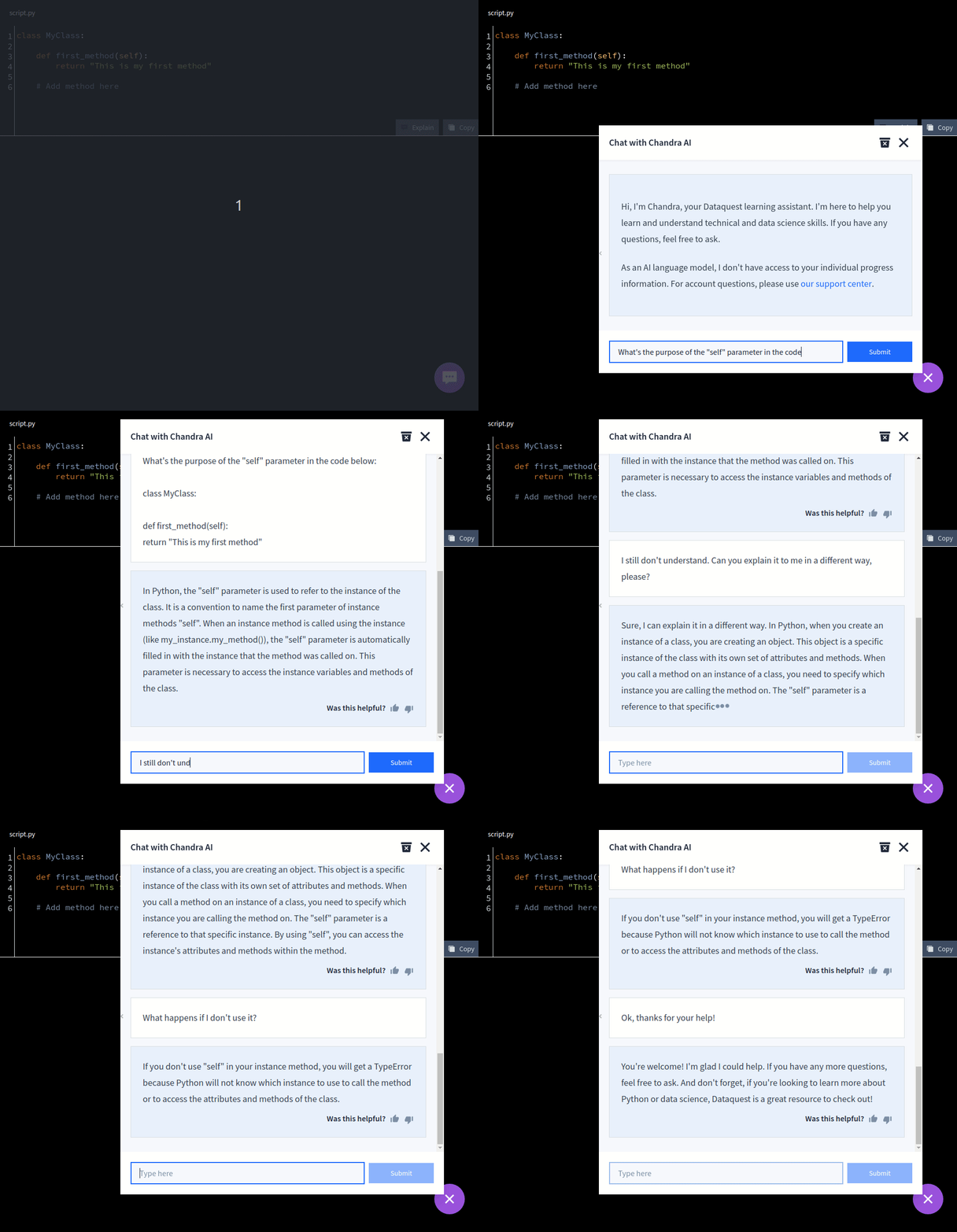
  • Extra perks: Browser-based coding, instant feedback, real datasets, guided learning paths, portfolio projects.
  • Who it’s best for: Self-motivated learners who want flexible, hands-on coding practice without a huge tuition cost.

Dataquest isn’t a traditional bootcamp, but it’s still one of the most effective ways to learn Python.

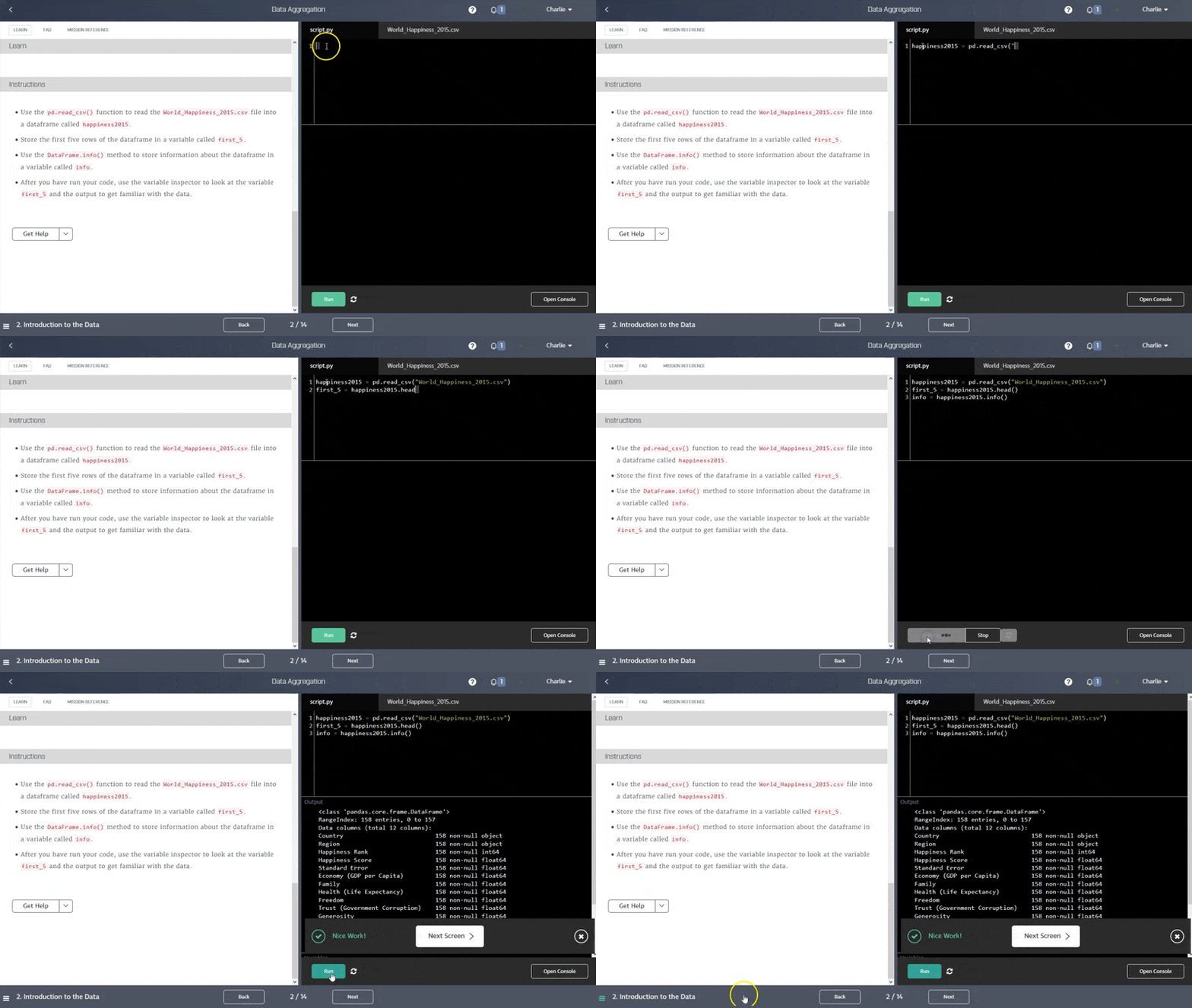
Instead of long video lectures, everything is hands-on. You learn by writing real Python code in the browser, completing guided exercises, and building small projects as you go. It’s practical, fast, and far more affordable than most bootcamps without sacrificing results.

One of Dataquest’s biggest strengths is its career paths. These are structured sequences of courses and projects that guide you from beginner to job-ready. You can choose paths in Python such as Data Scientist, Data Analyst, or Data Engineer.

Each path shows you exactly what to learn next and includes real coding projects that help you build a portfolio. This gives you a clear, organized learning experience without the cost or rigidity of a traditional bootcamp.

Dataquest also offers shorter skill paths for more targeted learning. These focus on specific areas like Python fundamentals, machine learning, or APIs and web scraping. They work well if you want to strengthen a particular skill without committing to a full career program.

Pros Cons
✅ You learn by doing, every lesson has real coding practice ❌ No live instructors or cohort-style learning
✅ Much more affordable than most bootcamps ❌ You need self-discipline since it's fully self-paced
✅ Pick individual courses or follow full learning paths ❌ Some learners prefer having set deadlines
✅ Projects use real datasets, so you build a portfolio early ❌ Text-based lessons may not suit video-first learners
✅ Beginner-friendly, with a clear order to follow if you want structure ❌ No job placement services like some bootcamps offer

Dataquest starts at the most basic level, so a beginner can understand the concepts. I tried learning to code before, using Codecademy and Coursera. I struggled because I had no background in coding, and I was spending a lot of time Googling. Dataquest helped me actually learn.

Aaron Melton, Business Analyst at Aditi Consulting

The Dataquest platform offers the necessary elements needed to succeed as a data science learner. By starting from the basics and building upon it, Dataquest makes it easy to grasp and master the concept of data science.

Goodluck Ogundare

2. Noble Desktop

Noble Desktop
  • Price: \$1,495.
  • Duration: 30 hours spread across five intensive days (Monday–Friday, 10 am–5 pm).
  • Format: Live online or in person (NYC).
  • Rating: 5/5.
  • Extra perks: Free retake, class recordings, 1-on-1 mentoring, certificate of completion.
  • Who it’s best for: Beginners who prefer live instruction, personal support, and a short, intensive bootcamp.

Noble Desktop has a complete Python bootcamp that is a beginner-friendly program designed for anyone starting from zero.

It covers the essential skills you need for Python-based fields like web development, data science, or automation. Classes are small, hands-on, and taught live by expert instructors.

You’ll learn core programming concepts, including variables, data types, loops, functions, and object-oriented programming. Throughout the week, you’ll complete guided exercises and small projects, ending with code you can upload to GitHub as part of your portfolio.

Students also receive a 1-on-1 training session, access to class recordings, and a free retake within one year.

Pros Cons
✅ Very beginner-friendly with clear explanations ❌ Too basic for learners who already know some Python
✅ Strong instructors with a lot of teaching experience ❌ Moves quickly, which can feel rushed for absolute beginners
✅ Small class sizes for more personal support ❌ Only covers fundamentals, not deeper topics
✅ Live online or NYC in-person options ❌ Higher price for a short program
✅ Free retake and access to class recordings ❌ Limited career support compared to full bootcamps

I am learning what I wanted and in the right atmosphere with the right instructor. Art understands Python and knows how to drive its juice into our souls. He is patient and tolerant with us and has so many ways to make each format sink in.

― Jesse Daniels

Very good foundational class with good information for those just starting out in Python. Getting the Python class set up and scheduled was very smooth and the instructor was excellent.

― Clayton Wariner

3. Byte Academy

Byte Academy
  • Price: Course Report lists the program at about \$14,950 with a \$1,500 refundable deposit, but you need to contact Byte Academy for exact pricing.
  • Duration: Full-time or part-time options and hands-on projects + required 4-week internship.
  • Format: Live online, instructor-led 45-minute lessons.
  • Rating: 3.99/5.
  • Extra perks: Mandatory internship, personalized support, real-world project experience.
  • Who it’s best for: Aspiring software engineers who want full-stack skills plus Python in a structured, live, project-heavy program.

Byte Academy offers a Python-focused full stack bootcamp with live, instructor-led training and a required internship.

The curriculum covers Python fundamentals, data structures, algorithms, JavaScript, React, SQL, Git, and full end-to-end application development.

Students follow structured lessons, complete daily practice exercises, and build three major projects. These projects include apps that use production databases and external APIs.

A key feature of this bootcamp is the 4-week internship. Students work on real tasks with real deadlines to gain practical experience for their resume. Instructors track progress closely and provide code reviews, interview prep, and presentation practice.

Pros Cons
✅ Practical, project-heavy curriculum that helps you build real apps. ❌ Fast pace can be difficult for beginners without prior coding exposure.
✅ Small classes and instructors who offer close guidance. ❌ Career support feels inconsistent for some students.
✅ Good option for career changers who need structured learning. ❌ Job outcomes vary and there's no job guarantee.
✅ Strong focus on Python, full stack skills, and hands-on exercises. ❌ Requires a heavy weekly time commitment outside of class.

Coming from a non-coding background, I was concerned about my ability to pick up the coursework but Byte's curriculum is well structured and the staff is so incredibly supportive. I truly felt like I was joining a family and not a bootcamp.

― Chase Ahn

Byte really understands what it takes to get a great job…I can genuinely say that the learning which Byte provided me with, was pinnacle to receiving an offer.

― Ido

4. General Assembly

General Assembly
  • Price: \$4,500, with occasional discounts that can reduce tuition to around \$2,700. Installment plans are available, and most learners pay in two to four monthly payments.
  • Duration: 10-week part-time (evenings) or 1-week accelerated full-time.
  • Format: Live online or in person (depending on region).
  • Rating: 4.31/5.
  • Extra perks: Capstone project, real-time teaching, AI-related content included.
  • Who it’s best for: Beginners who want live instruction, a portfolio project, and flexible part-time or intensive options.

General Assembly’s Python Programming Short Course is built for beginners who want a structured way to learn Python with live, instructor-led classes.

You learn core Python fundamentals and see how they apply to web development and data science. It’s taught by industry professionals and uses a clear, project-based curriculum with around 40 hours of instruction.

The course starts with Python basics, object-oriented programming, and working with common libraries.

Depending on the cohort, the specialization leans toward either data analysis (Pandas, APIs, working with datasets) or web development (Flask, basic backend workflows).

You finish the program by building a portfolio-ready project, such as a small web app or a data analysis tool that pulls from external APIs.

Pros Cons
✅ Live, instructor-led classes with real-time support ❌ Higher cost than most beginner-friendly Python options
✅ Clear, structured curriculum that works well for first-time programmers ❌ Job support varies and isn't as strong as full bootcamps
✅ Portfolio project lets you showcase real work ❌ Only 40 hours of instruction, so depth is limited
✅ Flexible schedules (part-time or 1-week intensive) ❌ Pace can feel fast for complete beginners
✅ Large alumni network and strong brand recognition ❌ Quality depends on the instructor and cohort

The approach that the instructor has taken during this course is what I have been looking for in every course that I have been in. General Assembly has acquired some of the finest teachers in the field of programming and development, and if all the other classes are structured the same way as the Python course I took, then there is a very high chance that I will come back for more.

― Nizar Altarooti

The Python course was great! Easy to follow along and the professor was incredibly knowledgeable and skilled at guiding us through the course.

― Fernando

Other Career-Specific Python Bootcamps

Learning Python doesn’t lock you into one job. It’s a flexible skill you can use in data, software, AI, automation, and more. To build a real career, you’ll need more than basic syntax, which is why most bootcamps train you for a full role.

These are the most common career paths you can take with Python and the best programs for each.

Best Python Bootcamps for Data Analytics

Most data analytics bootcamps are more beginner-friendly than data science programs. Python is used mainly for cleaning data, automating workflows, and running basic analysis alongside tools like Excel and SQL.

What you’ll do:

  • Work with Excel, SQL, and basic Python
  • Build dashboards
  • Create reports for business teams

1. Dataquest

Dataquest
  • Price: Free to start; \$49/month or \$588/year for full access.
  • Duration: ~11 months at 5 hrs/week.
  • Format: Online, self-paced.
  • Rating: 4.79/5.
  • Extra perks: Browser-based coding, instant feedback, real datasets, guided learning paths, portfolio projects.
  • Who it’s best for: Beginners who want a fully Python-based, affordable, project-driven path into data science at their own pace.

Dataquest teaches data analytics and data science entirely through hands-on coding.

You learn by writing Python in the browser, practicing with libraries like Pandas, NumPy, Matplotlib, and scikit-learn. Each step builds toward real projects that help you clean data, analyze datasets, and build predictive models.

Because the whole program is structured around Python, it’s one of the easiest ways for beginners to get comfortable writing real code while building a portfolio.

Pros Cons
✅ Affordable compared to full bootcamps ❌ No live mentorship or one-on-one support
✅ Flexible, self-paced structure ❌ Limited career guidance and networking
✅ Strong hands-on learning with real projects ❌ Text-based learning, minimal video content
✅ Beginner-friendly and well-structured ❌ Requires high self-discipline to stay consistent
✅ Covers core tools like Python, SQL, and machine learning

I used Dataquest since 2019 and I doubled my income in 4 years and became a Data Scientist. That’s pretty cool!

Leo Motta

I liked the interactive environment on Dataquest. The material was clear and well organized. I spent more time practicing than watching videos and it made me want to keep learning.

Jessica Ko, Machine Learning Engineer at Twitter

2. CareerFoundry

CareerFoundry
  • Price: Around \$7,900.
  • Duration: 6–10 months.
  • Format: Online, self-paced.
  • Rating: 4.66/5.
  • Extra perks: Dual mentorship model (mentor + tutor), portfolio-based projects, flexible pacing, structured career support.
  • Who it’s best for: Complete beginners who want a gentle, guided introduction to Python as part of a broader data analytics skill set, with mentor feedback and portfolio projects.

CareerFoundry includes Python in its curriculum, but it is not the primary focus.

You learn Python basics, data cleaning, and visualization with Pandas and Matplotlib, mostly applied to beginner-friendly analytics tasks. The course also covers Excel and SQL, so Python is one of several tools rather than the main skill.

This bootcamp works well if you want a gradual introduction to Python without jumping straight into advanced programming or machine learning. It’s designed for complete beginners and includes mentor feedback and portfolio projects, but the depth of Python is lighter compared to more technical programs.

Pros Cons
✅ Clear structure and portfolio-based learning ❌ Mentor quality can be inconsistent
✅ Good for beginners switching careers ❌ Some materials feel outdated
✅ Flexible study pace with steady feedback ❌ Job guarantee has strict conditions
✅ Supportive community and active alumni ❌ Occasional slow responses from support team

The Data Analysis bootcamp offered by CareerFoundry will guide you through all the topics, but lets you learn at your own pace, which is great for people who have a full-time job or for those who want to dedicate 100% to the program. Tutors and Mentors are available either way, and are willing to assist you when needed.

― Jaime Suarez

I have completed the Data Analytics bootcamp and within a month I have secured a new position as data analyst! I believe the course gives you a very solid foundation to build off of.

― Bethany R.

3. Coding Temple

Coding Temple
  • Price: \$6,000–\$9,000.
  • Duration: ~4 months.
  • Format: Live online + self-paced.
  • Rating: 4.77/5.
  • Extra perks: Daily live sessions, LaunchPad real-world projects, smaller class sizes, lifetime career support.
  • Who it’s best for: Learners who want a fast-paced, structured program with deeper Python coverage and hands-on analytics and ML practice.

Coding Temple teaches Python more deeply than most data analytics bootcamps.

You work with key libraries like Pandas, NumPy, Matplotlib, and scikit-learn, and you apply them in real datasets through LaunchPad and live workshops. Students also learn introductory machine learning, making the Python portion more advanced than many entry-level programs.

The pace is fast, but you get strong support from instructors and daily live sessions. If you want a structured environment and a clear understanding of how Python is used in analytics and ML, Coding Temple is a good match.

Pros Cons
✅ Supportive instructors who explain concepts clearly ❌ Fast pace can feel intense for beginners
✅ Good mix of live classes and self-paced study ❌ Job-guarantee terms can be strict
✅ Strong emphasis on real projects and practical tools ❌ Some topics could use a bit more depth
✅ Helpful career support and interview coaching ❌ Can be challenging to balance with a full-time job
✅ Smaller class sizes make it easier to get help

Enrolling in Coding Temple's Data Analytics program was a game-changer for me. The curriculum is not just about the basics; it's a deep dive that equips you with skills that are seriously competitive in the job market.

― Ann C.

The support and guidance I received were beyond anything I expected. Every staff member was encouraging, patient, and always willing to help, no matter how small the question.

― Neha Patel

Best Python Bootcamps for Data Science

Most data science bootcamps use Python as their main language. It’s the standard tool for data analysis, machine learning, and visualization.

What you’ll do in this field:

  • Analyze datasets
  • Build machine learning models
  • Work with statistics, visualization, and cloud tools
  • Solve business problems with data

1. BrainStation

BrainStation
  • Price: Around \$16,500.
  • Duration: 6 months, part-time.
  • Format: Live online or in major cities.
  • Rating: 4.66/5.
  • Extra perks: Live instructor-led classes, real company datasets, career coaching, global alumni network.
  • Who it’s best for: Learners who prefer structured, instructor-led programs and real-world data projects.

BrainStation’s Data Science Bootcamp teaches Python from the beginning and uses it for almost every part of the bootcamp.

Students learn Python basics, then apply it to data cleaning, visualization, SQL work, machine learning, and deep learning. The curriculum includes scikit-learn, TensorFlow, and AWS tools, with projects built from real company datasets.

Python is woven throughout the program. So it’s ideal for learners who want structured, instructor-led practice using Python in real data scenarios.

Pros Cons
✅ Instructors with strong industry experience ❌ Expensive compared to similar online bootcamps
✅ Flexible schedule for working professionals ❌ Fast-paced, can be challenging to keep up
✅ Practical, project-based learning with real company data ❌ Some topics are covered briefly without much depth
✅ 1-on-1 career support with resume and interview prep ❌ Career support is not always highly personalized
✅ Modern curriculum including AI, ML, and big data ❌ Requires strong time management and prior technical comfort

Having now worked as a data scientist in industry for a few months, I can really appreciate how well the course content was aligned with the skills required on the job.

― Joseph Myers

BrainStation was definitely helpful for my career, because it enabled me to get jobs that I would not have been competitive for before.

― Samit Watve, Principal Bioinformatics Scientist at Roche

2. NYC Data Science Academy

NYC Data Science Academy
  • Price: \$17,600.
  • Duration: 12–16 weeks full-time or 24 weeks part-time.
  • Format: Live online, in-person (NYC), or self-paced.
  • Rating: 4.86/5.
  • Extra perks: Company capstone projects, highly technical curriculum, small cohorts, lifelong alumni access.
  • Who it’s best for: Students aiming for highly technical Python and ML experience with multiple real-world projects.

NYC Data Science Academy provides one of the most technical Python learning experiences.

Students work with Python for data wrangling, visualization, statistical modeling, and machine learning. The program also teaches deep learning with TensorFlow and Keras, plus NLP tools like spaCy. While the bootcamp includes R, Python is used heavily in the ML and project modules.

With four projects and a real company capstone, students leave with strong Python experience and a portfolio built around real-world datasets.

Pros Cons
✅ Teaches both Python and R ❌ Expensive compared to similar programs
✅ Instructors with real-world experience (many PhD-level) ❌ Fast-paced and demanding workload
✅ Includes real company projects and capstone ❌ Requires some technical background to keep up
✅ Strong career services and lifelong alumni access ❌ Limited in-person location (New York only)
✅ Offers financing and scholarships ❌ Admission process can be competitive

The opportunity to network was incredible. You are beginning your data science career having forged strong bonds with 35 other incredibly intelligent and inspiring people who go to work at great companies.

― David Steinmetz, Machine Learning Data Engineer at Capital One

My journey with NYC Data Science Academy began in 2018 when I enrolled in their Data Science and Machine Learning bootcamp. As a Biology PhD looking to transition into Data Science, this bootcamp became a pivotal moment in my career. Within two months of completing the program, I received offers from two different groups at JPMorgan Chase.

― Elsa Amores Vera

3. Le Wagon

Le Wagon
  • Price: From €7,900.
  • Duration: 9 weeks full-time or 24 weeks part-time.
  • Format: Online or in-person.
  • Rating: 4.95/5.
  • Extra perks: Global campus network, intensive project-based learning, AI-focused Python curriculum, career coaching.
  • Who it’s best for: Learners who want a fast, intensive program blending Python, ML, and AI skills.

Le Wagon uses Python as the foundation for data science, AI, and machine learning training.

The program covers Python basics, data manipulation with Pandas and NumPy, and modeling with scikit-learn, TensorFlow, and Keras. New modules include LLMs, RAG pipelines, prompt engineering and GenAI tools, all written in Python.

Students complete multiple Python-based projects and an AI capstone, making this bootcamp strong for learners who want a mix of classic ML and modern AI skills.

Pros Cons
✅ Supportive, high-energy community that keeps you motivated ❌ Intense schedule, expect full commitment and long hours
✅ Real-world projects that make a solid portfolio ❌ Some students felt post-bootcamp job help was inconsistent
✅ Global network and active alumni events in major cities ❌ Not beginner-friendly, assumes coding and math basics
✅ Teaches both data science and new GenAI topics like LLMs and RAGs ❌ A few found it pricey for a short program
✅ University tie-ins for MSc or MBA pathways ❌ Curriculum depth can vary depending on campus

Looking back, applying for the Le Wagon data science bootcamp after finishing my master at the London School of Economics was one of the best decisions. Especially coming from a non-technical background it is incredible to learn about that many, super relevant data science topics within such a short period of time.

― Ann-Sophie Gernandt

The bootcamp exceeded my expectations by not only equipping me with essential technical skills and introducing me to a wide range of Python libraries I was eager to master, but also by strengthening crucial soft skills that I've come to understand are equally vital when entering this field.

― Son Ma

Best Python Bootcamps for Machine Learning

This is Python at an advanced level: deep learning, NLP, computer vision, and model deployment.

What you’ll do:

  • Train ML models
  • Build neural networks
  • Work with transformers, embeddings, and LLM tools
  • Deploy AI systems

1. Springboard

Springboard
  • Price: \$9,900 upfront or \$13,950 with monthly payments; financing and scholarships available.
  • Duration: ~9 months.
  • Format: Online, self-paced with weekly 1:1 mentorship.
  • Rating: 4.6/5.
  • Extra perks: Weekly 1:1 mentorship, two-phase capstone with deployment, flexible pacing, job guarantee (terms apply).
  • Who it’s best for: Learners who already know Python basics and want guided, project-based training in machine learning and model deployment.

Springboard’s ML Engineering & AI Bootcamp teaches the core skills you need to work with machine learning.

You learn how to build supervised and unsupervised models, work with neural networks, and prepare data through feature engineering. The program also covers common tools such as scikit-learn, TensorFlow, and AWS.

You also build a two-phase capstone project where you develop a working ML or deep learning prototype and then deploy it as an API or web service. Weekly 1:1 mentorship helps you stay on track, get code feedback, and understand industry best practices.

If you want a flexible program that teaches both machine learning and how to put models into production, Springboard is a great fit.

Pros Cons
✅ Strong focus on Python for machine learning and AI ❌ Self-paced format requires strong self-discipline
✅ Weekly 1:1 mentorship for code and project feedback ❌ Mentor quality can vary between students
✅ Real-world projects, including a deployed capstone ❌ Program can feel long if you fall behind
✅ Covers in-demand tools like scikit-learn, TensorFlow, and AWS ❌ Job guarantee has strict requirements
✅ Flexible schedule for working professionals ❌ Not beginner-friendly without basic Python knowledge

I had a good time with Spring Board's ML course. The certificate is under the UC San Diego Extension name, which is great. The course itself is overall good, however I do want to point out a few things: It's only as useful as the amount of time you put into it.

― Bill Yu

Springboard's Machine Learning Career Track has been one of the best career decisions I have ever made.

― Joyjit Chowdhury

2. Fullstack Academy

Fullstack Academy
  • Price: \$7,995 with discount (regular \$10,995).
  • Duration: 26 weeks.
  • Format: Live online, part-time.
  • Rating: 4.77/5.
  • Extra perks: Live instructor-led sessions, multiple hands-on ML projects, portfolio-ready capstone, career coaching support.
  • Who it’s best for: Learners who prefer live, instructor-led training and want structured exposure to Python, ML, and AI tools.

Fullstack Academy’s AI & Machine Learning Bootcamp teaches the main skills you need to work with AI.

You learn Python, machine learning models, deep learning, NLP, and popular tools like Keras, TensorFlow, and ChatGPT. The lessons are taught live, and you practice each concept through small exercises and real examples.

You also work on several projects and finish with a capstone where you use AI or ML to solve a real problem. The program includes career support to help you build a strong portfolio and prepare for the job search.

If you want a structured, live learning experience with clear weekly guidance, Fullstack Academy is a good option.

Pros Cons
✅ Live, instructor-led classes with clear weekly structure ❌ Fast pace can be tough without prior Python or math basics
✅ Strong focus on Python, ML, AI, and modern tools ❌ Fixed class schedule limits flexibility
✅ Multiple hands-on projects plus a portfolio-ready capstone ❌ Expensive compared to self-paced or online-only options
✅ Good career coaching and job search support ❌ Instructor quality can vary by cohort
✅ Works well for part-time learners with full-time jobs ❌ Workload can feel heavy alongside other commitments

I was really glad how teachers gave you really good advice and really good resources to improve your coding skills.

― Aleeya Garcia

I met so many great people at Full Stack, and I can gladly say that a lot of the peers, my classmates that were at the bootcamp, are my friends now and I was able to connect with them, grow my network of not just young professionals, but a lot of good people. Not to mention the network that I have with my two instructors that were great.

― Juan Pablo Gomez-Pineiro

3. TripleTen

TripleTen
  • Price: From \$9,113 upfront (or installments from around \$380/month; financing and money-back guarantee available).
  • Duration: 9 months.
  • Format: Online, part-time with flexible schedule.
  • Rating: 4.84/5.
  • Extra perks: Live instructor-led sessions, multiple hands-on ML projects, portfolio-ready capstone, career coaching support.
  • Who it’s best for: Beginners who want a flexible schedule, clear explanations, and strong career support while learning advanced Python and ML.

TripleTen’s AI & Machine Learning Bootcamp is designed for beginners, even if you don’t have a STEM background.

You learn Python, statistics, machine learning, neural networks, NLP, and LLMs. The program also teaches industry tools like NumPy, pandas, scikit-learn, PyTorch, TensorFlow, SQL, Docker, and AWS. Training is project-based, and you complete around 15 projects to build a strong portfolio.

You get 1-on-1 tutoring, regular code reviews, and the chance to work on externship-style projects with real companies. TripleTen also offers a job guarantee. If you finish the program and follow the career steps but don’t get a tech job within 10 months, you can get your tuition back.

This bootcamp is a good fit if you want a flexible schedule, beginner-friendly teaching, and strong career support.

Pros Cons
✅ Beginner-friendly explanations, even without a STEM background ❌ Long program length (9 months) can feel slow for some learners
✅ Strong Python focus with ML, NLP, and real projects ❌ Requires steady self-discipline due to part-time, online format
✅ Many hands-on projects that build a solid portfolio ❌ Job guarantee has strict requirements
✅ 1-on-1 tutoring and regular code reviews ❌ Some learners want more live group instruction
✅ Flexible schedule works well alongside a full-time job ❌ Advanced topics can feel challenging without math basics

Most of the tutors are practicing data scientists who are already working in the industry. I know one particular tutor, he works at IBM. I’d always send him questions and stuff like that, and he would always reply, and his reviews were insightful.

― Chuks Okoli

I started learning to code for the initial purpose of expanding both my knowledge and skillset in the data realm. I joined TripleTen in particular because after a couple of YouTube ads I decided to look more into the camp to explore what they offered, on top of already looking for a way to make myself more valuable in the market. Immediately, I fell in love with the purpose behind the camp and the potential outcomes it can bring.

― Alphonso Houston

Best Python Bootcamps for Software Engineering

Python is used for backend development, APIs, web apps, scripting, and automation.

What you’ll do:

  • Build web apps
  • Work with frameworks like Flask or Django
  • Write APIs
  • Automate tasks

1. Coding Temple

Coding Temple
  • Price: From \$3,500 upfront with discounts (or installment plans from ~\$250/month; 0% interest options available).
  • Duration: ~4–6 months.
  • Format: Online, part-time with live sessions.
  • Rating: 4.77/5.
  • Extra perks: Built-in tech residency, daily live coding sessions, real-world industry projects, and ongoing career coaching.
  • Who it’s best for: Learners who want a structured, project-heavy path into full-stack development with Python and real-world coding practice.

Coding Temple has one of the best coding bootcamps that teaches the core skills needed to build full-stack applications.

You learn HTML, CSS, JavaScript, Python, React, SQL, Flask, and cloud tools while working through hands-on projects. The program mixes self-paced lessons with daily live coding sessions, which helps you stay on track and practice new skills right away.

Students also join a built-in tech residency where they solve real coding problems and work on industry-style projects. Career support is included and covers technical interviews, mock assessments, and portfolio building.

It’s a good choice if you want structure, real projects, and a direct path into software engineering.

Pros Cons
✅ Very hands-on with daily live coding and frequent practice ❌ Fast pace can feel overwhelming for complete beginners
✅ Strong focus on real-world projects and applied skills ❌ Requires a big time commitment outside scheduled sessions
✅ Python is taught in a practical, job-focused way ❌ Depth can vary depending on instructor or cohort
✅ Built-in tech residency adds realistic coding experience ❌ Job outcomes depend heavily on personal effort
✅ Ongoing career coaching and interview prep ❌ Less flexibility compared to fully self-paced programs

Taking this class was one of the best investments and career decisions I've ever made. I realize first hand that making such an investment can be a scary and nerve racking decision to make but trust me when I say that it will be well worth it in the end! Their curriculum is honestly designed to give you a deep understanding of all the technologies and languages that you'll be using for your career going forward.

― Justin A

My experience at Coding Temple has been nothing short of transformative. As a graduate of their Full-Stack Developer program, I can confidently say this bootcamp delivers on its promise of preparing students for immediate job readiness in the tech industry.

― Austin Carlson

2. General Assembly

General Assembly
  • Price: \$16,450 total (installments and 0% interest loan options available).
  • Duration: 12 weeks full-time or 32 weeks part-time.
  • Format: Online or on campus, with live instruction.
  • Rating: 4.31/5.
  • Extra perks: Large global alumni network, multiple portfolio projects, flexible full-time or part-time schedules, dedicated career coaching.
  • Who it’s best for: Beginners who want a well-known program with live instruction, strong fundamentals, and a broad full-stack skill set.

General Assembly’s Software Engineering Bootcamp teaches full-stack development from the ground up.

You learn Python, JavaScript, HTML, CSS, React, APIs, databases, Agile workflows, and debugging. The program is beginner-friendly and includes structured lessons, hands-on projects, and support from experienced instructors. Both full-time and part-time formats are available, so you can choose a schedule that fits your lifestyle.

Students build several portfolio projects, including a full-stack capstone, and receive personalized career coaching. This includes technical interview prep, resume help, and job search support.

General Assembly is a good option if you want a well-known bootcamp with strong instruction, flexible schedules, and a large global hiring network.

Pros Cons
✅ Well-known brand with a large global alumni network ❌ Expensive compared to many similar bootcamps
✅ Live, instructor-led classes with structured curriculum ❌ Pace can feel very fast for true beginners
✅ Broad full-stack coverage, including Python and JavaScript ❌ Python is not the main focus throughout the program
✅ Multiple portfolio projects, including a capstone ❌ Instructor quality can vary by cohort or location
✅ Dedicated career coaching and interview prep ❌ Job outcomes depend heavily on individual effort and market timing

GA gave me the foundational knowledge and confidence to pursue my career goals. With caring teachers, a supportive community, and up-to-date, challenging curriculum, I felt prepared and motivated to build and improve tech for the next generation.

― Lyn Muldrow

I thoroughly enjoyed my time at GA. With 4 projects within 3 months, these were a good start to having a portfolio upon graduation. Naturally, that depended on your effort and diligence throughout the project duration. The pace was pretty fast with a project week after every two weeks of classes, but that served to stretch my learning capabilities.

― Joey L.

3. Flatiron School

Flatiron School
  • Price: \$17,500, or as low as \$9,900 with available discounts.
  • Duration: 15 weeks full-time or 45 weeks part-time.
  • Format: Online, full-time cohort, or flexible part-time.
  • Rating: 4.45/5.
  • Extra perks: Project at the end of every unit, full software engineering capstone, extended career services access, mentor, and peer support.
  • Who it’s best for: Learners who want a highly structured curriculum, clear milestones, and long-term career support while learning Python and full-stack development.

Flatiron School teaches software engineering through a structured, project-focused curriculum.

You learn front-end and back-end development using JavaScript, React, Python, and Flask, plus core engineering skills like debugging, version control, and API development. Each unit ends with a project, and the program includes a full software engineering capstone to help you build a strong portfolio.

Students also get support from mentors, 24/7 learning resources, and access to career services for up to 180 days, which includes resume help, job search guidance, and career talks.

Flatiron is a good fit if you want a beginner-friendly bootcamp with strong structure, clear milestones, and both full-time and part-time options.

Pros Cons
✅ Strong, well-structured curriculum with projects after each unit ❌ Intense workload that can feel overwhelming
✅ Multiple portfolio projects plus a full capstone ❌ Part-time / flex formats require high self-discipline
✅ Teaches both Python and full-stack development ❌ Instructor quality can vary by cohort
✅ Good reputation and name recognition with employers ❌ Not ideal for people who want a slower learning pace
✅ Extended career services and job-search support ❌ Expensive compared to self-paced or online-only options

As a former computer science student in college, Flatiron will teach you things I never learned, or even expected to learn, in a coding bootcamp. Upon graduating, I became even more impressed with the overall experience when using the career services.

― Anslie Brant

I had a great experience at Flatiron. I met some really great people in my cohort. The bootcamp is very high pace and requires discipline. The course is not for everyone. I got to work on technical projects and build out a great portfolio. The instructors are knowledgable. I wish I would have enrolled when they rolled out the new curriculum (Python/Flask).

― Matthew L.

Best Python Bootcamps for DevOps & Automation

Python is used for scripting, cloud automation, building internal tools, and managing systems.

What you’ll do:

  • Automate workflows
  • Write command-line tools
  • Work with Docker, CI/CD, AWS, Linux
  • Build internal automations for engineering teams

1. TechWorld with Nana
TechWorld with Nana
  • Price: \$1,795 upfront or 5 × \$379.
  • Duration: ~6 months (self-paced).
  • Format: Online with 24/7 support.
  • Rating: 4.9/5.
  • Extra perks: Real-world DevOps projects, DevOps certification, structured learning roadmap, active Discord community.
  • Who it’s best for: Self-motivated learners who want to use Python for automation while building practical DevOps skills at a lower cost.

TechWorld with Nana’s DevOps Bootcamp focuses on practical DevOps skills through a structured roadmap.

You learn core tools like Linux, Git, Jenkins, Docker, Kubernetes, AWS, Terraform, Ansible, and Python for automation.

The program includes real-world projects where you build pipelines, deploy to the cloud, and write Python scripts to automate tasks. You also earn a DevOps certification and get access to study guides and an active Discord community.

This bootcamp is ideal if you want an affordable, project-heavy DevOps program that teaches industry tools and gives you a portfolio you can show employers.

Pros Cons
✅ Strong focus on real-world DevOps projects and automation ❌ Fully self-paced, no live instructor-led classes
✅ Python taught in a practical DevOps and scripting context ❌ Less suited for absolute beginners with no tech background
✅ Very affordable compared to DevOps bootcamps ❌ No formal career coaching or job placement services
✅ Clear learning roadmap that's easy to follow ❌ Requires strong self-motivation and consistency
✅ Active Discord community for support and questions ❌ Certification is less recognized than major bootcamp brands

I would like to thank Nana and the team, your DevOps bootcamp allowed me to get a job as a DevOps engineer in Paris while I was living in Ivory Coast, so I traveled to take the job.

― KOKI Jean-David

I have ZERO IT background and needed a course where I can get the training for DevOps Engineering role. While I'm still progressing through this course, I have feel like I have gained so much knowledge in a short amount of time.

― Daniel

2. Zero To Mastery

Zero To Mastery
  • Price: \$25/month (billed yearly at \$299) or \$1,299 lifetime.
  • Duration: About 5 months.
  • Format: Fully online, self-paced, with an active Discord community and career support.
  • Rating: 4.9/5.
  • Extra perks: Large course library, 30+ hands-on projects, lifetime access option, active Discord, and career guidance.
  • Who it’s best for: Budget-conscious learners who want a self-paced, project-heavy DevOps path with strong Python foundations.

Zero To Mastery offers a full DevOps learning path that includes everything from Python basics to Linux, Bash, CI/CD, AWS, Terraform, networking, and system design.

You also get a complete Python developer course, so your programming foundation is stronger than what many DevOps programs provide.

The path is project-heavy, with 14 courses and 30 hands-on projects, plus optional career tasks like polishing your resume and applying to jobs.

If you want a very affordable way to learn DevOps, build a portfolio, and study at your own pace, ZTM is a practical choice.

Pros Cons
✅ Extremely affordable compared to most DevOps bootcamps ❌ Fully self-paced with no live instructor-led classes
✅ Strong Python foundation alongside DevOps tooling ❌ Can feel overwhelming due to the large amount of content
✅ Very project-heavy with 30+ hands-on projects ❌ Requires high self-discipline to finish the full path
✅ Lifetime access option adds long-term value ❌ No formal job guarantee or placement program
✅ Active Discord community and peer support ❌ Career support is lighter than traditional bootcamps

Great experience and very informative platform that explains concepts in an easy to understand manner. I plan to use ZTM for the rest of my educational journey and look forward to future courses.

― Berlon Weeks

The videos are well explained, and the teachers are supportive and have a good sense of humor.

― Fernando Aguilar

3. Nucamp

Nucamp
  • Price: \$99/month, with up to 25% off through available scholarships.
  • Duration: ~16 weeks (part-time, structured weekly schedule).
  • Format: Live online with scheduled instruction and weekend sessions.
  • Rating: 4.74/5.
  • Extra perks: AI-powered learning tools, lifetime content access, nationwide job board, hackathons, LinkedIn Premium.
  • Who it’s best for: Learners who want a low-cost, part-time backend-focused path that still covers Python, SQL, DevOps, and cloud deployment.

Nucamp’s backend program teaches the essential skills needed to build and deploy real web applications.

You start with Python fundamentals, data structures, and common algorithms. Then you move into SQL and PostgreSQL, where you learn to design relational databases and connect them to Python applications to build functional backend systems.

The schedule is designed for people with full-time jobs. You study on your own during the week, then attend live instructor-led workshops to review concepts, fix errors, and complete graded assignments.

Career services include resume help, portfolio guidance, LinkedIn Premium access, and a nationwide job board for graduates.

Pros Cons
✅ Very affordable compared to most bootcamps. ❌ Self-paced format can be hard if you need more structure.
✅ Instructors are supportive, and classes stay small. ❌ Career help isn't consistent across cohorts.
✅ Good hands-on practice with Python, SQL, and DevOps tools. ❌ Some advanced topics feel a bit surface-level.
✅ Lifetime access to learning materials and the student community. ❌ Not as intensive as full-time immersive programs.

As a graduate of the Back-End Bootcamp with Python, SQL, and DevOps, I can confidently say that Nucamp excels in delivering the fundamentals of the main back-end development technologies, making any graduate of the program well-equipped to take on the challenges of an entry-level role in the industry.

― Elodie Rebesque

The instructors at Nucamp were the real deal—smart, patient, always there to help. They made a space where questions were welcome, and we all hustled together to succeed.

― Josh Peterson

Best Python Bootcamps for Web Development

1. Coding Dojo

Coding Dojo
  • Price: \$9,995 for 1 stack; \$13,495 for 2 stacks; \$16,995 for 3 stacks. You can use a \$100 Open House grant, an up to \$750 Advantage Grant, and optional payment plans.
  • Duration: 20-32 weeks, depending on pace.
  • Format: Online or on-campus in select cities.
  • Rating: 4.38/5.
  • Extra perks: Multi-stack curriculum, hands-on projects, career support, mentorship, and career prep workshops.
  • Who it’s best for: Learners who want exposure to multiple web stacks, including Python, and strong portfolio development.

Coding Dojo’s Software Development Bootcamp is a beginner-friendly full-stack program for learning modern web development.

You start with basic programming concepts, then move into front-end work and back-end development with Python, JavaScript, or another chosen stack. Each stack includes practice with simple frameworks, server logic, and databases so you understand how web apps are built.

You also learn core tools used in real workflows. This includes working with APIs, connecting your projects to a database, and understanding basic server routing. As you move through each stack, you build small features step by step until you can create a full web application on your own.

The program is flexible and supports different learning styles. You get live lectures, office hours, code reviews, and 24/7 access to the platform. A success coach and career services team help you stay on track, build a portfolio, and prepare for your job search without adding stress.

Pros Cons
✅ Multi-stack curriculum gives broader web dev skills than most bootcamps ❌ Career support quality is inconsistent across cohorts
✅ Strong instructor and TA support for beginners ❌ Some material can feel outdated in places
✅ Clear progression from basics to full applications ❌ Students often need extra study after graduation to feel job-ready
✅ 24/7 platform access plus live instruction and code reviews ❌ Higher cost compared to many online alternatives

My favorite project was doing my final solo project because it showed me that I have what it takes to be a developer and create something from start to finish.

― Alexander G.

Coding Dojo offers an extensive course in building code in multiple languages. They teach you the basics, but then move you through more advanced study, by building actual programs. The curriculum is extensive and the instructors are very helpful, supplemented by TA's who are able to help you find answers on your own.

― Trey-Thomas Beattie

2. App Academy

App Academy
  • Price: \$9,500 upfront; \$400/mo installment plan; or \$14,500 deferred payment option.
  • Duration: ~5 months (part-time live track; daily commitment ~40 hrs/week).
  • Format: Online or in-person in select cities.
  • Rating: 4.65/5.
  • Extra perks: Built-in tech residency, AI-enhanced learning, career coaching, and lifetime support.
  • Who it’s best for: Highly motivated learners who want an immersive experience and career-focused training with Python web development.

App Academy’s Software Engineering Program is a beginner-friendly full-stack bootcamp that covers the core tools used in modern web development.

You start with HTML, CSS, and JavaScript, then move into front-end development with React and back-end work with Python, Flask, and SQL. The program focuses on practical, hands-on projects so you learn how complete web applications are built.

You also work with tools used in real production environments. This includes API development, server routing, databases, Git workflows, and Docker. The built-in tech residency gives you experience working on real projects in an Agile setting, with code reviews and sprint cycles that help you build a strong, job-ready portfolio.

The bootcamp supports different learning styles with live instruction, on-demand help, code reviews, and 24/7 access to materials. Success managers and career coaches also help you build your resume, improve your portfolio, and get ready for interviews.

Pros Cons
✅ Rigorous curriculum that actually builds real engineering skills ❌ Very time-intensive and demanding; easy to fall behind
✅ Supportive instructors, TAs, and a strong peer community ❌ Fast pacing can feel overwhelming for beginners
✅ Tech Residency gives real project experience before graduating ❌ Not a guaranteed path to a job; still requires heavy effort after graduation
✅ Solid career support (resume, portfolio, interview prep) ❌ High workload expectations (nights/weekends)
✅ Strong overall reviews from alumni across major platforms ❌ Stressful assessments and cohort pressure for some students

In a short period of 3 months, I've learnt a great deal of theoretical and practical knowledge. The instructions for the daily projects are very detailed and of high quality. Help is always there when you need it. The curriculum covers diverse aspects of software development and is always taught with a practical focus.

― Donguk Kim

App Academy was a very structured program that I learned a lot from. It keeps you motivated to work hard through having assessments every Monday and practice assessments prior to the main ones. This helps to constantly let you know what you need to do to stay on track.

― Alex Gonzalez

3. Developers Institute

Developers Institute
  • Price: 23,000 ILS full-time (~\$6,300 USD) and 20,000 ILS part-time (~\$5,500 USD). These are Early Bird prices.
  • Duration: 12 weeks full-time; 28 weeks part-time; 30 weeks flex.
  • Format: Online, on-campus (Israel, Mexico, Cameroon), or hybrid.
  • Rating: 4.94/5.
  • Extra perks: Internship opportunities, AI-powered learning platform, hackathons, career coaching, global locations.
  • Who it’s best for: Learners who want a Python + JavaScript full-stack path, strong support, and flexible schedule options.

Developers Institute’s Full Stack Coding Bootcamp is a beginner-friendly program that teaches the essential skills used in modern web development.

You start with HTML, CSS, JavaScript, and React, then move on to backend development with Python, Flask, SQL, and basic API work. The curriculum is practical and project-focused. You learn how the front end and back end fit together by building real applications.

You also learn tools used in professional environments, such as Git workflows, databases, and basic server routing. Full-time students can join an internship for real project experience. All learners also get access to DI’s AI-powered platform for instant feedback, code checking, and personalized quizzes.

The program offers multiple pacing options and includes strong career support. You get 1:1 coaching, portfolio guidance, interview prep, and job-matching tools. This makes it a solid option if you want structured training with Python in the backend and a clear path into a junior software or web development role.

Pros Cons
✅ Clear, supportive instructors who help when you get stuck. ❌ The full-time schedule can feel intense.
✅ Lots of hands-on practice and real coding exercises. ❌ Some lessons require extra self-study to fully understand.
✅ Helpful AI tools for instant feedback and code checking. ❌ Beginners may struggle during the first weeks.
✅ Internship option that adds real-world experience. ❌ Quality of experience can vary depending on the cohort.

You will learn not only main topics but also a lot of additional information which will help you feel confident as a developer and also impress HR!

― Vladlena Sotnikova

I just finished a Data Analyst course in Developers Institute and I am really glad I chose this school. The class are super accurate, we were learning up-to date skills that employers are looking for. All the teachers are extremely patient and have no problem reexplaining you if you did not understand, also after class-time.

― Anaïs Herbillon

Your Next Step

You don't need to pick the "perfect" bootcamp. You need to pick one that matches where you are right now and where you want to go.

If you're still figuring out whether coding is for you, start with something affordable and flexible like Dataquest or Noble Desktop's short course. If you already know you want a career change and need full support, look at programs like BrainStation, Coding Temple, or Le Wagon that include career coaching and real projects.

The bootcamp itself won't get you the job. It gives you structure, skills, and a portfolio. What comes after (building more projects, applying consistently, fixing your resume, practicing interviews) is still on you.

But if you're serious about learning Python and using it professionally, a good bootcamp can save you months of confusion and give you a clear path forward.

Pick one that fits your schedule, your budget, and your goals. Then commit to finishing it.

The rest will follow.

FAQs

Are Python bootcamps worth it?

Bootcamps can work, but they’re not going to magically land you a perfect job. You still need to put in hours outside of class and be accountable.

Bootcamps are worth it if:

  • You need structure because you struggle to stay consistent on your own.
  • You want career support like mock interviews, portfolio reviews, or job-search coaching.
  • You learn faster with deadlines, instructors, and a guided curriculum.
  • You prefer hands-on projects instead of reading tutorials in isolation.

Bootcamps are not worth it if:

  • You expect a job to be handed to you at the end.
  • You’re not ready to study outside class hours (Sometimes 20–40 extra hours per week is normal).
  • The tuition is so high that it adds stress instead of motivation.

Bootcamps work best for people who have already tried learning alone and hit a wall.

They give structure, accountability, networking, and a way to skip the confusion of “what do I learn next?” But you still have to do the messy part: debugging, building projects, failing, trying again, and actually understanding the code.

Bootcamps are worth it when they save you time, not when they sell you shortcuts.

Can you learn Python by yourself?

You can learn Python on your own, and a lot of people do. The language is designed to be readable, and there are endless free resources. You can follow tutorials, practice with small exercises, and slowly build confidence without joining a bootcamp.

The challenge usually appears after the basics. People often get stuck when they try to build real projects or decide what to learn next. This is one reason why bootcamps don’t focus on Python alone. Instead, they focus on careers like data science, analytics, or software development. Python is just one part of the larger skill set you need for those jobs.

So learning Python by yourself is completely possible. Bootcamps simply help learners take the next step and build the full stack of skills required for a specific role.

What’s the best way to learn Python?

No one can tell you exactly how you learn. Some people say you don’t need a structured Python course and that python.org is enough. Others swear by building projects from day one. Some prefer learning from a Python book. None of these are wrong. You can choose whichever path fits your learning style, and you can absolutely combine them.

To learn Python well, you should understand a few core things first. These are the Python foundations that make every tutorial, bootcamp, or project much easier:

  • Basic programming concepts (variables, loops, conditionals)
  • How Python syntax works and why it’s readable
  • Data types and data structures (strings, lists, dictionaries, tuples)
  • How to write and structure functions
  • How to work with files and modules
  • How to install and use libraries (like requests, Pandas, Matplotlib)
  • How to find and read documentation

Once you’re comfortable with these basics, you can move into whatever direction you want: data analysis, automation, web development, machine learning, or even simple scripting to make your life easier.

How long does it take to learn Python?

Most people learn basic Python in 1 to 3 months. This includes variables, loops, functions, and simple object-oriented programming.

Reaching an intermediate level takes about 3 to 6 months. At this stage, you can use Python libraries and work in Jupyter Notebook.

Becoming job-ready for a role like Python developer, data scientist, or software engineer usually takes 6 to 12 months because you need extra skills such as SQL, data visualization, or machine learning.

Is Python free?

Yes, Python is completely free. You can download it from python.org and install it on any device.

Most Python libraries for data visualization, machine learning, and software development are also free.

You do not need to pay for a Python course to get started. A coding bootcamp or Python bootcamp is helpful only if you want structure or guidance.

Is Python hard to learn?

Python is as easy a programming language can be. The syntax is simple and clear, which helps beginners understand how code works.

Most people find the challenge later, when they move from beginner basics into intermediate Python topics. This is where you need to learn how to work with libraries, build projects, and debug real code. Reaching advanced Python takes even more practice because you start dealing with larger applications, complex data work, or automation.

This is why some people choose coding bootcamps. They give structure and support when you want a clear learning path.
  •  

13 Best Data Engineering Certifications in 2026

Data engineering is one of the fastest-growing tech careers, but figuring out which certification actually helps you break in or level up can feel impossible. You'll find dozens of options, each promising to boost your career, but it's hard to know which ones employers actually care about versus which ones just look good on paper.

To make things even more complicated, data engineering has changed dramatically in the past few years. Lakehouse architecture has become standard. Generative AI integration has moved from a “specialty” to a “baseline” requirement. Real-time streaming has transformed from a competitive advantage to table stakes. And worst of all, some certifications still teach patterns that organizations are actively replacing.

This guide covers the best data engineering certifications that actually prepare you for today's data engineering market. We'll tell you which ones reflect current industry patterns, and which ones teach yesterday's approaches.


Best Data Engineering Certifications

1. Dataquest Data Engineer Path

Dataquest

Dataquest's Data Engineer path teaches the foundational skills that certification exams assume you already know through hands-on, project-based learning.

  • Cost: \$49 per month (or \$399 annually). Approximately \$50 to \$200 total, depending on your pace and available discounts.
  • Time: Three to six months at 10 hours per week. Self-paced with immediate feedback on exercises.
  • Prerequisites: None. Designed for complete beginners with no programming background.
  • What you'll learn:
    • Python programming from fundamentals through advanced concepts
    • SQL for querying and database management
    • Command line and Git for version control
    • Data structures and algorithms
    • Building complete ETL pipelines
    • Working with APIs and web scraping
  • Expiration: Never. Completion certificate is permanent.
  • Industry recognition: Builds the foundational skills that employers expect. You won't get a credential that shows up in job requirements like AWS or GCP certifications, but you'll develop the Python and SQL competency that makes those certifications achievable.
  • Best for: Complete beginners who learn better by doing rather than watching videos. Anyone who needs to build strong Python and SQL foundations before tackling cloud certifications. People who want a more affordable path to learning data engineering fundamentals.

Dataquest takes a different approach than certification-focused programs like IBM or Google. Instead of broad survey courses that touch many tools superficially, you'll go deep on Python and SQL through increasingly challenging projects. You'll write actual code and get immediate feedback rather than just watching video demonstrations. The focus is on problem-solving skills you'll use every day, not memorizing features for a certification exam.

Many learners use Dataquest to build foundations, then pursue vendor certifications once they're comfortable writing Python and SQL. With Dataquest, you're not just collecting a credential, you're actually becoming capable.

2. IBM Data Engineering Professional Certificate

IBM Data Engineering Professional Certificate

The IBM Data Engineering Professional Certificate gives you comprehensive exposure to the data engineering landscape.

  • Cost: About \$45 per month on Coursera. Total investment ranges from \$270 to \$360, depending on your pace.
  • Time: Six to eight months at 10 hours per week. Most people finish in six months.
  • Prerequisites: None. This program starts from zero.
  • What you'll learn:
    • Python programming fundamentals
    • SQL with PostgreSQL and MongoDB
    • ETL pipeline basics
    • Exposure to Hadoop, Spark, Airflow, and Kafka
    • Hands-on labs across 13 courses demonstrating how tools fit together
  • Expiration: Never. This is a permanent credential.
  • Industry recognition: Strong for beginners. ACE recommended for up to 12 college credits. Over 100,000 people have enrolled in this program.
  • Best for: Complete beginners who need a structured path through the entire data engineering landscape. Career changers who want comprehensive exposure before specializing.

This certification gives you the vocabulary to have intelligent conversations about data engineering. You'll understand how different pieces fit together without getting overwhelmed. The certificate from IBM carries more weight with employers than completion certificates from smaller companies.

While this teaches solid fundamentals, it doesn't cover lakehouse architectures, vector databases, or RAG patterns dominating current work. Think of it as your foundation, not complete preparation for today's industry.

3. Google Cloud Associate Data Practitioner

Google Cloud Associate Data Practitioner

Google launched the Associate Data Practitioner certification in January 2025 to fill the gap between foundational cloud knowledge and professional-level data engineering.

  • Cost: \$125 for the exam.
  • Time: One to two months of preparation if you're new to GCP. Less if you already work with Google Cloud.
  • Prerequisites: Google recommends six months of hands-on experience with GCP data services, but you can take the exam without it.
  • What you'll learn:
    • GCP data fundamentals and core services like BigQuery
    • Data pipeline concepts and workflows
    • Data ingestion and storage patterns
    • How different GCP services work together for end-to-end processing
  • Expiration: Three years.
  • Exam format: Two hours with multiple-choice and multiple-select questions. Scenario-based problems rather than feature recall.
  • Industry recognition: Growing rapidly. GCP Professional Data Engineer consistently ranks among the highest-paying IT certifications, with average salaries between \$129,000 and \$171,749.
  • Best for: Beginners targeting Google Cloud. Anyone wanting a less intimidating introduction to GCP before tackling the Professional Data Engineer certification. Organizations evaluating or adopting Google Cloud.

This certification is your entry point into one of the highest-paying data engineering career paths. The Associate level lets you test the waters before investing months and hundreds of dollars in the Professional certification.

The exam focuses on understanding GCP's philosophy around data engineering rather than memorizing service features. That makes it more practical than certifications that test encyclopedic knowledge of documentation.


Best Cloud Platform Data Engineering Certifications

4. AWS Certified Data Engineer - Associate (DEA-C01)

AWS Certified Data Engineer - Associate (DEA-C01)

The AWS Certified Data Engineer - Associate is the most requested data engineering certification in global job postings.

  • Cost: \$150 for the exam. Renewal costs \$150 every three years, or \$75 if you hold another AWS certification.
  • Time: Two to four months of preparation, depending on your AWS experience.
  • Prerequisites: None officially required. AWS recommends two to three years of data engineering experience and familiarity with AWS services.
  • What you'll learn:
    • Data ingestion and transformation (30% of exam)
    • Data store management covering Redshift, RDS, and DynamoDB (24%)
    • Data operations, including monitoring and troubleshooting (22%)
    • Data security and governance (24%)
  • Expiration: Three years.
  • Exam format: 130 minutes with 65 questions using multiple choice and multiple response formats. Passing score is 720 out of 1000 points.
  • Launched: March 2024, making it the most current major cloud data engineering certification.
  • Industry recognition: Extremely strong. AWS holds about 30% of the global cloud market. More data engineering job postings mention AWS than any other platform.
  • Best for: Developers and engineers targeting AWS environments. Anyone wanting the most versatile cloud data engineering certification. Professionals in organizations using AWS infrastructure.

AWS dominates the job market, making this the safest bet if you're unsure which platform to learn. The recent launch means it incorporates current practices around streaming, lakehouse architectures, and data governance rather than outdated batch-only patterns.

Unlike the old certification it replaced, this exam includes Python and SQL assessment. You can't just memorize service features and pass. Average salaries hover around \$120,000, with significant variation based on experience and location.

5. Google Cloud Professional Data Engineer

Google Cloud Professional Data Engineer

The Google Cloud Professional Data Engineer certification consistently ranks as one of the highest-paying IT certifications and one of the most challenging.

  • Cost: \$200 for the exam. Renewal costs \$100 every two years through a shorter renewal exam.
  • Time: Three to four months of preparation. Assumes you already understand data engineering concepts and are learning GCP specifics.
  • Prerequisites: None officially required. Google recommends three or more years of industry experience, including at least one year with GCP.
  • What you'll learn:
    • Designing data processing systems, balancing performance, cost, and scalability
    • Building and operationalizing data pipelines
    • Operationalizing machine learning models
    • Ensuring solution quality through monitoring and testing
  • Expiration: Two years.
  • Exam format: Two hours with 50 to 60 questions. Scenario-based and case study driven. Many people fail on their first attempt.
  • Industry recognition: Very strong. GCP emphasizes AI and ML integration more than other cloud providers.
  • Best for: Experienced engineers wanting to specialize in Google Cloud. Anyone emphasizing AI and ML integration in data engineering. Professionals targeting high-compensation roles.

This certification is challenging, and that's precisely why it commands premium salaries. Employers know passing requires genuine understanding of distributed systems and problem-solving ability. Many people fail on their first attempt, which makes the certification meaningful when you pass.

The emphasis on machine learning operations positions you perfectly for organizations deploying AI at scale. The exam tests whether you can architect complete solutions to complex problems, not just whether you know GCP services.

6. Microsoft Certified: Fabric Data Engineer Associate (DP-700)

Microsoft Certified Fabric Data Engineer Associate (DP-700)

Microsoft's Fabric Data Engineer Associate certification represents a fundamental shift in Microsoft's data platform strategy.

  • Cost: \$165 for the exam. Renewal is free through an annual online assessment.
  • Time: Two to three months preparation if you already use Power BI. Eight to 12 weeks if you're new to Microsoft's data stack.
  • Prerequisites: None officially required. Microsoft recommends three to five years of experience in data engineering and analytics.
  • What you'll learn:
    • Microsoft Fabric platform architecture unifying data engineering, analytics, and AI
    • OneLake implementation for single storage layer
    • Dataflow Gen2 for transformation
    • PySpark for processing at scale
    • KQL for fast queries
  • Expiration: One year, but renewal is free.
  • Exam format: 100 minutes with approximately 40 to 60 questions. Passing score is 700 out of 1000 points.
  • Launched: January 2025, replacing the retired DP-203 certification.
  • Industry recognition: Strong and growing. About 97% of Fortune 500 companies use Power BI according to Microsoft's reporting.
  • Best for: Organizations using Microsoft 365 or Azure. Power BI users expanding into data engineering. Engineers in enterprise environments or Microsoft-centric technology stacks.

The free annual renewal is a huge advantage. While other certifications cost hundreds to maintain, Microsoft keeps DP-700 current through online assessments at no charge. That makes total cost of ownership much lower than comparable certifications.

Microsoft consolidated its data platform around Fabric, reflecting the industry shift toward unified analytics platforms. Learning Fabric positions you for where Microsoft's ecosystem is heading, not where it's been.


Best Lakehouse and Data Platform Certifications

7. Databricks Certified Data Engineer Associate

Databricks Certified Data Engineer Associate

Databricks certifications are growing faster than any other data platform credentials.

  • Cost: \$200 for the exam. Renewal costs \$200 every two years.
  • Time: Two to three months preparation with regular Databricks use.
  • Prerequisites: Databricks recommends six months of hands-on experience, but you can take the exam without it.
  • What you'll learn:
    • Apache Spark fundamentals and distributed computing
    • Delta Lake architecture providing ACID transactions on data lakes
    • Unity Catalog for data governance
    • Medallion architecture patterns organizing data from raw to refined
    • Performance optimization at scale
  • Expiration: Two years.
  • Exam format: 45 questions with 90 minutes to complete. A mix of multiple-choice and multiple-select questions.
  • Industry recognition: Growing rapidly. 71% of organizations adopting GenAI rely on RAG architectures requiring unified data platforms. Databricks showed the fastest adoption to GenAI needs.
  • Best for: Engineers working with Apache Spark. Professionals in organizations adopting lakehouse architecture. Anyone building modern data platforms supporting both analytics and AI workloads.

Databricks pioneered lakehouse architecture, which eliminates the data silos that typically separate analytics from AI applications. You can run SQL analytics and machine learning on the same data without moving it between systems.

Delta Lake became an open standard supported by multiple vendors, so these skills transfer beyond just Databricks. Understanding lakehouse architecture positions you for where the industry is moving, not where it's been.

8. Databricks Certified Generative AI Engineer Associate

Databricks Certified Generative AI Engineer Associate

The Databricks Certified Generative AI Engineer Associate might be the most important credential on this list for 2026.

  • Cost: \$200 for the exam. Renewal costs \$200 every two years.
  • Time: Two to three months of preparation if you already understand data engineering and have worked with GenAI concepts.
  • Prerequisites: Databricks recommends six months of hands-on experience performing generative AI solutions tasks.
  • What you'll learn:
    • Designing and implementing LLM-enabled solutions end-to-end
    • Building RAG applications connecting language models with enterprise data
    • Vector Search for semantic similarity
    • Model Serving for deploying AI models
    • MLflow for managing solution lifecycles
  • Expiration: Two years.
  • Exam format: 60 questions with 90 minutes to complete.
  • Industry recognition: Rapidly becoming essential. RAG architecture is now standard across GenAI implementations. Vector databases are transitioning from specialty to core competency.
  • Best for: Any data engineer in organizations deploying GenAI (most organizations). ML engineers moving into production systems. Developers building AI-powered applications. Anyone who wants to remain relevant in modern data engineering.

If you only add one certification in 2026, make it this one. The shift to GenAI integration is as fundamental as the shift from on-premise to cloud. Every data engineer needs to understand how data feeds AI systems, vector embeddings, and RAG applications.

The data engineering team ensures data is fresh, relevant, and properly structured for RAG systems. Stale data produces inaccurate AI responses. This isn't a specialization anymore, it's fundamental to modern data engineering.

9. SnowPro Core Certification

SnowPro Core Certification

SnowPro Core is Snowflake's foundational certification and required before pursuing any advanced Snowflake credentials.

  • Cost: \$175 for the exam. Renewal costs \$175 every two years.
  • Time: One to two months preparation if you already use Snowflake.
  • Prerequisites: None.
  • What you'll learn:
    • Snowflake architecture fundamentals, including separation of storage and compute
    • Virtual warehouses for independent scaling
    • Data sharing capabilities across organizations
    • Security features and access control
    • Basic performance optimization techniques
  • Expiration: Two years.
  • Industry recognition: Strong in enterprise data warehousing, particularly in financial services, healthcare, and retail. Snowflake's data sharing capabilities differentiate it from competitors.
  • Best for: Engineers working at organizations that use Snowflake. Consultants supporting multiple Snowflake clients. Anyone pursuing specialized Snowflake credentials.

SnowPro Core is your entry ticket to Snowflake's certification ecosystem, but most employers care more about advanced certifications. Budget for both from the start. Core plus Advanced totals \$550 over three years compared to \$200 for Databricks.

Snowflake remains popular in enterprise environments for proven reliability, strong governance, and excellent data sharing. If your target organizations use Snowflake heavily, particularly in financial services or healthcare, the investment makes sense.

10. SnowPro Advanced: Data Engineer

SnowPro Advanced: Data Engineer

SnowPro Advanced: Data Engineer proves advanced expertise in Snowflake's data engineering capabilities.

  • Cost: \$375 for the exam. Renewal costs \$375 every two years. Total three-year cost including Core: \$1,100.
  • Time: Two to three months of preparation beyond the Core certification.
  • Prerequisites: SnowPro Core certification required. Snowflake recommends two or more years of hands-on experience.
  • What you'll learn:
    • Cross-cloud data transformation patterns across AWS, Azure, and Google Cloud
    • Real-time data streams using Snowpipe Streaming
    • Compute optimization strategies balancing performance and cost
    • Advanced data modeling techniques
    • Performance tuning at enterprise scale
  • Expiration: Two years.
  • Exam format: 65 questions with 115 minutes to complete. Tests practical problem-solving with complex scenarios.
  • Industry recognition: Strong in Snowflake-heavy organizations and consulting firms serving multiple Snowflake clients.
  • Best for: Snowflake specialists. Consultants. Senior data engineers in Snowflake-heavy organizations. Anyone targeting specialized data warehousing roles.

The high cost requires careful consideration. If Snowflake is central to your organization's strategy, the investment makes sense. But if you're evaluating platforms, AWS or GCP plus Databricks delivers similar expertise at lower cost with broader applicability.

Consider whether \$1,100 over three years aligns with your career direction. That money could fund multiple other certifications providing more versatile credentials across different platforms.


Best Specialized Tool Certifications

11. Confluent Certified Developer for Apache Kafka (CCDAK)

Confluent Certified Developer for Apache Kafka (CCDAK)

The Confluent Certified Developer for Apache Kafka validates your ability to build applications using Kafka for real-time data streaming.

  • Cost: \$150 for the exam. Renewal costs \$150 every two years.
  • Time: One to two months of preparation if you already work with Kafka.
  • Prerequisites: Confluent recommends six to 12 months of hands-on Kafka experience.
  • What you'll learn:
    • Kafka architecture, including brokers, topics, partitions, and consumer groups
    • Producer and Consumer APIs with reliability guarantees
    • Kafka Streams for stream processing
    • Kafka Connect for integrations
    • Operational best practices, including monitoring and troubleshooting
  • Expiration: Two years.
  • Exam format: 55 questions with 90 minutes to complete. Passing score is 70%.
  • Industry recognition: Strong across industries. Kafka has become the industry standard for event streaming and appears in the vast majority of modern data architectures.
  • Best for: Engineers building real-time data pipelines. Anyone working with event-driven architectures. Developers implementing CDC patterns. Professionals in organizations where data latency matters.

Modern applications need data measured in seconds or minutes, not hours. Real-time streaming shifted from competitive advantage to baseline requirement. RAG systems need fresh data because stale information produces inaccurate AI responses.

Many organizations consider Kafka a prerequisite skill now. The certification proves you can build production streaming applications, not just understand concepts. That practical competency differentiates junior from mid-level engineers.

12. dbt Analytics Engineering Certification

dbt Analytics Engineering Certification

The dbt Analytics Engineering certification proves you understand modern transformation patterns and testing practices.

  • Cost: Approximately \$200 for the exam.
  • Time: One to two months of preparation if you already use dbt.
  • Prerequisites: dbt recommends six months of hands-on experience.
  • What you'll learn:
    • Transformation best practices bringing software engineering principles to analytics
    • Data modeling patterns for analytics workflows
    • Testing approaches, validating data quality automatically
    • Version control for analytics code using Git workflows
    • Building reusable, maintainable transformation logic
  • Expiration: Two years.
  • Exam format: 65 questions with a 65% passing score required.
  • Updated: May 2024 to reflect dbt version 1.7 and current best practices.
  • Industry recognition: Growing rapidly. Organizations implementing data quality standards and governance increasingly adopt dbt as their standard transformation framework.
  • Best for: Analytics engineers. Data engineers focused on transformation work. Anyone implementing data quality standards. Professionals in organizations emphasizing governance and testing.

dbt brought software development practices to data transformation. With regulatory pressure and AI reliability requirements, version control, testing, and documentation are no longer optional. The EU AI Act enforcement with fines up to €40 million means data quality is a governance imperative.

Understanding how to implement quality checks, document lineage, and create testable transformations separates professionals from amateurs. Organizations need to prove their data meets standards, and dbt certification demonstrates you can build that reliability.

13. HashiCorp Terraform Associate (003)

HashiCorp Terraform Associate (003)

The HashiCorp Terraform Associate certification validates your ability to use infrastructure as code for cloud resources.

  • Cost: \$70.50 for the exam, which includes a free retake. Renewal costs \$70.50 every two years.
  • Time: Four to eight weeks of preparation.
  • Prerequisites: None.
  • What you'll learn:
    • Infrastructure as Code concepts and why managing infrastructure through code improves reliability
    • Terraform workflow, including writing configuration, planning changes, and applying modifications
    • Managing Terraform state
    • Working with modules to create reusable infrastructure patterns
    • Using providers across different cloud platforms
  • Expiration: Two years.
  • Exam format: 57 to 60 questions with 60 minutes to complete.
  • Important timing note: Version 003 retires January 8, 2026. Version 004 becomes available January 5, 2026.
  • Industry recognition: Terraform is the industry standard for infrastructure as code across multiple cloud platforms.
  • Best for: Engineers managing cloud resources. Professionals building reproducible environments. Anyone working in platform engineering roles. Developers wanting to understand infrastructure automation.

Terraform represents the best value at \$70.50 with a free retake. The skills apply across multiple cloud platforms, making your investment more versatile than platform-specific certifications.
Engineers increasingly own their infrastructure rather than depending on separate teams.

Understanding Terraform lets you automate environment creation and ensure consistency across development, staging, and production. These capabilities become more valuable as you advance and take responsibility for entire platforms.


Data Engineering Certification Comparison

Here's how all 13 certifications compare side by side. The table includes both initial costs and total three-year costs to help you understand the true investment.

Certification Exam Cost 3-Year Cost Prep Time Expiration Best For
Dataquest Data Engineer \$150-300 \$150-300 3-6 months Never Hands-on learners, foundational skills
IBM Data Engineering \$270-360 \$270-360 6-8 months Never Complete beginners
GCP Associate Data Practitioner \$125 \$125 1-2 months 3 years GCP beginners
AWS Data Engineer \$150 \$225-300 2-4 months 3 years Most job opportunities
GCP Professional Data Engineer \$200 \$300 3-4 months 2 years Highest salaries, AI/ML
Azure DP-700 \$165 \$165 2-3 months 1 year (free) Microsoft environments
Databricks Data Engineer Associate \$200 \$400 2-3 months 2 years Lakehouse architecture
Databricks GenAI Engineer \$200 \$400 2-3 months 2 years Essential for 2026
SnowPro Core \$175 \$350 1-2 months 2 years Snowflake prerequisite
SnowPro Advanced Data Engineer \$375 \$750 (with Core: \$1,100) 2-3 months 2 years Snowflake specialists
Confluent Kafka \$150 \$300 1-2 months 2 years Real-time streaming
dbt Analytics Engineering ~\$200 ~\$400 1-2 months 2 years Transformation & governance
Terraform Associate \$70.50 \$141 1-2 months 2 years Infrastructure as code

The total three-year cost reveals significant differences:

  • Terraform Associate costs just \$141 over three years, while SnowPro Advanced Data Engineer plus Core costs \$1,100
  • Azure DP-700 offers exceptional value at \$165 total with free renewals
  • Dataquest and IBM certifications never expire, eliminating long-term renewal costs.

Strategic Certification Paths That Work

Most successful data engineers don't just get one certification. They strategically combine credentials that build on each other.

Path 1: Foundation to Cloud Platform (6 to 9 months)

Start with Dataquest or IBM to build Python and SQL foundations. Choose your primary cloud platform based on job market or employer. Get AWS Data Engineer, GCP Professional Data Engineer, or Azure DP-700. Build portfolio projects demonstrating both foundational and cloud skills.

This combination addresses the most common entry-level hiring pattern. You prove you can write code and understand data engineering concepts, then add a cloud platform credential that appears in job requirements. Total investment ranges from \$300 to \$650 depending on choices.

Path 2: Cloud Foundation Plus GenAI (6 to 9 months)

Get AWS Data Engineer, GCP Professional Data Engineer, or Azure DP-700. Add Databricks Certified Generative AI Engineer Associate. Build portfolio projects demonstrating both cloud and AI capabilities.

This addresses the majority of job requirements you'll see in current postings. You prove foundational cloud data engineering knowledge plus critical GenAI skills. Total investment ranges from \$350 to \$500 depending on cloud platform choice.

Path 3: Platform Specialist Strategy (6 to 12 months)

Start with cloud platform certification. Add Databricks Data Engineer Associate. Follow with Databricks GenAI Engineer Associate. Build lakehouse architecture portfolio projects.

Databricks is the fastest-growing data platform. Lakehouse architecture is becoming industry standard. This positions you for high-value specialized roles. Total investment is \$800 to \$1,000.

Path 4: Streaming and Real-Time Focus (4 to 6 months)

Get cloud platform certification. Add Confluent Kafka certification. Build portfolio project showing end-to-end real-time pipeline. Consider dbt for transformation layer.

Real-time capabilities are baseline for current work. Specialized streaming knowledge differentiates you in a market where many engineers still think batch-first. Total investment is \$450 to \$600.

What Creates Overkill

Multiple cloud platforms without reason wastes time and money: Pick your primary platform. AWS has most jobs, GCP pays highest, Azure dominates enterprise. Add a second cloud only if you're consulting or your company uses multi-cloud.

Too many platform-specific certs creates redundancy: Databricks plus Snowflake is overkill unless you're a consultant. Choose one data platform and go deep.

Collecting credentials instead of building expertise yields diminishing returns: After two to three solid certifications, additional certs provide minimal ROI. Shift focus to projects and depth.

The sweet spot for most data engineers is one cloud platform certification plus one to two specializations. That proves breadth and depth while keeping your investment reasonable.


Making Your Decision

You've seen 13 certifications organized by what you're trying to accomplish. You understand the current landscape and which patterns matter:

  • Complete beginner with no technical background: Start with Dataquest or IBM Data Engineering Certificate to build foundations with comprehensive coverage. Then add a cloud platform certification based on your target jobs.
  • Software developer adding data engineering: AWS Certified Data Engineer - Associate assumes programming knowledge and reflects modern patterns. Most job postings mention AWS.
  • Current data analyst moving to engineering: GCP Professional Data Engineer for analytics strengths, or match your company's cloud platform.
  • Adding GenAI capabilities to existing skills: Databricks Certified Generative AI Engineer Associate is essential for staying relevant. RAG architecture and vector databases are baseline now.
  • Targeting highest-paying roles: GCP Professional Data Engineer (\$129K to \$172K average) plus Databricks certifications. Be prepared for genuinely difficult exams.
  • Working as consultant or contractor: AWS for broadest demand, plus Databricks for fastest-growing platform, plus specialty based on your clients' needs.

Before taking on any certification, ask yourself these three questions:

  1. Can I write SQL queries comfortably?
  2. Do I understand Python or another programming language?
  3. Have I built at least one end-to-end data pipeline, even a simple one?

If can say “yes” to each of these questions, focus on building fundamentals first. Strong foundations make certification easier and more valuable.

The two factors that matter most are matching your target employer's technology stack and choosing based on current patterns rather than outdated approaches. Check job postings for roles you want. Which tools and platforms appear most often? Does the certification cover lakehouse architecture, acknowledge real-time as baseline, and address GenAI integration?

Pick one certification to start. Not three, just one. Commit fully, set a target test date, and block study time on your calendar. The best data engineering certification is the one you actually complete. Every certification on this list can advance your career if it matches your situation.

Start learning data engineering today!


Frequently Asked Questions

Are data engineering certifications actually worth it?

It depends entirely on your situation. Certifications help most when you're breaking into data engineering without prior experience, when you need to prove competency with specific tools, or when you work in industries that value formal credentials like government, finance, or healthcare.

They help least when you already have three or more years of strong data engineering experience. Employers hiring senior engineers care more about systems you've built and problems you've solved than certifications you hold.

The honest answer is that certifications work best as part of a complete package. Combine them with portfolio projects, hands-on skills, and networking. They're tools that open doors, not magic bullets that guarantee jobs.

Which certification should I get first?

If you're completely new to data engineering, start with Dataquest or IBM Data Engineering Certificate. Both teach comprehensive foundations.

If you're a developer adding data skills, go with AWS Certified Data Engineer - Associate. Most job postings mention AWS, it reflects modern patterns, and it assumes programming knowledge.

If you work with a specific cloud already, follow your company's platform. AWS for AWS shops, GCP for Google Cloud, Azure DP-700 for Microsoft environments.

If you're adding GenAI capabilities, the Databricks Certified Generative AI Engineer Associate is critical for staying relevant.

How long does it actually take to get certified?

Marketing timelines rarely match reality. Entry-level certifications marketed as one to two months typically take two to four months if you're learning the material, not just memorizing answers.

Professional-level certifications like GCP Professional Data Engineer need three to four months of serious preparation even if you already understand data engineering concepts.

Your existing experience matters more than generic timelines. If you already use AWS daily, the AWS certification takes less time. If you're learning the platform from scratch, add several months.

Be realistic about your available time. If you can only study five hours per week, a 100-hour certification takes 20 weeks. Pushing faster often means less retention and lower pass rates.

Can I get a job with just a certification and no experience?

Rarely for data engineering roles, and maybe for very junior positions in some companies.

Certifications prove you understand concepts and passed an exam. Employers want to know you can apply those concepts to solve real problems. That requires demonstrated skills through projects, internships, or previous work.

Plan to combine certification with two to three strong portfolio projects showing end-to-end data pipelines you've built. Document your work publicly on GitHub. Write about what you learned. That combination of certification plus demonstrated ability opens doors.

Also remember that networking matters enormously. Many jobs get filled through referrals and relationships. Certifications help, but connections carry significant weight.

Do I need cloud experience before getting certified?

Not technically. Most certifications list no formal prerequisites. But there's a big difference between being allowed to take the exam and being ready to pass it.

Entry-level certifications like Dataquest, IBM Data Engineering, or GCP Associate Data Practitioner assume no prior cloud experience. They're designed for beginners.

Professional-level certifications assume you've worked with the technology. You can study for GCP Professional Data Engineer without GCP experience, but you'll struggle. The exam tests problem-solving with GCP services, not just memorizing features.

Set up free tier accounts. Build things. Break them. Fix them. Hands-on practice matters more than reading documentation.

Should I get multiple certifications or focus on just one?

Most successful data engineers have two to three certifications total. One cloud platform plus one to two specializations.

Strategic combinations that work include AWS plus Databricks GenAI, GCP plus dbt, or Azure DP-700 plus Terraform. These prove breadth and depth.

What creates diminishing returns: multiple cloud certifications without specific reason, too many platform-specific certs like Databricks plus Snowflake, or collecting credentials instead of building expertise.

After three solid certifications plus strong portfolio, additional certs provide minimal ROI. Focus on deepening your expertise and solving harder problems.

What's the difference between AWS, GCP, and Azure for data engineering?

AWS has the largest market share and appears in most job postings globally. It offers the broadest opportunities, is most requested, and provides a good all-around choice.

GCP offers the highest average salaries, with Professional Data Engineer averaging \$129K to \$172K. It has the strongest AI and ML integration and works best if you're interested in how data engineering connects to machine learning.

Azure dominates enterprise environments, especially companies using Microsoft 365. DP-700 reflects Fabric platform direction and is best if you're targeting large corporations or already work in the Microsoft ecosystem.

All three teach transferable skills. Cloud concepts apply across platforms. Pick based on job market in your area or your target employer's stack.

Is Databricks or Snowflake more valuable?

Databricks is growing faster, especially in GenAI adoption. Lakehouse architecture is becoming industry standard. If you're betting on future trends, Databricks has momentum.

Snowflake remains strong in enterprise data warehousing, particularly in financial services and healthcare. It's more established with a longer track record.

The cost difference is significant. Databricks certifications cost \$200 each. Snowflake requires Core (\$175) plus Advanced (\$375) for full data engineering credentials, totaling \$550.

Choose based on what your target companies actually use. Check job postings. If you're not yet employed in data engineering, Databricks provides more versatile skills for current market direction.

Do certifications expire? How much does renewal cost?

Most data engineering certifications expire and require renewal. AWS certifications last three years and cost \$150 to renew. GCP Professional expires after two years with a \$100 renewal exam option. Databricks, Snowflake, Kafka, dbt, and Terraform all expire after two years.

The exceptions are Azure DP-700, which requires annual renewal but is completely free through online assessment, and Dataquest and IBM Data Engineering Certificate, which never expire.

Budget for renewal costs when choosing certifications. Over three years, some certifications cost significantly more to maintain than initial exam fees suggest. This is why the comparison table shows three-year costs rather than just exam prices.

Which programming language should I learn for data engineering?

Python dominates data engineering today. It's the default language for data pipelines, transformation logic, and interfacing with cloud services. Nearly every certification assumes Python knowledge or tests Python skills.

SQL is mandatory regardless of programming language. Every data engineer writes SQL queries extensively. It's not optional.

Some Spark-heavy environments still use Scala, but Python with PySpark is more common now. Java appears in legacy systems but isn't the future direction.

Learn Python and SQL. Those two languages cover the vast majority of data engineering work and appear in most certification exams.

  •  

Best Data Analytics Certifications for 2026

You’re probably researching data analytics certifications because you know they could advance your career. But choosing the right one is genuinely frustrating. Dozens of options promise results, but nobody explains which one actually matters for your specific situation.

Some certifications cost \$100, others cost \$600. Some require three months, others require six. Ultimately, the question you should be asking is: which certification will actually help me get a job or advance my career?

This guide cuts through the noise. We’ll show you the best data analytics certifications based on where you are and where you’re heading. More importantly, we’ll help you determine which certification aligns with your specific situation.

In this guide, you’ll learn:

  • How to choose the right data analytics certification for your goals
  • The best certifications for breaking into data analytics
  • The best certifications for proving tool proficiency
  • The best certifications for advanced and specialized roles

Let’s find the right certification for you.


How to Choose the Right Data Analytics Certification

Before we get into specific certifications, let’s establish what actually matters to you when choosing one.

Match Your Current Situation

First of all, you need to be honest about where you’re starting. Are you completely new to analytics? Transitioning from an adjacent field? Already working as an analyst?

Complete beginners need fundamentally different certifications than experienced analysts. If you’ve never worked with data, jumping directly into an advanced tool certification will not help you get hired. If working with data is all new to you, start with programs that establish a solid foundation first.

If you’re already working with data, you can bypass the basics and pursue certifications that validate specific tool expertise or enhance credibility for senior positions.

Consider Your Career Goal

Since different certifications serve distinct purposes, start by identifying the scenario below that best describes your career goal:

  • I want to break into analytics and pursue my first data role: look for comprehensive programs that teach both theoretical concepts and practical skills. These certifications build credibility when you lack professional experience.
  • I am already working in analytics and need to demonstrate proficiency with a specific tool: Shorter, more focused certifications will work better for you. For example, companies frequently request certifications for tools like Power BI or Tableau explicitly in job postings.
  • I lead analytics projects without performing hands-on analysis myself: Consider business-focused certifications that demonstrate strategic thinking rather than technical execution.

Evaluate Practical Constraints

Consider your budget realistically and factor in both initial costs and renewal fees over time. Entry-level certifications typically cost \$150 to \$300, while advanced certifications can cost a lot more. Some certifications require annual renewal, adding ongoing expenses.

Think about your available time honestly. If you can dedicate five hours per week, a certification requiring 100 hours means 20 weeks of commitment. Can you sustain that pace while working full-time?

Research what your target employers actually value. Examine job postings for roles that interest you. Which certifications do they mention? Some companies request specific credentials explicitly. Others prioritize skills and portfolios more heavily.

Understand What Certifications Actually Do

Let’s make it clear what certifications can and can’t do for you.

It’s true that certifications can open doors for interviews. They validate that you understand specific concepts or tools. They provide structured learning when you’re uncertain where to start. They establish credibility when you lack professional experience.

But certifications cannot guarantee job offers. They can’t replace hands-on experience because they won’t qualify you for roles significantly beyond your current skill level.

People who succeed with certifications tend to combine them with real projects, strong portfolios, and consistent networking. Certifications are tools for career development, not guaranteed outcomes.


Best Certifications for Breaking Into Data Analytics

The certifications below help you build credibility and foundational skills while pursuing your first data analytics role.

Dataquest Data Analyst Career Paths

Dataquest

Dataquest offers structured career paths that teach data analytics through building real projects with real datasets.

  • Cost: \$49 per month for the annual plan (frequently available at up to 50% off). Total cost ranges from \$245 to \$392 for completion depending on your pace and any promotional pricing.
  • Time: The Data Analyst in Python path takes approximately 8 months at 5 hours per week. The Data Analyst in R path takes approximately 5 months at the same pace.
  • Prerequisites: None. These paths start from absolute zero and build your skills progressively.
  • What you’ll learn: Python or R programming, SQL for database queries, data cleaning and preparation, exploratory data analysis, statistical fundamentals, data visualization, and how to communicate insights effectively. You’ll complete multiple portfolio projects using real datasets throughout the curriculum.
  • What you get: A completion certificate for your chosen path, plus a portfolio of projects demonstrating your capabilities to potential employers.
  • Expiration: None. Permanent credential.
  • Industry recognition: While Dataquest certificates aren’t as instantly recognizable to recruiters as Google or IBM brand names, the portfolio projects you build demonstrate actual competency. Many learners complete a Dataquest path first, then pursue a traditional certification with stronger foundational skills.
  • Best for: Self-motivated learners who want hands-on practice with real data. People who learn better by doing rather than watching lectures. Anyone who needs to build a portfolio while learning. Those who want preparation for exam-based certifications.
  • Key advantage: The project-based approach means you’re building portfolio pieces as you learn. When you complete the path, you have both a certificate and tangible proof of your capabilities. You’re practicing skills in the exact way you’ll use them professionally.
  • Honest limitation: This is a structured learning path with a completion certificate, not a traditional exam-based certification. Some employers specifically request certifications from Google, IBM, or Microsoft. However, your portfolio projects often matter more than certificates when demonstrating actual capability.

Dataquest works particularly well if you’re unsure whether analytics is right for you. The hands-on approach helps you discover whether you genuinely enjoy working with data before investing heavily in expensive certifications. Many learners use Dataquest to build skills, then add a traditional certification for additional credibility.

Google Data Analytics Professional Certificate

Google Data Analytics Professional Certificate

The Google Data Analytics certificate remains the most popular entry point into analytics. Over 3 million people have enrolled, and that popularity reflects genuine value.

  • Cost: \$49 per month via Coursera. Total cost ranges from \$147 to \$294 depending on your completion pace.
  • Time: Six months at 10 hours per week. Most people finish in three to four months.
  • Prerequisites: None. This program was designed explicitly for complete beginners.
  • What you’ll learn: Google Sheets, SQL using BigQuery, R programming basics, Tableau for visualization, data cleaning techniques, and storytelling with data. The program added a ninth course in 2024 covering AI tools like Gemini and ChatGPT for job searches.
  • Expiration: None. This credential is permanent.
  • Industry recognition: Strong. Google provides access to a consortium of 150+ employers including Deloitte and Target. The program maintains a 4.8 out of 5 rating from learners.
  • Best for: Complete beginners exploring their interest in analytics. Career switchers who need structured learning. Anyone who values brand-name recognition on their resume.
  • Key limitation: The program teaches R instead of Python. Python appears more frequently than R in analytics job postings. However, for beginners, R works perfectly fine for learning core analytical concepts.

The Google certificate dominates entry-level conversations for legitimate reasons. It delivers substantive learning at an affordable price from a name employers recognize universally. If you’re completely new to analytics and prefer the most traveled path, this is it.

IBM Data Analyst Professional Certificate

IBM Data Analyst Professional Certificate

IBM’s certificate takes a more technically intensive approach than Google’s program, focusing on Python instead of R.

  • Cost: \$49 per month via Coursera. Total cost ranges from \$150 to \$294.
  • Time: Four months at 10 hours per week. The pace is moderately faster and more intensive than Google’s program.
  • Prerequisites: None, though the learning curve is noticeably steeper than Google’s certificate.
  • What you’ll learn: Python programming with Pandas and NumPy, SQL, Excel for analysis, IBM Cognos Analytics, Tableau, web scraping, and working with Jupyter Notebooks. The program expanded to 11 courses in 2024, adding a Generative AI module.
  • Expiration: None. Permanent credential.
  • Industry recognition: Solid. Over 467,000 people have enrolled. The program qualifies for ACE college credit. It maintains a 4.7 out of 5 rating.
  • Best for: Beginners who want to learn Python specifically. People with some technical inclination. Anyone interested in working with IBM or cloud environments.
  • Key limitation: Less brand recognition than Google. The technical content runs deeper, which some beginners find challenging initially.

If Python matters more to you than maximum brand recognition, IBM delivers stronger technical foundations. The steeper learning curve pays dividends with more marketable programming skills. Many people complete both certifications, but that’s excessive for most beginners. Choose based on which programming language you want to learn.

Meta Data Analyst Professional Certificate

Meta Data Analyst Professional Certificate

Meta launched this certificate in May 2024, positioning it strategically between Google’s beginner-friendly approach and IBM’s technical depth.

  • Cost: \$49 per month via Coursera. Total cost ranges from \$147 to \$245.
  • Time: Five months at 10 hours per week.
  • Prerequisites: None. Beginner level.
  • What you’ll learn: SQL, Python basics, Tableau, Google Sheets, statistics including hypothesis testing and regression, the OSEMN framework for data analysis, and data governance principles.
  • Expiration: None. Permanent credential.
  • Industry recognition: Growing steadily. Over 51,000 people have enrolled so far. The program maintains a 4.7 out of 5 rating. Because it’s newer, employer recognition is still developing compared to Google or IBM.
  • Best for: People targeting business or marketing analytics roles specifically. Those seeking balance between technical skills and business strategy. Career switchers from business backgrounds.
  • Key limitation: It’s the newest major certificate. Employers may not recognize it as readily as Google or IBM yet.

The Meta certificate emphasizes business context more heavily than technical mechanics. You’ll learn how to frame questions and connect insights to organizational goals, not merely manipulate numbers. If you’re transitioning from a business role into analytics, this certificate speaks your language naturally.

Quick Comparison: Entry-Level Certifications

Certification Cost Programming Time Best For
Dataquest Data Analyst \$245-\$392 Python or R 5-8 months Hands-on learners, portfolio builders
Google Data Analytics \$147-\$294 R 3-6 months Complete beginners, brand recognition
IBM Data Analyst \$150-\$294 Python 3-4 months Python learners, technical approach
Meta Data Analyst \$147-\$245 Python 4-5 months Business analytics focus

Combining Learning Approaches

Many successful data analysts combine structured learning paths with traditional certifications strategically. The combination delivers stronger results than either approach alone.

For example, you might start with Dataquest’s Python or R path to build hands-on skills and create portfolio projects. Once you’re comfortable working with data and have several projects completed, you could pursue the IBM or Google certificate to add brand-name credibility. This approach gives you both demonstrated capability (portfolio) and recognized credentials (certificate).

Alternatively, if you’ve already completed a traditional certification but lack hands-on experience, Dataquest’s paths help you build the practical skills and portfolio projects that employers want to see. The Data Analyst in Python path or Data Analyst in R path complement your existing credentials with tangible proof of capability.

For business analyst roles specifically, Dataquest’s Business Analyst paths for Power BI and Tableau prepare you for both foundational concepts and tool-specific certifications. You’ll learn business intelligence principles while building a portfolio that demonstrates competence.

SQL appears in virtually every data analytics certification and job posting. Dataquest’s SQL Skills path teaches querying fundamentals that support any certification path you choose. Many learners complete SQL training first, then pursue comprehensive certifications with stronger foundational understanding.


Best Certifications for Proving Tool Proficiency

Assuming you understand analytics fundamentals, you’ll need to validate your expertise with specific tools. These certifications prove your proficiency with the platforms companies actually use.

Microsoft Certified: Power BI Data Analyst Associate (PL-300)

Microsoft Certified Power BI Data Analyst Associate (PL-300)

The PL-300 certification validates that you can use Power BI effectively for business intelligence and reporting.

  • Cost: \$165 for the exam.
  • Time: Two to four weeks if you already use Power BI regularly. Three to six months if you’re learning from scratch.
  • Prerequisites: You should be comfortable with Power Query, DAX formulas, and data modeling concepts before attempting this exam.
  • What you’ll learn: Data preparation accounts for 25 to 30% of the exam. Data modeling comprises another 25 to 30%. Visualization and analysis cover 25 to 30%. Management and security topics constitute the remaining 15 to 20%.
  • What’s new: The exam updated in April 2025. Power BI Premium retired in January 2025, with functionality transitioning to Microsoft Fabric.
  • Expiration: 12 months. Microsoft offers free annual renewal through an online assessment.
  • Exam format: 40 to 60 questions. You have 100 minutes to complete it. Passing score is 700 out of 1,000.
  • Industry recognition: Exceptionally strong. Power BI is used by 97% of Fortune 500 companies according to Microsoft’s reporting. Over 29,000 U.S. job postings mention Power BI, with approximately 32% explicitly requesting or preferring the PL-300 certification based on job market analysis.
  • Best for: Business intelligence analysts. Anyone working in Microsoft-centric organizations. Professionals who create dashboards and reports. Corporate environment analysts.
  • Key limitation: Very tool-specific. Annual renewal required, though it’s free. If your company doesn’t use Power BI, this certification provides limited value.

Many employers request this certification specifically in job postings because they know exactly what skills you possess. The free annual renewal makes it straightforward to maintain. If you work in a Microsoft environment or target corporate roles, PL-300 delivers immediate credibility.

Tableau Desktop Specialist

Tableau Desktop Specialist

This entry-level certification validates basic Tableau skills. It’s relatively affordable and never expires.

  • Cost: \$75 to register for the exam.
  • Time: Three to six weeks of preparation.
  • Prerequisites: Tableau recommends three months of hands-on experience with the tool.
  • What you’ll learn: Connecting and preparing data. Creating basic visualizations. Using filters, sorting, and grouping. Building simple dashboards. Fundamental Tableau concepts.
  • What’s new: Following Salesforce’s acquisition of Tableau, the certification is now managed through Trailhead Academy. The name changed but the content remains largely similar.
  • Expiration: Lifetime. This certification does not expire.
  • Exam format: 40 multiple choice questions. 70 minutes to complete. Passing score is 48% for the English version, and 55% for the Japanese version.
  • Industry recognition: Solid as an entry-level credential. It serves as a stepping stone to more advanced Tableau certifications.
  • Best for: Beginners new to Tableau. People wanting affordable validation of basic skills. Those planning to pursue advanced Tableau certifications subsequently.
  • Key limitation: Entry-level only. It won’t differentiate you for competitive positions. Consider it proof you understand Tableau basics, not that you’re an expert.

Desktop Specialist works well as a confidence builder or resume line item when you’re just starting with Tableau. It’s affordable and demonstrates you’re serious about using the tool. But don’t stop here if you want Tableau expertise to become a genuine career differentiator.

Tableau Certified Data Analyst

Tableau Certified Data Analyst

This intermediate certification proves you can perform sophisticated work with Tableau, including advanced calculations and complex dashboards.

  • Cost: \$200 for the exam and \$100 for retakes.
  • Time: Two to four months of preparation with hands-on practice.
  • Prerequisites: Tableau recommends six months of experience using the tool.
  • What you’ll learn: Advanced data preparation using Tableau Prep. Level of Detail (LOD) expressions. Complex table calculations. Publishing and sharing work. Advanced dashboard design. Business analysis techniques.
  • What’s new: The exam includes hands-on lab components where you actually build visualizations, not just answer questions. It’s integrated with Salesforce’s credentialing system.
  • Expiration: Two years. You must retake the exam to renew.
  • Exam format: 65 questions total, including 8 to 10 hands-on labs. You have 105 minutes. Passing score is 65%.
  • Industry recognition: Highly valued for Tableau-focused roles. Some career surveys indicate this certification can lead to significant salary increases for analysts with Tableau-heavy responsibilities.
  • Best for: Experienced Tableau users. Senior analyst or business intelligence roles. Consultants who work with multiple clients. Anyone wanting to prove advanced Tableau expertise.
  • Key limitation: Higher cost. Two-year renewal means paying \$200 again to maintain the credential. If you transition to a different visualization platform, this certification loses relevance.

The hands-on lab component distinguishes this certification from multiple-choice-only exams. Employers know you can actually build things in Tableau, not just answer questions about it. If Tableau is central to your career trajectory, this certification proves you’ve mastered it.

Alteryx Designer Core Certification

Alteryx Designer Core Certification

The Alteryx Designer Core certification validates your ability to prepare, blend, and analyze data using Alteryx’s workflow automation platform.

  • Cost: Free
  • Time: Four to eight weeks of preparation with regular Alteryx use.
  • Prerequisites: Alteryx recommends at least three months of hands-on experience with Designer.
  • What you’ll learn: Building and modifying workflows. Data input and output. Data preparation and blending. Data transformation. Formula tools and expressions. Joining and unions. Parsing and formatting data. Workflow documentation.
  • Expiration: Two years. Renewal requires retaking the exam.
  • Exam format: 80 multiple-choice and scenario-based questions. 120 minutes to complete. Passing score is 73%.
  • Industry recognition: Strong in consulting, finance, healthcare, and retail sectors. Alteryx appears frequently in analyst job postings, particularly for roles emphasizing data preparation and automation. Alteryx reports over 500,000 users globally across diverse industries.
  • Best for: Analysts who spend significant time preparing and combining data from multiple sources. People working with complex data blending scenarios. Organizations using Alteryx for analytics automation. Consultants working across different client systems.
  • Key limitation: Alteryx requires a paid license, which can be expensive for individual learners. Less recognized than Power BI or Tableau in the broader job market.

Alteryx fills a fundamentally different functional role than visualization tools. Where Power BI and Tableau help you present insights, Alteryx helps you prepare the data that feeds those tools. If your work involves combining messy data from multiple sources without writing code, Alteryx becomes invaluable. The certification proves you can automate workflows that would otherwise consume hours of manual work.

Power BI vs. Tableau vs. Alteryx: Which Should You Choose?

Here’s how to answer this question strategically:

Check your target company’s tech stack first. Examine job postings for roles you want. Which tools appear most frequently in your target organizations?

  1. Power BI tends to dominate in:

    • Microsoft-centric organizations
    • Corporate environments already using Office 365
    • Finance and enterprise companies
    • Roles focusing on integration with Azure and other Microsoft products

    More Power BI job postings exist overall. The tool is growing faster in adoption. Microsoft’s ecosystem makes it attractive for large companies.

  2. Tableau tends to dominate in:

    • Tech companies and startups
    • Consulting firms
    • Organizations that were early adopters of data visualization
    • Roles requiring sophisticated visualization capabilities

    Tableau is often perceived as more sophisticated for complex visualizations. It has a robust community and extensive features. However, it costs more to maintain certification.

  3. Alteryx tends to dominate in:

    • Consulting and professional services
    • Healthcare and pharmaceutical companies
    • Retail and financial services
    • Organizations with complex data blending needs

    Alteryx specializes in data preparation rather than visualization. It’s the tool you use before Power BI or Tableau. If your role involves combining data from multiple sources regularly, Alteryx makes that work dramatically more efficient.

If you’re still not sure: Start with Power BI. It has more job opportunities and lower certification costs. You can always learn Tableau or Alteryx later if your career requires it. Many analysts eventually know multiple tools, but you don’t need to certify in all of them right away.

Tool Certification Comparison

Certification Cost Renewal Focus Area Best Use Case
Power BI (PL-300) \$165 Annual (free) Visualization & BI Corporate environments
Tableau Desktop Specialist \$100 Never expires Basic visualization Entry-level credential
Tableau Data Analyst \$250 Every 2 years Advanced visualization Senior analyst roles
Alteryx Designer Core Free Every 2 years Data prep & automation Complex data blending

Preparing for Tool Certifications

Tool certifications assess your ability to use specific platforms effectively, which means hands-on practice matters significantly more than reading documentation.

Dataquest’s Business Analyst with Power BI path prepares you for the PL-300 exam while teaching you to solve real business problems. You’ll learn data modeling, DAX functions, and visualization techniques that appear on the certification exam and in daily work. The projects you build serve double duty as portfolio pieces and exam preparation.

Similarly, Dataquest’s Business Analyst with Tableau path builds the skills tested in Tableau certifications. You’ll create dashboards, work with calculations, and practice techniques that appear in certification exams. Portfolio projects from the path complement your certification when you’re interviewing for positions.

Both paths emphasize practical application over memorization. That approach helps you succeed in certification exams while actually becoming competent with the tools themselves.


Best Certifications for Advanced and Specialized Roles

If this section is for you, you’re not learning analytics basics anymore; you’re advancing your career strategically. These certifications serve fundamentally different purposes than entry-level credentials.

Microsoft Certified: Fabric Analytics Engineer Associate (DP-600)

Microsoft Certified Fabric Analytics Engineer Associate (DP-600)

The DP-600 certification proves you can work with Microsoft’s Fabric platform for enterprise-scale analytics.

  • Cost: \$165 for the exam.
  • Time: 8 to 12 weeks of preparation, assuming you already have strong Power BI knowledge.
  • Prerequisites: You should be comfortable with Power BI, data modeling, DAX, and SQL before attempting this exam. The DP-600 builds directly on the PL-300 foundation.
  • What you’ll learn: Enterprise-scale analytics using Microsoft Fabric. Working with lakehouses and data warehouses. Building semantic models. Advanced DAX. SQL and KQL (Kusto Query Language). PySpark for data processing.
  • What’s new: This certification launched in January 2024, replacing the DP-500. Microsoft updated it in November 2024 to reflect Fabric platform changes.
  • Expiration: 12 months. Free renewal through Microsoft’s online assessment.
  • Industry recognition: Growing rapidly. Microsoft reports that approximately 67% of Fortune 500 companies now use components of the Fabric platform. The certification positions you for Analytics Engineer roles, which blend BI and data engineering responsibilities.
  • Best for: Experienced Power BI professionals ready for enterprise scale. Analysts transitioning toward engineering roles. Organizations consolidating their analytics platforms on Fabric.
  • Key limitation: Requires significant prior Microsoft experience. Not appropriate for people still learning basic analytics or Power BI fundamentals.

The DP-600 represents the evolution of Power BI work from departmental reports to enterprise-scale analytics platforms. If you’ve mastered PL-300 and your organization is adopting Fabric, this certification positions you for Analytics Engineer roles that command premium salaries. Skip it if you’re not deeply embedded in the Microsoft ecosystem already.

Certified Analytics Professional (CAP)

CAP Logo

CAP is often called the “gold standard” for senior analytics professionals. It’s expensive and has strict requirements.

  • Cost: \$440 for INFORMS members. \$640 for non-members.
  • Time: Preparation varies based on experience. This isn’t your typical study-for-three-months certification.
  • Prerequisites: You need either a bachelor’s degree plus five years of analytics experience, or a master’s degree plus three years of experience. These requirements are strictly enforced.
  • What you’ll learn: The CAP exam assesses your ability to manage the entire analytics lifecycle. Problem framing, data sourcing, methodology selection, model building, deployment, and lifecycle management.
  • Expiration: Three years. Recertification costs \$150 to \$200.
  • Industry recognition: Prestigious among analytics professionals. Less known outside specialized analytics roles, but highly respected within the field.
  • Best for: Senior analysts with significant experience. People seeking credentials for leadership positions. Specialists who want validation of comprehensive analytics expertise.
  • Key limitation: Expensive. Strict experience requirements. Not widely known outside analytics specialty. This isn’t a certification for early-career professionals.

CAP demonstrates you understand analytics as a business function, not just technical skills. It signals strategic thinking and comprehensive expertise. If you’re competing for director-level analytics positions or consulting roles, CAP adds prestige. However, the high cost and experience requirements mean it makes sense only at specific stages of your career.

IIBA Certification in Business Data Analytics (CBDA)

IIBA Certification in Business Data Analytics (CBDA)

The CBDA targets business analysts who want to add data analytics capabilities to their existing skill set.

  • Cost: \$250 for IIBA members. \$389 for non-members.
  • Time: Four to eight weeks of preparation.
  • Prerequisites: None officially. IIBA recommends two to three years of data-related experience.
  • What you’ll learn: Framing research questions. Sourcing and preparing data. Conducting analysis. Interpreting results. Operationalizing analytics. Building analytics strategy.
  • Expiration: Annual renewal required. Renewal costs \$30 to \$50 per year depending on membership status.
  • Exam format: 75 scenario-based questions. Two hours to complete.
  • Industry recognition: Niche recognition in the business analysis community. Limited awareness outside BA circles.
  • Best for: Business analysts seeking data analytics skills. CBAP or CCBA certified professionals expanding their expertise. People in organizations that value IIBA credentials.
  • Key limitation: Not well-known in pure data analytics roles. Annual renewal adds ongoing cost. If you’re not already in the business analysis field, this certification provides limited value.

The CBDA works best as an add-on credential for established business analysts, not as a standalone data analytics certification. If you already hold CBAP or CCBA and want to demonstrate data competency within the BA framework, CBDA makes sense. Otherwise, employer recognition is too limited to justify the cost and annual renewal burden.

SAS Visual Business Analytics Using SAS Viya

SAS Visual Business Analytics Using SAS Viya

This certification proves competency with SAS’s modern analytics platform.

  • Cost: \$180 for the exam.
  • Time: Variable depending on your SAS experience. Intermediate level difficulty.
  • What you’ll learn: Data preparation and management comprise 35% of the exam. Visual analysis and reporting account for 55%. Report distribution constitutes the remaining 10%.
  • Expiration: Lifetime. This certification does not expire.
  • Industry recognition: Highly valued in SAS-heavy industries like pharmaceuticals, healthcare, finance, and government. SAS remains dominant in certain regulated industries despite broader market shifts toward open-source tools.
  • Best for: Business intelligence professionals working in SAS-centric organizations. Analysts whose companies have invested heavily in SAS platforms.
  • Key limitation: Very vendor-specific. Less relevant outside organizations using SAS. The SAS user base is smaller than tools like Power BI or Tableau.
  • Important note: SAS Certified Advanced Analytics Professional Using SAS 9 retired on June 30, 2025. If you’re considering SAS certifications, focus on the Viya platform credentials, not older SAS 9 certifications.

SAS certifications make sense only if you work in SAS-heavy industries. Healthcare, pharmaceutical, government, and finance sectors still rely heavily on SAS for regulatory and compliance reasons. If that describes your environment, this certification proves valuable expertise. Otherwise, your time and money deliver better returns with more broadly applicable certifications.

Advanced Certification Comparison

Certification Cost Prerequisites Target Role Vendor-Neutral?
Microsoft DP-600 \$165 PL-300 + experience Analytics Engineer No
CAP \$440-\$640 Bachelor + 5 years Senior Analyst Yes
CBDA \$250-\$389 2-3 years recommended Business Analyst Yes
SAS Visual Analytics \$180 SAS experience BI Professional No

A Note About Advanced Certifications

These certifications require significant professional experience. Courses and study guides help, but you can’t learn enterprise-scale analytics or specialized business analysis from scratch in a few months.

If you’re considering these certifications, you likely already have the foundational skills. Focus your preparation on hands-on practice with the specific platforms and frameworks each certification assesses.

While Dataquest’s SQL path and Python courses provide strong technical foundations, these certifications assess specialized knowledge that comes primarily from professional experience.


Common Certification Paths That Work

Certifications aren’t isolated decisions. People often pursue them in sequences that build on each other strategically. Here are patterns that work well.

Path 1: Complete Beginner to Entry-Level Analyst

Timeline: 6 to 12 months

  1. Build foundational skills through structured learning (Dataquest or similar platform)
  2. Complete Google Data Analytics Certificate or IBM Data Analyst Certificate for credential recognition
  3. Create 2 to 3 portfolio projects using real datasets
  4. Start applying to jobs (don’t wait until you feel “ready”)
  5. Add tool-specific certification after seeing what your target employers use

This path works because you establish credibility with a recognized credential while building actual capability through hands-on practice. Portfolio projects prove you can apply skills practically. Early applications help you understand job market expectations accurately. Tool certifications come after you know what tools matter for your specific career path.

Common mistake: Collecting multiple entry-level certifications. Google plus IBM plus Meta is excessive. One comprehensive certificate plus strong portfolio beats three certificates with no demonstrated projects.

Path 2: Adjacent Professional to Data Analyst

Timeline: 3 to 6 months

  1. Build foundational data skills if needed (Dataquest or self-study)
  2. Tool certification matching your target employer’s tech stack (Power BI or Tableau)
  3. Portfolio projects showcasing your domain expertise combined with data skills
  4. Leverage existing professional network for introductions and referrals

Your domain expertise is genuinely valuable since you’re not starting from zero. Tool certification proves specific competency. Your existing network knows you’re capable and trustworthy, which matters significantly in hiring decisions.

Common mistake: Underestimating your existing value. If you’ve worked in finance, marketing, or operations, your business context is a substantial advantage. Don’t let lack of formal analytics experience make you think you’re starting completely from scratch.

Path 3: Current Analyst to Specialized Analyst

Timeline: 3 to 6 months

  1. Identify your specialization area (BI tools, data prep automation, advanced analytics)
  2. Pursue tool-specific or advanced certification (PL-300, Tableau Data Analyst, Alteryx, DP-600)
  3. Build advanced portfolio projects demonstrating specialized expertise
  4. Consider senior certification (CAP) only if targeting leadership roles

You already understand analytics fundamentally. Specialization makes you more valuable and marketable. Advanced certifications signal you’re ready for senior work. But don’t over-certify when experience matters more than additional credentials.

Common mistake: Certification treadmill behavior. After you have two solid certifications and strong portfolio, additional credentials provide diminishing returns. Focus on deepening expertise through challenging projects rather than collecting more certificates.

Certification Stacking: What Works and What’s Overkill

Strategic combinations:

  • Dataquest path plus Google or IBM certificate (hands-on skills plus brand recognition)
  • Google certificate plus Power BI certification (fundamentals plus specific tool)
  • IBM certificate plus PL-300 (Python skills plus Microsoft tool expertise)
  • PL-300 plus DP-600 (tool mastery plus enterprise-scale capabilities)

Combinations that waste time and money:

  • Google plus IBM plus Meta certificates (too much overlap in foundational content)
  • PL-300 plus Tableau Data Analyst (unless you genuinely need both tools professionally)
  • Multiple vendor-neutral certifications without clear purpose (excessive credentialing)

After two to three certifications, additional credentials rarely increase your job prospects substantially. Employers value hands-on experience and portfolio quality more heavily than credential quantity. Focus on deepening expertise rather than collecting certificates.


When You Don’t Need a Certification

Before we wrap things up, let’s look at the situations where certifications provide limited value. This matters because certifications require both money and time.

1. You Already Have Strong Experience

If you have three or more years of hands-on analytics work with a solid portfolio, certifications add limited incremental value. Employers hire based on what you’ve actually accomplished, not credentials you hold.

Your portfolio of real projects demonstrates competency more convincingly than any certification. Your experience solving business problems matters more than passing an exam. Save your money. Invest time in more challenging projects instead.

2. Your Target Role Doesn’t Mention Certifications

Check job postings carefully. Examine 10 to 20 positions you’re interested in. Do they mention or require certifications?

If your target companies prioritize skills and portfolios more than credentials, spend your time building impressive projects. You’ll get better results than studying for certifications nobody requested.

Some companies, especially startups and tech firms, care more about what you can build than what certifications you have.

3. You Need to Learn, Not Prove Knowledge

Certifications validate existing knowledge. However, they’re not the most effective approach for learning from scratch.

If you don’t understand analytics fundamentals yet, focus on learning first. Many people pursue certifications prematurely, and so they struggle to pass. They usually end up wasting money on retakes, and they get discouraged. Don’t be one of those people.

Instead, build foundational skills through hands-on practice. Pursue certifications when you’re ready to validate what you already know.

4. Your Company Promotes Based on Deliverables, Not Credentials

Some organizations promote internally based on impact and projects, not certifications. Understand your company’s culture thoroughly before investing in certifications.

Talk to people who’ve been promoted recently. Ask what helped their careers progress, and if nobody mentions certifications, that’s your answer.

TL;DR: Don’t pursue credentials for career advancement at a company that doesn’t value them.

Certification Alternatives to Consider

While certification can be helpful, sometimes other approaches work more effectively. Let’s take a look at a few of those scenarios:

  • Portfolio projects often impress employers more than certificates. Build something interesting with real data. Solve an actual problem. Document your process thoroughly. Share your work publicly.
  • Kaggle competitions demonstrate problem-solving ability. They show you can work with messy data and compete against other analysts. Some employers specifically look for Kaggle participation.
  • Open-source contributions prove collaboration skills. You’re working with others, following established practices, and contributing to real projects. That signals professional maturity clearly.
  • Side projects with real data show initiative. Find public datasets. Answer interesting questions. Create visualizations. Write about what you learned. This demonstrates passion and capability simultaneously.
  • Freelance work builds experience while earning money. Small projects on Upwork or Fiverr provide real client experience. You’ll learn to manage stakeholder expectations, deadlines, and deliverables.

The most successful people in analytics combine certifications with hands-on work strategically. They build portfolios. They network consistently. They treat certifications as one component of career development, not the entire strategy.


Data Analytics Certification Comparison Table

Here’s a comprehensive comparison of all major data analytics certifications to help you decide quickly what’s right for you:

Certification Cost Time Level Expiration Programming Best For
Dataquest Data Analyst \$245-\$392 5-8 months Entry Permanent Python or R Hands-on learners, portfolio builders
Google Data Analytics \$147-\$294 3-6 months Entry Permanent R Complete beginners
IBM Data Analyst \$150-\$294 3-4 months Entry Permanent Python Python seekers
Meta Data Analyst \$147-\$245 4-5 months Entry Permanent Python Business analytics
Microsoft PL-300 \$165 2-6 months Intermediate Annual (free) DAX Power BI specialists
Tableau Desktop Specialist \$100 3-6 weeks Entry Lifetime None Tableau beginners
Tableau Data Analyst \$250 2-4 months Advanced 2 years None Senior Tableau users
Alteryx Designer Core Free 1-2 months Intermediate 2 years None Data prep automation
Microsoft DP-600 \$165 2-3 months Advanced Annual (free) DAX/SQL Enterprise analytics
CAP \$440-\$640 Variable Expert 3 years None Senior analysts
CBDA \$250-\$389 1-2 months Intermediate Annual (\$30-50) None Business analysts
SAS Visual Analytics \$180 Variable Intermediate Lifetime SAS SAS organizations

Starting Your Certification Journey

You’ve seen the data analytics certification options. You understand what matters, and now it’s time to act!

Start by choosing a certification that matches your current situation. If you’re breaking into analytics with no experience, start with Dataquest for hands-on skills or Google/IBM for brand recognition. If you need to prove tool proficiency, choose Power BI, Tableau, or Alteryx based on what your target employers use. If you’re advancing to senior roles, select the specialized certification that aligns with your career trajectory.

Complete your chosen certification thoroughly; don’t rush through just to finish. The learning matters more than the credential itself.

Build 2 to 3 portfolio projects that demonstrate your skills. Where certifications validate your knowledge, projects prove you can apply it to real problems effectively.

Start applying to jobs before you feel completely ready. The job market teaches you what skills actually matter. Applications reveal which certifications and experiences employers value most highly.

Be ready to adjust your path based on feedback. If everyone asks about a tool you don’t know, learn that tool. If portfolios matter more than certificates in your target field, shift focus accordingly.

There’s no question that data analytics skills are valuable, but skills only matter if you develop them. Stop researching. Start learning. Your analytics career begins with action, not perfect planning.


Frequently Asked Questions

Are data analytics certifications worth it?

It depends on your situation. Certifications help most when you're breaking into analytics, need to prove tool skills, or work in credential-focused industries. They help least when you already have strong experience and a solid portfolio.

For complete beginners, certifications provide structured learning and credibility. For career switchers, they signal you're serious about the transition. For current analysts, tool-specific certifications can open doors to specialized roles.

Coursera reports that approximately 75% of Google certificate graduates report positive career outcomes within six months. That's encouraging, but it also means certifications work best when combined with portfolio projects, networking, and job search strategy.

If you have three or more years of hands-on analytics experience, additional certifications provide diminishing returns. Focus on deeper expertise and challenging projects instead.

Which data analytics certification is best for beginners?

For hands-on learners who want to build a portfolio, Dataquest's Data Analyst paths provide project-based learning with real datasets. For brand recognition and structured video courses, choose Google Data Analytics or IBM Data Analyst based on whether you want to learn R or Python.

Google offers the most recognized brand name and gentler learning curve. Over 3 million people have enrolled. It teaches R programming, which works perfectly fine for analytics. The program costs \$147 to \$294 total.

IBM provides deeper technical content and focuses on Python. Python appears more frequently than R in analytics job postings overall. The program costs \$150 to \$294 total. If you're technically inclined and want Python specifically, choose IBM.

Dataquest costs \$245 to \$392 for completion and emphasizes building portfolio projects as you learn. This approach works particularly well if you learn better by doing rather than watching lectures.

Don't pursue multiple overlapping certifications. They overlap significantly. Pick one approach, complete it thoroughly, then focus on building portfolio projects that demonstrate your skills.

Should I get Google or IBM?

Choose Google if you want the most recognized name and gentler learning curve. Choose IBM if you want to learn Python specifically or prefer deeper technical content. You don't need both.

The main difference is programming language. Google teaches R, IBM teaches Python. Both languages work fine for analytics. Python has broader applications beyond analytics if you're uncertain where your career will lead.

Many people complete both certifications, but that's excessive for most beginners. The time you'd spend on a second certificate delivers better returns when invested in portfolio projects that demonstrate real skills.

Can I get a job with just a data analytics certification?

Rarely. Certifications open doors for interviews, but they rarely lead directly to job offers by themselves.

Here's what actually happens: Certifications prove you understand concepts and tools. They get your resume past initial screening. They give you talking points in interviews.

But portfolio projects, communication skills, problem-solving ability, and cultural fit determine who gets hired. Employers want to see you can apply knowledge to real problems.

Plan to combine certification with 2 to 3 strong portfolio projects. Use real datasets. Solve actual problems. Document your process. Share your work publicly. That combination of certification plus demonstrated skills opens doors.

Also, networking matters enormously. Many jobs get filled through referrals and relationships. Certifications help, but connections carry more weight.

How long does it take to complete a data analytics certification?

Real timelines differ from marketing timelines.

Entry-level certifications like Google or IBM advertise six and four months respectively. Most people finish in three to four months, not the advertised time. That's at a pace of 10 to 15 hours per week.

Dataquest's Data Analyst paths take approximately 8 months for Python and 5 months for R at 5 hours per week of dedicated study.

Tool certifications like Power BI PL-300 or Tableau vary dramatically based on experience. If you already use the tool daily, you might prepare in two to four weeks. Learning from scratch takes three to six months of combined learning and practice.

Advanced certifications like CAP or DP-600 don't have fixed timelines. They assess experience-based knowledge. Preparation depends on your background.

Be realistic about your available time. If you can only dedicate five hours per week, a 100-hour certification takes 20 weeks. Pushing faster often means less retention and lower pass rates.

Do employers actually care about data analytics certifications?

Some do, especially for entry-level roles where experience is limited.

Job market analysis shows approximately 32% of Power BI positions explicitly request or prefer the PL-300 certification. That's significant. If a third of relevant jobs mention a specific credential, it clearly matters to many employers.

For entry-level positions, certifications provide a screening mechanism. When hundreds of people apply, certifications help you stand out among other beginners.

For senior positions, certifications matter less. Employers care more about what you've accomplished, problems you've solved, and impact you've had. A senior analyst with five years of strong experience doesn't gain much from adding another certificate.

Industry matters too. Government and defense sectors value certifications more than tech startups. Finance and healthcare companies often care about credentials. Creative agencies care less.

Check job postings in your target field. That tells you what actually matters for your specific situation.

Should I get certified in Python or R for data analytics?

Python appears in more job postings overall, but R works perfectly fine for analytics work.

If you're just starting, SQL matters more than either Python or R for most data analyst positions. Learn SQL first, then choose a programming language.

Python has broader applications beyond analytics. You can use it for data science, machine learning, automation, and web development. It's more versatile if you're uncertain where your career will lead.

R was designed specifically for statistics and data analysis. It excels at statistical computing and visualization. Academia and research organizations use R heavily.

For pure data analytics roles, both languages work fine. Don't overthink this choice. Pick based on what you're interested in learning or what your target employers use. You can always learn the other language later if needed.

Most importantly, both Google (R) and IBM (Python) certificates teach you programming thinking, data manipulation, and analysis concepts. Those fundamentals transfer between languages.

What's the difference between a certificate and a certification?

Certificates prove you completed a course. Certifications prove you passed an exam demonstrating competency.

A certificate says "this person took our program and finished it." Think of Google Data Analytics Professional Certificate or IBM Data Analyst Certificate. You get the credential by completing coursework.

A certification says "this person demonstrated competency through examination." Think of Microsoft PL-300 or CompTIA Data+. You get the credential by passing an independent exam.

In practice, people use both terms interchangeably. Colloquially, everything gets called a "certification." But technically, they're different validation mechanisms.

Certificates emphasize learning and completion. Certifications emphasize assessment and validation. Both have value. Neither is inherently better. What matters is whether employers in your field recognize and value the specific credential.

How much do data analytics certifications cost?

Entry-level certifications cost \$100 to \$400 typically. Advanced certifications cost more.

Entry-level options:

- Dataquest Data Analyst: \$245 to \$392 total (often discounted up to 50%)
- Google Data Analytics: \$147 to \$294 total
- IBM Data Analyst: \$150 to \$294 total
- Meta Data Analyst: \$147 to \$245 total

Tool certifications:

- Microsoft PL-300: \$165 exam
- Tableau Desktop Specialist: \$100 exam
- Tableau Data Analyst: \$250 exam
- Alteryx Designer Core: Free

Advanced certifications:

- Microsoft DP-600: \$165 exam
- CAP: \$440 to \$640 depending on membership
- CBDA: \$250 to \$389 depending on membership
- SAS Visual Analytics: \$180 exam

Don't forget renewal costs. Some certifications expire and require maintenance:

- Microsoft certifications: Annual renewal (free online assessment)
- Tableau Data Analyst: Every two years (\$250 to retake exam)
- Alteryx Designer Core: Every two years (free to retake)
- CBDA: Annual renewal (\$30 to \$50)
- CAP: Every three years (\$150 to \$200)

Calculate total cost over three to five years, not just initial investment. A \$100 certification with \$250 biennial renewal costs more long-term than a \$300 permanent credential. Alteryx Designer Core is a notable exception, offering both the exam and renewals completely free.

Are bootcamps better than certifications?

Bootcamps offer more depth and hands-on practice. They cost 10 to 20 times more than certifications.

A data analytics bootcamp typically costs \$8,000 to \$15,000. You get structured curriculum, instructor support, cohort learning, career services, and intensive project work. Duration is usually 12 to 24 weeks full-time or 24 to 36 weeks part-time.

Certifications cost \$100 to \$400 typically. You get video lectures, practice exercises, and a credential. Duration is typically three to six months self-paced.

Bootcamps work well if you learn better with structure, deadlines, and instructor interaction. They provide accountability and community. Career services help with job search strategy.

Certifications work well if you're self-motivated, have limited budget, and can create your own structure. Combined with self-study and portfolio projects, certifications achieve similar outcomes at much lower cost.

The actual difference in job outcomes isn't as dramatic as the price difference suggests. A motivated person with certifications plus strong portfolio projects competes effectively against bootcamp graduates.

Choose based on your learning style, budget, and need for external structure.

Which certification should I get first?

It depends on your goal.

If you're breaking into analytics with no experience: Start with Dataquest for hands-on portfolio building, or Google Data Analytics Certificate / IBM Data Analyst Certificate for brand recognition. These provide comprehensive foundations and recognized credentials.

If you need to prove tool proficiency: Identify which tool your target companies use. Get Microsoft PL-300 for Power BI environments. Get Tableau certifications for Tableau shops. Get Alteryx if you work with complex data preparation. Check job postings first.

If you're building general credibility: Dataquest's project-based approach helps you build both skills and portfolio simultaneously. Traditional certificates add brand recognition.

Don't pursue multiple overlapping entry-level certifications. One comprehensive approach plus strong portfolio projects beats three certificates with no demonstrated skills.

The most important principle: Start with one certification that matches where you are right now. Complete it. Build projects. Apply what you learned. Let the job market guide your next moves.

  •  

Dataquest vs DataCamp: Which Data Science Platform Is Right for You?

You're investing time and money in learning data science, so choosing the right platform matters.

Both Dataquest and DataCamp teach you to code in your browser. Both have exercises and projects. But they differ fundamentally in how they prepare you for actual work.

This comparison will help you understand which approach fits your goals.

Dataquest
vs

DataCamp

Portfolio Projects: The Thing That Actually Gets You Hired

Hiring managers care about proof you can solve problems. Your portfolio provides that proof. Course completion certificates from either platform just show you finished the material.

When you apply for data jobs, hiring managers want to see what you can actually do. They want GitHub repositories with real projects. They want to see how you handle messy data, how you communicate insights, how you approach problems. A certificate from any platform matters less than three solid portfolio projects.

Most successful career changers have 3 to 5 portfolio projects showcasing different skills. Data cleaning and analysis. Visualization and storytelling. Maybe some machine learning or recommendation systems. Each project becomes a talking point in interviews.

How Dataquest Builds Your Portfolio

Dataquest includes over 30 guided projects using real, messy datasets. Every project simulates a realistic business scenario. You might analyze Kickstarter campaign data to identify what makes projects successful. Or explore Hacker News post patterns to understand user engagement. Or build a recommendation system analyzing thousands of user ratings.

Here's the critical advantage: all datasets are downloadable.

This means you can recreate these projects in your local environment. You can push them to GitHub with proper documentation. You can show employers exactly what you built, not just claim you learned something. When you're in an interview, and someone asks, "Tell me about a time you worked with messy data," you point to your GitHub and walk them through your actual code.

These aren't toy exercises. One Dataquest project has you working with a dataset of 50,000+ app reviews, cleaning inconsistent entries, handling missing values, and extracting insights. That's the kind of work you'll do on day one of a data job.

Your Dataquest projects become your job application materials while you're learning.

How DataCamp Approaches Projects

DataCamp offers 150+ hands-on projects available on their platform. You complete these projects within the DataCamp environment, working with data and building analyses.

The limitation: you cannot download the datasets.

This means your projects stay within DataCamp's ecosystem. You can describe what you learned and document your approach, but it's harder to show your actual work to potential employers. You can't easily transfer these to GitHub as standalone portfolio pieces.

DataCamp does offer DataLab, an AI-powered notebook environment where you can build analyses. Some users create impressive work in DataLab, and it connects to real databases like Snowflake and BigQuery. But the work remains platform-dependent.

Our verdict: For career changers who need a portfolio to get interviews, Dataquest has a clear advantage here. DataCamp projects work well as learning tools, but many DataCamp users report needing to build independent projects outside the platform to have something substantial to show employers. If portfolio building is your priority, and it should be, Dataquest gives you a significant head start.

How You Actually Learn

Both platforms have browser-based coding environments. Both provide guidance and support. The real difference is in what you're practicing and why.

Dataquest: Practicing Realistic Work Scenarios

When you open a Dataquest lesson, you see a split screen. The explanation and instructions are on the left. Your code editor is on the right.

Dataquest Live Coding Demo

You read a brief explanation with examples, then write code immediately. But what makes it different is that the exercises simulate realistic scenarios from actual data jobs.

You receive clear instructions on the goal and the general approach. Hints are available if you get stuck. The Chandra AI assistant provides context-aware help without giving away answers. There's a Community forum for additional support. You're never abandoned or thrown to the wolves.

You write the complete solution with full guidance throughout the process. The challenge comes from the problem being real, not from a lack of support.

This learning approach helps you build:

  1. Problem-solving approaches that transfer directly to jobs.
  2. Debugging skills, because your code won't always work on the first try, just like in real work.
  3. Confidence tackling unfamiliar problems.
  4. The ability to break down complex tasks into manageable steps.
  5. Experience working with messy, realistic data that doesn't behave perfectly.

This means you're solving the kinds of problems you'll face on day one of a data job. Every mistake you make while learning saves you from making it in an interview or during your first week at work.

DataCamp: Teaching Syntax Through Structured Exercises

DataCamp takes a different approach. You watch a short video, typically 3 to 4 minutes, where an expert instructor explains a concept with clear examples and visual demonstrations.

Then you complete an exercise that focuses on applying that specific syntax or function. Often, some code is already provided. You add or modify specific sections to complete the task. The instructions clearly outline exactly what to do at each step.

For example: "Use the mean() method on the df[sales] column to find its average."

You earn XP points for completing exercises. The gamification system rewards progress with streaks and achievements. The structure is optimized for quick wins and steady forward momentum.

This approach genuinely helps beginners overcome intimidation. Video instruction provides visual clarity that many people need. The scaffolding helps you stay on track and avoid getting lost. Quick wins build motivation and confidence.

The trade-off is that exercises can feel more like syntax memorization than problem-solving. There's less emphasis on understanding why you're taking a particular approach. Some users complete exercises without deeply understanding the underlying concepts.

Research across Reddit and review sites consistently surfaces this pattern. One user put it clearly:

The exercises are all fill-in-the-blank. This is not a good teaching method, at least for me. I felt the exercises focused too much on syntax and knowing what functions to fill in, and not enough on explaining why you want to use a function and what kind of trade-offs are there. The career track isn’t super cohesive. Going from one course to the next isn’t smooth and the knowledge you learn from one course doesn’t carry to the next.

DataCamp teaches you what functions do. Dataquest teaches you when and why to use them in realistic contexts. Both are valuable at different stages.

Our verdict: Choose Dataquest if you want realistic problem-solving practice that transfers directly to job work. Choose DataCamp if you prefer structured video instruction and need confidence-building scaffolding.

Content Focus: Career Preparation vs. Broad Exploration

The differences in the course catalog reflect each platform's philosophy.

Dataquest's Focused Career Paths

Dataquest offers 109 courses organized into 7 career paths and 18 skill paths. Every career path is designed around an actual job role:

  1. Data Analyst in Python
  2. Data Analyst in R
  3. Data Scientist in Python
  4. Data Engineer in Python
  5. Business Analyst with Tableau
  6. Business Analyst with Power BI
  7. Junior Data Analyst

The courses build on each other in a logical progression. There's no fluff or tangential topics. Everything connects directly to your end goal.

The career paths aren't just organized courses. They're blueprints for specific jobs. You learn exactly the skills that role requires, in the order that makes sense for building competence.

For professionals who want targeted upskilling, Dataquest skill paths let you focus on exactly what you need. Want to level up your SQL? There's a path for that. Need machine learning fundamentals? Focused path. Statistics and probability? Covered.
What's included: Python, R, SQL for data work. Libraries like pandas, NumPy for manipulation and analysis. Statistics, probability, and machine learning. Data visualization. Power BI and Tableau for business analytics. Command line, Git, APIs, web scraping. For data engineering: PostgreSQL, data pipelines, and ETL processes.

What's not here: dozens of programming languages, every new technology, broad surveys of tools you might never use. This is intentional. The focus is on core skills that transfer across tools and on depth over breadth.

If you know you want a data career, this focused approach eliminates decision paralysis. No wondering what to learn next. No wasting time on tangential topics. Just a clear path from where you are to being job-ready.

DataCamp's Technology Breadth

DataCamp offers over 610 courses spanning a huge range of technologies. Python, R, SQL, plus Java, Scala, Julia. Cloud platforms including AWS, Azure, Snowflake, and Databricks. Business intelligence tools like Power BI, Tableau, and Looker. DevOps tools including Docker, Kubernetes, Git, and Shell. Emerging technologies like ChatGPT, Generative AI, LangChain, and dbt.

The catalog includes 70+ skill tracks covering nearly everything you might encounter in data and adjacent fields.

This breadth is genuinely impressive and serves specific needs well. If you're a professional exploring new tools for work, you can sample many technologies before committing. Corporate training benefits from having so many options in one place. If you want to stay current with emerging trends, DataCamp adds new courses regularly.

The trade-off is that breadth can mean less depth in core fundamentals. More choices create more decision paralysis about what to learn. With 610 courses, some are inevitably stronger than others. You might learn surface-level understanding across many tools rather than deep competence in the essential ones.

Our verdict: If you know you want a data career and need a clear path from start to job-ready, Dataquest's focused curriculum serves you better. If you're exploring whether data science fits you, or you need exposure to many technologies for your current role, DataCamp's breadth makes more sense.

Pricing as an Investment in Your Career

Let's talk about cost, because this matters when you're making a career change or investing in professional development.

Understanding the Real Investment

These aren't just subscriptions you're comparing. They're investments in a career change or significant professional growth. The real question isn't "which costs less per month?" It's "which gets me job-ready fastest and provides a better return on my investment?"

For career changers, the opportunity cost matters more than the subscription price. If one platform gets you hired three months faster, that's three months of higher salary. That value dwarfs a \$200 per year price difference.

Dataquest: Higher Investment, Faster Outcomes

Dataquest costs \$49 per month or \$399 per year, but often go on sale for up to 50% off. There's also a lifetime option available, typically \$500 to \$700 when on sale. You get a 14-day money-back guarantee, plus a satisfaction guarantee: complete a career path and receive a refund if you're not satisfied with the outcomes.

The free tier includes the first 2 to 3 courses in each career path, so you can genuinely try before committing.

Yes, Dataquest costs more upfront. But consider what you're getting: every dollar includes portfolio-building projects with downloadable datasets. The focused curriculum means less wasted time on topics that won't help you get hired. The realistic exercises build job-ready skills faster.

Career changers using Dataquest report a median salary increase of \$30,000 after completing their programs. Alumni work at Facebook, Uber, Amazon, Deloitte, and Spotify.

Do the math on opportunity cost. If Dataquest's approach gets you hired even three months faster, the value is easily \$15,000 to \$20,000 in additional salary during those months. One successful career change pays for years of subscription.

DataCamp: Lower Cost, Broader Access

DataCamp costs \$28 per month when billed annually, totaling \$336 per year. Students with a .edu email address get 50% off, bringing annual cost down to around \$149. The free tier gives you the first chapter of every course. You also get a 14-day money-back guarantee.

The lower price is genuinely more accessible for budget-conscious learners. The student pricing is excellent for people still in school. There's a lower barrier to entry if you're not sure about your commitment yet.

DataCamp's lower price may mean a longer learning journey. You'll likely need additional time to build an independent portfolio since the projects don't transfer as easily. But if you're exploring rather than committing, or if budget is a serious constraint, the lower cost makes sense.

The best way to think about it is to calculate your target monthly salary in a data role. Multiply that by the number of months you might save by getting hired with better portfolio projects and realistic practice. Compare that number to the difference in subscription prices.

Dataquest DataCamp
Monthly \$49 \$28 (annual billing)
Annual \$399 \$336
Portfolio projects Included, downloadable Limited transferability
Time to job-ready Potentially faster Requires supplementation

Our verdict: For serious career changers, Dataquest's portfolio projects and focused curriculum justify the higher cost. For budget-conscious explorers or students, DataCamp's lower price and student discounts provide better accessibility.

Learning Format: Video vs. Text and Where You Study

This consideration comes down to personal preference and lifestyle.

Video Instruction vs. Reading and Doing

DataCamp's video approach genuinely works for many people. Watching a 3 to 4 minute video with expert instructors provides visual demonstrations of concepts. Seeing someone code along helps visual learners understand. You can pause, rewind, and rewatch as needed. Many people retain visual information better than text.

Instructor personality makes learning engaging. For some learners, a video feels less intimidating than dense text explanations and diagrams.

Dataquest uses brief text explanations with examples, then asks you to immediately apply what you read in the code editor. Some learners prefer reading at their own pace. You can skim familiar concepts or deep-read complex ones. It's faster for people who read quickly and don't need video explanations. There’s also a new read-aloud feature on each screen so you can listen instead of reading.

The text format forces active reading/listening and immediate application. Some people find less distraction without video playing.

There's no objectively better format. If you learn better from videos, DataCamp fits your brain. If you prefer reading and immediately doing, Dataquest fits you. Try both free tiers to see what clicks.

Mobile Access vs. Desktop Focus

DataCamp offers full iOS and Android apps. You can access complete courses on your phone, write code during your commute or lunch break, and sync progress across devices. The mobile experience includes an extended keyboard for coding characters.

The gamification system (XP points, streaks, achievements) works particularly well on mobile. DataCamp designed their mobile app specifically for quick learning sessions during commutes, coffee breaks, or any spare moments away from your desk. The bite-sized lessons make it easy to maintain momentum throughout your day.

For busy professionals, this convenience matters. Making use of small pockets of time throughout your day lowers friction for consistent practice.

Dataquest is desktop-only. No mobile app. No offline access.

That said, the desktop focus is intentional, not an oversight. Realistic coding requires a proper workspace. Building portfolio-quality projects needs concentration and screen space. You're practicing the way you'll actually work in a data job.

Professional development deserves a professional setup. A proper keyboard, adequate screen space, the ability to have documentation open alongside your code. Real coding in data jobs happens at desks with multiple monitors, not on phones during commutes.

Our verdict: Video learners who need mobile flexibility should choose DataCamp. Readers who prefer focused desktop sessions should choose Dataquest. Try both free tiers to see which format clicks with you.

AI Assistance: Learning Support vs. Productivity Tool

Both platforms offer AI assistance, but designed for different purposes.

Chandra: Your Learning-Focused Assistant

Dataquest's Chandra AI assistant runs on Code Llama with 13 billion parameters, fine-tuned specifically for teaching. It's context-aware, meaning it knows exactly where you are in the curriculum and what you should already understand.

Click "Explain" on any piece of code for a detailed breakdown. Chat naturally about problems you're solving. Ask for guidance when stuck.

Here's what makes Chandra different: it's intentionally calibrated to guide without giving away answers. Think of it as having a patient teaching assistant available 24/7 who helps you think through problems rather than solving them for you.

Chandra understands the pedagogical context. Its responses connect to what you should know at your current stage. It encourages a problem-solving approach rather than just providing solutions. You never feel stuck or alone, but you're still doing the learning work.

Like all AI, Chandra can occasionally hallucinate and has a training cutoff date. It's best used for guidance and explaining concepts, not as a definitive source of answers.

Dataquest's AI Assistant Chandra

DataLab: The Professional Productivity Tool

DataCamp's DataLab is an OpenAI-powered assistant within a full notebook environment. It writes, updates, fixes, and explains code based on natural language prompts. It connects to real databases including Snowflake and BigQuery. It's a complete data science environment with collaboration features.

Datalab AI Assistant

DataLab is more powerful in raw capability. It can do actual work for you, not just teach you. The database connections are valuable for building real analyses.

The trade-off: when AI is this powerful, it can do your thinking for you. There's a risk of not learning underlying concepts because the tool handles complexity. DataLab is better for productivity than learning.

The free tier is limited to 3 workbooks and 15 to 20 AI prompts. Premium unlimited access costs extra.

Our verdict: For learning fundamentals, Chandra's teaching-focused approach builds stronger understanding without doing the work for you. For experienced users needing productivity tools, DataLab offers more powerful capabilities.

What Serious Learners Say About Each Platform

Let's look at what real users report, organized by their goals.

For Career Changers

Career changers using Dataquest consistently report better skill retention. The realistic exercises build confidence for job interviews. Portfolio projects directly lead to interview conversations.

One user explained it clearly:

I like Dataquest.io better. I love the format of text-only lessons. The screen is split with the lesson on the left with an code interpreter on the right. They make you repeat what you learned in each lesson over and over again so that you remember what you did.

Dataquest success stories include career changers moving into data analyst and data scientist roles at companies like Facebook, Uber, Amazon, and Deloitte. The common thread: they built portfolios using Dataquest's downloadable projects, then supplemented them with additional independent work.

The reality check both communities agree on: you need independent projects to demonstrate your skills. But Dataquest's downloadable projects give you a significant head start on building your portfolio. DataCamp users consistently report needing to build separate portfolio projects after completing courses.

For Professionals Upskilling

Both platforms serve upskilling professionals, just differently. DataCamp's breadth suits exploratory learning when you need exposure to many tools. Dataquest's skill paths allow targeted improvement in specific areas.

DataCamp's mobile access provides clear advantages for busy schedules. Being able to practice during commutes or lunch breaks fits professional life better for some people.

For Beginners Exploring

DataCamp's structure helps beginners overcome initial intimidation. Videos make abstract concepts more approachable. The scaffolding in exercises reduces anxiety about getting stuck. Gamification maintains motivation during the difficult early stages.

Many beginners appreciate DataCamp as an answer to "Is data science for me?" The lower price and gentler learning curve make it easier to explore without major commitment.

What the Ratings Tell Us

On Course Report, an education-focused review platform where people seriously research learning platforms:

Dataquest: 4.79 out of 5 (65 reviews)

DataCamp: 4.38 out of 5 (146 reviews)

Course Report attracts learners evaluating platforms for career outcomes, not casual users. These are people investing in education and carefully considering effectiveness.

Dataquest reviewers emphasize career transitions, skill retention, and portfolio quality. DataCamp reviewers praise its accessibility and breadth of content.

Consider which priorities match your goals. If you're serious about career outcomes, the audience rating Dataquest higher is probably similar to you.

Making Your Decision: A Framework

Here's how to think about choosing between these platforms.

Choose Dataquest if you:

  • Are serious about career change to data analyst, data scientist, or data engineer
  • Need portfolio projects for job applications and interviews
  • Want realistic problem-solving practice that simulates actual work
  • Have dedicated time for focused desktop learning sessions
  • Value depth and job-readiness over broad tool exposure
  • Are upskilling for specific career advancement
  • Want guided learning through realistic scenarios with full support
  • Can invest more upfront for potentially faster career outcomes
  • Prefer reading and immediately applying over watching videos

Choose DataCamp if you:

  • Are exploring whether data science interests you before committing
  • Want exposure to many technologies before specializing
  • Learn significantly better from video instruction
  • Need mobile learning flexibility for your lifestyle
  • Have a limited budget for initial exploration
  • Like gamification, quick wins, and progress rewards
  • Work in an organization already using it for training
  • Want to learn a specific tool quickly for immediate work needs
  • Are supplementing with other learning resources and just need introductions

The Combined Approach

Some learners use both platforms strategically. Start with DataCamp for initial exploration and confidence building. Switch to Dataquest when you're ready for serious career preparation. Use DataCamp for breadth in specialty areas like specific cloud platforms or tools. Use Dataquest for depth in core data skills and portfolio building.

The Reality Check

Success requires independent projects and consistent practice beyond any course. Dataquest's portfolio projects give you a significant head start on what employers want to see. DataCamp requires more supplementation with external portfolio work.

Your persistence matters more than your platform choice. But the right platform for your goals makes persistence easier. Choose the one that matches where you're trying to go.

Your Next Step

We've covered the meaningful differences. Portfolio building and realistic practice versus broad exploration and mobile convenience. Career-focused depth versus technology breadth. Desktop focus versus mobile flexibility.

The real question isn't "which is better?" It's "which matches my goal?"

If you're planning a career change into data science, Dataquest's focus on realistic problems and portfolio building aligns with what you need. If you're exploring whether data science interests you or need broad exposure for your current role, DataCamp's accessibility and breadth make sense.

Both platforms offer free tiers. Try actual lessons on each before deciding with your wallet. Pay attention to which approach keeps you genuinely engaged, not just which feels easier. Ask yourself honestly: "Am I learning or just completing exercises?"

Notice which platform makes you want to come back tomorrow.

Getting started matters more than perfect platform choice. Consistency beats perfection every time. The best platform is the one you'll actually use every week, the one that makes you want to keep learning.

If you're reading detailed comparison articles, you're already serious about this. That determination is your biggest asset. It matters more than features, pricing, or course catalogs.

Pick the platform that matches your goal. Commit to the work. Show up consistently.

Your future data career is waiting on the other side of that consistent practice.

  •  

13 Best Data Analytics Bootcamps – Cost, Curriculum, and Reviews

Data analytics is one of the hottest career paths today. The market is booming, growing from \$82.23 billion in 2025 to an expected \$402.70 billion by 2032.

That growth means opportunities everywhere. But it also means bootcamps are popping up left and right to fill that demand, and frankly, not all of them are worth your time or money. It's tough to know which data analytics programs actually deliver value.

Not every bootcamp fits every learner, and not every “data program” is worth your time or money. Your background, goals, and learning style all matter when choosing the right path.
This guide is designed to cut through the noise. We’ll highlight the 13 best online data analytics bootcamps, break down costs, curriculum, and reviews, and help you find a program that can truly launch your career.

Why These Online Data Analytics Bootcamps Matter

Bootcamps are valuable because they focus on hands-on, practical skills from day one. Instead of learning theory in a vacuum, you work directly with the tools that data professionals rely on.

Most top programs teach Python, SQL, Excel, Tableau, and statistics through real datasets and guided projects. Many include mentorship, portfolio-building, career coaching, or certification prep.

The field is evolving quickly. Some bootcamps stay current and offer strong guidance, while others feel outdated or too surface-level. Choosing a well-built program ensures you learn in a structured way and develop skills that match what companies expect today.

What Will You Learn in a Data Analytics Bootcamp?

At its core, data analytics is growing because companies want clear, reliable insights. They need people who can clean data, write SQL queries, build dashboards, and explain results in a simple way.

A good data analytics bootcamp teaches you the technical and analytical skills you’ll need to turn raw data into clear, actionable insights.

The exact topics may vary by program, but most bootcamps cover these key areas:

Topic What You'll Learn
Data cleaning and preparation How to collect, organize, and clean datasets by handling missing values, fixing errors, and formatting data for analysis.
Programming for analysis Learn to use Python or R, along with libraries like Pandas, NumPy, and Matplotlib, to manipulate and visualize data.
Databases and SQL Write SQL queries to extract, filter, and join data from relational databases, one of the most in-demand data skills.
Statistics and data interpretation Understand descriptive and inferential statistics, regression, probability, and hypothesis testing to make data-driven decisions.
Data visualization and reporting Use tools like Tableau, Power BI, or Microsoft Excel to build dashboards and communicate insights clearly.
Business context and problem-solving Learn to frame business questions, connect data insights to goals, and present findings to non-technical audiences.

Some programs expand into machine learning, big data, or AI-powered analytics to help you stay ahead of new trends.

This guide focuses on the best online data analytics bootcamps, since they offer more flexibility and typically lower costs than in-person bootcamps.

1. Dataquest

Dataquest

Price: Free to start; paid plans available for full access (\$49 monthly and \$588 annual).

Duration: ~8 months (recommended 5 hours per week).

Format: Online, self-paced.

Rating: 4.79/5

Key Features:

  • Project-based learning with real data
  • 27 interactive courses and 18 guided projects
  • Learn Python, SQL, and statistics directly in the browser
  • Clear, structured progression for beginners
  • Portfolio-focused, challenge-based lessons

Dataquest’s Data Analyst in Python path isn’t a traditional bootcamp, but it delivers similar results for a much lower price.

You’ll learn by writing Python and SQL directly in your browser and using libraries like Pandas, Matplotlib, and NumPy. The lessons show you how to prepare datasets, write queries, and build clear visuals step by step.

As you move through the path, you practice web scraping, work with APIs, and learn basic probability and statistics.

Each topic includes hands-on coding tasks, so you apply every concept right away instead of reading long theory sections.

You also complete projects that simulate real workplace problems. These take you through cleaning, analyzing, and visualizing data from start to finish. By the end, you have practical experience across the full analysis process and a portfolio of projects to show your work to prospective employers.

Pros Cons
✅ Practical, hands-on learning directly in the browser ❌ Text-based lessons might not suit every learning style
✅ Beginner-friendly and structured for self-paced study ❌ Some sections can feel introductory for experienced learners
✅ Affordable compared to traditional bootcamps ❌ Limited live interaction or instructor time
✅ Helps you build a portfolio to showcase your skills ❌ Advanced learners may want deeper coverage in some areas

“Dataquest starts at the most basic level, so a beginner can understand the concepts. I tried learning to code before, using Codecademy and Coursera. I struggled because I had no background in coding, and I was spending a lot of time Googling. Dataquest helped me actually learn.” - Aaron Melton, Business Analyst at Aditi Consulting.

“Dataquest's platform is amazing. Cannot stress this enough, it's nice. There are a lot of guided exercises, as well as Jupyter Notebooks for further development. I have learned a lot in my month with Dataquest and look forward to completing it!” - Enrique Matta-Rodriguez.

2. CareerFoundry

CareerFoundry

Price: Around \$7,900 (payment plans available from roughly \$740/month).

Duration: 6–10 months (flexible pace, approx. 15–40 hours per week).

Format: 100% online, self-paced.

Rating: 4.66/5

Key Features:

  • Dual mentorship (mentor + tutor)
  • Hands-on, project-based curriculum
  • Specialization in Data Visualization or Machine Learning
  • Career support and job preparation course
  • Active global alumni network

CareerFoundry’s Data Analytics Program teaches the essential skills for working with data.

You’ll learn how to clean, analyze, and visualize information using Excel, SQL, and Python. The lessons also introduce key Python libraries like Pandas and Matplotlib, so you can work with real datasets and build clear visuals.

The program is divided into three parts: Intro to Data Analytics, Data Immersion, and Data Specialization. In the final stage, you choose a track in either Data Visualization or Machine Learning, depending on your interests and career goals.

Each part ends with a project that you add to your portfolio. Mentors and tutors review your work and give feedback, making it easier to understand how these skills apply in real situations.

Pros Cons
✅ Clear structure and portfolio-based learning ❌ Mentor quality can be inconsistent
✅ Good for beginners switching careers ❌ Some materials feel outdated
✅ Flexible study pace with steady feedback ❌ Job guarantee has strict conditions
✅ Supportive community and active alumni ❌ Occasional slow responses from support team

“The Data Analysis bootcamp offered by CareerFoundry will guide you through all the topics, but lets you learn at your own pace, which is great for people who have a full-time job or for those who want to dedicate 100% to the program. Tutors and Mentors are available either way, and are willing to assist you when needed.” - Jaime Suarez.

“I have completed the Data Analytics bootcamp and within a month I have secured a new position as data analyst! I believe the course gives you a very solid foundation to build off of.” - Bethany R.

3. Fullstack Academy

Fullstack Academy

Price: \$6,995 upfront (discounted from \$9,995); \$7,995 in installments; \$8,995 with a loan option.

Duration: 10 weeks full-time or 26 weeks part-time.

Format: Live online.

Rating: 4.79/5

Key Features:

  • Live, instructor-led format
  • Tableau certification prep included
  • GenAI lessons for analytics tasks
  • Capstone project with real datasets

Fullstack Academy’s Data Analytics Bootcamp teaches the practical skills needed for entry-level analyst roles.

You’ll learn Excel, SQL, Python, Tableau, ETL workflows, and GenAI tools that support data exploration and automation.

The curriculum covers business analytics, data cleaning, visualization, and applied Python for analysis.

You can study full-time for 10 weeks or join the part-time 26-week schedule. Both formats include live instruction, guided workshops, and team projects.

Throughout the bootcamp, you’ll work with tools like Jupyter Notebook, Tableau, AWS Glue, and ChatGPT while practicing real analyst tasks.

The program ends with a capstone project you can add to your portfolio. You also receive job search support, including resume help, interview practice, and guidance from career coaches for up to a year.

It’s a good fit if you prefer structured, instructor-led learning and want a clear path to an entry-level data role.

Pros Cons
✅ Strong live, instructor-led format ❌ Fixed class times may not suit everyone
✅ Clear full-time and part-time schedules ❌ Some students mention occasional admin or billing issues
✅ Tableau certification prep included ❌ Job-search results can vary
✅ Capstone project with real business data
✅ Career coaching after graduation

“The instructors are knowledgeable and the lead instructor imparted helpful advice from their extensive professional experiences. The student success manager and career coach were empathetic listeners and overall, kind people. I felt supported by the team in my education and post-graduation job search.” - Elaine.

“At first, I was anxious seeing the program, Tableau, SQL, all these things I wasn't very familiar with. Then going through the program and the way it was structured, it was just amazing. I got to learn all these new tools, and it wasn't very hard. Once I studied and applied myself, with the help of Dennis and the instructors and you guys, it was just amazing.” - Kirubel Hirpassa.

4. Coding Temple

Coding Temple

Price: \$6,000 upfront (discounted from \$10,000); ~\$250–\$280/month installment plan; \$9,000 deferred payment.

Duration: About 4 months.

Format: Live online + asynchronous.

Rating: 4.77/5

Key Features:

  • Daily live sessions and flexible self-paced content
  • LaunchPad access with 5,000 real-world projects
  • Lifetime career support
  • Job guarantee (refund if no job in 9 months)

Coding Temple’s Data Analytics Bootcamp teaches the core tools used in today’s analyst roles, including Excel, SQL, Python, R, Tableau, and introductory machine learning.

Each module builds skills in areas like data analysis, visualization, and database management.

The program combines live instruction with hands-on exercises so you can practice real analyst workflows. Over the four-month curriculum, you’ll complete short quizzes, guided labs, and projects using tools such as Jupyter Notebook, PostgreSQL, Pandas, NumPy, and Tableau.

You’ll finish the bootcamp with a capstone project and a polished portfolio. The school also provides ongoing career support, including resume reviews, interview prep, and technical coaching.

This program is ideal if you want structure, accountability, and substantial practice with real-world datasets.

Pros Cons
✅ Supportive instructors who explain concepts clearly ❌ Fast pace can feel intense for beginners
✅ Good mix of live classes and self-paced study ❌ Job-guarantee terms can be strict
✅ Strong emphasis on real projects and practical tools ❌ Some topics could use a bit more depth
✅ Helpful career support and interview coaching ❌ Can be challenging to balance with a full-time job
✅ Smaller class sizes make it easier to get help

"Enrolling in Coding Temple's Data Analytics program was a game-changer for me. The curriculum is not just about the basics; it's a deep dive that equips you with skills that are seriously competitive in the job market." - Ann C.

“The support and guidance I received were beyond anything I expected. Every staff member was encouraging, patient, and always willing to help, no matter how small the question.” - Neha Patel.

5. Springboard x Microsoft

Springboard

Price: \$8,900 upfront (discounted from \$11,300); \$1,798/month (month-to-month, max 6 months); deferred tuition \$253–\$475/month; loan financing available.

Duration: 6 months, part-time.

Format: 100% online and self-paced with weekly mentorship.

Rating: 4.6/5

Key Features:

  • Microsoft partnership
  • Weekly 1:1 mentorship
  • 33 mini-projects plus two capstones
  • New AI for Data Professionals units
  • Job guarantee with refund (terms apply)

Springboard's Data Analytics Bootcamp teaches the core tools used in analyst roles, with strong guidance and support throughout.

You’ll learn Excel, SQL, Python, Tableau, and structured problem-solving, applying each skill through short lessons and hands-on exercises.

The six-month program includes regular mentor calls, project work, and career development tasks. You’ll complete numerous exercises and two capstone projects that demonstrate end-to-end analysis skills.

You also learn how to use data to make recommendations, create clear visualizations, and present insights effectively.

The bootcamp concludes with a complete portfolio and job search support, including career coaching, mock interviews, networking guidance, and job search strategies.

It’s an ideal choice if you want a flexible schedule, consistent mentorship, and the added confidence of a job guarantee.

Pros Cons
✅ Strong mentorship structure with regular 1:1 calls ❌ Self-paced format requires steady discipline
✅ Clear project workflow with 33 mini-projects and 2 capstones ❌ Mentor quality can vary
✅ Useful strategic-thinking frameworks like hypothesis trees ❌ Less real-time instruction than fully live bootcamps
✅ Career coaching that focuses on networking and job strategy ❌ Job-guarantee eligibility has strict requirements
✅ Microsoft partnership and AI-focused learning units ❌ Can feel long if managing a full workload alongside the program

“Those capstone projects are the reason I landed my job. Working on these projects also trained me to do final-round technical interviews where you have to set up presentations in Tableau and show your code in SQL or Python." - Joel Antolijao, Data Analyst at FanDuel.

“Springboard was a monumental help in getting me into my career as a Data Analyst. The course is a perfect blend between the analytics curriculum and career support which makes the job search upon completion much more manageable.” - Kevin Stief.

6. General Assembly

General Assembly

Price: \$10,000 paid in full (discounted), \$16,450 standard tuition, installment plans from \$4,112.50, and loan options including interest-bearing (6.5

Duration: 12 weeks full-time or 32 weeks part-time

Format: Live online (remote) or on-campus at GA’s physical campuses (e.g., New York, London, Singapore) when available.

Rating: 4.31/5

Key Features:

  • Prep work included before the bootcamp starts
  • Daily instructor and TA office hours for extra support
  • Access to alumni events and workshops
  • Includes a professional portfolio with real data projects

General Assembly is one of the most popular data analytics bootcamps, with thousands of graduates each year and campuses across multiple major cities, teaching the core skills needed for entry-level analyst roles.

You’ll learn SQL, Python, Excel, Tableau, and Power BI, while practicing how to clean data, identify patterns, and present insights. The lessons are structured and easy to follow, providing clear guidance as you progress through each unit.

Throughout the program, you work with real datasets and build projects that showcase your full analysis process. Instructors and TAs are available during class and office hours, so you can get support whenever you need it. Both full-time and part-time schedules include hands-on work and regular feedback.

Career support continues after graduation, offering help with resumes, LinkedIn profiles, interviews, and job-search planning. You also gain access to a large global alumni network, which can make it easier to find opportunities.

This bootcamp is a solid choice if you want a structured program and a well-known school name to feature on your portfolio.

Pros Cons
✅ Strong global brand recognition ❌ Fast pace can be tough for beginners
✅ Large alumni network useful for job hunting ❌ Some reviews mention inconsistent instructor quality
✅ Good balance of theory and applied work ❌ Career support depends on the coach you're assigned
✅ Project-based structure helps build confidence ❌ Can feel expensive compared to self-paced alternatives

“The General Assembly course I took helped me launch my new career. My teachers were helpful and friendly. The job-seeking help after the program was paramount to my success post graduation. I highly recommend General Assembly to anyone who wants a tech career.” - Liam Willey.

“Decided to join the Data Analytics bootcamp with GA in 2022 and within a few months after completing it, I found myself in an analyst role which I could not be happier with.” - Marcus Fasan.

7. CodeOp

CodeOp

Price: €6,800 total with a €1,000 non-refundable downpayment; €800 discount for upfront payment; installment plans available, plus occasional partial or full scholarships.

Duration: 7 weeks full-time or 4 months part-time, plus a 3-month part-time remote residency.

Format: Live online, small cohorts, residency placement with a real organization.

Rating: 4.97/5

Key Features:

  • Designed specifically for women, trans, and nonbinary learners
  • Includes a guaranteed remote residency placement with a real organisation
  • Option to switch into the Data Science bootcamp mid-bootcamp
  • Small cohorts for closer instructor support and collaboration
  • Mandatory precourse work ensures everyone starts with the same baseline

CodeOp’s Data Analytics Bootcamp teaches the main tools used in analyst roles.

You’ll work with Python, SQL, Git, and data-visualization libraries while learning how to clean data, explore patterns, and build clear dashboards. Pre-course work covers Python basics, SQL queries, and version control, so everyone starts at the same level.

A major benefit is the residency placement. After the bootcamp, you spend three months working part-time with a real organization, handling real datasets, running queries, cleaning and preparing data, building visualizations, and presenting insights. Some students may also transition into the Data Science track if instructors feel they’re ready.

Career support continues after graduation, including resume and LinkedIn guidance, interview preparation, and job-search planning. You also join a large global alumni network, making it easier to find opportunities.

This program is a good choice if you want a structured format, hands-on experience, and a respected school name on your portfolio.

Pros Cons
✅ Inclusive program for women, trans, and nonbinary students ❌ Residency is unpaid
✅ Real company placement included ❌ Limited spots because placements are tied to availability
✅ Small class sizes and close support ❌ Fast pace can be hard for beginners
✅ Option to move into the Data Science track ❌ Classes follow CET time zone

“The school provides a great background to anyone who would like to change careers, transition into tech or just gain a new skillset. During 8 weeks we went thoroughly and deeply from the fundamentals of coding in Python to the practical use of data sciences and data analytics.” - Agata Swiniarska.

“It is a community that truly supports women++ who are transitioning to tech and even those who have already transitioned to tech.” - Maryrose Roque.

8. BrainStation

BrainStation

Price: Tuition isn’t listed on the official site, but CareerKarma reports it at \$3,950. BrainStation also offers scholarships, monthly installments, and employer sponsorship.

Duration: 8 weeks (one 3-hour class per week).

Format: Live online or in-person at BrainStation campuses (New York, London, Toronto, Vancouver, Miami).

Rating: 4.66/5

Key Features

  • Earn the DAC™ Data Analyst Certification
  • Learn from instructors who work at leading tech companies
  • Take live, project-based classes each week
  • Build a portfolio project for your resume
  • Join a large global alumni network

BrainStation’s Data Analytics Certification gives you a structured way to learn the core skills used in analyst roles.

You’ll work with Excel, SQL, MySQL, and Tableau while learning how to collect, clean, and analyze data. Each lesson focuses on a specific part of the analytics workflow, and you practice everything through hands-on exercises.

The course is taught live by professionals from companies like Amazon, Meta, and Microsoft. You work in small groups to practice new skills and complete a portfolio project that demonstrates your full analysis process.

Career support is available through their alumni community and guidance during the course. You also earn the DAC™ certification, which is recognized by many employers and helps show proof of your practical skills.

This program is ideal for learners who want a shorter, focused course with a strong industry reputation.

Pros Cons
✅ Strong live instructors with clear teaching ❌ Fast pace can feel overwhelming
✅ Great career support (resume, LinkedIn, mock interviews) ❌ Some topics feel rushed, especially SQL
✅ Hands-on portfolio project included ❌ Pricing can be unclear and varies by location
✅ Small breakout groups for practice ❌ Not ideal if you prefer slower, self-paced learning
✅ Recognized brand name and global alumni network ❌ Workload can be heavy alongside a job

“The highlight of my Data Analytics Course at BrainStation was working with the amazing Instructors, who were willing to go beyond the call to support the learning process.” - Nitin Goyal, Senior Business Value Analyst at Hootsuite.

“I thoroughly enjoyed this data course and equate it to learning a new language. I feel I learned the basic building blocks to help me with data analysis and now need to practice consistently to continue improving.” - Caroline Miller.

9. Le Wagon

Le Wagon

Price: Around €7,400 for the full-time online program (pricing varies by country). Financing options include deferred payment plans, loans, and public funding, depending on location.

Duration: 2 months full-time (400 hours) or 6 months part-time.

Format: Live online or in-person on 28+ global campuses.

Rating: 4.95/5

Le Wagon’s Data Analytics Bootcamp focuses on practical skills used in real analyst roles.

You’ll learn SQL, Python, Power BI, Google Sheets, and core data visualization methods. The course starts with prep work, so you enter with the basics already in place, making the main sessions smoother and easier to follow.

Most of the training is project-based. You’ll work with real datasets, build dashboards, run analyses, and practice tasks like cleaning data, writing SQL queries, and using Python for exploration.

The course also includes “project weeks,” where you’ll apply everything you’ve learned to solve a real problem from start to finish.

Career support continues after training. Le Wagon’s team will help you refine your CV, prepare for interviews, and understand the job market in your region. You’ll also join a large global alumni community that can support networking and finding opportunities.

It’s a good choice if you want a hands-on, project-focused bootcamp that emphasizes practical experience, portfolio-building, and ongoing career support.

Pros Cons
✅ Strong global network for finding jobs abroad ❌ Very fast pace; hard for beginners to keep up
✅ Learn by building real projects from start to finish ❌ Can be expensive compared to other options
✅ Good reputation, especially in Europe ❌ Teacher quality depends on your location
✅ Great for career-changers looking to start fresh ❌ You need to be very self-motivated to succeed

"An insane experience! The feeling of being really more comfortable technically, of being able to take part in many other projects. And above all, the feeling of truly being part of a passionate and caring community!" - Adeline Cortijos, Growth Marketing Manager at Aktio.

“I couldn’t be happier with my experience at this bootcamp. The courses were highly engaging and well-structured, striking the perfect balance between challenging content and manageable workload.” - Galaad Bastos.

10. Ironhack

Ironhack

Price: €8,000 tuition with a €750 deposit. Pay in 3 or 6 interest-free installments, or use a Climb Credit loan (subject to approval).

Duration: 9 weeks full-time or 24 weeks part-time

Format: Available online and on campuses in major European cities, including Amsterdam, Berlin, Paris, Barcelona, Madrid, and Lisbon.

Rating: 4.78/5

Key Features:

  • 60 hours of prework, including how to use tools like ChatGPT
  • Daily warm-up sessions before class
  • Strong focus on long lab blocks for hands-on practice
  • Active “Ironhacker for life” community
  • A full Career Week dedicated to job prep

Ironhack’s Data Analytics Bootcamp teaches the core skills needed for beginner analyst roles. Before the program begins, you complete prework covering Python, MySQL, Git, statistics, and basic data concepts, so you feel prepared even if you’re new to tech.

During the bootcamp, you’ll learn Python, SQL, data cleaning, dashboards, and simple machine learning. You also practice using AI tools like ChatGPT to streamline your work. Each day includes live lessons, lab time, and small projects, giving you hands-on experience with each concept.

By the end, you’ll complete several projects and build a final portfolio piece. Career Week provides support with resumes, LinkedIn, interviews, and job search planning. You’ll also join Ironhack’s global community, which can help with networking and finding new opportunities.

It’s a good choice if you want a structured, hands-on program that balances guided instruction with practical projects and strong career support.

Pros Cons
✅ Strong global campus network (Miami, Berlin, Barcelona, Paris, Lisbon, Amsterdam) ❌ Fast pace can be tough for beginners
✅ 60-hour prework helps level everyone before the bootcamp starts ❌ Some students want deeper coverage in a few topics
✅ Hands-on labs every day with clear structure ❌ Career support results vary depending on student effort
✅ Good community feel and active alumni network ❌ Intense schedule makes it hard to balance with full-time work

“Excellent choice to get introduced into Data Analytics. It's been only 4 weeks and the progress is exponential.” - Pepe.

“What I really value about the bootcamp is the experience you get: You meet a lot of people from all professional areas and that share the same topic such as Data Analytics. Also, all the community and staff of Ironhack really worries about how you feel with your classes and tasks and really help you get the most out of the experience.” - Josué Molina.

11. WBS Coding School

WBS CODING SCHOOL

Price: €7,500 tuition with installment plans. Free if you qualify for Germany’s Bildungsgutschein funding.

Duration: 13 weeks full-time.

Format: Live online only, with daily instructor-led sessions from 9:00 to 17:30.

Rating: 4.84/5

Key Features:

  • Includes PCEP certification prep
  • 1-year career support after graduation
  • Recorded live classes for easy review
  • Daily stand-ups and full-day structure
  • Backed by 40+ years of WBS TRAINING experience

WBS Coding School is a top data analytics bootcamp that teaches the core skills needed for analyst roles.

You’ll learn Python, SQL, Tableau, spreadsheets, Pandas, and Seaborn through short lessons and guided exercises. The combination of live classes and self-study videos makes the structure easy to follow.

From the start, you’ll practice real analyst tasks. You’ll write SQL queries, clean datasets with Pandas, create visualizations, build dashboards, and run simple A/B tests. You’ll also learn how to pull data from APIs and build small automated workflows.

In the final weeks, you’ll complete a capstone project that demonstrates your full workflow from data collection to actionable insights.

The program includes one year of career support, with guidance on CVs, LinkedIn profiles, interviews, and job search planning. As part of the larger WBS Training Group, you’ll also join a broad European community with strong hiring connections.

It’s a good choice if you want a structured program with hands-on projects and long-term career support, especially if you’re looking to connect with the European job market.

Pros Cons
✅ Strong live-online classes with good structure ❌ Very fast pace and can feel intense
✅ Good instructors mentioned often in reviews ❌ Teaching quality can vary by cohort
✅ Real projects and a solid final capstone ❌ Some students say support feels limited at times
✅ Active community and helpful classmates ❌ Career support could be more consistent
✅ Clear workflow training with SQL, Python, and Tableau ❌ Requires a full-time commitment that's hard to balance

“I appreciated that I could work through the platform at my own pace and still return to it after graduating. The career coaching part was practical too — they helped me polish my resume, LinkedIn profile, and interview skills, which was valuable.” - Semira Bener.

"I can confidently say that this bootcamp has equipped me with the technical and problem-solving skills to begin my career in data analytics." - Dana Abu Asi.

12. Greenbootcamps

Greenbootcamps

Price: Around \$14,000, but Greenbootcamps does not list its tuition.

Duration: 12 weeks full-time.

Format: Fully online, Monday to Friday from 9:00 to 18:00 (GMT).

Rating: 4.4/5

Key Features:

  • Free laptop you keep after the program
  • Includes sustainability & Green IT modules
  • Certification options: Microsoft Power BI, Azure, and AWS
  • Career coaching with a Europe-wide employer network
  • Scholarships for students from underrepresented regions

Greenbootcamps is a 12-week online bootcamp focused on practical data analytics skills.

You’ll learn Python, databases, data modeling, dashboards, and the soft skills needed for analyst roles. The program blends theory with daily hands-on tasks and real business use cases.

A unique part of this bootcamp is the Green IT component. You’re trained on how data, energy use, and sustainability work together. This can help you stand out in companies that focus on responsible tech practices.

You also get structured career support. Career coaches help with applications, interviews, and networking. Since the school works with employers across Europe, graduates often find roles within a few months. With a free laptop and the option to join using Germany’s education voucher, it’s an accessible choice for many learners.

It’s a good fit if you want a short, practical program with sustainability-focused skills and strong career support.

Pros Cons
✅ Free laptop you can keep ❌ No public pricing listed
✅ Sustainability training included ❌ Very few verified alumni reviews online
✅ Claims 9/10 job placement ❌ Long daily schedule (9 am–6 pm)
✅ Career coaching and employer network ❌ Limited curriculum transparency
✅ Scholarships for disadvantaged students

“One of the best Bootcamps in the market they are very supportive and helpful. it was a great experience.” - Mirou.

“I was impressed by the implication of Omar. He followed my journey from my initial questioning and he supported my application going beyond the offer. He provided motivational letter and follow up emails for every step. The process can be overwhelming if the help is not provided and the right service is very important.” - Roxana Miu.

13. Developers Institute

Developers Institute

Price: 23,000–26,000 ILS (approximately \$6,000–\$6,800 USD), depending on schedule and early-bird discounts. Tuition is paid in ILS.

Duration: 12 weeks full-time or 20 weeks part-time.

Format: Online, on-campus (Israel), or hybrid.

Rating: 4.94/5

Key Features:

  • Mandatory 40-hour prep course
  • AI-powered learning platform
  • Optional internship with partner startups
  • Online, on-campus, and hybrid formats
  • Fully taught in English

Developers Institute’s Data Analytics Bootcamp is designed for beginners who want clear structure and support.

You’ll start with a 40-hour prep course covering Python basics, SQL queries, data handling, and version control, so you’re ready for the main program.

Both part-time and full-time tracks include live lessons, hands-on exercises, and peer collaboration. You’ll learn Python for analysis, SQL for databases, and tools like Tableau and Power BI for building dashboards.

A key part of the program is the internship option. Full-time students can complete a 2–3 month placement with real companies, working on actual datasets. You’ll also use Octopus, their AI-powered platform, which offers an AI tutor, automatic code checking, and personalized quizzes.

Career support begins early and continues throughout the program. You’ll get guidance on resumes, LinkedIn, interview prep, and job applications.

It’s ideal for people who want a structured, supportive program with hands-on experience and real-world practice opportunities.

Pros Cons
✅ AI-powered learning platform that guides your practice ❌ Fast pace that can be hard for beginners
✅ Prep course that helps you start with the basics ❌ Career support can feel uneven
✅ Optional internship with real companies ❌ Tuition paid in ILS, which may feel unfamiliar
✅ Fully taught in English for international students ❌ Some lessons move quickly and need extra study

“I just finished a Data Analyst course in Developers Institute and I am really glad I chose this school. The class are super accurate, we were learning up-to date skills that employers are looking for.” - Anaïs Herbillon.

“Finished a full-time data analytics course and really enjoyed it! Doing the exercises daily helped me understand the material and build confidence. Now I’m looking forward to starting an internship and putting everything into practice. Excited for what’s next!” - Margo.

How to Choose the Right Data Analytics Bootcamp for You

Choosing the best data analytics bootcamp isn’t the same for everyone. A program that’s perfect for one person might not work well for someone else, depending on their schedule, learning style, and goals.

To help you find the right one for you, keep these tips in mind:

Tip #1: Look at the Projects You’ll Actually Build

Instead of only checking the curriculum list, look at project quality. A strong bootcamp shows examples of past student projects, not just generic “you’ll build dashboards.”

You want projects that use real datasets, include SQL, Python, and visualizations, and look like something you’d show in an interview. If the projects look too simple, your portfolio won’t stand out.

Tip #2: Check How “Job Ready” the Support Really is

Every bootcamp says they offer career help, but the level of support varies a lot. The best programs show real outcomes, have coaches who actually review your portfolio in detail, and provide mock interviews with feedback.

Some bootcamps only offer general career videos or automated resume scoring. Look for ones that give real human feedback and track student progress until you’re hired.

Tip #3: Pay Attention to the Weekly Workload

Bootcamps rarely say this clearly: the main difference between finishing strong and burning out is how realistic the weekly time requirement is.

If you work full-time, a 20-hour-per-week program might be too much. If you can commit more hours, choose a program with heavier practice because you’ll learn faster. Match the workload to your life, not the other way around.

Tip#4: See How Fast the Bootcamp Updates Content

Data analytics changes quickly. Some bootcamps don’t update their material for years.

Look for signs of recent updates, like new modules on AI, new Tableau features, or modern Python libraries. If the examples look outdated or the site shows old screenshots, the content probably is too.

Tip# 5: Check the Community, Not Just the Curriculum

A strong student community (Slack, Discord, alumni groups) is an underrated part of a good bootcamp.

Helpful communities make it easier to get unstuck, find study partners, and learn faster. Weak communities mean you’re basically studying alone.

Career Options After a Data Analytics Bootcamp

A data analytics bootcamp prepares you for several entry-level and mid-level roles.

Most graduates start in roles that focus on data cleaning, data manipulation, reporting, and simple statistical analysis. These jobs exist in tech, finance, marketing, healthcare, logistics, and many other industries.

Data Analyst

You work with R, SQL, Excel, Python, and other data analytics tools to find patterns and explain what the data means. This is the most common first role after a bootcamp.

Business Analyst

You analyze business processes, create reports, and help teams understand trends. This role focuses more on operations, KPIs, and communication with stakeholders.

Business Intelligence Analyst

You build dashboards in tools like Tableau or Power BI and turn data into clear visual insights. Business intelligence analyst is a good fit if you enjoy visualization and reporting.

Junior Data Engineer

Some graduates move toward data engineering if they enjoy working with databases, ETL pipelines, and automation. This path requires stronger technical skills but is possible with extra study.

Higher-level roles you can grow into

As you gain more experience, you can move into roles like data analytics consultant, product analyst, BI developer, or even data scientist if you continue to build skills in Python, machine learning, and model evaluation.

A bootcamp gives you the foundation. Your portfolio, projects, communication skills, and consistency will determine how far you grow in the field. Many graduates start as a data analyst or business analyst.

FAQs

Do you need math for data analytics?

You only need basic math. Simple statistics, averages, percentages, and basic probability are enough to start. You do not need calculus or advanced formulas.

How much do data analysts earn?

Entry-level salaries vary by location. In the US, new data analysts usually earn between \$60,000 and \$85,000. In Europe, salaries range from €35,000 to €55,000 depending on the country.

What is the difference between data analytics and data science?

Data analytics focuses on dashboards, SQL, Excel, and answering business questions. Data science includes machine learning, deep learning, and model building. Analytics is more beginner-friendly and faster to learn.

Is a data analyst bootcamp worth it?

It can be worth it if you want a faster way into tech and are ready to practice consistently. Bootcamps give structure, projects, career services, and a portfolio that helps with job applications.

How do bootcamps compare to a degree?

A degree in computer science takes years and focuses more on theory, while a data analytics bootcamp teaches practical skills in a shorter time. A bootcamp takes months and focuses on practical skills. For most entry-level data analyst jobs, a bootcamp plus a solid portfolio of projects is enough.

  •  

10 Best Data Science Certifications in 2026

Data science certifications are everywhere, but do they actually help you land a job?

We talked to 15 hiring managers who regularly hire data analysts and data scientists. We asked them what they look for when reviewing resumes, and the answer was surprising: not one of them mentioned certifications.

So if certificates aren’t what gets you hired, why even bother? The truth is, the right data science certification can do more than just sit on your resume. It can help you learn practical skills, tackle real-world projects, and show hiring managers that you can actually get the work done.

In this article, we’ve handpicked the data science certifications that are respected by employers and actually teach skills you can use on the job.

Whether you’re just starting out or looking to level up, these certification programs can help you stand out, strengthen your portfolio, and give you a real edge in today’s competitive job market.

1. Dataquest

Dataquest

  • Price: \$49 monthly or \$399 annually.
  • Duration: ~11 months at 5 hours per week, though you can go faster if you prefer.
  • Format: Online, self-paced, code-in-browser.
  • Rating: 4.79/5 on Course Report and 4.85 on Switchup.
  • Prerequisites: None. There is no application process.
  • Validity: No expiration.

Dataquest’s Data Scientist in Python Certificate is built for people who want to learn by doing. You write code from the start, get instant feedback, and work through a logical path that goes from beginner Python to machine learning.

The projects simulate real work and help you build a portfolio that proves your skills.

Why It Works Well

It’s beginner-friendly, structured, and doesn’t waste your time. Lessons are hands-on, everything runs in the browser, and the small steps make it easy to stay consistent. It’s one of the most popular data science programs out there.

Here are the key features:

  • Beginner-friendly, no coding experience required
  • 38 courses and 26 guided projects
  • Hands-on learning in the browser
  • Portfolio-ready projects
  • Clear, structured progression from basics to machine learning

What the Curriculum Covers

You’ll learn Python, data cleaning, analysis, visualization, SQL, APIs, and basic machine learning. Most courses include guided projects that show how the skills apply in real situations.

Pros Cons
✅ No setup needed, everything runs in the browser ❌ Not ideal if you prefer learning offline
✅ Short lessons that fit into small daily study sessions ❌ Limited video content
✅ Built-in checkpoints that help you track progress ❌ Advanced learners may want deeper specializations

I really love learning on Dataquest. I looked into a couple of other options and I found that they were much too handhold-y and fill in the blank relative to Dataquest’s method. The projects on Dataquest were key to getting my job. I doubled my income!

Victoria E. Guzik, Associate Data Scientist at Callisto Media

2. Microsoft

Microsoft Learn

  • Price: \$165 per attempt.
  • Duration: 100-minute exam, with optional and free self-study prep available through Microsoft Learn.
  • Format: Proctored online exam.
  • Rating: 4.2 on Coursera. Widely respected in cloud and ML engineering roles.
  • Prerequisites: Some Python and ML fundamentals are needed. If you’re brand-new to data science, this won’t be the easiest place to start.
  • Languages offered: English, Japanese, Chinese (Simplified), Korean, German, Chinese (Traditional), French, Spanish, Portuguese (Brazil), Italian.
  • Validity: 1 year. You must pass a free online renewal assessment annually.

Microsoft’s Azure Data Scientist Associate certification is for people who want to prove they can work with real ML tools in Azure, not just simple notebook tasks.

It’s best for those who already know Python and basic ML, and want to show they can train, deploy, and monitor models in a real cloud environment.

Why It Works Well

It’s recognized by employers and shows you can apply machine learning in a cloud setting. The learning paths are free, the curriculum is structured, and you can prepare at your own pace before taking the exam.

Here are the key features:

  • Well-known credential backed by Microsoft
  • Covers real cloud ML workflows
  • Free study materials available on Microsoft Learn
  • Focus on practical tasks like deployment and monitoring
  • Valid for 12 months before renewal is required

What the Certification Covers

You work through Azure Machine Learning, MLflow, model deployment, language model optimization, and data exploration. The exam tests how well you can build, automate, and maintain ML solutions in Azure.

You can also study ahead using Microsoft’s optional prework modules before scheduling the exam.

Pros Cons
✅ Recognized by employers who use Azure ❌ Less useful if your target companies that don't use Azure
✅ Shows you can work with real cloud ML workflows ❌ Not beginner-friendly without ML basics
✅ Strong official learning modules to prep for the exam ❌ Hands-on practice depends on your own Azure setup

This certification journey has been both challenging and rewarding, pushing me to expand my knowledge and skills in data science and machine learning on the Azure platform.

― Mohamed Bekheet

3. DASCA

DASCA

  • Price: \$950 (all-inclusive).
  • Duration: 120-minute-long exam.
  • Format: Online, remote-proctored exam.
  • Prerequisites: 4–5 years of applied experience + a relevant degree. Up to 6 months of prep is recommended, with a pace of around 8–10 hours per week.
  • Validity: 5 years.

DASCA’s SDS™ (Senior Data Scientist) is designed for people who already have real experience with data and want a credential that shows they’ve moved past entry-level tasks.

It highlights your ability to work with analytics, ML, and cloud tools in real business settings. If you’re looking to take on more senior or leadership roles, this one fits well.

Why It Works Well

SDS™ is vendor-neutral, so it isn’t tied to one cloud platform. It focuses on practical skills like building pipelines, working with large datasets, and using ML in real business settings.

The 6-month prep window also makes it manageable for busy professionals.

Here are the key features:

  • Senior-level credential with stricter eligibility
  • Comes with its own structured study kit and mock exam
  • Focuses on leadership and business impact, not just ML tools
  • Recognized as a more “prestigious” certification compared to open-enrollment options

What It Covers

The exam covers data science fundamentals, statistics, exploratory analysis, ML concepts, cloud and big data tools, feature engineering, and basic MLOps. It also includes topics like generative AI and recommendation systems.

You get structured study guides, practice questions, and a full mock exam through DASCA’s portal.

Pros Cons
✅ Covers senior-level topics like MLOps, cloud workflows, and business impact ❌ Eligibility requirements are high (4–5+ years needed)
✅ Includes structured study materials ❌ Prep materials are mostly reading, not interactive
✅ Strong global credibility as a vendor-neutral certification ❌ Very few public reviews, hard to judge employer perception
✅ Premium-feeling credential kit and digital badge ❌ Higher price compared to purely technical certs

I am a recent certified SDS (Senior Data Scientist) & it has worked out quite well for me. The support that I received from the DASCA team was also good. Their books (published by Wiley) were really helpful & of course, their virtual labs were great. I have already seen some job posts mentioning DASCA certified people, so I guess it’s good.

― Anonymous

4. AWS

AWS

  • Price: \$300 per attempt.
  • Duration: 180-minute exam.
  • Format: Proctored online or at a Pearson VUE center.
  • Prerequisites: Best for people with 2+ years of AWS ML experience. Not beginner-friendly.
  • Languages offered: English, Japanese, Korean, and Simplified Chinese.
  • Validity: 3 years.

AWS Certified Machine Learning – Specialty is for people who want to prove they can build, train, and deploy machine learning models in the AWS cloud.

It’s designed for those who already have experience with AWS services and want a credential that shows they can design end-to-end ML solutions, not just build models in a notebook.

Why It Works Well

It’s respected by employers and closely tied to real AWS workflows. If you already use AWS in your projects or job, this certification shows you can handle everything from data preparation to deployment.

AWS also provides solid practice questions and digital learning paths, so you can prep at your own pace.

Here are the key features:

  • Well-known AWS credential
  • Covers real cloud ML architecture and deployment
  • Free digital training and practice questions available
  • Tests practical skills like tuning, optimizing, and monitoring
  • Valid for 3 years

What the Certification Covers

The exam checks how well you can design, build, tune, and deploy ML solutions using AWS tools. You apply concepts across SageMaker, data pipelines, model optimization, deep learning workloads, and production workflows.

You can also prepare using AWS’s free digital courses, labs, and official practice question sets before scheduling the exam.

Note: AWS has announced that this certification will be retired, with the last exam date currently set for March 31, 2026.

Pros Cons
✅ Recognized credential for cloud machine learning engineers ❌ Requires 2+ years of AWS ML experience
✅ Covers real AWS workflows like training, tuning, and deployment ❌ Exam is long (180 minutes) and can feel intense
✅ Strong prep ecosystem (practice questions, digital courses, labs) ❌ Focused entirely on AWS, not platform-neutral
✅ Useful for ML engineers building production systems ❌ Higher cost compared to many other certifications

This certification helped me show employers I could operate ML workflows on AWS. It didn’t get me the job by itself, but it opened conversations.

― Anonymous

5. IBM

IBM

  • Price: Included with Coursera subscription.
  • Duration: 3–6 months at a flexible pace.
  • Format: Online professional certificate with hands-on labs.
  • Rating: 4.6/5 on Coursera.
  • Prerequisites: None, fully beginner-friendly.
  • Validity: No expiration.

IBM Data Science Professional Certificate is one of the most popular beginner-friendly programs.

It's for people who want a practical start in data analysis, Python, SQL, and basic machine learning. It skips heavy theory and puts you straight into real tools, cloud notebooks, and guided labs. You actually understand how the data science workflow feels in practice.

Why It Works Well

The program is simple to follow and teaches through short, hands-on tasks. It builds confidence step by step, which makes it easier to stay consistent.

Here are the key features:

  • Hands-on Python, Pandas, SQL, and Jupyter work
  • Everything runs in the cloud, no setup needed
  • Beginner-friendly lessons that build step by step
  • Covers data cleaning, visualization, and basic models
  • Finishes with a project to apply all skills

What the Certification Covers

You learn Python, Pandas, SQL, data visualization, databases, and simple machine learning methods.

You also complete a capstone project that uses real datasets, giving you experience with core data science skills like exploratory analysis and model building. The program ends with a capstone project where you apply all the skills you’ve learned.

Pros Cons
✅ Beginner-friendly and easy to follow ❌ Won't make you job-ready on its own
✅ Hands-on practice with Python, SQL, and Jupyter ❌ Some lessons feel shallow or rushed
✅ Runs fully in the cloud, no setup required ❌ Explanations can be minimal in later modules
✅ Good introduction to data cleaning, visualization, and basic models ❌ Not ideal for learners who want deeper theory
✅ Strong brand recognition from IBM ❌ You'll need extra projects and study to stand out

I found the course very useful … I got the most benefit from the code work as it helped the material sink in the most.

― Anonymous

6. Databricks

Databricks

  • Price: \$200 per attempt.
  • Duration: 90-minute proctored certification exam.
  • Format: Online or test center.
  • Prerequisites: None, but 6+ months of hands-on practice in Databricks is recommended.
  • Languages offered: English, Japanese, Brazilian Portuguese, and Korean.
  • Validity: 2 years.

The Databricks Certified Machine Learning Associate exam is for people who want to show they can handle basic machine learning tasks in Databricks.

It tests practical skills in data exploration, model development, and deployment using tools like AutoML, MLflow, and Unity Catalog.

Why It Works Well

This certification helps you show employers that you can work inside the Databricks Lakehouse and handle the essential steps of an ML workflow.

It’s a good choice now that more teams are moving their data and models to Databricks.

Here are the key features:

  • Focuses on real Databricks ML workflows
  • Covers data prep, feature engineering, model training, and deployment
  • Includes AutoML and core MLflow capabilities
  • Tests practical machine learning skills rather than theory
  • Valid for 2 years with required recertification

What the Certification Covers

The exam includes Databricks Machine Learning fundamentals, training and tuning models, workflow management, and deployment tasks.

You’re expected to explore data, build features, evaluate models, and understand how Databricks tools fit into the ML lifecycle. All machine learning code on the exam is in Python, with some SQL for data manipulation.

Databricks Certified Machine Learning Professional (Advanced)

This is the advanced version of the Associate exam. It focuses on building and managing production-level ML systems using Databricks, including scalable pipelines, advanced MLflow features, and full MLOps workflows.

  • Same exam price as the Associate (\$200)
  • Longer exam (120 minutes instead of 90)
  • Covers large-scale training, tuning, and deployment
  • Includes Feature Store, MLflow, and monitoring
  • Best for people with 1+ year of Databricks ML experience
Pros Cons
✅ Recognized credential for Databricks ML skills ❌ Exam can feel harder than expected
✅ Good for proving practical machine learning abilities ❌ Many questions are code-heavy and syntax-focused
✅ Useful for teams working in the Databricks Lakehouse ❌ Prep materials don't cover everything in the exam
✅ Strong alignment with real Databricks workflows ❌ Not very helpful if your company doesn't use Databricks
✅ Short exam and no prerequisites required ❌ Requires solid hands-on practice to pass

This certification helped me understand the whole Databricks ML workflow end to end. Spark, MLflow, model tuning, deployment, everything clicked.

― Rahul Pandey.

7. SAS

SAS

  • Price: Standard pricing varies by region. Students and educators can register through SAS Skill Builder to take certification exams for \$75.
  • Format: Online proctored exams via Pearson VUE or in-person at a test center.
  • Prerequisites: Must earn three SAS Specialist credentials first.
  • Validity: 5 years.

The SAS AI & Machine Learning Professional credential is an advanced choice for people who want a solid, traditional analytics path. It shows you can handle real machine learning work using SAS tools that are still big in finance, healthcare, and government.

It’s tougher than most certificates, but it’s a strong pick if you want something that carries weight in SAS-focused industries.

Why It Works Well

The program focuses on real analytics skills and gives you a credential recognized in fields where SAS remains a core part of the data science stack.

Here are the key features:

  • Recognized in industries that rely on SAS
  • Covers ML, forecasting, optimization, NLP, and computer vision
  • Uses SAS tools alongside open-source options
  • Good fit for advanced analytics roles
  • Useful for people aiming at regulated or traditional sectors

What the Certification Covers

It covers practical machine learning, forecasting, optimization, NLP, and computer vision. You learn to work with models, prepare data, tune performance, and understand how these workflows run on SAS Viya.

The focus is on applied analytics and the skills used in industries that rely on SAS.

What You Need to Complete

To earn this certification, you must complete three underlying credentials:

After completing all three, SAS awards the full AI & Machine Learning Professional credential.

Pros Cons
✅ Recognized in industries that still rely on SAS ❌ Not very useful for Python-focused roles
✅ Covers advanced ML, forecasting, and NLP ❌ Requires three separate exams to earn
✅ Strong option for finance, healthcare, and government ❌ Feels outdated for modern cloud ML workflows
✅ Uses SAS and some open-source tools ❌ Smaller community and fewer free resources

SAS certifications can definitely help you stand out in fields like pharma and banking. Many companies still expect SAS skills and value these credentials.

― Anonymous

8. Harvard

Harvard

  • Price: \$1,481.
  • Duration: 1 year 5 months.
  • Format: Online, 9-course professional certificate.
  • Prerequisites: None, but you should be comfortable learning R.
  • Validity: No expiration.

HarvardX’s Data Science Professional Certificate is a long, structured program.

It’s built for people who want a deep foundation in statistics, R programming, and applied data analysis. It feels closer to a mini-degree than a short data science certification.

Why It Works Well

It’s backed by Harvard University, which gives it strong name recognition. The curriculum moves at a steady pace. It starts with the basics and later covers modeling and machine learning.

The program uses real case studies, which help you see how data science skills apply to real problems.

Here are the key features:

  • University-backed professional certificate
  • Case-study-based teaching
  • Covers core statistical concepts
  • Includes R, data wrangling, and visualization
  • Strong academic structure and progression

What the Certification Covers

You learn R, data wrangling, visualization, and core statistical methods like probability, inference, and linear regression. Case studies include global health, crime data, the financial crisis, election results, and recommendation systems.

It ends with a capstone project that applies all the skills learned.

Pros Cons
✅ Recognized Harvard-backed professional certificate ❌ Long program compared to other certifications
✅ Strong foundation in statistics, R, and applied data analysis ❌ Entirely in R, which may not suit Python-focused learners
✅ Case-study approach using real datasets ❌ Some learners say explanations get thinner in later modules
✅ Covers core data science skills from basics to machine learning ❌ Not ideal for fast job-ready training
✅ Good academic structure for committed learners ❌ Requires consistent self-study across 9 courses

I am SO happy to have completed my studies at HarvardX and received my certificate!! It's been a long but exciting journey with lots of interesting projects and now I can be proud of this accomplishment! Thanks to the Kaggle community that kept up my spirits all along!

― Maryna Shut

9. Open Group

Open Group

  • Price: \$1,100 for Level 1; \$1,500 for Level 2 and Level 3 (includes Milestone Badges + Certification Fee). Re-certification costs \$350 every 3 years.
  • Duration: Varies by level and candidate; based on completing Milestones & board review.
  • Format: Experience-based pathway (Milestones → Application → Board Review).
  • Prerequisites: Evidence of professional data science work and completion of Milestone Badges.
  • Validity: 3 years, with recertification or a new level required afterward.

Open CDS (Certified Data Scientist) is a very different type of certification because it is fully based on real experience and peer review. There is no course to follow and no exam to memorize for. You prove your skills by showing real project work and presenting it to a review board.

It’s built for people who want a credential that reflects what they have actually done, not how well they perform on a test.

Why It Works Well

This certification focuses on what you’ve actually done. It is respected in enterprise settings because candidates must show real project work and business impact. Companies also like that it requires technical depth instead of a simple multiple-choice exam.

Here are the key features:

  • Peer-reviewed, experience-based certification
  • Vendor-neutral and recognized across industries
  • Validates real project work, not test performance
  • Structured into multiple levels (Certified → Master → Distinguished)
  • Strong fit for senior roles and enterprise environments

What the Certification Evaluates

It looks at your real data science work. You must show that you can frame business problems, work with different types of data, choose and use analytic methods, build and test models, and explain your results clearly.

It also checks that your projects create real business impact and that you can use common tools in practical settings.

How the Certification Works

Open CDS uses a multi-stage certification path:

  • Step One: Submit five Milestones with evidence from real data science projects
  • Step Two: Complete the full certification application
  • Step Three: Attend a peer-review board review

Open CDS includes three levels of recognition. Level 1 is the Certified Data Scientist. Level 2 is the Master Certified Data Scientist. Level 3 is the Distinguished Certified Data Scientist for those with long-term experience and leadership.

Pros Cons
✅ Experience-based and peer-reviewed ❌ Requires time to prepare project evidence
✅ No exams or multiple-choice tests ❌ Less common than cloud certifications
✅ Strong credibility in enterprise environments ❌ Limited public reviews and community tips
✅ Vendor-neutral and globally recognized ❌ Higher cost compared to typical certificates
✅ Focuses on real project work and business impact ❌ Renewal every 3 years adds ongoing cost

You fill a form and answer several questions (by describing them and not simply choosing an alternative), this package is reviewed by a Review Board, you are then interviewed by such board and only then you are certified. It was tougher and more demanding than getting my MCSE and/or VCP.

― Anonymous270

10. CAP

CAP

  • Price:
    • Application fee: \$55.
    • Exam fee: \$440 (INFORMS member) / \$640 (non-member).
    • Associate level (aCAP): \$150 (member) / \$245 (non-member).
  • Duration: 3 hours of exam time (plan for 4–5 hours total, including check-in and proctoring).
  • Format: Online-proctored or testing center, multiple choice.
  • Prerequisites: CAP requires 2–8 years of analytics experience (based on education level), while aCAP has no experience requirements.
  • Validity: 3 years, with Professional Development Units required for renewal.

The Certified Analytics Professional (CAP) from INFORMS is a respected, vendor-neutral credential that shows you can handle real analytics work, not just memorize tools.

It’s designed for people who want to prove they can take a business question, structure it properly, and deliver insights that matter. Think of it as a way to show you can think like an analytics professional, not just code.

Why It Works Well

CAP is popular because it focuses on skills many professionals find challenging. It tests problem framing, analytics strategy, communication, and real business impact. It’s one of the few certifications that goes beyond coding and focuses on practical judgment.

Here are the key features:

  • Focus on real-world analytics ability
  • Industry-recognized and vendor-neutral
  • Includes problem framing, data work, modeling, and deployment
  • Three levels for beginners to senior leaders
  • Widely respected in enterprise and government roles

What the Certification Covers

CAP is based on the INFORMS Analytics Framework, which includes:

  • Business problem framing
  • Analytics problem framing
  • Data exploration
  • Methodology selection
  • Model building
  • Deployment
  • Lifecycle management

The exam is multiple-choice and focuses on applied analytics, communication, and decision-making rather than algorithm memorization.

Pros Cons
✅ Respected in analytics-focused industries ❌ Not as well known in pure tech/data science circles
✅ Tests real problem-solving and communication skills ❌ Requires some experience unless you take aCAP
✅ Vendor-neutral, so it fits any career path ❌ Not a coding or ML-heavy certification

As an operations research analyst … I was impressed by the rigor of the CAP process. This certification stands above other data certifications.

― Jessica Weaver

What Actually Gets You Hired (It's Not the Certificate)

Certifications help you learn. They give you structure, practice, and confidence. But they don't get you hired.

Hiring managers care about one thing: Can you do the job?

The answer lives in your portfolio. If your projects show you can clean messy data, build working models, and explain your results clearly, you'll get interviews. If they're weak, having ten data science certificates won't save you.

What to Focus on Instead

Ask better questions:

  • Which program helps me build real projects?
  • Which one teaches applied skills, not just theory?
  • Which certification gives me portfolio pieces I can show employers?

Your portfolio, your projects, and your ability to solve real problems are what move you forward. A certificate can support that. It can't replace it.

How to Pick the Right Certification

If You're Starting from Zero

Choose beginner-friendly programs that teach Python, SQL, data cleaning, visualization, and basic statistics. Look for short lessons, hands-on practice, and real datasets.

Good fits: Dataquest, IBM, Harvard (if you're committed to the long path).

If You Already Work with Data

Pick professional programs that build practical experience through cloud tools, deployment workflows, and production-level skills.

Good fits: AWS, Azure, Databricks, DASCA

Match It to Your Career Path

Machine learning engineer: Focus on cloud ML and deployment (AWS, Azure, Databricks)

Data analyst: Learn Python, SQL, visualization, dashboards (Dataquest, IBM, CAP)

Data scientist: Balance statistics, ML, storytelling, and hands-on projects (Dataquest, Harvard, DASCA)

Data engineer: Study big data, pipelines, cloud infrastructure (AWS, Azure, Databricks)

Before You Commit, Ask:

  • How much time can I actually give this?
  • Do I want a guided program or an exam-prep path?
  • Does this teach the tools my target companies use?
  • How much hands-on practice is included?

Choose What Actually Supports Your Growth

The best data science certification strengthens your actual skills, fits your current level, and feels doable. It should build your confidence and your portfolio, but not overwhelm you or teach things you'll never use.

Pick the one that moves you forward. Then build something real with what you learn.

  •  

Ubuntu 26.04 Replaces System Monitor and Totem with New Apps

Ubuntu developers confirm plans to ship 2 new apps in Ubuntu 26.04 LTS, replacing its video and system monitor apps with a pair it feels are more 'modern'.

You're reading Ubuntu 26.04 Replaces System Monitor and Totem with New Apps, a blog post from OMG! Ubuntu. Do not reproduce elsewhere without permission.

  •  

How to Become a Data Scientist (Yes, Even in 2025)

The world is becoming increasingly data-driven. Data is one of the most valuable resources a company can have, but without a data scientist, it’s just numbers.

Businesses everywhere are looking for professionals who can turn raw data into clear insights. According to the U.S. Bureau of Labor Statistics, jobs for data scientists are expected to grow by 34% between 2024 and 2034, much faster than most careers.

Becoming a data scientist takes more than coding or statistics. It’s a mix of math, computer science, business knowledge, and communication skills. This combination makes the role both challenging and in demand.

I know it’s possible to get there. I started with a history degree and later became a machine learning engineer, data science consultant, and founder of Dataquest. With the right plan, you can do it too.

What is a Data Scientist?

A data scientist is someone who uses data to answer questions and solve problems. They collect large amounts of information, clean it, analyze it, and turn it into something actionable.

They use tools like Python, R, and SQL to manage and explore data. They apply statistics, machine learning, and data visualization to find patterns, understand trends, and make predictions.

Some data scientists build tools and systems for users, while others focus on helping businesses make better decisions by predicting future outcomes.

What Do Data Scientists Do?

Data scientists wear many hats. Their work depends on the company and the type of data they handle, but the goal is always the same: to turn data into useful insights that help people make data-driven decisions.

Data science powers everything from the algorithm showing you the next TikTok video to how ChatGPT answers questions to how Netflix recommends shows.

Some data scientist responsibilities include:

  • Collect and clean data from databases, APIs, and spreadsheets to prepare it for analysis.
  • Analyze and explore data to find trends, patterns, and relationships that explain what’s happening.
  • Build machine learning models and make predictions to forecast sales, detect fraud, or recommend products.
  • Visualize and communicate insights through charts and dashboards using tools like Tableau, Matplotlib, or Power BI.
  • Automate and improve systems by creating smarter processes, optimizing marketing campaigns, or building better recommendation engines.

In short, they help businesses make smarter decisions and work faster.

The Wrong and Right Way

When I started learning data science, I followed every online guide I could find, but I ended up bored and without real skills to show for it. It felt like a teacher handing me a pile of books and telling me to read them all.

Eventually, I realized I learn best when I’m solving problems that interest me. So instead of memorizing a checklist of skills, I began building real projects with real data. That approach kept me motivated and mirrored the work I’d actually do as a data scientist.

With that experience, I created Dataquest to help others learn the same way: by doing. But courses alone aren’t enough. To succeed, you need to learn how to think, plan, and execute effectively. This guide will show you how.

How to Become a Data Scientist:

  • Step 1: Earn a Degree (Recommended, Not Required)
  • Step 2: Learn the Core Skills
  • Step 3: Question Everything and Find Your Niche
  • Step 4: Build Projects
  • Step 5: Share Your Work
  • Step 6: Learn From Others
  • Step 7: Push Your Boundaries
  • Step 8: Start Looking for a Job

Now, let’s go over each of these one by one.

Step 1: Earn a Degree (Recommended, Not Required)

Most data scientists start with a degree in a technical field. According to Zippia, 51% of data scientists hold a bachelor’s degree, 34% a master’s, and 13% a doctorate.

A degree helps you build a solid foundation in math, statistics, and programming. It also shows employers that you can handle complex concepts and long-term projects.

Relevant degrees include computer science, statistics, mathematics, data science, or engineering.

If university isn’t an option, you can still learn online. Platforms like Dataquest, Coursera, edX, and Google Career Certificates have trusted online courses and programs that teach the same essential skills through practical, hands-on projects.

Step 2: Learn the Core Skills

Even if you can’t study at a university or enroll in a course, the internet and books offer everything you need to get started. So, let’s look at what you should learn.

If you come from a computer science background, many concepts like algorithms, logic, and data structures will feel familiar. If not, Python is a great starting point because it teaches those fundamentals in a practical way.

1. Programming languages

Start with Python. It’s beginner-friendly and powerful for data analysis, machine learning, and automation.

Learn how to:

  • Write basic code (variables, loops, functions)
  • Use data science libraries like pandas, NumPy, and Matplotlib
  • Work with raw data files (e.g., CSVs and JSON) and collect data via APIs

Once you’re comfortable with Python, consider learning R for statistics and SQL for managing and querying databases.

Helpful guides:

  1. How to learn Python
  2. How to learn R
  3. How to learn SQL

2. Math and Statistics

A strong understanding of math and statistics is essential in data science. It helps you make sense of data and build accurate models.

Focus on:

3. Data Handling and Visualization

Being able to clean, organize, and visualize data is a key part of any data scientist’s toolkit. These skills help you turn raw data into clear insights that others can easily understand.

You’ll use tools like Excel, Tableau, or Power BI to build dashboards and reports, and Python libraries like pandas and Matplotlib for deeper analysis and visualization.

Here are some learning paths to guide you:

4. Core Concepts

Once you’ve built a solid technical foundation, it’s time to understand how these skills fit into the bigger picture.

  • How machine learning models work
  • How to ask business questions and measure results
  • How to translate data insights into real business impact

Step 3: Question Everything and Find Your Niche

The data science and data analytics field is appealing because you get to answer interesting questions using actual data and code. These questions can range from “Can I predict whether a flight will be on time?” to “How much does the U.S. spend per student on education?"

To answer these questions, you need to develop an analytical mindset.

The best way to develop this mindset is to start by analyzing news articles. First, find a news article that discusses data. Here are two great examples: Can Running Make You Smarter? or Is Sugar Really Bad for You?

Then, think about the following:

  • How they reach their conclusions given the data they discuss
  • How you might design a study to investigate further
  • What questions you might want to ask if you had access to the underlying data

Some articles, like this one on gun deaths in the U.S. and this one on online communities supporting Donald Trump, actually have the underlying data available for download. This allows you to explore even deeper.

You could do the following:

  • Download the data, and open it in Excel or an equivalent tool
  • See what patterns you can find in the data by eyeballing it
  • Does the data support the conclusions of the article? Why or why not?
  • What additional questions can you use the data to answer?

Here are some good places to find data-driven articles:

Think About What You’re Interested In

After a few weeks of reading articles, reflect on whether you enjoyed coming up with questions and answering them. Becoming a data scientist is a long road, and you need to be very passionate about the field to make it all the way. What is the industry that attracts you the most?

Perhaps you don't enjoy the process of coming up with questions in the abstract, but maybe you enjoy analyzing healthcare or finance data. Find what you're passionate about, and then start viewing it through an analytical lens.

Personally, I was very interested in stock market data, which motivated me to build a model to predict the market.

If you want to put in the months of hard work necessary to learn data science, working on something you’re passionate about will help you stay motivated when you face setbacks.

Step 4: Build Projects

As you’re learning the basics of coding, start applying your knowledge to get practical experience. Coursework isn't enough. Projects help you practice real-world techniques and develop the practical skills employers look for in the job market. It's a great way to test your knowledge.

Your projects don’t have to be complex. For example, you could analyze Super Bowl winners to find patterns, study weather data to predict rainfall, or explore movie ratings to see what drives popularity. The goal is to take an interesting dataset, ask good questions, and use code to answer them.

As you build projects, keep these points in mind:

  • Most real-world data science work involves data cleaning and preparation.
  • Simple machine learning algorithms like linear regression or decision trees are powerful starting points.
  • Focus on improving how you handle messy data, visualize insights, and communicate results. These are the techniques that make you stand out.
  • Everyone starts somewhere. Even small projects can show your creativity, logic, and problem-solving skills.

Building projects early helps you get practical experience that will make your portfolio much stronger when entering the job market.

As you're learning the basics of data science, you should start building projects that answer interesting questions that will showcase your data science skills.

If you need help finding free datasets for your projects, we've got you covered!

Where to Find Project Ideas

Not only does building projects help you practice your skills and understand real data science work, it also helps you build a portfolio to show potential employers.

Here are some more detailed guides on building projects on your own:

Additionally, most of Dataquest’s courses contain interactive projects that you can complete while you’re learning.

Here are just a few examples:

  • Profitable App Profiles for the App Store and Google Play Markets — Explore the app market to see what makes an app successful on both iOS and Android. You’ll analyze real data and find out why some book-based apps perform better than others.
  • Exploring Hacker News Posts — Analyze a dataset of posts from Hacker News, a popular tech community, and find out which kinds of discussions get the most attention.
  • Exploring eBay Car Sales Data — Use Python to work with a scraped dataset of used cars from eBay Kleinanzeigen, a classifieds section of the German eBay website.
  • Star Wars Survey — Analyze survey data from Star Wars fans and find fun patterns, like which movie is the most loved (or the most hated).
  • Analyzing NYC High School Data — Explore how different factors like income and race relate to SAT scores using scatter plots and maps.
  • Classifying Heart Disease — Go through the complete machine learning workflow of data exploration, data splitting, model creation, and model evaluation to develop a logistic regression classifier for detecting heart disease.

Our students have fun while practicing with these projects. Online courses don’t have to be boring.

Take It Up a Notch

After a few small projects, it’s time to level up! Start adding more complexity to your work so you can learn advanced topics. The key is to choose projects in an area that interests you.

For example, since I was interested in the stock market, I focused on predictive modeling. As your skills grow, you can make your projects more detailed, like using minute-by-minute data or improving prediction accuracy.

Check out our article on Python project ideas for more inspiration.

Step 5: Share Your Work

Once you've built a few data science projects, share them with others on GitHub! This might just be the way to find internships!

Here’s why:

  • It makes you think about how to best present your projects, which is what you'd do in a data science role.
  • They allow your peers to view your projects and provide feedback.
  • They allow employers to view your projects.

Helpful resources about project portfolios:

Start a Simple Blog

Besides uploading projects to GitHub, start a blog. Writing about what you learn helps you understand topics better and spot what you’ve missed. Teaching others is one of the fastest ways to master a concept.

When I was learning data science, writing blog posts helped me do the following:

  • Capture interest from recruiters
  • Learn concepts more thoroughly (the process of teaching really helps you learn)
  • Connect with peers

You can write about:

  • Explaining data science concepts in simple terms
  • Walking through your projects and findings
  • Sharing your learning journey

Here’s an example of a visualization I made on my blog many years ago that tries to answer the question: do the Simpsons characters like each other?

Step 6: Learn From Others

After you've started to build an online presence, it's a good idea to start engaging with other data scientists. You can do this in-person or in online communities.

Here are some good online communities:

Here at Dataquest, we have an online community where learners can receive feedback on projects, discuss tough data-related problems, and build relationships with data professionals.

Personally, I was very active on Quora and Kaggle when I was learning, which helped me immensely.

Engaging in online communities is a good way to do the following:

  • Find other people to learn with
  • Enhance your profile and find opportunities
  • Strengthen your knowledge by learning from others

You can also engage with people in person through Meetups. In-person engagement can help you meet and learn from more experienced data scientists in your area. Take all the opportunities to learn.

Step 7: Push Your Boundaries

What kind of data scientists do organizations want to hire? The ones that find critical insights that save them money or make their customers happier. You have to apply the same process to learning, keep searching for new questions to answer, and keep answering harder and more complex questions.

If you look back on your projects from a month or two ago, and you don’t see room for improvement, you probably aren't pushing your boundaries enough. You should be making strong progress every month, and your work should reflect that. Interesting projects will make you stand out among applicants.

Here are some ways to push your boundaries and learn data science faster:

  • Try working with a larger dataset
  • Start a data science project that requires knowledge you don't have
  • Try making your project run faster
  • Teach what you did in a project to someone else

Step 8: Start Looking for a Job

Once you’ve built a few projects and learned the core skills, it’s time to start applying, not “someday,” but now. Don’t wait until you feel completely ready. The truth is, no one ever does.

Start with internships, entry-level roles, or freelance gigs. These give you real-world experience and help you understand how data science works in a business setting. Even if the job description looks intimidating, apply anyway. Many employers list “ideal” requirements, not must-haves.

Don’t get stuck studying forever. The best learning happens on the job. Every interview, every project, and every rejection teaches you something new.

You never know, the opportunity that looks like a long shot might be the one that launches your data science career. The more practical experience you gain, the deeper your knowledge becomes.

Becoming a Data Scientist FAQs

I know what you might be thinking: Is it still worth pursuing a career in data science? Will AI replace data scientists, or will the role evolve with it? What skills do I actually need to keep up?

I get these questions a lot, and since I was once in your shoes, let me share what I’ve learned and help you find the right path.

Is data science still a good career choice?

Yes, a data science career is still a fantastic choice. Demand for data scientists is high, and the world is generating a massive (and increasing) amount of data every day.

We don't claim to have a crystal ball or know what the future holds, but data science is a fast-growing field with high demand and lucrative salaries.

Will AI replace data scientists?

AI won’t replace data scientists, but it will definitely change what they do. As AI tools become more advanced, data scientists will use them to make decisions faster and with greater accuracy. Instead of doing only technical work, they’ll focus more on strategy and big-picture analysis.

Data scientists will also work closely with AI engineers and machine learning specialists to develop and improve AI models. This includes tasks like choosing the right algorithms, engineering features, and making sure systems are fair and reliable.

To stay relevant, data scientists will need to expand their skills into areas such as machine learning, deep learning, and natural language processing. They’ll also play an important role in ethical AI, helping prevent bias, protect data privacy, and promote responsible use of technology.

Continuous learning will be essential as the field evolves, but AI isn’t replacing data scientists. It’s helping them become even more powerful problem solvers.

What are the AI skills a data scientist needs?

Every data scientist should have a knowledge of the basics, but as artificial intelligence becomes part of nearly every industry, learning AI-related skills is essential.

Start with a strong understanding of machine learning and the ability to use deep learning frameworks like TensorFlow and PyTorch. Learn natural language processing (NLP) for analyzing text data, and make sure you understand AI ethics, especially how to recognize and reduce bias in models.

It also helps to be comfortable with AI development tools and libraries, build some data engineering skills, and learn to work effectively in cross-disciplinary teams.

Continuous learning is key. AI evolves quickly, and the best data scientists keep experimenting, exploring new methods, and adapting their skills to stay ahead.

You’ve Got This!

Studying to become a data scientist or data engineer isn't easy, but the key is to stay motivated and enjoy what you're doing. If you're consistently building projects and sharing them, you'll build your expertise and get the data scientist job that you want.

After years of being frustrated with how conventional sites taught data science, I created Dataquest, a better way to learn data science online. Dataquest solves the problems of MOOCs, where you never know what course to take next, and you're never motivated by what you're learning.

Dataquest is just the lessons I've learned from helping thousands of people learn data science, and it focuses on making the learning experience engaging. Here, you'll build dozens of projects, and you’ll learn all the skills you need to be a successful data scientist. Dataquest students have been hired at companies like Accenture and SpaceX .

I wish you all the best on your path to becoming a data scientist!

  •  

20 Fun (and Unique) Data Analyst Projects for Beginners

You're here because you're serious about becoming a data analyst. You’ve probably noticed that just about every data analytics job posting asks for experience. But how do individuals get experience if they’re just starting out?! The answer: you do it by building a solid portfolio of data analytic projects so that you can land a job as a junior data analyst, even with no experience.

Data Analyst with a magnifying glass examining large chart graphics in the background.

Your portfolio is your ticket to proving your capabilities to a potential employer. Even without previous job experience, a well-curated collection of data analytics projects can set you apart from the competition. They demonstrate your ability to tackle real-world problems with real data, showcasing your ability to clean datasets, create compelling visualizations, and extract meaningful insights—skills that are in high demand.

You just have to pick the ones that speak to you and get started!

Getting started with data analytics projects

So, you're ready to tackle your first data analytics project? Awesome! Let's break down what you need to know to set yourself up for success.

Our curated list of 20 projects below will help you develop the most sought-after data analysis skills and practice using the most frequently used data analysis tools. Namely:

Setting up an effective development environment is also vital. Begin by creating a Python environment with Conda or venv. Use version control like Git to track project changes. Combine an IDE like Jupyter Notebook with core Python libraries to boost your productivity.

Remember, Rome wasn't built in a day! Start your data analysis journey with bite-sized projects to steadily build your skills. Keep learning, stay curious, and enjoy the ride. Before you know it, you'll be tackling real-world data challenges like the professionals do.

20 Data Analyst Projects for Beginners

Each project listed below will help you apply what you've learned to real data, growing your abilities one step at a time. While they are tailored towards beginners, some will be more challenging than others. By working through them, you'll create a portfolio that shows a potential employer you have the practical skills to analyze data on the job.

The data analytics projects below cover a range of analysis techniques, applications, and tools:

  1. Learn and Install Jupyter Notebook
  2. Profitable App Profiles for the App Store and Google Play Markets
  3. Exploring Hacker News Posts
  4. Clean and Analyze Employee Exit Surveys
  5. Star Wars Survey
  6. Word Raider
  7. Install RStudio
  8. Creating An Efficient Data Analysis Workflow
  9. Creating An Efficient Data Analysis Workflow, Part 2
  10. Preparing Data with Excel
  11. Visualizing the Answer to Stock Questions Using Spreadsheet Charts
  12. Identifying Customers Likely to Churn for a Telecommunications Provider
  13. Data Prep in Tableau
  14. Business Intelligence Plots
  15. Data Presentation
  16. Modeling Data in Power BI
  17. Visualization of Life Expectancy and GDP Variation Over Time
  18. Building a BI App
  19. Analyzing Kickstarter Projects
  20. Analyzing Startup Fundraising Deals from Crunchbase

In the following sections, you'll find step-by-step guides to walk you through each project. These detailed instructions will help you apply what you've learned and solidify your data analytics skills.

1. Learn and Install Jupyter Notebook

Overview

In this beginner-level project, you'll assume the role of a Jupyter Notebook novice aiming to gain the essential skills for real-world data analytics projects. You'll practice running code cells, documenting your work with Markdown, navigating Jupyter using keyboard shortcuts, mitigating hidden state issues, and installing Jupyter locally. By the end of the project, you'll be equipped to use Jupyter Notebook to work on data analytics projects and share compelling, reproducible notebooks with others.

Tools and Technologies

  • Jupyter Notebook
  • Python

Prerequisites

Before you take on this project, it's recommended that you have some foundational Python skills in place first, such as:

Step-by-Step Instructions

  1. Get acquainted with the Jupyter Notebook interface and its components
  2. Practice running code cells and learn how execution order affects results
  3. Use keyboard shortcuts to efficiently navigate and edit notebooks
  4. Create Markdown cells to document your code and communicate your findings
  5. Install Jupyter locally to work on projects on your own machine

Expected Outcomes

Upon completing this project, you'll have gained practical experience and valuable skills, including:

  • Familiarity with the core components and workflow of Jupyter Notebook
  • Ability to use Jupyter Notebook to run code, perform analysis, and share results
  • Understanding of how to structure and document notebooks for real-world reproducibility
  • Proficiency in navigating Jupyter Notebook using keyboard shortcuts to boost productivity
  • Readiness to apply Jupyter Notebook skills to real-world data projects and collaborate with others

Relevant Links and Resources

Additional Resources

2. Profitable App Profiles for the App Store and Google Play Markets

Overview

In this guided project, you'll assume the role of a data analyst for a company that builds ad-supported mobile apps. By analyzing historical data from the Apple App Store and Google Play Store, you'll identify app profiles that attract the most users and generate the most revenue. Using Python and Jupyter Notebook, you'll clean the data, analyze it using frequency tables and averages, and make practical recommendations on the app categories and characteristics the company should target to maximize profitability.

Tools and Technologies

  • Python
  • Data Analytics
  • Jupyter Notebook

Prerequisites

This is a beginner-level project, but you should be comfortable working with Python functions and Jupyter Notebook:

  • Writing functions with arguments, return statements, and control flow
  • Debugging functions to ensure proper execution
  • Using conditional logic and loops within functions
  • Working with Jupyter Notebook to write and run code

Step-by-Step Instructions

  1. Open and explore the App Store and Google Play datasets
  2. Clean the datasets by removing non-English apps and duplicate entries
  3. Isolate the free apps for further analysis
  4. Determine the most common app genres and their characteristics using frequency tables
  5. Make recommendations on the ideal app profiles to maximize users and revenue

Expected Outcomes

By completing this project, you'll gain practical experience and valuable skills, including:

  • Cleaning real-world data to prepare it for analysis
  • Analyzing app market data to identify trends and success factors
  • Applying data analysis techniques like frequency tables and calculating averages
  • Using data insights to inform business strategy and decision-making
  • Communicating your findings and recommendations to stakeholders

Relevant Links and Resources

Additional Resources

3. Exploring Hacker News Posts

Overview

In this project, you'll explore and analyze a dataset from Hacker News, a popular tech-focused community site. Using Python, you'll apply skills in string manipulation, object-oriented programming, and date management to uncover trends in user submissions and identify factors that drive community engagement. This hands-on project will strengthen your ability to interpret real-world datasets and enhance your data analysis skills.

Tools and Technologies

  • Python
  • Data cleaning
  • Object-oriented programming
  • Data Analytics
  • Jupyter Notebook

Prerequisites

To get the most out of this project, you should have some foundational Python and data cleaning skills, such as:

  • Employing loops in Python to explore CSV data
  • Utilizing string methods in Python to clean data for analysis
  • Processing dates from strings using the datetime library
  • Formatting dates and times for analysis using strftime

Step-by-Step Instructions

  1. Remove headers from a list of lists
  2. Extract 'Ask HN' and 'Show HN' posts
  3. Calculate the average number of comments for 'Ask HN' and 'Show HN' posts
  4. Find the number of 'Ask HN' posts and average comments by hour created
  5. Sort and print values from a list of lists

Expected Outcomes

After completing this project, you'll have gained practical experience and skills, including:

  • Applying Python string manipulation, OOP, and date handling to real-world data
  • Analyzing trends and patterns in user submissions on Hacker News
  • Identifying factors that contribute to post popularity and engagement
  • Communicating insights derived from data analysis

Relevant Links and Resources

Additional Resources

4. Clean and Analyze Employee Exit Surveys

Overview

In this hands-on project, you'll play the role of a data analyst for the Department of Education, Training and Employment (DETE) and the Technical and Further Education (TAFE) institute in Queensland, Australia. Your task is to clean and analyze employee exit surveys from both institutes to identify insights into why employees resign. Using Python and pandas, you'll combine messy data from multiple sources, clean column names and values, analyze the data, and share your key findings.

Tools and Technologies

  • Python
  • Pandas
  • Data cleaning
  • Data Analytics
  • Jupyter Notebook

Prerequisites

Before starting this project, you should be familiar with:

  • Exploring and analyzing data using pandas
  • Aggregating data with pandas groupby operations
  • Combining datasets using pandas concat and merge functions
  • Manipulating strings and handling missing data in pandas

Step-by-Step Instructions

  1. Load and explore the DETE and TAFE exit survey data
  2. Identify missing values and drop unnecessary columns
  3. Clean and standardize column names across both datasets
  4. Filter the data to only include resignation reasons
  5. Verify data quality and create new columns for analysis
  6. Combine the cleaned datasets into one for further analysis
  7. Analyze the cleaned data to identify trends and insights

Expected Outcomes

By completing this project, you will:

  • Clean real-world, messy HR data to prepare it for analysis
  • Apply core data cleaning techniques in Python and pandas
  • Combine multiple datasets and conduct exploratory analysis
  • Analyze employee exit surveys to understand key drivers of resignations
  • Summarize your findings and share data-driven recommendations

Relevant Links and Resources

Additional Resources

5. Star Wars Survey

Overview

In this project designed for beginners, you'll become a data analyst exploring FiveThirtyEight's Star Wars survey data. Using Python and pandas, you'll clean messy data, map values, compute statistics, and analyze the data to uncover fan film preferences. By comparing results between demographic segments, you'll gain insights into how Star Wars fans differ in their opinions. This project provides hands-on practice with key data cleaning and analysis techniques essential for data analyst roles across industries.

Tools and Technologies

  • Python
  • Pandas
  • Jupyter Notebook

Prerequisites

Before starting this project, you should be familiar with the following:

Step-by-Step Instructions

  1. Map Yes/No columns to Boolean values to standardize the data
  2. Convert checkbox columns to lists and get them into a consistent format
  3. Clean and rename the ranking columns to make them easier to analyze
  4. Identify the highest-ranked and most-viewed Star Wars films
  5. Analyze the data by key demographic segments like gender, age, and location
  6. Summarize your findings on fan preferences and differences between groups

Expected Outcomes

After completing this project, you will have gained:

  • Experience cleaning and analyzing a real-world, messy dataset
  • Hands-on practice with pandas data manipulation techniques
  • Insights into the preferences and opinions of Star Wars fans
  • An understanding of how to analyze survey data for business insights

Relevant Links and Resources

Additional Resources

6. Word Raider

Overview

In this beginner-level Python project, you'll step into the role of a developer to create "Word Raider," an interactive word-guessing game. Although this project won't have you perform any explicit data analysis, it will sharpen your Python skills and make you a better data analyst. Using fundamental programming skills, you'll apply concepts like loops, conditionals, and file handling to build the game logic from the ground up. This hands-on project allows you to consolidate your Python knowledge by integrating key techniques into a fun application.

Tools and Technologies

  • Python
  • Jupyter Notebook

Prerequisites

Before diving into this project, you should have some foundational Python skills, including:

Step-by-Step Instructions

  1. Build the word bank by reading words from a text file into a Python list
  2. Set up variables to track the game state, like the hidden word and remaining attempts
  3. Implement functions to receive and validate user input for their guesses
  4. Create the game loop, checking guesses against the hidden word and providing feedback
  5. Update the game state after each guess and check for a win or loss condition

Expected Outcomes

By completing this project, you'll gain practical experience and valuable skills, including:

  • Strengthened proficiency in fundamental Python programming concepts
  • Experience building an interactive, text-based game from scratch
  • Practice with file I/O, data structures, and basic object-oriented design
  • Improved problem-solving skills and ability to translate ideas into code

Relevant Links and Resources

Additional Resources

7. Install RStudio

Overview

In this beginner-level project, you'll take the first steps in your data analysis journey by installing R and RStudio. As an aspiring data analyst, you'll set up a professional programming environment and explore RStudio's features for efficient R coding and analysis. Through guided exercises, you'll write scripts, import data, and create visualizations, building key foundations for your career.

Tools and Technologies

  • R
  • RStudio

Prerequisites

To complete this project, it's recommended to have basic knowledge of:

  • R syntax and programming fundamentals
  • Variables, data types, and arithmetic operations in R
  • Logical and relational operators in R expressions
  • Importing, exploring, and visualizing datasets in R

Step-by-Step Instructions

  1. Install the latest version of R and RStudio on your computer
  2. Practice writing and executing R code in the Console
  3. Import a dataset into RStudio and examine its contents
  4. Write and save R scripts to organize your code
  5. Generate basic data visualizations using ggplot2

Expected Outcomes

By completing this project, you'll gain essential skills including:

  • Setting up an R development environment with RStudio
  • Navigating RStudio's interface for data science workflows
  • Writing and running R code in scripts and the Console
  • Installing and loading R packages for analysis and visualization
  • Importing, exploring, and visualizing data in RStudio

Relevant Links and Resources

Additional Resources

8. Creating An Efficient Data Analysis Workflow

Overview

In this hands-on project, you'll step into the role of a data analyst hired by a company selling programming books. Your mission is to analyze their sales data to determine which titles are most profitable. You'll apply key R programming concepts like control flow, loops, and functions to develop an efficient data analysis workflow. This project provides valuable practice in data cleaning, transformation, and analysis, culminating in a structured report of your findings and recommendations.

Tools and Technologies

  • R
  • RStudio
  • Data Analytics

Prerequisites

To successfully complete this project, you should have the following foundational control flow, iteration, and functions in R skills:

  • Implementing control flow using if-else statements
  • Employing for loops and while loops for iteration
  • Writing custom functions to modularize code
  • Combining control flow, loops, and functions in R

Step-by-Step Instructions

  1. Get acquainted with the provided book sales dataset
  2. Transform and prepare the data for analysis
  3. Analyze the cleaned data to identify top performing titles
  4. Summarize your findings in a structured report
  5. Provide data-driven recommendations to stakeholders

Expected Outcomes

By completing this project, you'll gain practical experience and valuable skills, including:

  • Applying R programming concepts to real-world data analysis
  • Developing an efficient, reproducible data analysis workflow
  • Cleaning and preparing messy data for analysis
  • Analyzing sales data to derive actionable business insights
  • Communicating findings and recommendations to stakeholders

Relevant Links and Resources

Additional Resources

9. Creating An Efficient Data Analysis Workflow, Part 2

Overview

In this hands-on project, you'll step into the role of a data analyst at a book company tasked with evaluating the impact of a new program launched on July 1, 2019 to encourage customers to buy more books. Using your data analysis skills in R, you'll clean and process the company's 2019 sales data to determine if the program successfully boosted book purchases and improved review quality. This project allows you to apply key R packages like dplyr, stringr, and lubridate to efficiently analyze a real-world business dataset and deliver actionable insights.

Tools and Technologies

  • R
  • RStudio
  • dplyr
  • stringr
  • lubridate

Prerequisites

To successfully complete this project, you should have some specialized data processing in R skills:

  • Manipulating strings using stringr functions
  • Working with dates and times using lubridate
  • Applying the map function to vectorize custom functions
  • Understanding and employing regular expressions for pattern matching

Step-by-Step Instructions

  1. Load and explore the book company's 2019 sales data
  2. Clean the data by handling missing values and inconsistencies
  3. Process the text reviews to determine positive/negative sentiment
  4. Compare key sales metrics like purchases and revenue before and after the July 1 program launch date
  5. Analyze differences in sales between customer segments

Expected Outcomes

By completing this project, you'll gain practical experience and valuable skills, including:

  • Cleaning and preparing a real-world business dataset for analysis
  • Applying powerful R packages to manipulate and process data efficiently
  • Analyzing sales data to quantify the impact of a new initiative
  • Translating analysis findings into meaningful business insights

Relevant Links and Resources

Additional Resources

10. Preparing Data with Excel

Overview

In this hands-on project for beginners, you'll step into the role of a data professional in a marine biology research organization. Your mission is to prepare a raw dataset on shark attacks for an analysis team to study trends in attack locations and frequency over time. Using Excel, you'll import the data, organize it in worksheets and tables, handle missing values, and clean the data by removing duplicates and fixing inconsistencies. This project provides practical experience in the essential data preparation skills required for real-world analysis projects.

Tools and Technologies

  • Excel

Prerequisites

This project is designed for beginners. To complete it, you should be familiar with preparing data in Excel:

  • Importing data into Excel from various sources
  • Organizing spreadsheet data using worksheets and tables
  • Cleaning data by removing duplicates, fixing inconsistencies, and handling missing values
  • Consolidating data from multiple sources into a single table

Step-by-Step Instructions

  1. Import the raw shark attack data into an Excel workbook
  2. Organize the data into worksheets and tables with a logical structure
  3. Clean the data by removing duplicate entries and fixing inconsistencies
  4. Consolidate shark attack data from multiple sources into a single table

Expected Outcomes

By completing this project, you will gain:

  • Hands-on experience in data preparation and cleaning techniques using Excel
  • Foundational skills for importing, organizing, and cleaning data for analysis
  • An understanding of how to handle missing values and inconsistencies in a dataset
  • Ability to consolidate data from disparate sources into an analysis-ready format
  • Practical experience working with a real-world dataset on shark attacks
  • A solid foundation for data analysis projects and further learning in Excel

Relevant Links and Resources

Additional Resources

11. Visualizing the Answer to Stock Questions Using Spreadsheet Charts

Overview

In this hands-on project, you'll step into the shoes of a business analyst to explore historical stock market data using Excel. By applying information design concepts, you'll create compelling visualizations and craft an insightful report – building valuable skills for communicating data-driven insights that are highly sought-after by employers across industries.

Tools and Technologies

  • Excel
  • Data visualization
  • Information design principles

Prerequisites

To successfully complete this project, it's recommended to have foundational visualizing data in Excel skills, such as:

  • Creating various chart types in Excel to visualize data
  • Selecting appropriate chart types to effectively present data
  • Applying design principles to create clear and informative charts
  • Designing charts for an audience using Gestalt principles

Step-by-Step Instructions

  1. Import the dataset to an Excel spreadsheet
  2. Create a report using data visualizations and tabular data
  3. Represent the data using effective data visualizations
  4. Apply Gestalt principles and pre-attentive attributes to all visualizations
  5. Maximize data-ink ratio in all visualizations

Expected Outcomes

By completing this project, you'll gain practical experience and valuable skills, including:

  • Analyzing real-world stock market data in Excel
  • Applying information design principles to create effective visualizations
  • Selecting the best chart types to answer specific questions about the data
  • Combining multiple charts into a cohesive, insightful report
  • Developing in-demand data visualization and communication skills

Relevant Links and Resources

Additional Resources

12. Identifying Customers Likely to Churn for a Telecommunications Provider

Overview

In this beginner project, you'll take on the role of a data analyst at a telecommunications company. Your challenge is to explore customer data in Excel to identify profiles of those likely to churn. Retaining customers is crucial for telecom providers, so your insights will help inform proactive retention efforts. You'll conduct exploratory data analysis, calculating key statistics, building PivotTables to slice the data, and creating charts to visualize your findings. This project provides hands-on experience with core Excel skills for data-driven business decisions that will enhance your analyst portfolio.

Tools and Technologies

  • Excel

Prerequisites

To complete this project, you should feel comfortable exploring data in Excel:

  • Calculating descriptive statistics in Excel
  • Analyzing data with descriptive statistics
  • Creating PivotTables in Excel to explore and analyze data
  • Visualizing data with histograms and boxplots in Excel

Step-by-Step Instructions

  1. Import the customer dataset into Excel
  2. Calculate descriptive statistics for key metrics
  3. Create PivotTables, histograms, and boxplots to explore data differences
  4. Analyze and identify profiles of likely churners
  5. Compile a report with your data visualizations

Expected Outcomes

By completing this project, you'll gain practical experience and valuable skills, including:

  • Hands-on practice analyzing a real-world customer dataset in Excel
  • Ability to calculate and interpret key statistics to profile churn risks
  • Experience building PivotTables and charts to slice data and uncover insights
  • Skill in translating analysis findings into an actionable report for stakeholders

Relevant Links and Resources

Additional Resources

13. Data Prep in Tableau

Overview

In this hands-on project, you'll take on the role of a data analyst for Dataquest to prepare their online learning platform data for analysis. You'll connect to Excel data, import tables into Tableau, and define table relationships to build a data model for uncovering insights on student engagement and performance. This project focuses on essential data preparation steps in Tableau, providing you with a robust foundation for data visualization and analysis.

Tools and Technologies

  • Tableau

Prerequisites

To successfully complete this project, you should have some foundational skills in preparing data in Tableau, such as:

  • Connecting to data sources in Tableau to access the required data
  • Importing data tables into the Tableau canvas
  • Defining relationships between tables in Tableau to combine data
  • Cleaning and filtering imported data in Tableau to prepare it for use

Step-by-Step Instructions

  1. Connect to the provided Excel file containing key tables on student engagement, course performance, and content completion rates
  2. Import the tables into Tableau and define the relationships between tables to create a unified data model
  3. Clean and filter the imported data to handle missing values, inconsistencies, or irrelevant information
  4. Save the prepared data source to use for creating visualizations and dashboards
  5. Reflect on the importance of proper data preparation for effective analysis

Expected Outcomes

By completing this project, you will gain valuable skills and experience, including:

  • Hands-on practice with essential data preparation techniques in Tableau
  • Ability to connect to, import, and combine data from multiple tables
  • Understanding of how to clean and structure data for analysis
  • Readiness to progress to creating visualizations and dashboards to uncover insights

Relevant Links and Resources

Additional Resources

14. Business Intelligence Plots

Overview

In this hands-on project, you'll step into the role of a data visualization consultant for Adventure Works. The company's leadership team wants to understand the differences between their online and offline sales channels. You'll apply your Tableau skills to build insightful, interactive data visualizations that provide clear comparisons and enable data-driven business decisions. Key techniques include creating calculated fields, applying filters, utilizing dual-axis charts, and embedding visualizations in tooltips. By the end, you'll have a set of powerful Tableau dashboards ready to share with stakeholders.

Tools and Technologies

  • Tableau

Prerequisites

To successfully complete this project, you should have a solid grasp of data visualization fundamentals in Tableau:

  • Navigating the Tableau interface and distinguishing between dimensions and measures
  • Constructing various foundational chart types in Tableau
  • Developing and interpreting calculated fields to enhance analysis
  • Employing filters to improve visualization interactivity

Step-by-Step Instructions

  1. Compare online vs offline orders using visualizations
  2. Analyze products across channels with scatter plots
  3. Embed visualizations in tooltips for added insight
  4. Summarize findings and identify next steps

Expected Outcomes

Upon completing this project, you'll have gained valuable skills and experience:

  • Practical experience building interactive business intelligence dashboards in Tableau
  • Ability to create calculated fields to conduct tailored analysis
  • Understanding of how to use filters and tooltips to enable data exploration
  • Skill in developing visualizations that surface actionable insights for stakeholders

Relevant Links and Resources

Additional Resources

15. Data Presentation

Overview

In this project, you'll step into the role of a data analyst exploring conversion funnel trends for a company's leadership team. Using Tableau, you'll build interactive dashboards that uncover insights about which marketing channels, locations, and customer personas drive the most value in terms of volume and conversion rates. By applying data visualization best practices and incorporating dashboard actions and filters, you'll create a professional, usable dashboard ready to present your findings to stakeholders.

Tools and Technologies

  • Tableau

Prerequisites

To successfully complete this project, you should be comfortable sharing insights in Tableau, such as:

  • Building basic charts like bar charts and line graphs in Tableau
  • Employing color, size, trend lines and forecasting to emphasize insights
  • Combining charts, tables, text and images into dashboards
  • Creating interactive dashboards with filters and quick actions

Step-by-Step Instructions

  1. Import and clean the conversion funnel data in Tableau
  2. Build basic charts to visualize key metrics
  3. Create interactive dashboards with filters and actions
  4. Add annotations and highlights to emphasize key insights
  5. Compile a professional dashboard to present findings

Expected Outcomes

Upon completing this project, you'll have gained practical experience and valuable skills, including:

  • Analyzing conversion funnel data to surface actionable insights
  • Visualizing trends and comparisons using Tableau charts and graphs
  • Applying data visualization best practices to create impactful dashboards
  • Adding interactivity to enable exploration of the data
  • Communicating data-driven findings and recommendations to stakeholders

Relevant Links and Resources

Additional Resources

16. Modeling Data in Power BI

Overview

In this hands-on project, you'll step into the role of an analyst at a company that sells scale model cars. Your mission is to model and analyze data from their sales records database using Power BI to extract insights that drive business decision-making. Power BI is a powerful business analytics tool that enables you to connect to, model, and visualize data. By applying data cleaning, transformation, and modeling techniques in Power BI, you'll prepare the sales data for analysis and develop practical skills in working with real-world datasets. This project provides valuable experience in extracting meaningful insights from raw data to inform business strategy.

Tools and Technologies

  • Power BI

Prerequisites

To successfully complete this project, you should know how to model data in Power BI, such as:

  • Designing a basic data model in Power BI
  • Configuring table and column properties in Power BI
  • Creating calculated columns and measures using DAX in Power BI
  • Reviewing the performance of measures, relationships, and visuals in Power BI

Step-by-Step Instructions

  1. Import the sales data into Power BI
  2. Clean and transform the data for analysis
  3. Design a basic data model in Power BI
  4. Create calculated columns and measures using DAX
  5. Build visualizations to extract insights from the data

Expected Outcomes

Upon completing this project, you'll have gained valuable skills and experience, including:

  • Hands-on practice modeling and analyzing real-world sales data in Power BI
  • Ability to clean, transform and prepare data for analysis
  • Experience extracting meaningful business insights from raw data
  • Developing practical skills in data modeling and analysis using Power BI

Relevant Links and Resources

Additional Resources

17. Visualization of Life Expectancy and GDP Variation Over Time

Overview

In this project, you'll step into the role of a data analyst tasked with visualizing life expectancy and GDP data over time to uncover trends and regional differences. Using Power BI, you'll apply data cleaning, transformation, and visualization skills to create interactive scatter plots and stacked column charts that reveal insights from the Gapminder dataset. This hands-on project allows you to practice the full life-cycle of report and dashboard development in Power BI. You'll load and clean data, create and configure visualizations, and publish your work to showcase your skills. By the end, you'll have an engaging, interactive dashboard to add to your portfolio.

Tools and Technologies

  • Power BI

Prerequisites

To complete this project, you should be able to visualize data in Power BI, such as:

  • Creating basic Power BI visuals
  • Designing accessible report layouts
  • Customizing report themes and visual markers
  • Publishing Power BI reports and dashboards

Step-by-Step Instructions

  1. Import the life expectancy and GDP data into Power BI
  2. Clean and transform the data for analysis
  3. Create interactive scatter plots and stacked column charts
  4. Design an accessible report layout in Power BI
  5. Customize visual markers and themes to enhance insights

Expected Outcomes

By completing this project, you'll gain practical experience and valuable skills, including:

  • Applying data cleaning, transformation, and visualization techniques in Power BI
  • Creating interactive scatter plots and stacked column charts to uncover data insights
  • Developing an engaging dashboard to showcase your data visualization skills
  • Practicing the full life-cycle of Power BI report and dashboard development

Relevant Links and Resources

Additional Resources

18. Building a BI App

Overview

In this hands-on project, you'll step into the role of a business intelligence analyst at Dataquest, an online learning platform. Using Power BI, you'll import and model data on course completion rates and Net Promoter Scores (NPS) to assess course quality. You'll create insightful visualizations like KPI metrics, line charts, and scatter plots to analyze trends and compare courses. Leveraging this analysis, you'll provide data-driven recommendations on which courses Dataquest should improve.

Tools and Technologies

  • Power BI

Prerequisites

To successfully complete this project, you should have some foundational skills in Power BI, such as how to manage workspaces and datasets in Power BI:

  • Creating and managing workspaces
  • Importing and updating assets within a workspace
  • Developing dynamic reports using parameters
  • Implementing static and dynamic row-level security

Step-by-Step Instructions

  1. Import and explore the course completion and NPS data, looking for data quality issues
  2. Create a data model relating the fact and dimension tables
  3. Write calculations for key metrics like completion rate and NPS, and validate the results
  4. Design and build visualizations to analyze course performance trends and comparisons

Expected Outcomes

Upon completing this project, you'll have gained valuable skills and experience:

  • Importing, modeling, and analyzing data in Power BI to drive decisions
  • Creating calculated columns and measures to quantify key metrics
  • Designing and building insightful data visualizations to convey trends and comparisons
  • Developing impactful reports and dashboards to summarize findings
  • Sharing data stories and recommending actions via Power BI apps

Relevant Links and Resources

Additional Resources

19. Analyzing Kickstarter Projects

Overview

In this hands-on project, you'll step into the role of a data analyst to explore and analyze Kickstarter project data using SQL. You'll start by importing and exploring the dataset, followed by cleaning the data to ensure accuracy. Then, you'll write SQL queries to uncover trends and insights within the data, such as success rates by category, funding goals, and more. By the end of this project, you'll be able to use SQL to derive meaningful insights from real-world datasets.

Tools and Technologies

  • SQL

Prerequisites

To successfully complete this project, you should be comfortable working with SQL and databases, such as:

  • Basic SQL commands and querying
  • Data manipulation and joins in SQL
  • Experience with cleaning data and handling missing values

Step-by-Step Instructions

  1. Import and explore the Kickstarter dataset to understand its structure
  2. Clean the data to handle missing values and ensure consistency
  3. Write SQL queries to analyze the data and uncover trends
  4. Visualize the results of your analysis using SQL queries

Expected Outcomes

Upon completing this project, you'll have gained valuable skills and experience, including:

  • Proficiency in using SQL for data analysis
  • Experience with cleaning and analyzing real-world datasets
  • Ability to derive insights from Kickstarter project data

Relevant Links and Resources

Additional Resources

20. Analyzing Startup Fundraising Deals from Crunchbase

Overview

In this beginner-level guided project, you'll step into the role of a data analyst to explore a dataset of startup investments from Crunchbase. By applying your pandas and SQLite skills, you'll work with a large dataset to uncover insights on fundraising trends, successful startups, and active investors. This project focuses on developing techniques for handling memory constraints, selecting optimal data types, and leveraging SQL databases. You'll strengthen your ability to apply the pandas-SQLite workflow to real-world scenarios.

Tools and Technologies

  • Python
  • Pandas
  • SQLite
  • Jupyter Notebook

Prerequisites

Although this is a beginner-level SQL project, you'll need some solid skills in Python and data analysis before taking it on:

Step-by-Step Instructions

  1. Explore the structure and contents of the Crunchbase startup investments dataset
  2. Process the large dataset in chunks and load into an SQLite database
  3. Analyze fundraising rounds data to identify trends and derive insights
  4. Examine the most successful startup verticals based on total funding raised
  5. Identify the most active investors by number of deals and total amount invested

Expected Outcomes

Upon completing this guided project, you'll gain practical skills and experience, including:

  • Applying pandas and SQLite to analyze real-world startup investment data
  • Handling large datasets effectively through chunking and efficient data types
  • Integrating pandas DataFrames with SQL databases for scalable data analysis
  • Deriving actionable insights from fundraising data to understand startup success
  • Building a project for your portfolio showcasing pandas and SQLite skills

Relevant Links and Resources

Additional Resources

Choosing the right data analyst projects

Since the list of data analytics projects on the internet is exhaustive (and can be exhausting!), no one can be expected to build them all. So, how do you pick the right ones for your portfolio, whether they're guided or independent projects? Let's go over the criteria you should use to make this decision.

Passions vs. Interests vs. In-Demand skills

When selecting projects, it’s essential to strike a balance between your passions, interests, and in-demand skills. Here’s how to navigate these three factors:

  • Passions: Choose projects that genuinely excite you and align with your long-term goals. Passions are often areas you are deeply committed to and are willing to invest significant time and effort in. Working on something you are passionate about can keep you motivated and engaged, which is crucial for learning and completing the project.
  • Interests: Pick projects related to fields or a topic that sparks your curiosity or enjoyment. Interests might not have the same level of commitment as passions, but they can still make the learning process more enjoyable and meaningful. For instance, if you're curious about sports analytics or healthcare data, these interests can guide your project choices.
  • In-Demand Skills: Focus on projects that help you develop skills currently sought after in the job market. Research job postings and industry trends to identify which skills are in demand and tailor your projects to develop those competencies.

Steps to picking the right data analytics projects

  1. Assess your current skill level
    • If you’re a beginner, start with projects that focus on data cleaning (an essential skill), exploration, and visualization. Using Python libraries like Pandas and Matplotlib is an efficient way to build these foundational skills.
    • Utilize structured resources that provide both a beginner data analyst learning path and support to guide you through your first projects.
  2. Plan before you code
    • Clearly define your topic, project objectives, and key questions upfront to stay focused and aligned with your goals.
    • Choose appropriate data sources early in the planning process to streamline the rest of the project.
  3. Focus on the fundamentals
    • Clean your data thoroughly to ensure accuracy.
    • Use analytical techniques that align with your objectives.
    • Create clear, impactful visualizations of your findings.
    • Document your process for reproducibility and effective communication.
  4. Start small and scale up
  5. Seek feedback and iterate
    • Share your projects with peers, mentors, or online communities to get feedback.
    • Use this feedback to improve and refine your work.

Remember, it’s okay to start small and gradually take on bigger challenges. Each project you complete, no matter how simple, helps you gain skills and learn valuable lessons. Tackling a series of focused projects is one of the best ways to grow your abilities as a data professional. With each one, you’ll get better at planning, execution, and communication.

Conclusion

If you're serious about landing a data analytics job, project-based learning is key.

There’s a lot of data out there and a lot you can do with it. Trying to figure out where to start can be overwhelming. If you want a more structured approach to reaching your goal, consider enrolling in Dataquest’s Data Analyst in Python career path. It offers exactly what you need to land your first job as a data analyst or to grow your career by adding one of the most popular programming languages, in-demand data skills, and projects to your CV.

But if you’re confident in doing this on your own, the list of projects we’ve shared in this post will definitely help you get there. To continue improving, we encourage you to take on additional projects and share them in the Dataquest Community. This provides valuable peer feedback, helping you refine your projects to become more advanced and join the group of professionals who do this for a living.

  •  

11 Must-Have Skills for Data Analysts in 2025

Data is everywhere. Every click, purchase, or social media like creates mountains of information, but raw numbers do not tell a story. That is where data analysts come in. They turn messy datasets into actionable insights that help businesses grow.

Whether you're looking to become a junior data analyst or looking to level up, here are the top 11 data analyst skills every professional needs in 2025, including one optional skill that can help you stand out.

1. SQL

SQL (Structured Query Language) is the language of databases and is arguably the most important technical skill for analysts. It allows you to efficiently query and manage large datasets across multiple systems—something Excel cannot do at scale.

Example in action: Want last quarter's sales by region? SQL pulls it in seconds, no matter how huge the dataset.

Learning Tip: Start with basic queries, then explore joins, aggregations, and subqueries. Practicing data analytics exercises with SQL will help you build confidence and precision.

2. Excel

Since it’s not going anywhere, it’s still worth it to learn Microsoft Excel. Beyond spreadsheets, it offers pivot tables, macros, and Power Query, which are perfect for quick analysis on smaller datasets. Many startups or lean teams still rely on Excel as their first database.

Example in action: Summarize thousands of rows of customer feedback in minutes with pivot tables, then highlight trends visually.

Learning Tip: Focus on pivot tables, logical formulas, and basic automation. Once comfortable, try linking Excel to SQL queries or automating repetitive tasks to strengthen your technical skills in data analytics.

3. Python or R

Python and R are essential for handling big datasets, advanced analytics, and automation. Python is versatile for cleaning data, automation, and integrating analyses into workflows, while R excels at exploratory data analysis and statistical analysis.

Example in action: Clean hundreds of thousands of rows with Python’s pandas library in seconds, something that would take hours in Excel.

Learning Tip: Start with data cleaning and visualization, then move to complex analyses like regression or predictive modeling. Building these data analyst skills is critical for anyone working in data science. Of course, which is better to learn is still up for debate.

4. Data Visualization

Numbers alone rarely persuade anyone. Data visualization is how you make your insights clear and memorable. Tools like Tableau, Power BI, or Python/R libraries help you tell a story that anyone can understand.

Example in action: A simple line chart showing revenue trends can be far more persuasive than a table of numbers.

Learning Tip: Design visuals with your audience in mind. Recreate dashboards from online tutorials to practice clarity, storytelling, and your soft skills in communicating data analytics results.

5. Statistics & Analytics

Strong statistical analysis knowledge separates analysts who report numbers from those who generate insights. Skills like regression, correlation, hypothesis testing, and A/B testing help you interpret trends accurately.

Example in action: Before recommending a new marketing campaign, test whether the increase in sales is statistically significant or just random fluctuation.

Learning Tip: Focus on core probability and statistics concepts first, then practice applying them in projects. Our Probability and Statistics with Python skill path is a great way to learn theoretical concepts in a hands-on way.

6. Data Cleaning & Wrangling

Data rarely comes perfect, so data cleaning skills will always be in demand. Cleaning and transforming datasets, removing duplicates, handling missing values, and standardizing formats are often the most time-consuming but essential parts of the job.

Example in action: You want to analyze customer reviews, but ratings are inconsistent and some entries are blank. Cleaning the data ensures your insights are accurate and actionable.

Learning Tip: Practice on free datasets or public data repositories to build real-world data analyst skills.

7. Communication & Presentation Skills

Analyzing data is only half the battle. Sharing your findings clearly is just as important. Being able to present insights in reports, dashboards, or meetings ensures your work drives decisions.

Example in action: Presenting a dashboard to a marketing team that highlights which campaigns brought the most new customers can influence next-quarter strategy.

Learning Tip: Practice explaining complex findings to someone without a technical background. Focus on clarity, storytelling, and visuals rather than technical jargon. Strong soft skills are just as valuable as your technical skills in data analytics.

8. Dashboard & Report Creation

Beyond visualizations, analysts need to build dashboards and reports that allow stakeholders to interact with data. A dashboard is not just a fancy chart. It is a tool that empowers teams to make data-driven decisions without waiting for you to interpret every number.

Example in action: A sales dashboard with filters for region, product line, and time period can help managers quickly identify areas for improvement.

Learning Tip: Start with simple dashboards in Tableau, Power BI, or Google Data Studio. Focus on making them interactive, easy to understand, and aligned with business goals. This is an essential part of professional data analytics skills.

9. Domain Knowledge

Understanding the industry or context of your data makes you exponentially more effective. Metrics and trends mean different things depending on the business.

Example in action: Knowing e-commerce metrics like cart abandonment versus subscription churn metrics can change how you interpret the same type of data.

Learning Tip: Study your company’s industry, read case studies, or shadow colleagues in different departments to build context. The more you know, the better your insights and analysis will be.

10. Critical Thinking & Problem-Solving

Numbers can be misleading. Critical thinking lets analysts ask the right questions, identify anomalies, and uncover hidden insights.

Example in action: Revenue drops in one region. Critical thinking helps you ask whether it is seasonal, a data error, or a genuine trend.

Learning Tip: Challenge assumptions and always ask “why” multiple times when analyzing a dataset. Practice with open-ended case studies to sharpen your analytical thinking and overall data analyst skills.

11. Machine Learning Basics

Not every analyst uses machine learning daily, but knowing the basics—predictive modeling, clustering, or AI-powered insights—can help you stand out. You do not need this skill to get started as an analyst, but familiarity with it is increasingly valuable for advanced roles.

Example in action: Using a simple predictive model to forecast next month’s sales trends can help your team allocate resources more effectively.

Learning Tip: Start small with beginner-friendly tools like Python’s scikit-learn library, then explore more advanced models as you grow. Treat it as an optional skill to explore once you are confident in SQL, Python/R, and statistical analysis.

Where to Learn These Skills

Want to become a data analyst? Dataquest makes it easy to learn the skills you need to get hired.

With our Data Analyst in Python and Data Analyst in R career paths, you’ll learn by doing real projects, not just watching videos. Each course helps you build the technical and practical skills employers look for.

By the end, you’ll have the knowledge, experience, and confidence to start your career in data analysis.

Wrapping It Up

Being a data analyst is not just about crunching numbers. It is about turning data into actionable insights that drive decisions. Master these data analytics and data analyst skills, and you will be prepared to handle the challenges of 2025 and beyond.

  •