Reading view

Could Bittensor Ever Be as Successful as Bitcoin?

Bitcoin is now, almost paradoxically to its original ethos, being adopted by Wall Street. Bittensor is a new finger to “the man” of centralization. It’s a sizzling hot narrative. With the rise of AI, concerns have arisen about the tech’s concentration and centralization. 

Bittensor, and its cryptocurrency, TAO, aims to decentralize AI services.  Despite losing nearly 53% in 2025, some believe Bittensor is a next-generation Bitcoin for the AI age. But how realistic is this optimism?

The Premise and Promise of Bittensor

The network just completed a reward halving on December 15, reducing its supply of minted coins. The problem is, many have heard this narrative before. 

With the first Bittensor halving complete, I can’t help but recall Bitcoin’s first halving, which I was fortunate enough to witness.  History doesn’t repeat, but the rhymes are unmistakable; both the parallels and differences between the two are striking:

Same: A Decentralized…

— Greg Schvey (@GSchvey) December 15, 2025

Plenty of cryptocurrencies have claimed to be “the next Bitcoin” – because there’s money to be made with that story. 

However, there could be some real value for Bittensor over the long run – though it has hurdles to overcome, as any sort of ambitious crypto project like this would.

The tale of Bittensor is not unlike Bitcoin: There are powerful incumbents, and a new network can take on and even upend this world order.

For years, influencers rehashed an often similar, anthemic phrase of “long Bitcoin, short the banks”. Notwithstanding that now Bitcoin is embedded in Wall Street banks and publicly traded DAT stocks, this narrative worked well. 
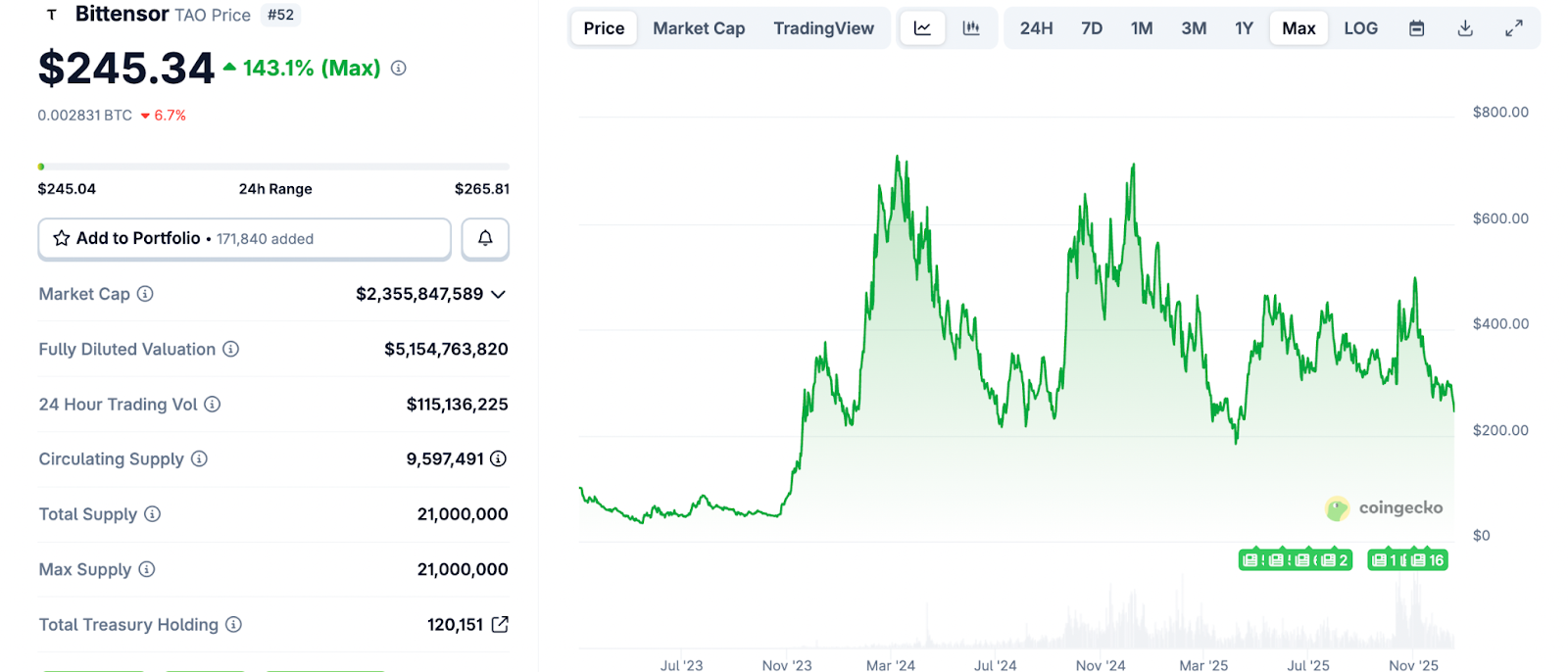
Bittensor’s price history since exchange listing in 2023. Source: CoinGecko

A premise is that AI companies such as OpenAI, Anthropic, and Deepseek have become too big and frightening, and people need to be concerned about their rise.


Decentralizing artificial intelligence workloads and replacing proof-of-work puzzles with actual real-use AI is Bittensor’s basic gist. 

“Bitcoin proved that cryptographic incentives could coordinate a global network of hardware to secure a ledger,” Evan Malanga, an executive at Yuma, one of the largest backers of the Bittensor platform, told BeInCrypto. “Bittensor takes that same mechanism and redirects the compute power toward something that has direct benefits in today’s world: Training and running AI models, applications, and infrastructure.”

Another Bitcoin? Really?

It’s important to note that Yuma is a subsidiary of Digital Currency Group (DCG), whose firm was one of the earliest backers of various cryptocurrencies, including Bitcoin, Zcash, and Decentraland. 

It was also an early investor in Coinbase, Circle, and Chainalysis. DCG’s CEO, Barry Silbert, is clearly on board with Bittensor – which for some could be considered a positive signal. 
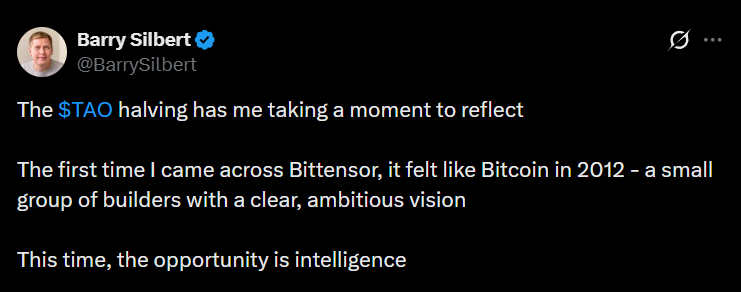
Barry Silbert, who started crypto investing in 2012, is on board the TAO train. Source: X

Bittensor does have some Bitcoin-like characteristics. There are only 21 million units of TAO, clearly a nod to BTC. Bittensor also has halvings, which in December reduced its rewards from 7,200 TAO to 3,600 per day. 

Instead of the energy-intensive proof-of-work riddles Bitcoin uses, Bittensor uses something called proof-of-intelligence, where nodes must perform tasks to prove their capability in handling AI workloads. The better a node’s task output quality, the higher the chance it can receive rewards in TAO. 

Nodes that are allowed on the Bittensor network are then assigned a subnet, of which there are currently 128. These subnets have different AI-related specialties. 

“Each subnet is like a specialized marketplace for a specific type of AI service – some focus on image generation, others on language models,” said Arrash Yasavolian, the cofounder of Taoshi, which runs a financial intelligence subnet. 

Centralization Versus Decentralization

Concerns about AI often center on a few companies having concentrated power. Concentration in any industry typically means higher prices and poorer services for customers – sometimes both at the same time. 

Bittensor aims to make AI more of a global good with its decentralization characteristics, like having independent node operators power the subnets for its artificial intelligence capabilities. 

“AI is redefining every industry,” said Ken Jon Miyachi, CEO of BitMind, which runs a subnet focused on deepfake detections on Bittensor. ”Bitcoin revolutionized the store of value, but Bittensor is revolutionizing entire economic systems by making intelligence a global commodity.”

But how decentralized is this network? On July 10, 2024, the Bittensor network was halted amidst an $8 million hack that drained wallets. The chain was put into a “safe mode” that produced blocks without any transaction capabilities. 

“There are legitimate centralization concerns today,” noted Taoshi’s Yasavolian. “The OpenTensor foundation is the sole party responsible for validating blocks. The top 10 largest subnet validators comprise about 67% of total network stake weight.”

Some might argue that Bittensor’s security risks and ability to shut down the network are antithetical to decentralization. Proponents of the network say that full decentralization will come later, becoming “credibly neutral” the same way Bitcoin is supposed to be for store-of-value purposes. 

“Bittensor’s long-term strategic goal is to become a credibly neutral AI development tool. It’s progressive decentralization, similar to how Ethereum evolved,” Yasavolian added. 

The AI Alarm

One way to increase the decentralization of Bittensor and to hear more voices of dissent is via subnet operators. These groups are spending time and money to invest in the network, and they, like Yasavolian, voice their opinions. 

And subnet growth has been strong. Since the start of 2025, the number of subnets has increased 97%, from 65 to 128. 

Sergey Khusnetdinov, Director of AI at Gain Ventures, sees the subnet community as critically important to Bittensor’s success. 

“The result is a meritocratic, self-improving ecosystem where useful intelligence doesn’t come from one lab or one corporation but emerges organically from a worldwide, permissionless community.”
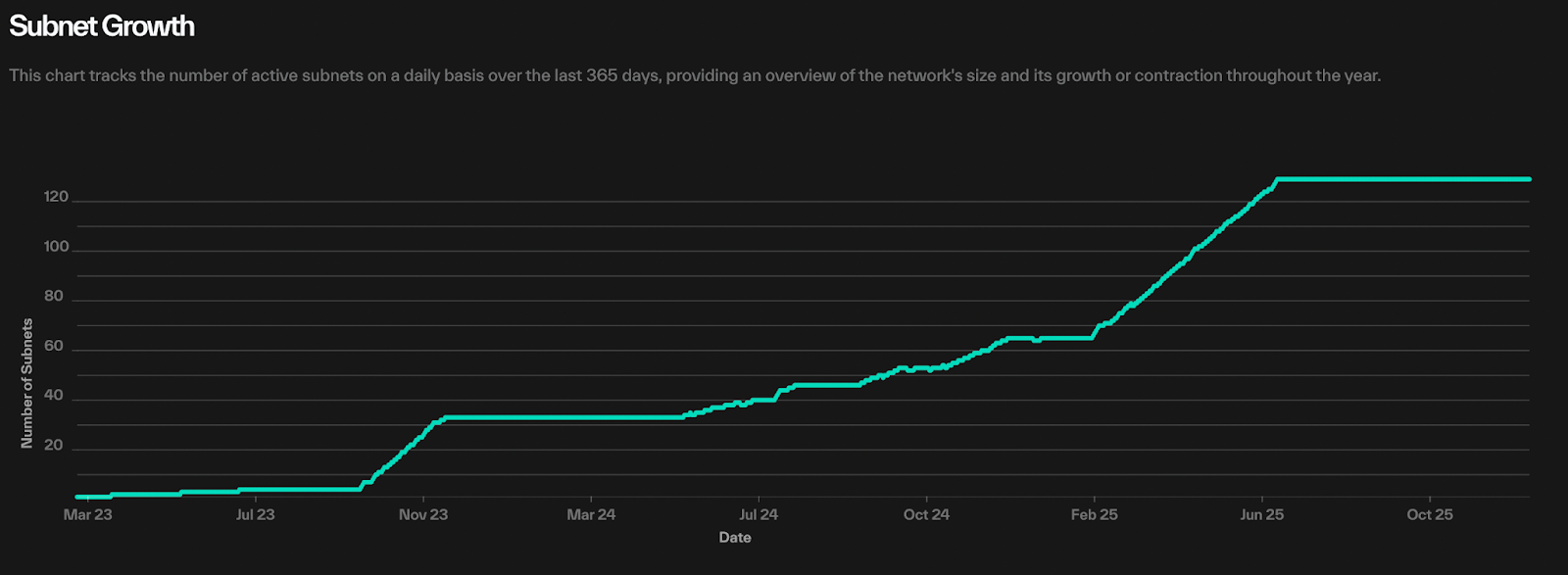
Chart of Bittensor subnet growth since March 2023. Source: Taostats

Centralized AI companies are valued quite ridiculously these days – OpenAI has a $500 billion valuation, Anthropic is at $350 billion. China-based Deepseek is rumored to have a $150 billion. With that in mind, what would be the value of a powerful AI network like Bittensor? 

Miyachi, the BitMind CEO who runs a deepfake detection subnet, bullishly believes the Bittensor network could someday excel over that of Bitcoin. 

“Value produced by the Bittensor ecosystem could surpass Bitcoin’s in the long run,” he told BeInCrypto. 

This could ultimately depend on how people perceive centralized AI systems over time, or whether anyone is concerned. But Bitcoin’s had huge runs as people reacted to economic instability and centralization failures such as a global pandemic, bank runs, and fiat currency debasement.  

Maybe soon, influencers might be saying, “long Bittensor, short centralized AI.” But who knows? Sometimes the future can be even stranger than AI could predict. 

The post Could Bittensor Ever Be as Successful as Bitcoin? appeared first on BeInCrypto.

  •  

November Profit Crisis: 70% of Top Miners Pivot to $20B AI Market

Bitcoin mining profitability plunged to record lows in late 2025 as the hash rate dropped below $35 per petahash per second, while production costs rose to $44.8 per petahash. This forced miners into payback periods over 1,200 days and drove a major industry shift, with 70% of top mining companies now earning revenue from artificial intelligence infrastructure.

November 2025 marked a turning point for the global Bitcoin mining industry. A confluence of collapsing margins, regulatory pressure, and strategic pivots reshaped the sector’s landscape. Here are the five key trends that defined the month.

Profitability Hits Historic Lows

Network hashrate surged to a record 1.1 ZH/s in October, intensifying competition. Meanwhile, Bitcoin prices dropped to around $81,000, crushing margins across the industry. Machine payback periods have stretched beyond 1,200 days.

MARA CEO Fred Thiel issued a stark warning about the industry’s future. After the 2028 halving reduces block rewards to roughly 1.5 BTC, most business models will collapse. Only miners with access to cheap energy or successful AI pivots will survive, he said.

Financing costs continue to rise as traditional mining revenue shrinks. Even companies transitioning to AI cannot yet offset the decline in Bitcoin income. The squeeze is forcing urgent strategic decisions across the sector.

AI Pivot Accelerates

Seven of the top ten mining companies now generate revenue from artificial intelligence. AI hosting yields already exceed traditional mining returns by roughly 50% per megawatt. The shift is reshaping how the industry measures success.

Bitfarms announced it will phase out Bitcoin mining entirely within two years. Its Washington State facility will be converted into an HPC data center by December 2026. CEO Ben Gagnon said potential returns could surpass all previous mining income.

IREN secured a landmark $9.7 billion, five-year GPU cloud computing agreement with Microsoft. The deal includes a 20% upfront payment. IREN will deploy NVIDIA GB300 GPUs at its Texas facility starting in 2026.

Hut 8 sold four Canadian natural gas power plants totaling 310 MW to TransAlta. The move aligns with its strategic shift toward Bitcoin mining plus HPC infrastructure. CleanSpark aims to become a comprehensive compute platform serving both AI and BTC.

Massive Capital Restructuring

A wave of convertible note issuances is sweeping the industry. CleanSpark raised $1.15 billion at 0% interest. TeraWulf completed a $1.025 billion offering, also at zero percent.

Cipher Mining issued $1.4 billion in senior secured notes at 7.125% yield. IREN plans to raise $2 billion through two separate convertible bond offerings. Bitfarms completed a $588 million convertible debt issuance.

Equipment commitments are equally massive. IREN signed a $5.8 billion agreement with Dell to procure NVIDIA GB300 GPUs. Cipher expanded its Fluidstack agreement, with Google providing $1.73 billion in guarantees.

Canaan secured a $72 million strategic investment from BH Digital, Galaxy Digital, and Weiss Asset Management. The funds will support high-performance computing and the development of energy infrastructure. The company aims to reduce future financing dilution.

Regulatory Polarization

Malaysia has uncovered approximately 14,000 illegal mining operations over the past five years. Stolen electricity has caused roughly $1.1 billion in damage to the state utility TNB. A government task force was established in November to intensify crackdowns.

Russia is deploying AI technology to combat illegal mining. State grid operator Rosseti embeds AI analytics into smart meters to detect power anomalies. One recent bust involved $1.5 million in stolen electricity.

Yet some governments are embracing mining. Japan launched its first government-linked project through a major regional utility. Canaan will deploy water-cooled Avalon miners for grid load balancing by year-end.

Belarusian President Lukashenko declared cryptocurrency mining a national priority for electricity usage. He suggested that crypto could serve as an alternative to reliance on the dollar. About 60% of Russian miners remain unregistered, prompting discussions of an amnesty.

Strategic BTC Accumulation

Leading miners are stockpiling Bitcoin rather than selling into the market. MARA holds 53,250 BTC valued at approximately $5.6 billion. The company ranks second globally in public Bitcoin reserves.

CleanSpark reported total holdings of 13,054 BTC as of November 30. Monthly production reached 587 BTC in November alone—year-to-date mining output totals 7,124 BTC.

Cango holds 6,412 BTC with an explicit commitment to long-term holding. Bitdeer increased its reserves to 2,233 BTC after mining 511 BTC in October. Canaan reached a record 1,610 BTC and 3,950 ETH.

The accumulation strategy signals confidence in Bitcoin’s long-term value. Miners are betting that surviving the current profitability crisis will prove rewarding. Those who hold through the squeeze may emerge as the biggest winners.

The post November Profit Crisis: 70% of Top Miners Pivot to $20B AI Market appeared first on BeInCrypto.
  •  

Bitcoin Mining Hit Its Breaking Point — Now AI Is Taking Over Its Racks | US Crypto News

Welcome to the US Crypto News Morning Briefing—your essential rundown of the most important developments in crypto for the day ahead.

Grab a coffee to read how the Bitcoin mining sector is changing. Skyrocketing costs, collapsing fees, and the rise of AI are forcing miners to rethink their playbook, turning once-stable operations into a battleground for next-generation compute power.

Crypto News of the Day: AI Takes Over Bitcoin Mining Racks as Costs Explode and Profitability Craters

The CoinShares Bitcoin Mining Report Q4 2025 reported that the sector has hit its breaking point. Production costs have surged to all-time highs, hash price has collapsed, and artificial intelligence (AI) is now outbidding miners for their own infrastructure, triggering the most dramatic structural shift the sector has ever faced.

The industry entered Q2 2025 with a brutal new reality:

  • The average cash cost to mine one BTC among public miners jumped to approximately $74,600,
  • All-in costs soared to $137,800.
  • Transaction fees, once a buffer for miner revenue, fell below 1% of block rewards in May and June, the weakest contribution since the 2024 halving.

Yet even as margins collapsed, the Bitcoin network continued to climb, smashing through 1 Zetta hash/s for the first time in August.

Public miners contributed only about 80 EH/s of year-to-date growth, meaning most of the expansion is now coming from private operators, sovereign miners, and well-capitalized energy players with vastly cheaper power.

The result: miners are being diluted by hashrate growth they are no longer driving.

AI Moves In — And It Pays 10–20× More Per Megawatt

A far bigger disruption is unfolding at the infrastructure level. Industrial-scale mining campuses, comprising 100MW to 1GW sites, share nearly identical power, cooling, and rack density requirements with modern AI datacenters.

That overlap has turned mining facilities into prime targets for hyperscalers.

Deals from Google–TeraWulf, Google–Cipher, and multi-site agreements with Fluidstack signal the same direction, that big-tech is moving into miner-built capacity at a premium.

The math explains why. Bitcoin mining yields roughly $1 million per megawatt, while AI compute generates $10 million to $20 million per megawatt.

No miner can ignore that spread.

Industry Splits: AI Megacampuses vs. Mobile, Ultra-Low-Cost Miners

The sector is now diverging into two clear models:

  1. 1. Megascale miners → fully or partially converting to AI/HPC

These facilities can upgrade their electrical topology and uptime standards to meet enterprise requirements. They’re signing decade-long contracts and shifting from volatile block rewards to stable, capacity-based revenue.

2. Low-cost, mobile miners → shifting to stranded energy

Miners unable to compete with AI are moving off-grid: flare gas, remote hydro, and surplus renewables. Portable rigs are being deployed everywhere cheap energy exists, echoing mining’s early decentralized roots.

This migration marks a long-term reshaping of the industry, and not a temporary cycle.

According to a CoinShares report:

  • Hashprice averaged approximately $50 per PH/s/day throughout Q2, continuing its post-halving slide.
  • With difficulty rising, fees stagnant, and Bitcoin trading mostly sideways, older ASIC fleets have been forced offline.

Analysts expect hashprice to remain range-bound between $37–55 per PH/s/day through 2028 unless BTC rallies far faster than hashrate growth.

A Structural Shift: AI Outbids Bitcoin

For the first time in Bitcoin’s history, miners are being priced out of their own infrastructure.

AI’s superior economics, hyperscaler deal flow, and the rising cost of industrial mining are pushing the industry into a permanent transformation.

The Bitcoin network remains strong, where hashrate is still climbing, but the business of mining is being rewritten fast.

This puts miners at an impasse, to either go big into AI, or go remote into stranded power.

Chart of the Day

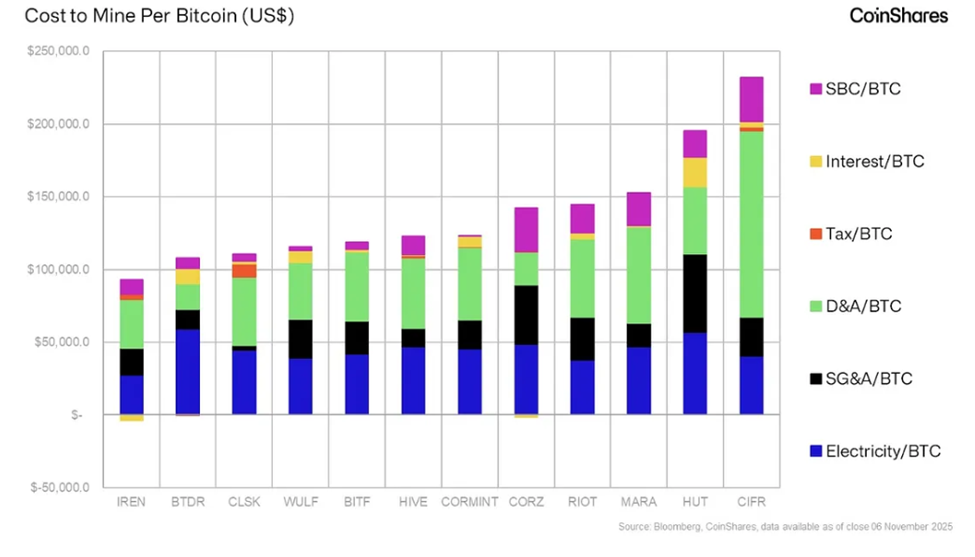
Analysis of Cost to Mine Bitcoin
Analysis of Cost to Mine Bitcoin. Source: CoinShares

Byte-Sized Alpha

Here’s a summary of more US crypto news to follow today:

Crypto Equities Pre-Market Overview

CompanyAt the Close of December 2Pre-Market Overview
Strategy (MSTR)$181.33$185.83 (+2.48%)
Coinbase (COIN)$263.26$269.39 (+2.33%)
Galaxy Digital Holdings (GLXY)$25.36$25.90 (+2.13%)
MARA Holdings (MARA)$11.91$12.27 (+3.02%)
Riot Platforms (RIOT)$15.22$15.55 (+2.17%)
Core Scientific (CORZ)$15.82$16.03 (+1.33%)
Crypto equities market open race: Google Finance

The post Bitcoin Mining Hit Its Breaking Point — Now AI Is Taking Over Its Racks | US Crypto News appeared first on BeInCrypto.

  •  

Foreign Investors Set Record With $646.8 Billion in US Stock Purchases Amid Shifting Global Capital Flows

A powerful and unusual wave of global capital is rushing into US markets. Foreign investors are buying American equities at a record pace, Treasury demand is reshuffling at a structural level, and domestic inflows are accelerating into year-end.

At the same time, US consumer debt has hit its highest level in history. For crypto and equity investors, the scale and direction of these flows signal a major shift in risk appetite and global macro positioning.

Foreign Investors Drive Record Equity Buying Amid Historic Realignment in Treasury Ownership

Private investors outside the US purchased $646.8 billion in US equities in the 12 months ending September 2025, according to data cited by Yardeni Research.

JUST IN: 🇺🇸 Private investors outside U.S. purchased record $646.8 billion of U.S. equities in the 12 months ending in September 2025 – Yardeni Research. pic.twitter.com/9dPxGJoS3g

— Whale Insider (@WhaleInsider) November 30, 2025

This marks the highest level on record, surpassing the 2021 peak by 66%, with flows doubling since January.

The buying is not limited to US equities. Foreign private-investor purchases of US Treasuries totalled $492.7 billion in the same period. Rolling 12-month non-US buying of Treasuries has remained above $400 billion for four consecutive years, reflecting persistent global demand for dollar-denominated safety.

“Everyone wants US assets,” analysts at the Kobeissi Letter remarked.

The composition of foreign Treasury holders is shifting in ways not seen in decades:

  • China’s share of foreign Treasury holdings has fallen to 7.6%, the lowest in 23 years, and down 20% over 14 years.
  • The UK’s share has quadrupled to 9.4%, near its highest level on record.
  • Japan, still the largest foreign holder, now accounts for 12.9%, down 26 points over the last 21 years.

These shifts suggest a long-term repositioning of sovereign and private capital, a trend with direct implications for interest rates, liquidity, and market volatility.

Something unusual is happening in the US Treasury market:

China’s Treasury holdings as a % of all foreign holdings is down to 7.6%, the lowest in 23 years.

This percentage has declined -20 points over the last 14 years.

As a result, China now ranks as the world’s 3rd-largest… pic.twitter.com/JWJ4bbhbsy

— The Kobeissi Letter (@KobeissiLetter) November 29, 2025

Domestic Investors Also Going Risk-On, But Record Consumer Debt Adds Complexity

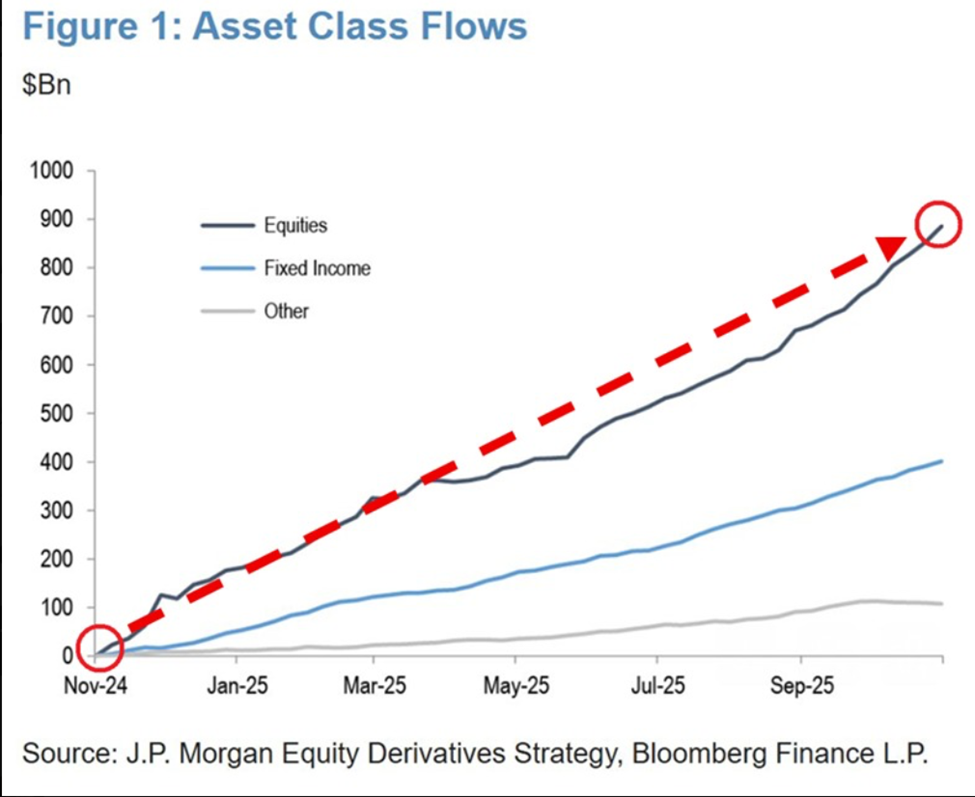
US investors have poured an extraordinary $900 billion into equity funds since November 2024, according to JPMorgan data, with half of that total, $450 billion, arriving in just the last five months.

US Asset Class Flows
US Asset Class Flows. Source: JP Morgan

Fixed-income funds added another $400 billion, while all other asset classes combined attracted only $100 billion.

Inflows into US equities have exceeded those into all other asset classes combined, reinforcing the strength of the bid for US risk assets.

While institutional and foreign investors are ramping up their exposure, US households are under growing financial pressure. Total US credit-card debt climbed to $1.233 trillion in Q3 2025, the highest level ever recorded.

JUST IN: 🇺🇸 Total U.S. credit-card debt reaches $1.233 trillion in third quarter of 2025, highest amount since tracking began. pic.twitter.com/sFi2cMhZTg

— Whale Insider (@WhaleInsider) November 30, 2025

This divergence between market optimism and consumer strain raises questions about sustainability, earnings resilience, and the timing of potential policy shifts.

Seasonality and Bullish Projections Lift Sentiment

JP Morgan expects the S&P 500 to reach 8,000 next year, a view reinforced by powerful seasonal tailwinds. This projection comes as markets anticipate the bank’s “everything rally” forecast shared just over a week ago.

S&P 500 could hit 8,000 next year says JP Morgan 🥳📈🤑🫂 pic.twitter.com/l8zYgPAtWS

— Barchart (@Barchart) November 29, 2025

December has historically been the strongest month for US stocks, with the S&P 500 rising 73% of the time since 1928 and delivering an average return of +1.28%.

For both crypto and equity markets, the surge in capital flows toward the US signals rising confidence in American assets, or a lack of attractive alternatives abroad.

Investors will watch to see whether these inflows accelerate in 2026, how Treasury demand shifts as global holdings rebalance, and whether record consumer debt becomes a drag on macroeconomic momentum.

With liquidity building and seasonality strengthening, both traditional markets and digital assets are entering a potentially decisive phase.

The post Foreign Investors Set Record With $646.8 Billion in US Stock Purchases Amid Shifting Global Capital Flows appeared first on BeInCrypto.

  •  

AI’s Productivity Drought May Be the Bullish Catalyst Wall Street Missed | US Crypto News

Welcome to the US Crypto News Morning Briefing—your essential rundown of the most important developments in crypto for the day ahead.

Grab a coffee because the next few weeks may mark a quiet turning point hiding in plain sight. While most are focused on headlines about bubbles and fears of a slowdown, Ark Invest CEO Cathie Wood reveals a deeper shift in liquidity, policy, and AI adoption that is capable of reshaping the outlook for tech and crypto.

Crypto News of the Day: Cathie Wood Talks About AI’s “Productivity Drought”

US liquidity is snapping back faster than most macro watchers expected, and Cathie Wood believes that timing could collide with one of the most misunderstood trends in tech and crypto: the widening gap between consumer AI adoption and enterprise productivity.

While headlines continue to warn of an AI bubble, ARK Invest argues that markets are entering the first inning of a rebound fueled by:

  • Liquidity,
  • Policy easing, and
  • Accelerating commercial AI demand.

According to ARK Invest, the US market liquidity has already begun a decisive reversal. In a detailed update, the firm noted that liquidity “is finally turning upward” after hitting a multi-year low in late October.

ARK stated that the six-week government shutdown resulted in a $621 billion drain from the system. Still, the reopening “released $70 billion back into markets,” with an estimated $300 billion likely to return over the next several weeks as the Treasury General Account normalizes.

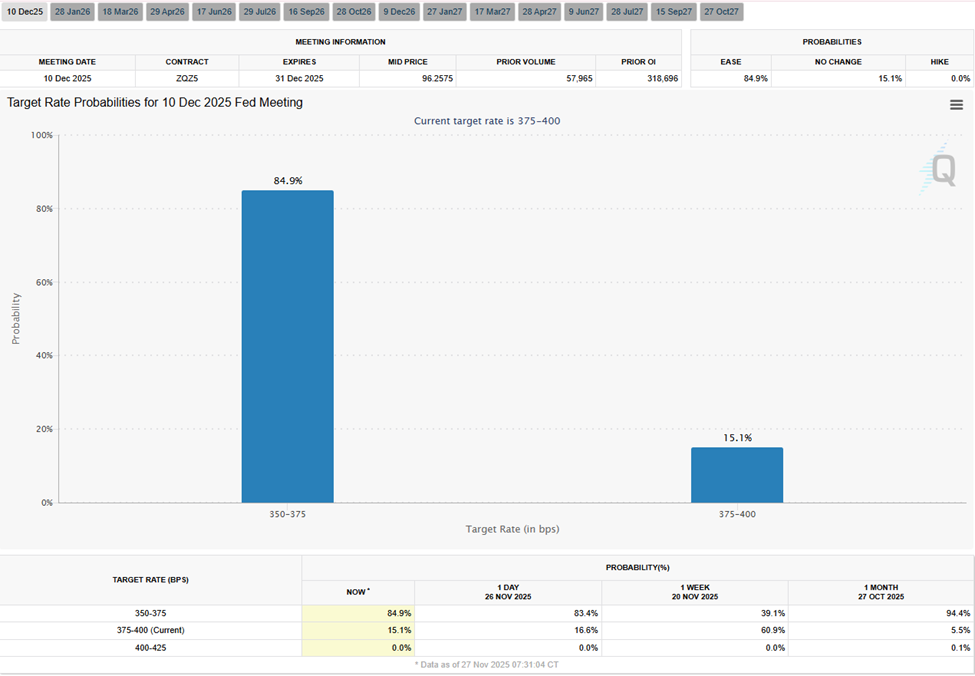
The firm added that the backdrop aligns with a dovish shift at the Federal Reserve, pushing market-implied odds of a near-term rate cut to roughly 90%.

This liquidity push comes just as quantitative tightening is scheduled to end on December 1, an inflection point ARK believes markets have not fully priced in.

“With liquidity returning, quantitative tightening ending December 1, and monetary policy turning supportive, we believe conditions are building for markets to reverse recent drawdowns potentially,” the firm said.

Cathie Wood Says AI’s Productivity Drought Is the Next Bull Catalyst

Cathie Woo, the firm’s founder, CEO, and CIO, is taking the argument further. In a recent webinar, she stated that the liquidity squeeze affecting AI and crypto “will reverse in the next few weeks.”

The AI story has just begun. Enterprises may be slow to show productivity gains, but @CathieDWood highlights that AI is flourishing on the consumer side and US commercial business was up 123% last quarter.

Fund webinar: https://t.co/oYbqsY4pMF pic.twitter.com/9ual0iKfnI

— ARK Funds (@ARK_Funds) November 24, 2025

The fund manager added that markets “seemed to buy” the thesis, given ARK holdings rallied 8% after the session.

She also pushed back against the prevailing narrative that AI is in bubble territory, pointing directly to commercial traction.

That surge is supported by Palantir’s latest earnings, which showed a triple-digit jump in US commercial revenue. According to Cathie Wood, this is evidence that enterprises are committing capital before productivity shows up.

$PLTR Palantir Q3 FY25:

• Net dollar retention 134% (+16pp Y/Y).
• Revenue +63% Y/Y to $1.18B ($90M beat).
• Non-GAAP EPS $0.21 ($0.04 beat).

FY25 guidance:
• Revenue +53% Y/Y to $4.4B ($252M raise).
• Adjusted margin 49% (3pp raise). pic.twitter.com/7g0Q3rFHZi

— App Economy Insights (@EconomyApp) November 3, 2025

This trend forms the core of ARK’s thesis, that consumer AI is exploding while enterprises appear stalled, but the lag is structural, not cyclical.

“We think this AI story has just begun. We are in the first inning,” Cathie Wood explained, adding that enterprises require time “to restructure and transform completely” before productivity becomes measurable.

She points to recent MIT research showing that most corporations are not yet seeing productivity gains from AI because their internal systems, workflows, and org structures are still built for pre-AI operations.

However, the firm argues that this “productivity drought” is exactly what forces CEOs into rapid investment cycles.

“…[decision-makers are already saying] we’ve got to do this or we’re going to lose our competitive edge out there,” Cathie Wood shared.

Still, ARK highlights one major risk: the energy bottleneck. AI-compute demand is exploding so fast that up to 20% of data-center projects are facing delays.

The coming liquidity wave may supercharge AI and crypto, if energy infrastructure scales quickly enough to support it. ARK Invests believes the pieces are aligning, citing:

  • Liquidity is rising,
  • QT is ending,
  • The Fed is turning dovish, and
  • Commercial AI spending is accelerating.

 If Wood is right, markets may not be facing an AI bubble, but are on the verge of the cycle’s real beginning.

Chart of the Day

Interest Rate Cut Probabilities
Interest Rate Cut Probabilities. Source: CME FedWatch Tool
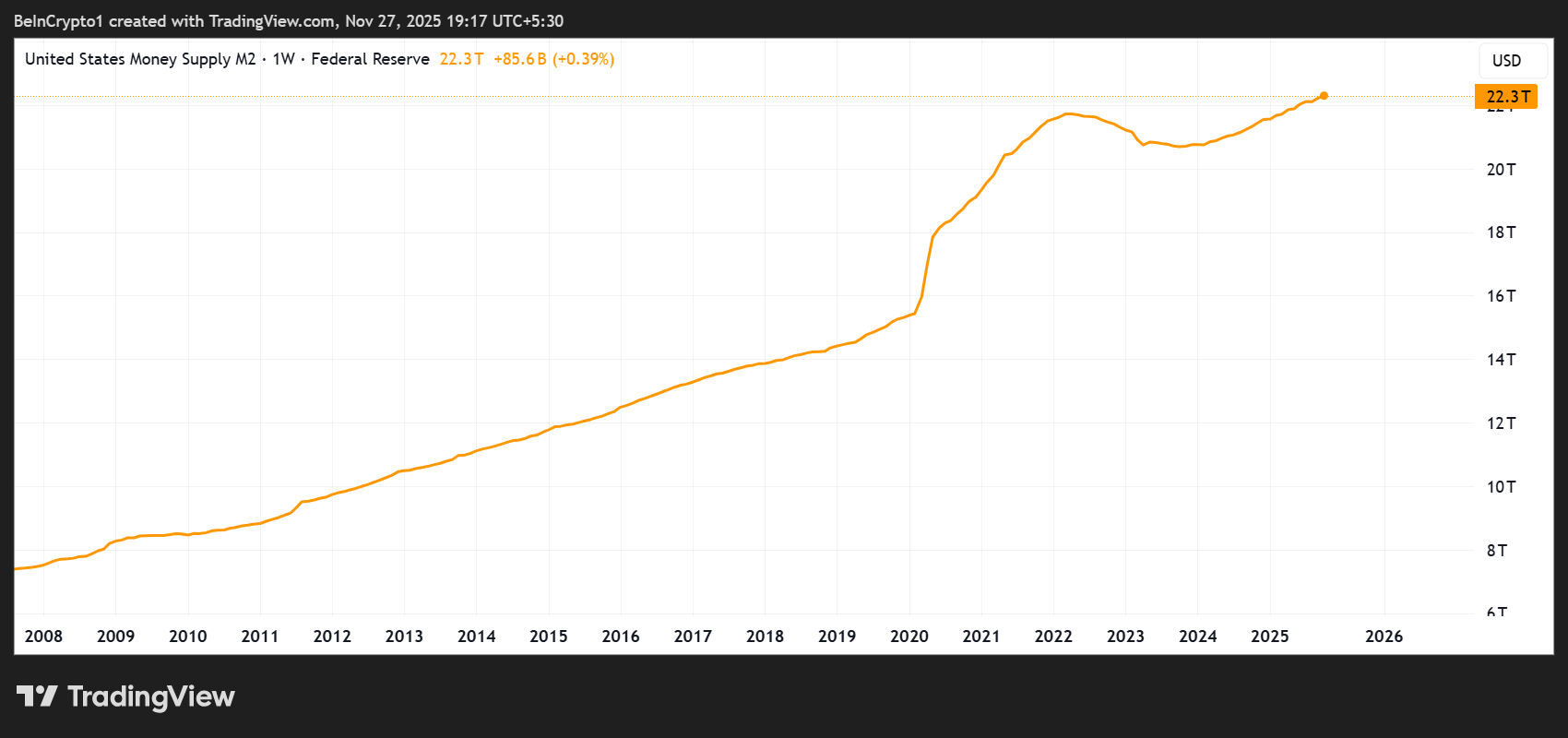
US Money Supply (M2)
US Money Supply (M2). Source: TradingView

Byte-Sized Alpha

Here’s a summary of more US crypto news to follow today:

Crypto Equities Pre-Market Overview

CompanyAt the Close of November 26Pre-Market Overview
Strategy (MSTR)$175.64$176.96 (+0.75%)
Coinbase (COIN)$264.97$268.68 (+1.40%)
Galaxy Digital Holdings (GLXY)$26.24$26.71 (+1.79%)
MARA Holdings (MARA)$11.11$11.29 (+1.62%)
Riot Platforms (RIOT)$14.96$15.19 (+1.54%)
Core Scientific (CORZ)$16.18$16.25 (+0.42%)
Crypto equities market open race: Google Finance

The post AI’s Productivity Drought May Be the Bullish Catalyst Wall Street Missed | US Crypto News appeared first on BeInCrypto.

  •  

Story Protocol Surges 21% on New Prediction Markets and Privacy Upgrade

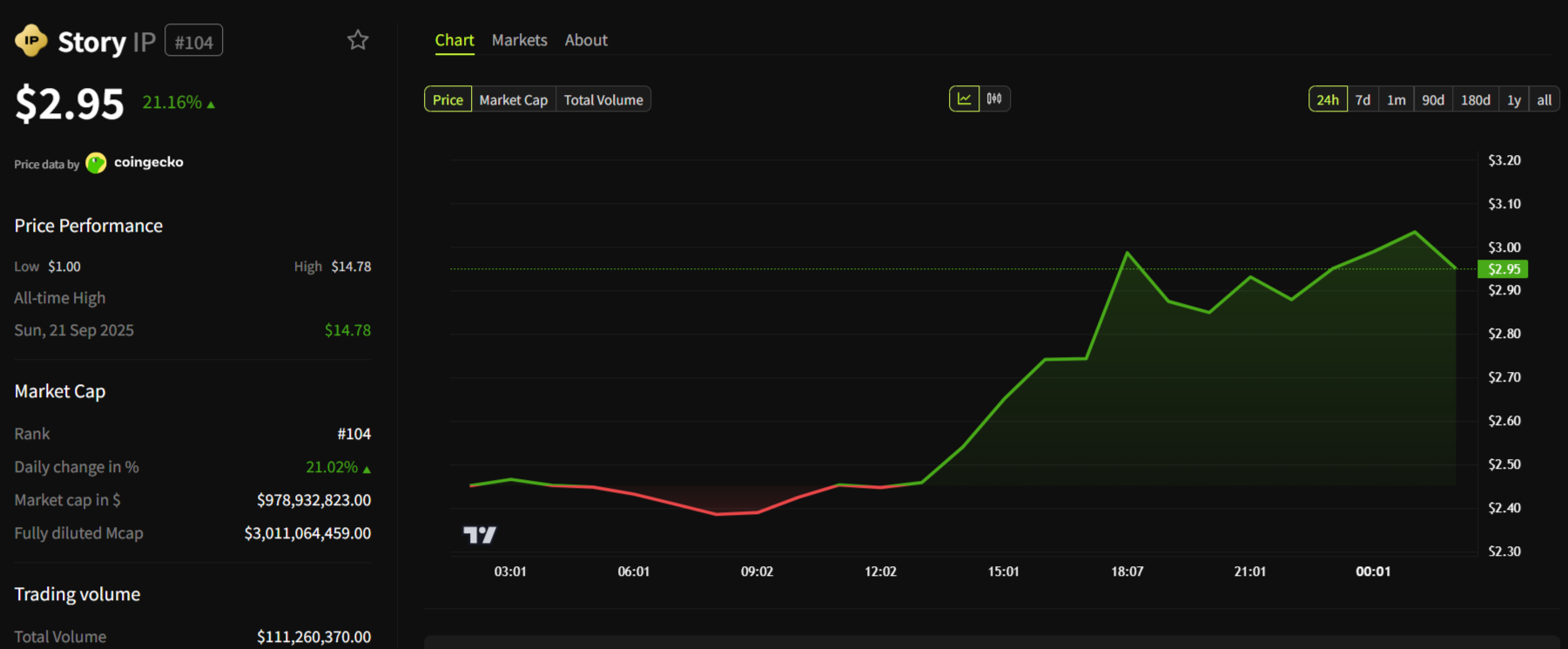
Story Protocol’s native token soared 21.48% to $2.98 in 24 hours as the blockchain introduced its first prediction markets and launched Confidential Data Rails. This privacy-focused upgrade secures encrypted data on-chain.

The surge mirrors multiple feature rollouts and rising institutional attention, positioning the Layer 1 blockchain as a critical driver in the growing $80 trillion intellectual property economy.

Price Jumps with New Features and Market Momentum

As of 2:00 am UTC on Wednesday, Story Protocol’s IP token traded at $2.98—a 21.48% increase over the previous day. The token saw $145.63 million in trading volume across leading exchanges. Its market cap reached $975.42 million, placing it #104 among global cryptocurrencies.

Story hit an all-time high of $14.78 on Sept. 21, 2025, and has traded between $1.00 and $14.78 since. Institutional confidence is rising as publicly traded IP Strategy (Nasdaq: IPST) holds 53 million tokens on its balance sheet. These tokens are valued at about $731 million.

Source: BeInCrypto

The price rally arrived alongside three major launches: Story’s first prediction markets, integration with Dune Analytics for on-chain data, and a technical paper outlining Confidential Data Rails. These updates expand Story’s capabilities beyond IP registration, demonstrating it can support a broader range of decentralized applications.

Story Protocol Debuts On-Chain Prediction Markets

Story Protocol unveiled its first prediction markets with MusicByVirtuals, allowing users to trade on outcomes linked to cultural and financial events. These markets enable bets on topics like K-pop chart positions and cryptocurrency prices, with settlements processed on Story’s blockchain.

The first prediction markets on Story are live.@MusicByVirtuals is betting that culture is as tradable as price, and now there’s a platform to prove it.

Zcash price. Kpop charts. Predictions settled on Story.

Details ↴ pic.twitter.com/3TQQP3YDmI

— Story (@StoryProtocol) November 25, 2025

These markets highlight how cultural trends and financial predictions can be tokenized and traded on-chain, showcasing Story’s versatility beyond IP management. It underscores Story’s aim to capture both IP ownership and the speculation surrounding cultural assets.

Confidential Data Rails: Privacy Upgrade for On-Chain Assets

Last Thursday, Story Protocol released its technical paper on Confidential Data Rails (CDR). This upgrade transforms encrypted data into programmable on-chain assets. The technology enables secure storage and automated management of sensitive assets within Story’s IP vaults. These assets include AI datasets, biomedical records, and API keys.

The official Story Foundation announcement describes CDR as a cryptographic foundation that combines confidentiality, automation, and programmability. Decentralized trusted execution environments (TEEs) and smart contracts on the Story chain enforce permissions. This system allows data owners to control confidential assets without exposing sensitive details.

Programmable confidentiality is here.

Confidential Data Rails (CDR) turns encrypted data into onchain building blocks, paving the way for new privacy use-cases on Story and beyond.

Technical Paper out now ↓ pic.twitter.com/pp96CAaCr9

— Story (@StoryProtocol) November 20, 2025

CDR helps solve a persistent blockchain challenge: ensuring privacy while maintaining transparency. Public blockchains are excellent for auditability but lack strong data protection. CDR lets creators and enterprises tokenize sensitive IP while maintaining strict access controls—a feature essential for sectors such as pharmaceuticals, entertainment, and AI, where confidential information must remain protected even as rights are managed on-chain.

Meanwhile, Story Protocol’s partnership with Dune Analytics enables real-time visualization of on-chain IP data, covering registrations, licenses, royalties, and derivative chains. Andrea Muttoni, President and Chief Product Officer, noted that the integration fosters transparency and deeper analytics in on-chain IP. The collaboration grants developers and institutions SQL access to Story’s data, promoting research into IP tokenization and licensing trends.

Creator Incentives Lead Platform Growth

Chase Chaisun Chang, Head of Korea at PIP Labs—the operator of Story Protocol—stressed at a South Korean conference on Tuesday that creator incentives are vital for consistent, high-quality content.

He explained how one dance video can generate 100,000 remixes within 24 hours, making traditional licensing impossible. AI consumes this content and endlessly produces secondary creations, while the boundary between creators and consumers has completely blurred.

Chang emphasized that, following the principle “garbage in, garbage out,” AI requires high-quality training data to function correctly. Proper attribution and ownership tracking are essential to combat misinformation and verify the authenticity of AI-generated content.

He concluded that digital transformation means individuals will increasingly own more intangible assets. Everyone is becoming both creator and consumer simultaneously in this new era. Better IP infrastructure is crucial to protect everyone’s digital assets in this rapidly evolving landscape.

The combination of price strength, feature launches, and institutional support positions Story Protocol as crucial infrastructure for decentralized IP management. Still, the token trades 80% below its all-time high. Ongoing adoption of CDR, prediction markets, and Dune-powered analytics will be decisive in whether the protocol can capture significant market share. As Story expands, the key question is whether creators and enterprises will move IP operations on-chain at a scale that justifies the protocol’s ambition.

The post Story Protocol Surges 21% on New Prediction Markets and Privacy Upgrade appeared first on BeInCrypto.

  •  

Strategy Fails to Join the S&P 500 Once Again

SanDisk Corp. will join the S&P 500 on Friday, November 28, 2024, replacing Interpublic Group of Companies Inc., according to S&P Dow Jones Indices. After the announcement on Monday, shares of the computer storage maker surged by more than 9% in after-hours trading.

This milestone signals SanDisk’s rapid rise, while Strategy (formerly MicroStrategy) faces another setback, remaining excluded from the S&P 500 despite holding more than 640,000 Bitcoin.

SanDisk’s Rapid Ascent to the S&P 500

SanDisk’s move from the S&P SmallCap 600 to the S&P 500 reflects its strong market performance over the past few months. Driven by demand from artificial intelligence applications, the company’s market capitalization has reached approximately $33 billion. This surpassed typical small-cap index thresholds, making the switch to the S&P 500 a logical step.

The announcement arrived just before the Thanksgiving holiday trading session, highlighting the urgency of the rebalancing. The replacement is occurring outside the usual quarterly rebalance, suggesting strong market momentum. The stock closed up 13.33% on the day of the announcement before the after-hours surge.

Joining the S&P 500 usually attracts significant passive inflows, as index-tracking funds buy shares to maintain their weightings. This change boosts SanDisk’s institutional investment appeal and liquidity. It also raises the company’s profile among investors focused on large-cap equities in the index.

SanDisk’s rise is fueled by optimism around AI infrastructure. As businesses use more advanced machine learning models, storage solutions are increasingly critical—driving investor enthusiasm and boosting SanDisk’s valuation over the past year.

Strategy’s Continued S&P 500 Challenge

While SanDisk celebrates, Strategy remains on the outside looking in, even after meeting several technical requirements. The company, led by executive chairman Michael Saylor, holds 640,808 BTC, valued at around $72.3 billion, making it the world’s largest corporate holder of Bitcoin. However, this asset concentration is seen as a liability by index decision makers.

Strategy was not included in the S&P 500’s September reshuffle, which selected Robinhood, AppLovin, and Emcor. Analysts put the company’s chances of inclusion in December at 70% following strong Q3 results. The firm reported $3.8 billion in Q3 earnings, showing profitability tied to Bitcoin’s price movements.

Yet, earnings volatility remains the main hurdle. Strategy’s results fluctuate each quarter with Bitcoin’s price, creating inconsistency with S&P 500 requirements. For instance, Q2 2024 delivered $10 billion in revenue and $14 billion in unrealized gains, while Q1 saw a $4.2 billion loss. The index requires four straight quarters of positive earnings—a threshold that has eluded Strategy due to its Bitcoin-heavy approach.

S&P Dow Jones Indices gave Strategy a ‘B-‘ credit rating, citing high Bitcoin exposure, low USD liquidity, and a narrow business model. These contribute to traditional finance skepticism about digital asset treasury companies. The rating shows the committee sees Bitcoin-based volatility as incompatible with the stability expected in S&P 500 members.

Even if Strategy meets the criteria for market capitalization and liquidity, the committee also considers business model diversity, financial stability, and sector representation. While some advocate for evolving index methodologies to include innovative treasury approaches, traditionalists insist on consistent, proven earnings, especially for benchmarks like the S&P 500.

Traditional Finance Meets Digital Asset Reality

The paths of SanDisk and Strategy highlight a broader divide between traditional finance and digital asset business models. Some crypto-exposed companies like Robinhood have entered the S&P 500, yet Strategy’s concentrated Bitcoin position poses unique challenges. The company’s stock is down 35% from its July high of $434, reflecting disappointment over exclusion and credit rating concerns.

Nasdaq’s scrutiny of digital asset treasury firms adds further obstacles for Strategy. As industry analysis notes, traditional finance’s skepticism extends beyond earnings volatility to concerns about long-term business models and regulatory compliance. This unease endures, even as Strategy has occasionally outperformed both Bitcoin and the S&P 500, as Saylor has highlighted.

On the other hand, MSCI’s recent consultation that Strategy could be removed from its key equity indices has sharpened investor focus on whether similar pressure might eventually extend to the S&P 500. While the company’s inclusion in MSCI USA and MSCI World has long funneled billions in passive capital into the stock, analysts now argue that its increasingly bitcoin-centric profile may no longer fit traditional index methodologies.

This has raised questions in the broader market about whether the valuation premium tied to expected index stability is at risk — and whether Strategy’s future index eligibility, including any long-shot hopes of S&P 500 admission, could be further complicated by the growing scrutiny.

The post Strategy Fails to Join the S&P 500 Once Again appeared first on BeInCrypto.

  •  

Mining Stocks Jump 20% as Amazon’s $50B AI Push Boosts Demand for Power

Crypto mining stocks jumped as much as 20% led by BitMine and Cipher Mining, after Amazon unveiled plans to invest up to $50 billion in AI infrastructure for U.S. government agencies.

This shift comes as Bitcoin miners face declining profitability following the 2024 halving event. Meanwhile, demand for AI compute capacity is soaring. Tech giants now view miners’ established power infrastructure as key to rapid data center growth.

Mining Stocks Post Double-Digit Gains as Focus Shifts to Infrastructure

The crypto mining sector saw a broad rally on Monday, notching a 13.84% sector-wide gain according to SoSoValue data. BitMine soared nearly 20%, while Cipher Mining rose more than 18%.

The rally followed Amazon’s announcement of an investment of up to $50 billion in AI infrastructure for US government agencies. The plan will add 1.3 gigawatts across multiple data centers, with construction set for 2026. Agencies will gain access to AWS tools, Anthropic’s Claude AI, Nvidia chips, and Trainium chips developed by Amazon.

Amazon also announced a $15 billion investment in Northern Indiana for new data center campuses, supporting 1,100 high-skilled jobs and 2.4 gigawatts of data capacity. This expansion underscores the scale of infrastructure required for AI workloads.

Meta has intensified its AI infrastructure efforts, seeking federal approval to trade electricity alongside Microsoft for long-term energy supply. Meta’s Louisiana campus alone is expected to require three new gas-fired plants.

Bitcoin Miners Evolve Into AI Power Players

The substantial stock gains reveal how bitcoin miners are transforming operations. Declining profits after Bitcoin’s April 2024 halving prompted miners to seek new revenue streams. AI data center developers, who now face electricity shortages, see miners’ grid-integrated facilities as strategic partners.

IREN, formerly Iris Energy, signed a $9.7 billion data center deal with Microsoft, granting the tech giant early access to Nvidia GPUs. IREN’s stock has shot up 580% this year since its rebrand. Other miners showed strong performance: Riot Platforms gained 100%, TeraWulf 160%, and Cipher Mining 360%.

The combined 14 gigawatts of power capacity among US miners has become key for tech firms seeking rapid scale. Favorable US policies, including Nvidia export restrictions to China, give domestic miners a competitive edge. In contrast, Chinese miners face more regulation and import barriers.

AI data center developers are now targeting bitcoin miners. These teams are approaching mining operations already running high-capacity, grid-integrated sites. Locations like Childress, Texas, have become major hubs for combined data and mining infrastructure.

Tech Leaders Accelerate Infrastructure Investments

Global tech firms are raising around $100 billion in bond offerings to fuel new AI and cloud capabilities. Amazon, Microsoft, Google, Oracle, and Meta could spend $400 billion this year on AI and data center investments. According to Deutsche Bank, total AI-related investment could reach $4 trillion by 2030.

The move signifies a shift from cash reserves to debt financing. Meta has launched its largest-ever bond sale, totaling $30 billion, for AI infrastructure. Amazon issued a $15 billion US bond, its first in three years, attracting $80 billion in demand. Amazon holds $69.29 billion in debt and $66.92 billion in cash.

Alphabet issued a $17.5 billion US bond and a €6.5 billion European bond, bringing its total debt to $48.78 billion. The aggressive borrowing reflects the immense capital needs for AI infrastructure.

The need for energy to power AI, however, surpasses grid expansion. With slow grid development, tech companies are securing direct energy sources. Apple already has federal approval to trade electricity wholesale, reflecting a trend of tech firms managing their own energy for AI infrastructure.

The merging of crypto mining infrastructure with AI compute demand signals a major strategic shift for both sectors. As bitcoin miners pivot to AI compute, their built-in power capacity and grid-ready sites enable tech giants to deploy quickly and compete in the fast-evolving AI landscape.

The post Mining Stocks Jump 20% as Amazon’s $50B AI Push Boosts Demand for Power appeared first on BeInCrypto.

  •  

Is This the Pin That Pops the AI Bubble? The Reason Why Burry and Thiel Are Bearish on Nvidia

Nvidia is one of the biggest winners of the AI boom. Its latest quarterly results showed $57 billion in revenue and $31.9 billion in profit, record numbers by any measure.

But instead of celebrating, the stock swung wildly: up 5% after earnings, then down again within 18 hours. Investors, algorithms, and market watchers are now asking a critical question: Is Nvidia’s AI growth as solid as it looks on paper?

NVIDIA’s Financing Model Draws Scrutiny as Big-Name Investors Bet Against It

The first warning sign is money that has not actually been paid. Nvidia has $33.4 billion in unpaid customer bills, nearly double what it had a year ago. On average, customers are taking 53 days to pay, up from 46 days.

Meanwhile, the company is sitting on $19.8 billion of unsold chips, yet management says demand is through the roof.

“Both cannot be true…Either customers aren’t buying or they’re buying without cash. The cash flow tells the real story,” said Shanaka Perera in a post.

Another red flag is the gap between profits and actual cash. Nvidia reported $19.3 billion in profit, but it generated only $14.5 billion in cash. That means $4.8 billion of its “profit” has not actually appeared in the bank.

For comparison, other chipmakers like TSMC and AMD turn almost all of their profits into cash. Nvidia’s lower rate raises questions about how much of its growth is real.

“Healthy chip companies like TSMC and AMD convert over 95% of profits to cash. Nvidia converts 75%. That’s distress level,” Perera added.

Things get even more complicated when you look at how AI companies buy from each other. Nvidia sells chips to firms like xAI, Microsoft, OpenAI, and Oracle. Many of these deals are funded by loans or credits from the same companies, meaning the same money is counted multiple times as revenue.

Michael Burry Sounds the Alarm on Nvidia’s Revenue and Demand

Michael Burry, the investor famous for predicting the 2008 crash, refers to this “suspicious revenue recognition,” warning that the actual demand from end-users may be very small.

Every company listed below has suspicious revenue recognition. The actual chart with ALL the give-and-take deals would be unreadable. The future will regard this a picture of fraud, not a flywheel. True end demand is ridiculously small. Almost all customers are funded by their… pic.twitter.com/0XyGQ8FjuE

— Cassandra Unchained (@michaeljburry) November 19, 2025

Burry also pointed out that Nvidia’s stock buybacks may be hiding another risk. Since 2018, the company has spent $112.5 billion on buybacks, while still issuing new shares.

That effectively dilutes existing shareholders. He also questioned whether older GPUs, which use far more electricity than newer models, are really as valuable as the company claims.

“Just because something is being used doesn’t mean it’s profitable,” he said.

Some big investors seem to agree. Peter Thiel reportedly sold all of his Nvidia shares, and SoftBank sold $5.8 billion worth on November 11. Michael Burry bought put options betting Nvidia would crash to $140 by March 2026.

Peter Thiel reportedly sold his entire position of 537,742 shares in Nivdia.

Why? It’s a bubble, they all know it & are cashing out.

– Nvidia ALONE = 15% of US GDP.
-OpenAi wants a govt bailout.
– US Growth is .01% when you remove AI sector. pic.twitter.com/mk3Nc6yBpk

— Maine (@TheMaineWonk) November 17, 2025

At the same time, AI-linked speculation appears to be affecting crypto markets. Bitcoin has dropped nearly 30% since October, partly because AI startups hold $26.8 billion in Bitcoin as collateral, which could be sold if Nvidia’s stock falls further.

Nvidia, $NVDA, CEO Jensen Huang told staff 'the whole world would've fallen apart' if Nvidia delivered a bad quarter, per BI

— unusual_whales (@unusual_whales) November 21, 2025

Not everyone is worried. Supporters argue that Nvidia has $23.8 billion in cash flow, huge orders from companies like Microsoft and Meta, and that some of the inter-company deals are standard in the tech industry.

Still, a recent survey by Bank of America shows that 45% of fund managers view AI as a major market bubble risk, a concern echoed by global regulators, including the IMF and Bank of England.

The next few months may be critical. Analysts are watching Nvidia’s fourth-quarter results in February 2026, possible credit downgrades in March, and any restatements in April.

How the company performs could decide whether the AI boom continues or if the recent market panic signals the start of a broader slowdown. Either way, the Nvidia story is now the test case for the AI-driven tech era.

The post Is This the Pin That Pops the AI Bubble? The Reason Why Burry and Thiel Are Bearish on Nvidia appeared first on BeInCrypto.

  •  

Block Announces $5B Buyback and 30% Annual Growth Goal in Bold Three-Year Strategy

Block, Inc. shares soared almost 9% on Wednesday after revealing plans to achieve $15.8 billion in gross profit by 2028 and announcing a $5 billion share repurchase, underscoring confidence in continued profitability.

The three-year outlook, launched at the 2025 Investor Day, marks a strategic shift for the Jack Dorsey-led company. Block is moving beyond its core point-of-sale operation into consumer services, artificial intelligence tools, and Bitcoin infrastructure.

Comprehensive Financial Targets Reflect Transformation

Block mapped out a roadmap targeting mid-teens percentage gross profit growth annually through 2028. The company expects adjusted operating income to rise about 30% per year, reaching $4.6 billion by 2028. Adjusted earnings per share are projected to grow by more than 30% each year, reaching $5.50 in 2028.

The event featured a rare appearance by CEO Jack Dorsey. The stock had dropped 30% earlier in 2025 due to competition in payments. However, the trading halt and subsequent announcement quickly reversed that decline.

For fiscal year 2026, Block projects gross profit rising 17% to nearly $12 billion. Adjusted operating income and earnings per share are each expected to climb by more than 30%, reaching $2.7 billion and $3.20, respectively. The new non-GAAP cash flow metric, which accounts for capital needs in lending, is forecast to get 25% of gross profit—more than $4 billion—by 2028.

Block aims to achieve the “Rule of 40” benchmark in 2026 and sustain it through 2028. This performance measure, combining revenue growth and profit margin over 40%, is a key target for software and fintech firms. Block’s official release emphasized efficiency, scale, and product innovation in its financial networks.

The expanded buyback program adds $5 billion to the $1.1 billion remaining from a previous authorization. In total, Block now has about $6.1 billion available for share repurchases, signaling confidence in cash generation.

Recent Performance Lays Out Growth Platform

Block reported mixed Q3 results, with earnings and revenue slightly missing analyst expectations. However, gross profit rose 18.3%, driven primarily by Cash App’s 24.3% increase. Square also contributed with a 9.2% gain in gross profit.

Cash App remained Block’s growth engine. Monthly active users reached 58 million, with profit per user rising 25.3%. Gross Payment Volume grew 10.9% year-over-year.

Subscription and services revenue increased 22.6%, indicating healthy recurring income streams. Bitcoin-related revenue, however, fell 19%. Despite this, Block maintains strong liquidity with ample cash reserves against manageable debt levels.

Management noted that since 2022’s investor day, gross profit has nearly doubled and adjusted EBITDA has tripled. The company now runs 26 products generating over $100 million in annual gross profit, showing healthy diversification across its portfolio.

Strategic Initiatives Broaden Block’s Reach

Block’s expansion plan includes ventures in tech and finance beyond payment processing. Its brands include Square, Cash App, Afterpay (buy-now-pay-later), TIDAL (music streaming), Bitkey (Bitcoin wallets), and Proto (Bitcoin mining products).

In October, Square launched Square Bitcoin, enabling over 4 million US merchants to accept and manage Bitcoin through existing Square systems. Merchants can accept Bitcoin at checkout, convert up to 50% of daily sales, and manage holdings on the Square Dashboard.

The Bitcoin payment program began with zero transaction fees for 1 year, starting November 10, 2025. The rollout covers all US states except New York due to regulatory limits. The 2024 pilot saw merchants accumulate 142 BTC, indicating strong interest in BNB and other cryptocurrencies among retailers.

The company is deploying artificial intelligence tools for merchants and expanding Cash App’s financial services. Management stressed technical unification and efficiency across the ecosystem. These efforts aim to reduce reliance on the core point-of-sale business, where competition from PayPal, Stripe, and traditional processors has grown.

COO and CFO Amrita Ahuja underscored Block’s focus on scale and long-term value. Leadership voiced confidence in innovation and investment as drivers of compounding growth and margin expansion through 2028.

10 years ago today we IPO’d…we’ve always been about the neighborhood. https://t.co/0Hq4e0QM2L pic.twitter.com/DQDotT0DOZ

— Block Investor Relations (@BlockIR) November 20, 2025

Over its 10-year journey since its 2015 IPO, Block has transformed from a card reader provider into a diversified fintech giant. The November 19 announcements seek to chart a clear path as the company matures in core markets and pursues growth in cryptocurrency infrastructure and AI-driven services.

The post Block Announces $5B Buyback and 30% Annual Growth Goal in Bold Three-Year Strategy appeared first on BeInCrypto.

  •  

Nvidia Posts $57B Record Revenue Pushing Bitcoin Above $91K

Nvidia surprised markets by posting fiscal third-quarter revenue of $57.01 billion, beating Wall Street estimates by almost $2 billion.

Meanwhile, Bitcoin rebounded above $91,000 after briefly dipping below $89,000, as analysts attributed much of the crypto market’s decline to growing concerns about a potential AI bubble.

Nvidia Smashes Wall Street Targets During Volatility

The chip giant reported $1.30 earnings per share and revenue of $57.01 billion for its fiscal third quarter, outperforming estimates of $1.26 EPS and $55.2 billion in revenue. Its data center business, which enables AI applications, contributed $51.2 billion—showing a sharp rise from previous periods.

CEO Jensen Huang noted ongoing strong demand for the company’s Blackwell chip architecture and cloud GPUs, reporting that products remain sold out. Nvidia’s forward guidance was also robust, with projected fiscal fourth-quarter revenue of $65 billion—beating analyst forecasts of $62 billion.

CFO Colette Kress pointed to another driver behind the firm’s results: CUDA-powered accelerators are extending hardware lifespans, boosting customer value, and solidifying Nvidia’s competitive edge in AI infrastructure. While the gaming unit drew $4.3 billion in revenue—slightly under expectations—it still delivered solid returns.

Nvidia’s market value recently surpassed $5 trillion, reinforcing its status as the world’s most valuable company. The stock has climbed 37% year-to-date and 25% over the last 12 months. Shares surged 5% following the earnings report, while chipmakers like AMD and Micron also rode the AI wave.

Bitcoin Rebounds as AI Investment Sentiment Returns

Bitcoin recovered on Thursday morning in Asia, jumping above $91,000 after testing lows below $89,000. The quick rebound implies some investors view current prices as entry opportunities despite uncertainty.

Major investors have recently shown caution toward AI stocks. Peter Thiel exited a $100 million stake in Nvidia. SoftBank sold about $5.8 billion in shares. These moves sparked debate over whether AI-driven rallies can last.

Regulators have also flagged risks. The Bank of England warned of systemic threats from widespread AI use in finance. The IMF cited bubble risks in its global stability assessments.

A Bank of America survey found 45% of fund managers see an AI bubble as the most significant market threat. Google CEO Sundar Pichai and JP Morgan’s Daniel Pinto warned of “irrationality”. Klarna’s CEO expressed concern over massive data center investments driven by AI demand.

However, Nvidia’s Q3 results revived AI investment sentiment. Nvidia defended its business model during its earnings call, while the data center’s accounting methods had been questioned. The strong results proved AI demand remains robust despite skepticism. Bitcoin prices also appeared to benefit from the renewed optimism.

Risk Correlations Deepen Across Crypto and Equities

Recent market turmoil has shown an increased correlation between cryptocurrencies and traditional risk assets. Bitcoin’s decline has mirrored declines across major stock indices such as the S&P 500, Nikkei 225, Hang Seng, and Stoxx Europe 600. Crypto-linked stocks are now more often seen as closely tied to the global risk environment.

Gold, usually considered a haven, also fell amid uncertainty. Rising US interest rates and reduced hopes for near-term Federal Reserve rate cuts have pressured both gold and cryptocurrencies. The global crypto market lost over $1 trillion in value over the last six weeks, losing a quarter of its value since October.

Technical outlooks on Bitcoin remain split. Some analysts interpret current trading as re-accumulation—long-term investors buying at lower prices. Others argue that buyer fatigue signals a possible deeper correction ahead.

Nvidia’s robust results offer some reassurance to investors amid concerns about a bubble. However, whether this can restore wider market confidence or prove to be an outlier remains uncertain as investors navigate complex signals around technology valuations and the economic outlook.

The post Nvidia Posts $57B Record Revenue Pushing Bitcoin Above $91K appeared first on BeInCrypto.

  •  

France Lifts Travel Ban on Telegram Founder Pavel Durov

France has officially lifted all travel restrictions on Telegram founder Pavel Durov as of November 13, 2025, bringing to an end a year of mandatory police check-ins and movement restrictions. The dual French-Russian citizen, detained in Paris in August 2024, can now cross borders freely without judicial oversight.

This development is pivotal in an ongoing criminal investigation that could lead to Durov facing up to 10 years in prison and fines of over $550,000.

From Detention to Freedom: Timeline of Durov’s Legal Restrictions

Durov’s legal troubles began when authorities arrested him at Paris’s Le Bourget Airport in August 2024. The charges involved allegations that Telegram enabled organized crime due to insufficient content moderation. French prosecutors accused the platform of refusing to cooperate in tackling illegal content, with a particular focus on child sex abuse material.

Initially, Durov was barred from leaving France and had to report regularly to the police in Nice. Over several months, the restrictions eased, permitting short, controlled trips to the United Arab Emirates for no more than two weeks. However, he remained under French jurisdiction until now.

According to France 24, Durov complied with all requirements for one year before authorities lifted both travel and judicial restrictions. As a result, mandatory police check-ins and all geographic limitations on his movement were eliminated.

Durov faced three interrogations by French authorities. His lawyers consistently challenged the investigation’s legitimacy and methods, arguing that they violated both domestic and European law.

Criminal Investigation Remains Active as Restrictions End

Although Durov is free to travel, the criminal investigation is ongoing. French authorities are examining Telegram’s alleged role in facilitating illicit transactions, the distribution of child sex abuse imagery, and enabling illegal content. The charges focus on complicity in organized crime rather than direct involvement.

The case portrays Telegram as a platform vulnerable to criminal misuse because of its limited content moderation. During questioning in December 2024, Durov acknowledged growing criminal abuse on Telegram and promised stronger oversight. The platform has since introduced additional moderation tools.

Telegram implemented advanced AI-powered moderation systems in early 2024, according to company documentation. In 2025, the platform reported blocking more than 34 million groups and channels, demonstrating increased enforcement. These steps address frequent criticism that Telegram enables criminal networks.

Despite compliance efforts, Durov still faces the risk of 10 years imprisonment and fines up to $550,000 if convicted. The investigation could set key precedents for platform accountability in Europe, especially for encrypted messaging services popular within cryptocurrency communities.

Durov Criticizes French Authorities, Voices Free Speech Concerns

During the investigation, Durov has publicly criticized French authorities and expressed concerns regarding government overreach. He accused prosecutors of procedural errors and argued that his arrest harmed France’s reputation as a supporter of freedom. Durov has characterized the proceedings as an attack on free speech and encryption.

His defense argues that Telegram acts as a neutral platform, not a vehicle for crime. Durov has positioned himself as a defender of privacy and free expression, standing against what he considers European censorship. This view has resonated with cryptocurrency and privacy advocates who regard encrypted communications as vital to digital freedom.

Social media reactions to the removal of the travel ban have been positive among Durov’s supporters. Nevertheless, the broader legal implications are unresolved. Both Paris prosecutors and Durov’s legal team declined public comment on the current status, so questions about trial timing and outcomes remain.

The case underscores ongoing tensions between privacy-focused tech platforms and regulatory enforcement. As France’s investigation continues, its outcome could influence the regulation of messaging services and platform accountability for user content across Europe. For now, Durov’s restored freedom of movement represents a partial win, yet the legal dispute is far from settled.

The post France Lifts Travel Ban on Telegram Founder Pavel Durov appeared first on BeInCrypto.

  •