Reading view

Could Bittensor Ever Be as Successful as Bitcoin?

Bitcoin is now, almost paradoxically to its original ethos, being adopted by Wall Street. Bittensor is a new finger to “the man” of centralization. It’s a sizzling hot narrative. With the rise of AI, concerns have arisen about the tech’s concentration and centralization. 

Bittensor, and its cryptocurrency, TAO, aims to decentralize AI services.  Despite losing nearly 53% in 2025, some believe Bittensor is a next-generation Bitcoin for the AI age. But how realistic is this optimism?

The Premise and Promise of Bittensor

The network just completed a reward halving on December 15, reducing its supply of minted coins. The problem is, many have heard this narrative before. 

With the first Bittensor halving complete, I can’t help but recall Bitcoin’s first halving, which I was fortunate enough to witness.  History doesn’t repeat, but the rhymes are unmistakable; both the parallels and differences between the two are striking:

Same: A Decentralized…

— Greg Schvey (@GSchvey) December 15, 2025

Plenty of cryptocurrencies have claimed to be “the next Bitcoin” – because there’s money to be made with that story. 

However, there could be some real value for Bittensor over the long run – though it has hurdles to overcome, as any sort of ambitious crypto project like this would.

The tale of Bittensor is not unlike Bitcoin: There are powerful incumbents, and a new network can take on and even upend this world order.

For years, influencers rehashed an often similar, anthemic phrase of “long Bitcoin, short the banks”. Notwithstanding that now Bitcoin is embedded in Wall Street banks and publicly traded DAT stocks, this narrative worked well. 
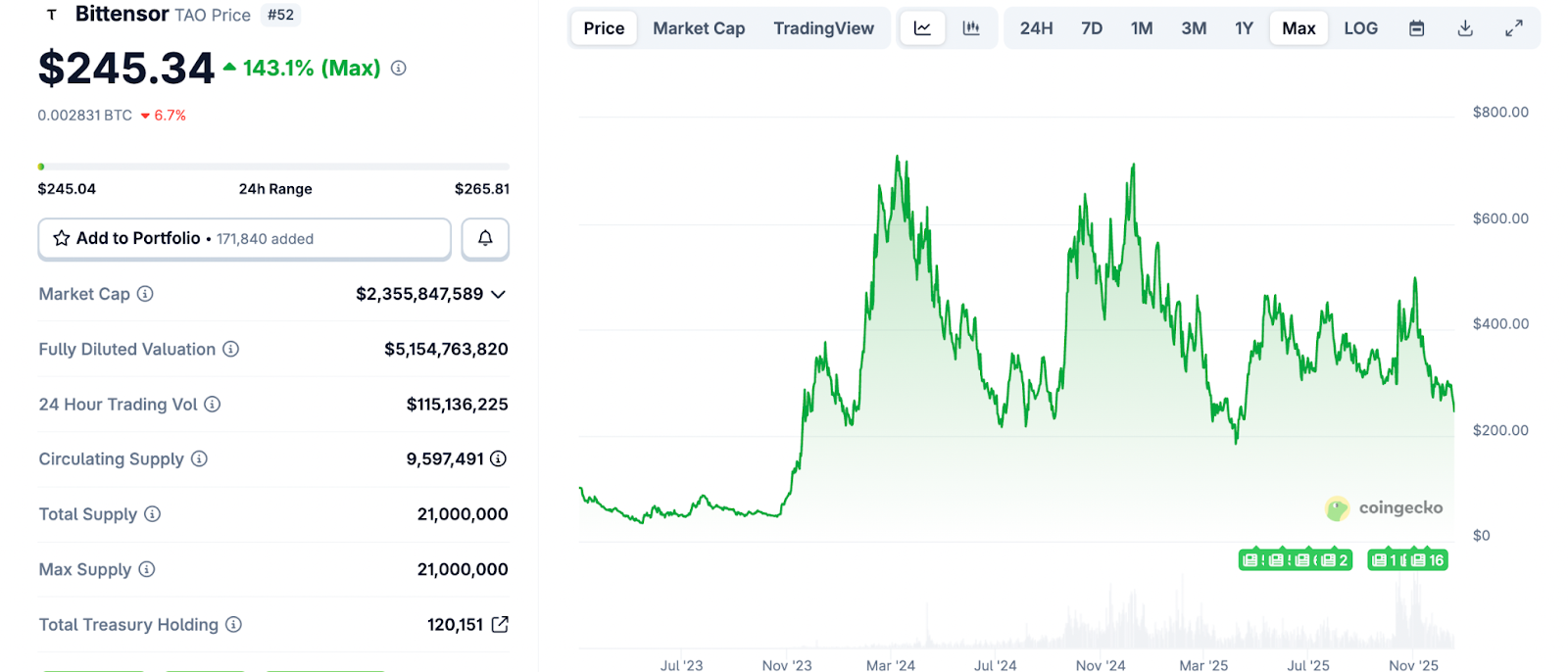
Bittensor’s price history since exchange listing in 2023. Source: CoinGecko

A premise is that AI companies such as OpenAI, Anthropic, and Deepseek have become too big and frightening, and people need to be concerned about their rise.


Decentralizing artificial intelligence workloads and replacing proof-of-work puzzles with actual real-use AI is Bittensor’s basic gist. 

“Bitcoin proved that cryptographic incentives could coordinate a global network of hardware to secure a ledger,” Evan Malanga, an executive at Yuma, one of the largest backers of the Bittensor platform, told BeInCrypto. “Bittensor takes that same mechanism and redirects the compute power toward something that has direct benefits in today’s world: Training and running AI models, applications, and infrastructure.”

Another Bitcoin? Really?

It’s important to note that Yuma is a subsidiary of Digital Currency Group (DCG), whose firm was one of the earliest backers of various cryptocurrencies, including Bitcoin, Zcash, and Decentraland. 

It was also an early investor in Coinbase, Circle, and Chainalysis. DCG’s CEO, Barry Silbert, is clearly on board with Bittensor – which for some could be considered a positive signal. 
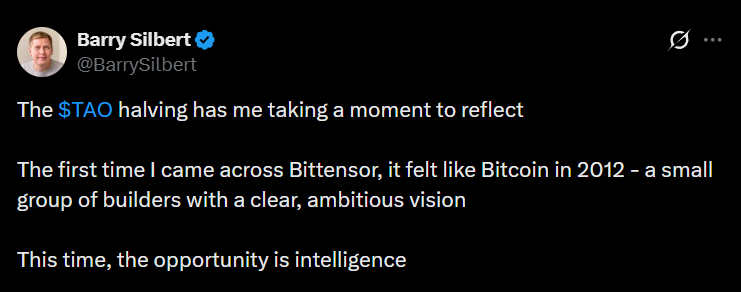
Barry Silbert, who started crypto investing in 2012, is on board the TAO train. Source: X

Bittensor does have some Bitcoin-like characteristics. There are only 21 million units of TAO, clearly a nod to BTC. Bittensor also has halvings, which in December reduced its rewards from 7,200 TAO to 3,600 per day. 

Instead of the energy-intensive proof-of-work riddles Bitcoin uses, Bittensor uses something called proof-of-intelligence, where nodes must perform tasks to prove their capability in handling AI workloads. The better a node’s task output quality, the higher the chance it can receive rewards in TAO. 

Nodes that are allowed on the Bittensor network are then assigned a subnet, of which there are currently 128. These subnets have different AI-related specialties. 

“Each subnet is like a specialized marketplace for a specific type of AI service – some focus on image generation, others on language models,” said Arrash Yasavolian, the cofounder of Taoshi, which runs a financial intelligence subnet. 

Centralization Versus Decentralization

Concerns about AI often center on a few companies having concentrated power. Concentration in any industry typically means higher prices and poorer services for customers – sometimes both at the same time. 

Bittensor aims to make AI more of a global good with its decentralization characteristics, like having independent node operators power the subnets for its artificial intelligence capabilities. 

“AI is redefining every industry,” said Ken Jon Miyachi, CEO of BitMind, which runs a subnet focused on deepfake detections on Bittensor. ”Bitcoin revolutionized the store of value, but Bittensor is revolutionizing entire economic systems by making intelligence a global commodity.”

But how decentralized is this network? On July 10, 2024, the Bittensor network was halted amidst an $8 million hack that drained wallets. The chain was put into a “safe mode” that produced blocks without any transaction capabilities. 

“There are legitimate centralization concerns today,” noted Taoshi’s Yasavolian. “The OpenTensor foundation is the sole party responsible for validating blocks. The top 10 largest subnet validators comprise about 67% of total network stake weight.”

Some might argue that Bittensor’s security risks and ability to shut down the network are antithetical to decentralization. Proponents of the network say that full decentralization will come later, becoming “credibly neutral” the same way Bitcoin is supposed to be for store-of-value purposes. 

“Bittensor’s long-term strategic goal is to become a credibly neutral AI development tool. It’s progressive decentralization, similar to how Ethereum evolved,” Yasavolian added. 

The AI Alarm

One way to increase the decentralization of Bittensor and to hear more voices of dissent is via subnet operators. These groups are spending time and money to invest in the network, and they, like Yasavolian, voice their opinions. 

And subnet growth has been strong. Since the start of 2025, the number of subnets has increased 97%, from 65 to 128. 

Sergey Khusnetdinov, Director of AI at Gain Ventures, sees the subnet community as critically important to Bittensor’s success. 

“The result is a meritocratic, self-improving ecosystem where useful intelligence doesn’t come from one lab or one corporation but emerges organically from a worldwide, permissionless community.”
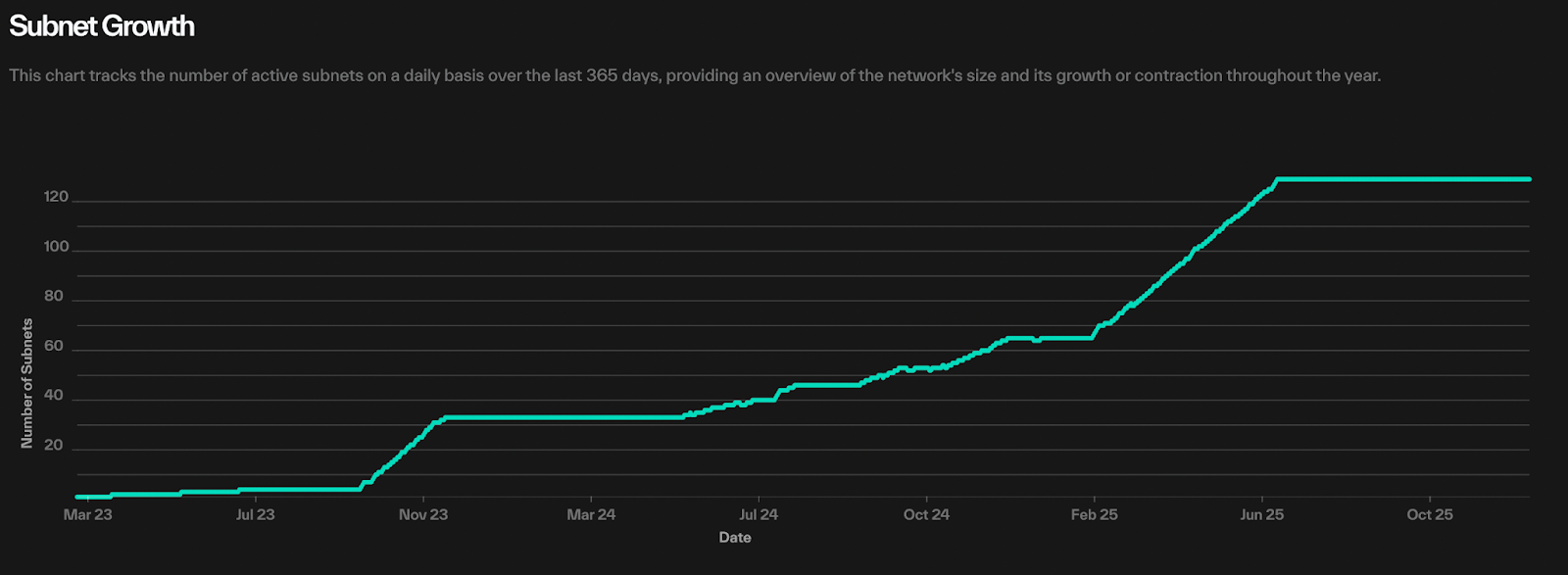
Chart of Bittensor subnet growth since March 2023. Source: Taostats

Centralized AI companies are valued quite ridiculously these days – OpenAI has a $500 billion valuation, Anthropic is at $350 billion. China-based Deepseek is rumored to have a $150 billion. With that in mind, what would be the value of a powerful AI network like Bittensor? 

Miyachi, the BitMind CEO who runs a deepfake detection subnet, bullishly believes the Bittensor network could someday excel over that of Bitcoin. 

“Value produced by the Bittensor ecosystem could surpass Bitcoin’s in the long run,” he told BeInCrypto. 

This could ultimately depend on how people perceive centralized AI systems over time, or whether anyone is concerned. But Bitcoin’s had huge runs as people reacted to economic instability and centralization failures such as a global pandemic, bank runs, and fiat currency debasement.  

Maybe soon, influencers might be saying, “long Bittensor, short centralized AI.” But who knows? Sometimes the future can be even stranger than AI could predict. 

The post Could Bittensor Ever Be as Successful as Bitcoin? appeared first on BeInCrypto.
  •  

Coinbase Ventures-Backed Stablecoin Bank Triggers Terra UST-Style Fears

Kontigo is gaining traction by promoting a stablecoin-first banking model as a global alternative to traditional financial services.

At the same time, its rapid rise has prompted skepticism within the crypto community. The model has raised questions over whether it can scale sustainably without repeating the missteps that have defined past industry failures.

Kontigo’s Rapid Rise Draws Attention

A new bank building its entire identity around stablecoins is rapidly climbing the ranks of the financial services industry.

Kontigo positions itself as a stable-currency platform offering self-custodial wallet services that allow users to store value in Bitcoin and spend in local stablecoins, with all transactions recorded on the blockchain.

On Tuesday, Kontigo CEO Jesus Castillo announced that the company had raised $20 million in a seed funding round to pursue its ambition of building the world’s largest bank. 

We just raised a $20M seed round to build the largest bank in the world.

Kontigo crossed $30M in annual revenue, $1B in payment volume, and 1M users in under 12 months, with a team of six engineers and one designer.

We are the fastest-growing stablecoin neobank in the world.… pic.twitter.com/pOmQ6gSy2H

— Jesus A. Castillo F. (@jecastillof) December 16, 2025

Castillo also described Kontigo as the fastest-growing stablecoin neobank globally. He said the platform allows individuals and businesses to earn a 10% yield on digital dollars, use a stablecoin-linked card with Bitcoin cashback, and invest in tokenized US stocks, among other features.

The leadership team says Kontigo aims to expand access to basic financial services to nearly 5 billion people worldwide. Prominent institutional investors, including Base and Coinbase Ventures, back the company.

Despite gaining significant traction almost immediately, Kontigo has also faced skepticism. Some observers questioned whether it represents a familiar crypto narrative, one that has previously generated catastrophic consequences for the broader market.

No-KYC Access Triggers Warning Signs

Among the various benefits Kontigo has highlighted, the company has emphasized that users from anywhere in the world can open an account and begin transacting in USDC or USDT without having to comply with Know Your Customer (KYC) requirements.

While this approach may appear less bureaucratic on the surface, it quickly raised concerns among users and industry observers. 

KYC rules are designed to protect financial institutions from bad actors. They require identity verification and confirmation of customer legitimacy.

Without such safeguards, both financial platforms and users face increased exposure to risks of fraud, money laundering, and terrorist financing.

Within the crypto industry, the absence of KYC standards has previously proven harmful for users relying on unprotected platforms.

A multinational stablecoin operation
Promising a fixed above-market yield
And access to tokenized stocks
With no KYC

Where have I seen all this before? pic.twitter.com/YAKiPpWH9B

— Zack Guzmán ♻️ (@zGuz) December 17, 2025

Last week, Terraform Labs co-founder Do Kwon was sentenced to 15 years in prison for orchestrating a $40 billion cryptocurrency fraud. Terra’s ecosystem operated without meaningful KYC controls, enabling vast sums of capital to enter the system anonymously and at scale.

When confidence in its algorithmic stablecoin unraveled, that absence of oversight intensified the run on the network, limited transparency around fund flows, and amplified losses for millions of users. The case underscored how the lack of basic safeguards can transform rapid expansion into systemic collapse.

The absence of KYC standards is not the only factor that has raised concerns about Kontigo’s mission.

Yield Promises Test User Confidence

Castillo clarified at one point that the 10% yield on USDC holdings comes from lending through DeFi protocol Morpho, exposure to US Treasury bills, and custody or yield-related services via Coinbase. 

Yet, critics said the numbers did not add up, raising concerns over the credibility of Kontigo’s advertised promises. Yields from these sources typically range between 3% and 7% annually, even when combined under current market conditions. 

be @kontigo_app a new Fintech

offer 10% yield on USDC

when asked where does it comes from lie saying is lending in Morpho + Tbills + Coinbase

math ain't mathing as those APRs are 5-7% short of 10%

Ignore people who point this shortage

any comments @jecastillof ? https://t.co/xegvZiODrg pic.twitter.com/blSKZLN7g7

— Cisco | CryptoAlert (@CiscoCANFT) December 17, 2025

Skeptics questioned how Kontigo can sustainably offer a 10% return. They pointed to the possibility of undisclosed risk, leverage, or opaque strategies.

Meanwhile, another user reported that a USDC transfer had not been credited to their wallet several hours after its initiation. 

For platforms that position themselves as banks or payment infrastructure, even short delays in fund availability can erode user confidence. Reliability and timely settlement are foundational expectations, regardless of transaction size.

As Kontigo scales, its long-term credibility will depend less on growth claims than on execution and earned user trust.

In a sector shaped by past failures, the company now faces mounting pressure to show that rapid expansion can be sustained without repeating the mistakes that have defined earlier crypto collapses.

The post Coinbase Ventures-Backed Stablecoin Bank Triggers Terra UST-Style Fears appeared first on BeInCrypto.

  •  

BitMine’s Tom Lee and On-Chain Data Signal a Big December Move for Bitcoin

Bitcoin may be approaching a decisive December as liquidity conditions tighten and on-chain metrics shift. BitMine Chairman Tom Lee says the market has been “limping” since the October 10 liquidation shock, but argues the setup now supports a major move before year-end. 

Recent on-chain trends and exchange-collateral data point to similar pressure building beneath the surface.

Liquidity Damage Still Defines the Market

Lee told CNBC that the October event severely damaged market-maker balance sheets. 

He described these firms as the “central banks” of crypto, responsible for depth, spreads, and inventory. When their balance sheets shrink, liquidity contracts for weeks.

WATCH: Tom Lee says “Bitcoin could hit a new all-time high before year-end” pic.twitter.com/13czeJdJeL

— BeInCrypto (@beincrypto) November 27, 2025

This matches market performance since early October. Bitcoin has dropped almost 30% from its $126,000 peak. 

Meanwhile, November has delivered one of the worst monthly performances for both price and ETF flows in years.

Market makers withdrew risk capital after the liquidation wave erased roughly $19 billion of leveraged positions. 

Order-book depth fell sharply across major exchanges, creating air pockets that amplified downside moves. Under such conditions, Bitcoin and Ethereum tend to react earlier to macro stress than equities.

Despite this damage, Lee expects a strong December rally, citing a potential dovish shift from the Federal Reserve.

“Bitcoin makes its best moves in 10 days every year, I think some of those days are still gonna happen before year end,” said Tom Lee.

On-Chain Metrics Show Sellers Losing Control

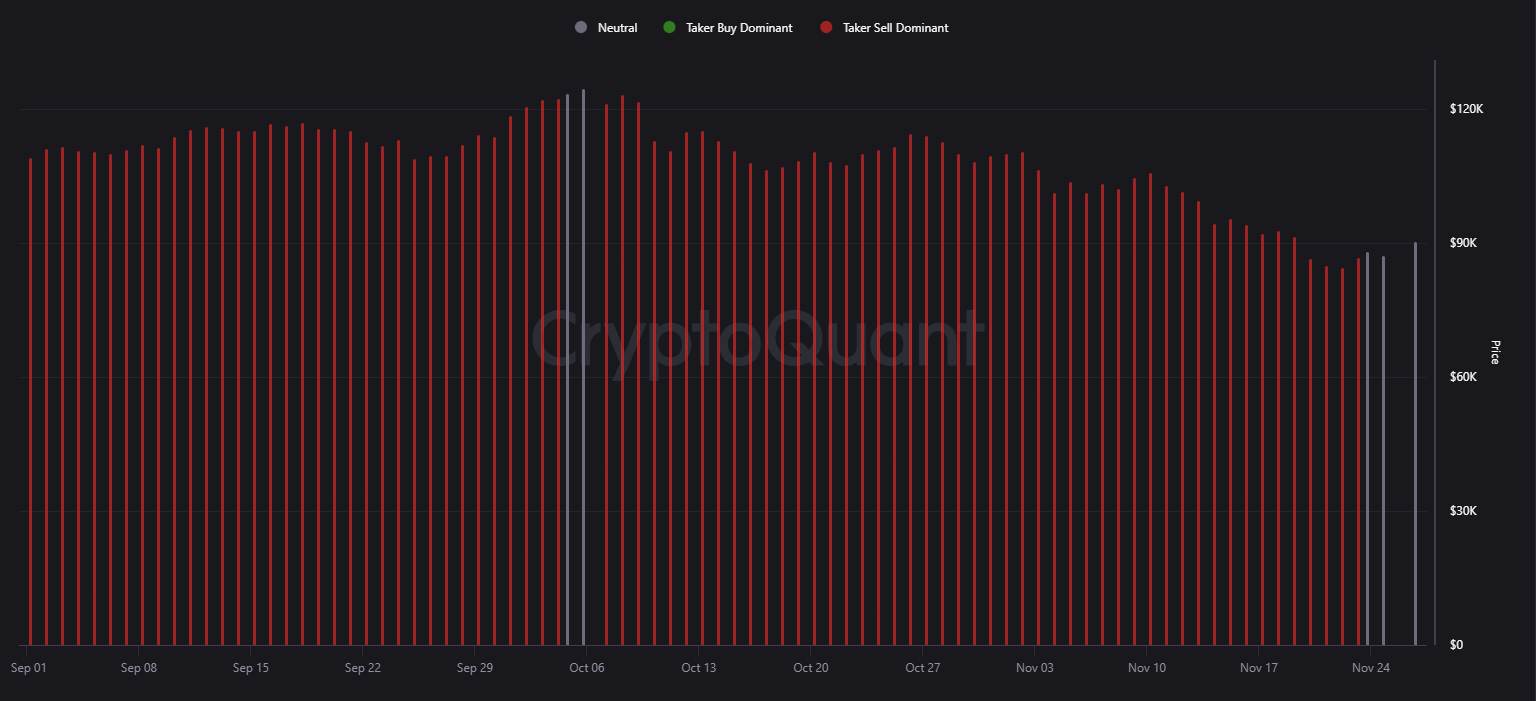
Bitcoin’s 90-day Spot Taker CVD has shifted from persistent sell dominance to a neutral stance. The indicator tracks aggressive market orders on spot exchanges. 

Bitcoin Spot Taker CVD(Cumulative Volume Delta, 90-day). Source: CryptoQuant

Red bars dominated from early September through mid-November, showing sustained taker-sell pressure.

The recent move to neutral marks a break in that pattern. It suggests the aggressive selling phase has exhausted. 

However, it does not show strong buyer dominance. Instead, the market has entered a balanced phase typical of late-cycle bear markets.

Price remains well below October levels, but the absence of persistent taker-sell pressure signals improved stability. 

The shift aligns with the broader leverage reset seen in futures markets, where funding rates have moved near zero.

Borrowing Trends Point to Strong Hands, but Fragile Leverage

CryptoQuant data shows Nexo users prefer borrowing against Bitcoin rather than selling it. BTC accounts for 53% to 57% of all collateral on the platform. That range has held for months despite the drawdown.

'@Nexo users aren’t selling their Bitcoin, they’re borrowing against it.

BTC now accounts for 54.3% of all collateral on the platform, holding a steady 53–57% range for months.

It confirms Bitcoin is the dominant asset users leverage when they need liquidity. pic.twitter.com/bhmL9UdUvO

— CryptoQuant.com (@cryptoquant_com) November 27, 2025

This behavior reduces immediate selling pressure. It also confirms that long-term holders continue to treat Bitcoin as their primary liquidity source. 

Yet it adds another layer of vulnerability. If Bitcoin drops further, collateralized positions face liquidation risk.

Combined with thin order books, any forced selling could produce outsized volatility. This dynamic reflects late-bear fragility rather than early-bull strength.

A Market Caught Between Exhaustion and Low Liquidity

Current market structure reflects a transition rather than a clean reversal. ETF outflows, damaged liquidity, and macro uncertainty keep pressure on prices. 

However, on-chain selling has cooled, and structural holders continue to defend positions.

The result is an environment where small catalysts can produce large moves. 

🚨TOM LEE: YEAR-END RALLY IS COMING

Despite a brutal six weeks, Tom Lee says a STRONG December rally is on deck, backed by by a dovish incoming Fed pivot. pic.twitter.com/G9afNmV0RR

— Coin Bureau (@coinbureau) November 27, 2025

A dovish Fed pivot would likely hit thin order books and accelerate a rebound. Another macro shock could trigger renewed deleveraging.

Lee’s view aligns with this setup. The market has stopped bleeding, but it remains fragile. Bitcoin has a history of delivering double-digit moves in compressed periods, especially after aggressive liquidations.

As December approaches, both liquidity conditions and on-chain data suggest the next large move is near. 

The direction will depend on macro signals and ETF flows rather than sentiment alone.

The post BitMine’s Tom Lee and On-Chain Data Signal a Big December Move for Bitcoin appeared first on BeInCrypto.

  •  

Monad Is Still Rallying, But How Long Will It Last?

Monad’s MON token continues to rally after its long-anticipated mainnet launch, defying the steep post-airdrop declines that dominated 2025. The token has climbed more than 70% above its Coinbase sale price while the broader crypto market trades under heavy pressure. 

Data from on-chain activity, exchange flows, and token distribution offer a clear explanation for the outperformance — and reveal how long the rally may realistically last.

Strong Day-One Performance Sets the Tone

Monad launched its public mainnet and MON token on November 24 with roughly 10–11% of its 100 billion supply unlocked. 

The airdrop and public sale provided liquidity, while more than 50.6% of the supply (team, investors, treasury) remained locked through 2029.

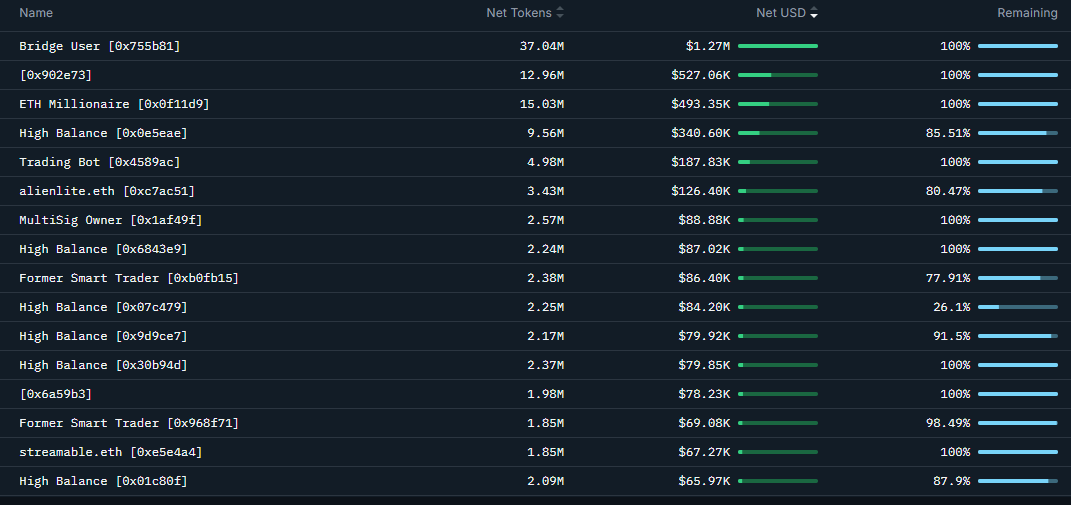
Large Monad Holders Are Still Not Selling Any MON Token. Source: Nansen

The launch attracted immediate attention. MON dipped about 15% in early trading, hitting $0.02 as airdrop sellers exited. 

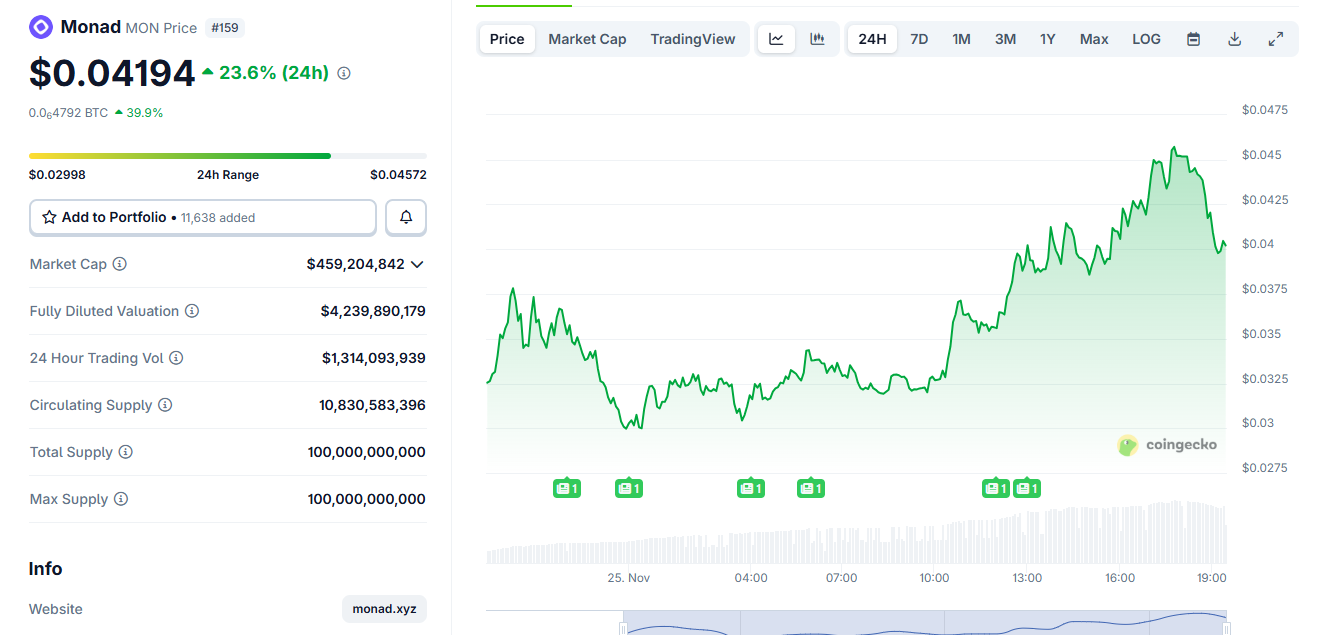
Buyers quickly absorbed the flow. Within 24 hours, MON traded near $0.03–0.035, and now sits around $0.04, more than 50–70% above its $0.025 public sale price.

This strength stands out in a market where Bitcoin has dropped below $90,000 and total crypto market capitalization has fallen by more than a trillion dollars since October.

Monad Price Chart. Source: CoinGecko

Airdrop and Token Sale Created a Stable Holder Base

Monad distributed roughly 4.73 billion MON in airdrops to 289,000 eligible accounts, with 3.33 billion ultimately claimed. The design targeted DeFi power-users, NFT traders, testnet contributors, and DAO participants rather than quest farmers.

The Coinbase token sale, which raised $269 million from about 85,820 participants, added a second cohort of committed holders. These buyers anchored around the $0.025 sale price and proved less eager to dump at launch.

Because insiders remain locked, early sellers were mostly airdrop recipients. This dynamic helped prevent the heavy cascades that crushed many 2025 airdrops.

my monad airdrop is worth $14,000?

what the actual fuck

hello wtf pic.twitter.com/zHkEdQQsIT

— Loshmi (@loshmi) November 25, 2025

Heavy Exchange Coverage Shielded MON From Volatility

MON was listed across major exchanges on day one, including Coinbase, Upbit, Bithumb, Kraken, Bybit, Bitget, Crypto.com, and MEXC. Derivatives opened on multiple venues, giving traders hedging options.

Deep order books absorbed airdrop selling. Market makers tightened spreads, and cross-venue liquidity reduced fragmentation. Traders could short, long, or hedge without flooding spot markets.

This broad coverage sharply contrasts with earlier L1 launches that relied on thin liquidity pools and fragmented markets, often triggering immediate 50–80% crashes.

Huge respect to @monad for not paying the Binance cartel listing fee.

Probably not a coincidence that the price is going up.

No serious project should waste millions of dollars for nothing (study Binance TGEs this cycle).

gMonad

— Aylo (@alpha_pls) November 25, 2025

On-Chain Activity Surprised the Market

Monad’s first 24 hours delivered rare on-chain traction for a new L1. Nansen recorded:

  • 3.7 million transactions
  • 153,000 active addresses
  • 18,000 contract deployments

These figures exceed what many blockchains achieve in their first year. They show early real usage from bots, arbitrageurs, developers, and liquidity programs.

.@Monad went live less than 24 hours ago

It already cleared:
– 3.7M daily txns
– 153K active addresses
– 18K contract deployments

That’s higher day-one activity than most chains in their first year

🧵 👇 pic.twitter.com/ggUwfOyjx7

— Nansen 🧭 (@nansen_ai) November 25, 2025

TVL reached ~$90 million, with Uniswap, Gearbox, Curve, and native dApps launching within hours. DEX volume crossed $70 million, driven by concentrated liquidity pools and farming incentives.

This early activity reinforced the perception that Monad launched as a functioning ecosystem, not as a speculative token awaiting future development.

Monad’s Rare Relative-Strength Play in a Weak Market

MON’s rally stands out because the rest of the market remains fragile. Bitcoin’s slide under $90,000 triggered retail outflows and pushed sentiment indicators into extreme fear.

Traders rotated into MON due to its relative strength. New tokens with credible metrics often attract momentum capital when major assets struggle.

This reflexive flow — strength attracting more capital — added fuel to the rally.

Arthur Hayes Goes All-In

Arthur Hayes weighed in with a sarcastic comment that captured the market mood. 

Just what this bull market needs another low float , high FDV useless L1. But obvi I aped. It’s a bull market bitches!$MON to $10 pic.twitter.com/UMSDWWmp5a

— Arthur Hayes (@CryptoHayes) November 25, 2025

He highlighted MON’s low float and high FDV (fully diluted valuation). With only around 10% of supply circulating and FDV near $3–4 billion, MON fits the low-float pattern that dominates early-stage price action.

Yet Hayes admitted he bought anyway. His remark reflects how traders treat early L1 tokens: fundamentally risky, but attractive for short-term speculation.

How Long Can the Monad Rally Last?

The current data and patterns point to three time horizons that shape MON’s outlook.

Short Term: Rally Can Sustain

Monad has absorbed its largest early unlocks. Liquidity remains deep, and on-chain usage is rising. Incentive programs are launching, and trading flows remain strong. 

Under these conditions, MON can maintain upward momentum for days or weeks.

Medium Term: Unlock Pressure Builds

Over the next several months, the circulating supply will rise as vesting tranches unlock. Even disciplined insider distribution adds structural sell pressure. 

Activity may normalize after early incentives fade. If TVL flattens or starts slipping, the narrative could shift.

Longer Term: Fundamental Execution Matters

MON’s FDV places high expectations on the chain. Sustained growth in TVL, real applications, and developer traction will determine long-run resilience. 

Without continued expansion, valuation compression becomes likely as supply expands.

In 2017 $ADA went from $3B → $30B in less than a month$MON just launched at $3B

Imagine the smell 💜 @monad pic.twitter.com/9LEg9WXNW9

— zac.eth 🧙🏻‍♂️♦️ (@zacxbt) November 24, 2025

Monad Token Outlook

Monad’s rally stems from a rare combination of strong distribution design, deep exchange liquidity, high early usage, and standout performance during a weak market. 

This alignment makes MON one of the few 2025 airdrop tokens to defy the typical post-launch collapse.

The rally can continue in the short term as long as on-chain demand holds and liquidity remains supportive. However, the token’s high FDV and long vesting schedule introduce clear medium-term risks.

For now, MON remains a high-momentum asset driven by early fundamentals and speculative flows. 

However, the durability of that momentum will depend on whether Monad converts its powerful first 48 hours into sustained ecosystem growth.

The post Monad Is Still Rallying, But How Long Will It Last? appeared first on BeInCrypto.
  •  

Trump’s Crypto Empire Is Crashing — and His Followers Are Paying the Price

Since taking office, US President Donald Trump and his family have dived headfirst into a wave of crypto-focused business ventures, briefly seeing their wealth surge on the back of these deals. But that momentum has faded. 

Today, both the Trump family’s gains —and those of their most devoted supporters— have been wiped out as market volatility intensifies.

Family Crypto Empire Faces Reversal

Trump’s crypto ventures have become recognizable fixtures across the industry. 

They began with the launch of a namesake meme coin, quickly followed by a nearly identical token from First Lady Melania Trump. Then came World Liberty Financial. Eric Trump also stepped in through the Bitcoin mining company Hut 8.

At this point, there’s virtually no corner of the crypto industry the presidential family hasn’t tapped into.

At their peak, the profits from these ventures were striking. Estimates differ, but an August investigation by watchdog group Accountable.US found that roughly 73% of Trump’s wealth was tied to crypto-related deals.

Everyone's worried about how inflationary Trump's new economic plan might be…

But it may not matter much to DJT.

His empire isn't built on golf courses and licensing deals anymore — it's being rebuilt on crypto.

Over the past year, the Trump family has accumulated:
– $2B+ in… pic.twitter.com/GWeBs4K2lW

— Simon (@simononchain) July 2, 2025

That figure represents a sharp rise from April, when the NGO State Democracy Defenders Fund estimated that 37% of his wealth came from crypto.

That picture, however, has changed dramatically. With markets now slumping and indicators flashing red, the Trump family’s crypto gains have taken a hit.

Family Tokens and Stocks Plunge

The Trump family’s crypto portfolio has been hit across nearly every venture they touched. 

Their Trump-branded memecoin reached its latest peak on November 10 at $9.49 but has since plummeted to $6.20 — a nearly 35% drop in just a few days. The family’s exact stake is unclear, but estimates suggest the drop erased about $117 million from their holdings.

Trump Media, the parent company of Trump’s social media platform Truth Social, has also suffered losses, particularly after it decided to invest $2 million worth of Bitcoin in July. 

Bloomberg estimates that the value of the president’s stake in the company has dropped by roughly $800 million since September. Trump remains its largest shareholder, with his holdings placed in a trust managed by his eldest son, Donald Trump Jr.

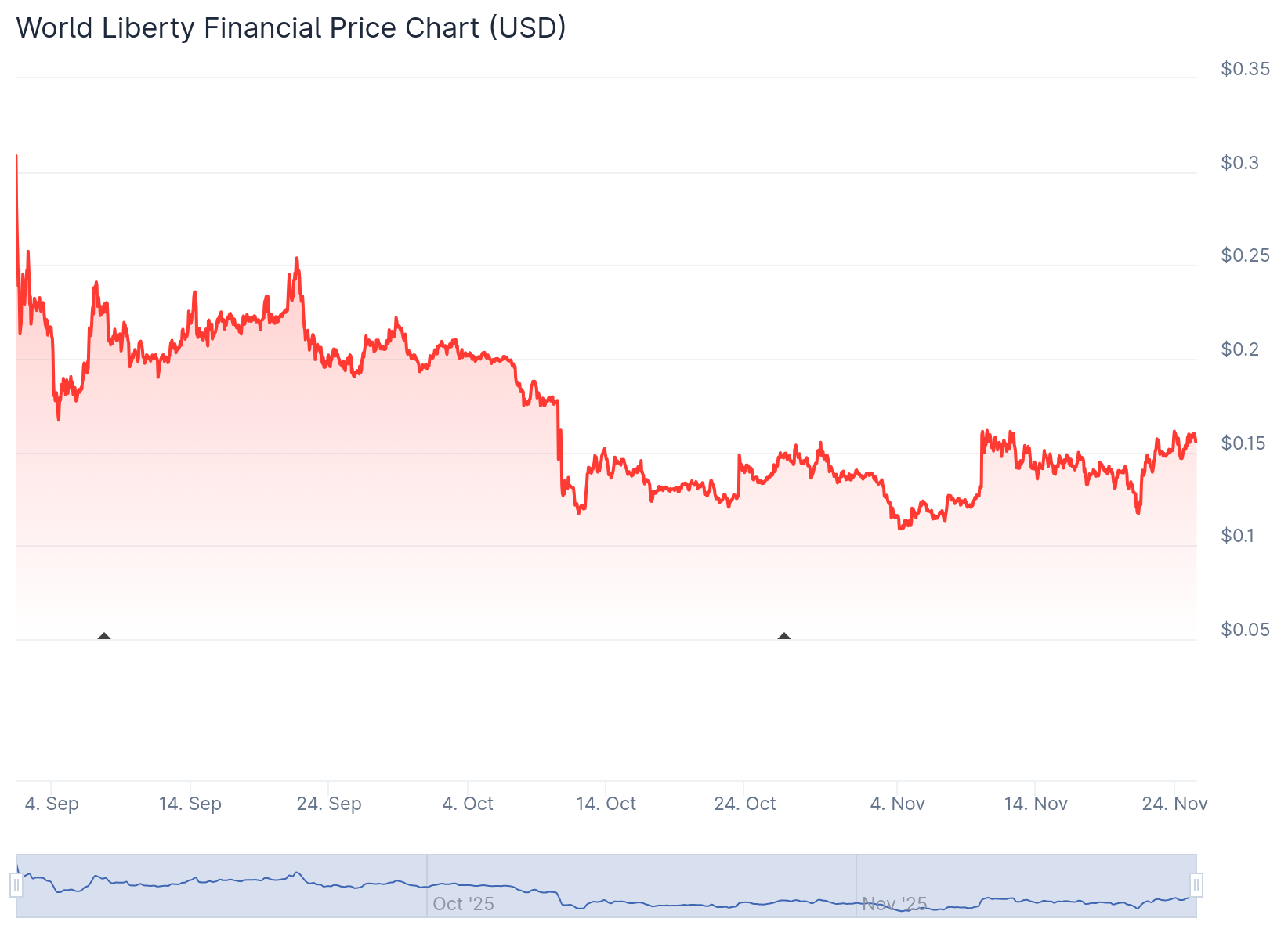
Meanwhile, WLFI has seen its token price decline from $0.26 in early September to roughly $0.15. The decline cut Trump’s locked token value almost in half, dropping from nearly $6 billion to around $3.15 billion.

WLFI price chart over the past 90 days. Source: CoinGecko.

Even their mining venture, American Bitcoin Corp., hasn’t escaped the rout. The company was formed shortly after Trump’s inauguration in partnership with Hut 8 Corp., which took a majority stake.

Eric Trump ended up with about 7.5% of the firm, while Donald Trump Jr. secured a smaller, undisclosed portion. 

The venture initially soared, valuing Eric’s stake at roughly $630 million, but as the market turned, shares fell by more than half, wiping out about $300 million from his holdings.

Market Meltdown Deepens Crypto Losses

The Trump family’s shrinking crypto fortune is just one piece of a wider market collapse that has erased more than $1 trillion in digital asset value. 

The sector is facing one of its sharpest downturns in months. Major tokens are experiencing a decline, leveraged positions are unwinding, and liquidation waves are rippling through derivatives markets.

Bitcoin’s selloff has dragged altcoins and crypto-linked equities lower, highlighting how quickly momentum can reverse in a notoriously volatile industry. 

Retail investors have borne much of the pain. Many piled into tokens, mining stocks, or high-profile branded projects near their highs, only to see prices crater within weeks.

The post Trump’s Crypto Empire Is Crashing — and His Followers Are Paying the Price appeared first on BeInCrypto.

  •