Reading view

How a Potential Russia–Ukraine Ceasefire Could Impact Crypto Markets

Diplomatic efforts to end the Russia–Ukraine war gained visible momentum on Monday, as US, Ukrainian, and European officials outlined the foundations of a possible ceasefire and post-war security framework.

The developments mark one of the most substantive diplomatic advances since the conflict began. The positive signs are already prompting investors to reassess geopolitical risk across global markets, including cryptocurrencies.

For crypto, which has recently suffered sharp declines tied to global risk-off dynamics, a ceasefire could alter sentiment, but not without important caveats.

Diplomatic Momentum Builds For Russian-Ukraine Ceasefire

Negotiators from Ukraine, the US, and key European allies met in Berlin this week for an intensive round of talks focused on ending hostilities and preventing renewed conflict. 

Officials involved in the discussions described progress as significant, with alignment reached on most elements of a proposed framework.

US officials confirmed that Washington has agreed to support meaningful security guarantees for Ukraine as part of a peace arrangement, addressing Kyiv’s long-standing demand for protection against future aggression. 

Flood of positive-sounding headlines as US official briefs media on Ukraine talks, says 90% of issues solved, Polymarket pricing just 3% odds of ceasefire this year pic.twitter.com/IMVlegXJGW

— db (@tier10k) December 15, 2025

According to officials familiar with the talks, negotiators are now aligned on roughly 90% of the framework. 

However, remaining disagreements centered on territorial questions in eastern Ukraine, particularly in the Donetsk region.

European leaders reinforced the diplomatic push by endorsing plans for a European-led multinational force that would assist in stabilizing Ukraine if a ceasefire holds. The proposal also includes a US-backed monitoring and verification mechanism designed to oversee ceasefire compliance and respond to violations.

Most recent polls suggest that only 38% of Ukraine's population are in favor of giving up any territory, even if it means the war must drag on. pic.twitter.com/kSsAPc6ZsS

— SPRAVDI — Stratcom Centre (@StratcomCentre) December 11, 2025

Public opinion inside Ukraine continues to act as a constraint on negotiations. Polling cited by Reuters shows that most Ukrainians oppose major territorial concessions or limits on the country’s military capabilities unless backed by firm and enforceable security commitments.

Fighting Continues Despite Negotiations

Even as diplomacy advances, military operations have not paused. On Monday, Ukrainian forces carried out additional long-range drone strikes against Russian oil infrastructure in the Caspian Sea, disrupting production at key platforms for the third time in recent days. 

The attacks highlight Kyiv’s strategy of applying economic pressure on Russia’s energy revenues while negotiations remain unresolved.

Ukraine has opened another front against Russia. Ukraine has begun striking Russian oil platforms and ships in the Caspian Sea. Russia is helpless to stop these Ukrainian drone and missile attacks. pic.twitter.com/bD3YW5Yg4P

— Jake Broe (@RealJakeBroe) December 14, 2025

Ukraine also claimed it struck a Russian Kilo-class submarine in the port of Novorossiysk using underwater drones. 

If confirmed, would underscore the growing sophistication of Ukraine’s asymmetric naval capabilities. Independent verification of the claim remains limited, and Russian officials have denied damage.

What a Ceasefire Could Mean for Crypto Markets

1. Reduced Safe-Haven Demand, Improved Risk Appetite

A credible ceasefire would remove one of the largest sources of global tail risk. In markets where risk sentiment is a major driver, such a de-escalation can:

  • Boost risk assets broadly, reducing demand for traditional safe havens like the US Treasuries and the US dollar.
  • Support assets like Bitcoin and major altcoins as investors rotate back toward higher-beta investments.
  • Lower implied volatility across equity and digital asset markets.

The mechanics are straightforward: with reduced geopolitical risk, funds that fled to safety may redeploy into risk assets, potentially lifting Bitcoin and Ethereum prices. A stronger risk appetite could also benefit altcoins, which tend to outperform in relief rallies.
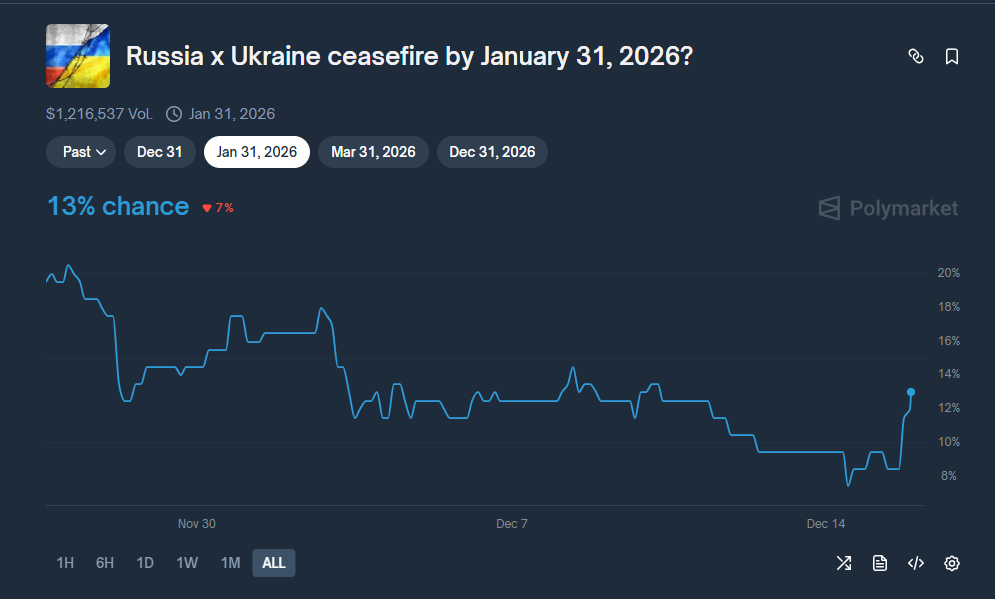
Polymarket Odds On Russia-Ukraine Ceasefire By Early 2026 Have Increased. Source: Polymarket

2. Energy and Inflation Narrative

A sustained ceasefire could also affect commodity markets, especially if it lessens pressure on energy prices. Lower or stabilized global energy prices could:

  • Dampen inflation expectations in Europe and elsewhere.
  • Reduce pressure on central banks to maintain restrictive policy settings.
  • Allow liquidity conditions to ease further, which historically has supported higher valuations in risk assets such as cryptocurrencies.

However, this transmission is neither direct nor immediate. It depends on how quickly markets perceive structural changes in energy markets and central bank policy trajectories.

What Might Limit the Crypto Recovery

While a ceasefire can reduce geopolitical risk, it cannot fully offset macro headwinds that influenced crypto markets over the past months:

  • Persisting central bank uncertainty: If the Bank of Japan proceeds with tightening and the US data continues to suggest sticky inflation, liquidity could remain constrained, muting upside in risk assets.
  • Derivative market positioning: Leverage has been a significant catalyst of past crypto declines. Relief rallies can trigger fresh positioning and high funding rates, only to be reversed if macro forces reassert.
  • Liquidity conditions: A ceasefire is good news, but sustained asset price rallies require ample liquidity. Without clearer signals of easing financial conditions, crypto assets may see only transient relief moves.
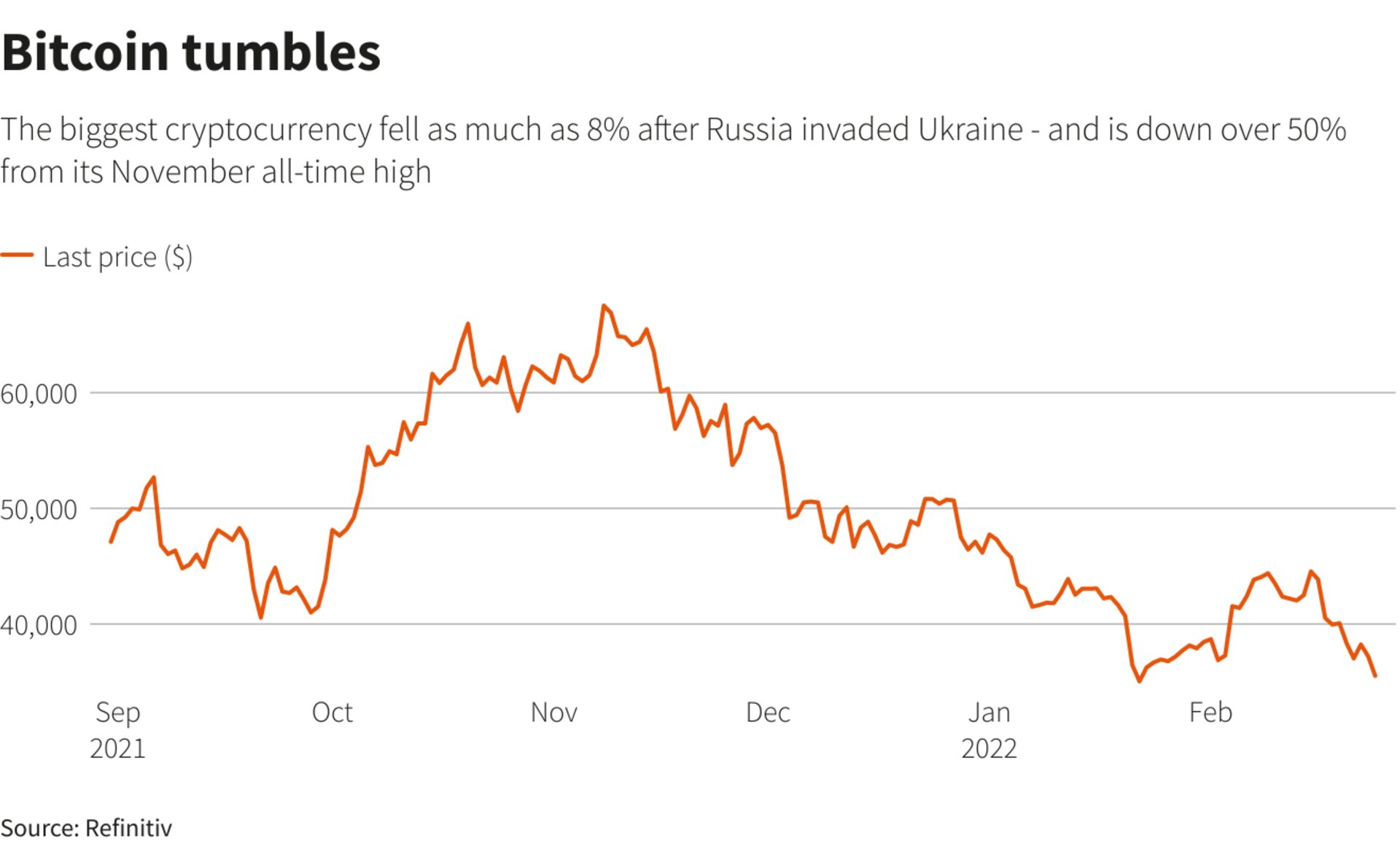
Bitcoin Dip When Russia Invaded Ukraine in 2022. Source: Reuters

A Ceasefire Would Be Positive, But Not Sufficient

An agreed ceasefire between Russia and Ukraine would mark a monumental shift in geopolitics and initially bolster risk assets, including cryptocurrencies. 

However, the broader impact on crypto markets will depend heavily on how the ceasefire intersects with liquidity conditions, central bank policy expectations, and global risk appetite.

In the short term, crypto could see a meaningful relief rally, driven by sentiment and risk reallocation. 

Over the medium term, the trend will likely hinge on whether ceasefire outcomes tangibly ease inflation and liquidity pressures — the primary macro drivers that have influenced digital assets in recent months.

The post How a Potential Russia–Ukraine Ceasefire Could Impact Crypto Markets appeared first on BeInCrypto.

  •  

Inside Putin’s Crypto Cold War: How Russia Evaded Western Sanctions In 2025

The Russia-Ukraine war has waged on for nearly 4 years now. Western sanctions were meant to isolate Russia financially. Instead, they forced adaptation.

In 2025, BeInCrypto began documenting how Russia and Russia-linked actors rebuilt payment routes using crypto. What emerged was not a single exchange or token, but a resilient system designed to survive freezes, seizures, and enforcement delays.

This investigation reconstructs that system in chronological order, based on on-chain forensic analysis and interviews with investigators tracking the flows.

The First Warning Signs Were not Criminal

Early signals did not point to ransomware or darknet markets. They pointed to trade.

Authorities began asking new questions on how money crossed borders for imports, how dual-use goods were paid for, and how settlements occurred without banks. 

At the same time, on-chain data showed Russian OTC desks surging in activity. Exchanges hosting Russian OTC liquidity also saw volumes spike, especially in Asia.

Meanwhile, Telegram groups and darknet forums discussed sanctions evasion openly. These were not hidden conversations. They described practical methods for moving value across borders without banks.

The method was simple. OTC desks accepted rubles domestically, sometimes as cash. They issued stablecoins or crypto. That crypto then settled abroad, where it could be converted into local currency.

Garantex Operated Russia’s Crypto Laundering Hub

Garantex played a critical role in this ecosystem. It functioned as a liquidity hub for OTC desks, migrants, and trade-linked payments.

Russia Using a UAE Proxy for Sanction Evasion 

Even after early sanctions, it continued interacting with regulated exchanges abroad. That activity persisted for months.

When enforcement finally escalated, the expectation was disruption. What followed instead was preparation.

“Even people who were leaving Russia were still using Garantex to move their money out. If you were trying to relocate to places like Dubai, this became one of the main ways to transfer funds once traditional banking routes were cut off. For many Russians trying to leave the country, Garantex became a practical exit route. It was one of the few ways to move money abroad after banks and SWIFT were no longer an option,” said Lex Fisun, CEO of Global Ledger

The Seizure Triggered a Reserve Scramble

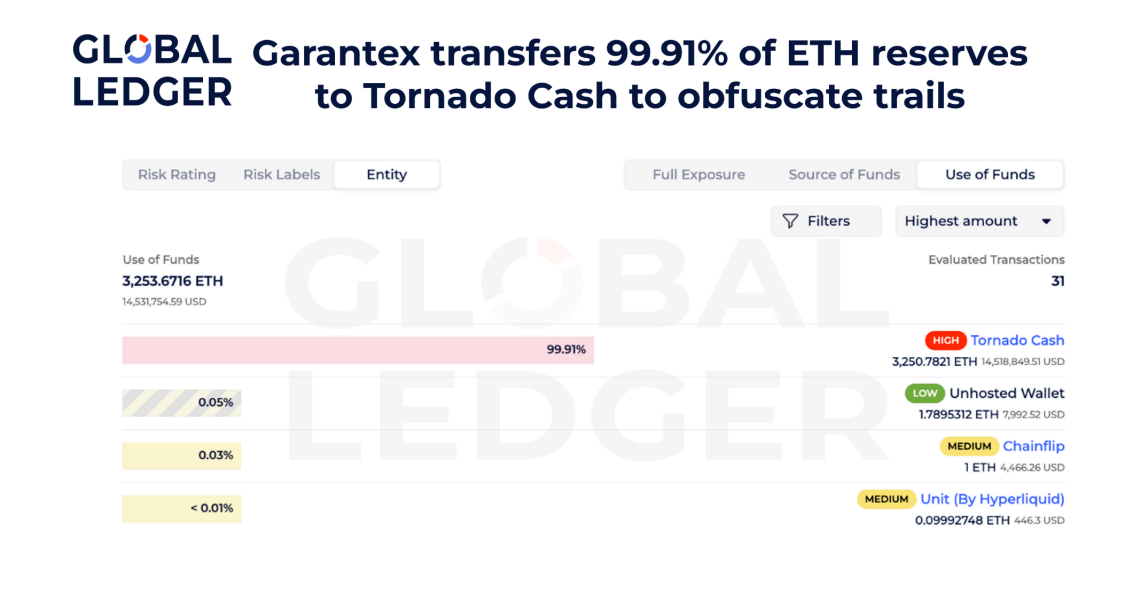
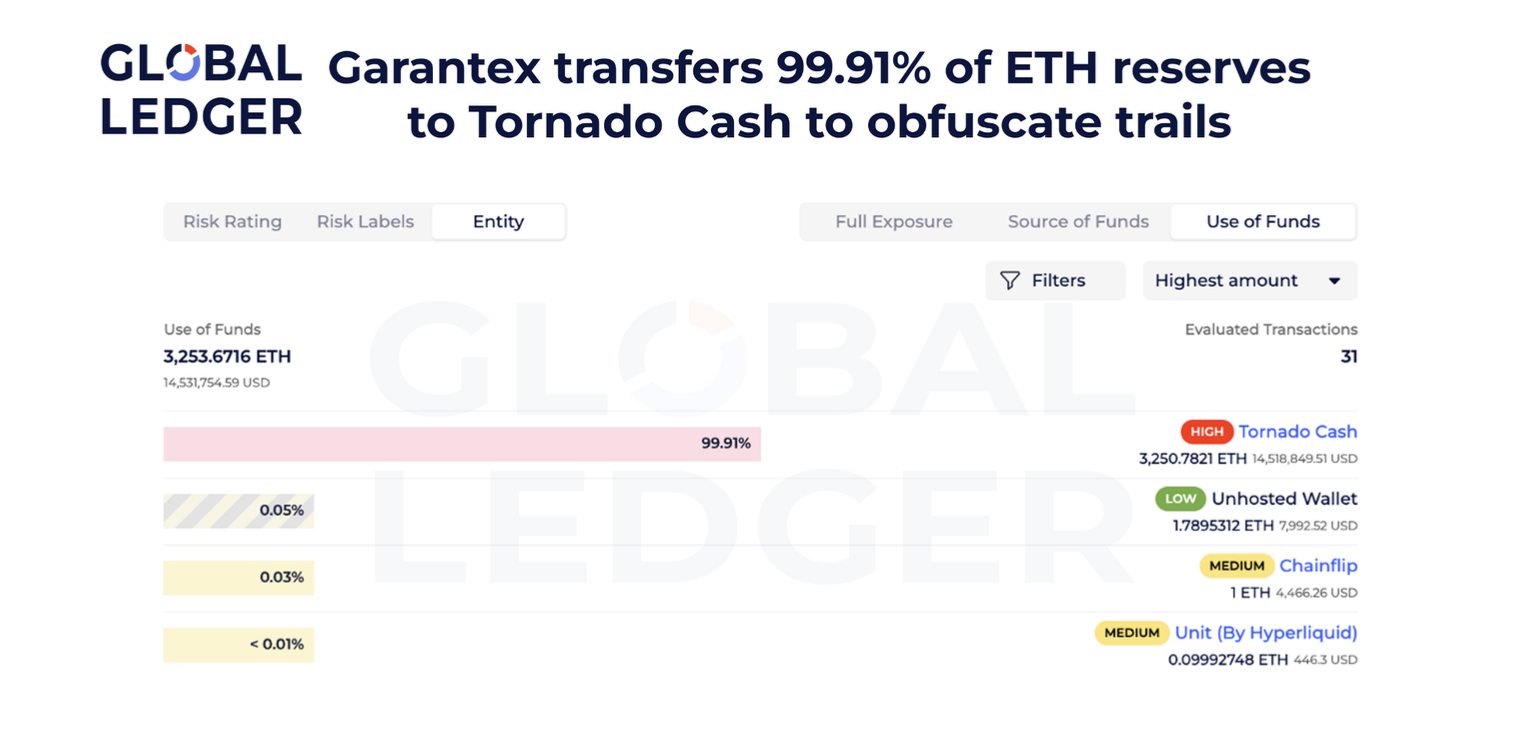
On the day Garantex’s infrastructure was seized in March 2025, a linked Ethereum wallet rapidly consolidated more than 3,200 ETH. Within hours, nearly the entire balance moved into Tornado Cash.

That move mattered. Tornado Cash does not facilitate payouts. It breaks transaction history.

ETH Reserve Consolidation and Tornado Cash Transfer Graphic. Source: Global Ledger

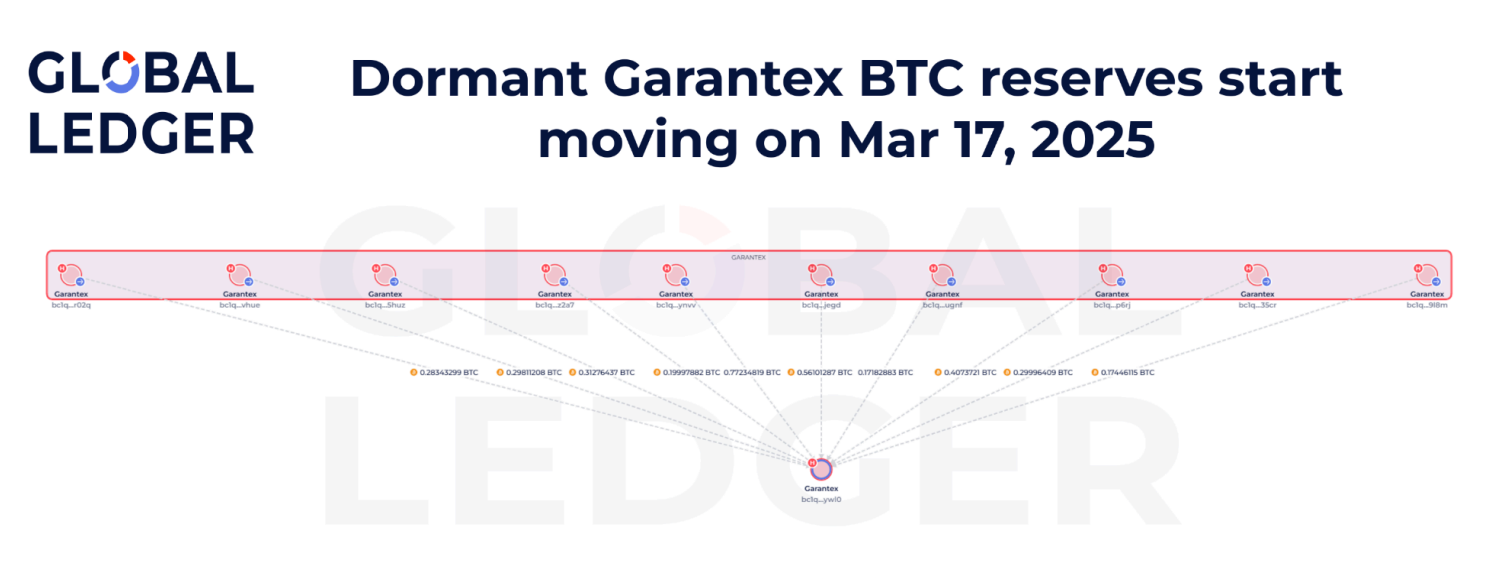
Days later, dormant Bitcoin reserves began moving. Wallets untouched since 2022 consolidated BTC. This was not panic selling. It was treasury management under pressure.

BTC Reserve Reactivation Chart

So, it was clear that assets outside stablecoin control remained accessible.

A Successor Appeared Almost Immediately

As access to Garantex faded, a new service emerged.

Grinex launched quietly and began supporting USDT. Traced flows passed through TRON and connected to Grinex-linked infrastructure. Users reported balances reappearing under the new name.

“It was probably the most obvious rebrand we’ve seen. The name was nearly the same, the website was nearly the same, and users who lost access to Garantex saw their balances reappear on Grinex,” Fisun told BeInCrypto. 

In late July 2025, Garantex publicly announced payouts to former users in Bitcoin and Ethereum. On-chain data confirmed the system was already live.

At least $25 million in crypto had been distributed. Much more remained untouched.

The payout structure followed a clear pattern where reserves were layered through mixers, aggregation wallets, and cross-chain bridges before reaching users.

High-Level Payout Flow Diagram

Ethereum Payouts Relied on Complexity

Ethereum payouts used deliberate obfuscation. Funds moved through Tornado Cash, then into a DeFi protocol, then across multiple chains. Transfers bounced between Ethereum, Optimism, and Arbitrum before landing in payout wallets.

Despite the complexity, only a fraction of the ETH reserves reached users. More than 88% remained untouched, indicating payouts were still in early stages.

Bitcoin Payouts Exposed a Different Weakness

Bitcoin payouts were simpler and more centralized.

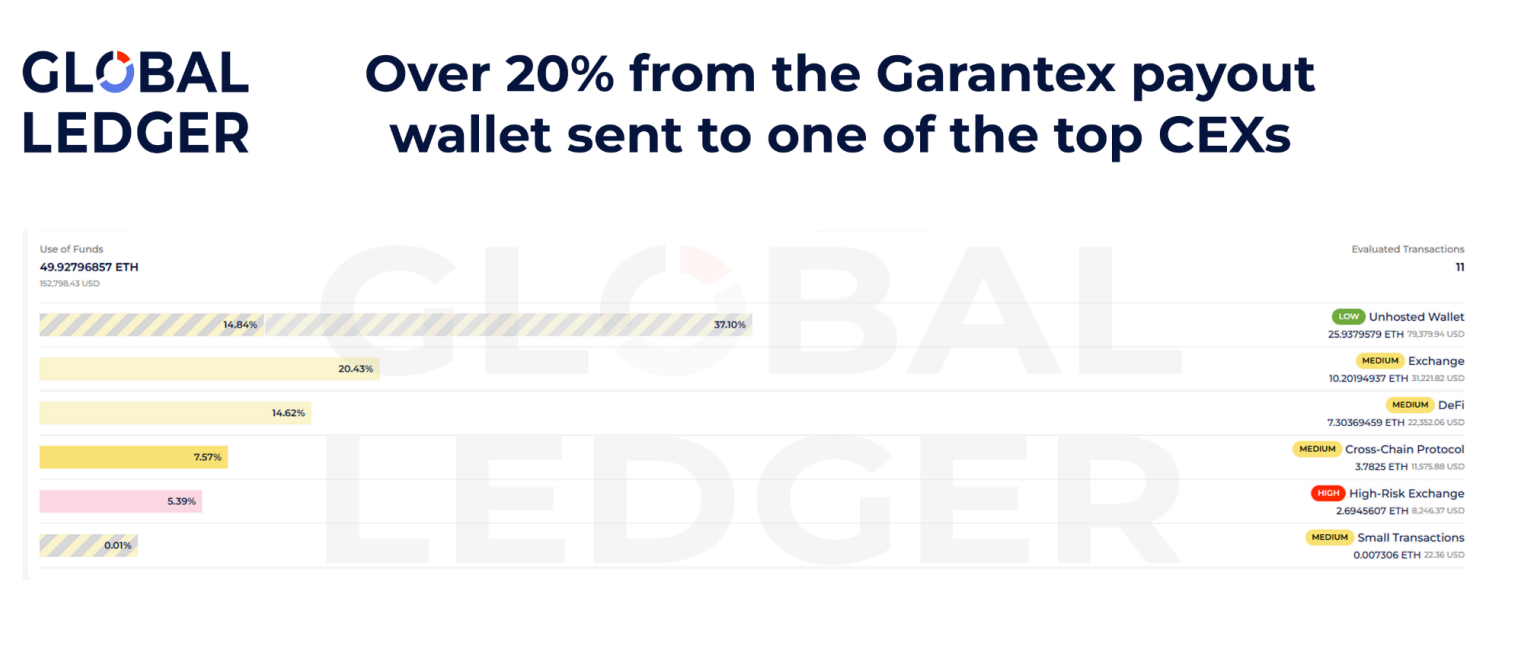
Investigators identified multiple payout wallets linked to a single aggregation hub that received nearly 200 BTC. That hub remained active months after the seizure.

More revealing was where the funds touched next.

Source wallets repeatedly interacted with deposit addresses tied to one of the world’s largest centralized exchanges. The transaction “change” consistently routed back there.

Why Western Sanctions Struggled to Keep Up

Western sanctions were not absent. They were late, uneven, and slow to execute.

By the time Garantex was fully disrupted, investigators had already documented billions of dollars moving through its wallets. 

Even after sanctions were applied, the exchange continued interacting with regulated platforms abroad, exploiting delays between designation, enforcement, and compliance updates.

The core problem was not a lack of legal authority. It was the speed mismatch between sanctions enforcement and crypto infrastructure. While regulators operate on weeks or months, crypto systems reroute liquidity in hours.

“Sanctions work on paper. The problem is execution. Billions can still move because enforcement is slow, fragmented, and often lags behind how fast crypto systems adapt. The issue isn’t that sanctions don’t exist. It’s that they’re enforced too slowly for a system that moves at crypto speed,” said the Global Ledger CEO. 

That gap allowed Garantex to adapt. Wallets rotated frequently. Hot wallets changed unpredictably. Remaining balances were moved in ways that mimicked normal exchange activity, making automated compliance systems less effective.

The private sector struggled to keep up. Banks and exchanges balance compliance obligations against transaction speed, customer friction, and operational cost. 

In that environment, sanctioned exposure can slip through when activity does not trigger obvious red flags.

By October 2025, the payout infrastructure was still active. Reserves remained. Routes stayed open.

This was not the collapse of an exchange, rather he evolution of a system.

Russia’s crypto strategy in 2025 showed how a sanctioned economy adapts by building parallel rails, preserving liquidity, and rerouting when blocked.

The post Inside Putin’s Crypto Cold War: How Russia Evaded Western Sanctions In 2025 appeared first on BeInCrypto.

  •  

Russia Revives Blacklisted Crypto Empire Garantex to Outrun Sanctions

Sanctioned Russian exchange Garantex is quietly moving funds again, according to an on-chain payout architecture uncovered by blockchain analytics firm Global Ledger. 

The forensic evidence confirmed that Russian actors have rebuilt a functioning payout system despite law enforcement efforts.

Garantex Quietly Moves Millions

A new investigation by Global Ledger reveals that Garantex, a Russian crypto exchange previously hit by Western sanctions and a server seizure, is still managing to move large sums of money. 

Researchers have uncovered new Garantex-linked wallets on Bitcoin and Ethereum that, together, hold more than $34 million in cryptocurrency. At least $25 million has already been paid out to former users. These movements confirm that the operation is active despite international pressure to shut it down.

Global Ledger explained that Garantex is operating a payout system designed to conceal the flow of money. The exchange shifts its reserves into mixing services such as Tornado Cash, which scramble the funds to obscure their origin. 

Garantex uses Tornado Cash to obscure money movement. Source: Global Ledger.

The money is then routed through a series of cross-chain tools. These facilitate the transfer of assets between networks, including Ethereum, Optimism, and Arbitrum. These transfers eventually end up in aggregation wallets, and from there, the funds are distributed to individual payout wallets.

The investigation also found that most Ethereum reserves remain untouched. More than 88% of the ETH linked to Garantex remains in reserve, indicating that only the initial phase of payouts has commenced.

The findings in the Global Ledger report are situated within a broader transformation within Russia’s financial system.

How Russia Uses A7A5 to Keep Trade Alive

Russia has made a remarkable shift in its approach to digital assets. 

In early 2022, the Russian Central Bank proposed a blanket ban on cryptocurrencies, describing them as a threat to financial stability. By 2024, the country had reversed its position and began using crypto to support trade under sanctions.

President Vladimir Putin has also personally backed a new payment network called A7. 

A7 launched a rouble-backed stablecoin named A7A5 at the start of 2025. This token enables the flow of money in and out of the conventional financial system, and according to Chainalysis, it has already supported more than $87 billion in trading activity.

Russian companies utilize A7A5 to convert rubles into USDT. This allows Russian firms to continue making cross-border payments even when banks refuse to process transfers linked to Russia.

While Russia works to build a financial system that no longer depends on Western channels, the Global Ledger findings add a critical new layer by showing that Garantex has not disappeared. 

Instead, it has adapted its operations and continues to move money through structures that mirror newer state-backed systems.

Taken together, the evidence shows how states are developing new crypto-based payment systems that circumvent country-specific sanctions and erode traditional forms of external pressure.

The post Russia Revives Blacklisted Crypto Empire Garantex to Outrun Sanctions appeared first on BeInCrypto.
  •  

November Profit Crisis: 70% of Top Miners Pivot to $20B AI Market

Bitcoin mining profitability plunged to record lows in late 2025 as the hash rate dropped below $35 per petahash per second, while production costs rose to $44.8 per petahash. This forced miners into payback periods over 1,200 days and drove a major industry shift, with 70% of top mining companies now earning revenue from artificial intelligence infrastructure.

November 2025 marked a turning point for the global Bitcoin mining industry. A confluence of collapsing margins, regulatory pressure, and strategic pivots reshaped the sector’s landscape. Here are the five key trends that defined the month.

Profitability Hits Historic Lows

Network hashrate surged to a record 1.1 ZH/s in October, intensifying competition. Meanwhile, Bitcoin prices dropped to around $81,000, crushing margins across the industry. Machine payback periods have stretched beyond 1,200 days.

MARA CEO Fred Thiel issued a stark warning about the industry’s future. After the 2028 halving reduces block rewards to roughly 1.5 BTC, most business models will collapse. Only miners with access to cheap energy or successful AI pivots will survive, he said.

Financing costs continue to rise as traditional mining revenue shrinks. Even companies transitioning to AI cannot yet offset the decline in Bitcoin income. The squeeze is forcing urgent strategic decisions across the sector.

AI Pivot Accelerates

Seven of the top ten mining companies now generate revenue from artificial intelligence. AI hosting yields already exceed traditional mining returns by roughly 50% per megawatt. The shift is reshaping how the industry measures success.

Bitfarms announced it will phase out Bitcoin mining entirely within two years. Its Washington State facility will be converted into an HPC data center by December 2026. CEO Ben Gagnon said potential returns could surpass all previous mining income.

IREN secured a landmark $9.7 billion, five-year GPU cloud computing agreement with Microsoft. The deal includes a 20% upfront payment. IREN will deploy NVIDIA GB300 GPUs at its Texas facility starting in 2026.

Hut 8 sold four Canadian natural gas power plants totaling 310 MW to TransAlta. The move aligns with its strategic shift toward Bitcoin mining plus HPC infrastructure. CleanSpark aims to become a comprehensive compute platform serving both AI and BTC.

Massive Capital Restructuring

A wave of convertible note issuances is sweeping the industry. CleanSpark raised $1.15 billion at 0% interest. TeraWulf completed a $1.025 billion offering, also at zero percent.

Cipher Mining issued $1.4 billion in senior secured notes at 7.125% yield. IREN plans to raise $2 billion through two separate convertible bond offerings. Bitfarms completed a $588 million convertible debt issuance.

Equipment commitments are equally massive. IREN signed a $5.8 billion agreement with Dell to procure NVIDIA GB300 GPUs. Cipher expanded its Fluidstack agreement, with Google providing $1.73 billion in guarantees.

Canaan secured a $72 million strategic investment from BH Digital, Galaxy Digital, and Weiss Asset Management. The funds will support high-performance computing and the development of energy infrastructure. The company aims to reduce future financing dilution.

Regulatory Polarization

Malaysia has uncovered approximately 14,000 illegal mining operations over the past five years. Stolen electricity has caused roughly $1.1 billion in damage to the state utility TNB. A government task force was established in November to intensify crackdowns.

Russia is deploying AI technology to combat illegal mining. State grid operator Rosseti embeds AI analytics into smart meters to detect power anomalies. One recent bust involved $1.5 million in stolen electricity.

Yet some governments are embracing mining. Japan launched its first government-linked project through a major regional utility. Canaan will deploy water-cooled Avalon miners for grid load balancing by year-end.

Belarusian President Lukashenko declared cryptocurrency mining a national priority for electricity usage. He suggested that crypto could serve as an alternative to reliance on the dollar. About 60% of Russian miners remain unregistered, prompting discussions of an amnesty.

Strategic BTC Accumulation

Leading miners are stockpiling Bitcoin rather than selling into the market. MARA holds 53,250 BTC valued at approximately $5.6 billion. The company ranks second globally in public Bitcoin reserves.

CleanSpark reported total holdings of 13,054 BTC as of November 30. Monthly production reached 587 BTC in November alone—year-to-date mining output totals 7,124 BTC.

Cango holds 6,412 BTC with an explicit commitment to long-term holding. Bitdeer increased its reserves to 2,233 BTC after mining 511 BTC in October. Canaan reached a record 1,610 BTC and 3,950 ETH.

The accumulation strategy signals confidence in Bitcoin’s long-term value. Miners are betting that surviving the current profitability crisis will prove rewarding. Those who hold through the squeeze may emerge as the biggest winners.

The post November Profit Crisis: 70% of Top Miners Pivot to $20B AI Market appeared first on BeInCrypto.

  •  

Central Banks Are Stockpiling Gold: Bitcoin Could Be Next

Central banks purchased a net 53 tonnes of gold in October 2025, a 36% month-over-month surge that brought the monthly total to the highest of the year.

This aggressive gold accumulation reflects growing concerns over macroeconomic uncertainty and a strategic shift away from traditional dollar-denominated assets.

Record Gold Purchases Signal Strategic Shift

According to World Gold Council data, central banks purchased a net 53 tonnes of gold in October alone—the highest monthly demand this year—led by Poland, Brazil, and emerging market economies.

Central banks acquired 254 tonnes year-to-date through October, making 2025 the fourth-highest year for gold accumulation this century. This trend highlights concerns about economic stability and currency diversification.

The National Bank of Poland led the activity, buying 16 tonnes in October. This brought Poland’s reserves to a record 531 tonnes, or about 26% of its total foreign exchange reserves. Brazil also bought 16 tonnes, while Uzbekistan added 9 tonnes and Indonesia acquired 4 tonnes. Turkey, the Czech Republic, and the Kyrgyz Republic expanded by 2 to 3 tonnes each. Meanwhile, Ghana, China, Kazakhstan, and the Philippines increased holdings, and Russia reduced its reserves by 3 tonnes to 2,327 tonnes.

Central banks are ramping up gold purchases:

Global central banks purchased +53 tonnes of gold in October, the most since November 2024.

This marks a +194% jump compared to July, and the 3rd-straight monthly acceleration.

In the first 10 months of the year, central banks have… pic.twitter.com/7pZWyEjjvf

— The Kobeissi Letter (@KobeissiLetter) December 4, 2025

95% of surveyed central banks expect reserves to climb next year. Serbia plans to nearly double its gold reserves to 100 tonnes by 2030, while Madagascar and South Korea are considering similar expansion. The sustained demand remains despite high gold prices, emphasizing gold’s strategic importance in uncertain times.

United States Establishes Bitcoin as National Reserve Asset

The trend is now spilling over into digital assets. As sovereign institutions diversify their reserves, Bitcoin is increasingly entering the conversation as a potential complement to gold.

In the United States, Senator Cynthia Lummis stated that funding for the Strategic Bitcoin Reserve “can start anytime,” citing President Trump’s executive order designating Bitcoin as a national reserve asset. The Treasury currently manages approximately 200,000 BTC—worth roughly $17 billion—under a budget-neutral framework using seized assets.

The House’s 2026 appropriations bill requires a 90-day Treasury study on custody, standards, and AI for sanctions enforcement. It also bans funds for a central bank digital currency. No further Bitcoin purchases are mandated beyond seized assets, leaving future reserve growth open for debate.

VanEck’s economic modeling projects that acquiring one million Bitcoin by 2029 could offset about 18% of the US national debt by 2049. CoinShares analysts suggest the reserve could strengthen technological leadership and offer inflation protection. Chainalysis economists, however, warn that simultaneous accumulation by many nations could affect market stability.

States and Nations Race to Build Bitcoin Reserves

Texas has already taken action. On November 20, it became the first US state to purchase Bitcoin for its treasury, acquiring $10 million through BlackRock’s spot Bitcoin ETF when prices briefly dipped to $87,000. The move signals a growing appetite among state governments to treat Bitcoin as a strategic asset.

The momentum is not limited to America. Taiwan’s legislature has urged the government to audit its Bitcoin holdings and consider adding cryptocurrency to its strategic reserves, with Premier Cho Jung-tai pledging a detailed report by year-end. Lawmakers cited concerns about the island’s heavy reliance on U.S. dollar assets, which account for over 90% of its $602.94 billion in foreign reserves.

Deutsche Bank analysts project that Bitcoin could appear on central bank balance sheets by 2030, coexisting with gold as a complementary hedge against inflation and geopolitical risk. As nations race to secure both traditional and digital safe-haven assets, the global reserve landscape may be on the verge of a historic transformation.

The post Central Banks Are Stockpiling Gold: Bitcoin Could Be Next appeared first on BeInCrypto.

  •  

France Lifts Travel Ban on Telegram Founder Pavel Durov

France has officially lifted all travel restrictions on Telegram founder Pavel Durov as of November 13, 2025, bringing to an end a year of mandatory police check-ins and movement restrictions. The dual French-Russian citizen, detained in Paris in August 2024, can now cross borders freely without judicial oversight.

This development is pivotal in an ongoing criminal investigation that could lead to Durov facing up to 10 years in prison and fines of over $550,000.

From Detention to Freedom: Timeline of Durov’s Legal Restrictions

Durov’s legal troubles began when authorities arrested him at Paris’s Le Bourget Airport in August 2024. The charges involved allegations that Telegram enabled organized crime due to insufficient content moderation. French prosecutors accused the platform of refusing to cooperate in tackling illegal content, with a particular focus on child sex abuse material.

Initially, Durov was barred from leaving France and had to report regularly to the police in Nice. Over several months, the restrictions eased, permitting short, controlled trips to the United Arab Emirates for no more than two weeks. However, he remained under French jurisdiction until now.

According to France 24, Durov complied with all requirements for one year before authorities lifted both travel and judicial restrictions. As a result, mandatory police check-ins and all geographic limitations on his movement were eliminated.

Durov faced three interrogations by French authorities. His lawyers consistently challenged the investigation’s legitimacy and methods, arguing that they violated both domestic and European law.

Criminal Investigation Remains Active as Restrictions End

Although Durov is free to travel, the criminal investigation is ongoing. French authorities are examining Telegram’s alleged role in facilitating illicit transactions, the distribution of child sex abuse imagery, and enabling illegal content. The charges focus on complicity in organized crime rather than direct involvement.

The case portrays Telegram as a platform vulnerable to criminal misuse because of its limited content moderation. During questioning in December 2024, Durov acknowledged growing criminal abuse on Telegram and promised stronger oversight. The platform has since introduced additional moderation tools.

Telegram implemented advanced AI-powered moderation systems in early 2024, according to company documentation. In 2025, the platform reported blocking more than 34 million groups and channels, demonstrating increased enforcement. These steps address frequent criticism that Telegram enables criminal networks.

Despite compliance efforts, Durov still faces the risk of 10 years imprisonment and fines up to $550,000 if convicted. The investigation could set key precedents for platform accountability in Europe, especially for encrypted messaging services popular within cryptocurrency communities.

Durov Criticizes French Authorities, Voices Free Speech Concerns

During the investigation, Durov has publicly criticized French authorities and expressed concerns regarding government overreach. He accused prosecutors of procedural errors and argued that his arrest harmed France’s reputation as a supporter of freedom. Durov has characterized the proceedings as an attack on free speech and encryption.

His defense argues that Telegram acts as a neutral platform, not a vehicle for crime. Durov has positioned himself as a defender of privacy and free expression, standing against what he considers European censorship. This view has resonated with cryptocurrency and privacy advocates who regard encrypted communications as vital to digital freedom.

Social media reactions to the removal of the travel ban have been positive among Durov’s supporters. Nevertheless, the broader legal implications are unresolved. Both Paris prosecutors and Durov’s legal team declined public comment on the current status, so questions about trial timing and outcomes remain.

The case underscores ongoing tensions between privacy-focused tech platforms and regulatory enforcement. As France’s investigation continues, its outcome could influence the regulation of messaging services and platform accountability for user content across Europe. For now, Durov’s restored freedom of movement represents a partial win, yet the legal dispute is far from settled.

The post France Lifts Travel Ban on Telegram Founder Pavel Durov appeared first on BeInCrypto.

  •