Reading view

Project Tutorial: Build a Web Interface for Your Chatbot with Streamlit (Step-by-Step)

You've built a chatbot in Python, but it only runs in your terminal. What if you could give it a sleek web interface that anyone can use? What if you could deploy it online for friends, potential employers, or clients to interact with?

In this hands-on tutorial, we'll transform a command-line chatbot into a professional web application using Streamlit. You'll learn to create an interactive interface with customizable personalities, real-time settings controls, and deploy it live on the internet—all without writing a single line of HTML, CSS, or JavaScript.

By the end of this tutorial, you'll have a deployed web app that showcases your AI development skills and demonstrates your ability to build user-facing applications.

Why Build a Web Interface for Your Chatbot?

A command-line chatbot is impressive to developers, but a web interface speaks to everyone. Portfolio reviewers, potential clients, and non-technical users can immediately see and interact with your work. More importantly, building web interfaces for AI applications is a sought-after skill as businesses increasingly want to deploy AI tools that their teams can actually use.

Streamlit makes this transition seamless. Instead of learning complex web frameworks, you'll use Python syntax you already know to create professional-looking applications in minutes, not days.

What You'll Build

  • Interactive web chatbot with real-time personality switching
  • Customizable controls for AI parameters (temperature, token limits)
  • Professional chat interface with user/assistant message distinction
  • Reset functionality and conversation management
  • Live deployment accessible from any web browser
  • Foundation for more advanced AI applications

Before You Start: Pre-Instruction

To make the most of this project walkthrough, follow these preparatory steps:

1. Review the Project

Explore the goals and structure of this project: Start the project here

2. Complete Your Chatbot Foundation

Essential Prerequisite: If you haven't already, complete the previous chatbot project to build your core logic. You'll need a working Python chatbot with conversation memory and token management before starting this tutorial.

3. Set Up Your Development Environment

Required Tools:

  • Python IDE (VS Code or PyCharm recommended)
  • OpenAI API key (or Together AI for a free alternative)
  • GitHub account for deployment

We'll be working with standard Python files (.py format) instead of Jupyter notebooks, so make sure you're comfortable coding in your chosen IDE.

4. Install and Test Streamlit

Install the required packages:

pip install streamlit openai tiktoken

Test your installation with a simple demo:

import streamlit as st
st.write("Hello Streamlit!")

Save this as test.py and run the following in the command line:

streamlit run test.py

If a browser window opens with the message "Hello Streamlit!", you're ready to proceed.

5. Verify Your API Access

Test your OpenAI API key works:

import os
from openai import OpenAI

api_key = os.getenv("OPENAI_API_KEY")
client = OpenAI(api_key=api_key)

# Simple test call
response = client.chat.completions.create(
    model="gpt-4o-mini",
    messages=[{"role": "user", "content": "Say hello!"}],
    max_tokens=10
)

print(response.choices[0].message.content)

6. Access the Complete Solution

View and download the solution files: Solution Repository

What you'll find:

  • starter_code.py - The initial chatbot code we'll start with
  • final.py - Complete Streamlit application
  • requirements.txt - All necessary dependencies
  • Deployment configuration files

Starting Point: Your Chatbot Foundation

If you don't have a chatbot already, create a file called starter_code.py with this foundation:

import os
from openai import OpenAI
import tiktoken

# Configuration
api_key = os.getenv("OPENAI_API_KEY")
client = OpenAI(api_key=api_key)
MODEL = "gpt-4o-mini"
TEMPERATURE = 0.7
MAX_TOKENS = 100
TOKEN_BUDGET = 1000
SYSTEM_PROMPT = "You are a fed up and sassy assistant who hates answering questions."

messages = [{"role": "system", "content": SYSTEM_PROMPT}]

# Token management functions (collapsed for clarity)
def get_encoding(model):
    try:
        return tiktoken.encoding_for_model(model)
    except KeyError:
        print(f"Warning: Tokenizer for model '{model}' not found. Falling back to 'cl100k_base'.")
        return tiktoken.get_encoding("cl100k_base")

ENCODING = get_encoding(MODEL)

def count_tokens(text):
    return len(ENCODING.encode(text))

def total_tokens_used(messages):
    try:
        return sum(count_tokens(msg["content"]) for msg in messages)
    except Exception as e:
        print(f"[token count error]: {e}")
        return 0

def enforce_token_budget(messages, budget=TOKEN_BUDGET):
    try:
        while total_tokens_used(messages) > budget:
            if len(messages) <= 2:
                break
            messages.pop(1)
    except Exception as e:
        print(f"[token budget error]: {e}")

# Core chat function
def chat(user_input):
    messages.append({"role": "user", "content": user_input})

    response = client.chat.completions.create(
        model=MODEL,
        messages=messages,
        temperature=TEMPERATURE,
        max_tokens=MAX_TOKENS
    )

    reply = response.choices[0].message.content
    messages.append({"role": "assistant", "content": reply})

    enforce_token_budget(messages)
    return reply

This gives us a working chatbot with conversation memory and cost controls. Now let's transform it into a web app.

Part 1: Your First Streamlit Interface

Create a new file called app.py and copy your starter code into it. Now we'll add the web interface layer.

Add the Streamlit import at the top:

import streamlit as st

At the bottom of your file, add your first Streamlit elements:

### Streamlit Interface ###
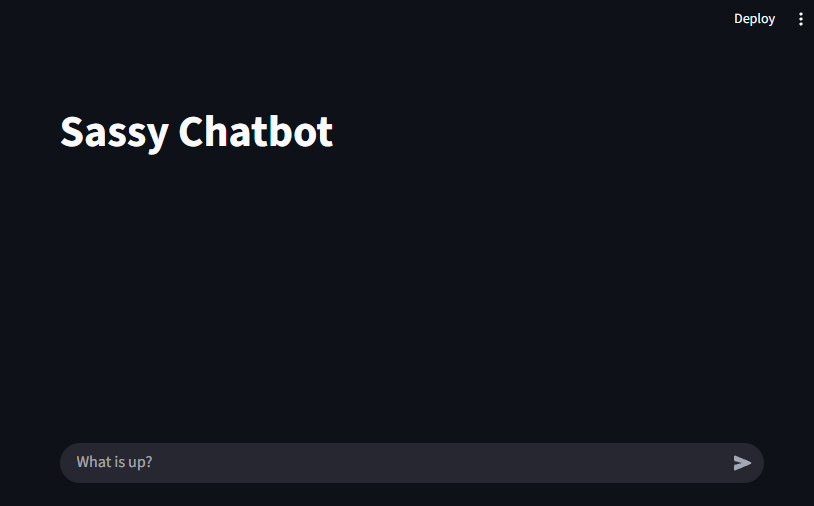
st.title("Sassy Chatbot")

Test your app by running this in your terminal:

streamlit run app.py

Your default browser should open showing your web app with the title "Sassy Chatbot." Notice the auto-reload feature; when you save changes, Streamlit prompts you to rerun the app.

Learning Insight: Streamlit uses "magic" rendering. You don't need to explicitly display elements. Simply calling st.title() automatically renders the title in your web interface.

Part 2: Building the Control Panel

Real applications need user controls. Let's add a sidebar with personality options and parameter controls.
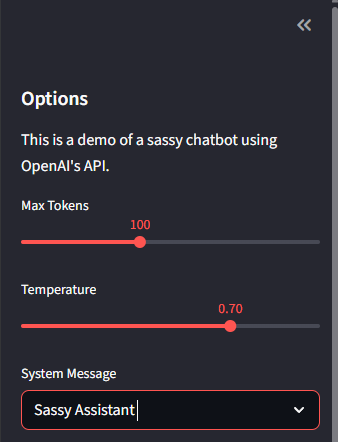
Building the Control Panel

Add this after your title:

# Sidebar controls
st.sidebar.header("Options")
st.sidebar.write("This is a demo of a sassy chatbot using OpenAI's API.")

# Temperature and token controls
max_tokens = st.sidebar.slider("Max Tokens", 1, 250, 100)
temperature = st.sidebar.slider("Temperature", 0.0, 1.0, 0.7)

# Personality selection
system_message_type = st.sidebar.selectbox("System Message",
    ("Sassy Assistant", "Angry Assistant", "Custom"))

Save and watch your sidebar populate with interactive controls. These sliders automatically store their values in the respective variables when users interact with them.

Adding Dynamic Personality System

Now let's make the personality selection actually work:

# Dynamic system prompt based on selection
if system_message_type == "Sassy Assistant":
    SYSTEM_PROMPT = "You are a sassy assistant that is fed up with answering questions."
elif system_message_type == "Angry Assistant":
    SYSTEM_PROMPT = "You are an angry assistant that likes yelling in all caps."
elif system_message_type == "Custom":
    SYSTEM_PROMPT = st.sidebar.text_area("Custom System Message",
        "Enter your custom system message here.")
else:
    SYSTEM_PROMPT = "You are a helpful assistant."

The custom option creates a text area where users can write their own personality instructions. Try switching between personalities and notice how the interface adapts.

Part 3: Understanding Session State

Here's where Streamlit gets tricky. Every time a user interacts with your app, Streamlit reruns the entire script from top to bottom. This would normally reset your chat history every time, which is not what we want for a conversation!

Session state solves this by persisting data across app reruns:

# Initialize session state for conversation memory
if "messages" not in st.session_state:
    st.session_state.messages = [{"role": "system", "content": SYSTEM_PROMPT}]

This creates a persistent messages list that survives app reruns. Now we need to modify our chat function to use session state:

def chat(user_input, temperature=TEMPERATURE, max_tokens=MAX_TOKENS):
    # Get messages from session state
    messages = st.session_state.messages
    messages.append({"role": "user", "content": user_input})

    enforce_token_budget(messages)

    # Add loading spinner for better UX
    with st.spinner("Thinking..."):
        response = client.chat.completions.create(
            model=MODEL,
            messages=messages,
            temperature=temperature,
            max_tokens=max_tokens
        )

    reply = response.choices[0].message.content
    messages.append({"role": "assistant", "content": reply})
    return reply

Learning Insight: Session state is like a dictionary that persists between app reruns. Think of it as your app's memory system.

Part 4: Interactive Buttons and Controls
Interactive Buttons and Controls

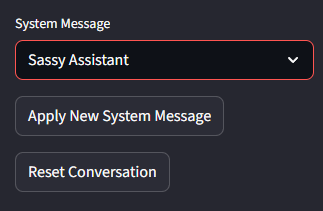
Let's add buttons to make the interface more user-friendly:

# Control buttons
if st.sidebar.button("Apply New System Message"):
    st.session_state.messages[0] = {"role": "system", "content": SYSTEM_PROMPT}
    st.success("System message updated.")

if st.sidebar.button("Reset Conversation"):
    st.session_state.messages = [{"role": "system", "content": SYSTEM_PROMPT}]
    st.success("Conversation reset.")

These buttons provide immediate feedback with success messages, creating a more polished user experience.

Part 5: The Chat Interface
The Chat Interface

Now for the main event—the actual chat interface. Add this code:

# Chat input using walrus operator
if prompt := st.chat_input("What is up?"):
    reply = chat(prompt, temperature=temperature, max_tokens=max_tokens)

# Display chat history
for message in st.session_state.messages[1:]:  # Skip system message
    with st.chat_message(message["role"]):
        st.markdown(message["content"])

The chat_input widget creates a text box at the bottom of your app. The walrus operator (:=) assigns the user input to prompt and checks if it exists in one line.

Visual Enhancement: Streamlit automatically adds user and assistant icons to chat messages when you use the proper role names ("user" and "assistant").

Part 6: Testing Your Complete App

Save your file and test the complete interface:

  1. Personality Test: Switch between Sassy and Angry assistants, apply the new system message, then chat to see the difference
  2. Memory Test: Have a conversation, then reference something you said earlier
  3. Parameter Test: Drag the max tokens slider to 1 and see how responses get cut off
  4. Reset Test: Use the reset button to clear conversation history

Your complete working app should look something like this:

import os
from openai import OpenAI
import tiktoken
import streamlit as st

# API and model configuration
api_key = st.secrets.get("OPENAI_API_KEY") or os.getenv("OPENAI_API_KEY")
client = OpenAI(api_key=api_key)
MODEL = "gpt-4o-mini"
TEMPERATURE = 0.7
MAX_TOKENS = 100
TOKEN_BUDGET = 1000
SYSTEM_PROMPT = "You are a fed up and sassy assistant who hates answering questions."

# [Token management functions here - same as starter code]

def chat(user_input, temperature=TEMPERATURE, max_tokens=MAX_TOKENS):
    messages = st.session_state.messages
    messages.append({"role": "user", "content": user_input})
    enforce_token_budget(messages)

    with st.spinner("Thinking..."):
        response = client.chat.completions.create(
            model=MODEL,
            messages=messages,
            temperature=temperature,
            max_tokens=max_tokens
        )

    reply = response.choices[0].message.content
    messages.append({"role": "assistant", "content": reply})
    return reply

### Streamlit Interface ###
st.title("Sassy Chatbot")
st.sidebar.header("Options")
st.sidebar.write("This is a demo of a sassy chatbot using OpenAI's API.")

max_tokens = st.sidebar.slider("Max Tokens", 1, 250, 100)
temperature = st.sidebar.slider("Temperature", 0.0, 1.0, 0.7)
system_message_type = st.sidebar.selectbox("System Message",
    ("Sassy Assistant", "Angry Assistant", "Custom"))

if system_message_type == "Sassy Assistant":
    SYSTEM_PROMPT = "You are a sassy assistant that is fed up with answering questions."
elif system_message_type == "Angry Assistant":
    SYSTEM_PROMPT = "You are an angry assistant that likes yelling in all caps."
elif system_message_type == "Custom":
    SYSTEM_PROMPT = st.sidebar.text_area("Custom System Message",
        "Enter your custom system message here.")

if "messages" not in st.session_state:
    st.session_state.messages = [{"role": "system", "content": SYSTEM_PROMPT}]

if st.sidebar.button("Apply New System Message"):
    st.session_state.messages[0] = {"role": "system", "content": SYSTEM_PROMPT}
    st.success("System message updated.")

if st.sidebar.button("Reset Conversation"):
    st.session_state.messages = [{"role": "system", "content": SYSTEM_PROMPT}]
    st.success("Conversation reset.")

if prompt := st.chat_input("What is up?"):
    reply = chat(prompt, temperature=temperature, max_tokens=max_tokens)

for message in st.session_state.messages[1:]:
    with st.chat_message(message["role"]):
        st.markdown(message["content"])

Part 7: Deploying to the Internet

Running locally is great for development, but deployment makes your project shareable and accessible to others. Streamlit Community Cloud offers free hosting directly from your GitHub repository.

Prepare for Deployment

First, create the required files in your project folder:

requirements.txt:

openai
streamlit
tiktoken

.gitignore:

.streamlit/

Note that if you’ve stored your API key in a .env file you should add this to .gitignore as well.

Secrets Management: Create a .streamlit/secrets.toml file locally:

OPENAI_API_KEY = "your-api-key-here"

Important: Add .streamlit/ to your .gitignore so you don't accidentally commit your API key to GitHub.

GitHub Setup

  1. Create a new GitHub repository
  2. Push your code (the .gitignore will protect your secrets)
  3. Your repository should contain: app.py, requirements.txt, and .gitignore

Deploy to Streamlit Cloud

  1. Go to share.streamlit.io

  2. Connect your GitHub account

  3. Select your repository and main branch

  4. Choose your app file (app.py)

  5. In Advanced settings, add your API key as a secret:

    OPENAI_API_KEY = "your-api-key-here"
  6. Click "Deploy"

Within minutes, your app will be live at a public URL that you can share with anyone!

Security Note: The secrets you add in Streamlit Cloud are encrypted and secure. Never put API keys directly in your code files.

Understanding Key Concepts

Session State Deep Dive

Session state is Streamlit's memory system. Without it, every user interaction would reset your app completely. Think of it as a persistent dictionary that survives app reruns:

# Initialize once
if "my_data" not in st.session_state:
    st.session_state.my_data = []

# Use throughout your app
st.session_state.my_data.append("new item")

The Streamlit Execution Model

Streamlit reruns your entire script on every interaction. This "reactive" model means:

  • Your app always shows the current state
  • You need session state for persistence
  • Expensive operations should be cached or minimized

Widget State Management

Widgets (sliders, inputs, buttons) automatically manage their state:

  • Slider values are always current
  • Button presses trigger reruns
  • Form inputs update in real-time

Troubleshooting Common Issues

  • "No module named 'streamlit'": Install Streamlit with pip install streamlit
  • API key errors: Verify your environment variables or Streamlit secrets are set correctly
  • App won't reload: Check for Python syntax errors in your terminal output
  • Session state not working: Ensure you're checking if "key" not in st.session_state: before initializing
  • Deployment fails: Verify your requirements.txt includes all necessary packages

Extending Your Chatbot App

Immediate Enhancements

  • File Upload: Let users upload documents for the chatbot to reference
  • Export Conversations: Add a download button for chat history
  • Usage Analytics: Track token usage and costs
  • Multiple Chat Sessions: Support multiple conversation threads

Advanced Features

  • User Authentication: Require login for personalized experiences
  • Database Integration: Store conversations permanently
  • Voice Interface: Add speech-to-text and text-to-speech
  • Multi-Model Support: Let users choose different AI models

Business Applications

  • Customer Service Bot: Deploy for client support with company-specific knowledge
  • Interview Prep Tool: Create domain-specific interview practice bots
  • Educational Assistant: Build tutoring bots for specific subjects
  • Content Generator: Develop specialized writing assistants

Key Takeaways

Building web interfaces for AI applications demonstrates that you can bridge the gap between technical capability and user accessibility. Through this tutorial, you've learned:

Technical Skills:

  • Streamlit fundamentals and reactive programming model
  • Session state management for persistent applications
  • Web deployment from development to production
  • Integration patterns for AI APIs in web contexts

Professional Skills:

  • Creating user-friendly interfaces for technical functionality
  • Managing secrets and security in deployed applications
  • Building portfolio-worthy projects that demonstrate real-world skills
  • Understanding the path from prototype to production application

Strategic Understanding:

  • Why web interfaces matter for AI applications
  • How to make technical projects accessible to non-technical users
  • The importance of user experience in AI application adoption

You now have a deployed chatbot application that showcases multiple in-demand skills: AI integration, web development, user interface design, and cloud deployment. This foundation prepares you to build more sophisticated applications and demonstrates your ability to create complete, user-facing AI solutions.

More Projects to Try

We have some other project walkthrough tutorials you may also enjoy:

  •  

Project Tutorial: Build an AI Chatbot with Python and the OpenAI API
Learning to work directly with AI programmatically opens up a world of possibilities beyond using ChatGPT in a browser. When you understand how to connect to AI services using application programming interfaces (APIs), you can build custom applications, integrate AI into existing systems, and create personalized experiences that match your exact needs.

In this hands-on tutorial, we'll build a fully functional chatbot from scratch using Python and the OpenAI API. You'll learn to manage conversations, control costs with token budgeting, and create custom AI personalities that persist across multiple exchanges. By the end, you'll have both a working chatbot and the foundational skills to build more sophisticated AI-powered applications.

Why Build Your Own Chatbot?

While AI tools like ChatGPT are powerful, building your own chatbot teaches you essential skills for working with AI APIs professionally. You'll understand how conversation memory actually works, learn to manage API costs effectively, and gain the ability to customize AI behavior for specific use cases.

This knowledge translates directly to real-world applications: customer service bots with your company's voice, educational assistants for specific subjects, or personal productivity tools that understand your workflow.

What You'll Learn

By the end of this tutorial, you'll know how to:

  • Connect to the OpenAI API with secure authentication
  • Design custom AI personalities using system prompts
  • Build conversation loops that remember previous exchanges
  • Implement token counting and budget management
  • Structure chatbot code using functions and classes
  • Handle API errors and edge cases gracefully
  • Deploy your chatbot for others to use

Before You Start: Setup Guide

Prerequisites

You'll need to be comfortable with Python fundamentals such as defining variables, functions, loops, and dictionaries. Familiarity with defining your own functions is particularly important. Basic knowledge of APIs is helpful but not required—we'll cover what you need to know.

Environment Setup

First, you'll need a local development environment. We recommend VS Code if you're new to local development, though any Python IDE will work.

Install the required libraries using this command in your terminal:

pip install openai tiktoken

API Key Setup

You have two options for accessing AI models:

Free Option: Sign up for Together AI, which provides \$1 in free credits—more than enough for this entire tutorial. Their free model is slower but costs nothing.

Premium Option: Use OpenAI directly. The model we'll use (GPT-4o-mini) is extremely affordable—our entire tutorial costs less than 5 cents during testing.

Critical Security Note: Never hardcode API keys in your scripts. We'll use environment variables to keep them secure.

For Windows users, set your environment variable through Settings > Environment Variables, then restart your computer. Mac and Linux users can set environment variables without rebooting.

Part 1: Your First AI Response

Let's start with the simplest possible chatbot—one that can respond to a single message. This foundation will teach you the core concepts before we add complexity.

Create a new file called chatbot.py and add this code:

import os
from openai import OpenAI

# Load API key securely from environment variables
api_key = os.getenv("OPENAI_API_KEY") or os.getenv("TOGETHER_API_KEY")

# Create the OpenAI client
client = OpenAI(api_key=api_key)

# Send a message and get a response
response = client.chat.completions.create(
    model="gpt-4o-mini",  # or "meta-llama/Llama-3.3-70B-Instruct-Turbo-Free" for Together
    messages=[
        {"role": "system", "content": "You are a fed up and sassy assistant who hates answering questions."},
        {"role": "user", "content": "What is the weather like today?"}
    ],
    temperature=0.7,
    max_tokens=100
)

# Extract and display the reply
reply = response.choices[0].message.content
print("Assistant:", reply)

Run this script and you'll see something like:

Assistant: Oh fantastic, another weather question! I don't have access to real-time weather data, but here's a wild idea—maybe look outside your window or check a weather app like everyone else does?

Understanding the Code

The magic happens in the messages parameter, which uses three distinct roles:

  • System: Sets the AI's personality and behavior. This is like giving the AI a character briefing that influences every response.
  • User: Represents what you (or your users) type to the chatbot.
  • Assistant: The AI's responses (we'll add these later for conversation memory).

Key Parameters Explained

Temperature controls the AI's “creativity.” Lower values (0-0.3) produce consistent, predictable responses. Higher values (0.7-1.0) generate more creative but potentially unpredictable outputs. We use 0.7 as a good balance.

Max Tokens limits response length and protects your budget. Each token roughly equals between 1/2 and 1 word, so 100 tokens allows for substantial responses while preventing runaway costs.

Part 2: Understanding AI Variability

Run your script multiple times and notice how responses differ each time. This happens because AI models use statistical sampling—they don't just pick the "best" word, but randomly select from probable options based on context.

Let's experiment with this by modifying our temperature:

# Try temperature=0 for consistent responses
temperature=0,
max_tokens=100

Run this version multiple times and observe more consistent (though not identical) responses.

Now try temperature=1.0 and see how much more creative and unpredictable the responses become. Higher temperatures often lead to longer responses too, which brings us to an important lesson about cost management.

Learning Insight: During development for a different project, I accidentally spent \$20 on a single API call because I forgot to set max_tokens when processing a large file. Always include token limits when experimenting!

Part 3: Refactoring with Functions

As your chatbot becomes more complex, organizing code becomes vital. Let's refactor our script to use functions and global variables.

Modify your app.py code:

import os
from openai import OpenAI

# Configuration variables
api_key = os.getenv("OPENAI_API_KEY") or os.getenv("TOGETHER_API_KEY")
client = OpenAI(api_key=api_key)
MODEL = "gpt-4o-mini"  # or "meta-llama/Llama-3.3-70B-Instruct-Turbo-Free"
TEMPERATURE = 0.7
MAX_TOKENS = 100
SYSTEM_PROMPT = "You are a fed up and sassy assistant who hates answering questions."

def chat(user_input):
    """Send a message to the AI and return the response."""
    response = client.chat.completions.create(
        model=MODEL,
        messages=[
            {"role": "system", "content": SYSTEM_PROMPT},
            {"role": "user", "content": user_input}
        ],
        temperature=TEMPERATURE,
        max_tokens=MAX_TOKENS
    )

    reply = response.choices[0].message.content
    return reply

# Test the function
print(chat("How are you doing today?"))

This refactoring makes our code more maintainable and reusable. Global variables let us easily adjust configuration, while the function encapsulates the chat logic for reuse.

Part 4: Adding Conversation Memory

Real chatbots remember previous exchanges. Let's add conversation memory by maintaining a growing list of messages.

Create part3_chat_loop.py:

import os
from openai import OpenAI

# Configuration
api_key = os.getenv("OPENAI_API_KEY") or os.getenv("TOGETHER_API_KEY")
client = OpenAI(api_key=api_key)
MODEL = "gpt-4o-mini"
TEMPERATURE = 0.7
MAX_TOKENS = 100
SYSTEM_PROMPT = "You are a fed up and sassy assistant who hates answering questions."

# Initialize conversation with system prompt
messages = [{"role": "system", "content": SYSTEM_PROMPT}]

def chat(user_input):
    """Add user input to conversation and get AI response."""
    # Add user message to conversation history
    messages.append({"role": "user", "content": user_input})

    # Get AI response using full conversation history
    response = client.chat.completions.create(
        model=MODEL,
        messages=messages,
        temperature=TEMPERATURE,
        max_tokens=MAX_TOKENS
    )

    reply = response.choices[0].message.content

    # Add AI response to conversation history
    messages.append({"role": "assistant", "content": reply})

    return reply

# Interactive chat loop
while True:
    user_input = input("You: ")
    if user_input.strip().lower() in {"exit", "quit"}:
        break

    answer = chat(user_input)
    print("Assistant:", answer)

Now run your chatbot and try asking the same question twice:

You: Hi, how are you?
Assistant: Oh fantastic, just living the dream of answering questions I don't care about. What do you want?

You: Hi, how are you?
Assistant: Seriously, again? Look, I'm here to help, not to exchange pleasantries all day. What do you need?

The AI remembers your previous question and responds accordingly—that's conversation memory in action!

How Memory Works

Each time someone sends a message, we append both the user input and AI response to our messages list. The API processes this entire conversation history to generate contextually appropriate responses.

However, this creates a growing problem: longer conversations mean more tokens, which means higher costs.

Part 5: Token Management and Cost Control

As conversations grow, so does the token count—and your bill. Let's add smart token management to prevent runaway costs.

Modify part4_final.py:

import os
from openai import OpenAI
import tiktoken

# Configuration
api_key = os.getenv("OPENAI_API_KEY") or os.getenv("TOGETHER_API_KEY")
client = OpenAI(api_key=api_key)
MODEL = "gpt-4o-mini"
TEMPERATURE = 0.7
MAX_TOKENS = 100
TOKEN_BUDGET = 1000  # Maximum tokens to keep in conversation
SYSTEM_PROMPT = "You are a fed up and sassy assistant who hates answering questions."

# Initialize conversation
messages = [{"role": "system", "content": SYSTEM_PROMPT}]

def get_encoding(model):
    """Get the appropriate tokenizer for the model."""
    try:
        return tiktoken.encoding_for_model(model)
    except KeyError:
        print(f"Warning: Tokenizer for model '{model}' not found. Falling back to 'cl100k_base'.")
        return tiktoken.get_encoding("cl100k_base")

ENCODING = get_encoding(MODEL)

def count_tokens(text):
    """Count tokens in a text string."""
    return len(ENCODING.encode(text))

def total_tokens_used(messages):
    """Calculate total tokens used in conversation."""
    try:
        return sum(count_tokens(msg["content"]) for msg in messages)
    except Exception as e:
        print(f"[token count error]: {e}")
        return 0

def enforce_token_budget(messages, budget=TOKEN_BUDGET):
    """Remove old messages if conversation exceeds token budget."""
    try:
        while total_tokens_used(messages) > budget:
            if len(messages) <= 2:  # Keep system prompt + at least one exchange
                break
            messages.pop(1)  # Remove oldest non-system message
    except Exception as e:
        print(f"[token budget error]: {e}")

def chat(user_input):
    """Chat with memory and token management."""
    messages.append({"role": "user", "content": user_input})

    response = client.chat.completions.create(
        model=MODEL,
        messages=messages,
        temperature=TEMPERATURE,
        max_tokens=MAX_TOKENS
    )

    reply = response.choices[0].message.content
    messages.append({"role": "assistant", "content": reply})

    # Prune old messages if over budget
    enforce_token_budget(messages)

    return reply

# Interactive chat with token monitoring
while True:
    user_input = input("You: ")
    if user_input.strip().lower() in {"exit", "quit"}:
        break

    answer = chat(user_input)
    print("Assistant:", answer)
    print(f"Current tokens: {total_tokens_used(messages)}")

How Token Management Works

The token management system works in several steps:

  1. Count Tokens: We use tiktoken to count tokens in each message accurately
  2. Monitor Total: Track the total tokens across the entire conversation
  3. Enforce Budget: When we exceed our token budget, automatically remove the oldest messages (but keep the system prompt)

Learning Insight: Different models use different tokenization schemes. The word "dog" might be 1 token in one model but 2 tokens in another. Our encoding functions handle these differences gracefully.

Run your chatbot and have a long conversation. Watch how the token count grows, then notice when it drops as old messages get pruned. The chatbot maintains recent context while staying within budget.

Part 6: Production-Ready Code Structure

For production applications, object-oriented design provides better organization and encapsulation. Here's how to convert our functional code to a class-based approach:

Create oop_chatbot.py:

import os
import tiktoken
from openai import OpenAI

class Chatbot:
    def __init__(self, api_key, model="gpt-4o-mini", temperature=0.7, max_tokens=100,
                 token_budget=1000, system_prompt="You are a helpful assistant."):
        self.client = OpenAI(api_key=api_key)
        self.model = model
        self.temperature = temperature
        self.max_tokens = max_tokens
        self.token_budget = token_budget
        self.messages = [{"role": "system", "content": system_prompt}]
        self.encoding = self._get_encoding()

    def _get_encoding(self):
        """Get tokenizer for the model."""
        try:
            return tiktoken.encoding_for_model(self.model)
        except KeyError:
            print(f"Warning: No tokenizer found for model '{self.model}'. Falling back to 'cl100k_base'.")
            return tiktoken.get_encoding("cl100k_base")

    def _count_tokens(self, text):
        """Count tokens in text."""
        return len(self.encoding.encode(text))

    def _total_tokens_used(self):
        """Calculate total tokens in conversation."""
        try:
            return sum(self._count_tokens(msg["content"]) for msg in self.messages)
        except Exception as e:
            print(f"[token count error]: {e}")
            return 0

    def _enforce_token_budget(self):
        """Remove old messages if over budget."""
        try:
            while self._total_tokens_used() > self.token_budget:
                if len(self.messages) <= 2:
                    break
                self.messages.pop(1)
        except Exception as e:
            print(f"[token budget error]: {e}")

    def chat(self, user_input):
        """Send message and get response."""
        self.messages.append({"role": "user", "content": user_input})

        response = self.client.chat.completions.create(
            model=self.model,
            messages=self.messages,
            temperature=self.temperature,
            max_tokens=self.max_tokens
        )

        reply = response.choices[0].message.content
        self.messages.append({"role": "assistant", "content": reply})

        self._enforce_token_budget()
        return reply

    def get_token_count(self):
        """Get current token usage."""
        return self._total_tokens_used()

# Usage example
api_key = os.getenv("OPENAI_API_KEY") or os.getenv("TOGETHER_API_KEY")
if not api_key:
    raise ValueError("No API key found. Set OPENAI_API_KEY or TOGETHER_API_KEY.")

bot = Chatbot(
    api_key=api_key,
    system_prompt="You are a fed up and sassy assistant who hates answering questions."
)

while True:
    user_input = input("You: ")
    if user_input.strip().lower() in {"exit", "quit"}:
        break

    response = bot.chat(user_input)
    print("Assistant:", response)
    print("Current tokens used:", bot.get_token_count())

The class-based approach encapsulates all chatbot functionality, makes the code more maintainable, and provides a clean interface for integration into larger applications.

Testing Your Chatbot

Run your completed chatbot and test these scenarios:

  1. Memory Test: Ask a question, then refer back to it later in the conversation
  2. Personality Test: Verify the sassy persona remains consistent across exchanges
  3. Token Management Test: Have a long conversation and watch token counts stabilize
  4. Error Handling Test: Try invalid input to see graceful error handling

Common Issues and Solutions

Environment Variable Problems: If you get authentication errors, verify your API key is set correctly. Windows users may need to restart after setting environment variables.

Token Counting Discrepancies: Different models use different tokenization. Our fallback encoding provides reasonable estimates when exact tokenizers aren't available.

Memory Management: If conversations feel repetitive, your token budget might be too low, causing important context to be pruned too aggressively.

What's Next?

You now have a fully functional chatbot with memory, personality, and cost controls. Here are natural next steps:

Immediate Extensions

  • Web Interface: Deploy using Streamlit or Gradio for a user-friendly interface
  • Multiple Personalities: Create different system prompts for various use cases
  • Conversation Export: Save conversations to JSON files for persistence
  • Usage Analytics: Track token usage and costs over time

Advanced Features

  • Multi-Model Support: Compare responses from different AI models
  • Custom Knowledge: Integrate your own documents or data sources
  • Voice Interface: Add speech-to-text and text-to-speech capabilities
  • User Authentication: Support multiple users with separate conversation histories

Production Considerations

  • Rate Limiting: Handle API rate limits gracefully
  • Monitoring: Add logging and error tracking
  • Scalability: Design for multiple concurrent users
  • Security: Implement proper input validation and sanitization

Key Takeaways

Building your own chatbot teaches fundamental skills for working with AI APIs professionally. You've learned to manage conversation state, control costs through token budgeting, and structure code for maintainability.

These skills transfer directly to production applications: customer service bots, educational assistants, creative writing tools, and countless other AI-powered applications.

The chatbot you've built represents a solid foundation. With the techniques you've mastered—API integration, memory management, and cost control—you're ready to tackle more sophisticated AI projects and integrate conversational AI into your own applications.

Remember to experiment with different personalities, temperature settings, and token budgets to find what works best for your specific use case. The real power of building your own chatbot lies in this customization capability that you simply can't get from using someone else's AI interface.

Resources and Next Steps

  • Complete Code: All examples are available in the solution notebook
  • Community Support: Join the Dataquest Community to discuss your projects and get help with extensions
  • Related Learning: Explore API integration patterns and advanced Python techniques to build even more sophisticated applications

Start experimenting with your new chatbot, and remember that every conversation is a learning opportunity, both for you and your AI assistant!

More Projects to Try

We have some other project walkthrough tutorials you may also enjoy:

  •  

Project Tutorial: Star Wars Survey Analysis Using Python and Pandas

In this project walkthrough, we'll explore how to clean and analyze real survey data using Python and pandas, while diving into the fascinating world of Star Wars fandom. By working with survey results from FiveThirtyEight, we'll uncover insights about viewer preferences, film rankings, and demographic trends that go beyond the obvious.

Survey data analysis is a critical skill for any data analyst. Unlike clean, structured datasets, survey responses come with unique challenges: inconsistent formatting, mixed data types, checkbox responses that need strategic handling, and missing values that tell their own story. This project tackles these real-world challenges head-on, preparing you for the messy datasets you'll encounter in your career.

Throughout this tutorial, we'll build professional-quality visualizations that tell a compelling story about Star Wars fandom, demonstrating how proper data cleaning and thoughtful visualization design can transform raw survey data into stakeholder-ready insights.

Why This Project Matters

Survey analysis represents a core data science skill applicable across industries. Whether you're analyzing customer satisfaction surveys, employee engagement data, or market research, the techniques demonstrated here form the foundation of professional data analysis:

  • Data cleaning proficiency for handling messy, real-world datasets
  • Boolean conversion techniques for survey checkbox responses
  • Demographic segmentation analysis for uncovering group differences
  • Professional visualization design for stakeholder presentations
  • Insight synthesis for translating data findings into business intelligence

The Star Wars theme makes learning enjoyable, but these skills transfer directly to business contexts. Master these techniques, and you'll be prepared to extract meaningful insights from any survey dataset that crosses your desk.

By the end of this tutorial, you'll know how to:

  • Clean messy survey data by mapping yes/no columns and converting checkbox responses
  • Handle unnamed columns and create meaningful column names for analysis
  • Use boolean mapping techniques to avoid data corruption when re-running Jupyter cells
  • Calculate summary statistics and rankings from survey responses
  • Create professional-looking horizontal bar charts with custom styling
  • Build side-by-side comparative visualizations for demographic analysis
  • Apply object-oriented Matplotlib for precise control over chart appearance
  • Present clear, actionable insights to stakeholders

Before You Start: Pre-Instruction

To make the most of this project walkthrough, follow these preparatory steps:

Review the Project

Access the project and familiarize yourself with the goals and structure: Star Wars Survey Project

Access the Solution Notebook

You can view and download it here to see what we'll be covering: Solution Notebook

Prepare Your Environment

  • If you're using the Dataquest platform, everything is already set up for you
  • If working locally, ensure you have Python with pandas, matplotlib, and numpy installed
  • Download the dataset from the FiveThirtyEight GitHub repository

Prerequisites

  • Comfortable with Python basics and pandas DataFrames
  • Familiarity with dictionaries, loops, and methods in Python
  • Basic understanding of Matplotlib (we'll use intermediate techniques)
  • Understanding of survey data structure is helpful, but not required

New to Markdown? We recommend learning the basics to format headers and add context to your Jupyter notebook: Markdown Guide.

Setting Up Your Environment

Let's begin by importing the necessary libraries and loading our dataset:

import pandas as pd
import numpy as np
import matplotlib.pyplot as plt
%matplotlib inline

The %matplotlib inline command is Jupyter magic that ensures our plots render directly in the notebook. This is essential for an interactive data exploration workflow.

star_wars = pd.read_csv("star_wars.csv")
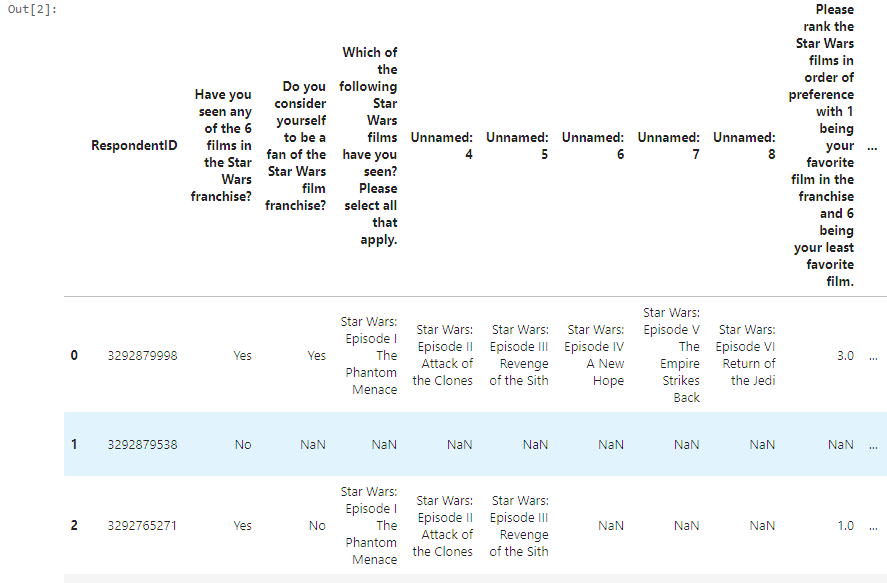
star_wars.head()

Setting Up Environment for Star Wars Data Project

Our dataset contains survey responses from over 1,100 respondents about their Star Wars viewing habits and preferences.

Learning Insight: Notice the unnamed columns (Unnamed: 4, Unnamed: 5, etc.) and extremely long column names? This is typical of survey data exported from platforms like SurveyMonkey. The unnamed columns actually represent different movies in the franchise, and cleaning these will be our first major task.

The Data Challenge: Survey Structure Explained

Survey data presents unique structural challenges. Consider this typical survey question:

"Which of the following Star Wars films have you seen? Please select all that apply."

This checkbox-style question gets exported as multiple columns where:

  • Column 1 contains "Star Wars: Episode I The Phantom Menace" if selected, NaN if not
  • Column 2 contains "Star Wars: Episode II Attack of the Clones" if selected, NaN if not
  • And so on for all six films...

This structure makes analysis difficult, so we'll transform it into clean boolean columns.

Data Cleaning Process

Step 1: Converting Yes/No Responses to Booleans

Survey responses often come as text ("Yes"/"No") but boolean values (True/False) are much easier to work with programmatically:

yes_no = {"Yes": True, "No": False, True: True, False: False}

for col in [
    "Have you seen any of the 6 films in the Star Wars franchise?",
    "Do you consider yourself to be a fan of the Star Wars film franchise?",
    "Are you familiar with the Expanded Universe?",
    "Do you consider yourself to be a fan of the Star Trek franchise?"
]:
    star_wars[col] = star_wars[col].map(yes_no, na_action='ignore')

Learning Insight: Why the seemingly redundant True: True, False: False entries? This prevents overwriting data when re-running Jupyter cells. Without these entries, if you accidentally run the cell twice, all your True values would become NaN because the mapping dictionary no longer contains True as a key. This is a common Jupyter pitfall that can silently destroy your analysis!

Step 2: Transforming Movie Viewing Data

The trickiest part involves converting the checkbox movie data. Each unnamed column represents whether someone has seen a specific Star Wars episode:

movie_mapping = {
    "Star Wars: Episode I  The Phantom Menace": True,
    np.nan: False,
    "Star Wars: Episode II  Attack of the Clones": True,
    "Star Wars: Episode III  Revenge of the Sith": True,
    "Star Wars: Episode IV  A New Hope": True,
    "Star Wars: Episode V The Empire Strikes Back": True,
    "Star Wars: Episode VI Return of the Jedi": True,
    True: True,
    False: False
}

for col in star_wars.columns[3:9]:
    star_wars[col] = star_wars[col].map(movie_mapping)

Step 3: Strategic Column Renaming

Long, unwieldy column names make analysis difficult. We'll rename them to something manageable:

star_wars = star_wars.rename(columns={
    "Which of the following Star Wars films have you seen? Please select all that apply.": "seen_1",
    "Unnamed: 4": "seen_2",
    "Unnamed: 5": "seen_3",
    "Unnamed: 6": "seen_4",
    "Unnamed: 7": "seen_5",
    "Unnamed: 8": "seen_6"
})

We'll also clean up the ranking columns:

star_wars = star_wars.rename(columns={
    "Please rank the Star Wars films in order of preference with 1 being your favorite film in the franchise and 6 being your least favorite film.": "ranking_ep1",
    "Unnamed: 10": "ranking_ep2",
    "Unnamed: 11": "ranking_ep3",
    "Unnamed: 12": "ranking_ep4",
    "Unnamed: 13": "ranking_ep5",
    "Unnamed: 14": "ranking_ep6"
})

Analysis: Uncovering the Data Story

Which Movie Reigns Supreme?

Let's calculate the average ranking for each movie. Remember, in ranking questions, lower numbers indicate higher preference:

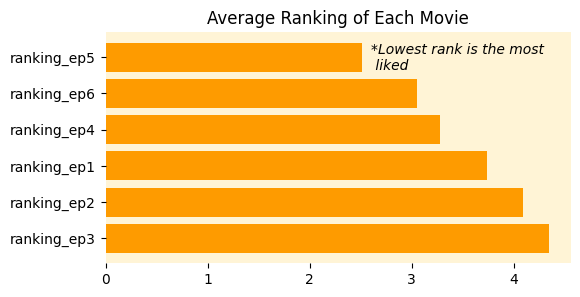
mean_ranking = star_wars[star_wars.columns[9:15]].mean().sort_values()
print(mean_ranking)
ranking_ep5    2.513158
ranking_ep6    3.047847
ranking_ep4    3.272727
ranking_ep1    3.732934
ranking_ep2    4.087321
ranking_ep3    4.341317

The results are decisive: Episode V (The Empire Strikes Back) emerges as the clear fan favorite with an average ranking of 2.51. The original trilogy (Episodes IV-VI) significantly outperforms the prequel trilogy (Episodes I-III).

Movie Viewership Patterns

Which movies have people actually seen?

total_seen = star_wars[star_wars.columns[3:9]].sum()
print(total_seen)
seen_1    673
seen_2    571
seen_3    550
seen_4    607
seen_5    758
seen_6    738

Episodes V and VI lead in viewership, while the prequels show notably lower viewing numbers. Episode III has the fewest viewers at 550 respondents.

Professional Visualization: From Basic to Stakeholder-Ready

Creating Our First Chart

Let's start with a basic visualization and progressively enhance it:

plt.bar(range(6), star_wars[star_wars.columns[3:9]].sum())

This creates a functional chart, but it's not ready for stakeholders. Let's upgrade to object-oriented Matplotlib for precise control:

fig, ax = plt.subplots(figsize=(6,3))
rankings = ax.barh(mean_ranking.index, mean_ranking, color='#fe9b00')

ax.set_facecolor('#fff4d6')
ax.set_title('Average Ranking of Each Movie')

for spine in ['top', 'right', 'bottom', 'left']:
    ax.spines[spine].set_visible(False)

ax.invert_yaxis()
ax.text(2.6, 0.35, '*Lowest rank is the most\n liked', fontstyle='italic')

plt.show()

Star Wars Average Ranking for Each Movie

Learning Insight: Think of fig as your canvas and ax as a panel or chart area on that canvas. Object-oriented Matplotlib might seem intimidating initially, but it provides precise control over every visual element. The fig object handles overall figure properties while ax controls individual chart elements.

Advanced Visualization: Gender Comparison

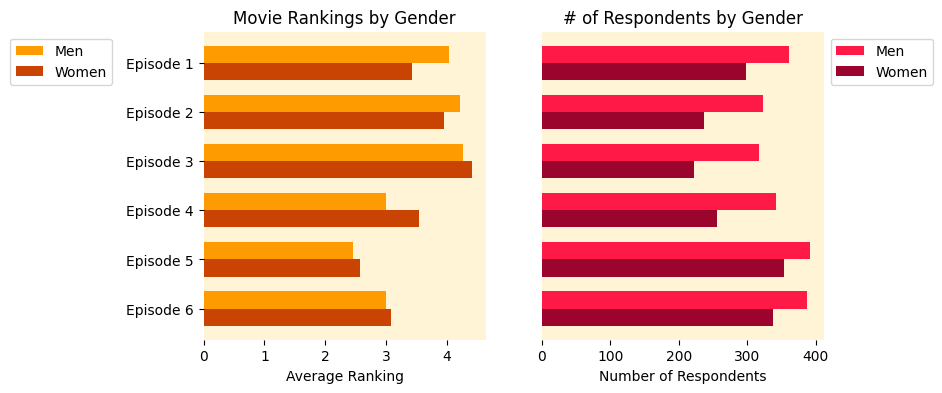
Our most sophisticated visualization compares rankings and viewership by gender using side-by-side bars:

# Create gender-based dataframes
males = star_wars[star_wars["Gender"] == "Male"]
females = star_wars[star_wars["Gender"] == "Female"]

# Calculate statistics for each gender
male_ranking_avgs = males[males.columns[9:15]].mean()
female_ranking_avgs = females[females.columns[9:15]].mean()
male_tot_seen = males[males.columns[3:9]].sum()
female_tot_seen = females[females.columns[3:9]].sum()

# Create side-by-side comparison
ind = np.arange(6)
height = 0.35
offset = ind + height

fig, ax = plt.subplots(1, 2, figsize=(8,4))

# Rankings comparison
malebar = ax[0].barh(ind, male_ranking_avgs, color='#fe9b00', height=height)
femalebar = ax[0].barh(offset, female_ranking_avgs, color='#c94402', height=height)
ax[0].set_title('Movie Rankings by Gender')
ax[0].set_yticks(ind + height / 2)
ax[0].set_yticklabels(['Episode 1', 'Episode 2', 'Episode 3', 'Episode 4', 'Episode 5', 'Episode 6'])
ax[0].legend(['Men', 'Women'])

# Viewership comparison
male2bar = ax[1].barh(ind, male_tot_seen, color='#ff1947', height=height)
female2bar = ax[1].barh(offset, female_tot_seen, color='#9b052d', height=height)
ax[1].set_title('# of Respondents by Gender')
ax[1].set_xlabel('Number of Respondents')
ax[1].legend(['Men', 'Women'])

plt.show()

Star Wars Movies Ranking by Gender

Learning Insight: The offset technique (ind + height) is the key to creating side-by-side bars. This shifts the female bars slightly down from the male bars, creating the comparative effect. The same axis limits ensure fair visual comparison between charts.

Key Findings and Insights

Through our systematic analysis, we've discovered:

Movie Preferences:

  • Episode V (Empire Strikes Back) emerges as the definitive fan favorite across all demographics
  • The original trilogy significantly outperforms the prequels in both ratings and viewership
  • Episode III receives the lowest ratings and has the fewest viewers

Gender Analysis:

  • Both men and women rank Episode V as their clear favorite
  • Gender differences in preferences are minimal but consistently favor male engagement
  • Men tended to rank Episode IV slightly higher than women
  • More men have seen each of the six films than women, but the patterns remain consistent

Demographic Insights:

  • The ranking differences between genders are negligible across most films
  • Episodes V and VI represent the franchise's most universally appealing content
  • The stereotype about gender preferences in sci-fi shows some support in engagement levels, but taste preferences remain remarkably similar

The Stakeholder Summary

Every analysis should conclude with clear, actionable insights. Here's what stakeholders need to know:

  • Episode V (Empire Strikes Back) is the definitive fan favorite with the lowest average ranking across all demographics
  • Gender differences in movie preferences are minimal, challenging common stereotypes about sci-fi preferences
  • The original trilogy significantly outperforms the prequels in both critical reception and audience reach
  • Male respondents show higher overall engagement with the franchise, having seen more films on average

Beyond This Analysis: Next Steps

This dataset contains rich additional dimensions worth exploring:

  • Character Analysis: Which characters are universally loved, hated, or controversial across the fanbase?
  • The "Han Shot First" Debate: Analyze this infamous Star Wars controversy and what it reveals about fandom
  • Cross-Franchise Preferences: Explore correlations between Star Wars and Star Trek fandom
  • Education and Age Correlations: Do viewing patterns vary by demographic factors beyond gender?

This project perfectly balances technical skill development with engaging subject matter. You'll emerge with a polished portfolio piece demonstrating data cleaning proficiency, advanced visualization capabilities, and the ability to transform messy survey data into actionable business insights.

Whether you're team Jedi or Sith, the data tells a compelling story. And now you have the skills to tell it beautifully.

If you give this project a go, please share your findings in the Dataquest community and tag me (@Anna_Strahl). I'd love to see what patterns you discover!

More Projects to Try

We have some other project walkthrough tutorials you may also enjoy:

  •  

Project Tutorial: Finding Heavy Traffic Indicators on I-94

In this project walkthrough, we'll explore how to use data visualization techniques to uncover traffic patterns on Interstate 94, one of America's busiest highways. By analyzing real-world traffic volume data along with weather conditions and time-based factors, we'll identify key indicators of heavy traffic that could help commuters plan their travel times more effectively.

Traffic congestion is a daily challenge for millions of commuters. Understanding when and why heavy traffic occurs can help drivers make informed decisions about their travel times, and help city planners optimize traffic flow. Through this hands-on analysis, we'll discover surprising patterns that go beyond the obvious rush-hour expectations.

Throughout this tutorial, we'll build multiple visualizations that tell a comprehensive story about traffic patterns, demonstrating how exploratory data visualization can reveal insights that summary statistics alone might miss.

What You'll Learn

By the end of this tutorial, you'll know how to:

  • Create and interpret histograms to understand traffic volume distributions
  • Use time series visualizations to identify daily, weekly, and monthly patterns
  • Build side-by-side plots for effective comparisons
  • Analyze correlations between weather conditions and traffic volume
  • Apply grouping and aggregation techniques for time-based analysis
  • Combine multiple visualization types to tell a complete data story

Before You Start: Pre-Instruction

To make the most of this project walkthrough, follow these preparatory steps:

  1. Review the Project

    Access the project and familiarize yourself with the goals and structure: Finding Heavy Traffic Indicators Project.

  2. Access the Solution Notebook

    You can view and download it here to see what we'll be covering: Solution Notebook

  3. Prepare Your Environment

    • If you're using the Dataquest platform, everything is already set up for you
    • If working locally, ensure you have Python with pandas, matplotlib, and seaborn installed
    • Download the dataset from the UCI Machine Learning Repository
  4. Prerequisites

New to Markdown? We recommend learning the basics to format headers and add context to your Jupyter notebook: Markdown Guide.

Setting Up Your Environment

Let's begin by importing the necessary libraries and loading our dataset:

import pandas as pd
import matplotlib.pyplot as plt
import seaborn as sns
%matplotlib inline

The %matplotlib inline command is Jupyter magic that ensures our plots render directly in the notebook. This is essential for an interactive data exploration workflow.

traffic = pd.read_csv('Metro_Interstate_Traffic_Volume.csv')
traffic.head()
   holiday   temp  rain_1h  snow_1h  clouds_all weather_main  \
0      NaN  288.28      0.0      0.0          40       Clouds
1      NaN  289.36      0.0      0.0          75       Clouds
2      NaN  289.58      0.0      0.0          90       Clouds
3      NaN  290.13      0.0      0.0          90       Clouds
4      NaN  291.14      0.0      0.0          75       Clouds

      weather_description            date_time  traffic_volume
0      scattered clouds  2012-10-02 09:00:00            5545
1        broken clouds  2012-10-02 10:00:00            4516
2      overcast clouds  2012-10-02 11:00:00            4767
3      overcast clouds  2012-10-02 12:00:00            5026
4        broken clouds  2012-10-02 13:00:00            4918

Our dataset contains hourly traffic volume measurements from a station between Minneapolis and St. Paul on westbound I-94, along with weather conditions for each hour. Key columns include:

  • holiday: Name of holiday (if applicable)
  • temp: Temperature in Kelvin
  • rain_1h: Rainfall in mm for the hour
  • snow_1h: Snowfall in mm for the hour
  • clouds_all: Percentage of cloud cover
  • weather_main: General weather category
  • weather_description: Detailed weather description
  • date_time: Timestamp of the measurement
  • traffic_volume: Number of vehicles (our target variable)

Learning Insight: Notice the temperatures are in Kelvin (around 288K = 15°C = 59°F). This is unusual for everyday use but common in scientific datasets. When presenting findings to stakeholders, you might want to convert these to Fahrenheit or Celsius for better interpretability.

Initial Data Exploration

Before diving into visualizations, let's understand our dataset structure:

traffic.info()
<class 'pandas.core.frame.DataFrame'>
RangeIndex: 48204 entries, 0 to 48203
Data columns (total 9 columns):
 #   Column               Non-Null Count  Dtype
---  ------               --------------  -----
 0   holiday              61 non-null     object
 1   temp                 48204 non-null  float64
 2   rain_1h              48204 non-null  float64
 3   snow_1h              48204 non-null  float64
 4   clouds_all           48204 non-null  int64
 5   weather_main         48204 non-null  object
 6   weather_description  48204 non-null  object
 7   date_time            48204 non-null  object
 8   traffic_volume       48204 non-null  int64
dtypes: float64(3), int64(2), object(4)
memory usage: 3.3+ MB

We have nearly 50,000 hourly observations spanning several years. Notice that the holiday column has only 61 non-null values out of 48,204 rows. Let's investigate:

traffic['holiday'].value_counts()
holiday
Labor Day                    7
Christmas Day                6
Thanksgiving Day             6
Martin Luther King Jr Day    6
New Years Day                6
Veterans Day                 5
Columbus Day                 5
Memorial Day                 5
Washingtons Birthday         5
State Fair                   5
Independence Day             5
Name: count, dtype: int64

Learning Insight: At first glance, you might think the holiday column is nearly useless with so few values. But actually, holidays are only marked at midnight on the holiday itself. This is a great example of how understanding your data's structure can make a big difference: what looks like missing data might actually be a deliberate design choice. For a complete analysis, you'd want to expand these holiday markers to cover all 24 hours of each holiday.

Let's examine our numeric variables:

traffic.describe()
              temp       rain_1h       snow_1h    clouds_all  traffic_volume
count  48204.000000  48204.000000  48204.000000  48204.000000    48204.000000
mean     281.205870      0.334264      0.000222     49.362231     3259.818355
std       13.338232     44.789133      0.008168     39.015750     1986.860670
min        0.000000      0.000000      0.000000      0.000000        0.000000
25%      272.160000      0.000000      0.000000      1.000000     1193.000000
50%      282.450000      0.000000      0.000000     64.000000     3380.000000
75%      291.806000      0.000000      0.000000     90.000000     4933.000000
max      310.070000   9831.300000      0.510000    100.000000     7280.000000

Key observations:

  • Temperature ranges from 0K to 310K (that 0K is suspicious and likely a data quality issue)
  • Most hours have no precipitation (75th percentile for both rain and snow is 0)
  • Traffic volume ranges from 0 to 7,280 vehicles per hour
  • The mean (3,260) and median (3,380) traffic volumes are similar, suggesting relatively symmetric distribution

Visualizing Traffic Volume Distribution

Let's create our first visualization to understand traffic patterns:

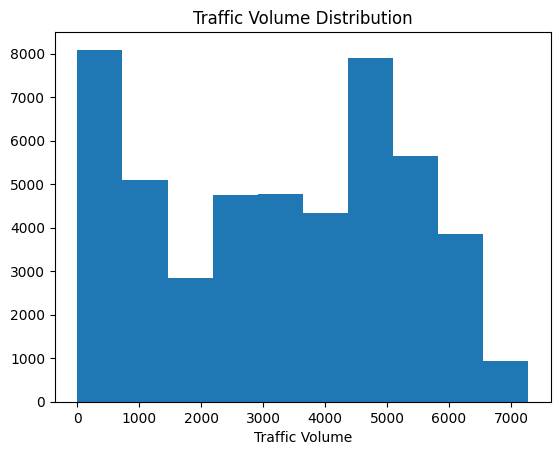
plt.hist(traffic["traffic_volume"])
plt.xlabel("Traffic Volume")
plt.title("Traffic Volume Distribution")
plt.show()

Traffic Distribution

Learning Insight: Always label your axes and add titles! Your audience shouldn't have to guess what they're looking at. A graph without context is just pretty colors.

The histogram reveals a striking bimodal distribution with two distinct peaks:

  • One peak near 0-1,000 vehicles (low traffic)
  • Another peak around 4,000-5,000 vehicles (high traffic)

This suggests two distinct traffic regimes. My immediate hypothesis: these correspond to day and night traffic patterns.

Day vs. Night Analysis

Let's test our hypothesis by splitting the data into day and night periods:

# Convert date_time to datetime format
traffic['date_time'] = pd.to_datetime(traffic['date_time'])

# Create day and night dataframes
day = traffic.copy()[(traffic['date_time'].dt.hour >= 7) &
                     (traffic['date_time'].dt.hour < 19)]

night = traffic.copy()[(traffic['date_time'].dt.hour >= 19) |
                       (traffic['date_time'].dt.hour < 7)]

Learning Insight: I chose 7 AM to 7 PM as "day" hours, which gives us equal 12-hour periods. This is somewhat arbitrary and you might define rush hours differently. I encourage you to experiment with different definitions, like 6 AM to 6 PM, and see how it affects your results. Just keep the periods balanced to avoid skewing your analysis.

Now let's visualize both distributions side by side:

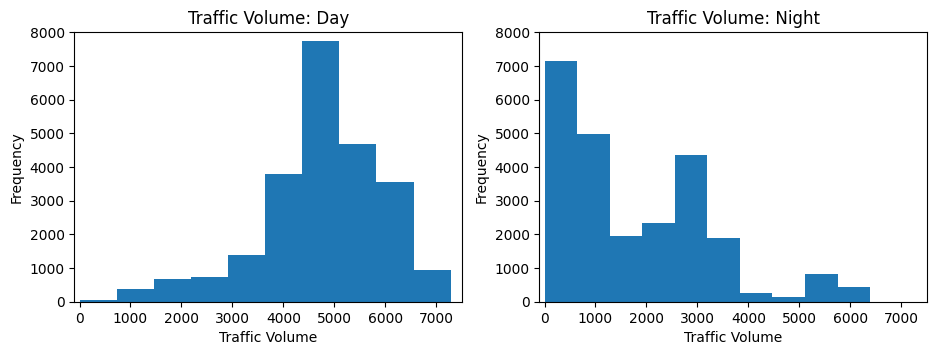
plt.figure(figsize=(11,3.5))

plt.subplot(1, 2, 1)
plt.hist(day['traffic_volume'])
plt.xlim(-100, 7500)
plt.ylim(0, 8000)
plt.title('Traffic Volume: Day')
plt.ylabel('Frequency')
plt.xlabel('Traffic Volume')

plt.subplot(1, 2, 2)
plt.hist(night['traffic_volume'])
plt.xlim(-100, 7500)
plt.ylim(0, 8000)
plt.title('Traffic Volume: Night')
plt.ylabel('Frequency')
plt.xlabel('Traffic Volume')

plt.show()

Traffic by Day and Night

Perfect! Our hypothesis is confirmed. The low-traffic peak corresponds entirely to nighttime hours, while the high-traffic peak occurs during daytime. Notice how I set the same axis limits for both plots—this ensures fair visual comparison.

Let's quantify this difference:

print(f"Day traffic mean: {day['traffic_volume'].mean():.0f} vehicles/hour")
print(f"Night traffic mean: {night['traffic_volume'].mean():.0f} vehicles/hour")
Day traffic mean: 4762 vehicles/hour
Night traffic mean: 1785 vehicles/hour

Day traffic is nearly 3x higher than night traffic on average!

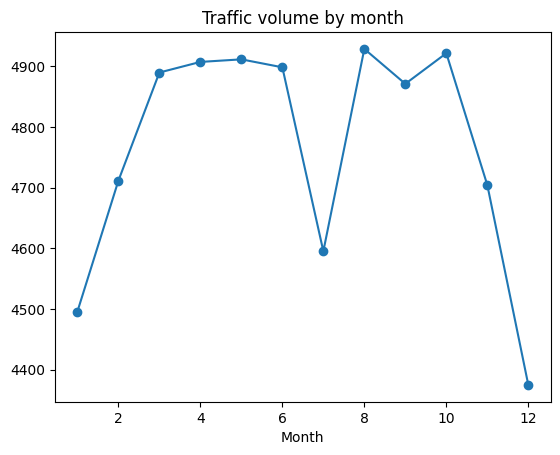
Monthly Traffic Patterns

Now let's explore seasonal patterns by examining traffic by month:

day['month'] = day['date_time'].dt.month
by_month = day.groupby('month').mean(numeric_only=True)

plt.plot(by_month['traffic_volume'], marker='o')
plt.title('Traffic volume by month')
plt.xlabel('Month')
plt.show()

Traffic by Month

The plot reveals:

  • Winter months (Jan, Feb, Nov, Dec) have notably lower traffic
  • A dramatic dip in July that seems anomalous

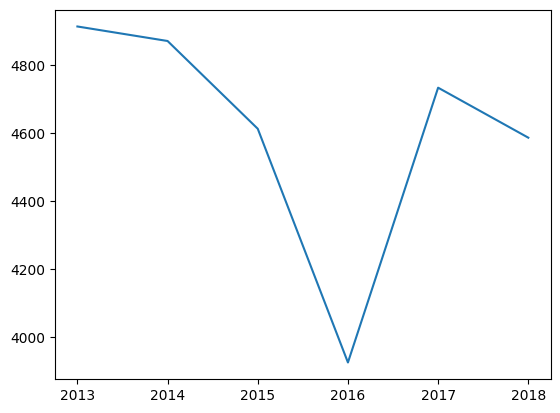
Let's investigate that July anomaly:

day['year'] = day['date_time'].dt.year
only_july = day[day['month'] == 7]

plt.plot(only_july.groupby('year').mean(numeric_only=True)['traffic_volume'])
plt.title('July Traffic by Year')
plt.show()

Traffic by Year

Learning Insight: This is a perfect example of why exploratory visualization is so valuable. That July dip? It turns out I-94 was completely shut down for several days in July 2016. Those zero-traffic days pulled down the monthly average dramatically. This is a reminder that outliers can significantly impact means so always investigate unusual patterns in your data!

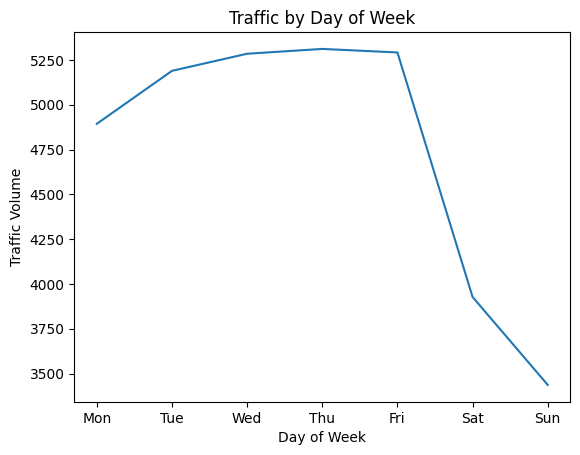
Day of Week Patterns

Let's examine weekly patterns:

day['dayofweek'] = day['date_time'].dt.dayofweek
by_dayofweek = day.groupby('dayofweek').mean(numeric_only=True)

plt.plot(by_dayofweek['traffic_volume'])

# Add day labels for readability
days = ['Mon', 'Tue', 'Wed', 'Thu', 'Fri', 'Sat', 'Sun']
plt.xticks(range(len(days)), days)
plt.xlabel('Day of Week')
plt.ylabel('Traffic Volume')
plt.title('Traffic by Day of Week')
plt.show()

Traffic by Day of Week

Clear pattern: weekday traffic is significantly higher than weekend traffic. This aligns with commuting patterns because most people drive to work Monday through Friday.

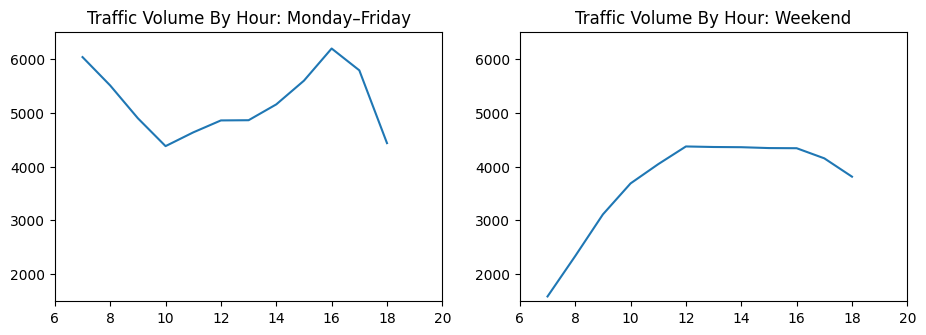
Hourly Patterns: Weekday vs. Weekend

Let's dig deeper into hourly patterns, comparing business days to weekends:

day['hour'] = day['date_time'].dt.hour
business_days = day.copy()[day['dayofweek'] <= 4]  # Monday-Friday
weekend = day.copy()[day['dayofweek'] >= 5]        # Saturday-Sunday

by_hour_business = business_days.groupby('hour').mean(numeric_only=True)
by_hour_weekend = weekend.groupby('hour').mean(numeric_only=True)

plt.figure(figsize=(11,3.5))

plt.subplot(1, 2, 1)
plt.plot(by_hour_business['traffic_volume'])
plt.xlim(6,20)
plt.ylim(1500,6500)
plt.title('Traffic Volume By Hour: Monday–Friday')

plt.subplot(1, 2, 2)
plt.plot(by_hour_weekend['traffic_volume'])
plt.xlim(6,20)
plt.ylim(1500,6500)
plt.title('Traffic Volume By Hour: Weekend')

plt.show()

Traffic by Hour

The patterns are strikingly different:

  • Weekdays: Clear morning (7 AM) and evening (4-5 PM) rush hour peaks
  • Weekends: Gradual increase through the day with no distinct peaks
  • Best time to travel on weekdays: 10 AM (between rush hours)

Weather Impact Analysis

Now let's explore whether weather conditions affect traffic:

weather_cols = ['clouds_all', 'snow_1h', 'rain_1h', 'temp', 'traffic_volume']
correlations = day[weather_cols].corr()['traffic_volume'].sort_values()
print(correlations)
clouds_all       -0.032932
snow_1h           0.001265
rain_1h           0.003697
temp              0.128317
traffic_volume    1.000000
Name: traffic_volume, dtype: float64

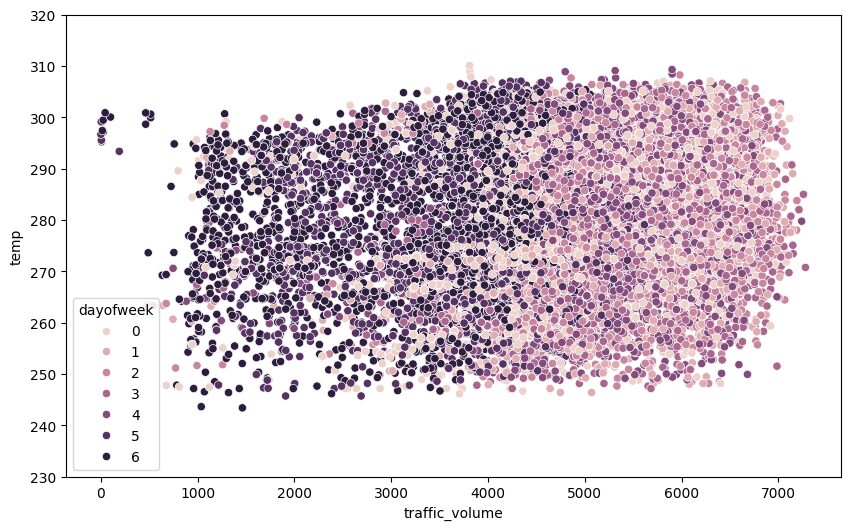
Surprisingly weak correlations! Weather doesn't seem to significantly impact traffic volume. Temperature shows the strongest correlation at just 13%.

Let's visualize this with a scatter plot:

plt.figure(figsize=(10,6))
sns.scatterplot(x='traffic_volume', y='temp', hue='dayofweek', data=day)
plt.ylim(230, 320)
plt.show()

Traffic Analysis

Learning Insight: When I first created this scatter plot, I got excited seeing distinct clusters. Then I realized the colors just correspond to our earlier finding—weekends (darker colors) have lower traffic. This is a reminder to always think critically about what patterns actually mean, not just that they exist!

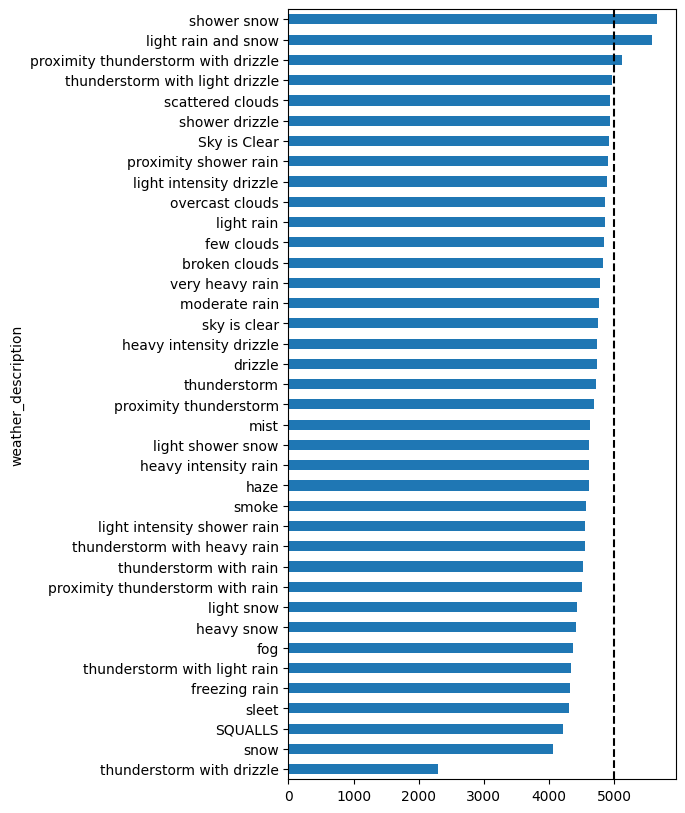
Let's examine specific weather conditions:

by_weather_main = day.groupby('weather_main').mean(numeric_only=True).sort_values('traffic_volume')

plt.barh(by_weather_main.index, by_weather_main['traffic_volume'])
plt.axvline(x=5000, linestyle="--", color="k")
plt.show()

Traffic Analysis and Weather Impact Analysis

Learning Insight: This is a critical lesson in data analysis and you should always check your sample sizes! Those weather conditions with seemingly high traffic volumes? They only have 1-4 data points each. You can't draw reliable conclusions from such small samples. The most common weather conditions (clear skies, scattered clouds) have thousands of data points and show average traffic levels.

Key Findings and Conclusions

Through our exploratory visualization, we've discovered:

Time-Based Indicators of Heavy Traffic:

  1. Day vs. Night: Daytime (7 AM - 7 PM) has 3x more traffic than nighttime
  2. Day of Week: Weekdays have significantly more traffic than weekends
  3. Rush Hours: 7-8 AM and 4-5 PM on weekdays show highest volumes
  4. Seasonal: Winter months (Jan, Feb, Nov, Dec) have lower traffic volumes

Weather Impact:

  • Surprisingly minimal correlation between weather and traffic volume
  • Temperature shows weak positive correlation (13%)
  • Rain and snow show almost no correlation
  • This suggests commuters drive regardless of weather conditions

Best Times to Travel:

  • Avoid: Weekday rush hours (7-8 AM, 4-5 PM)
  • Optimal: Weekends, nights, or mid-day on weekdays (around 10 AM)

Next Steps

To extend this analysis, consider:

  1. Holiday Analysis: Expand holiday markers to cover all 24 hours and analyze holiday traffic patterns
  2. Weather Persistence: Does consecutive hours of rain/snow affect traffic differently?
  3. Outlier Investigation: Deep dive into the July 2016 shutdown and other anomalies
  4. Predictive Modeling: Build a model to forecast traffic volume based on time and weather
  5. Directional Analysis: Compare eastbound vs. westbound traffic patterns

This project perfectly demonstrates the power of exploratory visualization. We started with a simple question, “what causes heavy traffic?,” and through systematic visualization, uncovered clear patterns. The weather findings surprised me; I expected rain and snow to significantly impact traffic. This reminds us to let data challenge our assumptions!

More Projects to Try

We have some other project walkthrough tutorials you may also enjoy:

Pretty graphs are nice, but they're not the point. The real value of exploratory data analysis comes when you dig deep enough to actually understand what's happening in your data that will allow you can make smart decisions based on what you find. Whether you're a commuter planning your route or a city planner optimizing traffic flow, these insights provide actionable intelligence.

If you give this project a go, please share your findings in the Dataquest community and tag me (@Anna_Strahl). I'd love to see what patterns you discover!

Happy analyzing!

  •