
Reading view

Arthur Hayes Sticks To His Extreme Bitcoin Price Prediction for Year-End

Arthur Hayes is standing by his prediction that Bitcoin could reach $200,000–$250,000 by the end of 2025, despite the October–November crash and lingering market fear. 

Speaking on the Milk Road Show on November 26, he said the recent drop to $80,000 marked the cycle bottom and argued that global dollar liquidity has turned a corner.

“I’m going to stick with it,” Hayes said when asked if his $200,000–$250,000 target still holds with only weeks left in the year. “If I’m wrong it doesn’t matter… I’m long, I’m still happy either way.”

Hayes Calls $80,000 the Bottom After Liquidity Shock

Hayes framed the entire move from Bitcoin’s $125,000 high down to $80,000 as a liquidity-driven reset, not the start of a new bear market.

He said his Bloomberg-based US dollar liquidity index showed about $1 trillion drained from dollar money markets between July and now. 

This came from the US Treasury refilling its account and the Federal Reserve continuing quantitative tightening.

People think Bitcoin runs on halving cycles.

Wrong.

It runs on liquidity, politics and the US business cycle. Which hasn’t even started yet.

2026 is where the fireworks starts:
– QT ending
– The US Midterm election
– Booming economy and stock market for reelection purposes
-… pic.twitter.com/aiyOOlODm1

— Quinten | 048.eth (@QuintenFrancois) November 28, 2025

According to Hayes, Bitcoin ignored that liquidity drain for months because ETF inflows and Digital Asset Treasury (DAT) issuances masked the damage. 

Once those flows flipped, he said, Bitcoin “fell down to where it should have been based on the dollar liquidity situation.”

ETF “Institutional Bid” Was Just a Basis Trade

Hayes argued that the widely celebrated ETF bid was badly misunderstood by retail traders.

The largest holders of BlackRock’s IBIT ETF are firms like Brevan Howard, Goldman Sachs, Millennium, Jane Street and Avenue

These are not long-only Bitcoin believers, he stressed, but basis traders exploiting a spread.

“They’re taking the IBIT ETF, they buy it, they pledge it with their broker, then they sell a futures contract… they were making let’s call it 7 to 10% per annum on that trade,” he said. 

As funding rates fell in September and October, those players unwound the trade by selling ETFs and buying back futures, turning ETF flows negative.

Retail investors then misread the outflows as “institutions dumping Bitcoin,” Hayes said, without understanding that institutions were only unwinding a funding strategy.

JP MORGAN IS MOVING BITCOIN INTO THE $318 TRILLION BOND MARKET.

JP Morgan has launched a new structured note that gives investors exposure to Bitcoin through BlackRock’s spot ETF (IBIT).

This matters because it pulls Bitcoin directly into the traditional bond and fixed-income… pic.twitter.com/HZQLM9YgGG

— Bull Theory (@BullTheoryio) November 28, 2025

Hayes also highlighted the role of Digital Asset Treasury companies, which issue stock and debt to buy Bitcoin when their market NAV trades at a premium.

When those stocks fell to par or discount, he said, this model broke. DATs could no longer issue new securities in an accretive way. 

Some even had an incentive to sell Bitcoin and buy back their own shares.

“All we know is that we have essentially bottomed on the liquidity chart and the direction in the future is higher,” he said. “That’s why I believe that the $80,000 dip on Bitcoin recently is the bottom.”

He expects the next leg of liquidity to come less from the Fed and more from the commercial banking system, pointing to early signs of renewed bank lending and political plans for a credit-fuelled industrial build-out.

Why Bitcoin Is “Stuck” Around $90,000 For Now

Asked why Bitcoin still trades near $90,000 if the liquidity outlook is improving, Hayes pointed to uncertainty over how aggressively the new US administration will actually create credit.

Markets, he said, still question how and when another “$10 trillion” of liquidity will materialise. 

Promises about bank lending, industrial policy, and a new Fed chair remain political talk until they turn into concrete programs and flows.

“Once we actually start to see things happen, markets will price a bigger forward on where this dollar liquidity situation is and risk assets like Bitcoin will accelerate their rise in price,” Hayes said.

The post Arthur Hayes Sticks To His Extreme Bitcoin Price Prediction for Year-End appeared first on BeInCrypto.

  •  

BitMine’s Tom Lee and On-Chain Data Signal a Big December Move for Bitcoin

Bitcoin may be approaching a decisive December as liquidity conditions tighten and on-chain metrics shift. BitMine Chairman Tom Lee says the market has been “limping” since the October 10 liquidation shock, but argues the setup now supports a major move before year-end. 

Recent on-chain trends and exchange-collateral data point to similar pressure building beneath the surface.

Liquidity Damage Still Defines the Market

Lee told CNBC that the October event severely damaged market-maker balance sheets. 

He described these firms as the “central banks” of crypto, responsible for depth, spreads, and inventory. When their balance sheets shrink, liquidity contracts for weeks.

WATCH: Tom Lee says “Bitcoin could hit a new all-time high before year-end” pic.twitter.com/13czeJdJeL

— BeInCrypto (@beincrypto) November 27, 2025

This matches market performance since early October. Bitcoin has dropped almost 30% from its $126,000 peak. 

Meanwhile, November has delivered one of the worst monthly performances for both price and ETF flows in years.

Market makers withdrew risk capital after the liquidation wave erased roughly $19 billion of leveraged positions. 

Order-book depth fell sharply across major exchanges, creating air pockets that amplified downside moves. Under such conditions, Bitcoin and Ethereum tend to react earlier to macro stress than equities.

Despite this damage, Lee expects a strong December rally, citing a potential dovish shift from the Federal Reserve.

“Bitcoin makes its best moves in 10 days every year, I think some of those days are still gonna happen before year end,” said Tom Lee.

On-Chain Metrics Show Sellers Losing Control

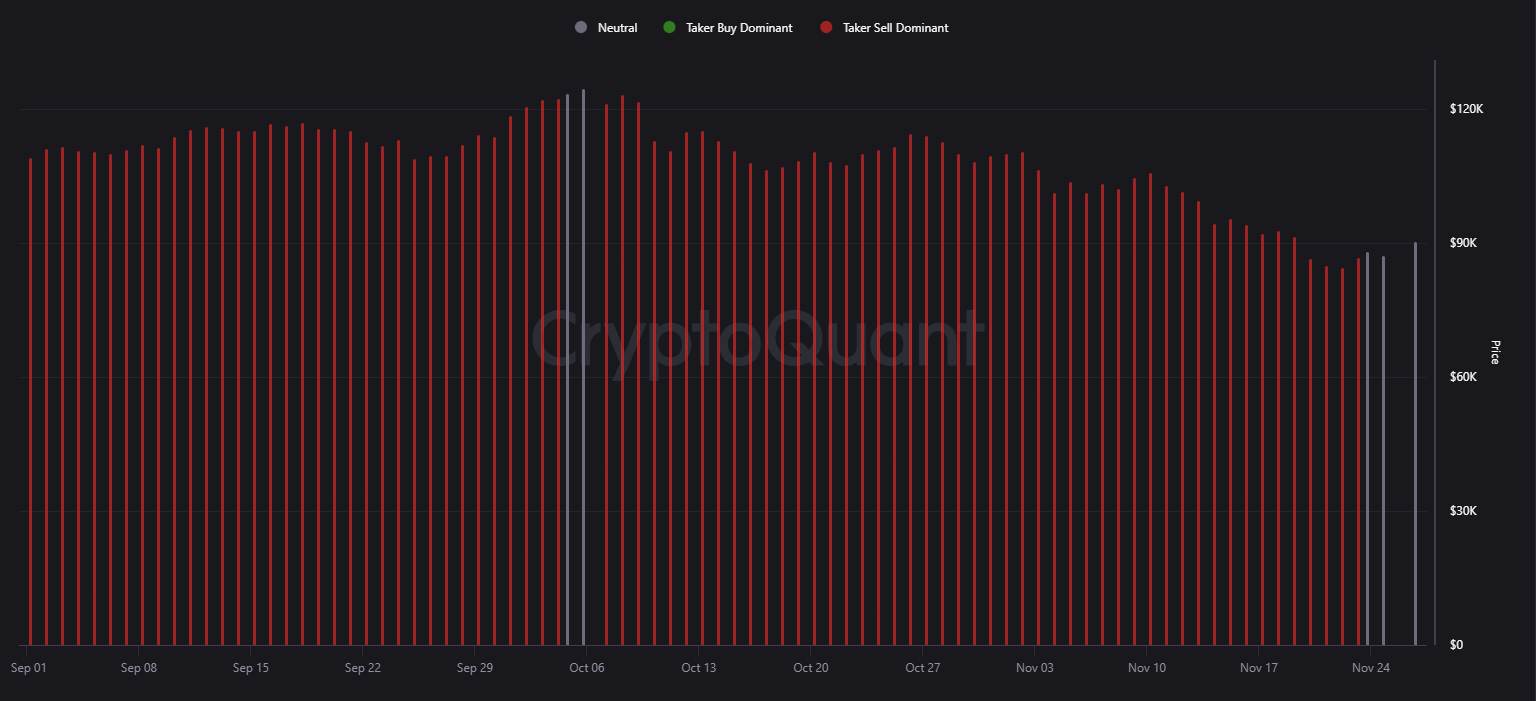
Bitcoin’s 90-day Spot Taker CVD has shifted from persistent sell dominance to a neutral stance. The indicator tracks aggressive market orders on spot exchanges. 

Bitcoin Spot Taker CVD(Cumulative Volume Delta, 90-day). Source: CryptoQuant

Red bars dominated from early September through mid-November, showing sustained taker-sell pressure.

The recent move to neutral marks a break in that pattern. It suggests the aggressive selling phase has exhausted. 

However, it does not show strong buyer dominance. Instead, the market has entered a balanced phase typical of late-cycle bear markets.

Price remains well below October levels, but the absence of persistent taker-sell pressure signals improved stability. 

The shift aligns with the broader leverage reset seen in futures markets, where funding rates have moved near zero.

Borrowing Trends Point to Strong Hands, but Fragile Leverage

CryptoQuant data shows Nexo users prefer borrowing against Bitcoin rather than selling it. BTC accounts for 53% to 57% of all collateral on the platform. That range has held for months despite the drawdown.

'@Nexo users aren’t selling their Bitcoin, they’re borrowing against it.

BTC now accounts for 54.3% of all collateral on the platform, holding a steady 53–57% range for months.

It confirms Bitcoin is the dominant asset users leverage when they need liquidity. pic.twitter.com/bhmL9UdUvO

— CryptoQuant.com (@cryptoquant_com) November 27, 2025

This behavior reduces immediate selling pressure. It also confirms that long-term holders continue to treat Bitcoin as their primary liquidity source. 

Yet it adds another layer of vulnerability. If Bitcoin drops further, collateralized positions face liquidation risk.

Combined with thin order books, any forced selling could produce outsized volatility. This dynamic reflects late-bear fragility rather than early-bull strength.

A Market Caught Between Exhaustion and Low Liquidity

Current market structure reflects a transition rather than a clean reversal. ETF outflows, damaged liquidity, and macro uncertainty keep pressure on prices. 

However, on-chain selling has cooled, and structural holders continue to defend positions.

The result is an environment where small catalysts can produce large moves. 

🚨TOM LEE: YEAR-END RALLY IS COMING

Despite a brutal six weeks, Tom Lee says a STRONG December rally is on deck, backed by by a dovish incoming Fed pivot. pic.twitter.com/G9afNmV0RR

— Coin Bureau (@coinbureau) November 27, 2025

A dovish Fed pivot would likely hit thin order books and accelerate a rebound. Another macro shock could trigger renewed deleveraging.

Lee’s view aligns with this setup. The market has stopped bleeding, but it remains fragile. Bitcoin has a history of delivering double-digit moves in compressed periods, especially after aggressive liquidations.

As December approaches, both liquidity conditions and on-chain data suggest the next large move is near. 

The direction will depend on macro signals and ETF flows rather than sentiment alone.

The post BitMine’s Tom Lee and On-Chain Data Signal a Big December Move for Bitcoin appeared first on BeInCrypto.

  •