Reading view

Perdagangan Crypto Yen Carry Sudah Berakhir? Jepang Sinyal Naikkan Suku Bunga

Imbal hasil obligasi pemerintah Jepang bertenor 2 tahun melonjak menjadi 1% pada 1 Desember, tertinggi sejak 2008. Gubernur Bank of Japan Kazuo Ueda mengisyaratkan kemungkinan kenaikan suku bunga pada pertemuan kebijakan moneter 18-19 Desember, membawa dampak besar ke pasar keuangan global.

Perkembangan ini bisa menjadi akhir dari tiga dekade suku bunga ultra-rendah yang mendukung perdagangan yen carry. Seiring biaya pinjaman naik dan yen menguat, pasar global kini bersiap menghadapi deleveraging signifikan di berbagai kelas aset.

Imbal Hasil Obligasi Naik Seiring Ekspektasi Kenaikan Suku Bunga Meningkat

Pasar obligasi Jepang bergerak tajam mengikuti pernyataan terbaru Ueda. Imbal hasil obligasi bertenor 2 tahun naik satu basis poin menjadi 1%. Obligasi bertenor lebih panjang juga mengalami kenaikan: imbal hasil lima tahun naik sekitar empat basis poin menjadi 1,35%, dan imbal hasil 10 tahun naik menjadi 1,845%, menurut data Bloomberg.

Selama perdagangan, imbal hasil obligasi pemerintah bertenor 10 tahun mencapai 1,850%, level tertinggi sejak Juni 2008. Tingginya selama 17 tahun ini menyoroti keyakinan pasar bahwa BOJ akan mengetatkan kebijakan segera. Perubahan dalam imbal hasil ini mencerminkan perubahan cepat dalam sentimen investor tentang langkah selanjutnya dari bank sentral.
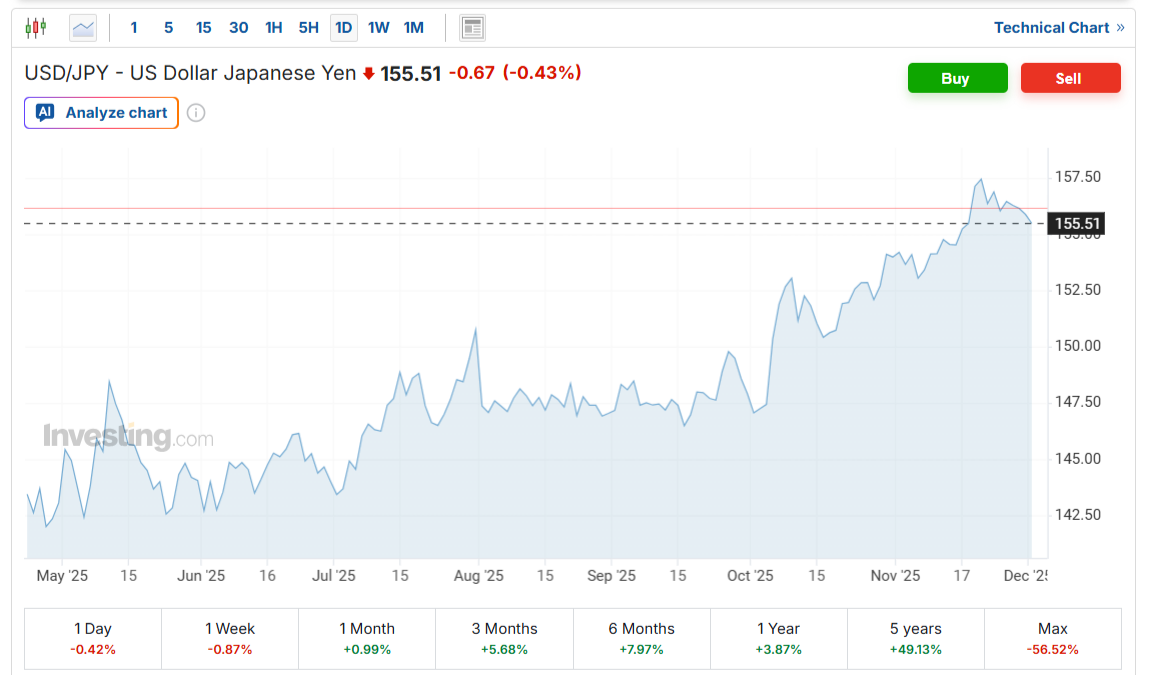
Sumber: investing.com

Pasar merespons dengan cepat. Yen naik sebanyak 0,4% terhadap dolar, diperdagangkan pada 155,49 pada 1 Desember. Pembalikan ini dari level November mencerminkan meningkatnya ekspektasi kenaikan suku bunga Jepang yang membuat aset yen menjadi lebih menarik.

Pada sebuah pertemuan bisnis di Nagoya, Ueda menyatakan bahwa berkurangnya ketidakpastian seputar ekonomi AS dan tarif meningkatkan kepercayaan terhadap prospek ekonomi dan harga Jepang. Dia menegaskan kembali bahwa perubahan suku bunga yang tepat waktu adalah kunci untuk stabilitas keuangan dan pencapaian target inflasi 2%.

Inflasi dan Kebijakan Fiskal Dorong Pergeseran Menuju Pengetatan

Kebijakan fiskal expansif pemerintah menambah tekanan inflasi, membangun alasan untuk pengetatan moneter. Depresiasi yen telah mengangkat harga impor, memicu inflasi konsumen dan menimbulkan pertanyaan tentang keberlanjutan stabilitas harga. Gubernur Ueda menyoroti dampak meluas dari yen yang lebih lemah pada biaya impor dan memperingatkan bahwa ekspektasi tersebut dapat mempengaruhi inflasi inti.

Perkiraan pasar sekarang menunjukkan tingkat kebijakan BOJ dapat mencapai 1,4% setelah tiga kali kenaikan 25 basis poin dari tingkat saat ini 0,5%. Berdasarkan tingkat Overnight Indexed Swap dan tarif maju 1 tahun, ekspektasi jelas meningkat. Katsutoshi Inatome dari Mitsui Sumitomo Trust mengatakan bahwa kenaikan pada bulan Desember akan mendorong perkiraan tingkat di masa depan menjadi lebih tinggi.

BOJ menghadapi keseimbangan yang hati-hati. Sementara menaikkan suku bunga membantu mengatasi inflasi dan mendukung mata uang, ini bisa mengganggu arus keuangan yang mengandalkan pendanaan Jepang yang murah. Ueda menekankan bahwa setiap kenaikan akan diukur dengan cara yang akomodatif, bukan sebagai pemutusan tajam. Dia menambahkan bahwa kebijakan Jepang telah menghidupkan kembali sistem di mana upah dan harga dapat naik secara moderat.

Pasar Global Bereaksi Saat Yen Carry Trade Hampir Berakhir

Pembatalan yen carry trade yang mungkin menandai perubahan signifikan bagi keuangan global. Selama 30 tahun, investor meminjam yen dengan suku bunga rendah untuk mencari pengembalian yang lebih tinggi di tempat lain, mendukung harga aset dari saham AS hingga obligasi pasar berkembang. Ini memberikan leverage yang memicu banyak reli pasar.

Seiring naiknya suku bunga Jepang, ekonomi perdagangan carry berubah. Peminjam yang mengunci pendanaan 1% dengan yen yang stabil kini menghadapi pembayaran kembali pada 3% dan mata uang yang telah menguat 10%. Ini meningkatkan biaya pinjaman efektif menjadi sekitar 13%, membuat perdagangan tersebut jauh kurang menarik. Kejatuhan pasar kilat di bulan Agustus 2024 memberikan gambaran tentang gejolak yang dapat terjadi ketika posisi perdagangan carry berakhir dengan cepat.

“Selama 30 tahun, Yen Carry Trade menyediakan subsidi bagi keangkuhan global — suku bunga nol… leverage gratis… pertumbuhan palsu… seluruh ekonomi dibangun dengan waktu dan uang pinjaman. Kini Jepang telah membalikkan sakelar. Suku bunga naik. Yen menguat. Dan ATM favorit dunia baru saja berubah menjadi penagih utang.” – AlgoBoffin

Nikkei 225 jatuh 1,88% saat deleveraging dimulai, dan analis memperingatkan bahwa ini bisa memulai siklus penjualan aset paksa. Ketika pembiayaan yen murah menghilang, pasar harus mengandalkan kekuatan fundamental daripada leverage. Dampaknya meluas melampaui Jepang, mempengaruhi pusat keuangan seperti Wall Street dan Shanghai yang mendapatkan manfaat dari likuiditas yang didorong yen.

Pasar mata uang kripto terutama rentan terhadap likuiditas global yang lebih ketat. Bitcoin dan aset digital lainnya merespons dengan tajam terhadap perubahan pendanaan. Biasanya, aset risiko menyerap gelombang pertama volatilitas saat likuiditas mengering, yang berpotensi menyebabkan pergerakan tajam dalam valuasi kripto.

These **three charts together (Japan 10Y + Silver + Bitcoin)** are telling one of the **clearest macro stories of our lifetime**.

## **1️⃣ Japan 10-Year Yield (The Beginning of the End of “Free Money”)**

For 30+ years, Japan kept interest rates near **zero**.
This created the… pic.twitter.com/JBIOu3SrwS

— ajay patel (@ajaycan) December 1, 2025

Beberapa analis berpendapat bahwa transisi ini mengungkapkan dinamika pasar yang mendasar yang telah tertutupi oleh bertahun-tahun kebijakan moneter longgar. Seiring likuiditas mengetat dan suku bunga normal, harga aset mungkin dinilai lebih pada nilai intrinsiknya daripada pendanaan murah. Pergeseran ini bisa menguntungkan beberapa komoditas dan aset keras, tapi menantang sektor pertumbuhan yang berkembang dengan suku bunga ultra-rendah.

Minggu-minggu mendatang sangat penting saat BOJ mempertimbangkan keputusan Desembernya. Pasar siap untuk pengetatan, tetapi kecepatannya belum diketahui. Apakah Jepang memilih kenaikan suku bunga secara bertahap atau lebih tajam akan membentuk seberapa cepat dan parahnya deleveraging global berlangsung. Era uang Jepang gratis sepertinya berakhir, membuka periode volatilitas lebih tinggi dan pengawasan lebih ketat atas fundamental pasar di seluruh dunia.


  •  

Yen Carry Crypto Trading Over? Japan Signals Rate Hike

Japan’s 2-year government bond yield surged to 1% on December 1, its highest since 2008. Bank of Japan Governor Kazuo Ueda signaled a possible interest rate hike at the December 18-19 monetary policy meeting, sending ripples through global financial markets.

This development could mark the end of three decades of ultra-low interest rates that fueled the yen carry trade. As borrowing costs rise and the yen strengthens, global markets now brace for significant deleveraging across asset classes.

Bond Yields Climb as Rate Hike Expectations Grow

Japan’s bond market moved sharply following Ueda’s recent statements. The 2-year note yield rose by one basis point to 1%. Longer-dated bonds also saw gains: five-year yields rose about four basis points to 1.35%, and 10-year yields climbed to 1.845%, according to Bloomberg data.

During trading, 10-year government bond yields reached 1.850%, their highest level since June 2008. This 17-year high highlights market belief that the BOJ will tighten policy soon. The shift in yields underscores the rapid change in investor sentiment on the central bank’s next move.

Source: investing.com

Markets responded quickly. The yen gained as much as 0.4% against the dollar, trading at 155.49 on December 1. This reversal from November’s levels reflects growing expectations of higher Japanese interest rates, which are making yen assets newly attractive.

At a business meeting in Nagoya, Ueda stated that reduced uncertainty around the US economy and tariffs bolstered confidence in Japan’s economic and price outlook. He reaffirmed that timely rate changes are key for financial stability and meeting the 2% inflation target.

Inflation and Fiscal Policy Drive Shift Toward Tightening

The government’s expansionary fiscal policy has added to inflation pressures, building a case for monetary tightening. Yen depreciation has lifted import prices, fueling consumer inflation and raising questions about the sustainability of price stability. Governor Ueda highlighted the growing impact of a weaker yen on import costs and warned that expectations could affect core inflation.

Market forecasts now suggest the BOJ’s policy rate could reach 1.4% following three 25-basis-point hikes from the current 0.5% rate. Based on Overnight Indexed Swap rates and 1-year forward rates, expectations are clearly rising. Katsutoshi Inatome of Mitsui Sumitomo Trust said that a hike in December would push future rate estimates even higher.

The BOJ faces a careful balance. While lifting rates tackles inflation and supports the currency, it could disrupt financial flows that have relied on cheap Japanese funding. Ueda emphasized that any hike would be measured in an accommodative manner, not as a sharp break. He added that Japanese policy has revived a system where both wages and prices can rise moderately.

Global Markets React as Yen Carry Trade Nears End

The possible unwinding of the yen carry trade marks a significant change for global finance. For 30 years, investors borrowed yen at low rates to seek higher returns elsewhere, supporting asset prices from US stocks to emerging market bonds. This provided leverage that fueled many market rallies.

As Japanese rates climb, the economics of the carry trade shift. Borrowers who locked in 1% funding with a stable yen now face repayment at 3% and a currency that has appreciated by 10%. This raises the effective borrowing cost to around 13%, making such trades far less attractive. The August 2024 flash crash previewed the turmoil that can occur when carry trade positions unwind quickly.

“For 30 years, the Yen Carry Trade subsidized global arrogance — zero rates… free leverage… fake growth… entire economies built on borrowed time and borrowed money. Now Japan has reversed the switch. Rates climbed. Yen strengthened. And the world’s favourite ATM just turned into a debt-collector.” – AlgoBoffin

The Nikkei 225 fell 1.88% as deleveraging began, and analysts warn that this could start a cycle of forced asset sales. When cheap yen financing vanishes, markets must rely on fundamental strength instead of leverage. The ripples stretch beyond Japan, impacting financial hubs like Wall Street and Shanghai that benefited from yen-driven liquidity.

Cryptocurrency markets are especially vulnerable to tighter global liquidity. Bitcoin and other digital assets respond sharply to changes in funding. Typically, risk assets absorb the first wave of volatility when liquidity dries up, potentially causing swings in crypto valuations.

These **three charts together (Japan 10Y + Silver + Bitcoin)** are telling one of the **clearest macro stories of our lifetime**.

## **1️⃣ Japan 10-Year Yield (The Beginning of the End of “Free Money”)**

For 30+ years, Japan kept interest rates near **zero**.
This created the… pic.twitter.com/JBIOu3SrwS

— ajay patel (@ajaycan) December 1, 2025

Some analysts argue that this transition exposes underlying market dynamics that have been masked by years of loose monetary policy. As liquidity tightens and rates normalize, asset prices may be judged more on intrinsic value than on cheap financing. This shift could benefit some commodities and hard assets, but challenge growth sectors that flourished with ultra-low rates.

The coming weeks are pivotal as the BOJ considers its December decision. Markets are set for tightening, but the exact pace is unknown. Whether Japan chooses gradual or sharper rate increases will shape how quickly and severely global deleveraging unfolds. The era of free Japanese money seems to be ending, ushering in a period of higher volatility and greater scrutiny of market fundamentals worldwide.

The post Yen Carry Crypto Trading Over? Japan Signals Rate Hike appeared first on BeInCrypto.

  •  

Bitcoin Dips Below $87K: One Week’s Gains Gone in One Candle

Bitcoin briefly plunged below $87,000, wiping out a week’s gains in one session.

The fast selloff triggered $400 million in liquidations within just 60 minutes and pushed the global crypto market capitalization down 4% to $3.04 trillion. Trading activity surged as both retail and institutional investors reacted swiftly to price pressure.

Market Turmoil Sparks Massive Liquidations

Liquidations surged across leveraged positions, reflecting the speed of the downturn. Market data noted $400 million liquidated in just one hour. This rapid wave of losses highlights the risks for traders during sharp price moves.

BREAKING: Bitcoin falls -$4,000 in 2 hours as mass liquidations return.

$400 million worth of levered longs have been liquidated over the last 60 minutes. pic.twitter.com/qKB7MYJapu

— The Kobeissi Letter (@KobeissiLetter) December 1, 2025

Trading volume spiked to over $110 billion as investors adjusted their holdings. Bitcoin’s dominance stood at 57.1%, while Ethereum held 11.3%, according to CoinGecko data.

The Kobeissi Letter attributed the crash to thin weekend liquidity and record-high leverage, saying, “This crypto bear market is still structural in nature. We do NOT view this as a fundamental decline.” The analyst noted that Bitcoin fell $4,000 in minutes with no news. This triggered a domino-effect selloff amplified by mass liquidations of leveraged positions.

Other analysts have warned that Bitcoin’s price pattern resembles earlier bearish cycles. Following a recovery above $90,000 after a drop on November 20, Bitcoin hovered around $91,208.85 on November 28 and maintained support at $90,000 for six days.

Korbot Labs describes that the current price action echoes April 2024, when Bitcoin bounced back above $70,000 only to drop to $57,000 by May and later to $67,000 by June. This pattern suggests that further sideways movement or another correction is possible.

Another analyst cautioned about the risk of deeper losses, noting that a “wipe out” could occur if Bitcoin falls through the $80,000 support level.

“Bitcoin not a good open to start the week! Much closer to becoming 2-1-2d as a measured move. This tends to cause a ‘wipe out’ type move if we successfully break through 80.00. Could see as low as 48k if we see the sellers stick around into the end of this year.”

Technical analysis also points to crucial support zones. Should selling persist, prices could slip much further. A drop to $48,000 would mark a dramatic 45% decline from current levels, but such a move would likely require sustained bearish sentiment.

Asset Rotation Narrative Shapes Sentiment

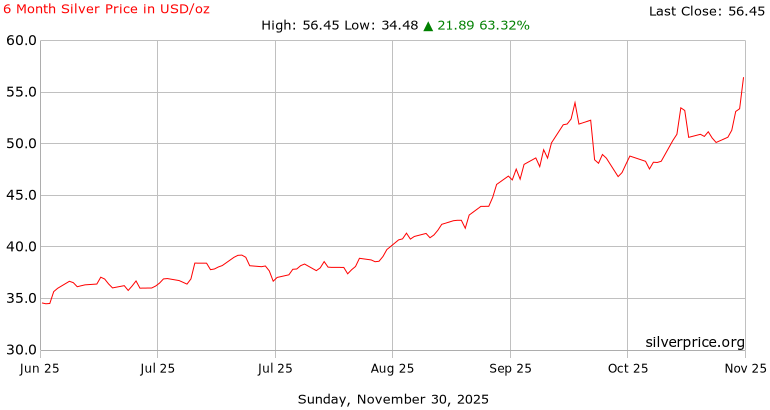
Some analysts see Bitcoin’s selloff as part of a broader shift in asset allocation. The move came as traditional safe-haven assets like precious metals outperformed. This suggests some investors are reconsidering their risk exposure.

Source: silverprice.org

This argument states that capital is flowing from digital assets to “hard money” alternatives. Silver, for example, surged even as Bitcoin fell. Some analysts see this as a sign of changing investor preferences.

“While #Bitcoin just erased most of the last week gain in a single candle, #Silver is breaking out vertically like there’s no tomorrow. Money is choosing real assets over speculative assets. The rotation is screaming loud: Paper wealth → Hard money, Digital risk → Monetary metals” – Macrobysunil

This theory remains hotly debated. Bitcoin has repeatedly rebounded from steep selloffs. Its 57.1% market dominance shows it still attracts most digital asset flows, despite volatility.

Meanwhile, on the first day of December, Bitcoin briefly dipped below $87,000 before quickly recovering. At the time of writing, Bitcoin is trading in the $87,200–$87,400 range, with market participants closely watching whether the $87,000 support level will hold.

The post Bitcoin Dips Below $87K: One Week’s Gains Gone in One Candle appeared first on BeInCrypto.

  •  

What Do Saylor’s Green Dots Mean? Secret Trigger?

MicroStrategy Chairman Michael Saylor’s cryptic post, “What if we start adding green dots?” to his well-known Bitcoin accumulation chart, has fueled widespread speculation across crypto circles.

The signal emerges just as CEO Phong Le publicly acknowledged, for the first time, that the company may sell Bitcoin under certain stress conditions. This dual narrative could mark a turning point for the corporate world’s most aggressive Bitcoin treasury strategy.

Decoding the Green Dots Mystery

Saylor’s Sunday post on X displayed the company’s Bitcoin portfolio chart. It outlined 87 purchase events totaling 649,870 BTC, valued at $59.45 billion, with an average cost of $74,433 per Bitcoin. Orange dots mark each acquisition since August 2020, while a dashed green line shows the average purchase price.

What if we start adding green dots? pic.twitter.com/a19bD33KzD

— Michael Saylor (@saylor) November 30, 2025

The crypto community quickly interpreted the green dots as a signal for accelerated Bitcoin purchases. One analyst summarized the bullish case, noting MicroStrategy has capital, conviction, substantial net asset value, and cash flow to support continued acquisitions. However, some offered alternative theories, including the possibility of stock buybacks or asset restructuring.

This ambiguity reflects Saylor’s history of cryptic messages. Supporters view his posts as deliberate signals of strategy, while skeptics question if they are merely for engagement. Still, the timing of this signal, along with financial disclosures, points to more than mere commentary.

First Admission: Bitcoin Sales Remain an Option

In a significant shift from MicroStrategy’s “never sell” philosophy, CEO Phong Le publicly admitted the company may sell Bitcoin if certain crisis conditions arise. MicroStrategy would consider a sale only if two triggers occur: the stock trades below 1x modified Net Asset Value (mNAV) and the company cannot raise new capital through equity or debt.

People don’t realize how big this is:

1. Strategy has capital

2. conviction is unchanged

3. NAV is strong

4. cash flow supports buys

5. demand could spike

"A Saylor signal is never random."

— George (@ScrewiexD) November 30, 2025

Modified Net Asset Value measures the company’s enterprise value divided by its Bitcoin holdings. As of November 30, 2025, the mNAV was near 0.95, close to the threshold. If it drops below 0.9, MicroStrategy could be pressured to liquidate Bitcoin to meet its $750 to $800 million annual preferred share dividend obligations.

The company issued perpetual preferred stock throughout 2025 to fund Bitcoin acquisitions. According to official press releases, the 8.00% Series A Perpetual Strike Preferred Stock requires quarterly dividends starting on March 31, 2025. These ongoing obligations add new liquidity pressure, especially as equity markets become less receptive to new issuances.

This policy change introduces a measurable risk threshold. Analysts now consider MicroStrategy much like a leveraged Bitcoin ETF: benefiting from appreciation in bull markets, but exposed to amplified risks when liquidity tightens.

Bitcoin Price Movement and Strategic Implications

Bitcoin’s recent price movement adds essential context to both Saylor’s message and Le’s admission.

MicroStrategy’s portfolio showed a 22.91% gain ($11.08 billion) as of November 30, 2025, bringing its valuation to $59.45 billion. However, its stock declined by more than 60% from recent highs, revealing a gap between Bitcoin gains and shareholder returns. This gap impacts the mNAV calculation and raises questions about the strategy’s sustainability.

green dots = more btc acquisitions. microstrategy proved treasury strategy works in bull markets. real test is holding through -80% drawdowns without forced liquidation. conviction has a price denominated in shareholder patience

— João Alcantara (@joaonalcantara) November 30, 2025

Some community members acknowledge this tension. One observer commented on X that green dots may suggest more Bitcoin acquisitions, but the key issue is whether MicroStrategy can hold through deep drawdowns without forced liquidation. This underscores the strategy’s challenge: strong in bull markets but unproven in downturns.

According to the company’s third-quarter 2025 financial results, it held roughly 640,808 bitcoins as of October 26, 2025, with an original cost basis of $47.4 billion. The subsequent growth to 649,870 BTC by November 30 highlights ongoing accumulation despite volatility.

The post What Do Saylor’s Green Dots Mean? Secret Trigger? appeared first on BeInCrypto.

  •  

Bitcoin (BTC) Crash di Bawah US$87.000, Hasil Cuan Sepekan Lenyap Seketika

Bitcoin sempat amblas di bawah US$87.000, menghapus raihan profit selama satu minggu dalam satu sesi.

Aksi jual cepat tersebut memicu likuidasi sebesar US$400 juta hanya dalam 60 menit dan menyeret kapitalisasi pasar kripto global turun 4% menjadi US$3,04 triliun. Aktivitas trading melesat ketika investor ritel dan institusi bereaksi cepat terhadap tekanan harga.

Gejolak Pasar Picu Likuidasi Massal

Likuidasi melonjak di seluruh posisi leverage, mencerminkan kecepatan crash tersebut. Data pasar mencatat US$400 juta tersapu likuidasi hanya dalam satu jam. Gelombang kerugian yang cepat ini menyoroti risiko bagi trader selama pergerakan harga tajam.

BREAKING: Bitcoin falls -$4,000 in 2 hours as mass liquidations return.

$400 million worth of levered longs have been liquidated over the last 60 minutes. pic.twitter.com/qKB7MYJapu

— The Kobeissi Letter (@KobeissiLetter) December 1, 2025

Volume perdagangan meningkat hingga lebih dari US$110 miliar ketika investor menyesuaikan portofolio mereka. Bitcoin Dominance bertengger di 57,1%, sementara Ethereum berada di 11,3%, menurut data CoinGecko.

The Kobeissi Letter menghubungkan crash ini dengan likuiditas akhir pekan yang tipis dan leverage yang mencapai rekor tertinggi, dengan mengatakan, “Bear market kripto ini masih bersifat struktural pada dasarnya. Kami TIDAK melihat ini sebagai penurunan fundamental”. Sang analis mencatat bahwa Bitcoin turun US$4.000 dalam hitungan menit tanpa adanya berita apa pun. Hal ini lantas memantik efek domino aksi jual yang diperkuat oleh likuidasi massal dari posisi leverage.

Analis lainnya telah memperingatkan bahwa pola harga Bitcoin menyerupai siklus bearish sebelumnya. Setelah pulih di atas US$90.000 pasca crash pada 20 November, Bitcoin berada di sekitar US$91.208,85 pada 28 November dan mempertahankan support di US$90.000 selama enam hari.

Korbot Labs menggambarkan bahwa aksi harga saat ini mencerminkan April 2024, ketika Bitcoin rebound di atas US$70.000 hanya untuk turun ke US$57.000 pada Mei dan kemudian ke US$67.000 pada Juni. Pola ini menunjukkan bahwa pergerakan sideways lebih lanjut ataupun koreksi berikutnya bisa saja terjadi.

Seorang analis lain memperingatkan soal risiko kerugian yang lebih dalam, mencatat bahwa “wipe out” bisa terjadi jika Bitcoin jatuh menjebol level support US$80.000.

“Bitcoin memulai minggu dengan buruk. Polanya kini semakin dekat membentuk struktur 2-1-2d sebagai gerakan terukur. Pola ini biasanya memicu aksi ‘wipe out’ jika support 80.00 jebol. Harga bisa merosot hingga 48k apabila tekanan jual terus berlanjut hingga akhir tahun.”

Analisis teknikal juga menunjukkan zona support krusial. Jika aksi jual berlanjut, harga bisa turun jauh lebih dalam. Drop ke US$48.000 akan menandai penurunan drastis 45% dari level saat ini, tetapi langkah seperti itu kemungkinan memerlukan sentimen bearish yang berkelanjutan.

Narasi Rotasi Aset Membentuk Sentimen

Beberapa analis memandang aksi jual Bitcoin sebagai bagian dari perubahan alokasi aset yang lebih luas. Pergerakan tersebut terjadi ketika aset safe-haven tradisional seperti logam mulia mencatat performa unggul. Ini menunjukkan bahwa sebagian investor sedang menilai ulang eksposur risiko mereka.

Sumber: silverprice.org

Argumen ini menyatakan bahwa modal mengalir keluar dari aset digital menuju alternatif “hard money”. Contohnya, perak melonjak ketika Bitcoin jatuh. Beberapa analis melihat ini sebagai tanda perubahan preferensi investor.

“Ketika #Bitcoin baru saja menghapus hampir seluruh kenaikan minggu lalu dalam satu candle, #Perak menembus naik secara vertikal seolah tidak ada hari esok. Uang kini memilih aset nyata dibanding aset spekulatif. Rotasinya terdengar sangat jelas: Kekayaan berbasis kertas → Hard money, Risiko digital → Logam moneter.” — Macrobysunil

Teori ini masih diperdebatkan dengan panas. Bitcoin sendiri sudah berkali-kali rebound dari aksi jual tajam. Bitcoin Dominance di 57,1% menunjukkan bahwa Bitcoin masih menarik mayoritas arus modal aset digital meski volatilitas tinggi.

Sementara itu, pada hari pertama bulan Desember, Bitcoin sempat turun di bawah US$87.000 sebelum pulih cepat. Pada waktu publikasi, Bitcoin parkir di kisaran US$87.200–US$87.400, dengan pelaku pasar mengamati apakah level support US$87.000 akan bertahan.

Bagaimana pendapat Anda tentang crash harga Bitcoin (BTC) ke bawah US$87K serta prediksi ke depan? Yuk, sampaikan pendapat Anda di grup Telegram kami. Jangan lupa follow akun Instagram dan Twitter BeInCrypto Indonesia, agar Anda tetap update dengan informasi terkini seputar dunia kripto!

  •  

Apa Makna “Green Dots” Saylor? Pemicu Rahasia?

Postingan misterius Chairman MicroStrategy Michael Saylor, “Bagaimana jika kita mulai menambahkan titik hijau?” pada grafik akumulasi Bitcoin terkenal miliknya, telah memicu spekulasi luas di komunitas kripto.

Sinyal ini muncul tepat ketika CEO Phong Le secara publik mengakui, untuk pertama kalinya, bahwa perusahaan mungkin saja suatu saat menjual Bitcoin dalam kondisi stres tertentu. Narasi ganda ini bisa menandai titik balik bagi strategi treasury Bitcoin korporasi paling agresif di dunia.

Memecahkan Misteri Green Dots

Posting Saylor pada hari Minggu di X menampilkan grafik portofolio Bitcoin perusahaan. Grafik tersebut menunjukkan 87 event pembelian dengan total 649.870 BTC, bernilai US$59,45 miliar, dengan rata-rata biaya US$74.433 per Bitcoin. Titik oranye menandai setiap akuisisi sejak Agustus 2020, sementara garis putus-putus hijau menunjukkan rata-rata harga pembelian.

What if we start adding green dots? pic.twitter.com/a19bD33KzD

— Michael Saylor (@saylor) November 30, 2025

Komunitas kripto dengan tangkas menafsirkan titik hijau sebagai sinyal percepatan pembelian Bitcoin. Seorang analis merangkum argumen bullish tersebut, mencatat bahwa MicroStrategy memiliki modal, keyakinan, nilai aset bersih substansial, dan arus kas untuk mendukung akumulasi berlanjut. Namun, beberapa pihak menawarkan teori alternatif, termasuk kemungkinan buyback saham atau restrukturisasi aset.

Ambiguitas ini mencerminkan sejarah Saylor dengan pesan simbolis. Para pendukung melihat posting-nya sebagai sinyal strategi yang disengaja, sementara kalangan skeptis bertanya-tanya apakah itu hanya untuk engagement. Tetap saja, timing sinyal ini, bersama dengan pengungkapan finansial, menunjukkan lebih dari sekadar komentar biasa.

Pengakuan Pertama: Penjualan Bitcoin Tetap Menjadi Opsi

Dalam perubahan signifikan dari filosofi “never sell” milik MicroStrategy, CEO Phong Le secara publik mengakui bahwa perusahaan berpeluang menjual Bitcoin jika kondisi krisis tertentu muncul. MicroStrategy akan mempertimbangkan penjualan hanya jika dua pemicu terjadi: saham diperdagangkan di bawah 1x modified Net Asset Value (mNAV) dan perusahaan tidak dapat menggalang modal baru melalui penerbitan ekuitas atau utang.

People don’t realize how big this is:

1. Strategy has capital

2. conviction is unchanged

3. NAV is strong

4. cash flow supports buys

5. demand could spike

"A Saylor signal is never random."

— George (@ScrewiexD) November 30, 2025

Adapun Modified Net Asset Value sendiri mengukur nilai enterprise perusahaan dibagi dengan kepemilikan Bitcoin-nya. Per 30 November 2025, mNAV berada dekat 0,95, mendekati ambang batas. Jika turun di bawah 0,9, MicroStrategy bisa didorong untuk melikuidasi Bitcoin guna memenuhi kewajiban dividen saham preferen tahunan sebesar US$750 juta hingga US$800 juta.

Perusahaan menerbitkan saham preferen perpetual sepanjang tahun 2025 untuk mendanai akuisisi Bitcoin. Menurut siaran pers resmi, 8.00% Series A Perpetual Strike Preferred Stock membutuhkan pembayaran dividen kuartalan mulai 31 Maret 2025. Kewajiban yang berkelanjutan ini menambah tekanan likuiditas, terutama ketika pasar ekuitas semakin kurang bersedia menerima penerbitan baru.

Perubahan kebijakan ini memperkenalkan ambang risiko yang dapat diukur. Para analis kini melihat MicroStrategy layaknya ETF Bitcoin dengan leverage: diuntungkan saat pasar bullish, namun terekspos risiko besar saat likuiditas mengetat.

Pergerakan Harga Bitcoin dan Implikasi Strategis

Pergerakan harga Bitcoin baru-baru ini menambah konteks penting bagi pesan Saylor dan pengakuan Le.

Portofolio MicroStrategy menunjukkan kenaikan 22,91% (US$11,08 miliar) per 30 November 2025, membawa valuasi menuju US$59,45 miliar. Namun, saham perusahaan turun lebih dari 60% dari level tertinggi terbaru, mengungkap kesenjangan antara kenaikan Bitcoin dan return pemegang saham. Kesenjangan ini memengaruhi perhitungan mNAV dan menimbulkan pertanyaan tentang keberlanjutan strategi.

green dots = more btc acquisitions. microstrategy proved treasury strategy works in bull markets. real test is holding through -80% drawdowns without forced liquidation. conviction has a price denominated in shareholder patience

— João Alcantara (@joaonalcantara) November 30, 2025

Beberapa anggota komunitas mengakui ketegangan ini. Seorang pengamat berkomentar di X bahwa green dots mungkin menandakan lebih banyak akuisisi Bitcoin, tetapi isu kunci adalah apakah MicroStrategy dapat bertahan melalui penurunan dalam tanpa dipaksa melakukan likuidasi. Hal ini menegaskan tantangan strategi: kuat dalam bull market, tetapi belum teruji dalam titik ekstrem bearish.

Menurut hasil keuangan kuartal ketiga 2025 perusahaan, MicroStrategy memegang sekitar 640.808 Bitcoin per 26 Oktober 2025, dengan basis biaya awal sebesar US$47,4 miliar. Pertumbuhan selanjutnya menjadi 649.870 BTC per 30 November menyoroti akumulasi yang berlanjut meski volatilitas tinggi.

Bagaimana pendapat Anda tentang rahasia di balik titik hijau Saylor di atas? Yuk, sampaikan pendapat Anda di grup Telegram kami. Jangan lupa follow akun Instagram dan Twitter BeInCrypto Indonesia, agar Anda tetap update dengan informasi terkini seputar dunia kripto!

  •  

Pakar Lokal Sebut Peretasan Upbit Berasal dari Eksploitasi Matematika Tingkat Tinggi

Seorang ahli dari Korea Selatan mengusulkan bahwa pelanggaran Upbit baru-baru ini mungkin berasal dari eksploitasi matematika tingkat tinggi yang menargetkan kelemahan dalam sistem penandatanganan atau sistem pembangkitan nomor acak di exchange tersebut.

Bukan karena kompromi wallet konvensional, serangan ini tampaknya memanfaatkan pola bias nonce halus yang tertanam dalam jutaan transaksi Solana—pendekatan yang memerlukan keahlian kriptografi tingkat lanjut dan sumber daya komputasi yang signifikan.

Analisis Teknikal dari Breakout

Pada hari Jumat, CEO Dunamu, operator Upbit, Kyoungsuk Oh, mengeluarkan permohonan maaf publik terkait insiden Upbit, mengakui bahwa perusahaan telah menemukan sebuah kelemahan keamanan yang memungkinkan penyerang untuk menyimpulkan private key dengan menganalisis sejumlah besar transaksi wallet Upbit yang terungkap di blockchain. Namun, pernyataannya langsung menimbulkan pertanyaan tentang bagaimana private key bisa dicuri melalui data transaksi.

Hari berikutnya, Profesor Jaewoo Cho dari Universitas Hansung memberikan wawasan tentang pelanggaran tersebut, mengaitkannya dengan nonce yang bias atau dapat diprediksi dalam sistem penandatanganan internal Upbit. Bukan dari cacat ulang nonce ECDSA yang biasa, metode ini mengeksploitasi pola statistik halus dalam kriptografi platform. Cho menjelaskan bahwa penyerang dapat memeriksa jutaan tanda tangan yang bocor, menyimpulkan pola bias, dan akhirnya mendapatkan private key.

Perspektif ini sejalan dengan studi terbaru yang menunjukkan bahwa nonce ECDSA yang berhubungan secara afinis menciptakan risiko signifikan. Sebuah studi tahun 2025 di arXiv menunjukkan bahwa hanya dua tanda tangan dengan nonce yang berkaitan dapat mengungkapkan private key. Akibatnya, ekstraksi private key menjadi lebih mudah bagi penyerang yang dapat mengumpulkan dataset besar dari exchange.

Tingkat kecanggihan teknis ini menunjukkan bahwa kelompok terorganisir dengan keterampilan kriptografi tingkat lanjut melaksanakan eksploitasi ini. Menurut Cho, mengidentifikasi bias minimal di antara jutaan tanda tangan memerlukan tidak hanya keahlian matematika tetapi juga sumber daya komputasi yang luas.

Menanggapi insiden ini, Upbit memindahkan semua aset yang tersisa ke cold wallet yang aman dan menghentikan deposit serta penarikan aset digital. Exchange tersebut juga berjanji untuk mengembalikan kerugian dari cadangannya, memastikan pengendalian kerusakan segera.

Lingkup dan Implikasi Keamanan

Bukti dari seorang peneliti Korea menunjukkan bahwa peretas mendapatkan akses tidak hanya ke hot wallet exchange tetapi juga ke individual deposit wallet. Ini mungkin mengindikasikan kompromi pada kunci otoritas penarikan—atau bahkan private key itu sendiri—yang menandakan pelanggaran keamanan serius.

Peneliti lain menunjukkan bahwa, jika private key terungkap, Upbit mungkin dipaksa untuk secara komprehensif melakukan pembaruan sistem keamanannya, termasuk modul keamanan perangkat keras (HSM), komputasi multi-pihak (MPC), dan struktur wallet-nya. Skenario ini menimbulkan pertanyaan tentang kontrol internal, menunjukkan kemungkinan keterlibatan orang dalam dan menempatkan reputasi Upbit dalam risiko. Tingkat serangan ini menyoroti perlunya protokol keamanan yang kuat dan kontrol akses ketat di seluruh exchange utama.

Insiden ini mengilustrasikan bahwa bahkan sistem yang sangat dirancang pun dapat menyembunyikan kelemahan matematis. Pembangkitan nonce yang efektif harus memastikan kerandoman dan ketidakpastian. Bias yang terdeteksi menciptakan kerentanan yang bisa dieksploitasi penyerang. Penyerang terorganisir semakin mampu mengidentifikasi dan memanfaatkan cacat ini.

Penelitian tentang perlindungan ECDSA menekankan bahwa kerandoman yang salah pada pembuatan nonce dapat membocorkan informasi kunci. Kasus Upbit menunjukkan bagaimana kerentanan teoretis dapat diterjemahkan menjadi kerugian nyata yang besar ketika penyerang memiliki keahlian dan motivasi untuk mengeksploitasinya.

Waktu dan Dampak Industri

Waktu serangan ini telah memicu spekulasi di kalangan komunitas. Ini terjadi tepat enam tahun setelah pelanggaran Upbit serupa di tahun 2019, yang dikaitkan dengan peretas Korea Utara. Selanjutnya, peretasan tersebut bertepatan dengan pengumuman merger besar yang melibatkan Naver Financial dan Dunamu, perusahaan induk Upbit.

Di dunia maya, beberapa teori konspirasi membicarakan tentang koordinasi atau pengetahuan orang dalam, sementara yang lain menyarankan serangan ini bisa menutupi motif lain, seperti penggelapan internal. Meskipun bukti teknis yang jelas menunjukkan penggodokan matematika yang kompleks menunjuk pada serangan yang sangat canggih oleh pelaku kejahatan siber, kritikus mengatakan pola ini masih mencerminkan kekhawatiran lama tentang exchange di Korea:

“Semua orang tahu exchange ini membantai trader ritel dengan melisting token yang meragukan dan membiarkannya mati tanpa likuiditas,” tulis seorang pengguna. Yang lain mencatat, “Dua exchange altcoin luar negeri baru-baru ini melakukan aksi serupa dan menghilang,” sementara yang lain menuduh perusahaan secara langsung: “Apakah ini hanya penggelapan internal dan menutup lubangnya dengan dana perusahaan?”

Kasus Upbit pada tahun 2019 menunjukkan bahwa entitas yang bersekutu dengan Korea Utara sebelumnya telah menargetkan exchange utama untuk menghindari sanksi melalui pencurian siber. Meskipun belum jelas apakah insiden saat ini melibatkan aktor yang disponsori negara, tingkat serangan yang maju ini tetap menjadi perhatian.

  •  

Upbit Hack Stemmed From High-Level Mathematical Exploit, Says Local Expert

A South Korean expert has suggested that the recent Upbit breach may have originated from a high-level mathematical exploit targeting flaws in the exchange’s signature or random-number generation system.

Rather than a conventional wallet compromise, the attack appears to have leveraged subtle nonce-bias patterns embedded in millions of Solana transactions—an approach requiring advanced cryptographic expertise and significant computational resources.

Technical Analysis of the Breach

On Friday, Upbit operator Dunamu’s CEO Kyoungsuk Oh issued a public apology regarding the Upbit incident, acknowledging that the company had discovered a security flaw that allowed an attacker to infer private keys by analyzing a large number of Upbit wallet transactions exposed on the blockchain. His statement, however, raised immediate questions about how private keys could be stolen through transaction data.

The next day, Professor Jaewoo Cho of Hansung University provided insight into the breach, linking it to biased or predictable nonces within Upbit’s internal signing system. Rather than typical ECDSA nonce-reuse flaws, this method exploited subtle statistical patterns in the platform’s cryptography. Cho explained that attackers could examine millions of leaked signatures, infer bias patterns, and ultimately recover private keys.

This perspective aligns with recent studies showing that affinely related ECDSA nonces create a significant risk. A 2025 study on arXiv demonstrated that just two signatures with such related nonces can expose private keys. As a result, private key extraction becomes far easier for attackers who can gather large datasets from exchanges.

The level of technical sophistication suggests an organized group with advanced cryptographic skills conducted this exploit. According to Cho, identifying minimal bias across millions of signatures requires not only mathematical expertise but also extensive computational resources.

In response to the incident, Upbit moved all remaining assets to secure cold wallets and halted digital asset deposits and withdrawals. The exchange has also pledged to restore any losses from its reserves, ensuring immediate damage control.

Extent and Security Implications

Evidence from a Korean researcher indicates that hackers gained access not only to the exchange’s hot wallet but also to individual deposit wallets. This may point to the compromise of sweep-authority keys—or even the private keys themselves—signaling a grave security breach.

Another researcher points out that, if private keys were exposed, Upbit could be forced to comprehensively overhaul its security systems, including its hardware security modules (HSM), multi-party computation (MPC), and wallet structures. This scenario raises questions about internal controls, indicating possible insider involvement and placing Upbit’s reputation at risk. The extent of the attack highlights the need for robust security protocols and strict access controls across major exchanges.

The incident illustrates that even highly engineered systems can conceal mathematical weaknesses. Effective nonce generation must ensure randomness and unpredictability. Detectable bias creates vulnerabilities that attackers can exploit. Organized attackers are increasingly capable of identifying and leveraging these flaws.

Research into ECDSA safeguards stresses that faulty randomness in nonce creation can leak key information. The Upbit case shows how theoretical vulnerabilities can translate into major real-world losses when attackers have the expertise and motivation to exploit them.

Timing and Industry Impact

The attack’s timing has fueled community speculation. It occurred exactly six years after a comparable Upbit breach in 2019, which was attributed to North Korean hackers. Furthermore, the hack coincided with the announcement of a major merger involving Naver Financial and Dunamu, Upbit’s parent company.

Online, some conspiracy theories about coordination or insider knowledge, while others suggest the attack could mask other motives, such as internal embezzlement. Although the clear technical evidence of a complex mathematical exploit points to a highly advanced attack by cybercriminals, critics say the pattern still mirrors longstanding concerns about Korean exchanges:

“Everyone knows these exchanges massacre retail traders by listing questionable tokens and letting them die with no liquidity,” one user wrote. Others noted, “Two overseas altcoin exchanges recently pulled the same stunt and disappeared,” while another accused the company directly: “Is this just internal embezzlement and plugging the hole with company funds?”

The 2019 Upbit case showed that North Korea-aligned entities had previously targeted major exchanges to evade sanctions through cyber theft. Although it’s unclear if the current incident involved state-sponsored actors, the advanced nature of the attack remains concerning.

The post Upbit Hack Stemmed From High-Level Mathematical Exploit, Says Local Expert appeared first on BeInCrypto.

  •  

Downtrend Bitcoin Dipicu oleh Penjualan Whale Awal, Kata Ki Young Ju

Koreksi tajam Bitcoin dari US$110.000 ke sekitar US$80.000 terkait dengan penjualan besar oleh whale awal dengan basis biaya mendekati US$16.000. CEO CryptoQuant Ki Young Ju menjelaskan bahwa metrik on-chain menunjukkan Bitcoin kini berada pada fase “shoulder” dalam siklusnya, dan ini menunjukkan potensi kenaikan jangka pendek yang terbatas.

Penjualan ini mengalahkan permintaan institusi dari ETF dan MicroStrategy, membentuk prospek aset kripto tahun 2025. Dalam sebuah wawancara dengan Upbit’s Upbitcare, Ju memberikan pandangan berbasis data tentang perubahan lanskap bagi investor Bitcoin dan kekuatan yang memengaruhi struktur pasar saat ini.

Whale Bitcoin Awal Memicu Tekanan Jual

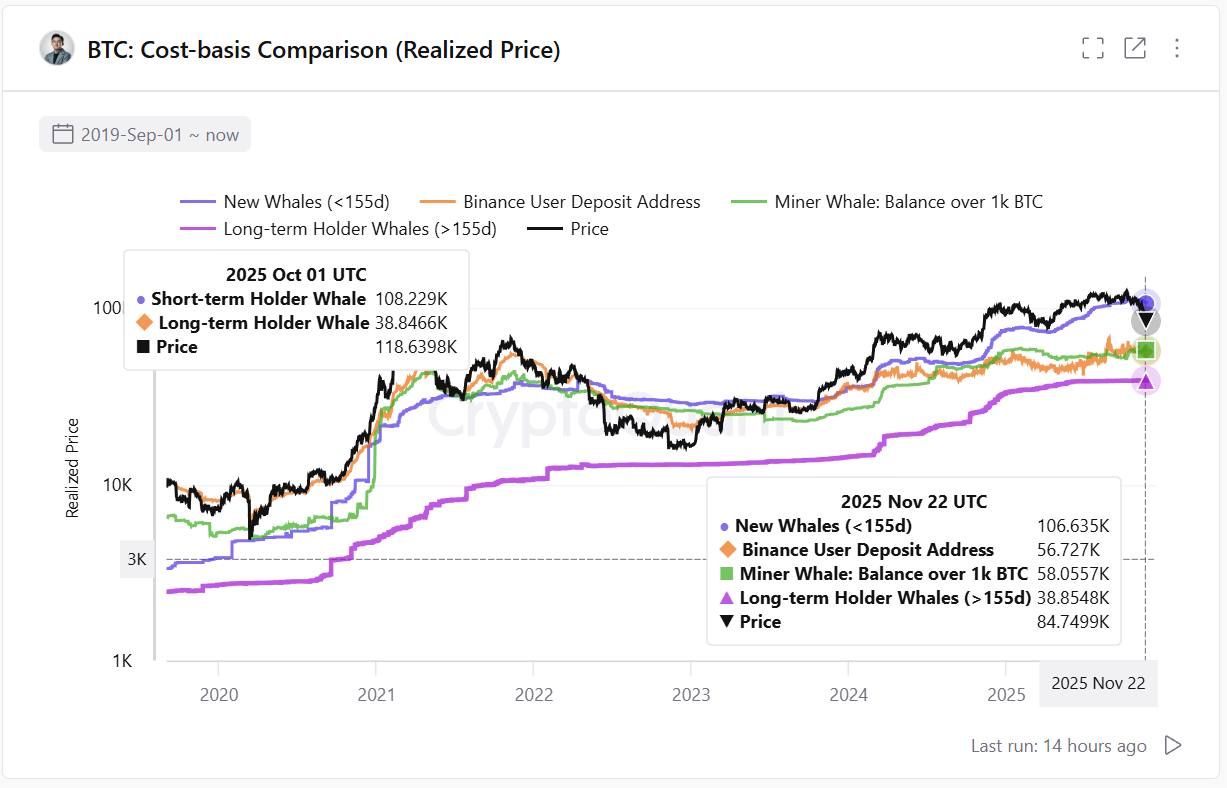
Ki Young Ju menjelaskan bahwa pasar saat ini dibentuk oleh kompetisi antara dua kelompok whale utama. Whale lama, yang memegang Bitcoin dengan biaya rata-rata mendekati US$16.000, telah mulai memperoleh keuntungan besar, menjual dengan laju yang diukur dalam ratusan juta US$ setiap hari. Penjualan yang terus-menerus ini telah memberikan tekanan besar pada harga Bitcoin.

Di saat yang sama, whale institusi melalui spot ETF Bitcoin dan MicroStrategy telah mengakumulasi posisi yang signifikan. Namun, kekuatan membeli mereka tidak sebanding dengan besarnya penjualan whale awal. Menurut Ju, wallet yang memegang lebih dari 10.000 BTC selama lebih dari 155 hari biasanya memiliki biaya rata-rata sekitar US$38.000. Trader Binance masuk posisi sekitar US$50.000, jadi banyak peserta pasar yang sudah untung dan bisa menjual jika diperlukan.

Bagan perbandingan basis biaya Bitcoin
Perbandingan basis biaya di antara berbagai kategori holder Bitcoin. Sumber: CryptoQuant

CEO CryptoQuant mengatakan bahwa aliran masuk spot ETF dan MicroStrategy telah meningkatkan pasar di awal tahun 2025. Namun, aliran tersebut kini sudah menurun. Aliran keluar mulai mendominasi lanskap pasar. Misalnya, data dari Farside Investors menunjukkan ETF Bitcoin mencatatkan arus masuk bersih sebesar US$42,8 juta pada 26 November 2025, meningkatkan arus masuk kumulatif menjadi US$62,68 miliar. Meski dengan angka-angka ini, penjualan berkelanjutan dari whale awal mengalahkan akumulasi institusi.

Analisis Siklus Pasar Isyaratkan Kenaikan Terbatas

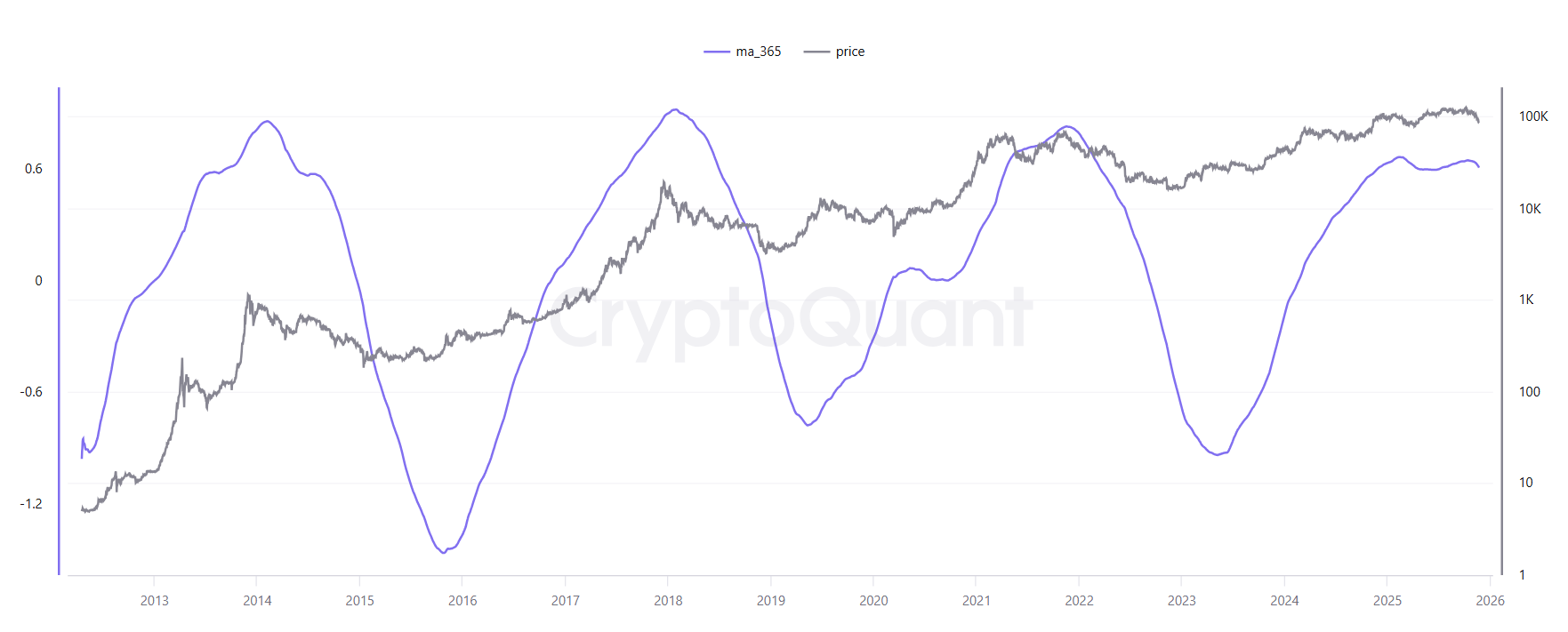
Metrik profit-and-loss on-chain menawarkan wawasan penting tentang siklus pasar. Analisis Ju menggunakan indeks PnL dengan rata-rata bergerak 365 hari menunjukkan bahwa pasar telah memasuki fase “shoulder”. Status akhir siklus ini menunjukkan potensi pertumbuhan yang terbatas dan peningkatan risiko koreksi.

Pengganda valuasi mencerminkan pandangan netral-ke-rata. Dalam siklus sebelumnya, setiap US$ baru mendorong pertumbuhan kapitalisasi pasar yang lebih besar. Sekarang, efek pengganda itu telah memudar. Ini menunjukkan leverage pasar kurang efisien, dan struktur tidak mendukung keuntungan yang signifikan.

Sinyal siklus indeks PnL Bitcoin
Indeks PnL menunjukkan posisi siklus Bitcoin saat ini. Sumber: CryptoQuant

Ju tidak mengharapkan penurunan dramatis sebesar 70-80%. Namun, menurutnya koreksi hingga 30% masih masuk akal. Penurunan dari US$100.000 bisa berarti Bitcoin jatuh ke sekitar US$70.000. Ia menggunakan data dari rasio long-short futures OKX, rasio leverage exchange, dan pola arus jual-beli untuk mendukung pandangan ini.

Ju menekankan pentingnya pendekatan berbasis data. Dalam sebuah posting terbaru, ia mendorong trader untuk menggunakan metrik untuk keyakinan, bukan spekulasi. Fokusnya tetap pada interpretasi data on-chain, aktivitas exchange, dan struktur pasar.

Never trade without data. pic.twitter.com/JnAtLwpdGa

— Ki Young Ju (@ki_young_ju) November 27, 2025

Analisis komprehensif ini menyediakan penilaian yang berdasar berdasarkan bukti on-chain. Karena whale Bitcoin awal terus menjual untuk mendapatkan keuntungan, institusi menghadapi lingkungan yang sulit. Dengan rasio leverage yang tinggi, pengganda valuasi yang netral, dan posisi akhir siklus, pasar memiliki potensi terbatas untuk reli besar dalam waktu dekat.

  •  

Sony Takes the Baton in Asia’s Entertainment–Web3 Convergence

Soneium, a Layer-2 blockchain platform by Sony Block Solutions Labs, announced a partnership with IRC APP, the official app for one of Japan’s largest idol and fashion festivals, Idol Runway Collection (IRC).

The collaboration will bring the IRC onto Soneium’s AI-powered IPFi infrastructure to transform global fan engagement through measurable, rewarding on-chain contributions. Asia’s entertainment industry has become a trailblazer in fan participation, a trend that is now taking hold in Western markets.

Sony’s Blockchain Infrastructure for Entertainment

The IRC, Japan’s largest idol and fashion hybrid festival, is hosted by YOAKE entertainment and has expanded its scale through a collaboration with Tokyo Girls Collection (TGC). IRC has already established itself as a success, attracting approximately 11,800 attendees and 107 idol groups to its 2025 event. 

The core goal of the partnership is redefining fan engagement by valuing and rewarding measurable on-chain contributions across the J-Pop fandom. This collaboration will unlock the creative community’s economic potential, starting with the world’s second-largest music market.

The core of fan engagement is within the IRC mobile app. This AI-powered app evaluates positive, consistent, supportive posts made by fans on platforms such as X (formerly Twitter). The measured engagement is converted into “IRC Score,” which is automatically claimed to fans’ on-chain wallets without gas fees.

The first wave of IRC 2026 performers, including Nogizaka46, has been announced by YOAKE Entertainment. Source: YOAKE Entertainment

This accumulated score determines a user’s Membership rank—Regular, Bronze, Silver, or Gold—with each tier offering progressively enhanced real-world benefits for IRC 2026, scheduled for March 15, 2026, in Tokyo, including early ticket access, priority entry, and premium venue invitations. It also enables the on-chain Fan Vote, which directly shapes tangible aspects of the IRC 2026 event. This measurable fandom contribution system will expand beyond idol culture into new creative frontiers such as anime and fashion.

Sony launched its Soneium blockchain mainnet on January 14, 2025, setting a new standard for production-grade Web3 services focused on entertainment, gaming, and intellectual property protection. This public Layer-2 network uses Ethereum’s OP Stack, inheriting its security while offering lower transaction fees and higher throughput. Sony Block Solutions Labs designed Soneium to support scalable applications for digital communities and creative industries.

Asian Entertainment Companies Pioneer Fan Ownership Models

This is not the first time Asian entertainment companies have tried Web3-related projects. In Korea, girl group tripleS has made blockchain a core source of revenue. Produced by Modhaus and formed as a 24-member group, tripleS lets fans use NFTs and utility tokens to influence unit composition and song selection. Fans purchase NFT objects to gain Komos token voting power in the COSMO app, creating a system of transparent, participatory governance.

Korea’s girl group tripleS took the stage at the 2024 Korea Blockchain Week. Source: Factblock

This model enabled tripleS to generate revenue even before its debut, providing members with compensation comparable to that of large companies. Production exceeded 10 billion KRW ($6.8 million), and early NFT sales helped cash flow, offering a fairer distribution than typical idol group contracts. TripleS stands out as a case where blockchain drives fan co-creation and transparent value sharing in entertainment.

China’s entertainment platforms are rapidly adopting superfan-driven community models that resemble Web3 economics even without blockchain. HYBE’s expansion through Tencent Music and Alibaba shows how direct messaging, authenticated merchandise, and integrated fan services strengthen ownership-like engagement. This environment naturally supports large-scale Web3-style participation economies.

Tencent Music’s superfan ecosystem illustrates this shift with Bubble surpassing 2.3 million paying subscribers. G-DRAGON’s Macau shows drew 36,000 attendees and 7 million simultaneous online viewers, proving the power of hybrid fan engagement. Merchandise, tiered subscriptions, and the expansion of long-form audio show China building a multi-channel superfan economy aligned with Web3 principles.

Lessons From Failed Web3 Entertainment Experiments

Failures have existed, too. Momentrica, an NFT platform by Dunamu and HYBE, closed on July 2, 2025, after posting an operating loss of 13 billion KRW ($8.88 million USD)and a net loss of 12.3 billion KRW in the last reported year. Although HYBE artists’ digital collectibles sparked initial interest, Momentrica struggled due to a lack of long-term utility or sustained fan participation amid the broader NFT market downturn. Precisely, the platform only offered NFTs as static digital goods, not as engagement tools.

The contrast between Momentrica and tripleS highlights a key difference in Web3 entertainment. Momentrica provided digital collectibles without voting rights, participation, or ongoing utility. In contrast, tripleS used blockchain at its core, granting fans voting rights and engagement options. The lesson is clear: successful Web3 in entertainment requires participation architectures, not just digital merchandise.

Sony’s Soneium appears poised to avoid Momentrica’s pitfalls by supporting high-volume, participation-based applications. Its scalable Layer-2 network is built for voting, reward distribution, and community engagement. Whether entertainment companies create effective participation models on this infrastructure will determine if Sony’s blockchain strategy succeeds where others have failed.

The post Sony Takes the Baton in Asia’s Entertainment–Web3 Convergence appeared first on BeInCrypto.

  •  

Bitcoin Downtrend Driven by Early Whale Selling, Says Ki Young Ju

Bitcoin’s sharp correction from $110,000 to around $80,000 is linked to heavy selling by early whales with cost bases near $16,000. CryptoQuant CEO Ki Young Ju notes that on-chain metrics indicate Bitcoin is now in the “shoulder” phase of its cycle, suggesting limited short-term upside potential.

This selling is overwhelming institutional demand from ETFs and MicroStrategy, shaping the cryptocurrency’s 2025 outlook. In an interview with Upbit’s Upbitcare, Ju provides a data-driven look at the shifting landscape for Bitcoin investors and the forces affecting its current market structure.

Early Bitcoin Whales Fuel Selling Pressure

Ki Young Ju explains that today’s market is shaped by a contest between two main whale groups. Legacy whales, holding Bitcoin with an average cost basis near $16,000, have begun to realize hefty profits, selling at a rate measured in hundreds of millions of USD each day. This persistent selling has exerted intense downward pressure on Bitcoin’s price.

At the same time, institutional whales via spot Bitcoin ETFs and MicroStrategy have accumulated significant positions. Yet, their buying power has not matched the scale of early whales’ sell-offs. According to Ju, wallets holding over 10,000 BTC for more than 155 days typically have an average cost basis of around $38,000. Binance traders entered positions around $50,000, so many market participants are in profit and can sell if needed.

Bitcoin cost basis comparison chart
Cost basis comparison across different Bitcoin holder categories. Source: CryptoQuant

The CryptoQuant CEO points out that spot ETF and MicroStrategy inflows had boosted the market earlier in 2025. However, those flows have now declined. Outflows have started to dominate the market landscape. For example, data from Farside Investors showed Bitcoin ETFs recorded $42.8 million in net inflows on November 26, 2025, lifting cumulative inflows to $62.68 billion. Despite these figures, the sustained selling from early whales outweighs institutional accumulation.

Market Cycle Analysis Signals Limited Upside

On-chain profit-and-loss metrics offer crucial insights into market cycles. Ju’s analysis using the PnL index with a 365-day moving average reveals that the market has entered a “shoulder” phase. This late-cycle status indicates constrained growth potential and increased risk of a correction.

The valuation multiplier reflects a neutral-to-flat outlook. In previous cycles, each new dollar drove amplified market-cap growth. Now, that multiplier effect has faded. This suggests market leverage is less efficient, and the structure does not support significant gains.

Bitcoin PnL index cyclical signals
PnL index showing Bitcoin’s current cycle position. Source: CryptoQuant

Ju does not expect a dramatic 70-80% crash. Still, he considers corrections up to 30% reasonable. A drop from $100,000 could mean Bitcoin falling to about $70,000. He uses data from OKX futures long-short ratios, exchange leverage ratios, and buy-sell flow patterns to support this view.

Ju underscores the importance of a data-driven approach. In a recent post, he urged traders to use metrics for conviction, not speculation. His focus remains on interpreting on-chain data, exchange activity, and market structure.

Never trade without data. pic.twitter.com/JnAtLwpdGa

— Ki Young Ju (@ki_young_ju) November 27, 2025

This comprehensive analysis provides a grounded assessment based on on-chain evidence. As early Bitcoin whales continue to sell at profits, institutions face a harsh climate. With high leverage ratios, neutral valuation multipliers, and a late-cycle stance, the market has limited potential for a major rally in the near future.

The post Bitcoin Downtrend Driven by Early Whale Selling, Says Ki Young Ju appeared first on BeInCrypto.

  •  

Story Protocol Naik 21% dengan Prediksi Pasar Baru dan Upgrade Privasi

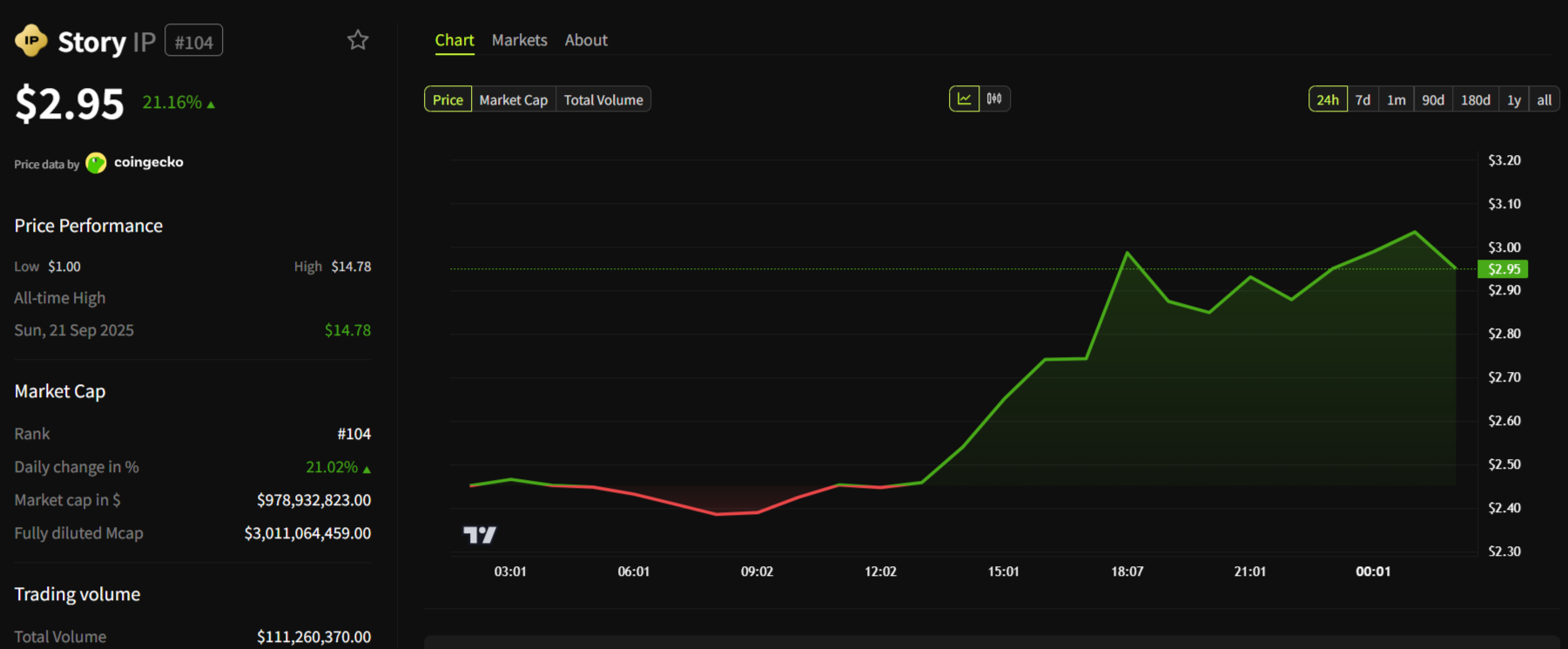
Token native Story Protocol melonjak 21,48% menjadi US$2,98 dalam 24 jam ketika blockchain memperkenalkan pasar prediksi pertamanya dan meluncurkan Confidential Data Rails. Upgrade yang berfokus pada privasi ini mengamankan data terenkripsi di chain.

Kenaikan ini mencerminkan peluncuran banyak fitur dan meningkatnya perhatian institusi, menempatkan blockchain layer-1 ini sebagai pendorong utama dalam ekonomi properti intelektual senilai US$80 triliun yang sedang berkembang.

Harga Naik dengan Fitur Baru dan Momentum Pasar

Pada pukul 2:00 pagi UTC pada hari Rabu, IP token Story Protocol diperdagangkan pada US$2,98—peningkatan 21,48% dari hari sebelumnya. Token ini mencatatkan volume perdagangan US$145,63 juta di berbagai exchange terkemuka. Kapitalisasi pasarnya mencapai US$975,42 juta, menjadikannya #104 di antara aset kripto global.

Story mencapai posisi tertingginya sepanjang masa di US$14,78 pada 21 September 2025, dan telah diperdagangkan di antara US$1,00 dan US$14,78 sejak saat itu. Kepercayaan lembaga meningkat karena IP Strategy (Nasdaq: IPST) yang diperdagangkan secara publik memegang 53 juta token dalam laporan keuangannya. Token-token ini memiliki nilai sekitar US$731 juta.

Kenaikan harga ini tiba bersamaan dengan tiga peluncuran besar: pasar prediksi pertama Story, integrasi dengan Dune Analytics untuk data di chain, dan makalah teknis tentang Confidential Data Rails. Pembaruan ini memperluas kemampuan Story di luar pendaftaran IP, menunjukkan bahwa ia dapat mendukung lebih banyak aplikasi terdesentralisasi.

Story Protocol Luncurkan Pasar Prediksi On-Chain

Story Protocol meluncurkan pasar prediksi pertamanya dengan MusicByVirtuals, memungkinkan pengguna untuk berdagang pada hasil yang terkait dengan acara budaya dan keuangan. Pasar ini memungkinkan taruhan pada topik seperti posisi tangga lagu K-pop dan harga aset kripto, dengan penyelesaian yang diproses di blockchain Story.

The first prediction markets on Story are live.@MusicByVirtuals is betting that culture is as tradable as price, and now there’s a platform to prove it.

Zcash price. Kpop charts. Predictions settled on Story.

Details ↴ pic.twitter.com/3TQQP3YDmI

— Story (@StoryProtocol) November 25, 2025

Pasar ini menunjukkan bagaimana tren budaya dan prediksi keuangan dapat ditokenisasi dan diperdagangkan di chain, menunjukkan fleksibilitas Story di luar manajemen IP. Hal ini menggarisbawahi tujuan Story untuk menangkap kepemilikan IP dan spekulasi seputar aset budaya.

Confidential Data Rails: Upgrade Privasi untuk Aset On-Chain

Kamis lalu, Story Protocol merilis makalah teknisnya tentang Confidential Data Rails (CDR). Upgrade ini mengubah data terenkripsi menjadi aset di chain yang dapat diprogram. Teknologi ini memungkinkan penyimpanan yang aman dan pengelolaan otomatis aset sensitif di gudang IP Story. Aset ini termasuk dataset AI, catatan biomedis, dan kunci API.

Pengumuman resmi dari Story Foundation menggambarkan CDR sebagai fondasi kriptografi yang menggabungkan kerahasiaan, otomatisasi, dan dapat diprogram. Lingkungan eksekusi terdesentralisasi yang tepercaya (TEEs) dan smart contract di chain Story menegakkan izin. Sistem ini memungkinkan pemilik data untuk mengendalikan aset rahasia tanpa mengungkapkan detail sensitif.

Programmable confidentiality is here.

Confidential Data Rails (CDR) turns encrypted data into onchain building blocks, paving the way for new privacy use-cases on Story and beyond.

Technical Paper out now ↓ pic.twitter.com/pp96CAaCr9

— Story (@StoryProtocol) November 20, 2025

CDR membantu menyelesaikan tantangan blockchain yang persisten: memastikan privasi sambil mempertahankan transparansi. Blockchain publik sangat baik untuk auditabilitas tetapi kurang dalam perlindungan data yang kuat. CDR memungkinkan pencipta dan perusahaan untuk menokenisasi IP sensitif sambil mempertahankan kendali ketat akses—fitur penting untuk sektor seperti farmasi, hiburan, dan AI, di mana informasi rahasia harus tetap dilindungi bahkan ketika hak dikelola di chain.

Selain itu, kemitraan Story Protocol dengan Dune Analytics memungkinkan visualisasi data IP di chain secara real-time, mencakup registrasi, lisensi, royalti, dan rantai turunan. Andrea Muttoni, Presiden dan Kepala Produk, menjelaskan bahwa integrasi ini mendorong transparansi dan analitik yang lebih dalam dalam IP di chain. Kolaborasi ini memberi akses SQL kepada pengembang dan institusi ke data Story, mempromosikan penelitian tentang tokenisasi IP dan tren lisensi.

Insentif Kreator Dorong Pertumbuhan Platform

Chase Chaisun Chang, Kepala Korea di PIP Labs—operator Story Protocol—menekankan pada sebuah konferensi di Korea Selatan pada hari Selasa bahwa insentif untuk kreator sangat penting untuk menghasilkan konten yang konsisten dan berkualitas tinggi.

Dia menjelaskan bagaimana satu video tari dapat menghasilkan 100.000 remix dalam 24 jam, membuat lisensi tradisional menjadi tidak mungkin. AI mengkonsumsi konten ini dan tanpa henti menghasilkan kreasi sekunder, sementara batas antara pencipta dan konsumen telah sepenuhnya kabur.

Chang menekankan bahwa, mengikuti prinsip “garbage in, garbage out,” AI memerlukan data pelatihan berkualitas tinggi untuk berfungsi dengan benar. Atribusi yang tepat dan pelacakan kepemilikan sangat penting untuk melawan misinformasi dan memverifikasi keaslian konten yang dihasilkan AI.

Dia menyimpulkan bahwa transformasi digital berarti individu akan semakin banyak memiliki aset tidak berwujud. Semua orang menjadi pencipta dan konsumen sekaligus di era baru ini. Infrastruktur IP yang lebih baik sangat penting untuk melindungi aset digital setiap orang dalam lanskap yang berkembang pesat ini.

Kombinasi kekuatan harga, peluncuran fitur, dan dukungan institusi menempatkan Story Protocol sebagai infrastruktur penting untuk manajemen IP yang terdesentralisasi. Namun, token ini masih diperdagangkan 80% di bawah tertinggi sepanjang masanya. Adopsi berkelanjutan dari CDR, pasar prediksi, dan analitik yang didukung Dune akan menjadi penentu apakah protokol ini dapat menangkap pangsa pasar yang signifikan. Seiring Story berkembang, pertanyaan kunci adalah apakah kreator dan perusahaan akan memindahkan operasi IP ke chain dalam skala yang membenarkan ambisi protokol ini.

  •  

Story Protocol Surges 21% on New Prediction Markets and Privacy Upgrade

Story Protocol’s native token soared 21.48% to $2.98 in 24 hours as the blockchain introduced its first prediction markets and launched Confidential Data Rails. This privacy-focused upgrade secures encrypted data on-chain.

The surge mirrors multiple feature rollouts and rising institutional attention, positioning the Layer 1 blockchain as a critical driver in the growing $80 trillion intellectual property economy.

Price Jumps with New Features and Market Momentum

As of 2:00 am UTC on Wednesday, Story Protocol’s IP token traded at $2.98—a 21.48% increase over the previous day. The token saw $145.63 million in trading volume across leading exchanges. Its market cap reached $975.42 million, placing it #104 among global cryptocurrencies.

Story hit an all-time high of $14.78 on Sept. 21, 2025, and has traded between $1.00 and $14.78 since. Institutional confidence is rising as publicly traded IP Strategy (Nasdaq: IPST) holds 53 million tokens on its balance sheet. These tokens are valued at about $731 million.

Source: BeInCrypto

The price rally arrived alongside three major launches: Story’s first prediction markets, integration with Dune Analytics for on-chain data, and a technical paper outlining Confidential Data Rails. These updates expand Story’s capabilities beyond IP registration, demonstrating it can support a broader range of decentralized applications.

Story Protocol Debuts On-Chain Prediction Markets

Story Protocol unveiled its first prediction markets with MusicByVirtuals, allowing users to trade on outcomes linked to cultural and financial events. These markets enable bets on topics like K-pop chart positions and cryptocurrency prices, with settlements processed on Story’s blockchain.

The first prediction markets on Story are live.@MusicByVirtuals is betting that culture is as tradable as price, and now there’s a platform to prove it.

Zcash price. Kpop charts. Predictions settled on Story.

Details ↴ pic.twitter.com/3TQQP3YDmI

— Story (@StoryProtocol) November 25, 2025

These markets highlight how cultural trends and financial predictions can be tokenized and traded on-chain, showcasing Story’s versatility beyond IP management. It underscores Story’s aim to capture both IP ownership and the speculation surrounding cultural assets.

Confidential Data Rails: Privacy Upgrade for On-Chain Assets

Last Thursday, Story Protocol released its technical paper on Confidential Data Rails (CDR). This upgrade transforms encrypted data into programmable on-chain assets. The technology enables secure storage and automated management of sensitive assets within Story’s IP vaults. These assets include AI datasets, biomedical records, and API keys.

The official Story Foundation announcement describes CDR as a cryptographic foundation that combines confidentiality, automation, and programmability. Decentralized trusted execution environments (TEEs) and smart contracts on the Story chain enforce permissions. This system allows data owners to control confidential assets without exposing sensitive details.

Programmable confidentiality is here.

Confidential Data Rails (CDR) turns encrypted data into onchain building blocks, paving the way for new privacy use-cases on Story and beyond.

Technical Paper out now ↓ pic.twitter.com/pp96CAaCr9

— Story (@StoryProtocol) November 20, 2025

CDR helps solve a persistent blockchain challenge: ensuring privacy while maintaining transparency. Public blockchains are excellent for auditability but lack strong data protection. CDR lets creators and enterprises tokenize sensitive IP while maintaining strict access controls—a feature essential for sectors such as pharmaceuticals, entertainment, and AI, where confidential information must remain protected even as rights are managed on-chain.

Meanwhile, Story Protocol’s partnership with Dune Analytics enables real-time visualization of on-chain IP data, covering registrations, licenses, royalties, and derivative chains. Andrea Muttoni, President and Chief Product Officer, noted that the integration fosters transparency and deeper analytics in on-chain IP. The collaboration grants developers and institutions SQL access to Story’s data, promoting research into IP tokenization and licensing trends.

Creator Incentives Lead Platform Growth

Chase Chaisun Chang, Head of Korea at PIP Labs—the operator of Story Protocol—stressed at a South Korean conference on Tuesday that creator incentives are vital for consistent, high-quality content.

He explained how one dance video can generate 100,000 remixes within 24 hours, making traditional licensing impossible. AI consumes this content and endlessly produces secondary creations, while the boundary between creators and consumers has completely blurred.

Chang emphasized that, following the principle “garbage in, garbage out,” AI requires high-quality training data to function correctly. Proper attribution and ownership tracking are essential to combat misinformation and verify the authenticity of AI-generated content.

He concluded that digital transformation means individuals will increasingly own more intangible assets. Everyone is becoming both creator and consumer simultaneously in this new era. Better IP infrastructure is crucial to protect everyone’s digital assets in this rapidly evolving landscape.

The combination of price strength, feature launches, and institutional support positions Story Protocol as crucial infrastructure for decentralized IP management. Still, the token trades 80% below its all-time high. Ongoing adoption of CDR, prediction markets, and Dune-powered analytics will be decisive in whether the protocol can capture significant market share. As Story expands, the key question is whether creators and enterprises will move IP operations on-chain at a scale that justifies the protocol’s ambition.

The post Story Protocol Surges 21% on New Prediction Markets and Privacy Upgrade appeared first on BeInCrypto.

  •  

Saham Miner Naik 20% setelah Dorongan AI Senilai US$50B dari Amazon Tingkatkan Permintaan Daya

Saham crypto mining melonjak hingga 20% dipimpin oleh BitMine dan Cipher Mining, setelah Amazon mengungkapkan rencana untuk berinvestasi hingga US$50 miliar dalam infrastruktur AI untuk lembaga pemerintah AS.

Perubahan ini muncul ketika Bitcoin miner menghadapi penurunan profitabilitas setelah peristiwa halving 2024. Sementara itu, permintaan kapasitas komputasi AI melambung tinggi. Raksasa teknologi kini melihat infrastruktur daya miner yang sudah mapan sebagai kunci untuk pertumbuhan pusat data yang cepat.

Saham Mining Bukukan Keuntungan Double-Digit Karena Fokus Beralih ke Infrastruktur

Sektor crypto mining melihat reli luas pada hari Senin, mencatatkan kenaikan 13,84% di sektor ini menurut data SoSoValue. BitMine melesat hampir 20%, sementara Cipher Mining naik lebih dari 18%.

Reli ini terjadi setelah pengumuman Amazon tentang investasi sebesar hingga US$50 miliar dalam infrastruktur AI untuk lembaga pemerintah AS. Rencana ini akan menambah 1,3 gigawatt di beberapa pusat data, dengan pembangunan dijadwalkan untuk 2026. Lembaga pemerintah akan mendapatkan akses ke alat AWS, Claude AI dari Anthropic, chip Nvidia, dan chip Trainium yang dikembangkan oleh Amazon.

Amazon juga mengumumkan investasi US$15 miliar di Northern Indiana untuk kampus pusat data baru, mendukung 1.100 pekerjaan berkeahlian tinggi dan 2,4 gigawatt kapasitas data. Ekspansi ini menyoroti skala infrastruktur yang diperlukan untuk beban kerja AI.

Meta juga meningkatkan upayanya dalam infrastruktur AI, mencari persetujuan federal untuk berdagang listrik bersama Microsoft untuk pasokan energi jangka panjang. Kampus Meta di Louisiana sendiri diperkirakan memerlukan tiga pembangkit listrik berbahan bakar gas baru.

Bitcoin Miner Berevolusi Menjadi Pemain Kuat AI

Kenaikan saham yang signifikan mengungkapkan bagaimana bitcoin miner mengubah operasional mereka. Penurunan keuntungan setelah halving Bitcoin pada April 2024 mendorong miner mencari sumber pendapatan baru. Pengembang pusat data AI, yang kini menghadapi kekurangan listrik, melihat fasilitas terintegrasi grid milik miner sebagai mitra strategis.

IREN, sebelumnya dikenal sebagai Iris Energy, menandatangani kesepakatan pusat data senilai US$9,7 miliar dengan Microsoft, memberikan raksasa teknologi tersebut akses awal ke GPU Nvidia. Saham IREN melonjak 580% tahun ini sejak rebranding-nya. Miner lain menunjukkan kinerja kuat: Riot Platforms naik 100%, TeraWulf 160%, dan Cipher Mining 360%.

Kapasitas daya gabungan sebesar 14 gigawatt di antara miner AS telah menjadi kunci bagi perusahaan teknologi yang mencari skala cepat. Kebijakan AS yang menguntungkan, termasuk pembatasan ekspor Nvidia ke Cina, memberi miner lokal keunggulan kompetitif. Sebaliknya, miner Cina menghadapi lebih banyak regulasi dan hambatan impor.

Para pengembang pusat data AI kini menargetkan bitcoin miner. Tim-tim ini mendekati operasi mining yang sudah menjalankan situs dengan kapasitas tinggi dan terintegrasi grid. Lokasi seperti Childress, Texas, telah menjadi pusat besar untuk infrastruktur data dan mining yang terintegrasi.

Pemimpin Teknologi Percepat Investasi Infrastruktur

Perusahaan teknologi global mengumpulkan sekitar US$100 miliar dalam penawaran obligasi untuk mendukung kapabilitas AI dan cloud baru. Amazon, Microsoft, Google, Oracle, dan Meta bisa menghabiskan US$400 miliar tahun ini untuk investasi AI dan pusat data. Menurut Deutsche Bank, total investasi terkait AI bisa mencapai US$4 triliun pada 2030.

Langkah ini menandai perubahan dari cadangan kas ke pembiayaan utang. Meta meluncurkan penjualan obligasi terbesarnya, total US$30 miliar, untuk infrastruktur AI. Amazon mengeluarkan obligasi AS senilai US$15 miliar, yang pertama dalam tiga tahun, menarik permintaan sebesar US$80 miliar. Amazon memegang utang sebesar US$69,29 miliar dan kas US$66,92 miliar.

Alphabet mengeluarkan obligasi AS senilai US$17,5 miliar dan obligasi Eropa sebesar €6,5 miliar, sehingga total utangnya mencapai US$48,78 miliar. Peminjaman agresif ini mencerminkan kebutuhan modal besar untuk infrastruktur AI.

Kebutuhan energi untuk menjalankan AI, namun, melampaui ekspansi grid. Dengan lambatnya pengembangan grid, perusahaan teknologi memperoleh sumber energi langsung. Apple sudah mendapatkan persetujuan federal untuk berdagang listrik grosir, mencerminkan tren perusahaan teknologi yang mengelola energi mereka sendiri untuk infrastruktur AI.

Penyatuan infrastruktur crypto mining dengan permintaan komputasi AI menandakan pergeseran strategis besar bagi kedua sektor. Ketika bitcoin miner beralih ke komputasi AI, kapasitas daya bawaan dan situs siap-grid memungkinkan raksasa teknologi untuk menerapkan dengan cepat dan bersaing dalam lanskap AI yang berkembang pesat.

  •  

XRP Naik 9% saat Franklin Templeton dan Grayscale Luncurkan ETF Spot

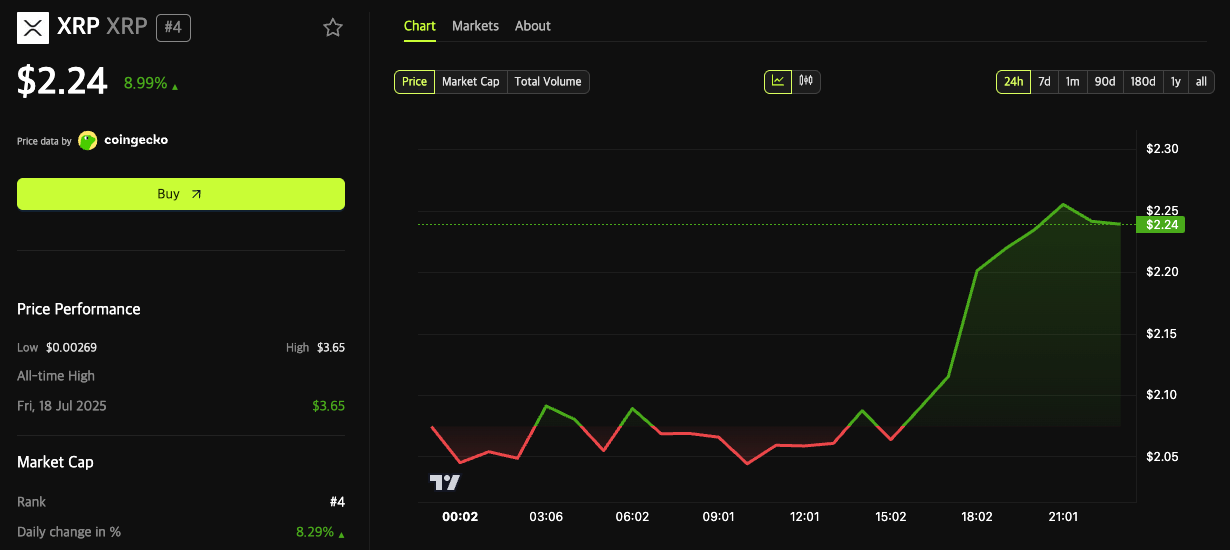
XRP melonjak lebih dari 9% menjadi US$2,27 setelah Franklin Templeton dan Grayscale meluncurkan exchange-traded fund (ETF) XRP spot mereka pada hari Senin. Manajer aset senilai US$1,69 triliun ini bergabung dengan Bitwise, Grayscale, dan Canary Capital dalam menawarkan produk investasi XRP yang teratur, yang menyebut XRP sebagai “fondasi” untuk infrastruktur penyelesaian global.

Gelombang peluncuran ETF ini menandai titik balik bagi XRP. Setelah ketidakpastian regulasi menghilang dengan penyelesaian SEC Ripple di awal tahun 2025, minat institusional meningkat pesat.

Gelombang Peluncuran ETF Institusional Menandakan Kedewasaan Pasar

Franklin Templeton memperkenalkan Franklin XRP ETF (XRPZ) di NYSE Arca, menawarkan eksposur XRP yang teratur melalui grantor trust. Dana ini melacak CME CF XRP-Dollar Reference Rate dan menggunakan Coinbase Custody sebagai kustodian, dengan BNY Mellon sebagai administrator. Menurut pengumuman Franklin Templeton, ETF ini memungkinkan investor untuk mengikuti kinerja XRP secara transparan, tanpa perlu membeli mata uang kripto tersebut secara langsung.

“XRPZ menawarkan cara yang nyaman dan teratur bagi investor untuk mengakses aset digital yang memainkan peran penting dalam infrastruktur penyelesaian global,” ujar David Mann, direktur produk ETF dan pasar modal di Franklin Templeton.

Grayscale juga telah meluncurkan ETF XRP Trust (GXRP) mereka dengan periode pengantar tanpa biaya, menyoroti posisi pasar kuat XRP.

Introducing Grayscale XRP Trust ETF (Ticker: $GXRP), now trading with 0% fees¹ from Grayscale, the world's largest crypto-focused asset manager².

Gain exposure to $XRP, the world’s 3rd largest digital asset³, driving innovation in global payments. Available in your brokerage… pic.twitter.com/rAzGrm0M6P

— Grayscale (@Grayscale) November 24, 2025

Bitwise, yang meluncurkan ETF XRP mereka seminggu sebelumnya, melaporkan arus masuk awal sebesar US$100 juta. Kelompok peluncuran ETF menandakan bahwa manajer aset sudah siap menghadapi kejelasan regulasi yang datang dari SEC pada tahun 2025.

Resolusi Regulasi Membuka Jalan untuk Masuknya Wall Street

Penyelesaian US$125 juta Ripple dengan Securities and Exchange Commission pada Mei 2025 mengakhiri ketidakpastian selama bertahun-tahun. Pernyataan SEC mengkonfirmasi bahwa Ripple menyelesaikan semua klaim tanpa mengakui kesalahan, membayar US$50 juta langsung ke agensi, dan sisanya dilepaskan dari escrow. Penyelesaian ini memberikan kepastian yang dibutuhkan institusi keuangan besar untuk mengejar ETF spot.

Partisipasi Franklin Templeton patut dicatat karena ukuran mereka, memberikan kredibilitas pada cerita XRP sebagai utilitas pembayaran. Investor kini dapat mengakses XRP melalui produk yang diatur oleh kustodian terkenal dan dengan transparansi yang jelas.

Sumber: BeInCrypto

Namun, prospektus memperingatkan bahwa risiko tetap ada, termasuk volatilitas XRP, diversifikasi terbatas, dan ketidakpastian regulasi di luar negeri. ETF ini hanya memegang XRP dan uang tunai, membuatnya tidak cocok sebagai investasi mandiri.

Keunggulan Teknis XRP Menarik Minat Institusi

XRP berjalan di atas decentralized XRP Ledger (XRPL), yang dirancang untuk penyelesaian pembayaran cepat. Dokumentasi XRPL menyoroti transaksi yang hampir instan dengan biaya rendah dan mencatat bahwa lebih dari 3,3 miliar transfer telah diproses di jaringan tersebut.

Sistem konsensus XRPL dikatakan efisien energi, menyelesaikan transaksi dalam tiga hingga lima detik. Fitur-fitur ini menarik bagi institusi yang mencari alternatif untuk SWIFT dan sistem tradisional lintas batas.

Prospektus Franklin Templeton dan Grayscale Research sama-sama menekankan kegunaan XRP sebagai jembatan mata uang dan untuk transfer yang efisien dan skalabel. Dengan karakteristik ini, XRP membedakan dirinya dari mata uang kripto seperti Bitcoin, yang lebih banyak berfungsi sebagai penyimpan nilai.

Reli saat ini bertepatan dengan peningkatan open interest dalam futures XRP, menunjukkan keterlibatan yang meningkat dari trader institusional dan ritel serta mengindikasikan aktivitas pasar yang berkelanjutan.

Dimensi Geopolitik dan Spekulasi Eksposur Cina

Beberapa analis percaya XRP dapat memainkan peran dalam koridor pembayaran lintas batas baru, termasuk di Asia, Timur Tengah, dan Afrika. Black Swan Capitalist berpendapat bahwa Cina memiliki eksposur tidak langsung terhadap XRP melalui BRICS New Development Bank dan fintech Jepang terkemuka SBI Holdings. Namun, adopsi langsung masih dibatasi oleh kebijakan Cina.

China already has indirect exposure to XRP through the BRICS New Development Bank, SBI, and the cross-border payment corridors linking Asia, the Middle East, and Africa. The rails don’t stop at the Great Wall, despite what some on Twitter might think.

— Black Swan Capitalist (@VersanAljarrah) November 21, 2025

Rekomendasi dari dewan bisnis BRICS pada April 2025 mendesak dukungan untuk penyelesaian digital lintas batas — tema yang sejalan dengan desain inti XRP, meskipun tidak ada penyebutan eksplisit tentang mata uang kripto tersebut. Rekomendasi tersebut menyoroti kebutuhan yang semakin meningkat untuk sistem pembayaran digital yang efisien.

Bank Sentral Eropa juga sedang mengkaji infrastruktur pembayaran lintas batas. Proyek Nexus dibahas dalam sebuah pidato April 2025 tentang menghubungkan sistem pembayaran di Asia dan Eropa. Tren ini mencerminkan relevansi global dari kasus penggunaan XRP Ledger.

  •  

Strategy Fails to Join the S&P 500 Once Again

SanDisk Corp. will join the S&P 500 on Friday, November 28, 2024, replacing Interpublic Group of Companies Inc., according to S&P Dow Jones Indices. After the announcement on Monday, shares of the computer storage maker surged by more than 9% in after-hours trading.

This milestone signals SanDisk’s rapid rise, while Strategy (formerly MicroStrategy) faces another setback, remaining excluded from the S&P 500 despite holding more than 640,000 Bitcoin.

SanDisk’s Rapid Ascent to the S&P 500

SanDisk’s move from the S&P SmallCap 600 to the S&P 500 reflects its strong market performance over the past few months. Driven by demand from artificial intelligence applications, the company’s market capitalization has reached approximately $33 billion. This surpassed typical small-cap index thresholds, making the switch to the S&P 500 a logical step.

The announcement arrived just before the Thanksgiving holiday trading session, highlighting the urgency of the rebalancing. The replacement is occurring outside the usual quarterly rebalance, suggesting strong market momentum. The stock closed up 13.33% on the day of the announcement before the after-hours surge.

Joining the S&P 500 usually attracts significant passive inflows, as index-tracking funds buy shares to maintain their weightings. This change boosts SanDisk’s institutional investment appeal and liquidity. It also raises the company’s profile among investors focused on large-cap equities in the index.

SanDisk’s rise is fueled by optimism around AI infrastructure. As businesses use more advanced machine learning models, storage solutions are increasingly critical—driving investor enthusiasm and boosting SanDisk’s valuation over the past year.

Strategy’s Continued S&P 500 Challenge

While SanDisk celebrates, Strategy remains on the outside looking in, even after meeting several technical requirements. The company, led by executive chairman Michael Saylor, holds 640,808 BTC, valued at around $72.3 billion, making it the world’s largest corporate holder of Bitcoin. However, this asset concentration is seen as a liability by index decision makers.

Strategy was not included in the S&P 500’s September reshuffle, which selected Robinhood, AppLovin, and Emcor. Analysts put the company’s chances of inclusion in December at 70% following strong Q3 results. The firm reported $3.8 billion in Q3 earnings, showing profitability tied to Bitcoin’s price movements.

Yet, earnings volatility remains the main hurdle. Strategy’s results fluctuate each quarter with Bitcoin’s price, creating inconsistency with S&P 500 requirements. For instance, Q2 2024 delivered $10 billion in revenue and $14 billion in unrealized gains, while Q1 saw a $4.2 billion loss. The index requires four straight quarters of positive earnings—a threshold that has eluded Strategy due to its Bitcoin-heavy approach.

S&P Dow Jones Indices gave Strategy a ‘B-‘ credit rating, citing high Bitcoin exposure, low USD liquidity, and a narrow business model. These contribute to traditional finance skepticism about digital asset treasury companies. The rating shows the committee sees Bitcoin-based volatility as incompatible with the stability expected in S&P 500 members.

Even if Strategy meets the criteria for market capitalization and liquidity, the committee also considers business model diversity, financial stability, and sector representation. While some advocate for evolving index methodologies to include innovative treasury approaches, traditionalists insist on consistent, proven earnings, especially for benchmarks like the S&P 500.

Traditional Finance Meets Digital Asset Reality

The paths of SanDisk and Strategy highlight a broader divide between traditional finance and digital asset business models. Some crypto-exposed companies like Robinhood have entered the S&P 500, yet Strategy’s concentrated Bitcoin position poses unique challenges. The company’s stock is down 35% from its July high of $434, reflecting disappointment over exclusion and credit rating concerns.

Nasdaq’s scrutiny of digital asset treasury firms adds further obstacles for Strategy. As industry analysis notes, traditional finance’s skepticism extends beyond earnings volatility to concerns about long-term business models and regulatory compliance. This unease endures, even as Strategy has occasionally outperformed both Bitcoin and the S&P 500, as Saylor has highlighted.

On the other hand, MSCI’s recent consultation that Strategy could be removed from its key equity indices has sharpened investor focus on whether similar pressure might eventually extend to the S&P 500. While the company’s inclusion in MSCI USA and MSCI World has long funneled billions in passive capital into the stock, analysts now argue that its increasingly bitcoin-centric profile may no longer fit traditional index methodologies.

This has raised questions in the broader market about whether the valuation premium tied to expected index stability is at risk — and whether Strategy’s future index eligibility, including any long-shot hopes of S&P 500 admission, could be further complicated by the growing scrutiny.

The post Strategy Fails to Join the S&P 500 Once Again appeared first on BeInCrypto.

  •  

Mining Stocks Jump 20% as Amazon’s $50B AI Push Boosts Demand for Power

Crypto mining stocks jumped as much as 20% led by BitMine and Cipher Mining, after Amazon unveiled plans to invest up to $50 billion in AI infrastructure for U.S. government agencies.

This shift comes as Bitcoin miners face declining profitability following the 2024 halving event. Meanwhile, demand for AI compute capacity is soaring. Tech giants now view miners’ established power infrastructure as key to rapid data center growth.

Mining Stocks Post Double-Digit Gains as Focus Shifts to Infrastructure

The crypto mining sector saw a broad rally on Monday, notching a 13.84% sector-wide gain according to SoSoValue data. BitMine soared nearly 20%, while Cipher Mining rose more than 18%.

The rally followed Amazon’s announcement of an investment of up to $50 billion in AI infrastructure for US government agencies. The plan will add 1.3 gigawatts across multiple data centers, with construction set for 2026. Agencies will gain access to AWS tools, Anthropic’s Claude AI, Nvidia chips, and Trainium chips developed by Amazon.

Amazon also announced a $15 billion investment in Northern Indiana for new data center campuses, supporting 1,100 high-skilled jobs and 2.4 gigawatts of data capacity. This expansion underscores the scale of infrastructure required for AI workloads.

Meta has intensified its AI infrastructure efforts, seeking federal approval to trade electricity alongside Microsoft for long-term energy supply. Meta’s Louisiana campus alone is expected to require three new gas-fired plants.

Bitcoin Miners Evolve Into AI Power Players

The substantial stock gains reveal how bitcoin miners are transforming operations. Declining profits after Bitcoin’s April 2024 halving prompted miners to seek new revenue streams. AI data center developers, who now face electricity shortages, see miners’ grid-integrated facilities as strategic partners.

IREN, formerly Iris Energy, signed a $9.7 billion data center deal with Microsoft, granting the tech giant early access to Nvidia GPUs. IREN’s stock has shot up 580% this year since its rebrand. Other miners showed strong performance: Riot Platforms gained 100%, TeraWulf 160%, and Cipher Mining 360%.

The combined 14 gigawatts of power capacity among US miners has become key for tech firms seeking rapid scale. Favorable US policies, including Nvidia export restrictions to China, give domestic miners a competitive edge. In contrast, Chinese miners face more regulation and import barriers.

AI data center developers are now targeting bitcoin miners. These teams are approaching mining operations already running high-capacity, grid-integrated sites. Locations like Childress, Texas, have become major hubs for combined data and mining infrastructure.

Tech Leaders Accelerate Infrastructure Investments

Global tech firms are raising around $100 billion in bond offerings to fuel new AI and cloud capabilities. Amazon, Microsoft, Google, Oracle, and Meta could spend $400 billion this year on AI and data center investments. According to Deutsche Bank, total AI-related investment could reach $4 trillion by 2030.

The move signifies a shift from cash reserves to debt financing. Meta has launched its largest-ever bond sale, totaling $30 billion, for AI infrastructure. Amazon issued a $15 billion US bond, its first in three years, attracting $80 billion in demand. Amazon holds $69.29 billion in debt and $66.92 billion in cash.

Alphabet issued a $17.5 billion US bond and a €6.5 billion European bond, bringing its total debt to $48.78 billion. The aggressive borrowing reflects the immense capital needs for AI infrastructure.

The need for energy to power AI, however, surpasses grid expansion. With slow grid development, tech companies are securing direct energy sources. Apple already has federal approval to trade electricity wholesale, reflecting a trend of tech firms managing their own energy for AI infrastructure.

The merging of crypto mining infrastructure with AI compute demand signals a major strategic shift for both sectors. As bitcoin miners pivot to AI compute, their built-in power capacity and grid-ready sites enable tech giants to deploy quickly and compete in the fast-evolving AI landscape.

The post Mining Stocks Jump 20% as Amazon’s $50B AI Push Boosts Demand for Power appeared first on BeInCrypto.

  •  

XRP Jumps 9% as Franklin Templeton and Grayscale Launch Spot ETFs

XRP jumped more than 9% to $2.27 after Franklin Templeton and Grayscale launched their spot XRP ETF on Monday. The $1.69 trillion asset manager joined Bitwise, Grayscale, and Canary Capital in offering regulated XRP investment products, calling XRP “foundational” for global settlement infrastructure.

This wave of ETF launches marks a turning point for XRP. After regulatory uncertainty faded with Ripple’s SEC settlement earlier in 2025, institutional interest is surging.

Wave of Institutional ETF Launches Signals Market Maturity

Franklin Templeton debuted the Franklin XRP ETF (XRPZ) on NYSE Arca, offering regulated XRP exposure through a grantor trust. The fund tracks the CME CF XRP-Dollar Reference Rate and uses Coinbase Custody as custodian, with BNY Mellon as administrator. According to Franklin Templeton’s announcement, the ETF allows investors to follow XRP’s performance transparently, without buying the cryptocurrency directly.

“XRPZ offers investors a convenient and regulated way to access a digital asset that plays a critical role in the global settlement infrastructure,” stated David Mann, director of ETF products and capital markets at Franklin Templeton.

Grayscale has also launched its XRP Trust ETF (GXRP) with a zero-fee introductory period, highlighting XRP’s strong market position.

Introducing Grayscale XRP Trust ETF (Ticker: $GXRP), now trading with 0% fees¹ from Grayscale, the world's largest crypto-focused asset manager².

Gain exposure to $XRP, the world’s 3rd largest digital asset³, driving innovation in global payments. Available in your brokerage… pic.twitter.com/rAzGrm0M6P

— Grayscale (@Grayscale) November 24, 2025

Bitwise, which launched its XRP ETF a week earlier, reported $100 million in initial inflows. The clustering of ETF launches signals that asset managers were prepared for regulatory clarity, which arrived from the SEC in 2025.

Regulatory Resolution Paves Way for Wall Street Entry

Ripple’s $125 million settlement with the Securities and Exchange Commission in May 2025 ended years of uncertainty. SEC statements confirm that Ripple resolved all claims without admitting wrongdoing, paid $50 million directly to the agency, and had the rest released from escrow. This resolution gave large financial institutions the assurance needed to pursue spot ETFs.

Franklin Templeton’s participation is notable for its size, lending credibility to XRP’s story as a payment utility. Investors can now access XRP through regulated products managed by well-known custodians and with clear transparency.

Source: BeInCrypto

Still, prospectuses caution that risks remain, including XRP’s volatility, limited diversification, and regulatory uncertainty abroad. The ETF holds only XRP and cash, making it unsuitable as a standalone investment.

XRP’s Technical Advantages Drive Institutional Interest

XRP runs on the decentralized XRP Ledger (XRPL), designed for rapid payment settlement. XRPL documentation highlights near-instant, low-fee transactions and notes that over 3.3 billion transfers have been processed on the network.

XRPL’s consensus system is said to be energy efficient, settling transactions in three to five seconds. These features attract institutions seeking alternatives to SWIFT and traditional cross-border systems.

Franklin Templeton’s prospectus and Grayscale Research both stress XRP’s usefulness as a currency bridge and for efficient, scalable transfers. With these characteristics, XRP sets itself apart from cryptocurrencies like Bitcoin, which mainly serve as a store of value.

The current rally coincides with rising open interest in XRP futures, pointing to growing involvement from institutional and retail traders and suggesting sustained market activity.

Geopolitical Dimensions and China Exposure Speculation

Some analysts believe XRP could play a role in new cross-border payment corridors, including those in Asia, the Middle East, and Africa. Black Swan Capitalist has argued that China has indirect exposure to XRP through the BRICS New Development Bank and leading Japanese fintech SBI Holdings. However, direct adoption remains limited by Chinese policies.

China already has indirect exposure to XRP through the BRICS New Development Bank, SBI, and the cross-border payment corridors linking Asia, the Middle East, and Africa. The rails don’t stop at the Great Wall, despite what some on Twitter might think.

— Black Swan Capitalist (@VersanAljarrah) November 21, 2025

BRICS business council recommendations from April 2025 urged support for cross-border digital settlements — a theme in line with XRP’s core design, despite no explicit mention of the cryptocurrency. The recommendations highlight a growing need for efficient digital payment systems.

The European Central Bank is also examining cross-border payment infrastructure. Project Nexus was discussed during an April 2025 speech about linking payment systems in Asia and Europe. These trends echo the global relevance of the XRP Ledger’s use cases.

The post XRP Jumps 9% as Franklin Templeton and Grayscale Launch Spot ETFs appeared first on BeInCrypto.

  •  

Upbit Operator to Announce Merger with Korean Tech Giant Naver This Week

South Korea’s top payment platform and largest cryptocurrency exchange are set to merge, with board approvals expected on Wednesday and a public announcement planned for the next day.

This agreement will combine Naver Financial and Dunamu, the operator of Upbit, to form a powerful player that bridges traditional finance and digital assets in one of Asia’s largest economies.

Merger Timeline and Structure

The boards of both companies plan to meet on November 26 to approve the merger. After that, a joint announcement is expected on November 27. According to local media reports, top executives will attend a press conference at Naver’s campus.

The transaction will involve a complete stock exchange, making Dunamu a wholly owned subsidiary of Naver Financial. Current estimates value Naver Financial at about KRW 5 trillion and Dunamu at KRW 15 trillion. This difference suggests a 1:3 share exchange ratio.

Dunamu’s shareholders will exchange their stakes for shares in Naver Financial, and its principal holders are likely to take nearly 30% of the combined company. At the same time, Naver’s stake will decline from 69% to 17%, but operational control is expected to stay with Naver, one of South Korea’s top tech giants.

To comply with the country’s fair trade laws, Dunamu may assign over half of its voting rights to Naver. This step intends to address market concentration concerns while preserving the strategic advantages of the deal.

Strategic Outlook for the Combined Entity

This merger unites two complementary leaders in South Korea’s financial sector. Naver Financial runs the country’s most popular payment platform with strong ties to Naver’s e-commerce, search, and communication services. Dunamu dominates cryptocurrency trading through Upbit, processing billions in daily trading volume and serving millions of users.

The combined company seeks to create a comprehensive financial ecosystem that erases boundaries between traditional payments and digital assets. Their leaders expect to stress plans to compete with global tech giants. This strategy highlights the need for Korean fintech firms to scale and remain competitive beyond their home market.

Naver’s large user base and strong technology platform could accelerate the adoption of crypto among mainstream consumers. In return, Dunamu’s blockchain experience and regulatory know-how may boost Naver Financial’s edge in new financial technologies.

Regulatory Review and Future Impact

The proposed merger is under scrutiny by regulators. South Korea’s Financial Supervisory Service and Fair Trade Commission must both review the deal. The FSS will assess financial risk, especially the impact of combining a licensed payment platform with a virtual asset exchange. Regulators have long separated these sectors to prevent systemic risk.

Shareholder protection is another primary concern. With Naver’s stake falling below 20%, questions arise about governance and minority rights. Regulators will likely examine whether the agreement protects existing investors in both firms.

Competition authorities face a complex decision. While executives claim the merger is needed to compete globally, the Fair Trade Commission must determine whether it unfairly concentrates control over South Korea’s payment network and its largest cryptocurrency exchange. The review will focus on possible effects on market competition and consumer choice.

Approval will take months. Both companies must show that the merger’s benefits outweigh any risks to financial stability or fair competition. The decision could set a precedent for how traditional finance and digital assets may merge in South Korea and across Asia in the future.

The post Upbit Operator to Announce Merger with Korean Tech Giant Naver This Week appeared first on BeInCrypto.

  •  

Operator Upbit akan Umumkan Merger dengan Raksasa Teknologi Korea Naver Minggu Ini

Platform pembayaran teratas dan exchange aset kripto terbesar di Korea Selatan akan bergabung, dengan persetujuan direksi diharapkan terjadi pada hari Rabu, dan pengumuman publik direncanakan untuk hari berikutnya.

Kesepakatan ini akan menggabungkan Naver Financial dan Dunamu, operator Upbit, untuk membentuk pemain kuat yang menghubungkan keuangan tradisional dan aset digital di salah satu ekonomi terbesar di Asia.

Timeline dan Struktur Merger

Dewan dari kedua perusahaan berencana bertemu pada 26 November untuk menyetujui merger ini. Setelah itu, pengumuman bersama diharapkan pada 27 November. Menurut laporan media lokal, eksekutif puncak akan menghadiri konferensi pers di kampus Naver.

Transaksi ini akan melibatkan pertukaran saham lengkap, menjadikan Dunamu sebagai anak perusahaan yang sepenuhnya dimiliki Naver Financial. Estimasi saat ini menilai Naver Financial sekitar KRW 5 triliun dan Dunamu sekitar KRW 15 triliun. Perbedaan ini menunjukkan rasio pertukaran saham 1:3.

Pemegang saham Dunamu akan menukar saham mereka dengan saham di Naver Financial, dan pemegang utamanya kemungkinan akan mengambil hampir 30% dari perusahaan gabungan. Sementara itu, kepemilikan Naver akan menurun dari 69% menjadi 17%, namun kontrol operasional diperkirakan tetap dengan Naver, salah satu raksasa teknologi di Korea Selatan.

Untuk mematuhi hukum perdagangan adil negara, Dunamu mungkin akan menyerahkan lebih dari setengah hak suaranya kepada Naver. Langkah ini dimaksudkan untuk menangani kekhawatiran konsentrasi pasar sambil mempertahankan keunggulan strategis dari kesepakatan ini.

Pandangan Strategis untuk Entitas Gabungan

Merger ini menyatukan dua pemimpin yang saling melengkapi dalam sektor keuangan Korea Selatan. Naver Financial menjalankan platform pembayaran paling populer di negara ini dengan hubungan erat dengan layanan e-commerce, pencarian, dan komunikasi Naver. Dunamu mendominasi perdagangan aset kripto melalui Upbit, memproses miliaran volume perdagangan harian dan melayani jutaan pengguna.

Perusahaan gabungan ini bertujuan untuk menciptakan ekosistem keuangan yang komprehensif yang menghapus batas antara pembayaran tradisional dan aset digital. Para pemimpin mereka diharapkan menekankan rencana untuk bersaing dengan raksasa teknologi global. Strategi ini menyoroti perlunya perusahaan fintech Korea untuk berkembang dan tetap kompetitif di luar pasar domestik mereka.

Basis pengguna besar Naver dan platform teknologi yang kuat dapat mempercepat adopsi kripto di kalangan konsumen utama. Sebagai balasannya, pengalaman blockchain dan pengetahuan regulasi Dunamu dapat meningkatkan keunggulan Naver Financial dalam teknologi keuangan baru.

Tinjauan Regulasi dan Dampak Masa Depan

Merger yang diusulkan ini sedang diperiksa oleh regulator. Layanan Pengawasan Keuangan Korea Selatan dan Komisi Perdagangan Adil harus meninjau kesepakatan ini. FSS akan mengevaluasi risiko finansial, terutama dampak dari menggabungkan platform pembayaran berlisensi dengan sebuah exchange aset virtual. Regulator telah lama memisahkan sektor-sektor ini untuk mencegah risiko sistemik.

Otoritas persaingan menghadapi keputusan yang kompleks. Sementara eksekutif mengklaim bahwa merger diperlukan untuk bersaing secara global, Komisi Perdagangan Adil harus menentukan apakah ini secara tidak adil memusatkan kontrol atas jaringan pembayaran Korea Selatan dan exchange aset kripto terbesarnya. Tinjauan akan berfokus pada kemungkinan efek pada persaingan pasar dan pilihan konsumen.

Persetujuan akan memakan waktu berbulan-bulan. Kedua perusahaan harus menunjukkan bahwa manfaat dari merger ini melebihi risiko terhadap stabilitas finansial atau persaingan yang adil. Keputusan ini dapat membentuk preseden mengenai bagaimana keuangan tradisional dan aset digital dapat bergabung di Korea Selatan dan di seluruh Asia di masa mendatang.

  •  
❌