Reading view

Hundreds of Crypto Firms Slam US Bank’s Lobby to Prohibit Stablecoin Yields 

A coalition of more than 125 cryptocurrency companies and advocacy groups has launched a coordinated offensive against US banking lobbyists. The group includes major crypto firms such as Coinbase, Gemini, and Kraken.

The move escalates a high-stakes battle over who has the right to pay interest on stablecoin deposits.

Why Banks Are Lobbying to Tweak the GENIUS Act

The main bone of contention is that the GENIUS Act explicitly prohibits stablecoin issuers like Tether from paying dividends.

However, there is currently a loophole that allows third-party platforms, such as crypto exchanges, to pass this stablecoin yield on to users.

As a result, traditional banking groups are aggressively lobbying to close this avenue, arguing that it constitutes regulatory arbitrage.

The banking lobby contends that if unregulated fintech platforms are allowed to offer high yields on cash-equivalent tokens, it poses a systemic risk to the traditional financial architecture.

In briefings with Capitol Hill, they warned that preserving the current rules could trigger a massive capital flight. They estimated potential deposit outflows of up to $6.6 trillion from commercial banks to digital asset platforms.

Such a shift, they argue, would hollow out the capital base that banks use to underwrite mortgages and business loans. That erosion would force lenders to shrink capacity and raise borrowing costs for American households.

Crypto Coalition Fights Back

In a December 18 letter to the US Senate Committee on Banking, the crypto coalition urged lawmakers to reject attempts to expand the scope of the recently enacted GENIUS Act.

“Reopening this issue before the GENIUS Act’s implementation would weaken the certainty that defines Congressional-enacted regulatory frameworks and introduce unnecessary risk into the broader market structure effort. It would signal that even recently enacted compromises remain subject to almost immediate renegotiation, undermining the predictability that markets, consumers, and innovators rely on,” the group argued.

The crypto coalition also dismissed the banks’ concerns about stability as a protectionist effort to maintain a monopoly on low-interest deposits.

The signatories argued that banks are merely trying to protect their profit margins by preventing consumers from accessing the 4% yields currently available in the Treasury market.

“Stablecoins rewards programs enable platforms to share value directly with users, helping households benefit from higher-rate environments rather than absorbing losses to inflation,” the crypto firms argued.

The Banksters are trying to prohibit platforms like @Gemini, @coinbase, and @krakenfx from offering stablecoin rewards to you. The GENIUS Act already settled this issue with an elegant compromise — stablecoin issuers cannot offer rewards, but intermediary platforms like Gemini,… https://t.co/QpdiQfaD0X

— Tyler Winklevoss (@tyler) December 19, 2025

Tyler Winklevoss, co-founder of Gemini, also publicly slammed the banking lobby’s maneuver, characterizing it as an attempt to “relitigate a settled legislative issue.”

The post Hundreds of Crypto Firms Slam US Bank’s Lobby to Prohibit Stablecoin Yields  appeared first on BeInCrypto.

  •  

Ethereum Developers Plan ‘Glamsterdam’ and ‘Hegota’ Upgrades for 2026

Ethereum core developers have revealed plans to execute two major network upgrades in 2026, codenamed “Glamsterdam” and “Hegota.”

This decision marks the blockchain network’s continued strategic pivot toward a faster release cadence. The move is intended to establish a predictable biannual upgrade schedule and strengthen its competitive position against high-throughput rivals.

Ethereum Shifts to Biannual Upgrades to Fend Off High-Speed Rivals

The roadmap positions “Glamsterdam” for release in the first half of 2026, arriving fast on the heels of the recent “Fusaka” hard fork.

According to developers, Glamsterdam will focus on immediate scalability and efficiency fixes, primarily through gas optimizations and “Enshrined Proposer-Builder Separation” (ePBS).

This technical upgrade aims to separate the roles of block builders and block proposers at the protocol level. It reduces censorship risks and further decentralizes the network.

Meanwhile, the developers intend to finalize the full feature list for Glamsterdam immediately following the holiday break.

On the other hand, the second phase of the 2026 sprint, “Hegota,” targets the latter half of the year.

The upgrade’s name reflects its dual nature, combining the “Bogota” execution-layer update with the “Heze” consensus-layer update.

Christine Kim, a former Vice President at Galaxy Digital who now closely tracks protocol governance, noted that scoping discussions for Hegota will commence on the January 8 All Core Developers call.

These sessions will determine the fork’s “headliner” features, with a finalized scope expected by late February.

Other Planned Updates

Parallel to these structural changes, the Ethereum Foundation is aggressively reorienting its long-term research toward security hardening.

Researcher George Kadianakis confirmed that the network aims to achieve “128-bit provable security” by year-end 2026. The cryptographic standard is considered essential for institutional-grade financial applications.

“For zkEVMs, this isn’t academic. A soundness issue is not like other security issues. If an attacker can forge a proof, they can forge anything: mint tokens from nothing, rewrite state, steal funds. For an L1 zkEVM securing hundreds of billions of dollars, the security margin is not negotiable,” he stated.

The Foundation has linked this initiative to specific milestones, including a “soundcalc” integration in February and full alignment with the Glamsterdam hard fork in May.

Meanwhile, these efforts aim to remove the technical friction that currently limits Ethereum’s mass adoption.

To bridge this gap, developers are implementing a strategy to lower entry barriers and match the intuitive simplicity of mainstream consumer applications.

The post Ethereum Developers Plan ‘Glamsterdam’ and ‘Hegota’ Upgrades for 2026 appeared first on BeInCrypto.

  •  

Crypto Trader Suffers $50 million Loss Following Address Poisoning Attack

A cryptocurrency trader lost $50 million in Tether’s USDT after falling victim to a sophisticated “address poisoning” attack.

On December 20, blockchain security firm Scam Sniffer reported that the attack began after the victim sent a small $50 test transaction to his own address.

How The Address Poisoning Scheme Unfolded

Notably, traders use this standard precaution to confirm that they are sending funds to the correct address.

However, that activity alerted an automated script controlled by the attacker, which immediately generated a “spoofed” wallet address.

🚨💔 A victim lost ~$50M after copying the wrong address from contaminated transfer history. https://t.co/ur4SJ0cvN0 pic.twitter.com/6K5ftJzC1G

— Scam Sniffer | Web3 Anti-Scam (@realScamSniffer) December 20, 2025

The fake address is designed to match the intended recipient’s address at the beginning and end of the alphanumeric string. The differences appear only in the middle characters, making the fraud difficult to detect at a glance.

The attacker then sent a negligible amount of cryptocurrency from the spoofed address to the victim’s wallet.

That transaction effectively placed the fraudulent address into the victim’s recent transaction history, where many wallet interfaces display only truncated address details.

Relying on that visual shorthand, the victim copied the address from their transaction history without checking the full string. So, instead of transferring funds to a secure personal wallet, the trader sent 49,999,950 USDT directly to the attacker.

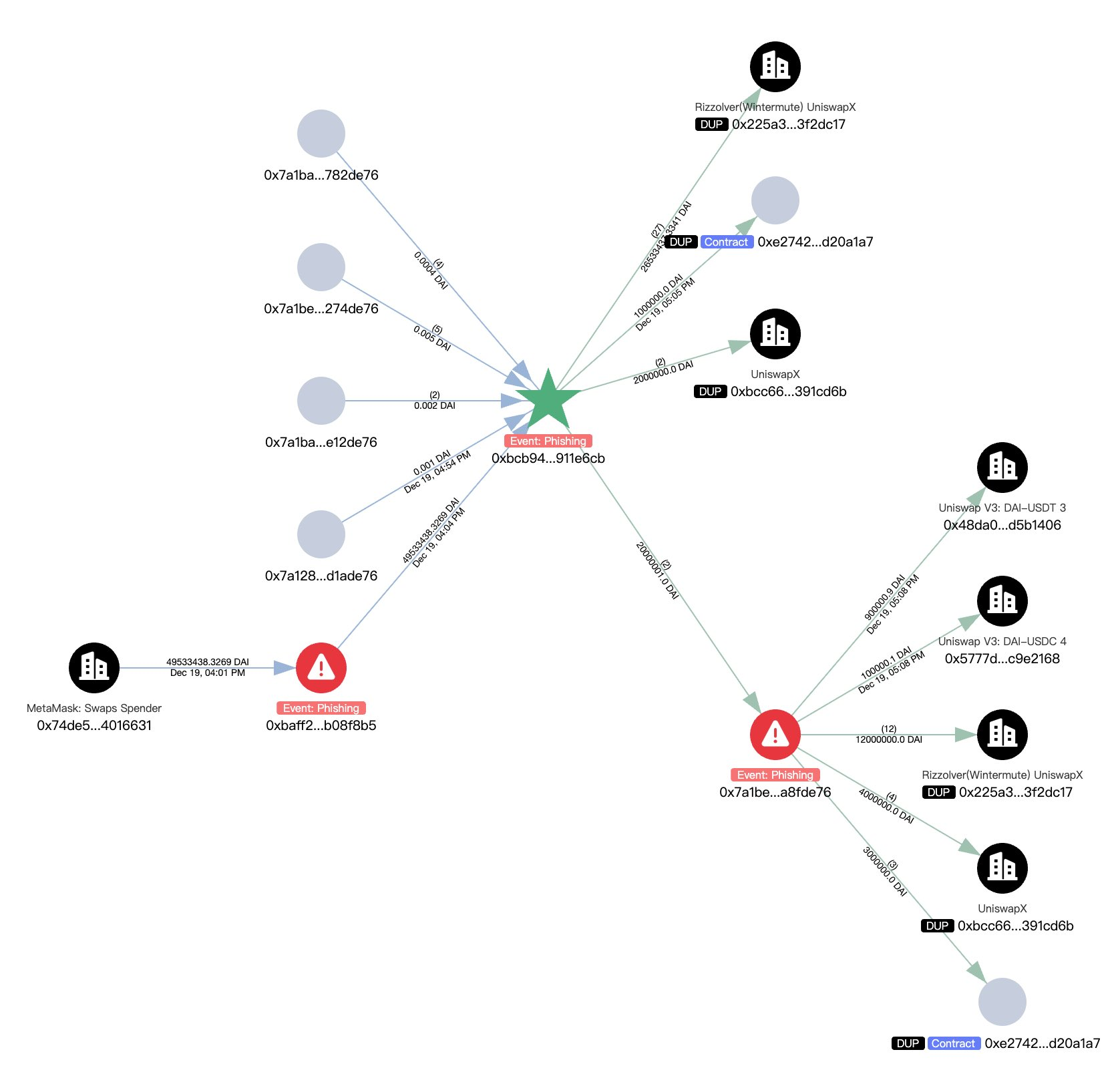
After receiving the funds, the malicious attacker quickly moved to limit the risk of asset seizure, according to on-chain records. The attacker immediately swapped the stolen USDT, which its issuer can freeze, for the DAI stablecoin using MetaMask Swap.

Attacker Moves to Obscure Transaction Trail.
Attacker Moves to Obscure Transaction Trail. Source: Slowmist

The attacker then converted the funds into roughly 16,680 ETH.

To further obscure the transaction trail, the attacker deposited the ETH into Tornado Cash. The decentralized mixing service is designed to sever the visible link between sending and receiving addresses.

Victim Offers $1 Million Bounty

In an attempt to recover the assets, the victim sent an on-chain message offering a $1 million white-hat bounty in return for 98% of the stolen funds.

“We have officially filed a criminal case. With the assistance of law enforcement, cybersecurity agencies, and multiple blockchain protocols, we have already gathered substantial and actionable intelligence regarding your activities,” the message stated.

The message warned that the victim would pursue “relentless” legal action if the attacker failed to comply within 48 hours.

“If you fail to comply: We will escalate the matter through legal and international law enforcement channels. Your identity will be uncovered and shared with the appropriate authorities. We will relentlessly pursue criminal and civil action until full justice is served. This is not a request. You are being given one final chance to avoid irreversible consequences,” the victim stated.

The incident underscores a persistent vulnerability in how digital wallets display transaction information and how attackers exploit user behavior rather than flaws in blockchain code.

Security analysts have repeatedly warned that wallet providers’ practice of abbreviating long address strings for usability and design reasons creates a persistent risk.

If this problem is not solved, attackers are likely to continue exploiting users’ tendency to verify only the first and last few characters of an address.

The post Crypto Trader Suffers $50 million Loss Following Address Poisoning Attack appeared first on BeInCrypto.

  •  

Pro-Crypto Senator Cynthia Lummis Won’t Run for Re-Election

Senator Cynthia Lummis, the US Senate’s most prominent cryptocurrency advocate, announced on December 19 that she will not seek reelection in 2026.

The decision sets a definitive deadline on her legislative agenda, creating a two-year sprint to enshrine digital asset regulations before she leaves office in January 2027.

Lummis’ Impending Retirement Adds Pressure to Codify Crypto Laws

Lummis cited the “exhausting” pace of recent sessions as the primary driver for her exit. “I am a devout legislator, but I feel like a sprinter in a marathon,” she wrote, admitting she lacks the energy reserves for another six-year term.

Thank you, Wyoming! Serving our state has been the honor of my life. – Cynthia Lummis pic.twitter.com/FoRTlHaHxI

— Cynthia Lummis 🦬 (@CynthiaMLummis) December 19, 2025

Her impending departure adds immediate urgency to the crypto legislative calendar.

Lummis has been a major player behind several pivotal crypto bills, including the crypto market structure bill and the US National Bitcoin Strategic Reserve (SBR). Her efforts also stood against the SEC’s “regulation by enforcement” approach under Gensler.

While the Trump administration has reversed several anti-crypto measures and advanced pro-crypto goals through executive action, Sen. Lummis has welcomed those steps.

She has consistently argued, however, that durable progress requires legislative codification rather than policy set by executive order alone.

So, her final term will focus on bridging the gap between temporary executive orders and permanent congressional law to protect the industry from future political reversals.

“I look forward to throwing all my energy into bringing important legislation to [Trump’s] desk in 2026 and into retaining commonsense Republican control of the US Senate,” Lummis said.

Meanwhile, the announcement triggered immediate accolades from industry heavyweights. Some argued that her exit would leave a crypto leadership vacuum in Washington.

Collin McCune, Head of Government Affairs at a16z, highlighted her national impact and noted her role in advancing crypto legislation.

“Senator Lummis fought for Wyoming every day for many years. Beyond that, her leadership created space for innovators and builders across the country. Crypto would not be where it is today without her fight in the Congress,” he added.

Arjun Sethi, co-CEO of crypto exchange Kraken, offered a detailed retrospective on Lummis’s legacy, crediting her with making Wyoming the first jurisdiction to take a “technically informed approach” to digital assets.

Sethi praised Lummis for championing frameworks that aligned with “technical reality” rather than legacy assumptions. He said the approach helped create operating certainty across markets, from Bitcoin to emerging “memetic assets.”

“Senator Lummis advocacy for Bitcoin and digital assets has been grounded, patient, and long term. Not performative. Not reactive. Focused on competitiveness, resilience, and ensuring the United States remains a place where open systems can be built and operated responsibly,” Sethi said.

The post Pro-Crypto Senator Cynthia Lummis Won’t Run for Re-Election appeared first on BeInCrypto.

  •  

Ratusan Perusahaan Aset Kripto Kecam Lobi Bank AS untuk Melarang Imbal Hasil Stablecoin

Sebuah koalisi yang terdiri dari lebih dari 125 perusahaan aset kripto dan kelompok advokasi telah meluncurkan serangan terkoordinasi terhadap pelobi perbankan AS. Grup ini mencakup perusahaan kripto besar seperti Coinbase, Gemini, dan Kraken.

Langkah ini meningkatkan pertarungan besar mengenai siapa yang berhak untuk membayar bunga atas simpanan stablecoin.

Mengapa bank berupaya melobi agar GENIUS Act diubah

Permasalahan utama adalah GENIUS Act secara tegas melarang penerbit stablecoin seperti Tether untuk membayar dividen.

namun, saat ini ada celah yang memungkinkan platform pihak ketiga, seperti exchange aset kripto, untuk menyalurkan hasil dari stablecoin ini kepada pengguna.

Akibatnya, kelompok perbankan tradisional secara agresif melobi untuk menutup jalan ini, karena mereka menyatakan bahwa hal ini adalah arbitrase regulasi.

Lobi perbankan berpendapat jika platform fintech yang tidak teregulasi diizinkan menawarkan hasil tinggi pada token setara kas, maka hal tersebut bisa menimbulkan risiko sistemik bagi arsitektur keuangan tradisional.

Di dalam pemaparan bersama Capitol Hill, mereka memperingatkan bahwa mempertahankan aturan saat ini dapat memicu arus keluar modal besar-besaran. Mereka memperkirakan potensi arus keluar simpanan hingga US$6,6 triliun dari bank komersial ke platform aset digital.

Pergeseran sebesar itu, ujar mereka, akan mengikis basis modal yang digunakan bank untuk mendukung kredit hipotek dan pinjaman bisnis. Akibatnya, bank harus mengurangi penyaluran kredit dan menaikkan biaya pinjaman bagi rumah tangga Amerika.

Koalisi Crypto Melawan Balik

Pada surat tertanggal 18 Desember kepada Komite Perbankan Senat AS, koalisi kripto mendesak para legislator untuk menolak upaya memperluas cakupan GENIUS Act yang baru disahkan.

“Membuka kembali isu ini sebelum GENIUS Act diimplementasi akan melemahkan kepastian yang menjadi ciri kerangka regulasi hasil keputusan Kongres dan membawa risiko tidak perlu terhadap upaya penguatan struktur pasar secara luas. Ini juga akan mengisyaratkan bahwa kompromi yang baru saja disahkan pun tetap bisa segera dinegosiasi ulang, sehingga mencederai prediktabilitas yang diandalkan pasar, konsumen, dan inovator,” terang koalisi tersebut.

Koalisi kripto juga menepis kekhawatiran bank soal stabilitas dan menilainya hanya sebagai upaya protektif agar tetap memonopoli simpanan berbunga rendah.

Para penandatangan surat itu menjelaskan bahwa bank hanya ingin melindungi margin keuntungan mereka dengan mencegah konsumen mengakses imbal hasil 4% yang sekarang tersedia di pasar Treasury.

“Program rewards stablecoin memungkinkan platform berbagi nilai langsung kepada pengguna, sehingga rumah tangga bisa menikmati manfaat dari lingkungan suku bunga tinggi alih-alih menanggung kerugian akibat inflasi,” papar perusahaan kripto tersebut.

The Banksters are trying to prohibit platforms like @Gemini, @coinbase, and @krakenfx from offering stablecoin rewards to you. The GENIUS Act already settled this issue with an elegant compromise — stablecoin issuers cannot offer rewards, but intermediary platforms like Gemini,… https://t.co/QpdiQfaD0X

— Tyler Winklevoss (@tyler) December 19, 2025

Tyler Winklevoss, co-founder Gemini, juga secara terbuka mengkritisi manuver lobi bank dengan menyebutnya sebagai upaya untuk “memperdebatkan kembali isu legislatif yang sudah selesai.”

  •  

Pengembang Ethereum Rencanakan Upgrade ‘Glamsterdam’ dan ‘Hegota’ untuk 2026

Para pengembang inti Ethereum telah mengungkapkan rencana untuk melakukan dua upgrade besar jaringan pada tahun 2026, dengan kode nama “Glamsterdam” dan “Hegota”.

Keputusan ini menandai langkah strategis berkelanjutan jaringan blockchain tersebut untuk mempercepat jadwal perilisan upgrade. Langkah ini bertujuan agar ada jadwal upgrade dua kali setahun secara teratur dan membuat posisi Ethereum lebih kompetitif melawan sejumlah rival berkapasitas transaksi tinggi.

Ethereum lakukan upgrade dua kali setahun agar bisa bersaing dengan rival berkecepatan tinggi

Roadmap menargetkan “Glamsterdam” akan dirilis pada paruh pertama 2026, tidak lama setelah hard fork “Fusaka” yang baru-baru ini terjadi.

Menurut para pengembang, Glamsterdam akan berfokus pada perbaikan skalabilitas dan efisiensi secara langsung, terutama lewat optimasi gas dan penerapan “Enshrined Proposer-Builder Separation” (ePBS).

Upgrade teknis ini bertujuan memisahkan peran builder blok dan proposer blok di tingkat protokol. Hal ini mengurangi risiko sensor dan makin mendesentralisasikan jaringan.

Sementara itu, para pengembang juga berencana untuk segera merampungkan daftar fitur penuh Glamsterdam setelah libur akhir tahun.

Di sisi lain, tahap kedua dari sprint 2026, yaitu “Hegota”, menyasar paruh kedua tahun tersebut.

Nama upgrade ini mencerminkan dua gabungan pembaruan, yaitu pembaruan layer eksekusi “Bogota” dengan pembaruan layer konsensus “Heze”.

Christine Kim, mantan Wakil Presiden di Galaxy Digital yang kini aktif memantau tata kelola protokol, menuturkan bahwa diskusi lingkup pembaruan Hegota akan dimulai pada panggilan All Core Developers tanggal 8 Januari.

Sesi-sesi ini akan menentukan fitur utama dari hard fork tersebut, dengan lingkup resmi yang diperkirakan rampung di akhir Februari.

Update Lain yang Sudah Direncanakan

Bersamaan dengan perubahan struktural ini, Ethereum Foundation secara agresif tengah mengarahkan ulang riset jangka panjangnya demi memperkuat keamanan jaringan.

Peneliti George Kadianakis mengonfirmasi bahwa tujuan jaringan ini ingin mencapai “keamanan terbukti 128-bit” di akhir tahun 2026. Standar kriptografi tersebut dianggap sangat penting untuk aplikasi finansial tingkat institusi.

“For zkEVMs, this isn’t academic. A soundness issue is not like other security issues. If an attacker can forge a proof, they can forge anything: mint tokens from nothing, rewrite state, steal funds. For an L1 zkEVM securing hundreds of billions of dollars, the security margin is not negotiable,” ucapnya .

Foundation tersebut mengaitkan inisiatif ini dengan sejumlah target khusus, termasuk integrasi “soundcalc” di bulan Februari lalu sinkronisasi penuh dengan hard fork Glamsterdam di bulan Mei.

Upaya ini bertujuan untuk menghilangkan hambatan teknis yang saat ini masih membatasi adopsi massal Ethereum.

Untuk menjembatani hal ini, para pengembang pun menerapkan strategi guna menurunkan hambatan masuk dan menyesuaikan kemudahan aplikasi Ethereum layaknya aplikasi konsumen arus utama.

  •  

Trader Kripto Alami Kerugian US$50 juta setelah Serangan Address Poisoning

Seorang trader aset kripto kehilangan US$50 juta dalam USDT milik Tether setelah menjadi korban serangan “address poisoning” yang sangat canggih.

Pada 20 Desember, perusahaan keamanan blockchain Scam Sniffer melaporkan bahwa serangan ini bermula setelah korban mengirim transaksi uji coba kecil senilai US$50 ke alamat wallet miliknya sendiri.

Bagaimana skema address poisoning terjadi

Trader memang biasa menggunakan langkah pencegahan standar seperti ini untuk memastikan mereka mengirim dana ke alamat yang benar.

Namun, aktivitas itu justru memicu skrip otomatis milik penyerang, yang langsung membuat sebuah alamat wallet “spoofing”.

🚨💔 A victim lost ~$50M after copying the wrong address from contaminated transfer history. https://t.co/ur4SJ0cvN0 pic.twitter.com/6K5ftJzC1G

— Scam Sniffer | Web3 Anti-Scam (@realScamSniffer) December 20, 2025

Alamat palsu ini dirancang agar cocok dengan alamat tujuan di awal dan akhir deretan karakter alfanumerik. Perbedaan terletak hanya di bagian tengah, sehingga sangat sulit dideteksi sekilas.

Penyerang lalu mengirim sejumlah aset kripto yang sangat kecil dari alamat spoofing tersebut ke wallet korban.

Transaksi tersebut secara efektif menempatkan alamat palsu tadi ke dalam riwayat transaksi terbaru korban, di mana banyak tampilan wallet hanya memperlihatkan bagian alamat yang telah dipersingkat.

Mengandalkan tampilan singkat itu, korban menyalin alamat tersebut dari riwayat transaksi tanpa mengecek seluruh deretan karakter. Alhasil, alih-alih mengirim dana ke wallet pribadi yang aman, trader tersebut justru mengirim langsung 49.999.950 USDT ke penyerang.

Setelah menerima dana tersebut, penyerang jahat tersebut langsung bergerak untuk mengurangi risiko aset disita, menurut catatan on-chain. Penyerang pun segera menukar USDT hasil curian, yang dapat dibekukan oleh pihak penerbit, menjadi stablecoin DAI melalui MetaMask Swap.

Attacker Moves to Obscure Transaction Trail.
Penyerang Mencoba Menyamarkan Jejak Transaksi | Sumber: Slowmist

Penyerang kemudian mengonversi dana tersebut menjadi sekitar 16.680 ETH.

Untuk semakin menyamarkan jejak transaksi, pelaku kemudian mendepositkan ETH ke Tornado Cash. Layanan mixing terdesentralisasi ini memang dirancang agar hubungan alamat pengirim dan penerima menjadi sulit dilacak.

Korban tawarkan bounty US$1.000.000

Dalam upaya memulihkan aset, korban mengirim pesan on-chain yang menawarkan bounty white-hat senilai US$1 juta jika penyerang mengembalikan 98% dana yang dicuri.

“We have officially filed a criminal case. With the assistance of law enforcement, cybersecurity agencies, and multiple blockchain protocols, we have already gathered substantial and actionable intelligence regarding your activities,” ujar pesan tersebut .

Pesan itu juga memperingatkan bahwa korban akan melakukan tindakan hukum “tanpa henti” jika penyerang tidak menggubris dalam waktu 48 jam.

“If you fail to comply: We will escalate the matter through legal and international law enforcement channels. Your identity will be uncovered and shared with the appropriate authorities. We will relentlessly pursue criminal and civil action until full justice is served. This is not a request. You are being given one final chance to avoid irreversible consequences,” terang korban.

Insiden ini menegaskan adanya kerentanan yang terus berulang pada sistem wallet digital yang menampilkan informasi transaksi — dan bagaimana penyerang mengeksploitasi perilaku pengguna, bukan celah di kode blockchain.

Analis keamanan telah berulang kali memperingatkan bahwa praktik penyedia wallet yang memangkas panjang alamat demi kepraktisan dan desain antarmuka justru menciptakan risiko besar yang berkelanjutan.

Jika masalah ini tidak segera diatasi, para penyerang hampir pasti akan terus memanfaatkan kebiasaan pengguna yang hanya mengecek beberapa karakter awal dan akhir dari sebuah alamat.

  •  

Senator Pro-Aset Kripto Cynthia Lummis tidak akan mencalonkan diri lagi

Senator Cynthia Lummis, politisi Senat AS yang paling dikenal mendukung aset kripto, mengumumkan pada 19 Desember bahwa ia tidak akan mencalonkan diri lagi pada 2026.

Keputusan ini menjadi tenggat yang pasti untuk agenda legislasinya, sehingga menciptakan dua tahun terakhir untuk memperjuangkan regulasi aset digital sebelum ia meninggalkan jabatannya pada Januari 2027.

Rencana Pensiun Lummis Menambah Tekanan untuk Mengatur Hukum Aset Kripto

Lummis menyebut bahwa ritme kerja yang “melelahkan” dalam beberapa sidang terakhir menjadi alasan utama keputusannya. “Saya adalah legislator yang taat, namun saya merasa seperti pelari jarak pendek di dalam maraton,” tulisnya, sambil mengakui bahwa ia tidak memiliki stamina lagi untuk masa jabatan enam tahun berikutnya.

Thank you, Wyoming! Serving our state has been the honor of my life. – Cynthia Lummis pic.twitter.com/FoRTlHaHxI

— Cynthia Lummis 🦬 (@CynthiaMLummis) December 19, 2025

Kepergiannya dalam waktu dekat membuat agenda regulasi kripto di parlemen menjadi lebih mendesak.

Lummis punya peran penting di sejumlah RUU kripto utama, seperti RUU struktur pasar aset kripto dan Strategic Bitcoin Reserve (SBR) nasional AS. Ia juga menentang pendekatan “regulasi melalui penegakan hukum” yang dilakukan SEC di bawah kepemimpinan Gensler.

Walaupun pemerintahan Trump telah membalikkan sejumlah kebijakan anti-kripto serta mendorong tujuan pro-kripto lewat aksi eksekutif, Senator Lummis menyambut langkah-langkah tersebut.

Namun ia juga selalu menegaskan, kemajuan yang bertahan lama harus lewat aturan yang dilembagakan oleh legislatif, bukan sekadar kebijakan dari keputusan eksekutif semata.

Karena itu, masa jabatannya terakhir ini akan fokus menjembatani celah antara perintah eksekutif yang bersifat sementara dengan hukum kongres yang bersifat tetap demi melindungi industri dari potensi pembalikan politik di masa depan.

“I look forward to throwing all my energy into bringing important legislation to [Trump’s] desk in 2026 and into retaining commonsense Republican control of the US Senate,” ujar Lummis.

Sementara itu, pengumuman ini langsung mendapat pujian dari para tokoh besar industri. Sebagian berpendapat kepergian Lummis akan meninggalkan kekosongan kepemimpinan kripto di Washington.

Collin McCune, Kepala Urusan Pemerintahan di a16z, menyoroti pengaruh Lummis secara nasional dan perannya mendorong legislasi kripto.

“Senator Lummis memperjuangkan Wyoming setiap hari selama bertahun-tahun. Selain itu, kepemimpinannya membuka ruang bagi inovator dan builder di seluruh negeri. Dunia kripto tidak mungkin seperti saat ini tanpa perjuangannya di Kongres,” tambahnya.

Arjun Sethi, co-CEO crypto exchange Kraken, memberikan ulasan mendalam terkait warisan Lummis, dan menyebut dirinya berjasa menjadikan Wyoming sebagai yurisdiksi pertama yang menerapkan pendekatan “berbasis pengetahuan teknis” pada aset digital.

Sethi memuji Lummis karena mengedepankan kerangka kerja yang sejalan dengan “realitas teknis” daripada asumsi lama. Ia mengatakan bahwa pendekatan ini membantu menciptakan kepastian operasional di berbagai pasar, baik pada Bitcoin sampai “aset memetik” yang baru muncul.

“Senator Lummis advocacy for Bitcoin and digital assets has been grounded, patient, and long term. Not performative. Not reactive. Focused on competitiveness, resilience, and ensuring the United States remains a place where open systems can be built and operated responsibly,” papar Sethi .

  •  
❌