Reading view

Solana Meme Coins are Dying Out, Key Metric Shows

Solana’s meme coin market has fallen to its weakest level in nearly two years as trading activity continues to contract across decentralized exchanges.

According to Blockworks data, the category now accounts for less than 10% of daily volume on Solana-based DEXs. This marks a sharp reversal from the boom that dominated the network last year.

Solana Traders Dump Meme Coins For Stablecoins

For context, Solana meme coins generated roughly $295 million in volume on November 27. That amount represented about 9.2% of the more than $3.2 billion traded across the network that day.
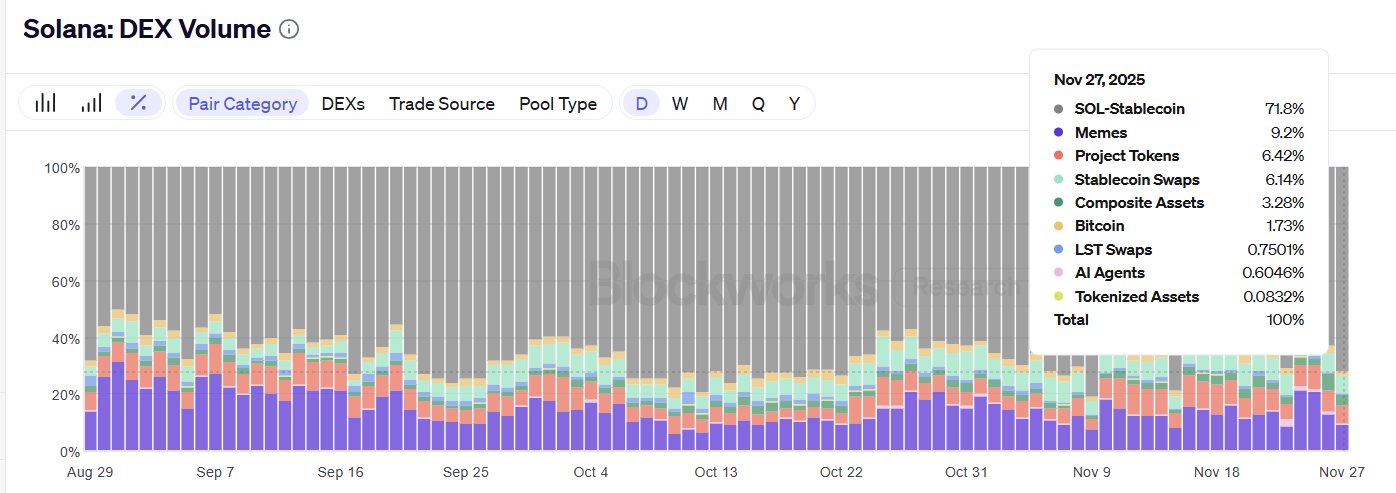
Solana DEX Volume Category.
Solana DEX Volume Category. Source: Blockworks

The slide underscores a steep decline from December 2024, when meme assets accounted for more than 70% of trading volume on Solana DEXs.

The pullback follows a series of high-profile rug pulls and scams that hit the Solana ecosystem earlier this year.

One of the most visible incidents involved the LIBRA token, a meme coin linked to a controversy surrounding Argentine President Javier Milei.

Its collapse drained more than $107 million in liquidity. It also contributed to an estimated $4 billion in broader losses, according to industry trackers.

The fallout led to a decline in Solana user activity, including a drop in unique traders, and set the tone for a broader retreat from meme-linked assets.

Subsequent scams reinforced the trend, eroding investor confidence and narrowing the pool of market participants willing to speculate on new tokens.

As a result, the number of token launches on Solana has dropped by 42% since mid-January. The decline reflects a broader contraction in appetite for high-risk projects.

Are memecoins dead?

The amount of token launches on solana has decreased by a whopping 42% since mid-january.

However, that hasn't reduced the amount of activity onchain with over 11M active addresses. Very bullish actually. pic.twitter.com/a5Qpjbmmmp

— Solana Sensei (@SolanaSensei) November 28, 2025

Meanwhile, as meme coin activity receded, stablecoins have taken a larger share of network flow.

Blockworks data shows stablecoin-related transactions climbed to nearly 80% of DEX volume, one of the highest readings in more than two years.

This shift signals a clear preference for assets that offer deeper liquidity and lower volatility, particularly as markets absorb this year’s broader downturn.

The post Solana Meme Coins are Dying Out, Key Metric Shows appeared first on BeInCrypto.

  •  

Solana Considers Cutting $3 billion in SOL Emissions in its Biggest Economic Shift Yet

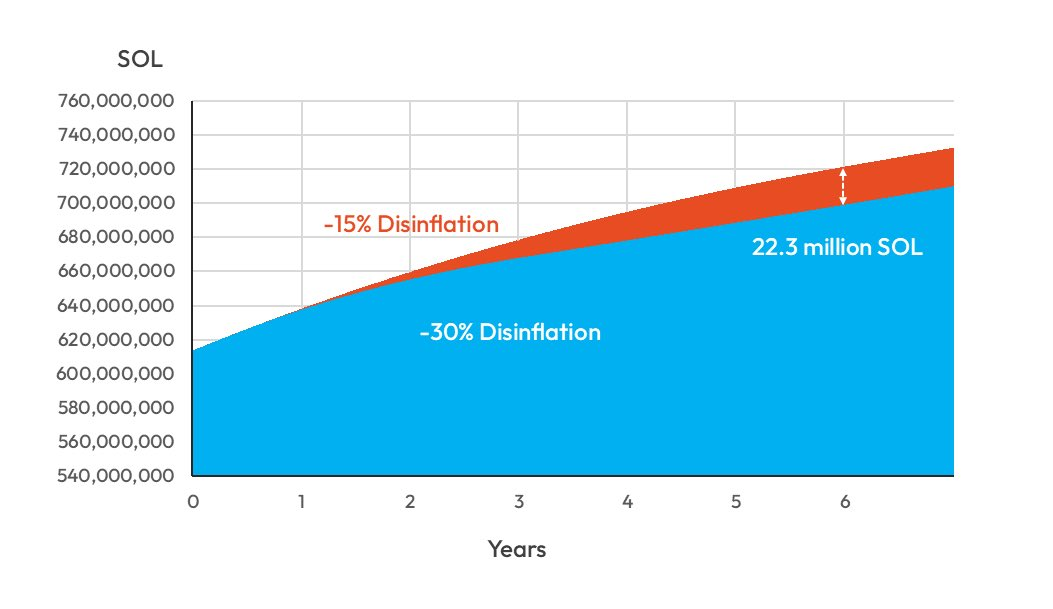
Solana is weighing a radical shift in its economic model that would eliminate approximately 22.3 million SOL ($2.9 billion) from projected emissions over the next six years.

As a result, the proposal would aggressively fast-track the transition of the blockchain to a low-inflation environment.

Solana’s Plan to Tighten Supply Risks Squeezing Nearly 50 Validators

The measure, formally titled SIMD-0411, proposes doubling the Solana network’s annual disinflation rate from 15% to 30%.

“Doubling the disinflation rate requires modifying a single parameter, making it the simplest possible protocol change that delivers a meaningful reduction in inflation. This adjustment will not consume core developer resources. It carries minimal risk of introducing bugs or unforeseen edge cases,” the authors argued.

If passed, Solana would hit its “terminal” inflation target of 1.5% in roughly three years, ie, by 2029. Notably, that milestone was originally scheduled for 2032.

Proponents describe the current emissions schedule as a “leaky bucket” that continually dilutes holders and creates persistent sell pressure.

By tightening supply, the network hopes to emulate the scarcity mechanics that have historically benefited Bitcoin and Ethereum.

“Our modeling indicates that, over the next 6 years, total supply would be approximately 3.2% lower (a reduction of 22.3 million SOL) than under the current inflation schedule. At today’s SOL price, this equates to roughly $2.9 billion in reduced emissions. Excessive emissions create persistent downward price pressure, distorting market signals and hindering fair price comparison,” they wrote.

Solana’s Disinflation Proposal. Source: Solana Floor

Beyond price support, the plan seeks to overhaul the incentive structure for decentralized finance (DeFi).

Moreover, the proposal argues that high inflation mirrors high interest rates in traditional finance, raising the “risk-free” benchmark and discouraging borrowing.

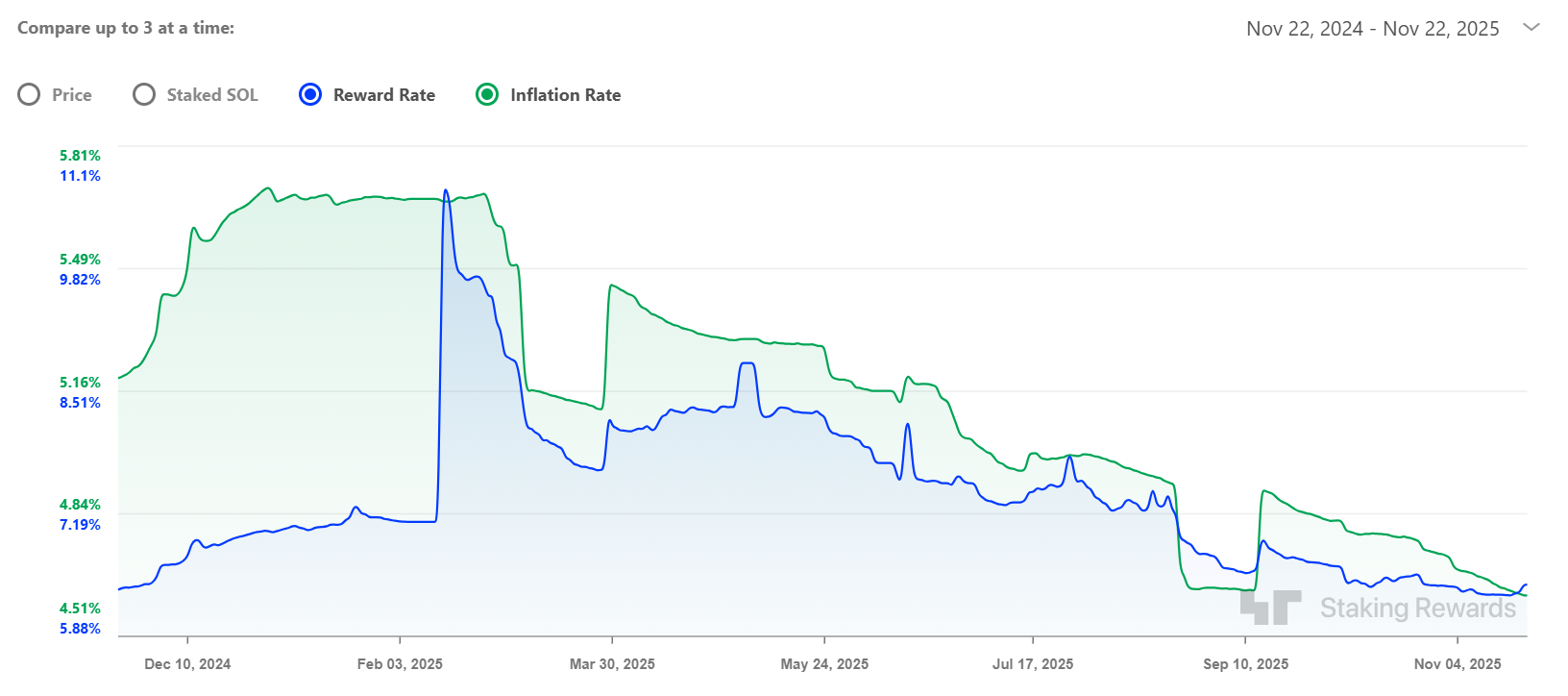
Considering this, Solana aims to push capital out of passive validation and into active liquidity provision by compressing nominal staking yields. Those yields are projected to fall from 6.41% to 2.42% by the third year.

Solana's Staking Reward and Inflation Rate.
Solana’s Staking Reward and Inflation Rate. Source: Staking Rewards

However, this “hard money” pivot carries operational risks.

The reduction in subsidies will inevitably squeeze validator margins.

The proposal estimates that up to 47 validators could become unprofitable within three years as rewards dry up. However, the authors describe this level of churn as minimal.

Still, it raises questions about whether the network will consolidate around larger, better-capitalized operators that can survive on transaction fees alone.

Despite these concerns, early backing from key ecosystem players suggests Solana is prepared to trade subsidized growth for greater stability. The shift reflects a move toward positioning the network as a more mature, scarcity-driven asset class.

The post Solana Considers Cutting $3 billion in SOL Emissions in its Biggest Economic Shift Yet appeared first on BeInCrypto.

  •  
❌