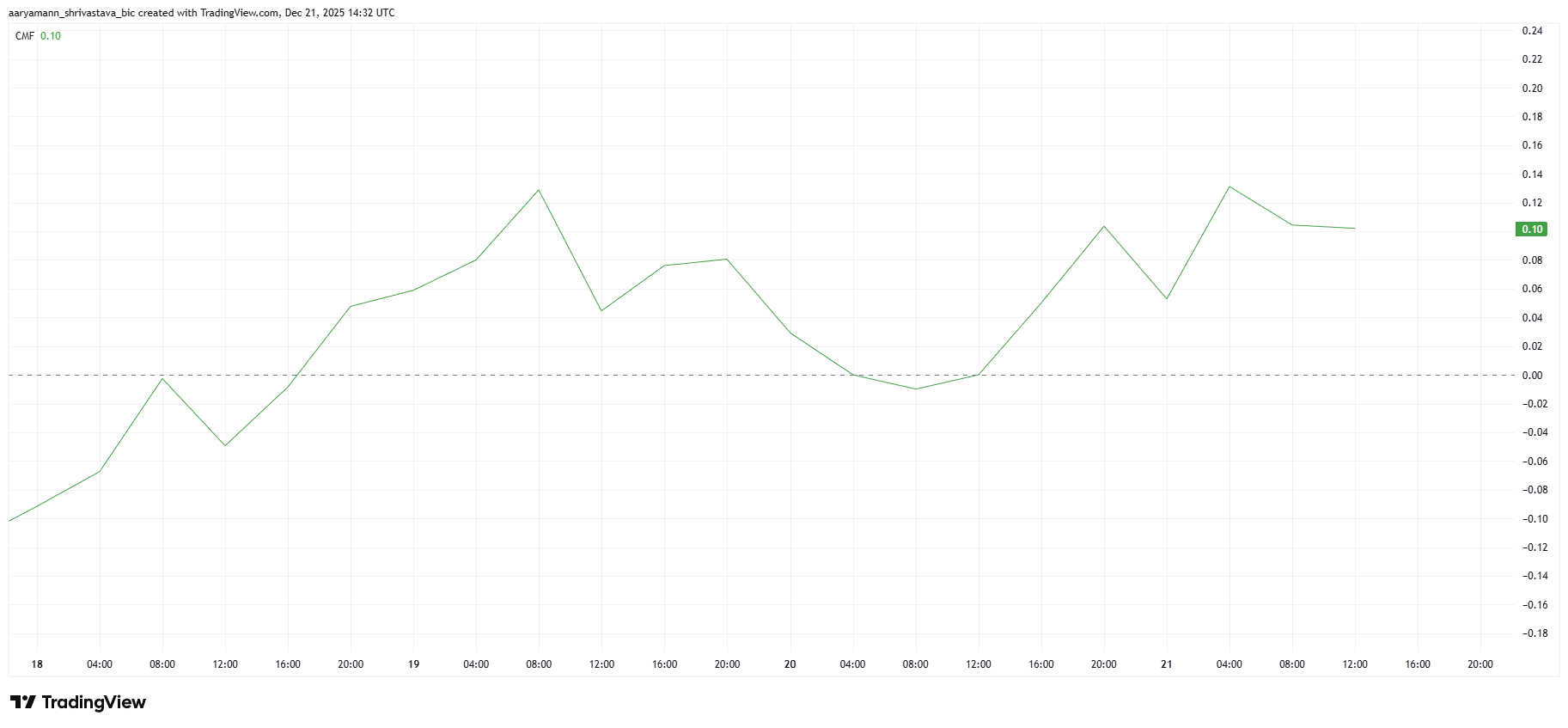
Ethereum continues to struggle near the $3,000 level as repeated recovery attempts lose momentum. ETH trades just below this psychological barrier, reflecting cautious sentiment.
While investor interest is rising, on-chain activity remains muted. This imbalance is raising concerns that Ethereum’s price may be overheating without sufficient network usage to sustain gains.
Ethereum Holders Are Rising
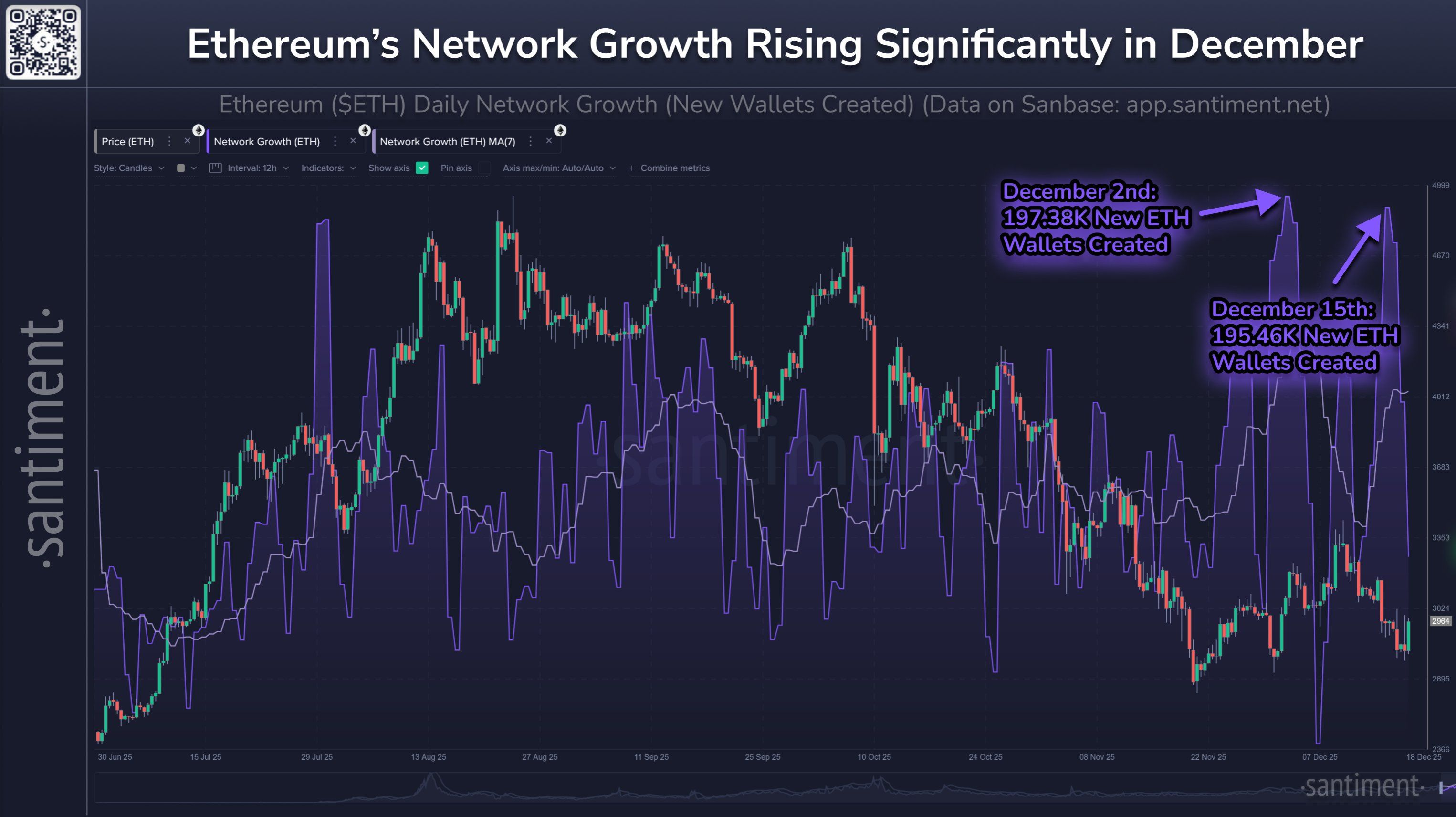
Ethereum is recording a steady rise in new wallet creation. The network now averages about 163,000 new addresses per day. This compares with roughly 124,000 daily additions during July, previously considered a peak period for network growth.
The increase highlights strong investor curiosity around Ethereum despite weak price performance. Growing wallet creation suggests demand for exposure remains intact. However, new addresses alone do not guarantee price strength.
Want more token insights like this? Sign up for Editor Harsh Notariya’s Daily Crypto Newsletter here.
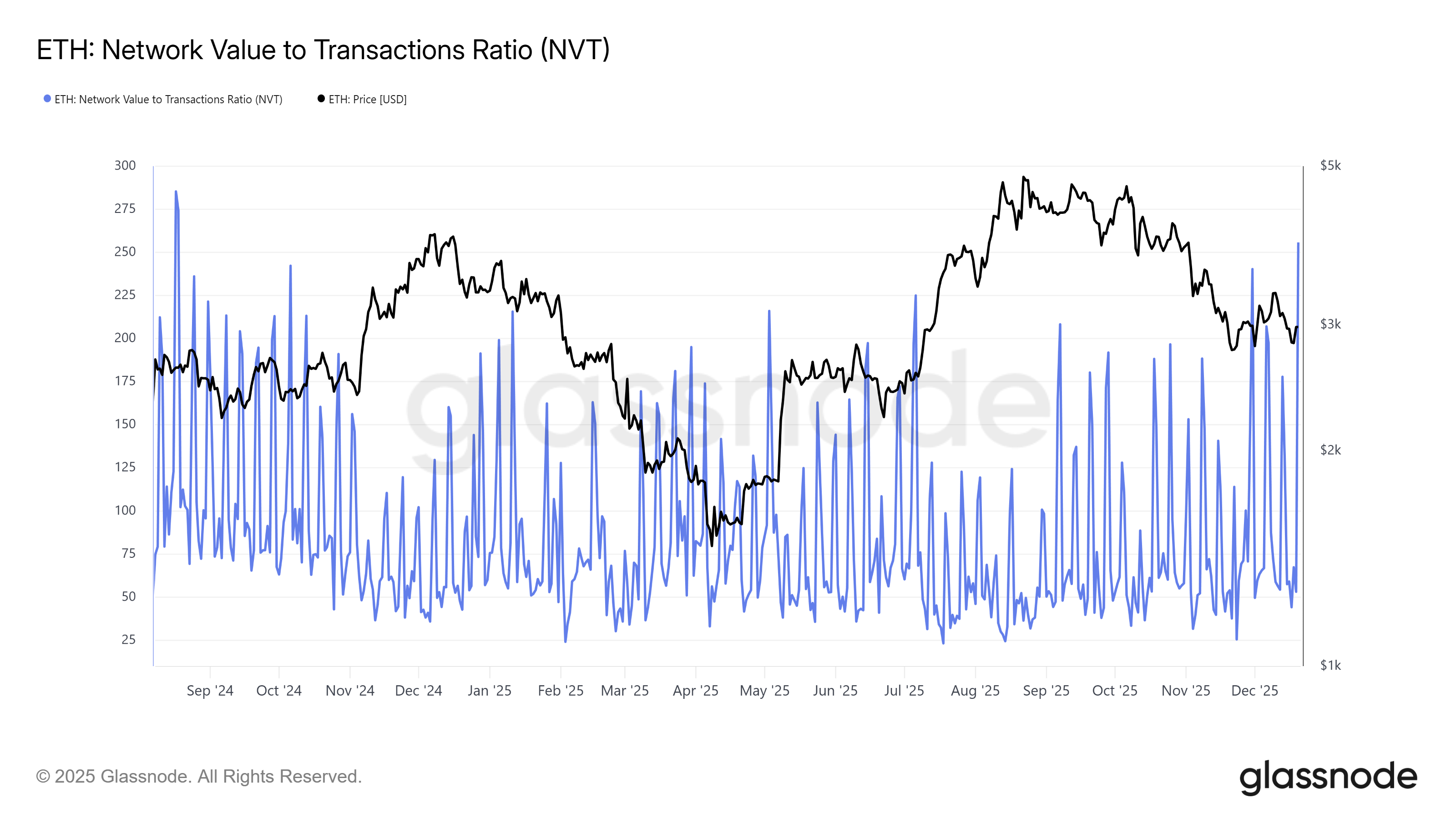
Macro indicators present a mixed picture. Ethereum’s network value-to-transactions ratio is rising sharply. The indicator currently sits at a 16-month high, signaling potential overheating conditions.
A high NVT ratio suggests market valuation is growing faster than transaction activity. Optimism around recovery appears to be driving interest, but real usage has yet to follow. Without increased on-chain activity, price advances risk stalling as valuation outpaces fundamentals.
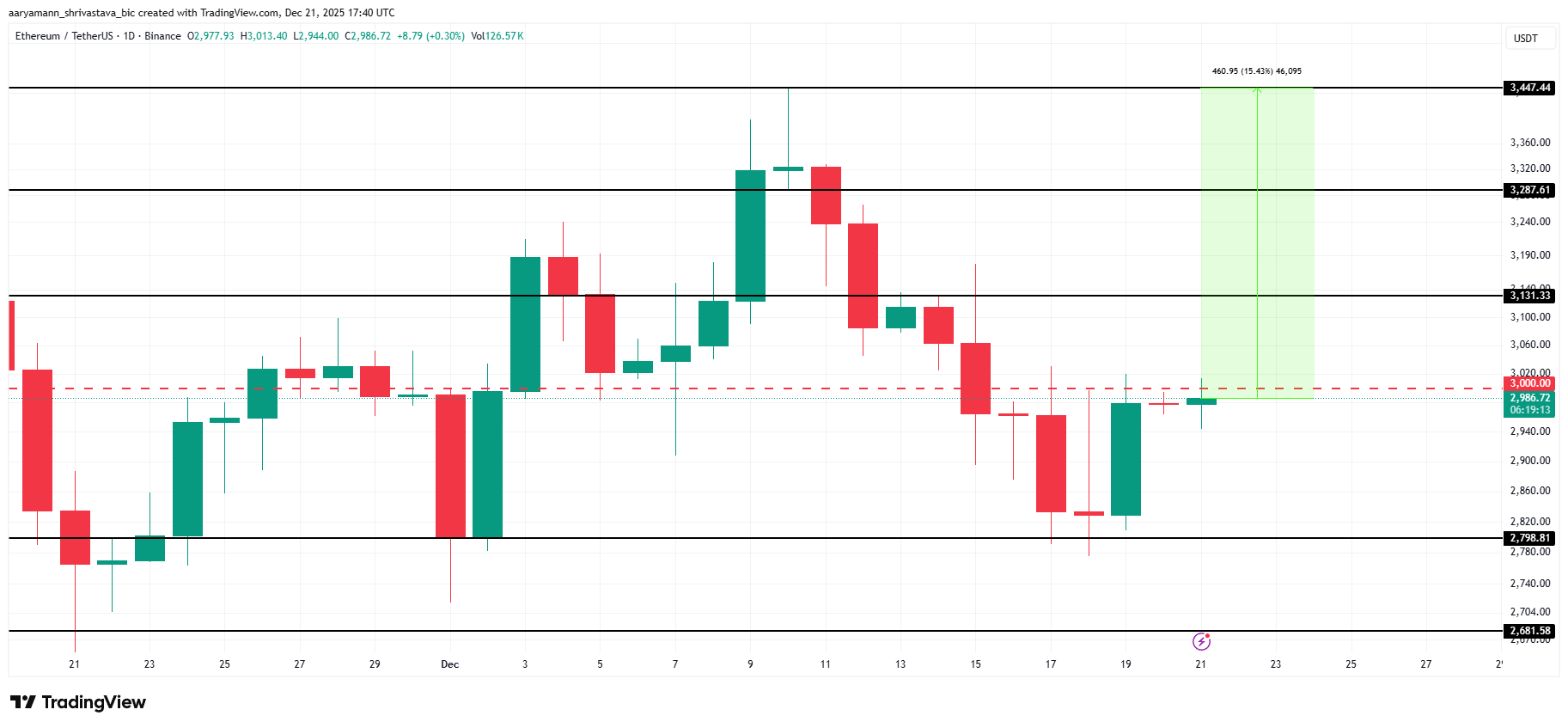
Ethereum trades near $2,986 at the time of writing, sitting just below the $3,000 resistance. This level has been tested repeatedly in recent sessions. Failure to break above it has reinforced caution among traders watching for confirmation.
ETH may continue consolidating below $3,000 or briefly breach it without holding support. If transaction activity remains weak, downside pressure could return. In that case, the $2,798 support may be tested again, reflecting unresolved macro imbalances.
Improving conditions could shift the outlook. A rise in transaction volume would help Ethereum secure $3,000 as support. Holding that level could open a path toward $3,131. A sustained break beyond this barrier would invalidate the bearish thesis and allow ETH to target $3,287, restoring confidence.
The Santa Rally—Wall Street’s beloved year-end tradition—has found an eager audience among Chinese crypto Twitter’s most followed analysts.
Far from dismissing it as Western-market folklore, key opinion leaders in the Chinese-speaking community are treating the final trading days of 2025 as a critical signal of what lies ahead in 2026.
Santa Rally More Than Seasonal Noise
Phyrex, one of the most cited macro analysts in Chinese crypto circles, argues that the Santa Rally is not merely a statistical curiosity. “It’s more like a barometer of market risk appetite,” he wrote. “If markets manage to rise as expected from Christmas through New Year—without fresh macro catalysts—it confirms that investors are still willing to allocate to risk assets, setting the emotional foundation for next year’s pricing.”
The flip side carries weight, too. A failed rally, Phyrex warns, often signals that risk appetite has not recovered, leaving markets vulnerable to weakness or choppy trading well into January and beyond.
The analyst points to several mechanical factors that typically support year-end gains. Tax-loss harvesting wraps up by mid-December, freeing capital to rotate back into equities. Institutional desks go quiet for the holidays, thinning out volumes and allowing modest buying pressure to move indices higher. Year-end bonuses and automatic 401(k) contributions add passive bid support.
Michael Chao, a US-focused markets commentator popular on Chinese Twitter, highlighted the historical odds: since 1950, the S&P 500 has risen 75% of the time during the Santa Rally window, posting an average gain of 1.55%.
But Risks Loom Large
Not everyone is popping champagne early. Cryptojiejie noted that Bitcoin and Ethereum global volumes have shrunk to 2025 lows, calling current conditions “garbage time” for traders. She advised breakout-focused traders to step back and enjoy the holidays until liquidity returns.
Macro headwinds add to the caution. Zhou Financial wrote that the Bank of Japan’s December rate hike to 0.75% has raised concerns about the unwinding of the yen carry trade, while the Federal Reserve’s hawkish 25-basis-point rate cut—paired with a dot plot signaling only two cuts through 2026—disappointed markets that had expected more accommodation.
Phyrex framed the tension bluntly: “If the market still can’t form an effective rally under seasonal tailwinds and gradually recovering liquidity, it likely means the current high-rate environment’s pressure on the economy has already overwhelmed the sentiment boost from holiday factors.”
The 2026 Preview
For Phyrex, this year’s Santa Rally carries outsized significance. He sees it as effectively a preview of Q1 2026 expectations. The logic is straightforward: if investors refuse to bid up risk assets even when seasonal patterns, sentiment vacuums, and returning liquidity all align in their favor, something deeper may be broken.
The intense focus on Wall Street may partly reflect a lack of domestic options. Earlier this month, seven major Chinese financial industry associations issued a joint risk warning—the most comprehensive crypto crackdown since the 2021 ban that drove all exchanges out of the country.
The statement explicitly prohibited real-world asset (RWA) tokenization for the first time, alongside stablecoins, airdrops, and mining. With regulators sealing off virtually every on-ramp, Chinese crypto investors have little choice but to watch global markets from the sidelines.
As Chinese crypto Twitter watches Wall Street just as closely as anyone else, all eyes are on whether Santa shows up.
A massive power outage hit San Francisco on Saturday afternoon, leaving 130,000 homes and businesses without electricity. The incident forced residents to face technology’s fundamental vulnerabilities. Caused by a fire at a PG&E substation, the blackout cut off access to digital wallets and cryptocurrency exchanges for thousands of users.
The event highlights how, despite the resilience of decentralized blockchain networks, practical crypto usability still relies on local electricity and internet infrastructure.
San Francisco’s Power Crisis: Scale and Impact
The outage began at 1:09 pm, affecting about one-third of PG&E customers in San Francisco. The disruption focused on the Richmond District and spread across the city. By 11 p.m., power had been restored to roughly 95,000 customers, but nearly 18,000 remained without electricity Sunday afternoon.
The incident disrupted city transit, halted Waymo robotaxis mid-ride, and forced the closure of many restaurants and shops. The scale caught many off guard. As one observer noted on social media, nearly 30% of the city lost power overnight—no storm, no warning, no clear accountability.
Blockchain Networks Endure Local Outages
The blackout offers a timely reminder: even decentralized technologies remain tethered to centralized infrastructure.
Cryptocurrency networks like Bitcoin and Ethereum operate on distributed ledgers maintained by thousands of nodes worldwide. A regional blackout, even one affecting a major tech hub like San Francisco, does not halt the blockchain itself. Transactions continue to be validated, blocks continue to be added, and user assets remain safely recorded on-chain.
In short, your crypto doesn’t disappear when the lights go out.
However, the practical reality is less reassuring. Without electricity and internet access, affected users cannot access wallets, execute trades, or complete payments. Crypto-accepting merchants face the same limitation—no power means no point-of-sale systems.
Mining operations, which require substantial and continuous power, halt immediately during outages. If a blackout affects a region with significant hash rate concentration, network validation could slow temporarily.
For those mid-transaction when power fails, the outcome depends on timing. Unconfirmed transactions remain in the mempool and will be processed once connectivity returns. Confirmed transactions are immutable and unaffected.
Exchange Infrastructure Keeps Crypto Trading 24/7
Major crypto exchanges have developed strategies for uninterrupted trading during power disruptions. Based on industry analysis, exchanges use layered defenses, including uninterruptible power supplies (UPS), backup generators for extended outages, and redundant data centers with automatic failover protocols.
If a main facility fails, trading shifts instantly to another healthy region. Data replication between centers ensures zero data loss and maintains transaction integrity during crises.
Asset security is vital during blackouts. Most holdings are in cold storage, offline, and far from network risks. Hot wallets—used for current trading—are limited and protected by multi-signature protocols and withdrawal limits. Regular drills and continuity plans ensure exchanges continue to operate during extended failures.
The North American Electric Reliability Corporation has documented infrastructure standards for crypto operations. A white paper notes that cryptocurrency facilities require complex internal infrastructure, including UPS systems and generators, to ensure resilience.
These efforts underscore the divide between decentralized network design and the traditional infrastructure required for practical access. However, while blockchains survive regional outages, the services that connect users depend on power and connectivity investments.
The Hardware Wallet Paradox
Security-conscious holders often store assets in hardware wallets, keeping private keys offline and protected from network-based attacks. This remains sound practice. But the blackout reveals an uncomfortable truth: hardware wallets are secure, yet without power, users cannot access them either.
The device itself is safe. The assets are intact. But the owner sitting in a dark apartment cannot verify balances, sign transactions, or move funds to respond to market conditions. Security and accessibility exist in tension during infrastructure failures.
Offline seed phrase backups ensure eventual recovery, but they offer no help in the immediate crisis. For crypto to function as a reliable financial tool, users must plan for scenarios where even their most secure storage becomes temporarily unreachable.
Decentralized, But Not Independent
The San Francisco outage underscores a fundamental tension in cryptocurrency’s value proposition. Decentralization protects the network from single points of failure at the protocol level. But end-user access still depends entirely on electricity, internet connectivity, and functioning local infrastructure—the same dependencies as traditional digital payments.
Some projects are exploring alternatives. Blockstream‘s satellite network broadcasts Bitcoin blockchain data globally, enabling node synchronization without traditional internet access. Such solutions remain niche but point toward greater infrastructure independence.
What This Means for Users
The incident carries practical lessons for crypto holders. Diversified backup plans matter: mobile hotspots, portable battery packs, and knowing which local areas might retain power. When evaluating exchanges, infrastructure redundancy and disaster recovery capabilities should be considered alongside fees and token listings.
But perhaps the most honest takeaway is this: blockchain networks survive blackouts, but user access does not. Until that gap closes, crypto remains a fair-weather financial tool—resilient in theory, unreachable when it matters most.
Midnight has extended its sharp rally as strong investor demand pushed the token to a new all-time high. The project associated with Cardano founder Charles Hoskinson continues to attract attention after sustaining upside momentum.
While NIGHT has already delivered outsized gains, technical and macro signals suggest additional upside potential remains.
Midnight Holders Are Watching A New Sunrise
Investor support for NIGHT remains firm. The Chaikin Money Flow sits in positive territory above the zero line, confirming net inflows. Although the indicator dipped slightly over the past 48 hours, capital continues entering the asset, signaling ongoing confidence rather than distribution.
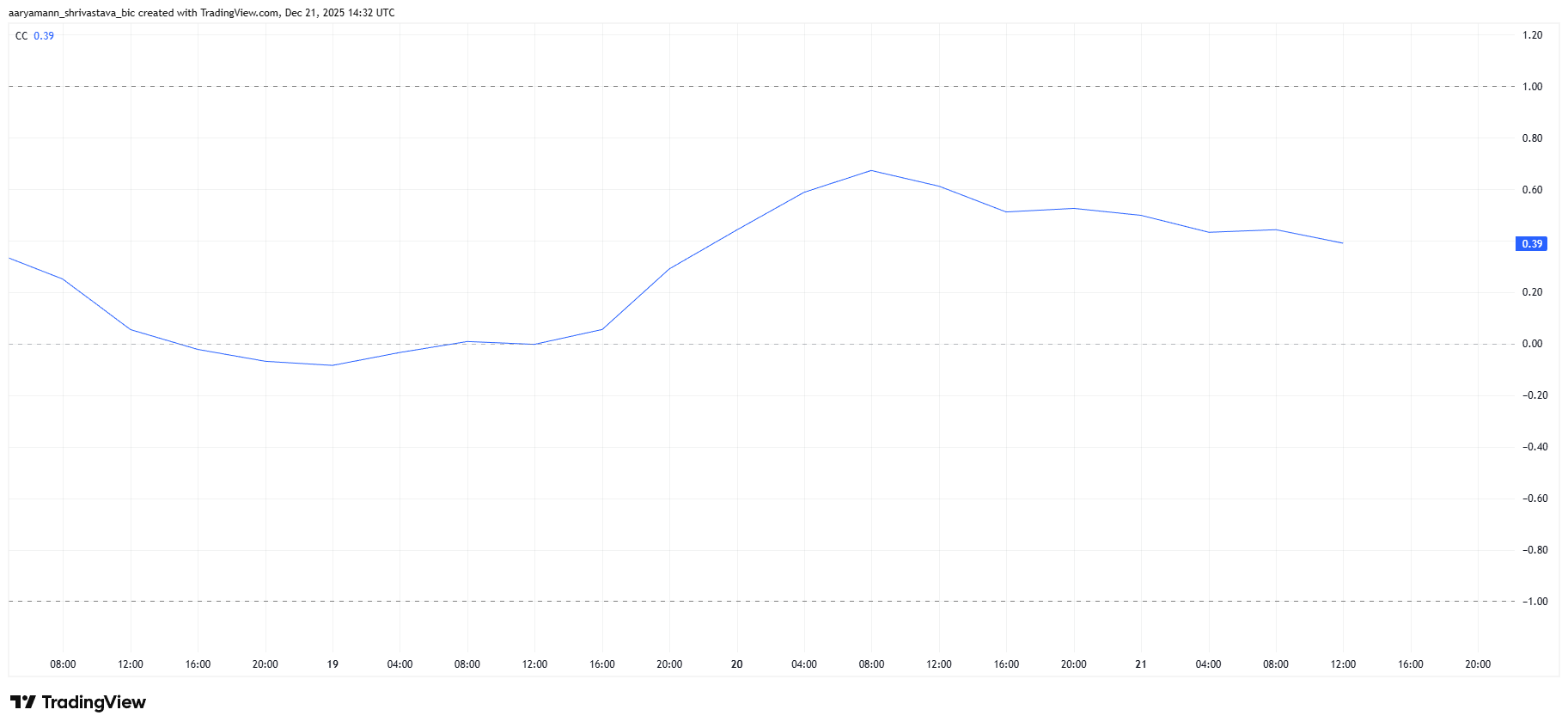
Macro conditions also favor NIGHT’s performance. The token shows a weak correlation with Bitcoin, insulating it from broader market uncertainty. This independence has allowed NIGHT to trend higher even as Bitcoin struggles to regain momentum.
Low correlation often benefits emerging assets during periods of BTC consolidation. With Bitcoin lacking a clear recovery signal, NIGHT’s ability to move on its own fundamentals remains a key advantage. This dynamic could continue supporting relative outperformance in the near term.
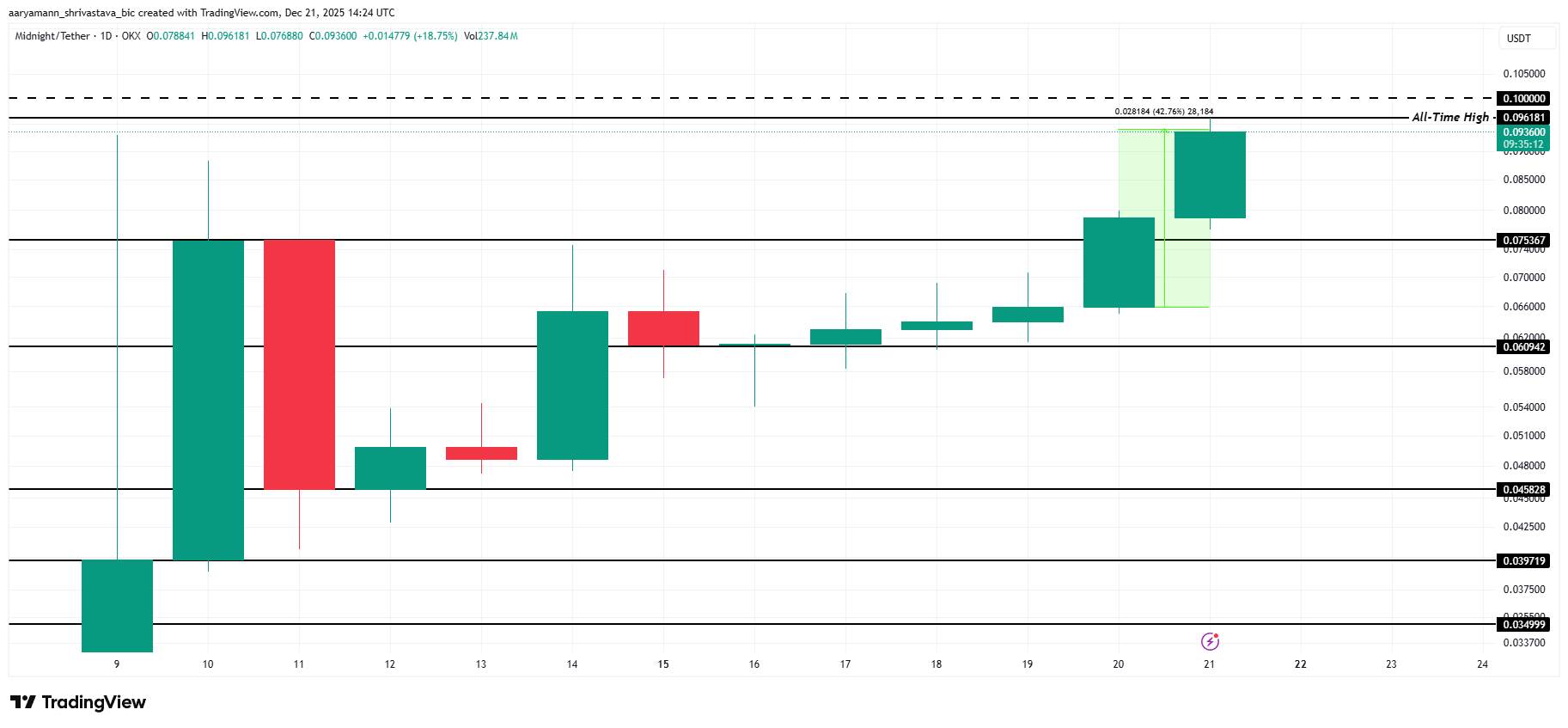
Midnight price surged 42.7% over the past 24 hours, trading near $0.093 at the time of writing. The rally resulted in a new intraday all-time high of $0.096. Momentum remains strong, reflecting aggressive buying and sustained interest following the breakout.
Bullish sentiment and favorable macro conditions support further upside. If current trends persist, NIGHT could push beyond the $0.100 level. Entering the 10-cent range would mark a psychological milestone, potentially drawing additional speculative interest and reinforcing momentum.
Risks remain if holders begin taking profits. A wave of selling could pull NIGHT back toward the $0.075 support. Losing that level would weaken the bullish structure. Further downside could extend to $0.060, invalidating the current bullish thesis and increasing volatility.
Bitcoin has shown mixed price action in recent sessions, marked by sharp fluctuations and tentative recovery attempts. BTC rebounded after a brief breakdown, yet momentum remains fragile.
A key concern is weakening confidence among one of Bitcoin’s most influential cohorts, which could complicate efforts to sustain a broader price recovery.
Bitcoin Holders Witness A Dip In Gains
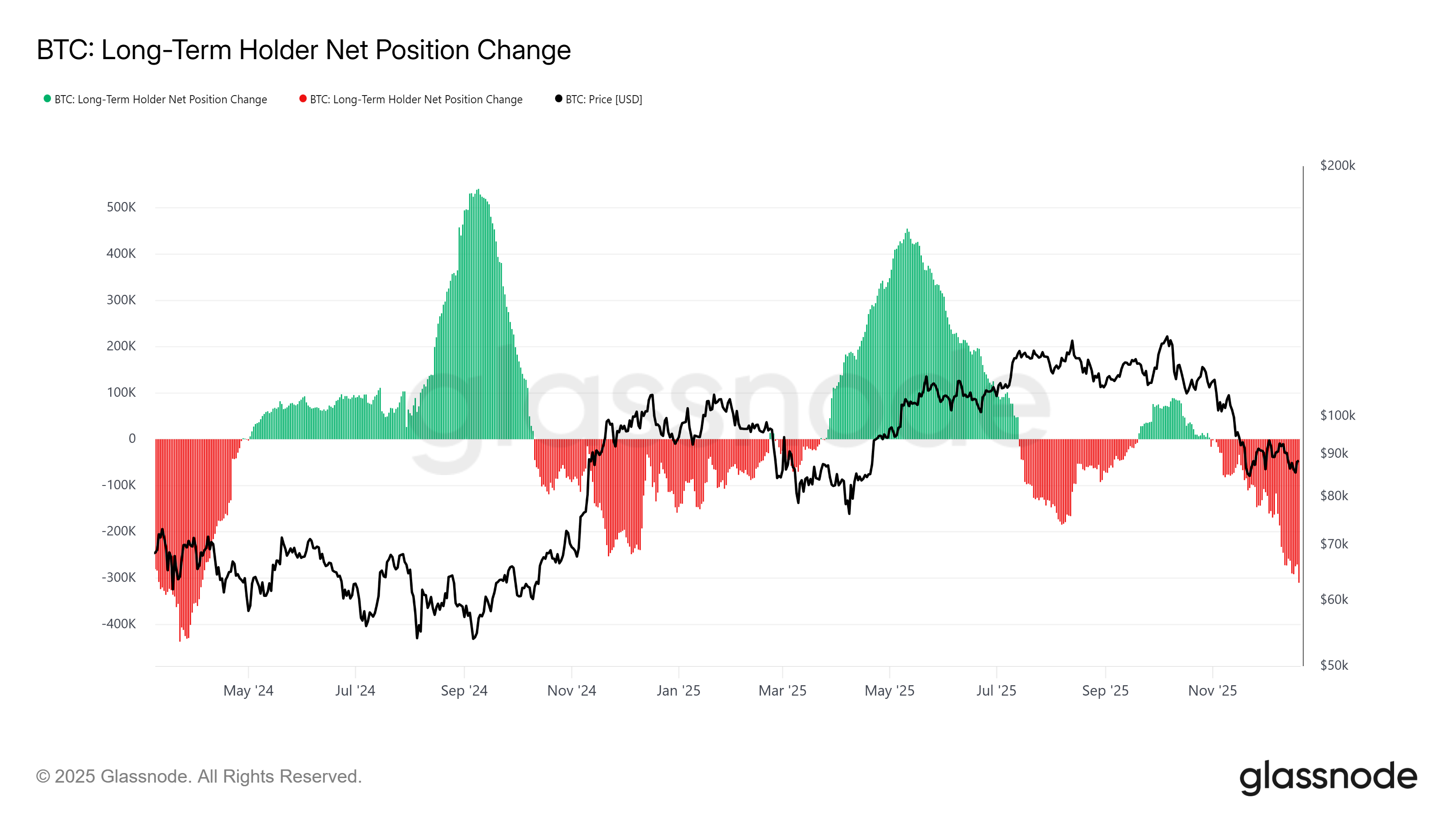
Bitcoin long-term holders have increased selling activity over the past several days. On-chain data shows the 30-day change in long-term holder supply has dropped to a 20-month low.
Similar levels were last recorded in April 2024, signaling elevated distribution pressure.
This behavior suggests long-term holders are reducing exposure to protect remaining gains. As unrealized profits shrink, selling accelerates to avoid losses. Such actions often weigh on price recovery, as supply increases without a matching rise in new demand.
Want more token insights like this? Sign up for Editor Harsh Notariya’s Daily Crypto Newsletter here.
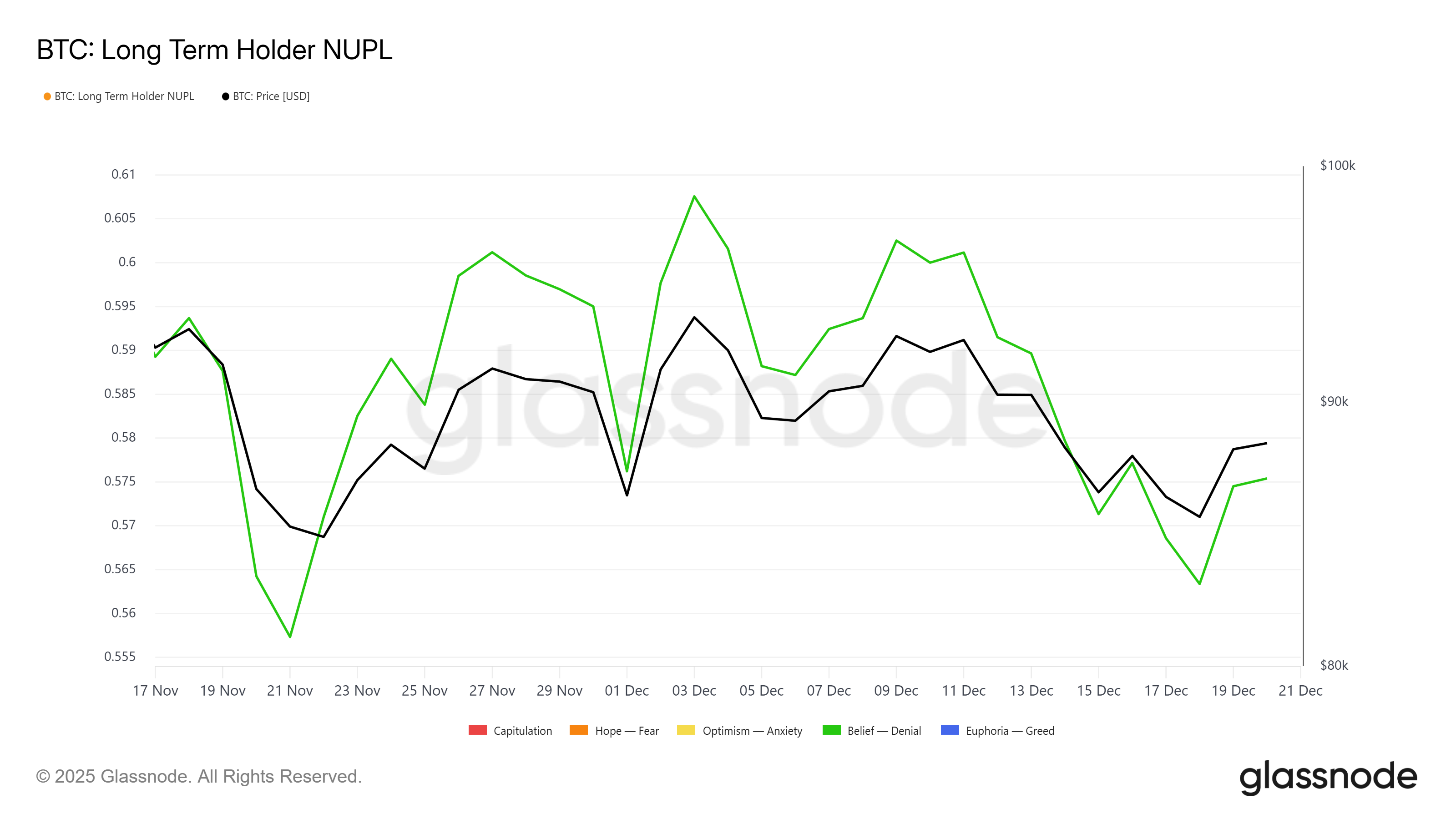
Macro indicators provide additional context. The long-term holder net unrealized profit or loss metric has declined to a monthly low. This drop indicates profits among this group are eroding, increasing sensitivity to further downside moves.
Historically, falling LTH NUPL readings trigger defensive selling. However, once the indicator declines further, selling pressure often slows.
At those levels, long-term holders typically pause distribution, allowing Bitcoin price to stabilize and potentially recover if demand improves.
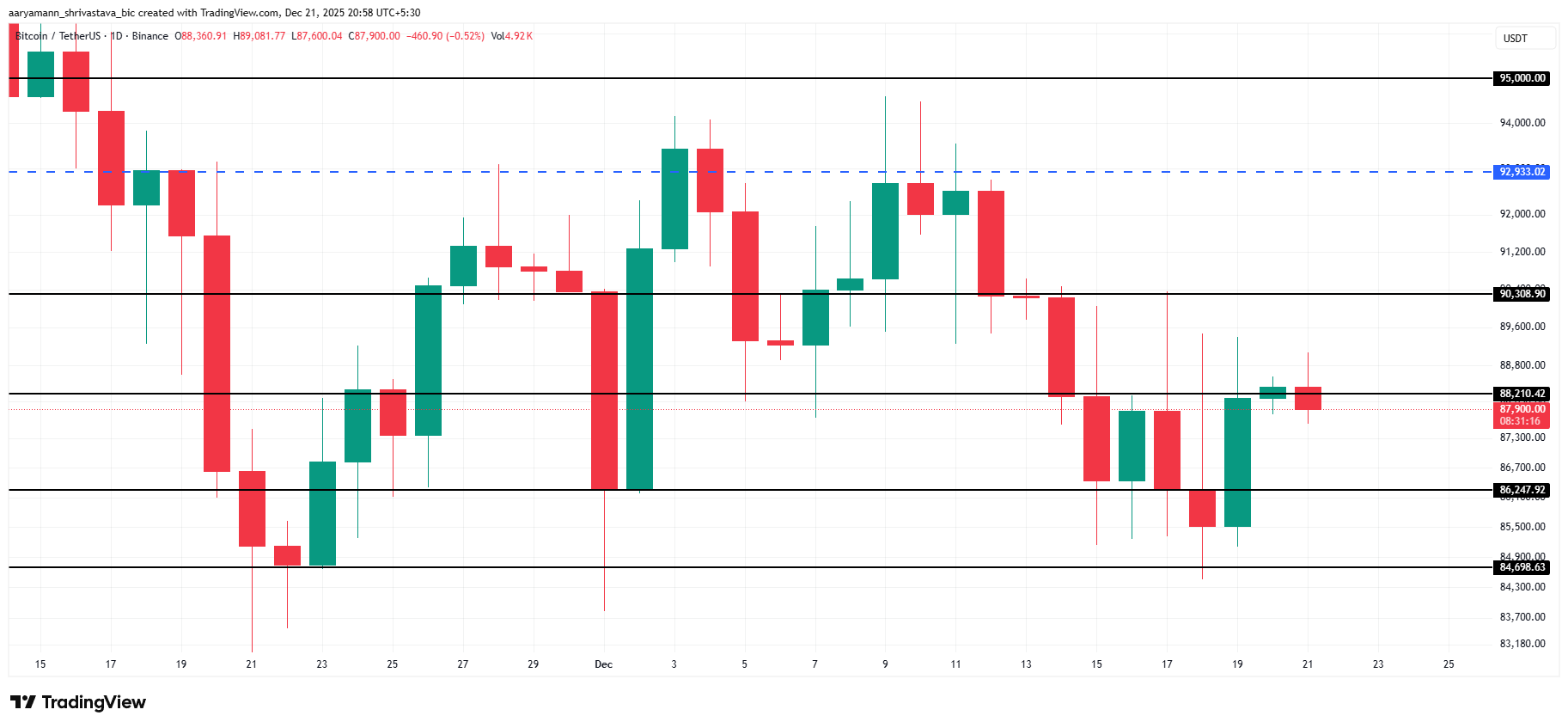
Bitcoin trades near $87,900 at the time of writing, remaining below the $88,210 resistance. The asset recently bounced after briefly slipping under the $86,247 support. This recovery shows buyers are still active at lower levels, though conviction remains cautious.
A short-term climb toward $90,308 remains possible. However, resistance near that level could cap gains. Given ongoing long-term holder selling, Bitcoin may continue consolidating near the $88,201 zone while the market absorbs excess supply.
Upside potential improves if long-term holders shift their stance. A slowdown in selling could reduce overhead pressure.
In that scenario, Bitcoin may break above $90,308 and target $92,933. Such a move would invalidate the bearish thesis and signal renewed confidence among key market participants.
Posts on X (Twitter) suggest that Bitmain co-founder Micree “James” Zhan Ketuan may be facing a billion-dollar fine, alleged detention, and a complete fallout with business partner Jihan Wu.
Conflicting reports leave the crypto community scrambling to verify the details of one of the sector’s most high-profile crises.
Bitmain Co-Founders at Center of Growing Speculation and Uncertainty
Bitmain, a pioneer in Bitcoin mining hardware, controls equipment powering over 74% of the global Bitcoin hash rate. It is also responsible for chips used in AI data centers running Nvidia H100s.
The company now finds itself at the intersection of geopolitics, legal scrutiny, and internal corporate strife.
On December 21, 2025, crypto veteran Chandler Guo sparked speculation with a cryptic social media post referencing an industry colleague’s “deep-sea fishing” ordeal. The term is used to describe covert detention in China, worth several billion dollars over six months.
According to Guo, while the individual emerged safely, he had learned a hard lesson that even the biggest backers are not reliable. When they fall, their associates suffer as well.
“There’s an old friend from the crypto circle by my side who just went through an experience of being deep-sea fished. It’s said to involve several billion US dollars, and he’s been dealing with it for half a year. Fortunately, the person has already safely come out of it…He relied on his backer’s connections to strike down his opponents, but he also got bitten back by the backer’s own enemies,” wrote Guo.
Observers quickly connected Guo’s account to Zhan. Rumors circulating in crypto circles indicate fines ranging from $1 billion to $10 billion, though none have been officially confirmed.
Some reports claim Zhan paid a $1 billion penalty, while others allege he fled to Indonesia two months ago and remains missing. A Chinese community lead, popular on X, confirmed two key developments:
Recent disruptions in Xinjiang’s mining operations and
Escalating internal conflict between Bitmain’s co-founders.
Dual CEO System Collapses Amid Founder Conflict
Bitmain’s dual CEO structure, which allowed both Zhan and Wu to lead the company, collapsed completely in 2025. Wu, a Peking University graduate, reportedly used political connections to challenge Zhan, a Chinese Academy of Sciences alumnus who focused on chip design and production.
This alleged internal upheaval comes as Bitmain faces mounting external pressures. While Zhan historically focused on technical operations, Wu has led strategic partnerships and business development.
The absence of either founder could leave operational gaps at a time when Bitmain remains central to Bitcoin mining worldwide. The firm is already facing a lawsuit from Old Const alleging breach of a hosting deal and attempts to reclaim mining hardware without cause.
Geopolitical Risks and Infrastructure Vulnerabilities
Beyond corporate disputes, Bitmain faces scrutiny from US authorities over potential hardware security threats. In June, Bitmain and two other firms relocated to the US to bypass new tariffs and optimize supply chains.
However, with the company’s mining infrastructure embedded in both crypto and AI data centers, national security concerns amplify the stakes.
Any compromise could ripple through global Bitcoin networks, highlighting crypto’s ongoing vulnerability to geopolitical tensions.
Recent crackdowns on Xinjiang mining farms, combined with Zhan’s alleged detention, have fueled speculation of coordinated regulatory pressure.
The crypto sector remains vigilant, as the situation could impact mining hardware markets, supply chains, and competitive dynamics.
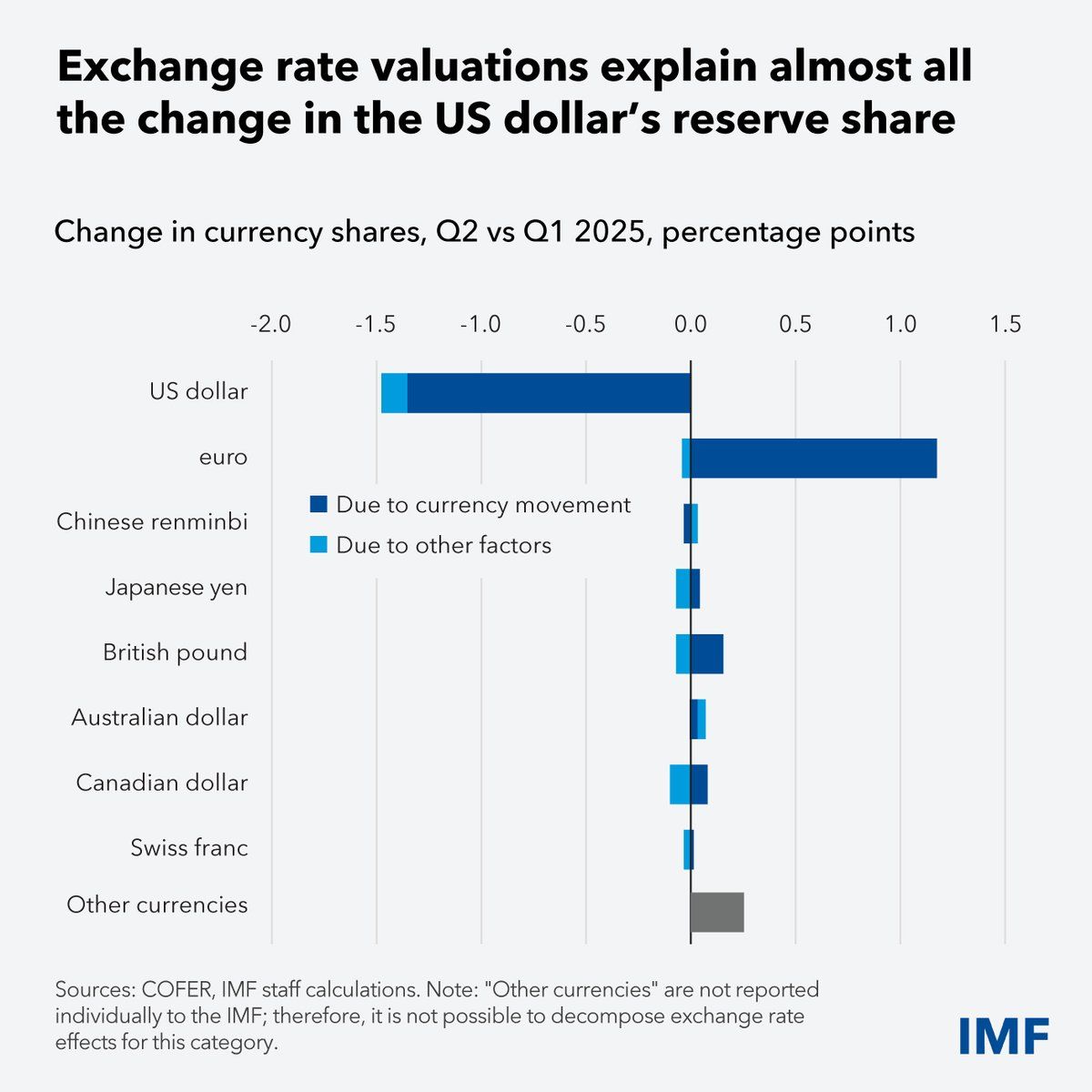
The US dollar’s global reserve share dropped to 56.32% in Q2 2025, but 92% of that decline was driven by exchange-rate effects, not central bank portfolio changes. Currency adjustments show a marginal decline to just 57.67%, indicating central banks largely maintained their USD holdings.
The International Monetary Fund’s new Currency Composition of Official Foreign Exchange Reserves (COFER) report provides important insights for crypto investors tracking macroeconomic trends. The data reveals that central banks kept dollar allocations steady, even amid notable currency swings during the quarter.
IMF: Central Banks Stayed Dollar-Heavy Despite Depreciation
The IMF’s COFER dataset tracks currency reserves from 149 economies in US dollars. In Q2 2025, major currency movements gave the impression of large portfolio reallocations.
According to the report, the DXY index declined by more than 10% in the first half of 2025, its biggest drop since 1973.
The US dollar declined 7.9% against the euro and 9.6% against the Swiss franc in Q2. These swings lowered the USD reserve share from 57.79% to 56.32%. However, this reduction reflected exchange-rate effects rather than active reallocation.
Adjusted for constant exchange rates, the dollar’s reserve share edged down only 0.12% to 57.67%. This indicates that central banks made minimal changes to their dollar reserves during the quarter, challenging stories of global dedollarization.
Similarly, the euro’s reserve share appeared to rise to 21.13%, an increase of 1.13 points. Yet, this was also driven entirely by currency valuations.
At constant exchange rates, the euro’s share declined slightly by 0.04 points, showing central banks actually trimmed euro holdings.
IMF bar chart showing exchange rate valuations explain almost all the change in the US dollar’s reserve share in Q2 2025, attributed to IMF
What This Means for Bitcoin and Altcoins
This analysis offers muted macro signals for Bitcoin and other digital assets marketed as hedges against US dollar weakness. Central banks did not diversify away from the dollar even as the currency depreciated significantly.
Dedollarization trends are often highlighted as possible drivers of institutional adoption of crypto. However, the COFER data, once adjusted for exchange rates, suggest that these trends can be misleading without proper context.
The IMF’s study provides investors a more accurate view of monetary policy during volatile markets. By distinguishing between true policy moves and temporary valuation changes, crypto investors can better evaluate global macro trends.
Central Bank Reserve Strategies and Outlook
Dollar holdings remained stable in Q2 2025, showing central banks still rely on traditional currencies even as digital alternatives gain attention. The IMF emphasized that exchange-rate adjustments are crucial for understanding reserve shifts accurately.
The US dollar’s share of global foreign reserves held steady in Q2, after adjustment for currency fluctuations. Exchange-rate effects drove nearly all the decline in the US currency’s share of reserves. Our blog has the details. https://t.co/XtaRfBIbqLpic.twitter.com/fXcUkRkg7U
Central banks prioritize liquidity, returns, and risk when managing reserves. The dollar’s strong position is linked to deep markets, high transaction utility, and established systems. These aspects are still hurdles for digital assets to overcome.
The IMF’s methodology reveals how currency changes can distort reserve data. In Q2, nearly all reported shifts in major currencies resulted from valuation swings, not actual portfolio rebalancing. Central banks maintained a careful stance during the market’s turbulence.
These findings help clarify global trends shaping crypto markets. Investors interested in dedollarization as a Bitcoin catalyst should rely on exchange-rate-adjusted numbers.
Bitcoin’s price may still dominate headlines, but among analysts and institutional strategists, attention is quietly shifting elsewhere.
Instead of debating whether Bitcoin can reclaim upside momentum in the near term, market observers are increasingly focused on a deeper question: whether the structural signals that once reliably guided Bitcoin’s four-year cycle are beginning to fracture.
Analysts Are No Longer Looking at Bitcoin Price As Demand Signals Quietly Deteriorate
The shift comes on the backdrop of fading demand indicators, rising exchange flows, and a growing divide between analysts.
On the one hand, some believe Bitcoin is entering a traditional post-peak correction. On the other hand, others argue that the pioneer crypto may be breaking free from its historical cycle altogether.
Analyst Daan Crypto Trades argues that recent price behavior has already challenged one of Bitcoin’s most dependable seasonal assumptions.
“BTC Looking ahead, Q1 is generally a good quarter for Bitcoin, but so was Q4, and that one didn’t quite work out this time. No doubt 2025 has been a very messy year. Massive inflows and treasury accumulation, which were matched by big OG whales and 4-year cycle selling. Q1 2026 is where Bitcoin has a chance to show whether the 4-year cycle persists or not,” he wrote.
Rather than signaling a definitive breakdown, the underperformance suggests friction. ETF inflows and corporate accumulation are being absorbed by long-term holder distribution, muting the impact those inflows once had on BTC price.
That structural tension is also visible in US spot market data. According to Kyle Doops, the Coinbase Bitcoin premium, often used as a proxy for US institutional demand, has remained negative for an extended period.
The Coinbase $BTC premium has stayed negative for 7 straight days, now around -0.04% per Coinglass.
That usually signals U.S. spot demand is lagging the rest of the market.
Less aggressive institutional buying, softer risk appetite, and capital staying cautious.
The message is not capitulation, but hesitation, which means capital is present, yet unwilling to chase.
Exchange Flows Point to Distribution, Not Accumulation
On-chain data highlights the need for cautious interpretation, as Bitcoin exchange inflows surge to levels historically associated with late-cycle behavior.
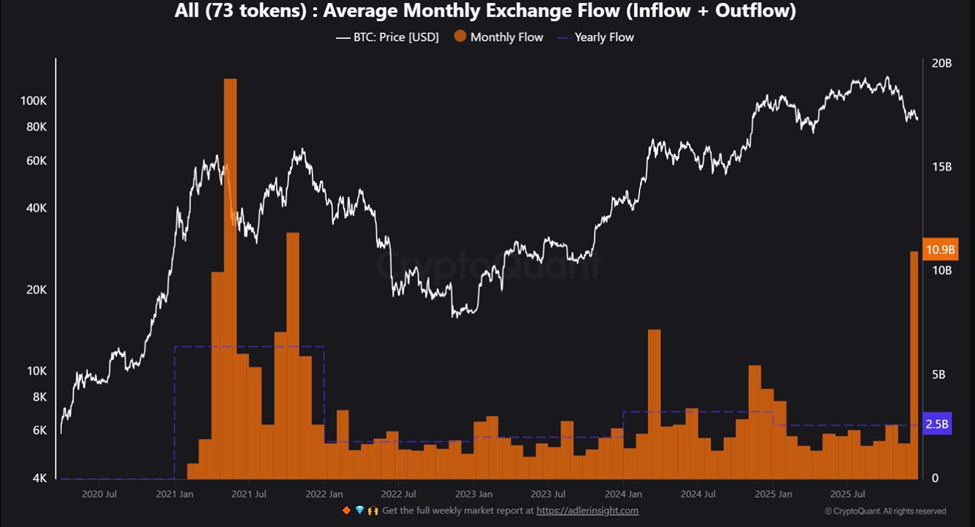
“Monthly exchange flows have surged to $10.9 billion, the highest since May 2021. High exchange flows like this signify increased selling pressure, as investors move assets onto exchanges to liquidate positions, take profits, or hedge against downturns. This is further evidence of a market top and the start of a bear market amid heightened volatility,” said analyst Jacob King.
Historically, similar spikes have coincided with profit-taking phases rather than early accumulation periods.
Monthly Exchange Flow. Source: CryptoQuant
If History Holds, Cycle Math Still Points Lower with Institutions Split but Disciplined
On-chain analyst Ali Charts argues that despite structural changes, Bitcoin’s timing symmetry remains striking.
“Bitcoin’s price cycles have followed a strikingly consistent pattern, both in timing and magnitude. Historically, it takes around 1,064 days from the market bottom to the market top, and about 364 days from the top back to the next bottom,” he wrote, outlining how previous cycles adhered closely to that rhythm.
If that pattern persists, the analyst suggests that the market may now be inside its corrective window. Historical retracements imply further downside before a durable reset.
At the institutional level, views are diverging without turning chaotic. Fundstrat’s Head of Crypto Strategy Sean Farrell acknowledged near-term pressures while maintaining a longer-term bullish framework.
“Bitcoin is currently in a valuation ‘no man’s land’,” Farrell said, citing ETF redemptions, selling by original holders, miner pressure, and macro uncertainty. Still, he added, “I still expect Bitcoin and Ethereum to challenge new all-time highs before the end of the year, thereby ending the traditional four-year cycle with a shorter, smaller bear market.”
The Cycle Debate Is Now Institutional
That possibility is echoed by Tom Lee, whose view has been amplified across crypto commentary, suggesting that Bitcoin will soon break its 4-year cycle.
Fidelity’s Jurrien Timmer takes the opposite stance. According to Lark Davis, Timmer believes Bitcoin’s October peak marked both a price and time top, with “2026… a down year” and support forming in the $65,000–$75,000 range.
"The bear market is here and Bitcoin is heading down to $65,000"
That's what Fidelity's director of global macro Jurrien Timmer thinks.
While Jurrien is bullish on $BTC in the long term, he believes that Bitcoin is once again following its historical 4-year cycle driven by its… pic.twitter.com/KFPcBWTcZP
Together, these perspectives show why analysts are no longer fixated solely on Bitcoin price. The pioneer crypto’s next move may not decide who was bullish or bearish, but whether the framework that has defined its market for over a decade still applies at all.
Michael Saylor is signaling another aggressive Bitcoin accumulation for Strategy (formerly MicroStrategy).
This signals that the firm is down on its high-stakes treasury strategy even as its MSTR stock falters.
Why Saylor is Teasing a New Bitcoin Buy for Strategy
On December 21, Saylor posted a cryptic image to X captioned “Green Dots ₿eget Orange Dots,” referencing the company’s “SaylorTracker” portfolio visualization.
The post continues a year-long pattern Saylor has used to hint at a new BTC purchase. Notably, such a weekend teaser is usually followed by a Monday morning SEC filing confirming a significant acquisition.
Meanwhile, a new purchase would add to an already staggering hoard.
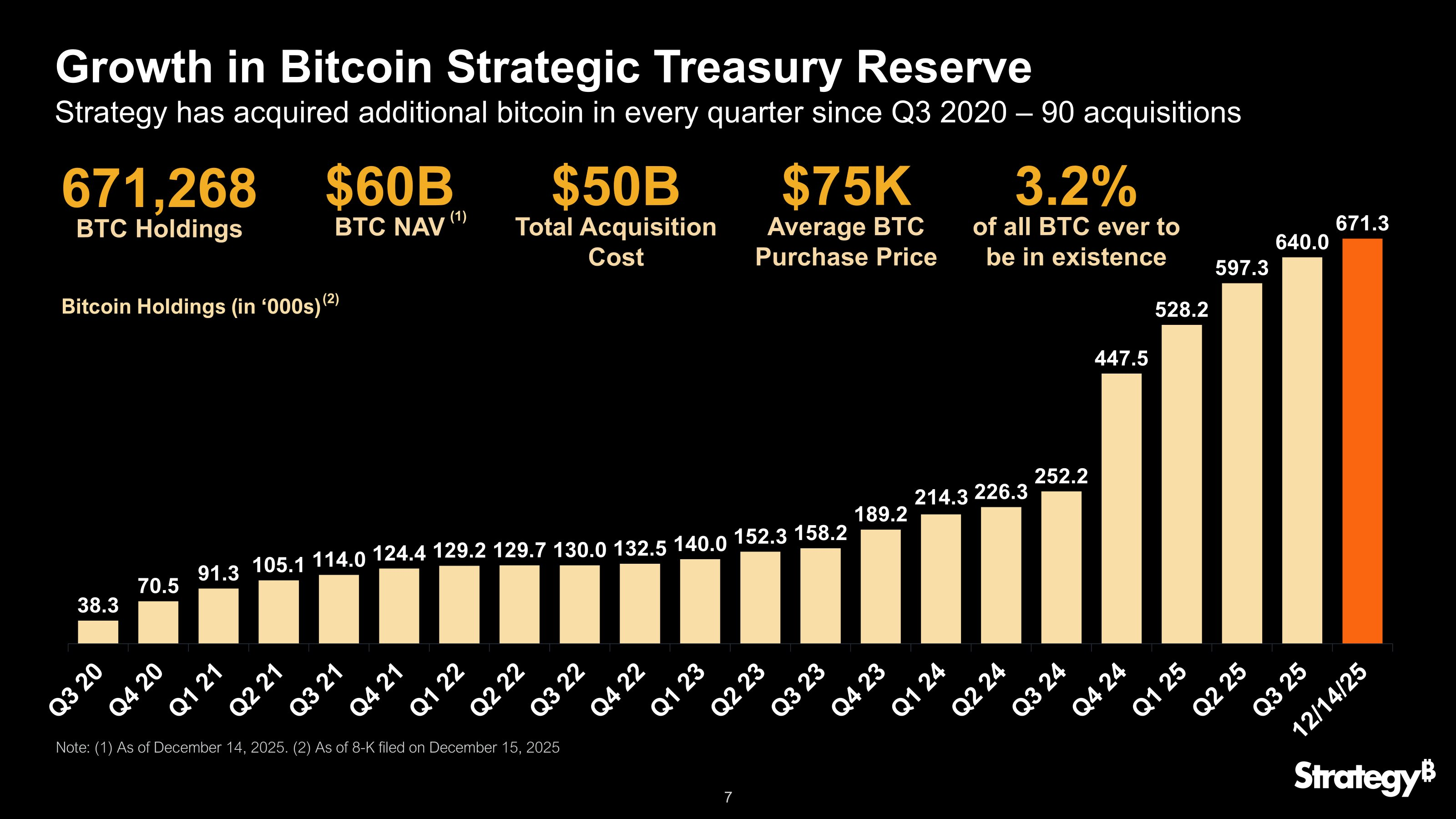
As of press time, Strategy held 671,268 BTC—valued at roughly $50.3 billion—representing 3.2% of the total Bitcoin supply.
While the company touts a “BTC Yield” of 24.9%—a proprietary metric measuring the accretion of Bitcoin per share—institutional investors are increasingly focused on the looming external risks rather than internal yield metrics.
However, the most immediate threat to Saylor’s strategy is not Bitcoin’s price, but a potential regulatory reclassification.
MSCI is considering removing Strategy Inc. from its global indices during its February review. The index provider has flagged concerns that the firm now functions more like an investment vehicle than an operating company.
Market analysts have pointed out that the financial implications of such a move are severe.
The firm called the MSCI proposal “arbitrary, discriminatory, and unworkable,” arguing that it unfairly targets digital asset companies while ignoring other holding-heavy conglomerates.
“The proposal improperly injects policy considerations into indexing. The proposal conflicts with U.S. policy and would stifle innovation,” it argued.
So, Saylor’s potential new purchase serves a dual purpose: it lowers the company’s average cost basis during a market correction, but more importantly, it signals to the market that despite the MSCI threat and the stock’s poor performance, the “all-in” strategy remains unchanged.
BlackRock iShares Bitcoin Trust (IBIT) is set to close 2025 as a top-tier force in the US financial landscape. The fund achieved a rare feat in asset management by raising billions of dollars while losing money for its investors.
Data compiled by Bloomberg Intelligence confirms that IBIT secured the sixth spot on the US ETF leaderboard by net inflows.
The fund attracted $25.4 billion in fresh capital throughout the year, outpacing traditional heavyweights such as the Invesco QQQ Trust and the SPDR Gold Trust (GLD).
This capital flood occurred despite a stark divergence in asset performance.
$IBIT is the only ETF on the 2025 Flow Leaderboard with a negative return for the year. CT's knee-jerk reaction is to whine about the return but the real takeaway is that is was 6th place DESPITE the negative return (Boomers putting on a HODL clinic). Even took in more than $GLD… pic.twitter.com/68uq3HFRuO
Typically, negative returns trigger capital flight.
However, IBIT’s ability to attract $25 billion during a correction signals a fundamental shift in investor behavior. It shows that institutional allocators are systematically buying the dip rather than panic-selling volatility.
Considering this, Bloomberg Senior ETF Analyst Eric Balchunas characterized the inflows as a definitive bullish signal for the asset’s long-term trajectory.
“IBIT is the only ETF on the 2025 Flow Leaderboard with a negative return for the year,” Balchunas stated.
Meanwhile, James Thorne, Chief Market Strategist at Wellington-Altus, argues that these flows validate the “financialization” of Bitcoin.
According to him, the digital asset now behaves less like a speculative tech stock and more like a mature macro commodity.
“Watching how Bitcoin now trades, the market microstructure and narrative management increasingly resemble the way gold behaved for decades under heavy institutional influence, with price action reflecting not just fundamental demand, but also positioning, product design, and the preferences of large financial intermediaries,” he added.
For the broader market, BlackRock IBIT’s 2025 performance proves that the Bitcoin ETF is not a fad. It has successfully entrenched itself in institutional portfolios, flipping gold as the preferred “alternative” allocation even when the precious metal vastly outperforms on price.
Pi Coin has faced renewed selling pressure after its recent decline pushed the price below the $0.200 level. The drop reflected weak market confidence and broader hesitation among investors.
However, recent activity suggests holders are actively attempting to reverse the trend and stabilize Pi Coin’s price action.
Pi Coin Holders Change Their Stance
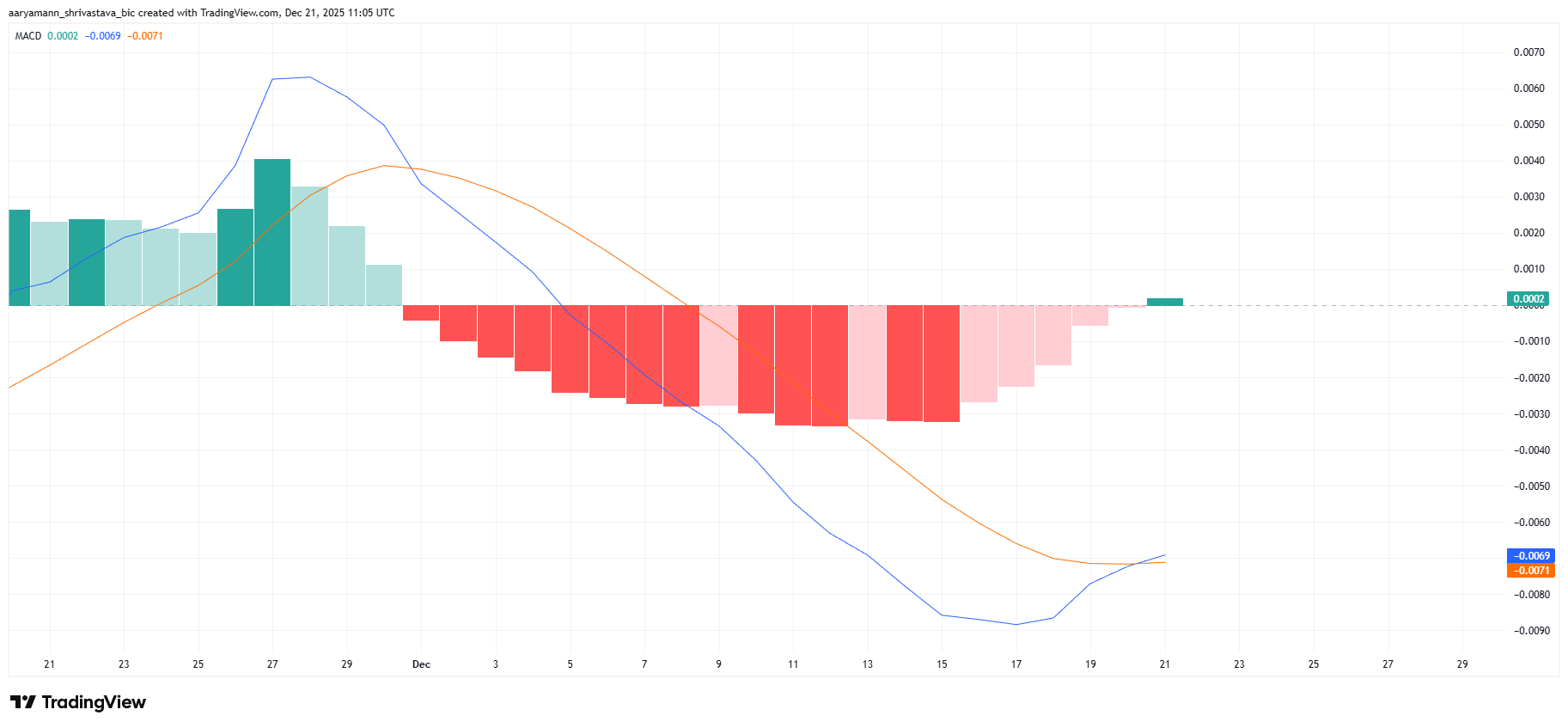
Momentum indicators point to a shift in sentiment. The moving average convergence divergence is forming a bullish crossover. The MACD line has crossed above the signal line, indicating strengthening upside momentum after an extended corrective phase.
This crossover ends a nearly 20-day stretch of bearish momentum. Such signals often precede short-term recoveries when supported by capital inflows.
For Pi Coin, this development suggests buyers are regaining control and attempting to rebuild confidence at current levels.
Want more token insights like this? Sign up for Editor Harsh Notariya’s Daily Crypto Newsletter here.
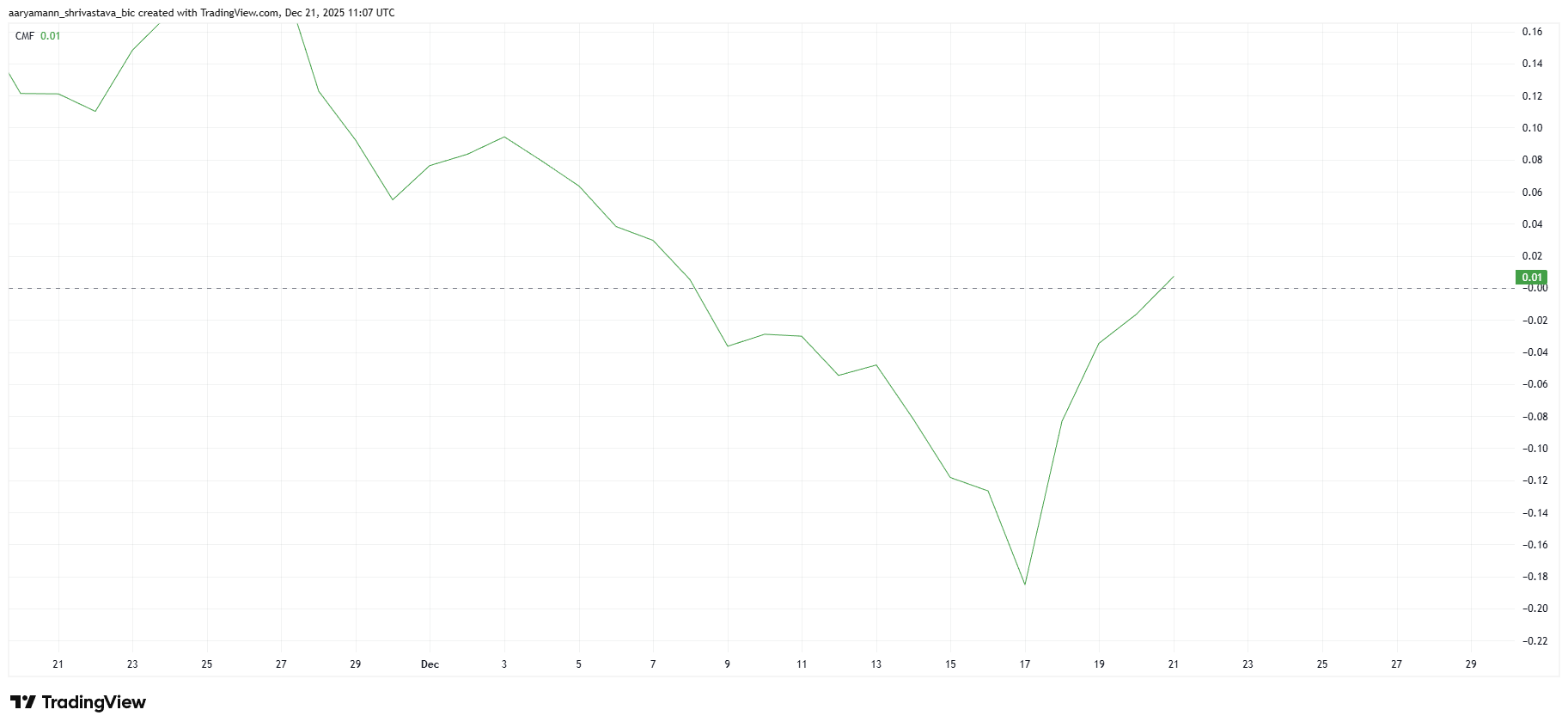
Macro indicators reinforce the improving outlook. The Chaikin Money Flow shows a clear change in capital behavior. Outflows observed earlier this month have flipped into inflows during the past 24 hours.
The CMF has moved above the zero line, confirming net buying activity. This shift highlights growing conviction among Pi Coin holders. Sustained inflows are essential for recovery, as price advances rely on consistent demand rather than short-lived speculative interest.
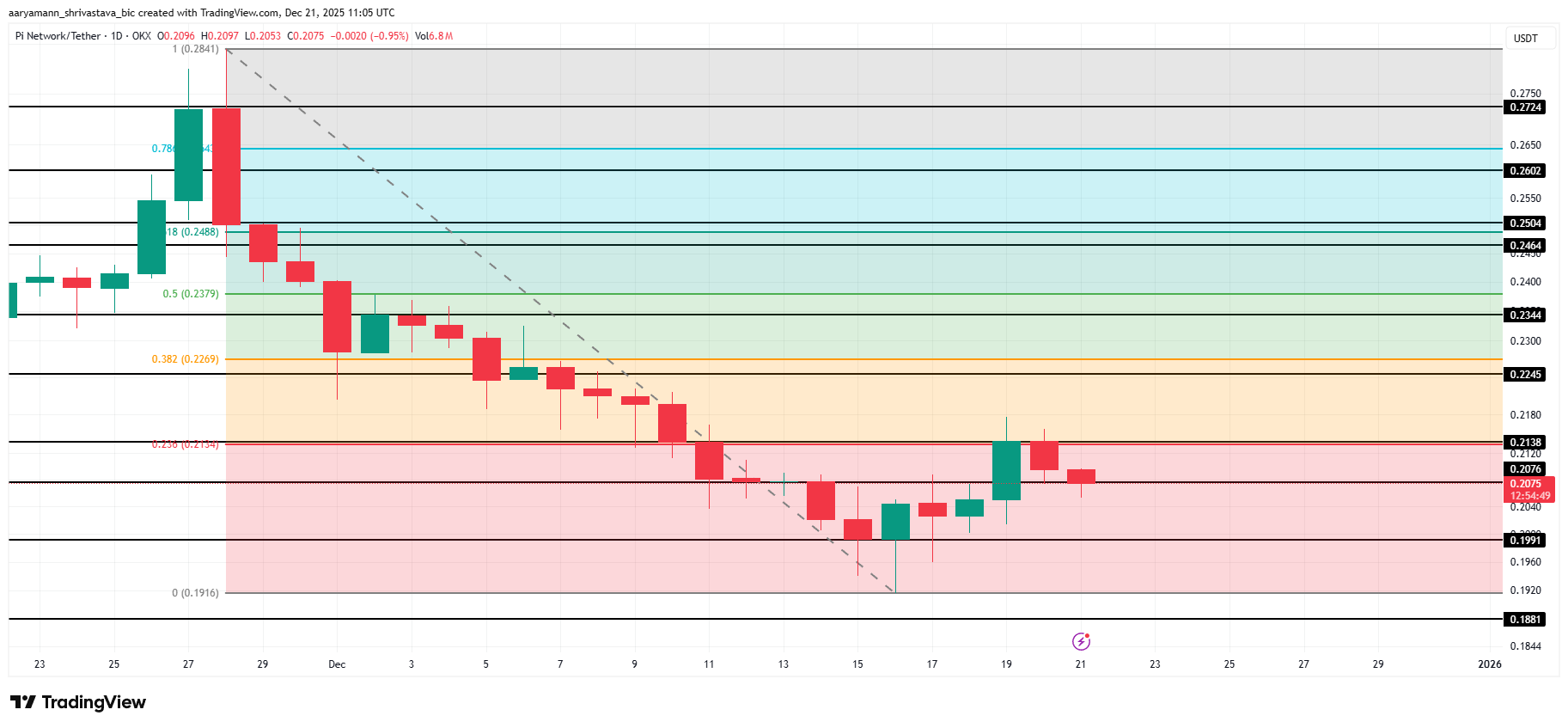
Pi Coin trades near $0.207 at the time of writing, sitting just below the $0.213 resistance. This level aligns with the 23.6% Fibonacci retracement. The overlap increases its technical importance for defining near-term direction.
Reclaiming $0.213 as support would strengthen the recovery structure. In an uptrend, holding this Fibonacci level often signals continuation. Supported by improving momentum and inflows, Pi Coin could advance toward $0.224, with scope for further gains if buying pressure persists.
Downside risks remain if sentiment shifts again. Renewed selling could push Pi Coin below $0.207. A breakdown may expose $0.199 as initial support, followed by $0.188. Losing these levels would invalidate the bullish thesis and reinforce downside vulnerability.
Tether is pushing beyond its role as a backend stablecoin issuer and moving directly to the end user.
On December 20, Paolo Ardoino, the firm’s CEO, disclosed that he was hiring a Lead Software Engineer to build a self-custodial mobile wallet that integrates the company’s massive liquidity with its nascent artificial intelligence division.
Tether’s Planned Mobile Crypto Wallet
The recruitment posting offers the most specific look yet at Tether’s consumer strategy.
Ardoino envisions a “100% self-custodial” mobile application designed to serve as a fortress for a strict asset basket.
Unlike general-purpose wallets that support thousands of speculative tokens, Tether’s product will support only four assets. These include Bitcoin (BTC) via the Lightning Network, Tether (USDT), the gold-pegged XAUT, and USAT, the firm’s new US-compliant stablecoin.
Imagine a wallet that supports only BTC (also via LN), USDT, USAT, XAUT. And will have local private AI integration via QVAC. https://t.co/BCyqjob1Sh
This restricted asset list signals a clear strategic intent. Tether is building a “hard money” payment rail, ignoring the broader decentralized finance (DeFi) casino in favor of pure payments and store-of-value assets.
Meanwhile, the announcement confirms the wallet will be powered by two proprietary technologies, including the Wallet Development Kit (WDK) and QVAC.
Ardoino detailed a vision in which the wallet features a “local private AI integration,” allowing users to run advanced automated tasks directly on their devices.
By processing data locally with QVAC rather than routing it to the cloud, Tether aims to deliver the functionality of an AI-powered financial assistant.
The approach is designed to avoid the privacy trade-offs typically associated with Big Tech platforms.
Moreover, the move underscores Tether’s shift from an infrastructure provider to a consumer-facing tech giant. It builds on last week’s launch of PearPass, a peer-to-peer password manager designed to eliminate reliance on cloud storage.
Indeed, these product lines demonstrate that the company is aggressively verticalizing its stack.
Tether would control the wallet interface, the underlying stablecoins USDT and USAT, the security layer via PearPass, and the intelligence stack via QVAC.
This structure reduces reliance on third-party platforms and strengthens the company’s operational autonomy.
Solana has struggled to recover after a recent price decline, with SOL remaining capped below the $130 resistance. The altcoin has shown attempts to stabilize, yet momentum remains fragile.
Unlike previous rallies driven by new inflows, the next move appears dependent on existing Solana holders rather than fresh market entrants.
Some Solana Holders Show Resilience
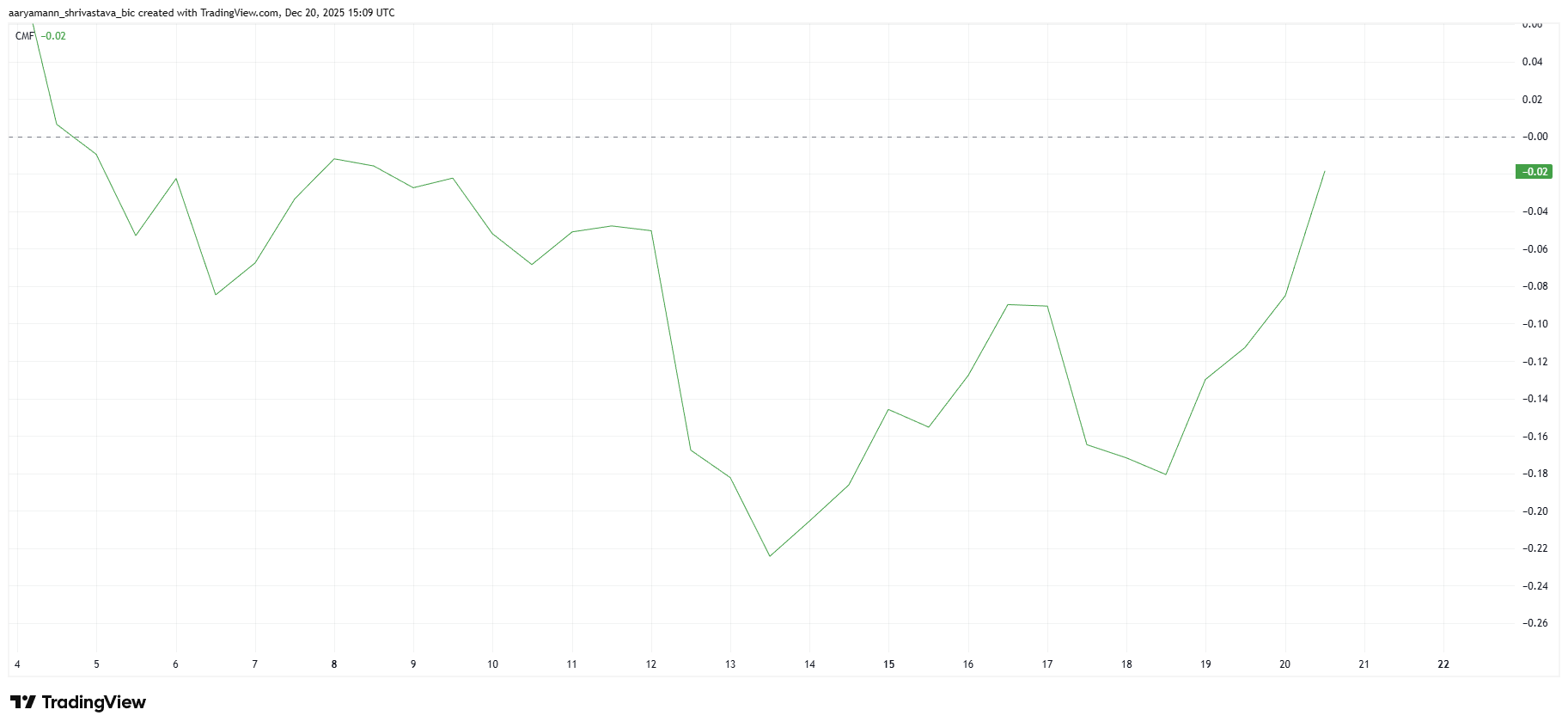
On-chain data shows early signs of stabilization. The Chaikin Money Flow has posted a sharp uptick over the past few days. Although the indicator remains below the zero line, the upward movement suggests that capital outflows are slowing.
This shift is critical for Solana’s recovery outlook. Declining outflows often precede a transition toward inflows. Once buying pressure outweighs selling, SOL price can respond quickly. Sustained improvement in CMF would signal returning confidence among current holders.
Want more token insights like this? Sign up for Editor Harsh Notariya’s Daily Crypto Newsletter here.
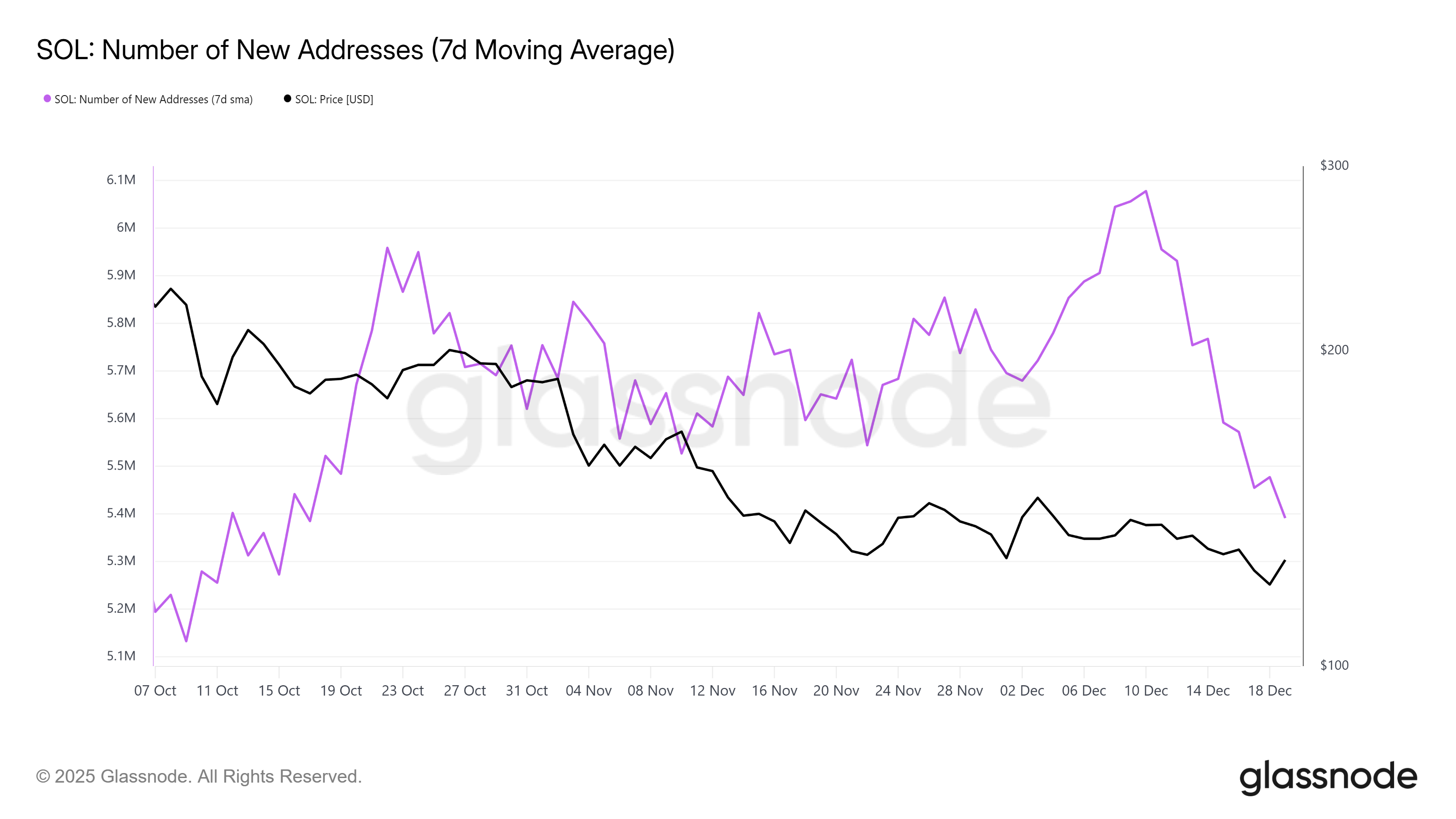
Macro indicators present a more cautious picture. The number of new Solana addresses has dropped sharply in recent sessions. New addresses declined from 6.077 million to 5.390 million, an 11.3% decrease over ten days.
Falling network participation suggests weaker speculative interest. New investors appear hesitant, citing limited short-term incentives. This lack of fresh demand places greater importance on existing holders to support price stability and any recovery attempt.
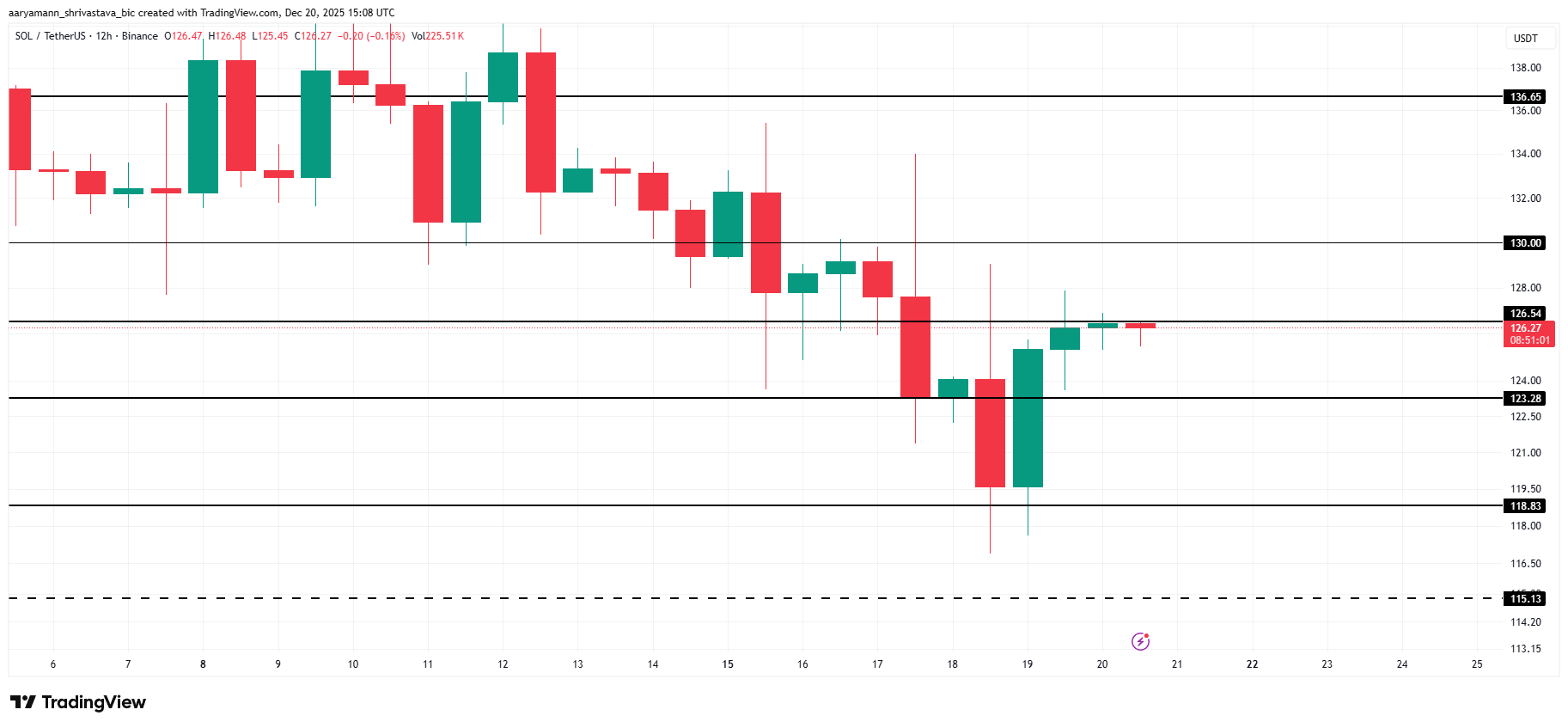
Solana trades near $126 at the time of writing, remaining below the $130 resistance level. Price action shows consolidation rather than a breakout. The immediate goal for SOL is reclaiming $130, which would mark a shift in short-term momentum.
Declining outflows improve the probability of a rebound. If current holders maintain accumulation and inflows emerge, buying pressure could lift SOL toward $130. A sustained move above this level would require consistent support rather than brief speculative spikes.
Downside risks persist if sentiment deteriorates. Renewed selling could push Solana below the $123 support. A breakdown at that level may expose $118 as the next downside target. Losing this support would invalidate the bullish outlook and reinforce short-term weakness.
A coalition of more than 125 cryptocurrency companies and advocacy groups has launched a coordinated offensive against US banking lobbyists. The group includes major crypto firms such as Coinbase, Gemini, and Kraken.
The move escalates a high-stakes battle over who has the right to pay interest on stablecoin deposits.
Why Banks Are Lobbying to Tweak the GENIUS Act
The main bone of contention is that the GENIUS Act explicitly prohibits stablecoin issuers like Tether from paying dividends.
However, there is currently a loophole that allows third-party platforms, such as crypto exchanges, to pass this stablecoin yield on to users.
The banking lobby contends that if unregulated fintech platforms are allowed to offer high yields on cash-equivalent tokens, it poses a systemic risk to the traditional financial architecture.
In briefings with Capitol Hill, they warned that preserving the current rules could trigger a massive capital flight. They estimated potential deposit outflows of up to $6.6 trillion from commercial banks to digital asset platforms.
Such a shift, they argue, would hollow out the capital base that banks use to underwrite mortgages and business loans. That erosion would force lenders to shrink capacity and raise borrowing costs for American households.
Crypto Coalition Fights Back
In a December 18 letter to the US Senate Committee on Banking, the crypto coalition urged lawmakers to reject attempts to expand the scope of the recently enacted GENIUS Act.
“Reopening this issue before the GENIUS Act’s implementation would weaken the certainty that defines Congressional-enacted regulatory frameworks and introduce unnecessary risk into the broader market structure effort. It would signal that even recently enacted compromises remain subject to almost immediate renegotiation, undermining the predictability that markets, consumers, and innovators rely on,” the group argued.
The crypto coalition also dismissed the banks’ concerns about stability as a protectionist effort to maintain a monopoly on low-interest deposits.
The signatories argued that banks are merely trying to protect their profit margins by preventing consumers from accessing the 4% yields currently available in the Treasury market.
“Stablecoins rewards programs enable platforms to share value directly with users, helping households benefit from higher-rate environments rather than absorbing losses to inflation,” the crypto firms argued.
The Banksters are trying to prohibit platforms like @Gemini, @coinbase, and @krakenfx from offering stablecoin rewards to you. The GENIUS Act already settled this issue with an elegant compromise — stablecoin issuers cannot offer rewards, but intermediary platforms like Gemini,… https://t.co/QpdiQfaD0X
Tyler Winklevoss, co-founder of Gemini, also publicly slammed the banking lobby’s maneuver, characterizing it as an attempt to “relitigate a settled legislative issue.”
XRP has struggled to sustain a recovery over the past several days, with price repeatedly failing to gain traction near key resistance levels. Despite the hesitation, investor behavior is shifting.
Large holders appear to be increasing exposure, signaling growing confidence that current prices may offer an attractive entry point.
XRP Holders Are Imbuing Confidence
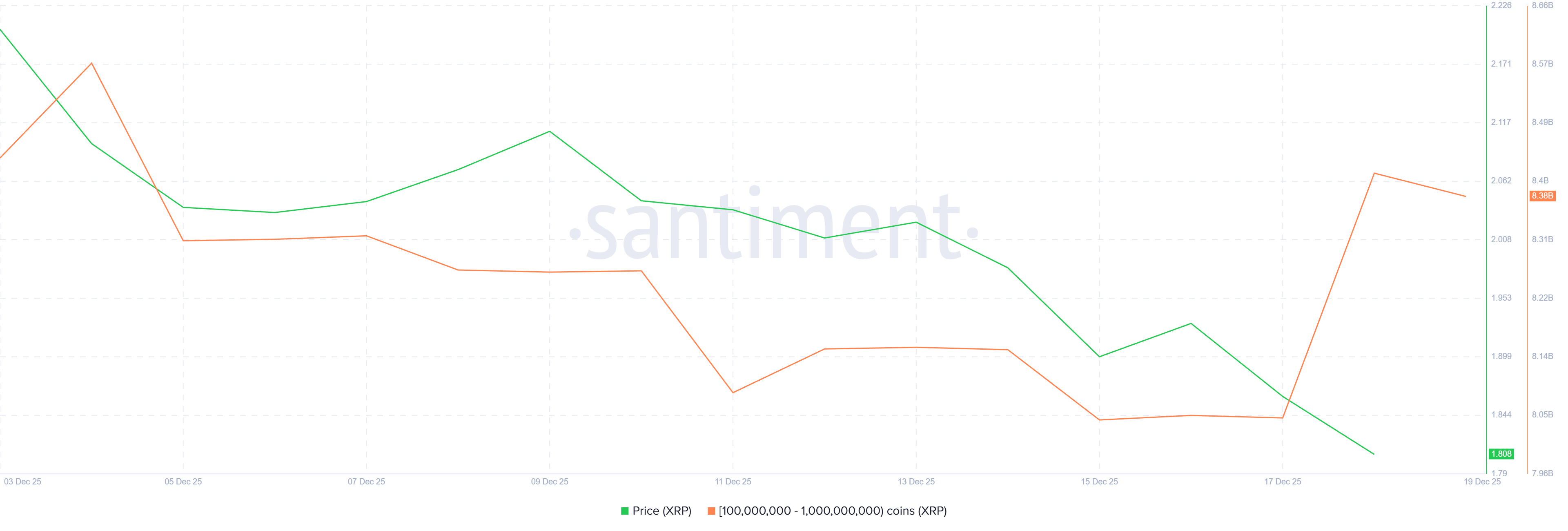
On-chain data shows a notable increase in whale accumulation. Addresses holding between 100 million and 1 billion XRP added roughly 330 million tokens over the past 48 hours.
This accumulation is valued at approximately $642 million, highlighting renewed demand from large investors.
Such behavior suggests XRP whales are capitalizing on depressed prices rather than exiting positions. Accumulation during consolidation phases often reflects expectations of recovery.
This demand can provide structural support, reducing downside risk while improving the probability of a sustained rebound.
Want more token insights like this? Sign up for Editor Harsh Notariya’s Daily Crypto Newsletter here.
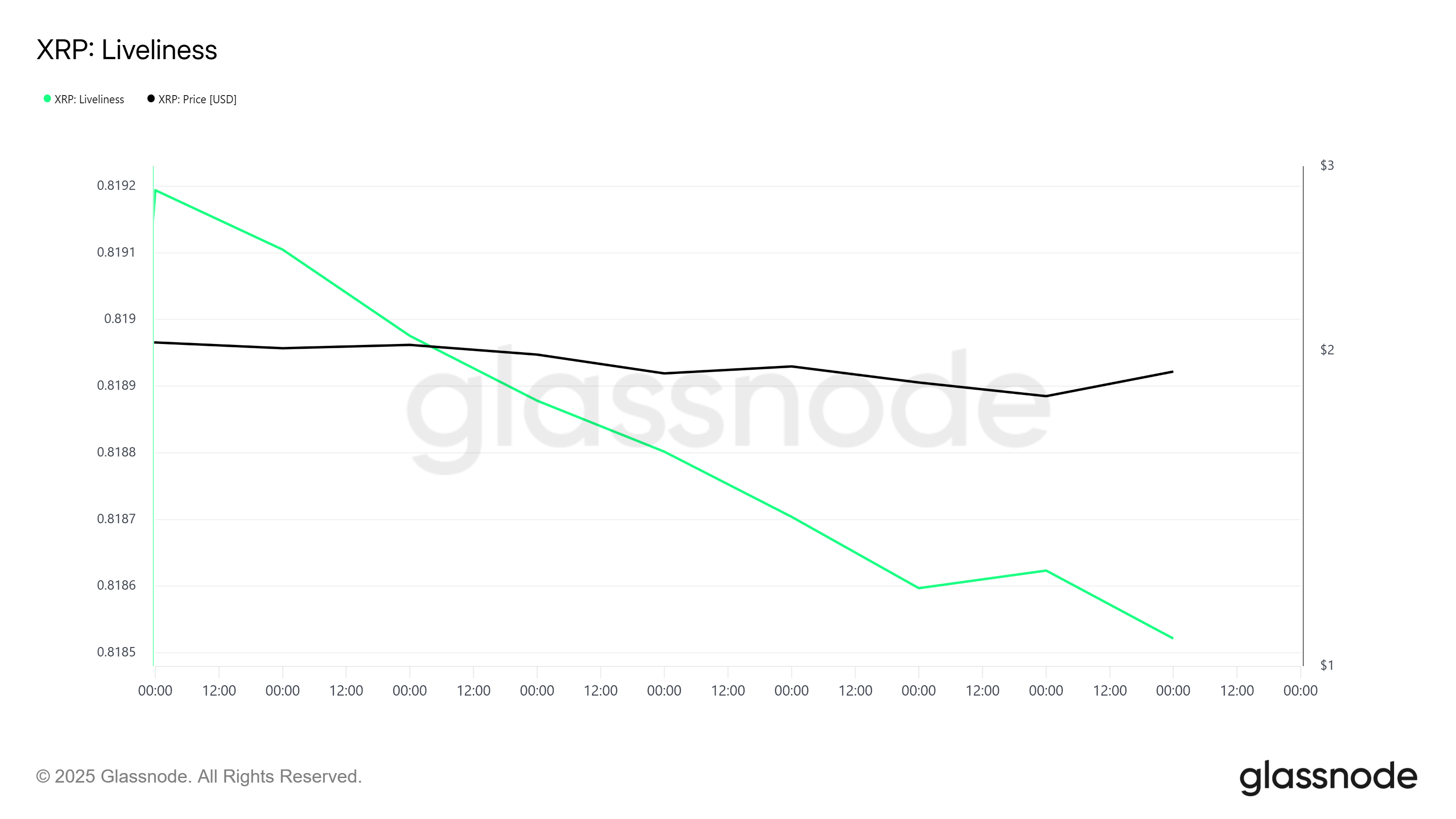
Macro indicators further support the constructive outlook. XRP’s liveliness metric has declined over the past week, signaling reduced coin movement. This trend suggests that long-term holders are shifting away from a selling behavior.
Lower liveliness readings often reflect accumulation or holding patterns. Even a pause in selling by long-term holders can stabilize price action.
Reduced distribution helps absorb short-term volatility, improving conditions for recovery when new demand enters the market.
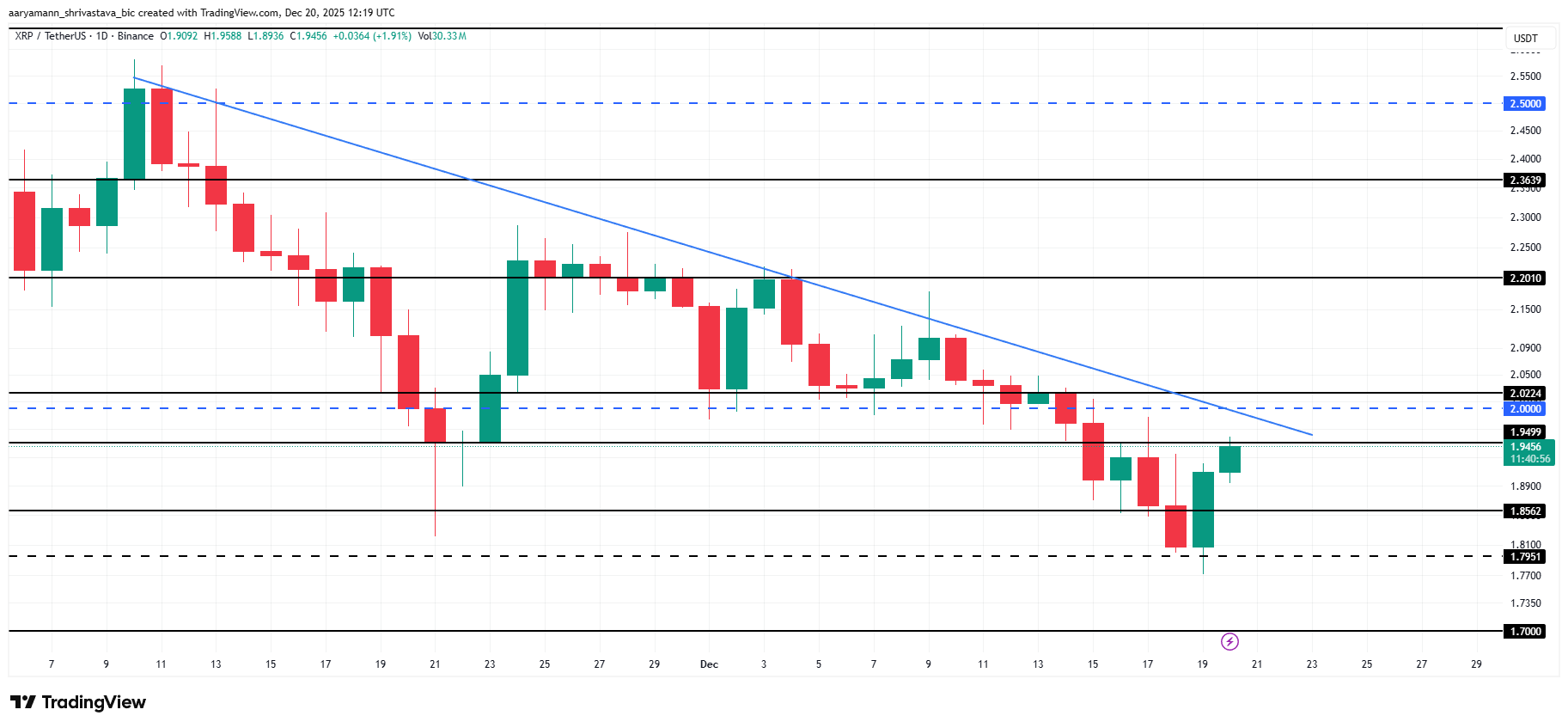
XRP trades near $1.94 at the time of writing, sitting just below a month-long downtrend that has capped upside. The immediate recovery target stands at $2.02. A break above this level would signal renewed strength and an improvement in the trend.
Accumulation by whales and declining long-term selling pressure favor a bullish scenario. If these factors persist, XRP could push past $2.02 and advance toward $2.20. Such a move would mark a clear breakout from the prevailing downtrend.
Downside risks remain if bearish pressure regains control. A failure to sustain momentum could pull XRP back toward $1.85. Further weakness may expose the $1.79 support. Losing that level would invalidate the bullish thesis and reinforce near-term downside risk.
Hedera’s HBAR continues to trade under pressure as a persistent downtrend limits upside attempts. Multiple breakout efforts have failed, keeping the altcoin from establishing higher levels.
The broader market environment has added strain, preventing HBAR from gaining traction despite brief stabilization near key support zones.
Hedera Is Facing Bearishness
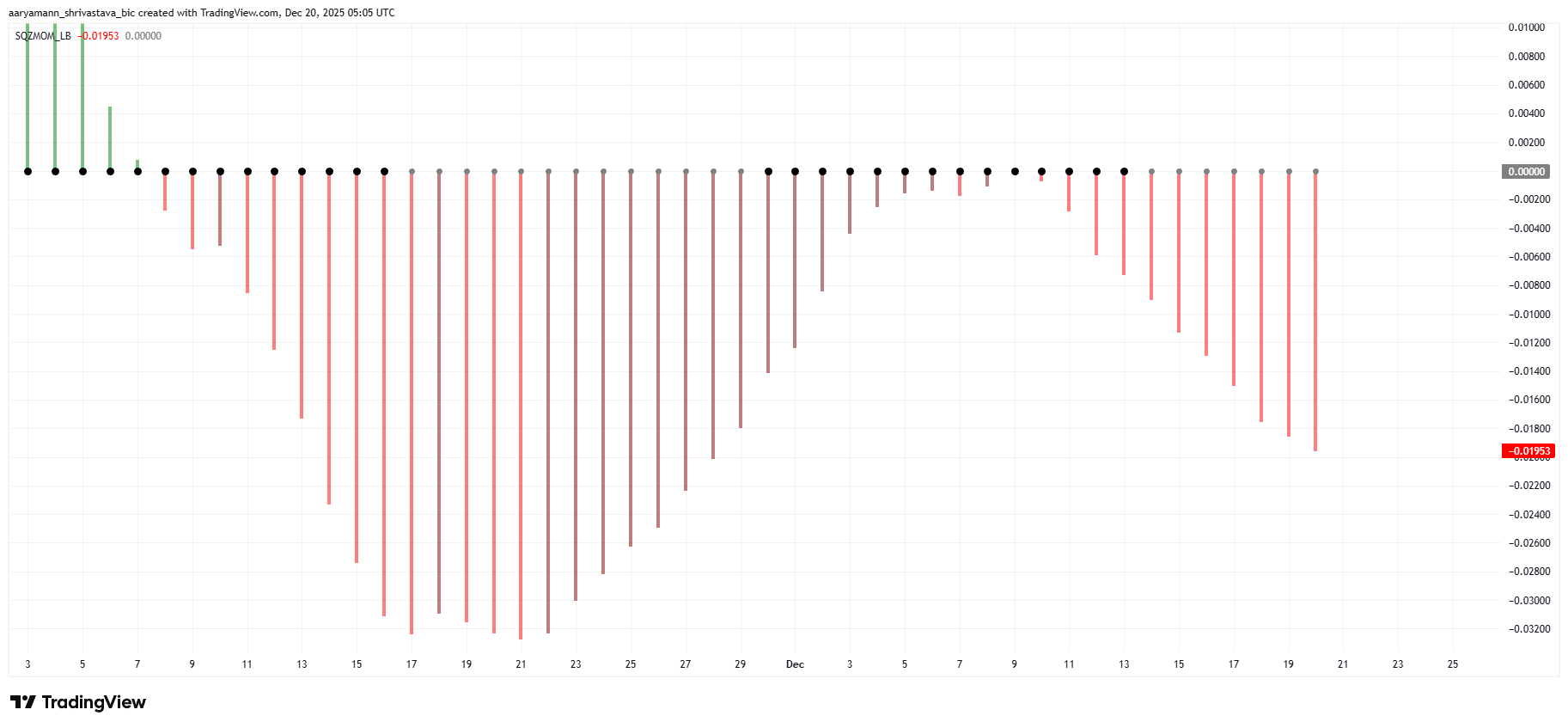
Technical indicators show growing bearish momentum. The Squeeze Momentum Indicator was released earlier last week, triggering heightened volatility. Instead of an upside move, the release resulted in a sharp price drop, reinforcing negative sentiment among short-term traders.
The indicator’s histogram continues to deepen in bearish territory. This pattern suggests selling pressure remains dominant. Strengthening downside momentum reduces the likelihood of HBAR price recovery, as traders hesitate to reenter positions amid weak technical confirmation.
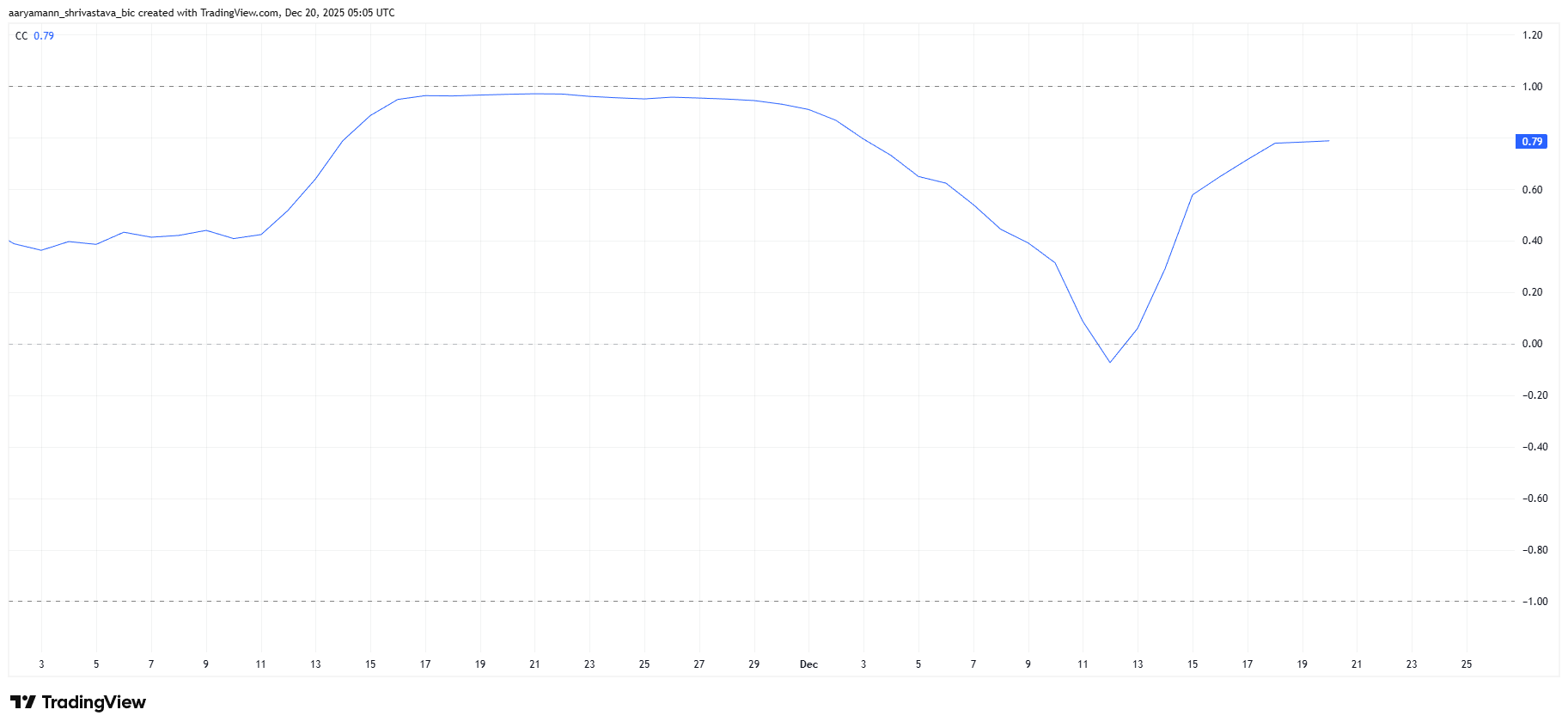
HBAR’s macro outlook is closely tied to Bitcoin’s performance. The altcoin currently shows a strong correlation of 0.79 with BTC. This relationship indicates HBAR is largely mirroring Bitcoin’s price movements rather than acting independently.
Bitcoin’s struggle to recover has therefore weighed heavily on HBAR. When BTC lacks momentum, correlated assets often face similar constraints. Unless Bitcoin stages a sustained rebound, HBAR’s ability to break its downtrend remains limited by broader market weakness.
HBAR Correlation With Bitcoin. Source: TradingView
HBAR Price Could Note Further Decline
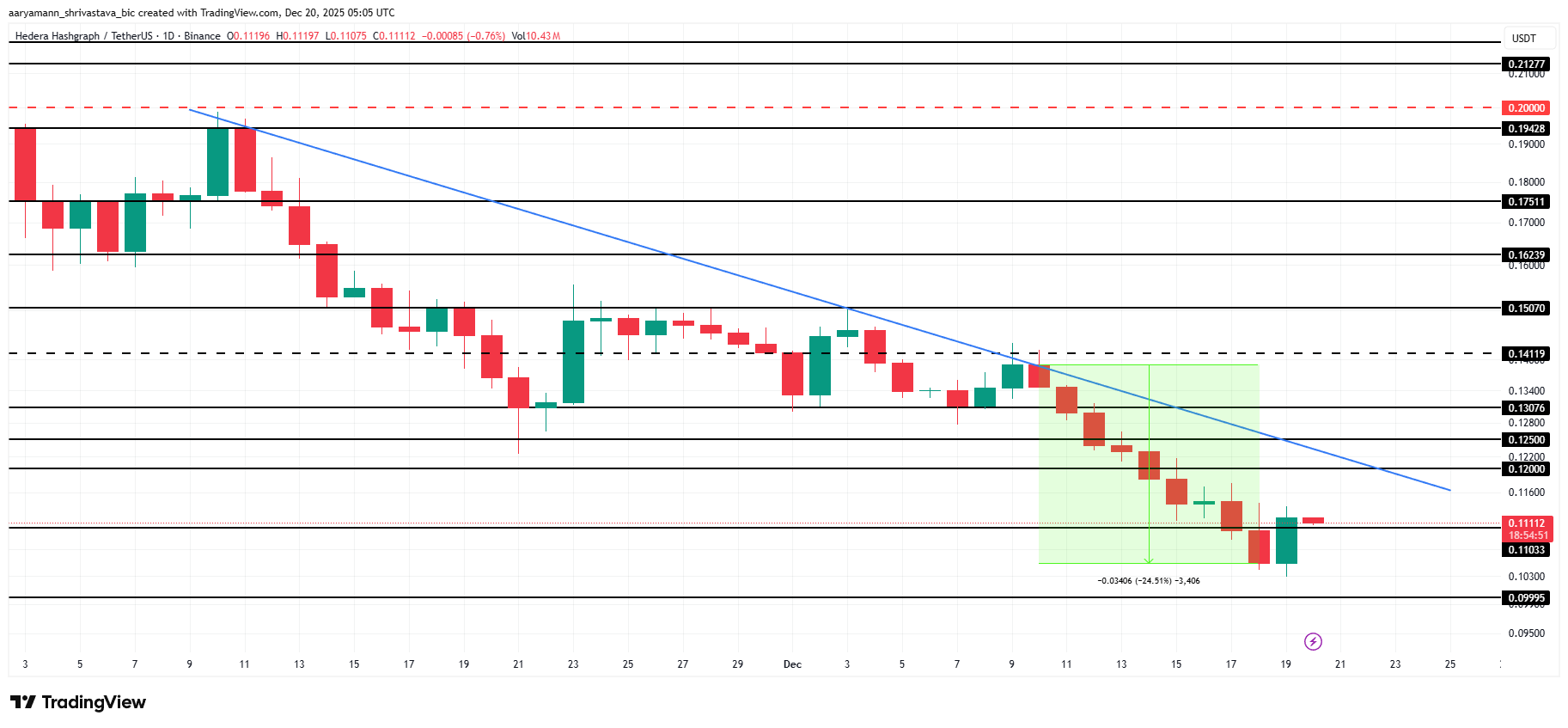
HBAR trades near $0.111 at the time of writing, holding slightly above the $0.110 support. The token dropped 24.5% earlier last week after failing to escape its month-long downtrend. Current price action suggests cautious stabilization rather than reversal.
Given prevailing conditions, HBAR may continue to struggle below the $0.120 level. Persistent bearish momentum could drag the price toward $0.099. A move to this zone would extend losses and reinforce the downtrend that has dominated recent trading sessions.
A bullish alternative depends on renewed investor inflows. Increased buying interest could help HBAR reclaim $0.120 and break free from its downward structure. A sustained push toward $0.125 would invalidate the bearish thesis and signal improving confidence among market participants.
Ethereum core developers have revealed plans to execute two major network upgrades in 2026, codenamed “Glamsterdam” and “Hegota.”
This decision marks the blockchain network’s continued strategic pivot toward a faster release cadence. The move is intended to establish a predictable biannual upgrade schedule and strengthen its competitive position against high-throughput rivals.
Ethereum Shifts to Biannual Upgrades to Fend Off High-Speed Rivals
The roadmap positions “Glamsterdam” for release in the first half of 2026, arriving fast on the heels of the recent “Fusaka” hard fork.
According to developers, Glamsterdam will focus on immediate scalability and efficiency fixes, primarily through gas optimizations and “Enshrined Proposer-Builder Separation” (ePBS).
Meanwhile, the developers intend to finalize the full feature list for Glamsterdam immediately following the holiday break.
On the other hand, the second phase of the 2026 sprint, “Hegota,” targets the latter half of the year.
The upgrade’s name reflects its dual nature, combining the “Bogota” execution-layer update with the “Heze” consensus-layer update.
Christine Kim, a former Vice President at Galaxy Digital who now closely tracks protocol governance, noted that scoping discussions for Hegota will commence on the January 8 All Core Developers call.
These sessions will determine the fork’s “headliner” features, with a finalized scope expected by late February.
Other Planned Updates
Parallel to these structural changes, the Ethereum Foundation is aggressively reorienting its long-term research toward security hardening.
Researcher George Kadianakis confirmed that the network aims to achieve “128-bit provable security” by year-end 2026. The cryptographic standard is considered essential for institutional-grade financial applications.
“For zkEVMs, this isn’t academic. A soundness issue is not like other security issues. If an attacker can forge a proof, they can forge anything: mint tokens from nothing, rewrite state, steal funds. For an L1 zkEVM securing hundreds of billions of dollars, the security margin is not negotiable,” he stated.
The Foundation has linked this initiative to specific milestones, including a “soundcalc” integration in February and full alignment with the Glamsterdam hard fork in May.
Meanwhile, these efforts aim to remove the technical friction that currently limits Ethereum’s mass adoption.
To bridge this gap, developers are implementing a strategy to lower entry barriers and match the intuitive simplicity of mainstream consumer applications.
Zcash has recorded a sharp upside move, gaining 13% over the past 24 hours and pushing closer to the $500 level.
The rally reflects improving holder confidence and supportive technical momentum. Unlike many altcoins, ZEC is maintaining relative strength despite broader market uncertainty.
Zcash Holders Seem To Be Changing Stance
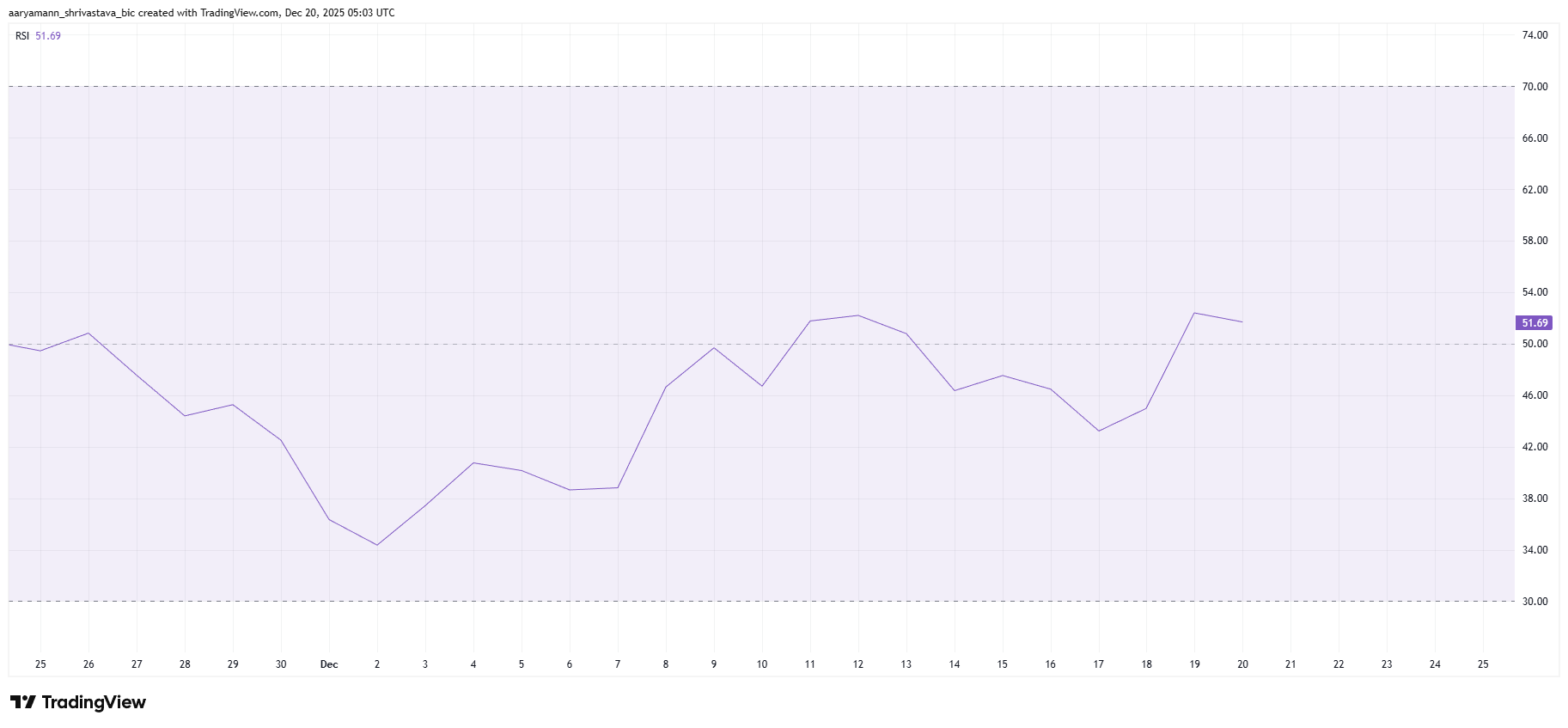
Momentum indicators highlight Zcash’s improving sentiment. The Relative Strength Index (RSI) has climbed above the neutral 50.0 level and entered the positive zone. This shift places ZEC among a small group of altcoins currently showing bullish momentum.
An RSI above 50.0 suggests buyers are gaining control. This positioning may help Zcash resist short-term bearish pressure affecting the wider market. Strong momentum readings often support trend continuation when paired with stable demand from holders.
Want more token insights like this? Sign up for Editor Harsh Notariya’s Daily Crypto Newsletter here.
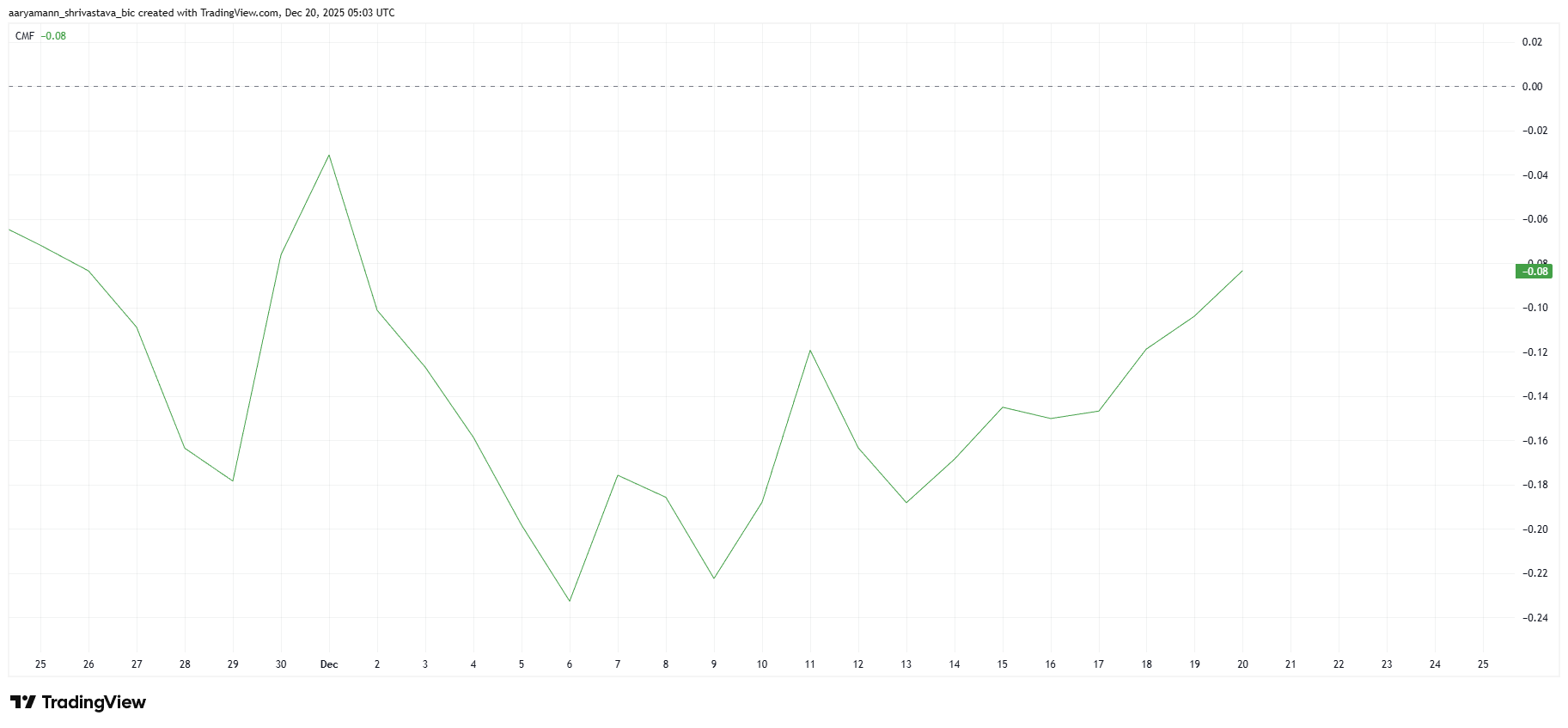
Macro indicators reinforce the constructive outlook. The Chaikin Money Flow is trending higher, signaling a slowdown in capital outflows. Although the indicator remains below the zero line, the upward move suggests selling pressure is easing.
Retracing outflows is significant during recovery phases. If market conditions remain steady, declining outflows could transition into net inflows. Such a shift would confirm improving conviction and provide the liquidity needed to sustain ZEC’s upward trajectory.
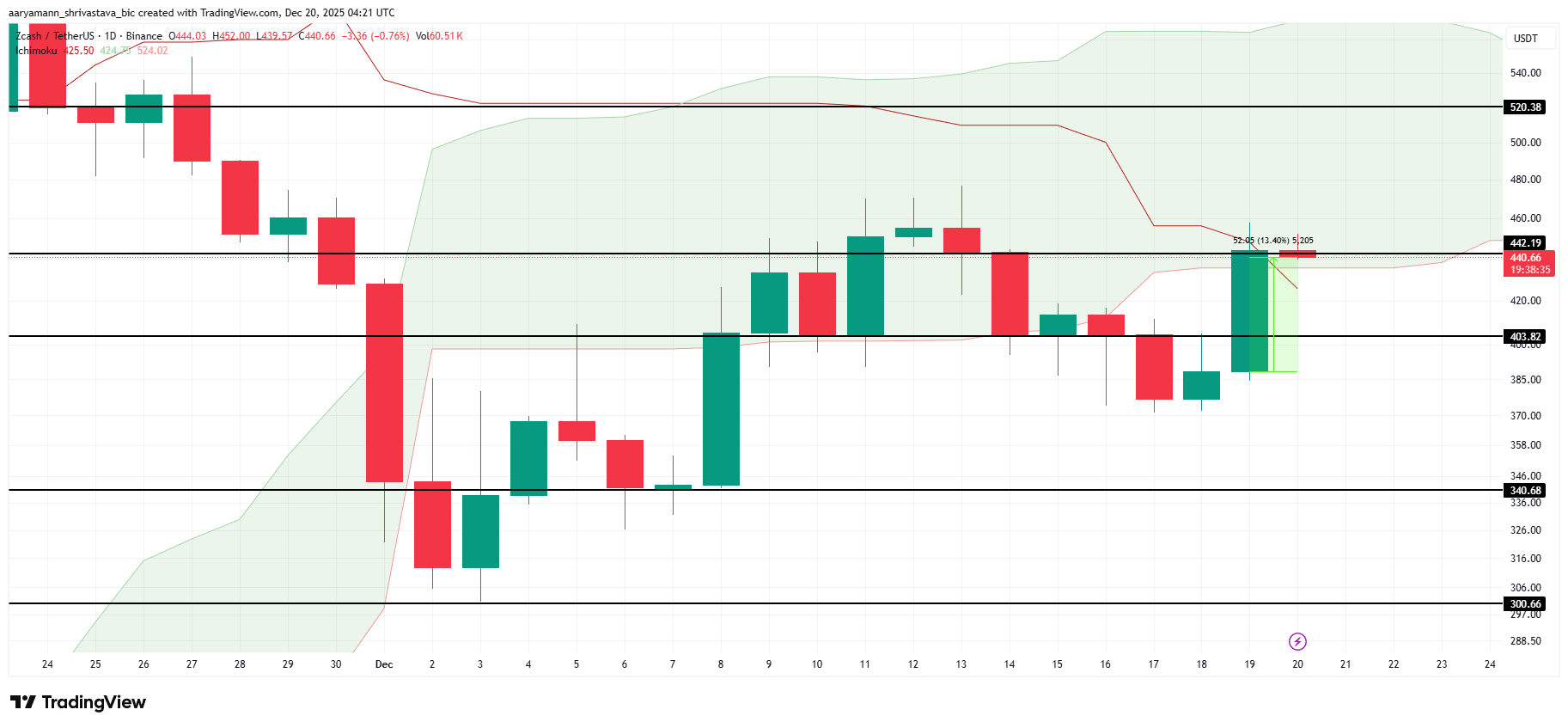
Zcash price is standing near $438 at the time of writing, marking a 13% gain in one day. The price is now testing the $442 resistance zone. Clearing this level is critical for confirming the continuation of the current rally.
Bullish technical signals support further upside. If momentum indicators remain positive and capital flows stabilize, ZEC could advance toward $500. The move would require only a 13.8% increase from current levels, making the target technically achievable in favorable conditions.
Downside risks persist if resistance holds. Failure to breach $442 or renewed selling could pull ZEC back toward the $403 support. A breakdown below that level would weaken the bullish outlook and open the door to a deeper correction toward $370.
A cryptocurrency trader lost $50 million in Tether’s USDT after falling victim to a sophisticated “address poisoning” attack.
On December 20, blockchain security firm Scam Sniffer reported that the attack began after the victim sent a small $50 test transaction to his own address.
How The Address Poisoning Scheme Unfolded
Notably, traders use this standard precaution to confirm that they are sending funds to the correct address.
— Scam Sniffer | Web3 Anti-Scam (@realScamSniffer) December 20, 2025
The fake address is designed to match the intended recipient’s address at the beginning and end of the alphanumeric string. The differences appear only in the middle characters, making the fraud difficult to detect at a glance.
The attacker then sent a negligible amount of cryptocurrency from the spoofed address to the victim’s wallet.
That transaction effectively placed the fraudulent address into the victim’s recent transaction history, where many wallet interfaces display only truncated address details.
Relying on that visual shorthand, the victim copied the address from their transaction history without checking the full string. So, instead of transferring funds to a secure personal wallet, the trader sent 49,999,950 USDT directly to the attacker.
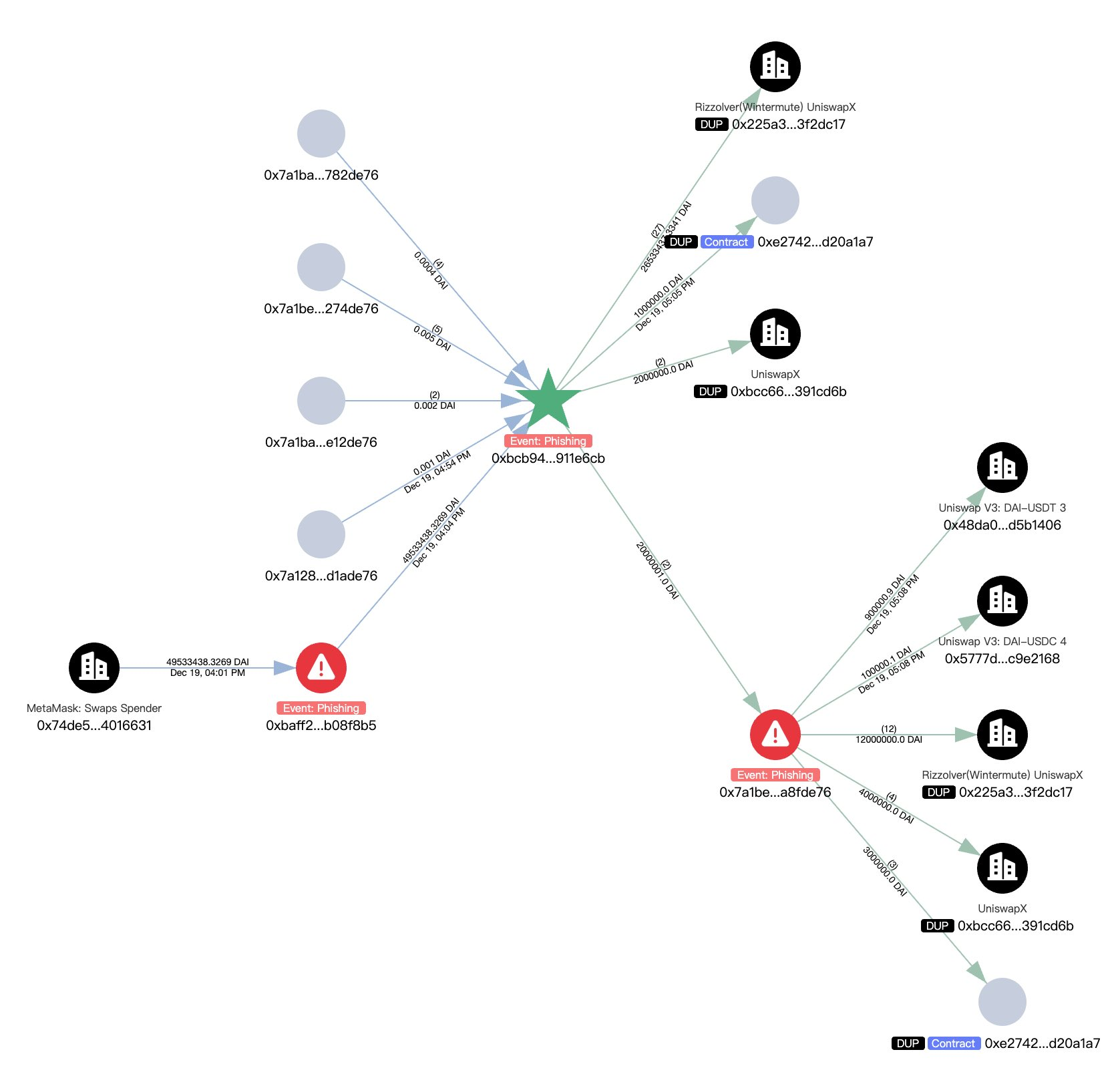
After receiving the funds, the malicious attacker quickly moved to limit the risk of asset seizure, according to on-chain records. The attacker immediately swapped the stolen USDT, which its issuer can freeze, for the DAI stablecoin using MetaMask Swap.
Attacker Moves to Obscure Transaction Trail. Source: Slowmist
The attacker then converted the funds into roughly 16,680 ETH.
To further obscure the transaction trail, the attacker deposited the ETH into Tornado Cash. The decentralized mixing service is designed to sever the visible link between sending and receiving addresses.
Victim Offers $1 Million Bounty
In an attempt to recover the assets, the victim sent an on-chain message offering a $1 million white-hat bounty in return for 98% of the stolen funds.
“We have officially filed a criminal case. With the assistance of law enforcement, cybersecurity agencies, and multiple blockchain protocols, we have already gathered substantial and actionable intelligence regarding your activities,” the message stated.
The message warned that the victim would pursue “relentless” legal action if the attacker failed to comply within 48 hours.
“If you fail to comply: We will escalate the matter through legal and international law enforcement channels. Your identity will be uncovered and shared with the appropriate authorities. We will relentlessly pursue criminal and civil action until full justice is served. This is not a request. You are being given one final chance to avoid irreversible consequences,” the victim stated.
The incident underscores a persistent vulnerability in how digital wallets display transaction information and how attackers exploit user behavior rather than flaws in blockchain code.
Security analysts have repeatedly warned that wallet providers’ practice of abbreviating long address strings for usability and design reasons creates a persistent risk.
If this problem is not solved, attackers are likely to continue exploiting users’ tendency to verify only the first and last few characters of an address.
Senator Cynthia Lummis, the US Senate’s most prominent cryptocurrency advocate, announced on December 19 that she will not seek reelection in 2026.
The decision sets a definitive deadline on her legislative agenda, creating a two-year sprint to enshrine digital asset regulations before she leaves office in January 2027.
Lummis’ Impending Retirement Adds Pressure to Codify Crypto Laws
Lummis cited the “exhausting” pace of recent sessions as the primary driver for her exit. “I am a devout legislator, but I feel like a sprinter in a marathon,” she wrote, admitting she lacks the energy reserves for another six-year term.
Thank you, Wyoming! Serving our state has been the honor of my life. – Cynthia Lummis pic.twitter.com/FoRTlHaHxI
While the Trump administration has reversed several anti-crypto measures and advanced pro-crypto goals through executive action, Sen. Lummis has welcomed those steps.
She has consistently argued, however, that durable progress requires legislative codification rather than policy set by executive order alone.
So, her final term will focus on bridging the gap between temporary executive orders and permanent congressional law to protect the industry from future political reversals.
“I look forward to throwing all my energy into bringing important legislation to [Trump’s] desk in 2026 and into retaining commonsense Republican control of the US Senate,” Lummis said.
Meanwhile, the announcement triggered immediate accolades from industry heavyweights. Some argued that her exit would leave a crypto leadership vacuum in Washington.
Collin McCune, Head of Government Affairs at a16z, highlighted her national impact and noted her role in advancing crypto legislation.
“Senator Lummis fought for Wyoming every day for many years. Beyond that, her leadership created space for innovators and builders across the country. Crypto would not be where it is today without her fight in the Congress,” he added.
Arjun Sethi, co-CEO of crypto exchange Kraken, offered a detailed retrospective on Lummis’s legacy, crediting her with making Wyoming the first jurisdiction to take a “technically informed approach” to digital assets.
Sethi praised Lummis for championing frameworks that aligned with “technical reality” rather than legacy assumptions. He said the approach helped create operating certainty across markets, from Bitcoin to emerging “memetic assets.”
“Senator Lummis advocacy for Bitcoin and digital assets has been grounded, patient, and long term. Not performative. Not reactive. Focused on competitiveness, resilience, and ensuring the United States remains a place where open systems can be built and operated responsibly,” Sethi said.

 Login
Login