Reading view

USDC Is Being Used for More Than Trading, and Bybit Is Expanding Support on XDC

As 2025 winds down, stablecoins like USDC are being used for more than just trading. They are increasingly part of payments, business transfers, and routine movement of funds, not only activity tied to market cycles. As more money moves more often, the way those transfers settle has started to matter far more than it used to. 

That change has put pressure on existing blockchain networks. Activity picked up over the second half of the year, and during busy periods this showed up through higher fees, slower confirmations, and less predictable transfer costs.

On Ethereum, for example, sending USDC late in 2025 has often cost anywhere from a few dollars to well over ten dollars during periods of congestion, meaning even a basic transfer can end up costing more than expected.

By the second half of the year, fee volatility had become another familiar issue. Gas-based pricing means the cost of a stablecoin transfer can change quickly depending on network conditions, making routine payments harder to plan for traders, businesses, and treasury teams. In practice, once exchange and transfer fees are factored in, the cost advantage of using stablecoins can narrow more than many users expect.

That’s where Bybit’s decision to add USDC support on the XDC Network fits in. As stablecoin transfers become part of everyday activity, exchanges are under pressure to offer routes that are easier to manage and more predictable. How quickly and cheaply funds can move now matters as much as access itself.

“Most users don’t care about blockchain labels anymore. They care about whether a transfer clears quickly and what it costs them in the end,” said Angus O’Callaghan, head of trading and markets at XDC Network. “If stablecoins are going to function as everyday financial tools, the infrastructure underneath them has to feel reliable, not stressful.”

Bybit Waives USDC Fees on XDC and Launches $200,000 Reward Program

For most stablecoin users, access isn’t the problem anymore. USDC is already available on nearly every major exchange. What people care about now is whether moving funds actually works the way they need it to: quickly, regularly, and without having to think twice about the cost.

Bybit’s recent changes make sense within this context. Alongside opening another route for USDC transfers, the exchange is waiving withdrawal fees on XDC from December 1, 2025 through January 1, 2026, and offering a 200,000 USDC reward pool for new users who register and make qualifying deposits.

From a user point of view, this is less about features and more about convenience. When transfers start to feel expensive or unpredictable, people naturally change how they move money. Some wait longer to transfer, others batch payments, and some avoid smaller transactions altogether. Having another option available makes those decisions easier.

For Bybit users, USDC on XDC simply adds flexibility. It gives them another way to move funds when the usual routes don’t feel like the best choice, without changing what they’re using or how they think about stablecoins.

What This Signals for Exchanges

Bybit’s recent move around USDC transfers reflects a change that’s starting to show up across the exchange landscape. While Bybit has taken a clear step in expanding how users can move funds, it’s also part of a wider pattern playing out over the past few weeks.

BTSE, KuCoin, MEXC, Gate.io, Bitrue, and Pionex have also expanded support for XDC, enabling deposits, withdrawals, and trading. Taken together, these moves point to growing interest among exchanges in settlement networks that can handle regular transfer activity without the fee swings seen on more congested chains.

For exchanges, the reasoning is largely practical. As stablecoin flows increase, relying on a small set of networks can make platforms more exposed to sudden cost changes and slower settlement during peak periods. Adding alternative routes gives exchanges more flexibility, helps smooth out those pressures, and offers users more consistent ways to move funds without changing the assets they already use.

All of this is also happening as stablecoins start to be treated more like real payment tools. In the U.S., proposals such as the GENIUS Act are focused on putting clearer rules around how stablecoins are issued and used, especially for payments and institutional activity. As that happens, the way stablecoins move between platforms and networks becomes more than a technical detail and part of what users and institutions expect by default.

“When stablecoins start getting used outside of trading, the conversation changes,” O’Callaghan added. “Once there are clearer rules around how they’re meant to work, like what’s being discussed with the GENIUS Act, people stop treating transfers as experiments. They expect them to behave like regular payments: to go through on time, at a cost they can understand, and without needing to second-guess every move.”

XDC in Practice

XDC Network is mostly used for practical, behind-the-scenes work rather than consumer-facing crypto activity. It’s been used in areas like trade finance, real-world asset tokenization, and settlement processes where systems need to work consistently and without surprises.

That same setup also works well for moving stablecoins. Transfers on XDC tend to go through quickly and usually cost very little, which matters more now that stablecoin transfers became more common. For people or businesses sending USDC often, lower and more predictable costs make those transfers easier to manage over time.

This is starting to show in the data. The amount of USDC issued on XDC has continued to rise and recently passed $200 million, indicating that usage is moving beyond early tests and into more regular activity. Rather than brief spikes, the numbers point to steady use by participants who move funds often.
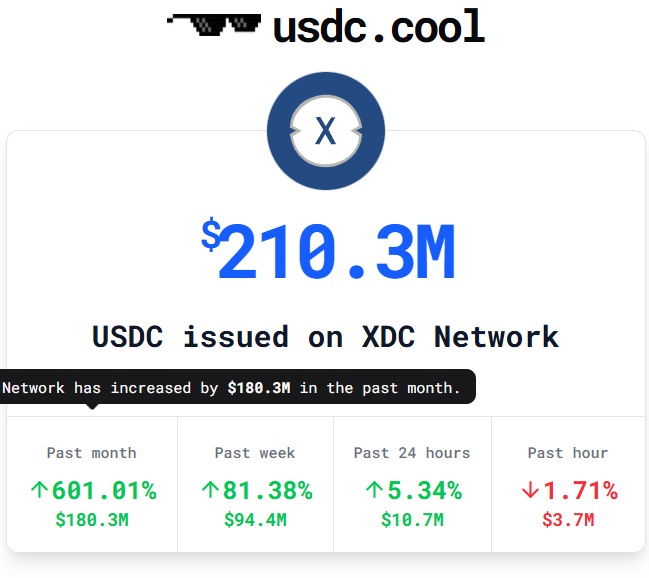
Image source: USDC.COOL

From XDC’s side, integrations like Bybit’s are mainly about being useful. The network is being used as another place where stablecoin transfers can happen reliably, rather than as something meant to attract attention on its own.

XDC was also designed with institutional payment flows in mind, where predictable settlement and consistent costs matter more than short-term optimization. That makes it practical for businesses and financial institutions moving stablecoins at scale, where delays or sudden fee swings quickly turn into operational problems.

That focus is already showing up in how the network is being used. Beyond basic transfers, XDC supports more complex financial workflows, including global payments, tokenized settlement, and stablecoin-based liquidity. Assets like USDC are increasingly used within these flows, including as collateral, and more than $500 million worth of assets have already been tokenized and settled on the network.
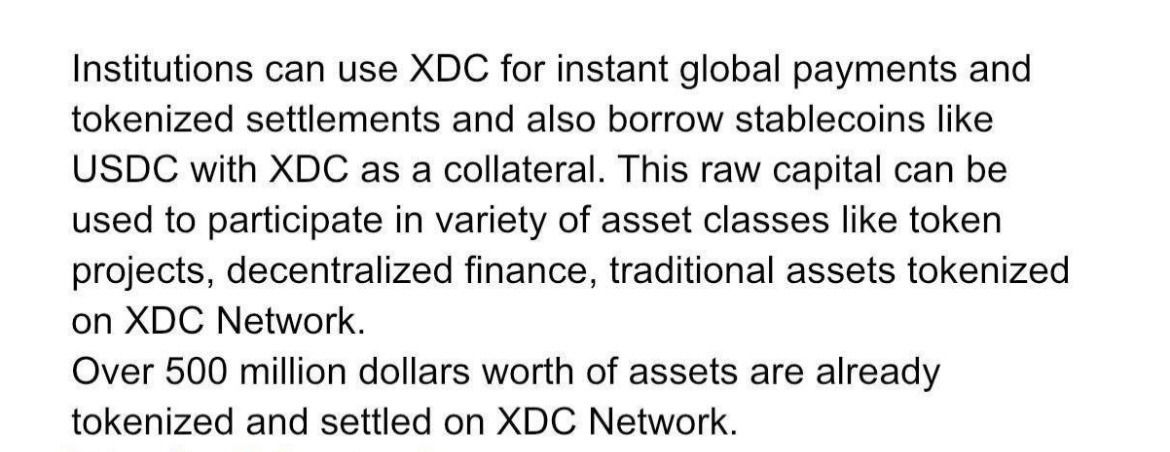
Image source: TradeFi Network

This kind of activity is especially relevant for trade finance and cross-border settlement, where funds need to move reliably across jurisdictions rather than fluctuate with market conditions. As more payment and trade processes move on-chain, infrastructure that can handle steady, high-volume transfers becomes less of a nice-to-have and more of a requirement.

Closing

In the end, decisions like Bybit’s USDC support on XDC are not about any single network or promotion and more about how exchanges are adjusting to a maturing market. For the exchange, offering another way to move USDC is part of that adjustment – making sure the experience holds up not just during quiet periods, but when activity picks up and small frictions start to matter. XDC’s role in that setup reflects how infrastructure choices are becoming part of the exchange’s responsibility, even if they stay largely out of sight.

“Good infrastructure doesn’t draw attention to itself,” O’Callaghan concludes. “When it works properly, users barely think about it, and that’s usually the goal.”

The post USDC Is Being Used for More Than Trading, and Bybit Is Expanding Support on XDC appeared first on BeInCrypto.

  •  

As Verifiable Compute Bottlenecks Grow, Cysic Mainnet Launches Into a Broader Infrastructure Shift

In the race to scale blockchain and decentralize AI, one barrier continues to surface: compute. Whether it’s the rising cost of zero-knowledge (ZK) proof generation or the opaque infrastructure behind AI inference, developers are increasingly bottlenecked by centralized, expensive, and often inaccessible compute power.

One protocol trying to end this bottleneck is Cysic, a decentralized compute marketplace built to provide ZK proofs and verified AI inference. It officially launched its mainnet alpha today, with over 260,000 nodes already onboarded and integrations with Scroll, Succinct, and NetworkNoya ecosystems. With such early success, the team characterizes this shift as the emerging ‘ComputeFi‘ era, in which computation becomes a verifiable, on-chain resource where computation itself becomes a verifiable, onchain resource.

The development comes at a time of significant transformation in both the blockchain and AI sectors. Ethereum’s shift toward ZK-native architectures, the rise of modular stacks, and the proliferation of AI agents have all contributed to a surge in demand for decentralized compute. Projects like zkSync, which recently surged 150% on the back of the new ZK infrastructure and privacy integrations, show how investors and developer interest is converging around verifiable computation as a foundational layer, not just a feature. 

Recent trends such as the emergence of Proof-of-AI, decentralized GPU markets, and compute tokenization mark a larger shift toward verifiable, programmable infrastructure layers. With outages like AWS’s recent downtime highlighting the fragility of centralized backends, builders are increasingly seeking more resilient and transparent alternatives.

Why Compute Has Become a Core Infrastructure Concern

Blockchain scaling and AI integration are both rapidly increasing compute demand, but traditional infrastructure struggles to meet the unique needs of decentralized systems:

  • ZK Proof Generation: Zero‑knowledge proofs are central to many scaling strategies, enabling privacy and validation without exposing underlying data. But generating these proofs requires significant specialized compute, often handled by a handful of centralized providers — an arrangement that limits decentralization and can inflate costs.
  • AI Verification: As AI models are integrated into onchain workflows and autonomous agents, there’s a growing need not just for compute output, but verifiable results that can be audited or proven to follow specified logic. Traditional cloud APIs deliver performance but lack native verifiability when tied to blockchain logic.

These pressures reflect a broader shift in how developers think about infrastructure: it’s no longer enough to just execute compute as applications increasingly demand cryptographic assurances about how that compute was performed.

Cysic’s Role in the New Compute Economy

Cysic’s mainnet goes live as verifiable compute moves from theoretical promise to ecosystem necessity. Rather than relying on centralized servers or opaque APIs, the network distributes ZK proving and AI inference tasks across a global node base, from consumer GPUs to custom ASIC hardware, forming a marketplace for provable computation.

Ahead of mainnet, the protocol processed over 10 million ZK proofs, onboarded 260,000+ nodes, and attracted 1.4 million wallets through test phases. It now integrates with projects like Scroll, Succinct, and Polygon CDK, signaling real adoption rather than speculative hype.

The network aims to provide scalable, verifiable compute at lower cost. In AI contexts, partners like NetworkNoya report over 70% speed boosts and 91% cost reductions using Cysic’s infrastructure. In ZK environments, teams like Succinct and Scroll have used its prover networks to improve efficiency on live workloads.

The project positions its approach as an effort to make compute more provable, decentralized, and programmable.

Decentralized Compute Is an Ecosystem Trend, Not an Isolated Sprint

Cysic’s launch is one piece of a larger pattern in Web3 and decentralized systems. While projects vary in approach, the underlying challenge they tackle is consistent: reducing dependency on centralized compute providers and enabling more trustable, accessible infrastructure.

For example:

  • Decentralized AI compute networks like NodeGoAI are exploring ways to monetize idle hardware for AI tasks in distributed environments.
  • Decentralized resource networks captured by the DePIN movement aim to incentivize compute sharing at scale — a theme that has come into sharper focus following disruptions like the AWS outage that affected parts of Web3 infrastructure.
  • Broader discussions of decentralized AI infrastructure signal that trust, verification, and auditability are now core concerns, not niche research topics. 

These ecosystem signals suggest that decentralized compute isn’t a one‑off idea but a structural response to real world limitations in how compute is provisioned, priced, and trusted.

The Road Ahead: ZK, AI, and Beyond

While Ethereum rollups are a natural entry point, Cysic’s ambitions extend far beyond the blockchain scalability narrative. The network is already being used to support verifiable AI inference — a capability that enables smart contracts and autonomous agents to verify that an output came from a specific, authorized model. This use case is particularly relevant as AI-generated content proliferates and demands stronger provenance guarantees.

Cysic is also targeting workloads in scientific computing, including genomics and climate simulations, where reproducibility and transparency are critical. In parallel, the network supports a class of dual-purpose devices like the DogeBox1, which can toggle between mining and zero-knowledge proving based on real-time market conditions, allowing infrastructure owners to dynamically optimize for yield.

Together, these use cases point to a broader shift: computation is no longer just infrastructure. It’s becoming programmable, verifiable, and liquid, now the backbone of what Cysic coins the ComputeFi economy.

The post As Verifiable Compute Bottlenecks Grow, Cysic Mainnet Launches Into a Broader Infrastructure Shift appeared first on BeInCrypto.

  •  

What 2025 Proved About Passive DeFi and Why AI Agent Systems Like Theoriq’s AlphaVault Are the Next Step

DeFi landscape has been marked by impressive growth, yet persistent volatility remains a defining feature as 2025 draws to a close. The ecosystem hit a record $237 billion in total value locked (TLV) in Q3 2025, but the exuberance was short-lived. By late November, the total TVL had contracted by $55 billion, falling to $123 billion.

Despite these sharp fluctuations, DeFi participation has not only held steady but has gone way up. Over 14.2 million wallets were engaged in the ecosystem this year, and Ethereum continues to capture around 63% of all DeFi activity.

This high level of participation can be seen as a testament to DeFi’s potential. However, according to some experts, the volatility has exposed a fundamental challenge: the constant need to react to market conditions, placing success out of reach for most users.

Users have been expected to continuously monitor liquidity ranges, adjust positions, and navigate shifting arbitrage opportunities. This has created a paradox where, despite the claim that money grows on its own, DeFi participants are actually burdened with time-consuming, manual tasks to optimize their returns.

One example of this view is Ron Bodkin, a former Google executive who now leads the team for AI Agent Protocol Theoriq. Bodkin claims that he has watched the burden on everyday users increase as DeFi has scaled.

“Most people came to DeFi hoping their money would work for them,” Bodkin says.

“But somehow it turned into them working for their money: checking charts at midnight, adjusting ranges in between meetings. It’s kind of backwards and wears users down.”

According to Bodkin, real passivity won’t come from asking users to do even more but from rethinking how yield is managed altogether. This sounds less like the yield-chasing days of past cycles and more like a search for tools that don’t depend on users being glued to their wallets.

Bringing AI Into DeFi Without the Black Box Problem

Theoriq’s new protocol, AlphaVault, fits into a broader shift toward more autonomous forms of DeFi management. In the past year, more projects have started experimenting with the overlap between DeFi and AI (sometimes called DeFAI), using agents to help automate routine decisions and keep up with fast-moving markets.

It’s the kind of experimentation that has slowly moved from hackathon curiosity to something protocol teams now discuss as part of long-term roadmaps. Bodkin adds: 

“We’re seeing more interest in AI across DeFi, but the real challenge is making sure people can understand and trust what those agents are doing. Transparency has to grow alongside automation, or none of this scales the way people hope.”

AlphaVault  is among the DeFi vaults experimenting with using specialized AI agents to manage user capital directly. Instead of relying on simple, rule-based compounding tools, it uses a multi-agent system built to adjust to changing market conditions. This setup was tested under real pressure during Theoriq’s testnet, which processed more than 65 million agent requests across 2.1 million wallets.

According to the team, one of the key differences with it and other AI Agent protocols is how it handles transparency and safety. Earlier attempts were often criticized for hiding how decisions were made.

AlphaVault approaches this with “policy cages”, which are smart-contract rules that define exactly what an agent is allowed to do, from asset types to position sizes. These boundaries are meant to give users a clearer sense of how the system operates and reduce the risks seen in earlier AI experiments.

At launch, AlphaVault is integrating with established, trusted partners in the Ethereum yield space. These include Lido’s stRATEGY vault, curated by Mellow Protocol, and Chorus One’s MEV Max, powered by StakeWise.

These partnerships allow AlphaVault to allocate capital into established Ethereum yield strategies that have been used across the ecosystem. The idea is to give users a way to earn returns without constantly checking or adjusting their positions, though how well this works in practice will depend on the system’s long-term performance.

Bootstrapping Liquidity the Way Many DeFi Projects Now Do

Across DeFi, early participation programs have become a common way for projects to build liquidity and establish an initial base of total value locked (TVL), giving new systems room to operate under real conditions. AlphaVault is taking a similar route.

To get the vault started, Theoriq has launched an incentivized bootstrapping phase where the community can lock ETH and earn points that convert into $THQ rewards. As this phase progresses, TVL gradually moves from being locked capital to live capital managed inside AlphaVault by its autonomous agents.

It’s a familiar pattern in DeFi, but in this case the capital doesn’t just sit but becomes fuel for a system designed to operate with minimal manual oversight, the team claims.

Where things get more interesting is in how $THQ is meant to function going forward. Instead of serving only as an incentive, Theoriq plans for it to become a reputation token that lets users stake behind AI agents they believe are performing well.

If an agent behaves poorly or fails to meet expectations, those stakes can be partially slashed. This mechanism aims to keep quality high and discourage reckless behavior.

This approach reflects a broader industry effort to bring more accountability into automated systems. Rather than relying on marketing claims or opaque performance reports, the idea is to let reputation form directly around how these agents behave over time.

In theory, that creates a system where trust isn’t based on personalities or promises, but on visible, on-chain performance, and where the community has a direct role in shaping which AI agents earn more responsibility. 

Where DeFi Goes After the Yield-Chasing Era

Theoriq hopes to shift the industry conversation away from chasing bigger APYs and toward reducing the amount of work users are expected to do. It is designed based on the idea that developers are looking for ways to offload the constant monitoring, rebalancing, and decision-making that most people still carry out manually.

The goal isn’t to remove users from the process, but to build tools that take care of the routine, time-sensitive parts of on-chain management so people don’t have to treat DeFi like a side job.

According to the team, there’s a growing interest among users in systems that can operate more consistently in the background, reacting to market conditions without requiring them to intervene every few hours. This type of automation is increasingly seen as a natural next step for a sector that wants to mature, scale, and bring in a broader audience.

It’s within this wider push for more dependable, transparent on-chain automation that Theoriq and its AlphaVault system may make sense. Whether AI-managed vaults become standard or remain early experiments is still an open question, but the direction of the industry makes their arrival feel far from accidental.

The post What 2025 Proved About Passive DeFi and Why AI Agent Systems Like Theoriq’s AlphaVault Are the Next Step appeared first on BeInCrypto.

  •  
❌