Reading view

Cooling Inflation, Weak Confidence: What the Michigan Consumer Data Means for Bitcoin

Fresh US economic data is sending a clear but nuanced signal to markets. Inflation pressures are easing, but consumers remain under strain. 

For Bitcoin and the broader crypto market, that mix points to improving macro conditions, tempered by near-term volatility.

Why Inflation Expectations Matter More Than Sentiment

US consumer sentiment edged up to 52.9 in December, slightly higher than November but still nearly 30% lower than a year ago, according to the University of Michigan. 

At the same time, inflation expectations continued to fall. Short-term expectations dropped to 4.2%, while long-term expectations eased to 3.2%.

The University of Michigan consumer sentiment index came in worse than expected at 52.9 in December. pic.twitter.com/yQ79MOBt5R

— Yahoo Finance (@YahooFinance) December 19, 2025

For markets, those inflation expectations matter more than confidence levels.

Consumer sentiment measures how people feel about their finances and the economy. Inflation expectations measure what they think prices will do next. Central banks care far more about the latter.

Falling short- and long-term inflation expectations suggest households believe price pressures are easing and will stay contained. 

That supports the Federal Reserve’s goal of cooling inflation without keeping policy restrictive for too long.

This data follows November’s CPI report, which showed inflation cooling faster than expected. Together, the two reports reinforce the same message: inflation is losing momentum.

Who do you believe:

A. University of Michigan consumer confidence below COVID April 2020 and Lehman September 2008 levels.

B. CPI inflation data, skewed by bogus OER? pic.twitter.com/FFEWj0I7OE

— Lawrence McDonald (@Convertbond) December 19, 2025

What This Means for Interest Rates and Liquidity

Lower inflation expectations reduce the need for high interest rates. Markets tend to respond by pricing in earlier or deeper rate cuts, even if economic growth remains slow.

For risk assets, including crypto, this matters because:

  • Lower rates reduce returns on cash and bonds
  • Real yields tend to fall
  • Financial conditions gradually loosen

Bitcoin has historically responded more to liquidity conditions than to consumer confidence or economic growth.

Why Weak Confidence Does Not Hurt Crypto as Much

Low consumer confidence reflects cost-of-living pressures, not collapsing demand. People still feel stretched, but they are less worried about prices rising sharply from here.

Crypto markets do not rely on consumer spending in the same way equities do. Instead, they react to:

  • Interest rate expectations
  • Dollar strength
  • Global liquidity

That makes falling inflation expectations supportive for Bitcoin, even when confidence remains weak.

Why Volatility Is Likely to Continue

This environment favors risk assets over time, but not in a straight line.

Weak confidence means growth remains fragile. That keeps markets sensitive to data releases, positioning, and short-term flows. As seen after the CPI report, even bullish macro data can trigger sharp reversals when leverage is high.

For Bitcoin, that typically results in:

  • Strong reactions to macro news
  • Choppy price action
  • Rallies driven by liquidity rather than conviction

Looking Ahead to January 2026

Taken together, the data points to a constructive macro backdrop for crypto heading into early 2026. Inflation pressures are easing, policy constraints are loosening, and liquidity conditions are improving.

At the same time, weak confidence explains why markets remain volatile and prone to sudden selloffs.

The key takeaway is simple: macro conditions are improving for Bitcoin, but price action will continue to be shaped by flows, leverage, and timing rather than optimism alone.

The post Cooling Inflation, Weak Confidence: What the Michigan Consumer Data Means for Bitcoin appeared first on BeInCrypto.

  •  

90% of HBAR Buyers Are Gone — Is Price Breakdown Now the Base Case?

Hedera is moving into a risky zone. Over the past month, buying pressure has dropped by nearly 90%, even as the HBAR price continues to slide. While the broader crypto market is trying to stabilize, Hedera is not seeing the same response, especially on the charts.

Buyers are stepping away instead of buying dips. At this point, a downside break is no longer a low-chance outcome. It is starting to look like the base case.

Spot Buying Has Almost Vanished as Downtrend Stays Intact

The HBAR spot market shows the clearest warning.

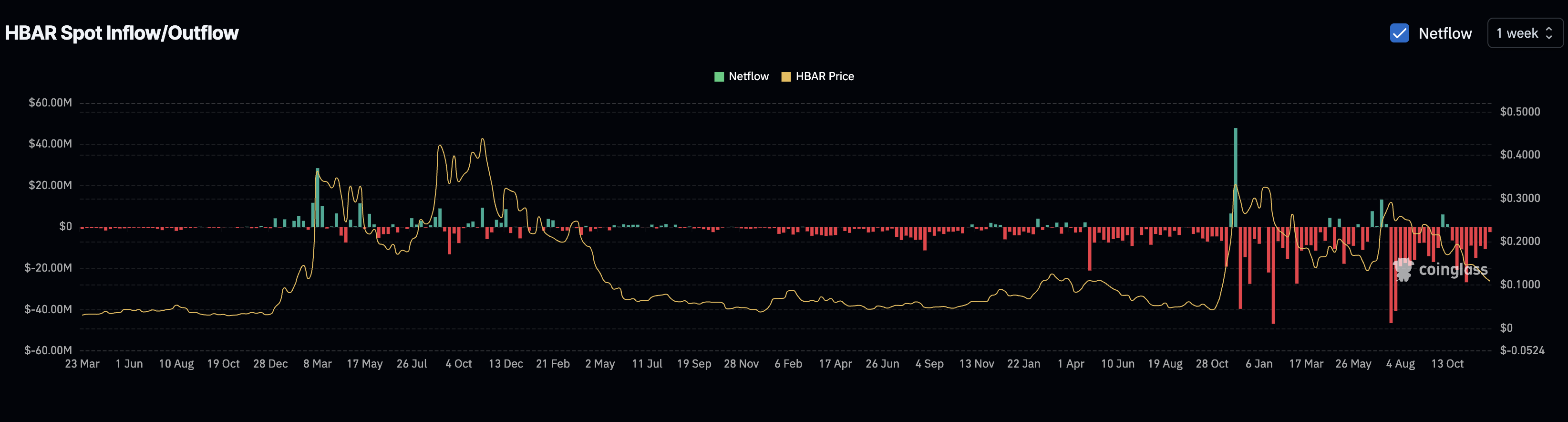
In the week ending November 10, Hedera recorded spot outflows of approximately $26.7 million, indicating strong buying as coins moved off exchanges. By the week ending December 15, that number fell to just $2.4 million. That is a collapse of roughly 90% in buying pressure in little more than a month.

Buyers Leaving
Buyers Leaving: Coinglass

This is significant because the price is already trading within a descending channel, a bearish pattern. When buyers disappear during a downtrend, sellers need little force to push the price lower. The market becomes fragile.

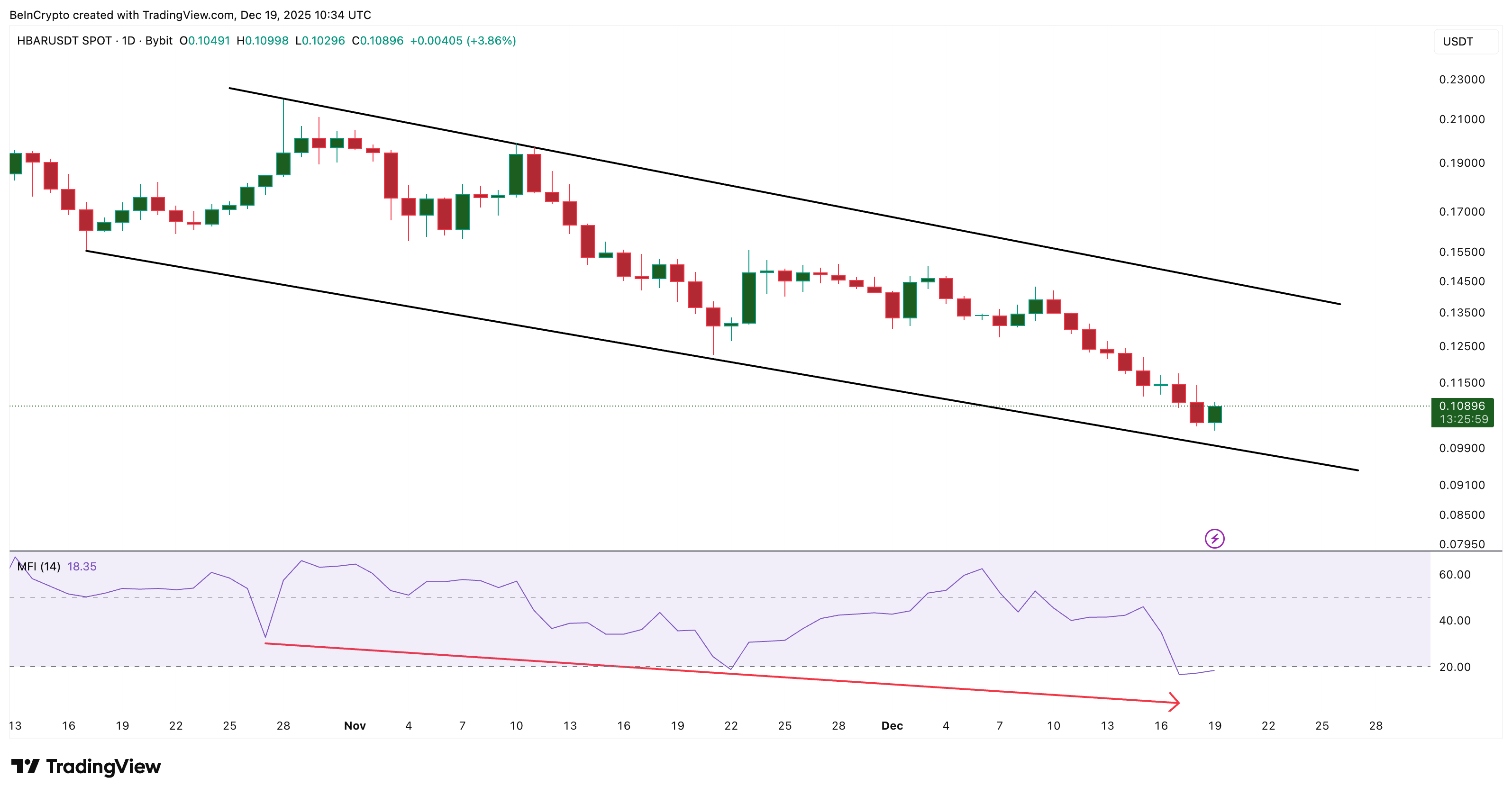
The Money Flow Index, or MFI, confirms this weakness. MFI tracks how much money is entering or leaving an asset using both price and volume. In HBAR’s case, MFI has been making lower lows along with price and has now slipped into oversold territory. Instead of bouncing, it keeps trending down.

Want more token insights like this? Sign up for Editor Harsh Notariya’s Daily Crypto Newsletter here.

No Dip Buying Visible
No Dip Buying Visible: TradingView

That indicates that dips are not being bought, suggesting minimal price-specific conviction.

Why the HBAR Price Breakdown Scenario Is Gaining Weight

With weak spot demand and falling money flow, the HBAR price action becomes the final judge.

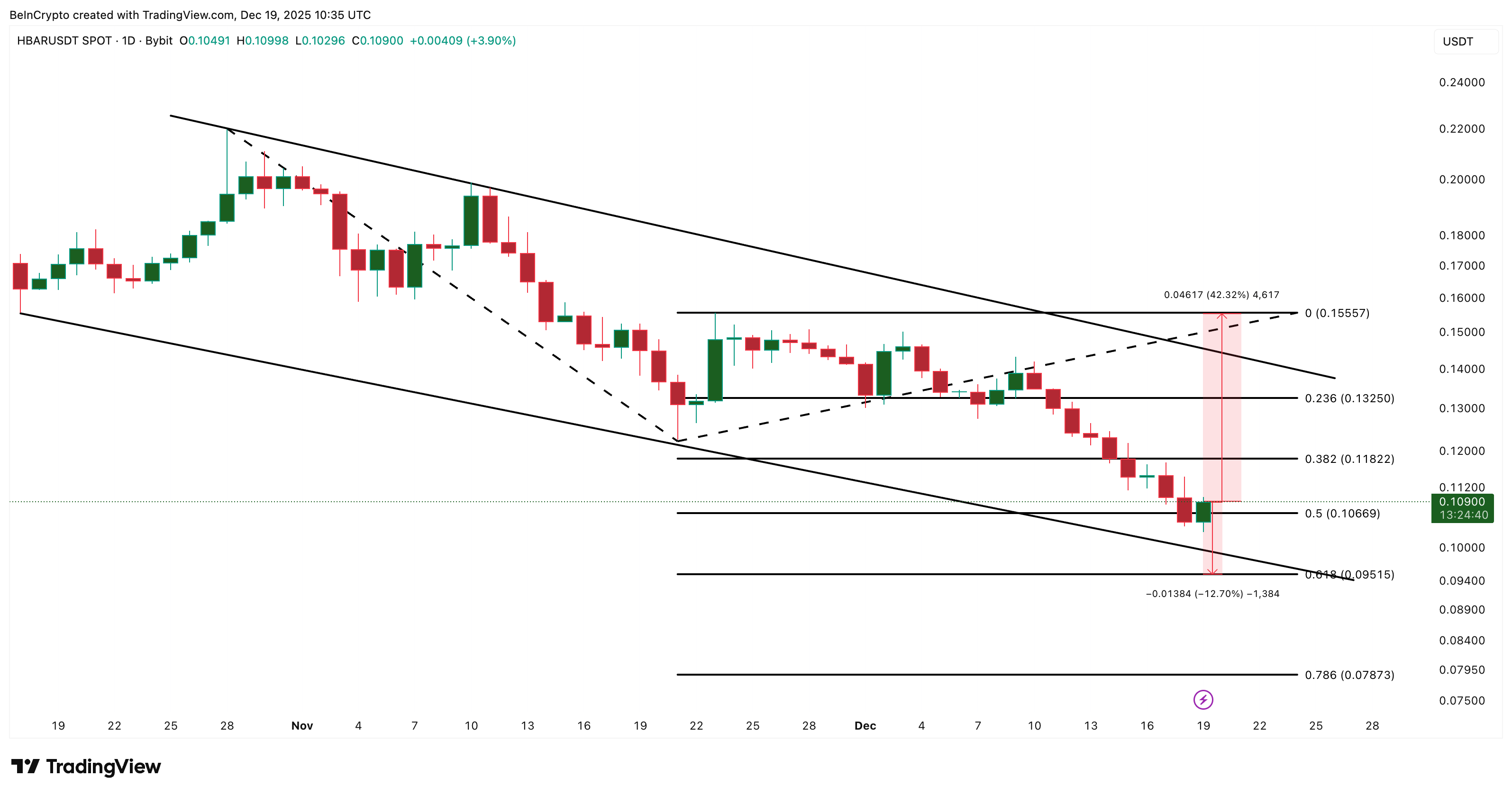
HBAR is sitting near the lower boundary of its descending channel. The first key level to watch is $0.106. If price loses this level on a daily close, the next downside target comes in near $0.095, which is about 12% lower than current levels. Reaching there would mean a confirmed bearish breakdown, bringing even $0.078 into the mix.

That move would confirm continuation of the downtrend rather than a temporary dip.

HBAR Price Analysis
HBAR Price Analysis: TradingView

For the bearish case to break, HBAR would need a major shift. Price would have to reclaim several resistance zones and close near $0.155. Given the collapse in spot buying and the persistence of weak MFI, that outcome appears unlikely at present.

The conclusion is straightforward. With buyers largely gone, money flow falling, and price already trapped in a bearish structure, a breakdown is no longer just a risk. For now, it is the base case, or rather a likely outcome.

The post 90% of HBAR Buyers Are Gone — Is Price Breakdown Now the Base Case? appeared first on BeInCrypto.

  •  

Japan Tightens, America Eases: Which Central Bank Really Moves Markets Now? | US Crypto News

Welcome to the US Crypto News Morning Briefing—your essential rundown of the most important developments in crypto for the day ahead.

Grab a coffee because today’s Morning Briefing isn’t just about interest rates. It’s about leverage, funding, and which side of the Pacific really sets the rhythm for risk assets when the policy paths split. As one central bank eases (the US), the other tightens (Japan). The tension between the two is beginning to reshape global liquidity in ways that don’t show up in a single chart or price candle.

Crypto News of the Day: Japan Raises Interest Rates, But the Fed Cuts, Which Side Has A Stronger Impact?

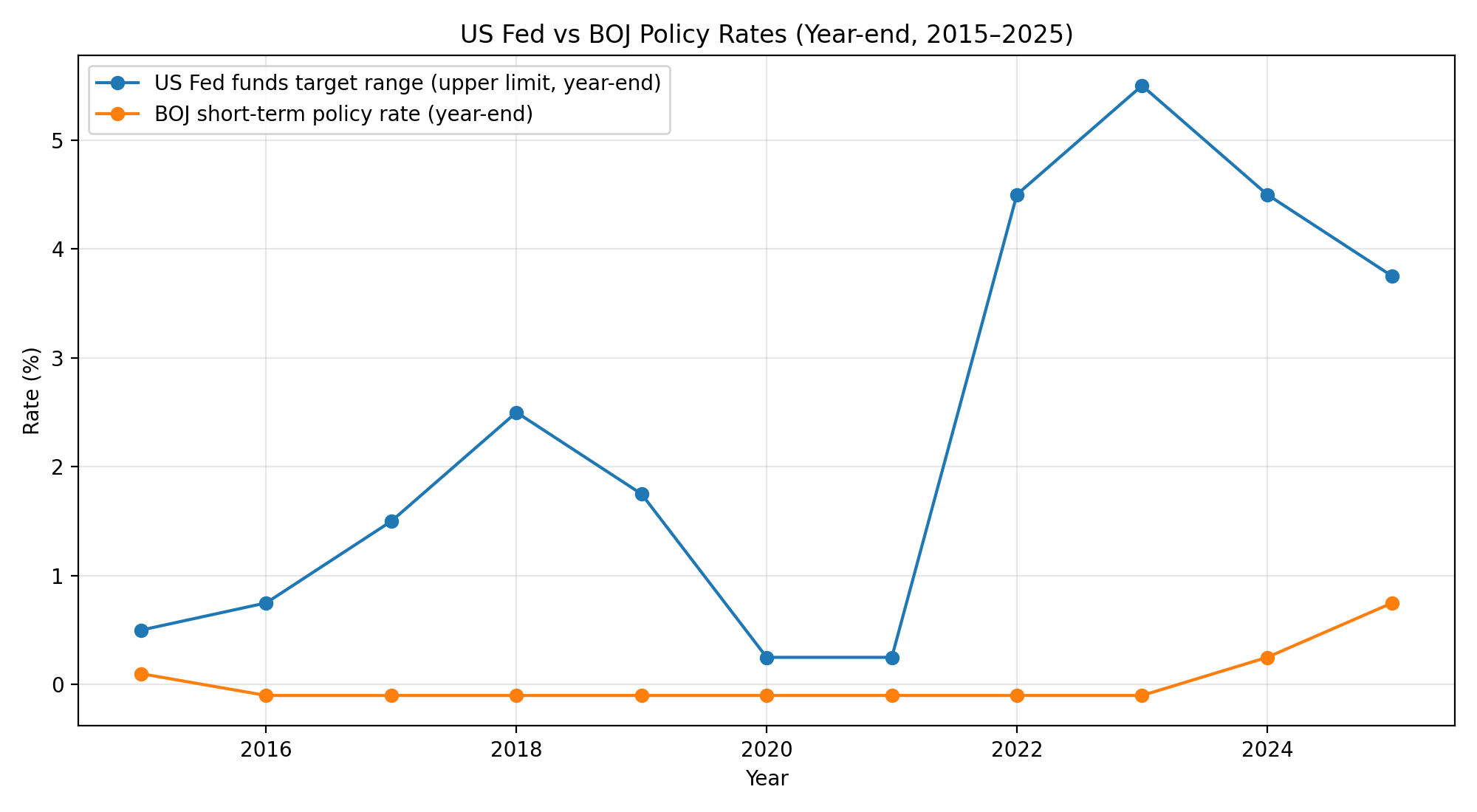
Global markets are at an impasse, amid a rare and consequential policy divergence. On the one hand, the US Federal Reserve has begun cutting interest rates to support slowing growth. In contrast, the Bank of Japan (BOJ) is moving in the opposite direction, raising rates to levels not seen in three decades.

The question facing investors is no longer whether these moves matter, but which one ultimately carries more weight for global liquidity, currencies, and crypto markets.

On December 19, the BOJ raised its policy rate by 25 basis points to 0.75%, the highest level since 1995. This marks another step away from decades of ultra-loose monetary policy. Macro analysts see the move as more than a routine adjustment.

🚨 BREAKING: 🇯🇵 BOJ DELIVERS THE HIKE

Rates raised 25 bps to 0.75%, marking a 30-year high.

Japan’s era of ultra-easy money keeps fading.

This is a major global LIQUIDITY shift… watch yen and risk assets closely. 👀 pic.twitter.com/vfciRH84WJ

— Wise Advice (@wiseadvicesumit) December 19, 2025

Unlike the Federal Reserve’s rate cuts, which are cyclical and designed to smooth economic slowdowns, Japan’s tightening is structural. For nearly 30 years, near-zero Japanese rates anchored one of the world’s most important sources of cheap leverage.

Even modest increases now carry outsized consequences because they disrupt funding strategies deeply embedded across global markets.

The immediate impact was most visible in currency markets. Despite the historic hike, the yen initially weakened as Governor Kazuo Ueda offered limited clarity on the pace of future tightening.

Reuters noted that the currency slipped as the BOJ “stays vague on tightening path.” This highlights how forward guidance, not just the hike itself, remains critical.

Still, analysts argue the real transmission channel lies elsewhere: the yen carry trade, as reported in a recent US Crypto News publication.

As Japanese yields rise and the US–Japan rate gap narrows, borrowing yen to fund higher-yielding positions becomes increasingly expensive.

Fed cut rates, but the message mattered more than the cut. Their dot plot now shows fewer cuts ahead. That flipped expectations from “easy money coming” to “higher for longer.” At the same time, BOJ hike expectations strengthened the yen → yen carry trades started unwinding →… pic.twitter.com/eSaJLWQajg

— Dmytro V7 🇺🇦 (@V7Dmytro) December 16, 2025

This is where the divergence between Tokyo and Washington becomes critical:

  • Fed cuts tend to support markets gradually by easing credit conditions.
  • BOJ tightening, by contrast, forces immediate repositioning as leverage costs rise.

Crypto markets have historically experienced this impact more quickly than traditional assets. Previous BOJ tightening cycles coincided with sharp Bitcoin drawdowns of 20–30% as liquidity tightened and carry trades unwound.

THE BANK OF JAPAN MIGHT BE BITCOIN’S BIGGEST ENEMY

Japan holds the most US debt.
Every time they hike, Bitcoin bleeds:

March 2024: -23%
July 2024: -30%
Jan 2025: -31%

Next hike: Dec 19
Next move: loading…

If the pattern repeats, $70K is in play. pic.twitter.com/R5916R702I

— Merlijn The Trader (@MerlijnTrader) December 14, 2025

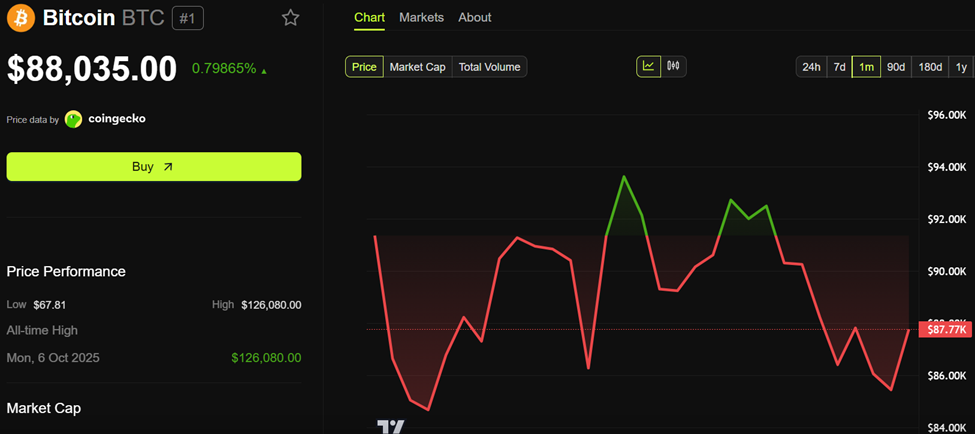
That pattern has made Bitcoin’s recent stability stand out. As of this writing, BTC was trading for $88,035, up by almost 1% in the last 24 hours.

Bitcoin (BTC) Price Performance. Source: BeInCrypto

“History shows every prior tightening triggered 20–30% Bitcoin drops as yen carry trades unwound and liquidity tightened. Yet with the hike fully priced in and BTC holding around $85k–$87k, this could be the dip buyers have been waiting for,” wrote analyst Blueblock.

However, resilience at the top of the crypto market does not eliminate risk elsewhere. Altcoins, which are far more sensitive to liquidity conditions, remain exposed if Japanese tightening continues.

Indeed, BOJ officials have openly signaled willingness to keep tightening if wage growth and inflation remain durable. Analysts at ING and Bloomberg have warned that while further hikes may not be imminent, the direction of travel is clear.

The implication for global markets is stark. Fed cuts may provide broad support over time, but Japan’s retreat from ultra-easy policy strikes directly at the foundation of global leverage.If the BOJ continues down this path, its influence on liquidity, currencies, and crypto could outweigh US easing, at least in the near term.

Chart of the Day

Fed Fund Rates vs BOJ Policy Rate

Byte-Sized Alpha

Here’s a summary of more US crypto news to follow today:

Crypto Equities Pre-Market Overview

CompanyAt the Close of December 18Pre-Market Overview
Strategy (MSTR)$158.24$163.97 (+3.62%)
Coinbase (COIN)$239.20$246.00 (+2.84%)
Galaxy Digital Holdings (GLXY)$22.51$22.95 (+1.95%)
MARA Holdings (MARA)$9.69$9.87 (+1.86%)
Riot Platforms (RIOT)$13.38$13.73 (+2.62%)
Core Scientific (CORZ)$14.56$15.04 (+3.30%)
Crypto equities market open race: Google Finance

The post Japan Tightens, America Eases: Which Central Bank Really Moves Markets Now? | US Crypto News appeared first on BeInCrypto.
  •  

$1 Billion by 2026? Analysts Eye Ownership Coins as Crypto’s Next Governance Game-Changer

Ownership coins are set to transform decentralized governance in 2026, with analysts forecasting that at least one project will surpass a $1 billion market cap.

Unlike current governance tokens, ownership coins combine economic, legal, and governance rights in one asset. This development could solve longstanding issues that have challenged decentralized autonomous organizations (DAOs) for years.

How Ownership Coins Differ From Traditional Governance Tokens

Traditional DAO governance tokens generally offer only voting rights, lacking real economic power or legal accountability within decentralized organizations. This limitation introduces investment risks and weakens the goal of truly decentralized governance.

Ownership coins offer a major shift in design. According to research from Galaxy Digital, these tokens unite economic, legal, and governance rights within a legally enforceable digital asset. This integrated approach aims to fix accountability issues that have affected DAOs since their start.

Galaxy Digital describes this model as creating “digital companies” in which onchain governance holds legal weight rather than relying only on social consensus.

Token holders thus gain meaningful and enforceable control over digital organizations with tangible assets. This innovation creates a path toward legally recognized, self-governed on-chain entities.

MetaDAO was among the first to use this framework, applying futarchy principles, a governance system using prediction markets instead of direct votes.

The project launched on Solana in November 2023, guiding decisions with trading in prediction markets rather than traditional voting methods.

Messari Report Identifies AVICI as Top Performer

The Messari Theses report positions ownership coins as a major investment opportunity for 2026. It spotlights AVICI as the biggest winner over the past year, highlighting the sector’s growth prospects.

We are so back!

The Messari Theses for 2026 is live and available for free.

Jump into the full report now ⬇️ pic.twitter.com/HA3za2QktZ

— Messari (@MessariCrypto) December 18, 2025

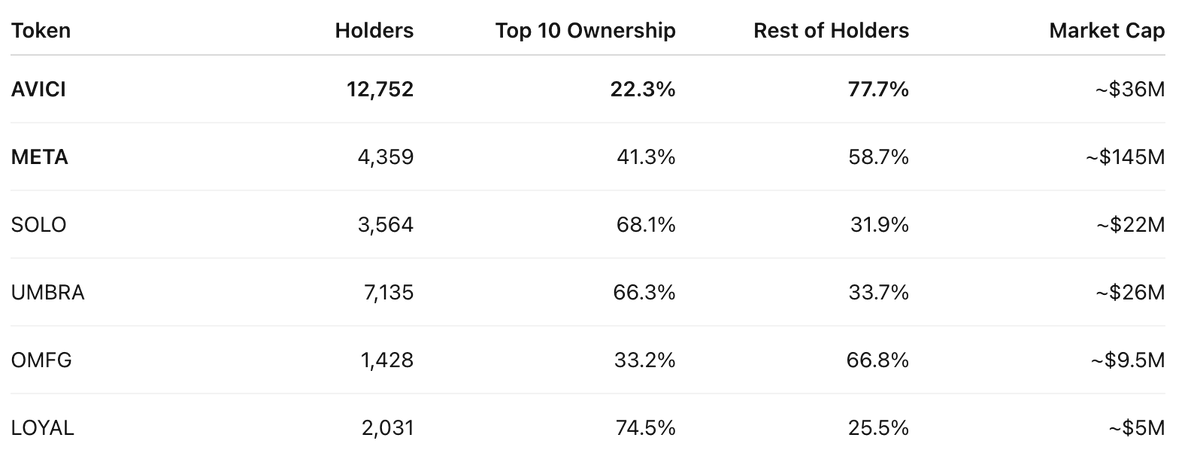
AVICI has shown strong holder retention and broad distribution, despite price volatility. As of mid-December 2025, the token counted 12,752 holders and maintained a low concentration among large holders.

Analyst crypto_iso shared that AVICI began with 4,000 holders and reached 13,300 within 45 days.

During a steep 65% price decline, AVICI lost only 600 holders, just 21% of its initial growth rate. On average, the coin added 200 holders per day at its peak and lost about 43 per day during the downturn. These numbers signal community resilience despite market fluctuation.

Yes for sure.

Here is an interesting datapoint on the holder front.$Avici is still sitting at 12.7k holders which is pretty impressive because if you think about the net number given a drawdown of 65% it's strong. I think it started with around 4k holders or so day 1 and in 45… pic.twitter.com/pTnn9pItjf

— CryptoISO (@crypto_iso) December 18, 2025
Table comparing ownership coin holder metrics
AVICI leads in holder count and distribution among ownership coins (crypto_iso)

Sector Remains Early-Stage, Offering Potential for Growth

The ownership coin market is viewed as a new frontier with substantial upside, as no project yet has exceeded a $1 billion fully diluted valuation. Many investors see this as untapped potential for significant gains.

“My biggest bet for 2026 are ownership coins. They are in early stage right now, not a single coin above 1B mcap. Opportunity right in front of you,” wrote analyst Anglio.

Much of the discourse on social media calls 2026 the “year of the ownership coin.” The blend of authentic innovation and early entry point is attracting interest from retail and institutional investors alike.

Ownership coins may solve barriers that have limited DAO growth and investment. Their legally binding onchain governance systems can let blockchain-native organizations function as true business entities.

This step could impact capital formation, investor protection, and the development of decentralized governance.

Nevertheless, this market is still in its infancy. Most ownership coin projects remain under development, and legal clarity for these hybrid entities varies across regions. Whether this innovation can fulfill the aspiration of self-governing onchain organizations will depend on successful implementation in 2026.

The post $1 Billion by 2026? Analysts Eye Ownership Coins as Crypto’s Next Governance Game-Changer appeared first on BeInCrypto.
  •  

What Does a 100% Accurate Historical Indicator Signal for Bitcoin in December?

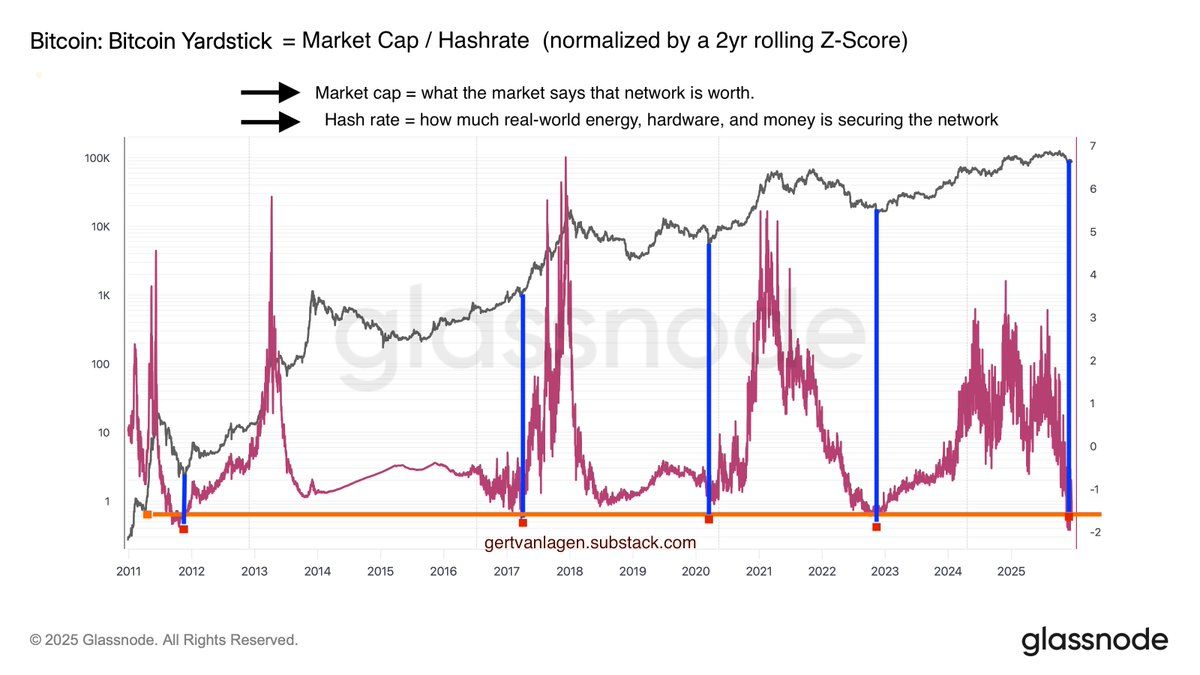
Bitcoin may be approaching one of its most pivotal turning points in years. A leading valuation metric, the BTC Yardstick, currently reads -1.6 standard deviations below its long-term mean, signaling the pioneer crypto’s deepest undervaluation since the 2022 bear market low.

Historically, this level has coincided with major cycle bottoms, including 2011, 2017, 2020, and 2022.

BTC Yardstick Shows Strongest Undervaluation in Years

The Yardstick measures Bitcoin’s market price against the cost and power required to secure its network. This includes mining infrastructure and operational expenditures.

“BTC Yardstick at –1.6σ = Bitcoin is insanely undervalued. Other occurrences: 2022 bear market low, 2020 COVID crash bottom, 2017 pre-blow-off base, 2011 bear market bottom…All occurrences coincided with strong accumulation…Bottom was in as well!” wrote analyst Gert van Lagen in a post.

BTC Yardstick indicator showing historical undervaluation signals
BTC Yardstick indicator at major market bottoms, attributed to Gert van Lagen

Whale Accumulation Hits Highest Levels in Over a Decade

Meanwhile, the undervaluation signal coincides with unprecedented accumulation activity. Over the past 30 days, BTC whales and large holders purchased 269,822 BTC, worth approximately $23.3 billion. According to Glassnode data, this is the largest monthly accumulation since 2011.

BITCOIN'S BIGGEST MONTHLY ACCUMULATION IN 13 YEARS

Whales purchased 269,822 BTC, worth approximately $23.3 billion, in just 30 days.

– Glassnode Data pic.twitter.com/6FPfhFhfh4

— Kashif Raza (@simplykashif) December 18, 2025

“Largest accumulation in 13 years. The 4-year cycle is dead; the Supercycle is here,” wrote crypto analyst Kyle Chasse.  

The bulk of this buying occurred in wallets holding between 100 and 1,000 BTC. This suggests that both high-net-worth individuals and smaller institutions are positioning for a potential market rebound.

Market Sentiment After Bitcoin’s Minor Correction As Frustration Breeds Opportunity

Despite the record accumulation and undervaluation, Bitcoin’s price has faced downward pressure this year. According to Bloomberg ETF analyst Eric Balchunas, recent losses are modest relative to prior gains.

I get that this year is a drag but consider Bitcoin was up 468%(!!) in the two years prior to this year. That's 138% ann, 8x US stocks. That is sooo much excess return beyond normalcy (even for btc, thank you ETFs!). All that happened this year is you gave back a tiny bit of the… https://t.co/oQ4EuUt64A

— Eric Balchunas (@EricBalchunas) December 18, 2025

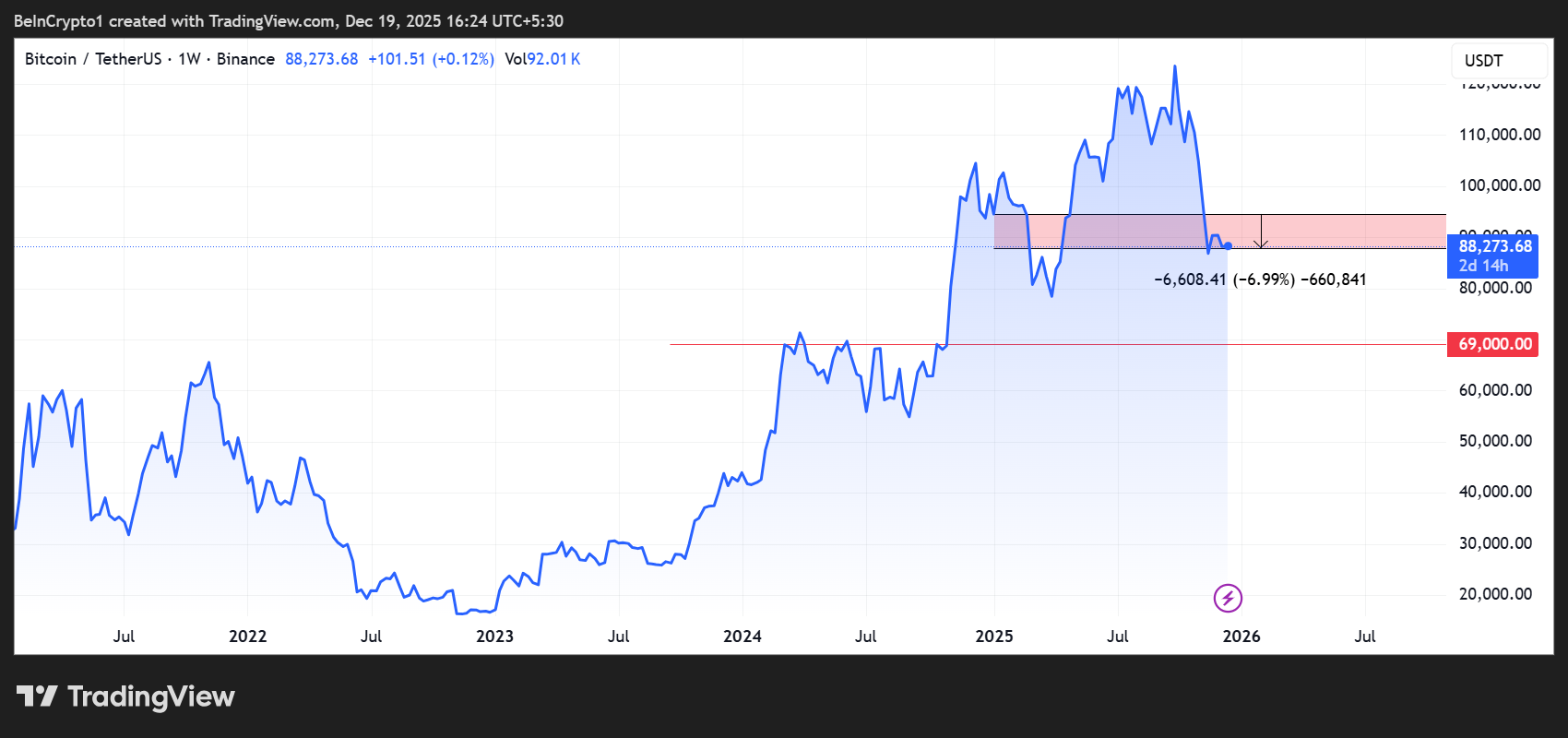
The launch of spot Bitcoin ETFs in early 2024 contributed to previous surges, driving the asset to its then-record highs near $69,000 in March 2024.

Overall, Bitcoin returned 155.42% in 2023 and 121.05% in 2024 before experiencing an 7% decline year-to-date. This suggests the current dip may be a natural correction after exceptional gains.

Bitcoin (BTC) Price Performance
Bitcoin (BTC) Price Performance. Source: TradingView

Analysts note that market rallies often begin not when hope is high, but when investors are weary.

“We are not scared anymore, we are tired. Tired of waiting. Tired of believing. But listen, market rallies don’t start when hope is high; it’s when people are tired, frustrated, and ready to give up,” wrote analyst Ash Crypto.

The convergence of historically low valuation, record whale accumulation, and declining leverage suggests that Bitcoin may be nearing another cyclical inflection point.

While timing remains uncertain, these indicators highlight a unique window of potential opportunity for long-term investors.

The post What Does a 100% Accurate Historical Indicator Signal for Bitcoin in December? appeared first on BeInCrypto.

  •  

ADA Is Down 70% in 2025 —But 2 New Sources of Demand Are Emerging For Cardano

Cardano (ADA) price has dropped 70% in 2025, erasing all gains from last year. Despite remaining a top-10 altcoin by market capitalization, ADA has increasingly frustrated many holders.

However, late December has brought signs that could support a potential ADA recovery. The most notable factor is the rising demand for Midnight (NIGHT).

How Could Midnight (NIGHT) Trading Demand Impact ADA?

First, the surge in NIGHT trading volume on Cardano-based decentralized exchanges (DEXs) stands out as a key driver.

Midnight is a blockchain network developed by Input Output Global (IOG), the company behind Cardano. The network prioritizes data privacy by utilizing zero-knowledge proof technology.

Cardanians, a company running Cardano stake pools, reported that NIGHT trading on Cardano DEXs has created a new wave of on-chain activity.

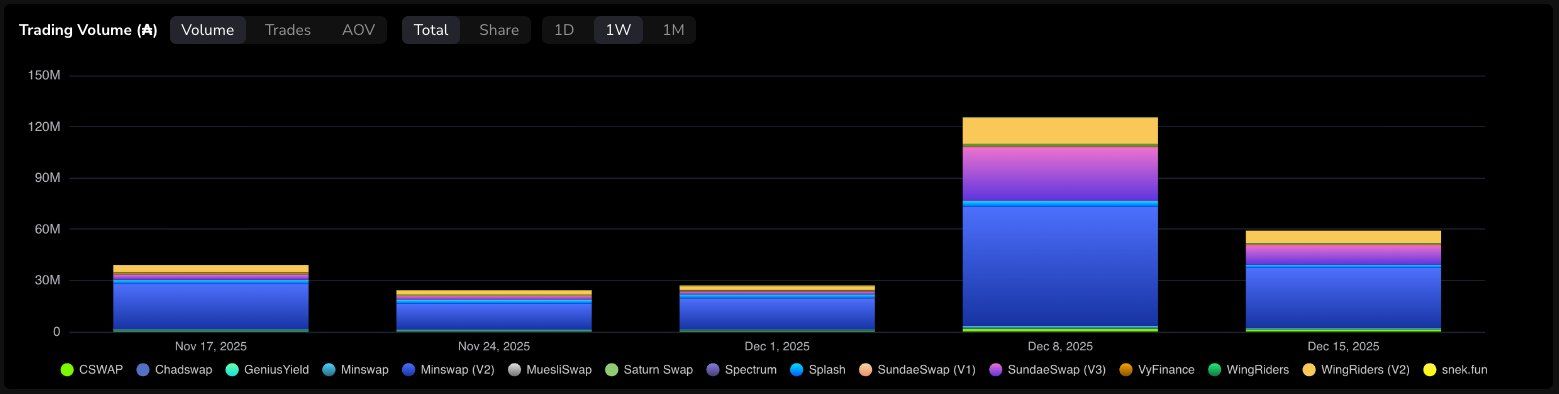
Cardano DEXs Volume. Source: Cardanians

Data shows trading volume on Cardano DEXs reached 125 million ADA last week and 59 million ADA so far this week.

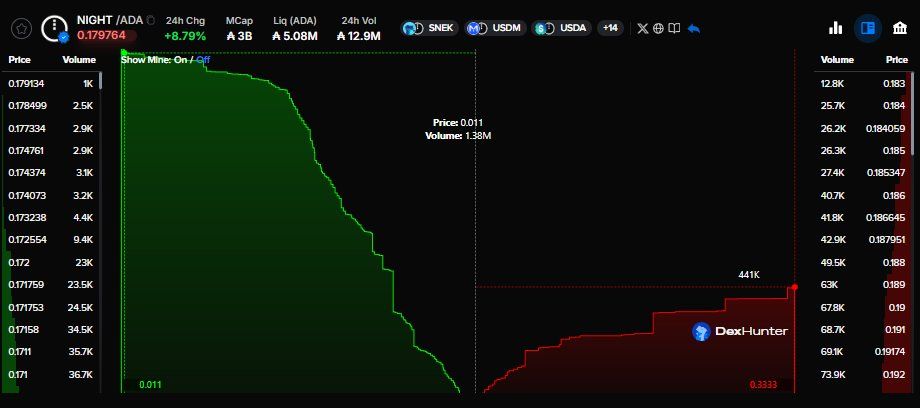
DexHunter, a Cardano DEX aggregator, reported that the NIGHT order book reflects stronger demand to buy NIGHT using ADA than to sell. Specifically, buy orders total 1.38 million ADA, while sell orders stand at only 480,000 ADA.

Midnight (NIGHT) Order Book. Source: DexHunter

“NIGHT is one of the most anticipated projects on Cardano today, and possibly across all ecosystems,” DexHunter stated.

These signals reflect growing interest in Midnight and increase demand for ADA as the base asset for fees, liquidity, and swaps.

How long the interest in Midnight will last remains uncertain. For now, it is creating demand momentum that could combine with additional factors to support an ADA recovery.

Cardano as a Preferred Asset in Crypto Index ETPs While Holders Remain Loyal

Second, ADA’s unique position in crypto index investment products, known as Crypto Index ETPs, also plays an important role.

According to an analysis by expert James Seyffart, ADA is the only asset included in all six ETP products he reviewed.

Notable and surprising to me — The only asset that made its way into all 6 of the products i looked at was Cardano ( $ADA). pic.twitter.com/Sf71ca3xKe

— James Seyffart (@JSeyff) December 17, 2025

James Seyffart expects more Crypto Index ETPs to launch in 2026. These exchange-traded products hold diversified baskets of crypto assets.

Cardano’s inclusion in most ETPs suggests that financial institutions view ADA as stable with strong long-term potential. This perception places ADA ahead of many other altcoins.

Such positioning encourages institutional capital inflows into ADA. It also creates positive buying pressure and attracts retail investors.

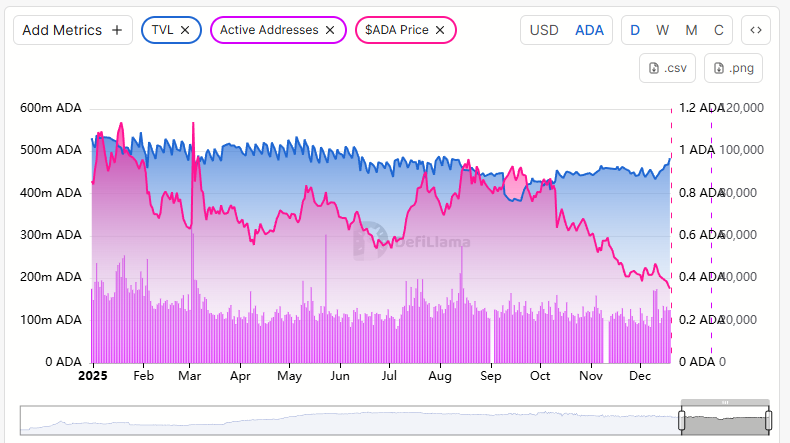
Additionally, DeFiLlama data indicate that Cardano’s total value locked (TVL), measured in ADA, has remained relatively stable at around 500 million, despite market volatility. This level indicates that users are not withdrawing capital and continue to hold positions.

Cardano's Total Value Locked. Source: DeFiLlama
Cardano’s Total Value Locked. Source: DeFiLlama

The number of daily active addresses has stayed stable at around 25,000 since the beginning of the year.

Falling prices combined with sustained on-chain activity suggest that investors are not exiting the ecosystem. This behavior reflects long-term confidence among holders and could become a catalyst for ADA’s recovery.

The post ADA Is Down 70% in 2025 —But 2 New Sources of Demand Are Emerging For Cardano appeared first on BeInCrypto.
  •  

Kdenlive 25.12 Video Editor Adds New Docking System, Welcome Screen, and More

Kdenlive 25.12

Kdenlive 25.12 open-source video editor is now available for download with a new and flexible docking system, a new Welcome Screen, and more. Here's what's new!

The post Kdenlive 25.12 Video Editor Adds New Docking System, Welcome Screen, and More appeared first on 9to5Linux - do not reproduce this article without permission. This RSS feed is intended for readers, not scrapers.

  •  

Fwupd 2.0.19 Linux Firmware Updater Supports Lenovo Sapphire Folio Keyboard

fwupd

Fwupd 2.0.19 Linux firmware updater is now available for download with support for the Lenovo Sapphire Folio keyboard and other changes. Here's what's new!

The post Fwupd 2.0.19 Linux Firmware Updater Supports Lenovo Sapphire Folio Keyboard appeared first on 9to5Linux - do not reproduce this article without permission. This RSS feed is intended for readers, not scrapers.

  •  

Firefox Will Ship with an “AI Kill Switch” to Completely Disable all AI Features

Firefox AI Kill Switch

Mozilla is working on an AI kill switch for the Firefox open-source web browser to let users completely disable all AI features.

The post Firefox Will Ship with an “AI Kill Switch” to Completely Disable all AI Features appeared first on 9to5Linux - do not reproduce this article without permission. This RSS feed is intended for readers, not scrapers.

  •  

OpenZFS 2.4 Released with Linux 6.18 LTS Support, Quotas, Uncached IO, and More

OpenZFS 2.4

OpenZFS 2.4 file system and volume manager is now available for download with support for Linux kernel 6.18 LTS and several new features. Here’s what’s new!

The post OpenZFS 2.4 Released with Linux 6.18 LTS Support, Quotas, Uncached IO, and More appeared first on 9to5Linux - do not reproduce this article without permission. This RSS feed is intended for readers, not scrapers.

  •  

NVIDIA 590 Linux Graphics Driver Released with More Wayland Improvements

NVIDIA 535.54.03

NVIDIA 590.48.01 graphics driver is now available for download for Linux, FreeBSD, and Solaris systems with various bug fixes. Here's what's changed!

The post NVIDIA 590 Linux Graphics Driver Released with More Wayland Improvements appeared first on 9to5Linux - do not reproduce this article without permission. This RSS feed is intended for readers, not scrapers.

  •  

Linux Mint 22.3 “Zena” Beta Is Available for Download with Cinnamon 6.6

Linux Mint 22.3 Beta

Linux Mint 22.3 beta is now available for download with the Cinnamon 6.6, Xfce 4.20, and MATE 1.26 desktops, based on Ubuntu 24.04.3 LTS.

The post Linux Mint 22.3 “Zena” Beta Is Available for Download with Cinnamon 6.6 appeared first on 9to5Linux - do not reproduce this article without permission. This RSS feed is intended for readers, not scrapers.

  •  

Linux Kernel 6.17 Reaches End of Life, It’s Time to Upgrade to Linux Kernel 6.18 LTS

Linux Kernel 6.17 End

Linux kernel 6.17 reached end of life and all users are now recommended to upgrade their systems to the latest Linux 6.18 kernel series as soon as possible.

The post Linux Kernel 6.17 Reaches End of Life, It’s Time to Upgrade to Linux Kernel 6.18 LTS appeared first on 9to5Linux - do not reproduce this article without permission. This RSS feed is intended for readers, not scrapers.

  •  

LibreOffice 25.8.4 Is Now Available for Download with More Than 70 Bug Fixes

LibreOffice 25.8

LibreOffice 25.8.4 is now available for download as the fourth maintenance update to the latest LibreOffice 25.8 office suite series with more than 70 bug fixes.

The post LibreOffice 25.8.4 Is Now Available for Download with More Than 70 Bug Fixes appeared first on 9to5Linux - do not reproduce this article without permission. This RSS feed is intended for readers, not scrapers.

  •  

Xiaomi Home Screen 11 launches with 11-inch 1200P display and AI

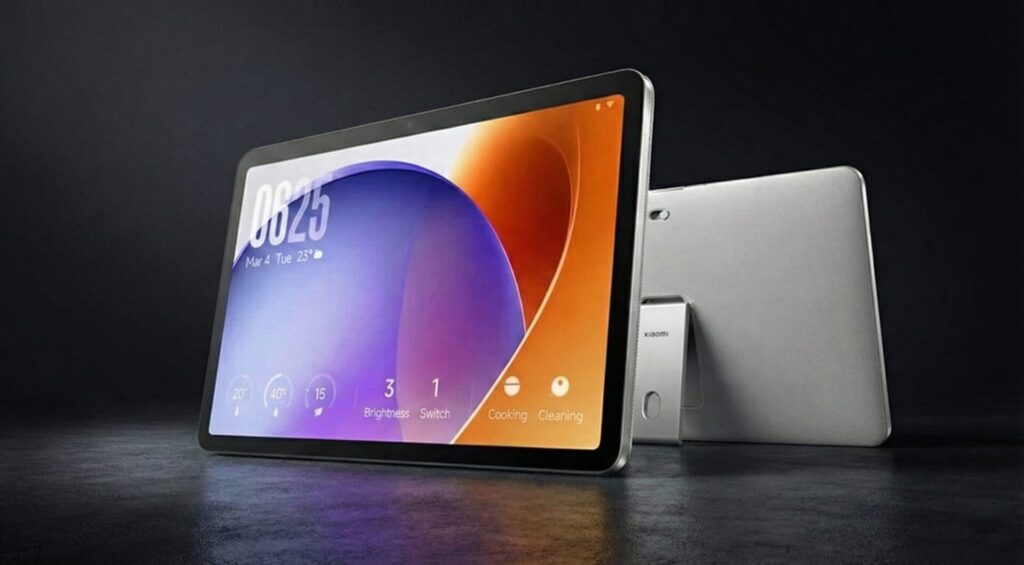
Xiaomi has now officially listed the Xiaomi Home Screen 11 on JD.com, claiming it to be the most capable smart home display from the company thus far. The device is designed to act as a central control hub for Xiaomi smart home products and is expected to make an appearance alongside upcoming flagship devices like the Xiaomi 17 Ultra. As part of Xiaomi’s expanding smart ecosystem, the Home Screen 11 places a massive emphasis on display quality, family-oriented features, and deeper integration with Xiaomi HyperConnect across supported devices. For users who have been following Xiaomi’s smart home strategy, this could be an important launch in terms of home control displays.

Xiaomi Home Screen 11 2

Design and Display Features

The design of the frame is made of metal; the accent is made on durability and a clean minimalistic look. From the front, there is an 11-inch LCD panel with the 1920×1200 (1200P) resolution for clear visual display-both at information panels and at playing multimedia content.

The screen supports up to 400 nits of brightness and a 1500:1 contrast ratio, which is right for indoor environments such as living rooms, kitchens, or home offices. Xiaomi has optimized the interface for large-screen viewing, hence making this device able to serve as a family dashboard, digital photo frame, and smart home control center all at once.

Xiaomi Home Screen 11 1

Smart Functions and Integration with XiaoAI

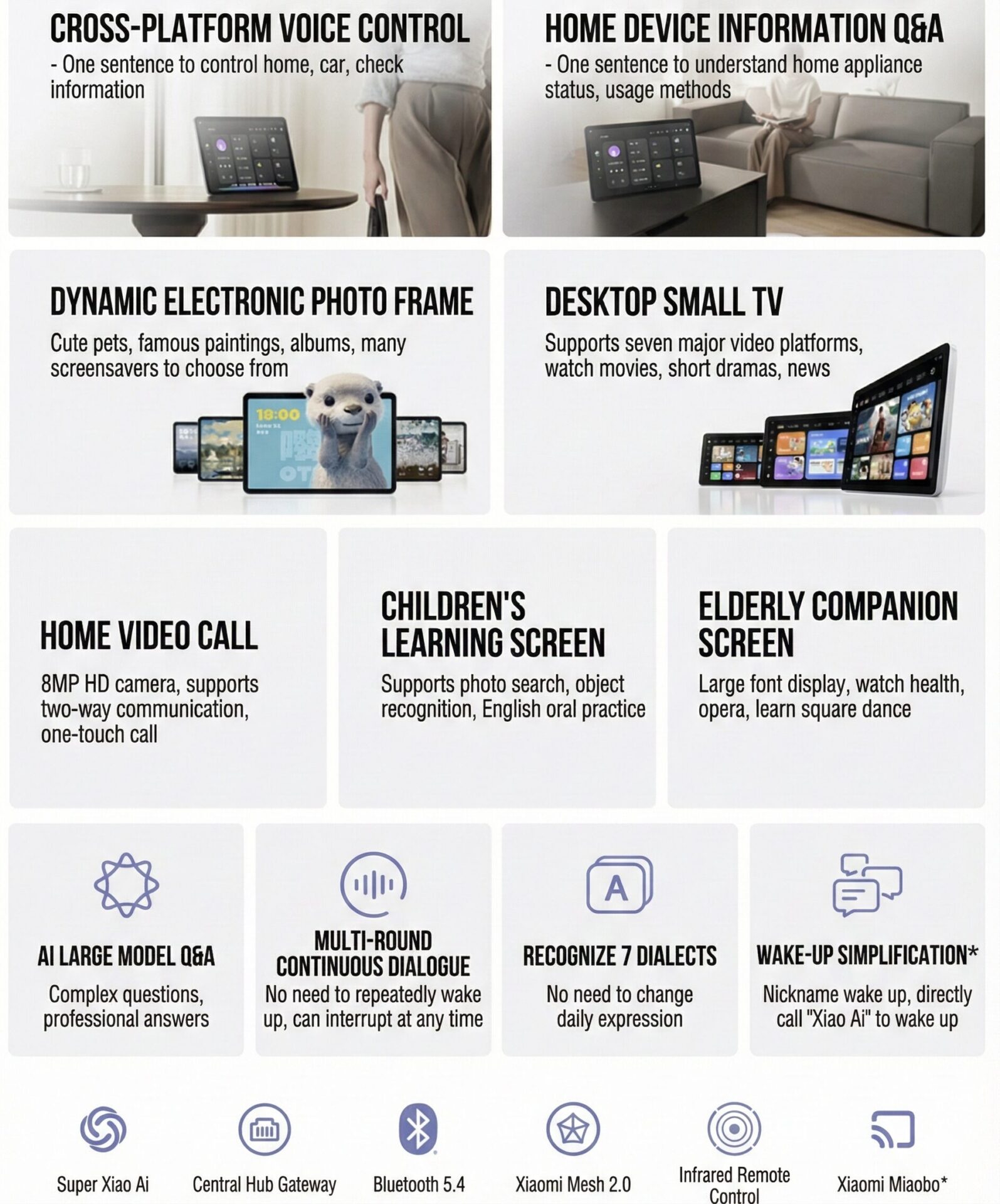
The Xiaomi Home Screen 11 comes right out of the box with several built-in content modes, including a family photo album, displays of world-famous paintings, dynamic wallpapers, and real-time family information panels. These features are all enhancements designed to bring important information into view at a glance.

An 8MP front-facing camera enables two-way video calls through supported apps such as WeChat to help the family keep up with one another. Voice interaction is handled by XiaoAI, Xiaomi’s AI assistant. It should be mentioned, though, that XiaoAI functions are only available in China due to the region-lock service not supporting global markets currently.

Hardware Specifications & Audio System

The device shall be powered by an octa-core processor having 6GB of RAM and 32GB of internal storage. This configuration is aimed at ensuring smooth daily operation, including multitasking between smart home controls, media playback, and video calls.

Xiaomi Home Screen 11 3

It houses a quad-speaker system to handle audio output from both high and mid-to-low frequencies. With this setup, the Home Screen 11 becomes capable of functioning both as a control panel and as a capable media playback device for music, videos, and voice responses.

Availability

The Xiaomi Home Screen 11 is currently released only in China, and it is listed on JD.com. Pricing details are listed locally, while there’s no announcement of a global release at this stage.

Source

  •