Reading view

Mengapa Perak Bisa Mengungguli Emas dan Bitcoin pada 2026

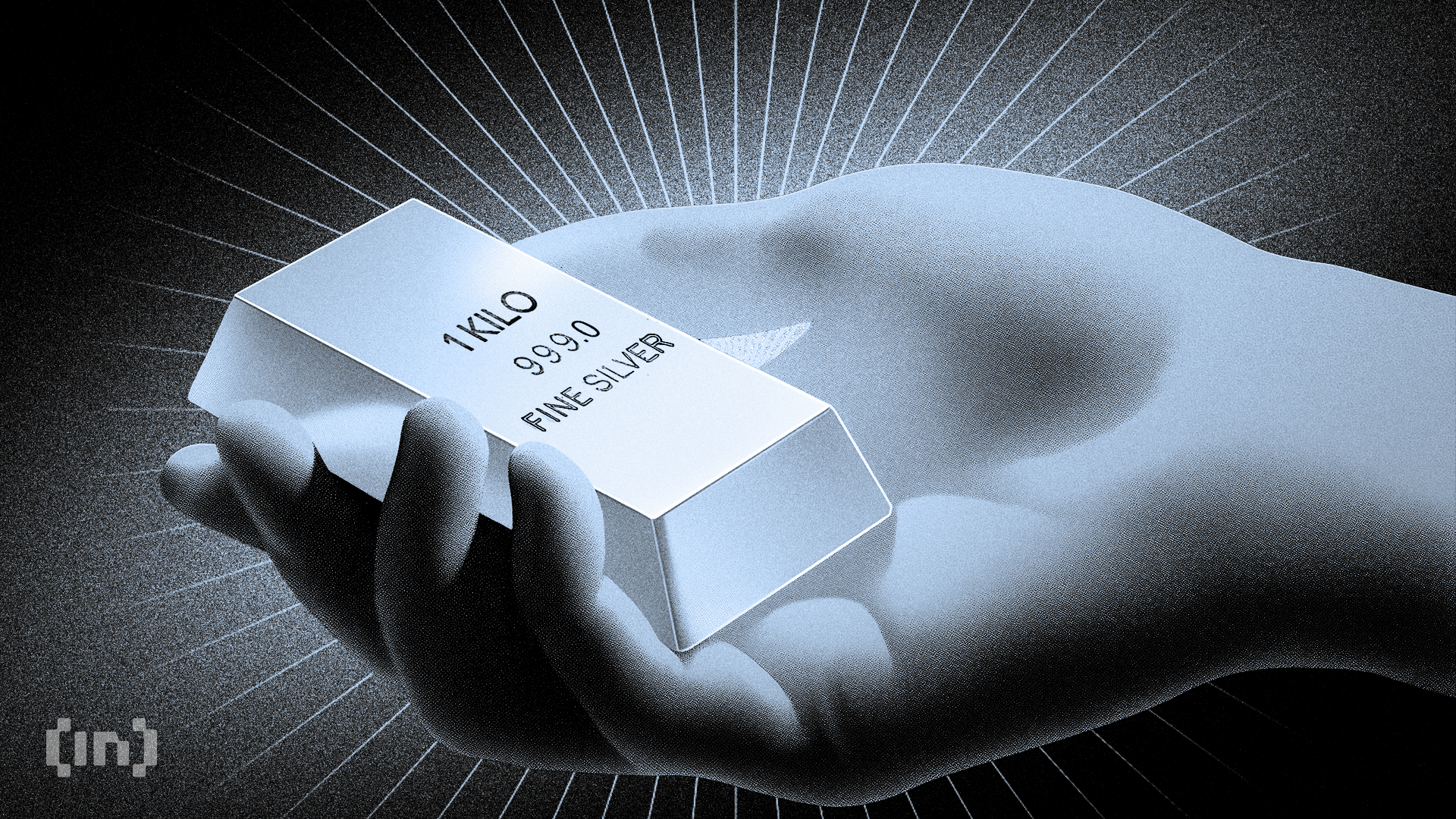
Perak menjadi salah satu aset utama dengan performa terkuat di tahun 2025, bahkan jauh mengungguli emas dan Bitcoin.

Reli perak ini bukan hanya didorong spekulasi semata. Kondisi ini justru mencerminkan perpaduan langka pergeseran ekonomi makro, permintaan industri, dan tekanan geopolitik, yang bisa terus berlangsung hingga 2026.

Performa Silver di 2025 dalam Konteks

Menjelang akhir Desember 2025, harga perak diperdagangkan mendekati US$71 per ons, naik lebih dari 120% sepanjang tahun. Harga emas juga naik sekitar 60% di periode yang sama, sedangkan Bitcoin justru ditutup sedikit turun setelah sempat bergerak volatil dan mencapai puncak pada Oktober.

Harga perak memulai 2025 di kisaran US$29 per ons lalu terus naik stabil sepanjang tahun. Lonjakan makin kencang pada paruh kedua tahun seiring defisit pasokan melebar dan permintaan industri naik di luar perkiraan.
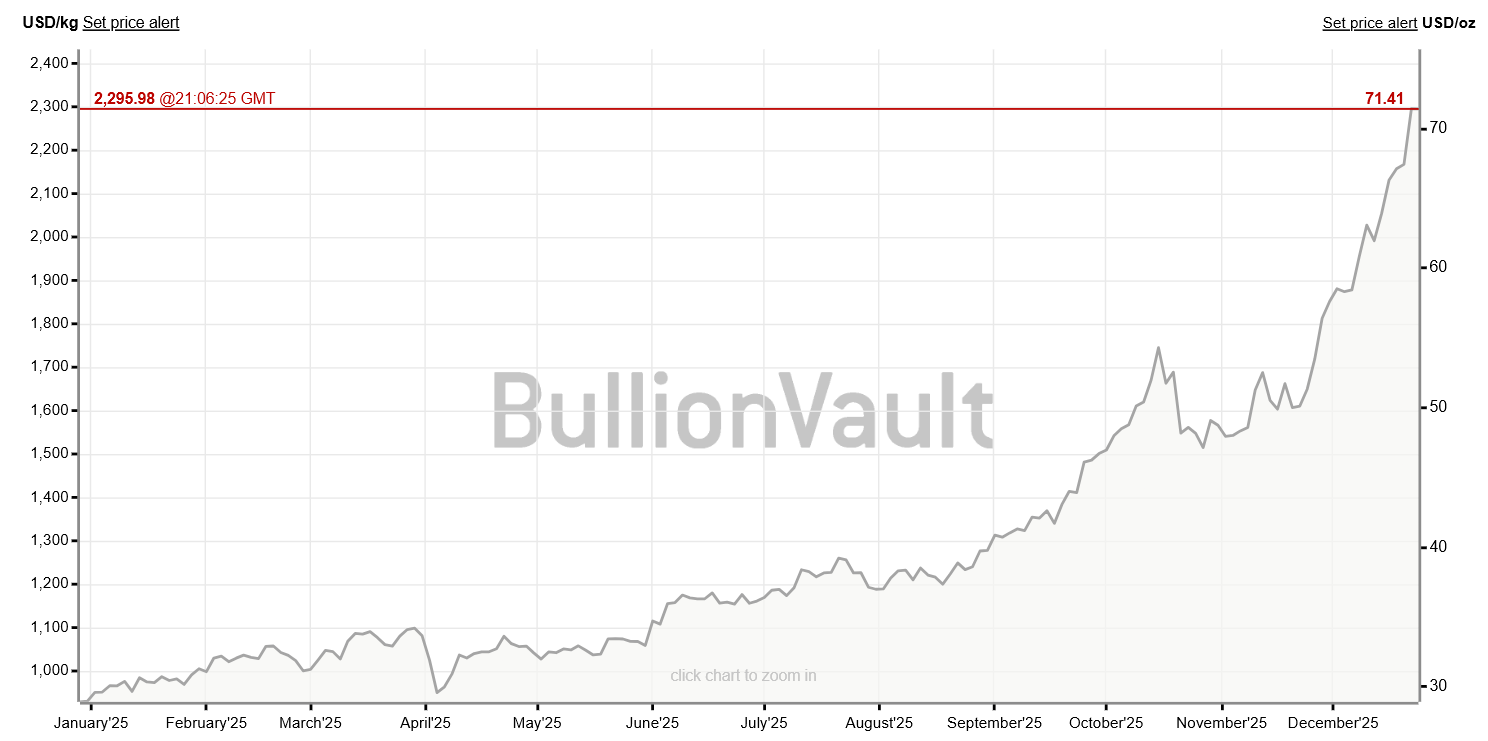
Grafik Harga Perak di 2025 | Sumber: BullionVault

Emas juga menguat signifikan, bergerak dari kisaran US$2.800 ke atas US$4.400 per ons, didukung oleh turunnya yield riil dan permintaan dari bank sentral.

Meskipun begitu, performa perak jauh melampaui emas, sesuai dengan kecenderungan historisnya yang memang sering menguat lebih tinggi di setiap siklus komoditas logam mulia.
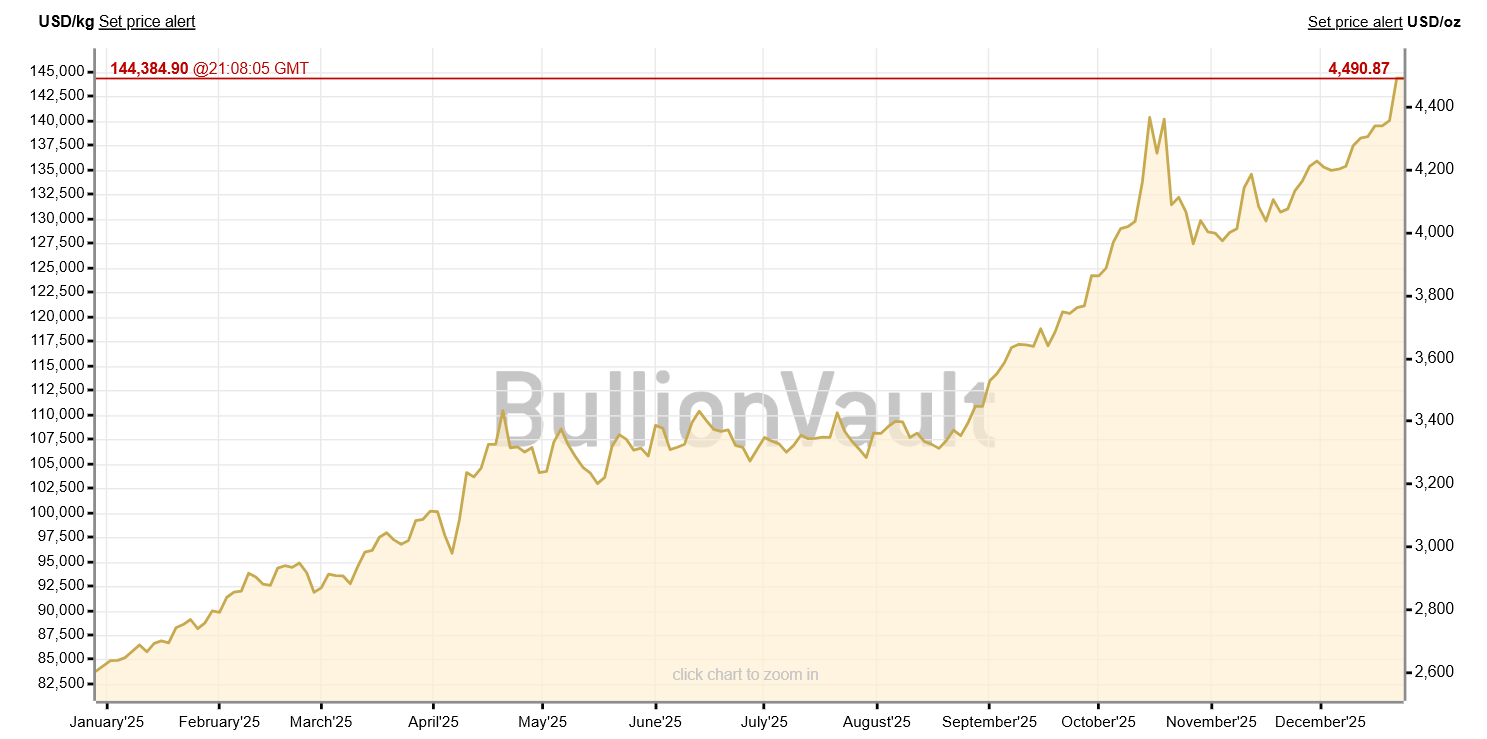
Grafik Harga Emas di 2025 | Sumber: BullionVault

Bitcoin justru memilih jalur berbeda. Harga Bitcoin melonjak ke rekor mendekati US$126.000 pada awal Oktober, tapi kemudian berbalik turun tajam hingga akhir Desember hanya berada di kisaran US$87.000.

Berbeda dengan logam mulia, Bitcoin gagal menjadi aset lindung yang diincar saat terjadi aksi risk-off di akhir tahun.

Kondisi ekonomi makro mendukung aset keras

Ada beberapa faktor ekonomi makro yang menopang perak sepanjang tahun 2025. Yang paling utama, kebijakan moneter global mulai melonggar. The Fed AS telah menurunkan suku bunga berkali-kali hingga akhir tahun, sehingga yield riil turun dan dollar melemah.

Bersamaan itu, kekhawatiran soal inflasi juga belum terselesaikan. Kombinasi seperti ini secara historis memang menguntungkan aset nyata, khususnya yang memiliki nilai moneter sekaligus industri.

Berbeda dengan emas, perak dapat manfaat langsung dari ekspansi ekonomi. Di tahun 2025, peran ganda ini jadi sangat menentukan.

This is a 50-Yr chart of Silver futures
The red arrow marks my 1st trade in Silver
The $50 level rejected Silver in 1981 and 2011
The price has now sliced above $50
Corrections should find support in the low $50s
Upside targets exist at $87 and eventually $200-plus$SI_F pic.twitter.com/sz076mdeP1

— Peter Brandt (@PeterLBrandt) December 13, 2025

Permintaan Industri Jadi Penggerak Utama

Reli perak makin kuat karena didorong oleh permintaan fisik, bukan arus investasi belaka. Penggunaan industri telah menyumbang sekitar setengah dari total konsumsi perak, bahkan porsinya kini terus tumbuh.

Transisi energi punya peran besar. Sektor tenaga surya tetap menjadi sumber permintaan baru terbesar, dan elektrifikasi di sektor transportasi maupun infrastruktur justru menambah beban pada pasokan perak yang sudah ketat.

Pasar perak global membukukan defisit tahunan kelima secara beruntun pada tahun 2025. Pasokan sulit bertambah karena sebagian besar produksi perak hanya sebagai produk sampingan pertambangan logam dasar, bukan dari proyek khusus perak.

Most of silver demand is industrial and those users don't care if the price is 5x, because silver is only a small part of their products.

Industrial demand (mainly solar) continues to rise.

Also retail demand in Asia is now INCREASING along with rising prices.

— GoldSilver HQ (@GoldSilverHQ) December 23, 2025

Kendaraan Listrik Tambah Permintaan Struktural

Mobil listrik telah meningkatkan kebutuhan perak secara signifikan di tahun 2025. Setiap mobil listrik membutuhkan 25 hingga 50 gram perak, atau sekitar 70% lebih banyak dibanding kendaraan bermesin pembakaran.

Dengan penjualan mobil listrik global naik dua digit setiap tahun, permintaan perak untuk otomotif mencapai puluhan juta ons per tahun.

Infrastruktur pengisian daya menambah tren ini. Pengisi daya cepat berdaya tinggi memerlukan kilogram perak untuk komponen elektronik dan konektornya.

Berbeda dengan permintaan investasi yang cenderung naik-turun mengikuti siklus, konsumsi perak untuk mobil listrik bersifat struktural. Pertumbuhan produksi pun langsung berdampak pada peningkatan penyerapan fisik yang berkelanjutan.

Silver $71 today.
Just the beginning.
I completed a detailed analysis of Samsung's new battery technology. Production begins in 2027. (Confirmed by Samsung.) Approximately 1 kg of silver will be needed per EV. And Samsung's silver-carbon batteries will also be widely used across…

— HealthRanger (@HealthRanger) December 23, 2025

Pengeluaran pertahanan diam-diam memperketat pasokan

Permintaan dari sektor militer menjadi faktor yang kurang terlihat, tapi peranannya makin penting. Persenjataan modern sangat bergantung pada perak untuk sistem elektronik panduan, radar, komunikasi aman, hingga drone.

Satu rudal jelajah saja bisa mengandung ratusan ons perak yang langsung hancur saat digunakan. Permintaan dari sektor pertahanan pun jadi tidak bisa didaur ulang.

Pengeluaran militer dunia mencetak rekor tertinggi di 2024 dan masih terus naik selama 2025 di tengah perang di Ukraina dan Timur Tengah.

Eropa, Amerika Serikat, dan Asia semuanya meningkatkan pembelian amunisi canggih, sekaligus secara diam-diam menyerap perak fisik.

Guncangan Geopolitik Menguatkan Tren

Ketegangan geopolitik semakin memperkuat posisi perak. Konflik yang berkepanjangan mendorong penimbunan persediaan pertahanan, sedangkan fragmentasi perdagangan menimbulkan kekhawatiran tentang keamanan pasokan bahan-bahan penting.

Berbeda dengan emas, perak berada di persimpangan kebijakan keamanan nasional dan industri. Beberapa pemerintah mulai mengklasifikasikan perak sebagai material strategis, yang mencerminkan perannya dalam teknologi sipil dan militer.

Dinamika ini menciptakan umpan balik langka: risiko geopolitik menaikkan permintaan investasi safe-haven sekaligus konsumsi industri yang nyata.

The rise in the price of gold and silver from 2001 through 2008 was a sign of a major Fed policy error and a harbinger of the 2008 financial crisis. The current rally that began in 2024 is signaling a bigger policy error that will have even more profound consequences for the U.S.

— Peter Schiff (@PeterSchiff) December 22, 2025

Mengapa 2026 bisa memperpanjang masa outperformance

Ke depannya, sebagian besar faktor yang mendorong harga perak di 2025 masih tetap ada. Adopsi kendaraan listrik terus meningkat. Ekspansi jaringan listrik dan investasi di energi terbarukan masih menjadi prioritas pemerintah. Anggaran pertahanan pun belum menunjukkan tanda-tanda penurunan.

Pada saat yang sama, pasokan perak tetap terbatas. Proyek pertambangan baru memerlukan waktu lama dan daur ulang tidak mampu mengimbangi kehilangan industri yang terus meningkat dari pemakaian militer.

Emas mungkin masih akan berkinerja baik jika imbal hasil riil tetap rendah. Bitcoin bisa pulih jika selera risiko membaik. Tapi tidak ada yang menggabungkan perlindungan moneter sekaligus paparan langsung pada tren elektrifikasi global dan pengeluaran pertahanan seperti perak.

Kombinasi inilah yang membuat banyak analis melihat perak sebagai aset yang sangat menarik untuk 2026.

Looks like silver is going to be a shocker for most. While a significant group of investors is still in denial and do not realize that we are in a new realities constantly waiting for a pullback, silver keeps pushing higher and higher. My immediate target is $75 – 80. Let's wait… pic.twitter.com/ni35W0lIwd

— Rashad Hajiyev (@hajiyev_rashad) December 22, 2025

Reli perak di tahun 2025 bukan sekadar lonjakan spekulatif sesaat. Hal ini mencerminkan perubahan struktural mendalam dalam cara ekonomi global menggunakan logam ini.

Jika tren saat ini terus berlanjut, peran ganda perak sebagai lindung nilai moneter dan kebutuhan industri bisa saja membuatnya mengungguli baik emas maupun Bitcoin lagi di 2026.
  •  

Rusia Rencanakan Regulasi Baru Aset Kripto untuk 2026

Bank Sentral Rusia memperkenalkan kerangka konseptual yang telah lama dinantikan untuk mengatur perdagangan aset kripto pada 23 Desember, menandai pergeseran besar dari pembatasan ad-hoc menuju pasar yang terstruktur dan berlisensi.

Dalam usulan tersebut, aset kripto dan stablecoin akan diakui secara legal sebagai nilai mata uang yang bisa dibeli dan dijual. Tapi, aset ini tetap dilarang sebagai alat pembayaran di dalam Rusia.

Apa yang Diperkenalkan Kerangka Baru Ini

Bank sentral sudah menyerahkan usulan legislatifnya kepada Pemerintah Rusia untuk ditinjau.

Pengumuman ini menjadi upaya terbesar sejauh ini untuk membawa aktivitas kripto di bawah pengawasan keuangan yang resmi, sambil tetap menjaga kontrol ketat terhadap risiko ritel dan arus modal.

Usulan ini menetapkan model investor dua tingkat, yaitu membedakan antara peserta ritel dan profesional.

Investor yang belum memenuhi syarat hanya diperbolehkan membeli aset kripto paling likuid saja, yang akan didefinisikan di aturan mendatang.

Akses akan mewajibkan tes pengetahuan risiko dan pembelian akan dibatasi maksimal 300.000 rubel per tahun.

Investor yang telah memenuhi syarat akan menghadapi lebih sedikit pembatasan. Mereka diperbolehkan membeli aset kripto apa saja kecuali token anonim yang smart contract-nya menyembunyikan data transaksi.

Batasan volume pembelian tidak berlaku, walaupun tes pengetahuan risiko tetap wajib dilakukan.

Bank sentral menekankan bahwa aset kripto tetap memiliki risiko yang tinggi, karena volatilitas, tidak ada dukungan dari negara, dan paparan terhadap sanksi.

Russia is leading Europe in crypto use, over $376B moved in a year, says Chainalysis.

While others talk about regulation, Russians are actually using crypto for real needs; trading, saving, and moving money fast.

Quiet adoption, big numbers. pic.twitter.com/2XcmYx8ioB

— Tom Tucker (@WhatzTheTicker) October 16, 2025

Perbedaan Hal Ini dengan Sikap Rusia Saat Ini

Sampai saat ini, kebijakan kripto Rusia masih terpecah-pecah. Kepemilikan dan perdagangan secara praktik dibolehkan, tapi tidak ada jalur pengaturan yang jelas.

Akses ritel berada di area abu-abu, perantara menghadapi ketidakpastian, dan penegakan hukum bergantung pada pembatasan informal daripada aturan pasar yang resmi.

Konsep baru ini meresmikan apa yang sebelumnya hanya ditoleransi, sambil sangat membatasi bagaimana investor ritel dapat terlibat.

Konsep ini juga memastikan bahwa Rusia akan mengatur aktivitas kripto menggunakan infrastruktur keuangan yang sudah ada, sehingga exchange, broker, dan manajer trust bisa tetap beroperasi memakai lisensi yang saat ini mereka miliki. Akan ada persyaratan tambahan untuk deposit dan layanan exchange yang khusus untuk kripto.

Kerangka aturan ini juga memperjelas regulasi lintas batas negara. Warga Rusia diperbolehkan membeli aset kripto di luar negeri menggunakan akun asing, dan transfer kripto ke luar negeri lewat perantara asal Rusia asalkan mereka memberitahu otoritas pajak.

Timeline dan Penegakan

Bank sentral menargetkan untuk merampungkan dasar hukum ini sebelum 1 Juli 2026. Mulai 1 Juli 2027, perantaraan kripto ilegal akan mendapat sanksi yang setara dengan hukuman atas aktivitas perbankan ilegal.

Pendekatan bertahap ini memberi waktu bagi pelaku pasar untuk menyesuaikan diri dengan aturan lisensi, pengungkapan, dan kepatuhan.

Bagaimana pendekatan Rusia dibandingkan secara global

AreaRusia (Konsep BoR)Uni Eropa (MiCA)Amerika Serikat
Status hukumAset investasi (“nilai mata uang”), bukan alat pembayaranPasar kripto yang diaturPemantauan federal & negara bagian terpecah
Akses ritelDibolehkan dengan tes dan batasan ketatDibolehkan melalui sistem pengungkapanLuas, tanpa batas federal
PerantaraLisensi yang ada + aturan khusus kriptoLisensi CASP wajibKerangka kerja lintas lembaga
StablecoinBisa diperdagangkan, dilarang untuk pembayaranSangat diaturHukum federal stablecoin sudah berlaku
Penegakan hukumBertahap, mulai 2027Sudah aktifPenegakan terus berjalan oleh lembaga

Secara umum, Rusia tidak meliberalisasi kripto seperti di negara Barat.

Sebaliknya, pemerintah memindahkan kripto keluar dari pasar abu-abu, memperketat pengawasan, membatasi eksposur investor ritel, dan menempatkan perdagangan kripto yang diatur sebagai perluasan dari sistem keuangan tradisional Rusia yang sudah ada.

  •  

Grup-Grup Cina Ubah Telegram Jadi Dark Web Penipuan Aset Kripto

Jaringan berbahasa Mandarin yang beroperasi di Telegram kini menjadi tulang punggung ekonomi aset kripto ilegal terbesar di dunia.

Grup-grup ini sudah melampaui dark web dengan menggabungkan penipuan, rekayasa AI, serta pencucian uang ke dalam satu sistem yang berskala industri.

Pasar Telegram Kini Jauh Lebih Besar dari Para Raksasa Dark Web di Masa Lalu

Skalanya benar-benar belum pernah terjadi sebelumnya. Data dari Elliptic menunjukkan Huione Guarantee, yang kemudian berganti nama menjadi Haowang Guarantee, memproses transaksi sebesar US$27 miliar dari tahun 2021 hingga 2025.

Angka itu mengalahkan setiap dark web market utama sepanjang sejarah.

Over recent years, we've supplied @okx with crypto threat intelligence via multiple channels, and their compliance progress is notable.

Data shows a significant decrease in risky USDT deposits from Huione&Tudou Guarantee.

We will continue monitoring this. @star_okx pic.twitter.com/f7zHpzra8j

— Bitrace (@Bitrace_team) October 15, 2025

Setelah Telegram melarang Huione pada bulan Mei, aktivitasnya pun berpindah. Kini ada dua market yang mendominasi:

  • Tudou Guarantee: sekitar US$1,1 miliar per bulan
  • Xinbi Guarantee: sekitar US$850 juta per bulan

Total volume bulanan gabungan kedua market ini kini sudah melampaui jumlah transaksi AlphaBay sepanjang sejarah operasinya.

Mengapa Telegram menggantikan dark web

Telegram menawarkan channel publik, sistem escrow seperti layanan penjaminan, dan jangkauan global secara instan. Pengguna bahkan tidak perlu Tor browser atau kemampuan teknis.

Market ini meniru fitur khas dari darknet:

  • Sistem reputasi vendor
  • Layanan escrow dan penyelesaian sengketa
  • Penyelesaian dengan stablecoin
  • Rebranding cepat begitu terkena banned

Secara praktik, Telegram sudah menjadi “dark web tanpa hambatan.”

Be careful ⚠️⚠️⚠️

a FAKE telegram channel is trying to scam Smardex holders

There is NO V3 migration,
DO NOT FALL FOR SUCH SCAM

the official updates can ONLY be received through their website https://t.co/Ghz45GSSnI, their X: @SmarDex and their official TG (its link is in… pic.twitter.com/cESr07yx4e

— Crypto Feras  (@CryptoFeras) November 5, 2025

Pasar Penipuan Aset Kripto Mendukung Industri Penipuan Global

Market-market ini memang tidak memperjualbelikan narkoba atau senjata dalam jumlah besar, tapi mereka menjual infrastruktur penipuan.

Mayoritas pelanggan berasal dari industri pig-butchering scam. Penipuan berkedok asmara jangka panjang dan investasi mendatangkan sekitar US$10 miliar per tahun hanya dari korban di AS, berdasarkan data federal.

Operasi ini terpusat di Asia Tenggara dan banyak yang memanfaatkan pekerja yang diperdagangkan paksa dan ditahan di kompleks penipuan.

Market di Telegram menawarkan:

  • Layanan pencucian uang
  • Platform investasi palsu
  • Identitas curian
  • Alat telekomunikasi dan rekayasa sosial

Ekonomi penipuan dan market ini tumbuh saling terkait.

Alat Face-Swap AI Meningkatkan Aksi Penipuan

Pendorong utama pertumbuhan adalah artificial intelligence. Grup Telegram berbahasa Mandarin secara aktif menjual:

  • Perangkat lunak face-swap real-time
  • Alat kloning suara
  • Paket identitas deepfake

Alat-alat tersebut memudahkan penipu untuk menyamar sebagai orang nyata saat video call. Hal ini sangat meningkatkan tingkat kepercayaan dan konversi korban.

Analis keamanan menyebut fenomena ini sebagai industrialisasi rekayasa sosial. Penipuan sekarang bekerja sangat efisien seperti di pabrik.

Look at this, what appears to be a SCAM site that is fully AI generated.

What is the government doing to stop these? Nothing at all?

All that talent going toward scamming new crypto users… on Twitter, Telegram, etc.

www_youtube_com/@cryptotopstories <– SCAM!!!… pic.twitter.com/HG1w0Lkx3e

— Jae Kwon – "godfather of proof-of-stake" (@jaekwon) November 22, 2025

USDT adalah fondasi keuangan utama

Hampir seluruh transaksi menggunakan Tether (USDT). Tidak seperti aset kripto terdesentralisasi, USDT sebenarnya bisa dibekukan. Fitur itu tersedia namun hampir tidak pernah digunakan secara besar-besaran.

Akibatnya, stablecoin yang paling terpusat justru menjadi fondasi utama pasar aset kripto ilegal terbesar yang pernah ada. Ketergantungan ini memperbesar risiko pada penipuan, pencucian uang, hingga penipuan lintas negara.

Telegram sebelumnya sudah pernah menghapus market-market besar. Tapi, setiap kali market dihapus, penggantinya selalu muncul dalam hitungan minggu.

Kepemilikan market berpindah-pindah. Likuiditas pun langsung mengikuti.

Elliptic saat ini memantau sekitar 30 market Telegram berbahasa Mandarin. Seluruhnya memproses puluhan miliar dolar AS setiap tahun, dan mayoritasnya melalui aset kripto.

Tekanan penegakan hukum masih terpecah dan tidak konsisten.

Pada akhirnya, ini bukan lagi sekadar cerita kejahatan dunia maya yang ‘niche’.

Platform pesan publik sekarang memfasilitasi pembiayaan ilegal dalam skala global. Jaringan berbasis bahasa kini lebih signifikan daripada letak geografis; alat-alat digital juga pelan-pelan mengubah cara kerja ekonomi penipuan.

Akhirnya, ekosistem kriminal yang muncul sudah jauh lebih besar dibanding apapun yang pernah dibangun dark web — dan semuanya berjalan terbuka di depan mata.

Tanpa aksi bersama antara platform, stablecoin, dan aparat penegak hukum, sistem ini akan terus tumbuh makin besar.

  •  

Surprise Pertumbuhan PDB AS Isyaratkan Masalah untuk Altcoin, Bukan Bitcoin

Laporan terbaru GDP AS memberikan sinyal ekonomi yang kuat—tapi untuk pasar aset kripto, terutama altcoin, ini bisa jadi kabar buruk.

Data yang dirilis pada 23 Desember menunjukkan ekonomi AS tumbuh lebih cepat dari perkiraan di Q3, memperkuat pandangan bahwa kondisi moneter bisa tetap ketat lebih lama. Sementara Bitcoin tetap cukup tahan, pasar aset kripto yang lebih luas mulai mengeluarkan sinyal peringatan.

Pertumbuhan PDB AS Lampaui Ekspektasi

Ekonomi AS tumbuh dengan laju tahunan sebesar 4,3% di Q3, jauh di atas prediksi pasar sebesar 3,3%, dan juga lebih tinggi dari data sebelumnya di 3,8%.

The year of the tariff is powering America’s economy as real GDP accelerated to a 4.3% annualized rate and exports rose to an 8.8% SAAR in the third quarter.

This is just the beginning of new era of economic prosperity thanks to President Trump’s trade program unlocking new… pic.twitter.com/kWeBtxQ7aN

— United States Trade Representative (@USTradeRep) December 23, 2025

Pada saat yang sama, inflasi inti PCE naik menjadi 2,9%, meningkat dari 2,6%, dan masih bertahan di atas target The Fed sebesar 2%.

Sementara itu, belanja konsumsi pribadi riil melonjak 3,5%, jauh melebihi ekspektasi sebesar 2,7%.

Sederhananya, warga Amerika masih belanja dengan agresif, dan tekanan inflasi sepertinya belum cukup reda bagi para pembuat kebijakan untuk mengklaim kemenangan.

Kenapa Pertumbuhan Kuat Bisa Jadi Masalah untuk Aset Kripto

Pertumbuhan yang lebih kuat dari perkiraan mengurangi urgensi pemangkasan suku bunga.

Bila kita gabungkan dengan data CPI terbaru dan ekspektasi inflasi yang masih tinggi dari survei University of Michigan, laporan GDP ini memperkuat argumen untuk suku bunga tinggi yang lebih lama di 2026.

Bagi aset berisiko seperti aset kripto, hal ini penting karena:

  • Suku bunga tinggi meningkatkan imbal hasil dari uang tunai dan obligasi.
  • Likuiditas menjadi lebih selektif.
  • Aset spekulatif kesulitan menarik modal baru.

Kondisi ini biasanya memberikan tekanan pada altcoin lebih besar daripada Bitcoin.

The US economy has now been in an expansion for 65 months with annualized real GDP growth of 4.3% over that time.
The average expansion length since 1949: 67 months.
Longest: 128 months.
Shortest: 12 months. pic.twitter.com/QE6WnhhMA5

— Charlie Bilello (@charliebilello) December 23, 2025

Bitcoin Tetap Lebih Kuat Dibanding Altcoin

Reaksi pasar setelah rilis data GDP mencerminkan dinamika tersebut.

Bitcoin tetap relatif stabil di kisaran US$87.800, turun tipis dalam sehari tapi masih bertahan di level krusial. Kapitalisasi pasarnya tetap di atas US$1,75 triliun, menandakan tidak ada kepanikan jual besar-besaran.

Namun, altcoin tampil jauh lebih lemah:

  • Ethereum turun lebih dari 3% dalam satu hari.
  • Solana, Cardano, dan Dogecoin anjlok antara 3%–6%.
  • Token mid-cap dan small-cap mencatat kerugian lebih dalam dengan pemulihan yang lemah.

Perbedaan ini menyoroti peran Bitcoin sebagai penyerap likuiditas saat ketidakpastian ekonomi makro terjadi.

MACD Kripto Konfirmasi Tren Bearish yang Meluas

Indikator momentum juga memperkuat kekhawatiran ini.

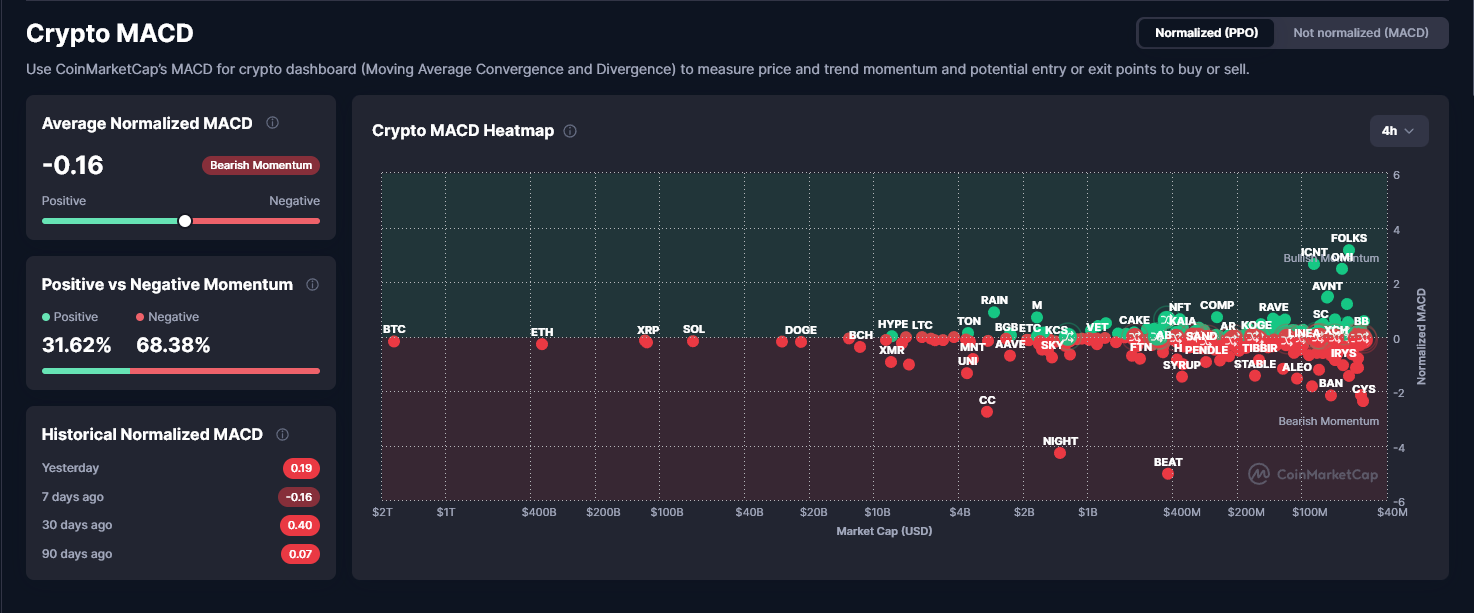
Menurut MACD yang dinormalisasi dari CoinMarketCap, 68% aset kripto yang dipantau sekarang ada dalam momentum negatif. Rata-rata MACD pasar di angka –0,16, jelas menandakan wilayah bearish.

Sebagian besar aset di bawah kapitalisasi pasar US$10 miliar masih berada di zona negatif dalam.

Saat momentum melemah di seluruh pasar, modal biasanya berpindah ke aset yang lebih sedikit dan lebih likuid—dan lagi-lagi Bitcoin lebih diuntungkan dibanding altcoin.

Rata-rata MACD Pasar Kripto | Sumber: CoinMarketCap

Kenapa Altcoin Lebih Rentan

Altcoin sangat bergantung pada likuiditas murah, arus masuk ritel, dan sentimen risk-on. Pertumbuhan GDP yang kuat bersama inflasi yang membandel membuat ketiganya berkurang.

Dengan konsumen AS yang masih belanja tapi menghadapi biaya lebih tinggi, pendapatan yang bisa digunakan untuk investasi spekulatif bisa menyusut di awal 2026.

Sementara itu, institusi tetap berhati-hati di tengah risiko Bank of Japan dan ketidakpastian suku bunga global. Kombinasi faktor ini menciptakan lingkungan yang sulit untuk altcoin bertahan dalam reli.

Apa Artinya untuk Pasar Aset Kripto Menuju 2026

Laporan GDP tidak menandakan kehancuran aset kripto secara langsung. tapi ini meningkatkan kemungkinan konsolidasi jangka panjang atau tekanan turun, khususnya di luar Bitcoin.

Jika kondisi ekonomi makro tetap seperti sekarang:

  • Bitcoin mungkin lanjut bergerak sideways daripada anjlok.
  • Altcoin bisa mengalami koreksi berkepanjangan.
  • Kepemimpinan pasar mungkin semakin menyempit.

Secara keseluruhan, data ekonomi kuat dari AS tidak lagi bullish—tapi ini menjadi peringatan likuiditas.

  •  

Why Silver Could Outperform Gold and Bitcoin in 2026

Silver emerged as one of the strongest-performing major assets in 2025, sharply outperforming both gold and Bitcoin. 

The rally was not driven by speculation alone. Instead, it reflected a rare convergence of macroeconomic shifts, industrial demand, and geopolitical pressure that could extend into 2026.

Silver’s 2025 Performance in Context

By late December 2025, silver traded near $71 per ounce, up more than 120% year-to-date. Gold rose roughly 60% over the same period, while Bitcoin ended the year slightly lower after a volatile run that peaked in October.

Silver price entered 2025 near $29 per ounce and climbed steadily through the year. Gains accelerated in the second half as supply deficits widened and industrial demand surprised to the upside.

Silver Price Chart In 2025. Source: BullionVault

Gold also rallied strongly, moving from roughly $2,800 to above $4,400 per ounce, supported by falling real yields and central-bank demand. 

However, silver outpaced gold by a wide margin, consistent with its historical tendency to amplify precious-metal cycles.

Gold Price Chart In 2025. Source: BullionVault

Bitcoin followed a different path. It surged to a record near $126,000 in early October before reversing sharply, ending December near $87,000

Unlike metals, Bitcoin failed to hold safe-haven inflows during late-year risk-off moves.

Macro Conditions Favored Hard Assets

Several macroeconomic forces supported silver in 2025. Most importantly, global monetary policy shifted toward easing. The US Federal Reserve delivered multiple rate cuts by year-end, pushing real yields lower and weakening the dollar.

At the same time, inflation concerns remained unresolved. That combination historically favors tangible assets, particularly those with monetary and industrial value.

Unlike gold, silver benefits directly from economic expansion. In 2025, that dual role proved decisive.

This is a 50-Yr chart of Silver futures
The red arrow marks my 1st trade in Silver
The $50 level rejected Silver in 1981 and 2011
The price has now sliced above $50
Corrections should find support in the low $50s
Upside targets exist at $87 and eventually $200-plus$SI_F pic.twitter.com/sz076mdeP1

— Peter Brandt (@PeterLBrandt) December 13, 2025

Industrial Demand Became the Core Driver

Silver’s rally was increasingly anchored in physical demand rather than investment flows. Industrial usage accounts for roughly half of total silver consumption, and that share continues to grow.

The energy transition played a central role. Solar power remained the single largest source of new demand, while electrification across transport and infrastructure added further pressure to already tight supply.

Global silver markets recorded a fifth consecutive annual deficit in 2025. Supply struggled to respond, as most silver production comes as a byproduct of base-metal mining rather than primary silver projects.

Most of silver demand is industrial and those users don't care if the price is 5x, because silver is only a small part of their products.

Industrial demand (mainly solar) continues to rise.

Also retail demand in Asia is now INCREASING along with rising prices.

— GoldSilver HQ (@GoldSilverHQ) December 23, 2025

Electric Vehicles Added Structural Demand

Electric vehicles significantly increased silver consumption in 2025. Each EV uses 25 to 50 grams of silver, roughly 70% more than an internal-combustion vehicle.

With global EV sales rising at double-digit rates, automotive silver demand climbed into the tens of millions of ounces annually. 

Charging infrastructure amplified the trend. High-power fast chargers use kilograms of silver in power electronics and connectors.

Unlike cyclical investment demand, EV-related silver consumption is structural. Production growth directly translates into sustained physical offtake.

Silver $71 today.
Just the beginning.
I completed a detailed analysis of Samsung's new battery technology. Production begins in 2027. (Confirmed by Samsung.) Approximately 1 kg of silver will be needed per EV. And Samsung's silver-carbon batteries will also be widely used across…

— HealthRanger (@HealthRanger) December 23, 2025

Defense Spending Quietly Tightened Supply

Military demand became a less visible but increasingly important factor. Modern weapons systems rely heavily on silver for guidance electronics, radar, secure communications, and drones.

A single cruise missile can contain hundreds of ounces of silver, all of which is destroyed upon use. That makes defense demand non-recyclable.

Global military spending reached record highs in 2024 and continued rising in 2025 amid wars in Ukraine and the Middle East

Europe, the United States, and Asia all expanded procurement of advanced munitions, quietly absorbing physical silver.

Geopolitical Shocks Reinforced the Trend

Geopolitical tensions further strengthened silver’s case. Prolonged conflicts increased defense stockpiling, while trade fragmentation raised concerns about supply security for critical materials.

Unlike gold, silver sits at the intersection of national security and industrial policy. Several governments moved to classify silver as a strategic material, reflecting its role in both civilian and military technologies.

This dynamic created a rare feedback loop: geopolitical risk boosted both safe-haven investment demand and real industrial consumption.

The rise in the price of gold and silver from 2001 through 2008 was a sign of a major Fed policy error and a harbinger of the 2008 financial crisis. The current rally that began in 2024 is signaling a bigger policy error that will have even more profound consequences for the U.S.

— Peter Schiff (@PeterSchiff) December 22, 2025

Why 2026 Could Extend the Outperformance

Looking ahead, most of the drivers that powered silver price in 2025 remain in place. EV adoption continues to accelerate. Grid expansion and renewable investment remain policy priorities. Defense budgets show no signs of retreat.

At the same time, silver supply remains constrained. New mining projects face long lead times, and recycling cannot offset growing industrial losses from military use.

Gold may continue to perform well if real yields stay low. Bitcoin may recover if risk appetite improves. But neither combines monetary protection with direct exposure to global electrification and defense spending.

That combination explains why many analysts see silver as uniquely positioned for 2026.

Looks like silver is going to be a shocker for most. While a significant group of investors is still in denial and do not realize that we are in a new realities constantly waiting for a pullback, silver keeps pushing higher and higher. My immediate target is $75 – 80. Let's wait… pic.twitter.com/ni35W0lIwd

— Rashad Hajiyev (@hajiyev_rashad) December 22, 2025

Silver’s 2025 rally was not a one-off speculative spike. It reflected deep structural changes in how the global economy consumes the metal.

If current trends persist, silver’s dual role as a monetary hedge and industrial necessity could allow it to outperform both gold and Bitcoin again in 2026.

The post Why Silver Could Outperform Gold and Bitcoin in 2026 appeared first on BeInCrypto.

  •  

Russia Plans New Crypto Regulation for 2026

The Central Bank of Russia unveiled a long-awaited conceptual framework to regulate crypto trading on December 23, marking a decisive shift from ad-hoc restrictions toward a structured, licensed market.

Under the proposal, cryptocurrencies and stablecoins will be legally recognized as currency values that can be bought and sold. However, they remain prohibited as a means of payment inside Russia. 

What the New Framework Introduces

The central bank submitted its legislative proposals to the Government of Russia for review.

The announcement marks the largest effort yet to bring crypto activity under formal financial supervision, while maintaining strict controls on retail risk and capital flows.

The proposal establishes a two-tier investor model, separating retail and professional participants.

Non-qualified investors will be allowed to purchase only the most liquid cryptocurrencies, as defined in future legislation. 

Access will require passing a mandatory risk-knowledge test, and purchases will be capped at 300,000 rubles per year.

Qualified investors will face fewer restrictions. They will be permitted to buy any cryptocurrency except anonymous tokens whose smart contracts conceal transaction data. 

Volume limits will not apply, although risk-awareness testing remains mandatory.

The central bank emphasized that cryptocurrencies remain high-risk instruments, citing volatility, lack of sovereign backing, and sanctions exposure.

Russia is leading Europe in crypto use, over $376B moved in a year, says Chainalysis.

While others talk about regulation, Russians are actually using crypto for real needs; trading, saving, and moving money fast.

Quiet adoption, big numbers. pic.twitter.com/2XcmYx8ioB

— Tom Tucker (@WhatzTheTicker) October 16, 2025

How This Differs From Russia’s Current Stance

Until now, Russia’s crypto policy has been fragmented. Ownership and trading were legal in practice but lacked a clear regulatory pathway. 

Retail access operated in a gray zone, intermediaries faced uncertainty, and enforcement relied on informal restrictions rather than explicit market rules.

The new concept formalizes what was previously tolerated, while sharply narrowing how retail investors can participate. 

It also confirms that Russia will regulate crypto activity through existing financial infrastructure, allowing exchanges, brokers, and trust managers to operate using their current licenses. Additional requirements will apply to crypto-specific depositaries and exchange services.

The framework also clarifies cross-border rules. Russian residents will be allowed to buy crypto abroad using foreign accounts and transfer crypto overseas through Russian intermediaries, provided they notify tax authorities.

Timeline and Enforcement

The central bank plans to finalize the legislative base by July 1, 2026. From July 1, 2027, illegal crypto intermediation will trigger liability comparable to penalties for illegal banking activity.

This phased approach gives market participants time to align with licensing, disclosure, and compliance requirements.

How Russia’s Approach Compares Globally

AreaRussia (BoR Concept)EU (MiCA)United States
Legal statusInvestment asset (“currency value”), not paymentRegulated crypto marketFragmented federal & state oversight
Retail accessAllowed with testing and strict capsAllowed via disclosure regimeBroad, no federal caps
IntermediariesExisting licenses + added crypto rulesMandatory CASP licensingMulti-agency framework
StablecoinsTradable, payment banHeavily regulatedFederal stablecoin law in place
EnforcementPhased, starts 2027Already activeOngoing agency enforcement

Overall, Russia is not liberalizing crypto in the Western sense. 

Instead, it is moving crypto out of the gray market, tightening supervision, limiting retail exposure, and positioning regulated crypto trading as an extension of its traditional financial system.

The post Russia Plans New Crypto Regulation for 2026 appeared first on BeInCrypto.

  •  

Chinese Groups Have Transformed Telegram into the Dark Web of Crypto Scams

Chinese-language networks operating on Telegram have become the backbone of the world’s largest illicit crypto economy. 

These groups have surpassed the dark web in fusing scams, AI-driven deception, and money laundering into a single, industrial system.

Telegram Markets Now Dwarf Historical Dark Web Giants

The scale is unprecedented. Elliptic data shows Huione Guarantee, later rebranded as Haowang Guarantee, processed $27 billion between 2021 and 2025. 

That figure exceeds every major dark web market in history.

Over recent years, we've supplied @okx with crypto threat intelligence via multiple channels, and their compliance progress is notable.

Data shows a significant decrease in risky USDT deposits from Huione&Tudou Guarantee.

We will continue monitoring this. @star_okx pic.twitter.com/f7zHpzra8j

— Bitrace (@Bitrace_team) October 15, 2025

After Telegram banned Huione in May, activity migrated. Two markets now dominate:

  • Tudou Guarantee: roughly $1.1 billion per month
  • Xinbi Guarantee: roughly $850 million per month

Combined monthly volume now surpasses what AlphaBay processed over its entire lifetime.

Why Telegram Replaced the Dark Web

Telegram offers public channels, escrow-like systems, and instant global reach. Users need no Tor browser or technical knowledge.

Markets recreate classic darknet features:

  • Vendor reputation systems
  • Escrow and dispute resolution
  • Stablecoin settlement
  • Rapid rebranding after bans

In practice, Telegram has become a “dark web without friction.”

Be careful ⚠️⚠️⚠️

a FAKE telegram channel is trying to scam Smardex holders

There is NO V3 migration,
DO NOT FALL FOR SUCH SCAM

the official updates can ONLY be received through their website https://t.co/Ghz45GSSnI, their X: @SmarDex and their official TG (its link is in… pic.twitter.com/cESr07yx4e

— Crypto Feras  (@CryptoFeras) November 5, 2025

Crypto Scam Markets Feed a Global Fraud Industry

These markets do not sell drugs or weapons at scale, but they sell scam infrastructure.

The primary customer base is the pig-butchering scam industry. These long-term romance and investment scams generate roughly $10 billion annually from US victims alone, according to federal data.

Operations are concentrated in Southeast Asia. Many rely on trafficked labor held in scam compounds.

Telegram markets provide:

  • Money-laundering services
  • Fake investment platforms
  • Stolen identities
  • Telecom and social-engineering tools

The scam economy and the markets grow together.

AI Face-Swap Tools Supercharge Fraud

A key accelerant is artificial intelligence. Chinese-language Telegram groups actively sell:

  • Real-time face-swap software
  • Voice-cloning tools
  • Deepfake identity kits

These tools allow scammers to impersonate real people on video calls. They dramatically increase trust and conversion rates.

Threat analysts describe this as the industrialization of social engineering. Scams now operate with assembly-line efficiency.

Look at this, what appears to be a SCAM site that is fully AI generated.

What is the government doing to stop these? Nothing at all?

All that talent going toward scamming new crypto users… on Twitter, Telegram, etc.

www_youtube_com/@cryptotopstories <– SCAM!!!… pic.twitter.com/HG1w0Lkx3e

— Jae Kwon – "godfather of proof-of-stake" (@jaekwon) November 22, 2025

USDT Is the Financial Backbone

Nearly all transactions settle in Tether (USDT). Unlike decentralized cryptocurrencies, USDT can be frozen. That capability exists but is rarely used at scale.

As a result, the most centralized stablecoin underpins the largest illicit crypto markets ever recorded. This dependency concentrates risk across scams, money laundering, and cross-border fraud.

Telegram has removed major markets before. Each time, replacements emerged within weeks.

Ownership stakes shift between markets. Liquidity follows instantly.

Elliptic tracks roughly 30 Chinese-language Telegram markets today. Together, they move tens of billions of dollars annually, mostly through crypto. 

Enforcement pressure remains fragmented and inconsistent.

Overall, this is no longer a niche cybercrime story.

Public messaging platforms now host global illicit finance at scale. Language-based networks matter more than geography; tools are reshaping fraud economics.

The result is a criminal ecosystem larger than anything the dark web ever produced. And it operates in plain sight.

Without a coordinated platform, stablecoin, and law-enforcement action, this system will keep growing.

The post Chinese Groups Have Transformed Telegram into the Dark Web of Crypto Scams appeared first on BeInCrypto.

  •  

US GDP Surprise Signals Trouble for Altcoins, Not Bitcoin

The latest US GDP report delivered a strong economic signal—but for crypto markets, especially altcoins, it may be bad news.

Data released on December 23 showed the US economy growing faster than expected in Q3, reinforcing the idea that monetary conditions may stay tighter for longer. While Bitcoin remains relatively resilient, broader crypto markets are flashing warning signs.

US GDP Growth Beats Expectations

The US economy expanded at an annualized rate of 4.3% in Q3, well above the market forecast of 3.3% and higher than the previous 3.8% reading.

The year of the tariff is powering America’s economy as real GDP accelerated to a 4.3% annualized rate and exports rose to an 8.8% SAAR in the third quarter.

This is just the beginning of new era of economic prosperity thanks to President Trump’s trade program unlocking new… pic.twitter.com/kWeBtxQ7aN

— United States Trade Representative (@USTradeRep) December 23, 2025

At the same time, core PCE inflation rose to 2.9%, up from 2.6%, remaining sticky above the Federal Reserve’s 2% target.

Also, Real personal consumption expenditures jumped 3.5%, far exceeding expectations of 2.7%.

In simple terms, Americans are still spending aggressively, and inflation pressures have not cooled enough for policymakers to declare victory.

Why Strong Growth Is a Problem for Crypto

Stronger-than-expected growth reduces the urgency for interest-rate cuts.

Combined with recent CPI data and still-elevated inflation expectations from the University of Michigan survey, the GDP report strengthens the case for higher-for-longer rates in 2026.

For risk assets like crypto, that matters because:

  • Higher rates increase the return on cash and bonds.
  • Liquidity becomes more selective.
  • Speculative assets struggle to attract new capital.

This environment historically pressures altcoins more than Bitcoin.

The US economy has now been in an expansion for 65 months with annualized real GDP growth of 4.3% over that time.
The average expansion length since 1949: 67 months.
Longest: 128 months.
Shortest: 12 months. pic.twitter.com/QE6WnhhMA5

— Charlie Bilello (@charliebilello) December 23, 2025

Bitcoin Holds Better Than Altcoins

Market reaction following the GDP release reflected this dynamic.

Bitcoin remained relatively stable near $87,800, down modestly on the day but still holding key structural levels. Its market cap stayed above $1.75 trillion, showing limited panic selling.

Altcoins, however, underperformed sharply:

  • Ethereum fell over 3% on the day.
  • Solana, Cardano, and Dogecoin dropped between 3%–6%.
  • Mid-cap and small-cap tokens saw deeper losses with weaker recoveries.

This divergence highlights Bitcoin’s role as a liquidity sink during macro uncertainty.

Crypto MACD Confirms Bearish Breadth

Momentum indicators reinforce the concern.

According to CoinMarketCap’s normalized MACD, 68% of tracked crypto assets are now in negative momentum. The average market MACD sits at –0.16, firmly in bearish territory.

Most assets below the $10 billion market-cap range remain deeply negative.

When momentum weakens across the market, capital tends to retreat toward fewer, more liquid assets—again favoring Bitcoin over altcoins.

Average Crypto MACD. Source: CoinMarketCap

Why Altcoins Are More Exposed

Altcoins rely heavily on cheap liquidity, retail inflows, and risk-on sentiment. Strong GDP growth combined with persistent inflation reduces all three.

With US consumers still spending but facing higher costs, disposable income for speculative investment may shrink in early 2026. 

Institutions, meanwhile, remain cautious amid Bank of Japan risks and global rate uncertainty. That combination creates a difficult environment for altcoins to sustain rallies.

What This Means For Crypto Markets Going Into 2026

The GDP report does not signal an immediate crypto crash. However, it raises the probability of prolonged consolidation or downside pressure, particularly outside Bitcoin.

If macro conditions remain unchanged:

  • Bitcoin may continue to range rather than collapse.
  • Altcoins could face extended drawdowns.
  • Market leadership may narrow further.

Overall, strong US economic data is no longer bullish—it is a liquidity warning.

The post US GDP Surprise Signals Trouble for Altcoins, Not Bitcoin appeared first on BeInCrypto.

  •  
❌