Reading view

DePIN’s Silent Struggle: Why One of Crypto’s Most Useful Sectors Lacks Market Attention

This year, the crypto market has seen a revival of older tokens as utility-based narratives gained renewed traction. Despite this momentum, DePIN has struggled to keep pace, slipping out of the spotlight.

BeInCrypto spoke with several experts to understand why one of crypto’s most fundamentally useful sectors still can’t capture sustained market attention, and what might come next for it.

Understanding DePIN

DePIN, short for Decentralized Physical Infrastructure Networks, refers to blockchain-based systems that coordinate, fund, and operate real-world infrastructure through decentralized incentives. 

Instead of relying on traditional companies to build networks like wireless coverage, storage, sensors, or energy grids, DePIN distributes the work across individuals and small operators who contribute hardware and earn tokens in return. 

This model reduces upfront costs, expands global access, and unlocks previously difficult-to-scale infrastructure. By aligning incentives with actual demand, DePIN aims to build more resilient and efficient systems. 

Why is DePIN Still Struggling in 2025?

Nonetheless, the space has continued to face challenges. According to Artemis data, it ranks among the top 10 worst-performing sectors this year. The DePIN market has declined by over 74% in 2025.
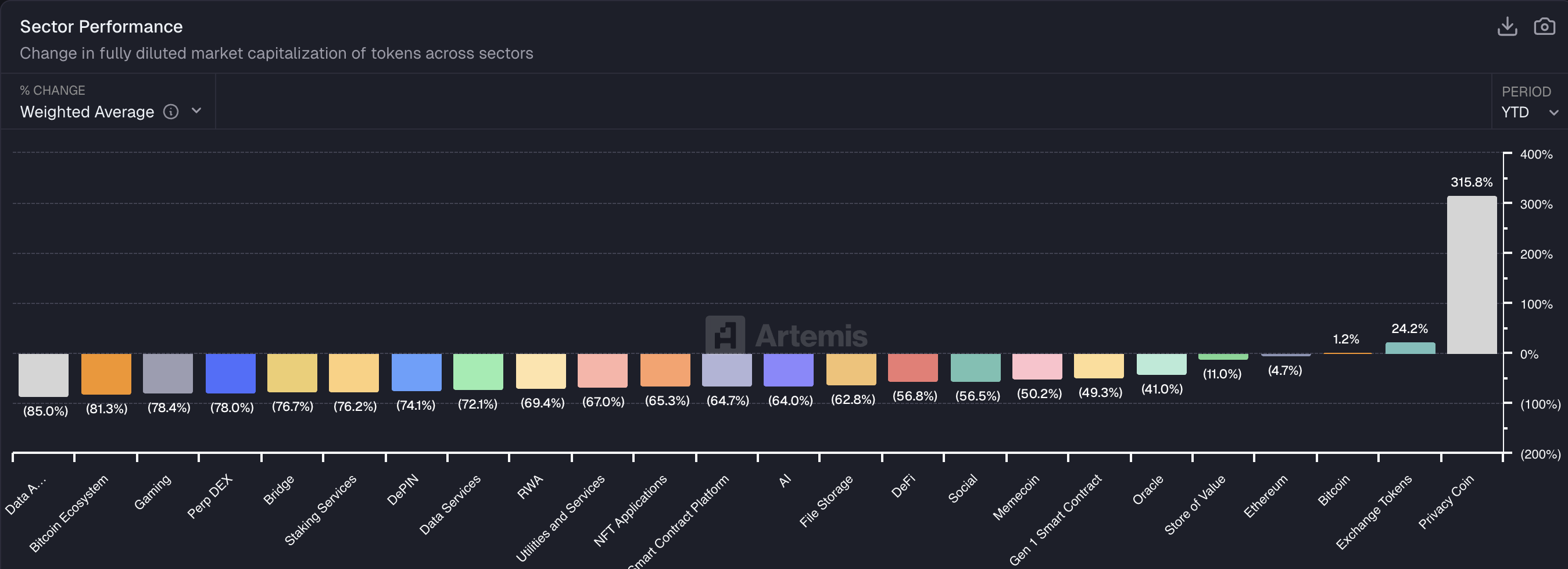
Crypto Sectors’ Performance.
Crypto Sectors’ Performance. Source: Artemis

But why is this happening? Sami Kassab, Managing Partner at Unsupervised Capital, told BeInCrypto that the weakness across the altcoin market has naturally affected DePIN as well. 

According to him, macro conditions explain part of the sector’s slowdown, but not all of it. The deeper issue, he said, is that there has not been a “breakout DePIN yet.”

“The other side of the coin is that DePINs are building real infrastructure and real businesses. That takes a long time, which the crypto market isn’t wired for. Investors are used to fast-moving narratives and overnight successes,” Kassab added.

Leo Fan, Co-Founder of Cysic, revealed that DePIN’s main obstacle is the mismatch between infrastructure build cycles and the crypto market’s short attention span. While non-fungible tokens (NFTs), meme coins, and major altcoins thrive on culture, identity, and hype, DePIN functions as an infrastructure layer that most users struggle to connect with emotionally. 

Its value grows quietly through hardware deployments and real compute capacity — progress that isn’t immediately visible or profitable. Fan noted that,

“Most investors still view token value as the only metric for success, which does not apply to infrastructure systems. DePIN networks create tangible value through services like compute power and data delivery. Their performance is measured by usage, speed and reliability, rather than short-term volatility. Because this model does not mirror traditional crypto dynamics, it remains outside the comfort zone of most market participants.” 

Maria Carola, CEO of StealthEx, shared a similar outlook. She stated that most investors remain drawn to assets they can quickly trade rather than sectors that require deeper understanding.

“Within crypto cycles, speculation will always dominate, and DePIN’s complex approach doesn’t help its position either. Most of the investors never fully grasp how token incentives drive data collection, storage, or connectivity, and how that translates into revenue. If we’re talking about traditional markets, the infrastructure side is always the least glamorous, yet it’s still the most essential. DePIN is the crypto’s version of that,” she mentioned to BeInCrypto.

However, Vinayak Kurup, Investment and Research Partner at Escape Velocity Crypto (EV3), pointed out that DePIN’s slowdown isn’t just about market perception — it’s the difficulty of building real-world networks that require hardware, manufacturing, and physical deployment. 

“They are often compared directly to existing large-scale network providers; the challenge for DePIN operators is to provide a comparably reliable and simple user-experience for a fraction of the capital while operating within sectors where user stickiness is high. Combined, these factors dampen the DePIN mindshare,” Kurup highlighted.

Usage Surges, Prices Sink: Experts Explain DePIN’s Widening Fundamentals Gap

Despite the sector’s underperformance, usage metrics are painting a different picture. Fees surged to a record high in October even as the broader market continued to decline.

October set a record for DePIN fees at $2.5 million.

@helium led with $1.7m
@Hivemapper (+111%) & @LivepeerOrg (+74%) had largest MoM growth
– Total fees up 273% YoY https://t.co/h9o68rqOy4 pic.twitter.com/Jf3WiKB3Nh

— Artemis (@artemis) November 4, 2025

This suggests a growing disconnect between falling token prices and rising real-world usage. According to Kassab,

“Fees are trending upward, but they’re still small compared to the value of emissions spent since inception or the revenue of the incumbents these networks aim to disrupt.”

Carola said this disconnect is typical of emerging infrastructure sectors, where fundamentals can strengthen long before prices. She explained that sentiment often swings independently of utility: investors may rotate out of risk during uncertain markets, even while real activity continues to grow.

“Rising fees and network activity during a down market instead show that real users continue to find value in these services, whether for storage or computing. In the long term, these are the metrics that will matter more than short-term token performance, once revenues eventually pour in with usage, just like in the early days of the internet,” she remarked.

Fan also emphasized that speculation and actual usage have clearly decoupled. He said the price action largely reflects investor mood — what he called “Wall Street sentiment” — while fee growth captures genuine demand for the networks. When fees increase in a bearish environment, it signals that DePIN’s core services are gaining traction regardless of market cycles.

“Such divergence is common in early infrastructure cycles. The networks are being used more, but the market has not yet priced that in because investors still treat DePIN tokens as speculative assets,” the executive disclosed to BeInCrypto.

Could DePIN Be the Next Sector to Break Out After Privacy Coins?

It’s clear that DePIN is seeing real market demand, which raises an important question: could the sector finally experience a breakout similar to the one privacy coins saw this year?

Carola believes the answer leans toward yes. She noted that crypto cycles tend to shift from narrative-driven speculation to phases where utility and real adoption take center stage.

According to her, if privacy coins reflected a push toward digital sovereignty this year, DePIN may be positioned for a similar rise — one grounded in measurable output. She commented,

“DePIN could have tangible productivity by next year. Whether for physical infrastructure or decentralized data, network builders are laying the groundwork, expecting and preparing for when the market starts valuing cash flow and adoption over memes. When that shift happens, DePIN will be the sector that can show a measurable, real-world traction.”

Fan echoed this outlook. He suggested that once the market rotates back toward sectors with clear utility, DePIN stands out as a natural beneficiary. He pointed to concrete on-chain indicators that are already trending upward. 

“Network fees are rising, node participation is expanding, and operational performance continues to strengthen. Should these data points become standard reference metrics, DePIN might be recognised as the quiet builder of trading infrastructure,” he forecasted.

Kurup offered a broader perspective. While acknowledging the uncertainty of broader market conditions, he said investor preferences are gradually shifting toward projects with recurring cash flows and strong fundamentals — an environment that plays directly to DePIN’s strengths.

“But it’s also likely a tailwind from other shifts in the market. 2026 will be the year of DePIN’s resurgence,” he declared.

Why Enterprises Could Unlock DePIN’s Next Phase 

Experts also pointed to several catalysts that could spark a major shift for the sector, with both Carola and Fan agreeing that enterprise adoption may be the key driver.

“Enterprise adoption is the strongest driver. Regulation and investor sentiment will follow proof of adoption. Once enterprises begin integrating decentralised infrastructure into existing systems, confidence in the model will rise. DePIN’s credibility depends on measurable performance, and enterprise engagement provides exactly that,” the Cysic co-founder explained.

Kurup stressed that multiple factors will likely converge to drive a turnaround. Investor psychology remains critical, he said, but growing visibility and mainstream presence could accelerate that shift. 

“Now, I see Helium advertising their free phone plan in the New York subways– compared to their Web2 counterparts, it’s only recently that DePINs have been well capitalized enough to enter the mainstream,” Kurup shared.

What Role Will DePIN Play in Crypto’s Future?

As optimism for the sector’s trajectory remains strong, it’s still worth wondering where DePIN truly fits in the broader crypto ecosystem. Will DePIN remain a niche bet, or is it poised to become crypto’s bridge to the real economy once markets catch up?

The StealthEx CEO argued that DePIN already functions as that bridge — the market just hasn’t fully recognized it yet. As blockchain shifts from abstract financial experimentation to practical, real-world use cases, she believes DePIN will anchor many of those transitions.

“Whether it’s powering smart cities, distributed AI compute, or IoT networks, these systems make crypto tangible. So while it might feel like a limited niche today, it’s already foundational. When people finally start interacting with decentralized infrastructures without realizing it’s crypto, it is when DePIN will have truly won,” Carola conveyed to BeInCrypto.

Fan pointed to developments in 2025, especially the rise of real-world asset (RWA) tokenization and increasing institutional adoption, as signs that the real economy already sees value in decentralized systems. In his view, DePIN is well-positioned to become the infrastructure layer connecting DeFi to enterprise use cases.

“I do believe that DePIN will be one of crypto’s bridges into TradFi as the sector matures, serving as the infrastructure layer that anchors DeFi in a real-world capacity. As institutions look for verifiable, cost-efficient infrastructure to support secure settlement, DePIN will move from a niche experiment to the fundamental layer of digital finance.”

Whether the market realizes it now or years from now, the experts agree on one point: DePIN’s long-term value lies not in speculation, but in becoming the invisible infrastructure powering crypto’s real-world impact.

The post DePIN’s Silent Struggle: Why One of Crypto’s Most Useful Sectors Lacks Market Attention appeared first on BeInCrypto.
  •  

Token Unlock Perlu Diperhatikan Minggu Ketiga November 2025

Jutaan token akan masuk ke pasar kripto minggu ini. Terutama, tiga ekosistem utama; LayerZero (ZRO), SOON (SOON), dan YZY (YZY) yang akan merilis pasokan yang sebelumnya terkunci.

Unlock ini mungkin menyebabkan volatilitas pasar serta memengaruhi pergerakan harga dalam jangka pendek. Berikut adalah rincian yang perlu di perhatikan di setiap proyek.

1. LayerZero (ZRO)

  • Tanggal Unlock: 20 November
  • Jumlah Token yang Akan Di unlock: 25,71 juta ZRO (2,57% dari Total Supply)
  • Pasokan Beredar Saat Ini: 198,25 juta ZRO
  • Total Supply: 1 miliar ZRO

LayerZero adalah protokol interoperabilitas yang di rancang untuk menghubungkan berbagai blockchain. Hal ini dapat memungkinkan komunikasi lintas chain yang lancar agar dApps dapat berinteraksi di berbagai blockchain tanpa jembatan tradisional.

Tim ini akan merilis 25,71 juta token pada 20 November, dengan nilai sekitar US$36,76 juta. Jumlah ini mencakup 7,29% dari suplai yang di rilis.

ZRO Crypto Token Unlock in November
Unlock Token Kripto ZRO di Bulan November | Sumber: Tokenomist

LayerZero akan menyalurkan 13,42 juta altcoin kepada mitra strategis. Kontributor inti akan mendapatkan 10,63 juta ZRO. Terakhir, 1,67 juta ZRO adalah untuk token yang di persembahkan kembali oleh tim.

2. SOON

  • Tanggal Unlock: 23 November
  • Jumlah Token yang Akan Di unlock: 15,21 juta SOON (1,54% dari Total Supply)
  • Pasokan Beredar Saat Ini: 281,1 juta SOON
  • Total Supply: 984,1 juta SOON

SOON adalah Rollup Solana Virtual Machine (SVM) berperforma tinggi, yang di rancang untuk menerapkan Super Adoption Stack. Ini mencakup tiga komponen utama: SOON Mainnet, SOON Stack, dan InterSOON.

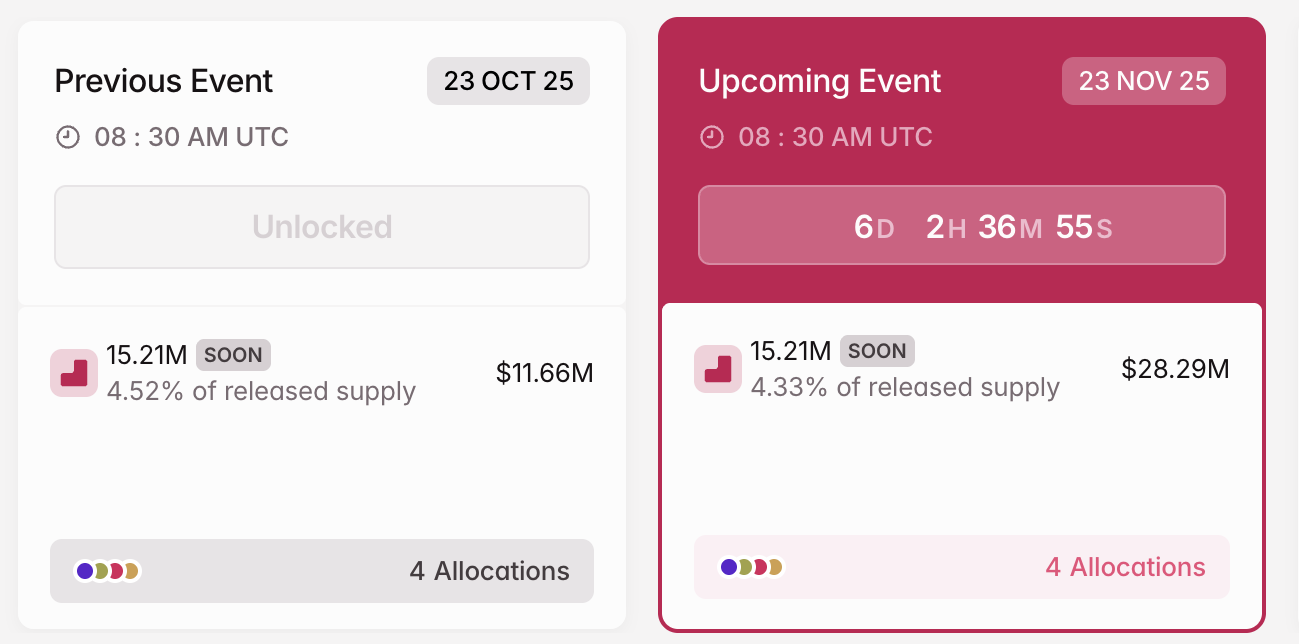
Jaringan ini akan mengunlock 15,21 juta SOON pada 23 November. Jumlah ini mencakup 4,33% dari suplai yang di rilis serta bernilai US$28,29 juta.

SOON Crypto Token Unlock in November
Unlock Token Kripto SOON di Bulan November | Sumber: Tokenomist

SOON akan mempersiapkan 8,3 juta token untuk airdrop bagi holder non-fungible token (NFT). Mereka akan mendistribusikan 4,17 juta koin untuk ekosistem. Alokasinya adalah 2,22 juta SOON untuk insentif komunitas dan 520,830 token untuk airdrop dan likuiditas.

Baca Juga: Info Dan Analisa Bitcoin Hari Ini: Waspada Koreksi Makin Dalam!

3. YZY

  • Tanggal Unlock: 19 November
  • Jumlah Token yang Akan Di unlock: 37,5 juta YZY (3,75% dari Total Supply)
  • Pasokan Yang Beredar Saat Ini: 129,99 juta YZY
  • Total Supply: 1 miliar YZY

YZY adalah token cryptocurrency yang terkait dengan rapper Ye (dahulu di kenal sebagai Kanye West). Ini adalah bagian dari ekosistem “YZY MONEY” yang lebih luas, yang mencakup token YZY, platform pembayaran bernama Ye Pay, dan Kartu YZY fisik.

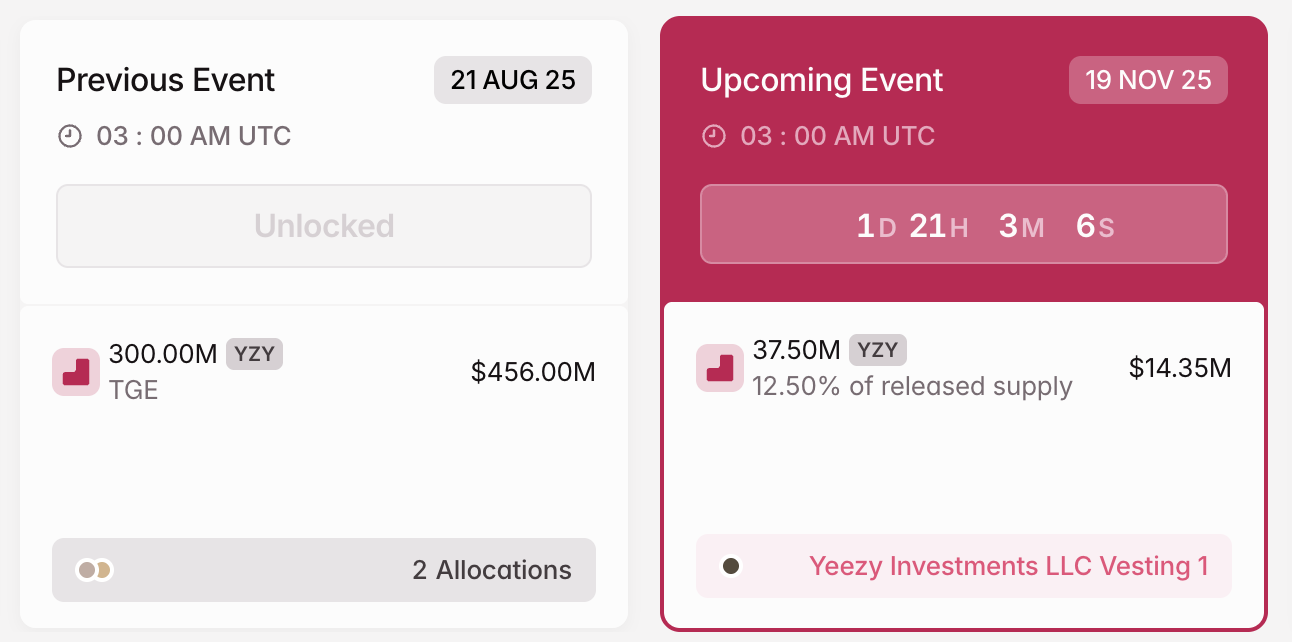
Pada 19 November, YZY akan mengunlock 37,5 juta token senilai sekitar US$14,35 juta. Token ini mewakili 12,5% dari pasokan yang beredar. 

YZY Crypto Token Unlock in November
Unlock Token Kripto YZY di Bulan November | Sumber: Tokenomist

Pembukaan kunci lainnya yang menonjol dan dapat di perhatikan investor pada minggu ketiga November mencakup adalah ZKsync (ZK), KAITO (KAITO), ApeCoin (APE)

Bagaimana pendapat Anda tentang token unlock di atas? Yuk, sampaikan pendapat Anda di grup Telegram kami. Jangan lupa follow akun Instagram dan Twitter BeInCrypto Indonesia, agar Anda tetap update dengan informasi terkini seputar dunia kripto!

  •  

Perjuangan Diam DePIN: Mengapa Salah Satu Sektor Terkaya dalam Atensi Market Aset Kripto Kurang Mendapat Perhatian

Tahun ini, pasar kripto telah menyaksikan kebangkitan token lama seiring narasi berbasis utilitas mendapatkan daya tarik baru. Namun, meskipun momentum ini, DePIN kesulitan untuk tetap bertahan, sehingga kurang diperhatikan.

BeInCrypto berbicara dengan beberapa ahli untuk memahami mengapa salah satu sektor yang paling penting secara fundamental di dunia kripto masih belum dapat menarik perhatian pasar secara berkelanjutan dan apa yang mungkin terjadi selanjutnya.

Memahami DePIN

DePIN, singkatan dari Decentralized Physical Infrastructure Networks, merujuk pada sistem berbasis blockchain yang mengkoordinasikan, mendanai, dan mengoperasikan infrastruktur dunia nyata melalui insentif terdesentralisasi.

Alih-alih bergantung pada perusahaan tradisional untuk membangun jaringan seperti cakupan nirkabel, penyimpanan, sensor, atau jaringan energi, DePIN mendistribusikan pekerjaan tersebut ke individu dan operator kecil yang menyumbangkan perangkat keras dan mendapatkan token sebagai imbalannya.

Model ini mengurangi biaya awal, memperluas akses global, dan membuka infrastruktur yang sebelumnya sulit ditingkatkan skalanya. Dengan menyelaraskan insentif dengan permintaan nyata, DePIN bertujuan untuk membangun sistem yang lebih tangguh dan efisien.

Mengapa DePIN Masih Berjuang di 2025?

Namun, ruang ini terus mengalami tantangan. Menurut data Artemis, sektor ini berada di antara 10 sektor dengan kinerja terburuk tahun ini. Pasar DePIN mengalami penurunan lebih dari 74% pada 2025.

Kinerja Sektor Kripto.
Kinerja Sektor Kripto | Sumber: Artemis

Tapi kenapa ini terjadi? Sami Kassab, Managing Partner di Unsupervised Capital, kepada BeInCrypto, bahwa kelemahan di pasar altcoin secara alami turut memengaruhi DePIN.

Menurutnya, kondisi makro menjelaskan sebagian dari perlambatan sektor, namun tidak semuanya. Masalah yang lebih dalam, ucapnya, adalah bahwa belum ada “DePIN yang melakukan breakout.”

“Di sisi lain, DePIN membangun infrastruktur nyata dan bisnis nyata. Itu memakan waktu lama, sementara pasar kripto tidak terprogram untuk itu. Investor terbiasa dengan narasi yang bergerak cepat dan kesuksesan dalam semalam,” tambah Kassab.

Leo Fan, Co-Founder dari Cysic, mengungkapkan bahwa hambatan utama DePIN adalah ketidakcocokan antara siklus pembangunan infrastruktur dan perhatian singkat pasar kripto. Sementara non-fungible token (NFT), meme coin, dan altcoin besar berkembang dalam budaya, identitas, dan hype, DePIN berfungsi sebagai lapisan infrastruktur yang kebanyakan pengguna kesulitan untuk terhubung secara emosional.

Nilainya bertumbuh secara diam-diam melalui penyebaran perangkat keras dan kapasitas komputasi nyata — kemajuan yang tidak segera terlihat atau menguntungkan. Fan mengungkapkan bahwa,

“Sebagian besar investor masih melihat nilai token sebagai satu-satunya metrik keberhasilan, yang tidak berlaku untuk sistem infrastruktur. Jaringan DePIN menciptakan nilai nyata melalui layanan seperti daya komputasi dan pengiriman data. Kinerja mereka diukur dengan penggunaan, kecepatan, dan keandalan, bukan volatilitas jangka pendek. Karena model ini tidak mencerminkan dinamika kripto tradisional, tetap berada di luar zona nyaman sebagian besar pelaku pasar.”

Maria Carola, CEO StealthEx, berbagi pandangan serupa. Dia menyatakan bahwa kebanyakan investor cenderung tertarik pada aset yang dapat mereka perdagangkan dengan cepat ketimbang sektor yang membutuhkan pemahaman lebih dalam.

“Dalam siklus kripto, spekulasi akan selalu mendominasi, dan pendekatan kompleks DePIN tidak membantu posisinya. Sebagian besar investor tidak sepenuhnya memahami bagaimana insentif token mendorong pengumpulan data, penyimpanan, atau konektivitas, dan bagaimana itu berkontribusi pada pendapatan. Jika kita berbicara tentang pasar tradisional, sisi infrastruktur selalu menjadi yang paling tidak glamor, tetapi tetap menjadi yang paling penting. DePIN adalah versi kripto dari itu,” ujarnya kepada BeInCrypto.

Namun, Vinayak Kurup, Investment and Research Partner di Escape Velocity Crypto (EV3), menggarisbawahi bahwa perlambatan DePIN bukan semata soal persepsi pasar — ini adalah tantangan dalam membangun jaringan dunia nyata yang memerlukan perangkat keras, produksi, dan penerapan fisik.

“Mereka sering dibandingkan langsung dengan penyedia jaringan skala besar; tantangan bagi operator DePIN adalah memberikan pengalaman pengguna yang sebanding dalam hal keandalan dan kesederhanaan dengan modal yang jauh lebih sedikit, sambil beroperasi dalam sektor yang memiliki retensi pengguna tinggi. Faktor-faktor ini, jika digabungkan, menekan kesadaran terhadap DePIN,” terang Kurup.

Penggunaan Meningkat, Harga Turun: Ahli Menjelaskan Kesenjangan Fundamental DePIN yang Semakin Luas

Meski sektor ini berkinerja buruk, metrik penggunaan menunjukkan gambaran yang berbeda. Biaya melonjak ke rekor tertinggi pada Oktober meskipun pasar yang lebih luas terus menurun.

October set a record for DePIN fees at $2.5 million.

@helium led with $1.7m
@Hivemapper (+111%) & @LivepeerOrg (+74%) had largest MoM growth
– Total fees up 273% YoY https://t.co/h9o68rqOy4 pic.twitter.com/Jf3WiKB3Nh

— Artemis (@artemis) November 4, 2025

Hal ini menunjukkan adanya perbedaan yang semakin besar antara penurunan harga token dan peningkatan penggunaan di dunia nyata. Menurut Kassab,

“Biaya sedang meningkat, namun jumlahnya masih kecil dibandingkan dengan nilai emisi yang dihabiskan sejak awal atau pendapatan dari pemain lama yang ingin digantikan jaringan ini.”

Carola mengatakan bahwa perbedaan ini adalah hal yang biasa di sektor infrastruktur yang baru berkembang, di mana dasar-dasar bisa menguat jauh sebelum harga. Dia menjelaskan bahwa sentimen seringkali berayun bebas dari utilitas: investor mungkin keluar dari risiko selama pasar tidak menentu, meskipun aktivitas nyata terus tumbuh.

“Kenaikan biaya dan aktivitas jaringan selama pasar turun justru menunjukkan bahwa pengguna sesungguhnya terus menemukan nilai dalam layanan ini, baik untuk penyimpanan maupun komputasi. Dalam jangka panjang, metrik-metrik ini akan lebih penting daripada kinerja token jangka pendek, ketika pada akhirnya pendapatan mengalir dengan penggunaan, seperti pada awal-awal internet,” ujarnya.

Fan juga menekankan bahwa spekulasi dan penggunaan sebenarnya jelas telah terpisah. Dia mengatakan aksi harga sebagian besar mencerminkan suasana hati investor — yang dia sebut “sentimen Wall Street” — sedangkan pertumbuhan biaya mencerminkan permintaan nyata untuk jaringan tersebut. Ketika biaya meningkat dalam lingkungan bearish, itu menandakan bahwa layanan inti DePIN mendapatkan daya tarik terlepas dari siklus pasar.

“Perbedaan seperti ini biasa terjadi dalam siklus infrastruktur awal. Jaringannya digunakan lebih banyak, tetapi pasar belum memasukkannya ke dalam harga, karena investor masih memperlakukan token DePIN sebagai aset spekulatif,” ungkap eksekutif tersebut kepada BeInCrypto.

Apakah DePIN Bisa Menjadi Sektor Berikutnya yang Breakout Setelah Privacy Coins?

Jelas bahwa DePIN mengalami permintaan pasar nyata, yang memunculkan pertanyaan penting: apakah sektor ini akhirnya dapat mengalami breakout seperti yang terjadi pada privacy coin tahun ini?

Carola percaya jawabannya cenderung ya. Dia mencatat bahwa siklus kripto cenderung beralih dari spekulasi berbasis naratif ke fase di mana utilitas dan adopsi nyata menjadi pusat perhatian.

Menurutnya, jika privacy coin mencerminkan dorongan menuju kedaulatan digital tahun ini, DePIN mungkin diposisikan untuk kenaikan serupa — satu yang didasarkan pada hasil yang terukur. Dia berkomentar,

“DePIN dapat memiliki produktivitas nyata pada tahun depan. Baik untuk infrastruktur fisik atau data terdesentralisasi, para pembangun jaringan sedang menyiapkan fondasi, mengharapkan dan mempersiapkan ketika pasar mulai menghargai aliran kas dan adopsi daripada meme. Ketika pergeseran itu terjadi, DePIN akan menjadi sektor yang dapat menunjukkan daya tarik nyata, terukur di dunia nyata.”

Fan menegaskan pandangan ini. Dia menyarankan bahwa ketika pasar berputar kembali ke sektor-sektor yang memiliki utilitas yang jelas, DePIN menonjol sebagai penerima manfaat yang alami. Dia menunjuk pada indikator on-chain konkret yang sudah menunjukkan tren peningkatan. 

“Biaya jaringan meningkat, partisipasi node berkembang, dan kinerja operasional terus menguat. Jika poin data ini menjadi metrik referensi standar, DePIN mungkin akan diakui sebagai pembangun infrastruktur perdagangan yang tenang,” dia memperkirakan.

Kurup menawarkan perspektif yang lebih luas. Sambil mengakui ketidakpastian kondisi pasar yang lebih luas, dia mengatakan bahwa preferensi investor secara bertahap beralih ke proyek-proyek dengan aliran kas berulang dan fundamental yang kuat — lingkungan yang secara langsung mendukung kekuatan DePIN.

“Tapi juga mungkin ada angin penolong dari pergeseran lain di pasar. Tahun 2026 akan menjadi tahun kebangkitan DePIN,” dia nyatakan.

Mengapa Perusahaan Bisa Membuka Fase Berikutnya DePIN

Para ahli juga menunjukkan beberapa katalis yang dapat memicu perubahan besar untuk sektor ini, di mana Carola dan Fan sepakat bahwa adopsi perusahaan dapat menjadi penggerak utama.

“Adopsi perusahaan adalah penggerak terkuat. Regulasi dan sentimen investor akan mengikuti bukti adopsi. Ketika perusahaan mulai mengintegrasikan infrastruktur terdesentralisasi ke dalam sistem yang ada, kepercayaan pada model ini akan meningkat. Kredibilitas DePIN bergantung pada kinerja yang terukur, dan keterlibatan perusahaan menyediakan hal itu,” terang co-founder Cysic.

Kurup menekankan bahwa banyak faktor kemungkinan akan bersatu untuk mendorong perubahan. Psikologi investor tetap penting, ujarnya, namun meningkatnya visibilitas dan kehadiran di arus utama dapat mempercepat pergeseran tersebut. 

“Sekarang, saya melihat Helium mengiklankan rencana telepon gratis mereka di kereta bawah tanah New York — dibandingkan dengan pesaing Web2 mereka, baru belakangan ini DePIN cukup kuat didanai untuk masuk ke arus utama,” tutur Kurup.

Peran Apa yang Akan Dimainkan DePIN dalam Masa Depan Aset Kripto?

Seiring optimisme untuk jalur sektor ini tetap kuat, tetap patut dipertanyakan di mana posisi DePIN sebenarnya dalam ekosistem kripto yang lebih luas. Apakah DePIN akan tetap menjadi taruhan niche, atau bersiap untuk menjadi jembatan kripto ke ekonomi nyata begitu pasar menyusul?

CEO StealthEx berpendapat bahwa DePIN sudah berfungsi sebagai jembatan tersebut — hanya saja pasar belum sepenuhnya mengenalinya. Seiring blockchain beralih dari eksperimen finansial abstrak ke penggunaan praktis di dunia nyata, dia percaya DePIN akan menjadi jangkar banyak transisi tersebut.

“Apakah itu untuk mendukung kota cerdas, komputasi AI yang terdistribusi, atau jaringan IoT, sistem-sistem ini membuat aset kripto menjadi nyata. Jadi meskipun mungkin terasa seperti niche terbatas hari ini, itu sudah menjadi fondasi. Ketika orang akhirnya mulai berinteraksi dengan infrastruktur terdesentralisasi tanpa menyadari bahwa itu adalah kripto, itulah saatnya DePIN benar-benar menang,” sampaikan Carola kepada BeInCrypto.

Fan menunjuk pada perkembangan tahun 2025, terutama kenaikan tokenisasi aset dunia nyata (RWA) dan meningkatnya adopsi institusional, sebagai tanda bahwa ekonomi nyata sudah melihat nilai dalam sistem terdesentralisasi. Dalam pandangannya, DePIN berada dalam posisi yang baik untuk menjadi lapisan infrastruktur yang menghubungkan DeFi dengan kasus penggunaan perusahaan.

“Saya percaya bahwa DePIN akan menjadi salah satu jembatan aset kripto ke TradFi saat sektor ini matang, berfungsi sebagai lapisan infrastruktur yang menjangkar DeFi dalam kapasitas dunia nyata. Ketika institusi mencari infrastruktur yang dapat diverifikasi dan efisien biaya untuk mendukung penyelesaian yang aman, DePIN akan bergerak dari eksperimen niche ke lapisan dasar keuangan digital.”

Apakah pasar menyadarinya sekarang atau beberapa tahun ke depan, para ahli sepakat pada satu hal: nilai jangka panjang DePIN tidak terletak pada spekulasi, tetapi pada menjadi infrastruktur tak terlihat yang menggerakkan dampak nyata aset kripto di dunia.

  •  

3 Token Unlocks to Watch in the Third Week of November 2025

Millions of tokens will enter the crypto market this week. Notably, three major ecosystems, LayerZero (ZRO), SOON (SOON), and YZY (YZY) will release previously locked supply.

These unlocks might lead to market volatility and influence price movements in the short term. Here is a breakdown of what to watch for in each project.

1. LayerZero (ZRO)

  • Unlock Date: November 20
  • Number of Tokens to be Unlocked: 25.71 million ZRO (2.57% of Total Supply)
  • Current Circulating Supply: 198.25 million ZRO
  • Total Supply: 1 billion ZRO

LayerZero is an interoperability protocol designed to connect different blockchains. Its main goal is to enable seamless cross-chain communication so that decentralized applications (dApps) can interact across multiple blockchains without relying on traditional bridging models.

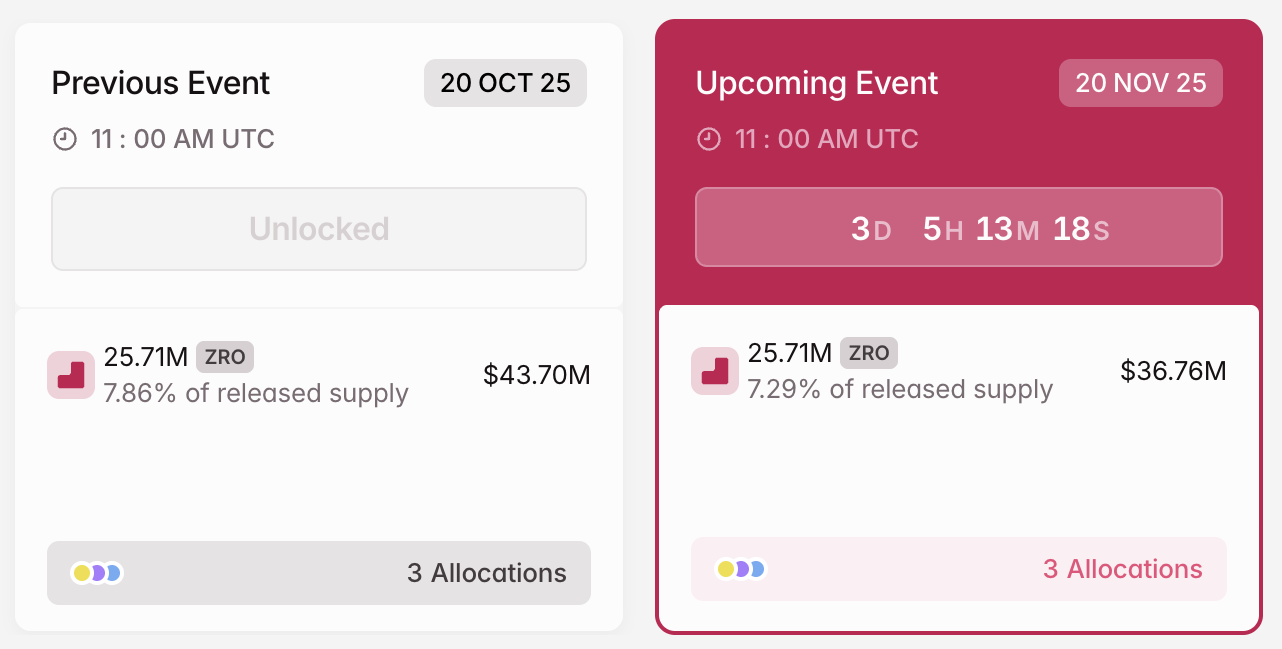
The team will release 25.71 million tokens on November 20, valued at around $36.76 million. The stack accounts for 7.29% of the released supply.

ZRO Crypto Token Unlock in November
ZRO Crypto Token Unlock in November. Source: Tokenomist

LayerZero will award 13.42 million altcoins to strategic partners. Core contributors will get 10.63 million ZRO. Lastly, 1.67 million ZRO are for tokens repurchased by the team.

2. Soon (SOON)

  • Unlock Date: November 23
  • Number of Tokens to be Unlocked: 15.21 million SOON (1.54% of Total Supply)
  • Current Circulating Supply: 281.1 million SOON
  • Total Supply: 984.1 million SOON

SOON is a high-performance Solana Virtual Machine (SVM) Rollup, designed to implement the Super Adoption Stack. It includes three main components: SOON Mainnet, SOON Stack, and InterSOON.

The network will unlock 15.21 million SOON on November 23. The stack represents 4.33% of the released supply and is worth $28.29 million.

SOON Crypto Token Unlock in November
SOON Crypto Token Unlock in November. Source: Tokenomist

SOON will keep 8.3 million tokens for an airdrop to non-fungible token (NFT) holders. The team will also award 4.17 million coins to the ecosystem. Furthermore, it will allocate 2.22 million SOON for community incentives and 520,830 tokens for airdrop and liquidity.

3. YZY (YZY)

  • Unlock Date: November 19
  • Number of Tokens to be Unlocked: 37.5 million YZY (3.75% of Total Supply)
  • Current Circulating Supply: 129.99 million YZY
  • Total supply: 1 billion YZY

YZY is a cryptocurrency token associated with the rapper Ye (formerly known as Kanye West). It is positioned as part of the broader “YZY MONEY” ecosystem, which includes the YZY token, a payment platform called Ye Pay, and a physical YZY Card.

On November 19, YZY will unlock 37.5 million tokens worth around $14.35 million. The tokens represent 12.5% of the circulating supply. 

YZY Crypto Token Unlock in November
YZY Crypto Token Unlock in November. Source: Tokenomist

Furthermore, it marks the project’s first unlock since its token generation (TGE) event in August. Yeezy Investments LLC will receive the entire supply of tokens.

In addition to these, other prominent unlocks that investors can look out for in the third week of November include ZKsync (ZK), KAITO (KAITO), ApeCoin (APE), and more, contributing to the overall market-wide releases.

The post 3 Token Unlocks to Watch in the Third Week of November 2025 appeared first on BeInCrypto.

  •  
❌