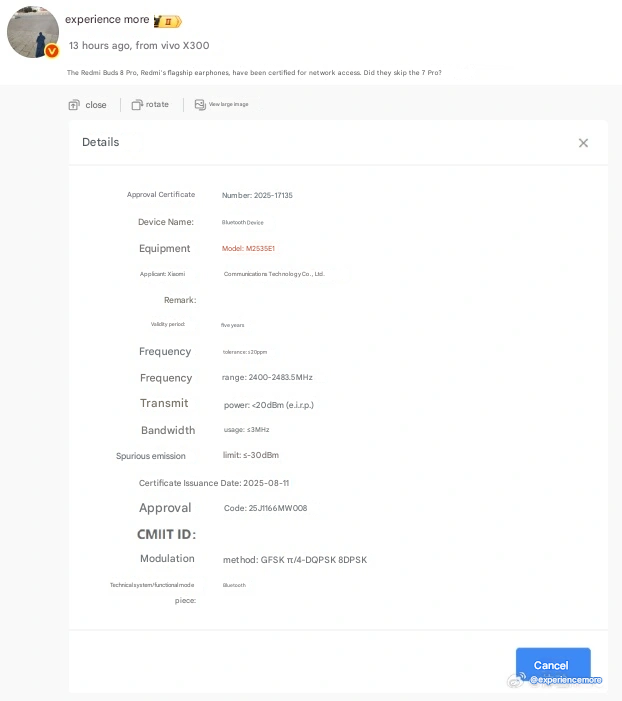
A new Xiaomi audio product has now made an appearance in China’s regulatory listings, hinting at an imminent addition to the firm’s wireless earphone portfolio. The gadget, bearing model number M2535E1, cleared the Ministry of Industry and Information Technology’s radio approval in August. If tipster @experiencemore is anything to go by, this model is actually part of the upcoming Redmi Buds 8 Pro, meaning Xiaomi is getting ready with a refresh of their popular mid-tier TWS series.
The certification only means that the Redmi Buds 8 Pro has passed essential regulatory procedures in China. This generally precedes the public announcements, which means that this product is going to hit the market soon. Xiaomi has not confirmed specifications, but from the given certification, it is certain that the development is finished and mass production probably started, too, which speaks volumes about how quickly this company expands its ecosystem.
Xiaomi has not yet announced the launch date or price of the Redmi Buds 8 Pro, but given the timing of certifications and based on previous product launches, an official announcement might be coming quite soon. Positioned as an affordable yet technically rich offering, the Redmi Buds 8 Pro should contribute to firming up Xiaomi’s mid-segment audio lineup and retain support for the company’s HyperConnect ecosystem.
Xiaomi HyperOS offers a fast and modern system design, but many users want deeper customization and smoother performance. With a few advanced optimizations, it is possible to enhance imaging quality, improve responsiveness, and create a cleaner user interface. In this guide, we explore key enhancements such as GCam integration, UI customization, gesture optimization, and ADB-based system tuning.
Enhancing Imaging Performance with GCam
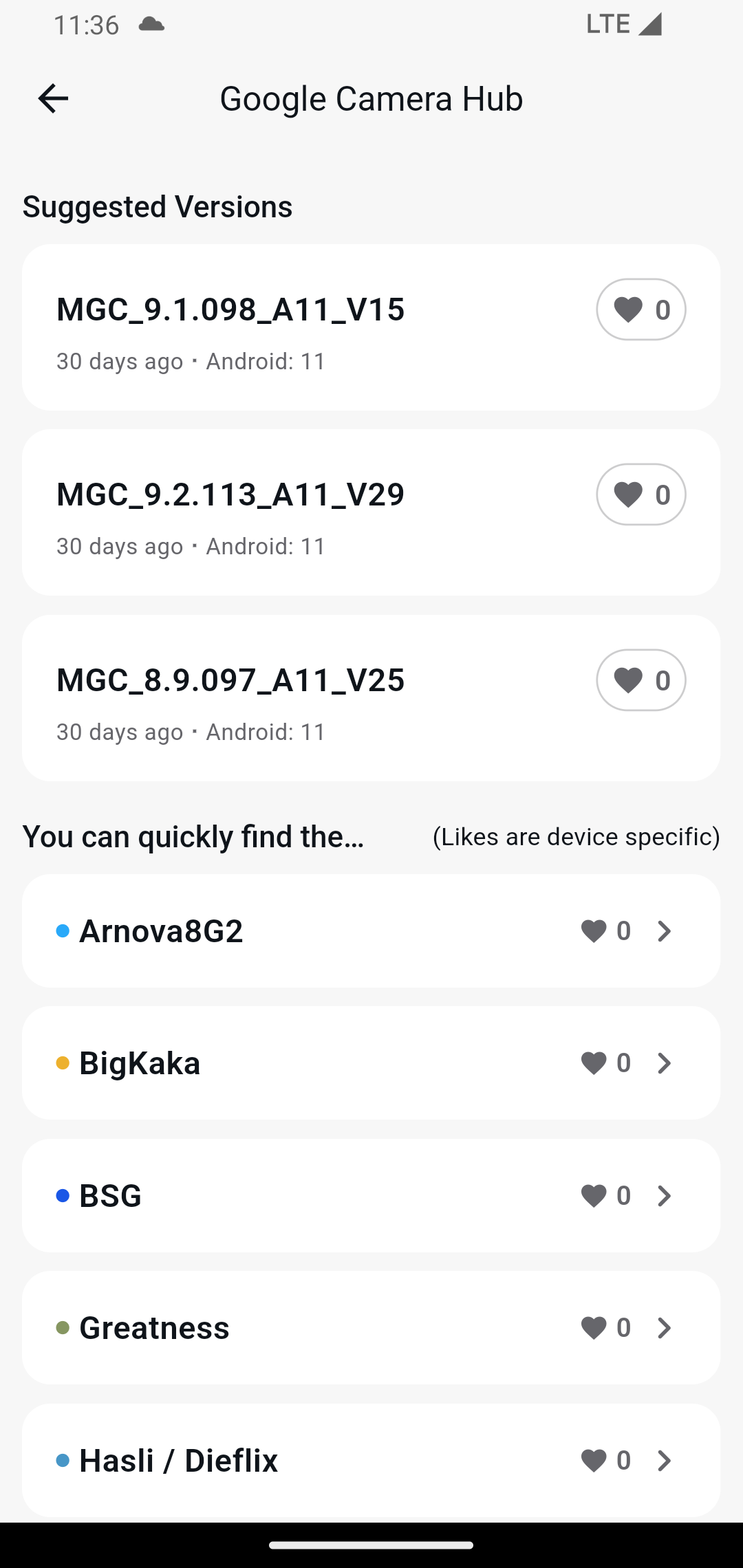
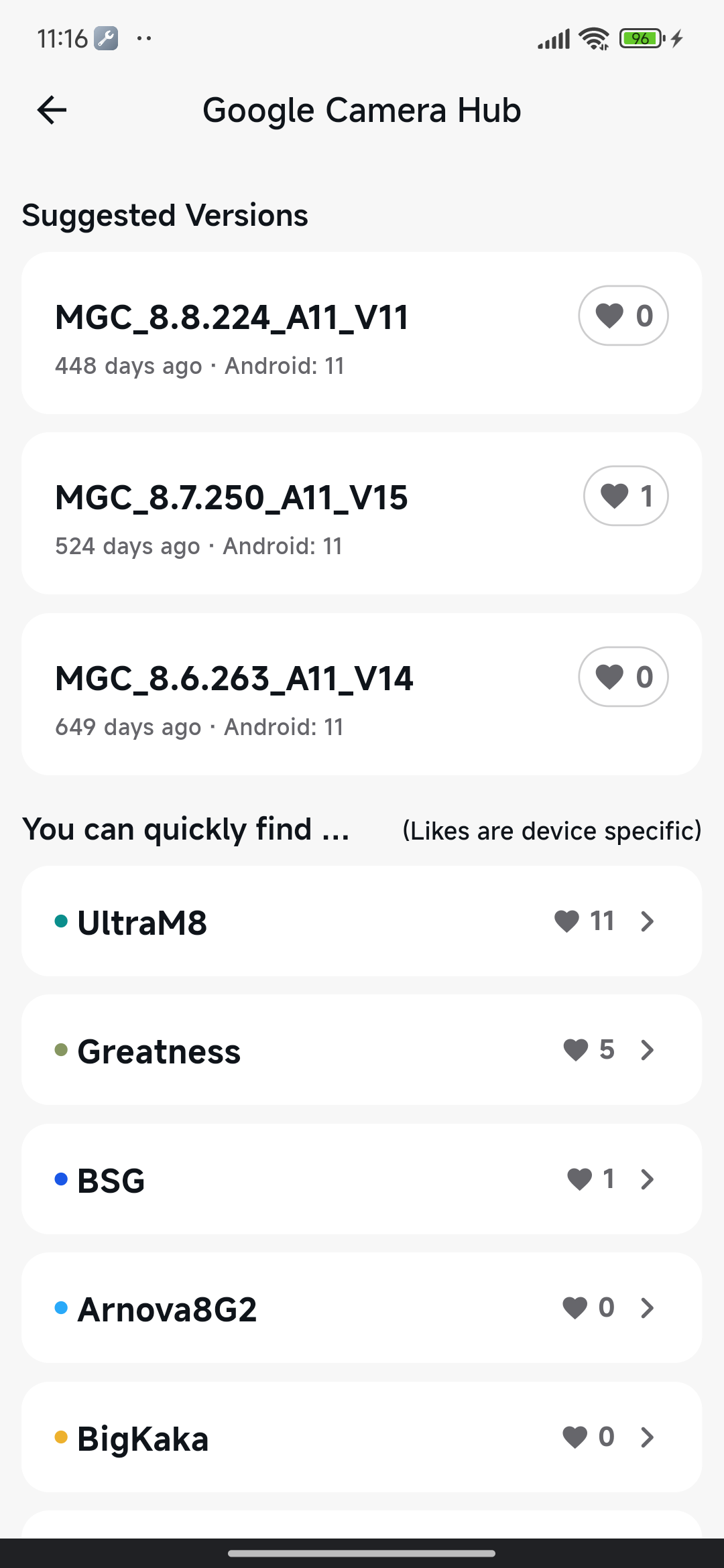
Google Camera (GCam) can significantly improve dynamic range, exposure balance, and night performance on HyperOS devices. Many Xiaomi models benefit from GCam’s HDR+ and Night Sight algorithms, especially when paired with the correct XML configuration.
Installing GCam requires loading the APK and importing an XML profile. The correct configuration ensures proper color tuning, sensor mapping, and advanced feature support. After creating the /GCam/Configs/ directory, users double-tap the viewfinder’s black border to import their XML file. This step ensures correct calibration for Xiaomi’s image signal processor.
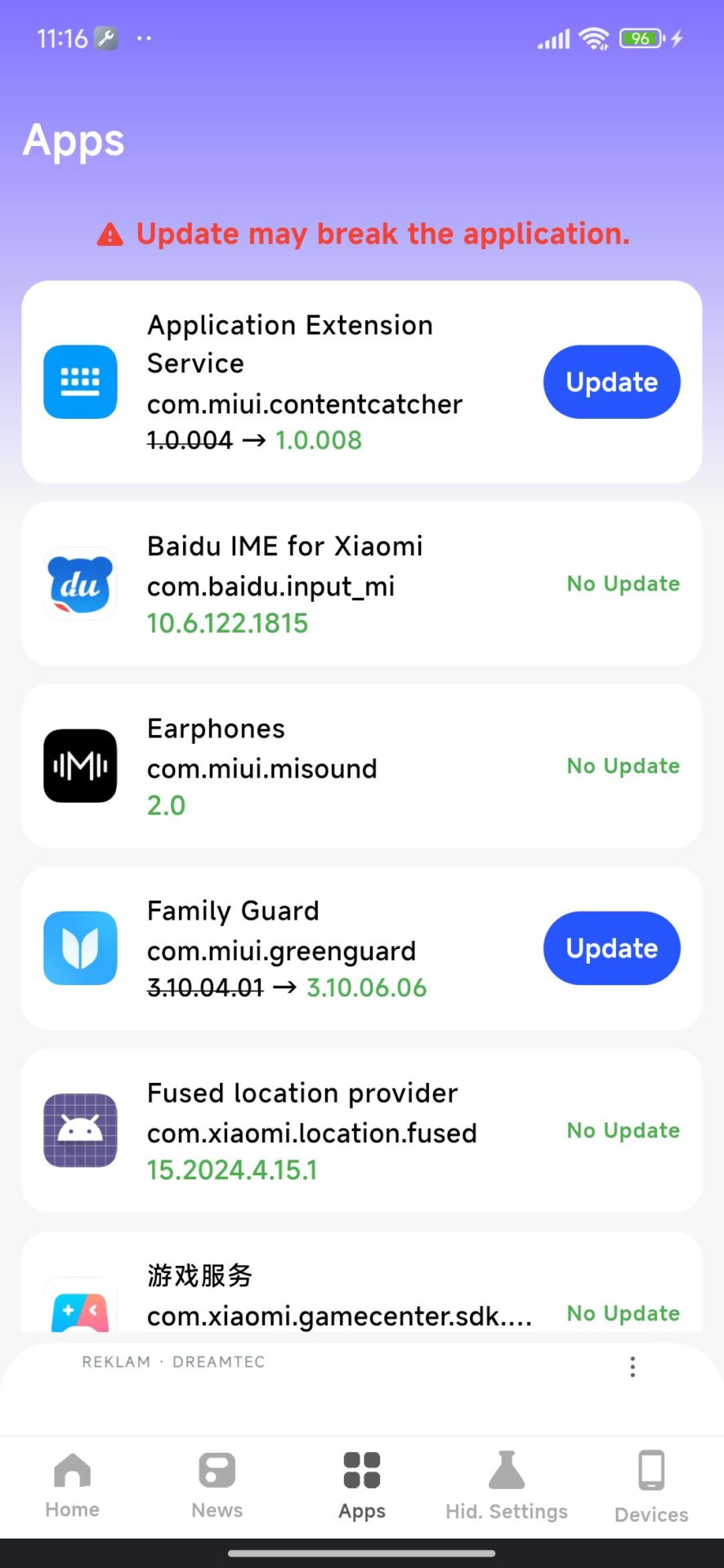
You can use GCamLoader application to get latest GCam.
Customizing the HyperOS Interface
Visual and sound customization tools allow users to make their device more personal and more functional.
Replacing Default Ringtones
HyperOS allows full customization of call tones by importing local audio files. Users simply navigate to Settings → Sound & Vibration to select or upload new tones. For dual-SIM devices, HyperOS also supports assigning different tones per SIM, increasing clarity in daily use.
Enabling Dynamic Animated Weather Wallpapers
HyperOS sometimes limits animated weather wallpapers on mid-range devices to preserve resources. Installing the Weather package restores full high-resolution animations. This version is originally designed for Xiaomi tablets but works effectively across HyperOS smartphones.
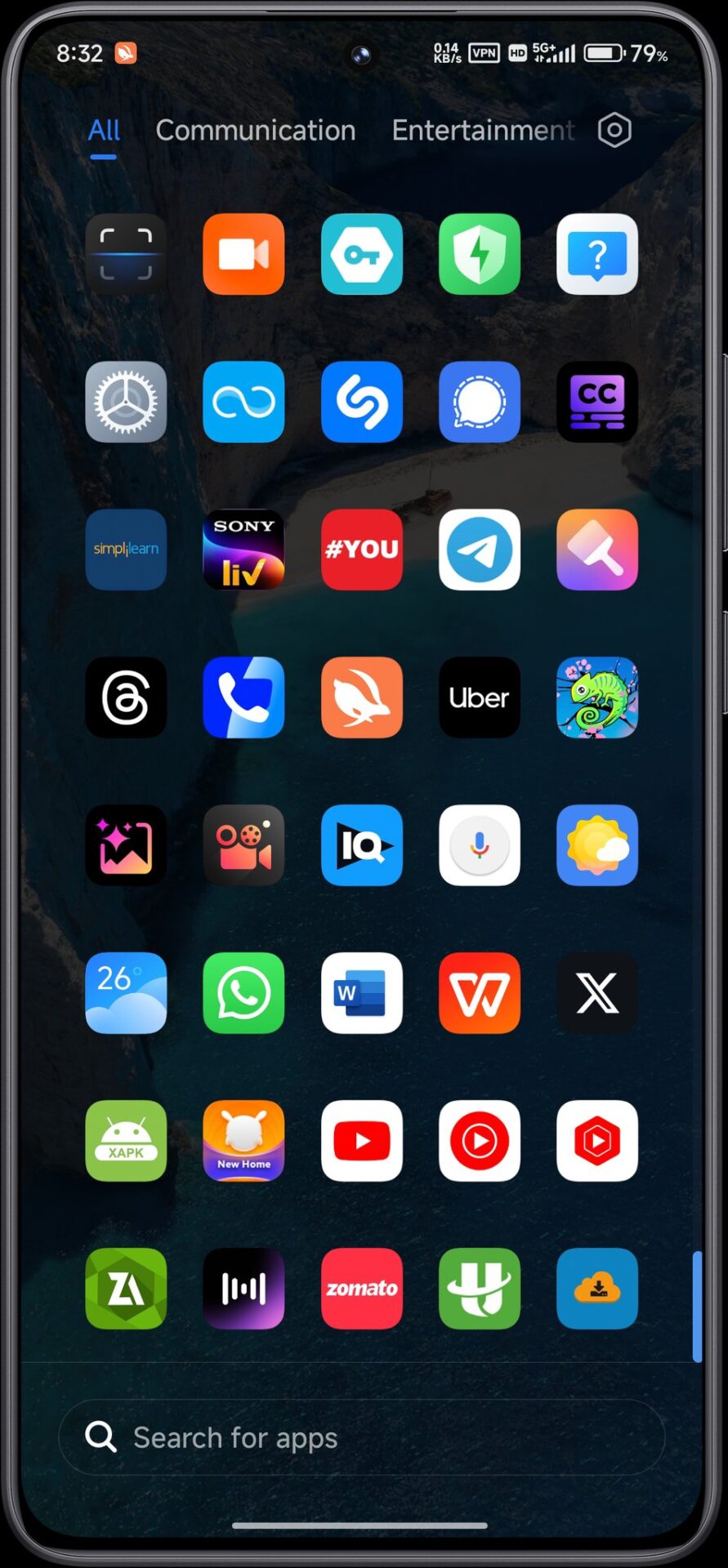
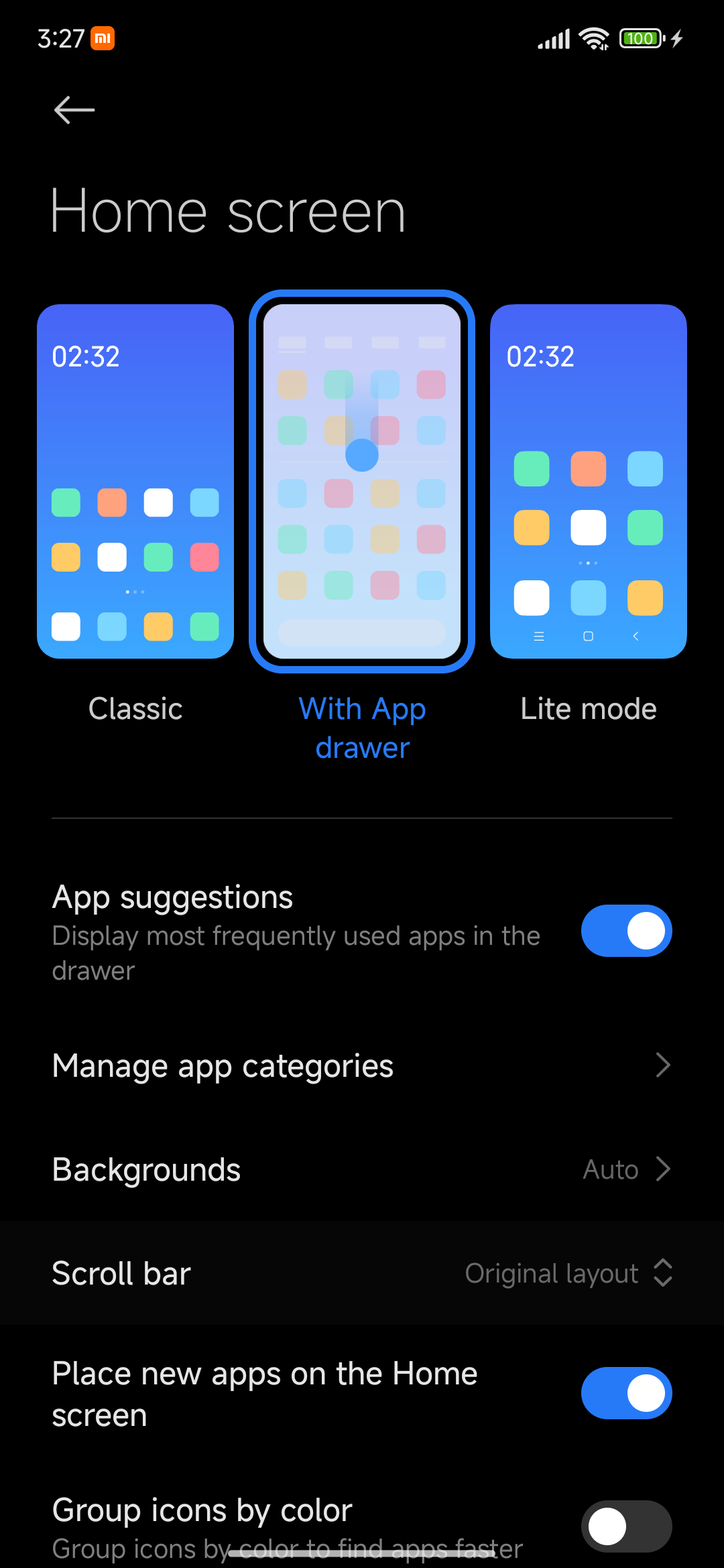
Switching to the App Drawer Layout
Users can enable App Drawer mode by going to Home Screen Settings → With App Drawer. This mode offers visual organization tools, category management, and a cleaner home layout.
Optimizing Gestures and Launchers
HyperOS restricts full-screen gesture support when third-party launchers are set as default. Power users often bypass this limitation using specialized methods. Tools such as Fluid Navigation Gestures (FNG) provide gesture overlays using Android Accessibility Services. This avoids system exploits while offering customizable swipe controls.
Deep System Optimization with ADB Debloating
ADB debloating removes unnecessary applications, improving RAM efficiency and reducing background power consumption. This method is safe when applied carefully and allows users to reinstall removed packages at any time.
Performance improvements in HyperOS depend on both visual settings and system balancing features.
Animation Scale Adjustments
Setting Window, Transition, and Animator scales to 0.5x creates an instantly snappier user experience. These changes reduce visual delay without impacting actual performance levels.
Using Performance Modes
HyperOS provides both automatic smart performance balancing and a high-power Performance Mode for demanding tasks such as gaming. Users can activate it via Settings → Battery → Performance Mode.-
Improving the Xiaomi HyperOS experience is a blend of thoughtful customization, correct tool usage, and ongoing system maintenance. By integrating GCam, fine-tuning visual and gesture settings, and carefully applying ADB optimizations, users can achieve a faster, cleaner, and more refined HyperOS environment. With responsible adjustments and regular system updates, HyperOS becomes a flexible, high-performance platform suitable for both casual and advanced users.
Driving forces behind Xiaomi’s rapid global expansion include a unique strategic model, fusing cost leadership with ecosystem integration and profitable internet services. This structure, often referred to as the company’s “Iron Triangle,” links hardware and AIoT devices with high-margin digital services into one coherent growth engine. You can learn more about Xiaomi devices on our related pages: Xiaomi 15 series, HyperOS features, and Xiaomi AIoT ecosystem**. In aggregate, these elements create a sustainable competitive advantage that fosters user loyalty and underpins sound financial performance.
The Foundations of Xiaomi’s Growth Model
Its expansion is underpinned by a business architecture designed to balance high volume, competitive pricing with integrated digital services. This model allows the company to deliver stable growth while maintaining profitability across diverse market segments.
Cost Leadership and Margin Commitment
Xiaomi’s long-term commitment to maintaining net profit margins for hardware at a level below 5% acts both as a pricing strategy and a tool to gain trust. This limit on margin bolsters consumer confidence, consolidates loyalty, and attracts a global user base with less fluctuation. With reduced marketing expenses, community-driven engagement also enables Xiaomi to redirect some resources into the affordability of devices. This perpetuates demand in emerging markets-especially in regions with prevailing purchasing behaviors driven by value.
Ecosystem Penetration and User Retention
Hundreds of millions of devices are now connected within the AIoT ecosystem of Xiaomi, and smartphones will assume a central position in the interconnected digital environment. Such an architecture creates recurring engagement and reinforces long-term platform stickiness. The increasing number of users possessing five or more devices from Xiaomi represents its deep integration strategy and proves the ability to drive ecosystem-led retention. This integrated approach ensures that users remain within the Xiaomi environment for hardware refresh cycles and internet service consumption alike.
Revenue Structure and Cross-Subsidization Dynamics
Its financial success is closely linked with the “Iron Triangle” model, where Xiaomi maintains stable margins and supports aggressive expansion into new business categories.
Three-Segment Business Architecture
The company operates in three main verticals: It includes:
Smartphones: The largest revenue driver, supported by scale, competitive pricing, and broad global distribution.
AIoT and Lifestyle Products: Fast-growing segment that reinforces ecosystem depth and cross-device experiences.
Internet Services: The highest-margin vertical, driven by MIUI’s user base and integration with the HyperOS ecosystem.
Xiaomi uses a cross-subsidization structure, with hardware working on thin margins, but the business model ensures that the Internet Services bring in enterprise-level profitability. This allows it to sell devices aggressively while maintaining robust consolidated financial results.
Expansion Into EV and AI Industries
Investing in EVs and advanced AI capabilities is a long-term expansion vector for Xiaomi. These new segments are already contributing significantly to revenue, showing the company’s shift from traditional consumer electronics toward multi-industry innovation leadership. Growing R&D capacity supports this transition at Xiaomi, further strengthening imaging technology, processing performance, and software intelligence across product categories.
Global Strategy, Localization, and Market Positioning
With flexible supply chains and fast regional adaptation, the broad global reach of Xiaomi is enabled. The operational agility allows the company to maintain consistent device availability and pricing even during periods of global instability.
Premiumization and Competitive Positioning
Over the last couple of years, Xiaomi has increasingly been making its way into premium segments to take on traditionally strong competitors like Samsung and Apple. This is further helped by advances in imaging, materials engineering, processor architecture, and industrial design. High-end products, such as flagships and foldables, are brand-building vehicles that raise Xiaomi’s perception in mature markets. Premium products also contribute to increasing the overall ASP and decreasing reliance on lower-margin businesses.
International Penetration and Retail Expansion
The offline store expansion strategy of Xiaomi strengthens its presence in Europe, Southeast Asia, and Latin America. In addition, localization efforts support product relevance, maintaining regulatory compliance, and region-specific marketing. This multilayered approach will definitely ensure stronger brand awareness and higher conversion rates across diverse consumer bases.
AIoT Integration & Service Monetization
Xiaomi’s AIoT platform enhances the value chain by connecting smart home devices, apps, and internet services into one unified user experience.
Long-Term Ecosystem Value
With nearly 700 million connected IoT devices, Xiaomi’s ecosystem creates extensive behavioral data and interaction points that feed into personalized services, advertising efficiency, and high-margin digital offerings. The result is that the company will continue to have highly attractive monetization potential across all regions, with a strong predictable revenue stream over and above hardware cycles.
Xiaomi’s internal build progression for HyperOS 3 (Android 16 and 15) provides a detailed view of how the company prepares major system updates across its ecosystem. Current indicators strongly suggest that HyperOS 3 has reached its final Release Candidate stage, positioning eligible devices for stable rollout within the projected window. Users can check update history via HyperOSUpdates. This analysis presents a structured overview of development progress, quality-control phases and distribution expectations.
Internal Software Structure and Release Candidate Verification
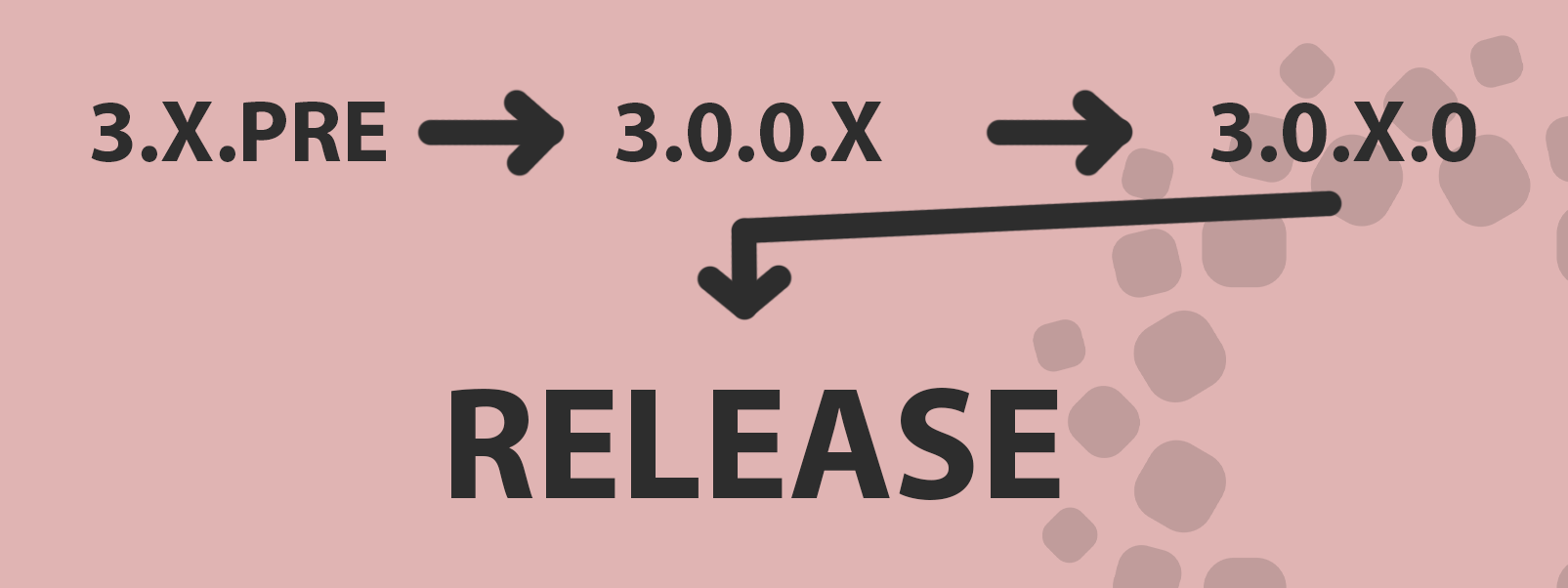
Xiaomi’s HyperOS build naming system offers reliable insight into development status, region targeting, and stability readiness. When a device transitions from the 3.0.X.PRE line to the OS3.0.0.X stable numbering format, the firmware is considered complete at a system-architecture level. The user-observed 3.0.X.0 build is consistent with Xiaomi’s “release-ready” convention and indicates that final verification stages have already been passed internally.
Breakdown of HyperOS Build Anatomy
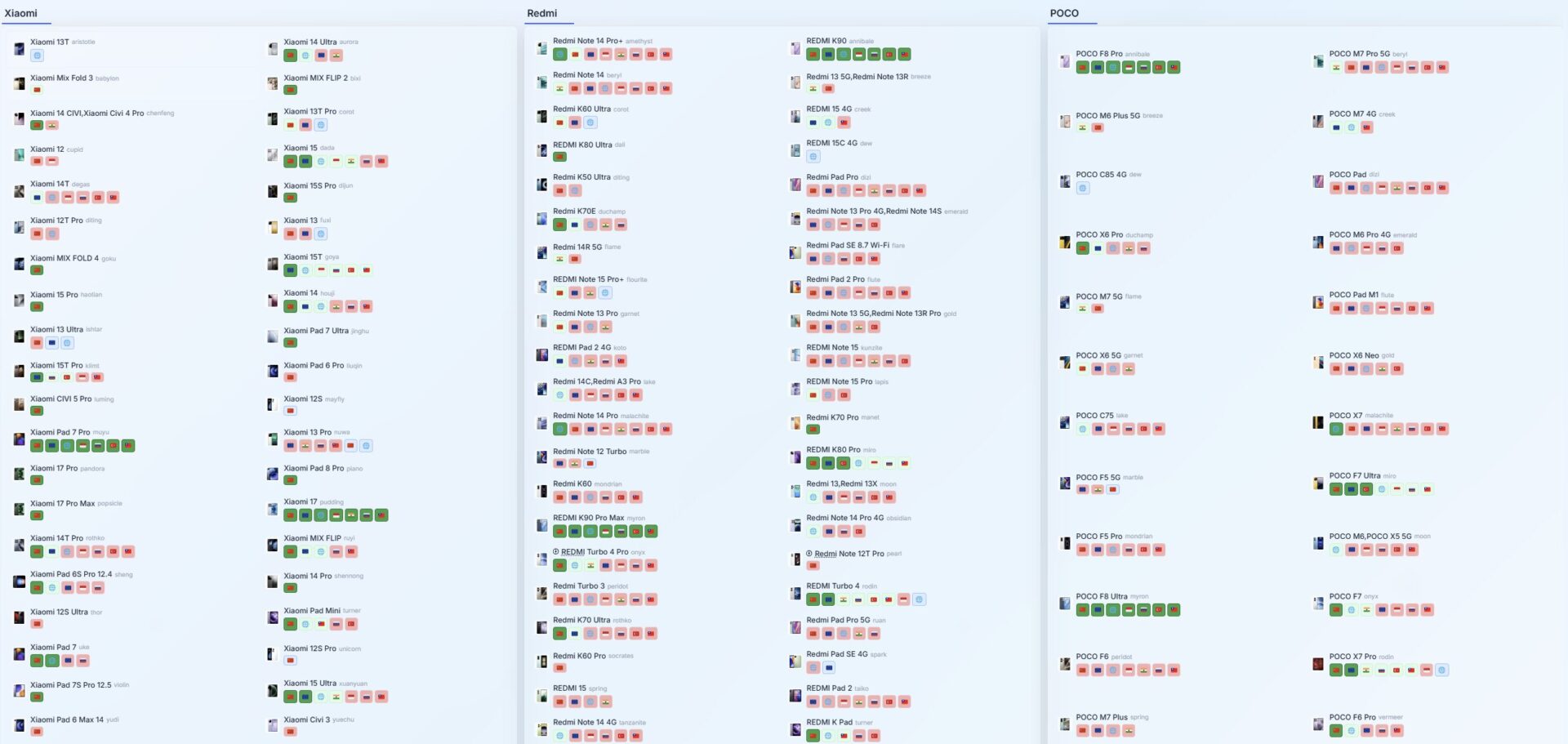
The OS3.0.X.0 prefix defines the major system generation, confirming Android 16 and 15 integration and full feature maturity. Regional suffixes such as EUXM (for EEA) and MIXM (for Global) reflect Xiaomi’s standardized distribution flow. In Turkey, stable builds typically arrive under the TRXM, RUXM, TWXM, INXM, IDXM region code and follow EEA markets with minimal latency. The identified RC build demonstrates that the device has already reached the same structural tier as officially published stable packages for models such as POCO X7 Pro.
HyperOS Development Stages and Time-to-Stable Projection
Xiaomi applies a three-layer development framework before approving any version for mass deployment. Each stage focuses on a different quality vector such as architectural stability, performance refinement, or regional certification.
Overview of Testing Phases
The .PRE Alpha stage validates fundamental kernel integration with Android 16. The 3.0.0.X Beta phase comprises internal testing with extensive feedback from real-world scenarios. The 3.0.1.0 stage is the final milestone before regional rollout begins.
Empirical distribution data from HyperOS 3 deployments shows that the transition from release channel to public OTA commonly takes between one and four weeks. Given the synchronized progress across multiple Xiaomi models, the estimated rollout window of late November to mid-December 2025 remains consistent with Xiaomi’s historical release behavior.
HyperOS 3 Global Rollout Alignment and Market Synchronization
HyperOS 3.0 is scheduled as Xiaomi’s major annual platform update, with staged deployments beginning in China during early October 2025 and extending globally through November. The primary wave includes flagship and priority models such as the Xiaomi 15T series, POCO F7 Ultra and Xiaomi Pad 7.
EEA Benchmarks and other region market impact
The confirmed release of OS3.0.2.0 for POCO X7 Pro users in the EEA region demonstrates complete architectural stability. Historically, Turkey follows EEA by two to four weeks, supported by similar certification requirements and identical HyperOS feature sets. Because Xiaomi has already validated structural integrity across multiple device categories — including foldables, tablets and mid-range platforms — the probability of extended delays for TRXM, RUXM, TWXM, INXM, IDXM builds remains low.
Based on current evidence, HyperOS 3.0’s Release Candidate status confirms that the update is development-complete and awaiting only regional distribution sequencing. With Xiaomi’s ongoing preparations for HyperOS 3.1 already in progress, the company is prioritizing rapid stabilization of the 3.0 release line across all major markets. The expected rollout window of late November to mid-December 2025 aligns fully with Xiaomi’s distribution model and benchmark data from comparable devices.
Those who are really unable to wait for the latest features and improvements of Xiaomi HyperOS, they can update in several ways in advance of the official release. Below is a step-by-step guide to do this on the MemeOS Enhancer, HyperOS Updates Android apps.
How to download HyperOS updates early?
Using 3 different methods you can download HyperOS updates early.
OTA Update Package Download: Download in any of the following sources like XiaomiTime Downloader, HyperOS Updates, or the HyperOS Downloader Android app to get the OTA update package.
Go to Device Settings: Go to Settings, then My Device.
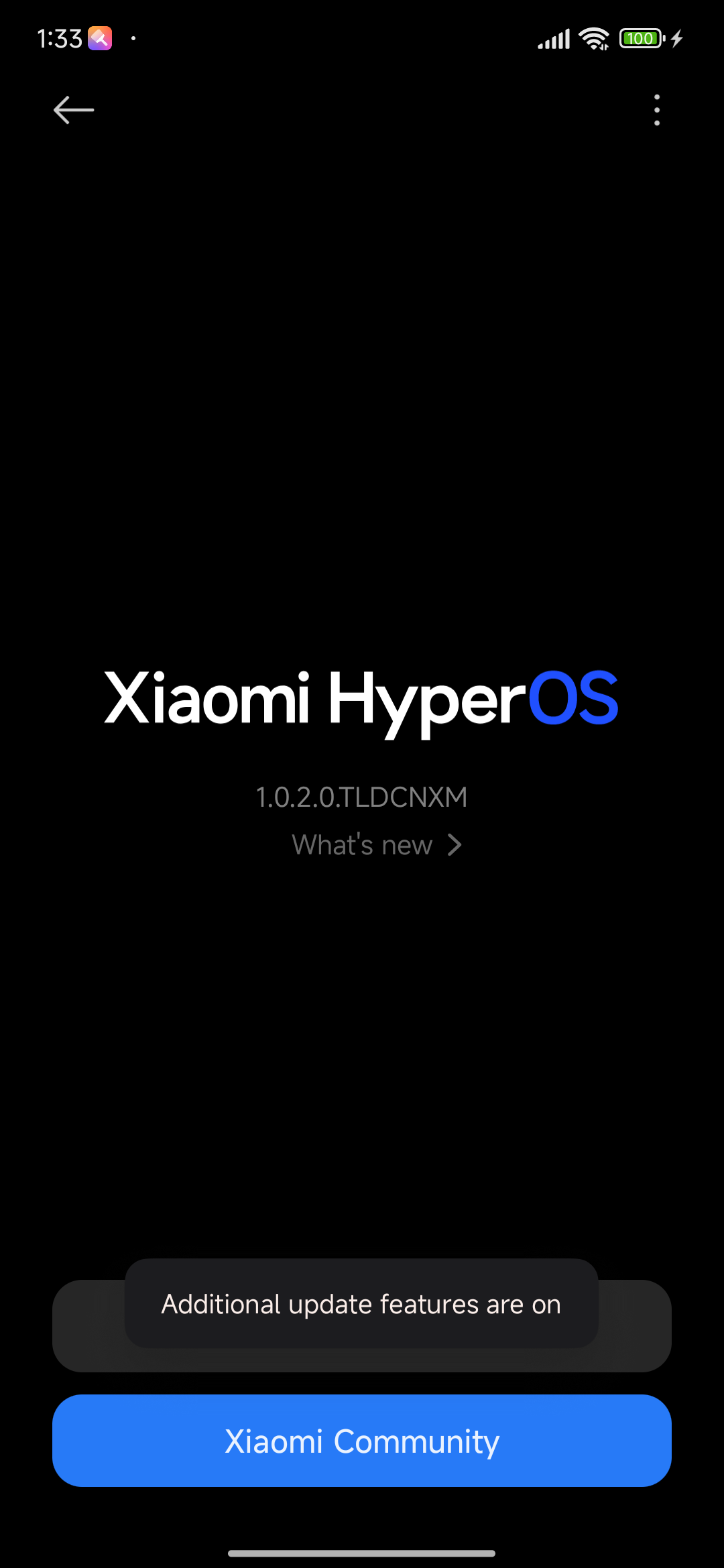
Activate Any Extra Features: Tap on the HyperOS logo multiple times until the message “additional features are on” appears. This will open up more update options.
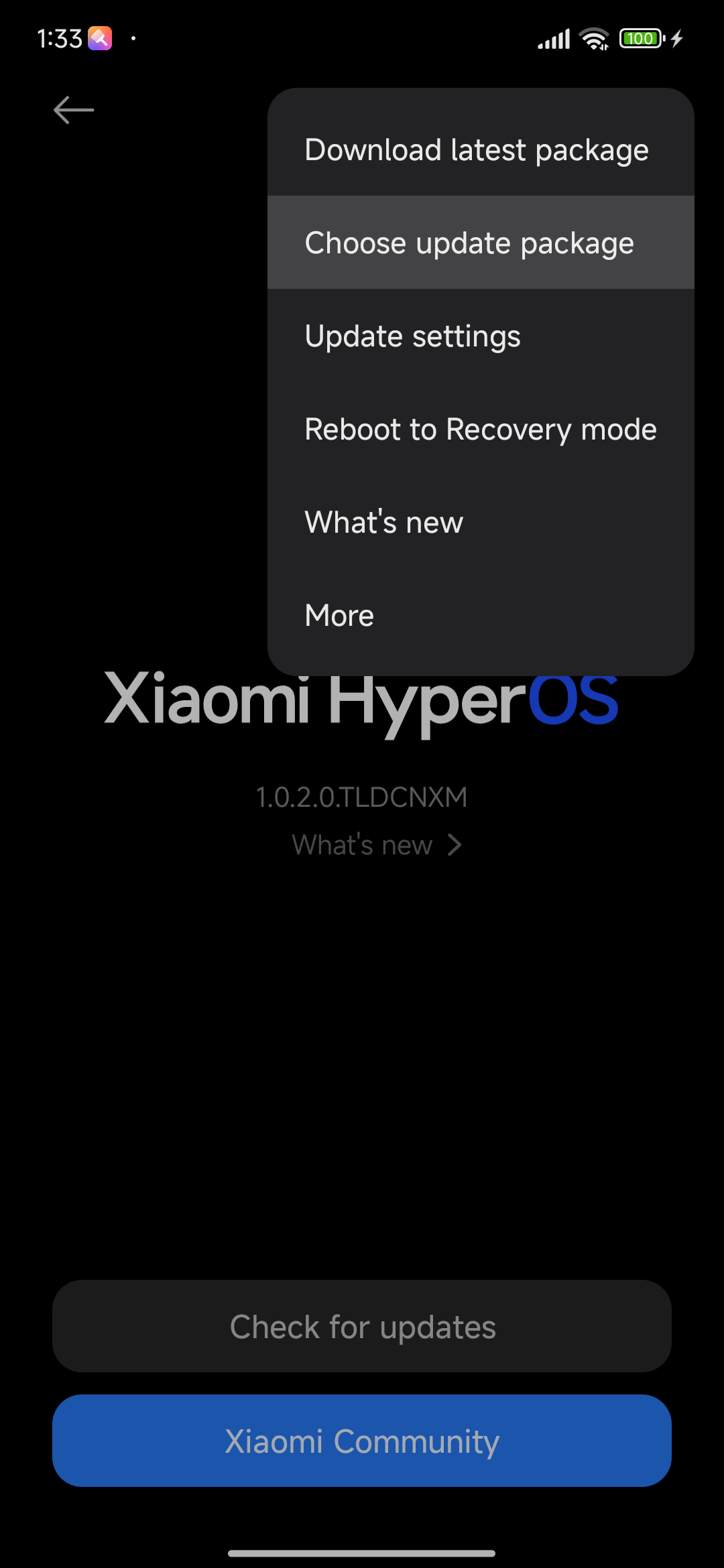
Click on Update Menu: Tap on the update menu by (open the hamburger menu) three horizontal lines.
Select the Update Package: Click on the “Choose update package.” From here, you can manually browse and select the file for updating.
Select Downloaded Package: Browse to the location where you saved the download of the package update and click on it.
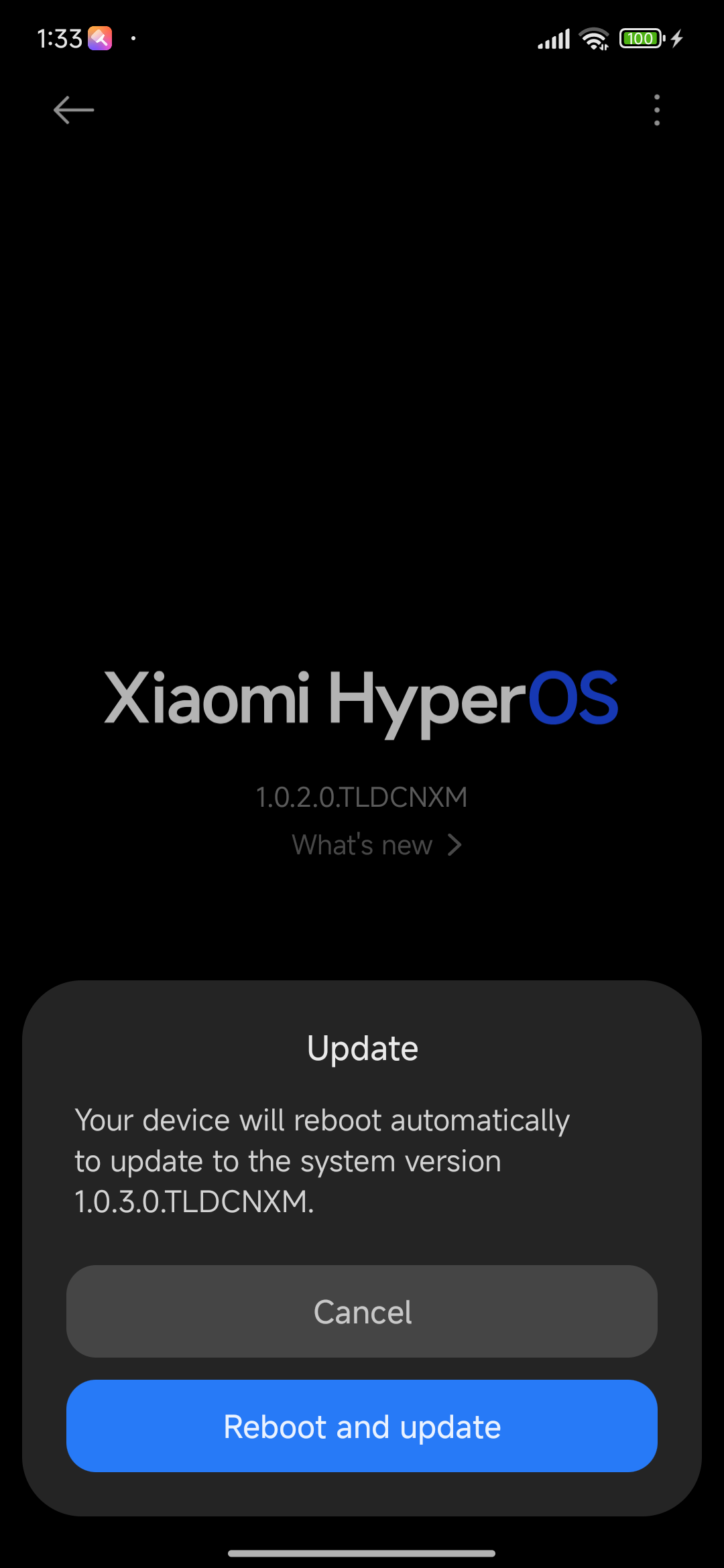
Confirm and Install: The system will ask you to confirm the installation. Tap Update, and the update process will start.
Method 2: Rename Trick V2
If the standard method doesn’t work, you can try this alternative approach. This method will work.
Download necessary files: Download the update file according to your current version number and the new version number that you would like to update to.
Go to Device Configuration: Head towards the path of Settings > My Device and thump your HyperOS logo until you see the “additional features are on” message.
Update Menu: Tap on the hamburger menu and press on the “Change update package”.
Choose the Current Version Package: Choose the package of your software’s current version.
Preparation for Update: Confirm the installation without closing the warning message.
Rename Files: Use file manager, rename the new version Zip file to the present version file name.
Replace Files: Copy the renamed new version file over the current version file.
Finish the Update: After that, go back to the app from the Recent section and tap Update. This is especially helpful for flitting between Mi Pilot ROMs and Stable ROMs or different region.
Method 3: With the Help of HyperCeiler (Root)
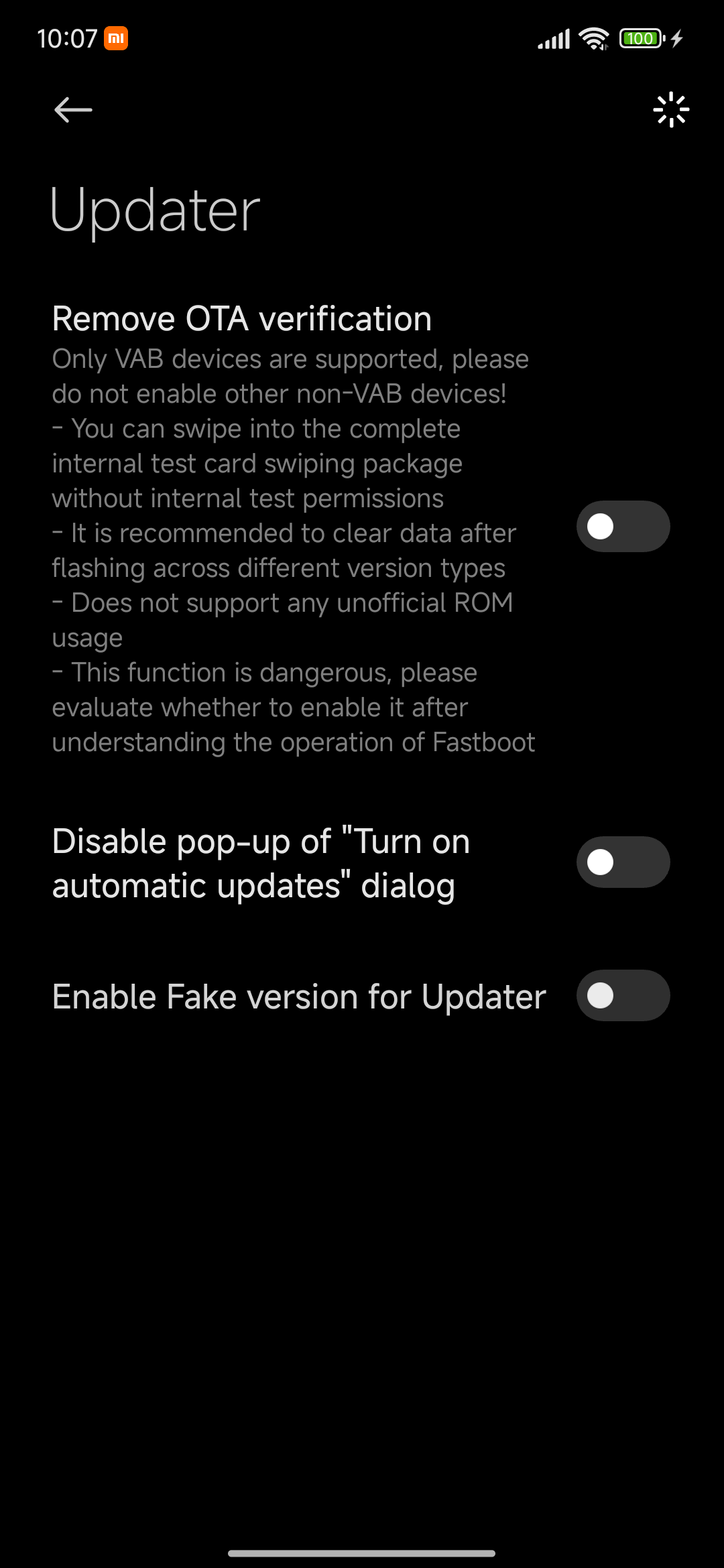
The module HyperCeiler enables bypassing of the version checks for rooted devices. If non-root methods doesn’t work, use this.
Open HyperCeiler: Launch the HyperCeiler app on an Android device.
Disabling Version Check: Go into the HyperCeiler application, navigate under Updater, and enable all options to turn off the version check.
Standard Method Applied: Once the version check is turned off, find out steps in Method 1 on how to implement the update.
Method 4: TWRP Recovery (Root)
TWRP, as in Team Win Recovery Project, is an open-source, custom recovery image for Android devices with a touch-capable interface for ease in handling advanced recovery and installation tasks.
Download the Update Download the update package you want to apply.
Enter TWRP Recovery Turn your phone off. Later, press the power and the volume up buttons simultaneously to power in TWRP recovery mode.
Install Updates In TWRP, tap on Install, then locate the ROM Zip file and select it. Now swipe to flash.
Reboot and Reflash TWRP Once the process finishes, just reboot the system. Note that it may also ask for reflashing TWRP image every time you flash any official update because it often replaces TWRP with Mi-Recovery.
This way, you will always be ahead in class and enjoy the new features of Xiaomi HyperOS prior to the official update release. Enjoy the discovery of new features and improvements!
Xiaomi has updated a new weekly bug report on the Mi Community, clearly detailing the most relevant problems seen across HyperOS and the progress being made in regard to fixing them. This structured report series keeps users informed and provides transparency regarding software stability as the company continues refining its latest system. For readers who want to learn how to send feedback, our How to Report Bugs on HyperOSguide and HyperOS 3 update tracker can help through internal links.
Overview of the Weekly Bug Assessment
The weekly review that Xiaomi issues mentions the current bugs affecting selected devices and their current status regarding the fix. Given the transparency, users are informed on time without speculation. This week’s report, dated 23 November 2025, has listed two major issues that are related to certification and connectivity of recently released models. The company has confirmed that software engineers are already preparing corrective updates.
eSIM and Mobile Data Activation Issue on Xiaomi 15 Ultra
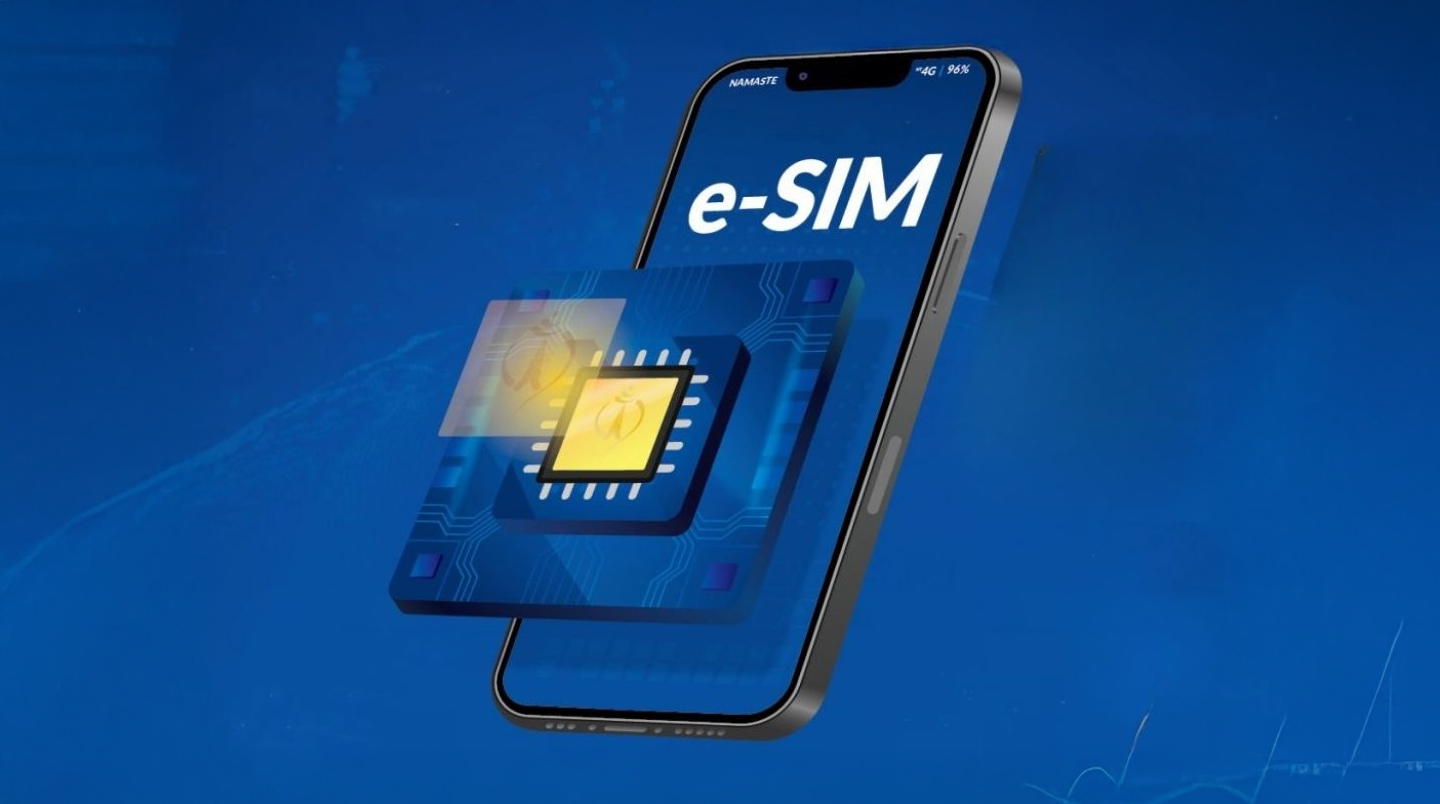
This week’s first reported case involves the Xiaomi 15 Ultra, where users started reporting failures to activate eSIM or access mobile data on the latest HyperOS version, OS3.0.3.0.WOAEUXM. Xiaomi has now provided some insight by stating that the root cause has been fully identified. The fix has already been integrated into the upcoming OS3.0.4.0.WOAEUXM build, which is currently being repacked with the latest November security patch before rollout. The company promised distribution once the final internal validation process is complete to ensure the best standards in terms of safety and performance.
Play Protect Certification Issue on POCO X7 / Redmi Note 14 Pro 5G
The second reported problem affects the POCO X7-also known as Redmi Note 14 Pro 5G in China-where Google Play Protect certification fails to initialize in HyperOS version OS3.0.4.0.WOOMIXM. Because of this, the Google applications may not function as expected. According to Xiaomi’s engineering team, the issue has been officially confirmed and is presently under detailed investigation. Further updates will be shared in future weekly reports once the fix is fully validated and assigned to an upcoming release.
How Users Can Contribute to HyperOS Stability
Xiaomi hopes that its community could continue to provide support in reporting the issues of HyperOS accurately. Users may report bugs using our detailed guide available at the link shown below. Providing structured feedback allows engineers to speed up patch delivery and maintain user experiences stable.
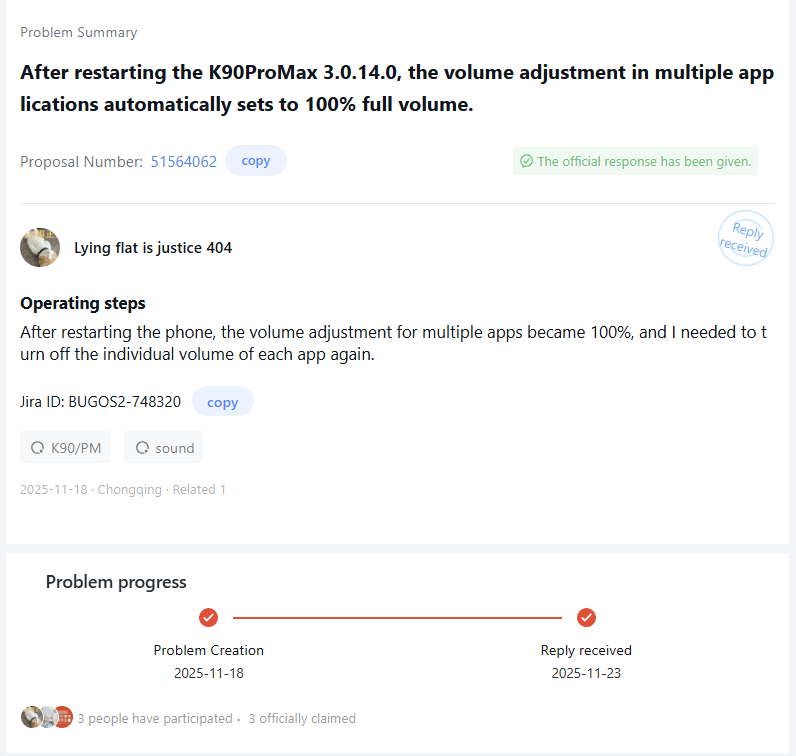
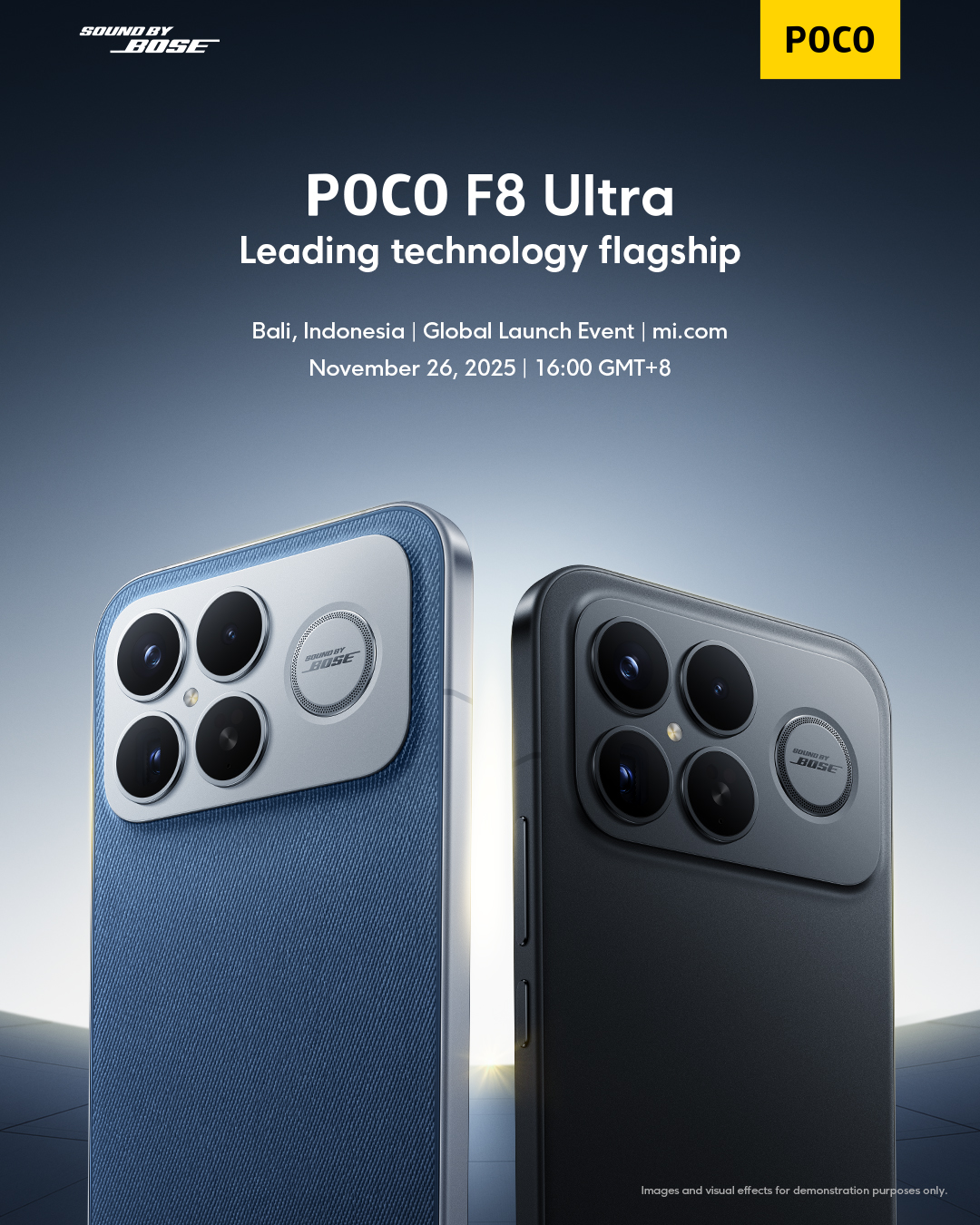
Xiaomi has now officially fixed a major audio bug on the REDMI K90 Pro Max, which is the China-exclusive model that will arrive globally as the POCO F8 Ultra. As per Xiaomi’s bug report platform, the device was returning to maximum volume when certain applications were reopened, which could create an undesirable scenario given the integrated Bose acoustic system.
Xiaomi Addresses the Audio Issue
The core issue included some instances when the volume in the REDMI K90 Pro Max would suddenly increase to full after a restart of particular applications. Considering that the model sports a Bose-tuned rear dual speakers, an unusual vertical layout for better spatial sound, such behavior threatened to cause discomfort for users and to provide inconsistent acoustic performance. Xiaomi’s audio engineering team pinpointed and fixed the problem early this week, which let the global release schedule for the device go forward without further delay.
Why This Fix Was Important
The partnership of Bose on this series with Xiaomi adds premium audio hardware to the smartphone, making any volume irregularities more noticeable. It was seen as important for stable volume management, both for ensuring user safety and market positioning of the phone. The patch ensures consistent output calibration across system processes, resolving the last pending issue before mass deployment.
POCO F8 Ultra Set for Global Introduction
With the audio issue now out of the way, Xiaomi promptly kicked off the marketing sequence for the POCO F8 Ultra. The device will arrive on 26 November 2025, after its China counterpart stabilizes the software. Similar to past generations, the REDMI K-series keeps its China-only status, while the Ultra variant moves outside China under the POCO brand.
Launch Expectations
The POCO F8 Ultra is expected to retain the basic hardware layout of the REDMI K90 Pro Max: Bose-enhanced rear audio, a flagship-class processor from the Snapdragon 8 Elite line, and advanced imaging capabilities on par with Xiaomi’s high-end phones. Xiaomi added that all systems now fall within expected acoustic parameters and that the device is fully ready for consumer release.
The audio fix is added in this release, which points to Xiaomi’s commitment to pre-launch stability, especially for flagship-caliber models with unique hardware configurations. With the final patch applied, the POCO F8 Ultra looks all set for its end-November global debut.

 Login
Login