Reading view

US Crypto CLARITY Act Set for Senate Markup in January

David Sacks, the White House’s AI and crypto czar, said the Digital Asset Market Clarity Act (CLARITY Act) will enter the US Senate markup stage in January, marking a critical step toward final passage.

Sacks said Senate Banking Committee Chair Tim Scott and Senate Agriculture Committee Chair John Boozman have confirmed the timeline, setting the stage for formal review and amendments before a full Senate vote.

We had a great call today with Chairmen @SenatorTimScott and @JohnBoozman who confirmed that a markup for Clarity is coming in January. Thanks to their leadership, as well as @RepFrenchHill and @CongressmanGT in the House, we are closer than ever to passing the landmark crypto…

— David Sacks (@davidsacks47) December 18, 2025

What Happens in January

The update signals growing momentum behind the bill after the House advanced it earlier in 2025. 

If the Senate process stays on schedule, lawmakers could finalize a reconciled version later in the year. This will position the CLARITY Act as the central market-structure law for US crypto markets.

During markup, Senate committees will review the House-passed text line by line. Lawmakers will propose amendments, debate policy trade-offs, and vote on changes before sending a revised bill to the Senate floor. 

The process will involve both the Banking Committee, which oversees securities regulation, and the Agriculture Committee, which supervises the Commodity Futures Trading Commission (CFTC).

🚨 The $CLARITY Act — the U.S. $crypto market structure bill — has been delayed until 2026 as Senate action stalls. This means federal regulatory clarity for digital #assets won’t happen this year, keeping the industry in limbo 📉

No law = more uncertainty
More delay = more… pic.twitter.com/gpuUTMQGUU

— COACHTY (@TheRealTRTalks) December 18, 2025

The goal is to resolve long-standing jurisdictional disputes between the SEC and the CFTC and to strengthen guardrails for spot crypto markets. 

Committee leaders have indicated they want a bill that can attract bipartisan support and avoid reopening enforcement-heavy approaches.

Likely Amendment Focus for the CLARITY Act

Amendments are expected to concentrate on three areas. 

First, asset classification, including tighter criteria for determining when a token qualifies as a digital commodity versus a security. 

Also, investor and consumer protections, such as disclosures, custody standards, and conflict-of-interest rules for exchanges and brokers. 

Lastly, implementation timelines, including how quickly platforms must register and how agencies coordinate supervision during the transition.

Senators may also refine preemption language to limit overlapping state rules without weakening state enforcement authority.

After years of talk, the CLARITY Act now has a real path forward.

The White House and key Senators have finally agreed to move the bill, and they’ve put an actual date on it.

January 2026 is when the Senate plans to formally debate it, amend it, and try to push it toward… https://t.co/Uq9BIOQGLx pic.twitter.com/251ij1zE5i

— Milk Road (@MilkRoad) December 18, 2025

How will the CLARITY Act Change US Crypto Markets in 2026?

If enacted, the CLARITY Act would reshape the US crypto market in 2026. It would place spot digital commodity markets under CFTC oversight, end years of regulatory ambiguity, and create a federal registration regime for exchanges, brokers, and dealers. 

For the industry, this would reduce legal uncertainty, support institutional participation, and shift compliance from courtroom battles to rule-based supervision.

For regulators, the law would replace fragmented enforcement with clearer mandates. 

Most importantly, for the market, it would mark the United States’ first comprehensive framework for crypto trading. This would potentially restore competitiveness with jurisdictions that already offer regulatory clarity.

The post US Crypto CLARITY Act Set for Senate Markup in January appeared first on BeInCrypto.

  •  

US Inflation Cooled, So Why Did Bitcoin and Stocks Sell Off?

US inflation delivered its biggest downside surprise in months. Yet instead of a sustained rally, both Bitcoin and US equities sold off sharply during US trading hours. 

The price action puzzled many traders, but the charts point to a familiar explanation rooted in market structure, positioning, and liquidity rather than macro fundamentals.

What Happened After the US CPI Release

Headline CPI slowed to 2.7% year over year in November, well below the 3.1% forecast. Core CPI also undershot expectations at 2.6%. 

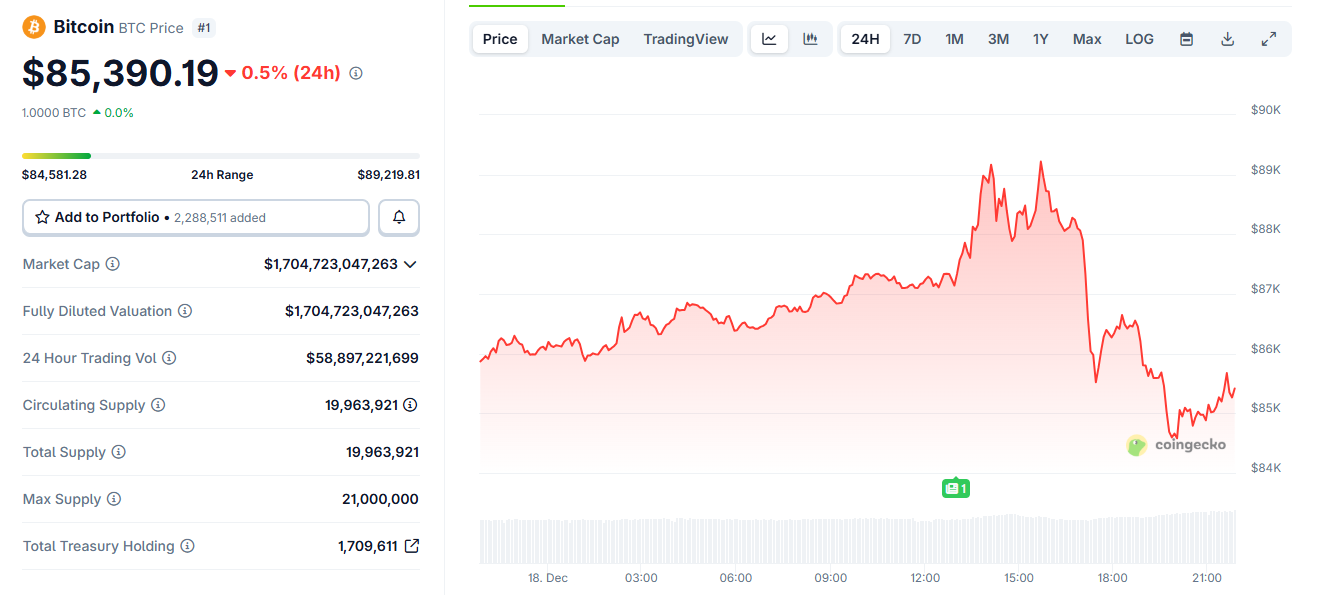
On paper, this was one of the most risk-positive inflation prints of 2025. Markets initially reacted as expected. Bitcoin jumped toward the $89,000 area, while the S&P 500 spiked higher shortly after the data hit.

That rally did not last.

Bitcoin Price Briefly Rallies and Dumps After US CPI Data. Source: CoinGecko

Within roughly 30 minutes of the CPI print, Bitcoin reversed sharply. After tagging intraday highs near $89,200, BTC sold off aggressively, sliding toward the $85,000 area. 

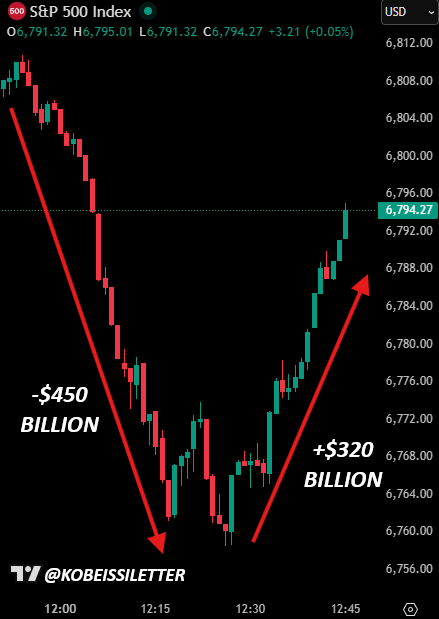
The S&P 500 followed a similar path, with sharp intraday swings that erased much of the initial CPI-driven gains before stabilizing.

S&P 500 Sharply Drops and then Spikes After US CPI. Source: X/Kobeissi Letter

This synchronized reversal across crypto and equities matters. It signals that the move was not asset-specific or sentiment-driven. It was structural.

Bitcoin Taker Sell Volume Tells the Story

The clearest clue comes from Bitcoin’s taker sell volume data.

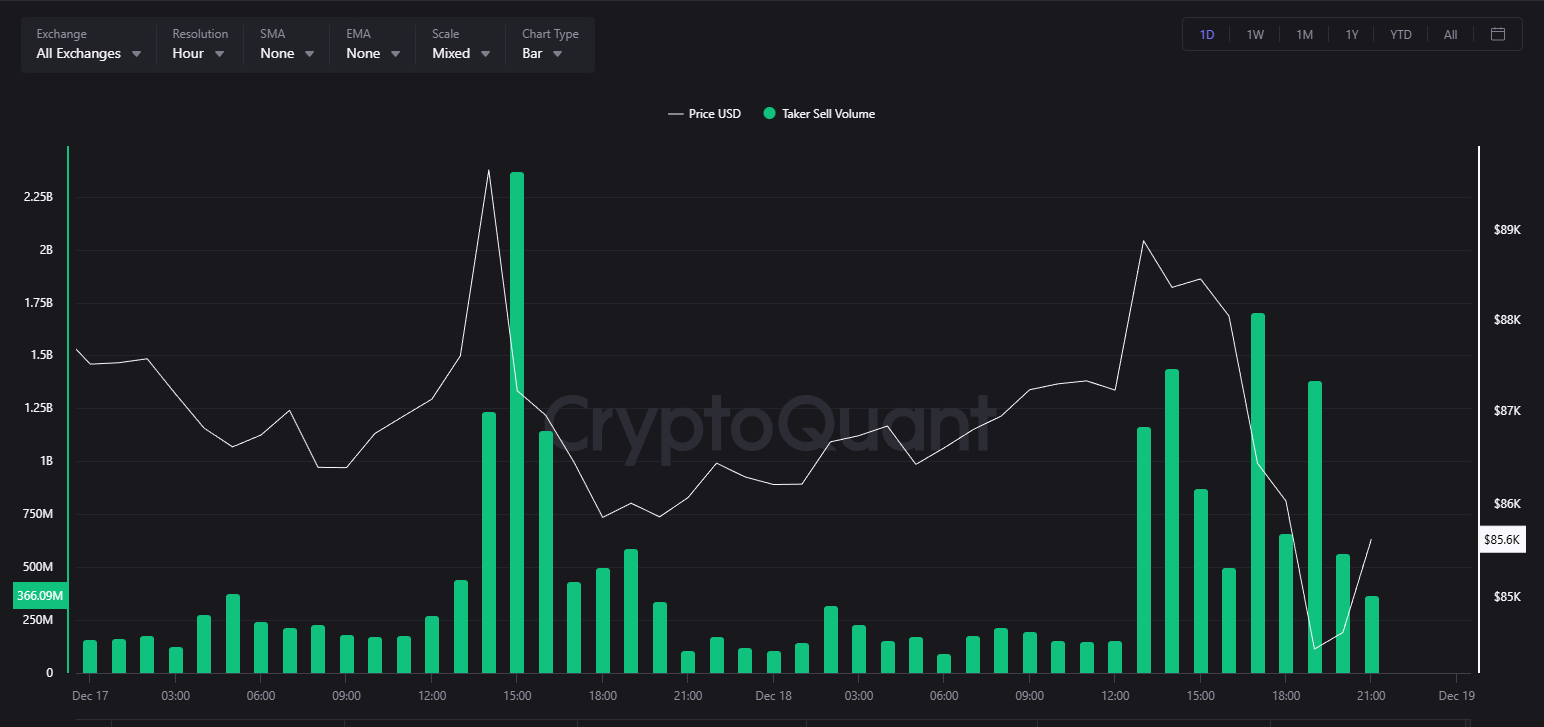
On the intraday chart, large spikes in taker sell volume appeared precisely as Bitcoin broke lower. Taker sells reflect market orders hitting the bid — aggressive selling, not passive profit-taking. 

These spikes clustered during US market hours and coincided with the fastest part of the decline.

Bitcoin Taker Volume Across All Exchanges On December 18. Source: CryptoQuant

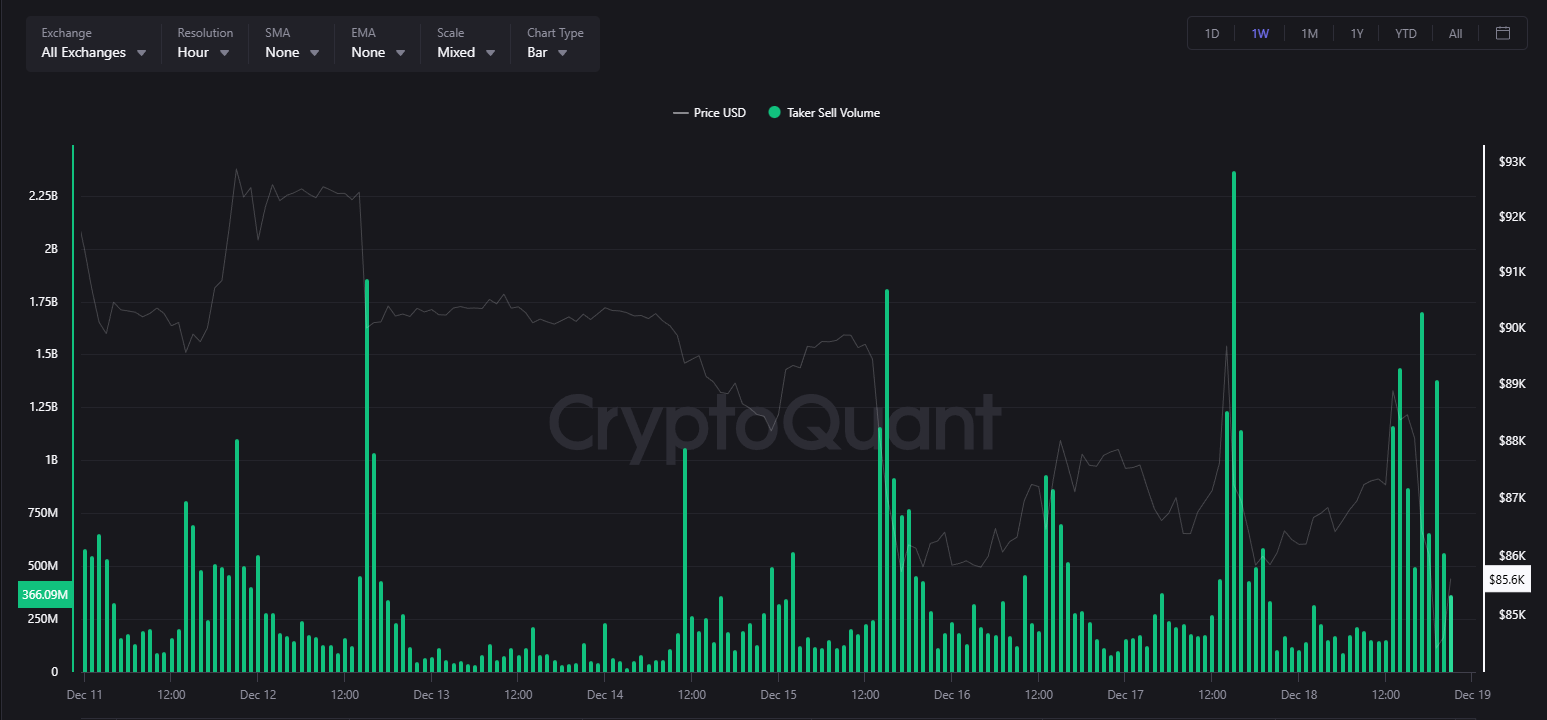
The weekly view reinforces this pattern. Similar sell-side bursts appeared multiple times over the past week, often during high-liquidity windows, suggesting repeated episodes of forced or systematic selling rather than isolated retail exits.

This behavior is consistent with liquidation cascades, volatility-targeting strategies, and algorithmic de-risking — all of which accelerate once price starts moving against leveraged positions.

Bitcoin Taker Volume Across All Exchanges Over the Past Week. Source: CryptoQuant

Why ‘Good News’ Became the Trigger

The CPI report did not cause the selloff because it was bad. It caused volatility because it was good.

Softer inflation briefly increased liquidity and tightened spreads. That environment allows large players to execute size efficiently. 

Bitcoin’s initial spike likely ran into a dense zone of resting orders, stop losses, and short-term leverage. Once upside momentum stalled, price reversed, triggering long liquidations and stop-outs.

As liquidations hit, forced market selling amplified the move. This is why the decline accelerated rather than unfolded gradually.

The S&P 500’s intraday whipsaw shows a similar dynamic. Rapid downside and recovery patterns during macro releases often reflect dealer hedging, options gamma effects, and systematic flows adjusting risk in real time.

🚨 This is insane level of manipulation.

8:30 a.m.

CPI came in lower than expected.

– On the bullish CPI news, Bitcoin pumped $2217, from $87,260 to $89,477 in just 60 minutes.
– $70B added to the crypto market.
– $94 million worth of shorts liquidated.

10:00 a.m.

The… pic.twitter.com/FmJqLDKbBw

— Bull Theory (@BullTheoryio) December 18, 2025

Does This Look Like Manipulation?

The charts do not prove manipulation. But they show patterns commonly associated with stop-runs and liquidity extraction:

  • Fast moves into obvious technical levels
  • Reversals immediately after liquidity improves
  • Large bursts of aggressive selling during breakdowns
  • Tight alignment with US trading hours

These behaviors are typical in highly leveraged markets. The most likely drivers are not individuals, but large funds, market makers, and systematic strategies operating across futures, options, and spot markets. Their goal is not narrative control, but execution efficiency and risk management.

In crypto, where leverage remains high and liquidity thins quickly outside key windows, these flows can look extreme.

🚨 THEY ARE MANIPULATING BITCOIN AGAIN AND I HAVE EVIDENCE!!!

Bitcoin dumped $4000 in minutes…

and almost no one actually understands what just took place.

It’s the same group of players manipulating the price… AGAIN.

Stop looking at charts, YOU NEED TO CHECK THE OUTFLOWS.… pic.twitter.com/ymU4kXdWvb

— NoLimit (@NoLimitGains) December 18, 2025

What This Means Going Forward

The selloff does not invalidate the CPI signal. Inflation genuinely cooled, and that remains supportive for risk assets over time. What the market experienced was a short-term positioning reset, not a macro reversal.

In the near term, traders will watch whether Bitcoin can stabilize above recent support and whether sell-side pressure fades as liquidations clear. 

If taker sell volume subsides and price holds, the CPI data may still assert itself over the coming sessions.

The post US Inflation Cooled, So Why Did Bitcoin and Stocks Sell Off? appeared first on BeInCrypto.

  •  

Fasttoken Rallies Nearly 200% Despite Bearish Crypto Market

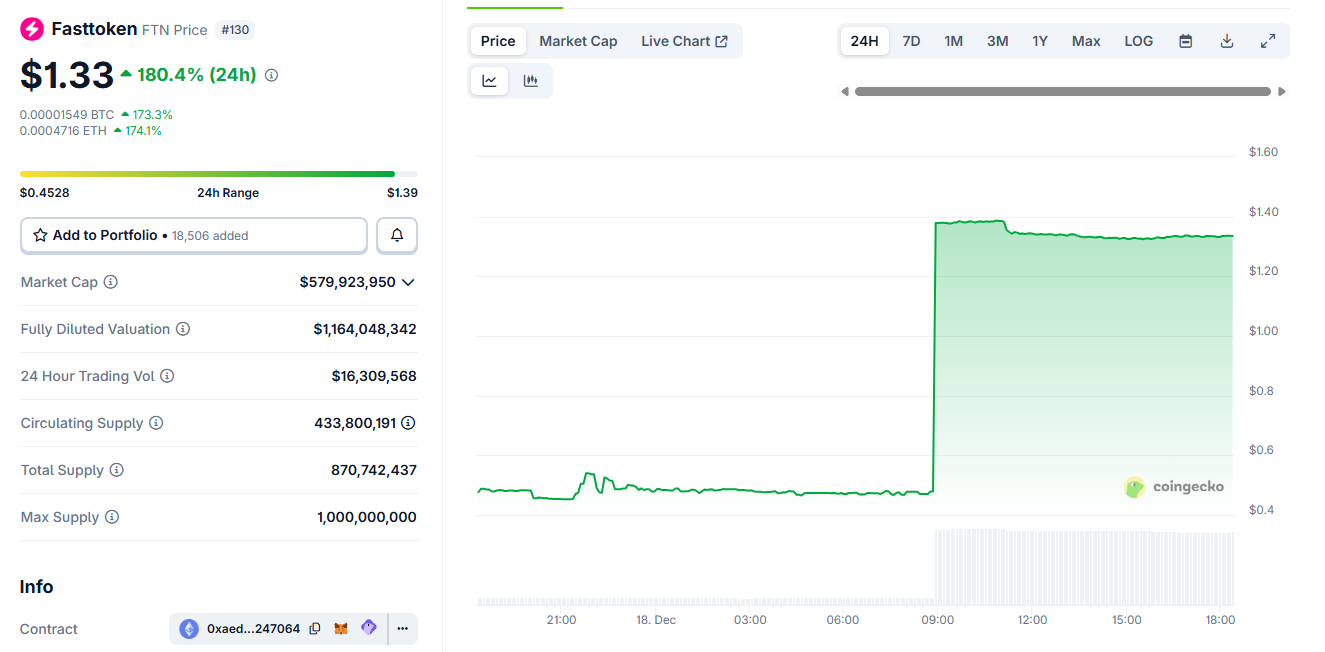
Fasttoken (FTN), the native token of the Fastex ecosystem, surged nearly 200% on December 18, sharply outperforming the broader crypto market, which remained largely in the red.

FTN jumped from around $0.37 to above $1.30 within 24 hours, making it one of the day’s top-performing cryptocurrencies. The rally occurred without any major announcement, pointing to a technical and sentiment-driven move rather than a fundamental revaluation.

Fasttoken Rallies Over 180% on December 18. Source: CoinGecko

What Is Fasttoken (FTN)?

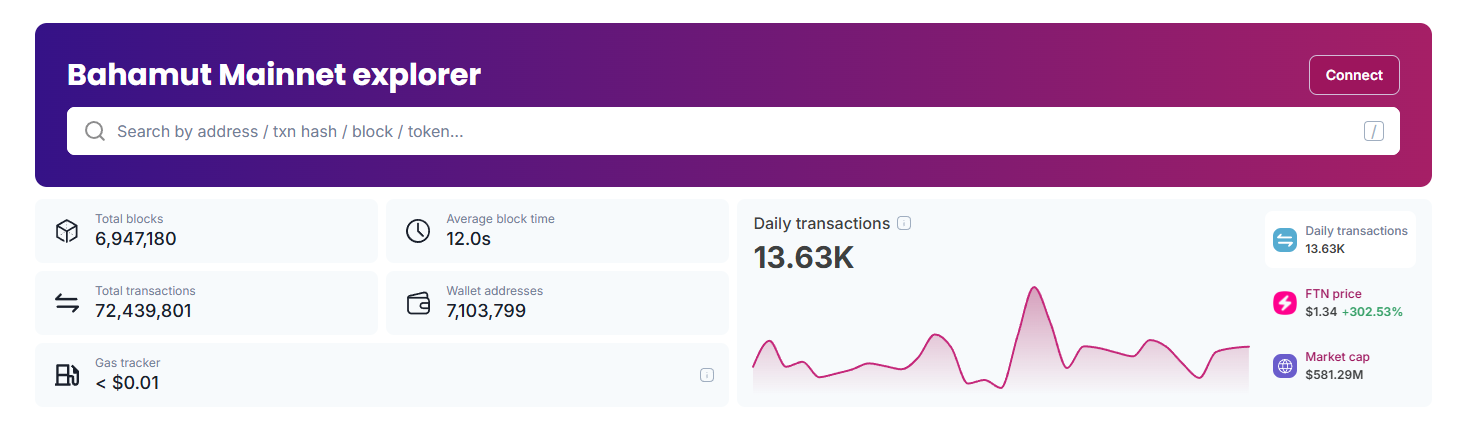
Fasttoken is the utility token of the Fastex ecosystem, developed by SoftConstruct. It powers the Bahamut blockchain, an EVM-compatible Layer-1 network that uses a Proof-of-Stake and Activity (PoSA) consensus model.

FTN is used for transaction fees and staking on Bahamut, payments via Fastex Pay, trading on the Fastex exchange, and NFTs, gaming, and other Web3 applications within the ecosystem

SoftConstruct, Fastex’s parent company, operates across payments, gaming, and IT infrastructure, giving FTN exposure beyond a single product line.

Bahamut Blockchain Stats. Source: FTN Scan

A Difficult 2025 for FTN

The sharp rally follows a brutal decline throughout 2025.

Earlier this year, FTN traded above $2.00, but steadily sold off as:

  • Large token unlocks entered circulation
  • Risk-off sentiment dominated altcoins
  • Exchanges issued warnings, including MEXC’s “Special Treatment” label

By mid-December, FTN had lost over 90% of its value, briefly touching all-time lows between $0.25 and $0.37. Many traders had written the token off.

Why is Fasttoken Rallying Today?

There was no single catalyst behind FTN’s sudden surge. Instead, several factors likely combined to trigger the move.

FTN’s prolonged sell-off created deeply oversold conditions. As the token hit all-time lows, buyers stepped in looking for a short-term recovery play. In thin markets, even moderate buying can lead to outsized price moves.

Fasttoken $FTN is up 216% in the last 24 Hours 😲

For those unaware

-> $FTN is the native crypto of Bahamut, a public EVM-compatible L1 Blockchain
-> The project is developed by SoftConstruct and is part of the Fastex Ecosystem
-> This token painted an upward only chart from… pic.twitter.com/g1QsH0FP0f

— Web3 AjaX 🦅🔥 (@Web3AjaX) December 18, 2025

Earlier this month, concerns emerged after MEXC flagged FTN for potential risk monitoring. By mid-December, no delisting followed. That relief appears to have encouraged traders who were previously sidelined.

FTN trades on a limited number of venues, with liquidity concentrated on a few exchanges. Low liquidity often magnifies volatility, allowing prices to rise rapidly once momentum builds.

The rally also coincided with renewed discussion around Fastex’s broader infrastructure, including Bahamut, Fastex Pay, NFTs, and gaming integrations. While none of these developments were new, they provided narrative support as price momentum accelerated.

✨ Fasttoken ( $FTN ) is flashing some serious warning signs right now.

The chart may look stable on the surface, but the underlying data tells a different story. Liquidity is extremely thin, with only around $3M in total 24h volume across all chains. That’s nowhere near enough… https://t.co/utfR6yfjHz

— Kryptotalker (@kryptotalker) November 20, 2025

No Major Announcement, High Volatility Remains

Despite the sharp gains, there was no official update, partnership, or protocol change announced on December 18. That suggests the rally was driven primarily by technical rebound, market psychology, and short-term speculation.

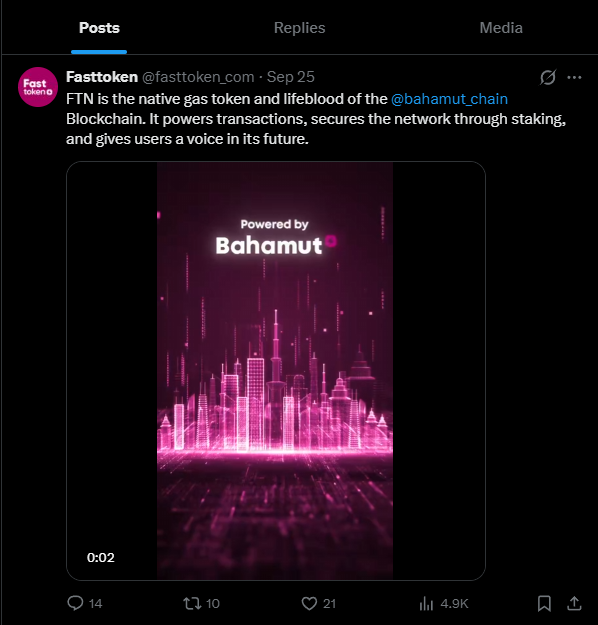
Most notably, Fasttoken’s X (formerly Twitter) account has been inactive since late-September. 

Fasttoken’s Last X Post Was in September

Analysts caution that such rebounds after steep declines can be volatile. FTN still faces future token unlocks and must show sustained usage growth to support higher valuations.

For now, Fasttoken’s surge stands out as one of the most dramatic moves in an otherwise cautious crypto market—but its durability remains uncertain.

The post Fasttoken Rallies Nearly 200% Despite Bearish Crypto Market appeared first on BeInCrypto.

  •  

US Inflation Cools Sharply in November, CPI Misses Forecasts

US inflation slowed more than expected in November, delivering a clear downside surprise that could reshape near-term market and Federal Reserve expectations. According to fresh data released on December 18, the headline Consumer Price Index (CPI) rose 2.7% year over year, well below market expectations of 3.1%.

Meanwhile, core CPI, which excludes food and energy, increased 2.6% year over year, also missing forecasts of 3.0%. The data marks a notable deceleration in price pressures and signals that disinflation momentum has strengthened heading into the end of 2025.

Is This Bullish For Crypto Markets?

The softer-than-expected print reinforces the view that inflation is cooling faster than policymakers and markets anticipated just weeks ago. Core inflation, closely watched by the Federal Reserve, now sits well below 3%—a level last seen before inflation reaccelerated earlier this year.

This print weakens the case for prolonged restrictive monetary policy and strengthens expectations that the Fed may turn more accommodative sooner than previously priced in.

Markets are likely to interpret the data as rate-cut supportive, particularly for early 2026. Lower inflation reduces pressure on real yields and the US dollar—two key headwinds for risk assets in recent months.

Risk markets, including equities and crypto, were already positioned cautiously ahead of the release, suggesting room for sharp repricing as traders digest the data.

Bitcoin and the broader crypto market entered the CPI release in consolidation mode, with traders bracing for volatility. A downside inflation surprise typically acts as a macro tailwind for crypto, as easing inflation expectations improve liquidity conditions and risk appetite.

Short-term price action will now depend on how quickly markets reprice Fed policy expectations and whether follow-through buying emerges after the initial reaction.

What comes next? Attention will shift to:

  • Updated Fed rate-cut probabilities
  • US Treasury yield reactions
  • Dollar strength or weakness
  • Risk-asset follow-through into year-end

For now, November’s CPI report delivers a clear message: inflation cooled faster than expected, and markets will need to adjust quickly.

The post US Inflation Cools Sharply in November, CPI Misses Forecasts appeared first on BeInCrypto.

  •  

Rancangan Undang-Undang CLARITY Aset Kripto AS Siap Dibahas di Senat pada Januari

David Sacks, pejabat AI dan kripto di Gedung Putih, mengungkapkan bahwa Digital Asset Market Clarity Act (CLARITY Act) akan masuk ke tahap markup di Senat AS pada bulan Januari, yang menjadi langkah krusial menuju pengesahan akhir.

Sacks menjelaskan bahwa Ketua Komite Perbankan Senat Tim Scott dan Ketua Komite Pertanian Senat John Boozman sudah memastikan jadwalnya, sehingga tahap peninjauan resmi dan amandemen sebelum pemungutan suara penuh di Senat akan segera dimulai.

We had a great call today with Chairmen @SenatorTimScott and @JohnBoozman who confirmed that a markup for Clarity is coming in January. Thanks to their leadership, as well as @RepFrenchHill and @CongressmanGT in the House, we are closer than ever to passing the landmark crypto…

— David Sacks (@davidsacks47) December 18, 2025

Apa yang Terjadi di Januari

Update ini menunjukkan semakin besarnya dukungan untuk RUU ini setelah DPR mengesahkannya lebih awal pada tahun 2025.

Jika proses di Senat sesuai jadwal, para legislator bisa saja merampungkan versi yang telah disesuaikan pada akhir tahun. Hal ini akan membuat CLARITY Act menjadi undang-undang utama tentang struktur pasar untuk pasar kripto di AS.

Pada tahap markup, komite-komite Senat akan menelaah teks hasil pengesahan DPR secara rinci. Legislator akan mengusulkan amandemen, memperdebatkan kebijakan, dan melakukan pemungutan suara sebelum mengirim RUU yang telah direvisi ke lantai Senat.

Proses ini akan melibatkan baik Komite Perbankan, yang mengawasi regulasi sekuritas, maupun Komite Pertanian, yang memiliki kewenangan atas Commodity Futures Trading Commission (CFTC).

🚨 The $CLARITY Act — the U.S. $crypto market structure bill — has been delayed until 2026 as Senate action stalls. This means federal regulatory clarity for digital #assets won’t happen this year, keeping the industry in limbo 📉

No law = more uncertainty
More delay = more… pic.twitter.com/gpuUTMQGUU

— COACHTY (@TheRealTRTalks) December 18, 2025

Tujuannya adalah untuk menyelesaikan perselisihan yurisdiksi yang sudah lama terjadi antara SEC dan CFTC sekaligus memperkuat aturan untuk pasar kripto spot.

Pimpinan komite juga menegaskan bahwa mereka menginginkan RUU yang bisa menarik dukungan bipartisan dan tidak ingin kembali mengadopsi pendekatan yang terlalu fokus pada penegakan hukum.

Fokus Amandemen yang Nampaknya Jadi Perhatian untuk CLARITY Act

Amandemen-amandemen diperkirakan akan fokus pada tiga area utama.

Pertama, klasifikasi aset, termasuk kriteria yang lebih tegas untuk menentukan apakah sebuah token masuk kategori komoditas digital atau sekuritas.

Kedua, perlindungan investor dan konsumen, seperti ketentuan pengungkapan, standar kustodi, serta aturan konflik kepentingan untuk exchange dan broker.

Terakhir, jadwal pelaksanaan, termasuk seberapa cepat platform harus mendaftar dan bagaimana koordinasi pengawasan antar lembaga selama masa transisi berlangsung.

Senator juga mungkin memperbaiki ketentuan preemption agar dapat membatasi aturan negara bagian yang tumpang tindih, namun tanpa memperlemah kewenangan penegakan hukum di tingkat negara bagian.

After years of talk, the CLARITY Act now has a real path forward.

The White House and key Senators have finally agreed to move the bill, and they’ve put an actual date on it.

January 2026 is when the Senate plans to formally debate it, amend it, and try to push it toward… https://t.co/Uq9BIOQGLx pic.twitter.com/251ij1zE5i

— Milk Road (@MilkRoad) December 18, 2025

Bagaimana CLARITY Act akan Mengubah Pasar Aset Kripto AS pada 2026?

Jika disahkan, CLARITY Act akan membentuk ulang pasar kripto AS pada 2026. RUU ini akan menempatkan pasar komoditas digital spot di bawah pengawasan CFTC, mengakhiri ketidakjelasan regulasi selama bertahun-tahun, serta menciptakan sistem pendaftaran federal untuk exchange, broker, dan dealer.

Bagi industri, aturan ini akan mengurangi ketidakpastian hukum, mendukung partisipasi institusi, dan mengalihkan urusan kepatuhan dari perselisihan hukum ke pengawasan berbasis aturan.

Bagi regulator, undang-undang ini akan menggantikan penegakan hukum yang terfragmentasi dengan mandat yang lebih jelas.

Paling penting, untuk pasar, aturan ini akan menjadi kerangka kerja komprehensif pertama di Amerika Serikat untuk perdagangan kripto. Hal ini berpotensi mengembalikan daya saing AS dengan yurisdiksi lain yang sudah menawarkan kejelasan regulasi terlebih dahulu.

  •  

Inflasi AS Melandai, tapi Kenapa Bitcoin & Saham Tetap Turun?

Inflasi Amerika Serikat (AS) menghadirkan kejutan paling “ramah risiko” dalam beberapa bulan terakhir. Namun alih-alih memantik reli berkelanjutan, Bitcoin dan pasar saham AS justru tergelincir tajam selama jam perdagangan AS.

Aksi harga ini membuat banyak pelaku pasar mengernyit. Namun, pembacaan grafik mengarah pada penjelasan yang familier: harga digerakkan oleh struktur pasar, positioning, dan likuiditas, bukan oleh perubahan fundamental ekonomi makro.

Apa yang Terjadi setelah Rilis CPI AS

Headline CPI AS melambat ke 2,7% secara tahunan (year on year / YoY) pada November, jauh di bawah konsensus 3,1%. Core CPI juga turun ke 2,6%, melampaui ekspektasi pasar.

Secara teori, ini merupakan salah satu rilis inflasi paling bullish bagi aset berisiko sepanjang 2025. Reaksi awal pasar pun selaras dengan buku teks. Bitcoin melonjak ke area US$89.000, sementara indeks S&P 500 dibuka dengan penguatan tajam pasca-data dirilis.

Namun, reli tersebut ternyata berumur pendek.

Harga Bitcoin Sempat Reli, Lalu Dump Setelah Data CPI AS | Sumber: CoinGecko

Dalam rentang sekitar 30 menit setelah rilis CPI, Bitcoin berbalik arah. Dari puncak intraday di kisaran US$89.200, harga BTC terhempas cepat menuju area US$85.000.

S&P 500 memperlihatkan pola serupa: volatilitas intraday yang menyapu bersih kenaikan awal sebelum akhirnya menemukan keseimbangan kembali.

S&P 500 Anjlok Tajam lalu Melesat Setelah Data CPI AS | Sumber: X/Kobeissi Letter

Pembalikan serempak antara kripto dan saham ini krusial. Ia menandakan bahwa pergerakan tersebut bukan reaksi emosional atau sentimen sektoral, melainkan dinamika struktural lintas pasar.

Volume Jual Taker Bitcoin Membuka Tabir

Petunjuk paling jelas terlihat dari data volume jual taker Bitcoin.

Pada grafik intraday, lonjakan masif volume jual taker muncul tepat saat Bitcoin mulai kehilangan pijakan. Taker sell mencerminkan market order agresif yang langsung menghantam bid, bukan sekadar aksi ambil untung bertahap.

Lonjakan ini terkonsentrasi selama jam perdagangan AS dan bertepatan dengan fase penurunan harga paling curam.

Volume Taker Bitcoin di Semua Exchange pada 18 Desember | Sumber: CryptoQuant

Grafik mingguan mempertegas pola tersebut. Lonjakan serupa berulang dalam beberapa hari terakhir, umumnya saat likuiditas memuncak. Ini mengindikasikan aksi jual yang bersifat paksa atau sistematis, bukan eksodus ritel secara satuan.

Perilaku ini konsisten dengan likuidasi berantai, strategi volatility-targeting, serta de-risking algoritmik—mekanisme yang cenderung mempercepat tekanan jual ketika harga bergerak berlawanan dengan posisi leverage.

Volume Taker Bitcoin di Semua Exchange Selama Seminggu Terakhir | Sumber: CryptoQuant

Mengapa “Kabar Baik” Justru Memicu Tekanan?

Data CPI tak memicu aksi jual karena kualitasnya buruk, melainkan karena terlalu baik.

Inflasi yang melandai memperbaiki kondisi likuiditas, mempersempit spread bid-ask, dan membuka ruang bagi pelaku besar untuk mengeksekusi transaksi berskala besar secara efisien.

Lonjakan awal Bitcoin kemungkinan bertabrakan dengan zona order book yang padat, stop loss, dan leverage jangka pendek. Ketika momentum naik kehilangan tenaga, harga berbalik, memicu stop-out dan likuidasi posisi long.

Begitu likuidasi dimulai, tekanan jual berubah eksponensial. Itulah sebabnya penurunan berlangsung tajam dan cepat, bukan melalui erosi bertahap.

Fluktuasi intraday S&P 500 mencerminkan mekanisme serupa. Pola jatuh cepat lalu pulih mendadak pasca-data makro sering kali terkait dengan lindung nilai dealer, efek gamma opsi, serta penyesuaian risiko sistematis secara real time.

🚨 This is insane level of manipulation.

8:30 a.m.

CPI came in lower than expected.

– On the bullish CPI news, Bitcoin pumped $2217, from $87,260 to $89,477 in just 60 minutes.
– $70B added to the crypto market.
– $94 million worth of shorts liquidated.

10:00 a.m.

The… pic.twitter.com/FmJqLDKbBw

— Bull Theory (@BullTheoryio) December 18, 2025

Apakah Ini Terlihat Seperti Manipulasi?

Grafik tidak membuktikan adanya manipulasi. Namun, ia menampilkan ciri-ciri khas yang kerap diasosiasikan dengan stop-run dan penyerapan likuiditas:

  • Pergerakan cepat ke level teknikal yang sudah jelas
  • Pergerakan balik langsung setelah likuiditas membaik
  • Lonjakan besar aksi jual agresif saat breakdown
  • Kesesuaian waktu yang ketat dengan jam perdagangan AS

Perilaku seperti ini lazim di pasar dengan leverage tinggi. Pemicu utamanya bukan individu, melainkan dana besar, market maker, dan strategi sistematis yang beroperasi lintas futures, opsi, dan spot. Fokus mereka bukan narasi, melainkan efisiensi eksekusi dan manajemen risiko.

Di pasar kripto—di mana leverage tinggi dan likuiditas cepat mengering di luar jam utama—arus semacam ini kerap terlihat ekstrem.

🚨 THEY ARE MANIPULATING BITCOIN AGAIN AND I HAVE EVIDENCE!!!

Bitcoin dumped $4000 in minutes…

and almost no one actually understands what just took place.

It’s the same group of players manipulating the price… AGAIN.

Stop looking at charts, YOU NEED TO CHECK THE OUTFLOWS.… pic.twitter.com/ymU4kXdWvb

— NoLimit (@NoLimitGains) December 18, 2025

Apa Artinya ke Depan?

Penurunan harga ini tidak meniadakan sinyal CPI. Inflasi memang melandai, dan itu tetap mendukung aset berisiko dalam horizon menengah hingga panjang. Yang terjadi lebih menyerupai penataan ulang posisi jangka pendek, bukan perubahan arah makro.

Dalam waktu dekat, perhatian trader tertuju pada dua hal: apakah Bitcoin mampu bertahan di atas zona support terbarunya, dan apakah tekanan jual mereda seiring berakhirnya fase likuidasi.

Jika volume jual taker mulai surut dan harga mampu bertahan, dampak dovish CPI berpotensi kembali merembes ke pasar dalam beberapa sesi mendatang.

Bagaimana pendapat Anda tentang saham dan Bitcoin yang tak naik pasca melandainya data inflasi? Yuk, sampaikan pendapat Anda di grup Telegram kami. Jangan lupa follow akun Instagram dan Twitter BeInCrypto Indonesia, agar Anda tetap update dengan informasi terkini seputar dunia kripto!

  •  

Fasttoken reli hampir 200% meski pasar aset kripto sedang bearish

Fasttoken (FTN), native token dari ekosistem Fastex, melonjak hampir 200% pada 18 Desember dan jauh mengungguli pasar aset kripto secara umum yang masih banyak bergerak di zona merah.

FTN naik dari sekitar US$0,37 ke atas US$1,30 hanya dalam 24 jam, menjadikannya salah satu aset kripto dengan performa terbaik hari itu. Reli ini terjadi tanpa adanya pengumuman besar sehingga menunjukkan bahwa kenaikan harga lebih disebabkan faktor teknikal dan sentimen, bukan karena perubahan fundamental.

Fasttoken Reli Lebih dari 180% pada 18 Desember | Sumber: CoinGecko

Apa Itu Fasttoken (FTN)?

Fasttoken adalah utility token dari ekosistem Fastex yang dikembangkan oleh SoftConstruct. Token ini menjadi sumber daya utama blockchain Bahamut, yang merupakan jaringan layer-1 kompatibel EVM dengan model konsensus Proof-of-Stake and Activity (PoSA).

FTN digunakan untuk membayar biaya transaksi dan staking di Bahamut, pembayaran via Fastex Pay, trading di exchange Fastex, serta untuk NFT, gaming, dan aplikasi Web3 lainnya dalam ekosistem Fastex.

SoftConstruct, perusahaan induk Fastex, beroperasi di bidang pembayaran digital, gaming, dan infrastruktur IT sehingga FTN memiliki eksposur lebih luas dari sekadar satu lini produk.

Statistik Blockchain Bahamut | Sumber: FTN Scan

Tahun 2025 yang Sulit untuk FTN

Reli tajam ini terjadi setelah penurunan besar sepanjang 2025.

Di awal tahun, FTN pernah diperdagangkan di atas US$2,00, namun harga terus turun seiring dengan:

  • Terjadinya cliff unlock token dalam jumlah besar yang masuk sirkulasi
  • Sentimen risk-off yang mendominasi altcoin
  • Exchange memberikan peringatan, termasuk label “Special Treatment” dari MEXC

Pada pertengahan Desember, nilai FTN sudah turun lebih dari 90% sehingga sempat menyentuh harga terendah sepanjang masa di kisaran US$0,25 sampai US$0,37. Banyak trader sempat menganggap token ini sudah tidak layak diperhatikan lagi.

Mengapa Fasttoken reli hari ini?

Tidak ada satu pemicu khusus atas lonjakan FTN ini. Beberapa faktor sepertinya saling berkontribusi menciptakan momentum harga.

Penurunan FTN dalam waktu panjang telah menciptakan kondisi sangat oversold. Ketika token ini menyentuh harga terendah, pembeli mulai masuk untuk mencari peluang reli jangka pendek. Di pasar dengan likuiditas tipis, pembelian biasa saja dapat mendorong harga naik tajam.

Fasttoken $FTN is up 216% in the last 24 Hours 😲

For those unaware

-> $FTN is the native crypto of Bahamut, a public EVM-compatible L1 Blockchain
-> The project is developed by SoftConstruct and is part of the Fastex Ecosystem
-> This token painted an upward only chart from… pic.twitter.com/g1QsH0FP0f

— Web3 AjaX 🦅🔥 (@Web3AjaX) December 18, 2025

Pada awal bulan ini, muncul kekhawatiran setelah FTN diberi label pemantauan risiko oleh MEXC. Tapi hingga pertengahan Desember, tidak ada delisting. Hal ini nampaknya memberi kelegaan bagi trader yang sebelumnya memilih menunggu di pinggir lapangan.

Saat ini FTN hanya diperdagangkan di beberapa exchange saja sehingga likuiditasnya terkonsentrasi dan cukup rendah. Likuiditas rendah seringkali memperbesar volatilitas, sehingga harga bisa melonjak cepat saat ada momentum beli.

Reli FTN juga bertepatan dengan munculnya diskusi baru seputar infrastruktur Fastex secara keseluruhan, termasuk Bahamut, Fastex Pay, NFT, dan integrasi gaming. Walaupun semua pengembangan tersebut bukan kabar baru, hal ini tetap memberi dorongan narasi positif pada saat harga mulai naik cepat.

✨ Fasttoken ( $FTN ) is flashing some serious warning signs right now.

The chart may look stable on the surface, but the underlying data tells a different story. Liquidity is extremely thin, with only around $3M in total 24h volume across all chains. That’s nowhere near enough… https://t.co/utfR6yfjHz

— Kryptotalker (@kryptotalker) November 20, 2025

Tidak Ada Pengumuman Besar, Volatilitas Tetap Tinggi

Meski terjadi lonjakan harga signifikan, pada 18 Desember tidak ada update resmi, kerja sama baru, ataupun perubahan protokol yang diumumkan. Ini menunjukkan reli FTN lebih didorong rebound teknikal, psikologi pasar, dan spekulasi jangka pendek.

Perlu dicatat, akun X (sebelumnya Twitter) milik Fasttoken tidak aktif sejak akhir September.

Postingan X terakhir Fasttoken terjadi pada bulan September

Analis mengingatkan bahwa rebound setelah penurunan tajam seperti ini cenderung volatil. FTN masih menghadapi cliff unlock token di masa depan dan perlu menunjukkan pertumbuhan penggunaan yang berkelanjutan agar valuasinya bisa bertahan lebih tinggi.

Saat ini, lonjakan Fasttoken jadi salah satu pergerakan paling dramatis di tengah market aset kripto yang cenderung hati-hati—tapi masih belum jelas apakah reli ini akan bertahan dalam waktu lama.

  •  

Inflasi AS Turun Tajam di November, CPI Tidak Capai Perkiraan

Inflasi AS melambat lebih besar dari perkiraan pada November, menghadirkan kejutan negatif yang jelas serta bisa mengubah ekspektasi pasar dan The Fed dalam waktu dekat. Berdasarkan data terbaru yang dirilis pada 18 Desember, Consumer Price Index (CPI) utama naik 2,7% secara year on year, jauh di bawah ekspektasi pasar sebesar 3,1%.

Sementara itu, core CPI yang tidak memasukkan makanan dan energi, naik 2,6% secara year on year, juga meleset dari perkiraan sebesar 3,0%. Data ini menunjukkan perlambatan signifikan pada tekanan harga dan menandakan momentum disinflasi semakin kuat menjelang akhir tahun 2025.

Apakah Ini Bullish untuk Pasar Aset Kripto?

Hasil yang lebih rendah dari proyeksi ini memperkuat pandangan bahwa inflasi menurun lebih cepat dibandingkan yang diperkirakan para pengambil kebijakan dan pelaku pasar baru-baru ini. Inflasi inti, yang sangat diperhatikan oleh The Fed, kini berada jauh di bawah 3%—angka yang terakhir kali tercapai sebelum inflasi melonjak kembali awal tahun ini.

Data ini melemahkan alasan untuk mempertahankan kebijakan moneter ketat lebih lama dan memperkuat keyakinan bahwa The Fed bisa jadi akan mengambil sikap lebih akomodatif lebih cepat dari yang sudah diperhitungkan pasar sebelumnya.

Pasar kemungkinan besar akan menafsirkan data ini sebagai pendorong pemangkasan suku bunga, khususnya untuk awal tahun 2026. Inflasi yang lebih rendah mengurangi tekanan pada yield riil dan US dollar—dua hambatan utama bagi aset berisiko dalam beberapa bulan terakhir.

Pasar aset berisiko, termasuk saham dan aset kripto, sebelumnya sudah bersikap hati-hati menjelang perilisan data ini, sehingga masih ada peluang untuk penyesuaian harga yang tajam seiring trader mencerna data baru tersebut.

Bitcoin dan pasar kripto secara umum memasuki momen rilis CPI dalam kondisi konsolidasi, dengan para trader bersiap menghadapi volatilitas. Kejutan penurunan inflasi biasanya menjadi sentimen makro positif bagi aset kripto, karena ekspektasi inflasi yang mulai mereda akan mendukung kondisi likuiditas dan minat risiko.

Pergerakan harga dalam jangka pendek sekarang akan bergantung pada seberapa cepat pasar menyesuaikan ekspektasi terhadap kebijakan The Fed dan apakah pembelian lanjutan akan terjadi setelah reaksi awal tersebut.

Apa yang akan terjadi selanjutnya? Perhatian pasar akan tertuju pada:

  • Update peluang pemangkasan suku bunga oleh The Fed
  • Respon yield Treasury AS
  • Kekuatan atau pelemahan US dollar
  • Pergerakan lanjutan aset berisiko hingga akhir tahun

Untuk saat ini, laporan CPI bulan November memberikan pesan yang jelas: inflasi turun lebih cepat dari perkiraan, dan pasar harus segera menyesuaikan diri.

  •  

Statistik Pembayaran USDT Tether Tunjukkan Kondisi Sebenarnya Adopsi Aset Kripto di 2025

USDT milik Tether memproses pembayaran senilai US$156 miliar untuk transaksi US$1.000 atau kurang di tahun 2025, menurut data yang dibagikan hari ini oleh CEO Paolo Ardoino, berdasarkan data Chainalysis dan Artemis.

Angka ini menyoroti sisi adopsi aset kripto yang sering tidak terlihat di grafik harga maupun aliran ETF, yaitu penggunaan transaksi sehari-hari.

USDT digunakan sebagai pengganti bank dan uang tunai

Transfer dengan nilai kecil sekarang menjadi bagian signifikan dari aktivitas USDT. Data menunjukkan pertumbuhan stabil sejak 2020, bahkan makin cepat di sepanjang 2024 hingga 2025, karena rata-rata volume harian untuk transfer di bawah US$1.000 naik melampaui US$500 juta.

Hal ini menunjukkan USDT berfungsi bukan hanya sebagai instrumen trading, tapi lebih sebagai jalur pembayaran digital.

Data Pembayaran USDT yang Dibagikan CEO Tether | Sumber: X/Paolo Ardoino

Pentingnya terlihat dari siapa yang menggunakan stablecoin dan bagaimana caranya. Transfer di bawah US$1.000 biasanya mencerminkan pengiriman uang, gaji, pembayaran ritel, perpindahan dana tabungan, dan transaksi antar pengguna, terutama di negara-negara berkembang.

Berbeda dengan arus besar di exchange, transaksi ini umumnya tidak bersifat spekulatif dan terjadi secara rutin.

Secara praktis, USDT semakin sering digunakan sebagai pengganti uang tunai dan transfer bank di wilayah di mana akses terhadap dollar terbatas atau mahal.

Tren ini sejalan dengan perkembangan USDT di tahun 2025. Pasokan yang beredar mencapai rekor tertinggi selama tahun ini, menggambarkan permintaan likuiditas dollar yang melampaui sekadar trading aset kripto.

Pada saat yang sama, perubahan regulasi juga memengaruhi di mana dan bagaimana USDT beredar.

Di AS, GENIUS Act memperjelas aturan hukum untuk stablecoin pembayaran, sehingga memperkuat kepercayaan institusional terhadap token dollar yang sesuai regulasi.

Di Eropa, MiCA memperkenalkan aturan lisensi yang lebih ketat sehingga beberapa aktivitas di platform berlisensi bergeser dari USDT, tapi tidak mengurangi penggunaan USDT di jaringan global.

Kapitalisasi Pasar Stablecoin di 2025 | Sumber: DeFilLama

Tether juga memperluas infrastruktur miliknya. Investasi terbaru dalam jalur pembayaran berbasis Lightning menandakan upaya untuk membawa USDT ke jaringan settlement yang lebih cepat dan biaya rendah.

Kemitraan regional di Afrika serta Timur Tengah juga menegaskan fokus pada pembayaran dan akses keuangan, bukan hanya likuiditas exchange.

Secara menyeluruh, angka US$156 miliar ini mengubah sudut pandang soal adopsi kripto. Walau siklus pasar mendominasi berita utama, stablecoin terus berkembang diam-diam sebagai infrastruktur keuangan sehari-hari.

Pertumbuhan pembayaran kecil dengan USDT menunjukkan bahwa di tahun 2025, adopsi kripto kini bukan hanya soal spekulasi, tapi soal manfaat nyata, ketahanan, dan kemudahan akses ke dollar global. Pergeseran ini bisa jadi jauh lebih tahan lama dibanding reli pasar bullish manapun.

  •  

Tether’s USDT Payment Stats Show the Real State of Crypto Adoption in 2025

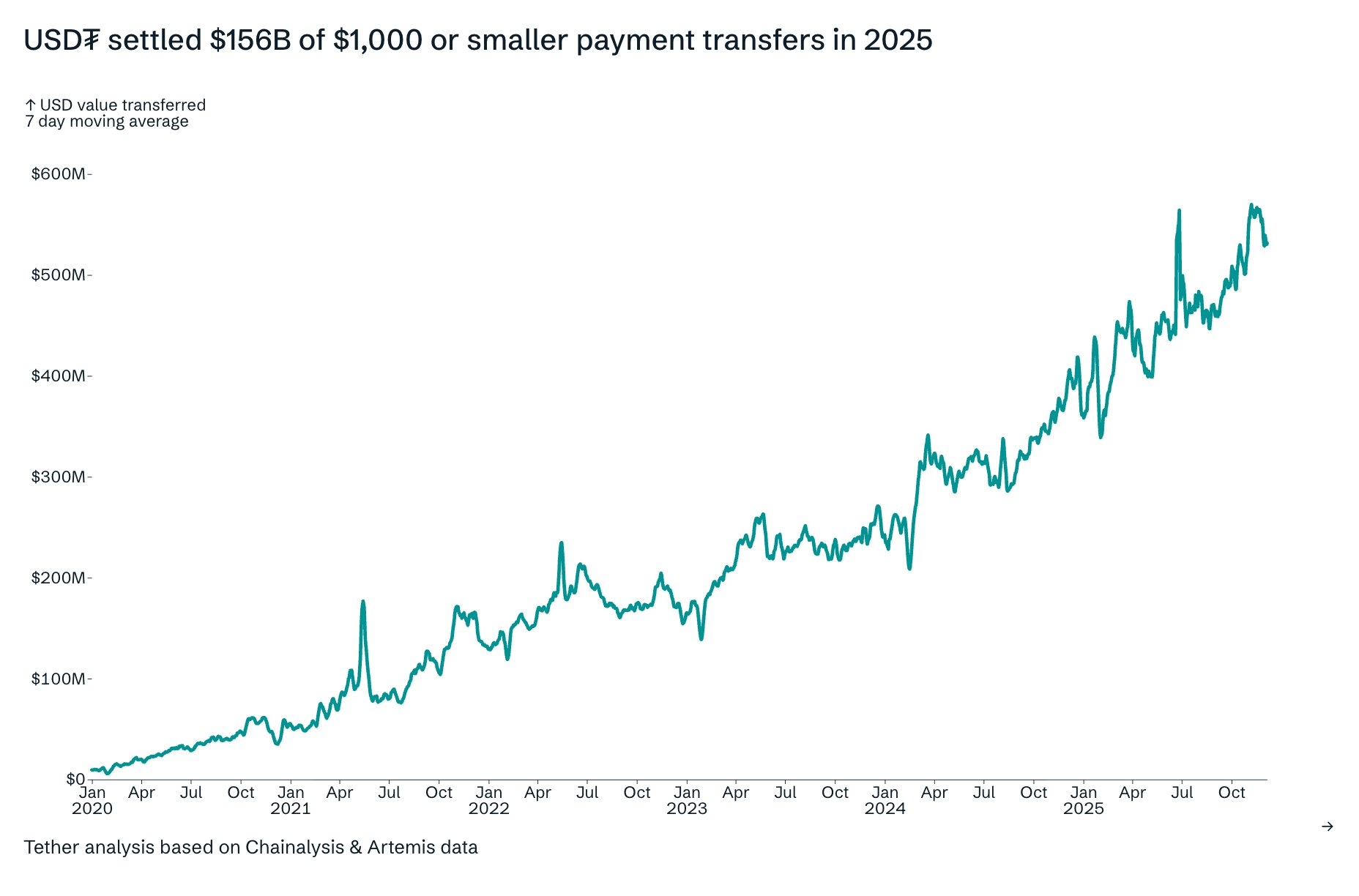
Tether’s USDT processed $156 billion in payments of $1,000 or less in 2025, according to figures shared today by CEO Paolo Ardoino, based on Chainalysis and Artemis data. 

The number highlights a side of crypto adoption often missed by price charts and ETF flows – everyday transactional use.

USDT is Being Used as a Substitute for Banks and Cash

Small-value transfers now represent a meaningful share of USDT activity. The data shows steady growth since 2020, with acceleration through 2024 and into 2025, as average daily volumes for sub-$1,000 transfers climbed above $500 million. 

This points to USDT functioning less as a trading instrument and more as a digital payments rail.

USDT Payments Data Shared By Tether CEO. Source: X/Paolo Ardoino

The significance lies in who uses stablecoins and how. Transfers under $1,000 typically reflect remittances, payroll, retail payments, savings movement, and peer-to-peer transfers, especially in emerging markets. 

Unlike large exchange flows, these transactions tend to be non-speculative and recurring. 

In practical terms, USDT is increasingly acting as a substitute for cash and bank wires in regions where access to dollars is limited or expensive.

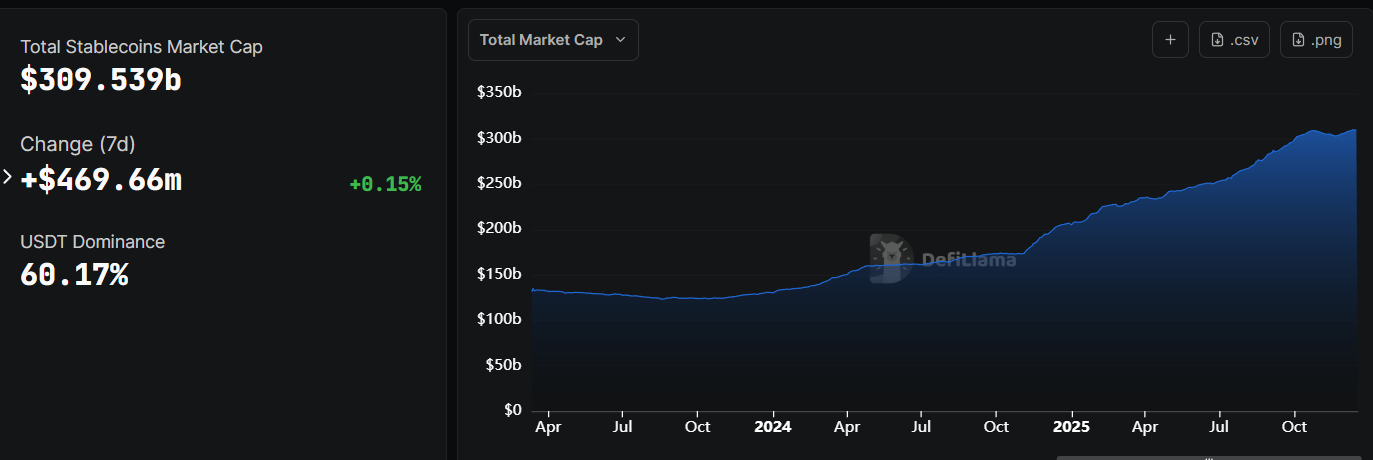
This trend aligns with USDT’s broader trajectory in 2025. Circulating supply reached new highs during the year, reflecting demand for dollar liquidity beyond crypto trading. 

At the same time, regulatory developments reshaped where and how USDT circulates. 

In the US, the GENIUS Act clarified the legal framework for payment stablecoins, reinforcing institutional confidence in compliant dollar-backed tokens. 

In Europe, MiCA introduced stricter licensing rules, shifting some regulated platform activity away from USDT but not slowing global on-chain usage.

Stablecoins Market Cap In 2025. Source: DeFilLama

Tether has also expanded its infrastructure footprint. Recent investments in Lightning-based payment rails signal an effort to push USDT into faster, lower-cost settlement networks. 

Regional partnerships in Africa and the Middle East further indicate a focus on payments and financial access, not just exchange liquidity.

Taken together, the $156 billion figure reframes the crypto adoption debate. While market cycles drive headlines, stablecoins continue to scale quietly as financial plumbing. 

The growth in small USDT payments suggests that, in 2025, crypto adoption is less about speculation and more about utility, resilience, and global dollar access. This shift may prove more durable than any bull market.

The post Tether’s USDT Payment Stats Show the Real State of Crypto Adoption in 2025 appeared first on BeInCrypto.
  •  

Bitcoin Added And Lost Nearly $100 Billion In Hours, What Just Happened?

Bitcoin experienced an extreme bout of volatility on December 17, surging more than $3,000 in under an hour before reversing sharply and falling back toward $86,000.

The violent swing did not follow any major news. Instead, market data shows the move was driven by leverage, positioning, and fragile liquidity conditions.

A Short Squeeze Pushed Bitcoin Higher

The initial rally began as Bitcoin pushed toward the $90,000 level, a major psychological and technical resistance zone.

Bitcoin Price Wild Swing on December 17. Source: CoinGecko

Liquidation data shows a dense cluster of leveraged short positions positioned above that level. When price moved higher, those shorts were forced to close. That process requires buying Bitcoin, which pushed prices up even faster.

Roughly $120 million in short positions were liquidated during the spike. This created a classic short squeeze, where forced buying accelerates the move beyond what normal spot demand would justify.

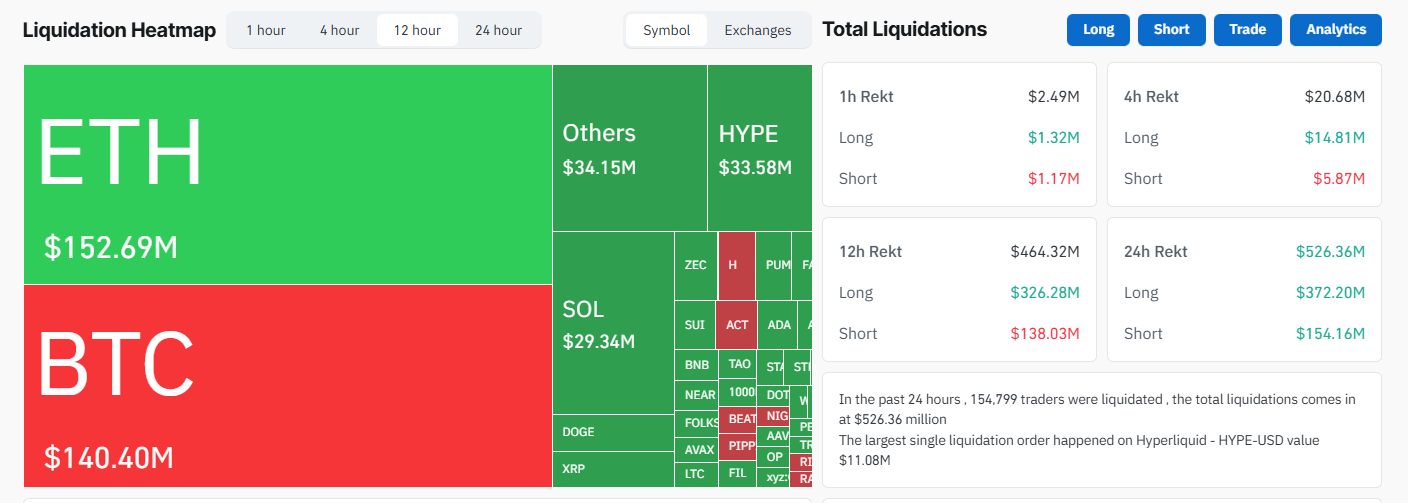
Crypto Market Liquidations On December 17. Source: Coinglass

At this stage, the move looked strong. But the structure underneath it was weak.

The Rally Flipped Into A Long Liquidation Cascade

As Bitcoin briefly reclaimed $90,000, new traders entered the market chasing momentum.

Many of those traders opened leveraged long positions, betting the breakout would hold. However, the rally lacked sustained spot buying and quickly stalled.

When the price began to fall, those long positions became vulnerable. Once key support levels broke, exchanges automatically liquidated those positions. More than $200 million in long liquidations followed, overwhelming the market.

Whoever is left

We need to know what happened on October 10

It's VERY apparent that the market broke that day and nothing has been the same since

We haven't seen Bitcoin or Alts trade like this since 2018

We need answers pic.twitter.com/jXe7jwd7RA

— EllioTrades (@elliotrades) December 17, 2025

This second wave explains why the drop was faster and deeper than the initial rise. 

Within hours, Bitcoin had fallen back toward $86,000, erasing most of the gains.

Positioning Data Shows A Fragile Market Setup

Trader positioning data from Binance and OKX helps explain why the move was so violent.

On Binance, the number of top trader accounts leaning long rose sharply ahead of the spike. However, position-size data showed less conviction, suggesting many traders were long but not heavily sized.

Bitcoin Long/Short Ratio on Binance Futures. Source: Coinglass

On OKX, position-based ratios shifted aggressively after the volatility. That suggests larger traders repositioned quickly, either buying the dip or adjusting hedges as liquidations played out.

This combination — crowded positioning, mixed conviction, and heavy leverage — creates a market that can move violently in both directions with little warning.

Bitcoin Long/Short Ratio on OKX. Source: Coinglass

Did Market Makers Or Whales Manipulate The Move?

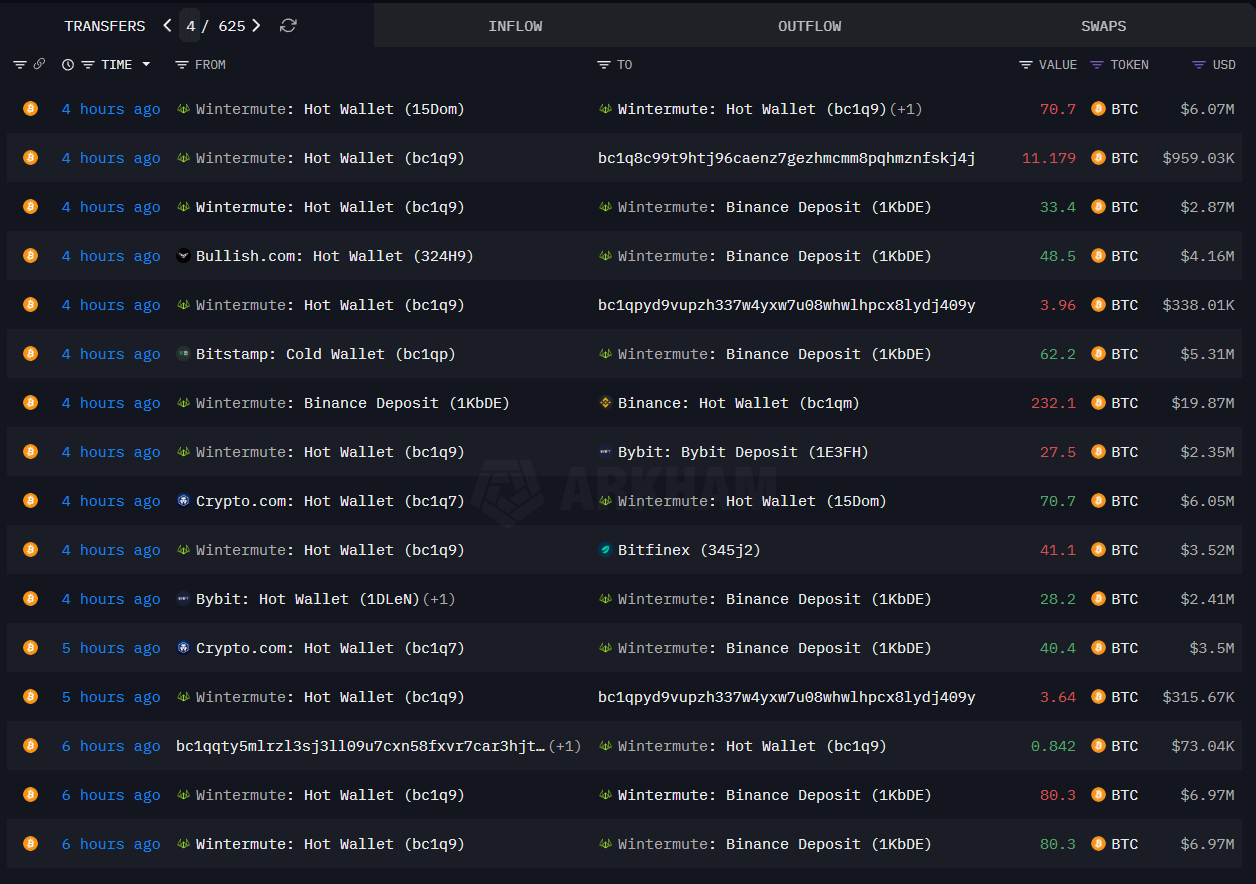
On-chain data showed market makers such as Wintermute moving Bitcoin between exchanges during the volatility. Those transfers coincided with the price swings but do not prove manipulation.

Market makers routinely rebalance inventory during periods of stress. Deposits to exchanges can indicate hedging, margin management, or liquidity provision, not necessarily selling to crash prices.

Importantly, the entire move can be explained by known market mechanics: liquidation clusters, leverage, and thin order books. There is no clear evidence of coordinated manipulation.

Wintermute Heavily Repositioning Bitcoin Across Centralized Exchanges. Source: Arkham

What This Means For Bitcoin Going Forward

This episode highlights a key risk in today’s Bitcoin market.

Leverage remains elevated. Liquidity thins quickly during fast moves. When price approaches key levels, forced liquidations can dominate price action.

Bitcoin’s fundamentals did not change during those hours. The swing reflected market structure fragility, not a shift in long-term value.

🚨 BITCOIN IS BEING MANIPULATED, AND I HAVE SOLID PROOF!!!

Everyone’s talking about how Bitcoin went up $3,000 and then down $4,000 in minutes.

Everyone’s posting about it…

but nobody seems to understand what actually happened.

You need to look at the flows, not the chart.… pic.twitter.com/IHCXtx3sUF

— NoLimit (@NoLimitGains) December 17, 2025

Until leverage resets and positioning becomes healthier, similar sharp moves remain possible. In this case, Bitcoin did not rally and crash because of news.

It moved because leverage turned price against itself.

The post Bitcoin Added And Lost Nearly $100 Billion In Hours, What Just Happened? appeared first on BeInCrypto.
  •  

FTX Scandal Figure Caroline Ellison Leaves Prison: Was Justice Too Lenient?

Caroline Ellison, the former CEO of Alameda Research and a central figure in the FTX scandal, is no longer behind bars. 

US Bureau of Prisons records show Ellison has been transferred from federal prison to Residential Reentry Management (RRM) in New York. This marks a shift from incarceration to community confinement.

What RRM Status Actually Means

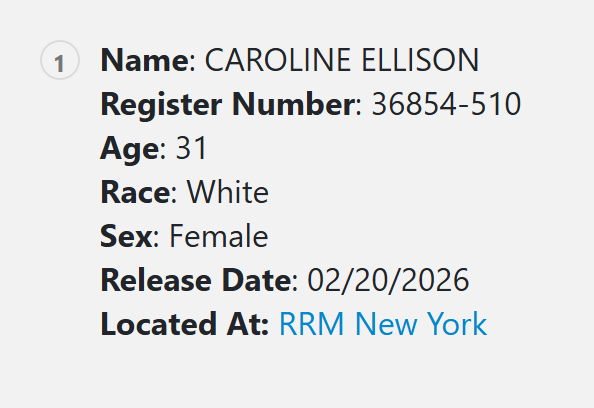
According to the Bureau of Prisons inmate locator, Ellison remains in federal custody with a projected release date of February 20, 2026. However, her current status confirms she is no longer housed in a correctional facility.

RRM — short for Residential Reentry Management — oversees the final phase of a federal sentence. Individuals under RRM may be placed in a halfway house or home confinement, rather than a prison. 

BOP Inmate Location. Source: Federal Bureau of Prisons

While still under Bureau of Prisons supervision, inmates face fewer physical restrictions and may be permitted to work, maintain limited social contact, and prepare for reintegration.

Unlike prison, RRM placements involve no cells, no guards, and significantly more autonomy, though strict monitoring and movement limits remain in place. 

Ellison’s transfer signals she has entered the reentry phase of her sentence, not that she has been released.

Ellison’s Role in the FTX Collapse

Ellison pleaded guilty in 2022 to multiple federal fraud charges tied to the misuse of FTX customer funds

As CEO of Alameda Research, the trading arm closely tied to FTX, she admitted to executing trades and financial maneuvers that relied on billions in customer deposits.

However, prosecutors and the court drew a clear distinction between Ellison’s role and that of FTX founder Sam Bankman-Fried, who designed the systems that enabled the fraud. Ellison did not control FTX’s exchange infrastructure, customer custody mechanisms, or governance.

Today, SBF's lawyer asked him about his relationship with Caroline Ellison and why it ended. SBF responded by mentioning she wanted more than the time and energy he could give:

"Historically, I haven't been great at … romantic relationships" pic.twitter.com/w19csqFgPr

— Zack Guzmán ♻️ (@zGuz) October 27, 2023

Her cooperation proved decisive. Ellison became the government’s key witness, offering extensive testimony that helped secure Bankman-Fried’s conviction. In 2024, a federal judge sentenced her to two years in prison, citing her cooperation, early guilty plea, and subordinate role.

A Stark Contrast With Do Kwon

Ellison’s move out of prison comes as Terraform Labs co-founder Do Kwon begins serving a 15-year US federal sentence for fraud linked to the collapse of the TerraUSD stablecoin. 

Prosecutors argued Kwon knowingly misled investors about the stability of Terra’s algorithmic peg, triggering losses estimated at over $40 billion.

4:04 pm- they've back.
Judge Engelmayer: 5 years is entire off the table. Even 12 years might be unreasonable & here is why. The fraud you pled guilty to cost victims more than $40 billion. Even in SDNY, it's eye popping. There is a 25 year cap, so not life

— Inner City Press (@innercitypress) December 11, 2025

Unlike Ellison, Kwon was a founder, public promoter, and architect of the system at the center of the collapse. The sentencing disparity reflects how courts differentiate between system designers and operators.

Too Lenient Or Legally Consistent?

Ellison’s transition to community confinement is legally routine, but politically charged. To critics, it reinforces perceptions of uneven accountability in crypto scandals. 

To prosecutors, it reflects established sentencing principles: cooperation, reduced authority, and acceptance of responsibility.

For now, Ellison remains under federal supervision. But her exit from prison, even if temporary, has reopened a familiar question — who truly pays the price when crypto empires collapse?

The post FTX Scandal Figure Caroline Ellison Leaves Prison: Was Justice Too Lenient? appeared first on BeInCrypto.

  •  

Bitcoin Tambah dan Kehilangan Hampir US$100 Miliar dalam Beberapa Jam, Apa yang Terjadi?

Bitcoin mengalami volatilitas ekstrem pada 17 Desember, melonjak lebih dari US$3.000 dalam waktu kurang dari satu jam sebelum berbalik tajam dan turun kembali mendekati US$86.000.

Pergerakan yang begitu liar ini tidak terjadi karena berita besar. Sebaliknya, data pasar menunjukkan bahwa pergerakan ini didorong oleh leverage, posisi trader, dan kondisi likuiditas yang rapuh.

Short squeeze dorong harga Bitcoin naik

Reli awal dimulai saat Bitcoin bergerak mendekati level US$90.000, yaitu zona resistance psikologis dan teknikal utama.

Pergerakan Harga Bitcoin yang Liar pada 17 Desember | Sumber: CoinGecko

Data likuidasi menunjukkan ada klaster short position dengan leverage yang padat di atas level tersebut. Saat harga naik, para pelaku short ini terpaksa menutup posisi. Proses itu membutuhkan membeli Bitcoin sehingga mendorong harga naik semakin cepat.

Sekitar US$120 juta posisi short terlikuidasi selama lonjakan harga itu. Hal ini menciptakan short squeeze klasik, di mana pembelian terpaksa membuat harga melonjak melampaui permintaan spot yang sewajarnya.

Likuidasi Pasar Kripto pada 17 Desember | Sumber: Coinglass

Pada tahap ini, pergerakan tampak kuat. Tapi struktur di baliknya ternyata lemah.

Reli Berubah Menjadi Rangkaian Likuidasi Long

Saat Bitcoin sempat kembali menyentuh US$90.000, trader-trader baru masuk ke pasar untuk mengejar momentum reli.

Banyak dari para trader itu membuka long position dengan leverage, berharap breakout akan bertahan. namun, reli ini tidak didukung oleh pembelian spot berkelanjutan sehingga harga pun cepat berhenti naik.

Saat harga mulai turun, posisi long itu jadi rentan. Begitu level support kunci terpecahkan, exchange secara otomatis melikuidasi posisi-posisi tersebut. Lebih dari US$200 juta long position terlikuidasi setelahnya, sehingga pasar pun kewalahan.

Whoever is left

We need to know what happened on October 10

It's VERY apparent that the market broke that day and nothing has been the same since

We haven't seen Bitcoin or Alts trade like this since 2018

We need answers pic.twitter.com/jXe7jwd7RA

— EllioTrades (@elliotrades) December 17, 2025

Gelombang kedua inilah yang membuat penurunan harga terjadi lebih cepat dan dalam dibanding kenaikan sebelumnya.

Dalam hitungan jam, Bitcoin turun kembali mendekati US$86.000 sehingga hampir semua keuntungan tadi terhapus.

Data Positioning Menunjukkan Setup Pasar yang Rentan

Data posisi trader dari Binance dan OKX membantu menjelaskan kenapa pergerakan harga berlangsung sangat liar.

Di Binance, jumlah akun trader top yang cenderung long naik tajam sebelum lonjakan ini. namun, data ukuran posisi menunjukkan keyakinan yang kurang kuat, menandakan banyak trader memang sedang long namun nominalnya tidak terlalu besar.

Rasio Long/Short Bitcoin pada Binance Futures | Sumber: Coinglass

Di OKX, rasio berbasis posisi langsung berubah secara agresif setelah terjadinya volatilitas. Hal ini menandakan trader-trader besar segera mengubah posisi mereka, entah dengan beli saat harga turun maupun mengatur ulang hedging ketika terjadi likuidasi.

Kombinasi ini — posisi yang menumpuk, keyakinan yang tidak kuat, dan leverage yang tinggi — menciptakan pasar yang bisa bergerak sangat liar ke dua arah tanpa banyak peringatan.

Rasio Long/Short Bitcoin pada OKX | Sumber: Coinglass

Apakah market maker atau whale yang mengatur pergerakan ini?

Data on-chain menunjukkan market maker seperti Wintermute memindahkan Bitcoin antar exchange saat terjadi volatilitas. Perpindahan tersebut bertepatan dengan pergerakan harga, tapi tidak membuktikan adanya manipulasi.

Market maker memang sering menyeimbangkan inventori mereka di masa-masa pasar bergejolak. Setoran ke exchange bisa jadi menandakan hedging, pengelolaan margin, atau penyediaan likuiditas — tidak selalu berarti menjual untuk menjatuhkan harga.

Yang penting, seluruh pergerakan ini bisa dijelaskan dengan mekanisme pasar yang sudah diketahui: klaster likuidasi, leverage, dan order book yang tipis. Tidak ada bukti jelas soal manipulasi terkoordinasi.

Wintermute Sedang Melakukan Reposisi Besar Bitcoin di Berbagai Exchange Terpusat | Sumber: Arkham

Apa Artinya Ini untuk Bitcoin ke Depan

Episode ini menyoroti risiko utama di pasar Bitcoin saat ini.

Leverage masih tinggi dan likuiditas cepat menipis saat terjadi pergerakan harga yang pesat. Ketika harga mendekati level penting, likuidasi paksa bisa mendominasi pergerakan harga.

Fundamental Bitcoin tidak berubah dalam beberapa jam tersebut. Pergerakan harga hanya mencerminkan struktur pasar yang rapuh, bukan perubahan nilai jangka panjang.

🚨 BITCOIN IS BEING MANIPULATED, AND I HAVE SOLID PROOF!!!

Everyone’s talking about how Bitcoin went up $3,000 and then down $4,000 in minutes.

Everyone’s posting about it…

but nobody seems to understand what actually happened.

You need to look at the flows, not the chart.… pic.twitter.com/IHCXtx3sUF

— NoLimit (@NoLimitGains) December 17, 2025

Selama leverage belum kembali normal dan posisi pasar belum sehat, pergerakan tajam yang mirip masih bisa saja terjadi. Dalam kasus ini, Bitcoin tidak reli atau anjlok gara-gara berita.

Pergerakan terjadi karena leverage membuat harga berbalik arah sendiri.

  •  

Tokoh Skandal FTX Caroline Ellison Tinggalkan Penjara: Apakah Hukuman Terlalu Ringan?

Caroline Ellison, mantan CEO Alameda Research sekaligus tokoh sentral dalam skandal FTX, kini sudah tidak lagi berada di balik jeruji penjara.

Catatan dari US Bureau of Prisons menunjukkan bahwa Ellison telah dipindahkan dari penjara federal ke Residential Reentry Management (RRM) di New York. Ini menandai perubahan dari tahanan menjadi penahanan dalam komunitas.

Apa Arti Sebenarnya Status RRM

Berdasarkan situs pencarian napi milik Bureau of Prisons, Ellison masih berada dalam pengawasan federal dengan tanggal pembebasan yang diproyeksikan pada 20 Februari 2026. tapi, statusnya sekarang memastikan ia sudah tidak lagi tinggal di fasilitas tahanan.

RRM — singkatan dari Residential Reentry Management — mengawasi tahapan akhir masa hukuman federal. Orang yang berada di bawah RRM bisa ditempatkan di rumah singgah (halfway house) atau tahanan rumah, bukan lagi di penjara.

Lokasi Narapidana BOP | Sumber: Federal Bureau of Prisons

Walaupun masih di bawah pengawasan Bureau of Prisons, napi menghadapi pembatasan fisik yang lebih sedikit dan biasanya boleh bekerja, menjaga kontak sosial terbatas, serta mempersiapkan diri untuk kembali ke masyarakat.

Berbeda dengan penjara, penempatan di RRM tidak ada sel, tanpa penjaga, dan jauh lebih mandiri, walau tetap ada pengawasan ketat dan pembatasan pergerakan.

Pemindahan Ellison menandakan ia sudah memasuki tahap reintegrasi dalam hukumannya, bukan berarti sudah bebas sepenuhnya.

Peran Ellison dalam Kejatuhan FTX

Pada 2022, Ellison mengaku bersalah atas beberapa dakwaan penipuan federal yang berkaitan dengan penyalahgunaan dana nasabah FTX.

Sebagai CEO Alameda Research, divisi perdagangan yang terhubung erat dengan FTX, ia mengakui telah melakukan perdagangan dan manuver keuangan yang mengandalkan dana nasabah hingga miliaran dolar.

tapi, jaksa dan pengadilan dengan jelas membedakan peran Ellison dibanding Sam Bankman-Fried, pendiri FTX yang merancang sistem penipuan tersebut. Ellison tidak mengendalikan infrastruktur exchange FTX, sistem penitipan dana nasabah, maupun tata kelolanya.

Today, SBF's lawyer asked him about his relationship with Caroline Ellison and why it ended. SBF responded by mentioning she wanted more than the time and energy he could give:

"Historically, I haven't been great at … romantic relationships" pic.twitter.com/w19csqFgPr

— Zack Guzmán ♻️ (@zGuz) October 27, 2023

Kerja sama dari pihaknya menjadi sangat penting. Ellison menjadi saksi kunci pemerintah, memberikan kesaksian komprehensif yang membantu menghukum Bankman-Fried. Pada 2024, hakim federal memvonis Ellison dengan hukuman dua tahun penjara, mempertimbangkan kerjasama, pengakuan bersalah sejak awal, serta peran bawahan.

Perbedaan Besar dengan Do Kwon

Keluar-masuknya Ellison dari penjara terjadi ketika co-founder Terraform Labs, Do Kwon, mulai menjalani hukuman 15 tahun penjara federal AS karena penipuan terkait runtuhnya stablecoin TerraUSD.

Pihak jaksa berargumen Kwon secara sadar menyesatkan investor soal stabilitas algoritmik Terra, sehingga menimbulkan kerugian lebih dari US$40 miliar.

4:04 pm- they've back.
Judge Engelmayer: 5 years is entire off the table. Even 12 years might be unreasonable & here is why. The fraud you pled guilty to cost victims more than $40 billion. Even in SDNY, it's eye popping. There is a 25 year cap, so not life

— Inner City Press (@innercitypress) December 11, 2025

Berbeda dengan Ellison, Kwon merupakan pendiri, promotor publik, sekaligus arsitek utama sistem yang menjadi pusat keruntuhan tersebut. Perbedaan hukuman ini menunjukkan bagaimana pengadilan membedakan antara perancang sistem dan operator biasa.

Terlalu Lunak atau Konsisten dengan Hukum?

Transisi Ellison ke penahanan komunitas adalah prosedur rutin secara hukum, tapi bermuatan politis. Bagi para pengkritik, hal ini memperkuat anggapan bahwa akuntabilitas dalam skandal aset kripto masih belum merata.

Sedangkan bagi jaksa, hal ini mencerminkan prinsip pemidanaan yang berlaku: adanya kerja sama, kewenangan yang lebih rendah, dan penerimaan tanggung jawab.

Sampai saat ini, Ellison tetap dibawah pengawasan federal. tapi, keluarnya dia dari penjara — meski hanya sementara — kembali mengangkat pertanyaan lama: siapa sebenarnya yang menanggung akibat saat kerajaan aset kripto runtuh?

  •  

Mengapa Orang Amerika Mungkin Punya Lebih Sedikit Uang untuk Aset Kripto pada 2026

Data ekonomi AS memberi sinyal peringatan dini bagi aset berisiko dan aset kripto. Data ketenagakerjaan terbaru menunjukkan pertumbuhan pendapatan rumah tangga bisa melemah menuju 2026.

Tren ini bisa mengurangi arus investasi ritel, terutama ke aset yang volatil seperti aset kripto. Dalam jangka pendek, ini lebih menimbulkan masalah permintaan, bukan krisis struktural.

Data Tenaga Kerja AS Tunjukkan Pertumbuhan Pendapatan Disposabel yang Lebih Lambat

Laporan Nonfarm Payrolls terbaru menunjukkan terciptanya lapangan kerja yang moderat di tengah kenaikan tingkat pengangguran. Pertumbuhan upah juga melambat dan ini menandakan momentum pendapatan rumah tangga yang semakin lemah.

Nonfarm payrolls -105k in October … +64k in November pic.twitter.com/tJcn8RSu9m

— Kevin Gordon (@KevRGordon) December 16, 2025

Pendapatan yang dapat dibelanjakan penting bagi adopsi aset kripto. Investor ritel biasanya mengalokasikan uang lebih, bukan dengan leverage, ke aset berisiko.

Saat upah stagnan dan keamanan kerja menurun, rumah tangga akan memangkas pengeluaran diskresioner terlebih dahulu. Investasi spekulatif sering masuk dalam kategori ini.

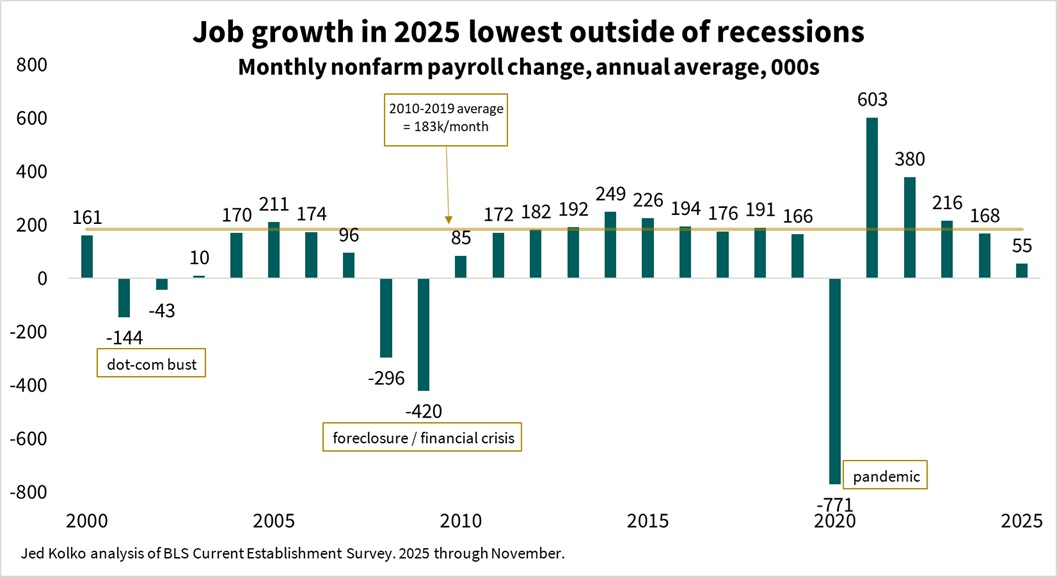
Pertumbuhan Lapangan Kerja AS Selama Bertahun-tahun | Sumber: X/Jed Kolko

Investor ritel paling berisiko dan altcoin bisa terdampak lebih dulu

Keterlibatan investor ritel punya peran lebih besar di pasar altcoin dibanding di Bitcoin. Token-token kecil sangat bergantung pada modal ritel yang mencari imbal hasil tinggi.

Sebaliknya, Bitcoin menarik arus institusi, ETF, dan holder jangka panjang. Ini memberi Bitcoin likuiditas yang lebih dalam serta bantalan di sisi penurunan harga yang lebih kuat.

Jika orang Amerika punya lebih sedikit uang untuk diinvestasikan, altcoin biasanya terdampak lebih dulu. Likuiditas mengering lebih cepat dan penurunan harga bisa bertahan lebih lama.

Investor ritel juga bisa terpaksa keluar dari posisinya untuk menutup keperluan sehari-hari. Tekanan jual seperti ini lebih terasa di token berkapitalisasi kecil.

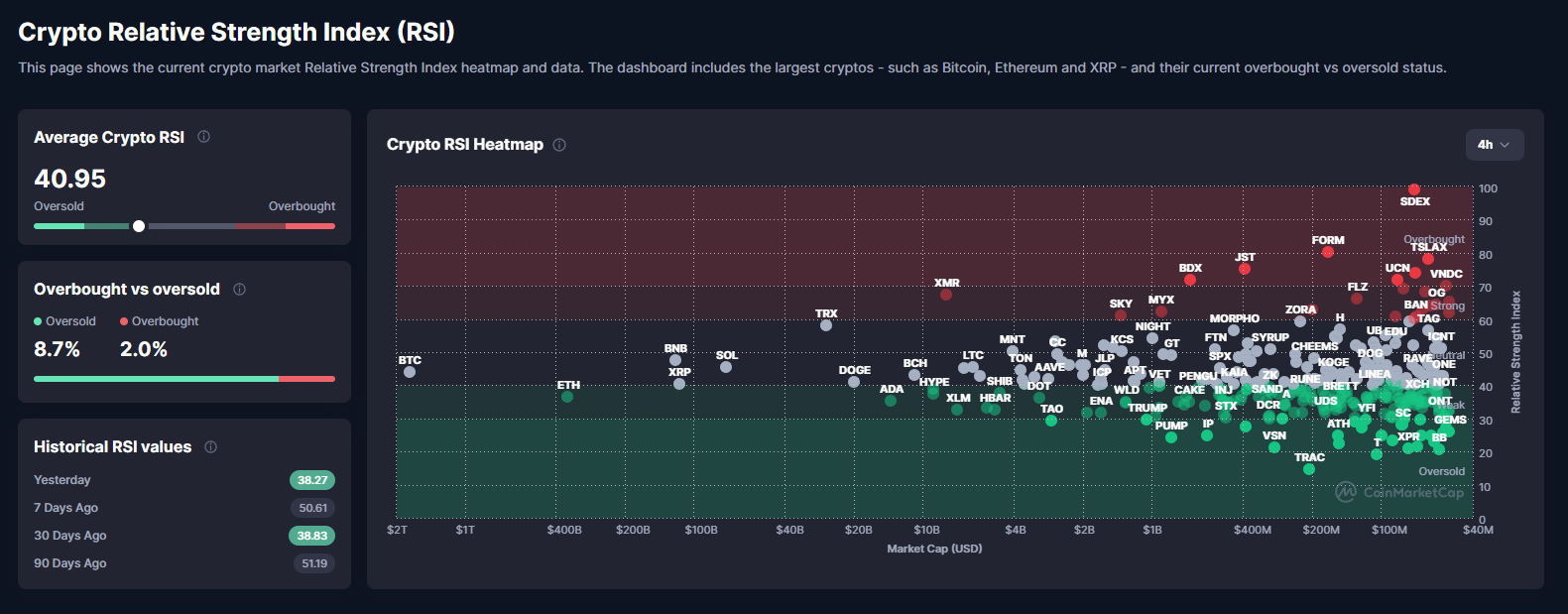
Rata-rata Relative Strength Index (RSI) Aset Kripto Masih di Dekat Level Oversold | Sumber: CoinMarketCap

Pendapatan lebih rendah tidak berarti harga lebih rendah, tapi ini mengubah penggeraknya

Harga aset sebenarnya tetap bisa naik meski pendapatan melemah. Biasanya ini terjadi saat kebijakan moneter jadi lebih mendukung.

Pelemahan pasar tenaga kerja memberi ruang bagi The Fed untuk memangkas suku bunga. Suku bunga yang lebih rendah bisa meningkatkan harga aset melalui likuiditas, bukan karena permintaan dari rumah tangga.

Untuk aset kripto, perbedaan ini sangat penting. Reli yang hanya didorong likuiditas jauh lebih rentan dan sensitif terhadap guncangan ekonomi makro.

Lembaga Keuangan Menghadapi Tantangan Tersendiri dari Jepang

Kelemahan investor ritel hanyalah sebagian gambaran. Investor institusi kini juga mulai lebih berhati-hati.

Potensi kenaikan suku bunga Bank of Japan bisa mengancam kondisi likuiditas global. Hal ini berisiko membalikkan tren carry trade yen yang telah menopang aset berisiko selama bertahun-tahun.

Bank of Japan is set to hike interest rates by 25bps on December 19

The last 3 times BoJ hiked rates, Bitcoin dumped by over 20%

March 2024 → -27%
July 2024 → -30%
January 2025 → -31%

We already saw a 7% dump last week as investors tried to front-run the dump.

However,… pic.twitter.com/ex77EzHBMh

— Lark Davis (@LarkDavis) December 15, 2025

Saat biaya pinjaman naik di Jepang, institusi seringkali memangkas eksposur mereka secara global. Aset kripto, saham, maupun obligasi semuanya merasakan dampaknya.

Risiko utama saat ini bukanlah kejatuhan, tapi permintaan yang tipis. Investor ritel bisa mundur karena pertumbuhan pendapatannya melemah. Sementara institusi mungkin menunda aksi karena likuiditas global mengencang.

Altcoin tetap menjadi pihak yang paling rentan dalam situasi seperti ini. Bitcoin jauh lebih mampu menyerap perlambatan pasar.

Untuk saat ini, pasar aset kripto nampaknya sedang bertransisi. Dari momentum yang digerakkan ritel menjadi lebih berhati-hati karena faktor makro.

Pergeseran inilah yang bisa menentukan bulan-bulan awal di tahun 2026.

  •  

Mengapa Bank of Japan Sangat Penting bagi Bitcoin

Trader Bitcoin sering memperhatikan The Fed di Amerika Serikat. Tapi, Bank of Japan (BoJ) juga bisa sama pentingnya untuk pasar aset kripto.

Hal ini karena Jepang memiliki peran unik dalam likuiditas global. Saat likuiditas itu mengetat, Bitcoin biasanya mengalami penurunan tajam.

Yen Murah Jadi Mesin Likuiditas Tersembunyi Bitcoin

Selama puluhan tahun, Jepang menetapkan suku bunga mendekati nol atau bahkan negatif. Hal itu membuat yen menjadi salah satu mata uang termurah di dunia untuk dipinjam.

Situasi ini melahirkan yen carry trade.

The 🇯🇵 Bank of Japan is about to do a rate hike on Friday the 19th, creating massive fear surrounding the Yen carry trade.

Bitcoin dumped hard the last time they hiked rates:

But why is this exactly? Let’s break it down 👇

What is the Yen Carry Trade?

For decades, the Yen has… pic.twitter.com/YjxzOctjnx

— Mister Crypto (@misterrcrypto) December 14, 2025

Institusi besar — termasuk hedge fund, bank, manajer aset, dan desk trading proprietary — meminjam yen lewat bank-bank Jepang, pasar FX swap, dan jalur pendanaan jangka pendek lainnya.

Mereka lalu menukar yen tersebut ke dolar atau euro. Modal itu kemudian dialirkan ke aset-aset yang menawarkan imbal hasil lebih tinggi.

Aset tersebut termasuk saham, kredit, pasar berkembang, dan belakangan mulai merambah aset kripto. Bitcoin diuntungkan saat pendanaan ini tetap murah dan melimpah.

Bitcoin sangat menarik karena diperdagangkan 24 jam nonstop serta punya volatilitas tinggi. Untuk dana yang memakai leverage, Bitcoin menjadi cara yang likuid untuk membuka posisi risk-on.

Kenaikan suku bunga BoJ bisa mengganggu sistem ini.

🚨 JAPAN WILL CRASH BITCOIN IN 5 DAYS!!!

People are seriously underestimating what Japan is about to do to Bitcoin.

The Bank of Japan is expected to raise rates again on Dec 19.

That might not sound like a big deal… until you remember one thing:

Japan is the largest holder… pic.twitter.com/0a9Aimfn88

— NoLimit (@NoLimitGains) December 14, 2025

Mengapa Kenaikan Suku Bunga Kecil oleh BoJ Bisa Berdampak Besar

Di atas kertas, langkah BoJ yang diantisipasi ini terlihat sederhana.

Pasar memprediksi kenaikan sekitar 25 basis poin, sehingga suku bunga acuan Jepang jadi sekitar 0,75%. Angka ini masih jauh lebih rendah dibandingkan suku bunga di AS atau Eropa.

Tapi, besarnya kenaikan bukan masalah utamanya.

Jepang sudah bertahun-tahun berada di kisaran nol. Bahkan kenaikan kecil saja sudah menjadi pergeseran struktural dalam kondisi pendanaan.

Lebih penting lagi, hal ini mengubah ekspektasi.

Jika pasar percaya Jepang akan masuk siklus pengetatan bertahap, trader biasanya bertindak cepat. Mereka memangkas eksposur lebih awal.

Antisipasi ini saja bisa langsung memicu aksi jual pada aset berisiko di seluruh dunia. Bitcoin langsung merasakan dampaknya karena diperdagangkan nonstop dan bereaksi lebih cepat daripada saham atau obligasi.

Bagaimana Pengetatan BoJ Bisa Picu Likuidasi Bitcoin

Penurunan paling tajam Bitcoin jarang sekali hanya karena aksi jual spot. Biasanya terjadi akibat leverage.

Jika BoJ mengambil langkah hawkish, nilai yen bisa menguat dan yield global meningkat. Hal ini menekan aset berisiko di waktu yang bersamaan.

Setelah itu, Bitcoin bisa jatuh menembus level teknis penting. Ini berdampak besar karena pasar kripto sangat mengandalkan perpetual Futures dan margin.

Saat harga anjlok, posisi long dengan leverage akan terkena ambang likuidasi. Exchange otomatis menjual aset jaminan untuk menutup kerugian.

Bank of Japan is set to hike interest rates by 25bps on December 19

The last 3 times BoJ hiked rates, Bitcoin dumped by over 20%

March 2024 → -27%
July 2024 → -30%
January 2025 → -31%

We already saw a 7% dump last week as investors tried to front-run the dump.

However,… pic.twitter.com/ex77EzHBMh

— Lark Davis (@LarkDavis) December 15, 2025

Penjualan paksa ini mendorong harga Bitcoin makin turun. Proses ini menimbulkan likuidasi bertingkat yang saling memicu.

Karena itulah, kejadian ekonomi makro kadang terlihat seperti crash khusus kripto. Kejutan awal berasal dari suku bunga dan FX.

Gelombang kedua muncul karena struktur leverage di pasar aset kripto.

Apa yang trader perhatikan saat keputusan BoJ

Risiko dari BoJ biasanya meningkat sebelum pengumuman resminya. Trader memantau tanda-tanda awal berikut:

  • Penguatan yen, menandakan carry trade mulai dibuka
  • Kenaikan yield obligasi, memperketat kondisi keuangan
  • Penurunan funding rate atau Open Interest, menunjukkan leverage mulai keluar
  • Support Bitcoin utama jebol, bisa memicu likuidasi besar-besaran

Nada pidato dan arahan BoJ juga penting. Kenaikan suku bunga dengan pesan dovish bisa menenangkan pasar.

Sinyal hawkish justru akan memperpanjang tekanan jual.

Singkatnya, Bank of Japan penting karena mereka mengontrol salah satu sumber likuiditas global utama. Ketika likuiditas mengetat, biasanya Bitcoin jadi aset pertama yang kena efeknya.

  •  

Apakah MicroStrategy Melakukan Pembelian Bitcoin Terburuk di 2025?

Pembelian Bitcoin terbaru MicroStrategy langsung menuai sorotan. Hanya sehari setelah perusahaan mengumumkan pembelian besar, harga Bitcoin langsung turun tajam.

Pada 14 Desember, MicroStrategy mengumumkan telah membeli 10.645 BTC dengan harga sekitar US$980,3 juta, membayar rata-rata US$92.098 per koin. Pada saat itu, Bitcoin masih diperdagangkan di level tertinggi lokal.

Pembelian yang Kurang Tepat Waktu, Setidaknya untuk Jangka Pendek

Waktunya memang kurang beruntung. Hanya sehari setelah pembelian yang diumumkan oleh MicroStrategy, harga Bitcoin sempat anjlok ke kisaran US$85.000, bahkan sempat turun di bawah angka itu. Pada waktu publikasi, BTC tetap berada di bawah US$80.000.

Strategy has acquired 10,645 BTC for ~$980.3 million at ~$92,098 per bitcoin and has achieved BTC Yield of 24.9% YTD 2025. As of 12/14/2025, we hodl 671,268 $BTC acquired for ~$50.33 billion at ~$74,972 per bitcoin. $MSTR $STRC $STRK $STRF $STRD $STRE https://t.co/VdAz7pqce1

— Michael Saylor (@saylor) December 15, 2025

Penurunan harga Bitcoin terjadi di tengah aksi jual global yang dipicu oleh kekhawatiran kenaikan suku bunga oleh Bank of Japan, likuidasi leverage, dan aksi de-risking dari market maker. Pembelian MicroStrategy terjadi tepat sebelum penurunan besar itu.

Bitcoin’s Price Drop Was Driven by Liquidations — Not Spot Selling

“In this context, the current move should be viewed less as a collapse in fundamental demand and more as a structural deleveraging event.” – By @xwinfinance pic.twitter.com/i1DSrt2Ttw

— CryptoQuant.com (@cryptoquant_com) December 16, 2025

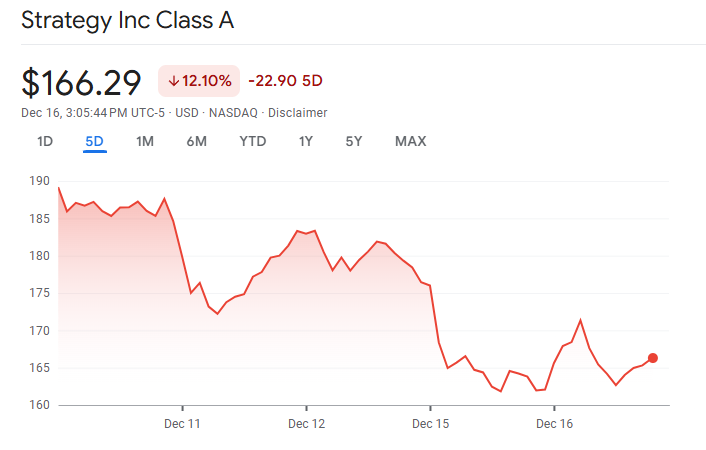
Saat Bitcoin turun, harga saham MicroStrategy pun jatuh tajam. Dalam lima hari perdagangan terakhir, saham MSTR turun lebih dari 25%, jauh lebih buruk dibandingkan penurunan Bitcoin itu sendiri.

Meski hari ini sahamnya sedikit pulih, nilainya masih jauh di bawah level sebelum pengumuman pembelian.

Harga Saham MSTR Selama Seminggu Terakhir | Sumber: Google Finance

Angka-angka di Balik Kekhawatiran

Saat ini, MicroStrategy memegang 671.268 BTC yang didapatkan dengan total sekitar US$50,33 miliar pada harga rata-rata US$74.972 per koin.

Secara jangka panjang, perusahaan ini masih untung besar.

Tapi, persepsi jangka pendek punya pengaruh sendiri. Dengan harga Bitcoin di sekitar US$85.000, pembelian terbaru ini sudah mengalami kerugian di atas kertas.

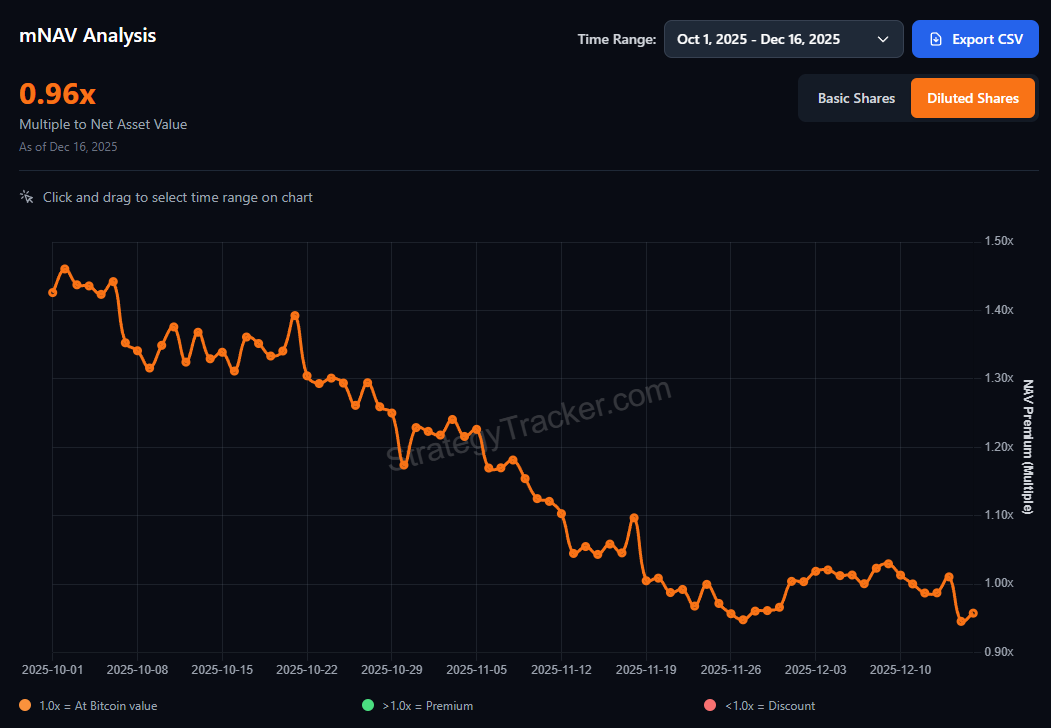
mNAV MicroStrategy saat ini berada di sekitar 1,11, artinya saham tersebut hanya diperdagangkan sekitar 11% di atas nilai aset Bitcoin yang dimiliki. Premi ini menyusut cepat seiring harga Bitcoin jatuh dan para investor saham mengevaluasi ulang risiko.

mNAV MicroStrategy | Sumber: Saylor Tracker

Kenapa pasar bereaksi sangat keras

Investor tidak mempertanyakan keyakinan MicroStrategy terhadap Bitcoin. Mereka justru mempertanyakan masalah waktu pembelian dan pengelolaan risikonya.

Risiko makro yang memicu penurunan Bitcoin ini sudah lama diperingatkan pasar. Pasar sejak beberapa minggu lalu sudah mewaspadai potensi kenaikan suku bunga oleh Bank of Japan dan ancaman terhadap yen carry trade.

Bitcoin memang punya sejarah sering turun tajam saat siklus kenaikan suku bunga Bank of Japan terjadi. Kondisi kali ini pun serupa.

Pihak yang mengkritik mengatakan MicroStrategy dinilai tidak menunggu kejelasan kondisi makro. Perusahaan ini terlihat membeli secara agresif di dekat resistance, tepat saat kondisi likuiditas global sedang mengetat.

🚨 JAPAN WILL CRASH BITCOIN IN 5 DAYS!!!

People are seriously underestimating what Japan is about to do to Bitcoin.

The Bank of Japan is expected to raise rates again on Dec 19.

That might not sound like a big deal… until you remember one thing:

Japan is the largest holder… pic.twitter.com/0a9Aimfn88

— NoLimit (@NoLimitGains) December 14, 2025

Apakah Ini Sebenarnya Sebuah Kesalahan?

Semua itu tergantung dari sudut waktu yang dipakai.

Dari sudut pandang trading, pembelian ini memang terlihat kurang tepat waktu. Harga Bitcoin langsung drop, bahkan harga sahamnya turun lebih jauh karena pengaruh leverage, sentimen, dan shrinking NAV premium.

Tapi dari sisi strategi, MicroStrategy memang tidak pernah menargetkan beli di harga terendah. Perusahaan tetap fokus pada akumulasi jangka panjang, bukan pada mengoptimalkan harga beli di jangka pendek.

CEO Michael Saylor berulang kali menyampaikan bahwa memiliki lebih banyak Bitcoin jauh lebih penting daripada presisi harga pembelian.

Risiko utama bukan di aksi beli itu sendiri. Tapi justru pada apa yang terjadi setelahnya.

Jika harga Bitcoin stabil dan tekanan makro mereda, pembelian terbaru MicroStrategy akan menyatu ke dalam biaya rata-rata jangka panjang. Tapi jika Bitcoin turun semakin jauh, keputusan ini bisa akan terus menjadi sorotan para pengkritik.

Mungkin MicroStrategy bukan pembeli Bitcoin terburuk di tahun 2025. Tapi sepertinya ini adalah pembelian yang paling tidak nyaman.

  •  

SEC Hentikan Penyelidikan Lama terhadap Aave Protocol

US Securities and Exchange Commission (SEC) telah menghentikan investigasi terhadap Aave Protocol tanpa merekomendasikan tindakan penegakan hukum, menurut sebuah pengumuman tertanggal 16 Desember.

Keputusan ini mengakhiri penyelidikan selama bertahun-tahun terhadap salah satu platform decentralized finance (decentralized finance) lending terbesar dan menghilangkan tekanan regulasi utama untuk sektor tersebut.

Penyelidikan Ditutup tanpa Penegakan

Dalam pengumuman tersebut, SEC menyatakan telah menyelesaikan investigasi terhadap Aave Protocol dan saat ini tidak berniat merekomendasikan tindakan penegakan hukum.

namun, lembaga itu menegaskan bahwa penutupan investigasi ini bukan berarti pembebasan sepenuhnya dan tidak mencegah tindakan di masa depan jika situasi berubah. Pengumuman ini mengikuti praktik standar SEC sesuai Securities Act Release No. 5310.

After four years, we are finally ready to share that the SEC has concluded its investigation into the Aave Protocol.

This process demanded significant effort and resources from our team, and from me personally as the founder, to protect Aave, its ecosystem, and DeFi more… pic.twitter.com/aZeLrZz5ZQ

— Stani.eth (@StaniKulechov) December 16, 2025

Penyelidikan ini dimulai sekitar 2021–2022, di masa saat SEC memperketat pengawasan terhadap aktivitas crypto lending, staking, dan governance token.

Aave, sebuah decentralized finance protocol non-custodial, memungkinkan pengguna untuk meminjam dan meminjamkan aset digital lewat smart contract otomatis. Protokol ini berjalan tanpa perantara dan dikelola oleh para holder token AAVE.

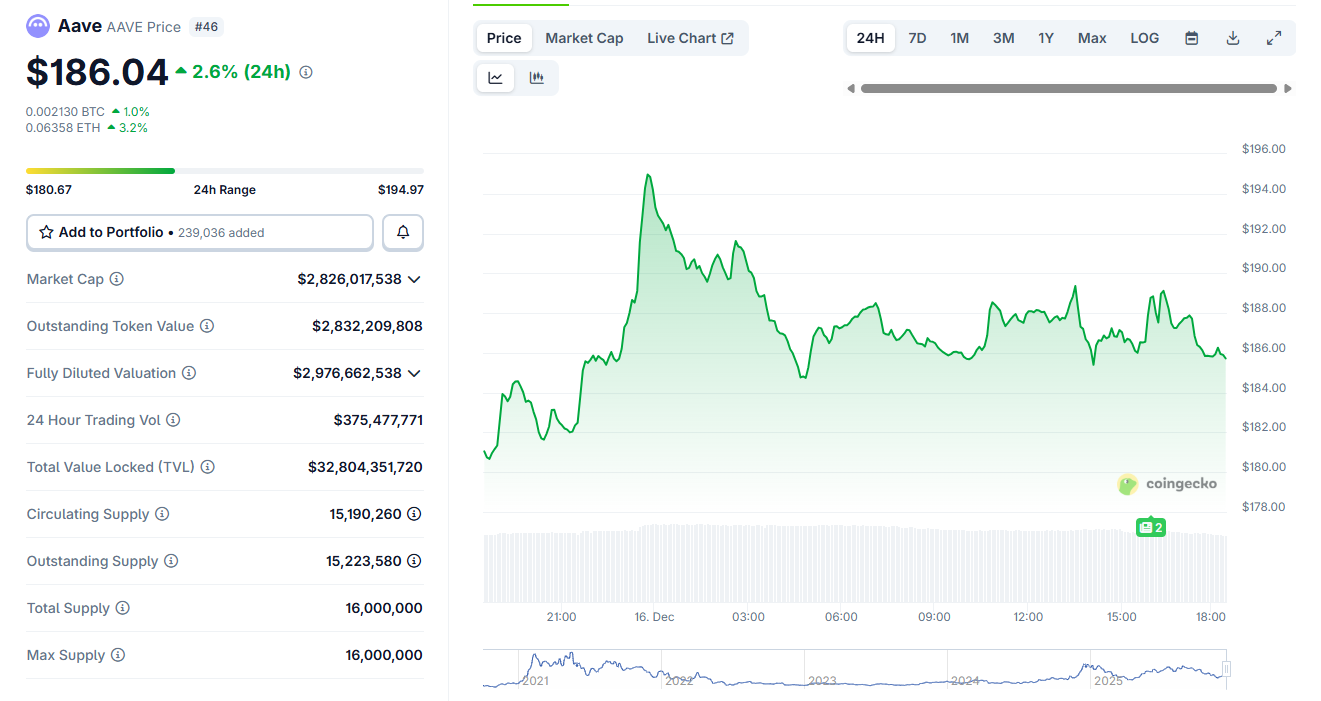
AAVE Sempat Naik Setelah Pengumuman SEC | Sumber: CoinGecko

Pendapatan dan Tata Kelola Aave Jadi Sorotan

Keputusan SEC ini hadir ketika Aave juga menghadapi isu internal terkait pendapatan dan tata kelola.

Pada pekan ini, anggota DAO menyoroti kekhawatiran bahwa perubahan infrastruktur front-end mungkin telah mengalihkan pendapatan biaya swap dari kas DAO Aave. Masalah ini muncul setelah adanya peralihan dari ParaSwap ke CoW Swap di antarmuka resmi Aave.

Extremely concerning.

The stealth privatization of approximately 10% of Aave DAO's potential revenue, leveraging brand and IPs paid for by the DAO, represents a clear attack on the best interests of the $AAVE Token holders.

We will prepare an official response with @AaveChan. https://t.co/opoG3I7x7s

— Marc ”七十 Billy” Zeller (@Marczeller) December 12, 2025

Delegasi governance menyampaikan bahwa perubahan ini bisa menurunkan pendapatan DAO hingga US$10 juta per tahun, tergantung pada volume trading.

Aave Labs menjelaskan bahwa front-end adalah produk terpisah dan pembagian pendapatan sebelumnya sifatnya sukarela.

Untuk saat ini, Aave berhasil lolos dari pengawasan regulasi tanpa sanksi, yang menjadi pola umum karena SEC mulai mundur dalam penegakan aturan aset kripto di bawah Paul Atkins.

Meski demikian, protokol ini tetap menghadapi pertanyaan seputar tata kelola, desentralisasi, dan penangkapan nilai seiring perkembangan decentralized finance.

  •  

Why Americans May Have Less Money For Crypto In 2026

US economic data is flashing early warning signs for risk assets and crypto. The latest labor figures suggest household income growth may weaken heading into 2026.

That trend could reduce retail investment flows, especially into volatile assets like crypto. In the short term, this creates a demand problem rather than a structural crisis.

US Labor Data Signals Slower Disposable Income Growth

The latest Nonfarm Payrolls report showed modest job creation alongside a rising unemployment rate. Wage growth also slowed, pointing to weaker income momentum for households.

Nonfarm payrolls -105k in October … +64k in November pic.twitter.com/tJcn8RSu9m

— Kevin Gordon (@KevRGordon) December 16, 2025

Disposable income matters for crypto adoption. Retail investors typically allocate surplus cash, not leverage, to risk assets.

When wages stagnate and job security weakens, households cut discretionary spending first. Speculative investments often fall into that category.

US Job Growth Over the Years. Source: X/Jed Kolko

Retail Investors Are Most Exposed And Altcoins Could Feel It First

Retail participation plays a larger role in altcoin markets than in Bitcoin. Smaller tokens rely heavily on discretionary retail capital chasing higher returns.

Bitcoin, by contrast, attracts institutional flows, ETFs, and long-term holders. That gives it deeper liquidity and stronger downside buffers.

If Americans have less money to invest, altcoins tend to suffer first. Liquidity dries up faster, and price declines can persist longer.

Retail investors may also be forced to exit positions to cover expenses. That selling pressure weighs more heavily on smaller-cap tokens.

Average Crypto RSI Remains Near Oversold Levels. Source: CoinMarketCap

Lower Income Does Not Mean Lower Prices, But It Changes The Driver

Asset prices can still rise even when incomes weaken. That typically happens when monetary policy becomes more supportive.

A cooling labor market gives the Federal Reserve room to cut rates. Lower rates can boost asset prices through liquidity rather than household demand.

For crypto, that distinction matters. Rallies driven by liquidity are more fragile and sensitive to macro shocks.

Institutions Face Their Own Headwinds From Japan

Retail weakness is only part of the picture. Institutional investors are also becoming more cautious.

The Bank of Japan’s potential rate hikes threaten global liquidity conditions. They risk unwinding the yen carry trade that has supported risk assets for years.

Bank of Japan is set to hike interest rates by 25bps on December 19

The last 3 times BoJ hiked rates, Bitcoin dumped by over 20%

March 2024 → -27%
July 2024 → -30%
January 2025 → -31%

We already saw a 7% dump last week as investors tried to front-run the dump.

However,… pic.twitter.com/ex77EzHBMh

— Lark Davis (@LarkDavis) December 15, 2025

When borrowing costs rise in Japan, institutions often reduce exposure globally. Crypto, equities, and credit all feel the impact.

The main risk is not collapse, but thin demand. Retail investors may step back due to weaker income growth. Institutions may pause as global liquidity tightens.

Altcoins remain the most vulnerable in this environment. Bitcoin is better positioned to absorb the slowdown.

For now, crypto markets appear to be transitioning. From retail-driven momentum to macro-driven caution.

That shift could define the early months of 2026.

The post Why Americans May Have Less Money For Crypto In 2026 appeared first on BeInCrypto.

  •  

Why the Bank of Japan Is So Critical for Bitcoin

Bitcoin traders often focus on the US Federal Reserve. However, the Bank of Japan (BoJ) can be just as important for crypto markets.

That’s because Japan plays a unique role in global liquidity. When that liquidity tightens, Bitcoin often drops hard.

The ‘Cheap Yen’ is Bitcoin’s Hidden Liquidity Engine

For decades, Japan maintained near-zero or negative interest rates. That made the yen one of the cheapest currencies in the world to borrow.

This gave rise to the yen carry trade.

The 🇯🇵 Bank of Japan is about to do a rate hike on Friday the 19th, creating massive fear surrounding the Yen carry trade.

Bitcoin dumped hard the last time they hiked rates:

But why is this exactly? Let’s break it down 👇

What is the Yen Carry Trade?

For decades, the Yen has… pic.twitter.com/YjxzOctjnx

— Mister Crypto (@misterrcrypto) December 14, 2025

Large institutions — including hedge funds, banks, asset managers, and proprietary trading desks — borrow yen through Japanese banks, FX swap markets, and short-term funding channels.

They then convert that yen into dollars or euros. The capital flows into higher-yielding assets.

Those assets include equities, credit, emerging markets, and increasingly, crypto. Bitcoin benefits when this funding stays cheap and abundant.

Bitcoin is especially attractive because it trades 24/7 and offers high volatility. For leveraged funds, it becomes a liquid way to express risk-on positioning.

A BoJ rate hike disrupts that system.

🚨 JAPAN WILL CRASH BITCOIN IN 5 DAYS!!!

People are seriously underestimating what Japan is about to do to Bitcoin.

The Bank of Japan is expected to raise rates again on Dec 19.

That might not sound like a big deal… until you remember one thing:

Japan is the largest holder… pic.twitter.com/0a9Aimfn88

— NoLimit (@NoLimitGains) December 14, 2025

Why a Small BoJ Rate Hike Can Have an Outsized Impact

On paper, the expected BoJ move looks modest.

Markets are pricing a hike of roughly 25 basis points, taking Japan’s policy rate toward 0.75%. That is still far below US or European rates.

But the size of the hike is not the real issue.

Japan spent decades anchored near zero. Even a small increase represents a structural shift in funding conditions.

More importantly, it changes expectations.

If markets believe Japan is entering a multi-step tightening cycle, traders do not wait. They cut exposure early.

That anticipation alone can trigger selling across global risk assets. Bitcoin feels the impact quickly because it trades continuously and reacts faster than stocks or bonds.

How the BoJ Tightening Can Trigger Bitcoin Liquidations

Bitcoin’s sharpest drops rarely come from spot selling alone. They come from leverage.

A hawkish BoJ move can strengthen the yen and lift global yields. That pressures risk assets simultaneously.

Bitcoin then falls through key technical levels. That matters because crypto markets rely heavily on perpetual futures and margin.

As price drops, leveraged long positions hit liquidation thresholds. Exchanges automatically sell collateral to cover losses.

Bank of Japan is set to hike interest rates by 25bps on December 19

The last 3 times BoJ hiked rates, Bitcoin dumped by over 20%

March 2024 → -27%
July 2024 → -30%
January 2025 → -31%

We already saw a 7% dump last week as investors tried to front-run the dump.

However,… pic.twitter.com/ex77EzHBMh

— Lark Davis (@LarkDavis) December 15, 2025

That forced selling pushes Bitcoin lower again. It triggers more liquidations in a cascading loop.

This is why macro events can look like crypto-specific crashes. The initial shock comes from rates and FX.

The second wave comes from crypto’s leverage structure.

What Traders Watch Around BoJ Decisions

BoJ risk builds before the announcement. Traders watch for early warning signs:

  • Yen strength, which signals carry trades are unwinding
  • Rising bond yields, which tighten financial conditions
  • Falling funding rates or open interest, which show leverage exiting
  • Key Bitcoin support breaks, which can trigger liquidations

The tone of BoJ guidance also matters. A hike with dovish messaging can calm markets.

A hawkish signal can extend selling pressure.

In short, the Bank of Japan matters because it controls a major source of global liquidity. When that liquidity tightens, Bitcoin often pays the price first.

The post Why the Bank of Japan Is So Critical for Bitcoin appeared first on BeInCrypto.
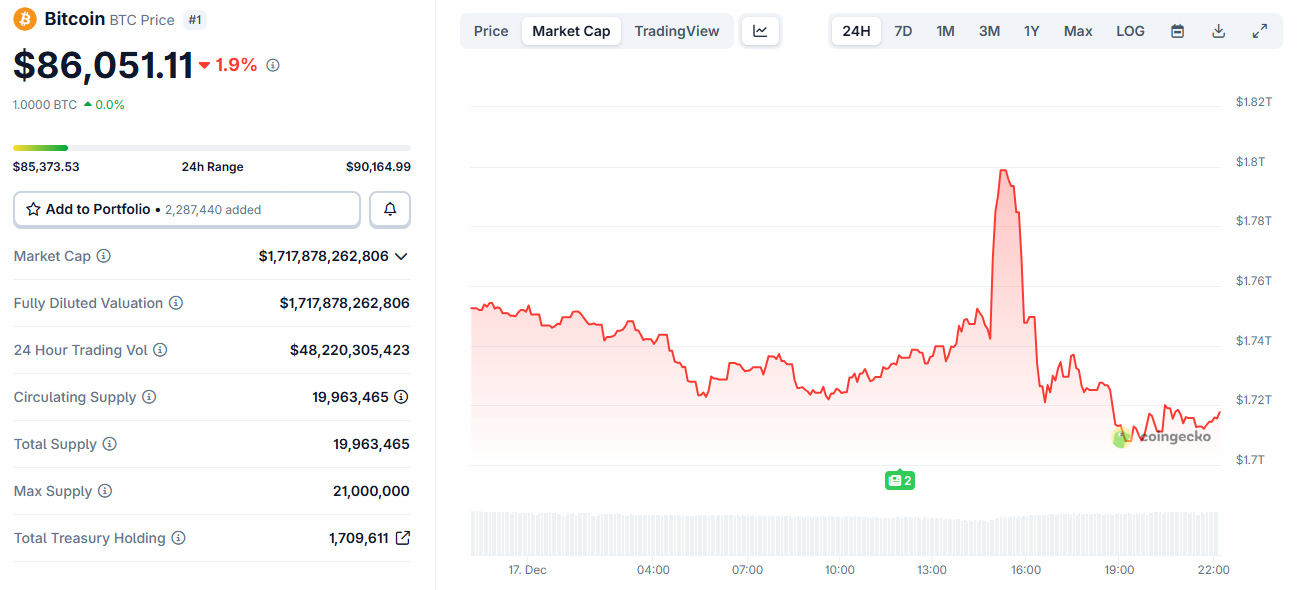
  •  
❌