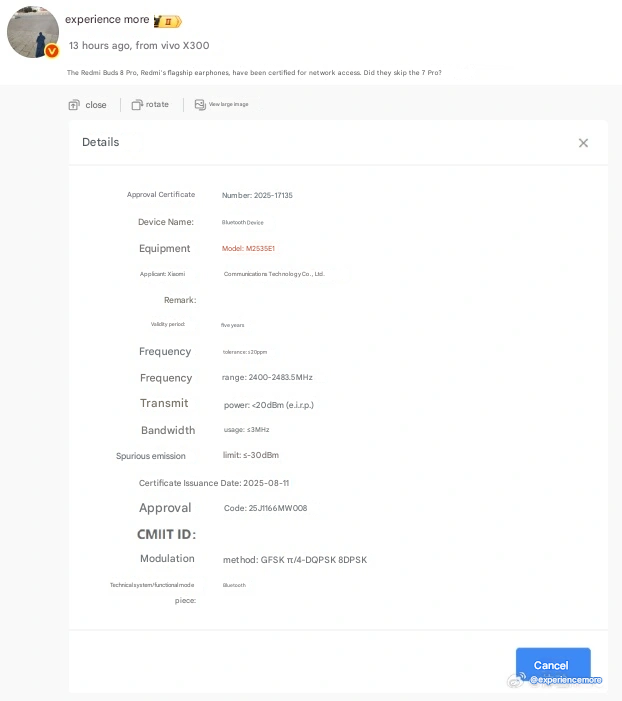
A new Xiaomi audio product has now made an appearance in China’s regulatory listings, hinting at an imminent addition to the firm’s wireless earphone portfolio. The gadget, bearing model number M2535E1, cleared the Ministry of Industry and Information Technology’s radio approval in August. If tipster @experiencemore is anything to go by, this model is actually part of the upcoming Redmi Buds 8 Pro, meaning Xiaomi is getting ready with a refresh of their popular mid-tier TWS series.
The certification only means that the Redmi Buds 8 Pro has passed essential regulatory procedures in China. This generally precedes the public announcements, which means that this product is going to hit the market soon. Xiaomi has not confirmed specifications, but from the given certification, it is certain that the development is finished and mass production probably started, too, which speaks volumes about how quickly this company expands its ecosystem.
Xiaomi has not yet announced the launch date or price of the Redmi Buds 8 Pro, but given the timing of certifications and based on previous product launches, an official announcement might be coming quite soon. Positioned as an affordable yet technically rich offering, the Redmi Buds 8 Pro should contribute to firming up Xiaomi’s mid-segment audio lineup and retain support for the company’s HyperConnect ecosystem.
Xiaomi HyperOS offers a fast and modern system design, but many users want deeper customization and smoother performance. With a few advanced optimizations, it is possible to enhance imaging quality, improve responsiveness, and create a cleaner user interface. In this guide, we explore key enhancements such as GCam integration, UI customization, gesture optimization, and ADB-based system tuning.
Enhancing Imaging Performance with GCam
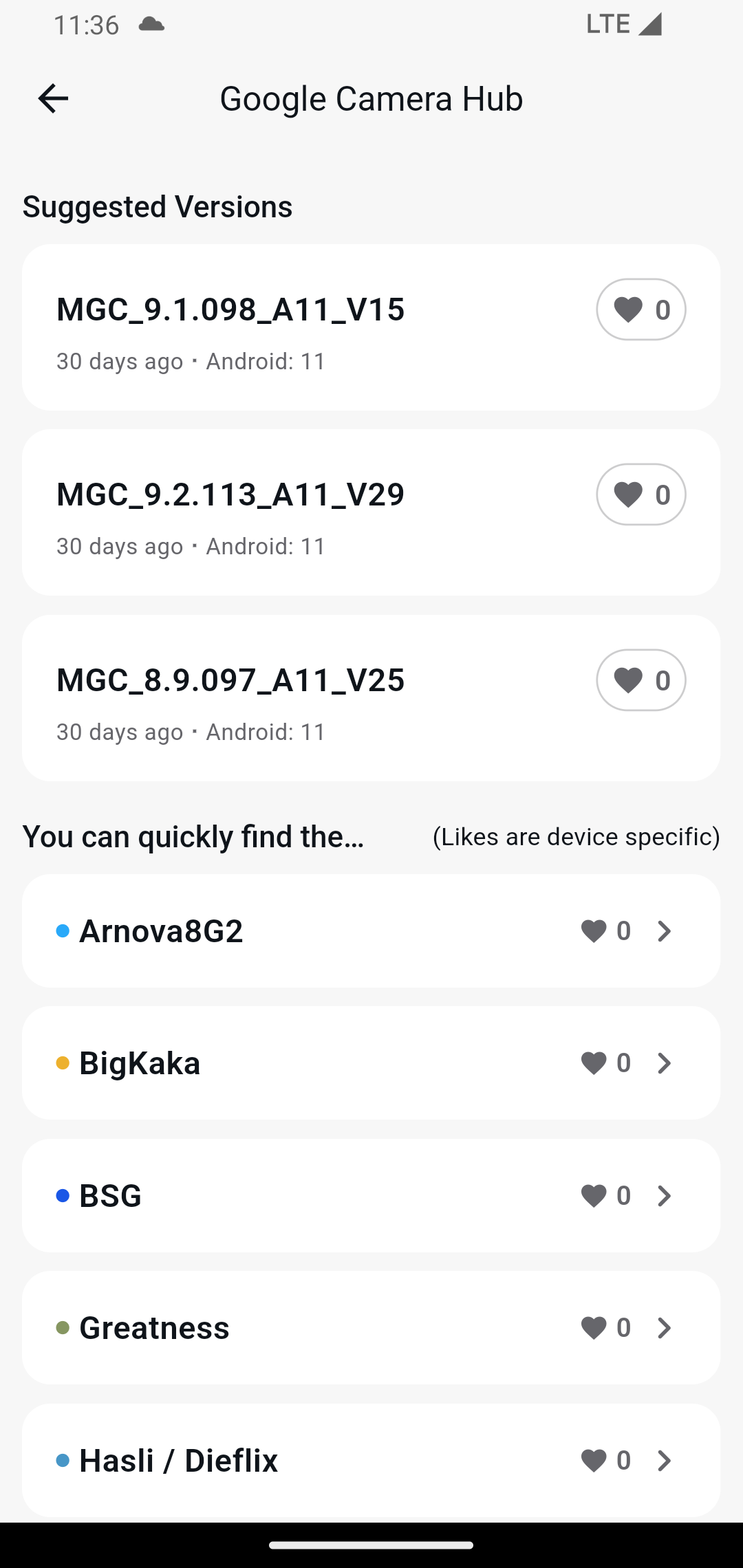
Google Camera (GCam) can significantly improve dynamic range, exposure balance, and night performance on HyperOS devices. Many Xiaomi models benefit from GCam’s HDR+ and Night Sight algorithms, especially when paired with the correct XML configuration.
Installing GCam requires loading the APK and importing an XML profile. The correct configuration ensures proper color tuning, sensor mapping, and advanced feature support. After creating the /GCam/Configs/ directory, users double-tap the viewfinder’s black border to import their XML file. This step ensures correct calibration for Xiaomi’s image signal processor.
You can use GCamLoader application to get latest GCam.
Customizing the HyperOS Interface
Visual and sound customization tools allow users to make their device more personal and more functional.
Replacing Default Ringtones
HyperOS allows full customization of call tones by importing local audio files. Users simply navigate to Settings → Sound & Vibration to select or upload new tones. For dual-SIM devices, HyperOS also supports assigning different tones per SIM, increasing clarity in daily use.
Enabling Dynamic Animated Weather Wallpapers
HyperOS sometimes limits animated weather wallpapers on mid-range devices to preserve resources. Installing the Weather package restores full high-resolution animations. This version is originally designed for Xiaomi tablets but works effectively across HyperOS smartphones.
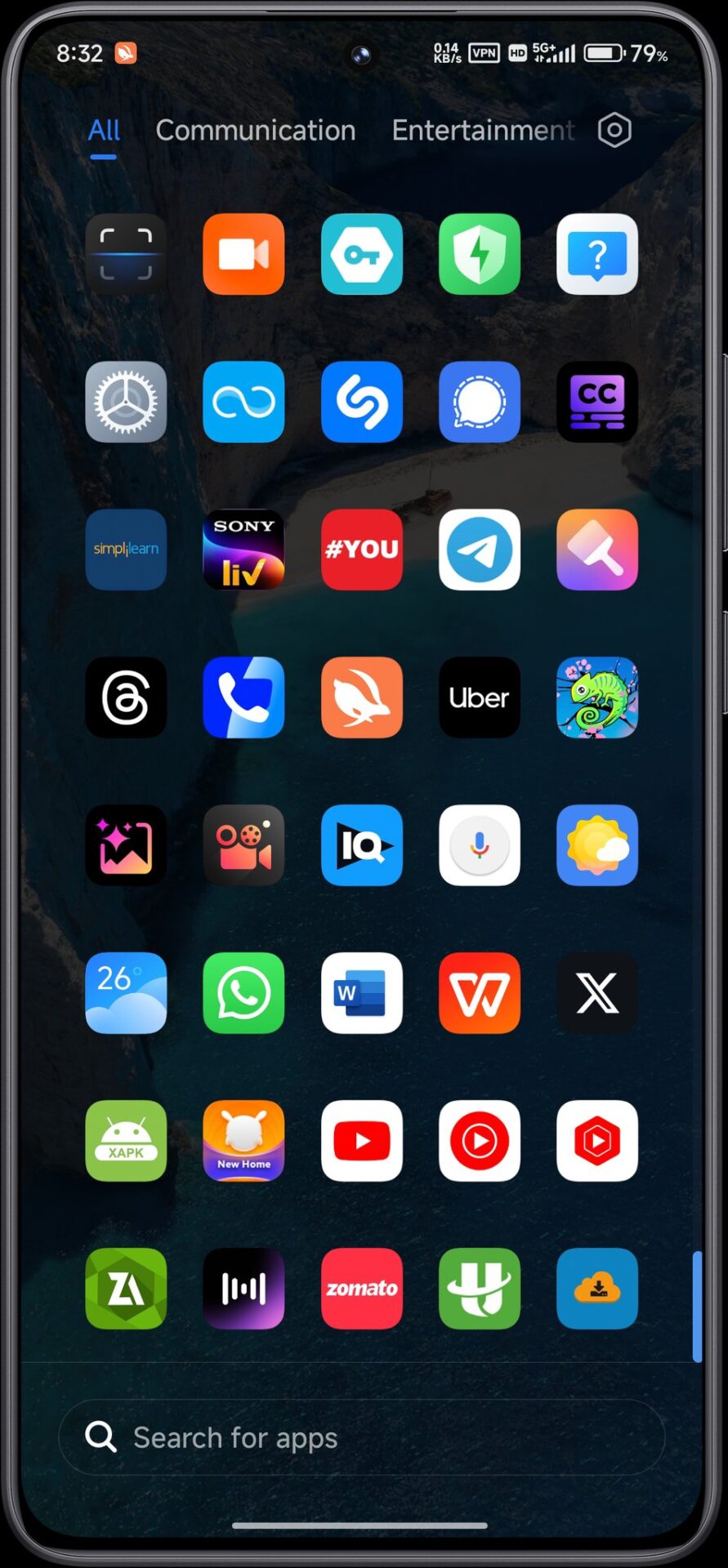
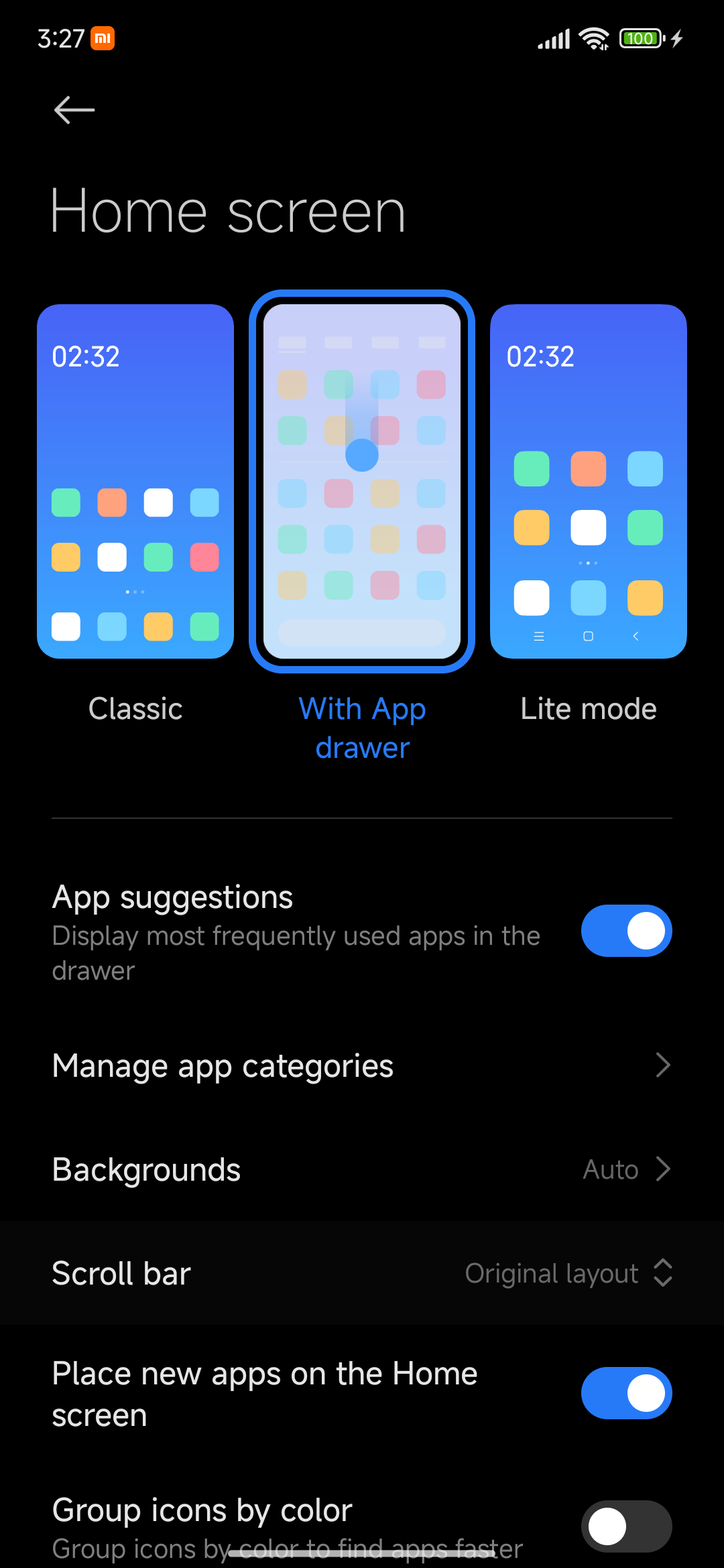
Switching to the App Drawer Layout
Users can enable App Drawer mode by going to Home Screen Settings → With App Drawer. This mode offers visual organization tools, category management, and a cleaner home layout.
Optimizing Gestures and Launchers
HyperOS restricts full-screen gesture support when third-party launchers are set as default. Power users often bypass this limitation using specialized methods. Tools such as Fluid Navigation Gestures (FNG) provide gesture overlays using Android Accessibility Services. This avoids system exploits while offering customizable swipe controls.
Deep System Optimization with ADB Debloating
ADB debloating removes unnecessary applications, improving RAM efficiency and reducing background power consumption. This method is safe when applied carefully and allows users to reinstall removed packages at any time.
Performance improvements in HyperOS depend on both visual settings and system balancing features.
Animation Scale Adjustments
Setting Window, Transition, and Animator scales to 0.5x creates an instantly snappier user experience. These changes reduce visual delay without impacting actual performance levels.
Using Performance Modes
HyperOS provides both automatic smart performance balancing and a high-power Performance Mode for demanding tasks such as gaming. Users can activate it via Settings → Battery → Performance Mode.-
Improving the Xiaomi HyperOS experience is a blend of thoughtful customization, correct tool usage, and ongoing system maintenance. By integrating GCam, fine-tuning visual and gesture settings, and carefully applying ADB optimizations, users can achieve a faster, cleaner, and more refined HyperOS environment. With responsible adjustments and regular system updates, HyperOS becomes a flexible, high-performance platform suitable for both casual and advanced users.
Canonical's engineers have submitted pull requests to add RISC-V support to Google's Flutter toolkit, which Ubuntu uses to built many of its desktop apps.
Badan Layanan Keuangan Jepang (FSA) dilaporkan berencana mengklasifikasikan 105 aset cryptocurrency sebagai produk keuangan dan memangkas pajak keuntungan kripto maksimum dari 55% menjadi tarif tetap 20%. Kebijakan ini akan menyelaraskan pajak crypto dengan pasar saham.
Reformasi ini adalah langkah berani Jepang untuk menghidupkan kembali sektor kripto mereka. Tujuannya adalah menjawab keluhan investor mengenai pajak tinggi sambil memperkuat pengawasan pasar, menjadikan Jepang salah satu pasar mata uang crypto terbaik di kawasan Asia.
Jepang: Kripto Setara Produk Keuangan dan Perlindungan Investor
Jepang bersiap melakukan perombakan regulasi besar dengan mengklasifikasikan aset crypto sebagai produk keuangan di bawah Financial Instruments and Exchange Act (FIEA). Langkah ini merupakan bagian dari reformasi yang bertujuan menata kembali sektor kripto nasional.
Badan Layanan Keuangan Jepang (FSA) berencana memasukkan setidaknya 105 mata uang kripto, termasuk Bitcoin (BTC) dan Ethereum (ETH), ke dalam cakupan FIEA, secara efektif menyetarakan cryptocurrency dengan saham dan obligasi.
Perluasan payung regulasi ini bertujuan utama untuk memastikan sektor kripto mematuhi aturan perlindungan investor yang lebih ketat dan standar yang lebih tinggi. Berdasarkan aturan yang diusulkan, cryptocurrency terbaik seperti BTC dan ETH yang terdaftar di bursa domestik harus memenuhi protokol ketat terkait perjanjian pengungkapan (disclosure agreement).
Bursa di Jepang diwajibkan untuk mengungkapkan secara transparan informasi mendasar setiap token, termasuk penerbit, infrastruktur blockchain yang digunakan, serta riwayat volatilitas harga. Ini menandai upaya serius Jepang untuk memberikan kejelasan regulasi dan meningkatkan kepercayaan publik terhadap pasar aset digital.
CZ Puji Langkah Jepang Potong Pajak Kripto
Kabar mengenai rencana pemangkasan pajak keuntungan kripto di Jepang disambut baik oleh salah satu tokoh paling berpengaruh di industri ini, salah satunya adalah Co-Founder Binance, Changpeng Zhao (CZ). Melalui unggahan di platform X, CZ memberikan dukungannya dengan menyatakan, “Biaya yang lebih rendah = pertumbuhan ekonomi yang lebih besar.”
Dukungan dari figur sebesar CZ memiliki dampak signifikan. Sebagai suara yang sangat dihormati di komunitas kripto global, restunya mengindikasikan bahwa Jepang berpotensi menjadi salah tujuan investasi yang sangat menarik bagi para investor aset digital untuk menempatkan dana mereka.
Dampak positifnya tidak hanya berhenti pada sentimen; dukungan CZ kemungkinan besar akan mendorong lebih banyak individu dan perusahaan untuk berinvestasi, serta berpartisipasi aktif dalam pasar crypto Jepang yang sedang berkembang.
Minat Jepang terhadap aset digital sebenarnya sudah mulai menguat di era Perdana Menteri sebelumnya, Shigeru Ishiba. Beliau memandang mata uang digital sebagai salah satu alat strategis bagi Jepang untuk mengatasi tantangan ekonomi yang telah berlangsung lama.
Kini, Perdana Menteri yang baru, Sanae Takaichi, juga dikenal sangat mendukung teknologi baru dan berencana untuk terus mengarahkan Jepang menuju adopsi cryptocurrency yang lebih luas.
Langkah reformasi pajak dan klasifikasi aset kripto di bawah Financial Instruments and Exchange Act (FIEA) ini memang menandai komitmen Jepang untuk menciptakan lingkungan regulasi yang kondusif. Dengan tarif pajak yang disetarakan dengan pasar saham, Jepang tidak hanya berupaya mengatasi keluhan investor domestik tetapi juga memposisikan diri sebagai pusat inovasi dan investasi kripto yang kompetitif di Asia.
Reformasi Pajak: Apakah Cukup Memicu Boom Kripto Jepang?
Meskipun pemotongan pajak kripto yang signifikan oleh Jepang disambut antusias, muncul pertanyaan: apakah reformasi pajak saja cukup untuk memicu kembali boom kripto di negara tersebut?
Realitasnya lebih bernuansa. Penurunan beban pajak dan klarifikasi regulasi adalah kondisi yang diperlukan, tetapi tidak cukup untuk menjamin ledakan pertumbuhan. Langkah-langkah ini hanya membuka peluang, bukan jaminan kesuksesan.
Di satu sisi, Tokyo mengirimkan sinyal kuat bahwa mereka tidak ingin lagi melihat talenta dan modalnya bermigrasi ke pusat-pusat cryptocurrency lain seperti Singapura, Hong Kong, atau Dubai. Dengan menyamakan perlakuan pajak kripto dengan saham, pesan kepada para pengusaha Web3 sangat jelas: bangunlah ekosistem di Jepang, bukan di tempat lain.
Perusahaan lokal, yang sebelumnya mengeluhkan pajak atas keuntungan yang belum direalisasi, kini telah mendapatkan pelonggaran awal untuk tetap beroperasi di dalam negeri (onshore).
Namun, tantangan yang dihadapi Jepang jauh lebih besar. Jepang adalah ekonomi matang dengan populasi menua dan selera risiko yang lebih terukur dibandingkan wilayah lain.
Pajak yang lebih ringan memang dapat menarik trader dan pengembang untuk kembali, tetapi itu tidak bisa menggantikan budaya inovasi yang dinamis, kerangka perbankan yang lincah, atau modal ventura yang siap mendanai proyek berisiko tinggi. Reformasi pajak memberikan ruang bernapas, tetapi tidak menciptakan mesin pertumbuhan itu sendiri.
Pada praktiknya, revitalisasi ekosistem crypto Jepang akan bergantung pada kombinasi beberapa faktor: adopsi oleh institusi besar, munculnya proyek-proyek lokal yang berkualitas, dan kemampuan masyarakat umum untuk kembali percaya setelah bertahun-tahun dibayangi oleh sistem pajak yang mencekik.
Reformasi pajak hanyalah fondasi. Hal yang akan menentukan adalah pengalaman konkret dan inovatif yang ditawarkan kepada pengguna setelah fondasi ini berdiri.
PEPENODE: Gelombang Baru Penambangan Kripto yang Lebih Terjangkau
Perdebatan mengenai reformasi pajak di Jepang mengingatkan kita bahwa jika ekosistem kripto ingin berkembang, penting untuk menyediakan gerbang masuk bagi investor kecil yang tidak elitis atau secara teknis terlalu rumit. PEPENODE (PEPENODE) memilih untuk mengatasi masalah ini melalui konsep penambangan yang di-gamifikasi.
Alih-alih harus mengejar perangkat ASIC yang mahal dan dibebani tagihan listrik yang mencekik—kendala umum dalam penambangan tradisional—pengguna di PEPENODE memulai dengan hanya memiliki ruang server virtual sederhana.
Dari sana, mereka mulai menambahkan “node” yang masing-masing memiliki karakteristik unik, membangun konfigurasi penambangan mereka secara bertahap. Meskipun faktor acak ikut berperan, di mana beberapa node lebih unggul dari yang lain, perbedaan utama terletak pada strategi pemain: bagaimana menggabungkan node yang tepat, memperluas ruang, dan menjual aset yang kurang efektif untuk meningkatkan keseluruhan rig.
Pendekatan ini berhasil mengubah aktivitas penambangan menjadi sebuah permainan membangun dan strategi, tetapi dengan hasil nyata: generasi token $PEPENODE. Selain itu, rig yang dibangun juga menghasilkan meme coin populer lainnya seperti PEPE atau FARTCOIN. Ke depannya, insentif lain seperti DOGE atau SHIB berpotensi ditambahkan, yang makin meningkatkan daya tarik model ini.
Investor kecil, yang selama ini tersingkir dari penambangan Bitcoin karena modal besar, kini menemukan arena di mana modal sederhana mereka memiliki kesempatan untuk diperhitungkan. PEPENODE menciptakan lingkungan inklusif, memungkinkan partisipasi dalam penambangan tanpa hambatan biaya dan teknis yang tinggi.
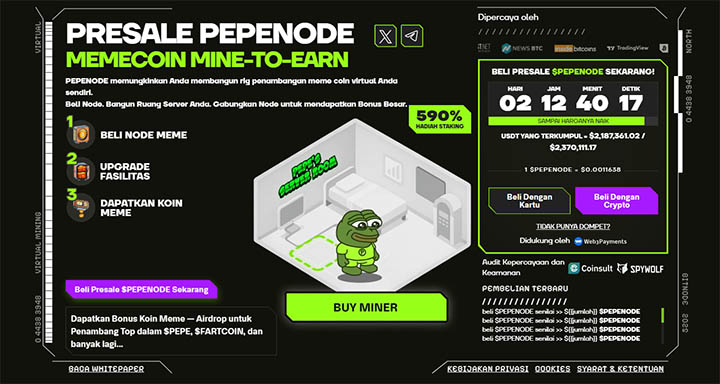
Saat ini presale PEPENODE telah mengumpulkan lebih dari $2,1 juta atau sekitar Rp35 miliar. Perolehan tersebut mencerminkan tingginya minat dari penggemar kripto terhadap platform mine-to-earn inovatif yang ditawarkan proyek ini.
PEPENODE masih menggelar presale crypto untuk token $PEPENODE, dengan harga saat ini $0,0011638 per token. Investor presale dapat mengharapkan imbal hasil melalui metode staking yang saat ini menawarkan imbalan mencapai 590% APY.
Baca panduan lengkap cara beli PEPENODE untuk mendapatkan langkah komprehensif membeli $PEPENODE di situs web resminya. Anda juga dapat memperkaya informasi mengenai proyek ini dengan membaca prediksi harga PEPENODE.
Disclaimer: Pendapat dan pandangan yang diungkapkan dalam postingan ini tidak selalu mencerminkan kebijakan atau posisi resmi Cryptonews. Informasi yang disediakan dalam postingan ini hanya untuk tujuan informasi dan tidak boleh dianggap sebagai nasihat keuangan, investasi, atau profesional. Cryptonews tidak mendukung produk, layanan, atau perusahaan tertentu yang disebutkan dalam postingan ini. Pembaca disarankan untuk melakukan riset mandiri dan berkonsultasi dengan profesional yang berkualifikasi sebelum mengambil keputusan keuangan apa pun. Jangan pernah menginvestasikan lebih dari yang Anda siap kehilangan.
Pasar crypto kembali diguncang gelombang likuidasi besar yang menyapu posisi trader dalam hitungan jam. Dalam satu hari, lebih dari $1 miliar atau sekitar 16,7 triliun rupiah menguap, dengan Bitcoin, Ethereum, dan Solana menjadi titik benturan utama.
Peristiwa ini menegaskan normal baru di crypto, volatilitas ekstrem yang hidup karena leverage tinggi. Gerak harga kecil pun bisa menjelma domino yang meruntuhkan posisi beruntun.
1 Miliar Dolar Hilang dalam 24 Jam
Likuidasi lebih dari $1 miliar atau sekitar 16,7 triliun rupiah terjadi hanya dalam sehari dan menyentuh sekitar 180.000 sampai 190.000 trader. Posisi long mendominasi korban, sehingga pihak yang yakin reli berlanjut menanggung koreksi paling keras.
BREAKING:
$1,000,000,000 worth of Bitcoin & crypto longs liquidated in the past 60 minutes. pic.twitter.com/jiL8AXDtml
Total kapitalisasi market crypto turun sekitar 3 sampai 4 persen, tetapi portofolio yang memakai leverage besar merasakan dampak paling brutal. Bitcoin sempat mematahkan area $85.000 atau sekitar 1,42 miliar rupiah sebelum pantulan muncul.
Sentimen market masih tegang, karena satu sumbu candle dapat memicu forced liquidation baru. Ethereum ikut turun di bawah level psikologis $3.000 atau sekitar 50 juta rupiah. Solana meneruskan rangkaian penurunan walau pembahasan ETF SOL tetap ramai.
Altcoin besar seperti XRP dan BNB ikut melemah 3 sampai 5 persen. Pola ini lebih mirip rentetan hentakan tajam ketimbang crash klasik yang panjang.
Efek Bola Salju Saat Leverage Melemahkan Crypto
Gelombang likuidasi $1 miliar ini bukan insiden tunggal. Beberapa pekan terakhir sering menampilkan hari dengan posisi terhapus di atas $500 juta atau sekitar 8,34 triliun rupiah.
Sejumlah sesi bahkan melewati $1,3 miliar atau sekitar 21,7 triliun rupiah saat Bitcoin jatuh lebih curam. Polanya jelas, leverage menumpuk, kedalaman market menipis, lalu penurunan kecil berubah menjadi arus deras.
Pelaku institusional bergerak lebih hati hati. Setelah guncangan Oktober yang menghapus hampir $19 miliar atau sekitar 316,7 triliun rupiah di seluruh market, arus keluar modal dari produk terstruktur dan ETF meningkat. Likuiditas dasar ikut menyusut, sementara trader ritel tetap agresif memakai leverage 20x, 50x, bahkan 100x di derivatives.
Penurunan harga 2 atau 3 persen saja bisa mendorong posisi dengan leverage tinggi melewati batas margin. Exchange mengeksekusi penjualan paksa, tekanan jual memperdalam koreksi, lalu memicu liquidations lanjutan. Rantai ini berputar cepat dan otomatis. Istilah crash terasa kurang pas, karena market mengalami kumpulan letupan mikro yang menumpuk sampai miliaran lenyap.
Bitcoin Hyper HYPER – Opsi Pilihan Saat Pasar Mengalami Koreksi
Tekanan besar tidak selalu membuat investor menjauh dari crypto. Banyak pelaku pasar memilih reposisi ke proyek yang menempel kuat pada narasi Bitcoin. Bitcoin Hyper atau $HYPER mencuri perhatian karena menawarkan eksposur ke potensi bull run BTC berikutnya tanpa hanya mengandalkan pembelian spot.
Cerita Layer 2 yang melekat pada jaringan Bitcoin memberi jalur alternatif bagi investor yang ingin ikut siklus naik. Presale $HYPER sudah mengumpulkan $28,3 juta atau sekitar 472 miliar rupiah. Harga token saat ini berada di $0.013325.
Minat whale ikut menonjol. Seorang investor membeli hampir $500.000 atau sekitar 8,34 miliar rupiah bulan ini. Whale lain masuk pada Oktober dengan nilai sekitar $833.000 atau sekitar 13,9 miliar rupiah. Pembelian besar di tengah market gelisah biasanya mencerminkan keyakinan jangka menengah.
Proyeksi analis tetap spekulatif. Alan Draper menaruh target $0.0583 pada 2025 atau potensi naik lebih dari 330 persen dari harga sekarang. Prediksi harga Bitcoin Hyper menempatkan token ini dengan peluang kenaikan di atas 1.000 persen.
Beberapa suara menyebut skenario x1000 jika utilitas BTC dan ekosistem HYPER benar benar tersambung. Investor yang tertarik, bisa memanfaatkan fase presale untuk membangun posisi lebih awal. Untuk informasi selengkapnya, silakan baca panduan kami cara beli Bitcoin Hyper dan ikuti perkembangan proyek crypto ini dengan bergabung ke Telegram dan juga media sosial X (Twitter) mereka.
Maxi Doge MAXI – Memecoin yang Bergerak Berlawanan Arus
Ranah meme coin juga melahirkan kandidat yang bergerak melawan arus, yaitu Maxi Doge atau $MAXI. Saat banyak trader melepas posisi di aset bermodal besar, presale Maxi Doge menembus $4,1 juta atau sekitar 68,4 miliar rupiah. Pencapaian ini tidak menjamin hasil akhir, tetapi menunjukkan selera risiko pada proyek spekulatif masih hidup.
Harga masuk yang rendah menjadi daya tarik utama. Token $MAXI saat ini berada di $0.0002695, sehingga investor bisa masuk dengan dana kecil sambil mengejar upside besar. Program staking dengan yield menarik ikut mendorong arus dana, karena investor bisa meraih passive income sambil menunggu listing di exchange besar.
Dinamika komunitas yang menguat setiap kali proyek viral membuat Maxi Doge mulai membangun jalur sendiri di antara memecoin bertema anjing. Bagi Anda yang tertarik dengan koin meme yang satu ini, jangan lupa baca prediksi harga Maxi Doge untuk memetakan peluang di fase berikutnya.
Panduan cara beli Maxi Doge biasanya mengarahkan investor ke presale resmi, lalu dilanjutkan dengan staking bila ingin menambah potensi imbal hasil. Proyek Maxi Doge aktif di akun X (Twitter) dan Telegram resmi mereka, jadi pantau kanal itu untuk update presale dan roadmap. Kunjungi laman resmi proyek agar Anda memperoleh informasi tokenomics dan jadwal terbaru.
Disclaimer:Pendapat dan pandangan yang diungkapkan dalam postingan ini tidak selalu mencerminkan kebijakan atau posisi resmi Cryptonews. Informasi yang disediakan dalam postingan ini hanya untuk tujuan informasi dan tidak boleh dianggap sebagai nasihat keuangan, investasi, atau profesional. Cryptonews tidak mendukung produk, layanan, atau perusahaan tertentu yang disebutkan dalam postingan ini. Pembaca disarankan untuk melakukan riset mandiri dan berkonsultasi dengan profesional yang berkualifikasi sebelum mengambil keputusan keuangan apa pun. Jangan pernah menginvestasikan lebih dari yang Anda siap kehilangan.
The DistroWatch news feed is brought to you by TUXEDO COMPUTERS. This week in DistroWatch Weekly:
Review: MX Linux 25
News: systemd experiments with musl libc support, Debian Libre Live publishes media for Trixie, Xubuntu reviews website hack
Questions and answers: Why are video drivers special?
Released last week: Finnix 251, Aurora 43, Proxmox 9.1 "Virtual Environment"
Torrent corner: KDE neon, Proxmox
Opinion poll:....
South Korea’s top payment platform and largest cryptocurrency exchange are set to merge, with board approvals expected on Wednesday and a public announcement planned for the next day.
This agreement will combine Naver Financial and Dunamu, the operator of Upbit, to form a powerful player that bridges traditional finance and digital assets in one of Asia’s largest economies.
Merger Timeline and Structure
The boards of both companies plan to meet on November 26 to approve the merger. After that, a joint announcement is expected on November 27. According to local media reports, top executives will attend a press conference at Naver’s campus.
The transaction will involve a complete stock exchange, making Dunamu a wholly owned subsidiary of Naver Financial. Current estimates value Naver Financial at about KRW 5 trillion and Dunamu at KRW 15 trillion. This difference suggests a 1:3 share exchange ratio.
Dunamu’s shareholders will exchange their stakes for shares in Naver Financial, and its principal holders are likely to take nearly 30% of the combined company. At the same time, Naver’s stake will decline from 69% to 17%, but operational control is expected to stay with Naver, one of South Korea’s top tech giants.
To comply with the country’s fair trade laws, Dunamu may assign over half of its voting rights to Naver. This step intends to address market concentration concerns while preserving the strategic advantages of the deal.
Strategic Outlook for the Combined Entity
This merger unites two complementary leaders in South Korea’s financial sector. Naver Financial runs the country’s most popular payment platform with strong ties to Naver’s e-commerce, search, and communication services. Dunamu dominates cryptocurrency trading through Upbit, processing billions in daily trading volume and serving millions of users.
The combined company seeks to create a comprehensive financial ecosystem that erases boundaries between traditional payments and digital assets. Their leaders expect to stress plans to compete with global tech giants. This strategy highlights the need for Korean fintech firms to scale and remain competitive beyond their home market.
Naver’s large user base and strong technology platform could accelerate the adoption of crypto among mainstream consumers. In return, Dunamu’s blockchain experience and regulatory know-how may boost Naver Financial’s edge in new financial technologies.
Regulatory Review and Future Impact
The proposed merger is under scrutiny by regulators. South Korea’s Financial Supervisory Service and Fair Trade Commission must both review the deal. The FSS will assess financial risk, especially the impact of combining a licensed payment platform with a virtual asset exchange. Regulators have long separated these sectors to prevent systemic risk.
Shareholder protection is another primary concern. With Naver’s stake falling below 20%, questions arise about governance and minority rights. Regulators will likely examine whether the agreement protects existing investors in both firms.
Competition authorities face a complex decision. While executives claim the merger is needed to compete globally, the Fair Trade Commission must determine whether it unfairly concentrates control over South Korea’s payment network and its largest cryptocurrency exchange. The review will focus on possible effects on market competition and consumer choice.
Approval will take months. Both companies must show that the merger’s benefits outweigh any risks to financial stability or fair competition. The decision could set a precedent for how traditional finance and digital assets may merge in South Korea and across Asia in the future.
A well-known Polish market analyst has publicly apologized after his latest Bitcoin outlook collapsed within weeks, sparking debate across social media.
Robert Ruszała, known online as El Profesor, admitted his plan was wrong and published a detailed breakdown explaining the mistakes behind his failed scenario.
Analyst Breaks Industry Norm by Owning His Error
Crypto commentators often highlight their wins and stay silent when predictions miss. Ruszała took the opposite approach.
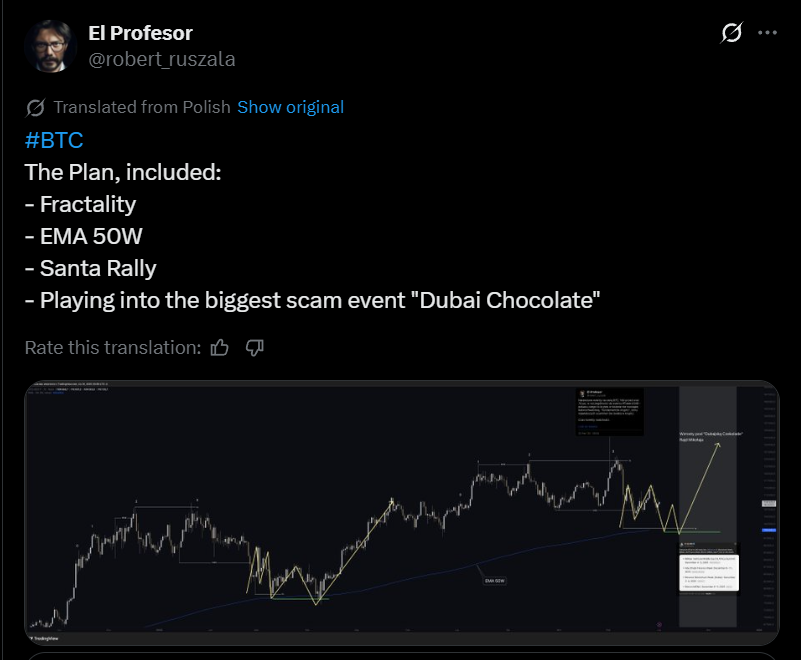
He originally released a forecast called “The Plan,” outlining a bullish path for Bitcoin based on market fractals, the 50-week EMA, and a seasonal move often described as the “Santa Rally.”
Original Post From the Analyst
According to his model, Bitcoin was expected to hold its uptrend and provide opportunities to take long positions at specific technical levels.
Market Reversal Forces a Reassessment
However, it took the market only three weeks to dismiss that vision. Bitcoin dropped below key zones and invalidated the entire bullish structure.
On 21 November, Ruszała addressed the failed call directly, writing: “I failed… I’m sorry to everyone who followed this plan. I know where I made the mistake.”
He later explained that he always prepares two scenarios — bullish and bearish. The first one worked from roughly $116,000 down to $94,700. The deeper decline activated his bearish outlook.
He stressed that reacting to market changes matters more than sticking to a single direction.
What Went Wrong in “The Plan”
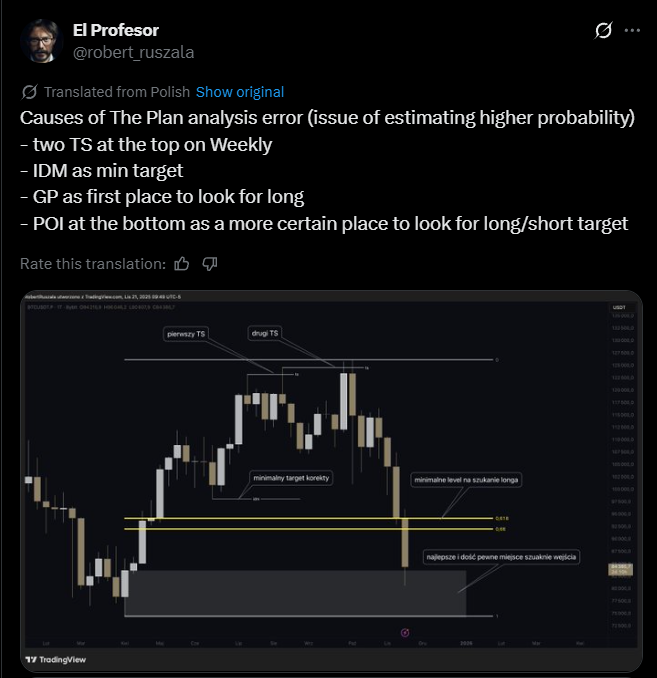
Ruszała then published a technical breakdown of the error. He pointed to several indicators that he ranked incorrectly in terms of probability.
The Analyst Later Explains Why His Prediction Failed
The post did not spark major controversy, but it prompted discussion among traders. Several users praised him for his transparency, noting that few analysts publicly dissect their own mistakes.
His response highlights a broader reality in crypto markets: even well-constructed scenarios require constant revision, and the market can still surprise the most seasoned experts.
Ethereum has struggled to recover from its recent dip, with the altcoin king attempting to regain momentum after slipping below key levels. While ETH has strong support from long-term holders, the recovery still requires fresh investment.
That inflow of new capital, however, appears limited at the moment, creating uncertainty around Ethereum’s next move.
Ethereum Holders Have Mixed Feelings
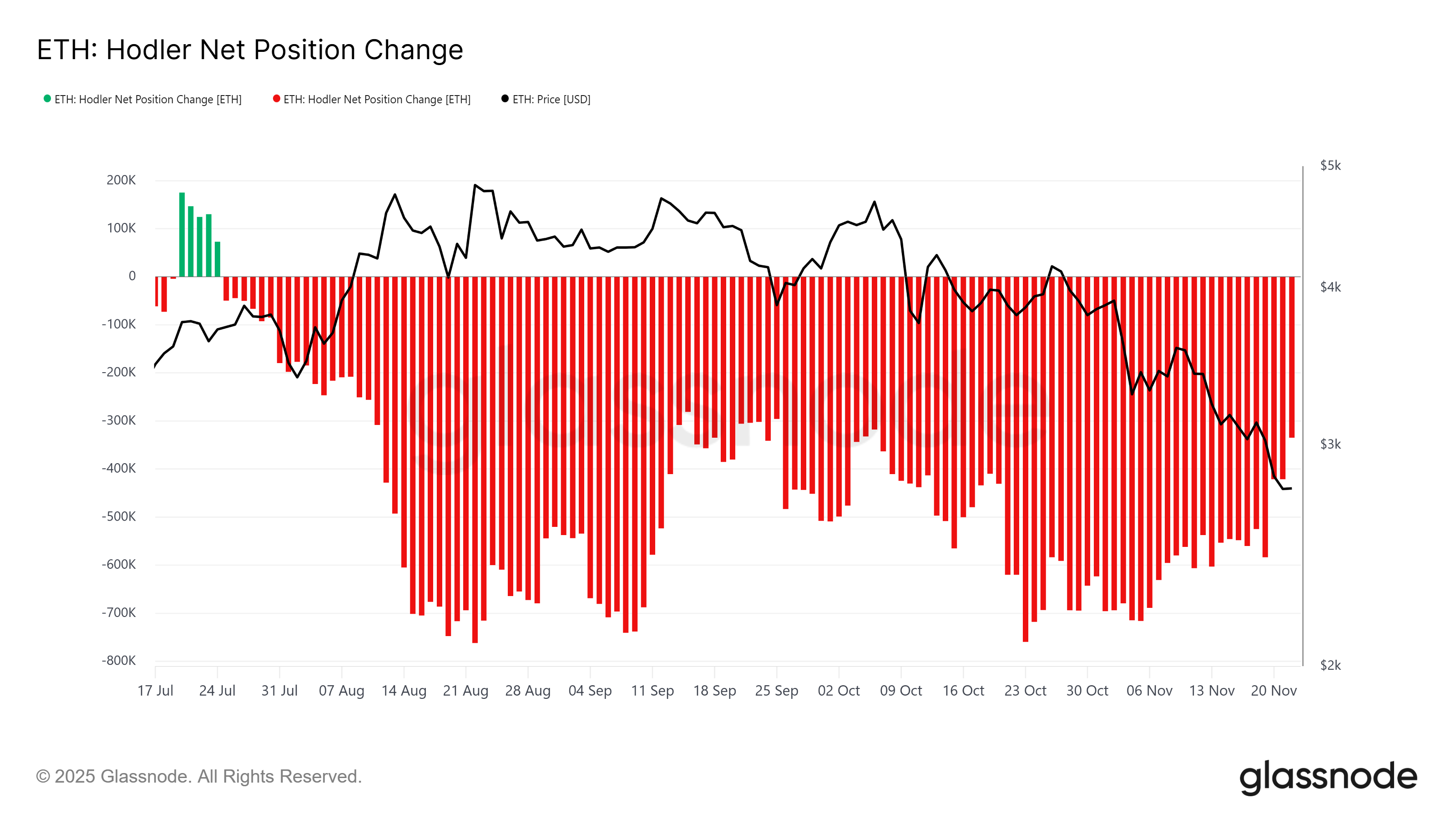
The HODLer Net Position Change indicator is showing a steady incline, signaling improving confidence among long-term holders. This metric measures the movement of ETH within LTH wallets, and the current rise from the negative zone suggests that outflows are slowing. Historically, a shift like this often precedes renewed accumulation.
As long-term holders reduce selling, the market gains stability. Their conviction in Ethereum’s recovery strengthens the asset’s foundation even during volatile conditions.
If this trend continues, LTHs may soon transition from holding to accumulating, providing meaningful support for ETH’s next upward push.
Want more token insights like this? Sign up for Editor Harsh Notariya’s Daily Crypto Newsletter here.
Ethereum HODLer Net Position Change. Source: Glassnode
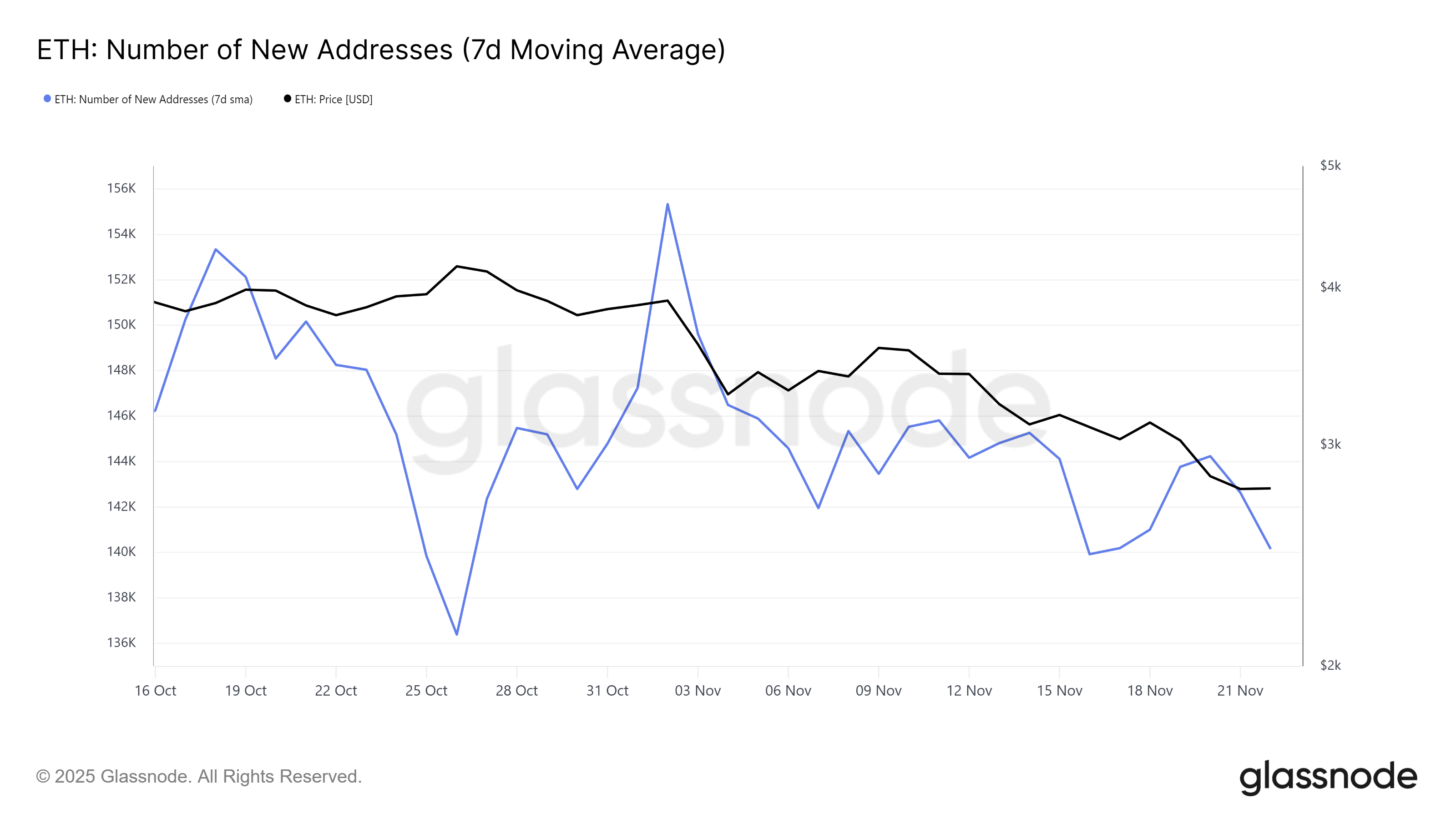
Despite improving sentiment from long-term holders, broader macro momentum remains mixed. The number of new Ethereum addresses is moving sideways, indicating weak interest from potential new investors.
This stagnation is concerning because fresh demand is a critical component of sustained price recovery.
Without an increase in new market participants, inflows may not be strong enough to propel ETH toward the $3,000 mark. Even with solid support from existing holders, a lack of external capital could delay or weaken any meaningful rally.
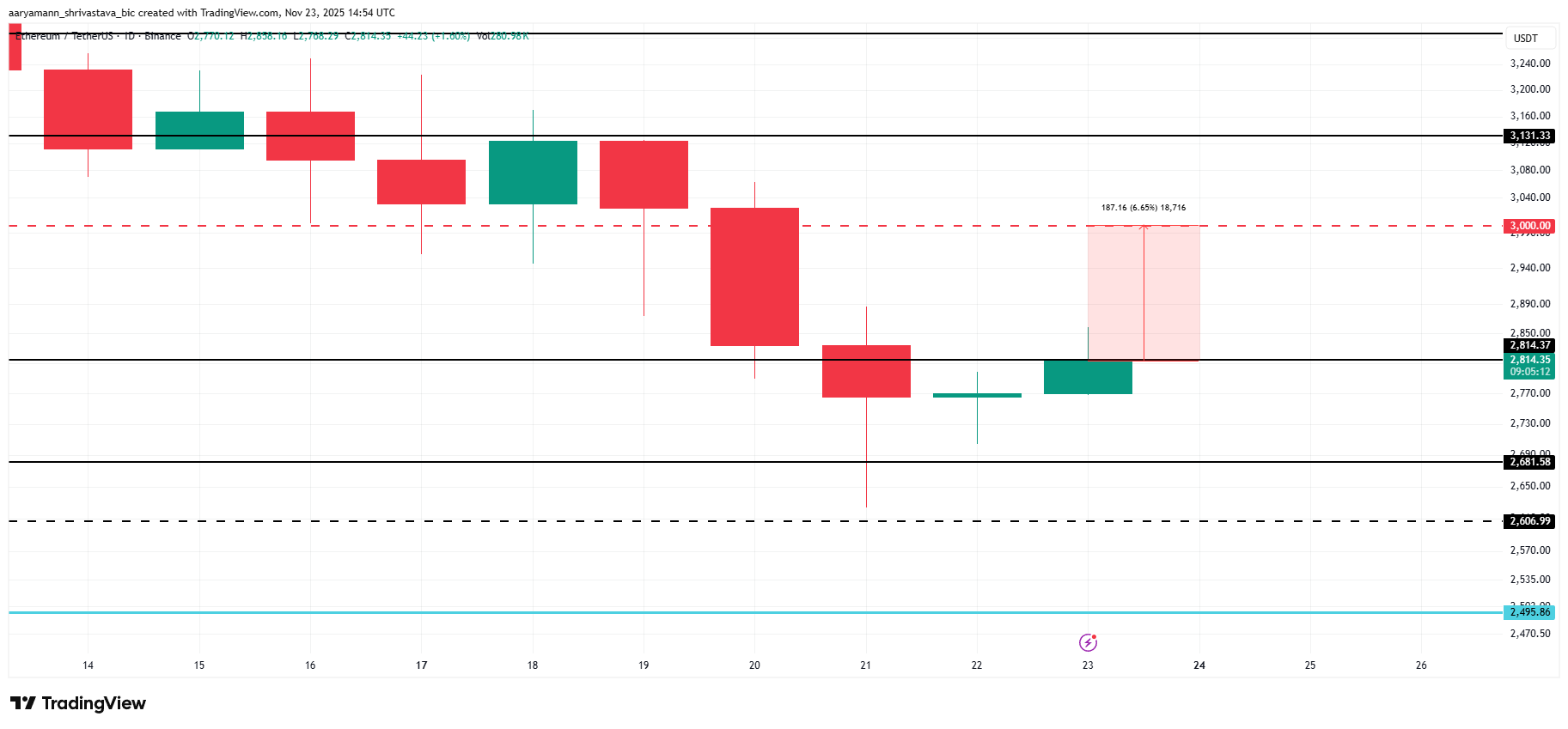
Ethereum is trading at $2,814, sitting directly beneath a key resistance level. At this distance, ETH is just 6.6% away from reclaiming $3,000, a psychologically significant barrier for both traders and long-term investors.
For Ethereum to reach this threshold, support from new investors is essential. If new demand remains weak, ETH may consolidate below $3,000 as existing capital alone may not be sufficient to drive an extended rally. The altcoin king needs broader participation to sustain a breakout.
If inflows improve and new investors re-engage, Ethereum could rally to $3,000 and attempt to flip the level into support. Successfully reclaiming this zone may pave the way for $3,131 or higher. This would invalidate the bearish outlook and restore bullish momentum.
Bitwise Chief Investment Officer Matt Hougan highlights common mispricing in Digital Asset Treasury Companies (DATs). He urges investors to consider valuation beyond simple crypto holdings as these firms navigate complex financial dynamics.
DATs now manage over $130 billion in digital assets, serving as vital links between traditional capital markets and direct cryptocurrency exposure. Their unique position brings new valuation challenges that set them apart from other investment vehicles.
Bitwise Just Revealed 3 Ways to Value DATs: All You Need to Know
Bitwise CIO Matt Hougan warns that most DATs are mispriced. While many trade at a discount to their assets, a few can trade at a premium by boosting crypto-per-share.
Hougan’s framework offers investors a clear way to separate the winners from the laggards.
1/ I see a lot of bad analysis of DATs, or digital asset treasury companies. Specifically, I see a lot of bad takes on whether they should trade at, above, or below the value of the assets they hold (their so-called “mNAV”).
Some DATs outperform by increasing crypto-per-share, with Hougan identifying four key strategies:
Issuing Debt: Borrowing USD to buy crypto can grow per-share holdings if prices rise.
Lending Crypto: Earning interest compounds the crypto held by the company.
Using Derivatives: Writing options or similar strategies generates additional assets, though it may limit upside.
Acquiring Crypto at a Discount: Buying undervalued assets, repurchasing shares, or acquiring cash-flow businesses can increase crypto-per-share efficiently.
The Bitwise executive articulates that scale matters, noting that larger DATs can access debt more easily, lend more crypto, and take advantage of M&A opportunities. Size is a structural advantage.
Market Differentiation Is Coming
DATs have historically moved together, but Hougan predicts increased divergence.
Discount DATs: Struggling with expenses, risk, or small scale.
Investors can use Hougan’s approach, calculating expenses, risk, and growth potential, to determine fair value.
Investors should also watch:
Which DATs consistently increase crypto-per-share.
How scale gives certain DATs a long-term edge.
Market moves that create opportunities to buy undervalued DATs.
With the market set for more differentiation, understanding Hougan’s framework could separate winners from losers amid a growing digital asset treasury space.
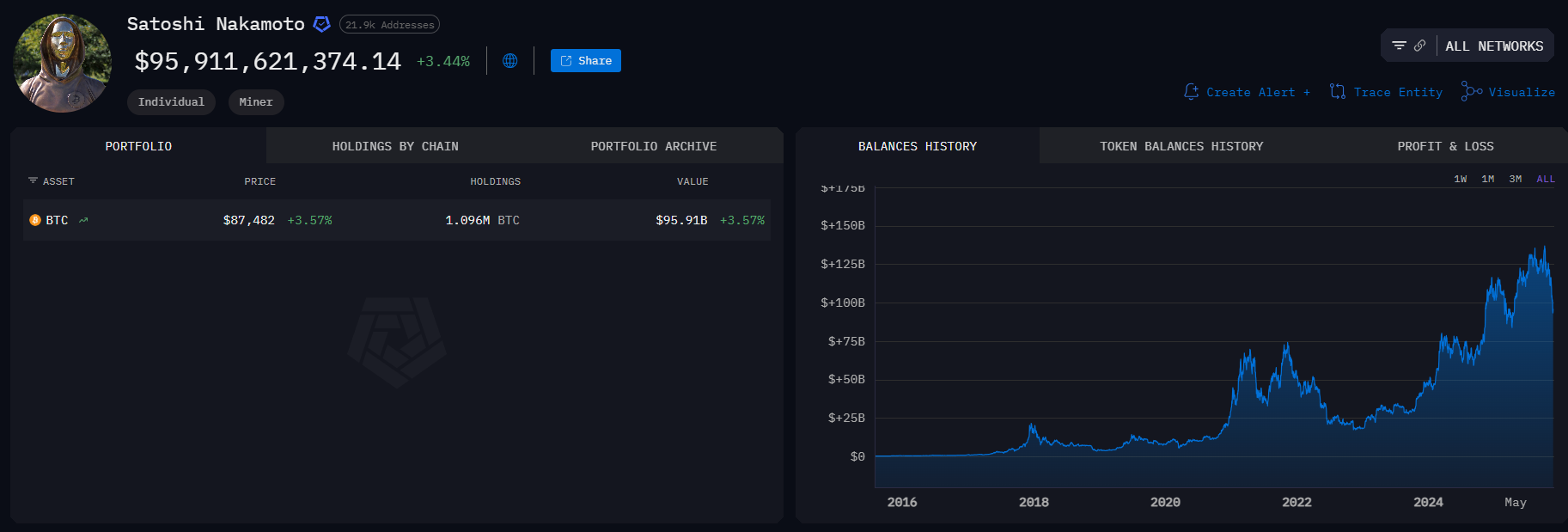
Satoshi Nakamoto’s legendary Bitcoin fortune has dropped by an estimated $41 billion, as BTC’s price slid more than 30% from its all-time high.
The pseudonymous creator’s 1.1 million Bitcoin, tracked using the Patoshi mining pattern, fell from $138 billion in October to about $96 billion as of this writing. This sharp decline moved Satoshi from 11th to around 20th among the world’s wealthiest people, now just below Bill Gates.
BTC Price Crashed, But What Happened to Satoshi’s Bitcoin Stash
Arkham Intelligence, a blockchain analytics firm, estimates Satoshi’s Bitcoin using mining analysis and on-chain forensics.
The “Patoshi Pattern,” discovered by Sergio Lerner, identifies more than 22,000 early addresses likely controlled by one entity, widely believed to be Satoshi Nakamoto. These coins, untouched for over a decade, continue to fuel intense speculation.
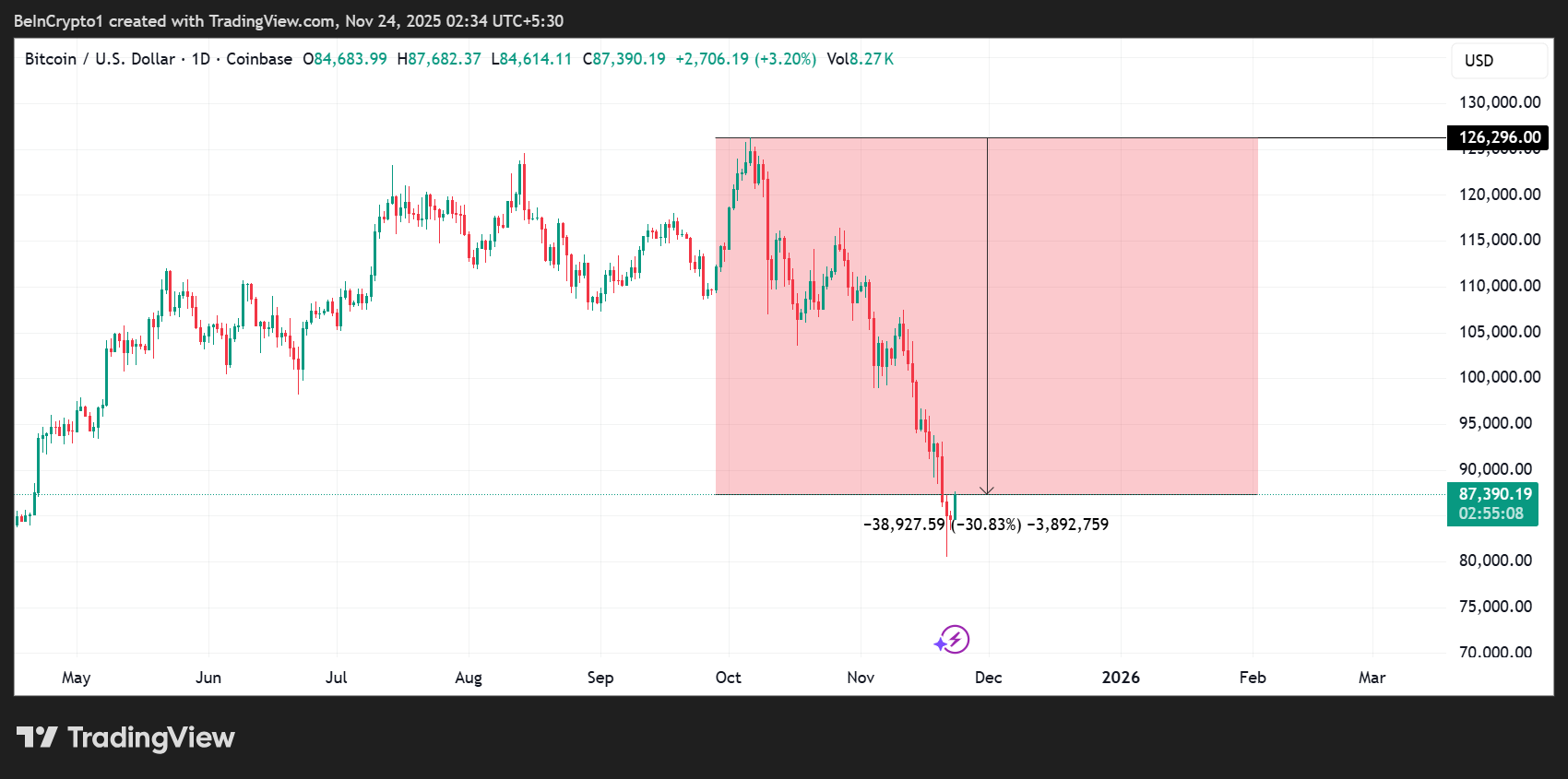
As of October 6, 2025, when the pioneer crypto established an all-time high of $126,296, Satoshi’s Bitcoin stash was valued at $138.92 billion. However , Bitcoin’s price has since dropped by over 30% to trade for $87,390 as of this writing.
With this drop, Satoshi’s Bitcoin stash has shrunk to $96.129 billion, meaning $42.79 billion of this fortune disappeared in weeks.
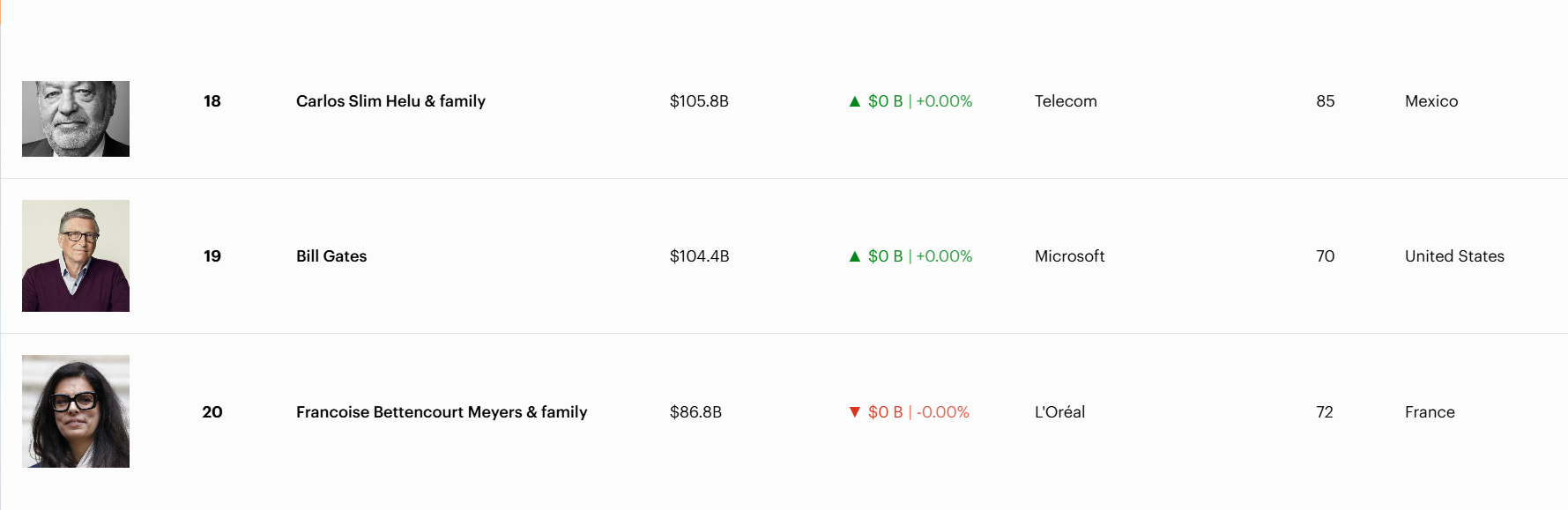
If Forbes listed Satoshi among the list of the world’s richest people, the Bitcoin founder would rank just below Bill Gates and right above Françoise Bettencourt Meyers & family at position 20.
Satoshi’s Place Among Richest People in the World. Source: Forbes
Despite the vast scale of Satoshi’s holdings, Forbes and other wealth trackers do not count the Bitcoin founder in their official billionaire lists. The reasons include Satoshi’s unverified legal status and the fact that the assets have remained dormant, leaving ownership questions unresolved.
“Forbes does not include Satoshi Nakamoto on our Billionaire rankings because we have not been able to verify whether he or she is a living person, or one person vs. a collective group of people,” the magazine told BeInCrypto.
Ironically, Satoshi’s coins remain among the most visible fortunes due to the blockchain’s transparency.
Some experts suggest Forbes and others should consider including pseudonymous crypto wallets in their lists, even though ownership is anonymous.
Nonetheless, the long-term dormancy has also led to speculation that the fortune could be lost, inaccessible, or deliberately abandoned, an unusual scenario among billionaires.
Quantum Threats and Satoshi’s Secret
Elsewhere, the rise of quantum computing has renewed debate about Satoshi’s future and potential identity. Because quantum computers might one day break early Bitcoin cryptography, some experts propose freezing Satoshi’s coins or forking the network before a possible “Q-Day.” If these risks emerge, the controller of these coins may need to surface.
Important not to scaremonger here about quantum timelines.
Running Shor's algorithm is not the same thing as breaking an actual 256-bit ECC key. You can use Shor's algorithm to factor a number—that will be impressive—but will take a huge degree of scaling and engineering to… https://t.co/juppHGU8wCpic.twitter.com/k38lZvMBLl
Nakamoto’s enigma will reach a global audience in 2026 with “Killing Satoshi,” a film exploring the mystery and geopolitical implications of dormant Bitcoin wealth.
Until these coins are moved or declared lost, Satoshi’s fortune remains a symbol of Bitcoin’s origins and its greatest secret.
If Bitcoin surges to $320,000–$370,000, Satoshi could become the world’s richest person. For now, the fortune remains unchanged for over 15 years, highly visible, but untouched.
The Department of Government Efficiency (DOGE) has been dissolved, according to the Office of Personnel Management (OPM), despite its mandate being scheduled to continue through July 2026.
Despite the news, the meme coin associated with the Elon Musk and Vivek Ramaswamy-led initiative is up by double digits.
The launch sparked immediate attention, driving Dogecoin prices up over 10% on the announcement and leading to expectations of more crypto use in government.
OPM director Scott Kupor confirmed the dissolution, noting that DOGE doesn’t exist as a centralized entity. The department’s roles have shifted into OPM, while Trump now refers to DOGE in the past tense at public events.
Good editing by @reuters – spliced my full comments across paragraphs 2/3 to create a grabbing headline 🙂 The truth is: DOGE may not have centralized leadership under @USDS. But, the principles of DOGE remain alive and well: de-regulation; eliminating fraud, waste and abuse;…
Despite its aggressive cost-cutting, the department quietly closed its doors.
Vivek Ramaswamy withdrew from the Ohio Senate race to focus on DOGE, but the department faced criticism for a lack of transparency and public accountability throughout its brief existence.
DOGE agents reportedly moved aggressively through agencies, making large personnel cuts and trimming budgets with minimal stakeholder input.
DOGE’s leadership claimed billions in savings, but no concrete, verifiable evidence has shown true cost reductions from these actions. This lack of transparent accounting has left many questioning whether DOGE improved spending efficiency at all.
Until shortly before its closure, DOGE’s official account posted regular updates on contract reductions, highlighting cost-cutting milestones in multiple agencies.
Contracts Update!
Over the last 9 days, agencies terminated and descoped 78 wasteful contracts with a ceiling value of $1.9B and savings of $335M, including an $616k HHS IT services contract for “social media monitoring platform subscription”, an $191k USAGM broadcasting… pic.twitter.com/83ldxUZ1NY
Some former DOGE employees are concerned about possible legal consequences related to their involvement in the department’s aggressive measures.
These concerns reveal persistent questions regarding whether DOGE’s practices crossed legal or ethical lines in its short tenure.
This transition marks a shift from DOGE’s drastic cost-cutting to broader government modernization. Critics have noted that only Congress can officially disband agencies, and DOGE’s scope was always limited to what executive actions could deliver.
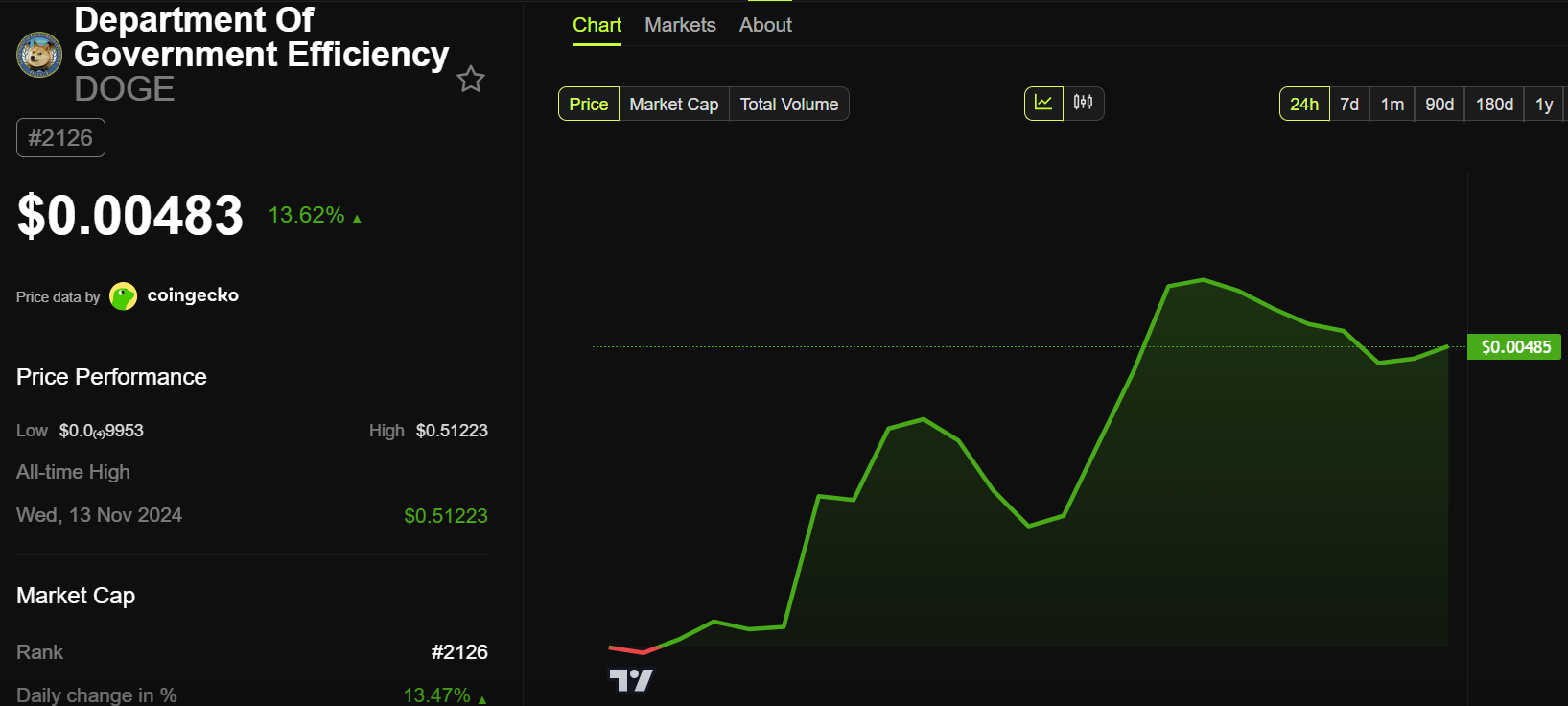
Department of Government Efficiency (DOGE) Price Performance. Source: BeInCrypto
Meanwhile, the Department Of Government Efficiency cryptocurrency token continues trading. Data on BeInCrypto shows the token’s price sits at $0.00483, up 13.62% in 24 hours.
The dissolution of DOGE raises questions about how sustainable rapid government restructurings can be, and what role executive actions play in structural reform.
As federal operations absorb former DOGE staff and the administration moves on, the real impact of DOGE’s brief experiment remains uncertain and open to further assessment.
Bitcoin has spent several days under heavy selling pressure, dropping to the $85,000 zone before attempting a modest recovery. The drawdown has shaken market confidence, but the intensity of capitulation now emerging from Bitcoin holders suggests the market may be forming a bottom.
The price is stabilizing around a key psychological level, but this stabilization comes at the cost of widespread holder surrender — a classic bottoming signal.
Bitcoin Traders And Investors Let Go
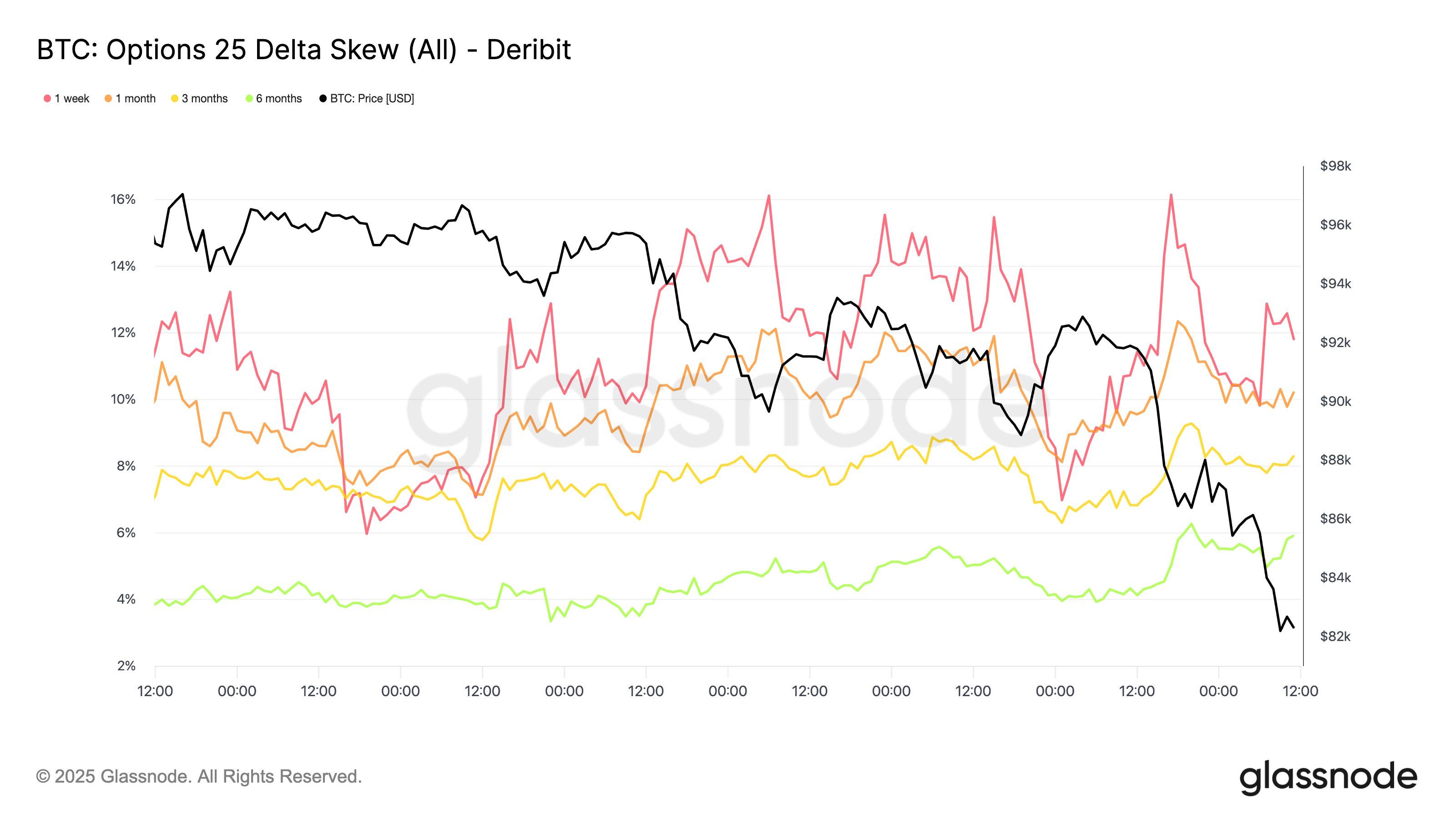
Macro momentum indicators show Bitcoin market’s risk expectations shifting aggressively. The 25-delta skew has pushed deeper into put territory across all maturities, signaling that traders are increasingly paying up for downside protection. Short-dated options remain the most skewed, but the notable shift is in longer expiries.
Six-month puts have gained two volatility points in just a week, highlighting a move toward structurally bearish positioning. Traders are now pricing both immediate downside risk and the possibility of a larger break.
This pattern typically appears near major cyclical bottom zones as markets overshoot to the downside before equilibrium returns.
Want more token insights like this? Sign up for Editor Harsh Notariya’s Daily Crypto Newsletter here.
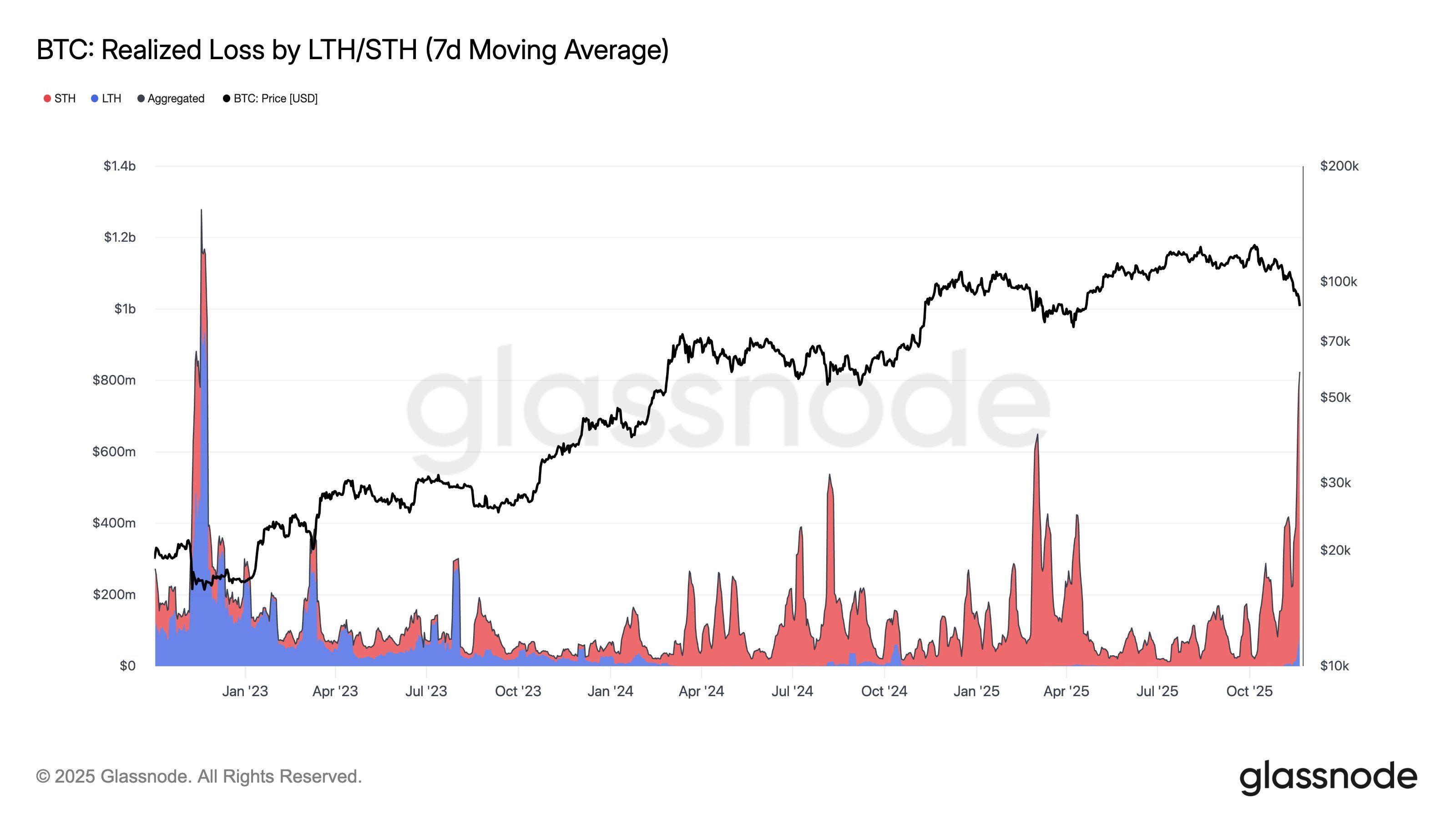
Realized losses among Bitcoin holders have surged to levels not seen since the FTX collapse. Short-term holders are driving most of this capitulation, reflecting panic selling from recent buyers who accumulated near the highs. The scale and speed of these realized losses indicate that marginal demand has been fully exhausted.
This type of aggressive deleveraging historically marks the final phase of a downturn. When short-term holders unwind en masse, long-term holders typically step in, and accumulation zones begin to form.
This aligns with classic bottoming behavior, where capitulation precedes recovery.
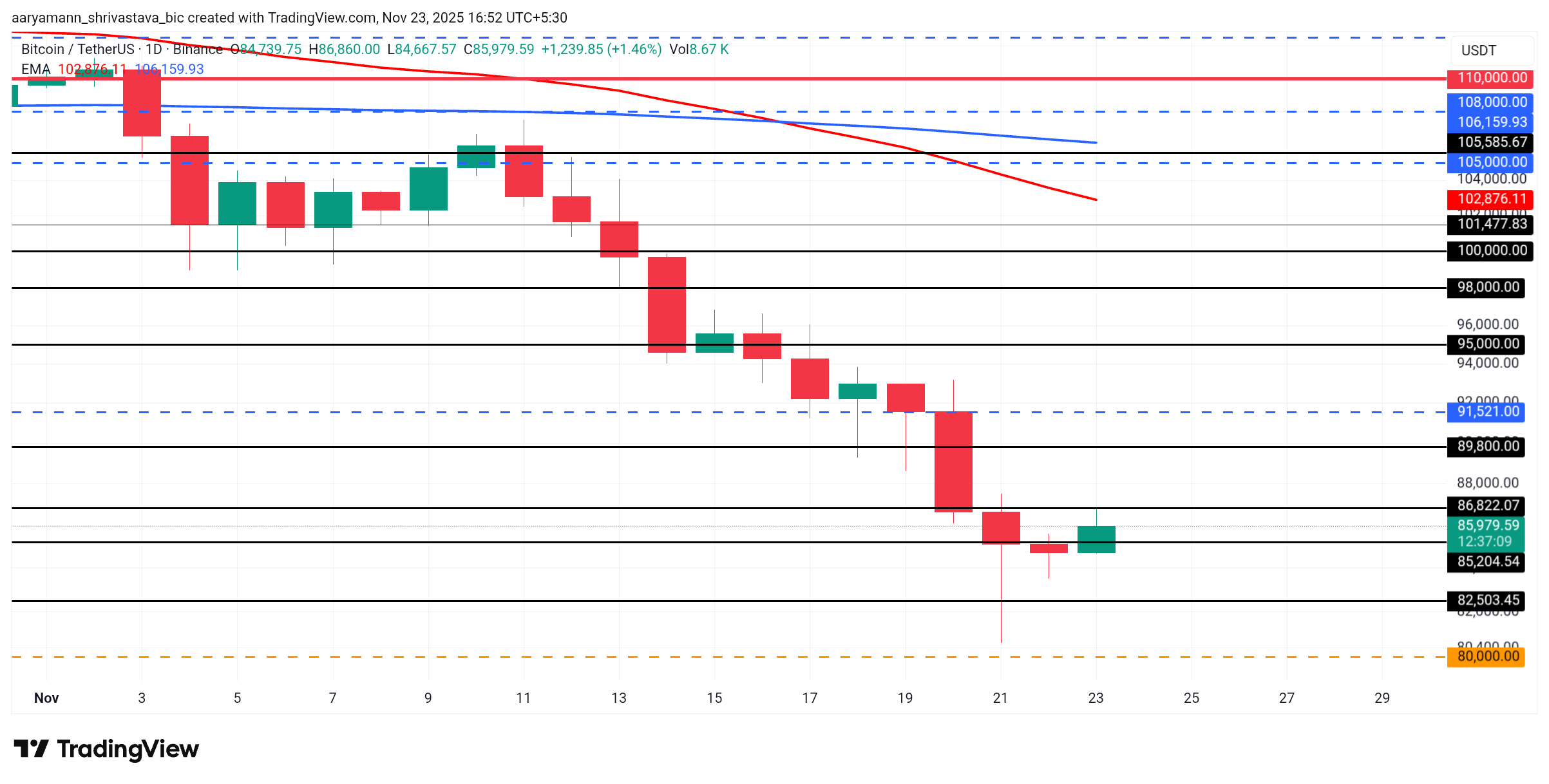
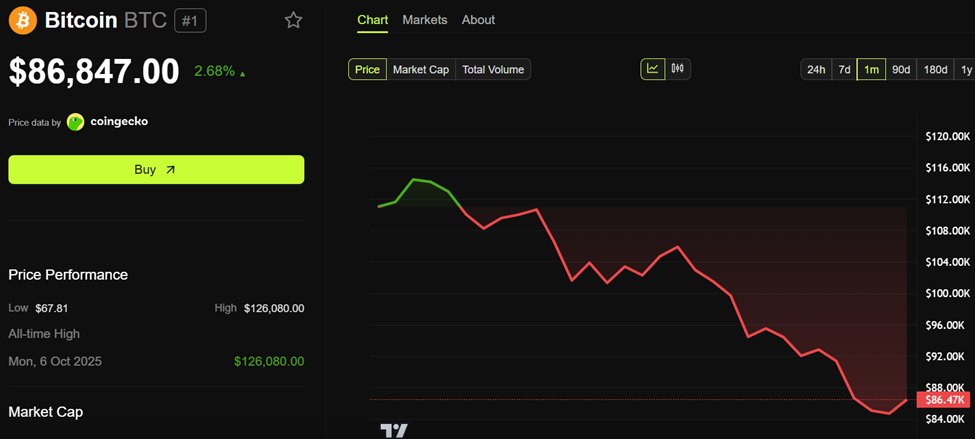
Bitcoin trades at $85,979 at the time of writing, holding above the $85,204 support level and defending the $85,000 psychological floor. The confluence of capitulation, bearish skew, and deep realized losses suggests that a market bottom is near or already forming.
If this bottom confirms, Bitcoin could rebound and break through the $86,822 resistance. A move above that level may enable a rally to $89,800 and then $91,521. Clearing these barriers would restore bullish sentiment, potentially driving BTC toward $95,000 in the short term.
However, if bearish pressure intensifies and macro conditions fail to improve, Bitcoin may break below $85,204. A decline under $82,503 would expose the price to a deeper fall toward $80,000, invalidating the bullish thesis and delaying recovery.
Zcash, the privacy-focused cryptocurrency, surged more than 12% to trade near $600 on Sunday after OKX announced it would relist the token.
The rally makes ZEC the top-performing asset among major cryptocurrencies in the last 24 hours, significantly outpacing Bitcoin, which has struggled to reclaim the $90,000 level.
Wall Street Divided on Zcash Impact on Bitcoin
On November 23, OKX announced that spot trading for the ZEC/USDT pair would resume at 12:00 UTC tomorrow.
While the exchange failed to provide additional reasons for its decision, the move marks a significant regulatory U-turn for the venue. It had previously delisted the asset in 2023, citing compliance risks.
Meanwhile, the resurgence of Zcash has ignited a philosophical clash on Wall Street regarding the future of digital privacy.
Eric Balchunas, Senior ETF Analyst at Bloomberg, cautioned that the sudden pivot to privacy coins could fragment the broader crypto narrative. He noted that this shift comes at a time when Bitcoin is trying to consolidate institutional support.
He argued that pushing a separate privacy layer risks “splitting the vote” of capital allocation when Bitcoin needs unified political and cultural backing to cement its status as a global reserve asset.
“Zcash has third-party candidate vibes, like Gary Johnson or Jill Stein. Seems like you’d better off folding in their ideas to the main party vs splitting the vote, which could have major consequences, especially in such a crucial time for BTC,” he said.
Jan van Eck, CEO of global investment manager VanEck, pushed back against the “spoiler” characterization. He noted that veteran investors are treating Zcash as a necessary complement to Bitcoin rather than a competitor.
TLDR:
The bitcoin bear market is being driven by the onchain reality of the halving cycle (bearish for 2026), quantum-breaking-encryption concerns and the better privacy of Zcash.@vaneckpk said it best: dollar cost average into bear markets@vaneck_ushttps://t.co/T4o8ofDggD
According to Van Eck, the current bear market in Bitcoin reflects “the on-chain reality” of surveillance risks. He argued that rising demand for confidentiality is driving capital toward Zcash’s encrypted ledger.
Over the course of last week, and even before that, the Bitcoin price recorded a concerning pattern. The US trading sessions drove Bitcoin losses, while Asian markets consistently bought the dip, indicating sharp regional divergence.
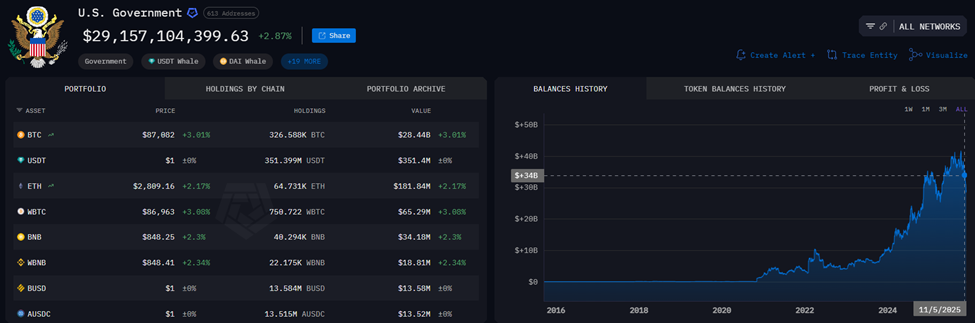
New reports allege that the government may have orchestrated the sell-off seen during the US sessions as part of its broader investment strategy.
US Buyout Rumors Hit MicroStrategy as Bitcoin Crashes to $85,000
Bitcoin’s recent price decline revealed a sharp split in trading, with US sessions driving sell-offs while Asian traders steadily buy the dip. BeInCrypto reported that American sessions have become the weakest period for Bitcoin prices.
According to Max Keiser, a Bitcoin pioneer, the US government may be eyeing MicroStrategy ($MSTR) and Coinbase ($COIN), potentially capitalizing on Bitcoin’s steep sell-off in November.
While no evidence confirms the claims, the speculation has spread. Some suggest that this interest drove the government to orchestrate the recent Bitcoin sell-off to the sub-$90,000 range.
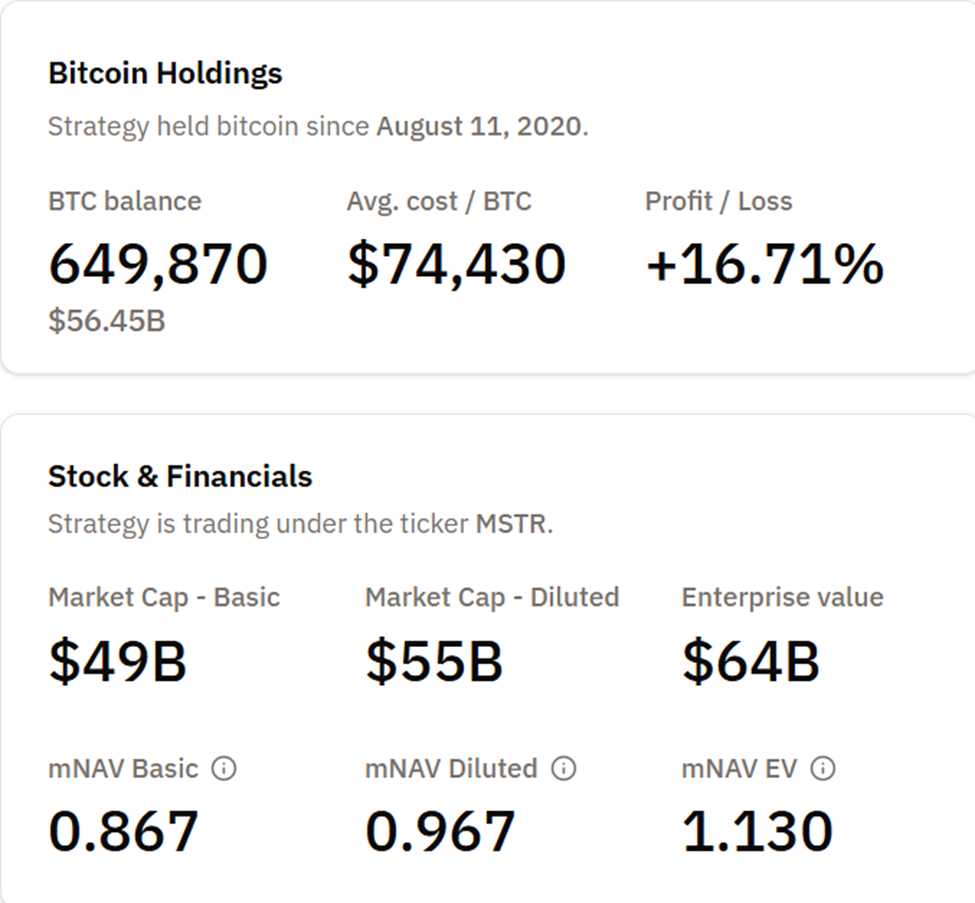
Allegedly, US government officials wanted MicroStrategy’s market value to net asset value (mNAV) near 1.0 and therefore manufactured a crash on Bitcoin to compress the premium.
“The US is contemplating a multi-billion-dollar investment in MSTR, and they needed the mNAV to be 1 before it made sense for them to invest, so they manufactured a crash on bitcoin,” wrote Teddy, a popular user on X (Twitter).
Mike Alfred names officials such as President Donald Trump, Treasury Secretary Scott Bessent, and allies, citing a multi-step plan to bolster Bitcoin, MSTR, and stablecoins while simultaneously defunding JP Morgan, the Fed, and the US banking cabal to protect US citizens.
Again, there are no official statements or regulatory filings backing these claims. No representatives from the US Treasury, White House, or regulatory agencies have addressed or confirmed the rumors.
“The administration views it as a defining battle,” Alfred noted.
MicroStrategy’s Index Risk Matters More Than the Noise
Several factors have factually influenced recent price volatility. Strategy Inc. faces the potential impact of MSCI’s proposed index exclusion for companies with more than 50% of their assets in Bitcoin or similar cryptocurrencies. If adopted, this policy could trigger as much as $8.8 billion in passive fund outflows from the stock.
At the same time, shifting outlooks on Fed rate cuts and volatility in bond markets have pressured riskier investments, leading to increased market declines.
MicroStrategy, whose balance sheet is dominated by Bitcoin, dropped more than 60% from its highs, pushing its mNAV to levels below 1 as of November 23.
Even without evidence of a government bid, the rumors highlight several key realities:
MicroStrategy’s valuation remains tightly correlated with Bitcoin volatility.
Index-eligibility reviews could materially impact liquidity for $MSTR.
Social media-driven narratives can influence sentiment during high-volatility periods.
While these remain speculation from some of the industry’s loudest voices, the timing of these posts, amidst one of Bitcoin’s sharpest weekly declines of 2025, may be exacerbating the spread.
Dogecoin has been sliding over the past several days as bearish sentiment spreads across the broader crypto market. Despite the decline, the meme coin is currently overvalued due to heightened speculation surrounding the upcoming launch of Grayscale’s Dogecoin ETF (GDOG).
This hype may translate into substantial transaction volume on Monday, potentially reshaping DOGE’s short-term outlook.
Dogecoin Investors Provide Support
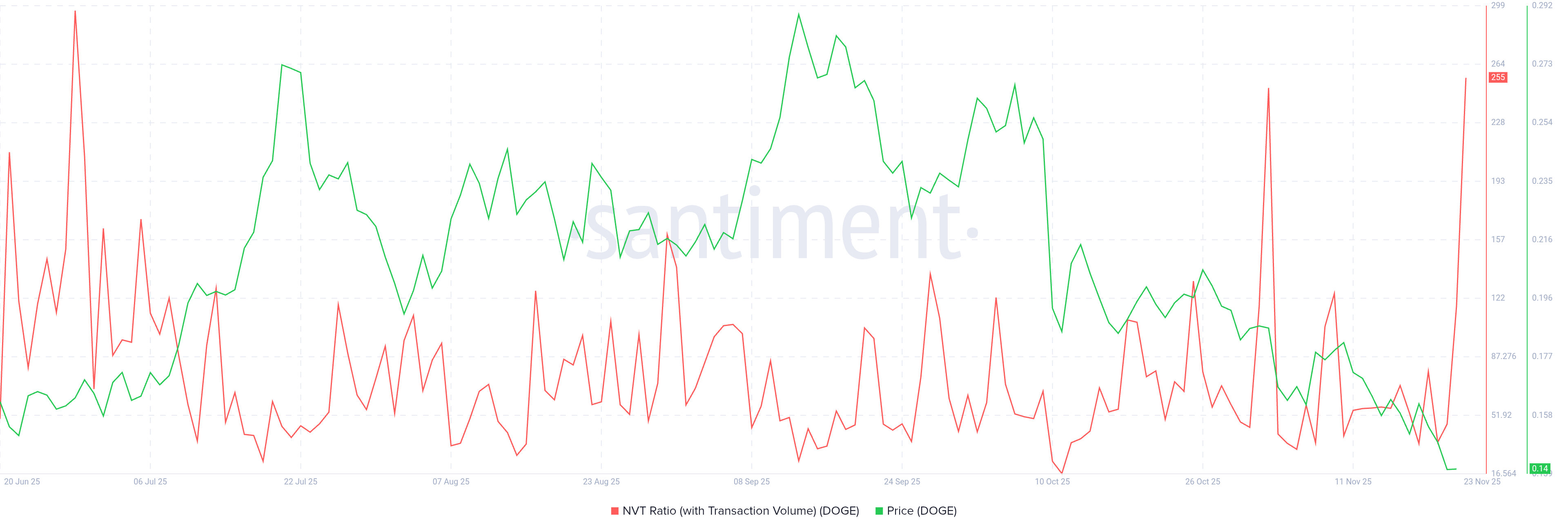
Dogecoin’s NVT Ratio is spiking sharply, signaling a disconnect between valuation and on-chain activity.
The ratio compares market capitalization with transaction volume, and a surge typically indicates limited transactional utility relative to price. While DOGE is attracting strong social attention and broad support, its actual transaction levels are not keeping pace.
This mismatch can often lead to overvaluation, which in bearish conditions may trigger a drop.
However, the timing of this spike aligns with the anticipated launch of Grayscale’s Dogecoin ETF. The ETF is expected to draw notable capital inflows, which could reset the NVT Ratio and restore balance between price and on-chain activity.
Want more token insights like this? Sign up for Editor Harsh Notariya’s Daily Crypto Newsletter here.
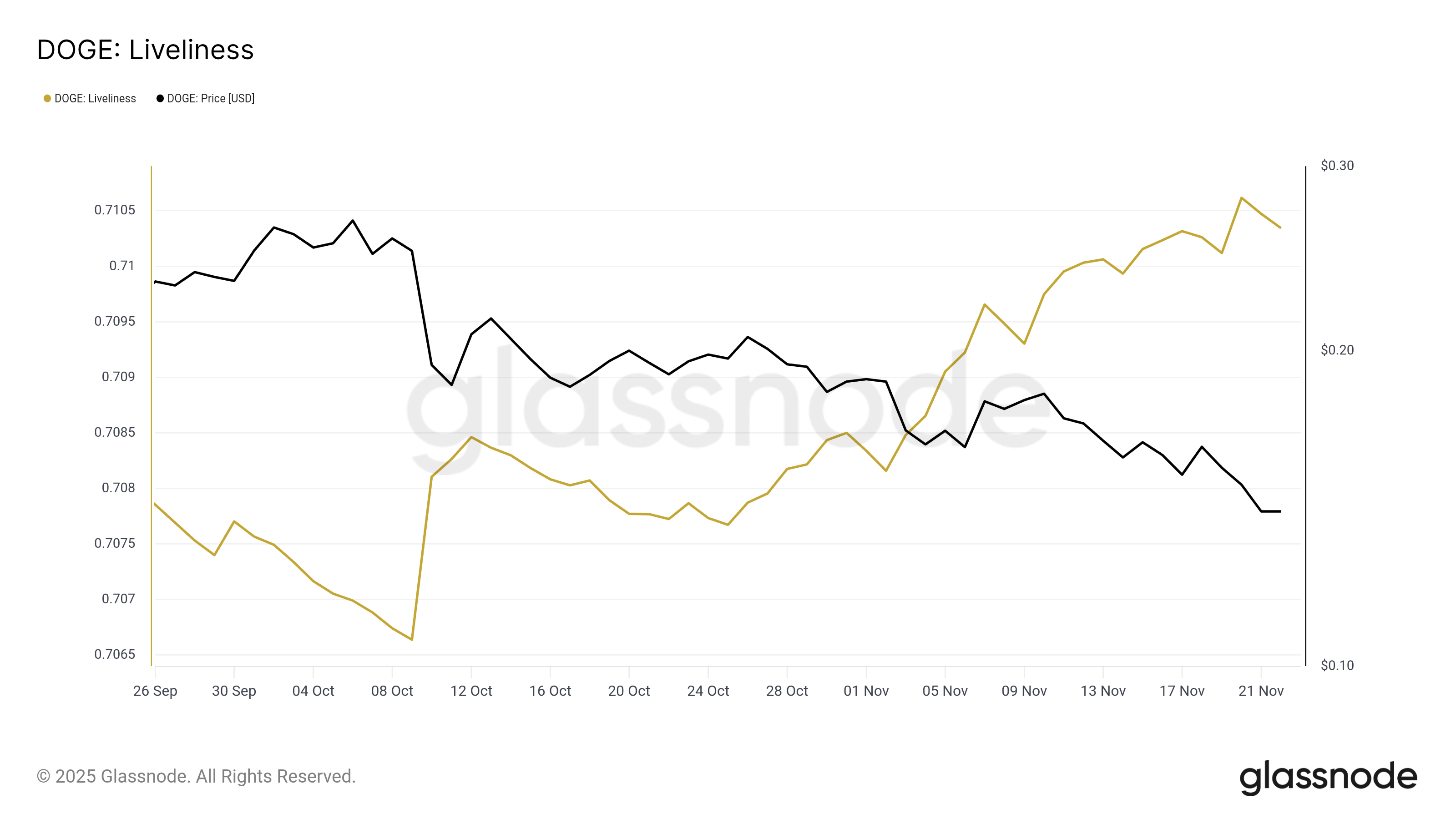
Macro indicators also paint an encouraging picture. Dogecoin’s Liveliness metric has been rising for several days, indicating increased HODLing behavior among long-term holders.
Liveliness rises when coins remain dormant for longer periods rather than being spent, suggesting that key holders are protecting their positions.
This trend is particularly important during downturns. Long-term holders often act as the backbone of price stability, resisting volatility caused by short-term traders.
Their continued conviction reduces the risk of abrupt sell-offs and shows confidence in Dogecoin’s ability to recover once market conditions shift.
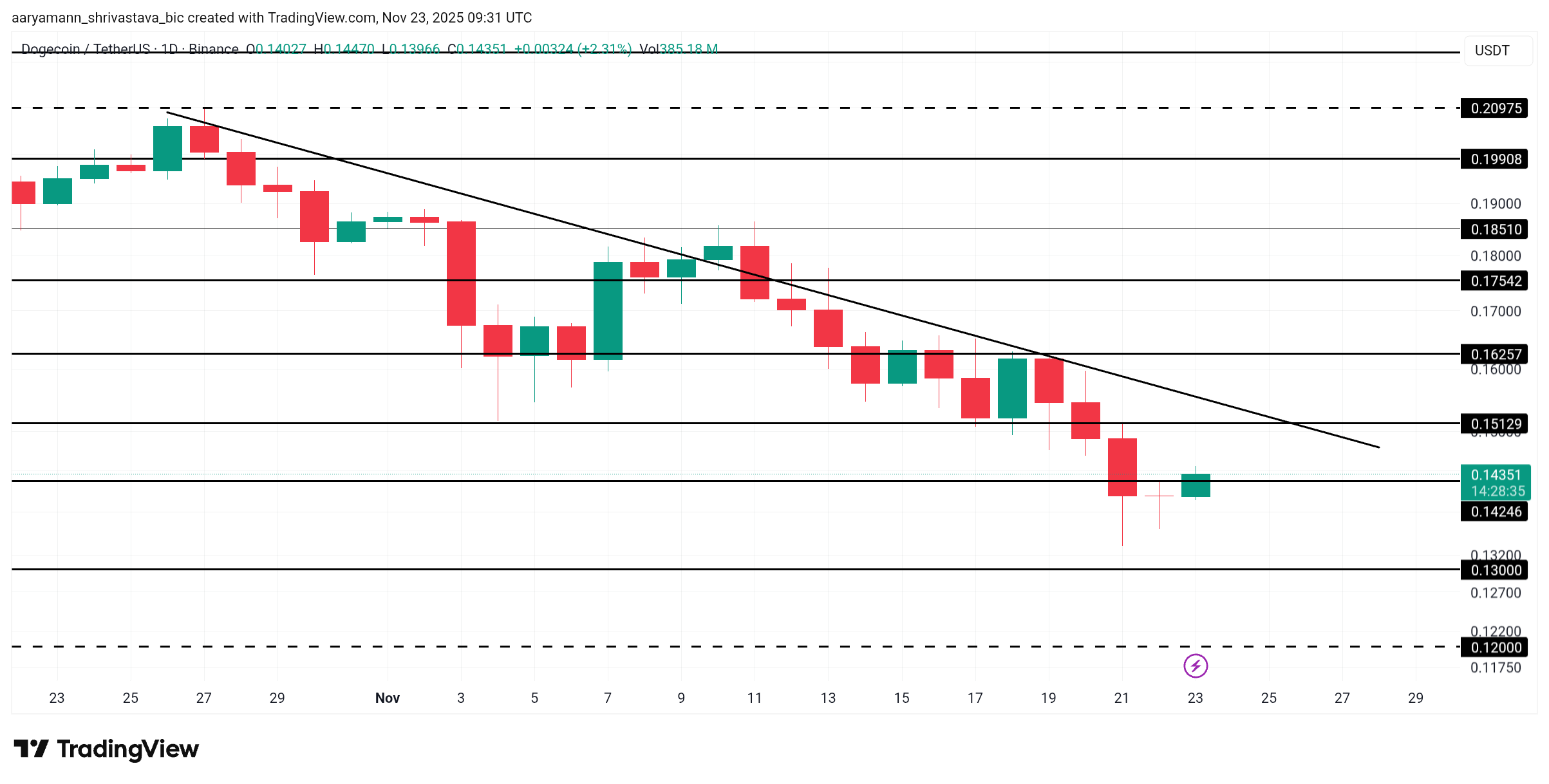
Dogecoin is trading at $0.143 and holding near the $0.142 support level. The meme coin remains trapped under a month-long downtrend that it has repeatedly failed to break. Current bearish conditions make recovery difficult without a significant catalyst.
The launch of the DOGE ETF could provide that catalyst. A successful debut may lift DOGE above $0.151, opening the path toward $0.165. A move of this scale would invalidate the downtrend and signal a shift in momentum supported by new inflows.
BitMine is intensifying its aggressive accumulation of Ethereum, looking past a 47% collapse in its stock price and billions in unrealized losses.
On November 23, blockchain platform Lookonchain reported that a wallet linked to the corporate giant received 21,537 ETH. The transfer, valued at approximately $60 million, came from institutional prime broker FalconX.
BitMine Doubles Down on Ethereum With Staking Plan
This new purchase would bring BitMine’s total hoard to over 3.5 million ETH, representing nearly 3% of the token’s circulating supply.
Indeed, Ethereum is trading near $2,808, down roughly 29% over the past month. Notably, BitMine’s Thomas Lee had attributed ETH’s recent weakness to broader market mechanics rather than fundamental flaws.
According to him, the October 10 “liquidity shock,” which wiped nearly $20 billion in leveraged positions from the crypto market, was the primary driver of the drawdown.
“In 2022, the post-FTX liquidity shock took 8 weeks to clear, but similar to prior drawdowns, crypto prices quickly recovered. History shows crypto prices stage V-shaped recoveries after a lingering and drawn out decline, and we expect this to again be the case in this current drawdown,” He added.
To offset the sting of declining asset prices, BitMine is effectively rebranding itself from a passive ETH holding company to an active yield generator.
On November 21, the firm announced the launch of the “Made in America Validator Network” (MAVAN). The proprietary staking infrastructure is set to go live in early 2026.
Meanwhile, the firm confirmed that it has selected three pilot partners to test its staking operations.
“We plan to partner with one or more of these pilot partners plus world-class infrastructure providers to scale our own “Made in America Validator Network” (MAVAN) over the coming quarter…we believe in building the premier destination for our natively staked Ether and are proud to build with the best partners. At scale, we believe our strategy will best serve the long-term best interests of our shareholders,” Lee stated.
By staking its 3.5 million ETH, BitMine could theoretically generate substantial annual revenue from network rewards. This would create a cash-flow floor that pure holding strategies lack.
Additionally, the firm declared an annual dividend of $0.01 per share, positioning itself as the first large-cap crypto treasury to return capital to investors directly.
Cardano is facing renewed questions about its network resilience after a malformed transaction triggered a temporary chain split this week.
A pseudonymous X developer known as Homer J caused the November 21 incident and revealed that he relied on artificial intelligence tools.
Why Cardano Experienced a Temporary Chain Split
The developer stated that they had no malicious intent and the action was a “failed personal challenge.”
“I didn’t sell any Ada before my ‘testing in production’ disaster, or short it (don’t even know how to do that) or worked with anyone on this or plan it long and hard. I do have a lot to lose as a consequence of my actions. Sorry, Cardano community, I truly am,” the developer claimed.
This created a temporary fork between the chain carrying the poisoned transaction and a second, healthy chain.
“While the core Cardano protocol remains robust, this edge-case vulnerability provided a vector for the disruption. The transaction was crafted specifically to trigger this bug on mainnet following its earlier discovery on the Preview network, creating a consensus disagreement between nodes that had processed the transaction and those that had not,” Intersect explained.
Intersect said the bug had been masked for years by older ledger versions and standard transaction tooling.
It surfaced only in recent node releases combined with specialized submission methods.
While the split caused many wallets and decentralized applications to become inoperative, block production continued.
“It is important to note that the network did not stall. Block production continued on both chains throughout the incident, and at least some identical transactions appeared on both chains,” Intersect stated.
Following the incident, staking pool operators were instructed to download an updated node release, which enabled the ecosystem to consolidate the two chains back into a single canonical history.
“Cardano works so fast that we forked, fixed, and caught the guy all in one day. He was quite active in the Fake Fred discord. It was absolutely personal and now he’s trying to walk it back because he knows the FBI is already involved,” Hoskinson said.
Cardano’s Technology Earns Praise
Cardano’s technology response to the incident drew unexpected praise from outside its community.
The Solana network is one of Cardano’s largest rivals, and the two often compete for developer and investor attention.
I am gonna go out on a limb and actually say this is pretty cool. Nakamoto style consensus without proof of work is extremely hard to build. The protocol functioned as designed in the presence of bugs. https://t.co/K3WO0BE7Cf
Yakovenko noted that maintaining network continuity without proof-of-work is “extremely hard,” and argued that the protocol behaved as intended under stress.
His comments stand out in an industry where rival ecosystems rarely commend each other’s architecture.
Cardano developers and operators treated the acknowledgment as validation of the network’s ability to withstand edge-case failures without widespread disruption.
“This whole thing was only possible because of Ouroboros, our Nakamoto-style consensus, and the way the community, SPOs, and the dev teams all stepped up together,” Dori, a Cardano Drep, said.
Platform pembayaran teratas dan exchange aset kripto terbesar di Korea Selatan akan bergabung, dengan persetujuan direksi diharapkan terjadi pada hari Rabu, dan pengumuman publik direncanakan untuk hari berikutnya.
Kesepakatan ini akan menggabungkan Naver Financial dan Dunamu, operator Upbit, untuk membentuk pemain kuat yang menghubungkan keuangan tradisional dan aset digital di salah satu ekonomi terbesar di Asia.
Timeline dan Struktur Merger
Dewan dari kedua perusahaan berencana bertemu pada 26 November untuk menyetujui merger ini. Setelah itu, pengumuman bersama diharapkan pada 27 November. Menurut laporan media lokal, eksekutif puncak akan menghadiri konferensi pers di kampus Naver.
Transaksi ini akan melibatkan pertukaran saham lengkap, menjadikan Dunamu sebagai anak perusahaan yang sepenuhnya dimiliki Naver Financial. Estimasi saat ini menilai Naver Financial sekitar KRW 5 triliun dan Dunamu sekitar KRW 15 triliun. Perbedaan ini menunjukkan rasio pertukaran saham 1:3.
Pemegang saham Dunamu akan menukar saham mereka dengan saham di Naver Financial, dan pemegang utamanya kemungkinan akan mengambil hampir 30% dari perusahaan gabungan. Sementara itu, kepemilikan Naver akan menurun dari 69% menjadi 17%, namun kontrol operasional diperkirakan tetap dengan Naver, salah satu raksasa teknologi di Korea Selatan.
Untuk mematuhi hukum perdagangan adil negara, Dunamu mungkin akan menyerahkan lebih dari setengah hak suaranya kepada Naver. Langkah ini dimaksudkan untuk menangani kekhawatiran konsentrasi pasar sambil mempertahankan keunggulan strategis dari kesepakatan ini.
Pandangan Strategis untuk Entitas Gabungan
Merger ini menyatukan dua pemimpin yang saling melengkapi dalam sektor keuangan Korea Selatan. Naver Financial menjalankan platform pembayaran paling populer di negara ini dengan hubungan erat dengan layanan e-commerce, pencarian, dan komunikasi Naver. Dunamu mendominasi perdagangan aset kripto melalui Upbit, memproses miliaran volume perdagangan harian dan melayani jutaan pengguna.
Perusahaan gabungan ini bertujuan untuk menciptakan ekosistem keuangan yang komprehensif yang menghapus batas antara pembayaran tradisional dan aset digital. Para pemimpin mereka diharapkan menekankan rencana untuk bersaing dengan raksasa teknologi global. Strategi ini menyoroti perlunya perusahaan fintech Korea untuk berkembang dan tetap kompetitif di luar pasar domestik mereka.
Basis pengguna besar Naver dan platform teknologi yang kuat dapat mempercepat adopsi kripto di kalangan konsumen utama. Sebagai balasannya, pengalaman blockchain dan pengetahuan regulasi Dunamu dapat meningkatkan keunggulan Naver Financial dalam teknologi keuangan baru.
Tinjauan Regulasi dan Dampak Masa Depan
Merger yang diusulkan ini sedang diperiksa oleh regulator. Layanan Pengawasan Keuangan Korea Selatan dan Komisi Perdagangan Adil harus meninjau kesepakatan ini. FSS akan mengevaluasi risiko finansial, terutama dampak dari menggabungkan platform pembayaran berlisensi dengan sebuah exchange aset virtual. Regulator telah lama memisahkan sektor-sektor ini untuk mencegah risiko sistemik.
Otoritas persaingan menghadapi keputusan yang kompleks. Sementara eksekutif mengklaim bahwa merger diperlukan untuk bersaing secara global, Komisi Perdagangan Adil harus menentukan apakah ini secara tidak adil memusatkan kontrol atas jaringan pembayaran Korea Selatan dan exchange aset kripto terbesarnya. Tinjauan akan berfokus pada kemungkinan efek pada persaingan pasar dan pilihan konsumen.
Persetujuan akan memakan waktu berbulan-bulan. Kedua perusahaan harus menunjukkan bahwa manfaat dari merger ini melebihi risiko terhadap stabilitas finansial atau persaingan yang adil. Keputusan ini dapat membentuk preseden mengenai bagaimana keuangan tradisional dan aset digital dapat bergabung di Korea Selatan dan di seluruh Asia di masa mendatang.

 Login
Login



 Canonical's engineers have submitted pull requests to add RISC-V support to Google's Flutter toolkit, which Ubuntu uses to built many of its desktop apps.
 BREAKING:
 △ (@AlexMasonCrypto)
 BNB (@cz_binance)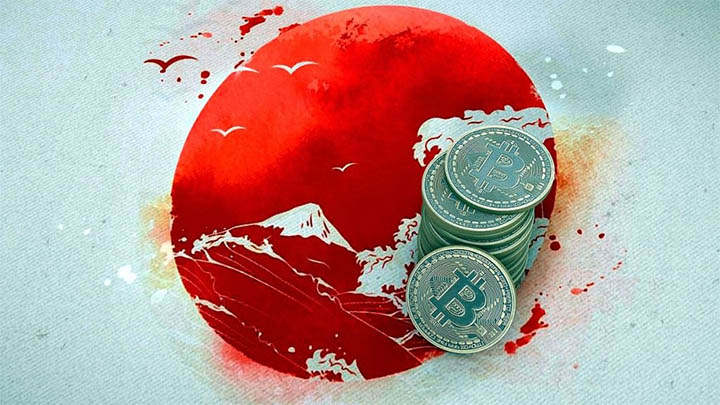
 BREAKING: